Reflecting on reflection

There are problems with reflection. Seeped in the IB tradition, first through my children and now as an educator, I know that no matter how well it’s disguised or re-engineered most students do not like reflection. In my own children, the response to me asking them about the reflection process resulted in one saying, “it’s over, let’s move on and what difference will the reflection make anyway?” and the other saying “I do my own reflection and it’s deeply personal so I’m definitely not going to share that with a teacher, let alone my class, so I just tell them what I know they’ll want to hear”.   And with the adults in my life so far I think most fall somewhere on that continuum, with the rare exception of those prepared to be/risk being truly vulnerable.

This blog is my exercise in reflection, and heaven knows I screw up often enough, but how much of that is reflected in this? I’m afraid probably not enough. Because as a teacher one is also a public persona and unless your blog is private – in which case, why would you blog if not to receive feedback – you run the risk of incurring the ire or approbation of someone, somewhere in the organisation. Because to reflect in a way that it is meaningful one has to be open to change – either internally or in the environment – and change is one of those very hard things. Changing the self is difficult enough even if you ostensibly / presumably have control over self (I’ve just finished reading Homo Deus, where these philosophical questions were even better and more extremely expressed). As Harari wrote of power  “The entire contract can be summarised in a single phrase: humans agree to give up meaning in exchange for power.” I think we give up more than just meaning for power. And I suspect one of the reasons reflection avoidance seems to hardwired from they youngest age, is that reluctance to show our soft underbellies, because for sure, the power-hungry will pounce.

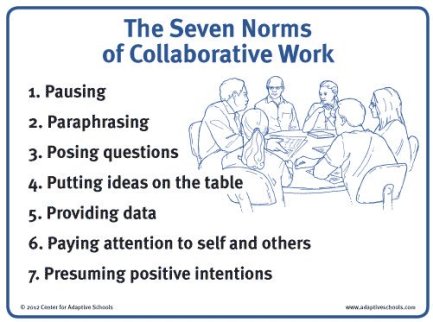
Another part of reflection is the existence of pathways and an environment allowing for honesty without it being labelled as negativity. And that is a two way street that needs a rare combination of humility, excellent communication skills, acceptance skills and the intellectual rigour to have emotional detachment from ideas and practices.  7 norms

Adaptive schools / cognitive coaching and the 7 Norms of collaboration go a long way towards bridging these human fallibilities. But there are many enemies (besides power) to the process including time pressure, face, and the very human difficulty in accepting sunk costs.

So who can reflect honestly?  The very very young, the naive, the elders – provided they are still allowed to be seen as relevant, the very wealthy and perhaps the court jesters / devil’s advocates.   The rest of us I fear go so far and no further. Or tell people what they want to hear.

Learning and change

The phrase “life long learning” gets bandied around a lot, and today I’m going to write a little about just how much learning is involved in moving job, school section, country, and home.

I left a country that was easy to live in (Singapore) and I job that I loved and was comfortable with for a place (Beijing) that generally led people to shake their heads in puzzlement, even as they acknowledged that the school I was moving to was something special.  Easy is not always good. I must admit I never really liked living in SG – it did not make my heart sing in the way that Hong Kong did. I never felt at home like I did in Hong Kong. And the only thing that kept me there for the last 3 years was a great job that kept me busy enough that the things that irritated me about SG didn’t bother me because I didn’t have time to be bothered.

Living Learning – my husband just announced he needs a haircut – what does that have to do with learning – well it’s just one of a myriad of daily / weekly / monthly things that one has to do in life where you have to relearn how it works and where to make it work. Of course the easy answer is – just pop into a barber or hairdresser – and that’s simple enough if you’re a no-nonsense type of short-back-and-sides-guy but just look in any Asian-expat forum for the pleas for hairdressers who understand curly / blonde / kinky / wavy hair and you’ll realise some things cannot be taken for granted. Like buying knives in Beijing. When you move here you need to surrender your passport to your employer for an extended period of time while all the visa work is sorted out. But no-one will sell you as much as a bread-knife without seeing your passport and registering it (history here – and I’ve learned something).  We’ve moved into our house already and we’re in camping mode until our shipment arrives – so a few kitchen knives are kind of important – luckily we have nice colleagues with knives – presumably purchased prior to the ban!

Then there’s spatial learning. Orientating yourself in time and space, just like the PYP teaches. The Beijing public bus system is amazing. And cheap. For the equivalent of 20-50 cents you can go pretty far within your zone. Compared to 25x as much for a taxi (even if taxi’s are way cheaper here than elsewhere). So it’s a real good idea to learn how the system works. But it’s not that easy. I got a bit of a reputation of being the daring bus lady in our first few weeks, and this is the true story of why. My husband and I, newly married, moved to Sao Paulo, Brazil in 1995. When we arrived we had no money, nearly no furniture and only his job. And if anyone follows South American economic history – it was just after the Plano Real, which meant that everything was super-expensive as the country came out of hyper-inflation, but the balance between cost and value was still being established. So there I was, stuck in an apart-hotel, without the wherewithal to attend all those fancy expat lunches and coffee-mornings, no car and no money for taxis. Oh, and after a 2 week Portuguese crash course I spoke next to no Portuguese and in those days not many people spoke English. And add to that, no smart phone, in fact make that no phone at all, as there was a 6 month waiting list and a $5,000 installation fee to get a phone line installed in your home, and no internet. So I used to walk down the road and get on a bus and drive that bus the whole loop and work out where it went and of what use it would be to me. I figured I didn’t have anything more pressing to do with my time (except find a job quickly); and I didn’t have any money, so there was nothing to steal from me, so what-the-hell.

These days it’s so easy. High speed internet, a “maps” app that works in Beijing, even for public transport and in English. But still you need to learn some stuff. Like the Chinese name for your compound / complex. The nearest bus stop. What time they start and stop and the frequency. If you need to change over, which combinations are the fastest at which time of the day. Whether it’s better to take a bus or the Metro or walk. The short-cuts and back streets. And how to cross the road without being killed.

There are still things I want to know. And I’m not there yet. Like what app to use for buses in advance – there are some great subway apps, like Metro Beijing  where you can put in your start and end points. Maps sort of works, there is a workaround where instead of a location you can look for “transport” and then “Bus Stops” and then click on the bus number and see its whole route. But that only finds the buses near to your location, which isn’t much good for advance planning. I also know you can get an app for your transport card, but I haven’t found it yet. There are some I’m sure, but only in Chinese. Which I’m still re-learning. I’ll do Chinese in a whole other dedicated post.

Work hygiene learning. I call it that based on Herzberg’s motivation theory, because it kind of makes sense and I don’t have a better way of describing it. It’s all the stuff besides the technical / knowledge bits of your job that you need to know to survive and thrive in your new environment. Now this is a pretty steep learning curve. Because every school has their own “untouchables”. I was asking a friend about a new person in another school and her conclusion was she had great ideas and enthusiasm but this wasn’t being appreciated. I sort of know the environment there and I can just see that happening. It’s a dynamic tension. You’re presumably hired to a job because they want your input, and in some circumstances for you to change things. But not too much or to soon. Or perhaps they do what a lot of change and quickly. But who do you ask? Who wants to tell you? There is this mutual dancing around things. Both my predecessor and myself to my successor deliberately didn’t say too much about the environment, because it is important to try and feel it out for yourself. And it’s also nice after a few weeks to be able to ask someone if your experience aligns with theirs – because it’s so hard to know if it’s “just you” or if there are other things at play.

Similarly in my mentor group (another “first” for me – having 12 students to nurture throughout the year), I’ve deliberately not looked at their records or files, as I want to take them as they are without history or labels and then move on from there.

Where to play. It’s not all about work, so our Newbie WeChat has been full of which restaurants are good to go to, where to have a massage, where the beer is cheap, nice parks to hang out in, bars and clubs for the night owls. This morning I was delighted to find the Beijing Greenway just minutes from our house with I think about 12km of walkway along the river through wooded areas with lush green and few people.

I’m seeing similar exploratory type posts on the facebook pages of friends who have also taken the plunge into the new and unknown. It’s easy to say it’s easier now we have the internet and facebook and smart phones and apps. But change and adaptation in reality is never easy because it has its own absorption rate. And even after moving around for the last 35 years, I’ll put my money on the fact that it will take at least a year. Because it always does. Except in Luxembourg where we only lived for 10 months!

If you’re new to this game, you may want to read up more on “culture shock“; the 5 stages of culture shock – honeymoon; culture shock; actual adjustment; isolation period; acceptance and integration, the W curve etc.

We were lucky to learn this all at the Royal Tropical Institute in Amsterdam prior to our moving to Brazil. And they also gave us one of the best tips ever – which was easy to implement in 1995 when flights were expensive and phone calls cost at least $5 per minute – and that was – not to have contact with home in the first 6 months. That’s pretty unbelievable in this day and age, but it probably helped with the move and integration.

A little writing about writing

I threw down the gauntlet to my mentor, Katie Day last night. She who taught me all I know about being a teacher librarian in the weeks and months that I sat by her side while doing my MIS and part of my M.Ed before I was thrust into the world of a library of my own. I was mentioning how I was a little shocked and disappointed at the standard of writing of Masters’ level students, and she mentioned that in her current position she was seeing more student writing and had decided to give that a focus this school year. I have a mentor group for the first time this year, and I want to try to emulate a wonderful teacher in my previous position, Christene, who used back and forth journalling with her G6 class as a way of getting to know them deeper, while developing their writing and depth of thought – particularly over what they were reading.

Now Katie is a phenomenal librarian – probably one of the best in the Asian international school network. She suffers from one immense flaw generally – the fact that she doesn’t market herself, and currently, she’s gone silent and no longer stimulates and challenges the rest of our thinking frequently enough  through her blog. This is where a biblical reference is most apt – that of hiding your light under a bushel. Like most newbies to a profession, I’m still greedy for knowledge and advancing my skills and look to thought-leadership in the field to advance my own understanding. So, the blogging challenge is on – at least a blog a week between now and Christmas.

In our first week at school, we were asked to do a Strengths Finder test – I’ve done one previously, but this was a different one. I found it a little repetitive as it kept bringing up the same questions differently phrased – I know, internal validity and all that. And then was a little surprised – bearing in mind the results of a previous such test – when the top strength spat out at me was “writing”. I immediately wanted to reject this, as actually I do precious little writing in my job. And it sounded such a stagnant non-sexy non-innovative type of thing that I felt undervalued me as a thinking, teaching, doing, researching, active professional.

As a librarian I read a prolific amount, a lot of it mediocre if I have to be honest, and I’ve always said that you’d never find me writing a book, in response to everyone who asks. I know enough authors to know that besides anything, it’s a poorly paid mugs’ game where you spend a disproportionate amount of time trying to get out there and promote the book rather than write – plus the financial returns are so poor that you inevitably need a second or third career to sustain your writing. So I don’t actually see myself as a writer. But then I realised, that I’ve been blogging now for 15 years, and that actually I have a need to write my experience. And I’m forever encouraging students and fellow professionals to do the same.

So here goes everyone – if you still have a blog out there – dust it off, start writing, or continue writing! Post your URL’s in the comments so we can follow and comment on each other’s posts.

The 10% problem

It’s a funny time of year in education, November and December. I never knew this before. It’s the time when educators need to decide if they’re staying or going in their current school or position, and if not, what the next move will be. I’m new to this game, and as I librarian I get to see all classes, all teachers and many parents. Observation and conversations are things that happen a lot.

The 10% use of the brain myth has been debunked I know, but I think it is still a useful meme to use in education. Because one of the things that keep coming up in the conversations I’m having with people who are leaving of their own volition (some are due to partner careers, or family issues) is the frustration that for one reason or another, all they have, know and are capable of is not being used or recognised. I know, because as an older educator coming late to the game with a longer “past” I feel this very acutely.

A little while back a group of us had an interesting lunch conversation along the lines of our former pre-teaching lives, or what we’d taught before we were teaching what we were teaching. There is so much unlocked knowledge, skill and potential in education. And I’ve just mentioned the teachers. Before I was a TL I was a sort-of SAHM (stay at home mum). Sort of, because I kept studying and doing stuff. Stuff that would keep me sane and my brain occupied while my body was present for young children and a partner who travelled anything from 70-90% of the time, and then we’d move country to spice things up a little more. And I kept bumping into women (mainly) with amazing brains. Women with fantastic pasts whose only outlet was pouring themselves into organising PTA/O fundraising and events and being class-mothers. Not that it’s unimportant, but really? Think of the energy equation – it’s like starting up a blast-furnace every-time you need enough fuel to drive around the block.

While the unlocked potential in teachers is particularly acute in primary, where teachers are often limited to their own classrooms, teaching a breadth of skills and subject areas they may or may not be optimally suited for, I heard the same while working in secondary. One person in particular sticks out. He was very bright, very capable in his own field, constantly seeking out new knowledge. He was also not from the dominant mono-lingual white male BANA pack, and such was an outsider. He left in frustration saying that while he’d been hired for all the bits and pieces he had, he was only being used for a small portion of them and wasn’t even consulted when his PhD specialisation was being looked at in the community (I won’t mention what this was as it would be a give away). I’ve spoken to language teachers a lot, who say they sit mute and unsolicited in meetings while mono-linguals decide language strategy and curricula. Parents who come from a huge diversity of educational and learning backgrounds who are literally NEVER consulted because they are “just” parents. And if they ever dare mention that things could be, and are different elsewhere, at least in some areas, they’re quickly shut down with “well, this is the way we do it here” while the dominant culture and pedagogy continues hurtling down the track.

school is easy

I use hurtling consciously. Because the sad thing in education is the pace. There is just so much busyness. It is no wonder that the 10% usage exists – there is just not enough time for anything else. And all the time there is that anxiety. Parents are skittish that their child is in the “right” school. Ready to run and change at the drop of a hat. Students mete out their time for subject by subject homework. Teachers are stretched thin juggling reporting, marking, teaching, preparation, running excursions and events. And somehow, most times, in the midst of this all, miraculously, learning takes place.

Another sadder thing I’m noticing at the moment is that there is a widespread occurrence of “losing weight after the divorce” to use another bad analogy. And that is, suddenly there is a bunch of people getting all sorts of qualifications (albeit sometimes the maligned-by-me google-educator badges), suddenly getting out there at teacher events and PD as they polish themselves up for the market. That’s more than just a little bit sad. And a lot of a bit of waste on both sides of the equation.


#fakenews – symptom or disease?

Last week I attended a “#Call to Action: Fake News, Misinformation and Post-Truth” held by the SMU libraries in  Singapore. Library network groups are full of requests for student appropriate examples of fake news. Most librarians have a stock list starting from the spaghetti harvest (1957) / tree octopus (1988). And we’ve unfortunately become over excited that #fakenews will be the saviour of librarianship. Because yay – we’re good at research, we’re good at teaching and applying the C.R.A.A.P / E.S.C.A.P.E tests, we’re about literacy, we’ve got all these captive young minds in front of us.

But between the insightful comments of very intelligent people like Eugene Tan and Gulcin Cribb at this seminar, where one had to conclude that the usual antidotes – trying to outcrowd “fake” news with “good /solid” news, padding news consumption with self-imposed digital/information literacy filters like the above mentioned CRAAP/ESCAPE tests or attempting to regulate it, will only work selectively or not at all.

haythamcom_02a
Best quote of the seminar – indeed there is nothing new under the sun

Caulfield in his blog has been hammering on about being able to distinguish between fake and real images, sourcing quotes,  but his latest post was one that threw the switch for me, on digital polarization on pinterest. (An aside, I gave up on pinterest because I can’t be bothered to log in every time I need to go past the first page and I prefer Evernote as a curation tool anyway). If you do nothing else in the fake news landscape ever, just watch this video he made.

And that, combined with the very disturbing article by James Bridle on Kid’s YouTube, following all the work that MathBabe, Cathy O’Neil, has been doing on web algorithms, and watching YouTube with my teenage son who is innately simultaneously curious about all sorts of scary (to mom) teenage stuff, combined with a reluctance to research beyond YouTube and Infographics* has made me really think about the way we’re approaching this conversation.

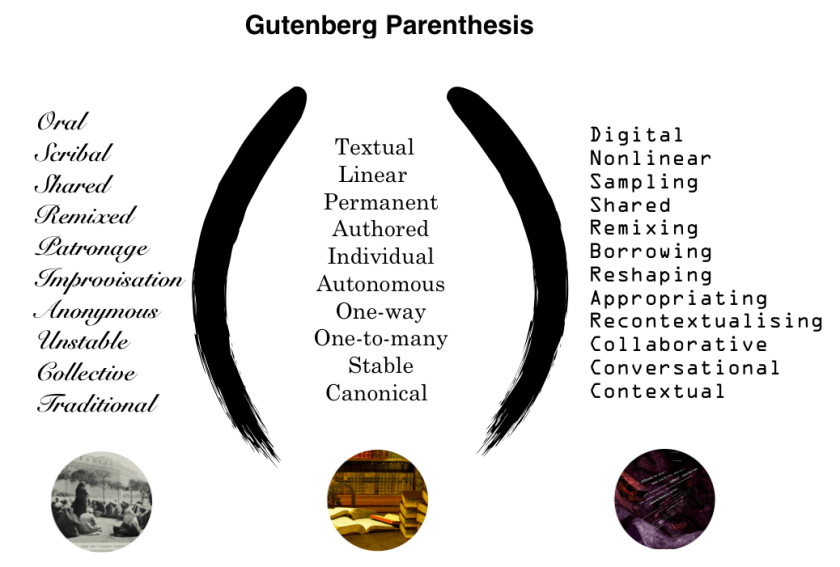
Let’s follow this thing upstream. Bear with me as I bring a couple of concepts that I think are related into this. A few things that have a lot to do with some human traits. The need to tell and listen to stories, The difficulty and recency of reading. The concept of the Gutenberg parenthesis. And last but not least, modern capitalism and/or the seven deadly sins (a concept I needed to explain to my kids the other night).

gutenberg parenthesis

So where does that veritable soup land one? Well, exactly where Mike Caulfield found himself as he clicked along in Pinterest, and like Alice in Wonderland found himself in a different universe to the one he started out in.  Pinterest is perhaps one of more extreme examples of algorithms at work. But the same is going on in Twitter (I was browsing through some UX stuff this morning and my feed and suggested people to follow changed suit in a matter of minutes) and Facebook and Instagram.

We have to face that honesty and a quest for truth doesn’t give one a monopoly on creating world class videos and infographics. That is the realm of those with a big enough budget to do it professionally. And that is how people like their information. So is the cure an infographic cold war, where every side builds up their arsenal of clickbait and point form iconic bite-sized digests? Or do we demand that algorithms are audited? Do we stop being curious and resist what we think is the “road less travelled” and the urge to click down paths that are actually carefully manipulated to pre-purchased outcomes?

So #fakenews is just a symptom. And by trying to treat the symptoms are going to get us nowhere. But unfortunately the disease is being human, and their is no vaccine against that. Except consciousness. Extreme consciousness. And consciousness takes time, and time is what technology is robbing us of. The irony.

————————————————-

* Shoot me – I’m human. That saying about cobblers and shoes? He came home the other day and told me his English teacher said reading was important for vocabulary and a whole host of things and that “just 20 minutes a day would make a difference” 

Advocacy is not enough we need power

Librarians are big on advocacy. Big on helping their peers when they’re not being heard in their communities or schools to build their “advocacy toolkit”. Most librarian courses include at least one module in one course on advocacy. Some academic librarians have built their careers on advocacy. But I’d like to cry foul. This has been going on for long enough.

Looking at advocacy it has a couple of tenants:

“Five Advocacy Tips
At the basic level advocacy is building relationships. The goal is to become a valuable resource for policymakers. No matter who the audience is, you should keep in mind the following:
1. Be confident.
2. Frame your message to answer the question, “So what?”
3. Plan and practice your message.
4. Present a clear and compelling message; less is more.
5. Offer yourself as an expert resource and provide examples from your community; stories are more compelling than statistics” (Advocacy toolkit).

I’d like to posit that the whole concept of advocacy is wrong. It is not advocacy that we need but a seat at the table. But the problem is that no one is going to shift over and make a place for people who are nicely, confidently giving compelling messages from experts. If anything after all these years of advocacy the situation has become worse rather than better. This is global, in all the countries that used to be bastions of (school / public) libraries and librarianship: the UK ; USA; Australia, and Canada.

I’d like to suggest that the decline in school libraries and school librarians is inversely correlated with the rise in EdTech or Digital Tech or Digital Literacy teams and resources. Those same UK schools claiming poverty when it comes to libraries have 900m to spend on edtech? And what I’m noticing is that the heads of these subsections do have a seat at the table, a link on the webpages and a say at every conceivable moment.  And I’m wondering, not saying this is a fact, just wondering out loud, whether it has anything to do with the fact that so many of those leading this corner of the education landscape are male as are most of the leadership in schools?  And while I’m a huge prosumer of tech and use it extensively in my teaching and learning, I’m suspecting it’s not really helping our students’ literacy – even their digital literacy ($129b pound investment by 2020 for students to have “basic” digital literacy and no one’s saying the numbers don’t add up?).

There have been two little discussions on the various librarian network groups I’m on that relate to these questions.

The first was about the merits of becoming Google Educator certified. It’s a push at most schools and apparently something sought after by  recruiters. I’m flabbergasted. Google is so frigging smart. And we’re being conned. And no one is crying foul. I grew up with computers as they burst into the scene in the early 80’s. I could use every iteration of word processing, presentation and spreadsheet tools from the very first most basic google librarytypes. When I say I can use, I REALLY can use. I know how to use templates, make an index, do auto-intext citation, add captions, make data tables, pivot tables, look ups, statistical analysis, import addresses into labels etc etc. And what I don’t know I know how to find out how to do, either online or because I know people who know their S*** around this type of stuff. People of my generation and younger. I also have an Education masters in knowledge networks and digital innovation and follow all sorts of trends and tools and try everything at least once.  I can use basic HTML and CSS and find out how to do anything if I get stuck. I know how to learn and where to learn anything I need to know and I’m prepared to put in the time to do so. This is in a “just-in- time-and-immediate-application-and-use-basis”, rather than a “just-in-case – and-I’ll-forget it-tomorrow-and-probably-never-use-it-basis”. So can you tell my why I would bother wasting my time and money becoming GAFE (or anything else) diploma’ed when the equivalent is for me to go from driving a high powered sports car to getting a tricycle license? I feel the same way about this as I feel about people saying you don’t need libraries now you have google. Well actually I feel stronger about it. It seems like every single for profit educational technology app or company is now convincing educators that the way for them to be taken seriously is to “certify” themselves on their tools, something that involves a couple of hours of mind-numbingly boring and simple video tutorials and/or multiple choice tests with or without a cheapish fee and then to add a row of downloadable certs into their email signatures like so many degree mill qualifications on a quack’s wall. And then these are held in higher regard (it seems) than the double masters degrees it takes to be a librarian??  Not a game I’m prepared to be playing.

Then next question was about an upcoming education conference – I’m not going to name names but it’s a biggie, and  one of my fellow (male) librarians managed to convince the organisers to include a library strand. Bravo for him – he’s obviously got a voice that’s being heard and this is a huge step forward. BUT, as he and I discussed off-line, privately, when I mentioned the word “echo-chamber” we’ll all be sitting at the wrong table. A nice table. An interesting table, a stimulating table, a worthwhile, practical, intelligent table with some wonderful people (librarians really are super people, I wish I’d discovered them a lot earlier), but the wrong table. And even if our “strand” is open to others, we’re in direct timetable competition with some pretty heavy hitters who are in other very enticing and compelling strands that just beg to be explored. Strands that I as a librarian with an M.Ed have covered in my degree with some of these hard hitting thought shapers. But I’ll not be at those tables, because I’ll be in the librarian strand, where we all agree, and where I can guarantee there will be some mutual hand wringing on budgets, staffing, literacy and advocacy issues. And I can almost certainly also guarantee that none of the librarian strand events will be attended by a single education powerbroker who is not a librarian (please prove me wrong – someone – anyone?).

So I’d say we don’t need advocacy we need power. And to get power we need to be political. And librarians, like language teachers are not very good at politics. We don’t like being unpopular, we want to be accepted and needed, but I would argue we no longer can ethically rely on advocacy, children’s literate lives are at stake, we have to enter the fray.

(I’ll add a personal disclaimer here, I work on a campus where my (female) leadership team is incredibly supportive of the library, invites me to leadership meetings and where I do have a seat on (some) tables. I also was highly flattered when one of the teachers rose up to bat for me last week on a visibility issue. But I’m aware that I’m probably in a minority, which is why I wrote this post).

Scheduling – priorities and dissonance

New year, new chances, old problems. The perennial one of scheduling library time. I kind of started commenting on people’s posts and questions on FaceBook and then decided it merited a blog post on its own. There is also a whole discussion on libraries and librarians going at the IBO level where priorities, recognition, roles, responsibilities etc. are also being hashed out. But coming from a corporate background and not an educational one, I sometimes can’t help seeing things a bit differently.

One of the most useful courses I followed during my librarian studies was “Designing spaces for learning”. And spaces weren’t just physical spaces, or even physical and online spaces, it includes temporal space – as I wrote about here  and design thinking. The thing is that time is the great leveller. We all have 24 hours of it a day, but what we choose to do with it is telling, because it will determine who we are as librarians and display our priorities more strongly than just about anything else we do.  I could even put money on the fact that if you walked into a school where there was a troubling relationship between the librarian and staff / admin and you asked to see the library timetable it could be used as both a diagnostic tool and a cure.

So I’ll begin this post by giving a shout-out to my principal who gives me the autonomy necessary to both think all this out and then to discuss it with her and implement it. She also gives me the support I need when things are not working optimally, if I’m reasonable in my requests and it supports student learning.  My PYP coordinators who are allowing me to be their educational partners also makes things a lot easier. And the school I’m at that generously allows for 3 support staff members in the library in their HR budget to open up time for me to be doing higher order teacher-librarian things rather than processing and circulating books. Now apologies for a barrage of management-type speak and jargon, please bear with me.

In library scheduling there are two main schools of thought, primarily defined as fixed scheduling (you set up a schedule each year / term, and every class gets their time to go to the library at that designated time) and flexible scheduling (the librarian’s time is bookable, on demand). Each have their benefits and drawbacks – with fixed you get to see everyone regularly, but in a large school you have no time left, or go on a two / three week schedule. With flexible you run the risk of never ever seeing some kids depending on the teacher’s ideas of the library, priorities etc. Most larger schools where the ratio of librarian to students is low (e.g. 1 librarian to 1500 students) opt for a flexible schedule. Our ratio is 1:630 with 34 classes so theoretically a fixed schedule can work, and I’ve tried to build some flex into it otherwise I’d never do the things that differentiate me from what a teacher or library assistant can do.

Priorities

The first part of the process is to decide what your priorities are. Now in education this is way harder than in corporate life, since often many of your priorities are set for you. It also took me a little while to get the experience and confidence to actually realise what my priorities should be and to advocate for them.  And also to decide what my priorities shouldn’t be and to draw a line in the sand.  Part of your priorities are governed by your school’s mission and value statement. Part is about your integrity to yourself as a professional (teacher) librarian and part is about the resources physical and financial your school has.

My personal priority statement is “I am about literacy“. So everything that has to do with any of the literacies (alphabetic, informational, numerical, multi-lingual and to a certain extent digital) I will prioritise.  I steer clear of discussions on makerspaces for that reason, partly because we have a dedicated STEAM department, and partly because if it has nothing to do with creating some form of reading, writing or research I consider it outside of my ambit. OK, shoot me, but you have to draw the line somewhere or you’ll have to compromise on something else, or just never stop working 24 hours a day.

The next thing is to think about how you are going to integrate yourself into teaching and learning in a collaborative way. There are two frequent laments heard in this regard “I don’t have time for meetings” and “I don’t get invited to meetings” – and here is where a supportive principal comes in. The very first thing that went into my timetable this year were the days and times for co-planning for each grade. It’s taken 2 years to get to this point and I only need / want to go to the meetings once a unit – usually a week or so before the unit starts so I’m involved in hearing where the team wants to go with the unit, what digital and physical resources they need and how I can meaningfully integrate information literacy or other ATL skills into the unit. I also only need to be there for about 10-20 minutes depending on whether it’s an old or new unit. So what about the other 4/5 weeks? Well I’m using the time to DO what the team needs. And if I’m teaching in that time, I can’t be doing. Doing includes making library guides (that’s how I have time for them), curating resources, ordering new resources, weeding old resources. Although I am not considered a HOD, my principal also kindly invites me to the weekly lead meetings so I know what is going on and coming up, and can involve the library in any way that is meaningful.

Then comes the fixed part, which fulfils my literacy priority. Since I do have a manageable ratio / number of students / classes, I have a fixed part of my schedule whereby each student gets to come to the library once a week. How has this been engineered? By chunking time and students. 40 lesson periods and 34 classes would mean no time for co-planning, co-teaching, own planning let alone the library facility management stuff. So, based on the advice of my predecessor and in the face of intense resistance from teachers, the timetable was split into 20 minute library times from G4 and under and kept at 40 minute sessions for G5 & 6. The compromise for lower level teachers is they can pair up with another teacher in the same grade had have 40 minutes with 2 classes. It’s not my preference, but they may choose this.  I do this because I want to see every single child every single week and make sure that I am helping them with free voluntary reading.  In Krashen’s (2004) words ” evidence from several areas continues to show that those who do more recreational reading show better development in reading, writing, grammar and vocabulary, These results hold for first and second language acquisition, and for children and adults. ”  I am an unabashed book pusher. I do everything I can to put books in the hands of children that they want to read. And to do that I need to see them and I need to know them. Especially the ones that will only come to the library that once a week.

Yes you can do a library lesson in 20 minutes, if you have staff who can do the check-in / check-out and shelving while you’re doing the reading, the mini-lesson and the reader-advisory, and if your teachers are in the library helping. Yes I do get that much support from my school and I’m very grateful for it.

Another small note on this section – switching costs nearly killed me in my first year. I was doing a G1 class then a G6 class then a G3 class then Kindergarten jumping around day in and day out. So I asked teachers to try and schedule in the library so that all the classes in a grade (or 2 grades, depending on number of classes) were on the same day. It worked last year and we kept it up this year – it was actually easier timetabling that way – constraints work. There were only 2 exceptions where the larger school timetable and teacher preps meant that I’m taking a class to help them out on a day different to the rest of the grade. That’s not bad going.

My next priority is multi-lingual literacy. Actually part of it comes in the fixed part. We are a bilingual English/Chinese school. I am the parent of two bilingual children. A child is NOT bilingual unless they are bi-literate. I will not compromise on that. I faced fierce opposition from parents complaining via teachers when I insisted that every child in the bilingual program had to take home a book in each of the languages irrespective of their ability to read in that language at that point*. I am very uncompromising on some things and this is one of them. At home, I have two bilingual teenagers, one in Chinese, one in Dutch who are still doing their languages as a first language only because I am uncompromising on the fact bilingual has to be bi-literate otherwise you are fooling yourself. And bi-literate means reading and writing. The classes that have “first dibs” on the library timetable are the bilingual teachers. One of my library assistants has to be fluent in Chinese and able to read aloud to my students and help me curate chinese resources.

So those are the bilingual classes. We also have ELL (English Language Learners) and students doing French as a second language. Their teachers also have (and take) the opportunity to bring their students into the library (or the library classroom where my world language resides) with their students every week. Language can just not be taught in isolation from books and reading.

The learning eco-system priority. Teaching and learning does not occur in a vacuum. Children are part of a family, a linguistic community, a social community, a cultural community. At the primary level, besides teachers,  parents are my best allies in my literacy goals for my students. So they get two periods once a week for library information sessions, for time to drop in for some reader advisory, for meetings the school needs to hold in my space for them.  I am a neutral zone. I am there to help them realise their goals for their family.

Then there is my co-teaching / information literacy teaching priority. I’m listing this last just because it’s last in the process, not because it’s last in priority. Doing all the above, specifically the 20 minute slots with the younger kids gives me 8 x 40 minute periods where I can make myself available for whatever lessons my teachers would like me to teach in the library or in the classroom. These are not used every week, but now that we’re integrated the research ATL into units they will be used far more.

My library facility priority, means I’ve blocked off 2 periods for inter-campus meetings, either by google-hangout or face2face with my fellow librarians and with my own staff.

These are my priorities and how I’ve structured my temporal space to accommodate them (see below). I’m in primary school – people in MS or HS may have other priorities and concerns. People in larger or smaller schools will have other issues. But the bottom line is your priorities need to be worked out (it’s taken me 2 years to get here and to articulate them), and reflected in your timetable. And you need to articulate them well so that if necessary you can argue your case with whoever is getting in the way of allowing you to reflect them in your timetable.  Things may and probably will change, but that’s it for now.

library timetable 2017:8

As a closing note – another part of the IBO library/librarian discussion was about the “super-librarian” archetype. I don’t want to be a super librarian. I want to be a great librarian. When Clark Kent is busy being superman, he neglects being Clark Kent. We cannot afford to be super-librarians because super librarians can and do burn out. And while everyone around this type of librarian says how super-librarianish they are, I don’t think they get the recognition they really deserve as librarians. And their successors have big shoes to fill, but not necessarily the right shoes to fill.


* Why do I insist on this? Often they can’t read the book, sometimes/ often their parents can’t read the book. Because they can’t read the book YET. Just like my kindergarten and pre-kindergarten children take home books they can’t read, so too my English / French / Dutch speaking kids take home Chinese books because the assumption has to be that they WILL be able to read those books. Otherwise get out of the bilingual program. Seriously. What do we do with mono-lingual kids who can’t read? We read to them. What if we can’t read? We sit and page through the books with them and we ask them to explain the pictures to us.  We ask them to point out the words they do recognise. We ask them to point out the letters they recognise.



But I was born here!

One of my favourite UOI (Units of inquiry) has started for my G3 students – in our library lesson last week I introduced the theme through reference to (a somewhat dated, but still very clear) video

Now one thing you can be certain about with students is that their responses will not be predictable. So too this time – what happened? They were cheering every-time their own flag appeared – irrespective whether it was to say that their nation was in the “top” for migration to or from – the subtlety of the relative positions totally escaped them.

At the point of the video where there is talk about how visa systems let people in or exclude them, I paused the video and mentioned the fact that actually all of them sitting there were migrants. Shocked silence for a few seconds followed by indignant cries of “but I’ve lived here all my life” or “but I was born here” or “my parents have lived here for 12 years”. I then asked how many of them were Singapore passport holders. In the 4 classes I had that afternoon, none. Yet they were all insistent on their rights not to be called migrants. I suspect they think of migrants as migrant workers in the sense of their helpers or construction workers.  When we got to the “push” and “pull” factors I said perhaps they should go home and ask their parents what were the push and pull reasons for being in Singapore.

How protected a life our students lead. A large number of leaving parents have come to me at the end of last year to have their library records cleared and signed off and told tales of the employment pass holder being made redundant and a home leave Christmas holiday being turned into a “packing up in a hurry and going home to an uncertain future” holiday. Those children leave and the ones left behind have no idea of the realities, are shielded from the realities.  I remember how few children could relate to Eve Buntings “Yard Sale” during the Global Read Aloud last year. They could only tell tales of moving to ever larger houses and getting more possessions rather than scaling down. The offspring of the 1%.

How much should our children know? How much should these sad, difficult and terrible things be made real and relevant to them instead of being images on screen or stories in books?  And if we make it more real, do we build empathy or fear?  I remember my daughter having weeks of nightmares after first learning about 9/11, combined with a trip to the coastal defense museum in HK and jets flying at the level of our apartment in HK. 5 year olds are not good with historical time perspective. Perhaps 8 year olds are not good with financial and living condition perspectives. Tough questions. Is this the right unit for Grade 3s?

You can find my research guide for the unit here, but I’d like to highlight some resources I find particular effective include:

Virtual reality

Clouds over Sidra

//player.with.in/embed/index.html?id=21

Interactive documentary

Refugee republic

Dynamic flow map

Also only until 2010, but a brilliant piece of interactive mapping of migrant flows too and from countries.

As educators we are expected to present information in a neutral fashion. I can only hope that some of our students are able to take what we present and link the past to the present and the future given the current changes in global politics – particularly with relation to human migration.

If we build it will they come?

In my past “homeless” week I’ve had opportunity to offer PD to my fellow librarians & library staff and to some teachers, and also to go into classrooms for a longer period of time and help with research, and I’ve had time to find, curate and put resources onto our libguides, and I’m hot-desking in the coordinator’s office. Its’ been a very informative time.

What I’ve learnt:

  • Never make assumptions about a basic level of digital literacy – just because you’re comfortable with screenshots, copying and pasting, using short-cuts etc. your audience may not be. Often they only know the very specific applications and programs (and operating systems) that they need for their specific tasks in their job.  You need to be very explicit and slow in explaining things.
  • Many many students do not know the difference between being in a browser window and typing in a URL (even a shortened one) and typing in a search term in a search box since the two have become ubiquitous to them – and Chrome as a Google product has played into that by allowing you to access either a search or an address from either. That’s something I never paused to think about, as a computer child of the 80’s they were very distinct things. This is philosophically interesting and I wonder if it impacts on understanding the nature of search and query?  I see a considerable amount of blurring generally – and if one thinks of aspects of information literacy in terms of threshold concepts I’m wondering if all these developments, while apparently making things easier are actually making them more difficult?

My biggest learning is that I have a poor understanding of how, where, why and when students and teachers access information. I’ve gone for a (at least) three times redundancy concept in providing access to anything –

  • in the OLP (Online Learning Platfrom – both on the homeroom page AND on the library page)
  • on the front page of our OPAC
  • on our Library Guides

In initial library lessons we’ve also had students (and teachers and parents – in our library bytes sessions) bookmark the 3 primary sites – the catalog, the library guides and then library OLP page. But the issues with information seem to be more deep-seated than that. I suspect that there is still confusion about not even knowing why you’d want to access anything – a kind of informational existential issue.

I’m guessing about 10-15% of the students in a class are making full use of the resources we’re providing.  Our school is probably not unique in this. I hear the same lament everywhere.  There is the saying of “meet your customer where they are” (not where you want them to be) and I think we neither really always know where they are – or we suspect they’re just on google, nor are we able to meet them there. AND OUR VENDORS ARE NOT HELPING US!  Let’s take our OPAC / Catalog as an example. Follett has finally woken up to the fact that google, and not our catalog or databases is the first place students look, so they’ve come up with a very nifty chrome extension that allows you to plug in your catalog (and webpath express) as the first search result – like below

screen-shot-2016-12-10-at-10-42-09-am

But, it only works with iOS on desktops / laptops. And we’re an iPad school (not an android / chromebook school). So it doesn’t work on iPads. So far so useless actually.

Oh, but there is a Destiny Discover App for iPads… except all it does is try to update every time you access it, and it gets to 31% and then crashes. And you can only set age / Lexile / grade level limiters to books, not databases or online resources, so it’s even more overwhelming than good ole google.

So at our last inter-campus librarian meeting we decided to try and encourage entry and access to our paid resources by making them options on our UOI guide resources page – so we’ve semi-standardised our boxes to have Books (with a link to the catalog via Librarythingsforlibraries book display widget), Videos (since Youtube is the 2nd only to google as the “go to” place for student research) and Resources (including Britannica, Brainpop, Epic Books and other curated links).

screen-shot-2016-12-10-at-10-51-56-am

The thought is, that they then don’t have to leave the page in order to go to a resource, they just click on the picture, and get to say Britannica, and once they’re there, the threshold is lower to then search for something from within there … we’ll see what the reality is.  I’ve also explicitly told them this in their last research lesson. Now to follow up and see if the usage stats change.

So what now? 

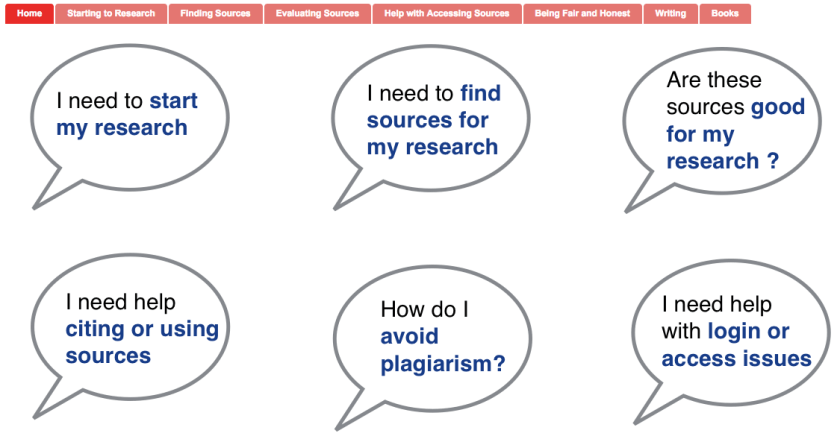
I think I need to move to a simpler and more intuitive layout – Following Katie Day’s layout for her research guide, perhaps making it student question related?

screen-shot-2016-12-10-at-11-08-41-am

At a whole different level is the services and guides that happen at Scotch College ….

screen-shot-2016-12-10-at-11-15-54-am

I think I need to sit down with teachers and students and really understand how they use information, how they look for it and where they expect to find it. Customer journey maps – something that I was thinking of as an alternative study avenue before I looked at our Blokes with Books club as my case study. Has anyone looked into that in the library context? I know people have looked at social media in library, but this is different – the physical and digital paths our patrons use to get information (or get frustrated by us). Any pointers?


Firmware (& Software)

Planning for a library expansion and renovation involves considerable time, thought and work on the “hardware” of the physical building. Including last week’s work of packing up the books and getting them put into storage. I’d blogged a little about how just prior to that we’d done a lot of weeding, and sorting out patron data on our system, as somehow the physical sorting out led to a drive for digital sort out and housekeeping.

I’ve been promising for a while that I’ll talk a little about the “digital” side of the library, but first I’d like to talk about what I’d refer to as “Firmware”

screen-shot-2016-12-04-at-9-58-00-am

A characteristic of most international schools is the transience of its students, and often teaching staff. Naturally this includes the library.  In my current position I’m aware of the fact that I’m just one in a long line of librarians who have come and gone. I’m also extremely grateful to our permanent library staff, who keep things ticking over as teacher librarians come and go, each trying to put their mark on the physical and teaching environment.  They have institutional knowledge. They know what has been tried and worked or failed, and a pretty good idea of why.  I admire their unrelenting politeness and helpfulness as they cope with the latest “new broom” .

When you speak to other librarians, inevitably the conversation will come around to the fact that they’d like their staff to take more initiative, or upgrade their skills beyond shelving and circulation and basic queries.  But that is harder to realise than one would think. There appears to be a reluctance that sometimes is hard to fathom.  Some librarians have taken great initiatives in this direction – like the KL librarians under Robert George with their JAWs (Job Alike Workshop), and more recently the similar sessions initiated by Barb Reid in Singapore.  The problem with any professional development at any level is that there needs to be a compelling reason to take the learning and put it into action as soon as possible. But invariably the day-to-day tasks take over and there just isn’t enough space between relentless shelving and picking books for the next (18) Units to get the practise …

However in the last month, we’ve had to challenge the “read-only” part of the definition to its limits, with one staff member on maternity leave and the other on hospitalisation leave, and as a result, that once in a blue moon occurrence – a “firmware update” has become the new norm. So suddenly business as usual hasn’t been usual, and everyone has had to do everything all the time, with a lot of compromise and cobbling things together as we go along.  We haven’t had the luxury of designated tasks and roles, and suddenly we are all cataloguers, and weeders, and resource list creators.

I’d set aside a week for packing up the library. But I’d not calculated on the energy and enthusiasm of my staff and the maintenance staff, and the help of our Grade 5 students who made a “book train” from the library upstairs, so by the end of Tuesday we were pretty much done (and not dusted – boy oh boy, did we discover dirt and dust…). So I declared Wednesday to be systems and PD day, kept back 3 tables and chairs and we sat down and I taught everyone how to use Libguides.   We probably only spent about two hours on learning the basics, and that’s really all that is needed, because with everything it’s not about the theory it’s about using it.   Then back to some more boring stuff, getting images onto books in the collection.

And then more important, but still a little bit tedious – especially if you’re using Follett – checking through resource lists and updating visual search for all the UOIs.   Oh gosh, I’m embarrassed to say how many links were old or incorrect.

Next up was making resource lists for all the books related to all the countries our students came from. For Uniting Nations day I had made a cursory start by grouping books into continents as it was a “quick and dirty” way of getting lists out there for our “read around the world” challenge.  Now I wanted to dig deeper, so I took the list of all the student nationalities and we divided it up and started searching and added. We quickly saw the countries that were under-represented, or not even represented at all – books from / about Bulgaria anyone?

I also spent the better part of a day sorting out and adding books related to Social and Emotional Learning  based on the handout of Dr. Myra Bacsal after her talk. It also entailed adding nearly US$2,000 worth of books to a “to purchase” list, as I realised that while we did have many of the books recommended, we were also lacking in a few – and particularly in more diverse and more recent books.

Our final day in the library, around rapidly diminishing furniture – including at one point our desks, was spent putting the libguide PD into practice, as the 3 of us sat with a list of all units, all guides made and guides to be made and started putting libguides together!

screen-shot-2016-12-04-at-10-36-11-am

The previous day while my staff was helping their colleagues at our other campus, I’d been sitting with the librarians, helping them extend their knowledge of libguides, and us brainstorming ways of presenting physical and digital resources in the guides in such a way that it was easy to navigate and would ensure that students could benefit from knowing what books we had and also how to access other QUALITY resources (i.e. not just google) that we were paying for but were perhaps not being well utilized.

We decided on

  • having the central idea at the top in a floating box
  • on the left – having a scrolling bookshelf of our unit books – using the Library Thing for Libraries book display unit. That way teachers and students could see all available books in a unit, even if they were distributed in a different classroom – and clicking on the link would take them to the book in the catalog – AND if they looked at the subject headings under Explore! would hopefully have a Webpath Express link to click on.
  • Putting some videos in the middle for our more visual / video liking students – also very handy for our ELL students with the paired speaking / images.
  • On the right having a tabbed box that could alternate between Brainpop (a staple in primary), Epic Books (easy to access and great free selection of nonfiction books for easy projection & assignment in class), Britannica (because Encyclopedia) and other links.

screen-shot-2016-12-04-at-10-40-52-am

screen-shot-2016-12-04-at-10-48-31-am

Of course nothing is simple – and even now as I look over the units, I see that some units have the UOI books around the central idea and inquiry in them and some have that plus what-ever literacy / math connection is being made (so more than half of the books are poetry for example). In the medium term all that needs to be straightened out and sorted out as well.

Also before you can add a scrolling list of books, you need a list of books … and to know how to get the books into Library things, and then into a book display widget – so I made a little screencast on how to do that!

The wonderful thing about all of this is the obvious enjoyment and pride that my staff got out of researching units and finding resources and adding them to a guide – they kept on saying “this is so interesting”, and “this is so creative”.  Of course it is not a “quick” thing, I’d say on average a very basic guide at primary level that is reasonably complete will take around 3 to 4 hours. And then one just has to hope that the units don’t change every year!

All in all, and incredibly productive week, and also my staff finally “gets” the fact that my drive for automating student update and photo import etc. etc. is not to put them out of a job, but to free them up to do more interesting and meaningful work.  After we talked about that, one staff member said “and now to automate the shelving!” amen to that!