The problems with imperfect information

This is a post I started writing earlier in the year that didn’t get finished and am now revisiting as it’s recruiting season again …

I’d also say to anyone – if you’re thinking of moving – it’s a really hard thing to do, particularly if you’re happy where you are. However moving and change results in a considerable amount of personal and professional growth – even as it perhaps hurts like pulling a plaster off a wound (cue my bursting into tears at the staff farewell last year).

IMG_0413

——————

In November / December last year it became clear that I’d have to put myself on the international selling block as our continued existence in Singapore had become too economically fragile on one (local contract) based salary. And so I entered the fray of job search at international schools. Let’s say it just doesn’t work quite like this in the corporate world where I’d come from. But the longer I was in the process the more it was “same same but different”.

There are a few things that are quite unusual, but for logical reasons. For one you have a deadline by which you need to state your intent to leave or stay and that date is quite early on in the year, often around November. The problem with that is that both the school and the “leaver” could suffer from “well I’m/they’re leaving anyway” syndrome as funding for PD and admission to committees / strategic planning / POC’s dry up.

The other big problem is both schools and candidates have imperfect information – since different schools have different dates, and sometimes extensions can be negotiated, both the pool of jobs and pool of candidates isn’t known at the same time.

Thanks to informal networks like Facebook, if you’re in the right group, you may know about jobs coming up before they’re officially advertised. But the market is dominated by a few recruiters (Search Associates, Schrole, ISS and TES) who have a monopoly on the market without, in my opinion – or perhaps my advisor just didn’t “get it”, adding much value to the equation. Conferences are a great chance to meet people face to face and also to hear what’s happening in the world and who’s thinking of moving, decided to move / retire, move in or out of one part of the school or another.

I thought a lot about what would be a good fit for myself and the school and the family – and one of the interesting things I came across was the idea of the .eHarmony algorithm of compatibility   – sometimes someone at the school (including the current librarian) may know that one person or another wouldn’t be a good fit or would be an excellent fit – so it’s often a good idea to reach out to them.

Something that I’ve always wondered about in the process is why no one ever bothers asking the library staff about candidates – they often know more about what the sphere is like, what the librarian really is doing and how things work than the principal – during last years job rounds I saw some pretty egregious examples of people padding or exaggerating their CV’s and taking credit for predecessor’s work.

If you don’t have an “inside” into the school it’s really hard to have knowledge of the principal / coordinators / departments / teacher attitudes to the library – aside from the dreadful ISR where it seems only people with an axe to grind give their opinions, and even if you know a school at a certain point in time, by the time you start everything could (and often will) change.

There is a heck of a lot you need to know before you jump into a job, and not all of it is as transparent as you’d like it to be – especially while you’re in the “finding out” stages – one of the jobs I was applying for, the previous person had left due to being unable to survive on the salary package – knowledge about salaries, benefits, cost of living is crucial – yet you can’t start asking too early about this, and the information on the recruitment sites is often abysmally out of date – with them hiding behind “we rely on the schools to keep it up to date” – sorry, that’s what you’re being paid for both by the schools and the candidates!

I also gained in self-knowledge due to a lovely encounter with a super principal where I was in the running for a job that I could have done perfectly well, but if I was completely honest with myself was just not the right fit for me (and I subsequently found out would not have been ideal for my family either) – I really appreciate that person’s  kindness in rejecting me in the nicest possible way for the right reasons.

What have I learned? One thing is that it’s easier to be neutral about the process once you’ve finally got a job! A few podcasts that are apparently unrelated have had some interesting insights:

Hidden Brain: Daniel Kahneman On Misery, Memory, And Our Understanding Of The Mind

https://www.npr.org/player/embed/592766436/593002199

Freakanomics: Here’s Why All Your Projects Are Always Late — and What to Do About It

https://www.wnyc.org/widgets/ondemand_player/freakonomics/#file=json/838923

Learnings – we are a victim of our cognitive bias including optimism bias, planning fallacy, impulse control and information overload. In addition, it’s generally know that men are over-confident and go for jobs that are a reach, and females under-confident and undersell their abilities (the confidence gap). For job seekers it’s important to start early, budget way more time for the process than you could think is humanely possible, and learn to oversell yourself.  For recruiters, the lesson is that job seekers are going to oversell (particularly if they’re male) and to check references carefully – as much in omission as in commission. In the library field I would always ask library assistants, a couple of teachers and colleagues, besides the curriculum coordinators / principal who may or may not be involved in the detail.
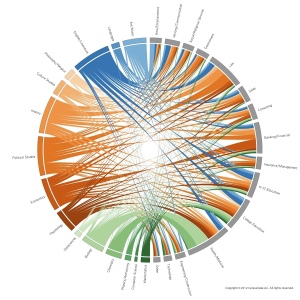
compilationApropos to careers – here is a pretty cool dynamic infographic from Satyan Devadoss
Professor of Mathematics at Williams College on the Impact of Major on Career Path for 15600 Williams College Alums.

And the best advice I got after the initial struggles in my last job, going forward into my new job was “don’t water the rocks” – i.e. work with the people who want to work with you and it will take a lot of pressure off the initial months that are hard enough anyway.

 

Learning and change

The phrase “life long learning” gets bandied around a lot, and today I’m going to write a little about just how much learning is involved in moving job, school section, country, and home.

I left a country that was easy to live in (Singapore) and I job that I loved and was comfortable with for a place (Beijing) that generally led people to shake their heads in puzzlement, even as they acknowledged that the school I was moving to was something special.  Easy is not always good. I must admit I never really liked living in SG – it did not make my heart sing in the way that Hong Kong did. I never felt at home like I did in Hong Kong. And the only thing that kept me there for the last 3 years was a great job that kept me busy enough that the things that irritated me about SG didn’t bother me because I didn’t have time to be bothered.

Living Learning – my husband just announced he needs a haircut – what does that have to do with learning – well it’s just one of a myriad of daily / weekly / monthly things that one has to do in life where you have to relearn how it works and where to make it work. Of course the easy answer is – just pop into a barber or hairdresser – and that’s simple enough if you’re a no-nonsense type of short-back-and-sides-guy but just look in any Asian-expat forum for the pleas for hairdressers who understand curly / blonde / kinky / wavy hair and you’ll realise some things cannot be taken for granted. Like buying knives in Beijing. When you move here you need to surrender your passport to your employer for an extended period of time while all the visa work is sorted out. But no-one will sell you as much as a bread-knife without seeing your passport and registering it (history here – and I’ve learned something).  We’ve moved into our house already and we’re in camping mode until our shipment arrives – so a few kitchen knives are kind of important – luckily we have nice colleagues with knives – presumably purchased prior to the ban!

Then there’s spatial learning. Orientating yourself in time and space, just like the PYP teaches. The Beijing public bus system is amazing. And cheap. For the equivalent of 20-50 cents you can go pretty far within your zone. Compared to 25x as much for a taxi (even if taxi’s are way cheaper here than elsewhere). So it’s a real good idea to learn how the system works. But it’s not that easy. I got a bit of a reputation of being the daring bus lady in our first few weeks, and this is the true story of why. My husband and I, newly married, moved to Sao Paulo, Brazil in 1995. When we arrived we had no money, nearly no furniture and only his job. And if anyone follows South American economic history – it was just after the Plano Real, which meant that everything was super-expensive as the country came out of hyper-inflation, but the balance between cost and value was still being established. So there I was, stuck in an apart-hotel, without the wherewithal to attend all those fancy expat lunches and coffee-mornings, no car and no money for taxis. Oh, and after a 2 week Portuguese crash course I spoke next to no Portuguese and in those days not many people spoke English. And add to that, no smart phone, in fact make that no phone at all, as there was a 6 month waiting list and a $5,000 installation fee to get a phone line installed in your home, and no internet. So I used to walk down the road and get on a bus and drive that bus the whole loop and work out where it went and of what use it would be to me. I figured I didn’t have anything more pressing to do with my time (except find a job quickly); and I didn’t have any money, so there was nothing to steal from me, so what-the-hell.

These days it’s so easy. High speed internet, a “maps” app that works in Beijing, even for public transport and in English. But still you need to learn some stuff. Like the Chinese name for your compound / complex. The nearest bus stop. What time they start and stop and the frequency. If you need to change over, which combinations are the fastest at which time of the day. Whether it’s better to take a bus or the Metro or walk. The short-cuts and back streets. And how to cross the road without being killed.

There are still things I want to know. And I’m not there yet. Like what app to use for buses in advance – there are some great subway apps, like Metro Beijing  where you can put in your start and end points. Maps sort of works, there is a workaround where instead of a location you can look for “transport” and then “Bus Stops” and then click on the bus number and see its whole route. But that only finds the buses near to your location, which isn’t much good for advance planning. I also know you can get an app for your transport card, but I haven’t found it yet. There are some I’m sure, but only in Chinese. Which I’m still re-learning. I’ll do Chinese in a whole other dedicated post.

Work hygiene learning. I call it that based on Herzberg’s motivation theory, because it kind of makes sense and I don’t have a better way of describing it. It’s all the stuff besides the technical / knowledge bits of your job that you need to know to survive and thrive in your new environment. Now this is a pretty steep learning curve. Because every school has their own “untouchables”. I was asking a friend about a new person in another school and her conclusion was she had great ideas and enthusiasm but this wasn’t being appreciated. I sort of know the environment there and I can just see that happening. It’s a dynamic tension. You’re presumably hired to a job because they want your input, and in some circumstances for you to change things. But not too much or to soon. Or perhaps they do what a lot of change and quickly. But who do you ask? Who wants to tell you? There is this mutual dancing around things. Both my predecessor and myself to my successor deliberately didn’t say too much about the environment, because it is important to try and feel it out for yourself. And it’s also nice after a few weeks to be able to ask someone if your experience aligns with theirs – because it’s so hard to know if it’s “just you” or if there are other things at play.

Similarly in my mentor group (another “first” for me – having 12 students to nurture throughout the year), I’ve deliberately not looked at their records or files, as I want to take them as they are without history or labels and then move on from there.

Where to play. It’s not all about work, so our Newbie WeChat has been full of which restaurants are good to go to, where to have a massage, where the beer is cheap, nice parks to hang out in, bars and clubs for the night owls. This morning I was delighted to find the Beijing Greenway just minutes from our house with I think about 12km of walkway along the river through wooded areas with lush green and few people.

I’m seeing similar exploratory type posts on the facebook pages of friends who have also taken the plunge into the new and unknown. It’s easy to say it’s easier now we have the internet and facebook and smart phones and apps. But change and adaptation in reality is never easy because it has its own absorption rate. And even after moving around for the last 35 years, I’ll put my money on the fact that it will take at least a year. Because it always does. Except in Luxembourg where we only lived for 10 months!

If you’re new to this game, you may want to read up more on “culture shock“; the 5 stages of culture shock – honeymoon; culture shock; actual adjustment; isolation period; acceptance and integration, the W curve etc.

We were lucky to learn this all at the Royal Tropical Institute in Amsterdam prior to our moving to Brazil. And they also gave us one of the best tips ever – which was easy to implement in 1995 when flights were expensive and phone calls cost at least $5 per minute – and that was – not to have contact with home in the first 6 months. That’s pretty unbelievable in this day and age, but it probably helped with the move and integration.

A little writing about writing

I threw down the gauntlet to my mentor, Katie Day last night. She who taught me all I know about being a teacher librarian in the weeks and months that I sat by her side while doing my MIS and part of my M.Ed before I was thrust into the world of a library of my own. I was mentioning how I was a little shocked and disappointed at the standard of writing of Masters’ level students, and she mentioned that in her current position she was seeing more student writing and had decided to give that a focus this school year. I have a mentor group for the first time this year, and I want to try to emulate a wonderful teacher in my previous position, Christene, who used back and forth journalling with her G6 class as a way of getting to know them deeper, while developing their writing and depth of thought – particularly over what they were reading.

Now Katie is a phenomenal librarian – probably one of the best in the Asian international school network. She suffers from one immense flaw generally – the fact that she doesn’t market herself, and currently, she’s gone silent and no longer stimulates and challenges the rest of our thinking frequently enough  through her blog. This is where a biblical reference is most apt – that of hiding your light under a bushel. Like most newbies to a profession, I’m still greedy for knowledge and advancing my skills and look to thought-leadership in the field to advance my own understanding. So, the blogging challenge is on – at least a blog a week between now and Christmas.

In our first week at school, we were asked to do a Strengths Finder test – I’ve done one previously, but this was a different one. I found it a little repetitive as it kept bringing up the same questions differently phrased – I know, internal validity and all that. And then was a little surprised – bearing in mind the results of a previous such test – when the top strength spat out at me was “writing”. I immediately wanted to reject this, as actually I do precious little writing in my job. And it sounded such a stagnant non-sexy non-innovative type of thing that I felt undervalued me as a thinking, teaching, doing, researching, active professional.

As a librarian I read a prolific amount, a lot of it mediocre if I have to be honest, and I’ve always said that you’d never find me writing a book, in response to everyone who asks. I know enough authors to know that besides anything, it’s a poorly paid mugs’ game where you spend a disproportionate amount of time trying to get out there and promote the book rather than write – plus the financial returns are so poor that you inevitably need a second or third career to sustain your writing. So I don’t actually see myself as a writer. But then I realised, that I’ve been blogging now for 15 years, and that actually I have a need to write my experience. And I’m forever encouraging students and fellow professionals to do the same.

So here goes everyone – if you still have a blog out there – dust it off, start writing, or continue writing! Post your URL’s in the comments so we can follow and comment on each other’s posts.

A nerd’s guide to moving house

A slight departure from my usual library and education pondering as we’ve yet again moved country and therefor house. My teenage son asked me the other day how many times we’ve moved in our lives, and we tried to start counting and then were going off on tangents like, “just countries, or while in countries?” and “just since we left home or also while being a child?” (not that that was soooo much as both of us came from fairly non-moving families!) and “does in and out of temporary accommodation while waiting for a home / shipment count?”.

IMG_0201
There is some freedom in reducing life to a few suitcases.

So here we go again, this time we’re now in Beijing, China and LOVING it. This was the move, that when we told people they’d say “really? why?” or just look at us as if we’d grown a unicorn horn. Or put on that sympathetic gaze. But ever since I started learning Chinese at HKU 9 years ago, I’ve wanted to live in China. And that even more so since in the 7 years of Singapore I managed to lose 99% of what I’d learnt and deeply regretted it. I joke that doing 2 back-to-back Masters in Education and Information studies pushed all the Chinese out of what was left of my brain. It’s not far from the truth. Changing one’s career radically  half way through your 40’s and then starting a new job in said-career doesn’t leave much room for practising a language that’s ironically not that widely used in a Chinese dominant country. It’s the environment. Both in HK and here, you saw Chinese everywhere – the characters that is. In Singapore, English has taken over.

Back to moving. As my husband and I strolled around the “hood” of our new environment last night, we remarked that actually this has been one of our easiest moves. Which may sound strange because it’s the first move we’re doing with me as the dominant career, and that being a teacher rather than a big-shot corporate banker with lots of settling in allowances and a huge administrative department etc. What has made the difference? The school has a designated person whose sole job is to take care of us newbies. Everything and anything we need and a need to know and need to have translated and need to find and need advice on. So after arrival he had our sim cards waiting for us. Anyone who has moved knows how huge this is an how difficult it can be (Singapore I’m looking at you where a “dependant” can’t enter a phone shop without his/her employment pass holder in tow). We went on trips to the bank and to see inside other people’s houses in the most popular living areas. Dinner every night with different people in different locations. Briefings by every department (finance, purchasing, human resources etc.) and so much more I can’t even remember it.


And now, 15 days after arriving, and only 5 days after my family arrived, we are in our home. We had secured it after a visit during the spring break, which meant the lease was signed and ready, so that made things a little swifter too.  And because of the onerous visa process, our shipment can’t leave Singapore until our final version has been finalised, we won’t have our “things” until somewhere in October.  So for now we’re camping in our house – which isn’t all that much different to camping in temporary accommodation, and it feels a lot better.

Oh I’m verbose – 566 words and now the point of this post – we have a lot of stuff. We did a huge sell and whittle down when we left Singapore and managed to fit everything into one container again. So the stuff this time is a lot less – particularly as I had to whittle our DVD and CD collection to nothing (they’re safely in our holiday home since I don’t do the cloud), and our book collection from about 2,500 books to the 200 we were allowed to bring with us to China (most were donated and given away, the more precious books were sent back to Europe – first editions, the children’s favourite childhood books, my Africana collection, our HK and China collection). So it’s mainly furniture we couldn’t sell, donate or give away because it was either – nearly brand new, or really old and sentimental as it had been passed down from deceased grandparents or bought sometime during our travels around the world.

So now we have that wonderful puzzle of working out how to fit everything that was in a fairly large apartment (over 300 m2) into a 4 storey townhouse with lower ceilings and smaller rooms of about 150 m2 which is more like 120 m2 when you take away the smelly basement that we’ll have to use to store the landlord’s fairly yucky but very welcome – while we’re in transition- furniture.  While I’m fairly good at judging space and configuration, one can be badly wrong if you make sure, and if there’s one rule when moving and dealing with strong muscly types that typically move stuff from containers into houses and up stairs it’s “DON’T PISS OFF THE MOVERS”. I can just imagine their tales of stupid rich (it’s a relative term in the countries we’ve lived in, so even on a teacher’s salary we’re rich in their eyes) people not knowing where to put their too much stuff.

And here’s the nerdy stuff. I have a spreadsheet, that I’ve had since we first moved from Brazil to the Netherlands of the dimensions of every piece of furniture we own, it’s cost price and the insurable value. And I keep it up to date as things get left behind or get added. This makes making those darn inventory lists so much easier. It also makes it easier to plan where everything goes in the new place / configuration, because then I either get a house architectural plan from the landlord / agent or I go in and measure up every room (much easier now you can point and shoot with your phone – but I usually still check with a measuring tape). I then enter it all into a floor planner (link to the one I use) and put the furniture into the plan. It’s 3 dimensional – so I can make sure of height as well.

Camden17
An old planner from one of our favourite houses in Singapore

So today, while the painters come, and since it’s raining I’m going to be doing some measuring and reallocating furniture around.

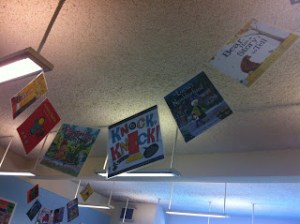
And because this is a library blog – a few pictures of my new work environment:

SDGs in the library

Many schools, and particularly those following the IB (International Baccalaureate) framework are attempting to incorporate Sustainable Development Goals (SDGs) into their teaching and learning.  The library can play an important role in supporting this through curation and discoverability.

Our G6 students used the SDGs to focus their research during their PYP Exhibition Project. I’d been meaning for the longest time to curate a list of books around the SDGs and this was the ideal opportunity.  In curating the list there were actually two phases. In the first I was looking for books that would act as provocations and allow students to form a feeling of empathy and identification with the goal. In the second, when they’d chosen their area of focus, it was to find books that would aid their research and investigations.  These are two quite different goals, with very different resources.

During their exhibition “kick-off” library lessons I did a different book with each class, One Plastic Bag: Isatou Ceesay and the Recycling Women of the Gambia
by Miranda Paul and Elizabeth Zunon (Illustrator); and Emmanuel’s dream : the true story of Emmanuel Ofosu Yeboah by Laurie Ann Thompson and Sean Qualls (Illustrator).


So that everyone could see the images clearly, instead of a read aloud, I projected a YouTube video of the books being read.

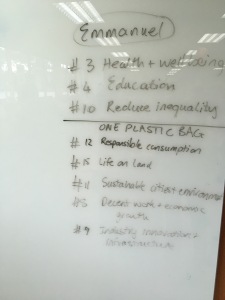
We then discussed which SDG’s were covered by the respective stories, which was easy enough for them:

IMG_7869

Empathy Map (1)
Empathy Map

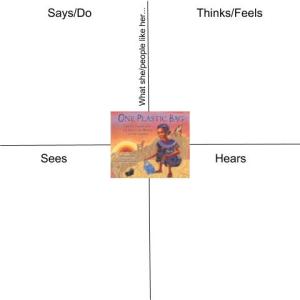
After the story I introduced the concept of an “Empathy Map”. There are many different versions of the empathy map, (the original is from Dave Gray) but I wanted it to be as visceral as possible. Students were each given 4 sticky notes to write what they thought the main character in the book would “say / do”, “think/feel”, “see” or “hear”. Now this may sound quite simple, but the exercise is very effect just because this is way harder than what it seems. Students had to really get out of their own heads and it took a bit of prompting by the teachers and myself to put themselves in the character’s shoes and consider things from the protagonist’s perspective. The map was just a piece of flipboard paper with the name of the book and the 4 quadrants written in.

At the end of the lesson it looked like this:


The follow up to the lesson was to create a page on my PSEL library guide to include the books I’d curated for the SDGs. The images are linked to my resource lists in our library.

As the students decided on the focus of their research, and narrowed down their central idea and lines of inquiry, I helped them to find relevant books in the library, or, for quite a few we needed to purchase additional books.  I also started (but have not yet finished) making lists on EpicBooks (e.g. SDG7). EpicBooks is simultaneously a wonderful and very exasperating resource due the inability to tag resources and easy group and regroup them.

With the G6 teachers and some of the exhibition mentors we also started a flipboard with appropriate news articles related to the student choices.

View my Flipboard Magazine.

Move forward a couple of months and within the #IntlLead group we’re currently trying to initiate an International Libraries week with a focus on SDGs, and so to write this post I started uploading all my lists onto my Library Things account. I’ve put them into a collection called SDG and tagged them SDG1, SDG2 etc. and the name Zero Poverty, Zero Hunger etc.  Since LibraryThings can be quite geeky for the non-librarian I’ve also created a TinyCat for this collection, which is visually much more appealing. It’s also not corrupted by the 1000s of other books in my collection.

What else is going on in the world of SDGs and libraries and schools?

Please comment if you’ve got anything else to add.

Between competition and cooperation

At the moment I’m busy setting up for Readers’ Cup season. And I have yet again a chance to think about the balance between competition and cooperation. This time in the light of having attended the AISC in Hong Kong in December (which I still need to write about) and and particularly having attended David Gleason’s session “At what cost?” (You can purchase his book here).

Some educators, and most parents (particularly the competitive types themselves –  and high fee paying schools are full of those types – because they’re the “winners“, if they weren’t they couldn’t have afforded the fees) will tell you that kids “love” competition. That it’s an artificial construct to pretend otherwise. And the whole movement towards medals for all is “stupid” or “unnatural” etc.  I’m not entirely sure. And bits of evidence appear to be pointing in different directions. I’ve not done any academic study of this, and won’t be able to point to any peer reviewed research, but things I’ve been hearing and reading seem to think there is substantial nuance in the matter.

The most interesting of these was the following: “Do Nobel Laureates Create Prize-Winning Networks? An Analysis of Collaborative Research in Physiology or Medicine“:

Nobel Laureates in Physiology or Medicine who received the Prize between 1969 and 2011 are compared to a matched group of scientists to examine productivity, impact, coauthorship and international collaboration patterns embedded within research networks. After matching for research domain, h-index, and year of first of publication, we compare bibliometric statistics and network measures. We find that the Laureates produce fewer papers but with higher average citations. The Laureates also produce more sole-authored papers both before and after winning the Prize. The Laureates have a lower number of coauthors across their entire careers than the matched group, but are equally collaborative on average. Further, we find no differences in international collaboration patterns. The Laureates coauthor network reveals significant differences from the non-Laureate network. Laureates are more likely to build bridges across a network when measuring by average degree, density, modularity, and communities. Both the Laureate and non-Laureate networks have “small world” properties, but the Laureates appear to exploit “structural holes” by reaching across the network in a brokerage style that may add social capital to the network. The dynamic may be making the network itself highly attractive and selective. These findings suggest new insights into the role “star scientists” in social networks and the production of scientific discoveries.

Things seem to have shifted in the last 50 years, as interestingly enough, in 1967,  Harriet Zuckerman found that:

“Nobel laureates in science publish more and are more apt to collaborate than a matched sample of scientists. Interviews with 41 of 55 laureates and comparison of their research output with the output of the matched sample indicate that these patterns hold at every stage of the life-work-cycle. As laureates report and as their publications corroborate, they exercise noblesse oblige in arranging co-authorship in collaborative publications. Receipt of the Nobel prize is followed by declining productivity and changed work practices, as a result of changed role obligations and activities. Reductions in productivity are more severe for laureates who experience comparatively large increments in prestige through the prize than for those who were already eminent. The prize generates strain in collaborative associations so that most of these terminate soon after the award.”

And then of course the Google findings that what they needed in their employees wasn’t necessarily STEM skills or coding, but actually empathy.

“Project Oxygen shocked everyone by concluding that, among the eight most important qualities of Google’s top employees, STEM expertise comes in dead last. The seven top characteristics of success at Google are all soft skills: being a good coach; communicating and listening well; possessing insights into others (including others different values and points of view); having empathy toward and being supportive of one’s colleagues; being a good critical thinker and problem solver; and being able to make connections across complex ideas.”

How should this knowledge change my approach both to my own students and my practice as a librarian within the greater network of librarians both in Singapore and generally?  Besides evangelising our school’s Blokes with Books clubs at a number of different conferences this academic year – because I believe SOCIAL BELONGING is such a vital ingredient in learning; I’ve also started pushing the Global Read Aloud whenever I can. It has its flaws, as I’ve documented, but it’s a good start for cooperative connection and reading.  It’s a model that we can emulate at a national or regional level where we form connections between students in our own book clubs, and can reach out to students at other schools as well. The technology is there, synchronous and asynchronous, we just need the will to create the time and enthusiasm.

The typical relationship between schools (if any) is adversarial. We compete for students to ensure “bums on seats” so we can ensure our continued existence. We compete in sports, in chess, in lego robotics, in the math / science olympiads, battle of the books / readers’ cup. Schools like to be “exclusive” where the emphasis is on “exclude” . And yet all the research on motivation, academic and otherwise shows us that the things that count are autonomy, mastery, affiliation and purpose (using those words or a variation of them). In all the 100s of studies I’ve read over the last years, not one article has ever suggested that competition is the way to go – except to say it doesn’t work, nor does other types of extrinsic reward.

So why do my students get rabid with excitement at the mention of a kahoot? And yet the flip side of that is that there are always tears and panic – human nature, human emotion, adrenaline?

I’d love to be able to keep central the idea of “I’m improving” “we’re improving” “we’re in this together”. As Jeremy Farrar stated, reflecting on the 2017 Nobel prize winners:

“And if we look towards some of the great challenges of our time – tackling the problem of clean and sustainable energy, providing sufficient food for a growing planet, developing new genetic technologies to improve health, or harnessing the power of the digital revolution, we start to see how difficult it will be for any one individual to take any of them on alone. The same is true for fundamental science such as understanding the working of the brain or the origin of the universe.

Collaboration brings fresh ideas and new perspectives. Bringing people together from diverse backgrounds, often across borders, leads to new ways of thinking, better solutions and faster progress.”

References:

Farrar, J. (2017, September 30). We hail individual geniuses, but success in science comes through collaboration. Retrieved 24 February 2018, from http://www.theguardian.com/commentisfree/2017/sep/30/we-hail-individual-geniuses-success-in-science-collaboration-nobel-prize
Gleason, D. L. (2017). At what cost?: defending adolescent development in fiercely competitive schools.
Strauss, V. (2017, December 20). The surprising thing Google learned about its employees — and what it means for today’s students – [Newspaper]. Retrieved 24 February 2018, from https://www.washingtonpost.com/news/answer-sheet/wp/2017/12/20/the-surprising-thing-google-learned-about-its-employees-and-what-it-means-for-todays-students/?utm_term=.125a0277f88b
Wagner, C. S., Horlings, E., Whetsell, T. A., Mattsson, P., & Nordqvist, K. (2015). Do Nobel Laureates create prize-winning networks? An analysis of collaborative research in physiology or medicine. PLOS ONE, 10(7), e0134164. https://doi.org/10.1371/journal.pone.0134164
Zuckerman, H. (1967). Nobel laureates in science: Patterns of productivity, collaboration, and authorship. American Sociological Review, 32(3), 391. https://doi.org/10.2307/2091086

The 10% problem

It’s a funny time of year in education, November and December. I never knew this before. It’s the time when educators need to decide if they’re staying or going in their current school or position, and if not, what the next move will be. I’m new to this game, and as I librarian I get to see all classes, all teachers and many parents. Observation and conversations are things that happen a lot.

The 10% use of the brain myth has been debunked I know, but I think it is still a useful meme to use in education. Because one of the things that keep coming up in the conversations I’m having with people who are leaving of their own volition (some are due to partner careers, or family issues) is the frustration that for one reason or another, all they have, know and are capable of is not being used or recognised. I know, because as an older educator coming late to the game with a longer “past” I feel this very acutely.

A little while back a group of us had an interesting lunch conversation along the lines of our former pre-teaching lives, or what we’d taught before we were teaching what we were teaching. There is so much unlocked knowledge, skill and potential in education. And I’ve just mentioned the teachers. Before I was a TL I was a sort-of SAHM (stay at home mum). Sort of, because I kept studying and doing stuff. Stuff that would keep me sane and my brain occupied while my body was present for young children and a partner who travelled anything from 70-90% of the time, and then we’d move country to spice things up a little more. And I kept bumping into women (mainly) with amazing brains. Women with fantastic pasts whose only outlet was pouring themselves into organising PTA/O fundraising and events and being class-mothers. Not that it’s unimportant, but really? Think of the energy equation – it’s like starting up a blast-furnace every-time you need enough fuel to drive around the block.

While the unlocked potential in teachers is particularly acute in primary, where teachers are often limited to their own classrooms, teaching a breadth of skills and subject areas they may or may not be optimally suited for, I heard the same while working in secondary. One person in particular sticks out. He was very bright, very capable in his own field, constantly seeking out new knowledge. He was also not from the dominant mono-lingual white male BANA pack, and such was an outsider. He left in frustration saying that while he’d been hired for all the bits and pieces he had, he was only being used for a small portion of them and wasn’t even consulted when his PhD specialisation was being looked at in the community (I won’t mention what this was as it would be a give away). I’ve spoken to language teachers a lot, who say they sit mute and unsolicited in meetings while mono-linguals decide language strategy and curricula. Parents who come from a huge diversity of educational and learning backgrounds who are literally NEVER consulted because they are “just” parents. And if they ever dare mention that things could be, and are different elsewhere, at least in some areas, they’re quickly shut down with “well, this is the way we do it here” while the dominant culture and pedagogy continues hurtling down the track.

school is easy

I use hurtling consciously. Because the sad thing in education is the pace. There is just so much busyness. It is no wonder that the 10% usage exists – there is just not enough time for anything else. And all the time there is that anxiety. Parents are skittish that their child is in the “right” school. Ready to run and change at the drop of a hat. Students mete out their time for subject by subject homework. Teachers are stretched thin juggling reporting, marking, teaching, preparation, running excursions and events. And somehow, most times, in the midst of this all, miraculously, learning takes place.

Another sadder thing I’m noticing at the moment is that there is a widespread occurrence of “losing weight after the divorce” to use another bad analogy. And that is, suddenly there is a bunch of people getting all sorts of qualifications (albeit sometimes the maligned-by-me google-educator badges), suddenly getting out there at teacher events and PD as they polish themselves up for the market. That’s more than just a little bit sad. And a lot of a bit of waste on both sides of the equation.


Art in the library

I always like seeing how different libraries make use of their wall space (if they have any) and what art work or displays or other interesting bits and pieces are on display.

All of the work below is particularly special as it was created by the primary pupils of the school library and then put on display there.  I particularly like the first item, which looks like a book array but is a clever stitching of rolled up magazine pages!

The next is a clever way of using book covers that have been discarded during covering or processing – or I guess you could just photo copy and laminate them.  If you’ve got a high ceiling and want to lower it, this kind of hanging display is particularly nice.

Finally – the shelf of cuddles!  What a nice addition to an infant library … could anything be nicer than cuddling up to something soft while reading your favourite book?

Network, networking, social networking

As week 2 of my professional placement draws to an end I’m thinking more about this network thing.  Both now, and during my study visit I’m noticing more and more the difference between “networked” librarians and “non-networked” to put it a little crudely.  Of course, even the “non-networked” librarians are networked, in the “no (wo)man is an island” sense of the word, but its a question of where you are concentrating your efforts.  And this, to put a blunt point on it, can be a Machiavellian thing.  Which is to say, I’m not necessarily saying that more (professional) networking is good and less is bad.

I’m just going to report on the dimensions that I observe, in no particular order, and it’s not a value judgement, and I’m now wondering what kind of research has been done on this in the library sphere – I’m pretty sure there is plenty in management /corporate literature generally.

*  life of the party
well networked with peers in other departments, people stop by for a chat, get’s a lot of positive recommendations as being “fun”  (note – this does not say anything about professional capability, or ability to do the job well, just that they’re fun to be around)

*  in with the big boys
gets invited to and participates on the same level at meetings and social events with the decision makers of the organisation. Considered to be a peer in thought leadership. Paid on par with peers. May or may not be a great librarian for the “little people”

* hiding behind the desk / door
could be a brilliant librarian, could have wonderful thoughts, and the source of marvellous conversations, brilliant resource suggestions – BUT, they’re waiting for you (user) to come and extract them – unfortunately I’ve seen quite a few of these.  They’re there.  and they’re there for you, but you need to find them and engage them.  You want to send them on some sort of assertiveness training or just something that will boost their confidence.  I’m wondering how someone gets to this point – is it being a naturally shy and retiring type of person (the Susan Cain introvert), or is it the lack of opportunity to experiment safely with being “out there”, or is it having tried and then been knocked down (deliberately or incidentally) by someone else with more power or a lack of feeling for where they’re coming from?
I have a suspicion that these people are networked – in their own world and with other similar types.  Now this is a great resource in an organisation, but it’s a little bit like the functionality of so much software.  Its there and its great, but should the user have to wade through forums and how to guides, or should there be some type of annoying paperclip popping up and saying “I noticed you’re trying to … how about … (no), or is there some other way?

* sweet spot but one step short
This is the souped up version of the hiding librarian.  They don’t hide, they’re friendly, they’re on the floor, they’re helping, they’re talking, perhaps not the life and soul of the party, but they’re liked and respected by users and their peers.  They’re innovative, they’re taking initiative, they’re approachable. But, they’re not “in with the boys”.   They’re not being paid what they’re worth, not getting the resources they deserve and not being listened to, really, where and when it counts.  While it may seem a little more obvious how to get from “behind the desk” to “sweet spot” it’s a little harder to work out how to get from “sweet spot” to “in with the boys”.  Again, I’m not saying that one should be “in with the boys” I’m pretty sure library services in an organisation (and the organisation as a whole) would benefit from at least one of the librarians being “in with the boys”.  And is that within the control of the person or the organisation?

* looks good on-line / on paper
All the right qualifications, all the right names, great resume, stunning website, active on social media, great blog, but then falls flat in reality. As librarians, we’ve probably seen our fair share of this in authors – we were talking about just one such person the other day.  Brilliant person, everyone loves reading him, ROTFL type of books, but in the flesh?

* 20 years
Ok, that’s an arbitrary number, but you know what I mean. “I’ve been doing this 20 years and … / but I’ve been doing this for 20 years” I’m wondering if it’s a co-incidence that most library jobs advertised ask for 10 years of experience. I see a lot of that around the whole use of social media, the internet, eBooks, display, design and assumptions about people, learners, users.

*I’m just …
a temp, a student, an admin assistant, whatever.  This is a bit frustrating, because I’d like to think that everyone in a library takes ownership over that space.  Not in the alpha monkey sense of all vying for top dog, (sorry mixed metaphors flying fast and thick), but in the sense of “yes I can help you” or “yes I do want to think about how best to … shelve / control / order / administer etc.

I’ve probably missed out on a few types and I’m going to hit google now*.  Perhaps every library organisation needs a balance of these types in order to function well.  But I do see quite a bit of frustration as I move through these learning experiences.  And I sense that in most cases there’s just a little something that could be added or amplified to making things a better experience for everyone.  Is it about self-knowledge or organisation knowledge or fit?  And I’m wondering what type I would be when I’d be working in a library.

=======

I did find one interesting article, will have a dig around management literature to see if there’s more

First questions

(a) define what social networking is (in your own words);
In my opinion there are two types of social networking – that which occurs online, and that which occurs online. In both my online and offline worlds I enjoy having disparate networks of friends and connections who define parts of who I am and how I function in the world.  These days, my online and offline social networks often intertwine.
A network is basically a group of people who are connected to you by virtue of something you have in common.  For example, I have a network of friends who I work out with at crossfit.  We see each other at workouts and at functions organised by the box, but we’re also active through Facebook where we post articles and comments and questions to each other.
On the other hand, I’m a member of LinkedIn, where I’m connected to people who I’ve worked with or come into contact with professionally – a few of them are personal friends, and some are Facebook friends, but most are not.
For many years I wrote a blog on bilingual chinese / english education.  I wrote this anonymously and over the years built up quite a following of anonymous strangers, some of whom became friends – we were united in a social network but most of us never met.
The best social networks are the ones that give you a buzz, where you’re interacting, enjoying and learning and contributing all at the same time.  Funnily enough for me that usually works when I’m one on one with someone and we’re “jamming” – not in the musical sense but in the app sense, and it’s a case of “look what cool toy I found” and seeing how we can apply it to solve real world personal or professional problems (like today).  Or when you’re trying to plan thing and you or someone knows someone who then knows someone else who would be perfect for a talk or presentation or bit of information that will complete what you’re trying to achieve.
In order to have a good social network you need to be able to both “get out there” physically and network in real life, and “be out there” hanging out where your professional peers are hanging out – whether that’s blogging, twitter, Facebook, LinkedIn or whatever else the flavour of the month is.  – And if your kids aren’t doing it – it’s probably not worth spending much time on.
 In the context of this course, social networking is probably referring to the networking that happens online.  
(b) list what social networking technologies and sites you already use (for personal, work and
study purposes); and
LInkedIn, Facebook, Twitter, Diigo, Blogger, Flipboard, Youtube, Evernote, Goodreads, Whatsapp, Picassa, Google+, 


(c) describe what you expect to learn from completing INF506
Keep current, maximise and optimise my time online.  Coherence between the various platforms.