No excuses – Britannica Image Quest

This no excuses post has been a long time coming. One of the things that most librarians have in common is that they are long-suffering, friendly, helpful, accommodating types, ready to share knowledge, know-how and eager to grasp on any acknowledgement they receive from academic leadership and fellow teachers. While the grumbles and moans are prolific within our little echo chambers, few of us have the time or energy to actually be vocal. We’re generally just grateful we have jobs, in a market where libraries and librarians are sacrificed a the altars of economies and “it’s on the internet”. So many just put up and shut up. And are careful of the swords we’re prepared to fall on.

In the mean time, there are people and companies in this academic / learning / research space who are making a lot of money and who do get heard / listened to. If you read only one article about this, I’d recommend the Guardian Long Read : “Is the staggeringly profitable business of scientific publishing bad for science?” I’d love to ask if the profitable business of school databases is bad for research and learning.

So the saga began at the end of the last academic year.  I was teaching academic honesty to my Grade 4’s and they were just about at the point of grudgingly agreeing that it was a good idea (in IB PYP speak) to have “integrity, respect and appreciation” for other’s work and be “principled” in acknowledging where the images they were using in their research were coming from.

In order to limit their going too wildly astray on the world wild web, the teachers and I agreed that we’d limit the images they used to two sites – the paid Britannica Image Quest (available to schools as part of the school version of Britannica bundle for a mere US$6,000 per year depending on your size), and the unpaid “photosforclass” where the attribution is included in the photo watermark and they make an effort to ensure the photos are school appropriate and are under creative commons license.

So far so good until we got to the point of looking at the citations created by – no not the free tool but the really expensive one!

As we looked up the various things students were researching to my utter dismay I realised that each and every one had as creation date 25 May 2016.

One of the things that I try to keep in the back of my mind when teaching information literacy is where we are going in terms of threshold concepts.  We want to ensure that students are not going through the rote / skill part of academic honesty without really understanding the bigger information literacy picture.

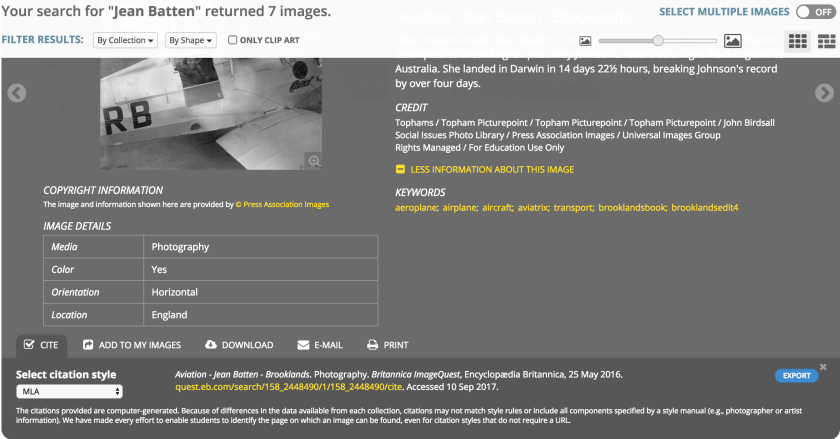
Screenshot Britannica Image Quest
Screenshot Jean Batten – Brooklands and citation, Britannica Image Quest, 10 September 2017.

So I wrote to our “local” Britannica representative questioning the date on the image. Surely it couldn’t have been May 2016? And who was the photographer? Surely they deserved a mention?

The correct structure for MLA8 (the system our school is using) is:

Creator’s last name, first name. “Title of the image.” Title of the journal or container that the image was found on, First name Last name of any other contributors responsible for the image, Version of the image (if applicable), Any numbers associated with the image (such as a volume and issue number, if applicable), Publisher, Publication date, Location. Title of the database or second container, URL or DOI number.

So the response I got back from Britannica was:

Many thanks for your email expressing your concern over our citation. I am guessing you are referring to the MLA format. We follow the required format for online publishing which does not require that particular information.

Example below.

HIV viruses (red). Photography. Britannica ImageQuest, Encyclopædia Britannica, 25 May 2016.
quest.eb.com/search/132_1274904/1/132_1274904/cite. Accessed 16 May 2017.

MLA citation requires a publication date which is considered a core element of the citation. That, of course, would be the date of the last image publish of that collection, May 25, 2016. Because the data from the images comes from more than 60 collections, it is very inconsistent or we don’t have it at all. Britannica tries never to provide information that we cannot guarantee to be correct. We suppress this from the site for that reason.

http://quest.eb.com/collections

I hope this assists your understanding of our difficulty here. Please come back to me if I can be of more assistance.

At which point I cried foul. And took my concern to a couple of librarian networks. Where it was roundly ignored. Or where it wasn’t ignored it was met with a powerless sigh. And I wrote back to them as said no, I was not satisfied with that. Are you serious? They get photos from 60+ databases and can’t be bothered to spend a few dollars on mapping the available data properly to their database? Only 60? That means you pay 60 something people, one to look at each of those databases and work out their tagging and map it to your tagging.  And then you pay somebodies to manually sort out the ones that don’t map nicely or you default to the cop-out citation for those. In the world of cheap accessible outsourced IT, that should be a no brainer. The entry about the privately owned Britannica on Wikipedia is illuminating.

In the world of fake news and fake photos and fake evidence and fake research and fake everything we need to be vigilant. When original primary research documents and images get scanned into databases we lose a trail if the creators and dates are no longer considered important enough to add. We are not talking about born-digital images here.

So I persisted and got this response:

Well you have certainly stirred thing up, in a good way I think. J

I’d like to share with you some of what has occurred since your concern was raised, in the hope it will be interesting and helpful in the future.

Our Editorial Team was consulted and they will be handling citations going forward. They did a full review of the MLA format and consulted with the MLA Handbook 8th Edition.

As I mentioned in a previous email, the reason we leave off the photographer is because the data we get from the partner is not in a format that would allow us to list it correctly on a consistent bases. The MLA Handbook states, “When a work is published without an author’s name. . .skip the author element and begin the entry with the work’s title” (p. 24). Since we cannot accurately list it, we are leaving it off. The editorial team are going to explore this a bit more and see if there is a way we can improve this, but for now we will leave it off. This will not be an easy thing to fix.

We are listing the publish date of the images (in addition to accessed date). According to the MLA Handbook, the publish date is appropriate. Because we didn’t always store the publish date in the database, when we revised for MLA 8  we had to fill in something so all images would have a date. We used the date of the most recent publish. From the point of making this change and going forward we now list the actual publish date of image. Since this did result in most, but not all, of the images having the same date we are going to go back and try to update the publish dates with the date the collection was first published on our site. This will hopefully make it easier to teach students what this date is for since the majority will not be the same. However just to reiterate, as new images are published they are now listing their actual publish date.

Over the next month or so, the Editorial Team will also complete a review of the other citation formats in ImageQuest and we will make changes as time allows. We will also create a citation page where we provide additional information to clarify our citation policy.

Nadine, I do hope it is clear that Britannica always endeavours to provide the most accurate information possible and that we do react, where we can, to try and improve on a valued customers suggestion.

and in fact, if you look at the bottom of every citation you’ll now see the following:

“The citations provided are computer-generated. Because of differences in the data available from each collection, citations may not match style rules or include all components specified by a style manual (e.g., photographer or artist information). We have made every effort to enable students to identify the page on which an image can be found, even for citation styles that do not require a URL.”

Why does this still bother me six months later? Let’s return to what we really want students to know about Information Literacy. What will carry them beyond their latest assignment, their Personal Project, their Extended essay. What will take them through life as sceptical consumers of information. Let’s go back to understanding the threshold concepts of information literacy.

We should rely on information that has authority.  So we check the credentials, experience and expertise of those giving the information. There is an image of a young woman and a claim she broke an aviation speed record in 1934. Who took that photo? Where was it taken? When was it taken? Was she leaving or arriving? If the photo was taken on another day or time was it just posed? Was that the triumphant photographic proof of her exploit?

Information has a format. And it’s format is related to its creation, production and dissemination, NOT how it is delivered or experienced. Usually this is considered when comparing journal articles in a journal in a database to the journal format of the past as in volumes of books. The fact that the format is now online, doesn’t impact on the fact that it’s a a peer reviewed journal article. A similar argument can be made for a historical photo. The fact that it’s now delivered digitally shouldn’t ignore the fact that it was once a photo taken with a camera at a point in time by a real photographer.

Information is a good (as in goods and services). As such there is a value and a cost to information, and we should be aware of that. At the moment the balance of financial cost and reward seems to be very one sided. Databases buy up collections of information, bundle it, and sell it on at a premium and add as little value to the images as they can get away with. Usually just giving information on the seller rather than the creator of the images.  The information structure – information is structured and accessed / searched in a certain way and that differs depending on the format and container.

The research process builds on existing knowledge. But if we ignore the existing knowledge and process whereby we get to the current point we’re negating this aspect. This also builds into the idea of scholarly discourse – that we’re entering an academic conversation at a certain moment.

So at this point I’d still be saying – no excuses. The fact that something is hard should never be an excuse not to do it properly.  Yes they are right – they are complying with the MLA8 structure. But they are not helping with the spirit of scholarship and information literacy.


No excuses: Syndetics

It must be an age thing – but as I’m getting further into my 50’s I’m becoming less tolerant of fancy sounding reasons and explanations that are actually just excuses for staving off change. This is the first of a series of posts on things that really annoy me as an international librarian, with a smattering of understanding of technology and a desire to serve ALL students, teachers, parents and administrators in my community as best I can. I have an overdeveloped sense of fairness and justice and I sometimes feel that librarians as a group are just too nice and suck up way too many things.

brazen

I’ll also admit to being emboldened by a FABULOUS new biography on women called “Brazen” (coming out in English next year – thank you Netgalley for the preview copy) You can preorder your copy now – suitable for High School 13+. And in fact this book just highlights what I’m going to write about today. This book originated in French. I’m currently totally inspired by the Guardian’s World library list and wanted to replicate it, adapted for primary school, particularly with a view to Uniting Nations day coming up in November.

bangladeshNow I work really hard at trying to transform my library into one that is representative of my students. I love the fact that my one Bangladeshi student asks me every week if I have any new books about or set in Bangladesh. And that at the beginning of term she came to proudly tell me that she was no longer the one and only but had been joined by another family. And when I showed her our new book about Bangladesh she took time out of her library browsing time to show me all the things the book depicted that were special to her.

I also work hard on my libguides to make sure that my books are showcased graphically and visually to make perusing them interesting for primary level students. So this is when I get really annoyed that Syndetics, the one interface for front covers that just about every system, from OPAC to libguides to LibraryThingsforLibraries uses does NOT seem to recognise that there is a publishing industry outside of the BANA (Britain, Australia, North America) countries – in fact they even struggle with Australia most the time. And don’t let me even consider China – well they cheat a bit – a lot actually – thinking that one ISBN number should suffice for a whole series of books – even if there are 57 books in the series.

This means that my libguide with my books from and about other countries, my catalog and my destiny discover new books respectively looks like this:


Spot the problem? And Syndetics actually prides itself in the fact that the covers of the coverless books are now colourful with title and author. NOT GOOD ENOUGH! For my catalog, my library assistants spend hours manually inserting the covers, and for the much touted, over promised under-delivered Destiny discover it’s just a blue boring nothing. So 5 of my 8 most recently purchased books are just blue blobs. So if you’re a librarian trying to diversify AND to make your new purchases appealing the cards are stacked against you.

Before I started writing this post I thought I’d do a bit of research into Syndetics, and the whole cover image thing. And then I thought no damnit. I won’t.  I don’t really care what the reason or excuse is. They’re selling an expensive service. They’re complicit in not improving the marketing of diversity of literature and I’m just going to put it out there and they can do the explaining, and hopefully a bit of soul searching on how they can make this better. What BIG things, what IMPORTANT and sea-change things they, as a big corporation as opposed to me as a little librarian in a little library serving 650 students from 40 nations can achieve.


Scheduling – priorities and dissonance

New year, new chances, old problems. The perennial one of scheduling library time. I kind of started commenting on people’s posts and questions on FaceBook and then decided it merited a blog post on its own. There is also a whole discussion on libraries and librarians going at the IBO level where priorities, recognition, roles, responsibilities etc. are also being hashed out. But coming from a corporate background and not an educational one, I sometimes can’t help seeing things a bit differently.

One of the most useful courses I followed during my librarian studies was “Designing spaces for learning”. And spaces weren’t just physical spaces, or even physical and online spaces, it includes temporal space – as I wrote about here  and design thinking. The thing is that time is the great leveller. We all have 24 hours of it a day, but what we choose to do with it is telling, because it will determine who we are as librarians and display our priorities more strongly than just about anything else we do.  I could even put money on the fact that if you walked into a school where there was a troubling relationship between the librarian and staff / admin and you asked to see the library timetable it could be used as both a diagnostic tool and a cure.

So I’ll begin this post by giving a shout-out to my principal who gives me the autonomy necessary to both think all this out and then to discuss it with her and implement it. She also gives me the support I need when things are not working optimally, if I’m reasonable in my requests and it supports student learning.  My PYP coordinators who are allowing me to be their educational partners also makes things a lot easier. And the school I’m at that generously allows for 3 support staff members in the library in their HR budget to open up time for me to be doing higher order teacher-librarian things rather than processing and circulating books. Now apologies for a barrage of management-type speak and jargon, please bear with me.

In library scheduling there are two main schools of thought, primarily defined as fixed scheduling (you set up a schedule each year / term, and every class gets their time to go to the library at that designated time) and flexible scheduling (the librarian’s time is bookable, on demand). Each have their benefits and drawbacks – with fixed you get to see everyone regularly, but in a large school you have no time left, or go on a two / three week schedule. With flexible you run the risk of never ever seeing some kids depending on the teacher’s ideas of the library, priorities etc. Most larger schools where the ratio of librarian to students is low (e.g. 1 librarian to 1500 students) opt for a flexible schedule. Our ratio is 1:630 with 34 classes so theoretically a fixed schedule can work, and I’ve tried to build some flex into it otherwise I’d never do the things that differentiate me from what a teacher or library assistant can do.

Priorities

The first part of the process is to decide what your priorities are. Now in education this is way harder than in corporate life, since often many of your priorities are set for you. It also took me a little while to get the experience and confidence to actually realise what my priorities should be and to advocate for them.  And also to decide what my priorities shouldn’t be and to draw a line in the sand.  Part of your priorities are governed by your school’s mission and value statement. Part is about your integrity to yourself as a professional (teacher) librarian and part is about the resources physical and financial your school has.

My personal priority statement is “I am about literacy“. So everything that has to do with any of the literacies (alphabetic, informational, numerical, multi-lingual and to a certain extent digital) I will prioritise.  I steer clear of discussions on makerspaces for that reason, partly because we have a dedicated STEAM department, and partly because if it has nothing to do with creating some form of reading, writing or research I consider it outside of my ambit. OK, shoot me, but you have to draw the line somewhere or you’ll have to compromise on something else, or just never stop working 24 hours a day.

The next thing is to think about how you are going to integrate yourself into teaching and learning in a collaborative way. There are two frequent laments heard in this regard “I don’t have time for meetings” and “I don’t get invited to meetings” – and here is where a supportive principal comes in. The very first thing that went into my timetable this year were the days and times for co-planning for each grade. It’s taken 2 years to get to this point and I only need / want to go to the meetings once a unit – usually a week or so before the unit starts so I’m involved in hearing where the team wants to go with the unit, what digital and physical resources they need and how I can meaningfully integrate information literacy or other ATL skills into the unit. I also only need to be there for about 10-20 minutes depending on whether it’s an old or new unit. So what about the other 4/5 weeks? Well I’m using the time to DO what the team needs. And if I’m teaching in that time, I can’t be doing. Doing includes making library guides (that’s how I have time for them), curating resources, ordering new resources, weeding old resources. Although I am not considered a HOD, my principal also kindly invites me to the weekly lead meetings so I know what is going on and coming up, and can involve the library in any way that is meaningful.

Then comes the fixed part, which fulfils my literacy priority. Since I do have a manageable ratio / number of students / classes, I have a fixed part of my schedule whereby each student gets to come to the library once a week. How has this been engineered? By chunking time and students. 40 lesson periods and 34 classes would mean no time for co-planning, co-teaching, own planning let alone the library facility management stuff. So, based on the advice of my predecessor and in the face of intense resistance from teachers, the timetable was split into 20 minute library times from G4 and under and kept at 40 minute sessions for G5 & 6. The compromise for lower level teachers is they can pair up with another teacher in the same grade had have 40 minutes with 2 classes. It’s not my preference, but they may choose this.  I do this because I want to see every single child every single week and make sure that I am helping them with free voluntary reading.  In Krashen’s (2004) words ” evidence from several areas continues to show that those who do more recreational reading show better development in reading, writing, grammar and vocabulary, These results hold for first and second language acquisition, and for children and adults. ”  I am an unabashed book pusher. I do everything I can to put books in the hands of children that they want to read. And to do that I need to see them and I need to know them. Especially the ones that will only come to the library that once a week.

Yes you can do a library lesson in 20 minutes, if you have staff who can do the check-in / check-out and shelving while you’re doing the reading, the mini-lesson and the reader-advisory, and if your teachers are in the library helping. Yes I do get that much support from my school and I’m very grateful for it.

Another small note on this section – switching costs nearly killed me in my first year. I was doing a G1 class then a G6 class then a G3 class then Kindergarten jumping around day in and day out. So I asked teachers to try and schedule in the library so that all the classes in a grade (or 2 grades, depending on number of classes) were on the same day. It worked last year and we kept it up this year – it was actually easier timetabling that way – constraints work. There were only 2 exceptions where the larger school timetable and teacher preps meant that I’m taking a class to help them out on a day different to the rest of the grade. That’s not bad going.

My next priority is multi-lingual literacy. Actually part of it comes in the fixed part. We are a bilingual English/Chinese school. I am the parent of two bilingual children. A child is NOT bilingual unless they are bi-literate. I will not compromise on that. I faced fierce opposition from parents complaining via teachers when I insisted that every child in the bilingual program had to take home a book in each of the languages irrespective of their ability to read in that language at that point*. I am very uncompromising on some things and this is one of them. At home, I have two bilingual teenagers, one in Chinese, one in Dutch who are still doing their languages as a first language only because I am uncompromising on the fact bilingual has to be bi-literate otherwise you are fooling yourself. And bi-literate means reading and writing. The classes that have “first dibs” on the library timetable are the bilingual teachers. One of my library assistants has to be fluent in Chinese and able to read aloud to my students and help me curate chinese resources.

So those are the bilingual classes. We also have ELL (English Language Learners) and students doing French as a second language. Their teachers also have (and take) the opportunity to bring their students into the library (or the library classroom where my world language resides) with their students every week. Language can just not be taught in isolation from books and reading.

The learning eco-system priority. Teaching and learning does not occur in a vacuum. Children are part of a family, a linguistic community, a social community, a cultural community. At the primary level, besides teachers,  parents are my best allies in my literacy goals for my students. So they get two periods once a week for library information sessions, for time to drop in for some reader advisory, for meetings the school needs to hold in my space for them.  I am a neutral zone. I am there to help them realise their goals for their family.

Then there is my co-teaching / information literacy teaching priority. I’m listing this last just because it’s last in the process, not because it’s last in priority. Doing all the above, specifically the 20 minute slots with the younger kids gives me 8 x 40 minute periods where I can make myself available for whatever lessons my teachers would like me to teach in the library or in the classroom. These are not used every week, but now that we’re integrated the research ATL into units they will be used far more.

My library facility priority, means I’ve blocked off 2 periods for inter-campus meetings, either by google-hangout or face2face with my fellow librarians and with my own staff.

These are my priorities and how I’ve structured my temporal space to accommodate them (see below). I’m in primary school – people in MS or HS may have other priorities and concerns. People in larger or smaller schools will have other issues. But the bottom line is your priorities need to be worked out (it’s taken me 2 years to get here and to articulate them), and reflected in your timetable. And you need to articulate them well so that if necessary you can argue your case with whoever is getting in the way of allowing you to reflect them in your timetable.  Things may and probably will change, but that’s it for now.

library timetable 2017:8

As a closing note – another part of the IBO library/librarian discussion was about the “super-librarian” archetype. I don’t want to be a super librarian. I want to be a great librarian. When Clark Kent is busy being superman, he neglects being Clark Kent. We cannot afford to be super-librarians because super librarians can and do burn out. And while everyone around this type of librarian says how super-librarianish they are, I don’t think they get the recognition they really deserve as librarians. And their successors have big shoes to fill, but not necessarily the right shoes to fill.


* Why do I insist on this? Often they can’t read the book, sometimes/ often their parents can’t read the book. Because they can’t read the book YET. Just like my kindergarten and pre-kindergarten children take home books they can’t read, so too my English / French / Dutch speaking kids take home Chinese books because the assumption has to be that they WILL be able to read those books. Otherwise get out of the bilingual program. Seriously. What do we do with mono-lingual kids who can’t read? We read to them. What if we can’t read? We sit and page through the books with them and we ask them to explain the pictures to us.  We ask them to point out the words they do recognise. We ask them to point out the letters they recognise.



Storage, seating and signage

I’ve been meaning to write this for the longest time – after the library renovation / redesign what is working and what isn’t. For the history have a look under make-over or library design posts and categories.

I was prompted to write this really due to three main questions that have been floating around the Facebook librarian groups that I’m a member of. The questions of storage, seating and signage.

Storage:

There was a question this morning about an administrator who expected the new school library to have no storage except a desk with two drawers …


Screen Shot 2017-08-12 at 4.00.04 PM

Now I’ve never seen this in a library, BUT when I went for a tour of the Lego regional hub in Singapore where each employee is give a 30cm2 cubby for all personal things and for the rest

IMG_3268

of the time they just hot-desk it. Any desk left unoccupied for more than 30 minutes gets its stuff removed! It did look very sleek, but sounded like something that would be pretty hard to adapt to.

I did try in our library to have the ability to hide the things that don’t need to be seen, while ensure that my staff and I still had a workable situation given the fact that a lot of what happens in libraries is about processing and storage!

First off the circulation desk. This is one of the prime examples of something that looks good but isn’t very functional. It’s a case where design won over best practice according to the literature and best instinct according to what was logical. But it looks nice. Says everyone who sees it.

It’s circular. It looks nice. But one of the first things they warn you against in library design 101 as it’s not very practical. And on the right side, instead of having the circle go to the wall I insisted out of health and safety concerns (we’re a primary library) that we could “get out” to attend to the “floor” very quickly. So it had to be open on both sides. So that means we lost about 50cm on the side. Which meant that the 3 chairs are pretty squishy next to each other. Which is good and bad – good because it means that it’s not really comfortable so you’re kind of forced to be up and moving and on the floor and doing people/book type things. Not so good because when 3 of you need to be there for a big class or year end check ins, there just is not enough space.

And the drawers. They don’t all open at once, so it’s a case of “you first, no you first” – luckily my ladies have a sense of humour and get on with each other.

We have some good processing space at the back, with a sliding surface that pops out to create extra space when you need it. That’s handy.

Cupboard storage

I had all those boxes of literature circle multiple copy books in my room and I didn’t want them in a space that students and teachers didn’t consider to be public. But we didn’t want boxes and boxes cluttering the space. some of the nicer spaces I saw had used sliding doors with writable surfaces in their classes or libraries, so we used that idea. The top and right photos is the storage with and without doors.  What you can’t see in the photo is that the projector screen comes down in front of the cupboards during presentations and the doors can be shifted to the sides for writing on while projecting. The bottom photo the sliding cabinets where all the PM readers are kept in a side class.

Good and bad of this – I love the fact that it looks so neat. But the doors have a habit of “jumping” their tracks and since the writeable surface is glass I’m nervous of kids opening it without an adult around. Also the glass surface can only be written on in black or dark blue – other colours don’t show up.

Seating

Way back in the day all I wanted was better seating where the chairs legs didn’t stick out with everyone tripping over them all the time (top left photo). Then I got a complete renovation and someone (not me) left the seating out of the budget. Then I got the budget and my seating! Yay!

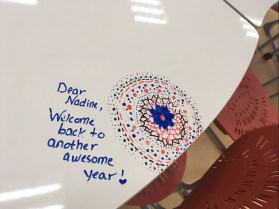
I must admit I really love my Furnware chairs and tables. My students love them too and my teachers are just a little big jealous of them – but they’re still sweet enough to leave me nice notes

img_5927.jpg

on the writeable surface! The chairs are quite heavy, but stackable and the “rocky” children love the fact that they can wiggle without falling over backward.

The beanbags are a mixed bag. Another no-no if you ask librarians, but on the balance I’d say I’m glad we have them. We have 12, and so far only one has had an issue with a zip, and that’s been repairable. My students were warned that if they “died” an unnatural death due to abuse they wouldn’t be replaced and they’ve been fairly good about policing each other about the usage. They’re super light and moveable, and it’s lovely to see how the students create their own spaces either sociable or isolated by the positioning of themselves relative to the bag and other bags and people.

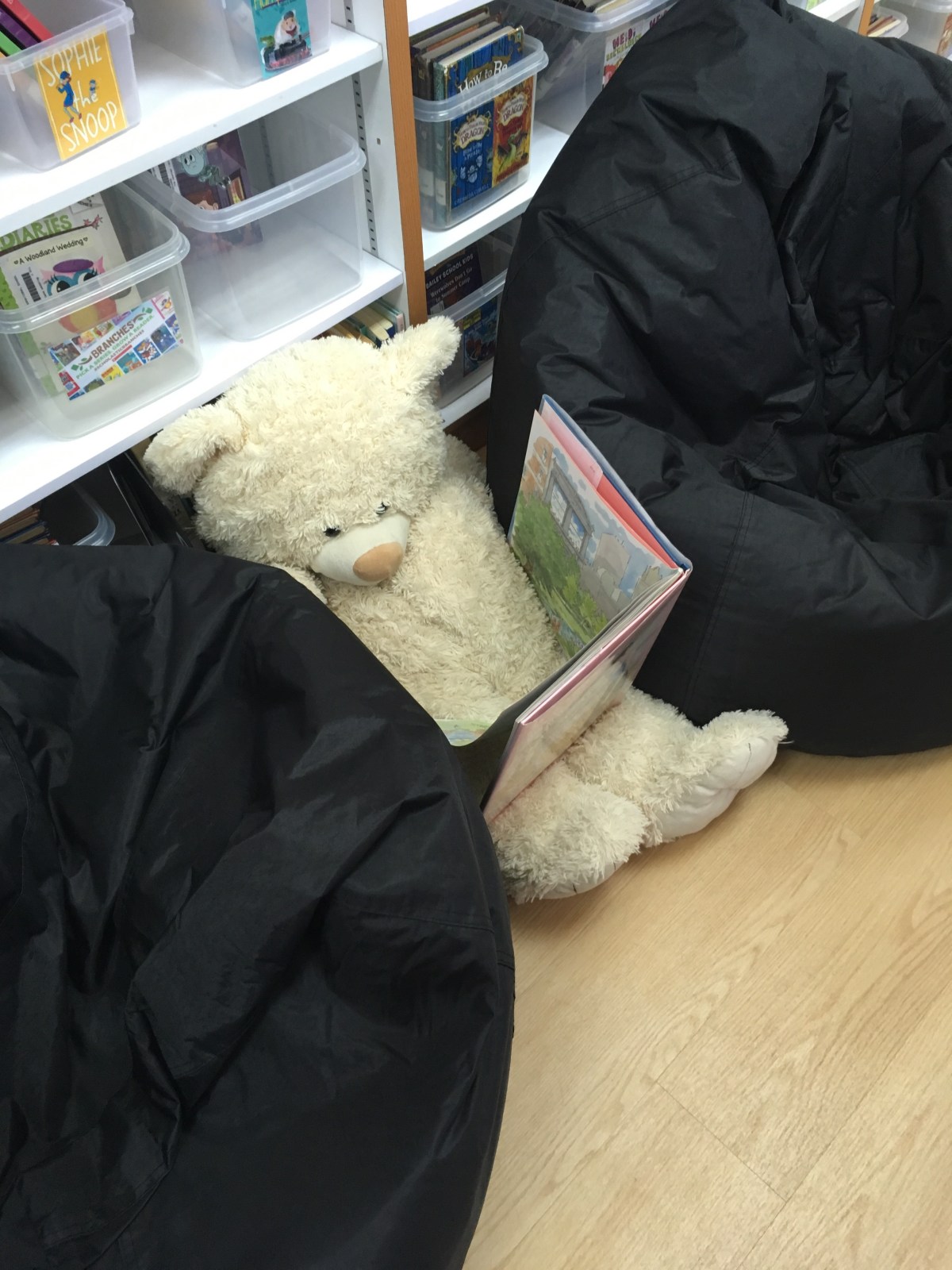
We have 2 of the green armchairs, which are good for adult sized people and a couch in the classroom. Since it’s a primary school though – they also spend a lot of time sprawled out on the floor or on the mats. (Don’t you love the sense of humour – some of my kids left Bear reading a book after recess one day).

There is of course a lot of dragging bag back into place after recess ready for class, and I really need some kind of solution for my side classroom as it’s not ideal, but I need time to think about it and live in it more first.

Signage

We went with Merchandising Libraries for our signage and on a whole I’m quite pleased with how it turned out. We used their shelf-talkers, fiction section dividers and junior section dividers. We used plain black with white to go with our corporate look and feel. for the “inbetween” bits I use old VCR holders and print out the signage black background, white lettering. Cheap and good looking.

I had to order in a hurry to have it ready, and order everything at once and I only had the catalog rather than physical objects to go by.  This is what it looks like:

If I had to do it over, I’d stay with the Junior section dividers and the alphabet for my fiction sections but another solution for the picture books and junior section as the A-Z tends to stick out too much for little people with a poor sense of  proprioception. I also regret the fact that I don’t really have a good place to signal dewey. I’m still thinking about hanging something from the ceiling, but I hated that when I first arrived, so I’m going to have to think some more.

Part of signage is display space, and I’m really happy with that. The thin slats at the door and space above allow really flexible displays of books and student work.  And I love my pillar disguising round display space. Yes the variable signage above the slats could be better than just print outs on paper – ideas?

Next project – well, my children’s orthodontist had THIS in his surgery – talking to our open-minds coordinator about doing something similar when our G2’s have their plants unit …


Can we be smarter with communicating benefits of reading?

During the vacation I’ve been catching up with some podcasts, including listening to a few new ones that were recommended to me by friends. While there are some great educational podcasts out there, sometimes while one is looking outside of the field that you are struck by things that are relevant.

So it was with this podcast from “You are not so Smart” based on research on how to deal with climate deniers with Per Espen Stocknes.

Because sometimes (most the time) when looking at reluctant readers I’m pretty sure I’m missing the boat on how to communicate effectively and meaningfully with them. Like the time I asked a group why they thought I kept trying to get them to read more and they basically said “because it’s your job Ms!”

So the thing is, there are 5 different ways that you can mess up your communication, which result in the “backfire effect” whereby people negate your message and turn all defensive on you. So you’d be better off saying nothing, than saying something that gets folks’ psychological back’s up.  While the talk related this to climate change I’ll re-interpret them along the lines of getting kids and their families (and even gasp, teachers) to read more, read together, read-aloud.

  • Doom and Gloom
  • Distance
  • Dissonance
  • Denial
  • iDentity

In the doom and gloom scenario you’re telling kids that if they don’t read they’re going to fail, drop out, go to prison, not get a good job, not get into college etc. if they don’t read. Psychologically this leads to a guilt and fear mind frame in the audience, increased passivity and avoidance. When what we really want is for parents and students to jump into action with a plan of daily reading! Another problem with those messages – it’s all too abstract and too distant. It’s the issue that that the problematic future is well, in the future, and right now they’d rather be playing an online game, or kicking a soccer ball. The locus of control is also presumed to be outside their scope of influence, there is reduced urgency and personal agency leading to a feeling of helplessness.

Cognitive dissonance is a very tricky thing when dealing with parents. Every parent, no matter what they may be struggling with privately or publicly with their children have to be believed to be doing the best they can with the knowledge and tools at their disposal. Ditto teachers (I include teachers as there are many teachers who do not read, and do not find reading pleasurable, and struggle with “walking the talk”). When people tell you that you should be reading to your child or reading more, or reading differently that kind of flies in the face of your image of yourself as a good and successful parent and person. And so what one often hears is “I/my husband / his grandpa/ never was much of a reader, and they turned out OK”  or even “we have plenty of books at home” or “he/she borrows books every week“. All of which may be perfectly true, even if those books may never be opened and read … and it’s the “right” answer to shut up a concerned teacher / librarian.

Denial is another mechanism frequently employed – one comes out with some latest research or study that reading is the answer to life, the universe and everything, and all sorts of things get thrown back at you – like “I read that if you read online it’s not effective” or “all they want to read is graphic novels” or some kind of moral licensing – “but he/she is very involved with the school play / the band / Kumon worksheets and doesn’t have the time for reading” and “he/she is doing just fine in class” or even worse “but X is struggling much more“.

The final point has to do with identity.  Everyone, from young students up need to protect their self-esteem and keep their identity intact. For some of my students it’s very important to be cool. And being cool doesn’t involve struggling or appearing to struggle at anything. For many families caught up in the fairyland of expatriate existence, a veneer of “everything is fine” is also very important. Problems with reading – fluency, comprehension, language, and admitting to those problems does not gel with that identity.  At this point a lot of blame gets thrown around. The teacher who didn’t teach properly. The librarian who put them off borrowing after they lost a book. The teacher who won’t let them borrow batman books or insists on “just right” books.  It’s a tough one and part of what we attempted to do with “Blokes with Books” is to make reading cool and social.

Right, so what to do about this.  There were 5 solutions offered by Stocknes and I’ll relate these to what I’m trying to do, and plan to do in the new school year.

  • Social
  • Signals
  • Simple
  • Supportive
  • Storytelling

Keeping things social is something I absolutely subscribe to. As I’ve said so often before, contrary to belief, reading is not a solitary activity. It is social. The kind of things that my students enjoy are book clubs, sitting and reading the same book at the same time and turning the pages at the same time. Reading in a group of three of four and raucously pointing at things and exclaiming.

Feedback and signals need to be those that people can relate to and are relevant.The antidote to distant gloom and doom is making things near and personal, since good behaviour can be contagious – particularly if it’s acknowledged and there is some positive comparison going on. Now this works brilliantly with electricity consumption in the examples given, but I’m a little wary of competitive reading. Cue in all the research done by Krashen et.al and the dangers of extrinsic versus intrinsic rewards and the virtues of free voluntary reading. I’d be the last to deny that (some) kids appear to be motivated by reading points, scores, levels etc. But I’m still not prepared to make that the focus of my efforts. I’ve been thinking long and hard about what kind of comparisons are relevant and meaningful.  One that I’ve used on my students has been to work out the median number of books students in their class and grade read each month and ask them to compare themselves.  The best thing we’ve done for our reluctant (male) readers has been the “blokes with books” club, which has helped both with identity and social belonging.

Schools and homes are incredibly busy environments. It’s imperative to keep things simple and easy, with low barriers.  Some things I’ve already put in place, like allowing students to borrow books on four occasions daily (before and after school at recess and at lunch) on any day of the week, in addition to their normal weekly library lesson with their class. There kind of are limits on the number of books they can borrow based on their age, but they all know that’s negotiable. Likewise parents can now join and supposedly borrow three books at a time, but we have some parents who borrow more and one who gets around 10-20 every Friday, as she’s a working parent and doesn’t get to the library every day. I don’t mind, as long as they keep returning.  Classroom libraries are also a great way of ensuring books are in the hands of students.  That still needs more work.  All our classes have class-libraries, but they’re not functioning optimally. This is a loaded area. The library is “my” domain (but not really) and the class “theirs”, so I can implement best practice with abandon in the former and have to tread carefully in the latter.  What would I like to see / do differently?  More movement more regularly in the class libraries – now books are checked out for the year. Self-checkout / check-in in the classrooms – my fault in prior years and I really need to get that going this year. More weeding of old, tattered and yucky books – it’s starting to happen.  Nicer display – need to think about that as it’s definitely crossing the line. Maybe a workshop on class libraries?

Providing a supportive framework – takes time. Time for you to get to know the students, the teachers the parents. Sticking to the message of the importance of reading without the judgement. Being there and listening when one of the parts of the reading ecosystem need to unburden or get a book list or suggestions without jumping to conclusions or formulaic solutions. I’m incredibly fortunate to have a supportive administration and principal and (so far) an adequate budget, and library assistants who are buying into creating an environment conducive to encouraging reading.

Finally incorporating the storytelling format in communication. Stories need to be personal and individual and incorporate an element of dream actualisation.  I’ve been doing a bit of this around the PYP and Singapore environment (most recently at the AFCC), the stories of the gains my formerly reluctant readers have made compared to their peers really is motivating.  Success stories are wonderful.  But struggle stories are also relevant, and the fact that I have a reluctant reader at home keeps things real and personal. I have no pedestal to preach from as I’ve been exposed to every excuse, every battle, and tried every possible solution myself and I’m still only partially successful in my efforts.

As the new school year starts I hope all your reading dreams for your students come true!

Junior fiction – what’s hot and what’s not

It’s a public holiday today, so instead of doing what I should be doing (making questions for the Readers’ Cup), I’ve been ordering replacement FollettBound books – for the ones that have fallen apart and are now out of print.  Easier said than done. There’s a reason (some) books go out of print. And junior fiction is a very special and dare I say, very fickle, niche in children’s books.

I started looking through our lists of what’s circulating and what’s not and it was rather fascinating how tastes, and perhaps even reading ability is changing over the years. Our Junior section caters for the Grade 1 to 3 crowds (6-8 year olds). Or to be more accurate, those who have gone past the early readers and are not quite ready for more substantial chapter books yet.

[Have I ever moaned about Follett Destiny before? If not, just a little aside about how difficult it is to get the kind of reports you’d like to have easily. So for this exercise I ran a “Shelf List” by call number, grouping call numbers together, and requested circulations for the last 2 years and publication date (price is the other alternative – economically useless because for my purposes cost is sunk cost, the only relevant piece of information here would be publication date and acquisition date – since newer books have had less time to circulate… are there any real current or former librarians actually working at Follett one has to wonder?). ]

Looking mainly at series – because this is so the age of reading series, what’s happening amongst my elite little bunch of international kids in Singapore?

What’s Hot 

Screen Shot 2017-05-10 at 15.03.32

  • Geronimo and Thea Stilton (may I admit I’m not rushing to replace these as they die a natural death through over-circulation?)
  • Billie B Brown
  • Star Wars
  • Heidi Hecklebeck
  • Go Girl
  • Captain Underpants
  • Jake Maddox
  • Sports Illustrated Kids / Jake Maddox
  • Dinosaur Cove (and oldie, still hanging in there)
  • Minecraft adventures / Zombies (I don’t think they’re actually reading these as the level is too high for them – need to replace them with something easier)
  • Secret Kingdom
  • Danger Dan (yay for local authors visiting who make a difference)
  • Jill Tomlinson (yay for teachers who champion good authors)
  • Red Dot Books (anything on the current and prior year’s list)

What’s gaining Traction

  • Scholastic Branches series – especially Princess Pink & Owl Diaries
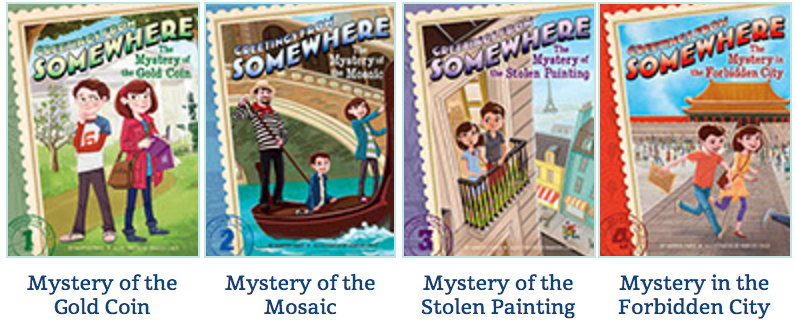
  • Greetings from Somewhere
  • Galaxy Zack
  • Dragonbreath
  • Kingdom of Wrenly
  • Dory Fantasmagory

What’s Surviving

These titles are circulating regularly but not spectacularly – but not badly enough to be culled. And some may have merit imho so I probably need to push some of them more

Screen Shot 2017-05-10 at 14.50.50

  • Zac Power
  • EJ12
  • My Weird School
  • Judy Moody
  • Magic Treehouse
  • A-Z mysteries
  • Clementine (I personally love this, so need to push it as a read-aloud)
  • Roald Dahl (the older books do better than the early books)
  • Ready Freddy
  • Cam Jansen
  • Horrid Henry – but not Horrible Harry (both I think are awful)
  • Rainbow Magic (although some titles are not going so may be time to cull a box of these)

What’s Not

  • Marvin Redpost
  • Nancy Drew Notebooks
  • Tashi
  • Bailey School Kids
  • Box Car Children
  • Owen Foote

Find out more about what our students like by visiting our “top 10” lists of Fiction, Junior Fiction, Picture Books and Graphic Novels.

It’s not (just) the book

This is a post I’ve been meaning to write for a while. A long while. I’m a member of quite a few librarian and school librarian groups and invariably, at least once a month, a question will pop up asking for a “killer” book. Either one that is perfect for reluctant readers, or one that will entice students to read, or the perfect book for boys, for grade 2, 3, 6, middle grade. There is an assumption out there that there’s a quick fix. That one book that will transform lives, transform non-readers to readers. It’s that one dose of the right drug that will make of our students little reading addicts. Firmly entrenched in the Judaeo-Christian culture of the “road to Damascus”. There is a similar culture amongst dieters and sports people. The one tablet, the one food, the one diet, the one coach.

The truth I’m afraid is more nuanced. Yes there are books that capture and imagination and hearts and minds. Just as the “Kid magician” captured that of my BWB (Blokes with Books) last year. But I think once the flame is kindled with a book, the fire needs to be continually fed in order to keep burning.

Since I’m giving a session at the AFCC I was asked to provide a book list so that the books could be available after the session for parents and students to purchase. So on Friday I asked my blokes to write down the top 3 books that they’ve read in the last few months. When they’d done that some grumbled that 3 wasn’t enough, so I let them also add “the ones that got away”.  I’ve just gotten around to analysing the list. Now a list is a list prima facie, unless you have a very good feel for what is going on in the school and the environment it would be very easy to misinterpret this list and think that there was something special about the books.  Yes, each of the books selected by the 21 boys have merit, but there is more.

  1. The top books are books with “cult status“.  I deliberately said they couldn’t choose “Wimpy kid” because it’s already at the top of my “top 10 fiction” lists each month. It’s also the book that everyone always mentions as a panacea to reluctant readers. We know that, let’s move on. So in our top books we find the series of “Storey Treehouse” (Andy Griffiths and Terry Denton). Then comes Harry Potter (JK Rowling) – who is still making his mark, followed by Amulet (Kazu Kibuishi) and Conspiracy 365 (Gabrielle Lord).
  2. The next set of books are very special. Mainly because I KNOW they were teacher read-alouds to various classes. This I think is very important. Yes they are great books, I know because I recommended them to the various teachers. But they aren’t always the easiest books to read independently. These include Because of Mr. Terupt, Pax, Wonder and City of Ember. I cannot over emphasize the importance of teachers reading books aloud to their classes. Particularly “first in the series” books.
  3. The following set shows the power of carefully selected books for national or regional book awards. In this instance the “Red Dot Book Awards” run by the ISLN. Of the selection for 2016/7: Secrets of Singapore; Confessions of an Imaginary Friend; The Thing about Jelly Fish; Blackthorn Key; Bronze and Sunflower; and Circus Mirandus; made the lists. Once again, these are books that students probably wouldn’t naturally gravitate towards, but which have received a lot of publicity in the school, we have at least 6 copies of each which means they’re more widely available and read and talked about.
  4. The power of author visits. During the past year we’ve had the authors of these titles, and it’s shown clearly in their popularity: Sherlock Sam, Secrets of Singapore / Danger Dan.
  5. The rest. What is so interesting about the list is that 21 boys selected 36 different titles in their top 3 lists and a further 10 titles in their “ones that got away”. I really like that. It shows an increasing maturity in reading and a diversity in taste and choice.

The complete list can be found here:

BWB favourites


#1 Digital resources

In an attempt to blog more regularly, I’ve signed up for a challenge – so these posts will be in amongst all the other stuff I may be blogging.

#FutureReadyLibs 10-Week #BlogChallenge Challenge #1: How did you get involved in the Future Ready Schools/Future Ready Librarians initiative? Are you involved in the district strategic planning process? What is your vision for a future ready school? What makes you a Future Ready Librarian?

How I got involved

Well I guess it was just a result of being added or adding myself to a Facebook group that looked interesting. Sometimes things just happen that way.  Also since I’ve just finished my MIS and M Ed degrees I’m still vaguely interested in this type of thing, in order to keep my learning up to date.

frlblogchallenge1I think our school, as an IB PYP school is pretty future-ready in many aspects, in fact sometimes I think the cost of being “future ready” is that you occasionally need to go “back to basics” and check up on the 3 R’s and make sure you stay sober and self-critical.

Am I future ready as a librarian? Looking at the little graphic on the left, I can tick most of those boxes, or slices, inasmuch as things are in my power at least. And where not, I’m constantly nudging for change.

I’m not entirely sure if I’m on the right topic for this week – I’d note “digital resources” so I’ll write a little about that.

Curates digital resources and tools:

When I started my job at my current school I’d come from working part time in a secondary library where a large part of my time was spent creating library guides for the Middle & High School (including the IB).  I was lucky to have Katie Day as my mentor, and we had many many discussions on how to curate resources so that students had easy access to them from their laptops (they’re a one-on-one macbook school in secondary). The idea was to have digital resources in the form of videos, curated Flipboard articles and database access, but at the same time make our physical resources digitally visual and “clickable” for later borrowing as necessary.

Screen Shot 2017-03-28 at 4.55.31 PMSo, a few weeks into my new job I discovered we had an unused library guide subscription, and I immediately put it to work. Of course curating for primary is a somewhat different proposition. Immense more thought and care needs to be put into ensuring things are age appropriate – in content, in level and in access.  And I was a newbie … so it was a case of building things and hoping they would come. It’s taken a while. After the first year, a couple of teachers were on board, and now more and more are coming to expect and use the resources. My main objective is to move away from letting kids “just google it” to an idea of just like we don’t throw a bookshelf full of books into their UOI (unit of inquiry) boxes, but make sure they’re appropriate for the grade level, for the central idea, for the lines of inquiry, and may even evolve as they go through a unit, so too we can have digital resources that are similarly curated.

A few things have been a huge boon in this respect.  In the first instance I cannot express my admiration for Epic books enough. They are an absolute game changer.  In terms of depth and breadth of their books they far surpass the incumbents such as Tumblebooks. I do have some librarian type quibbles with a few of their set-up methodologies, but that’s small fish compared to what they’re achieving.

Secondly, Springshare – the owners of Libguides are just phenomenal in their ability to constantly evolve and develop their platform. I love the fact that the libguide community are so amazing in their ability to creatively curate, to combine physical and digital and particularly the fact that they demonstrate CREATION and SHARING, which is absolutely what a future ready community should be about.  Also, my desire to make good looking guides has pushed me to learning some (very basic) HTML which never ceases to impress the fine young gentlemen and ladies in my library who then realise I’m not just an old library lady!

Thirdly LibraryThings for Libraries through their book display widgets they bridge the gap between a lovely visual interface (libguides) and an old stodgy very unfriendly catalog (Follett Destiny).

As far as tools are concerned. I try to keep introducing appropriate tools to my students and to fellow teachers – but only if they are meaningful. It’s a balance. Our students are “over tech-ed” and we’re getting a lot of pushback from both parents AND students about the amount of time they spend in front of a screen. So where it saves time, hassle, helps make things neat and well spelt, sure. Otherwise it’s back to the physical.

Empowering Students as creators

I’m very fortunate to be in a school environment where there is an EdTech coach and a STEAM coach. So wild ideas for physical or digital creation can be co-shared with them. We’ve had students create book trailers, book recommendations, book spine poetry, book covers, their own books, display work pieces in the library etc.  I don’t think any of that is particularly special though – most librarians do that kind of thing in conjunction with their students and teachers – it sure makes displays easier!

Builds instructional partnerships

That part is definitely a work in progress. It’s tricky. I could blame a whole host of things – fitting in 35 classes a week on a fixed schedule, a yet to be approved information literacy scope and sequence that’s embedded in the curriculum, running, managing and keeping up to date (and renovating) a facility, curating digital resources in library guides … but instructional partnerships is a ball I’ve dropped. Or actually never really properly had in the air. It works piecemeal, depending more on relationships and invitations than being structural. I’m working on it with my fellow librarians from our other campus, the head of curriculum etc. It takes time is all I can say. And I don’t think I’m the only one saying it judging from the comments of my fellow teacher-librarians.  I beat myself up about it a LOT in my first year. To the point of tears. This year I’ve been distracted a bit by the renovation and staff medical issues. But we’re inching there.  Watch this space.

Frustrations of a librarian

And it’s not the usual stuff about being poor misunderstood under-utilized bits of the school / community.  No, the frustration goes much much further.  It’s about how information, knowledge, books, data, well just about anything is NOT being tagged and catalogued and made generally searchable, available.

What prompted this?  Well my inbox. I subscribe to a few blog sites that are, well let’s say prolific is an understatement.  One is the NerdyBookClub and the other is  Global Literature in Libraries Initiative  and the last is Gathering Books. And do you know what is terribly frustrating – I get behind on the reading. Terribly behind. And I know there are all sorts of ways of IFTTTing your inbox, but what I’d prefer is that theses consortia of writers (because no one human can be so prolific, so usually the blogs are written by teams) would just tag their posts, and make the tags obvious at the TOP of the blog, so that I know whether to read it now or leave it for later or just delete it.

Let’s take some examples that I’ve been reading today in a desperate attempt to tame my inbox:

GLLI: French Graphic Novels in translation – not categorised and no tags. If I’d been writing that post it would have had the tags of: French, Translation, Graphic Novels, Middle Grade at the very least. Then I’d immediately know that it’s worth a read, because I need to increase the diversity of my collection, so some French books in translation are relevant. My students love GN’s so that would have caught my interest but NOT if the tag included YA, since right now I’m in K-6

NBC: A look at expository literature: again, the only tag is the author and their twitter tag. Not enough. I needed to know that they were talking about: picture books, nonfiction, mentor texts, and that it included a booklist. 

Gathering Books: Fears etc. again a fabulous site with resources, but the layout and curation makes my head spin and spin and spin. It’s really hard to find stuff, there are so much great reviews going on, but then sometimes it’s poetry, sometimes it’s other stuff. The posts are allocated to categories, but don’t seem to be tagged, so if I wanted to see all the book reviews on grief, or death, or migration for example I wouldn’t be able to do so.

And then the HUGE question of where all this goes?  And it’s a really big question. Because we all know the problems of finding great and diverse literature. Of finding authors with a unique voice who are new and interesting and not part of the publishing machinery. Ones that aren’t institutionalised onto the same old same old top 10 lists.But why do we keep going back to those lists? Because it’s so easy.

Where are all these fabulous blogs curating their book lists? Where are the catalogues? Are they on Goodreads with a proliferation of shelves or on LibraryThings with 100s of tags and collections?  Where are the links and the connections and the overlaps? Even the ones working together (like NBC) seem to be working on their own.Their site has a store selling mugs for heavens’ sake. The list on the side is a list of their bloggers, not of the books / categories / shelves. Even the Nerdies – their awards page, is an unlinked list of books that is not tagged or categories in any way… where are the librarians? This is not a criticism of what they’re doing – they’re doing some fabulous things – it’s about how they’re doing it, and how much easier it could be for their readers / followers!


Buying the future of research …

There’s been quite a to-do on librarian sites recently about the acquisition of RefMe, an academic citation tool by Chegg, a purveyor of online textbooks and tutors (and more). Before you click past this, let’s have a little look and think about this business model…

The citation engine issue

In the opinion of my peers – CiteThisForMe is an inferior product to its precursor RefMe. To be technical about this –
  • it doesn’t allow for importing .ris files from databases (a common standard)
  • you can’t create folders for citations
  • user interface is poor
  • numerous popup boxes for editing
  • no google SSO
  • no easy import function from existing products
  • it’s not terribly good or accurate
  • etc.

So far it seems one librarian wrote about the take-over with foreboding  but again, more from a technical point of view. It’s just not a very good product. As he pointed out – none of the “quick and dirty” products are very good. For non pure-academic sites (i.e. paid databases) It boils down to whether some back-end programmer has bothered to capture much (if any) meta-data on author, date, title etc. And I’m afraid to say that’s exactly the type of site most of our students cut their researching teeth on. Think of it as the crack-cocaine of citation. You add a chrome extension, you go to a website / youtube video / online newspaper and click the extension and like magic your citation is generated. But not quite. At worst it’ll just pick up the URL, at best perhaps a title and author. And I’m afraid to say most teachers grading “research” are long happy that even that’s been included in a bibliography or works cited or reference list.

From boring citation to sexy ‘critical moments’

But actually none of that really matters. Well it does, sort of, eventually to the people who matter who care. What is somewhat more concerning is this.
The first time RefMe came into the (financial) news in a serious way was in 2015 when GEMs Education threw some money at it. Educational companies don’t throw money at citation tools unless there’s something in it for them:

But it isn’t just students who are showing an interest in the platform, RefME has received £2.7 million backing from GEMs Education, the largest private education company in the world. They want to encourage more schoolchildren to use the app, as pupils are now increasingly having to reference too.

‘We’ve identified 150-200 million kids around the world who cite,’ said Hatton.
The platform also does more than create references – RefME collects information about what people cite, making a map of the data. This means it can give you recommendations based on what other people who used that same citation went on to find, something Hatton calls ‘removing the search from research’.

Then the Chegg acquisition 2 years later, and one of the first things you see when you open their site is side by side in the news is the financial results and the tie in between this “academic” provider and a “global media agency”
Screen Shot 2017-03-16 at 8.15.43 PM
Screen Shot 2017-03-16 at 8.11.25 PM
Bait and switch tactics …
and when you read the terms and conditions you find out:
The Services may collect “Personal Information” (which is information that can be used to identify or contact a specific individual, such as your name and email address), account information (such as a password or other information that helps us confirm that it is you accessing your account) and demographic or other information (such as your school, gender, age or birthdate and zip code and information about your interests and preferences).

And you thought FaceBook was bad …


“When you submit, post, upload, embed, display, communicate, link to, email or otherwise distribute or publish any review, problem, suggestion, idea, solution, question, answer, class notes, course outline bibliographic and citation information comment, testimonial, feedback, message, image, video, text, profile data or other material (“User Content”) to Chegg, any Chegg employee or contractor, or a Chegg Website, you grant Chegg and our affiliates, licensees, distributors, agents, representatives and other entities or individuals authorized by Chegg, a non-exclusive, worldwide, perpetual, unlimited, irrevocable, royalty-free, fully sublicensable (through multiple tiers) and fully transferable right to exercise any and all copyright, trademark, publicity, and database rights you have in the content, in any media known now or in the future, and to make, use, reproduce, copy, display, publish, exhibit, distribute, modify, sell, offer for sale, create derivative works based upon and otherwise use the User Content.
Note that we may create, facilitate or display social advertisements, whereby your name, profile and photo may be used to advertise products and services to your network based on your use of the Services and your interactions with Chegg. You agree that Chegg may use your name and profile picture in connection with social ads to advertise products and services to your network based on your use of the Services and your interactions with Chegg and third parties through the Services.
You further agree that Chegg is free to use any ideas or concepts contained in any User Content for any purposes whatsoever, including, without limitation, developing, manufacturing and marketing products and services; and creating informational articles, without any payment of any kind to you. You authorize Chegg to publish your User Content in a searchable format that may be accessed by users of the Services and the Internet. To the fullest extent permitted by law, you waive any moral rights you may have in any User Content you submit, even if such User Content is altered or changed in a manner not agreeable to you.” (Privacy Policy)
Well actually FaceBook is bad – the worst possible place to put all that information exchange and community knowledge and knowhow, (I’m looking at you my lovely library networks on Facebook), but we kind of know it’s bad and we live with it for all kinds of reasons, and most of us (I hope) extract the useful stuff and put it elsewhere like Evernote or GoogleDrive or … (oops who owns it then!?).
When Chegg bought Easybib, this is what the press release had to say:
“In the last 12 months, Imagine Easy’s bibliography and research tools powered about 240 million sessions and EasyBib alone saw more than 7 million unique users in March 2016, Chegg tells me. In total, all of these services together have helped students from mangling more than 1.4 billion bibliography entries.”
Bear in mind, nothing you do in their services is actually yours, not even the services you may have paid for:
Service Modifications
Chegg reserves the right, in our sole discretion, to make changes to or discontinue any of the Services at any time. Any description of the Services provided by Chegg is not a representation that the Services are working or will always work in that manner, as Chegg is continuously updating the Services, and these updates may not always be reflected in the Terms of Use.
Now this is one thing if you’re a Grade 5 student and with much blood sweat, tears and encouragement from your teachers, librarian and parents you’ve managed to come up with a bibliography of 3-5 items that say more that “wikipedia” or youtube.com. It’s quite another if you’re a serious researcher at say doctorate or post-doctorate level and have a few thousand articles referenced, with abstracts and perhaps attached documents or pdfs. Or if your 4,000 word extended essay is due in a few weeks time to finish off your IB, and the RefMe plug is pulled with practically no sensible communication from the company from the announcement at the end of January to about a week before the pulling of the plug on the 28th February (the Facebook trail of increasing panic and despair is awful – and that was just the librarians) – twitter showed some upset students but not as many as one would expect – perhaps the RefMe user base wasn’t that big or serious about social media – or they were too busy scrambling to migrate their data to an alternative platform.
So what is Chegg buying (by the way, the numbers are still relatively small potatoes in investment speak, but they’ve got ambition!)
If you have a look at last year’s financial report, this bit, where they refer to the acquisition of EasyBib is relevant:
With education representing a trillion-dollar opportunity in the U.S. alone, we believe that the number of students who will leverage online tools, use the services we have, and then benefit from new services that we plan to offer will increase dramatically over the next decade. That is why we continue to make strategic investments to take advantage of this growing opportunity. At the core of our success is reaching more students than anyone else, knowing more about them than anyone else, and leveraging that data to improve our products and services, acquire customers for less, and increase their customer satisfaction. That is the essence of what the Student Graph does, and we have been consistent in our product and business development strategies by investing in services that can both leverage and contribute to the Student Graph which accelerates our growth. That was the driving force behind our acquisition of Imagine Easy which has been one of the quickest and most successful integrations into the company. With 30 million annual unique visitors according to comScore, we continue to be confident that this acquisition is an enormous opportunity for students, for Chegg, and for our shareholders. There have been over 1.5 billion citations created to date with more than 400 million new ones added in 2016 alone. Already we are exceeding the expectations we have for the business and it is quickly becoming a core part of the Chegg Services platform.
The financial results are quite phenomenal actually – they’re making money, real money off a digital platform. They’ve got current students by the short and curlies and a pipeline of 200 million school kids to add to their existing user-base in the coming years. Lure them in with solving the citation hassle and then move them up the feeding chain to online textbook hire and tutors and test prep. As a former finance person I must say this is smart. I’m also wondering how much of their revenue is from selling their customer data on to media companies and all the social media / off-line entertainment type tie-ins?
So, that’s that for what’s going on in the otherwise boring old citation world… and now the next thing – online paraphrasing anyone?  Soon all you’ll have to do is get into a university (another service offered by Chegg) and the just physically sit out (or party through) your 3 or 4 years while the digital tools take care of all the messy bits of assignments and hand ins.
(ps. if you want to know what I recommend for what it’s worth? NoodleTools for K-12 students, and Zotero thereafter. And no, I don’t get a commission from either of them, and yes I pay for both for the premium service).