It’s not (just) the book

This is a post I’ve been meaning to write for a while. A long while. I’m a member of quite a few librarian and school librarian groups and invariably, at least once a month, a question will pop up asking for a “killer” book. Either one that is perfect for reluctant readers, or one that will entice students to read, or the perfect book for boys, for grade 2, 3, 6, middle grade. There is an assumption out there that there’s a quick fix. That one book that will transform lives, transform non-readers to readers. It’s that one dose of the right drug that will make of our students little reading addicts. Firmly entrenched in the Judaeo-Christian culture of the “road to Damascus”. There is a similar culture amongst dieters and sports people. The one tablet, the one food, the one diet, the one coach.

The truth I’m afraid is more nuanced. Yes there are books that capture and imagination and hearts and minds. Just as the “Kid magician” captured that of my BWB (Blokes with Books) last year. But I think once the flame is kindled with a book, the fire needs to be continually fed in order to keep burning.

Since I’m giving a session at the AFCC I was asked to provide a book list so that the books could be available after the session for parents and students to purchase. So on Friday I asked my blokes to write down the top 3 books that they’ve read in the last few months. When they’d done that some grumbled that 3 wasn’t enough, so I let them also add “the ones that got away”.  I’ve just gotten around to analysing the list. Now a list is a list prima facie, unless you have a very good feel for what is going on in the school and the environment it would be very easy to misinterpret this list and think that there was something special about the books.  Yes, each of the books selected by the 21 boys have merit, but there is more.

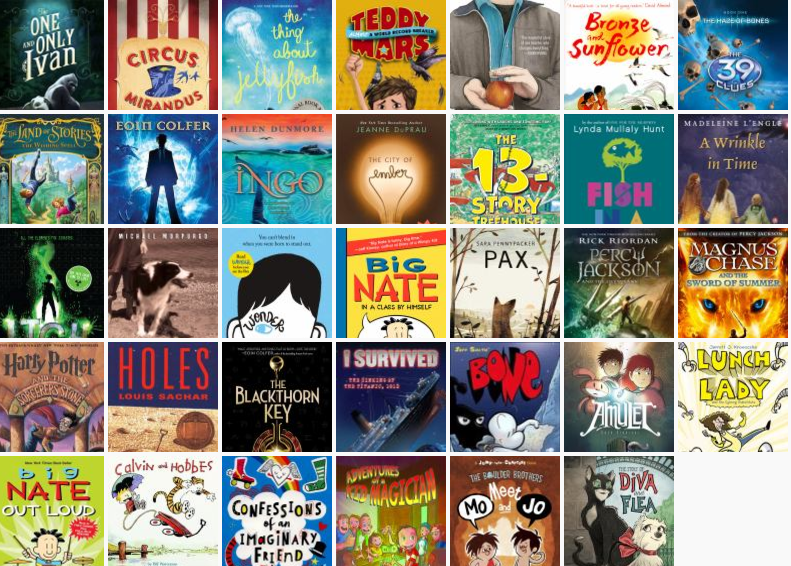
  1. The top books are books with “cult status“.  I deliberately said they couldn’t choose “Wimpy kid” because it’s already at the top of my “top 10 fiction” lists each month. It’s also the book that everyone always mentions as a panacea to reluctant readers. We know that, let’s move on. So in our top books we find the series of “Storey Treehouse” (Andy Griffiths and Terry Denton). Then comes Harry Potter (JK Rowling) – who is still making his mark, followed by Amulet (Kazu Kibuishi) and Conspiracy 365 (Gabrielle Lord).
  2. The next set of books are very special. Mainly because I KNOW they were teacher read-alouds to various classes. This I think is very important. Yes they are great books, I know because I recommended them to the various teachers. But they aren’t always the easiest books to read independently. These include Because of Mr. Terupt, Pax, Wonder and City of Ember. I cannot over emphasize the importance of teachers reading books aloud to their classes. Particularly “first in the series” books.
  3. The following set shows the power of carefully selected books for national or regional book awards. In this instance the “Red Dot Book Awards” run by the ISLN. Of the selection for 2016/7: Secrets of Singapore; Confessions of an Imaginary Friend; The Thing about Jelly Fish; Blackthorn Key; Bronze and Sunflower; and Circus Mirandus; made the lists. Once again, these are books that students probably wouldn’t naturally gravitate towards, but which have received a lot of publicity in the school, we have at least 6 copies of each which means they’re more widely available and read and talked about.
  4. The power of author visits. During the past year we’ve had the authors of these titles, and it’s shown clearly in their popularity: Sherlock Sam, Secrets of Singapore / Danger Dan.
  5. The rest. What is so interesting about the list is that 21 boys selected 36 different titles in their top 3 lists and a further 10 titles in their “ones that got away”. I really like that. It shows an increasing maturity in reading and a diversity in taste and choice.

The complete list can be found here:

BWB favourites


Frustrations of a librarian

And it’s not the usual stuff about being poor misunderstood under-utilized bits of the school / community.  No, the frustration goes much much further.  It’s about how information, knowledge, books, data, well just about anything is NOT being tagged and catalogued and made generally searchable, available.

What prompted this?  Well my inbox. I subscribe to a few blog sites that are, well let’s say prolific is an understatement.  One is the NerdyBookClub and the other is  Global Literature in Libraries Initiative  and the last is Gathering Books. And do you know what is terribly frustrating – I get behind on the reading. Terribly behind. And I know there are all sorts of ways of IFTTTing your inbox, but what I’d prefer is that theses consortia of writers (because no one human can be so prolific, so usually the blogs are written by teams) would just tag their posts, and make the tags obvious at the TOP of the blog, so that I know whether to read it now or leave it for later or just delete it.

Let’s take some examples that I’ve been reading today in a desperate attempt to tame my inbox:

GLLI: French Graphic Novels in translation – not categorised and no tags. If I’d been writing that post it would have had the tags of: French, Translation, Graphic Novels, Middle Grade at the very least. Then I’d immediately know that it’s worth a read, because I need to increase the diversity of my collection, so some French books in translation are relevant. My students love GN’s so that would have caught my interest but NOT if the tag included YA, since right now I’m in K-6

NBC: A look at expository literature: again, the only tag is the author and their twitter tag. Not enough. I needed to know that they were talking about: picture books, nonfiction, mentor texts, and that it included a booklist. 

Gathering Books: Fears etc. again a fabulous site with resources, but the layout and curation makes my head spin and spin and spin. It’s really hard to find stuff, there are so much great reviews going on, but then sometimes it’s poetry, sometimes it’s other stuff. The posts are allocated to categories, but don’t seem to be tagged, so if I wanted to see all the book reviews on grief, or death, or migration for example I wouldn’t be able to do so.

And then the HUGE question of where all this goes?  And it’s a really big question. Because we all know the problems of finding great and diverse literature. Of finding authors with a unique voice who are new and interesting and not part of the publishing machinery. Ones that aren’t institutionalised onto the same old same old top 10 lists.But why do we keep going back to those lists? Because it’s so easy.

Where are all these fabulous blogs curating their book lists? Where are the catalogues? Are they on Goodreads with a proliferation of shelves or on LibraryThings with 100s of tags and collections?  Where are the links and the connections and the overlaps? Even the ones working together (like NBC) seem to be working on their own.Their site has a store selling mugs for heavens’ sake. The list on the side is a list of their bloggers, not of the books / categories / shelves. Even the Nerdies – their awards page, is an unlinked list of books that is not tagged or categories in any way… where are the librarians? This is not a criticism of what they’re doing – they’re doing some fabulous things – it’s about how they’re doing it, and how much easier it could be for their readers / followers!


Books I wish would be published

I’ve been asked to be on a panel at the AFCC to chat about “Books Teachers Wish Authors Would Write” from a teacher / librarian perspective. So I put the question out on one of my teacher-librarian networks (an international one) and these were the responses I received:
  • World war 2 in Asia- novel for 8-10 year olds (NF / NNF)
  • big shortage of narrative nonfiction that is NOT about the holocaust, slavery, the American great depression or US civil rights. Also shortage of intra-Asia migration stories not Asia to Europe / north America (NF / NNF)
  • Third culture kids as main characters (CD)
  • More stories about our present/ early future stories that include digital tools and behaviour (D)
  • I’m looking for things like “lego ideas / lego play” but in small manageable books that kids can take out without breaking their backs / the book
  • nonfiction – updated human rights / millennial goals / NGOs / Poverty etc. for G4 level (9 year old) mixed format, good graphic design, mix of narrative and fact (NF)
  • Middle school nonfiction – life in different economic / political systems – communist, socialist, social democracy etc. with a world wide unbiased view of positives and negatives with personal stories and data (NNF)
  • Books on gaming or from the creators of games like Minecraft, Roblox, etc. (D)
  • Conflicts over resources around the world – case studies that are elementary friendly (NF)
  • The next “The Outsiders.” Something to appeal to the teens who fall in love with it in class, and are looking for something like it.
  • Decent Biographies that are at elementary aged level & middle school level without being dumbed down – with more Asian protagonists! (CD / NF)
  • Books purposely written for upper ES that has appropriate content and reading “level” (ELL)
  • More ES novels featuring multicultural characters that are not related to war or historical events (CD)
  • Books about world topics that are appropriate for kinder/g2 (NF)
  • Modern urban indigenous stories – universal experiences in all first nations people. (CD)
  • Easy read stories that are well written & not dumbed down for teens. – yes! especially for our ELL students! And that don’t portray just the…..dark side of life? I feel like when I was purchasing for xxx, the high interest/low level books all were about gang members/drug dealers in the US. (ELL)
  • Science fiction for Elementary kids. (SF)
  • Middle Grade fiction with a Korean protagonist (My Name Was Keoko style) (CD)
  • Books with culturally diverse characters. I still remember teaching a boy could Yousef who threw the book down in disgust and said ‘Why can’t they give them normal names?’……the character was called Joseph. Which really isn’t that out there, unless you’re an Arab boy. Then it’s just weird. (CD)
  • LGBT books for tweens (G)
  • Definitely more emigration/immigration stories that are intra-Asia. There are so many diaspora stories to be told that have nothing to do with Europe or North America. (NF / NNF)
  • Does anyone want war stories set in Asia – like Japanese invasion/ Korean War / American or Vietnam war with perspective from the non-western side – or is that too sensitive? (NF / NNF)
  • My teachers want more World War 1 fiction for grades 6-8 and social justice books for middle schoolers.(NF / NFF)
  • My middle school girls want more heroes that are NOT princesses. (G)
  • My boys want fiction that has video game elements like Minecraft stories.(D)
  • All of my high schoolers want “classics” with better covers.
  • what about this: teachers, school, parents do not compare my score with others, do not give me homework, I want to play. (C)

I’ve tried to code the answers as follows:

  • NF / NNF: narrative nonfiction – 10x
  • CD: cultural diversity – 6x
  • D: digital / gaming element – 3x
  • G: Gender related – 2x
  • ELL: hi lo / books for English Language Learners – 2x
  • SF: Science fiction – 1x
  • C: cultural issue – 1x

Looking at these I think that the theme is a general frustration with a lack of books with an Asian context.  Particularly historical fiction / narrative nonfiction and culturally diverse characters. We all know that the USA dominates publishing, followed by the UK. Australia has some good stuff out but limits itself by its steep pricing, expensive shipping costs and insular publishing industry. China is a late entrant into children’s books and is making great inroads – but mainly in translation into Chinese. What is particularly commendable is that they are not just translating the (North) American staples but many of the brilliant and wonderful European offerings.

Then I did a similar exercise with the BWB (Blokes with Books) yesterday. I asked them to go in groups of 2-4 students and tell me what kind of book they were missing in their lives. Books they wish authors would write.   They were amazing – a couple of groups even started writing the books they wish were written (a nice outcome given the fact that teachers are now complaining that we’ve got them reading but their writing is still poor).

Their suggestions could also be broadly grouped:

  • Two groups wanted Harry Potter extensions or back stories – one wanted the parallel books that focused on the other houses, not just Gryffindor Tower. Another group was fascinated by the horcruxes and wanted a book on that.
  • One group wanted an elaborate Pokemon book that inverted some of the characters with unexpected twists.
  • One group combined the ideas of the three group members into a fantasy / reality mixture involving video games and rugby with a wimpy gaming protagonist being forced to play rugby by an over-zealous parent and learning tricks and manouvers in video games that led him to dominate on the real life rugby pitch.
  • One group wanted (and started outlining the chapters) of a Roblox user manual.
  • Quite a few of them agreed they’d like fiction books with colour pictures inside

I’d like to add a note to the above list – the students are not yet familiar with fan fiction, and I’m not sure they’ve looked into the Harry Potter wikis. In a sense that makes me happy that they’re still at that wonderful age where this type of magical immersive reading stuff is to be found in books rather than online. They are aware that there are user forums on these games and chat rooms etc. BUT THEY WANT TO READ ABOUT IT IN A BOOK. This is a GOOD thing. Whenever they ask for books about Minecraft and Roblox and video games and I tell them we have some of the storybook series, the Minecraft “how to” and “surely you can just ask online” they say “but we want a book”.  There are few Roblox books and they all seem to be eBook editions (publishing haste?). The Minecraft adventure books are not what they’re looking for – remember the colour pictures comment? They want more graphics! I think also as adults we see their online/offline selves as separate, whereas they don’t, and they want to see that new normal reflected in what they read. They’re all avid fantasy readers, and that I think is partially meeting their need for that online/offline fantasy/reality integration.

A caveat to all the comments (and a personal gripe) – above all children want a well written story. They don’t want to be preached to. They’re sophisticated and well- and globally read. And they can spot the fakes. As a teacher-librarian I get immensely frustrated by wanna-be and self-published authors who keep trying to foist their wares on me when it’s immediately apparent that they’re poorly written, even more badly illustrated, not edited and horribly and cheaply published. Writers need to read. They need to read a lot, they need to read widely. They need to research not just their topic but also who else has written about it, tangentially to it, similarly to it. If you want to self-publish, unless you’re a designer, pay someone to do your design for you. Unless you’re an author-illustrator find the best illustrator you can afford. And everyone, join a writing / critique group (like SCWBI) – honestly, other authors are not out to steal your ideas – they’re too busy working on their own passions. And when you think you’re done, get a good and critical editor. All authors need good editors, even great authors. Do yourself a favour and look at the interactive TS Eliot “The Wasteland” and see all the handwritten edits by Ezra Pound.

To come back to the forum and the original question that started all this:

“Creators can step into the shoes of a teacher for one hour and learn what makes a book a treasured find. From beautiful illustrations to didactic language, speakers discuss their views on relevant and useful books children need and love.”

What a huge question. Relevant is not always pedagogically useful. Useful for whom? Relevant to what?  I’d like to end with the most relevant and useful and just plain wonderful book I’ve encountered this year – Stormy seas: stories of young boat refugees. 

31213610 Well done Annick Press (that does a lot of amazing things – particularly in nonfiction) It has become the new gold standard to which I will hold all nonfiction. The elements that make it so special:

  • Great graphics – combination of good design elements with original primary source photos
  • Easy to navigate blocks of text
  • Personal stories
  • Historical facts
  • Timelines
  • Maps

It is not out yet (April 2017) and I got a preview copy through Netgalley (sign up if you’re a teacher / librarian), I showed it to a couple of classes from G3-G6 and all were clamouring for a copy afterwards – something unusual for nonfiction. And when I couldn’t give them I copy I managed to “sell” some of my otherwise untouched narrative nonfiction / historic fiction books on WW2 etc.

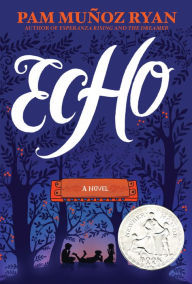
Another surprising (but not really because it’s so absolutely wonderful) hit has been Echo. It’s a huge book but every child and adult whose hand I’ve put 22749539it into  has just loved it – depite the fact that it takes a while to get through. Why – I suspect that the range and diversity of the characters and settings is satisfying to my international audience. But it is also great storytelling. And then they go on to read all the other Pam Muñoz Ryan books, which is also an excellent outcome.


What would you like to see more of that is “relevant and useful”?

BWB where are we at?

After a flurry of research and completing my final paper for my M. Ed, one may think that it’s all over with the inquiry into reluctant readers, boys reading etc. etc.  But it’s not. Far from it in fact. I’ve been a little distracted with the library renovation, a series of unfortunate events with library assistants having close encounters with pregnancy and injuries leading to somewhat more of a day to day burden on my shoulders etc. etc (it’s called “life” I keep reminding myself). But anyway, we carry on unabated with our BWB club (Blokes with Books) and you can come and hear me at the AFCC if you’d like to find out more!

Tim, the teacher leading the club and I had some conversations at the end of last year about how we needed to take things up a notch and really go deeper into the whole reading thing. The question of course is how do you make sure it’s still fun, that they still are committed, while deepening and expanding what they’re reading? We’re talking about 11/12 year old boys after all, and while my dry academic papers sound all unemotional and cool the truth is far from it.  We have spats and have to have firm words about “it’s just a game” and “if you don’t quit fighting about the chairs / beanbags / who got the book first, you will have to stop coming for a while” etc. etc.

But something special has been happening in the two weeks since we’ve been back. Sometimes you just get so caught unawares that you’re not recording or documenting and now I feel I need to document it. Last week our counsellor (who’s joined our team) was sharing how he’d seen an interview with Jamie Oliver about the fact that he’d read his first book at age 38. The boys were actually incredulous. And then a couple started spontaneously sharing how before BWB club they’d never finished a book either, or if they did it was just a quick and easy book and how much more they’re reading now and how it takes practice and perseverance. Note – it also takes courage for a boy this age to come out and say these things to his peers.

This week we reflected on Obama’s reading list and how he’d said it helped calm and focus him in times of stress. And again, a couple of boys put their hands up and said how reading helped them calm down, when they were angry or upset.

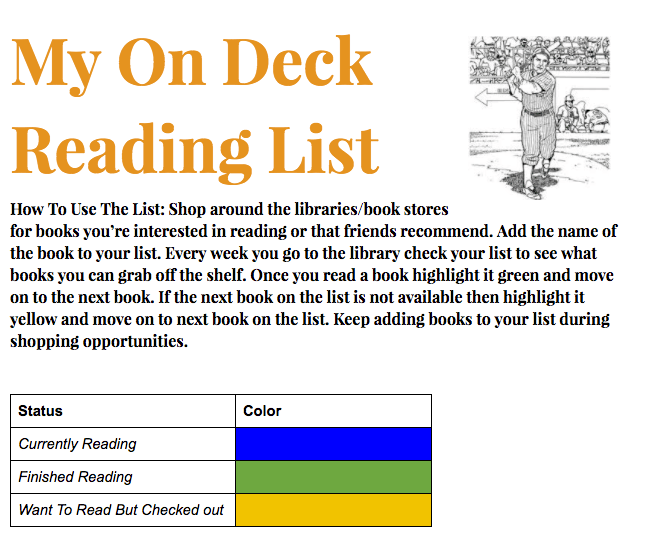
So, whscreen-shot-2017-01-21-at-1-47-36-pmat’s new.  Right now I’m trying to drill into every student at school the necessity of having a “what’s next” list – either a mental list or a  physical list or a pile of books that are the “books in waiting”.  And the great thing about a club like this is that we can try things out on them and see how effective they are.

This week we used Leigh Collazo’s Genre Personality test which you can purchase from TPT (a $5 well spent). My assistants and I spend quite a bit of time this week updating the bookmarks in order to make the book suggestions specific to our library.  The boys did the quiz during the BWB session on Friday and they really enjoyed doing it. It was fun and light-hearted and we kept emphasizing that there was no right or wrong answer and it wasn’t scientific. After they’d tallied up I made a spreadsheet of the topscreen-shot-2017-01-21-at-1-48-01-pm 3 categories of each boy, and as we read out the descriptions there were cries of “yes, that’s exactly how I am” and “I agree” and “yes!”  With their permission we then displayed the results. Most were evenly spread between A, (questioner); B (Escapist) and C (Innovator) with surprisingly few G’s (class clown) which is what I would have expected. Since that took up most of the hour we have with them – we didn’t get around to sharing the bookmarks, and
only introduced the “on deck” spreadsheet to help them keep track of their “what’s next” list – that’s next week’s work.


Read around the World

With view to the fact that our school is celebrating uniting nations week in October, this year we’re trying to add a literary bent to the proceedings.

There are a number of steps to this, which are easy or complicated, depending on how “ready” your collection is.

A little while back, I created resource lists on Destiny, and a visual search button for “read around the world”. Since I didn’t have a lot of time I grouped them by continent, with a separate section for Singapore which is where we live.  It involved doing subject searches on our catalog for various countries on each continent and then grouping them together.  Actually this wasn’t that easy. A book like “Inside out and Back again” – takes place in USA, about a Vietnamese immigrant – where do you put it and its ilk (of which we have many). What if an american author is writing about Africa? Generally I tended to put the books according to where they took place rather than the origin of the author. But I’ve allowed my students to decide how they want to categorise it when they add a comment to their shelfie (more later).

Before the summer break, I also ordered all the books suitable for primary school on the USBBY list for 2016 so they were ready for the school year. Again I didn’t have anything specific in mind, except to diversify my collection.  As an aside – I must say I’m incredibly impressed with the selection in this list and I’m going to order from it again this year, and from the backlists of prior years. Books like “My Two Blankets” are just phenomenal and just so appropriate for a multi-lingual environment.

This term, I joined the UN committee and put my idea forward to do a “read around the world” as part of the activities so it would not just be a “costume, food and flags” affair. I also convinced the parade organisers that it may be a nice idea to parade by country grouped by continent (to tie in what was feasible in the library with my limited display space).
Next I created a library guide and a padlet so the students could put up their pictures (we’re an iPad school so that’s one of the easiest ways).
Then last week I started introducing the concept to my students in the library lesson.  I adjusted it according to the age. For some, I asked how were ways we could find out about people around the world. We got the usual, go there, live their, eat food, have a friend etc. Then I introduced travelling their through books (depending on the age I told them the library was a magic travel machine), then I read a book from South Africa, my home country (Niki Daly’s “Where’s Jamela”), and then we had a tour around the world past all the displays and they could pick up a “souvenir” book on the way of whatever they liked.
For other classes my colleague met them at the door and said she was a tour guide and would take them around the world and they could pick up books along the way.
We then showed the library guide and explained how to get a picture onto padlet, and that they could then put a sticker on the map.
Some classes were more enthusiastic than others – generally the younger students were not very interested in books from other places, they wanted a book from the country they came from – fair enough.
It was interesting to see where students put books when they made a comment – the aforementioned “inside out” was labeled “Vietnam” by a student, while “Amulet” got a Japanese label based on the author name and origin (although born in Japan, he has lived in the USA since he was 10).
We’ve agreed that for the actual UN week each class well get a bundle of 20-30 books from various countries delivered to the classrooms to read during their DEAR time (they get 20 minutes a day).
Hopefully it will all work out! I’m also hoping our parents will want to get involved with their children.

Applying spatial changes and design thinking to middle school reading– a three phase collaborative approach

Introduction

There is a long history of research into the value of and elements contributing to the success of classroom libraries. They have an important role in ensuring accessibility of written works to promote fluency and skill in literacy and thereby contributing to academic achievement. But the literature appears to concentrate on elementary schools (Hopenwasser & Noel, 2014; James, 1923; Jones, 2006; Krarup, 1955; Powell, 1966; Sanacore & Palumbo, 2010; Todd, Gordon, & Lu, 2011; Worthy, 1996). Although partnership and collaboration with the school and/or public library and librarian is recommended, the literature often deals with the two spaces in isolation. Further, the problem of aliteracy in middle school – whereby students can read but don’t want to – is well documented (Kelley & Decker, 2009; Krashen, 2004; Lesesne, 1991; Sheldon & Davis, 2015; Worthy, 1996). This case report will show how the two environments library and classroom, can successfully be seen as extensions of each other through the principles of design and design thinking and explicit cooperation between the language humanities (Eng/Hum) teachers, literacy coach and school librarian in order to promote voluntary reading.

Case development

United World College South East Asia East (UWCSEA-East) is a K-12 international school located in Singapore. It commenced operations in 2008 and took occupancy of a purpose built campus in 2011. In this campus, the secondary school library initially served around 500 middle school students – see table 1. It now caters to three distinct communities, middle school, high school and the International Baccalaureate (IB) – see Table 2.
Screen Shot 2015-10-11 at 11.27.14 am
Despite consultation with the librarian in the planning phase, certain spaces of the library were designated different functions than agreed upon and furnished accordingly by the architect and building manager. One such area was upstairs overlooking the main school plaza with purpose built magazine racks. The idea was it would be a well-frequented showcase area for magazine reading. In reality a number of factors prevented this from being realised:
  • The furniture design didn’t accommodate its purpose as it was not deep or high enough and the storage area didn’t fit back copies
  • The zoning of the library post occupancy meant that materials affording quick casual reading such as graphic novels and periodicals were better located in the “noisier” and fast turnover area which allowed food and beverages, i.e. downstairs.
  • The trend in libraries is to move away from physical magazines and periodicals towards online providers including online databases and aggregators such as PressReader that provide the same product at a lower cost and without delays and issues with cataloguing and maintenance.
The question of what to do with the space was resolved by noticing that as the secondary school reached post occupancy capacity the lowest students in the pecking order i.e. middle school students were increasingly marginalised with students of higher sections taking over the prime library real estate (students are visually distinct due to different coloured polo shirts for their uniforms). In addition, middle school students no longer had library visits planned into their schedule. Furthermore, the large influx of new students and teachers meant that reading books in the classrooms were unevenly distributed both in terms of volume and quality without any structured form of classroom library, which the students had become accustomed to in the primary section. Finally, Eng/Hum teachers were noticing a decline in voluntary reading as students moved up through middle school.
These issues were addressed initially through collaboration between the librarian and Eng/Hum teachers and more recently by the new literacy coach over a period of three years as follows:
  • The conversion of the magazine area into a middle school reading zone
  • The establishing of a core library for each of the three middle school grades (Day, 2013b)
  • The creation of middle school classroom libraries in a formal and structured manner with materials integrated into the library catalogue (Day, 2015d)
  • The integration of informational / nonfiction texts into both areas
This is an on-going process and worth a critical analysis to examine the choice process, latent or existing attitudes and assumptions, exterior pressures and design constraints and collaboration and communication.

Critical analysis

Choice of process

The spatial change in the library was conceived and led by the teacher-librarian (TL) with the Eng/Hum teachers joining in the collaboration as the process evolved. Since the TL has experience in design thinking (Day, 2013a, 2015a, 2015c) the process followed the design thinking cycle of inspiration, ideation, iteration and getting to scale (Brown, 2008; IDEO, 2014).
This was achieved by:
  • Agreeing on a “core library” of 30 titles per grade for grades 6-8 which were prominently displayed
  • Adjusting shelving to accommodate front facing books
  • Relocating books of interest to this age group from the fiction collection
  • Using large posters to highlight the favourite books of middle school teachers in the library and class corridors and classroom walls
  • Ensuring multiple copies of books, by using class and literary circle sets
  • Adequate lighting, comfortable furniture and the creation of a private space
The above steps and final spatial design incorporated the elements that are recommended as enhancing school library spaces (Cha & Kim, 2015; Elliott-Burns, 2003; La Marca, 2008; A. McDonald, 2006; Serafini, 2011).
The design elements that contribute to successful classroom libraries are not dissimilar and include:
  • Sufficient space which is a focal area but partitioned and private
  • Comfortable furniture
  • Variety of material in range of complexity including different literary genres and informational texts
  • Category organisation and shelf labelling
  • Combination shelving allowing for quantity of books and display (front facing)
  • Advertising by means of posters and notices on whiteboards
  • Graphic organisation either thematic or by connections
  • Involvement of students in selection, organisation and maintenance (Fractor, Woodruff, Martinez, & Teale, 1993; Hopenwasser & Noel, 2014; Reutzel & Fawson, 2002, cited in Sanacore & Palumbo, 2010)
Discussion and research on the elements predominantly come from the elementary school environment, and the adoption to middle school requires some adjustments to account for the fact that students do not remain in one classroom, lessening the sense of ownership of a space on the part of students, and teachers needing to cater to multiple classes with different profiles and interests. Learning spaces are also typically smaller relative to the size of the students.
The creation of the library and classroom reading spaces and populating them with books is “necessary but not sufficient” (McGill-franzen, Allington, Yokoi, & Brooks, 1999). Other components of encouraging reading include training teachers to enhance their instructional routines to incorporate the material, and to ensure that teachers are familiar not only with their literary canon, but also the latest in good young adult fiction (Day, 2015b; McGill-franzen et al., 1999). The school has invested in training with Penny Kittle to assist in the instructional routines (Raisdana, 2015), while the librarian is working with the teachers on the latter.

Latent or existing attitudes and assumptions

An international school is blessed with diversity in cultures, languages and backgrounds both of their students and teachers. This results in a context of people coming from different systems with different attitudes, assumptions, beliefs and experiences around education, reading and libraries. In just the middle school, teachers come from Australia, United States, Philippines, Ireland, Canada and the United Kingdom, each with their own literary core. In addition, there are personal preferences and beliefs, for example around young adult literature (see Raisdana, 2014). Teachers may not be used to or have experience of collaboration with the TL, the benefits thereof, nor aware of the ways in which libraries have evolved (Gibbs, 2003; Montiel-Overall, 2006, 2008; Sullivan-Macdonald, 2015). And naturally there are assumptions around what constitutes an ideal learning or reading space and the balance between the two (Elliott-Burns, 2005). In a meta-review of access to print and educational outcomes, Lindsay (2010) concluded that limiting choices with a larger distribution interval led to more reading, particularly if it was accompanied by activities such as training and book talks. This is in contrast to the assumption that collections should be as large as possible. It also suggests that rotation of materials leads to better outcomes.

Exterior pressures and design constraints

The creation of the complementary spaces faced a number of constraints, design and otherwise. These included a small budget, limited time and variability in the reading level of students. In design thinking the presence of constraints is seen as a positive force that encourages creative solutions and exploring options that would not otherwise be considered, and this proved to be true in this case study (Brown & Katz, 2011; Hill, 1998; Ness, 2011).
Naturally budget was an important constraint that shaped the way in which the space was converted and books and furniture was acquired or moved and repurposed. As discussed earlier, the librarian was involved in the “fuzzy front end” (Sanders & Stappers, 2008, p. 6), of the secondary library design and once the space was completed it was not possible to change the space, only to adapt its purpose. In the classrooms the availability of furniture in the room to hold the books and the available space for the classroom library vis-à-vis other learning spaces determined how many books could effectively by stored and displayed. In this respect creative design thinking was deployed, for example by taking the doors off built-in cupboard space both in the classrooms and in the library, creating additional shelving. Comfortable furniture was either acquired by donations from the community or purchased to ensure equity between the classrooms.
Although the library and classes each have a budget for the acquisition of books, both wanted to ensure that existing resources were not wasted – for example the books already owned in multiple copies. However their repurposing had to be examined within the constraints of the reading level of the students and the curriculum themes for each grade.

Collaboration and communication

Collaboration and communication between the TL and teachers has received a lot of attention as has the ways in which spatial design and design thinking can enhance collaboration (Avallon & Schneider, 2013; Ferer, 2012; Gibbs, 2003; Knapp, 2014; Montiel-Overall, 2006; Williamson, Archibald, & McGregor, 2010). Enhancing collaboration between the TL and the Eng/Hum department has occurred on a number of fronts, both physical and virtual – such as book chat mornings to book talk new books, encouraging teachers and students to be involved with the selection of books for the Red Dot Awards (ISLN, 2015), processing and cataloguing the books, and the creation of a virtual space for the books (Day, 2015b).
Given time constraints and curriculum pressures, additional moments for collaboration and communication have had to be designed into the process. For example teachers can book the reading zone space to conduct lessons, and invite the TL to book talk new or noteworthy books. In addition the library receives supervision assistance from teachers during lunch, recess times and after school. The Eng/Hum teachers have first priority in requesting this duty, creating the opportunity for the important “casual conversations” that result in informal learning and information exchange (Oblinger, 2006; Somerville & Brown-Sica, 2011).

Conclusion

The process can neither be criticized for its efficacy nor results. Teachers, students and the librarian have largely viewed the change positively. Due to making small iterative changes to the spaces, starting with a small budget and a limited number of books in the first year, and subsequently adapting the choice of books, the selection and weeding process based on experience and feedback, the combined library / class library spaces appear to have grown organically despite a lot of “behind the scenes” work on book processing, cataloguing and making books classroom / shelf ready.
There are five main recommendations arising from the analysis of this case study, all which can be tackled through employing design thinking rather than further changes to the current spatial design:
  • Balance the contradictory forces of novelty and familiarity through how books are selected, displayed and rotated
  • Focus efforts on the most efficacious element of encouraging reading – book talks
  • Expand the space to include the home environment, particularly in the case of bilingual students
  • Increase involvement of students in the spatial design and change process
  • Quantify the benefits of this spatial / design thinking collaboration through evidence based research.
These will be elaborated in the next section.

Recommendations

Balance novelty and familiarity

Students like and respond to novelty in display and a constant supply of “new” titles, they would also possibly benefit from choice limitation (Iyengar, 2011). This can be achieved by a rotation of titles between spine and front facing, and through a rotation between the books in the various classes (Lindsay, 2010). At present the core and class libraries are refreshed annually and the class libraries are not rotated between classes or teachers. It is recommended this be considered to prevent staleness. The class library placement of books in bins rather than shelves with a mixture of front and spine facing, allowing changes is display is not best practise, nor is having all books available simultaneously (Fractor et al., 1993; Lindsay, 2010; Sanacore, 2000; Sanacore & Palumbo, 2010).

Book talks

The importance of teachers’, librarians’, students’ and the community’s increasing exposure of diverse books in all genres by book talking can’t be overstated (Bentheim, 2013; Gallo, 2001; L. McDonald, 2013; Serafini, 2011). But, as examined in the analysis, a number of barriers stand in the way of regular book talks. In addition, requiring reading related tasks from students runs the risk of resulting in unfavourable associations with reading and further reluctance (Eriksson, 2002; Gallo, 2001; Miller, 2009).
Many practioners have described how digital innovation and the creation of virtual spaces can enhance and augment traditional book talks as well as expand transliteracy skills of students (Dreon, Kerper, & Landis, 2011; Gogan & Marcus, 2013; Gunter & Kenny, 2008; Ragan, 2012). It is recommended that students be given ownership of exploring the potentials of the digital realm in this respect as a guided design thinking exercise.

Mother tongue material and the home environment

Access to mother tongue materials continues to be a weakness in the library and even more so in the classroom library. There are logistical and financial constraints including the wide spread of languages, the undervaluation of low status languages, and misinformation and misunderstanding on the value of reading in the mother tongue amongst students and parents (Bailey, 2014a, 2014b, 2015; Boelens, Cherek, Tilke, & Bailey, 2015). This is an area that would benefit greatly from increased collaboration between the college and parent body where previously “unknowable” resources could be tapped into through utilizing the analytical and process skills of design thinking (IDEO, 2014; Landis, Umolu, & Mancha, 2010; McIntosh, 2015).

Student involvement

While literature indicates collaboration by all stakeholders is essential for acceptance, particularly in learning environments (Hamilton, 2013; Jones, 2006; Sanders & Stappers, 2008), this has largely been a librarian / teacher initiative with some student involvement in book selection. Moving forward, the virtual or digital sphere is an area where students can also be encouraged to carve out a presence and take ownership with teachers taking on an enabler role as use of all seven learning spaces are maximised (Grisham & Wolsey, 2006; McIntosh, 2010; Thornburg, 2007; Wilson & Randall, 2012).

Quantify the benefits

Despite numerous hurdles in providing data and making analysis founded on circulation figures or student attainment records, there is considerable value in documenting and providing evidence for practises – not the least that it supports budget requests.
Circulation records do not provide a complete record or necessarily correlate with reading because:
  • Books may be read in library / class without being checked out
  • In affluent multi-cultural communities, students may have access to large personal libraries, including books in their mother tongue
  • Students may be borrowing books from the public library
Despite this, circulation is still the best proxy for reading. The decentralised nature of the class libraries results in less control over book checkout. Even in the library, that has no exit barriers, at the end of 2014/5 academic year roughly 20% of returned books had not been checked out of the system. While this can be lauded as an indication of the high moral and ethical standards of the students, it does pose difficulties in creating any evidence based data on the actual impact of either separating part of the library or decentralising the collection to class libraries in terms of increases in circulation.
It is recommended that both current and longitudinal research be carried out to see if there is any correlation between increased access to text, the amount of reading / circulation and other objective measures of attainment such as the annual PISA or TIMS tests. This will take the initiative beyond transformative individual anecdotal stories to evidence based research. The CLEP (Classroom Literacy Environmental Profile) (McGill-franzen et al., 1999; Wolfersberger, Reutzel, Sudweeks, & Fawson, 2004) and more recently the TEX-IN3 (Hoffman, Sailors, Duffy, & Beretvas, 2004) tools have successfully been used in the evaluation of elementary school class libraries and could be adapted for the middle school environment.
The recent inclusion of informational (nonfiction) texts in both the middle school zone and the classroom libraries is also one worth further investigation. Whether the expansion of the collections has impacted on the space, the ability to choose, and the completion of summative assessments in the individual subjects can be investigated in the light of the existing literature on the matter (Hopenwasser & Noel, 2014; Ness, 2011; Sanacore & Palumbo, 2010; Young & Moss, 2006; Young, Moss, & Cornwell, 2007).

References

Avallon, J., & Schneider, A. (2013). Building collaboration into workspace design. Facility Management Journal, (September / October), 34–38. Retrieved from http://cdn.ifma.org/sfcdn/fmj-supporting-documents/building-collaboration-into-workspace-design-fmj-sep-oct-2013.pdf?sfvrsn=0
Bailey, N. (2014a, November 12). Building a LOTE collection at an international school [Web Log]. Retrieved October 4, 2015, from http://informativeflights.blogspot.sg/2014/11/building-lote-collection-at.html
Bailey, N. (2014b, November 12). Research summary on language [Web Log]. Retrieved November 12, 2014, from http://informativeflights.blogspot.sg/2014/11/research-summary-on-language.html
Bailey, N. (2015). Digital language learning ecology. Singapore: iBooks. Retrieved from https://itunes.apple.com/us/book/digital-language-learning/id1000588637?ls=1&mt=11
Bentheim, C. A. (2013). Continuing the transition work from traditional library to learning commons. Teacher Librarian41(2), 29–36. Retrieved from http://ezproxy.csu.edu.au/login?url=http://search.ebscohost.com/login.aspx?direct=true&db=ehh&AN=92991111&site=ehost-live
Boelens, H., Cherek, J., Tilke, A., & Bailey, N. (2015). Communicating across cultures: cultural identity issues and the role of the multicultural, multilingual school library within the school community. Presented at the “The school library rocks” IASL 2015, Maastricht, Netherlands.
Brown, T. (2008). Design thinking. Harvard Business Review86(6), 84–92. Retrieved from http://ezproxy.csu.edu.au/login?url=http://search.ebscohost.com/login.aspx?direct=true&db=heh&AN=32108052&site=ehost-live
Brown, T., & Katz, B. (2011). Change by Design: Change by Design. Journal of Product Innovation Management28(3), 381–383. http://doi.org/10.1111/j.1540-5885.2011.00806.x
Cha, S. H., & Kim, T. W. (2015). What matters for students’ use of physical library space? The Journal of Academic Librarianship41(3), 274–279. http://doi.org/10.1016/j.acalib.2015.03.014
Day, K. (2013a, January 14). Carol Kuhlthau meets Tim Brown: Guided Inquiry {Design} Thinking [Web Log]. Retrieved October 3, 2015, from http://www.thelibrarianedge.com/libedge/2013/01/carol-kuhlthau-meets-tim-brown-guided.html?rq=design%20thinking
Day, K. (2013b, November). Liberate your book cupboards and create a more true “bookstore” model in your school library [Web Log]. Retrieved August 2, 2015, from http://www.thelibrarianedge.com/libedge/2013/11/liberate-your-book-cupboards-and-create.html
Day, K. (2015a, August 30). Expert learning in the library…. and classroom [Web Log]. Retrieved October 3, 2015, from http://www.thelibrarianedge.com/libedge/2015/8/30/a-sociologist-who-loves-the-research-process?rq=
Day, K. (2015b, September 3). Professional learning for teachers who read books students might read [Library Guide]. Retrieved September 6, 2015, from http://research.uwcsea.edu.sg/eastlibsec/classlibs
Day, K. (2015c, September 5). Design thinking for the research process (e.g., the IBO Extended Essay) [Web Log]. Retrieved September 6, 2015, from http://www.thelibrarianedge.com/libedge/2015/8/30/design-thinking-for-the-research-process
Day, K. (2015d, September 28). Center and satellite collections: connections between classrooms and the library [Web Log]. Retrieved October 3, 2015, from http://www.thelibrarianedge.com/libedge/2015/9/26/middle-school-classroom-libraries-and-the-central-library
Dreon, O., Kerper, R. M., & Landis, J. (2011). Digital storytelling: A tool for teaching and learning in the YouTube generation. Middle School Journal42(5), 4–9.
Elliott-Burns, R. (2003). Space, place, design and the school library. Journal of the Australian School Library Association17(2).
Elliott-Burns, R. (2005). Designing spaces for learning and living in schools: perspectives of a flaneuse. Presented at the Australian Curriculum Studies Association Biennial Conference, Queensland, Australia: University of the Sunshine Coast. Retrieved from http://eprints.qut.edu.au/4345/1/4345.pdf
Eriksson, K. (2002). Booktalk dilemmas: Teachers’ organisation of pupils’ reading. Scandinavian Journal of Educational Research46(4), 391–408. http://doi.org/10.1080/0031383022000024570
Ferer, E. (2012). Working together: library and writing center collaboration. Reference Services Review40(4), 543–557. http://doi.org/10.1108/00907321211277350
Fractor, J. S., Woodruff, M. C., Martinez, M. G., & Teale, W. H. (1993). Let’s not miss opportunities to promote voluntary reading: Classroom libraries in the elementary school. The Reading Teacher46(6), 476–484. Retrieved from http://www.jstor.org/stable/20201114
Gallo, D. R. (2001). How classics create an aliterate society. The English Journal90(3), 33–39. Retrieved from http://moormangb.ced.appstate.edu/5730_f11_h/unit1/Gallo.pdf
Gibbs, R. (2003). Reframing the role of the teacher-librarian : the case for collaboration and flexibility. Scan22(3), 4–7. Retrieved from http://search.informit.com.au.ezproxy.csu.edu.au/fullText;dn=129538;res=AEIPT
Gogan, B., & Marcus, A. (2013). Lost in transliteracy – how to expand student learning across a variety of platforms. Knowledge Quest41(5), 40–45.
Grisham, D. L., & Wolsey, T. D. (2006). Recentering the middle school classroom as a vibrant learning community: Students, literacy, and technology intersect. Journal of Adolescent & Adult Literacy49(8), 648–660. http://doi.org/10.1598/JAAL.49.8.2
Gunter, G. A., & Kenny, R. F. (2008). Digital booktalk: Digital media for reluctant readers. Contemporary Issues in Technology and Teacher Education8(1), 84–99.
Hamilton, B. (2013, November 14). A visit to the Lovett School story studio: Redesigning learning spaces, rewriting narratives of learning [Web Log]. Retrieved August 8, 2015, from https://theunquietlibrarian.wordpress.com/2013/11/14/a-visit-to-the-lovett-school-story-studio-redesigning-learning-spaces-rewriting-narratives-of-learning/
Hill, A. M. (1998). Problem solving in real-life contexts: An alternative for design in technology education. International Journal of Technology and Design Education8, 203–220.
Hoffman, J., Sailors, M., Duffy, G., & Beretvas, S. N. (2004). The effective elementary classroom literacy environment: Examining the validity of the TEX-IN3 observation system. Journal of Literacy Research36(3), 303–334. http://doi.org/10.1207/s15548430jlr3603_3
Hopenwasser, C. B., & Noel, A. M. (2014). Tackling text complexity with your classroom library. Kappa Delta Pi Record50(2), 81–84. http://doi.org/10.1080/00228958.2014.900851
IDEO. (2014). Design thinking for libraries – a toolkit for patron-centered design (p. 121).
IDEO, Bill & Melinda Gates Foundation. Retrieved from http://www.designthinkingforlibraries.com
ISLN. (2015). Red Dot Book Awards 2015-2016 [Google Site]. Retrieved October 8, 2015, from https://sites.google.com/site/reddotbookawards20152016/
Iyengar, S. (2011, November). How to make choosing easier [Video file]. Retrieved October 8, 2015, from https://www.ted.com/talks/sheena_iyengar_choosing_what_to_choose
James, M. E. (1923). Use of classroom libraries to stimulate interest and speed in reading. The Elementary School Journal23(8), 601–608. http://doi.org/10.2307/994550
Jones, J. A. (2006). Student-involved classroom libraries. The Reading Teacher59(6), 576–580. Retrieved from http://search.proquest.com/docview/203284680?accountid=10344
Kelley, M. J., & Decker, E. O. (2009). The Current State of Motivation to Read Among Middle School Students. Reading Psychology30(5), 466–485. http://doi.org/10.1080/02702710902733535
Knapp, J. (2014, May 1). Google Ventures: your design team needs a war room. Here’s how to set one up. Retrieved August 8, 2015, from http://www.fastcodesign.com/3028471/google-ventures-your-design-team-needs-a-war-room-heres-how-to-set-one-up
Krarup, A. (1955). Classroom libraries are not enough. The Reading Teacher8(4), 215–219. http://doi.org/10.2307/20196863
Krashen, S. D. (2004). The power of reading: insights from the research. Westport, Conn.; Portsmouth, N.H.: Libraries Unlimited ; Heinemann.
La Marca, S. (2008). Reading spaces (pp. 1–12). Presented at the 38th Annual Conference of the International Association of School Librarianship, Padua, Italy: International Association of School Librarianship. Retrieved from http://www.kzneducation.gov.za/Portals/0/ELITS%20website%20Homepage/IASL%202008/professional%20papers/lamarcaspacespp.pdf
Landis, D., Umolu, J., & Mancha, S. (2010). The power of language experience for cross-cultural reading and writing. The Reading Teacher63(7), 580–589. http://doi.org/10.1598/RT.63.7.5
Lesesne, T. S. (1991). Developing lifetime readers: Suggestions from fifty years of research. English Journal80(6), 61. Retrieved from http://search.proquest.com/docview/237285282?accountid=10344
Lindsay, J. (2010). Children’s access to print material and education-related outcomes: Findings from a meta-analytic review. Naperville, IL: Learning Point Associates. Retrieved from http://rif.org/documents/us/RIFandLearningPointMeta-FullReport.pdf
McDonald, A. (2006). The ten commandments revisited: the qualities of good library space. LIBER Quarterly16(2). Retrieved from http://liber.library.uu.nl/index.php/lq/article/view/7840/8010
McDonald, L. (2013). Literature for children and young adolescents. In A literature companion for teachers (pp. 1–7). Newtown, Australia: Primary English Teaching Association Australia (PETAA).
McGill-franzen, A., Allington, R. L., Yokoi, L., & Brooks, G. (1999). Putting books in the classroom seems necessary but not sufficient. The Journal of Educational Research93(2), 67–74. http://doi.org/10.1080/00220679909597631
McIntosh, E. (2010). Clicks & Bricks: When digital, learning and physical space meet. Educational Facility Planner45(1&2), 33–38. Retrieved from http://media.cefpi.org/efp/EFP45-1and2McIntosh.pdf
McIntosh, E. (2015, July). The unknown unknowns – test out your ideas [Web Log]. Retrieved July 19, 2015, from http://edu.blogs.com/edublogs/2015/07/the-unknown-unknowns-test-out-your-ideas.html
Miller, D. (2009). The book whisperer: awakening the inner reader in every child (1st ed). San Francisco, Calif: Jossey-Bass.
Montiel-Overall, P. (2006). Teacher and teacher-librarian collaboration: moving toward integration. Teacher Librarian34(2), 28–33. Retrieved from http://search.proquest.com/docview/224885770?accountid=10344
Montiel-Overall, P. (2008). Teacher and librarian collaboration: A qualitative study. Library & Information Science Research30(2), 145–155. http://doi.org/10.1016/j.lisr.2007.06.008
Ness, M. (2011). Teachers’ Use of and Attitudes Toward Informational Text in K-5 Classrooms. Reading Psychology32(1), 28–53. Retrieved from http://ezproxy.csu.edu.au/login?url=http://search.ebscohost.com/login.aspx?direct=true&db=pbh&AN=57420253&site=ehost-live
Oblinger, D. (2006). Learning spaces. Boulder, CO: EDUCAUSE.
Powell, W. R. (1966). Classroom libraries: their frequency of use. Elementary English43(4), 395–397. http://doi.org/10.2307/41387579
Ragan, M. (2012). Inspired technology, inspired readers – How book trailers foster a passion for reading. AccessMarch, 8–13.
Raisdana, J. (2014, March 10). Well-versed In books [Web Log]. Retrieved October 3, 2015, from http://www.jabizraisdana.com/blog/well-versed-in-books/
Raisdana, J. (2015, February 9). Leave with a suggestion [Web Log]. Retrieved October 3, 2015, from http://www.jabizraisdana.com/blog/leave-with-a-suggestion/
Sanacore, J. (2000). Promoting the lifetime reading habit in middle school students. The Clearing House73(3), 157–161. Retrieved from http://search.proquest.com/docview/196889420?accountid=10344
Sanacore, J., & Palumbo, A. (2010). Middle school students need more opportunities to read across the curriculum. The Clearing House83(5), 180–185. Retrieved from http://search.proquest.com/docview/744358835?accountid=10344
Sanders, E. B.-N., & Stappers, P. J. (2008). Co-creation and the new landscapes of design. CoDesign4(1), 5–18. http://doi.org/10.1080/15710880701875068
Serafini, F. (2011). Creating space for children’s literature. The Reading Teacher65(1), 30–34. http://doi.org/10.1598/RT.65.1.4
Sheldon, S., B., & Davis, M., H. (2015). “I wish everyone had a library like this” (The Baltimore Elementary and Middle School Library Project No. Year 2 Report). Baltimore, USA. Retrieved from http://baltimore-berc.org/wp-content/uploads/2015/06/ALibraryLikeThisJune2015.pdf
Somerville, M. M., & Brown-Sica, M. (2011). Library space planning: a participatory action research approach. The Electronic Library29(5), 669–681. http://doi.org/10.1108/02640471111177099
Sullivan-Macdonald, D. (2015, October 1). Teach more, librarian less, say SLJ leadership summit panelists [Web Log]. Retrieved October 3, 2015, from http://www.slj.com/2015/10/schools/teach-more-librarian-less-becoming-essential-panel-at-the-slj-leadership-summit/
Thornburg, D. (2007, October). Campfires in cyberspace: Primordial metaphors for learning in the 21st Century. TCPD. Retrieved from http://tcpd.org/Thornburg/Handouts/Campfires.pdf
Todd, R. J., Gordon, C. A., & Lu, Y.-L. (2011). One common goal: Student learning (Report of Findings and Recommendations of the New Jersey School Library Survey Phase 2). New Jersey, USA: New Jersey Association of School Librarians. Retrieved from http://www.njasl.info/wp-content/NJ_study/2011_Phase2Report.pdf
Williamson, K., Archibald, A., & McGregor, J. (2010). Shared vision: A key to successful collaboration? School Libraries Worldwide16(2), 16–30. Retrieved from http://ezproxy.csu.edu.au/login?url=http://search.ebscohost.com/login.aspx?direct=true&db=lih&AN=55415805&site=ehost-live
Wilson, G., & Randall, M. (2012). The implementation and evaluation of a new learning space: a pilot study. Research in Learning Technology20(2), 1–17. Retrieved from http://ezproxy.csu.edu.au/login?url=http://search.ebscohost.com/login.aspx?direct=true&db=ehh&AN=86214889&site=ehost-live
Wolfersberger, M., Reutzel, D. R., Sudweeks, R., & Fawson, P. (2004). Developing and validating the Classroom Literacy Environmental Profile (CLEP): A tool for examining the “print richness” of early childhood and elementary classrooms. Journal of Literacy Research36(2), 211–272. http://doi.org/10.1207/s15548430jlr3602_4
Worthy, J. (1996). Removing barriers to voluntary reading for reluctant readers: The role of school and classroom libraries. Language Arts73(7), 483–492. Retrieved from http://search.proquest.com/docview/196851690?accountid=10344
Young, T. A., & Moss, B. (2006). Nonfiction in the classroom library: A literacy necessity. Childhood Education82(4), 207–212. Retrieved from http://search.proquest.com/docview/210392168?accountid=10344
Young, T. A., Moss, B., & Cornwell, L. (2007). The classroom library: A place for nonfiction, nonfiction in its place. Reading Horizons48(1), 1–18. Retrieved from http://search.proquest.com/docview/236486012?accountid=10344

A linguistic Trio – part 2 Crisfield

Crisfield (Blog)

Like Rojas, Crisfield began by dispelling some of the common “mummy myths” around language, particularly that it was easier to learn for children – she said something that every parent with older children will have personal experience of – “no it’s still hard, but they’re just too small to complain”. Although they are more phonetically sensitive and therefore more likely to speak other languages without an accent. She emphasized that the role of parents was to ensure that we make our children’s language journeys as easy as possible, and to do this we have 6 tasks:

1. Learn the theory
2. Set Goals
3. Plan to achieve the goals
4. Communicate with our children
5. Communicate with others
6. Know when to get help.

Learn the theory

We commenced with a little bit of jargon, what is mother tongue, L1, home language etc. (see my glossary here for a complete vocabulary).

One of the most important things she touched on is how we need to take care of the messages (verbal, non-verbal and behavioural) we give our children about the relative importance of our mother tongue and our attitudes towards it, particularly in the case of languages with a lower status.

Set Goals

This was a discussion on what level of mastery of language (communicative and literary) was aimed for and why.  It was important to think the whole language journey through (or at least while they were students). While it was possible to impose our language expectations on our children while they were younger, we would need to be able to communicate a valid good reason for continuing the regime as they matured and formed their own opinions. In the case of multiple languages we needed to order our priorities and give reasons for them.

In setting goals, we should ensure we have the necessary knowledge and support network to support those goals and that the goals are realistic (I’ve written more on this here in theory, and as it relates to my family situation).

Plan to achieve the goals

Here the concept of a COP (community of practise) was introduced – i.e. is there a linguistic community around you that you can get help from.  The smaller the COP, the more planning and logistics were required.

The most fundamental issue was planning for enough language input.  According to Crisfield, research showed that for bi/tri-lingualism children needed around 30-35% of their linguistic input to be in the target language. (You will note I’ve said bi/tri-lingualism rather than multi-lingualism, which is what I used to say … I’d not heard the 30-35% statistic before and need to follow up on this). She stated that if language input was only say 20%, the child would understand the language but would most likely become a passive bilingual.  The 30-35% targeted input suggests that three languages are the most realistic option initially – with the caveat that this could change as the child got older.

In the case of language, it appeared that “less is more” should be our motto to ensure our time and effort is focused and is not spread too thinly.

It was also paramount to plan for multiple literacy, so that the language would not be lost over time and children could continue to resource their language maintenance on their own through reading and writing.  Once again, the reminder that BICS (conversational) language takes 1-2 years while CALP was a 3-9 year process (I’ve heard 5-7 years more commonly used).  She also cautioned that problems in other subjects may be masking a problem in language or a learning difficulty.

And in our globally mobile environment – we needed to think about a future in different countries or environments and how this would impact our plan and resourcing.  Language acquisition and sustainability was a long term process that couldn’t rely on one school or community if this was not likely to be permanent.

Communicate with our children

As mentioned earlier, at a certain point we will need to justify our choices to our children and to ensure that they are part of the discussion / conversation around language, and who speaks what and why in the family.  Choices are valid, but they should be properly communicated.

Communicate with others

One should communicate language goals, expectations and intentions with people around you. Like grandparents and other family, babysitters and others in the community to ensure their actions and language they speak are aligned. School teachers and administrators need to be kept in the loop about what is happening linguistically at home.

Know when to get help

If children are exhibiting delays in speech and language, or learning issues it’s important to look at all languages globally and not just at the dominant language. Any therapist, professional or doctor needs to understand the developmental and educational issues around bilingualism so that a proper assessment can be made. It is not good practise for a professional to suggest that one language should be stopped (e.g. to stop the home language to encourage the school language).

5 further issues were also discussed, literacy, content, cognitive development, confidence and social development.

Literacy

Children were learning to read and write in two or more languages.  In doing so, they could use translanguaging, which is where one language is used to help or scaffold the other, languages are used together and used strategically. This did not imply mixing languages or inserting words or sentences of one language into conversations randomly, but rather a strategic use in order to bridge gaps.

In order to become literate, children needed to go beyond merely being able to read in both languages to comprehending and understanding the content. Parents needed to check for understanding after reading to children or when children read to them.  This may require the reading of a story in both languages to ensure that meaning is conveyed, or reading the story more than once.  Reading to children in all languages was fundamental.  And, ironically children could often write before they could read, if they know letter formation and are left to creative phonetic spelling without correction.  Experience rather than accuracy should be emphasized.

Literacy in both languages could be simultaneous (at the same time) or sequential (where reading and writing of one language is started with and then the next added). In the case of a third language it is usually advisable to give children a mental break before adding the literacy of a third language.

Talk about the second language in the MT, compare and contrast and mediate in order to clarify similarities and differences.

Content

If the school language is different to the home language, one should support content at home using the home language with the help of websites or textbooks (in the home language). Conversations at home should include what is being learnt at school so that children gain vocabulary in the home language and make links between the school language and home language. This will enhance the quality of conversation in the home language as well.

Cognitive Development

Research has show that achievement in the school language is dependant on keeping up literacy in the mother tongue, and that if children are incapable of doing things in the mother tongue, they may struggle to do it in any language. It is the mother tongue that pulls all other languages up and if MT is not maintained there will be gaps in cognitive development and difficulties in conceptual thought and conversation.

Confidence

The use of MT encourages confidence in self and in one’s cultural identity.  It encourages cognitive growth and learning and allows children to experience competence at home and at school.  Children are not as resilient as we’d like to think they are, and we need to help them in their language journeys so it is not a case of sink or swim.

Social development

Encourage using the MT socially, during holidays and with family.
In conclusion this was a talk with a lot of very practical advice and tips for families around bringing up children in a bilingual environment, whether the result of two parents speaking different languages, or a child going to school with a non-home language, or even where three languages (mother, father and school) were involved.

Blog post 3: Write a book review – Diversity

1. A detailed description of the activity undertaken

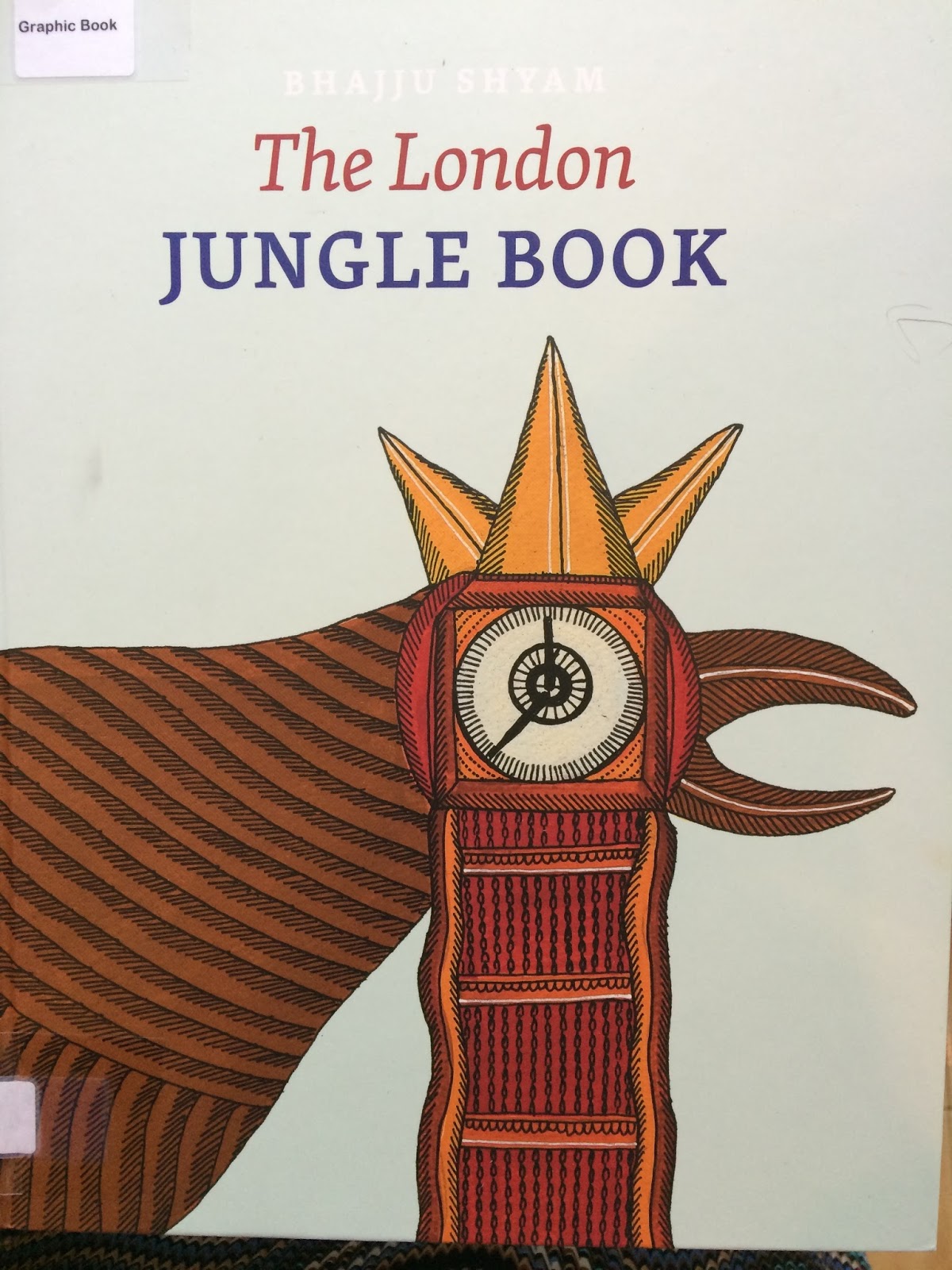
The visually stunning book: The London Jungle Book by Bhajju Shyam (Shyam, Rao, & Wolf, 2014) was reviewed.  In this recently republished book, an Indian artist from the Gond tribe creates a visual travelogue of his experiences in London where he lives for two months to paint murals in an Indian restaurant.  The title refers back to Rudyard Kipling’s Jungle book – a juxtaposition where an Englishman travelled to the jungle area where Shyam lives and wrote of his experiences there.

The visual story and text / Explanation of drawings

Besides the wonderful illustrations and the poignant but perceptive comments on London and its people, I particularly liked the fact that the book could be read on multi-levels and is therefore suitable for readers of all ages. There is a visual story accompanied by text in translation from his oral storytelling that will appeal as he simply recounts experiences and observations of a foreign land. Then the artist explains his choices of drawing as he breaks with traditional communal symbols and traditions in order to tell a unique and personal story. An additional level is added by the reader, who while reading this will no doubt reflect on his or her own travel experience or knowledge and feelings about London.
Extension activities for students could include investigating and comparing Kipling’s book with this as well as the works of the anthropologist Verrier Elwin who lived with the Gond tribe.

2. Answers to the following questions:

What did you learn?

In the first place I realized that although I’ve been reviewing books informally (in my Goodreads profile, or on my blog) for a while, I didn’t actually know what the principles of a good review were, so I had to first do some research on that. I found three good reputable resources, Owl Purdue writing lab (Brizee, 2012); BookTrust (Playa, 2014) and Scholastic (Philbrick, 2014) and compared the elements.

How was the activity relevant to your professional practice?

As a librarian I am often asked my opinion on books or need to write brief reviews. I had not approached this in a structural way before, so it is good to have a review “template” in mind when talking about a book. I can encourage students to write reviews on the books they have read, and give them tips on how to do so.

Were any gaps in your knowledge revealed? How might you fill those gaps?

At first the illustrations struck me as being reminiscent of Australian Aboriginal art, so I did some more research on the Gond Tribe and ethnic minorities in India. About 30% of our students are Indian, and I recognised that I know very little about India and its vast diversity in language, culture, art and literary traditions. I can fill the gaps in my knowledge both by reading up about the country and its people and by having conversations with students and their parents to better understand the nation.

3. References:

Brizee, A. (2012, September 19). Purdue OWL: Book Review. Retrieved September 7, 2014, from https://owl.english.purdue.edu/owl/resource/704/01/

Philbrick, R. (2014). Writing with Writers: Writing a Book Review. Retrieved September 7, 2014, from http://teacher.scholastic.com/writewit/bookrev/

Playa, L. (2014). Tips for writing book reviews [Article]. Retrieved September 7, 2014, from http://www.booktrust.org.uk/books/teenagers/writing-tips/tips-for-writing-book-reviews/

Shyam, B., Rao, S., & Wolf, G. (2014). The London jungle book. India: Tara Books.

Day 2: ebooks & audiobooks

This is a tough one.  The library I’m with at school hasn’t jumped on board.  And all for very good reasons.  Personally though, in my home library I’ve been embracing audio books ever since my kids were very small – (about 10 years ago) when we were living in Spain and I had a long commute to take them to and from kindergarten every day.  We started off with Peter Pan, and we’ve never stopped since then.  Even now when we drive from Netherlands to Switzerland in the summer – a good 8 hour trip we’ll arrive at the destination and they’ll clamour to stay in the car until the chapter is over.  It’s always been Naxos audio-books, as they have such wonderful voice artists, and we must have the CD of just about everything they’ve ever published (and if I ever have to listen to Professor Branestawn which has been on repeat mode for about 1 million time … again ….).  I also listen to the adult ones, and “A history of the world in 10 1/2 chapters” must be one of my all time favourites – it almost demands to be read aloud.   We had a subscription to the Naxos spoken word library – and that was wonderful – the kids used to dip in and out of books every evening before going to bed – particularly the children’s poetry – again something that is wonderful to hear rather than to read.

eBooks – I was an early kindle adopter, and I’m slowly but surely replacing all my old mouldy and yellowing classics with the online versions.  I love it for holiday.  I also have “overdrive” on my ipad, where I borrow books non-stop from the NLB, particularly when I’m travelling.  They also have audio-books for kids and my kids had great fun listening to the “Just William” books.

As a consumer therefore, yes, but as a librarian I know there are all sorts of issues with rights and ownership, not even to mention needing to train staff to train clients on the use thereof.  So that concludes day 2 of the challenge.

And if anyone knows how to get Gutenberg books into your Follett Destiny Catalogue – I’m all ears!