Content plus

One regularly hears phrases bandied around schools such as “Every teacher is a language teacher”; or “Every class should start with 10 minutes of reading” and you’d be hard pressed to find a teacher who doesn’t agree in theory, that reading is a good thing. But then there is the “reality” of supposed too little time, too much pressure, too much content to cover and the theory of reading becomes such an abstract notion that there isn’t even a consideration of how it could be implemented.

Last week-end, Katie Day and myself gave a 90 minute presentation to around 100 educators at the Neev Literature Festival titled “Books & Beyond”. You can find a copy of the presentation here as well as other resources.

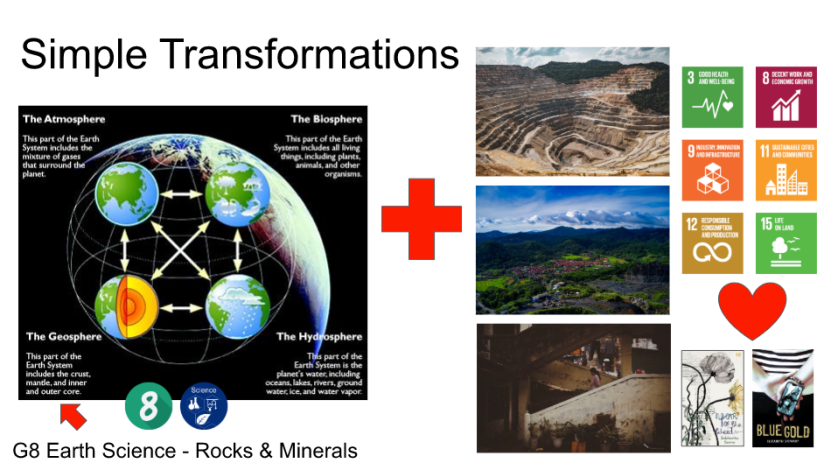
We’re on break now, and when we get back I was asked to present to our HODs for a few minutes on integrating reading into units in the middle school. I’ll probably just show this one slide:

I’d call it “content plus” – it’s from a G8 Earth Science unit that the Science team and I put together at the end of last year and they’re teaching now.

The idea is that you still have the science content as core to the unit – in this case Earth Science and learning about Sedimentary, igneous and metamorphic rocks and the minerals they contain and mining and the  products of mining. But to that you add the environmental and human impact, and the lens of the SDGs (Sustainable Development Goals).  And in order to help build empathy and understanding, add some literature.

Katie also had the brilliant idea, that she’s implemented in her school (and I’m going to be following quickly behind!), of getting good, relevant articles, stripping off the advertising etc (she uses Safari Reader View; I use Mercury Reader) putting them in binders and making them available in the library and classrooms – see slides 42-47).

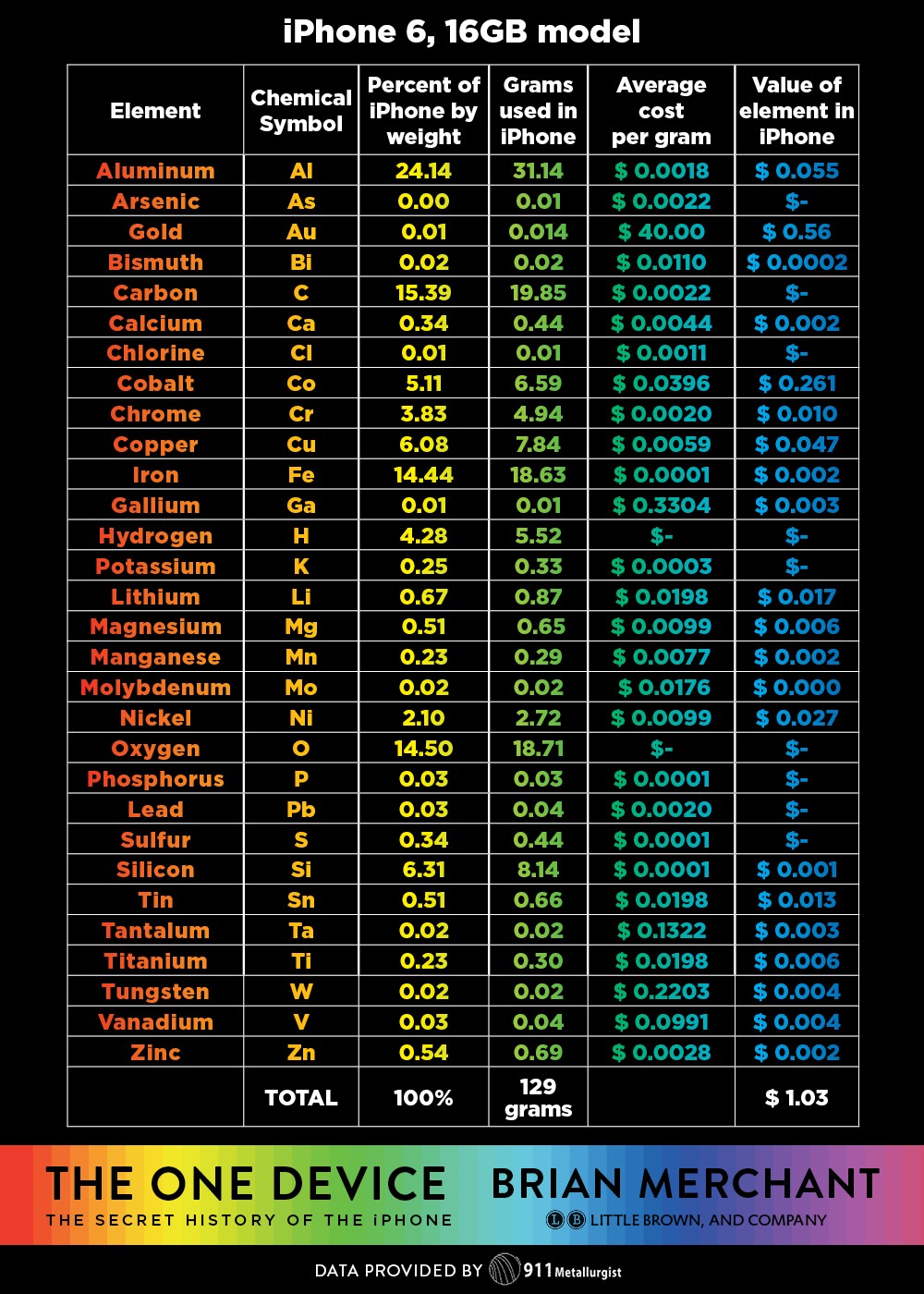
You can of course choose any minerals, but in this case to make it relevant to G8, we focused on the primary elements of an iPhone.


iPhone ingredients

Ideally, and this takes time, some of the science and or math units would be linked to Language & Literature or Individuals & Societies units allowing more time to explore literature.

In the mean time, one of the wonderful ways of adding literature into units is through picture books. In the guide we created for the Neev Festival, we made suggestions around groupings of the SDGs of the Neev shortlisted picture books plus lots of other books. It’s still a work in progress, but over time I’m hoping that for each and every global goal I have 10-20 picture books, (as well as 10-20 fiction books and 10-20 really good nonfiction books) that can easily and quickly be introduced to a class, thereby adding a very special element to learning, and truly making “every teacher a language teacher” and every teacher able to devote a tiny slice of their class to reading.

Seek and Find – breakout

In the interests of trying new things myself, and also making library orientation and searching the catalog / tracing items from the catalog to the physical copy more fun, I decided to create a library breakout.

I’d watched the “Breakout” phenomenon ebb and flow about 3-4 years ago and had always put it in the “fun, but how?” box, and this year finally decided to get into action. Our HS Edtech person had purchased the official “Breakout box” so I could have a look at that and the resources in the official site, and our ES Edtech person had deconstructed the idea and had a bunch of Stanley boxes, suitcases with locks and locks, so I had a lot to play around with. The first port of call was the official Breakout Site. Like all great ideas, this seems to be one that had its hey-day around 2015 and many of the potentially interesting links to library orientation were either broken, or the video instruction didn’t work or there were other issues, so, I left, muttering “maintenance” . I found a few good breakout description online (Library Media TechTalk; The Bright Ideas Library; LibraryStew; Ms. Kochel’s book blog;) and then, after getting an idea of how it could work, sat down and thought of what my aims would be.

  1. I wanted to highlight the “Panda” books – the annual students’ choice books that are on a huge display in the library but often get overlooked by students and teachers alike – we order 5/6 copies of each book each year and students vote on their favourite in March.
  2. I wanted students to be familiar with the library guides and bookmark the front page.
  3. I wanted to make sure students could log onto the library catalog, search for a book and then find the physical copy in the library
  4. I wanted each student to know how to use the “self-checkout” station
  5. I wanted the students to search the catalog to find more obscure items (in titles, in descriptions of books, number of books in a series etc)

With my “ISTE educator” hat on, I wanted to ensure I could work on the role of “Facilitator”:

Educators facilitate learning with technology to support student achievement of the 2016 ISTE Standards for Students. Educators:
a. Foster a culture where students take ownership of their learning goals and outcomes in both independent and group settings.
b. Manage the use of technology and student learning strategies in digital platforms, virtual environments, hands-on makerspaces or in the field.
c. Create learning opportunities that challenge students to use a design process and computational thinking to innovate and solve problems.

In this case they would be “Knowledge constructors”

3. Knowledge Constructor
Students critically curate a variety of resources using digital tools to construct knowledge, produce creative artifacts and make meaningful learning experiences for themselves and others. Students:
a. plan and employ effective research strategies to locate information and other resources for their intellectual or creative pursuits.

ATLS (approaches to learning):

  • Thinking – Creative thinking / problem solving
  • Self Management – Affective – show resilience; Demonstrate persistence and perseverance
  • Social – Collaborative – share responsibility and roles with others

Universal design for learning:

  • Multiple means of Engagement: Provide options for Sustaining Effort & Persistence
  • Multiple means of Action and Expression: Provide options for Physical Action

The guide for the breakout can be found here with the clues. Students could access this guide through a QR code on the box.  Most of them didn’t examine the box for the QR code but went straight for the printed instructions.

The activity needed at least 50-60 minutes – with some classes we had that, and generally those were the more successful classes who managed to complete all locks.

Some teams / classes didn’t complete for various reasons, and they didn’t get anything. Nothing. No compensatory prizes, no consolation prizes. The teams who did succeed could trade in their “key for success” cards in the box for boxes of “smarties” or chocolates – and the feeling of success.

Main takeaways:

  •  Students need to be carefully guided to read the instructions completely and carefully
  • Their enthusiasm and “let’s run here” inclinations needs to be tempered with “hey guys, how about stopping and thinking about …”
  • Where an activity led them to need to get a next clue from the library staff, our staff was instructed that they only proceeded if they were politely addressed and asked (part of the hidden agenda that my staff are people with feelings who need to be treated respectfully)
  • Students (and teachers) often don’t see displays and look over them – their attention needs to be brought to things deliberately
  • Don’t assume anything – some 14 year olds have never done puzzles or have any idea of what a cipher wheel is!


How to WINN in the new school year

Part of my vacation time is usually spent doing personal learning and preparing for the new year for both my students and for how I can impact teaching and learning for teachers. Last year was my first in a new environment – both in terms of level (middle school rather than primary) and country/school (Beijing, China). This year I’m preparing with somewhat more hindsight and the fact that we have 12 new teachers starting. This post I’m going to focus more on how I hope to support teachers.

Last year, my predecessor very kindly typed up a long list of answers to my 100s of questions to help guide me in the new position. It’s something I refer to from time to time even further into the year. This year I compiled a “newbies” guide with the help and input of all my fellow (last year) new teachers, and the rest of the staff on the nitty-gritty things that we wish we’d known before starting. We sent it out into the world and based on the feedback added additional information. It seems to have had some success with 1,282 views since it was created in May. But it’s a lot of information to digest.

Today I stumbled on the videos (and book) of Nick Shackleton Jones via a tweet on a blogpost of his (yes, rabbit hole – but this time a good one). This has definitely changed my whole view on how to approach supporting teachers, and perhaps even how to work with students.

A brief summary of the takeaways of the videos

Part 1 – distinguish between content dumping (my newbie Libguide – and other Libguides) and performance support. In order to give performance support you need to understand / analyse what people are trying to do and provide resources that have DESIGN & UTILITY.

Find out from your audience WHAT I NEED NOW (WINN).

Part 2 – this session is particularly interesting for on-boarding and knowledge sharing. The basic elements are things that people need immediately (how to use the computer); advice from peers, understanding how things connect together; factsheets; one page guides; checklists.

Part 3 – discusses the affective (emotional) context of learning and how to alternate between providing resources (when the audience has a strong emotional response to the information) and experiences (when the emotional response / interest is lower). The 5Di design process is introduced (define, discover, design, develop, deploy & iterate). Of particular use in my context was the CONCERN-TASK-RESOURCES model. I think that is a great way of deciding what resources to focus on by working out the concerns of the audience, relating them to tasks and then providing the resources that can help with the tasks.

I can see this working really well for designing learning experiences for our Day 9s to ensure that they are student need rather than teacher driven.

So, what I thought I’ll do is during the newbie week and first week of teachers back have daily debrief sessions on a pop-in or digital basis called WINN where teachers can quickly and briefly address what their concerns or tasks are that they need immediate help with and to build up the resources they need. Pop in is easy enough, for the digital I’m thinking of using our “ask” function of Libguides that I just started populating at the end of last year, so that the questions can accumulate into a knowledge database.

========================

Here is a longer video on “how people learn” worth the 29 minute investment – and a link to the book “How People Learn : Designing Education and Training that Works to Improve Employee Performance” I have a small gripe on the “employee performance” part of the subtitle – as I think it’s pretty universally applicable – but I guess that’s his background.

Header Photo by Felix Staffler from Pexels

When to read what how

First a shout-out – if you’re an international librarian and reading this – please join the International Librarians Lead (inTLlead) moodle – it aims to bring together a repository of resources, ideas and discussions on everything to do with being a 21C librarian in a global setting. We have 195 members and growing.

Further to my post about the difficulty in getting the right pitch in nonfiction reading in middle school, the discussion continued with science teachers about what students read (or don’t – thanks youtube) and how scientific time at school is used. And this is something I find incredibly weird as a non-science teacher, non science-curriculum creator, but as a parent of two kids having gone through science in PYP, iGCSE and MYP and DP. They spend a LOT of time and energy on lab-reports. Which often, no matter how heavily it’s scaffolded (and believe me I’m yet to see a lab report assignment that’s not heavily scaffolded) but they don’t spend any time until the IB reading a scientific journal article. And then probably only if they’re doing an EE (extended essay) on a scientific topic. And the skills required may or may not be explicitly taught depending on whether the librarian gets a look in, and depending on the supervisor and how much time they have.

Does anyone else find this strange? I’m wondering if we could somehow create a phased cross-walk between popular science articles in various areas to the original research that gave rise to those media interpretations (or misinterpretations as the case may be). Phased as in the sense of starting with the LCD of the abstract and conclusion and working up to sample size, statistics chosen and interpreted, hypothesis, methodology, experiment (link to the dreaded lab report) etc.

Am I talking nonsense? I’m thinking something very graphic so it’s pretty obvious. Or they create the graphic. By the time they get to the IB or university they don’t have the time to both do the writing needed and learning the decoding skills surely we should start earlier?

Trust me I’m a …

I’ve had this vague feeling ever since I started in the middle school that I’m just not serving my population well on the research side of things. I’ve tried putting my finger on it in the past but the unease has been growing. It started with being dissatisfied with nonfiction and that we’re not doing enough to uncover what research really looks like. I’ve not blogged much this year – partly due to having a lot on my plate with moving schools and school section, but also by choice since there’s just been so much to process and I’m not sure if writing it would be the best option.

It’s now near the end of May and my unease has not abated. A few things are going much better – I’m slowing getting some more collaboration going between the library and the various subjects. Which in some ways leads to more soul searching on how to best serve our students. I think I’m beginning to better understand the problem, not that I’m any closer to a solution. danah boyd gave yet another amazing talk recently and here is the transcript: “Agnotology and Epistemological Fragmentation” – bigger words than I’m accustomed to blogging on, but please indulge me and read the link, as it’s a good, albeit scary read. In particular what struck me was her discussion of the “data void” because that is exactly the description for what I’m experiencing as a middle school librarian.

In primary life was relatively easy – students had their passions – dinosaurs and trucks and kittens and ocean life and their inquiries, the rainforest, energy, etc. and I had a plethora of resources, mainly print books that could explain things in a simple yet clear and age appropriate way.

My latest existential crisis is the result of a rather good collaboration with G8 Biology, where we’re trying to take some biological understanding of cells and make it relevant to your average 13/14 year old in the throes of puberty where everything is more interesting than cellular details. So the idea was to try and help them examine what’s going on at a cellular basis when they indulge in typical teen behaviour – eating, drinking, going to the spa, putting on sunscreen, using makeup, experimenting with alcohol or smoking/vaping, dyeing their hair etc. I’m gathering some basic background information in a Libguide so that they don’t get bogged down in a google blackhole.

But that pulls me into the rabbit hole instead as I try to find scientific information. With the teachers we’d already decided that any books we had were largely irrelevant content detailed and superceded by better online models and information. But what we needed now was good information tailored to the unit.

I started with what I thought would be something relatively simple – deodorants – nothing could be further from the truth. On the one hand you have Dr. Mercola, and his ilk, countless hysterical “health” bloggers; Huffington post and on the other, the 200 page report on the matter from the EU scientific commission. Then there was the Doctor in the Harvard review (via Credo) answering questions posed by her daughter and her daughter’s friends and her mother and neighbour. With some pretty definitive answers, but not a citation or reference to back up her views. I don’t think so. So I had to eliminate that as a potential source – Harvard or not, Doctor or not.

As boyd so perfectly puts it “One of the best ways to seed agnotology is to make sure that doubtful and conspiratorial content is easier to reach than scientific material. YouTube is the primary search engine for people under 25. It’s where high school and college students go to do research. Digital Public Library of America works with many phenomenal partners who are all working to curate and make available their archives. Yet, how much of that work is available on YouTube?

I had a similar problem when I was trying to find some nonfiction books on vaping and e-cigarettes – the books were merely adequate. In particular I was interested in at least one chapter, or even a page that dealt with the science of nicotine / of what’s going on in the lungs, the science. A few good images that didn’t just include pictures of the hardware of vaping! But there isn’t anything.

Where does that leave us as teachers and teacher librarians? Caulfield, who I highly respect for his work on information literacy, has come up with an alternative to CRAAP – SIFT

  • (S)TOP
  • (I)nvestigate the Source
  • (F)ind better coverage
  • (T)race claims, quotes, and media back to the original context

It makes sense, I liked it, but it sat a little uneasily with me, and after reading boyd, I understand why. What happens when you’re going through SIFT and you get to the F and find that there is no better coverage? This can be due to a number of reasons –

  • The gap between what is accessible at your level of understanding / education / language /
  • the preferred mode of access gap (see the comment on YouTube earlier)
  • the void between what I would call the “Goop press” (see this, and this) and science journals.
  • The chasm between what student friendly sources publish and what students are actually researching – anyone find anything really good on micro-plastics recently? – Not in any of the databases my school subscribes to…
  • The fact that even the most intelligent and well meaning teacher in my environment is loath to consider allowing students to use wikipedia (that will be a whole blog post on its own)

You will not achieve an informed public simply by making sure that high quality content is publicly available and presuming that credibility is enough while you wait for people to come find it. You have to understand the networked nature of the information war we’re in, actively be there when people are looking, and blanket the information ecosystem with the information people need to make informed decisions (boyd).

In the mean time, I’m encouraging my teachers and students to use Beers & Probst’s Notice and Note for Nonfiction. At the very least I’m hoping that using it will give them a sense of unease. Of uncertainty, of wondering if what they are reading can be believed, and if not that if not now, at some point they’ll continue to mull over the topic and eventually be able to research it further, and if necessary change their minds or opinions on what they learnt back when they were in G8.

Does Activism require Power?

One of my most popular blog posts was “Advocacy is not enough we need power” and I still stand by that. Ironically enough in my new role I am teacher librarian slash Edtech integrator, and I like to joke with my colleagues who need anything from data to access to fixing an issue to equipment that “I have the power”. But some stuff fluttering around twitter recently has made me wonder about librarians and power and about power in general.

In particular I think something amazing is happening in university librarian land with the ending of negotiations with Elsevier by UC – and the person in the cape is a librarian! But here is the strange thing – @Jmmason is getting three likes (plus mine) and two retweets on his guide for transitioning journals to open access.

Is this a case of “if a tree falls in a forest”? Where are all the OA activist librarians? Where even are all the “whinging about costs” librarians?

I like to follow a wide variety of people and Chris Bourg is one of my “go to” activist librarians. We need so much more of this ilk. But then I wondered about whether activism could exist in a vacuum of power. At the same time I know that power can both be given or assumed.

Most librarian groups now seem to have migrated to Facebook. Which is ironical because if we were better librarians and better curators we would not base the existence of our professional learning networks on a platform where groups are closed, information gets lost and the same questions are repeated ad-infinitum (see rant here). And judging by the posts we’re pretty good at complaining and most of the complaints (I’m talking the K-12 sector) are about budgets, job loss (or more accurately position loss as in “an unqualified teacher will do the library next year), or lack of acknowledgement. These are not the bleatings of people with real or perceived power.

The question is who can become activists? On the one hand you have people like Bill and Melinda Gates (see their annual letter, and particularly the bit about data can be sexist) who have the power. On the other you have people with next to nothing to lose. And then there are all the rest of us status quo huggers.

I say “us” deliberately, because I’m complicit. I think of a few things that we need to get activist about – some in the cost sphere, some in the service sphere (FollettDestiny are you listening) where we need to get organised, we need to share cost and pricing data but we don’t. Is it time? Is it being contractually bound to silence? Is it not wanting to be the tall poppy? Definitely in the diverse and relevant resource sphere as international school librarians we need to be in a constant state of outrage. And then there is the whole literature / translation thing going on – or not. Thanks to GLLI it’s moving in the right direction – albeit slowly and again why don’t they have tens of thousands of followers?

So we are librarians, a marginalised group within a sector in most countries (and in particular in many parts of the mighty trend setting US or A) that is marginalised economically, is it strange that you don’t encounter many activist librarians?

No use me merely complaining – What would my suggestions be to become an activist librarian?

  • Uncompromising values and standards
  • Unite, collaborate, be present
  • Champion diversity

Uncompromising values and standards

This is both personal and global. If you’re a qualified librarian be amazing at what you do and if you’re mediocre work on becoming better. If you’re amazing become even better and make sure you’re sharing and mentoring other librarians – and not just in your local network – we need more mentoring programs for regions where library science is under-represented.

And let’s not start on the levels above – the funding for library positions in schools and for university library programs. Who gets admitted into the library programs – are they taking the best of the best? Or the ones who want to get out of teaching for an “easy ride”?

It’s a bit the Finland / Singapore argument (to dig up an old trope) – well paid professions attract professionals.

Unite, collaborate, be present

Unite here not just to complain but unite in action. Collaborate and if necessary collude on matters that matter for knowledge, deep education, and investigation. Be present in the discussions and arguments. If you are not the leader be the first or subsequent follower.

If you’re a librarian in an international school join IntlLead a platform run by and for librarians not affiliated to any organisation.

Find examples of activism in other fields / areas that you can learn from or latch onto or use as examples.

Champion Diversity

I’m not just talking about #WeNeedDiverseBooks (see Meting out Diversity?). We also need diverse knowledge. Is that an oxymoron? And we need to personally be critical about what passes as knowledge and pass that critical stance on to our students. AT ALL LEVELS – not just when they’re in High School or doing TOK. Our G5 students need to know the information they consume for their PYP Exhibition is biased and deficient and that they can and should be adding to this from their cultural or geographical or linguistic perspective. We need to help publish. We need to interrogate the authors we invite to our schools on what they are doing to mentor and encourage no-name-brand authors in our locale, theirs, where they are appropriating stories for their books or elsewhere (and not just those who can afford expensive workshops). We need to invite speakers who do not repeat what we think we know but who challenge our assumptions.

Knowledge is biased

Look at this. As librarians are we passing on our outrage to our students? Do we follow sites like @WhoseKnowledge and tell our students to check the origins of what they’re reading? And that they whole darn point of learning and research is to make your own contribution to the world of knowledge and end this microscopic world view?

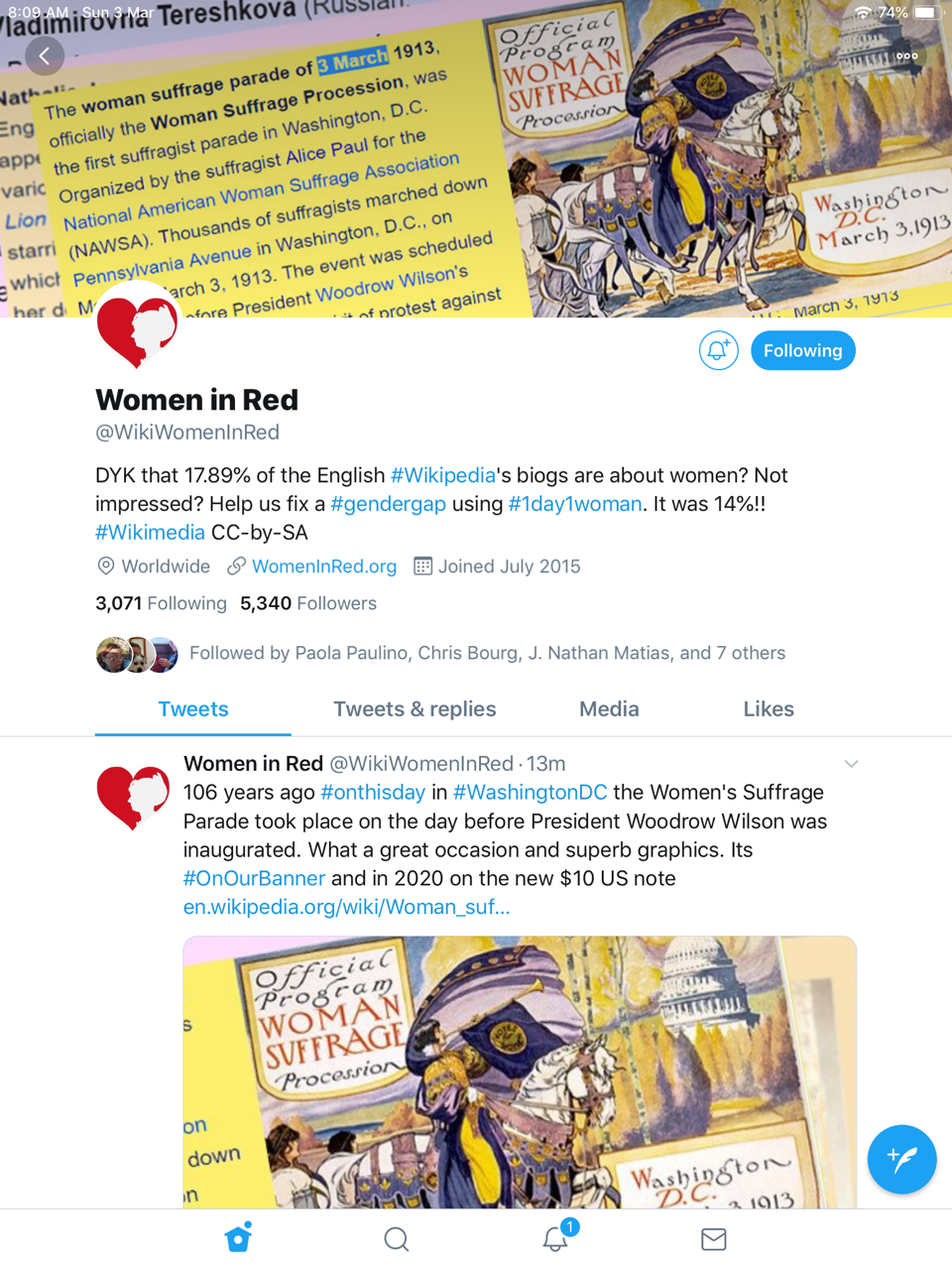
Here’s another one worth letting your students and fellow librarians know about – @WikiWomeninRed 

I don’t know how to end this. Just keep on being angry or outraged. And do something positive with that anger.

Are we teaching dogs to chase cars?

I’d love a dollar for every time as a TL I’m asked to teach students “how to search” or “search terms” or “searching. Once upon a time I complied. I’ve become a bit more bolshie in my old age. I now try to engage. Engage in a conversation as to what exactly the teaching and learning aim is behind the request.

You see, we don’t need to teach dogs to chase cars. We need to teach them what to do with them once they’ve caught them. And we need to teach that bit first, so that they can decide with the right amount of information at their disposal that actually, cars are not edible and therefore not worth the chase.

I understand the impetus behind wanting to teach better searching. It comes from a good place. One which recognises that students are going to google anyway, it will probably be their first and last port of call and we may as well teach them how to use it better so at least the results somewhat resemble the information they’re looking for.

But without some kind of prior knowledge or context, how will they recognise what is in front of them for what it is? And without deep literacy skills, both on the reading and writing side, how will they do something with it? And why am I seeing two huge time sucks in student “research” – searching and gathering “information” and dressing it up in some kind of (digital) presentation form. aka, the dogs chasing the car and trying to make a silk purse out of a sows ear. Which leaves precious little time for the meat in the middle.

Am I overly cynical, or is this a more generic experience? And what can we / dare we do about it?

Beyond beyond search and cite

A long while ago (3 years) I wrote a post about the fact that we needed to look beyond “search and cite” in teaching information literacy and look at the threshold concepts of research, and a presentation I’d given on the theme. I remember at the time seeing half the audience (of librarians) eyes glazing over and thinking, “oh no, this isn’t going to work if it’s not something librarians get and relate to – and how on earth would students buy in?” I still believe that understanding threshold concepts in any discipline and for us librarians in research / information literacy is crucial in diagnosing misunderstandings and structuring our teaching. But then yesterday I had another insight on how this could be approached in a far better way.

studentIn my current position I’m considered to be part of the school wide coaching team, and as a group it was suggested we read “Student-Centered Coaching” by Diane Sweeney. I’ve been enjoying the fact that it’s a pretty practical book and one where you start to think that by taking the focus off the coach or even the teacher, you can actually take a lot of the emotion out of the coaching / teaching equation.

The book emphasises the use of data, but not necessarily the data provided by testing, but rather from the usual formative and summative assessment that is going on anyway.  One example used DRA testing – the equivalent of which occurs all over regularly anyway, and another a rubric from a writing program using a writing prompt. The idea is to select pieces of writing and score them on writing conventions and then group students into bands of “exceeding, experienced, competent, developing, emerging or below emerging” conventions. One then tries to move those groups / cluster using differentiated instruction up the scale.

I immediately thought of a lost opportunity last term, I’d had to teach citation to groups of students prior to their final assessment of a unit. It had been hectic both on my side and the teacher / classes and I’d been beating myself up a bit about it. Then my son (a different grade) came home and showed me an I&S assessment task (ungraded) he’d done and asked me what I thought of it. That’s a tough call. Because,  there was a lot going on there and not all of it was pretty.

And then I realised it was the perfect way to do a “backwards by design” session on searching and citing.

What if the “works cited list” and in-text citations of an assessment task of a whole class or grade were to be critically looked at?  It is a few lines that reveal so much of what’s going on in research. And then based on that one could group students according to where they were and what needed to be worked on and then individualise that part of the rubric in order to see if there was progress in understanding (and if they were approaching the thresholds!).

A quick reminder of the IL threshold concepts – research is/has:

  • Authority – Is constructed and contextual
  • Format – the creation, production and dissemination of research is not equivalent to its delivery or how it is experienced
  • Information goods – research has a cost and a value
  • Information structure (searching as strategic exploration) – an ability to look “under the hood” of databases and search engines (including more and more as we use things like Google scholar – the algorithms that spit out the results)
  • Research process – as iterative, difficult and building on the those who came before
  • Scholarly discourse – citation is a point of access into this discourse
  • (Research as inquiry – ongoing nature of research this is used by some but not all researchers)

Some of the things I noticed when looking at my son’s paper were –

Evidence (just two examples as an example): Not understanding that “Et al.” means “and others” – encountered in the in-text citation and works cited. The in-text citation followed the format (author, date) while the works cited was MLA8. Kind of.

Indication of not understanding:  

  • authorship = authority. But behind that was an understanding of the research process that included groups of people working on a topic
  • Format – since he’d used google scholar as a delivery point for the search. And from there had got to the database article without realising that it was an article in a database.  And didn’t understand the format or
    Screen Shot 2018-10-14 at 19.21.28information structure.
    This is something, if MLA8 is correctly taught and deployed, including its emphasis of a Russian Doll like structure of containers, should become obvious.  There is another – more simple aspect of formatthat of the format of citing and where that can be found. I showed him the  ”  marks in google scholar and how that led to the citation that could be copied into NoodleTools as is… a revelation
    for him. I also showed him in the original journal article of two other sources how he could find the citations and just copy and paste them – let’s consider small steps here!

Indication of understanding:

  • Scholarly discourse – here is where my own prejudice to APA versus MLA8 for the humanities come in – the date is probably a better indication of the point of scholarly discourse and understanding that something more recent would encompass prior research

The Scott (2017) article listed below is a particularly good one – because it asks students to rank their understanding of the concepts and to explain them. And this is where you can see the metacognitive value of “knowing what you don’t know” (please read Errol Morris’  series of articles on the anosognosics dilemma – the best ever on this, if you haven’t already) comes into play

“One mentioned domain knowledge as a barrier: “You have to have some type of familiarity with the topic to ‘enter the conversation.’” (Scott, 2017, p. 295)

To reign this back, we’re talking about middle and high school. So wading straight into threshold concepts may be going in too deep for the average student. But it may be a useful diagnostic tool.

Getting back to the coaching bit – doing an autopsy on in-text citations and the works cited list would reveal where the gaps and issues both in searching and citing were. The humanities teacher is probably looking at the assessment using a different lens – that of understanding and using the information and the ability to write it up in an academically acceptable manner using some kind of scaffolding (e.g. point, evidence). And at the end of the assessment, once a grade has been given and the focus has moved onto the next unit / assessment, the gaps in the ATL “research” may not have been identified, recognised, nor addressed in the teaching or assessment rubric for the next unit.

I believe in rubrics as a way of shaping teaching and focusing attention in student effort. If in a year, the teacher in conjunction with the librarian, moves through perhaps four iterative cycles of research, I’m sure we’d see real progress in both the practical ability and metacognition of students as they approach research and the threshold concepts.

=================

Here are some articles that explore further information literacy as a threshold concept in an interesting way:

Further reading:

Corrall, S. (2017). Crossing the threshold: reflective practice in information literacy development. Journal of Information Literacy, 11(1), 23. https://doi.org/10.11645/11.1.2241
Hofer, A. R., Townsend, L., & Brunetti, K. (2012). Troublesome concepts and information literacy: Investigating threshold concepts for IL instruction. Portal: Libraries & The Academy, 12(4), 387-405.
Hofer, A., Brunetti, K., Townsend, L., & Portland State University. (2013). A threshold concepts approach to the standards revision. Comminfolit, 7(2), 108. https://doi.org/10.15760/comminfolit.2013.7.2.141
Morris, E. (2010, June 20). The anosognosic’s dilemma: Something’s wrong but you’ll never know what it is (Part 1). Retrieved 4 February 2014, from http://opinionator.blogs.nytimes.com/2010/06/20/the-anosognosics-dilemma-1/?_php=true&_type=blogs&_php=true&_type=blogs&_r=1
Scott, R. (2017). Transformative? Integrative? Troublesome? Undergraduate student reflections on information literacy threshold concepts. Communications in Information Literacy, 11(2), 283–301. https://doi.org/10.15760/comminfolit.2017.11.2.3
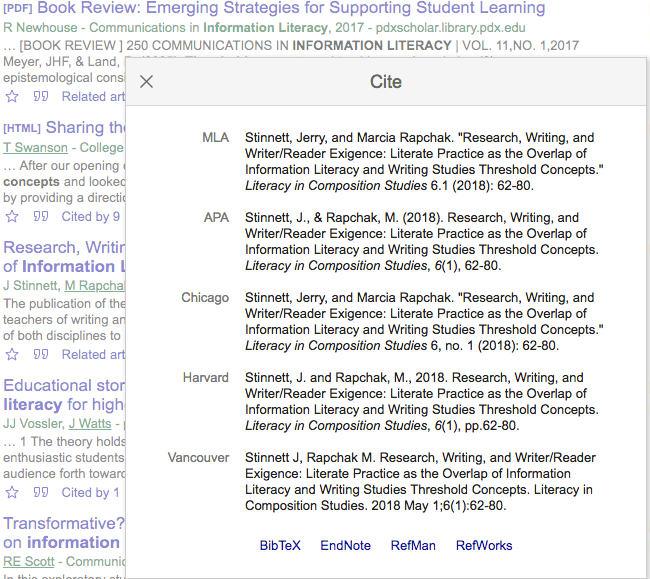
Stinnett, J., & Rapchak, M. (2018). Research, writing, and writer/reader exigence: Literate practice as the overlap of information literacy and writing studies threshold concepts. Literacy in Composition Studies, 6(1), 62–80. Retrieved from http://licsjournal.org/OJS/index.php/LiCS/article/viewFile/180/239
Townsend, L., Hofer, A. R., Lin Hanick, S., & Brunetti, K. (2016). Identifying threshold concepts for information literacy: A Delphi Study. Communications in Information Literacy, 10 (1), 23-49. https://doi.org/10.15760/comminfolit.2016.10.1.13

Are nonfiction books still relevant?

I was showing a fellow librarian around “my” new library today and we were chatting and discussing various aspects of middle school librarianship. We got to the nonfiction section and both sighed. I started that mine probably needed some significant weeding and that I’d made a start. I pointed out a few particularly nice books in the collection (Annick Press still does nonfiction well, the newish Theodore Gray Molecules and Reactions). But so much ages so badly and so quickly. And in an inquiry based system where one wants to encourage systems thinking and embrace the idea of interconnectivity it is almost anachronistic to maintain Dewey divisions and populate them with single topic books.

Gone are the days when teachers gave the librarian a content based topic and you could wheel a collection of books that covered the length and breadth of what there was to know at a specific grade level about that topic. Done and dusted. Now you’re not so much discussing WW1, so much as conflict, with WW1 as the bare-bones scaffold of the topic. There aren’t that many books that deal well with the nuances of conflict in an age appropriate, stimulating but accurate, culturally sensitive manner. One such book is Global Conflict, from the Children in our World series by Louise Spilsbury.  No, it probably isn’t written with 14 year olds in mind. And I had to offer it somewhat apologetically to one of the teachers and say I thought it actually covered the ground fairly well, and everything else on offer was probably pitched at a much too high level.

Besides which, students aren’t reading books anymore. The books I pulled out on WW1 for a display remained unread, un-borrowed. I dare not investigate too closely where they got their information for their assessment from, since, looking at the database statistics it wasn’t from databases either.

A month or so ago, I had a look at our “country” books – they ranged from 1999-2005. A lot has happened since 2005. So they had to go. But what to replace them with – if anything? I checked the curriculum, spoke to the lead of the one grade doing something on national cultures and offered a collection I’d made in Epic! that could cover it more or less. There are no students pouring over country books or atlases like perhaps we would have done. If they need information there’s wikipedia or facts on file.

All this time I’m reading “Reader Come Home” (it sure is taking a long time, but I’m distracted myself) and the issue of shallow reading and attention and focus and digital media. And I wouldn’t worry if it weren’t for the fact that the problem doesn’t seem to just be shallow reading, it seems to be a great divide between reading a lot, and not reading at all. I ran some statistics last night. Our top (G6) class read 4x as much as our bottom (G8) class (at least books from the library – to which everyone says “oh but they may be reading books at home – to which I say “evidence?”). But that’s not the problem – looking through numbers student by student so so many hadn’t borrowed even one book. I’m about to self-flagellate at this point and worry what I’m doing wrong. I need more data and then I need a strategy.

There’s no doubt quite a bit of the nonfiction must go – but what should I be replacing it with? Middle schoolers are just that little bit young to place popular nonfiction in – the Malcolm Gladwells and the like. What is everyone else doing?

I wish I didn’t have to welcome you

I’m part of this club that I never want to be in the position to welcome others to, and yet yesterday afternoon I had to admit yet another member.

I don’t even know what to call it – I don’t want to name it – #metoo has connotations that I’d rather not introduce an 11 year old to, but maybe we need to.

The scenario. Last hours of the last day of a G6 camp. A young girl sitting to the side crying. As the nearest available woman I was asked to see what the problem was. She was really upset. Why? She’d had a great idea during one of the group activities that was ignored, but then wholeheartedly accepted when a boy reiterated the exact same idea minutes later. I affirmed her right to be upset, and angry and frustrated. And inside I’m thinking omg, how horrid that at the tender age of 11 she’s already being confronted with this. Or how admirable that she’s so aware – I think I was in my own private intellectual haze until at least university.

I told her there was a name for what had happened – sort of, and explained mansplaining. I told her there were other strong capable women out there who were ready to support girls like her and that I’d send her some articles. I told her that crying was unfortunately not the answer, nor was setting herself aside. I quickly taught her some calming breathing, and yesterday evening got in touch with a wonderful teacher at our school who runs a club for students around the themes of gender and identity. I spoke to a couple of teachers who had been at the stations where she’d been excelling in leadership – intellectual and physical and who totally “got” that what had happened was that she’d been taken down a peg or two by the wanna-be alpha males in the group. At 11. Yes. At the age of 11. It probably happens earlier, but perhaps the consciousness and self-righteousness and awareness of what has just happened doesn’t happen earlier (frontal lobe and all that?).

#weareallfeminists