What research looks like

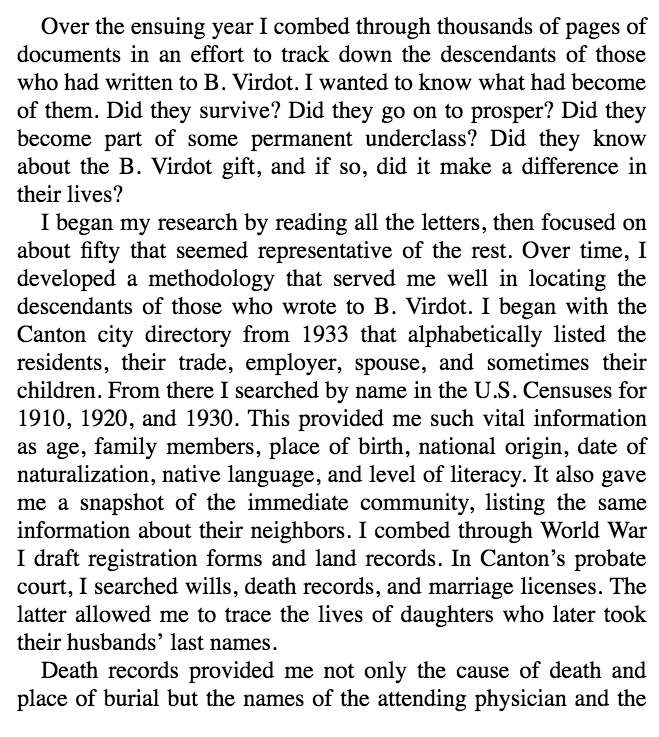
Lest I be accused of being too negative on the information literacy side of things I wanted to post something positive. A while back I was listening to an interesting enough book, (Gup, 2014) but the most fascinating part, and what sent me back to the eBook version was the part where the author explained how he’d conducted his research.

Now we often use mentor texts in education, and why not when we’re trying to teach research? In the extract below, Gup,  explains how he, a former Washington Post investigative journalist went about uncovering the story of his grandfather.

Research 1

Research 2
2 page extract from: “A secret gift” by T. Gup

This is the type of detail that is hidden to people who read a newspaper report. The amount of work is just staggering.

Perhaps that is why students struggle to understand what “real life” research looks like. After all what kind of research are they exposed to? Wikipedia is actually not bad, as it cites its sources at the bottom (to those who scorn it). Britannica for students hides behind editorship (as a substitute for identifiable authorship) and a lack of sources (this article on the depression has two authors but no sources and yet we’d rather students go to Brittanica than Wikipedia?). Books, when they’re used at all, do have sources, sometimes, depending on the target age and how scrupulous the publisher is. Newspaper or magazine articles – we have no idea of either the research process nor the sources of information except inasmuch it is divulged, for example, in movies such as Spotlight.

So our young researchers go off onto the internet, or maybe to Britannica and Brainpop and some books and then as they mature we coax students into using databases and journal articles. Where again, they see the end product rather than the process.

How often do we get researchers in to uncover their craft? Versus for example authors of fiction or poetry?  So is it by accident or design that they’re not breaking through those threshold concepts?

References:

Gup, T. (2014). A secret gift: how one man’s kindness–and a trove of letters–revealed the hidden history of the great depression. New York: Penguin Books. Retrieved from http://rbdigital.oneclickdigital.com


The Boston Globe. (2016). The Boston Globe Spotlight Team. Retrieved from https://www.youtube.com/watch?v=kJfyjq80Ths

Are we teaching dogs to chase cars?

I’d love a dollar for every time as a TL I’m asked to teach students “how to search” or “search terms” or “searching. Once upon a time I complied. I’ve become a bit more bolshie in my old age. I now try to engage. Engage in a conversation as to what exactly the teaching and learning aim is behind the request.

You see, we don’t need to teach dogs to chase cars. We need to teach them what to do with them once they’ve caught them. And we need to teach that bit first, so that they can decide with the right amount of information at their disposal that actually, cars are not edible and therefore not worth the chase.

I understand the impetus behind wanting to teach better searching. It comes from a good place. One which recognises that students are going to google anyway, it will probably be their first and last port of call and we may as well teach them how to use it better so at least the results somewhat resemble the information they’re looking for.

But without some kind of prior knowledge or context, how will they recognise what is in front of them for what it is? And without deep literacy skills, both on the reading and writing side, how will they do something with it? And why am I seeing two huge time sucks in student “research” – searching and gathering “information” and dressing it up in some kind of (digital) presentation form. aka, the dogs chasing the car and trying to make a silk purse out of a sows ear. Which leaves precious little time for the meat in the middle.

Am I overly cynical, or is this a more generic experience? And what can we / dare we do about it?

Beyond beyond search and cite

A long while ago (3 years) I wrote a post about the fact that we needed to look beyond “search and cite” in teaching information literacy and look at the threshold concepts of research, and a presentation I’d given on the theme. I remember at the time seeing half the audience (of librarians) eyes glazing over and thinking, “oh no, this isn’t going to work if it’s not something librarians get and relate to – and how on earth would students buy in?” I still believe that understanding threshold concepts in any discipline and for us librarians in research / information literacy is crucial in diagnosing misunderstandings and structuring our teaching. But then yesterday I had another insight on how this could be approached in a far better way.

studentIn my current position I’m considered to be part of the school wide coaching team, and as a group it was suggested we read “Student-Centered Coaching” by Diane Sweeney. I’ve been enjoying the fact that it’s a pretty practical book and one where you start to think that by taking the focus off the coach or even the teacher, you can actually take a lot of the emotion out of the coaching / teaching equation.

The book emphasises the use of data, but not necessarily the data provided by testing, but rather from the usual formative and summative assessment that is going on anyway.  One example used DRA testing – the equivalent of which occurs all over regularly anyway, and another a rubric from a writing program using a writing prompt. The idea is to select pieces of writing and score them on writing conventions and then group students into bands of “exceeding, experienced, competent, developing, emerging or below emerging” conventions. One then tries to move those groups / cluster using differentiated instruction up the scale.

I immediately thought of a lost opportunity last term, I’d had to teach citation to groups of students prior to their final assessment of a unit. It had been hectic both on my side and the teacher / classes and I’d been beating myself up a bit about it. Then my son (a different grade) came home and showed me an I&S assessment task (ungraded) he’d done and asked me what I thought of it. That’s a tough call. Because,  there was a lot going on there and not all of it was pretty.

And then I realised it was the perfect way to do a “backwards by design” session on searching and citing.

What if the “works cited list” and in-text citations of an assessment task of a whole class or grade were to be critically looked at?  It is a few lines that reveal so much of what’s going on in research. And then based on that one could group students according to where they were and what needed to be worked on and then individualise that part of the rubric in order to see if there was progress in understanding (and if they were approaching the thresholds!).

A quick reminder of the IL threshold concepts – research is/has:

  • Authority – Is constructed and contextual
  • Format – the creation, production and dissemination of research is not equivalent to its delivery or how it is experienced
  • Information goods – research has a cost and a value
  • Information structure (searching as strategic exploration) – an ability to look “under the hood” of databases and search engines (including more and more as we use things like Google scholar – the algorithms that spit out the results)
  • Research process – as iterative, difficult and building on the those who came before
  • Scholarly discourse – citation is a point of access into this discourse
  • (Research as inquiry – ongoing nature of research this is used by some but not all researchers)

Some of the things I noticed when looking at my son’s paper were –

Evidence (just two examples as an example): Not understanding that “Et al.” means “and others” – encountered in the in-text citation and works cited. The in-text citation followed the format (author, date) while the works cited was MLA8. Kind of.

Indication of not understanding:  

  • authorship = authority. But behind that was an understanding of the research process that included groups of people working on a topic
  • Format – since he’d used google scholar as a delivery point for the search. And from there had got to the database article without realising that it was an article in a database.  And didn’t understand the format or
    Screen Shot 2018-10-14 at 19.21.28information structure.
    This is something, if MLA8 is correctly taught and deployed, including its emphasis of a Russian Doll like structure of containers, should become obvious.  There is another – more simple aspect of formatthat of the format of citing and where that can be found. I showed him the  ”  marks in google scholar and how that led to the citation that could be copied into NoodleTools as is… a revelation
    for him. I also showed him in the original journal article of two other sources how he could find the citations and just copy and paste them – let’s consider small steps here!

Indication of understanding:

  • Scholarly discourse – here is where my own prejudice to APA versus MLA8 for the humanities come in – the date is probably a better indication of the point of scholarly discourse and understanding that something more recent would encompass prior research

The Scott (2017) article listed below is a particularly good one – because it asks students to rank their understanding of the concepts and to explain them. And this is where you can see the metacognitive value of “knowing what you don’t know” (please read Errol Morris’  series of articles on the anosognosics dilemma – the best ever on this, if you haven’t already) comes into play

“One mentioned domain knowledge as a barrier: “You have to have some type of familiarity with the topic to ‘enter the conversation.’” (Scott, 2017, p. 295)

To reign this back, we’re talking about middle and high school. So wading straight into threshold concepts may be going in too deep for the average student. But it may be a useful diagnostic tool.

Getting back to the coaching bit – doing an autopsy on in-text citations and the works cited list would reveal where the gaps and issues both in searching and citing were. The humanities teacher is probably looking at the assessment using a different lens – that of understanding and using the information and the ability to write it up in an academically acceptable manner using some kind of scaffolding (e.g. point, evidence). And at the end of the assessment, once a grade has been given and the focus has moved onto the next unit / assessment, the gaps in the ATL “research” may not have been identified, recognised, nor addressed in the teaching or assessment rubric for the next unit.

I believe in rubrics as a way of shaping teaching and focusing attention in student effort. If in a year, the teacher in conjunction with the librarian, moves through perhaps four iterative cycles of research, I’m sure we’d see real progress in both the practical ability and metacognition of students as they approach research and the threshold concepts.

=================

Here are some articles that explore further information literacy as a threshold concept in an interesting way:

Further reading:

Corrall, S. (2017). Crossing the threshold: reflective practice in information literacy development. Journal of Information Literacy, 11(1), 23. https://doi.org/10.11645/11.1.2241
Hofer, A. R., Townsend, L., & Brunetti, K. (2012). Troublesome concepts and information literacy: Investigating threshold concepts for IL instruction. Portal: Libraries & The Academy, 12(4), 387-405.
Hofer, A., Brunetti, K., Townsend, L., & Portland State University. (2013). A threshold concepts approach to the standards revision. Comminfolit, 7(2), 108. https://doi.org/10.15760/comminfolit.2013.7.2.141
Morris, E. (2010, June 20). The anosognosic’s dilemma: Something’s wrong but you’ll never know what it is (Part 1). Retrieved 4 February 2014, from http://opinionator.blogs.nytimes.com/2010/06/20/the-anosognosics-dilemma-1/?_php=true&_type=blogs&_php=true&_type=blogs&_r=1
Scott, R. (2017). Transformative? Integrative? Troublesome? Undergraduate student reflections on information literacy threshold concepts. Communications in Information Literacy, 11(2), 283–301. https://doi.org/10.15760/comminfolit.2017.11.2.3
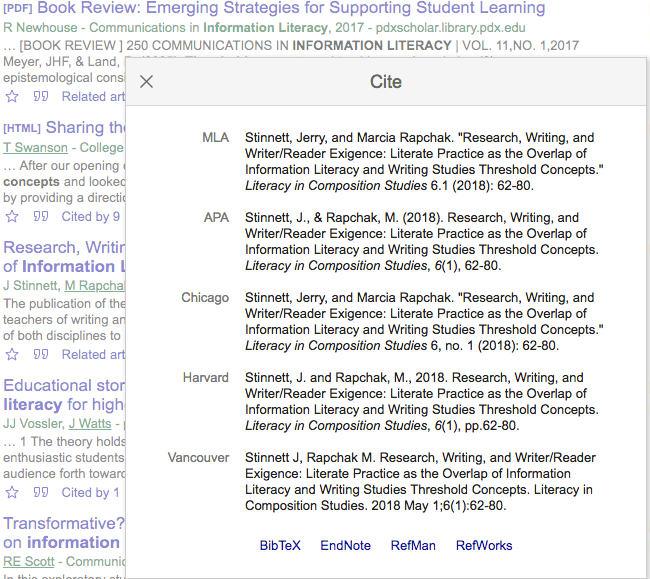
Stinnett, J., & Rapchak, M. (2018). Research, writing, and writer/reader exigence: Literate practice as the overlap of information literacy and writing studies threshold concepts. Literacy in Composition Studies, 6(1), 62–80. Retrieved from http://licsjournal.org/OJS/index.php/LiCS/article/viewFile/180/239
Townsend, L., Hofer, A. R., Lin Hanick, S., & Brunetti, K. (2016). Identifying threshold concepts for information literacy: A Delphi Study. Communications in Information Literacy, 10 (1), 23-49. https://doi.org/10.15760/comminfolit.2016.10.1.13

Ask the inhabitants

My online library network is getting excited about a couple of articles that are challenging beliefs.

There’s danah boyds’ You Think You Want Media Literacy… Do You? it is an incredibly powerful article that needs to be printed out and highlighted and read very slowly. A couple of times. One passage that struck me epitomised the near futility in what we’re trying to do on the “fake news” front.

“This is about making sense of an information landscape where the very tools that people use to make sense of the world around them have been strategically perverted by other people who believe themselves to be resisting the same powerful actors that we normally seek to critique.(boyd, 2018)

Her conclusion is that we need to “inoculate” students against their very human tendencies by approaches that “are designed to be cognitive strengthening exercises, to help students recognize their own fault lines, not the fault lines of the media landscape around them” (boyd, 2018).

And then Wilkinson’s (2017) very apt writing up of her presentation that boils down to the fact that it is humans, messy, opinionated humans, subject to confirmation bias who are doing the research and therefor takes a welcoming psychological approach to understanding how students research – the paragraph on “post truth psychology is particularly well worth reading.  Her point is to short-cut the evaluation part of resourcing research and cut to reliability.

So while all this was percolating in my brain, I went for a run while listening to 99% invisible, and they had a two part series on the Bijlmermeer. Having lived in the Netherlands in the 90’s – my first year was when the plane went down on one of the buildings – I was very interested to hear what an American podcast would have to say about it. And I realised that in many ways as librarians and teachers we are imposting a modernism/functionalism mindset on research. With our structures and mnemonics we are creating these concrete structures that get in the way of a more organic way of knowing and learning.

Furthermore, planners realized people didn’t want to live in huge concrete structures. Almost immediately after the Bijlmermeer was finished, another neighborhood in Amsterdam was redesigned — it was done with bricks, a traditional Dutch material.

The Bijlmermeer, and maybe a lot of Modernism, was architecture for architects. It was a top-down, paternalistic approach to city planning. The redesign of the Bijlmermeer did not make that mistake. People from the community were heavily involved in the redesign process (Mingle, 2018).

So yesterday evening I decided to ask the inhabitants. In this case my two high-school teenagers. I asked how they did research, how they decided where to search and what to use. The answers were enlightening. And frightening.

First my highly intellectual daughter who “does school” very well. She admitted that she didn’t have the first idea about doing “proper” research and that actually in the last seven years that she’s spent in a highly prestigious very expensive school she hasn’t had one single session with a librarian. Nor had her teachers taught her anything as up to now she’d never been asked to reference anything. And it’s only because I’d insisted and taught her Zotero for a recent Geography course-work project did she really know much about it. She blamed having to do the iGCSE, (something she absolutely hates) and if I had my time over I would never put my children in a school offering (i)GCSE. It’s a waste of time and intellect. Added teaching my daughter research before she goes off to do her IB onto my list of things to do in the next 3 months. Hahahahaha, crash course research. The irony.

Then my son. The dude who’s had a tough ride of school and teachers. The one that was fortunately rescued from prestige and arrogance. Well, he said, the need to spend time with the librarian on research was an extra bonus, but the problem wasn’t actually as “acute” (his own words!) as at his sister’s school as the teachers were “all over” researching well, so going to the library was reinforcement for what the teachers were doing. Well, I guess I use CRAAP he says. OK, I challenge, what does CRAAP stand for. He laughs embarrassed. Well, I don’t really use CRAAP he says – at the beginning of the year my teacher shared this site with us that gives reliable sources, so I know as long as I stick to those I’m ok. Touché.


Image-1 (1)


Back to the more structural part of all of this – Caulfield, who I greatly respect has a useful graphic and new open-source textbook – Web Literacy for student fact checkers for those who want to continue on the architectural part of research and learning.R

I like the first habit of “Check your emotions” – a bit like Tim Harford’s guide to understanding statistics in a misleading age.  Moi? I think I’m going to teach more psychology and less CRAAP to my students. A great place to start is “Your logical fallacy”  who have produced some excellent posters and other resources.

References:


Species at risk

(Usual disclaimers – does not reflect the position at my current school but a comment on librarianship as a whole etc. etc.)

I’ve been prompted to think about the library / librarian as part of an ecosystem (as opposed to the library ecosystem itself, * an important distinction) a lot recently as a result of the continued dismal reports on the state of libraries globally, but particularly in the USA / UK.  On some of my librarian groups there are school librarians saying that their annual budget is US$100, to which hundreds of others reply theirs is zero. In the largely International School Librarian bubble that I operate that is luckily unthinkable except in a few rare for profit schools with little reputation to care about.

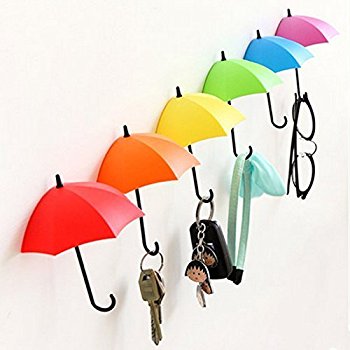
My Grade 1 students in their “Sharing the Planet” unit of inquiry investigate ecosystems, and I love learning along with them, as I continually update my knowledge and integrate aspects that were neglected in my own education. Last year I organised a great guest speaker, Jennifer Fox to come in to talk about “Saving the Rhino” and while she was talking about Rhino’s as “Umbrella Species” I was thinking about just how libraries and librarians are a little like crucial species at risk, and did a little research on the matter.  The National Wildlife Federation identifies three types of species they work to protect: Keystone, Umbrella and Indicator. I’d argue libraries have characteristics of all of these species. Let’s look at the definitions:

Keystone: “Keystone species are species that enrich ecosystem function in a unique and significant manner through their activities, and the effect is disproportionate to their
numerical abundance. Their removal initiates changes in ecosystem structure and often loss of diversity.”

Umbrella species: “An umbrella species are typically large and require a lot of habitat. By protecting this larger area, other species are protected as well. Umbrella species generally have the following characteristics: their biology is well known, they are easily observed or sampled, they have large home ranges, they are migratory, and have a long lifespan.” 

Indicator species: “A species that is particularly sensitive to environmental conditions and therefore can give early warning signals about ecosystem health. Because they are so sensitive, a decline in indicator species’ health can signal air and water pollution, soil contamination, climate change or habitat fragmentation. Indicator species are often threatened or endemic (native) species.” (quotes from National Wildlife Federation).

Libraries (when I say libraries I want you to read “libraries staffed by trained and competent specialised librarians”) are Keystone in the way they enrich the communities around them whether that be a local community, a school or university, or even a commercial entity with a library. In school environments often the number of librarians is vastly out of proportion (in the diminutive sense) to the community they serve, and yet all the teacher librarians I come in contact with are hugely influential in setting the tone for literacy and research in their schools. Exchanging information with each other to maximise their footprint and benefit to the community. Most of us strive to allow the voice of diversity to be heard and to have collections that reflect diversity. And if allowed are a counterbalance to other voices in the ecosystem as we generally have a longitudinal view of literacy and learning.  Umbrella – well, yes, libraries are large with a big footprint. We take up space. And space is often at a premium. And as a result there is often significant pressure for us to be all things to all people. Something I’d argue that results in the myth of the “super librarian” and doesn’t always have the desired outcome. In the International sphere, as I’ve just been noticing with the annual “musical chairs” of teacher librarian job positions opening and closing, I’d say even the “migratory” part is true.

The saddest is the way in which libraries are Indicator species. And there I’d say countries like the UK are in dire straights with the state of libraries and librarianship being the canary in the coal canary coal minemine. This has the most awful knockoff effect that is unfortunately felt world-wide. Over the summer I toured a number of very prestigious and expensive private (called public there) schools in the UK with my daughter who was looking for 6th form boarding. None of them had the school library on tour, and when we asked to see them, if we were allowed more than a peek through a locked door they were dismal to say the least. Collections were outdated, the library was cramped with limited space and big desktop computers had prominence. But besides that the library had no “presence” at the school in the sense of posters advertising books, announcements, classroom libraries, anything to say that the library was an active and valued part of the community. This is not only a pity for that particular school. Unfortunately the pool of international educators and particularly heads of schools and divisions is often taken from graduates and teachers from these institutions. And of course the Peter Effect applies – they too cannot give what they do not have. Show me a teacher-librarian struggling in a school ecosystem and you can probably follow the trail to an “under-libraried” principal or school head. Research and advocacy on the importance of reading and libraries be damned, they don’t feel it / have it in them, so it’s an intellectual construct for them. The converse is also true, I’m incredibly fortunate to have both a principal and head of schools who believe in libraries – yes, believe as in a tenant of faith, because I think that is actually what is needed – belief not just lip-service to borrow religious analogies along with my eco-system ones.

Digging around for some statistics I can see how circular reasoning is employed. Libraries are expensive, both in capital costs, in person-power and in keeping collections up to date, in the link above you can see a decline in spending and a decline in borrowing. Correlation is not causation, but the last “big spend” was around 2009 – are patrons interested in an outdated collection? I’m a member of the Singapore public library system. I actually physically visit the library once a year, to renew my membership card (and if I could do that online I would) but I borrow eBooks and audiobooks on a bi-weekly basis to get my “adult book fix” that’s not supplied by having K-6 books on tap in my school library. Beware of statistics.

Continuing on the ecosystem theme – who are the “big five” in education (if hunting refers to head-hunting)? To go back to a much read blog-post I wrote earlier on that dirty little word “power” again, looking at recruiting and search, I’m stunned that teacher librarians, a position requiring two masters degrees plus a teaching certification and “experience” are lumped in with teaching staff and are not part of the “leadership” positions. Librarians, like curriculum coordinators, heads of division and heads of schools have an overview of entire sections of schools. They give input into resourcing teaching and learning. Often have a dual role in learning technology as well as databases, digital and physical resources. Usually supervise library assistants and manage large budgets and a facility. Yet they are on teacher contracts and can and are regularly shoved back into the classroom when budget strings are tightened. There was much outrage on our International School Librarians’ group recently when a position in a prominent (UK) name brand school came up and the 13 page application form included such irrelevancies such as EVERY school attended since age 12 and EVERY job ever held as well as personal information such as whether your own children needed learning support (on the first page). Most people said they gave up after the first or second page as the information was largely irrelevant to the function, outdated or reeked of an exclusivity that didn’t align with their personal educational philosophies. Good luck finding a great librarian there, or maybe they’ll just staff it with the (unqualified) partner of a higher power or a nonfunctioning teacher (yes this happens more than you could imagine).

In saving libraries and qualified librarians we are not just saving buildings or people’s jobs, we’re saving the continued existence and perpetuation of literacy, learning, knowledge and wisdom. As crucial to a civilised society as the air we breath. Stop worrying about fake news, if we focus on good well run libraries the problem would take care of itself.


*Here is another great article using the eco-sytem metaphor – this time about feral and hybrid academic librarians!

The second shift

Last night my daughter asked me about citations for her Geography project. Now let it be made clear, my children, while lovely human beings, are in the “potted plant” phase of adolescence. So this was pretty rare. It’s also rare for them to acknowledge my knowledge or specialisation either.  But despite her multi-big-$$ education in a big name school (not where I’m at), and the fact that she’s highly motivated and organised, good research habits have not been instilled in her. Her references consisted of a couple of URLs and the in-text citations were random with “I KNOW mum sigh” when I raised my eyebrows. I asked what referencing style she had to use – “we can chose”. So I suggested APA – because I love it more than MLA8 and because Geography as a humanities subject is probably better suited to it long term.

I then had to teach her a few of the research habits that have served me well through two back-to-back masters degrees. This stuff is not brain science. If anything it’s like washing dishes and putting them in the cupboard. We re-activated her Evernote account that she’d opened for one enthusiastic teacher some time in the last 6 years. We then clipped all the articles into a Geography file in Evernote and tagged them with the project name. Next up was getting her citations into Zotero, the tool I prefer for upper secondary.

(After the whole debacle about RefMe / EasyBib etc. I’m committed to one tool, not following the latest trend, which inevitably seems to be about who is trying to monetise education and learning.  For primary and Middle School, it’s Noodletools)

There are many things I like about Zotero. The fact that it’s amazingly accurate in its citations and the really really good customer support being the main ones, but also the intelligence and diligence of the user-base can’t be denied. I was pleased to see that in their latest update – getting set up and integrated into Word has been made a whole lot easier. Yes, good old fashioned Word. GoogleDocs have their place but when one moves from being a child, you need to be more sophisticated and demanding in your needs and GoogleDocs doesn’t cut it.

So then I had her put the references in, via the Chrome extension (download the extension), make sure she had the right citation type, put in the missing data. Showed her OWL Purdue for APA, bookmark it, showed her the APA style blog site which has more relevant Q&A type things – like how to cite Google Maps).

And then the magic could happen – click on the end of the sentence, open Zotero in Word, put in the in text citation, click at the end of the document and have all the references upload.  Two hours. But hopefully that will be a lifetime of research “washing up” as you go along rather than crisis at the end.

Then I asked her what the style guide was for her assessment. Again, nothing.  Really teachers, please just get in the habit of telling them what you want things to look like. Line spacing, headings, margins, citation style etc. It really will set them up for University where this type of thing is so important. Stupidly important maybe, but professors can and do deduct plenty of marks for not getting it right.


#fakenews – symptom or disease?

Last week I attended a “#Call to Action: Fake News, Misinformation and Post-Truth” held by the SMU libraries in  Singapore. Library network groups are full of requests for student appropriate examples of fake news. Most librarians have a stock list starting from the spaghetti harvest (1957) / tree octopus (1988). And we’ve unfortunately become over excited that #fakenews will be the saviour of librarianship. Because yay – we’re good at research, we’re good at teaching and applying the C.R.A.A.P / E.S.C.A.P.E tests, we’re about literacy, we’ve got all these captive young minds in front of us.

But between the insightful comments of very intelligent people like Eugene Tan and Gulcin Cribb at this seminar, where one had to conclude that the usual antidotes – trying to outcrowd “fake” news with “good /solid” news, padding news consumption with self-imposed digital/information literacy filters like the above mentioned CRAAP/ESCAPE tests or attempting to regulate it, will only work selectively or not at all.

haythamcom_02a
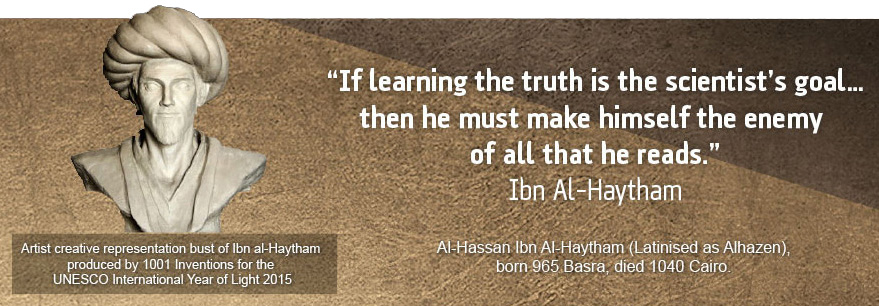
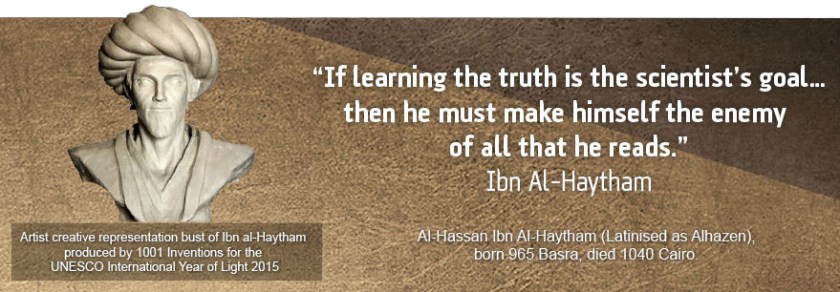
Best quote of the seminar – indeed there is nothing new under the sun

Caulfield in his blog has been hammering on about being able to distinguish between fake and real images, sourcing quotes,  but his latest post was one that threw the switch for me, on digital polarization on pinterest. (An aside, I gave up on pinterest because I can’t be bothered to log in every time I need to go past the first page and I prefer Evernote as a curation tool anyway). If you do nothing else in the fake news landscape ever, just watch this video he made.

And that, combined with the very disturbing article by James Bridle on Kid’s YouTube, following all the work that MathBabe, Cathy O’Neil, has been doing on web algorithms, and watching YouTube with my teenage son who is innately simultaneously curious about all sorts of scary (to mom) teenage stuff, combined with a reluctance to research beyond YouTube and Infographics* has made me really think about the way we’re approaching this conversation.

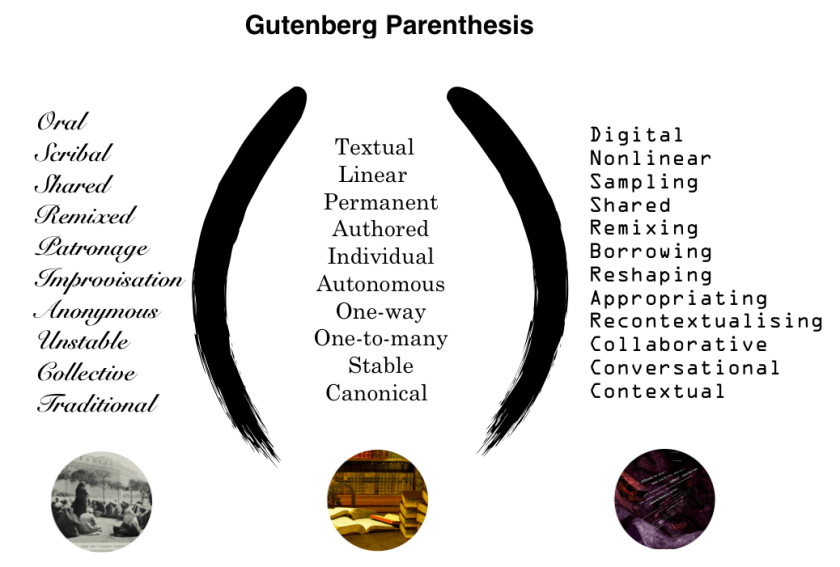
Let’s follow this thing upstream. Bear with me as I bring a couple of concepts that I think are related into this. A few things that have a lot to do with some human traits. The need to tell and listen to stories, The difficulty and recency of reading. The concept of the Gutenberg parenthesis. And last but not least, modern capitalism and/or the seven deadly sins (a concept I needed to explain to my kids the other night).

gutenberg parenthesis

So where does that veritable soup land one? Well, exactly where Mike Caulfield found himself as he clicked along in Pinterest, and like Alice in Wonderland found himself in a different universe to the one he started out in.  Pinterest is perhaps one of more extreme examples of algorithms at work. But the same is going on in Twitter (I was browsing through some UX stuff this morning and my feed and suggested people to follow changed suit in a matter of minutes) and Facebook and Instagram.

We have to face that honesty and a quest for truth doesn’t give one a monopoly on creating world class videos and infographics. That is the realm of those with a big enough budget to do it professionally. And that is how people like their information. So is the cure an infographic cold war, where every side builds up their arsenal of clickbait and point form iconic bite-sized digests? Or do we demand that algorithms are audited? Do we stop being curious and resist what we think is the “road less travelled” and the urge to click down paths that are actually carefully manipulated to pre-purchased outcomes?

So #fakenews is just a symptom. And by trying to treat the symptoms are going to get us nowhere. But unfortunately the disease is being human, and their is no vaccine against that. Except consciousness. Extreme consciousness. And consciousness takes time, and time is what technology is robbing us of. The irony.

————————————————-

* Shoot me – I’m human. That saying about cobblers and shoes? He came home the other day and told me his English teacher said reading was important for vocabulary and a whole host of things and that “just 20 minutes a day would make a difference” 

No excuses: Facebook

Continuing in my series of “no excuses” rants, I’m moving onto a biggie. Facebook. Except my rant isn’t so much against FB – everyone has done a better and more eloquent version of it in one form or another from one viewpoint or another. It’s more a rant against us librarians as consumers of FB (and yes this will be posted on FB – no irony?)

I’m writing this today in response to Philip Williams posting Alexandra Samuel’s “Can we build a better Facebook”  on Twitter, and following the links in the article to Beth Kanter’s article on the “Perils of Fake News” . You see I do agree Fake News is an issue. And I do see the valiant efforts of fellow librarians and concerned critical skeptical intelligent people putting the “fake” stamp on some of the rubbish twirling around. As I put in a comment, my concern with FB is that it is just like the stupid women’s magazines I eschewed from an early age.

The problem is even worse than you describe for reasons even beyond fake news and privacy and selling data. Basically FB is a useless tool that even information professionals like librarians have flocked to because of critical mass. But while it caters to our short term, immediate gratification needs it is terrible as a curation tool, unlike the relics of the past, the various internet groups which are still publicly searchable but went defunct around the rise of FB.
So now you have the “magazine cycle” in FB. Someone asks a question, gets 500 likes, 54 responses (the last 42 invariably just repeat what the first 12 said) and then gets buried. And then in a few days / months / quarters the same question comes up again. We don’t build knowledge. We don’t even build information.

I have a FB habit that consists of scrolling in the morning and evening, posting some of my shareable resources such as the PYP booklists, MLA8 posters , my blog posts and share any library worthy news. I ask questions about teacher-librarian practice, about books or booklists. But at the same time I am immensely frustrated by it. For these reasons.

Filing and searching

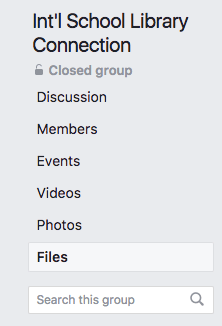
The same questions keep popping up regularly. Of course, because life has a cycle. But there is also a combination of laziness and the complete uselessness of the search Screen Shot 2017-10-21 at 10.39.16 AMfunction in FB. Many questions begin with the preamble “I know I saw X somewhere but I can’t for the life of me find it” On the left is one of the groups I’m a member of – it has 1,318 members. There are some great conversations that occur there. I went to check out “files” section – the one place where a semi-permanent record of anything could be kept. In the last 10 months exactly 20 files have been posted. That’s actually good – the “The School Librarian’s Workshop” 5,879 members and only 14 files since 2014!

So let’s take one of those things that regularly pop up – “Academic Honesty”. If I search the

Screen Shot 2017-10-21 at 10.45.22 AMgroup, I have quite a few options (honestly I think most people don’t even bother searching before asking a question – but that’s a whole different psycho-existential matter – like do we need to ask a question in order to “exist” / “be heard” in a group?). But the one option that would make a REAL difference in turning FB into a more useful tool for curation and knowledge building doesn’t exist – there is no option to search the files. So don’t we look at the files (no way of telling if they’re looked at) because they’re not searchable from the main menu (or in fact at all, so that’s a REAL disincentive to use them / add a lot of files to them) or because we don’t think to add to the files so we don’t use the files?

Whatever happened to databases?

Back in 1997 when I was doing my MBA I did a course on Knowledge Management (KM). It was to be “the” subject of the future. Actually it was more about how to extract employee knowhow and customer intelligence and make it accessible so as to make any given employee under the executive suite dispensable and therefore resistant as heck to it. During my MIS in 2015, I enrolled for the librarian version of KM, thinking I’d make it my major so I could then go in either direction, KM/corporate or librarianship. And found that in 18 years it hadn’t really moved much at all. Nothing new under the sun.  What has changed in the years that I’ve been on a computer, is that some type of database software used to be pretty standard issue with say the Microsoft suite etc. and now it’s not. I find that interesting in the same way I find it interesting that children’s fascination with space seems to have declined somewhat in proportion to the diminished ability to see the night sky due to pollution. And phobia for insects and dirt increasing in relation to the amount of time spent indoors and under protection of parents and iPads, along with a frightful decline in insects and birds.  Yes, tools like Excel have become way more sophisticated and can take on many of the functions that older databases used to. But we’re not using Excel really to its full extent are we? Most people can’t even make their way around the basic google “sheets” tool.

Book lists

Again it’s a search and curate problem. We have this “hive mind”, we have vested and interested and willing people. We don’t have the tools. Take an easy little book list challenge. I won’t ask you to find a middle grade book by an Austrian author translated into English in the last 4 years. Let’s just take something really easy like a book about bullying. So where are all the usual suspect places we can look?

  • Google search – 803,000 results, most in the form of “# books about bullying”.
  • Goodreads – search function 5,521 books, list search 63 lists – some with some VERY interesting descriptions.
  • Amazon – gives me 22,266 books, that I can narrow down to 942 if I chose age 6-8 and hardcover. I cannot however restrict it to published in the last 2 years, only the last 90 days
  • Bookdepository (which is just Amazon really, but a very different selection) – 5,889 down to 122 with 6-8 and hardcover.
  • I could (theoretically, but how many of us do this?) search some other libraries catalogs… but how do we know their protocols / subject set up?

But the more important question is what can I do with these lists? And the unfortunate answer is you can scroll through them, print them out, vote on them or add a book (goodreads), visually compare them. But you can’t import them into a database or spreadsheet. You can’t click on them to create a new list by combining parts of different lists. Librarians spend a LOT of time with booklists. Too much time if you really think about it. It really should be easier.

LibraryThings is much better in many respects. It’s partially open, and partially you need a subscription (like for the very useful TagMash tool). You can upload your holdings, so that means you can easily see which books you already have. But how often in the last year or so has someone referred you to LibraryThings when you’ve asked for a book list recommendation? How often have you used it (if at all)? But now, I get a tagmash list and again WHAT CAN I DO WITH IT? Nothing. I can’t add that tag to the 119 books I have (of which only 60 were tagged with bullying), I can’t add any books I like the sound of to a “to buy” list centrally – I’d have to click on each individually. I can’t easily share the list.


Why does all this matter?

Well one of the things that is important to me is the whole diversity question. But as mentioned in my last blog, diversity looks very different in different contexts. Putting on my librarian hat I want to help great initiatives like GLLI.  I want to make sure that my collection reflects my students. I want to have lists readily available and extractable (hence my database rant), so that when people say my school is 80% American born Chinese, or 50% Vietnamese, or 70% Thai or 80% of mixed parentage, or give me a Bulgarian book translated into English suitable for 6-8 year olds published in the last 4 years, the lists can be reconfigured and re-sorted and spit out the goodies. And can be added to and updated. I’m tired of stagnant static lists.

Likewise, if I have a folder of the academic honesty policies of about 20 schools that I used when our librarians were involved in setting up our school’s new policy – it should be easily and readily available to everyone who comes after me trying to do the same thing. But I’d prefer that the easily and readily available platform is NOT FB. Is NOT in a closed group.

Resist

So yes, resist FB, but not just because of Fake News etc. Resist it because it’s a useless platform that we’ve invested way to much time and energy into. Because we should be spending the time thinking about what we really need and creating it. Because we should be pressuring platforms that more closely meet our needs to improve their products.

Scheduling – priorities and dissonance

New year, new chances, old problems. The perennial one of scheduling library time. I kind of started commenting on people’s posts and questions on FaceBook and then decided it merited a blog post on its own. There is also a whole discussion on libraries and librarians going at the IBO level where priorities, recognition, roles, responsibilities etc. are also being hashed out. But coming from a corporate background and not an educational one, I sometimes can’t help seeing things a bit differently.

One of the most useful courses I followed during my librarian studies was “Designing spaces for learning”. And spaces weren’t just physical spaces, or even physical and online spaces, it includes temporal space – as I wrote about here  and design thinking. The thing is that time is the great leveller. We all have 24 hours of it a day, but what we choose to do with it is telling, because it will determine who we are as librarians and display our priorities more strongly than just about anything else we do.  I could even put money on the fact that if you walked into a school where there was a troubling relationship between the librarian and staff / admin and you asked to see the library timetable it could be used as both a diagnostic tool and a cure.

So I’ll begin this post by giving a shout-out to my principal who gives me the autonomy necessary to both think all this out and then to discuss it with her and implement it. She also gives me the support I need when things are not working optimally, if I’m reasonable in my requests and it supports student learning.  My PYP coordinators who are allowing me to be their educational partners also makes things a lot easier. And the school I’m at that generously allows for 3 support staff members in the library in their HR budget to open up time for me to be doing higher order teacher-librarian things rather than processing and circulating books. Now apologies for a barrage of management-type speak and jargon, please bear with me.

In library scheduling there are two main schools of thought, primarily defined as fixed scheduling (you set up a schedule each year / term, and every class gets their time to go to the library at that designated time) and flexible scheduling (the librarian’s time is bookable, on demand). Each have their benefits and drawbacks – with fixed you get to see everyone regularly, but in a large school you have no time left, or go on a two / three week schedule. With flexible you run the risk of never ever seeing some kids depending on the teacher’s ideas of the library, priorities etc. Most larger schools where the ratio of librarian to students is low (e.g. 1 librarian to 1500 students) opt for a flexible schedule. Our ratio is 1:630 with 34 classes so theoretically a fixed schedule can work, and I’ve tried to build some flex into it otherwise I’d never do the things that differentiate me from what a teacher or library assistant can do.

Priorities

The first part of the process is to decide what your priorities are. Now in education this is way harder than in corporate life, since often many of your priorities are set for you. It also took me a little while to get the experience and confidence to actually realise what my priorities should be and to advocate for them.  And also to decide what my priorities shouldn’t be and to draw a line in the sand.  Part of your priorities are governed by your school’s mission and value statement. Part is about your integrity to yourself as a professional (teacher) librarian and part is about the resources physical and financial your school has.

My personal priority statement is “I am about literacy“. So everything that has to do with any of the literacies (alphabetic, informational, numerical, multi-lingual and to a certain extent digital) I will prioritise.  I steer clear of discussions on makerspaces for that reason, partly because we have a dedicated STEAM department, and partly because if it has nothing to do with creating some form of reading, writing or research I consider it outside of my ambit. OK, shoot me, but you have to draw the line somewhere or you’ll have to compromise on something else, or just never stop working 24 hours a day.

The next thing is to think about how you are going to integrate yourself into teaching and learning in a collaborative way. There are two frequent laments heard in this regard “I don’t have time for meetings” and “I don’t get invited to meetings” – and here is where a supportive principal comes in. The very first thing that went into my timetable this year were the days and times for co-planning for each grade. It’s taken 2 years to get to this point and I only need / want to go to the meetings once a unit – usually a week or so before the unit starts so I’m involved in hearing where the team wants to go with the unit, what digital and physical resources they need and how I can meaningfully integrate information literacy or other ATL skills into the unit. I also only need to be there for about 10-20 minutes depending on whether it’s an old or new unit. So what about the other 4/5 weeks? Well I’m using the time to DO what the team needs. And if I’m teaching in that time, I can’t be doing. Doing includes making library guides (that’s how I have time for them), curating resources, ordering new resources, weeding old resources. Although I am not considered a HOD, my principal also kindly invites me to the weekly lead meetings so I know what is going on and coming up, and can involve the library in any way that is meaningful.

Then comes the fixed part, which fulfils my literacy priority. Since I do have a manageable ratio / number of students / classes, I have a fixed part of my schedule whereby each student gets to come to the library once a week. How has this been engineered? By chunking time and students. 40 lesson periods and 34 classes would mean no time for co-planning, co-teaching, own planning let alone the library facility management stuff. So, based on the advice of my predecessor and in the face of intense resistance from teachers, the timetable was split into 20 minute library times from G4 and under and kept at 40 minute sessions for G5 & 6. The compromise for lower level teachers is they can pair up with another teacher in the same grade had have 40 minutes with 2 classes. It’s not my preference, but they may choose this.  I do this because I want to see every single child every single week and make sure that I am helping them with free voluntary reading.  In Krashen’s (2004) words ” evidence from several areas continues to show that those who do more recreational reading show better development in reading, writing, grammar and vocabulary, These results hold for first and second language acquisition, and for children and adults. ”  I am an unabashed book pusher. I do everything I can to put books in the hands of children that they want to read. And to do that I need to see them and I need to know them. Especially the ones that will only come to the library that once a week.

Yes you can do a library lesson in 20 minutes, if you have staff who can do the check-in / check-out and shelving while you’re doing the reading, the mini-lesson and the reader-advisory, and if your teachers are in the library helping. Yes I do get that much support from my school and I’m very grateful for it.

Another small note on this section – switching costs nearly killed me in my first year. I was doing a G1 class then a G6 class then a G3 class then Kindergarten jumping around day in and day out. So I asked teachers to try and schedule in the library so that all the classes in a grade (or 2 grades, depending on number of classes) were on the same day. It worked last year and we kept it up this year – it was actually easier timetabling that way – constraints work. There were only 2 exceptions where the larger school timetable and teacher preps meant that I’m taking a class to help them out on a day different to the rest of the grade. That’s not bad going.

My next priority is multi-lingual literacy. Actually part of it comes in the fixed part. We are a bilingual English/Chinese school. I am the parent of two bilingual children. A child is NOT bilingual unless they are bi-literate. I will not compromise on that. I faced fierce opposition from parents complaining via teachers when I insisted that every child in the bilingual program had to take home a book in each of the languages irrespective of their ability to read in that language at that point*. I am very uncompromising on some things and this is one of them. At home, I have two bilingual teenagers, one in Chinese, one in Dutch who are still doing their languages as a first language only because I am uncompromising on the fact bilingual has to be bi-literate otherwise you are fooling yourself. And bi-literate means reading and writing. The classes that have “first dibs” on the library timetable are the bilingual teachers. One of my library assistants has to be fluent in Chinese and able to read aloud to my students and help me curate chinese resources.

So those are the bilingual classes. We also have ELL (English Language Learners) and students doing French as a second language. Their teachers also have (and take) the opportunity to bring their students into the library (or the library classroom where my world language resides) with their students every week. Language can just not be taught in isolation from books and reading.

The learning eco-system priority. Teaching and learning does not occur in a vacuum. Children are part of a family, a linguistic community, a social community, a cultural community. At the primary level, besides teachers,  parents are my best allies in my literacy goals for my students. So they get two periods once a week for library information sessions, for time to drop in for some reader advisory, for meetings the school needs to hold in my space for them.  I am a neutral zone. I am there to help them realise their goals for their family.

Then there is my co-teaching / information literacy teaching priority. I’m listing this last just because it’s last in the process, not because it’s last in priority. Doing all the above, specifically the 20 minute slots with the younger kids gives me 8 x 40 minute periods where I can make myself available for whatever lessons my teachers would like me to teach in the library or in the classroom. These are not used every week, but now that we’re integrated the research ATL into units they will be used far more.

My library facility priority, means I’ve blocked off 2 periods for inter-campus meetings, either by google-hangout or face2face with my fellow librarians and with my own staff.

These are my priorities and how I’ve structured my temporal space to accommodate them (see below). I’m in primary school – people in MS or HS may have other priorities and concerns. People in larger or smaller schools will have other issues. But the bottom line is your priorities need to be worked out (it’s taken me 2 years to get here and to articulate them), and reflected in your timetable. And you need to articulate them well so that if necessary you can argue your case with whoever is getting in the way of allowing you to reflect them in your timetable.  Things may and probably will change, but that’s it for now.

library timetable 2017:8

As a closing note – another part of the IBO library/librarian discussion was about the “super-librarian” archetype. I don’t want to be a super librarian. I want to be a great librarian. When Clark Kent is busy being superman, he neglects being Clark Kent. We cannot afford to be super-librarians because super librarians can and do burn out. And while everyone around this type of librarian says how super-librarianish they are, I don’t think they get the recognition they really deserve as librarians. And their successors have big shoes to fill, but not necessarily the right shoes to fill.


* Why do I insist on this? Often they can’t read the book, sometimes/ often their parents can’t read the book. Because they can’t read the book YET. Just like my kindergarten and pre-kindergarten children take home books they can’t read, so too my English / French / Dutch speaking kids take home Chinese books because the assumption has to be that they WILL be able to read those books. Otherwise get out of the bilingual program. Seriously. What do we do with mono-lingual kids who can’t read? We read to them. What if we can’t read? We sit and page through the books with them and we ask them to explain the pictures to us.  We ask them to point out the words they do recognise. We ask them to point out the letters they recognise.



#1 Digital resources

In an attempt to blog more regularly, I’ve signed up for a challenge – so these posts will be in amongst all the other stuff I may be blogging.

#FutureReadyLibs 10-Week #BlogChallenge Challenge #1: How did you get involved in the Future Ready Schools/Future Ready Librarians initiative? Are you involved in the district strategic planning process? What is your vision for a future ready school? What makes you a Future Ready Librarian?

How I got involved

Well I guess it was just a result of being added or adding myself to a Facebook group that looked interesting. Sometimes things just happen that way.  Also since I’ve just finished my MIS and M Ed degrees I’m still vaguely interested in this type of thing, in order to keep my learning up to date.

frlblogchallenge1I think our school, as an IB PYP school is pretty future-ready in many aspects, in fact sometimes I think the cost of being “future ready” is that you occasionally need to go “back to basics” and check up on the 3 R’s and make sure you stay sober and self-critical.

Am I future ready as a librarian? Looking at the little graphic on the left, I can tick most of those boxes, or slices, inasmuch as things are in my power at least. And where not, I’m constantly nudging for change.

I’m not entirely sure if I’m on the right topic for this week – I’d note “digital resources” so I’ll write a little about that.

Curates digital resources and tools:

When I started my job at my current school I’d come from working part time in a secondary library where a large part of my time was spent creating library guides for the Middle & High School (including the IB).  I was lucky to have Katie Day as my mentor, and we had many many discussions on how to curate resources so that students had easy access to them from their laptops (they’re a one-on-one macbook school in secondary). The idea was to have digital resources in the form of videos, curated Flipboard articles and database access, but at the same time make our physical resources digitally visual and “clickable” for later borrowing as necessary.

Screen Shot 2017-03-28 at 4.55.31 PMSo, a few weeks into my new job I discovered we had an unused library guide subscription, and I immediately put it to work. Of course curating for primary is a somewhat different proposition. Immense more thought and care needs to be put into ensuring things are age appropriate – in content, in level and in access.  And I was a newbie … so it was a case of building things and hoping they would come. It’s taken a while. After the first year, a couple of teachers were on board, and now more and more are coming to expect and use the resources. My main objective is to move away from letting kids “just google it” to an idea of just like we don’t throw a bookshelf full of books into their UOI (unit of inquiry) boxes, but make sure they’re appropriate for the grade level, for the central idea, for the lines of inquiry, and may even evolve as they go through a unit, so too we can have digital resources that are similarly curated.

A few things have been a huge boon in this respect.  In the first instance I cannot express my admiration for Epic books enough. They are an absolute game changer.  In terms of depth and breadth of their books they far surpass the incumbents such as Tumblebooks. I do have some librarian type quibbles with a few of their set-up methodologies, but that’s small fish compared to what they’re achieving.

Secondly, Springshare – the owners of Libguides are just phenomenal in their ability to constantly evolve and develop their platform. I love the fact that the libguide community are so amazing in their ability to creatively curate, to combine physical and digital and particularly the fact that they demonstrate CREATION and SHARING, which is absolutely what a future ready community should be about.  Also, my desire to make good looking guides has pushed me to learning some (very basic) HTML which never ceases to impress the fine young gentlemen and ladies in my library who then realise I’m not just an old library lady!

Thirdly LibraryThings for Libraries through their book display widgets they bridge the gap between a lovely visual interface (libguides) and an old stodgy very unfriendly catalog (Follett Destiny).

As far as tools are concerned. I try to keep introducing appropriate tools to my students and to fellow teachers – but only if they are meaningful. It’s a balance. Our students are “over tech-ed” and we’re getting a lot of pushback from both parents AND students about the amount of time they spend in front of a screen. So where it saves time, hassle, helps make things neat and well spelt, sure. Otherwise it’s back to the physical.

Empowering Students as creators

I’m very fortunate to be in a school environment where there is an EdTech coach and a STEAM coach. So wild ideas for physical or digital creation can be co-shared with them. We’ve had students create book trailers, book recommendations, book spine poetry, book covers, their own books, display work pieces in the library etc.  I don’t think any of that is particularly special though – most librarians do that kind of thing in conjunction with their students and teachers – it sure makes displays easier!

Builds instructional partnerships

That part is definitely a work in progress. It’s tricky. I could blame a whole host of things – fitting in 35 classes a week on a fixed schedule, a yet to be approved information literacy scope and sequence that’s embedded in the curriculum, running, managing and keeping up to date (and renovating) a facility, curating digital resources in library guides … but instructional partnerships is a ball I’ve dropped. Or actually never really properly had in the air. It works piecemeal, depending more on relationships and invitations than being structural. I’m working on it with my fellow librarians from our other campus, the head of curriculum etc. It takes time is all I can say. And I don’t think I’m the only one saying it judging from the comments of my fellow teacher-librarians.  I beat myself up about it a LOT in my first year. To the point of tears. This year I’ve been distracted a bit by the renovation and staff medical issues. But we’re inching there.  Watch this space.