The following slides are part of a presentation Katie Day and I made for the 2025 ISLE librarian conference in London. (Note: Although I am the one “publishing” or “blogging” this discussion the credit equally goes to Katie Day as this all originates in our many discussions on reading, nonfiction, librarianship and more. )
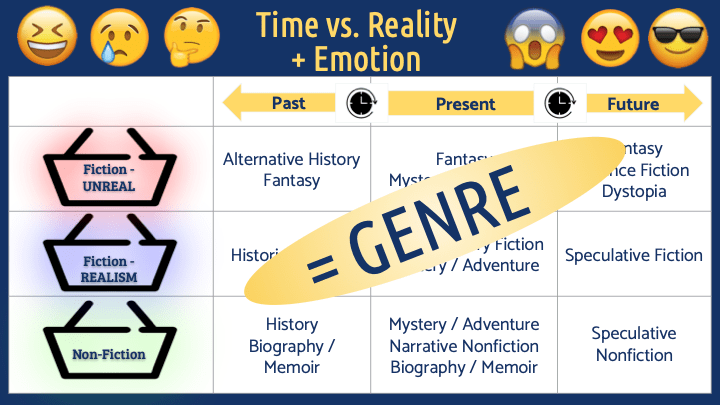
The slides are pretty self-explanatory. The main idea being that we tend to lump nonfiction into one big pile, perhaps separated by the five types recognised by Melissa Stewart. In this part of the presentation we argued that nonfiction could be categorised along the dimensions of “reality” “time” and “emotion”. In doing so one can more easily appeal to students who are more used to the fictional genres and sub-genres and perhaps find some nonfiction appealing to their fictional reading preferences.
This is the typical way of looking at the continuum between fiction and nonfiction. Note we talk about nonfiction as being “informational” rather than “factual” and try to nudge students into thinking of it in the same way.
The next dimension we add to the equation is that of time. In this instance we are focused on the bottom line of the time dimensions of nonfiction.
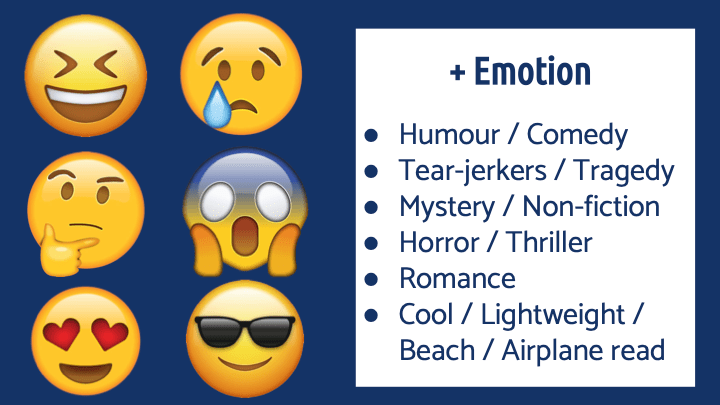
We then further elaborate with the dimension of emotion. And this is where we allow our students to feel they are in the more familiar territories of “genre”
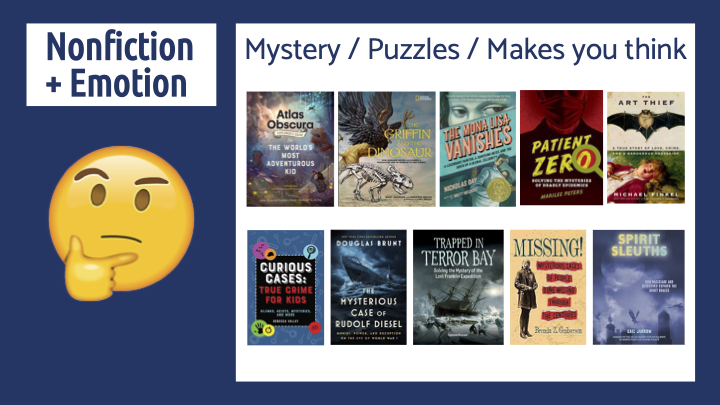
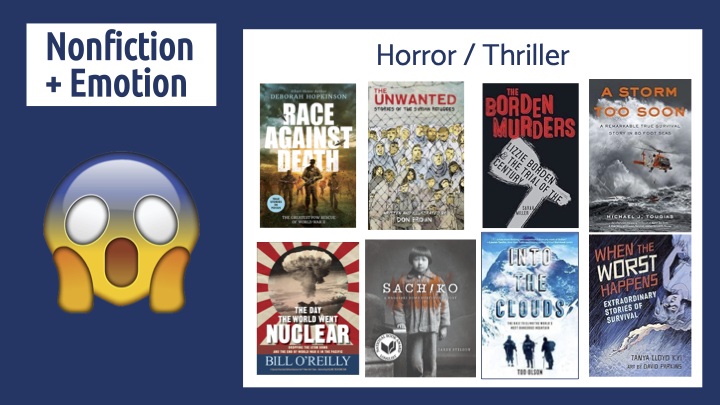
The next couple of slides give examples of the 6 “emotional tones” and related books.
Have fun exploring and discussing the categorisations with your students.
Despite appearances to the contrary I’ve actually been extremely busy blogging this month, doing a daily blog over at GLLI-US.org. Here is a summary of the month’s blogging with links to the individual blogs: ——————————-
I hope you’ve enjoyed my advent calendar type selection of “displays” for the month of December with a variety of ways to slice and dice collections and perhaps you’ve even found a few new or different books to add to your collections.
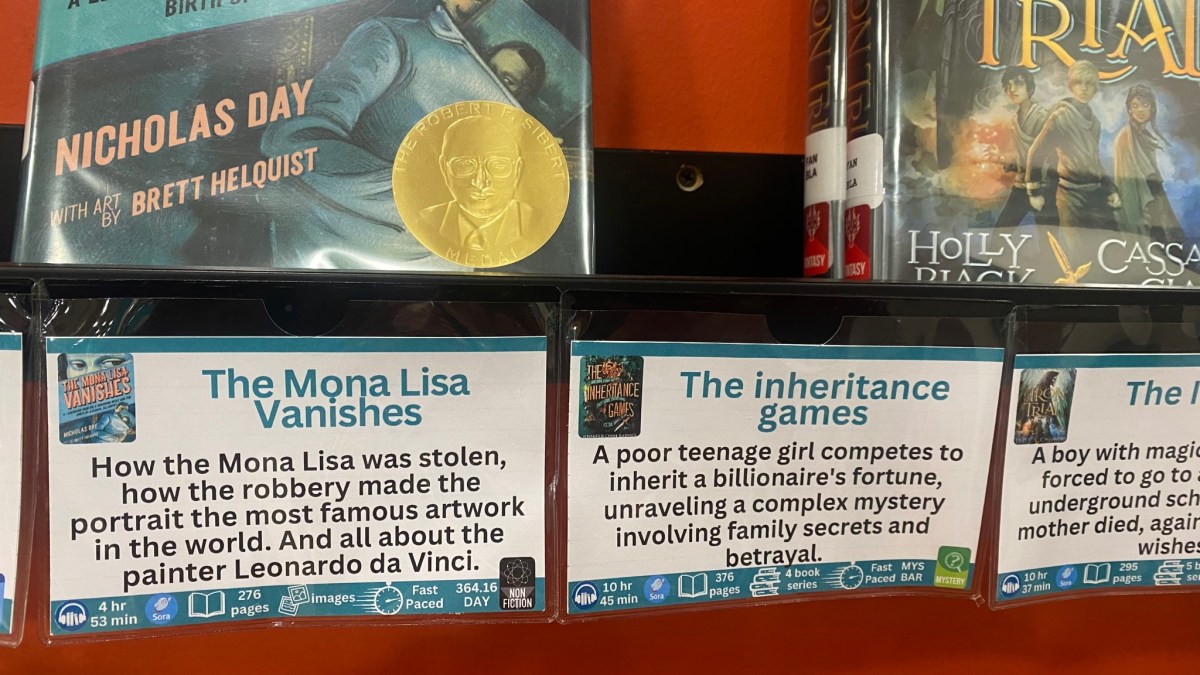
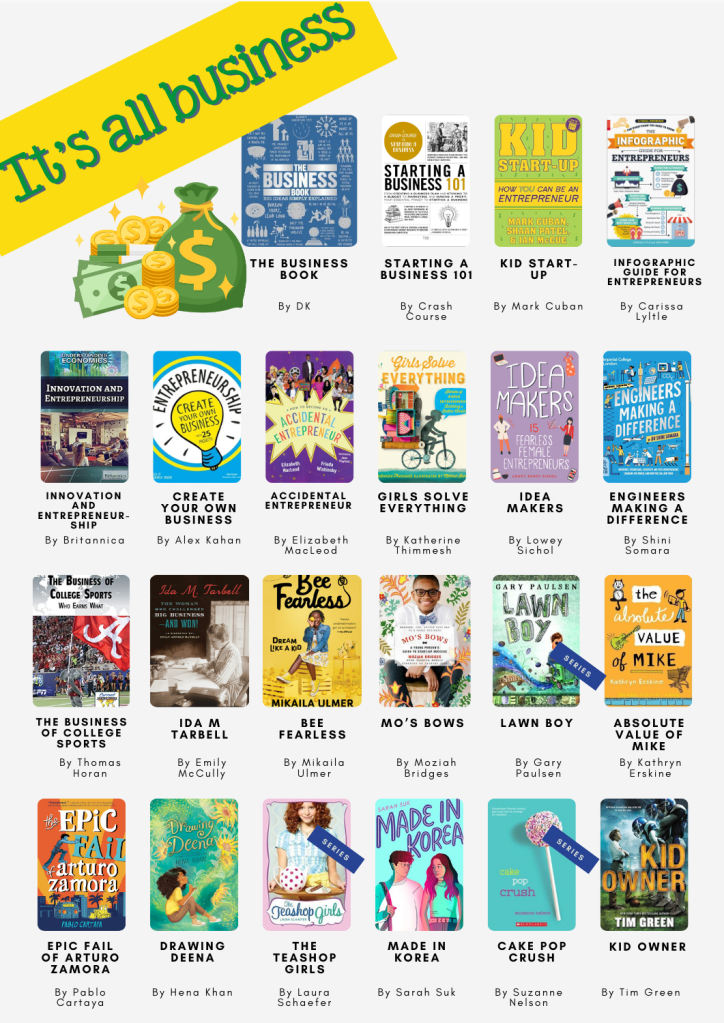
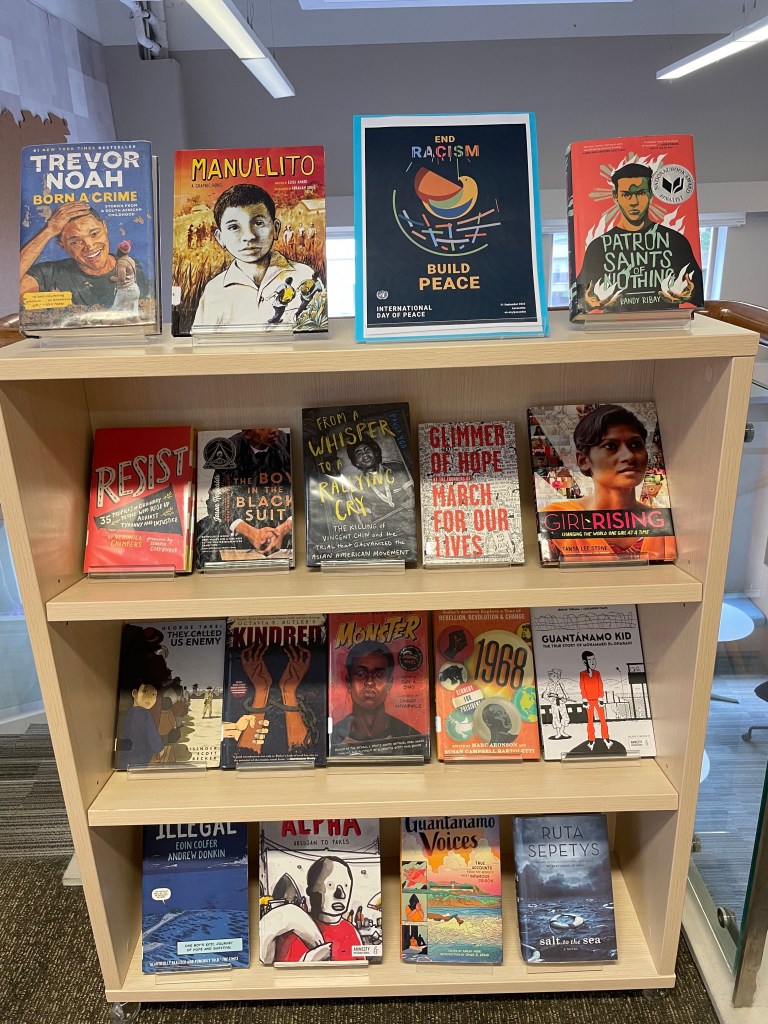
A couple of people have asked me about the how and why and wherefore of these posters, so in this wrap-up I’ll give links to the templates and also some ideas of how they are used in the various contexts. Generally all posters are put into A4 presentation books and are available in the ELA classrooms and in the library. Some selections are used for displays at the entrance of the library or on the display wall. Others are more of a “pop up” display when different classes come into the library to browse or borrow books with their classes.
Country Celebrations
Country celebration posters are sent out in our student and staff bulletins to coincide with the National Day of the various countries. I asked our Powerschool guru to run a list of all countries where we had at least 3 students having the country as their first, second or third passport, got a list of national days and worked from there. Sending out those email “birthday cards” is one of the most rewarding things I do as a librarian as I get so many thank you emails in response and students and adults coming in to borrow some of the books on the list. Depending on how busy our display space in the library is, I may or may not display the books at the library entrance.
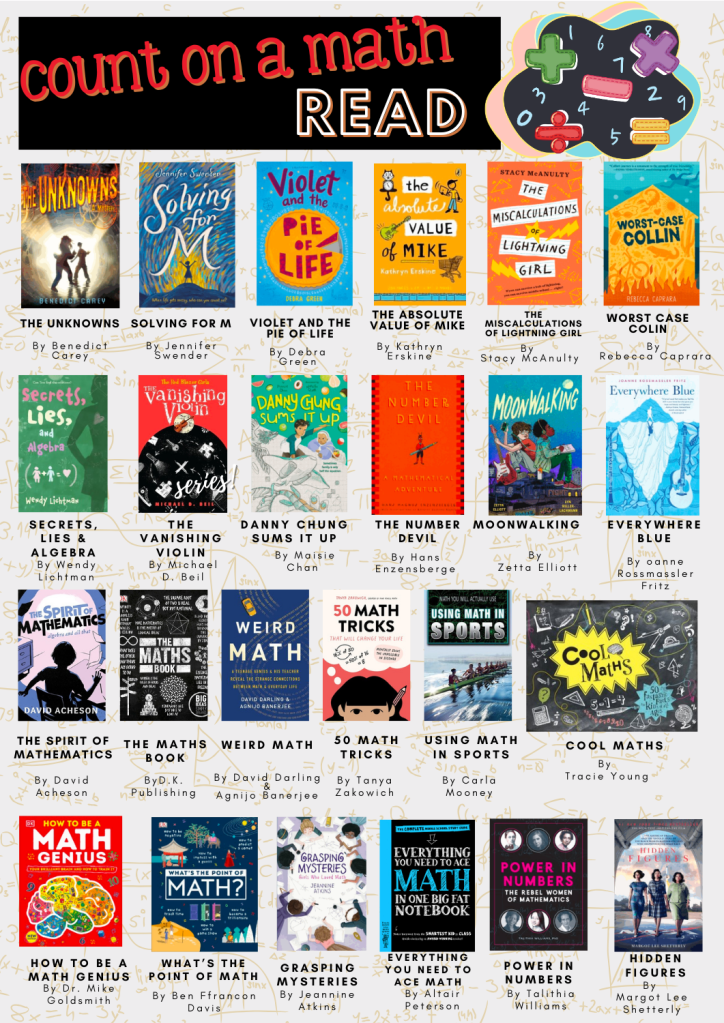
The read around posters are shared with our teachers of various subjects and generally they print them out in A3 size and put them either on their walls, doors or display boards outside their classrooms. Sometimes, when students come into the library with their ELA or Social Studies teachers I’ll have the books laid out on tables for them to have a look at and borrow.
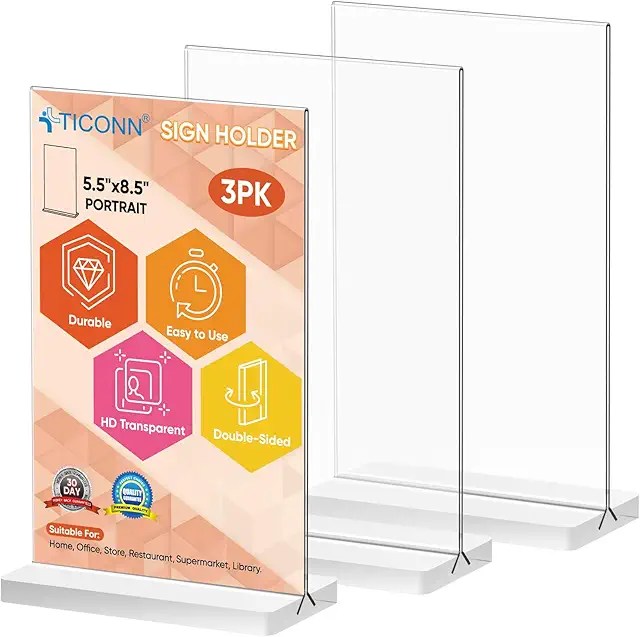
These and many other “Read alike” posters are printed in A4 and put into plastic “look book” presentation books that are available in the library and also in all our English Language Arts classrooms. Since our middle school students come to the library with their classes around once every 4 to 6 weeks, it makes it easy for students to browse for books in the classroom thematically and then go to the library with purpose in between the more formal library visits. When they come with their classes, I’ll generally confer with the teachers as to what they’d like displayed / what’s “hot” or wanted and then I’ll haul a bunch of tables to a part of the library where they can browse. Then these posters will be put into A3 acrylic sign holders on each table.
By Nadine Bailey – middle school teacher librarian, currently living and working in Dubai, formerly in Beijing China, Singapore and a bunch of other cities around the world. Passionate about our students seeing themselves and their worlds in literature and developing curiosity and a passion for reading and learning.
The views, opinions, and thoughts expressed in this blog post are solely my own and do not reflect the positions, policies, or opinions of any current or former employer. Any references or examples provided are intended for informational purposes only and should not be construed as endorsements or official statements from any organization I have been associated with.
Mediating between curiosity and research, curriculum and pleasure By Nadine Bailey and Katie Day
In the summer of 2024 we asked International School Middle School librarians to tell us the story of nonfiction in their libraries. We wanted to know their ambitions, frustrations, organisation and display as well as their collection development and usage plans. All books recommended in this article can be found tagged in our LibraryThing Shelf (https://www.librarything.com/catalog/middleNF).
Curriculum and Research
Educators and librarians who have been around for a while know and recognise the pendulum of ideas and practice that upend things first in one direction and then another. Nonfiction is one of those things where some of the momentum is now moving back to the practice of reading subject matter in physical form. Many librarians responded that in a post-covid learning environment both they and the teachers they work with were moving back to giving information in print form – mainly books where they were available, but also printing out articles from online sites such as Britannica and Newsela in order to encourage deep reading, avoid distractions and teach nonfiction reading skills that could be later transferred to online reading.
Schools following the IBO (International Baccalaureate Organisation) programmes (PYP/MYP) had particular interest in “transdisciplinary” and cross curricula books that would offer broader perspectives on curriculum or unit themes. Many librarians were investing in books that would support inquiry into aspects of the United Nations SDGs (Sustainable Development Goals). There was also a keen interest to ensure that sufficient “local” (country where the school is located) and “diverse” (countries of students’ origins) content was available in the library.
Many librarians have quite heavily weeded their nonfiction sections and are now looking to re-stock them based on this renewed interest in physical books. But it appears that publishers are not necessarily aware of what is happening on the ground and are not always updating and bringing out new editions of popular texts.
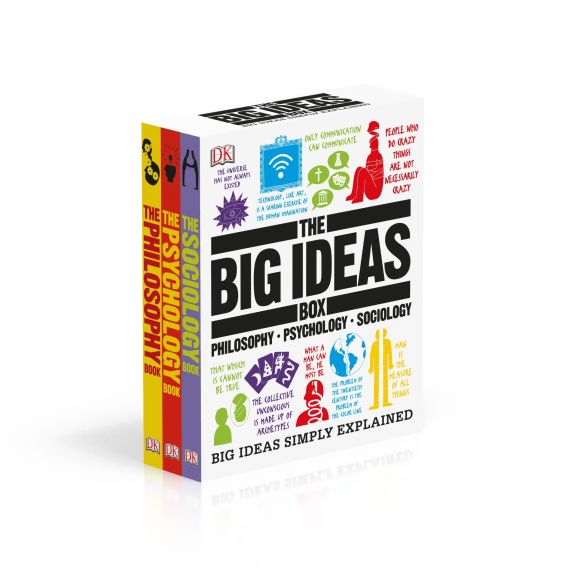
On the other hand, most respondents remarked on how much progress had been made in the last few years on the design, layout and illustrations in recent nonfiction texts. There was also a shoutout for the increase in different formats including “Oversize books” (see the books of “Big Picture Press – Welcome to the Museum”); Graphic and Manga imprints (series such HowToons; Cells at Work; and authors such as Don Brown and Jim Ottaviani); infographics (Infographic guides; ) Subject Summaries (The Big Fat Notebook series), Picture books (see this 2024 SLJ list) and Subject Overviews or introductions (DK Eyewitness, and DK Big Ideas).
Where curriculum and research is concerned, students can now often choose their favourite medium of access through a variety of formats.
Foster the flame of curiosity
Somewhere on the way to middle school, students amend their passions to fit in with their peers and ensure a sense of belonging. So out go the dinosaurs and big trucks to be replaced with their favourite sports personalities, music stars, books about their sports (soccer and basketball seem to be hits). Puberty hits this group hard and fast and strategic placement of sensitive materials can put paid to rumours and myths. It is also a time of self-absorption and worry about their physical and mental health – books on health and well being, relaxation, anxiety, meditation as well as psychology, are popular and an area of growth in most libraries.
Given the demographics of our schools, students of this age are already taking a keen interest in finance, aspects of wealth and investment as well as entrepreneurship. They’re also interested in personally exploring hobbies and activities they may see online such as cooking, sewing and knitting or other crafts.
History – particularly the world wars and more recent conflicts continue to fascinate and appal in equal measure – often mediated by historical fiction texts students may encounter in their literature studies or English classrooms and what they see on the news or social media.
Shelving, organisation and display
In order to make nonfiction appealing and accessible, quite a few of our respondents mentioned they either had or were in the process of rethinking the way that nonfiction was shelved, organised and displayed in their libraries. There is a continuum from pure DDC (Dewey Decimal Classification) to a range of Book Shop or genrified models. Librarians were more interested in getting books seen and read than in a hypothetical need for their audience to be able to navigate a university library later. One of our respondents coined the lovely phrase of “emotional accessibility” in this respect.
Of course most libraries have already taken the first step of putting “literature” or novels out of a straight Dewey 800 section into a fiction collection – genrified or or not. Other common “extractions” from the main Dewey structure include:
Taking Biographies, collective biographies and memoirs out of 910/920 and putting them in a separate section. Some libraries put collective biographies at the start of the section they pertain to (i.e. famous musicians go to 780).
Travel Books
Poetry
Drama and playscripts
Graphic Novels and Manga
Narrative nonfiction
Myths, Legends and Fairytales
Parenting
Well Being
Professional Development
Sports
Country specific collections
A specific nonfiction series that’s popular
Photo: American School of Dubai MSHS Sport Section
In the absence of permanently pulling out a section – many librarians make use of rotating “dynamic shelving” or temporary topical displays. The guideline here appears to be to follow the needs and interests of the community – teenagers want to be able to independently navigate the library without adult intervention that may be embarrassing.
Photo courtesy of Ashley SimmonsPhoto courtesy of Ashley Simmons
Related to that – signage and signposting was an area that nearly all librarians were investing in. Many mentioned significant weeding that had resulted in more space for forward facing displays and carving out sections of interest.
Recommendations
To support the discovery of nonfiction titles for middle school, we’ve curated a shelf of 389 (and growing) books on Librarything that we consider to be worth investing in. It’s an ongoing labour of love, so not every book has been tagged at this point yet.
Examples of Some of the tagging we’ve employed are (not an exhaustive list):
Narrative nonfiction
Manga
Graphic
Topic_
WW2
Women
Science
Mathematics
Religion
History
Climate
SDGxx
Activism
Wellbeing
War
Technology
Sustainability
Sports
Space
Social Media
Geo_
Southeast Asia
China
USA
Europe
UK
Australia
Edition
Young Reader
Since such lists can quickly go out of date, we’d also like to generalise with some series, authors, titles and publishers that we recommend.
Great AUTHORS
Marc Aronson
Don Brown
Marc Favreau
Candace Fleming
Russell Freedman
Yuval Noah Harari
Deborah Hopkinson
Tanya Lloyd Kyi (Canadian)
Randall Munroe
Jim Ottaviani
Elizabeth Partridge
Gillian Richardson
Steve Sheinkin
Cory Silverberg (Puberty)
Dashka Slater
Tanya Lee Stone
Pamela S. Turner
Great PUBLISHERS
Annick Press (Canada)
DK (Eyewitness; Big Ideas; Children’s Timelines; How Things Work; How Stuff Works)
First Second (MacMillan)
National Geographic for Kids
Usborne (UK)
Crabtree Publishing Company
Flying Eye Books
Great SERIES
DK Eyewitness
DK Big Ideas
DK Children’s Timelines
DK How Things Work / How Stuff Works
From Playground to Pitch
HowToons
Hazardous Tales (Nathan Hale)
Little Histories
World Citizen Comics
UN sustainable development goals
Great TITLES
There’s been a recent shift toward publishing a Young Adult version of popular nonfiction titles either simultaneously or shortly after the Adult version. These can be found by searching for “Young Readers” or “Young Reader’s edition” / “Young Reader’s Adaptation”.
Last but not least, pairing a nonfiction book with a novel can enhance both texts.
I initially started putting a fiction book on this libguide followed by suggestions of nonfiction, https://asdubai.libguides.com/ms/reading/nonfiction. I’ve now moved away from that somewhat and have started curating “Read Around the Curriculum” posters where either a curriculum topic is highlighted with fiction and nonfiction, or an “If you like / want to know more” poster is made of one of our book club fiction books with suggestions for finding out more about the context with other fiction/nonfiction books on the topic.
Katie Day and I would love to hear your suggestions for more nonfiction books, and perhaps we can expand the list to High School. Many of the books suggested in our list are suitable for High School and upper elementary as well.
Comments and suggestions much appreciated.
NOTE: Since the publication of this post we have been approached by commercial entities about using the list. While we cannot prevent the list from being used commercially this is our wish:
This list was created in order to freely help librarians all around the world. It was a labour of love which took a lot of our personal vacation time to create. If you are part of a commercial organization and you will be using the list commercially we would request that you attribute us and make a suitable donation in our names to “Biblioteca di Lampedusa” which serves refugees from around the world in their Silent Book initiative, https://www.facebook.com/BiblioLampedusa/ or the “IBBY Children in Crisis Fund”: https://www.ibby.org/awards-activities/ibby-children-in-crisis-fund. Thanks. Nadine & Katie
My good intentions to blog more have come to naught, but here’s some of the stuff I’ve been busy thinking about / learning / pondering / contemplating.
Read Around:
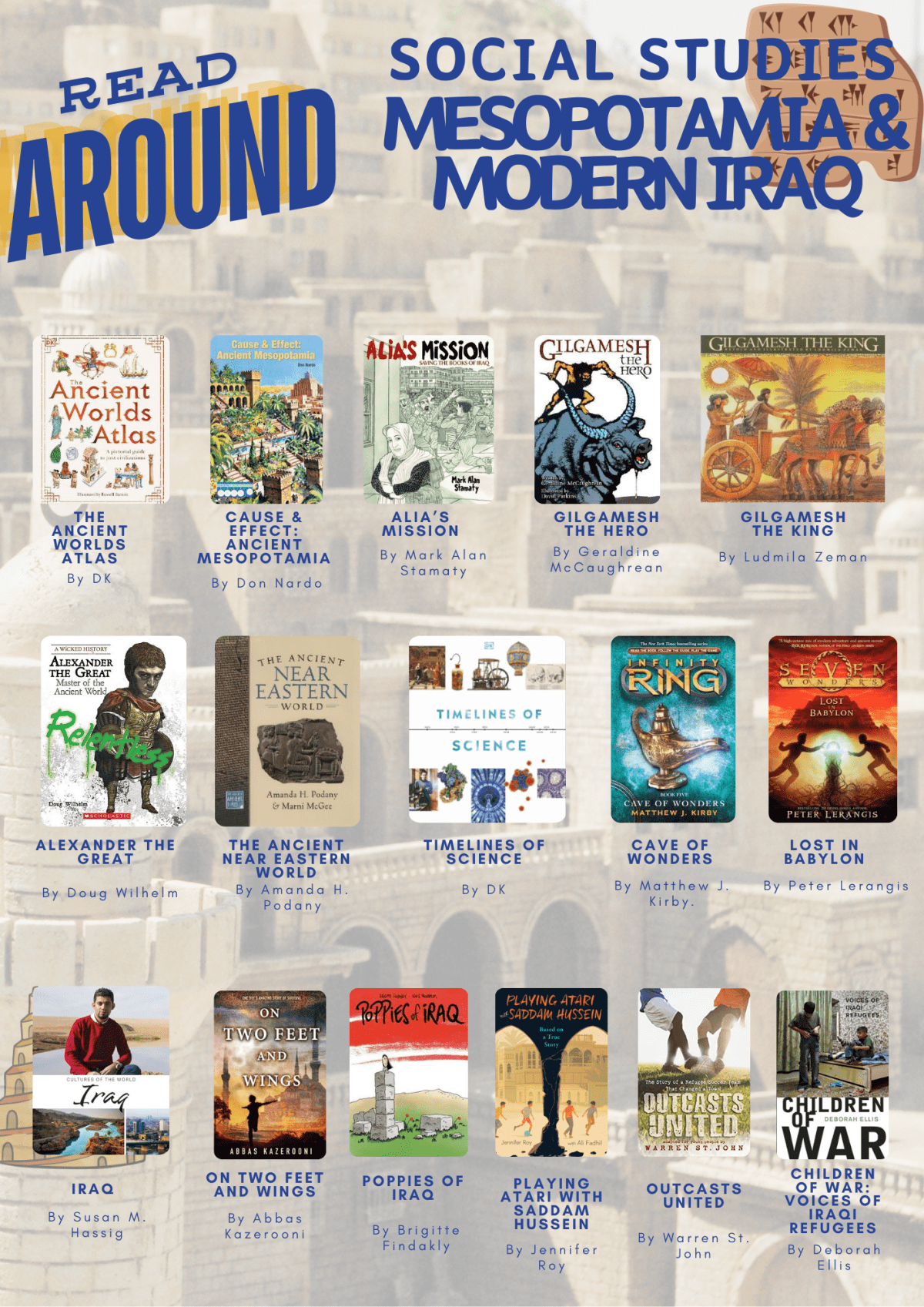
One of the things I’ve noticed moving from PYP / elementary librarian to Middle School is the apparent lack of curiosity in the students coming into the library. I’m sure there are many developmental and sociological reasons for this – not the least the necessity to belong and be cool. This combined with my drive to help “sense-making” in the library for our students – where a plethora of books is wonderful from a curation point of view but hopeless from a choice POV (POV is a very important thing in middle school parlance at the moment) means I’m spending a lot of my spare time (haha, not much of that unfortunately) making “read around” posters that go into look books that are a non-digital physical way of signposting books and hopefully stimulating curiosity and interest beyond what’s going on in the curriculum.
It’s still in a pretty messy form, so I’m not quite yet ready to share my Canva templates, but here are a few examples.
Kind of related to that Katie Day and I are busy creating the “Essential Middle School Nonfiction book list” – a “best of” in our opinion of the books now available for Middle School Students – and tagging the books along a bunch of dimensions of format, topic, geo-location etc. That should be ready soonish.
Learning and AI
Again, with my partner-in-learning, Katie, we’re preparing a talk for educators and parents for the Neev Literature Festival (if you’re anywhere near Bangalore India, that’s the place to be next week – an amazing line up of authors and speakers).
I became somewhat interested in AI, Blockchain and learning and matters related in the summer of 2018 thanks mainly to an article by Jeremy Howard on learning Chinese since at that point I was still in China and actively learning Chinese and I’m always fascinated and very fond (in an intellectual sense) of people who were climbing that mountain with me – this is a more recent podcast featuring him on the subject. I’ve since moved on to learning French and German using Duolingo – which I’m still somewhat deeply sceptical about, but more or less sucked into a learning streak which I suspect is more algorithmically behaviourally induced than true learning. I remember moments learning chinese when I literally was feeling my brain creaking – something Duolingo hasn’t managed to re-create.
Where am I now? Well, AI has progressed a lot faster than my interest in it, if I am completely honest. I’m not sure if it’s a result of a fundamental distrust of whatever the “latest thing” is, or I’m joining Socrates and Plato on a distrust of a new technology – their view being “writing is a fundamentally representational activity. The act of writing only records ideas; it cannot generate them” and I’m with the AI camp saying “AI is a fundamentally regenerational activity; it can only regenerate ideas; it cannot generate them”. Actually I must say I disagree that writing only records ideas – through the process of writing and researching in order to write I do think I generate ideas … maybe not world-changing ones, but ideas nonetheless.
A few things I’ve been watching / reading that I think are of use have been:
Rory Sutherland’s “Are we too impatient to be intelligent” two quotes I particularly liked were “…a problem, I think, which bedevils many technologies and many behaviours. It starts as an option, then it becomes an obligation. We welcome the technology at first because it presents us with a choice. But then everybody else has to adopt the technology, and we suddenly realize we’re worse off than we were when we started.” and “there are things in life where the value is precisely in the inefficiency, in the time spent, in the pain endured, in the effort you have to invest.” – thinking about what he is saying resulted in the title of this blog.
Jay Caspian Kang’s “Does A.I. Really Encourage Cheating in Schools?” with this message “school isn’t about creating new scholarship or answering questions correctly—it’s about teaching proper work habits. A young person who takes the time to go into a library is more likely to develop the types of work habits that will allow him to find accompanying bits of information that might be useful in creating a novel, an algorithm, or a convincing argument. Setting aside the obvious offense of dishonesty, the problem with cheating isn’t so much that the student skips over the process of explaining what they learned—it’s that they deprive themselves of the time-consuming labor of actually having read the book, type out the sentences, and think through the prompt.”
Joshua Rothman’s “What Does It Really Mean to Learn?” – I really loved this article about Leslie Valiant’s book “The Importance of Being Educable” – our ability to learn over the long term. I started reading the book but think the article actually covers the most important points very well.
I’ve also been reading around various academic papers in search of some kind of a framework within which to think about how to teach critical information literacy towards AI. There are a lot of very interesting “click-bait” titles, but so far not very much in the way of substance – so watch this space.
I’m wondering if it’s time for a renaissance. At least in the conversations I’m having with some educators we’re moving back to using nonfiction books for research, printing out articles from databases, using fewer resources more intensively and other such retro ideas. Faced with 22 students aged 10-12 learning about inventions in Mesopotamia I am resisting using the phrase “skim and scan” before they can actually read a paragraph, a page, a chapter and be able to tell what the main idea is and how that relates to what they already know and what they think they still need to find out.
It’s been a little while – but I’m going to direct you all to what I consider to be one of the best series of articles the NY Times has brought out – Errol Morris’ “The Anosognosic’s Dilemma: Something’s Wrong but You’ll Never Know What It Is” about the Dunning-Kruger effect “When people are incompetent in the strategies they adopt to achieve success and satisfaction, they suffer a dual burden: Not only do they reach erroneous conclusions and make unfortunate choices, but their incompetence robs them of the ability to realize it.” besides American (and other) politics, there are few places where this is more rampant than in middle school. It’s not our role as educators to point this out to our students, but rather to bring them to the point where we create the environment where they are nudged into making the right choices – at the very least around learning and to commence that journey of being able to glimpse the horizons of knowing what they don’t know.
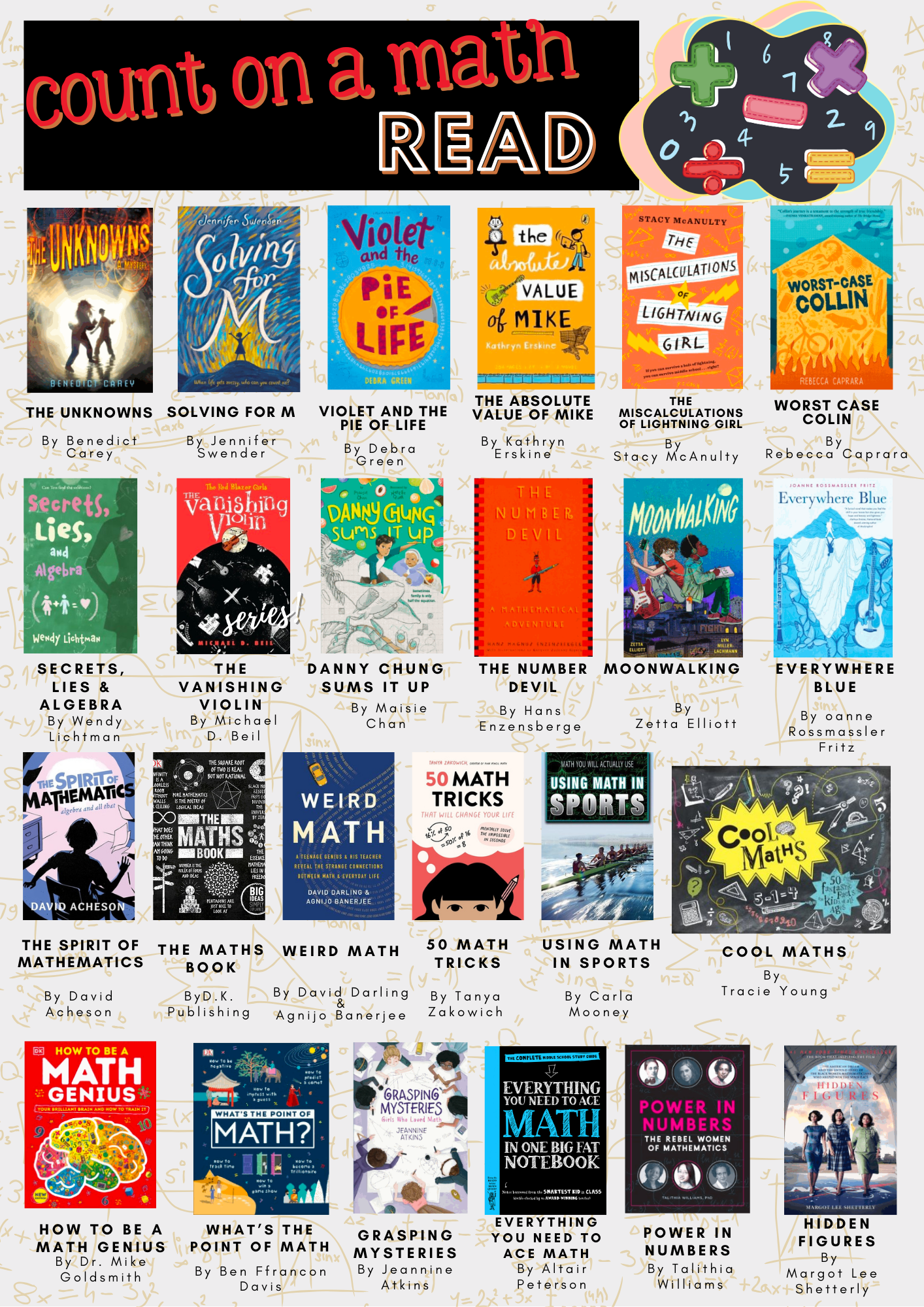
A few weeks ago one Friday, just before our WEIRD (WAB Extended Independent Reading Day) there was a sudden surge in interest in maths books from our G8 students. Unfortunately a little further questioning revealed that it wasn’t so much math books on demand as some kind of math text very specifically on quadratic equations as the students had a test in the next block but couldn’t spend the WEIRD block cramming / practising spreadsheets but had to in fact borrow and read a book.
The only book that really sufficed unfortunately was Everything you need to Ace Maths. While this type of book is a necessary part of a middle school library collection (we are after all there to meet the needs of our students), it got me thinking about the other wonderful books we have in our collection that were summarily rejected by the students.
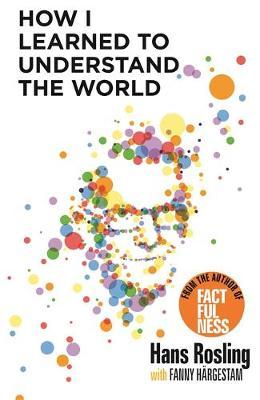
For a while one of my favourite has been Giorgia Lupi and Stefanie Posavec’s “Dear Data“. While not considered to be a traditional “Math” book it can help both teachers and students to change their pre-conceived ideas of how data can be represented. A book like this is particularly valuable in encouraging students who see themselves as more artistic and creative to seeing that one of the important parts of numbers is making the information contained in them visible visually. A point well made by Hans Rosling in his memoir “How I learned to understand the world” – a very enjoyable read by the late author of “Factfulness”.
Recently a most wonderful book landed on my desk. Actually the book that motivated me to write this post at all. Power in Numbers by Talithia Williams – it was an order from before the winter break that I’d made to expand the biographies available for our Grade 6 Unlikely Hero unit. Until now “Hidden Figures” (mainly as a result of the movie by the same name) was the main exposure our students had to the idea of women mathematicians. This type of combined biography is so exciting because it finally gives these women the exposure they deserve. And what I mean by deserve is in a big well designed hardcover glossy full colour book. It’s a trend started by “Goodnight stories for rebel girls” but goes far beyond both in form and content. The women are put in context both of the age within which they lived and the mathematics that they pursued. It’s a book that I was reluctant to let go of to be catalogued and one that I had to immediately share with the math teacher who shares my passion for books! For more from the author see her TED talk below.
Asian parents set a very high stake by their children’s abilities in maths. Our students at all ages are often exposed to acceleration in their arithmetic and math skills whether by Kumon or Abacus or other means. As my colleague is at pains to keep explaining, speed and the ability to use equations and “tricks” don’t always equate to true longevity in maths. One series of mystery books I enjoy exposing this age group to is “Red Blazer Girls” – where the boarding school based heroines use maths to solve mysteries. Often the kids with the so called “math smarts” struggle applying their skills to word / problem / real life based situations.
One of the Maths Teacher resource books that have been a hit recently is Peter Liljedah‘s “Building Thinking Classrooms in Mathematics. One of the benefits of social media includes being able to reach out to and engage with the authors of these books.
To end up this post, here is our Mathematics resource Library guide – happy to get more ideas of resources and the Maths books recommendations on a great website I was just introduced to today – Fivebooks.com! Worth some exploration as experts share their favourite top five books in various aspects of mathematics.
Tomorrow marks 74 days since we saw our students face-to-face. Since we had the luxury of physical indoor and outdoor spaces. A library. Fields to play in. Classrooms. We’re at the point of the year now where we’ve started talking about assessments and report cards and student led conferences. Where there are fewer days left until the end of the school year (67 days) than we’ve been doing online learning. And everyone I speak to is so very tired. Students, parents, teachers.
If this becomes our new normal, even in some kind of hybrid online/off-line model as articles such as this from the Atlantic Get Used to It: This Lockdown Won’t Be the Last suggest that we may be moving between the two for a while to come, then we’re going to have to rethink online learning in a major way.
I listened to an interesting podcast with Sam Harris and Matt Mullenweg little over a week ago, on the New Future of Work wanted to blog on it but then had to do some more thinking and revisiting the points, but it was nearly a 2 hour podcast and I didn’t have the time to re-listen to it (even on my usual double speed), and there was no transcript – so the hack I employed was to open a word document and activate dictate, play the podcast in the background and use Microsoft’s pretty impressive assistive technologies help me. I can read way faster than I can listen which is why video-based education always annoys the heck out of me. Podcasts are ok as I can do them while walking, cleaning, cooking etc.
Levels of Online Work:
Getting back to the point. Mullenweg identified five levels of online working. And I think this is probably true of online learning. He also had a great little anecdote about the early days of radio drama in the 1920’s when people didn’t take advantage of the medium and tried to recreate plays including costume etc and then broadcast it. Online everything is a bit like that – we take the physical and try to recreate it but online, not fully adapting to the medium.
The levels are:
Level 1: Occasional at home work for example due to emergencies / illness using basic equipment like phones / internet
Level 2: Attempt to recreate the office environment at home without taking advantage of the medium – i.e. synchronous, mandated online hours, surveillance by company, little freedom and agency.
Level 3: Take more advantage of the medium – e.g. shared documents, real-time editing for example during meetings for clarification and shared understanding, better home equipment, companies investing in hiring people with really good written communication skills.
Level 4: Going asynchronous giving agency to people to design their day and productivity. Performance is judged on production / output not on how it’s produced. The baton is passed on over time zones. Decisions take longer but allow for longer and better contemplation, less power dynamics and give space for introverts and people for whom English is a second language.
Level 5: Nirvana with better work and more fun. Environment is designed around health including mental health and wellness. People operated at a higher level being “heroicly productive”. A sense of a world of “infinite abundance” and where there is a noticeable divergence between peers in terms of their deliverables/output. The biases of online environments such as dress / self-presentation / image disappear.
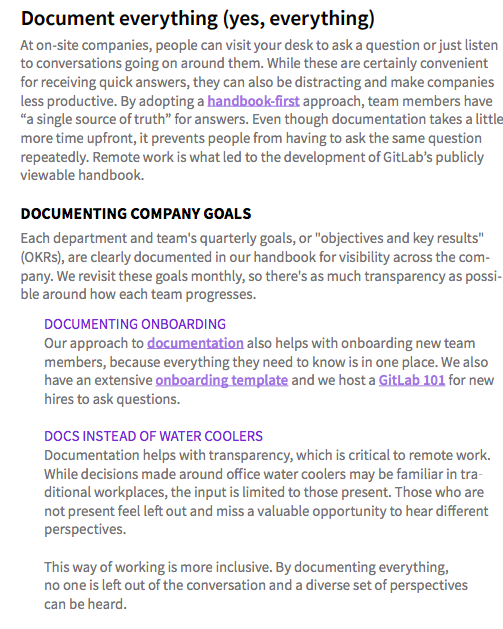
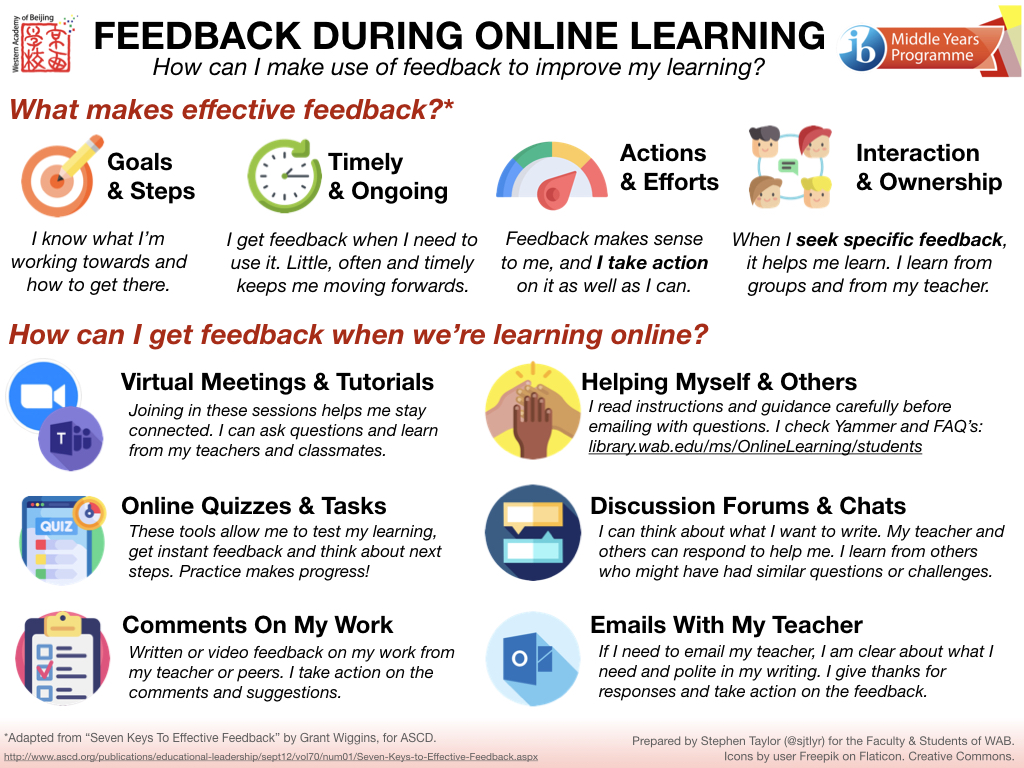
I really like some of their suggestions – including the one about documenting everything and having a single source of truth. Honestly that was one of the most time-consuming things I did initially and it remains tough to keep it updated and relevant, but our Middle School online learning guide (7,745 views) and the more detailed Teachers guide (5,476 views) remain the best time-investment I’ve made so far.
“sometimes I .. get under 5 emails per month, well and some months it might just be one or two basically all I get with email is like private HR stuff things that need to be one to one private communication everything else happens on these internal” (discussion boards / forums)
One of the most stressful parts of online learning I think for everyone has been the continual flow of single-purpose single-person emails all asking / saying the same thing. From the EdTech / IT side of things we’ve taken a load off with Libguides. I don’t get the feeling that’s happening so much in the various subjects. We’re not at Nirvana yet – or even close because there is still some pride in saying how many emails you have / have sent / how many hours you’ve been working. I had a really bad day on Friday. I’d been up late giving online PD to some educators in North America, followed by finishing off some points that had arisen from the PD plus internal stresses as our permission to stay is becoming an issue as we can’t return to China and my son and I were creating home-made application photos and filling in forms (in French – thank you Google translate) into the next morning. Then up early to do the first grocery shop in 3 weeks at 7.30am before the shops got busy. And then I was dead. I checked the most important emails and dealt with them – often just pointing people to our knowledge base. I left a bunch. And by the end of the day got “don’t worry I managed to solve it” from a few. The more robust our knowledge base can be, the easier this is going to become. I also need to make a huge investment in getting everything to ASK.wab.edu and then pointing to individual pages / boxes.
That’s going to take a huge investment not just in putting it all in “ask”, but also in getting our whole community to check there first as a habit.
Rethinking it all
But I diverge from the real point of this blog and that is the increasing realisation that perhaps we need to rethink teaching and learning. I attended a Zoom webinar with around 50 MYP educators last week, led by the indomitable Lenny Dutton and the consensus seemed to be converging around the fact that huge scaling down of the curriculum and content expectations was occurring – with 50% being the most common number suggested. (Side note, it also made me incredibly proud of the leadership, foresight and guidance of WAB as we’ve been asynchronous from the start). Perhaps it’s my A-type personality, or perhaps it was the question from my son “will all this result in the IB changing its exams next year to take account that we’re missing so much this year” that made me wonder what the heck we’re doing? Yes I’m not uncaring and I know all about Maslow vs. Bloom etc. I also know that there is less room for anxiety, worry and endless media scrolling when there’s useful and engaging work to be done.
I have to keep wondering if there is a different way, besides the asynchronous and slower pace to do this. My colleagues know I have two phrases of our greatest enemy in education that I repeat all the time “continual partial attention” and “switching costs“. I think education does particularly badly in helping students to find their flow or in adhering to Daniel Pinks’ tenants of motivation “autonomy, mastery and purpose”
I’m a veteran of (adult) distance learning, having done two back-to-back masters’ degrees remotely over four plus years. It was hard. Really hard. And it took a while (at least 3 subjects, lots of tears and feedback) before I managed to work out the best way to organise myself and my work flow and to find the balance between (part-time) work, full-time motherhood with a spouse who was on the road a lot and being a student.
The sweet spot for me was only two subjects per semester, and only working on one subject at a time each day.
Granted these were masters level subjects with an enormous course load and tons of academic reading to do. But then again I’m a highly literate adult, with hopefully more defined study skills and work habits. So if we’re asking students to do 8 or more subjects and teachers to be teaching 5 block – sometimes of different grades/subjects (middle school) is it any wonder we may be over-reaching? (The poor completion record of MOOCs is also something at the back of my mind).
As you know, I’ve also been grappling with that beast called Teams, and I’m trying to think out of the box and learn from all the questions and webinars and videos out there. One completely out of the box idea I had was perhaps we’re thinking of it the wrong way around – this is in particular to my thoughts about student agency, self-directed learning, portfolios and evidence of learning/mastery. What if instead of having class/subject teams, each STUDENT had a team they were owner of. They’d have channels for their various subjects, and they’d choose which two or three subjects they’d focus on at any time and when they’d do it. Subject groups would have department teams with all the teachers, the curriculum and curriculum content that then could be pushed down to students and mentors would help guide students in their choices. Instead of semesters, for this age group we’d probably have to look at shorter periods of time to ensure that the “forgetting” curve didn’t kick in – especially in continual practice type subjects (I’m in dire danger with my Chinese according to my memrise app, not to mention muscle loss on the fitness side of things).
What are you thinking?
In a conversation with a fellow educator last week, he said “Well WAB is just so far ahead in thinking about these things, we’re probably at least two or three years behind even putting theses discussions out in the open” and perhaps that is so with our Flow21 initiatives. I’m also wondering how far away we are from becoming a global rather than location based entity – for example some of our students were at one point enrolled in local schools where they were based and have now returned to the fold – what’s stopping us from enrolling other poorly served students into our programmes?
I’m thinking the IBO is also going to need to be far more proactive to fit the new reality. Personally I was not impressed with the timeline of action (exam cancellation and alternatives proposed) only coming after it was apparent that this wasn’t just a China problem. Value based leadership is essential in these times and that includes checking bias.
I do think the IBO focus on ATLs (Approaches to Learning), particularly communication would remain foremost – again from Mullenweg:
“and writing quality, clarity, and skill becomes more and more valuable I think in all organizations but the more distributed you are for sure. This is going to be a windfall for all the humanities degrees. Absolutely we screened for it very heavily in hiring process. Like I actually don’t care where you went to college or anything like that but we do a lot to screen for writing ability both in the how you apply how we interact will hire many many people without ever actually talking to them in real time or on voice we do it entirely through slack and tickets and other things because that’s how we work”
If we were to explode education what would it look like? Please comment.
This blog post is brought to you in-between too much stuff to do with online learning but as an absolute PLEA to Microsoft Education with their wonderful but exasperating Teams product to do some more heavy lifting to get Teams for Education into a shape and form that will get us through the next few months of online learning.
Why Teams is great – especially during online learning
Ok, I’ll do a sandwich – Teams has been wonderful for just existing. For making meetings quick and easy. For their integrated class/teacher/student notebooks (albeit they crash way too often and can refuse to sync properly). For their great way of setting up assignments making it quick and easy to have an overview, to mark and give feedback, for the rubrics. (Although you can’t see assignment dates on the calendar – please vote for this!) They’re doing a really really good job of a lot of what we need.
And now for the BUT.
The big but. And I understand how it happened. It happened like a lot of things to do with education happen, including a lot of LMS (Learning management systems). They do something for the big people, in corporations or in universities, and schools are crying out for a functioning and functional LMS that’s mobile and cloud based and so something gets adapted and pushed down to secondary school or even primary. Ditto the other way, things are made for primary school where you have one classroom with kids and a few specialist teachers / classes and someone tries to push it up to secondary.
So, we’ve been doing online learning for nearly 8 weeks now (I think, I’m losing track, and last week was a week “off”). And we’re really needing to change gear. We can no longer stay in first gear as if we’re climbing a steep mountain while on the flat-endless prairies. So it’s time to take stock and adapt practices for the longer term.
What is not working that in education we actually really really need to work? And pretty fast? (And all the mistakes I made along the way as bonus crash-viewing – hopefully this will help someone else just starting on this path) .
Child protection needs to be a priority
Teams was really new this year and has been adding great features along the way. So for a long while, it was an experimental sandpit for us where we were letting our early adopter teachers play around in, create as many teams as they wanted with no real oversight. It was great, we learnt a bunch and all was fine, because we were still having physical classes and mainly using it for assignments. Then Covid-19 hit and we went full stream online. We went from a handful of teams/teachers with regular feedback to over 300 teams and all teachers overnight. Despite having naming conventions (to easily find / sort teams) and requesting that EdTech and senior leadership were co-owners of all teams, that didn’t necessarily happen. Humans in panic and all. We set up protocols for online meetings. We requested teachers to record and save meetings.
People forget to record (meetings can’t be set to automatically record).
People forgot to put meetings on the public calendar(s) (we have one per grade)
Students start meetings before the meeting time/teacher is present.
Teams only keeps a meeting recording for 20 days.
Meetings in private channels can’t be recorded
These are things that were “nice” to have automated / sorted out before we went online but now are really important if we want to safe-guard students and protect teachers from (potential) unjustified accusations.
Here are the links to Microsoft teams UserVoice to request these things are implemented – please add your voice and vote:
Have meeting recordings automatically saved into files
Only the meeting owner/teacher can start meetings, and once they’ve left the meeting ends (now the meeting keeps going for hours and hours and can’t be stopped)
Schools have children in them – they do stupid things!
We have a number of teams for professional purposes, and even we have problems with basic organisation – such as putting things in the right channel, starting conversations in the right channel etc. We were so glad when Teams started the option of private channels, but then so disappointed when they didn’t have the full functionality of open channels. Open channels are fine. But not for 10-11 year olds. They need to be corralled into private channels so they don’t mess things up for themselves and others.
Teams has an endlessly flat non-hierarchical structure
Yes ideally and eventually we’re going to kill grade levels and age-based learning and all of that. But it hasn’t happened yet. And it’s not going to happen in the next few months of online learning. And yes fortunately and for the better of all we’re moving from thinking about students and classes as “my” student/class/subject.
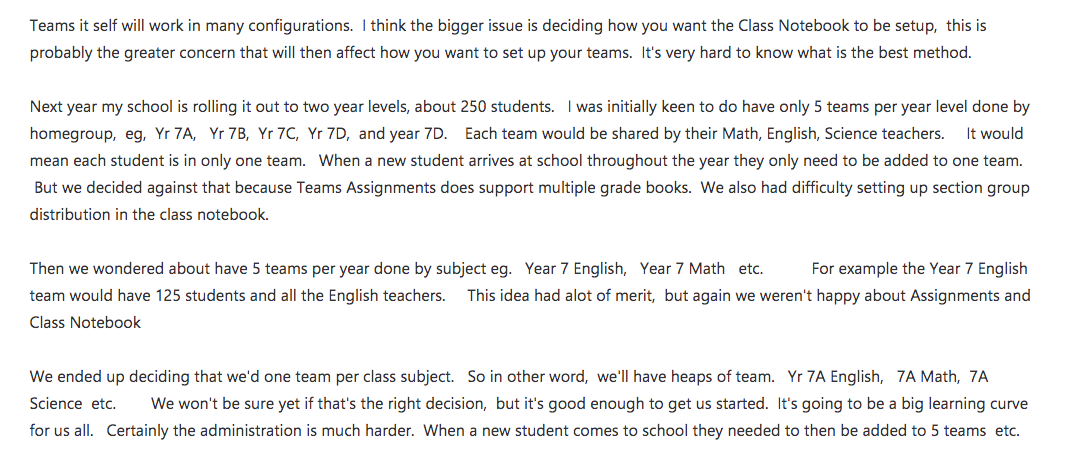
The very basic question we all grapple with in creating teams is how to structure it. Because there isn’t really a structure in teams.
I still don’t really have the optimal answer to that, particularly given the restrictions of private channels (maximum of 30 per team, no meeting scheduling and no meeting recording).
The thing is it’s better to think this all out in advance and to have a plan rather than to start and then have to reconfigure things afterwards because
you can’t change a private channel into a public channel after creating it as private
you can’t change a team into a channel – private or public or vice-versa
you can’t move a channel into another team
you can’t rename a team or change a teams name (well you may “think” you can and do it, but you have potential real problems in the back-end in Sharepoint)
you can’t sort teams or put them into folders or pin them – you can drag them around – easy enough if you have a couple of teams not so if you have 300 of them, you can filter them – but that only works if you’ve named them all properly and consistently.
There is no dashboard / entry point
When you enter teams it is a full on experience. There is no dashboard with your calendar / assignments / meetings about to happen. You can scroll and scroll and still miss things – sometimes I have a meeting to attend and I even know in which team and it’s started but I still can’t find it quickly!
The analytics are very rudimentary
I’m the first to admit I’m a little bit of a data nerd – ok a lot. I have seen a lot of responses in the twitter-sphere along the lines of “no one is going to tell my child what to do during school closure” or “I don’t care if they learn or not as long as they’re happy” – but that’s not my demographic. Our families are paying a lot of money for their children’s education and learning and they have high expectations of us and their children.
[Personally I’d also say an engaged, purposefully busy and cared for child (not just by the parents but by the educator too) is a happier child than one left to endless repeats of anxiety creating bad-news on social media or TV. ].
So we spend a lot of time and energy making sure we’re mentoring students, monitoring their engagement and that they’re not falling too far behind their peers. Moodle, our usual LMS (but the clunky old stead) has great analytics. I can see exactly who’s been online and when, for how long and what they’ve been engaged in – but for many reasons our students and teachers like the intuitive feel of Teams more.
Teams has basic analytics for the week and month BUT I can’t click on anything! I can see the number of active / inactive users but I can’t click further and see WHO is inactive – so here’s one class for example – 9 kids’ haven’t re-engaged in the first 3 days after spring break. Who are they? Without looking through comments and assignments in detail I don’t know. I look at 28 days and see it’s just 1 person – who is that?
But that’s just one teacher for one subject – say I’m a mentor for 11 students and I need to report weekly on all my students and see who’s falling behind and whether it’s just one subject or all of them. No can do.
Lack of portfolios
Using portfolios as evidence of learning is really important as we progress in our understanding of education as a process of learning rather than students needing to jump through some curriculum and examination hoops at certain points in time in their lives (really relevant now as IB, GCSE and A level exams were cancelled this year). The structure of teams is that the Team in Sharepoint “owns” the work students have done as assignments. There is no easy and quick way to gather all the evidence of learning from the assignments and “give” it back to students to add to their portfolios as they move through the system or from one school / teacher / grade to another.
This may seem minor but it’s a major philosophical shift that need to happen in education. Learning is not something that happens to students from teachers, but something that students own and are accountable for. Especially now. Especially in concept-based education like the MYP.
There are many ways of showing mastery and the current set-up still puts the teacher in the control panel.
I’m way over my time and word limit now, so to end my sandwich:
What else works really well
Add on apps and integration with things like Zoom. A fabulous user-base in China with the inimitable James Rong – check out his blog – we have a joke here that if we ask a question to Microsoft, they ask James and then come back to us with his answer. Our other “joke” is that he posts an answer on his blog to a question we didn’t even know we had until we see the answer!
If you’re rockin’ teams and have some suggestions on best practice, please don’t give them on twitter or facebook where they’ll disappear, but add them as a comment here so that as a community we can all learn together.
I don’t know who created the image on my blog header but it’s amazing – it was passed onto me in a chat as a meme, if it’s yours please let me know so I can credit you.
Our G6 Language & Literature classes have just started a unit on “Unlikely Heroes” and I must admit I’ve been having an amazing time finding some fantastic new biographies and memoirs to entice them into reading this genre and keeping an interest in the lives of people who may not always make the headlines, or who they may not be aware of, or who they only have an inkling of.
Two very interesting stories from the sporting realm are those of Jesselyn Silva with “My Corner of the Ring” (boxing) and Ibtihaj Muhammad with “Proud: living my American dream” (fencing). These are a double win to my mind featuring both lesser written about sports for middle grade students AND featuring young girls from non-traditional backgrounds in those sport – I have a daughter who fences and I know exactly how expensive (and sometimes snobby/exclusive) we’ve found it. There’s also the recent cliffhanger with young football players in Thailand, excellently written about by Marc Aronson in “Rising Water : The Story of the Thai Cave Rescue”.
Through my privileged connection with the Neev Children’s book awards, I’m able to encounter books that I wouldn’t otherwise be aware of such as “Like A Girl: Real Stories for Tough Kids” by Aparna Jain that showcases the lives of 56 Indian ladies, who may not be familiar to our students. Another book worth mentioning is the hybrid graphic novel / biography Indira by Devapriya Roy and Priya Kuriyan (Illustrator). What makes that book special is the way it weaves in how writing research is conducted in present day with the historical facts.
The last three books, are ones where he is part of an anthology. One thing that we’ve started doing as part of this unit, is where there are a number of “heroes” in one book, we’ve added all the names in the table of contents to our cataloging record. That helps students to find different perspectives, formats, lengths of explanation and viewpoints of the same person. We’re hoping that some students will start with one of our many combined biographies, for example the great series of “Forgotten Women” by Zing Tsjeng or the “Goodnight Stories for Rebel Girls; or The Good Guys or Stories for Boys; or Stories for Kids; or “A History of the world with the women put back in” by Kerstin Lücker & Ute Daenschel and end up further researching one particular person who catches their interest.
An amazing thing has happened to nonfiction since around 2016. The visuals, design and layout has improved to no end, so books have become so much more enticing. I’m also loving the fact that biographies of women are no longer so ugly and we’re finding out about other amazing women such as Didda the ruler of Kashmir from 958 CE to 1003 CE (Queen of Ice by Devika Rangachari).
More of the wonderful books and how we categorised the various types of heroes around this unit can be found on our library guide. The revolving book lists (created with LibraryThing for Libraries) on each section lead back to our catalogue where students can see if the book is available and if necessary put the book on hold.
Next time I hope to write about some more fabulous nonfiction recent finds related to other curriculum units.
One regularly hears phrases bandied around schools such as “Every teacher is a language teacher”; or “Every class should start with 10 minutes of reading” and you’d be hard pressed to find a teacher who doesn’t agree in theory, that reading is a good thing. But then there is the “reality” of supposed too little time, too much pressure, too much content to cover and the theory of reading becomes such an abstract notion that there isn’t even a consideration of how it could be implemented.
We’re on break now, and when we get back I was asked to present to our HODs for a few minutes on integrating reading into units in the middle school. I’ll probably just show this one slide:
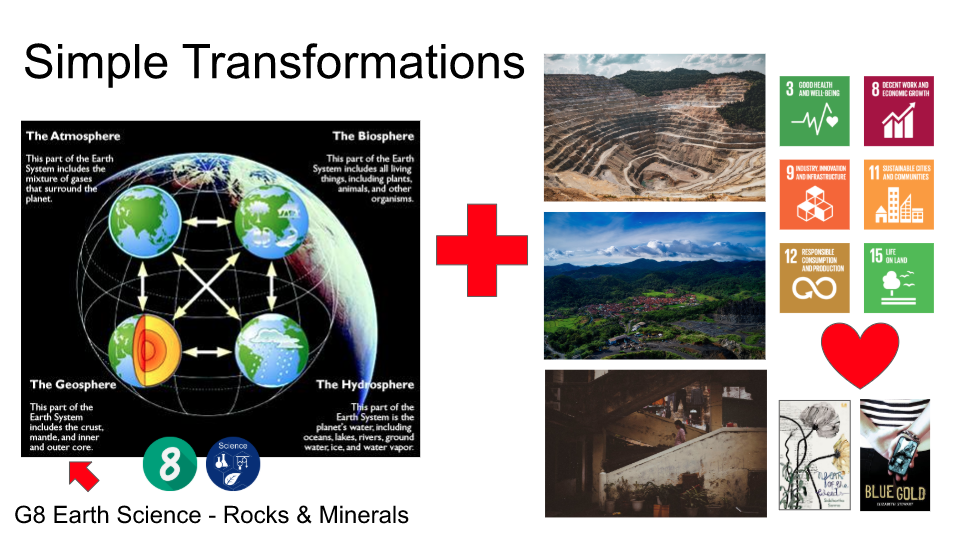
I’d call it “content plus” – it’s from a G8 Earth Science unit that the Science team and I put together at the end of last year and they’re teaching now.
The idea is that you still have the science content as core to the unit – in this case Earth Science and learning about Sedimentary, igneous and metamorphic rocks and the minerals they contain and mining and the products of mining. But to that you add the environmental and human impact, and the lens of the SDGs (Sustainable Development Goals). And in order to help build empathy and understanding, add some literature.
Katie also had the brilliant idea, that she’s implemented in her school (and I’m going to be following quickly behind!), of getting good, relevant articles, stripping off the advertising etc (she uses Safari Reader View; I use Mercury Reader) putting them in binders and making them available in the library and classrooms – see slides 42-47).
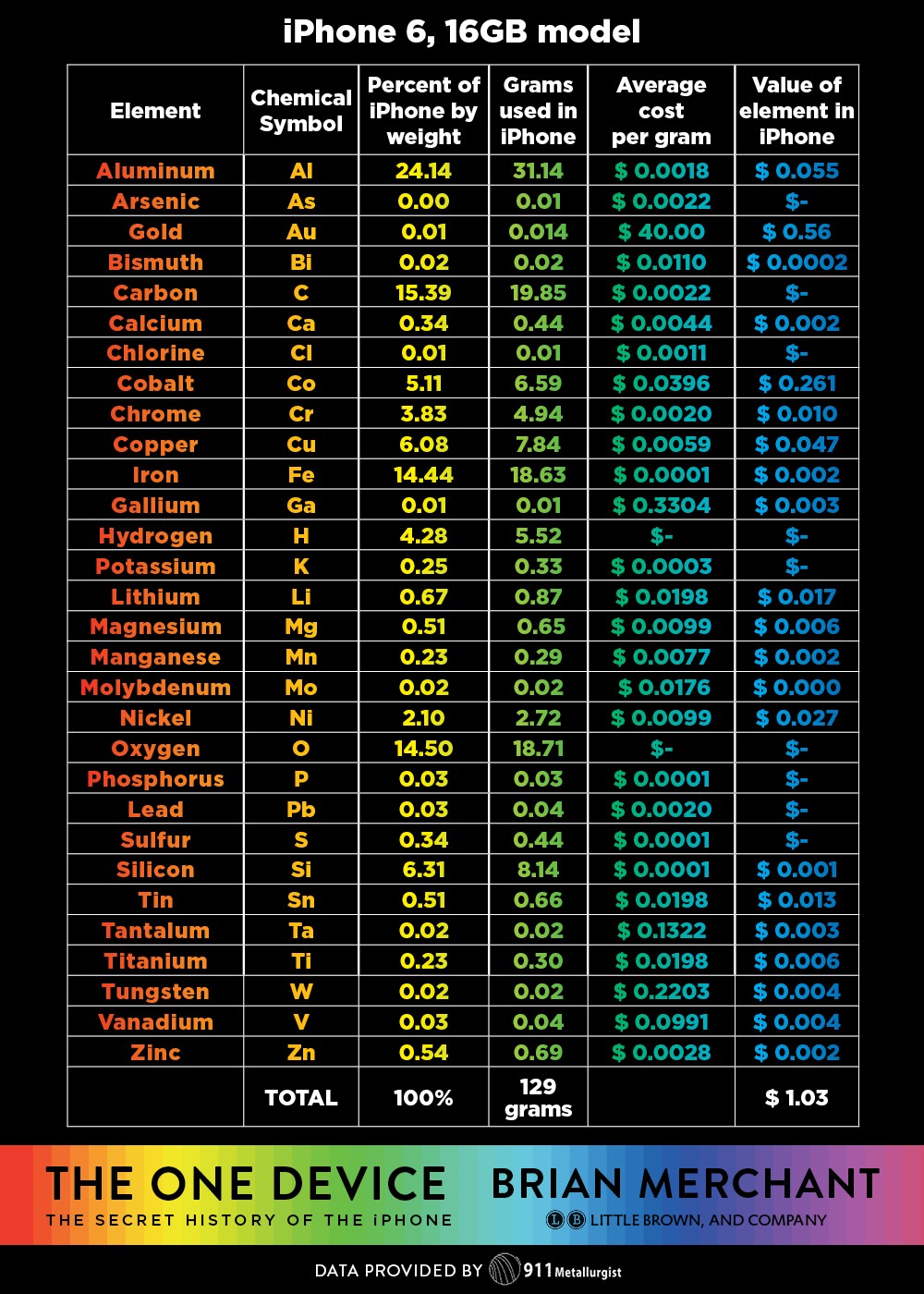
You can of course choose any minerals, but in this case to make it relevant to G8, we focused on the primary elements of an iPhone.
iPhone ingredients
Ideally, and this takes time, some of the science and or math units would be linked to Language & Literature or Individuals & Societies units allowing more time to explore literature.
In the mean time, one of the wonderful ways of adding literature into units is through picture books. In the guide we created for the Neev Festival, we made suggestions around groupings of the SDGs of the Neev shortlisted picture books plus lots of other books. It’s still a work in progress, but over time I’m hoping that for each and every global goal I have 10-20 picture books, (as well as 10-20 fiction books and 10-20 really good nonfiction books) that can easily and quickly be introduced to a class, thereby adding a very special element to learning, and truly making “every teacher a language teacher” and every teacher able to devote a tiny slice of their class to reading.
I meant to write this post a little while back, but then school started, and whoosh there went all my potential blogging time.
On one of the FB groups I follow someone was asking about teaching academic integrity / honesty. Naturally the librarians in the group responded with “ask your librarian”. To which the poster responded “I took it on. Go me!”
There are so many things wrong with this response it’s hard to know where to begin. And yet it is pretty common. Even in IBO programs. Maybe especially in IBO programs? You see a lot of IB educators (PYP, MYP, IBDP) are really smart people. Often they’re subject specialists. They’ve had additional post-graduate training specific to the IB, and often also have post-graduate degrees.
So what can be so hard for a person like that to teach information literacy / academic honesty etc? Why on earth should they involve their teacher-librarian (assuming that one still survives in their organisation and hasn’t been replaced by a (unqualified) parent volunteer or the principal’s wife?
In the first instance it’s not quite as easy and clear cut as people presume it is. Heck there are people like Mike Caulfield make it their life’s work to seriously consider information literacy and over the years boil it down to its most useful essence – perhaps in response to the “go me!” attitude of educators.
I’ve walked into classrooms where teachers have been talking old-fashioned nonsense that was relevant in the time they studied and had to go back to micro-fiches or dig through unfederated databases. Classrooms where teachers are mixing up APA in-text citations with MLA7 works cited lists in an environment where MLA8 is the norm. Classrooms where teachers have unattributed images or texts in use…
But worse than all of that, they have a black and white view of plagiarism. One that is unsubtle and non-nuanced. One that makes students “good or evil” and neglects the approach that academic honesty is a community effort. That it’s too late to make it a quick add on to a lesson. I’ve written on this in the past – plagiarism is not a simple matter, but mired in assumptions, teaching, culture and ignorance. And that’s the exact reason why it should be addressed centrally with common language, common understanding and be phased in over years with teachers and the rest of the community as role models.
So don’t “go you” – unless you’re going to your teacher librarian (TL). And if you haven’t bothered to talk to, or collaborated with your TL, do yourself, and your students a favour and do so. Yes you’re smart and all that. But the TL is a specialist in this stuff (remember the two masters degrees they need?). And if they’re not used, you’ll be left with a bunch of apps and ignorance. And the problem will not go away with some nifty templates from teachers-pay-teachers or your mates on FaceBook.



























 As you know, I’ve also been





 Two very interesting stories from the sporting realm are those of
  facts.
 The last three books, are ones where he is part of an anthology. One thing that we’ve started doing as part of this unit, is where there are a number of “heroes” in one book, we’ve added all the names in the table of contents to our cataloging record. That helps students to find different perspectives, formats, lengths of explanation and viewpoints of the same person. We’re hoping that some students will start with one of our many combined biographies, for example the great series of


 Informative Flights - Musings of a Teacher Librarian