Every year around this time, some parent will ask the teacher or myself what their child should be reading.
The “correct” response to this question is that we don’t make reading lists of prescribed or recommended books but prefer students to come and have a chat to us about what they like reading, what hobbies or interested they have and based on that we can personalise some recommendations for them. That we believe in free voluntary reading.
How many of you have had a follow up on that with the student popping by for that exciting interaction? I started getting parents coming by personally around the end of my first year in my last job, and parents and children sometime in the second year and students on their own around the middle of my third year.
The truth is that people like lists and they like recommendations. This New Yorker article gives some ideas as to why lists matter – the most salient features are that lists “alleviates the paradox of choice” help with “reduction of uncertainty” and due to their finite nature are easier on the book budget both for school and home libraries!
So why are book awards important? According to Underdown: ‘
“Awards are important in children’s books. They tell publishers, writers, and illustrators what is considered to be “the best,” and thus the standards they must strive to attain. Many children’s book awards, though not all, are selected by librarians. Award-winners then get orders from … both libraries and bookstores. They will also stay in print longer. For writers and illustrators, getting to know the award-winning books … is one of the ways to understand what is considered to be the best today.“
The idea of finding out what the best is “today” rather than when authors / illustrators or publishers – or parents and librarians were children is very important. I’d love a dollar for each time a parent wants to force the literature of their youth onto their progeny. Reading through the long list of the Neev awards, there was also quite the body of what I’d call “nostalgic” storytelling. Which is really hard to carry off, and generally appeals more to adults than children. Which is why, it may be important to consider a children’s choice option when moving from a short-list to the finalists.
Following last year’s very successful initial Neev Festival, during the feedback discussions the idea of an Indian Children’s book award was floated. One of the driving ideas was that India had a large body of children’s literature, published in English, but not widely known nor distributed internationally. And selfishly, as librarians in an (Asian) international context with 40-50% Indian diaspora making up our student bodies, we were just not able to provide our students with the “mirrors, windows and glass sliding doors they deserved – mirrors for the Indian students, and windows and doors for the other students. Kavita Gupta Sabharwal is a very special person, both visionary and someone who makes things happen, including this book award, both from a logistical and a financial point of view. Each award carries a cash prize of Rs 1 lakh (around US$ 1,400 – a substantial amount in the Indian publishing world).
Already, just based on circulating the short-list in social media groups, there has been substantial interest from the librarian community. The prize-winners saw their books fly off the tables following the award ceremony, with all books sold-out by the end of the festival. An award sends a powerful signal to publishers and the public – one that says “pay attention” this has value, create more like this. The award stickers on the books a “buy me” beacon.
The final step in the equation and the gauntlet to be thrown is whether the publishing and distribution channels will be able to push these books out into the wider world where they deserve their moment(s) in the sun. And in the longer term, creating teacher guides and author visits, websites, hyperdocs, quizzes, eBooks and audio-books. For that is what the world has come to expect. But first the small steps, make the books available for every child, parent, teacher or librarian in the world who wants to push a “buy” button and have the book delivered to them, anywhere in the world.
The phrase “life long learning” gets bandied around a lot, and today I’m going to write a little about just how much learning is involved in moving job, school section, country, and home.
I left a country that was easy to live in (Singapore) and I job that I loved and was comfortable with for a place (Beijing) that generally led people to shake their heads in puzzlement, even as they acknowledged that the school I was moving to was something special. Easy is not always good. I must admit I never really liked living in SG – it did not make my heart sing in the way that Hong Kong did. I never felt at home like I did in Hong Kong. And the only thing that kept me there for the last 3 years was a great job that kept me busy enough that the things that irritated me about SG didn’t bother me because I didn’t have time to be bothered.
Living Learning – my husband just announced he needs a haircut – what does that have to do with learning – well it’s just one of a myriad of daily / weekly / monthly things that one has to do in life where you have to relearn how it works and where to make it work. Of course the easy answer is – just pop into a barber or hairdresser – and that’s simple enough if you’re a no-nonsense type of short-back-and-sides-guy but just look in any Asian-expat forum for the pleas for hairdressers who understand curly / blonde / kinky / wavy hair and you’ll realise some things cannot be taken for granted. Like buying knives in Beijing. When you move here you need to surrender your passport to your employer for an extended period of time while all the visa work is sorted out. But no-one will sell you as much as a bread-knife without seeing your passport and registering it (history here – and I’ve learned something). We’ve moved into our house already and we’re in camping mode until our shipment arrives – so a few kitchen knives are kind of important – luckily we have nice colleagues with knives – presumably purchased prior to the ban!
Then there’s spatial learning. Orientating yourself in time and space, just like the PYP teaches. The Beijing public bus system is amazing. And cheap. For the equivalent of 20-50 cents you can go pretty far within your zone. Compared to 25x as much for a taxi (even if taxi’s are way cheaper here than elsewhere). So it’s a real good idea to learn how the system works. But it’s not that easy. I got a bit of a reputation of being the daring bus lady in our first few weeks, and this is the true story of why. My husband and I, newly married, moved to Sao Paulo, Brazil in 1995. When we arrived we had no money, nearly no furniture and only his job. And if anyone follows South American economic history – it was just after the Plano Real, which meant that everything was super-expensive as the country came out of hyper-inflation, but the balance between cost and value was still being established. So there I was, stuck in an apart-hotel, without the wherewithal to attend all those fancy expat lunches and coffee-mornings, no car and no money for taxis. Oh, and after a 2 week Portuguese crash course I spoke next to no Portuguese and in those days not many people spoke English. And add to that, no smart phone, in fact make that no phone at all, as there was a 6 month waiting list and a $5,000 installation fee to get a phone line installed in your home, and no internet. So I used to walk down the road and get on a bus and drive that bus the whole loop and work out where it went and of what use it would be to me. I figured I didn’t have anything more pressing to do with my time (except find a job quickly); and I didn’t have any money, so there was nothing to steal from me, so what-the-hell.
These days it’s so easy. High speed internet, a “maps” app that works in Beijing, even for public transport and in English. But still you need to learn some stuff. Like the Chinese name for your compound / complex. The nearest bus stop. What time they start and stop and the frequency. If you need to change over, which combinations are the fastest at which time of the day. Whether it’s better to take a bus or the Metro or walk. The short-cuts and back streets. And how to cross the road without being killed.
There are still things I want to know. And I’m not there yet. Like what app to use for buses in advance – there are some great subway apps, like Metro Beijing where you can put in your start and end points. Maps sort of works, there is a workaround where instead of a location you can look for “transport” and then “Bus Stops” and then click on the bus number and see its whole route. But that only finds the buses near to your location, which isn’t much good for advance planning. I also know you can get an app for your transport card, but I haven’t found it yet. There are some I’m sure, but only in Chinese. Which I’m still re-learning. I’ll do Chinese in a whole other dedicated post.
Work hygiene learning. I call it that based on Herzberg’s motivation theory, because it kind of makes sense and I don’t have a better way of describing it. It’s all the stuff besides the technical / knowledge bits of your job that you need to know to survive and thrive in your new environment. Now this is a pretty steep learning curve. Because every school has their own “untouchables”. I was asking a friend about a new person in another school and her conclusion was she had great ideas and enthusiasm but this wasn’t being appreciated. I sort of know the environment there and I can just see that happening. It’s a dynamic tension. You’re presumably hired to a job because they want your input, and in some circumstances for you to change things. But not too much or to soon. Or perhaps they do what a lot of change and quickly. But who do you ask? Who wants to tell you? There is this mutual dancing around things. Both my predecessor and myself to my successor deliberately didn’t say too much about the environment, because it is important to try and feel it out for yourself. And it’s also nice after a few weeks to be able to ask someone if your experience aligns with theirs – because it’s so hard to know if it’s “just you” or if there are other things at play.
Similarly in my mentor group (another “first” for me – having 12 students to nurture throughout the year), I’ve deliberately not looked at their records or files, as I want to take them as they are without history or labels and then move on from there.
Where to play. It’s not all about work, so our Newbie WeChat has been full of which restaurants are good to go to, where to have a massage, where the beer is cheap, nice parks to hang out in, bars and clubs for the night owls. This morning I was delighted to find the Beijing Greenway just minutes from our house with I think about 12km of walkway along the river through wooded areas with lush green and few people.
I’m seeing similar exploratory type posts on the facebook pages of friends who have also taken the plunge into the new and unknown. It’s easy to say it’s easier now we have the internet and facebook and smart phones and apps. But change and adaptation in reality is never easy because it has its own absorption rate. And even after moving around for the last 35 years, I’ll put my money on the fact that it will take at least a year. Because it always does. Except in Luxembourg where we only lived for 10 months!
If you’re new to this game, you may want to read up more on “culture shock“; the 5 stages of culture shock – honeymoon; culture shock; actual adjustment; isolation period; acceptance and integration, the W curve etc.
We were lucky to learn this all at the Royal Tropical Institute in Amsterdam prior to our moving to Brazil. And they also gave us one of the best tips ever – which was easy to implement in 1995 when flights were expensive and phone calls cost at least $5 per minute – and that was – not to have contact with home in the first 6 months. That’s pretty unbelievable in this day and age, but it probably helped with the move and integration.
Classroom libraries vs. school libraries, teacher superstars marginalising teacher librarians – or is it our fault?
This post was first going to go one way and then through holiday laziness in posting, it has taken a kind of dual direction as I have more time for self-reflection and research.
The first offensive was launched by KC Boyd (2018) in her post “Easy Like Sunday Morning: School Libraries vs Classroom Libraries” where she reflects on Chicago School System and the impact on literacy of shifting from school libraries to (only) classroom libraries (hint – it wasn’t favourable). She refers to Ariel Sack’s post on the importance (and diminishing) role of school librarians who asks “Can this project be done by an individual teacher? Yes. But it’s something different when one person with a vision and the time to implement it leads it consistently for the entire school, every year” (Sacks, 2018). I’d argue there is another factor – one very rarely meets a librarian who doesn’t read (I have however met library assistants without any interest in books or reading); but the Peter Effect is well documented in teachers (Applegate & Applegate, 2004; Binks-Cantrell, Washburn, Joshi, & Hougen, 2012; Turner, Applegate, & Applegate, 2009) with studies in various places around the world documenting aliteracy in teachers / pre-service teachers – “Findings revealed that 54.3% of 195 teacher candidates were classified as unenthusiastic about reading and only 25.2% of teacher candidates reported unqualified enjoyment of reading.” (Binks-Cantrell et al., 2012, p. 526), and the picture appears to be getting worse rather than better (Skaar, Elvebakk, & Nilssen, 2018).
This is something easy to lose sight of when twitter, YouTube, Facebook, blogposts and podcasts are dominated by literacy superstars like Pernille Ripp, Colby Sharp, Mr. Schu, Jennifer Gonzalez, Angela Watson etc. But for every one of them, even a small imitation of them, there are likely to be three or more other teachers who are either not enthusiastic about reading, or, who actually don’t deign to read the types of books their students do – something I know my librarian mentor Katie Day, (successfully) worked very hard on with the teachers at UWCSEA-East when she was there. Based on my own experience I have encountered whole grades where not one teacher has been actively and passionately engaged in books and reading, and where this is apparently not seen as an issue (except when it is reflected in their students’ testing scores – but then the solution has been to work on the students rather than the teachers).
Regie Routman in her article “On the level with levelled books” (Routman, 2018), makes some valid arguments for free voluntary reading, and the choice of a selection of relevant and developmentally appropriate books for classroom libraries, but only makes oblique reference to public libraries and with no mention of school libraries or librarians – not even in a nostalgic or wishful manner. Relying on teachers who care and the intervention of a literacy expert is not a long term solution!
Colby Sharp, boasting a 3,000 book classroom library, ordered in a numbered system unfamiliar to any librarian I asked, talks about book checkout and is quick to dismiss the scanning system a librarian assisted him in setting up as “too much trouble”… (Sharp, 2018)
To which Day responded on FB “as long as he is on top of what all his students are reading, then, yes, it could work. But it’s not scaleable — and he doesn’t mention inventory checks — so at the end of the year you know which books might need to be replaced. With 3,000 books, it might be good for his students (other students? other teachers?) to be able to search and discover what books he has in his class library… Just sayin’… And LibraryThing’s TinyCat is definitely an option he might consider — to be able to see his collection online, whether he uses their circulation system or not.”
And then I found out what his library looked like – with a self-invented number system – ok so Dewey doesn’t do it for everyone, but those random numbers? (Sharp, 2017). I love the idea and potential of classroom libraries – I baulk at the cost, duplication of effort, waste of resources, money and time, lack of discoverability, lack of meaningful data and often stagnant nature of them. I have seen money wasted on thoughtless last minute purchasing without any clear strategy, collection management or development. I’ve seen classroom libraries with books that would better be relegated to pulping or, redistributed to older or younger students. I’d be the first to admit that often no one knows students better than their class-teacher, but just as we shouldn’t have to choose between classroom libraries and school libraries, so too the burden of creating dynamic exciting collections needn’t be the domain of only the class teacher or the librarian – together we definitely are better. Dialogue, collaboration, debate, relative expertise – all these things make us stronger as a learning community.
I started out being a little annoyed at the lack of mention of (school) librarians, but then reading the FB question of a librarian, (who shall remain nameless) challenging whether she should be expected to find a selection of books on a specific theme for a teacher because “she’d already shown the teacher how to find book in the system” and the responses I wondered how much of it was our own fault? We should be falling over ourselves to help teachers, parents, administrators, everyone in the community with lists and suggestions and books and resources they didn’t even to know to ask about. We should be anticipating and proactive. Not whining on FB as to where the limits of our job lie. I love the fact that this is one of the careers where you can pretty much be without boundary and limitless in what you can do – all in the interest of teaching and learning.
Spending a bit of time on Twitter I saw what was going on with Project Lit – something started in an English Classroom that is going viral (Riddell, 2018), (and what an excellent book collection they’ve created!) and I thought, darn it – we’re missing so many tricks here. Why aren’t teacher librarians initiating things like this, or the GRA? Why aren’t we leveraging our knowledge and experience in more ways than just fretting about our increasing marginalization and extinction? Why aren’t we taking more leadership and visibility in these arguments and discussions?
We aren’t part of these discussions and we’re not top of mind to any of the people who are getting attention. Whose problem is that? Do these “superstars” have a blind spot to anything NIH (not invented here), monstrous egos, or are we / have we become just so marginal to the whole reading / literacy scene that we don’t even merit a mention unless prompted (as the Sack article intimated)?
On FB again, another librarian spoke of her school that has gone from a thriving library system with two libraries run by two qualified librarians that’s been whittled down and compromised to one remaining librarian and was wondering what the moral of the story was – I commented “frog in a pot that slowly comes to boil”.
The problem with being a passive Anura is that no one else is going to turn the gas off and you don’t want to be left alone when the party is no longer in the kitchen – with apologies to Joan Lewie (WiggyOfStHelens2008, 2008).
References
Applegate, A. J., & Applegate, M. D. (2004). The Peter Effect: Reading habits and attitudes of preservice teachers. The Reading Teacher, 57(6), 554–563.
Binks-Cantrell, E., Washburn, E. K., Joshi, R. M., & Hougen, M. (2012). Peter Effect in the Preparation of Reading Teachers. Scientific Studies of Reading, 16(6), 526–536. https://doi.org/10.1080/10888438.2011.601434
Skaar, H., Elvebakk, L., & Nilssen, J. H. (2018). Literature in decline? Differences in pre-service and in-service primary school teachers’ reading experiences. Teaching and Teacher Education, 69, 312–323. https://doi.org/10.1016/j.tate.2017.10.019
Turner, J. D., Applegate, A. J., & Applegate, M. D. (2009). Teachers as literacy leaders. The Reading Teacher, 63(3), 254–256.
Over the summer I completely rethought our school library libguides, and I’ve received quite a few positive comments and questions as to how I made the guides. Unfortunately there is not quick and easy answer, as the process resembles more closely this TED talk on building a toaster from scratch than a few lessons on embedding photos, files and links. So a little warning that things may get a little geeky.
When I started building libguides at UWCSEA-East nearly 5 years ago, I really had very little idea what I was doing. Content wise I was OK – I’d interview the teacher or head of department who wanted the guide, or Katie Day would tell me what she had in mind, and off I’d go finding interesting bits and bobs, do some extensive research and put them in a guide in some kind of logical flow and predictability. We started with making IB subject guides, really something to help students think about and around their subject and to perhaps pique interest in an area for their Extended Essays. Then teachers would ask to expand on a specific area (like development economics). Anyway, when I left to take up a position in a PYP library at CIS, I resurrected our libguides and continued in the same line with the thought of uniting our digital and physical resources. Except primary and secondary are two very different ballgames. Aside from the obvious content issues – videos and links need to be age appropriate, the way that younger students access web-based information is very different to older students. And so my journey began.
During the LKSW at UWCSEA-East last February I attended a workshop by Brad Tyrell of Scotch College. Now Scotch probably has the most awesome looking libguides around. They also have a team of developers and designers and IT-type specialists and vastly more staff than most libraries could dream of. So let’s say they’re the Koenigsegg CCXR Trevita, and up to then I’d been the Tata Nano, I reckoned there had to be a way I could get to at least a Toyota level, or maybe a basic Tesla.
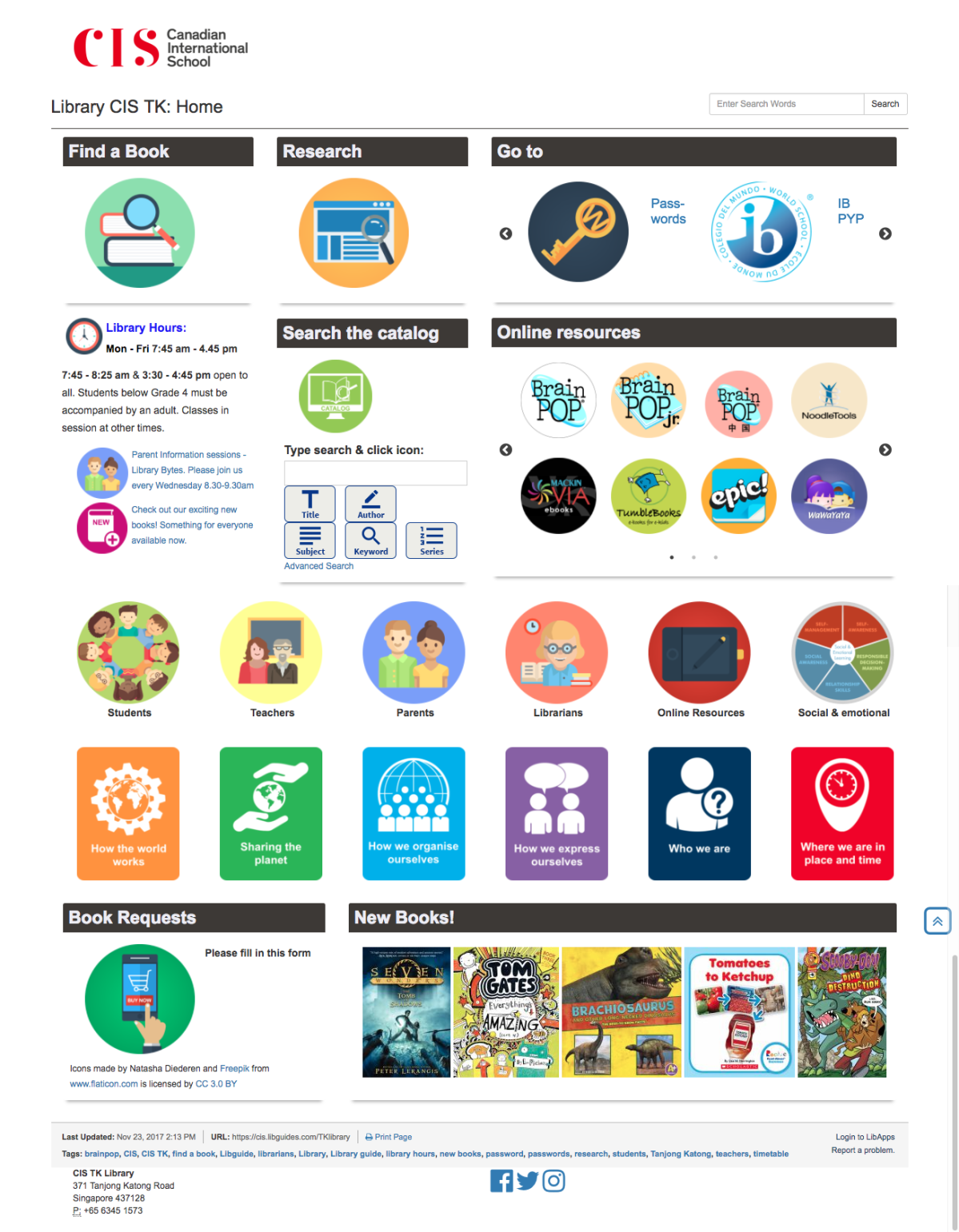
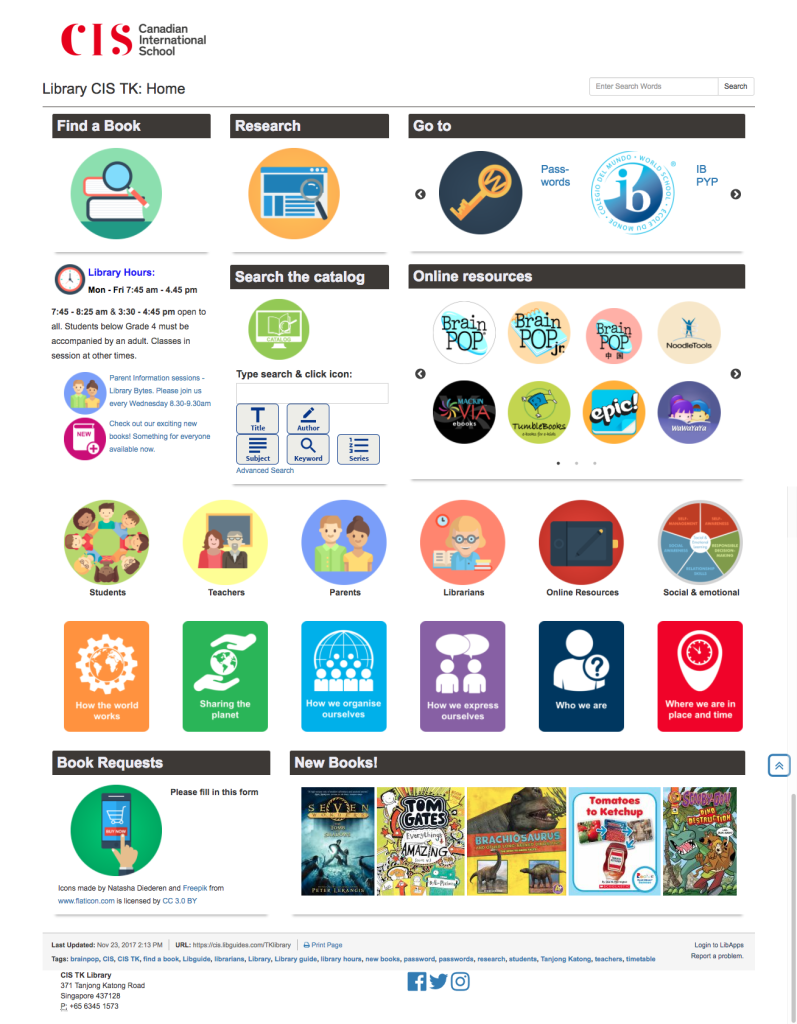
Unfortunately that workshop was a little too basic, but I did learn a few tips and tricks, including to watch out to use items that were counted statistically (books, links, databases) rather than just RTF and images, so you could have an idea of what people were finding useful / using and what not. There were also good hints on workflow and guide organisation. After the workshop I jazzed up my homepage and it looked like this:
While it was colourful, and to my mind logical and easy to access all the bits and pieces (plus each box was a link rather than rtf, so I could track where users were going), the overwhelming response from students when I and teachers asked for feedback at the end of the term was that there were “too many words”.
This is a common refrain in schools about just about anything with words – from websites to encyclopaedias, to books and beyond. In fact my teenage son introduced me to the concept of TL.DR (too long, didn’t read) along with a chrome extension to take away the grief of wordiness.
Luckily it was just in time for summer break and I had plenty of time on my hands to dig into this.
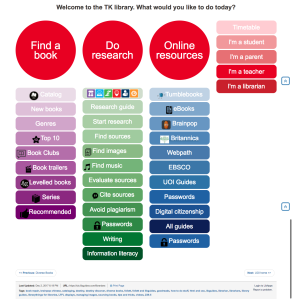
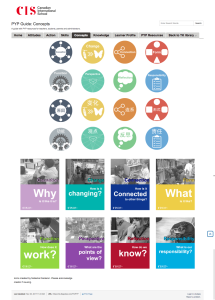
As I’m no longer a child, and fully, if not hyper- literate, I needed to understand a bit more about children and websites. There were more than enough articles on this, with this one from Canva the most useful. Conclusion after a few day’s reading was basically to go bright, use images and icons and moving and clickable things.
The next step was to brush up on some HTML and CSS. I’d previously run through some tutorials of W3Schools that were really good, and in fact used their scratch pads to do the limited coding I’d needed for the previous libguides. But I needed to think not just coding, but coding and kids. So I did a basic course for kids, kind of because I thought I’d need to think like a kid. It actually was a brilliant way of seeing the relationship between HTML and CSS in a very tangible way.
Next up was looking through lots of Libguides. Luckily Springshare, the purveyor of Libguides is excellent at sharing information and customer service, as are most of the librarians who use Libguides – making their guides (most of the 550k) open to access and copy and use. They have a collection of their “Springypicks“. I saw one I rather liked, the Mary Baldwin university library, but couldn’t figure out what they were doing. So I reached out to their librarians, and Anya Jones was online at the time and wonderful enough to do a google video-chat with me, to point me in the right direction of the knowledge I was missing to go further. How important knowing what you don’t know can be!
So it was back to the learning site, and off to SpringyCamp. SpringyCamp is this awesome online learning platform provided by Springshare free of charge whereby at certain times you sign up for whatever course at whatever level you’re at and they show you how to do stuff. Since I was in Europe there was only a 6 hour time difference rather than they usual 12 hour night and day problem so I could attend one live. The best part is if things went too fast, or you’re in the wrong time-zone you can watch the videos afterwards. A tip in this regard – I usually watch the video on my iPad while “doing” the stuff on my laptop – this means I can pause, try out, rewind, retry etc. otherwise it’s in one ear and out the other by the time I try to implement anything.
Then I discovered how primitive and naive I’d been, and moved one step closer by downloading a web-text editor (in this case Atom) that made my life infinitely easier. (Ok, I was really starting from zero, so don’t laugh). The most useful course I followed on the Springshare Video site was CMS Libguide / CSS.
Since it was vacation, I had the luxury of two teenagers at my disposal, and although they are way past primary age, they could critique what I was doing, and my daughter was put to work helping me select icons (mainly flat iron and envato) to purchase, or to make icons by adapting graphics from noun-project (like the ones she made for the PYP site). This helped me through a short-cut not have to add yet another tool into my kit – learning adobe illustrator.
The last bit involved using LibraryThings for Libraries book display widget to have scrolling book covers. Luckily this was something I’ve used before, so it was just a case of uploading our most recent Marc records and creating separate widgets for new books (front page) and the various other pages and familiarising myself with their upgraded version.
Once you have all the tools and skills at hand, there is of course a fairly long process of trial and error and planning as to how to put it all together, some of that just plain old pen and paper. And even then you keep tweaking things as it doesn’t quite gel or look like you’d like it to.
Of course changing one thing means you really need to change everything, because you’ve set new standards for the way things have to be. This is time consuming, but you also have the advantage that it gives you lots of practise, so you don’t forget what you’ve just learnt. I also revamped all the UOI guides as they’re the most frequently used, and
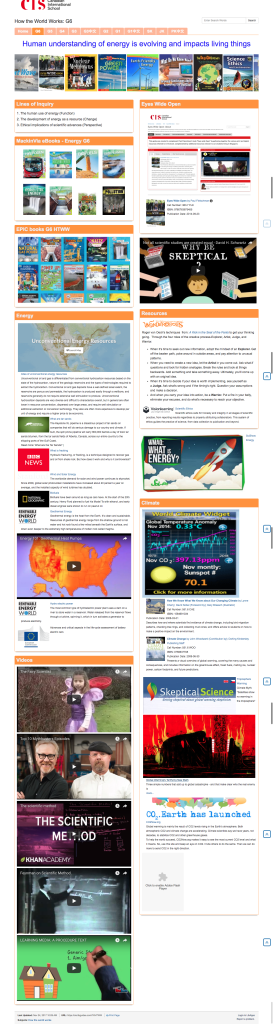
I’m moving my way through other guides. And they’re not perfect, every time I look at one I need to change a bit more. As we move towards new unit’s I’m updating the old guides so that the look and feel is the same, that the same elements can be found in the same places, and responding to student and teacher feedback. Some guides are a lot longer with more information on them – depending mainly on how intensively they’re used by the teacher, and some are more perfunctory – basically just a minimal presence because they’re not used / valued as much. That’s fine by me.
When I tell people who ask that I do libguides inbetween everything else, often in 10 minute chunks of time it is completely true. I don’t have a lot of time for this, which is why I do set-up and brain work in vacation time, so during term time is just filling work.
The next phase of the process has been to do some staff development so that my staff can take over the maintenance of sites. For example every time we have a new batch of books, they scan the ISBN’s into the “new books” LTFL widget, delete the previous list and my front page is automatically updated. While I was waiting for a new Chinese assistant, I also roped a bunch of Chinese speaking mothers (see my point on 10% in my last blog – one of them has a degree in Chinese literature) to read through all my Chinese picture books and put them into resource lists based on the PYP essential elements. These could then be linked to the PYP guide.
As a school with bilingual classes we have an increased responsibility in the library to ensure there is equity in the provision of help and resources to our Chinese classes. This is easier said than done. My new Chinese speaking assistant has been tasked with a more extensive involvement, including creating the Chinese Guides, as that is not something my limited Chinese extends to. The great thing is that they actually love this work, finding it more creative and fun than the check-in/check-out and shelving tasks that is their usual daily fare.
The next next phase for me is student curation. We’ve done a little of that, for example by asking G6 students to recommend the 3 best sources of information during their exhibition project. Last year we also started experimenting with Flipboard for the curation of articles by G5 & 6 students and teachers, and then embedding the Flipboard into the guide . We could do a lot more in that respect, but we’re being cautious with articles vetted by teachers or myself before being added.
Of course 4 months later I’m not entirely satisfied with everything. There is still a lot of work to be done on consistency and getting older guides up to standard. I need to work out a better process of guide building and handover. And after chatting to Kim Beeman at Tanglin, who is redoing her guides – albeit with a good number of dedicated qualified design and technical staff, I know I need to delve into UX. She’s recommended a couple of web accessibility evaluation tools such as mouseflow, WAVE, and crazyegg. But that will have to wait for the Christmas break, as this is just a small part of my job!
Continuing in my series of “no excuses” rants, I’m moving onto a biggie. Facebook. Except my rant isn’t so much against FB – everyone has done a better and more eloquent version of it in one form or another from one viewpoint or another. It’s more a rant against us librarians as consumers of FB (and yes this will be posted on FB – no irony?)
I’m writing this today in response to Philip Williams posting Alexandra Samuel’s “Can we build a better Facebook” on Twitter, and following the links in the article to Beth Kanter’s article on the “Perils of Fake News” . You see I do agree Fake News is an issue. And I do see the valiant efforts of fellow librarians and concerned critical skeptical intelligent people putting the “fake” stamp on some of the rubbish twirling around. As I put in a comment, my concern with FB is that it is just like the stupid women’s magazines I eschewed from an early age.
The problem is even worse than you describe for reasons even beyond fake news and privacy and selling data. Basically FB is a useless tool that even information professionals like librarians have flocked to because of critical mass. But while it caters to our short term, immediate gratification needs it is terrible as a curation tool, unlike the relics of the past, the various internet groups which are still publicly searchable but went defunct around the rise of FB.
So now you have the “magazine cycle” in FB. Someone asks a question, gets 500 likes, 54 responses (the last 42 invariably just repeat what the first 12 said) and then gets buried. And then in a few days / months / quarters the same question comes up again. We don’t build knowledge. We don’t even build information.
I have a FB habit that consists of scrolling in the morning and evening, posting some of my shareable resources such as the PYP booklists, MLA8 posters , my blog posts and share any library worthy news. I ask questions about teacher-librarian practice, about books or booklists. But at the same time I am immensely frustrated by it. For these reasons.
Filing and searching
The same questions keep popping up regularly. Of course, because life has a cycle. But there is also a combination of laziness and the complete uselessness of the search function in FB. Many questions begin with the preamble “I know I saw X somewhere but I can’t for the life of me find it” On the left is one of the groups I’m a member of – it has 1,318 members. There are some great conversations that occur there. I went to check out “files” section – the one place where a semi-permanent record of anything could be kept. In the last 10 months exactly 20 files have been posted. That’s actually good – the “The School Librarian’s Workshop” 5,879 members and only 14 files since 2014!
So let’s take one of those things that regularly pop up – “Academic Honesty”. If I search the
group, I have quite a few options (honestly I think most people don’t even bother searching before asking a question – but that’s a whole different psycho-existential matter – like do we need to ask a question in order to “exist” / “be heard” in a group?). But the one option that would make a REAL difference in turning FB into a more useful tool for curation and knowledge building doesn’t exist – there is no option to search the files. So don’t we look at the files (no way of telling if they’re looked at) because they’re not searchable from the main menu (or in fact at all, so that’s a REAL disincentive to use them / add a lot of files to them) or because we don’t think to add to the files so we don’t use the files?
Whatever happened to databases?
Back in 1997 when I was doing my MBA I did a course on Knowledge Management (KM). It was to be “the” subject of the future. Actually it was more about how to extract employee knowhow and customer intelligence and make it accessible so as to make any given employee under the executive suite dispensable and therefore resistant as heck to it. During my MIS in 2015, I enrolled for the librarian version of KM, thinking I’d make it my major so I could then go in either direction, KM/corporate or librarianship. And found that in 18 years it hadn’t really moved much at all. Nothing new under the sun. What has changed in the years that I’ve been on a computer, is that some type of database software used to be pretty standard issue with say the Microsoft suite etc. and now it’s not. I find that interesting in the same way I find it interesting that children’s fascination with space seems to have declined somewhat in proportion to the diminished ability to see the night sky due to pollution. And phobia for insects and dirt increasing in relation to the amount of time spent indoors and under protection of parents and iPads, along with a frightful decline in insects and birds. Yes, tools like Excel have become way more sophisticated and can take on many of the functions that older databases used to. But we’re not using Excel really to its full extent are we? Most people can’t even make their way around the basic google “sheets” tool.
Book lists
Again it’s a search and curate problem. We have this “hive mind”, we have vested and interested and willing people. We don’t have the tools. Take an easy little book list challenge. I won’t ask you to find a middle grade book by an Austrian author translated into English in the last 4 years. Let’s just take something really easy like a book about bullying. So where are all the usual suspect places we can look?
Google search – 803,000 results, most in the form of “# books about bullying”.
Goodreads – search function 5,521 books, list search 63 lists – some with some VERY interesting descriptions.
Amazon – gives me 22,266 books, that I can narrow down to 942 if I chose age 6-8 and hardcover. I cannot however restrict it to published in the last 2 years, only the last 90 days
Bookdepository (which is just Amazon really, but a very different selection) – 5,889 down to 122 with 6-8 and hardcover.
I could (theoretically, but how many of us do this?) search some other libraries catalogs… but how do we know their protocols / subject set up?
But the more important question is what can I do with these lists? And the unfortunate answer is you can scroll through them, print them out, vote on them or add a book (goodreads), visually compare them. But you can’t import them into a database or spreadsheet. You can’t click on them to create a new list by combining parts of different lists. Librarians spend a LOT of time with booklists. Too much time if you really think about it. It really should be easier.
LibraryThings is much better in many respects. It’s partially open, and partially you need a subscription (like for the very useful TagMash tool). You can upload your holdings, so that means you can easily see which books you already have. But how often in the last year or so has someone referred you to LibraryThings when you’ve asked for a book list recommendation? How often have you used it (if at all)? But now, I get a tagmash list and again WHAT CAN I DO WITH IT? Nothing. I can’t add that tag to the 119 books I have (of which only 60 were tagged with bullying), I can’t add any books I like the sound of to a “to buy” list centrally – I’d have to click on each individually. I can’t easily share the list.
Why does all this matter?
Well one of the things that is important to me is the whole diversity question. But as mentioned in my last blog, diversity looks very different in different contexts. Putting on my librarian hat I want to help great initiatives like GLLI. I want to make sure that my collection reflects my students. I want to have lists readily available and extractable (hence my database rant), so that when people say my school is 80% American born Chinese, or 50% Vietnamese, or 70% Thai or 80% of mixed parentage, or give me a Bulgarian book translated into English suitable for 6-8 year olds published in the last 4 years, the lists can be reconfigured and re-sorted and spit out the goodies. And can be added to and updated. I’m tired of stagnant static lists.
Likewise, if I have a folder of the academic honesty policies of about 20 schools that I used when our librarians were involved in setting up our school’s new policy – it should be easily and readily available to everyone who comes after me trying to do the same thing. But I’d prefer that the easily and readily available platform is NOT FB. Is NOT in a closed group.
Resist
So yes, resist FB, but not just because of Fake News etc. Resist it because it’s a useless platform that we’ve invested way to much time and energy into. Because we should be spending the time thinking about what we really need and creating it. Because we should be pressuring platforms that more closely meet our needs to improve their products.
One of my constant concerns as a librarian here in Singapore in an international school is that I don’t feel that my collection reflects the many rich and varied cultures and identities that my students have. So I must admit (selfishly) one of the first things that crossed my mind when I was invited was YAY, I don’t have to wait until ECISlibrary2018 to go on an Indian book buying spree for my library!
When I arrived on Thursday evening, I met up with Maya Thiagarajan, author of “Beyond the Tiger Mom“, friend, ex-colleague and fabulous once-a-month book-club member. Getting together is always so exciting as we have a million-and-one things to chat about, and her move to Chennai has created a huge gap for me, but is a wonderful thing for India as she can share her knowledge, experience and expertise with schools there. We brainstormed together for a presentation we were doing for parents and the public on “grow to read and read to grow” and then she gave me her perspectives as a classroom teacher on my workshop for teachers and administrators on Classroom libraries. Then we decided to do the workshop together instead of separately as it would add a multi-perspective to it!
On Friday, the first thing that struck me as I entered the school, besides the warm welcome, was the wonderful posters and signage and set up.
The Friday was set aside for celebrating storytelling, books and literature with children. I must say I was really happy to see the emphasis on storytelling, since it is the basis of everything. In fact, when I was asked to run a workshop for 5 year olds, that’s the first thing I thought of – using a wordless book as a prompt to encourage students to tell a story.
My session used the wordless books “Chalk” and “The Typewriter” by Bill Thomson to introduce the basic elements of a story – build up to a problem and a solution. First I told them they’d been tricked and I wasn’t going to read a story to them, but they were going to read to me (groans all around) and then they proceeded to do so, with “Chalk” lured by the images! We then spoke a little about the problem and solution and I said I had another book where something similar was going on and they could read it to me as well. I then projected “The Typewriter” (as I didn’t have a hardcopy) and we went through the same procedure, adding more prediction in this time. Then they went off to tables we’d set up with plain black goodie bags and cut out gold moons and stars to make their own “magic chalk” bag. They came back to the carpet and were told they were going to make their own story without words with magic chalk. We brainstormed some ideas of what kind of problems could happen and what their solutions would be. Such wonderful ideas, ranging from torrential rainstorms and flooding, to a meteorite crashing into earth, sharks attacking a mermaid, ghosts coming into the a house and scaring people etc.! We also chatted about how you would (in the case of the ghost story) show that time had passed and the ghost left and they came up with having a moon in some of the pictures with the ghost and a sun when the ghost fled. What was great was that some then said they wanted to do it in “teams”. Off they then went, armed with A1 black paper, folded into 6 panels and unfolded to de-mark scenes and lots of coloured chalk. As they were drawing I wandered the class with their teachers talking to them about the stories as they unfolded. 90 minutes without a break was barely enough to have everything finished and they proudly left with their magic bags and story creations.
The rest of the day flew by, popping in and out of classes and storytelling sessions, followed by the teacher workshop on classroom libraries. I’d somehow misheard that it was for 15/16 teachers… actually it was for 50-60 teachers – their whole staff! Maya and I had already (luckily, as that’s our philosophy) decided to take the tack that the existence or not of a classroom library was merely one part of creating a culture and eco-system of reading in a school. The session was lively and interactive. That’s one of the things I grew to really appreciate about what is going on a Neev academy – the vision of creating an alternative to traditional teaching and learning in their school, using the frameworks of the IB system and the encouragement of pleasure reading. As a non-international school they shine out as a beacon for local students.
Saturday’s sessions were opened to the wider community and public with a rousing speech by visionary Neev Academy founder Kavita Gupta Sabharwal.
Maya had the honour of being on a panel with Dr. Shyam Bhat and Sudha Murty and all three spoke of the importance of reading and storytelling, emotionally, from a neuro-science and educational point of view. My panel on “trends vs. traditions” co-hosted with Jane DeSouza with Ankit Chadha; Timeri Murari; Sohini Mitra and Reena Puri looked at the threats and potential of globalisation and the digital era on traditional storytelling, publishing and writing.
Then in-between another book buying spree at Lightroom Bookstore (who had a pop-up store at the festival). What a fabulous bookseller – I really really love independent bookstores with knowledgeable founders and staff who delight in the books as much as I do. Ones where you just have to start describing the book whose name you’ve forgotten and it’s suddenly in your hands! I had chance to meet up with the lovely librarians at both Neev Academy and Stonehill International School and we did what librarians do best – geek out on what our favourite resources were, what our websites included, how we resource our respective curricula and darn, there just wasn’t enough time so we have to continue our conversations online and through librarian facebook groups.
I then caught the tail end of a lively discussion “Should we fear the Dark?” that explored dark themes in children’s literature – luckily I shared a taxi with Paro Anand afterwards so we could continue the conversation together afterwards. I love fearless authors!
A dual author dual illustrator graphic novel
Maya and I shared the closing session of the day, focusing on how to hook children on reading and keep them reading with some great audience participation, and before we knew it, it was all over!
A great weekend, incredibly well organised and curated, buzzing with ideas and thought stimulation, discovering new books and authors. My biggest regret was the inability to clone myself so that I could join all the sessions simultaneously. Well done to Neev Academy and Kavita.
(PS Here is a selection of the book loot – invited our Singapore librarian network librarians around to have a look last week!
It must be an age thing – but as I’m getting further into my 50’s I’m becoming less tolerant of fancy sounding reasons and explanations that are actually just excuses for staving off change. This is the first of a series of posts on things that really annoy me as an international librarian, with a smattering of understanding of technology and a desire to serve ALL students, teachers, parents and administrators in my community as best I can. I have an overdeveloped sense of fairness and justice and I sometimes feel that librarians as a group are just too nice and suck up way too many things.
I’ll also admit to being emboldened by a FABULOUS new biography on women called “Brazen” (coming out in English next year – thank you Netgalley for the preview copy) You can preorder your copy now – suitable for High School 13+. And in fact this book just highlights what I’m going to write about today. This book originated in French. I’m currently totally inspired by the Guardian’s World library list and wanted to replicate it, adapted for primary school, particularly with a view to Uniting Nations day coming up in November.
Now I work really hard at trying to transform my library into one that is representative of my students. I love the fact that my one Bangladeshi student asks me every week if I have any new books about or set in Bangladesh. And that at the beginning of term she came to proudly tell me that she was no longer the one and only but had been joined by another family. And when I showed her our new book about Bangladesh she took time out of her library browsing time to show me all the things the book depicted that were special to her.
I also work hard on my libguides to make sure that my books are showcased graphically and visually to make perusing them interesting for primary level students. So this is when I get really annoyed that Syndetics, the one interface for front covers that just about every system, from OPAC to libguides to LibraryThingsforLibraries uses does NOT seem to recognise that there is a publishing industry outside of the BANA (Britain, Australia, North America) countries – in fact they even struggle with Australia most the time. And don’t let me even consider China – well they cheat a bit – a lot actually – thinking that one ISBN number should suffice for a whole series of books – even if there are 57 books in the series.
Spot the problem? And Syndetics actually prides itself in the fact that the covers of the coverless books are now colourful with title and author. NOT GOOD ENOUGH! For my catalog, my library assistants spend hours manually inserting the covers, and for the much touted, over promised under-delivered Destiny discover it’s just a blue boring nothing. So 5 of my 8 most recently purchased books are just blue blobs. So if you’re a librarian trying to diversify AND to make your new purchases appealing the cards are stacked against you.
Before I started writing this post I thought I’d do a bit of research into Syndetics, and the whole cover image thing. And then I thought no damnit. I won’t. I don’t really care what the reason or excuse is. They’re selling an expensive service. They’re complicit in not improving the marketing of diversity of literature and I’m just going to put it out there and they can do the explaining, and hopefully a bit of soul searching on how they can make this better. What BIG things, what IMPORTANT and sea-change things they, as a big corporation as opposed to me as a little librarian in a little library serving 650 students from 40 nations can achieve.
In an attempt to blog more regularly, I’ve signed up for a challenge – so these posts will be in amongst all the other stuff I may be blogging.
#FutureReadyLibs 10-Week #BlogChallenge Challenge #1: How did you get involved in the Future Ready Schools/Future Ready Librarians initiative? Are you involved in the district strategic planning process? What is your vision for a future ready school? What makes you a Future Ready Librarian?
How I got involved
Well I guess it was just a result of being added or adding myself to a Facebook group that looked interesting. Sometimes things just happen that way. Also since I’ve just finished my MIS and M Ed degrees I’m still vaguely interested in this type of thing, in order to keep my learning up to date.
I think our school, as an IB PYP school is pretty future-ready in many aspects, in fact sometimes I think the cost of being “future ready” is that you occasionally need to go “back to basics” and check up on the 3 R’s and make sure you stay sober and self-critical.
Am I future ready as a librarian? Looking at the little graphic on the left, I can tick most of those boxes, or slices, inasmuch as things are in my power at least. And where not, I’m constantly nudging for change.
I’m not entirely sure if I’m on the right topic for this week – I’d note “digital resources” so I’ll write a little about that.
Curates digital resources and tools:
When I started my job at my current school I’d come from working part time in a secondary library where a large part of my time was spent creating library guides for the Middle & High School (including the IB). I was lucky to have Katie Day as my mentor, and we had many many discussions on how to curate resources so that students had easy access to them from their laptops (they’re a one-on-one macbook school in secondary). The idea was to have digital resources in the form of videos, curated Flipboard articles and database access, but at the same time make our physical resources digitally visual and “clickable” for later borrowing as necessary.
So, a few weeks into my new job I discovered we had an unused library guide subscription, and I immediately put it to work. Of course curating for primary is a somewhat different proposition. Immense more thought and care needs to be put into ensuring things are age appropriate – in content, in level and in access. And I was a newbie … so it was a case of building things and hoping they would come. It’s taken a while. After the first year, a couple of teachers were on board, and now more and more are coming to expect and use the resources. My main objective is to move away from letting kids “just google it” to an idea of just like we don’t throw a bookshelf full of books into their UOI (unit of inquiry) boxes, but make sure they’re appropriate for the grade level, for the central idea, for the lines of inquiry, and may even evolve as they go through a unit, so too we can have digital resources that are similarly curated.
A few things have been a huge boon in this respect. In the first instance I cannot express my admiration for Epic books enough. They are an absolute game changer. In terms of depth and breadth of their books they far surpass the incumbents such as Tumblebooks. I do have some librarian type quibbles with a few of their set-up methodologies, but that’s small fish compared to what they’re achieving.
Secondly, Springshare – the owners of Libguides are just phenomenal in their ability to constantly evolve and develop their platform. I love the fact that the libguide community are so amazing in their ability to creatively curate, to combine physical and digital and particularly the fact that they demonstrate CREATION and SHARING, which is absolutely what a future ready community should be about. Also, my desire to make good looking guides has pushed me to learning some (very basic) HTML which never ceases to impress the fine young gentlemen and ladies in my library who then realise I’m not just an old library lady!
Thirdly LibraryThings for Libraries through their book display widgets they bridge the gap between a lovely visual interface (libguides) and an old stodgy very unfriendly catalog (Follett Destiny).
As far as tools are concerned. I try to keep introducing appropriate tools to my students and to fellow teachers – but only if they are meaningful. It’s a balance. Our students are “over tech-ed” and we’re getting a lot of pushback from both parents AND students about the amount of time they spend in front of a screen. So where it saves time, hassle, helps make things neat and well spelt, sure. Otherwise it’s back to the physical.
Empowering Students as creators
I’m very fortunate to be in a school environment where there is an EdTech coach and a STEAM coach. So wild ideas for physical or digital creation can be co-shared with them. We’ve had students create book trailers, book recommendations, book spine poetry, book covers, their own books, display work pieces in the library etc. I don’t think any of that is particularly special though – most librarians do that kind of thing in conjunction with their students and teachers – it sure makes displays easier!
Builds instructional partnerships
That part is definitely a work in progress. It’s tricky. I could blame a whole host of things – fitting in 35 classes a week on a fixed schedule, a yet to be approved information literacy scope and sequence that’s embedded in the curriculum, running, managing and keeping up to date (and renovating) a facility, curating digital resources in library guides … but instructional partnerships is a ball I’ve dropped. Or actually never really properly had in the air. It works piecemeal, depending more on relationships and invitations than being structural. I’m working on it with my fellow librarians from our other campus, the head of curriculum etc. It takes time is all I can say. And I don’t think I’m the only one saying it judging from the comments of my fellow teacher-librarians. I beat myself up about it a LOT in my first year. To the point of tears. This year I’ve been distracted a bit by the renovation and staff medical issues. But we’re inching there. Watch this space.





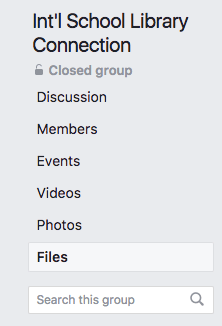 function in FB. Many questions begin with the preamble “I know I saw X somewhere but I can’t for the life of me find it” On the left is one of the groups I’m a member of – it has 1,318 members. There are some great conversations that occur there. I went to check out “files” section – the one place where a semi-permanent record of anything could be kept. In the last 10 months exactly 20 files have been posted. That’s actually good – the “The School Librarian’s Workshop” 5,879 members and only 14 files since 2014!
 group, I have quite a few options (honestly I think most people don’t even bother searching before asking a question – but that’s a whole different psycho-existential matter – like do we need to ask a question in order to “exist” / “be heard” in a group?). But the one option that would make a REAL difference in turning FB into a more useful tool for curation and knowledge building doesn’t exist – there is no option to search the files. So don’t we look at the files (no way of telling if they’re looked at) because they’re not searchable from the main menu (or in fact at all, so that’s a REAL disincentive to use them / add a lot of files to them) or because we don’t think to add to the files so we don’t use the files?


 Now I work really hard at trying to transform my library into one that is representative of my students. I love the fact that my one Bangladeshi student asks me every week if I have any new books about or set in Bangladesh. And that at the beginning of term she came to proudly tell me that she was no longer the one and only but had been joined by another family. And when I showed her our new book about Bangladesh she took time out of her library browsing time to show me all the things the book depicted that were special to her.


 I think our school, as an IB PYP school is pretty future-ready in many aspects, in fact sometimes I think the cost of being “future ready” is that you occasionally need to go “back to basics” and check up on the 3 R’s and make sure you stay sober and self-critical.
 So, a few weeks into my new job I discovered we had an unused library guide subscription, and

 Informative Flights - Musings of a Teacher Librarian
