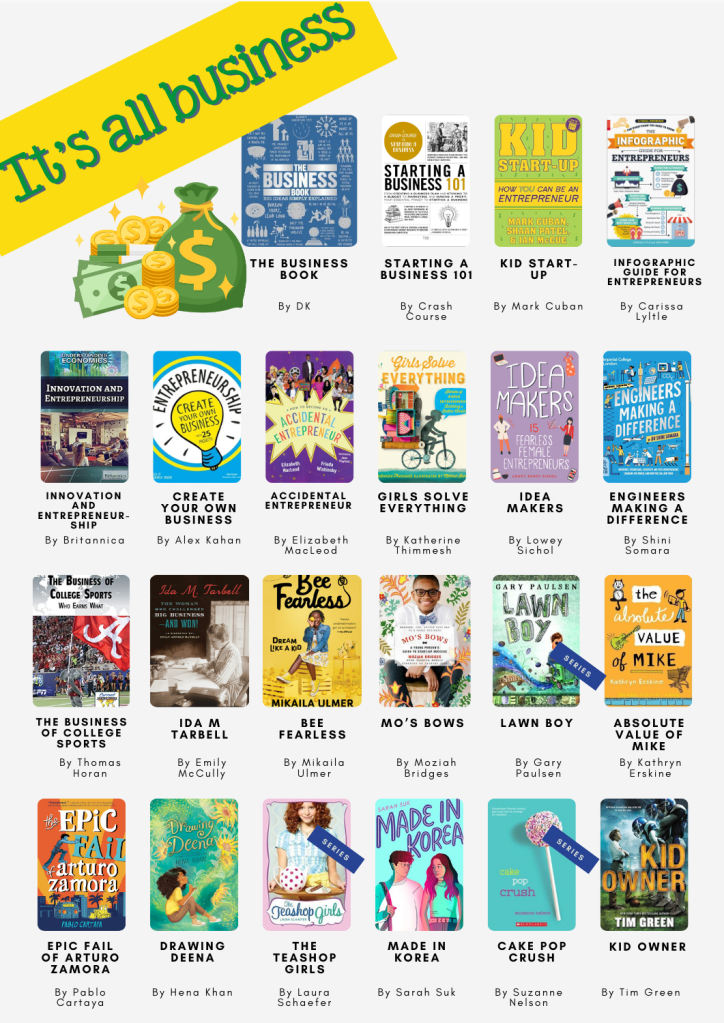
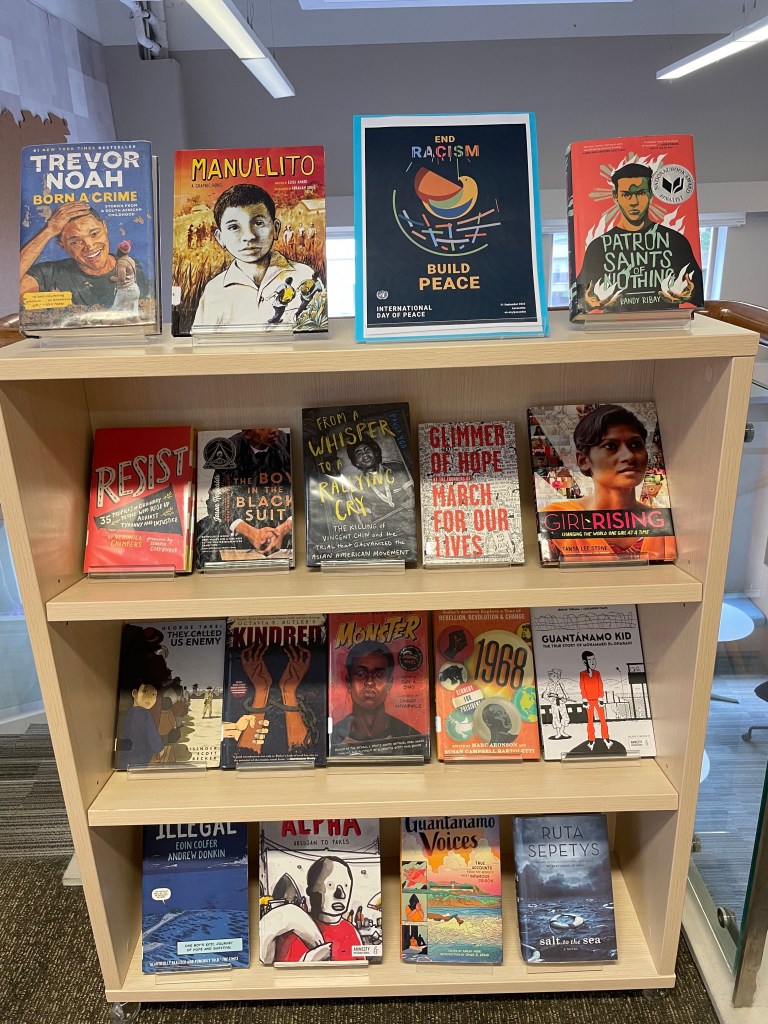
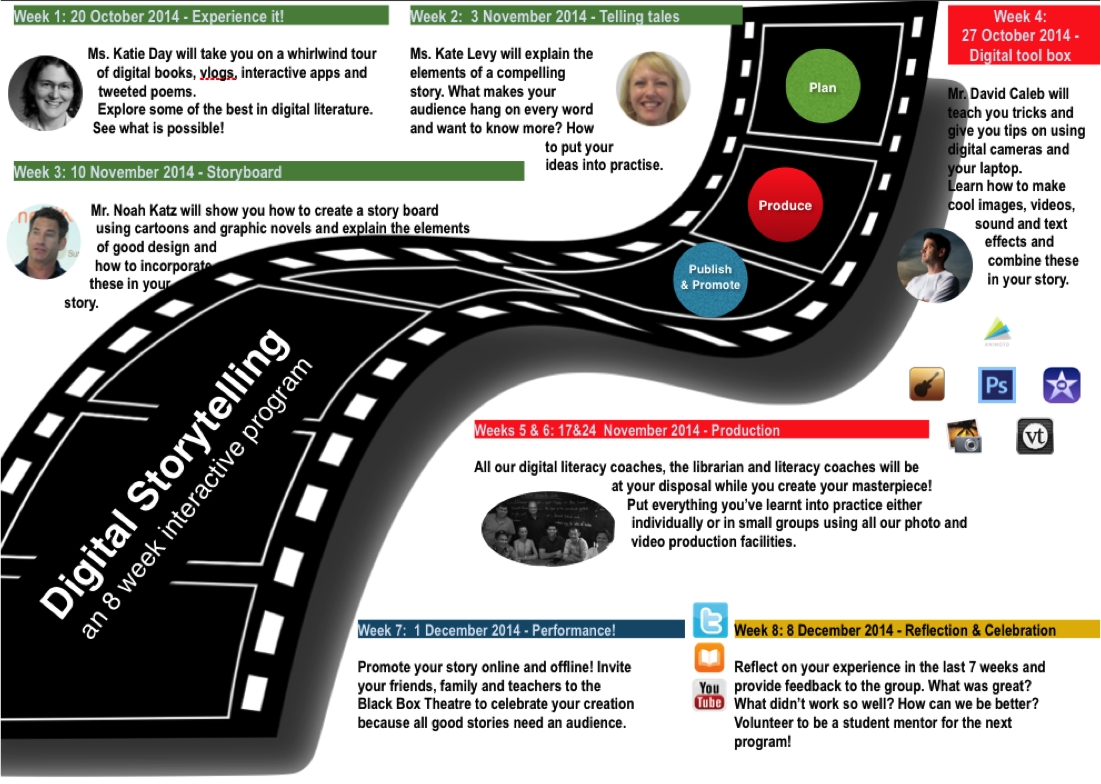
#DecDisplay month over at GLLI

Despite appearances to the contrary I’ve actually been extremely busy blogging this month, doing a daily blog over at GLLI-US.org. Here is a summary of the month’s blogging with links to the individual blogs:
——————————-

I hope you’ve enjoyed my advent calendar type selection of “displays” for the month of December with a variety of ways to slice and dice collections and perhaps you’ve even found a few new or different books to add to your collections.

A couple of people have asked me about the how and why and wherefore of these posters, so in this wrap-up I’ll give links to the templates and also some ideas of how they are used in the various contexts. Generally all posters are put into A4 presentation books and are available in the ELA classrooms and in the library. Some selections are used for displays at the entrance of the library or on the display wall. Others are more of a “pop up” display when different classes come into the library to browse or borrow books with their classes.

Country Celebrations

This image has an empty alt attribute; its file name is country-cover-small.png

Country celebration posters are sent out in our student and staff bulletins to coincide with the National Day of the various countries. I asked our Powerschool guru to run a list of all countries where we had at least 3 students having the country as their first, second or third passport, got a list of national days and worked from there. Sending out those email “birthday cards” is one of the most rewarding things I do as a librarian as I get so many thank you emails in response and students and adults coming in to borrow some of the books on the list. Depending on how busy our display space in the library is, I may or may not display the books at the library entrance.

Here is the Canva template with the posters made so far.

Read Around

This image has an empty alt attribute; its file name is music.png

The read around posters are shared with our teachers of various subjects and generally they print them out in A3 size and put them either on their walls, doors or display boards outside their classrooms. Sometimes, when students come into the library with their ELA or Social Studies teachers I’ll have the books laid out on tables for them to have a look at and borrow.

Here is the Canva Template with the posters highlighted and more.

Reading Recommendations

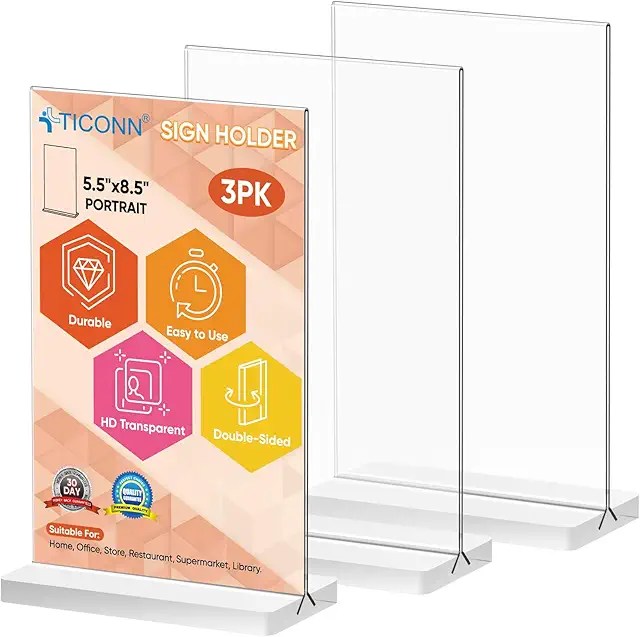
These and many other “Read alike” posters are printed in A4 and put into plastic “look book” presentation books that are available in the library and also in all our English Language Arts classrooms. Since our middle school students come to the library with their classes around once every 4 to 6 weeks, it makes it easy for students to browse for books in the classroom thematically and then go to the library with purpose in between the more formal library visits. When they come with their classes, I’ll generally confer with the teachers as to what they’d like displayed / what’s “hot” or wanted and then I’ll haul a bunch of tables to a part of the library where they can browse. Then these posters will be put into A3 acrylic sign holders on each table.

This image has an empty alt attribute; its file name is 614InJVsCaL._AC_UL640_FMwebp_QL65_.jpg
This image has an empty alt attribute; its file name is 51tepSnSCQL._AC_SX679_.jpg

All Posts

Finally here is a list of all the posts from this month.

This image has an empty alt attribute; its file name is nadine_bailey.png

By Nadine Bailey – middle school teacher librarian, currently living and working in Dubai, formerly in Beijing China, Singapore and a bunch of other cities around the world. Passionate about our students seeing themselves and their worlds in literature and developing curiosity and a passion for reading and learning.

The views, opinions, and thoughts expressed in this blog post are solely my own and do not reflect the positions, policies, or opinions of any current or former employer. Any references or examples provided are intended for informational purposes only and should not be construed as endorsements or official statements from any organization I have been associated with.

The current image has no alternative text. The file name is: shelftalker2.png

Nonfiction in the middle

Mediating between curiosity and research, curriculum and pleasure By Nadine Bailey and Katie Day

In the summer of 2024 we asked International School Middle School librarians to tell us the story of nonfiction in their libraries. We wanted to know their ambitions, frustrations, organisation and display as well as their collection development and usage plans. All books recommended in this article can be found tagged in our LibraryThing Shelf (https://www.librarything.com/catalog/middleNF). 

Curriculum and Research

Educators and librarians who have been around for a while know and recognise the pendulum of ideas and practice that upend things first in one direction and then another. Nonfiction is one of those things where some of the momentum is now moving back to the practice of reading subject matter in physical form. Many librarians responded that in a post-covid learning environment both they and the teachers they work with were moving back to giving information in print form – mainly books where they were available, but also printing out articles from online sites such as Britannica and Newsela in order to encourage deep reading, avoid distractions and teach nonfiction reading skills that could be later transferred to online reading. 

Schools following the IBO (International Baccalaureate Organisation) programmes (PYP/MYP) had particular interest in “transdisciplinary” and cross curricula books that would offer broader perspectives on curriculum or unit themes. Many librarians were investing in books that would support inquiry into aspects of the United Nations SDGs (Sustainable Development Goals). There was also a keen interest to ensure that sufficient “local” (country where the school is located) and “diverse” (countries of students’ origins) content was available in the library.

Many librarians have quite heavily weeded their nonfiction sections and are now looking to re-stock them based on this renewed interest in physical books. But it appears that publishers are not necessarily aware of what is happening on the ground and are not always updating and bringing out new editions of popular texts. 

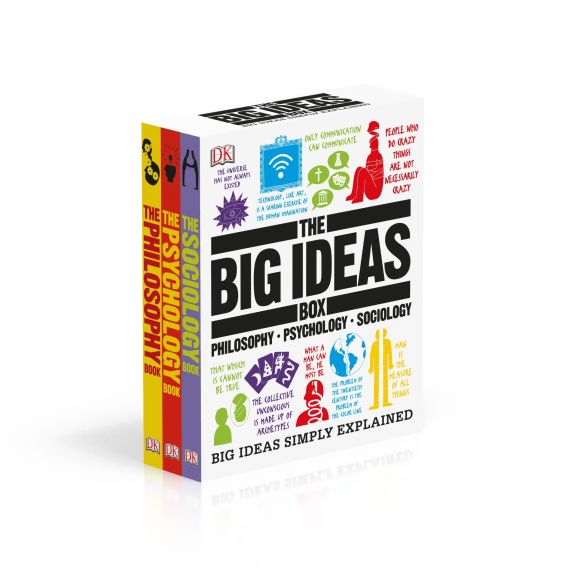
On the other hand, most respondents remarked on how much progress had been made in the last few years on the design, layout and illustrations in recent nonfiction texts. There was also a shoutout for the increase in different formats including “Oversize books” (see the books of “Big Picture Press – Welcome to the Museum”); Graphic and Manga imprints (series such HowToons; Cells at Work; and authors such as Don Brown and Jim Ottaviani); infographics (Infographic guides; ) Subject Summaries (The Big Fat Notebook series), Picture books (see this 2024 SLJ list) and Subject Overviews or introductions (DK Eyewitness, and DK Big Ideas).

Where curriculum and research is concerned, students can now often choose their favourite medium of access through a variety of formats.

Foster the flame of curiosity

Somewhere on the way to middle school, students amend their passions to fit in with their peers and ensure a sense of belonging. So out go the dinosaurs and big trucks to be replaced with their favourite sports personalities, music stars, books about their sports (soccer and basketball seem to be hits). Puberty hits this group hard and fast and strategic placement of sensitive materials can put paid to rumours and myths. It is also a time of self-absorption and worry about their physical and mental health – books on health and well being, relaxation, anxiety, meditation as well as psychology, are popular and an area of growth in most libraries. 

Given the demographics of our schools, students of this age are already taking a keen interest in finance, aspects of wealth and investment as well as entrepreneurship. They’re also interested in personally exploring hobbies and activities they may see online such as cooking, sewing and knitting or other crafts. 

History – particularly the world wars and more recent conflicts continue to fascinate and appal in equal measure – often mediated by historical fiction texts students may encounter in their literature studies or English classrooms and what they see on the news or social media. 

Shelving, organisation and display

In order to make nonfiction appealing and accessible, quite a few of our respondents mentioned they either had or were in the process of rethinking the way that nonfiction was shelved, organised and displayed in their libraries. There is a continuum from pure DDC (Dewey Decimal Classification) to a range of Book Shop or genrified models. Librarians were more interested in getting books seen and read than in a hypothetical need for their audience to be able to navigate a university library later. One of our respondents coined the lovely phrase of “emotional accessibility” in this respect. 

Of course most libraries have already taken the first step of putting “literature” or novels out of a straight Dewey 800 section into a fiction collection – genrified or or not. Other common “extractions” from the main Dewey structure include:

  • Taking Biographies, collective biographies and memoirs out of 910/920 and putting them in a separate section. Some libraries put collective biographies at the start of the section they pertain to (i.e. famous musicians go to 780).
  • Travel Books
  • Poetry
  • Drama and playscripts
  • Graphic Novels and Manga 
  • Narrative nonfiction
  • Myths, Legends and Fairytales
  • Parenting 
  • Well Being
  • Professional Development 
  • Sports 
  • Country specific collections
  • A specific nonfiction series that’s popular
Photo: American School of Dubai MSHS Sport Section

In the absence of permanently pulling out a section – many librarians make use of rotating “dynamic shelving” or temporary topical displays. The guideline here appears to be to follow the needs and interests of the community – teenagers want to be able to independently navigate the library without adult intervention that may be embarrassing. 

Related to that – signage and signposting was an area that nearly all librarians were investing in. Many mentioned significant weeding that had resulted in more space for forward facing displays and carving out sections of interest. 

Recommendations

To support the discovery of nonfiction titles for middle school, we’ve curated a shelf of 389 (and growing) books on Librarything that we consider to be worth investing in. It’s an ongoing labour of love, so not every book has been tagged at this point yet.

Examples of Some of the tagging we’ve employed are (not an exhaustive list):

  • Narrative nonfiction
  • Manga
  • Graphic
  • Topic_
    • WW2
    • Women
    • Science
    • Mathematics
    • Religion
    • History
    • Climate
    • SDGxx
    • Activism
    • Wellbeing
    • War
    • Technology
    • Sustainability
    • Sports
    • Space
    • Social Media
  • Geo_
    • Southeast Asia
    • China
    • USA
    • Europe
    • UK
    • Australia
  • Edition
    • Young Reader

Since such lists can quickly go out of date, we’d also like to generalise with some series, authors, titles and publishers that we recommend.

Great AUTHORS 

  • Marc Aronson
  • Don Brown
  • Marc Favreau
  • Candace Fleming
  • ​​Russell Freedman
  • Yuval Noah Harari
  • Deborah Hopkinson
  • Tanya Lloyd Kyi (Canadian)
  • Randall Munroe
  • Jim Ottaviani
  • Elizabeth Partridge
  • Gillian Richardson
  • Steve Sheinkin
  • Cory Silverberg (Puberty)
  • Dashka Slater
  • Tanya Lee Stone
  • Pamela S. Turner

Great PUBLISHERS

  • Annick Press (Canada)
  • DK (Eyewitness; Big Ideas; Children’s Timelines; How Things Work; How Stuff Works)
  • First Second (MacMillan)
  • National Geographic for Kids
  • Usborne (UK)
  • Crabtree Publishing Company
  • Flying Eye Books

Great SERIES

  • DK Eyewitness
  • DK Big Ideas
  • DK Children’s Timelines
  • DK How Things Work / How Stuff Works
  • From Playground to Pitch
  • HowToons
  • Hazardous Tales (Nathan Hale)
  • Little Histories 
  • World Citizen Comics
  • UN sustainable development goals

Great TITLES

There’s been a recent shift toward publishing a Young Adult version of popular nonfiction titles either simultaneously or shortly after the Adult version. These can be found by searching for “Young Readers” or “Young Reader’s edition” / “Young Reader’s Adaptation”.

Blogs and nonfiction websites

Nonfiction Book Awards

Pairing Nonfiction and Fiction

Last but not least, pairing a nonfiction book with a novel can enhance both texts.

I initially started putting a fiction book on this libguide followed by suggestions of nonfiction, https://asdubai.libguides.com/ms/reading/nonfiction. I’ve now moved away from that somewhat and have started curating “Read Around the Curriculum” posters where either a curriculum topic is highlighted with fiction and nonfiction, or an “If you like / want to know more” poster is made of one of our book club fiction books with suggestions for finding out more about the context with other fiction/nonfiction books on the topic.

Katie Day and I would love to hear your suggestions for more nonfiction books, and perhaps we can expand the list to High School. Many of the books suggested in our list are suitable for High School and upper elementary as well.

Comments and suggestions much appreciated.

NOTE: Since the publication of this post we have been approached by commercial entities about using the list. While we cannot prevent the list from being used commercially this is our wish:

This list was created in order to freely help librarians all around the world. It was a labour of love which took a lot of our personal vacation time to create. If you are part of a commercial organization and you will be using the list commercially we would request that you attribute us and make a suitable donation in our names to “Biblioteca di Lampedusa” which serves refugees from around the world in their Silent Book initiative, https://www.facebook.com/BiblioLampedusa/ or the “IBBY Children in Crisis Fund”: https://www.ibby.org/awards-activities/ibby-children-in-crisis-fund.
Thanks. Nadine & Katie

Applying spatial changes and design thinking to middle school reading– a three phase collaborative approach

Introduction

There is a long history of research into the value of and elements contributing to the success of classroom libraries. They have an important role in ensuring accessibility of written works to promote fluency and skill in literacy and thereby contributing to academic achievement. But the literature appears to concentrate on elementary schools (Hopenwasser & Noel, 2014; James, 1923; Jones, 2006; Krarup, 1955; Powell, 1966; Sanacore & Palumbo, 2010; Todd, Gordon, & Lu, 2011; Worthy, 1996). Although partnership and collaboration with the school and/or public library and librarian is recommended, the literature often deals with the two spaces in isolation. Further, the problem of aliteracy in middle school – whereby students can read but don’t want to – is well documented (Kelley & Decker, 2009; Krashen, 2004; Lesesne, 1991; Sheldon & Davis, 2015; Worthy, 1996). This case report will show how the two environments library and classroom, can successfully be seen as extensions of each other through the principles of design and design thinking and explicit cooperation between the language humanities (Eng/Hum) teachers, literacy coach and school librarian in order to promote voluntary reading.

Case development

United World College South East Asia East (UWCSEA-East) is a K-12 international school located in Singapore. It commenced operations in 2008 and took occupancy of a purpose built campus in 2011. In this campus, the secondary school library initially served around 500 middle school students – see table 1. It now caters to three distinct communities, middle school, high school and the International Baccalaureate (IB) – see Table 2.
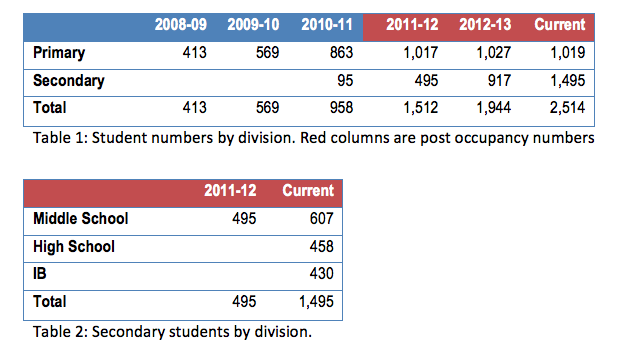
Screen Shot 2015-10-11 at 11.27.14 am
Despite consultation with the librarian in the planning phase, certain spaces of the library were designated different functions than agreed upon and furnished accordingly by the architect and building manager. One such area was upstairs overlooking the main school plaza with purpose built magazine racks. The idea was it would be a well-frequented showcase area for magazine reading. In reality a number of factors prevented this from being realised:
  • The furniture design didn’t accommodate its purpose as it was not deep or high enough and the storage area didn’t fit back copies
  • The zoning of the library post occupancy meant that materials affording quick casual reading such as graphic novels and periodicals were better located in the “noisier” and fast turnover area which allowed food and beverages, i.e. downstairs.
  • The trend in libraries is to move away from physical magazines and periodicals towards online providers including online databases and aggregators such as PressReader that provide the same product at a lower cost and without delays and issues with cataloguing and maintenance.
The question of what to do with the space was resolved by noticing that as the secondary school reached post occupancy capacity the lowest students in the pecking order i.e. middle school students were increasingly marginalised with students of higher sections taking over the prime library real estate (students are visually distinct due to different coloured polo shirts for their uniforms). In addition, middle school students no longer had library visits planned into their schedule. Furthermore, the large influx of new students and teachers meant that reading books in the classrooms were unevenly distributed both in terms of volume and quality without any structured form of classroom library, which the students had become accustomed to in the primary section. Finally, Eng/Hum teachers were noticing a decline in voluntary reading as students moved up through middle school.
These issues were addressed initially through collaboration between the librarian and Eng/Hum teachers and more recently by the new literacy coach over a period of three years as follows:
  • The conversion of the magazine area into a middle school reading zone
  • The establishing of a core library for each of the three middle school grades (Day, 2013b)
  • The creation of middle school classroom libraries in a formal and structured manner with materials integrated into the library catalogue (Day, 2015d)
  • The integration of informational / nonfiction texts into both areas
This is an on-going process and worth a critical analysis to examine the choice process, latent or existing attitudes and assumptions, exterior pressures and design constraints and collaboration and communication.

Critical analysis

Choice of process

The spatial change in the library was conceived and led by the teacher-librarian (TL) with the Eng/Hum teachers joining in the collaboration as the process evolved. Since the TL has experience in design thinking (Day, 2013a, 2015a, 2015c) the process followed the design thinking cycle of inspiration, ideation, iteration and getting to scale (Brown, 2008; IDEO, 2014).
This was achieved by:
  • Agreeing on a “core library” of 30 titles per grade for grades 6-8 which were prominently displayed
  • Adjusting shelving to accommodate front facing books
  • Relocating books of interest to this age group from the fiction collection
  • Using large posters to highlight the favourite books of middle school teachers in the library and class corridors and classroom walls
  • Ensuring multiple copies of books, by using class and literary circle sets
  • Adequate lighting, comfortable furniture and the creation of a private space
The above steps and final spatial design incorporated the elements that are recommended as enhancing school library spaces (Cha & Kim, 2015; Elliott-Burns, 2003; La Marca, 2008; A. McDonald, 2006; Serafini, 2011).
The design elements that contribute to successful classroom libraries are not dissimilar and include:
  • Sufficient space which is a focal area but partitioned and private
  • Comfortable furniture
  • Variety of material in range of complexity including different literary genres and informational texts
  • Category organisation and shelf labelling
  • Combination shelving allowing for quantity of books and display (front facing)
  • Advertising by means of posters and notices on whiteboards
  • Graphic organisation either thematic or by connections
  • Involvement of students in selection, organisation and maintenance (Fractor, Woodruff, Martinez, & Teale, 1993; Hopenwasser & Noel, 2014; Reutzel & Fawson, 2002, cited in Sanacore & Palumbo, 2010)
Discussion and research on the elements predominantly come from the elementary school environment, and the adoption to middle school requires some adjustments to account for the fact that students do not remain in one classroom, lessening the sense of ownership of a space on the part of students, and teachers needing to cater to multiple classes with different profiles and interests. Learning spaces are also typically smaller relative to the size of the students.
The creation of the library and classroom reading spaces and populating them with books is “necessary but not sufficient” (McGill-franzen, Allington, Yokoi, & Brooks, 1999). Other components of encouraging reading include training teachers to enhance their instructional routines to incorporate the material, and to ensure that teachers are familiar not only with their literary canon, but also the latest in good young adult fiction (Day, 2015b; McGill-franzen et al., 1999). The school has invested in training with Penny Kittle to assist in the instructional routines (Raisdana, 2015), while the librarian is working with the teachers on the latter.

Latent or existing attitudes and assumptions

An international school is blessed with diversity in cultures, languages and backgrounds both of their students and teachers. This results in a context of people coming from different systems with different attitudes, assumptions, beliefs and experiences around education, reading and libraries. In just the middle school, teachers come from Australia, United States, Philippines, Ireland, Canada and the United Kingdom, each with their own literary core. In addition, there are personal preferences and beliefs, for example around young adult literature (see Raisdana, 2014). Teachers may not be used to or have experience of collaboration with the TL, the benefits thereof, nor aware of the ways in which libraries have evolved (Gibbs, 2003; Montiel-Overall, 2006, 2008; Sullivan-Macdonald, 2015). And naturally there are assumptions around what constitutes an ideal learning or reading space and the balance between the two (Elliott-Burns, 2005). In a meta-review of access to print and educational outcomes, Lindsay (2010) concluded that limiting choices with a larger distribution interval led to more reading, particularly if it was accompanied by activities such as training and book talks. This is in contrast to the assumption that collections should be as large as possible. It also suggests that rotation of materials leads to better outcomes.

Exterior pressures and design constraints

The creation of the complementary spaces faced a number of constraints, design and otherwise. These included a small budget, limited time and variability in the reading level of students. In design thinking the presence of constraints is seen as a positive force that encourages creative solutions and exploring options that would not otherwise be considered, and this proved to be true in this case study (Brown & Katz, 2011; Hill, 1998; Ness, 2011).
Naturally budget was an important constraint that shaped the way in which the space was converted and books and furniture was acquired or moved and repurposed. As discussed earlier, the librarian was involved in the “fuzzy front end” (Sanders & Stappers, 2008, p. 6), of the secondary library design and once the space was completed it was not possible to change the space, only to adapt its purpose. In the classrooms the availability of furniture in the room to hold the books and the available space for the classroom library vis-à-vis other learning spaces determined how many books could effectively by stored and displayed. In this respect creative design thinking was deployed, for example by taking the doors off built-in cupboard space both in the classrooms and in the library, creating additional shelving. Comfortable furniture was either acquired by donations from the community or purchased to ensure equity between the classrooms.
Although the library and classes each have a budget for the acquisition of books, both wanted to ensure that existing resources were not wasted – for example the books already owned in multiple copies. However their repurposing had to be examined within the constraints of the reading level of the students and the curriculum themes for each grade.

Collaboration and communication

Collaboration and communication between the TL and teachers has received a lot of attention as has the ways in which spatial design and design thinking can enhance collaboration (Avallon & Schneider, 2013; Ferer, 2012; Gibbs, 2003; Knapp, 2014; Montiel-Overall, 2006; Williamson, Archibald, & McGregor, 2010). Enhancing collaboration between the TL and the Eng/Hum department has occurred on a number of fronts, both physical and virtual – such as book chat mornings to book talk new books, encouraging teachers and students to be involved with the selection of books for the Red Dot Awards (ISLN, 2015), processing and cataloguing the books, and the creation of a virtual space for the books (Day, 2015b).
Given time constraints and curriculum pressures, additional moments for collaboration and communication have had to be designed into the process. For example teachers can book the reading zone space to conduct lessons, and invite the TL to book talk new or noteworthy books. In addition the library receives supervision assistance from teachers during lunch, recess times and after school. The Eng/Hum teachers have first priority in requesting this duty, creating the opportunity for the important “casual conversations” that result in informal learning and information exchange (Oblinger, 2006; Somerville & Brown-Sica, 2011).

Conclusion

The process can neither be criticized for its efficacy nor results. Teachers, students and the librarian have largely viewed the change positively. Due to making small iterative changes to the spaces, starting with a small budget and a limited number of books in the first year, and subsequently adapting the choice of books, the selection and weeding process based on experience and feedback, the combined library / class library spaces appear to have grown organically despite a lot of “behind the scenes” work on book processing, cataloguing and making books classroom / shelf ready.
There are five main recommendations arising from the analysis of this case study, all which can be tackled through employing design thinking rather than further changes to the current spatial design:
  • Balance the contradictory forces of novelty and familiarity through how books are selected, displayed and rotated
  • Focus efforts on the most efficacious element of encouraging reading – book talks
  • Expand the space to include the home environment, particularly in the case of bilingual students
  • Increase involvement of students in the spatial design and change process
  • Quantify the benefits of this spatial / design thinking collaboration through evidence based research.
These will be elaborated in the next section.

Recommendations

Balance novelty and familiarity

Students like and respond to novelty in display and a constant supply of “new” titles, they would also possibly benefit from choice limitation (Iyengar, 2011). This can be achieved by a rotation of titles between spine and front facing, and through a rotation between the books in the various classes (Lindsay, 2010). At present the core and class libraries are refreshed annually and the class libraries are not rotated between classes or teachers. It is recommended this be considered to prevent staleness. The class library placement of books in bins rather than shelves with a mixture of front and spine facing, allowing changes is display is not best practise, nor is having all books available simultaneously (Fractor et al., 1993; Lindsay, 2010; Sanacore, 2000; Sanacore & Palumbo, 2010).

Book talks

The importance of teachers’, librarians’, students’ and the community’s increasing exposure of diverse books in all genres by book talking can’t be overstated (Bentheim, 2013; Gallo, 2001; L. McDonald, 2013; Serafini, 2011). But, as examined in the analysis, a number of barriers stand in the way of regular book talks. In addition, requiring reading related tasks from students runs the risk of resulting in unfavourable associations with reading and further reluctance (Eriksson, 2002; Gallo, 2001; Miller, 2009).
Many practioners have described how digital innovation and the creation of virtual spaces can enhance and augment traditional book talks as well as expand transliteracy skills of students (Dreon, Kerper, & Landis, 2011; Gogan & Marcus, 2013; Gunter & Kenny, 2008; Ragan, 2012). It is recommended that students be given ownership of exploring the potentials of the digital realm in this respect as a guided design thinking exercise.

Mother tongue material and the home environment

Access to mother tongue materials continues to be a weakness in the library and even more so in the classroom library. There are logistical and financial constraints including the wide spread of languages, the undervaluation of low status languages, and misinformation and misunderstanding on the value of reading in the mother tongue amongst students and parents (Bailey, 2014a, 2014b, 2015; Boelens, Cherek, Tilke, & Bailey, 2015). This is an area that would benefit greatly from increased collaboration between the college and parent body where previously “unknowable” resources could be tapped into through utilizing the analytical and process skills of design thinking (IDEO, 2014; Landis, Umolu, & Mancha, 2010; McIntosh, 2015).

Student involvement

While literature indicates collaboration by all stakeholders is essential for acceptance, particularly in learning environments (Hamilton, 2013; Jones, 2006; Sanders & Stappers, 2008), this has largely been a librarian / teacher initiative with some student involvement in book selection. Moving forward, the virtual or digital sphere is an area where students can also be encouraged to carve out a presence and take ownership with teachers taking on an enabler role as use of all seven learning spaces are maximised (Grisham & Wolsey, 2006; McIntosh, 2010; Thornburg, 2007; Wilson & Randall, 2012).

Quantify the benefits

Despite numerous hurdles in providing data and making analysis founded on circulation figures or student attainment records, there is considerable value in documenting and providing evidence for practises – not the least that it supports budget requests.
Circulation records do not provide a complete record or necessarily correlate with reading because:
  • Books may be read in library / class without being checked out
  • In affluent multi-cultural communities, students may have access to large personal libraries, including books in their mother tongue
  • Students may be borrowing books from the public library
Despite this, circulation is still the best proxy for reading. The decentralised nature of the class libraries results in less control over book checkout. Even in the library, that has no exit barriers, at the end of 2014/5 academic year roughly 20% of returned books had not been checked out of the system. While this can be lauded as an indication of the high moral and ethical standards of the students, it does pose difficulties in creating any evidence based data on the actual impact of either separating part of the library or decentralising the collection to class libraries in terms of increases in circulation.
It is recommended that both current and longitudinal research be carried out to see if there is any correlation between increased access to text, the amount of reading / circulation and other objective measures of attainment such as the annual PISA or TIMS tests. This will take the initiative beyond transformative individual anecdotal stories to evidence based research. The CLEP (Classroom Literacy Environmental Profile) (McGill-franzen et al., 1999; Wolfersberger, Reutzel, Sudweeks, & Fawson, 2004) and more recently the TEX-IN3 (Hoffman, Sailors, Duffy, & Beretvas, 2004) tools have successfully been used in the evaluation of elementary school class libraries and could be adapted for the middle school environment.
The recent inclusion of informational (nonfiction) texts in both the middle school zone and the classroom libraries is also one worth further investigation. Whether the expansion of the collections has impacted on the space, the ability to choose, and the completion of summative assessments in the individual subjects can be investigated in the light of the existing literature on the matter (Hopenwasser & Noel, 2014; Ness, 2011; Sanacore & Palumbo, 2010; Young & Moss, 2006; Young, Moss, & Cornwell, 2007).

References

Avallon, J., & Schneider, A. (2013). Building collaboration into workspace design. Facility Management Journal, (September / October), 34–38. Retrieved from http://cdn.ifma.org/sfcdn/fmj-supporting-documents/building-collaboration-into-workspace-design-fmj-sep-oct-2013.pdf?sfvrsn=0
Bailey, N. (2014a, November 12). Building a LOTE collection at an international school [Web Log]. Retrieved October 4, 2015, from http://informativeflights.blogspot.sg/2014/11/building-lote-collection-at.html
Bailey, N. (2014b, November 12). Research summary on language [Web Log]. Retrieved November 12, 2014, from http://informativeflights.blogspot.sg/2014/11/research-summary-on-language.html
Bailey, N. (2015). Digital language learning ecology. Singapore: iBooks. Retrieved from https://itunes.apple.com/us/book/digital-language-learning/id1000588637?ls=1&mt=11
Bentheim, C. A. (2013). Continuing the transition work from traditional library to learning commons. Teacher Librarian41(2), 29–36. Retrieved from http://ezproxy.csu.edu.au/login?url=http://search.ebscohost.com/login.aspx?direct=true&db=ehh&AN=92991111&site=ehost-live
Boelens, H., Cherek, J., Tilke, A., & Bailey, N. (2015). Communicating across cultures: cultural identity issues and the role of the multicultural, multilingual school library within the school community. Presented at the “The school library rocks” IASL 2015, Maastricht, Netherlands.
Brown, T. (2008). Design thinking. Harvard Business Review86(6), 84–92. Retrieved from http://ezproxy.csu.edu.au/login?url=http://search.ebscohost.com/login.aspx?direct=true&db=heh&AN=32108052&site=ehost-live
Brown, T., & Katz, B. (2011). Change by Design: Change by Design. Journal of Product Innovation Management28(3), 381–383. http://doi.org/10.1111/j.1540-5885.2011.00806.x
Cha, S. H., & Kim, T. W. (2015). What matters for students’ use of physical library space? The Journal of Academic Librarianship41(3), 274–279. http://doi.org/10.1016/j.acalib.2015.03.014
Day, K. (2013a, January 14). Carol Kuhlthau meets Tim Brown: Guided Inquiry {Design} Thinking [Web Log]. Retrieved October 3, 2015, from http://www.thelibrarianedge.com/libedge/2013/01/carol-kuhlthau-meets-tim-brown-guided.html?rq=design%20thinking
Day, K. (2013b, November). Liberate your book cupboards and create a more true “bookstore” model in your school library [Web Log]. Retrieved August 2, 2015, from http://www.thelibrarianedge.com/libedge/2013/11/liberate-your-book-cupboards-and-create.html
Day, K. (2015a, August 30). Expert learning in the library…. and classroom [Web Log]. Retrieved October 3, 2015, from http://www.thelibrarianedge.com/libedge/2015/8/30/a-sociologist-who-loves-the-research-process?rq=
Day, K. (2015b, September 3). Professional learning for teachers who read books students might read [Library Guide]. Retrieved September 6, 2015, from http://research.uwcsea.edu.sg/eastlibsec/classlibs
Day, K. (2015c, September 5). Design thinking for the research process (e.g., the IBO Extended Essay) [Web Log]. Retrieved September 6, 2015, from http://www.thelibrarianedge.com/libedge/2015/8/30/design-thinking-for-the-research-process
Day, K. (2015d, September 28). Center and satellite collections: connections between classrooms and the library [Web Log]. Retrieved October 3, 2015, from http://www.thelibrarianedge.com/libedge/2015/9/26/middle-school-classroom-libraries-and-the-central-library
Dreon, O., Kerper, R. M., & Landis, J. (2011). Digital storytelling: A tool for teaching and learning in the YouTube generation. Middle School Journal42(5), 4–9.
Elliott-Burns, R. (2003). Space, place, design and the school library. Journal of the Australian School Library Association17(2).
Elliott-Burns, R. (2005). Designing spaces for learning and living in schools: perspectives of a flaneuse. Presented at the Australian Curriculum Studies Association Biennial Conference, Queensland, Australia: University of the Sunshine Coast. Retrieved from http://eprints.qut.edu.au/4345/1/4345.pdf
Eriksson, K. (2002). Booktalk dilemmas: Teachers’ organisation of pupils’ reading. Scandinavian Journal of Educational Research46(4), 391–408. http://doi.org/10.1080/0031383022000024570
Ferer, E. (2012). Working together: library and writing center collaboration. Reference Services Review40(4), 543–557. http://doi.org/10.1108/00907321211277350
Fractor, J. S., Woodruff, M. C., Martinez, M. G., & Teale, W. H. (1993). Let’s not miss opportunities to promote voluntary reading: Classroom libraries in the elementary school. The Reading Teacher46(6), 476–484. Retrieved from http://www.jstor.org/stable/20201114
Gallo, D. R. (2001). How classics create an aliterate society. The English Journal90(3), 33–39. Retrieved from http://moormangb.ced.appstate.edu/5730_f11_h/unit1/Gallo.pdf
Gibbs, R. (2003). Reframing the role of the teacher-librarian : the case for collaboration and flexibility. Scan22(3), 4–7. Retrieved from http://search.informit.com.au.ezproxy.csu.edu.au/fullText;dn=129538;res=AEIPT
Gogan, B., & Marcus, A. (2013). Lost in transliteracy – how to expand student learning across a variety of platforms. Knowledge Quest41(5), 40–45.
Grisham, D. L., & Wolsey, T. D. (2006). Recentering the middle school classroom as a vibrant learning community: Students, literacy, and technology intersect. Journal of Adolescent & Adult Literacy49(8), 648–660. http://doi.org/10.1598/JAAL.49.8.2
Gunter, G. A., & Kenny, R. F. (2008). Digital booktalk: Digital media for reluctant readers. Contemporary Issues in Technology and Teacher Education8(1), 84–99.
Hamilton, B. (2013, November 14). A visit to the Lovett School story studio: Redesigning learning spaces, rewriting narratives of learning [Web Log]. Retrieved August 8, 2015, from https://theunquietlibrarian.wordpress.com/2013/11/14/a-visit-to-the-lovett-school-story-studio-redesigning-learning-spaces-rewriting-narratives-of-learning/
Hill, A. M. (1998). Problem solving in real-life contexts: An alternative for design in technology education. International Journal of Technology and Design Education8, 203–220.
Hoffman, J., Sailors, M., Duffy, G., & Beretvas, S. N. (2004). The effective elementary classroom literacy environment: Examining the validity of the TEX-IN3 observation system. Journal of Literacy Research36(3), 303–334. http://doi.org/10.1207/s15548430jlr3603_3
Hopenwasser, C. B., & Noel, A. M. (2014). Tackling text complexity with your classroom library. Kappa Delta Pi Record50(2), 81–84. http://doi.org/10.1080/00228958.2014.900851
IDEO. (2014). Design thinking for libraries – a toolkit for patron-centered design (p. 121).
IDEO, Bill & Melinda Gates Foundation. Retrieved from http://www.designthinkingforlibraries.com
ISLN. (2015). Red Dot Book Awards 2015-2016 [Google Site]. Retrieved October 8, 2015, from https://sites.google.com/site/reddotbookawards20152016/
Iyengar, S. (2011, November). How to make choosing easier [Video file]. Retrieved October 8, 2015, from https://www.ted.com/talks/sheena_iyengar_choosing_what_to_choose
James, M. E. (1923). Use of classroom libraries to stimulate interest and speed in reading. The Elementary School Journal23(8), 601–608. http://doi.org/10.2307/994550
Jones, J. A. (2006). Student-involved classroom libraries. The Reading Teacher59(6), 576–580. Retrieved from http://search.proquest.com/docview/203284680?accountid=10344
Kelley, M. J., & Decker, E. O. (2009). The Current State of Motivation to Read Among Middle School Students. Reading Psychology30(5), 466–485. http://doi.org/10.1080/02702710902733535
Knapp, J. (2014, May 1). Google Ventures: your design team needs a war room. Here’s how to set one up. Retrieved August 8, 2015, from http://www.fastcodesign.com/3028471/google-ventures-your-design-team-needs-a-war-room-heres-how-to-set-one-up
Krarup, A. (1955). Classroom libraries are not enough. The Reading Teacher8(4), 215–219. http://doi.org/10.2307/20196863
Krashen, S. D. (2004). The power of reading: insights from the research. Westport, Conn.; Portsmouth, N.H.: Libraries Unlimited ; Heinemann.
La Marca, S. (2008). Reading spaces (pp. 1–12). Presented at the 38th Annual Conference of the International Association of School Librarianship, Padua, Italy: International Association of School Librarianship. Retrieved from http://www.kzneducation.gov.za/Portals/0/ELITS%20website%20Homepage/IASL%202008/professional%20papers/lamarcaspacespp.pdf
Landis, D., Umolu, J., & Mancha, S. (2010). The power of language experience for cross-cultural reading and writing. The Reading Teacher63(7), 580–589. http://doi.org/10.1598/RT.63.7.5
Lesesne, T. S. (1991). Developing lifetime readers: Suggestions from fifty years of research. English Journal80(6), 61. Retrieved from http://search.proquest.com/docview/237285282?accountid=10344
Lindsay, J. (2010). Children’s access to print material and education-related outcomes: Findings from a meta-analytic review. Naperville, IL: Learning Point Associates. Retrieved from http://rif.org/documents/us/RIFandLearningPointMeta-FullReport.pdf
McDonald, A. (2006). The ten commandments revisited: the qualities of good library space. LIBER Quarterly16(2). Retrieved from http://liber.library.uu.nl/index.php/lq/article/view/7840/8010
McDonald, L. (2013). Literature for children and young adolescents. In A literature companion for teachers (pp. 1–7). Newtown, Australia: Primary English Teaching Association Australia (PETAA).
McGill-franzen, A., Allington, R. L., Yokoi, L., & Brooks, G. (1999). Putting books in the classroom seems necessary but not sufficient. The Journal of Educational Research93(2), 67–74. http://doi.org/10.1080/00220679909597631
McIntosh, E. (2010). Clicks & Bricks: When digital, learning and physical space meet. Educational Facility Planner45(1&2), 33–38. Retrieved from http://media.cefpi.org/efp/EFP45-1and2McIntosh.pdf
McIntosh, E. (2015, July). The unknown unknowns – test out your ideas [Web Log]. Retrieved July 19, 2015, from http://edu.blogs.com/edublogs/2015/07/the-unknown-unknowns-test-out-your-ideas.html
Miller, D. (2009). The book whisperer: awakening the inner reader in every child (1st ed). San Francisco, Calif: Jossey-Bass.
Montiel-Overall, P. (2006). Teacher and teacher-librarian collaboration: moving toward integration. Teacher Librarian34(2), 28–33. Retrieved from http://search.proquest.com/docview/224885770?accountid=10344
Montiel-Overall, P. (2008). Teacher and librarian collaboration: A qualitative study. Library & Information Science Research30(2), 145–155. http://doi.org/10.1016/j.lisr.2007.06.008
Ness, M. (2011). Teachers’ Use of and Attitudes Toward Informational Text in K-5 Classrooms. Reading Psychology32(1), 28–53. Retrieved from http://ezproxy.csu.edu.au/login?url=http://search.ebscohost.com/login.aspx?direct=true&db=pbh&AN=57420253&site=ehost-live
Oblinger, D. (2006). Learning spaces. Boulder, CO: EDUCAUSE.
Powell, W. R. (1966). Classroom libraries: their frequency of use. Elementary English43(4), 395–397. http://doi.org/10.2307/41387579
Ragan, M. (2012). Inspired technology, inspired readers – How book trailers foster a passion for reading. AccessMarch, 8–13.
Raisdana, J. (2014, March 10). Well-versed In books [Web Log]. Retrieved October 3, 2015, from http://www.jabizraisdana.com/blog/well-versed-in-books/
Raisdana, J. (2015, February 9). Leave with a suggestion [Web Log]. Retrieved October 3, 2015, from http://www.jabizraisdana.com/blog/leave-with-a-suggestion/
Sanacore, J. (2000). Promoting the lifetime reading habit in middle school students. The Clearing House73(3), 157–161. Retrieved from http://search.proquest.com/docview/196889420?accountid=10344
Sanacore, J., & Palumbo, A. (2010). Middle school students need more opportunities to read across the curriculum. The Clearing House83(5), 180–185. Retrieved from http://search.proquest.com/docview/744358835?accountid=10344
Sanders, E. B.-N., & Stappers, P. J. (2008). Co-creation and the new landscapes of design. CoDesign4(1), 5–18. http://doi.org/10.1080/15710880701875068
Serafini, F. (2011). Creating space for children’s literature. The Reading Teacher65(1), 30–34. http://doi.org/10.1598/RT.65.1.4
Sheldon, S., B., & Davis, M., H. (2015). “I wish everyone had a library like this” (The Baltimore Elementary and Middle School Library Project No. Year 2 Report). Baltimore, USA. Retrieved from http://baltimore-berc.org/wp-content/uploads/2015/06/ALibraryLikeThisJune2015.pdf
Somerville, M. M., & Brown-Sica, M. (2011). Library space planning: a participatory action research approach. The Electronic Library29(5), 669–681. http://doi.org/10.1108/02640471111177099
Sullivan-Macdonald, D. (2015, October 1). Teach more, librarian less, say SLJ leadership summit panelists [Web Log]. Retrieved October 3, 2015, from http://www.slj.com/2015/10/schools/teach-more-librarian-less-becoming-essential-panel-at-the-slj-leadership-summit/
Thornburg, D. (2007, October). Campfires in cyberspace: Primordial metaphors for learning in the 21st Century. TCPD. Retrieved from http://tcpd.org/Thornburg/Handouts/Campfires.pdf
Todd, R. J., Gordon, C. A., & Lu, Y.-L. (2011). One common goal: Student learning (Report of Findings and Recommendations of the New Jersey School Library Survey Phase 2). New Jersey, USA: New Jersey Association of School Librarians. Retrieved from http://www.njasl.info/wp-content/NJ_study/2011_Phase2Report.pdf
Williamson, K., Archibald, A., & McGregor, J. (2010). Shared vision: A key to successful collaboration? School Libraries Worldwide16(2), 16–30. Retrieved from http://ezproxy.csu.edu.au/login?url=http://search.ebscohost.com/login.aspx?direct=true&db=lih&AN=55415805&site=ehost-live
Wilson, G., & Randall, M. (2012). The implementation and evaluation of a new learning space: a pilot study. Research in Learning Technology20(2), 1–17. Retrieved from http://ezproxy.csu.edu.au/login?url=http://search.ebscohost.com/login.aspx?direct=true&db=ehh&AN=86214889&site=ehost-live
Wolfersberger, M., Reutzel, D. R., Sudweeks, R., & Fawson, P. (2004). Developing and validating the Classroom Literacy Environmental Profile (CLEP): A tool for examining the “print richness” of early childhood and elementary classrooms. Journal of Literacy Research36(2), 211–272. http://doi.org/10.1207/s15548430jlr3602_4
Worthy, J. (1996). Removing barriers to voluntary reading for reluctant readers: The role of school and classroom libraries. Language Arts73(7), 483–492. Retrieved from http://search.proquest.com/docview/196851690?accountid=10344
Young, T. A., & Moss, B. (2006). Nonfiction in the classroom library: A literacy necessity. Childhood Education82(4), 207–212. Retrieved from http://search.proquest.com/docview/210392168?accountid=10344
Young, T. A., Moss, B., & Cornwell, L. (2007). The classroom library: A place for nonfiction, nonfiction in its place. Reading Horizons48(1), 1–18. Retrieved from http://search.proquest.com/docview/236486012?accountid=10344

INF536: Assessment 4 – Part A: Applying spatial changes and design thinking to middle school reading– a three phase collaborative approach

Introduction

There is a long history of research into the value of and elements contributing to the success of classroom libraries. They have an important role in ensuring accessibility of written works to promote fluency and skill in literacy and thereby contributing to academic achievement. But the literature appears to concentrate on elementary schools (Hopenwasser & Noel, 2014; James, 1923; Jones, 2006; Krarup, 1955; Powell, 1966; Sanacore & Palumbo, 2010; Todd, Gordon, & Lu, 2011; Worthy, 1996). Although partnership and collaboration with the school and/or public library and librarian is recommended, the literature often deals with the two spaces in isolation. Further, the problem of aliteracy in middle school – whereby students can read but don’t want to – is well documented (Kelley & Decker, 2009; Krashen, 2004; Lesesne, 1991; Sheldon & Davis, 2015; Worthy, 1996). This case report will show how the two environments library and classroom, can successfully be seen as extensions of each other through the principles of design and design thinking and explicit cooperation between the language humanities (Eng/Hum) teachers, literacy coach and school librarian in order to promote voluntary reading.

Case development

United World College South East Asia East (UWCSEA-East) is a K-12 international school located in Singapore. It commenced operations in 2008 and took occupancy of a purpose built campus in 2011. In this campus, the secondary school library initially served around 500 middle school students – see table 1. It now caters to three distinct communities, middle school, high school and the International Baccalaureate (IB) – see Table 2.

Screen Shot 2015-10-11 at 11.27.14 am

Despite consultation with the librarian in the planning phase, certain spaces of the library were designated different functions than agreed upon and furnished accordingly by the architect and building manager. One such area was upstairs overlooking the main school plaza with purpose built magazine racks. The idea was it would be a well-frequented showcase area for magazine reading. In reality a number of factors prevented this from being realised:

  • The furniture design didn’t accommodate its purpose as it was not deep or high enough and the storage area didn’t fit back copies
  • The zoning of the library post occupancy meant that materials affording quick casual reading such as graphic novels and periodicals were better located in the “noisier” and fast turnover area which allowed food and beverages, i.e. downstairs.
  • The trend in libraries is to move away from physical magazines and periodicals towards online providers including online databases and aggregators such as PressReader that provide the same product at a lower cost and without delays and issues with cataloguing and maintenance.


The question of what to do with the space was resolved by noticing that as the secondary school reached post occupancy capacity the lowest students in the pecking order i.e. middle school students were increasingly marginalised with students of higher sections taking over the prime library real estate (students are visually distinct due to different coloured polo shirts for their uniforms). In addition, middle school students no longer had library visits planned into their schedule. Furthermore, the large influx of new students and teachers meant that reading books in the classrooms were unevenly distributed both in terms of volume and quality without any structured form of classroom library, which the students had become accustomed to in the primary section. Finally, Eng/Hum teachers were noticing a decline in voluntary reading as students moved up through middle school.


These issues were addressed initially through collaboration between the librarian and Eng/Hum teachers and more recently by the new literacy coach over a period of three years as follows:

  • The conversion of the magazine area into a middle school reading zone
  • The establishing of a core library for each of the three middle school grades (Day, 2013b)
  • The creation of middle school classroom libraries in a formal and structured manner with materials integrated into the library catalogue (Day, 2015d)
  • The integration of informational / nonfiction texts into both areas

This is an on-going process and worth a critical analysis to examine the choice process, latent or existing attitudes and assumptions, exterior pressures and design constraints and collaboration and communication.

Critical analysis

Choice of process

The spatial change in the library was conceived and led by the teacher-librarian (TL) with the Eng/Hum teachers joining in the collaboration as the process evolved. Since the TL has experience in design thinking (Day, 2013a, 2015a, 2015c) the process followed the design thinking cycle of inspiration, ideation, iteration and getting to scale (Brown, 2008; IDEO, 2014).


This was achieved by:

  • Agreeing on a “core library” of 30 titles per grade for grades 6-8 which were prominently displayed
  • Adjusting shelving to accommodate front facing books
  • Relocating books of interest to this age group from the fiction collection
  • Using large posters to highlight the favourite books of middle school teachers in the library and class corridors and classroom walls
  • Ensuring multiple copies of books, by using class and literary circle sets
  • Adequate lighting, comfortable furniture and the creation of a private space


The above steps and final spatial design incorporated the elements that are recommended as enhancing school library spaces (Cha & Kim, 2015; Elliott-Burns, 2003; La Marca, 2008; A. McDonald, 2006; Serafini, 2011).


The design elements that contribute to successful classroom libraries are not dissimilar and include:

  • Sufficient space which is a focal area but partitioned and private
  • Comfortable furniture
  • Variety of material in range of complexity including different literary genres and informational texts
  • Category organisation and shelf labelling
  • Combination shelving allowing for quantity of books and display (front facing)
  • Advertising by means of posters and notices on whiteboards
  • Graphic organisation either thematic or by connections
  • Involvement of students in selection, organisation and maintenance (Fractor, Woodruff, Martinez, & Teale, 1993; Hopenwasser & Noel, 2014; Reutzel & Fawson, 2002, cited in Sanacore & Palumbo, 2010)

Discussion and research on the elements predominantly come from the elementary school environment, and the adoption to middle school requires some adjustments to account for the fact that students do not remain in one classroom, lessening the sense of ownership of a space on the part of students, and teachers needing to cater to multiple classes with different profiles and interests. Learning spaces are also typically smaller relative to the size of the students.


The creation of the library and classroom reading spaces and populating them with books is “necessary but not sufficient” (McGill-franzen, Allington, Yokoi, & Brooks, 1999). Other components of encouraging reading include training teachers to enhance their instructional routines to incorporate the material, and to ensure that teachers are familiar not only with their literary canon, but also the latest in good young adult fiction (Day, 2015b; McGill-franzen et al., 1999). The school has invested in training with Penny Kittle to assist in the instructional routines (Raisdana, 2015), while the librarian is working with the teachers on the latter.

Latent or existing attitudes and assumptions

An international school is blessed with diversity in cultures, languages and backgrounds both of their students and teachers. This results in a context of people coming from different systems with different attitudes, assumptions, beliefs and experiences around education, reading and libraries. In just the middle school, teachers come from Australia, United States, Philippines, Ireland, Canada and the United Kingdom, each with their own literary core. In addition, there are personal preferences and beliefs, for example around young adult literature (see Raisdana, 2014). Teachers may not be used to or have experience of collaboration with the TL, the benefits thereof, nor aware of the ways in which libraries have evolved (Gibbs, 2003; Montiel-Overall, 2006, 2008; Sullivan-Macdonald, 2015). And naturally there are assumptions around what constitutes an ideal learning or reading space and the balance between the two (Elliott-Burns, 2005). In a meta-review of access to print and educational outcomes, Lindsay (2010) concluded that limiting choices with a larger distribution interval led to more reading, particularly if it was accompanied by activities such as training and book talks. This is in contrast to the assumption that collections should be as large as possible. It also suggests that rotation of materials leads to better outcomes.

Exterior pressures and design constraints

The creation of the complementary spaces faced a number of constraints, design and otherwise. These included a small budget, limited time and variability in the reading level of students. In design thinking the presence of constraints is seen as a positive force that encourages creative solutions and exploring options that would not otherwise be considered, and this proved to be true in this case study (Brown & Katz, 2011; Hill, 1998; Ness, 2011).


Naturally budget was an important constraint that shaped the way in which the space was converted and books and furniture was acquired or moved and repurposed. As discussed earlier, the librarian was involved in the “fuzzy front end” (Sanders & Stappers, 2008, p. 6), of the secondary library design and once the space was completed it was not possible to change the space, only to adapt its purpose. In the classrooms the availability of furniture in the room to hold the books and the available space for the classroom library vis-à-vis other learning spaces determined how many books could effectively by stored and displayed. In this respect creative design thinking was deployed, for example by taking the doors off built-in cupboard space both in the classrooms and in the library, creating additional shelving. Comfortable furniture was either acquired by donations from the community or purchased to ensure equity between the classrooms.


Although the library and classes each have a budget for the acquisition of books, both wanted to ensure that existing resources were not wasted – for example the books already owned in multiple copies. However their repurposing had to be examined within the constraints of the reading level of the students and the curriculum themes for each grade.

Collaboration and communication

Collaboration and communication between the TL and teachers has received a lot of attention as has the ways in which spatial design and design thinking can enhance collaboration (Avallon & Schneider, 2013; Ferer, 2012; Gibbs, 2003; Knapp, 2014; Montiel-Overall, 2006; Williamson, Archibald, & McGregor, 2010). Enhancing collaboration between the TL and the Eng/Hum department has occurred on a number of fronts, both physical and virtual – such as book chat mornings to book talk new books, encouraging teachers and students to be involved with the selection of books for the Red Dot Awards (ISLN, 2015), processing and cataloguing the books, and the creation of a virtual space for the books (Day, 2015b).


Given time constraints and curriculum pressures, additional moments for collaboration and communication have had to be designed into the process. For example teachers can book the reading zone space to conduct lessons, and invite the TL to book talk new or noteworthy books. In addition the library receives supervision assistance from teachers during lunch, recess times and after school. The Eng/Hum teachers have first priority in requesting this duty, creating the opportunity for the important “casual conversations” that result in informal learning and information exchange (Oblinger, 2006; Somerville & Brown-Sica, 2011).

Conclusion

The process can neither be criticized for its efficacy nor results. Teachers, students and the librarian have largely viewed the change positively. Due to making small iterative changes to the spaces, starting with a small budget and a limited number of books in the first year, and subsequently adapting the choice of books, the selection and weeding process based on experience and feedback, the combined library / class library spaces appear to have grown organically despite a lot of “behind the scenes” work on book processing, cataloguing and making books classroom / shelf ready.

There are five main recommendations arising from the analysis of this case study, all which can be tackled through employing design thinking rather than further changes to the current spatial design:

  • Balance the contradictory forces of novelty and familiarity through how books are selected, displayed and rotated
  • Focus efforts on the most efficacious element of encouraging reading – book talks
  • Expand the space to include the home environment, particularly in the case of bilingual students
  • Increase involvement of students in the spatial design and change process
  • Quantify the benefits of this spatial / design thinking collaboration through evidence based research.

These will be elaborated in the next section.

Recommendations

Balance novelty and familiarity

Students like and respond to novelty in display and a constant supply of “new” titles, they would also possibly benefit from choice limitation (Iyengar, 2011). This can be achieved by a rotation of titles between spine and front facing, and through a rotation between the books in the various classes (Lindsay, 2010). At present the core and class libraries are refreshed annually and the class libraries are not rotated between classes or teachers. It is recommended this be considered to prevent staleness. The class library placement of books in bins rather than shelves with a mixture of front and spine facing, allowing changes is display is not best practise, nor is having all books available simultaneously (Fractor et al., 1993; Lindsay, 2010; Sanacore, 2000; Sanacore & Palumbo, 2010).

Book talks

The importance of teachers’, librarians’, students’ and the community’s increasing exposure of diverse books in all genres by book talking can’t be overstated (Bentheim, 2013; Gallo, 2001; L. McDonald, 2013; Serafini, 2011). But, as examined in the analysis, a number of barriers stand in the way of regular book talks. In addition, requiring reading related tasks from students runs the risk of resulting in unfavourable associations with reading and further reluctance (Eriksson, 2002; Gallo, 2001; Miller, 2009).


Many practioners have described how digital innovation and the creation of virtual spaces can enhance and augment traditional book talks as well as expand transliteracy skills of students (Dreon, Kerper, & Landis, 2011; Gogan & Marcus, 2013; Gunter & Kenny, 2008; Ragan, 2012). It is recommended that students be given ownership of exploring the potentials of the digital realm in this respect as a guided design thinking exercise.

Mother tongue material and the home environment

Access to mother tongue materials continues to be a weakness in the library and even more so in the classroom library. There are logistical and financial constraints including the wide spread of languages, the undervaluation of low status languages, and misinformation and misunderstanding on the value of reading in the mother tongue amongst students and parents (Bailey, 2014a, 2014b, 2015; Boelens, Cherek, Tilke, & Bailey, 2015). This is an area that would benefit greatly from increased collaboration between the college and parent body where previously “unknowable” resources could be tapped into through utilizing the analytical and process skills of design thinking (IDEO, 2014; Landis, Umolu, & Mancha, 2010; McIntosh, 2015).

Student involvement

While literature indicates collaboration by all stakeholders is essential for acceptance, particularly in learning environments (Hamilton, 2013; Jones, 2006; Sanders & Stappers, 2008), this has largely been a librarian / teacher initiative with some student involvement in book selection. Moving forward, the virtual or digital sphere is an area where students can also be encouraged to carve out a presence and take ownership with teachers taking on an enabler role as use of all seven learning spaces are maximised (Grisham & Wolsey, 2006; McIntosh, 2010; Thornburg, 2007; Wilson & Randall, 2012).

Quantify the benefits

Despite numerous hurdles in providing data and making analysis founded on circulation figures or student attainment records, there is considerable value in documenting and providing evidence for practises – not the least that it supports budget requests.


Circulation records do not provide a complete record or necessarily correlate with reading because:

  • Books may be read in library / class without being checked out
  • In affluent multi-cultural communities, students may have access to large personal libraries, including books in their mother tongue
  • Students may be borrowing books from the public library

Despite this, circulation is still the best proxy for reading. The decentralised nature of the class libraries results in less control over book checkout. Even in the library, that has no exit barriers, at the end of 2014/5 academic year roughly 20% of returned books had not been checked out of the system. While this can be lauded as an indication of the high moral and ethical standards of the students, it does pose difficulties in creating any evidence based data on the actual impact of either separating part of the library or decentralising the collection to class libraries in terms of increases in circulation.


It is recommended that both current and longitudinal research be carried out to see if there is any correlation between increased access to text, the amount of reading / circulation and other objective measures of attainment such as the annual PISA or TIMS tests. This will take the initiative beyond transformative individual anecdotal stories to evidence based research. The CLEP (Classroom Literacy Environmental Profile) (McGill-franzen et al., 1999; Wolfersberger, Reutzel, Sudweeks, & Fawson, 2004) and more recently the TEX-IN3 (Hoffman, Sailors, Duffy, & Beretvas, 2004) tools have successfully been used in the evaluation of elementary school class libraries and could be adapted for the middle school environment.


The recent inclusion of informational (nonfiction) texts in both the middle school zone and the classroom libraries is also one worth further investigation. Whether the expansion of the collections has impacted on the space, the ability to choose, and the completion of summative assessments in the individual subjects can be investigated in the light of the existing literature on the matter (Hopenwasser & Noel, 2014; Ness, 2011; Sanacore & Palumbo, 2010; Young & Moss, 2006; Young, Moss, & Cornwell, 2007).

References

Avallon, J., & Schneider, A. (2013). Building collaboration into workspace design. Facility Management Journal, (September / October), 34–38. Retrieved from http://cdn.ifma.org/sfcdn/fmj-supporting-documents/building-collaboration-into-workspace-design-fmj-sep-oct-2013.pdf?sfvrsn=0

Bailey, N. (2014a, November 12). Building a LOTE collection at an international school [Web Log]. Retrieved October 4, 2015, from http://informativeflights.blogspot.sg/2014/11/building-lote-collection-at.html

Bailey, N. (2014b, November 12). Research summary on language [Web Log]. Retrieved November 12, 2014, from http://informativeflights.blogspot.sg/2014/11/research-summary-on-language.html

Bailey, N. (2015). Digital language learning ecology. Singapore: iBooks. Retrieved from https://itunes.apple.com/us/book/digital-language-learning/id1000588637?ls=1&mt=11

Bentheim, C. A. (2013). Continuing the transition work from traditional library to learning commons. Teacher Librarian, 41(2), 29–36. Retrieved from http://ezproxy.csu.edu.au/login?url=http://search.ebscohost.com/login.aspx?direct=true&db=ehh&AN=92991111&site=ehost-live

Boelens, H., Cherek, J., Tilke, A., & Bailey, N. (2015). Communicating across cultures: cultural identity issues and the role of the multicultural, multilingual school library within the school community. Presented at the “The school library rocks” IASL 2015, Maastricht, Netherlands.

Brown, T. (2008). Design thinking. Harvard Business Review, 86(6), 84–92. Retrieved from http://ezproxy.csu.edu.au/login?url=http://search.ebscohost.com/login.aspx?direct=true&db=heh&AN=32108052&site=ehost-live

Brown, T., & Katz, B. (2011). Change by Design: Change by Design. Journal of Product Innovation Management, 28(3), 381–383. http://doi.org/10.1111/j.1540-5885.2011.00806.x

Cha, S. H., & Kim, T. W. (2015). What matters for students’ use of physical library space? The Journal of Academic Librarianship, 41(3), 274–279. http://doi.org/10.1016/j.acalib.2015.03.014

Day, K. (2013a, January 14). Carol Kuhlthau meets Tim Brown: Guided Inquiry {Design} Thinking [Web Log]. Retrieved October 3, 2015, from http://www.thelibrarianedge.com/libedge/2013/01/carol-kuhlthau-meets-tim-brown-guided.html?rq=design%20thinking

Day, K. (2013b, November). Liberate your book cupboards and create a more true “bookstore” model in your school library [Web Log]. Retrieved August 2, 2015, from http://www.thelibrarianedge.com/libedge/2013/11/liberate-your-book-cupboards-and-create.html

Day, K. (2015a, August 30). Expert learning in the library…. and classroom [Web Log]. Retrieved October 3, 2015, from http://www.thelibrarianedge.com/libedge/2015/8/30/a-sociologist-who-loves-the-research-process?rq=

Day, K. (2015b, September 3). Professional learning for teachers who read books students might read [Library Guide]. Retrieved September 6, 2015, from http://research.uwcsea.edu.sg/eastlibsec/classlibs

Day, K. (2015c, September 5). Design thinking for the research process (e.g., the IBO Extended Essay) [Web Log]. Retrieved September 6, 2015, from http://www.thelibrarianedge.com/libedge/2015/8/30/design-thinking-for-the-research-process

Day, K. (2015d, September 28). Center and satellite collections: connections between classrooms and the library [Web Log]. Retrieved October 3, 2015, from http://www.thelibrarianedge.com/libedge/2015/9/26/middle-school-classroom-libraries-and-the-central-library

Dreon, O., Kerper, R. M., & Landis, J. (2011). Digital storytelling: A tool for teaching and learning in the YouTube generation. Middle School Journal, 42(5), 4–9.

Elliott-Burns, R. (2003). Space, place, design and the school library. Journal of the Australian School Library Association, 17(2).

Elliott-Burns, R. (2005). Designing spaces for learning and living in schools: perspectives of a flaneuse. Presented at the Australian Curriculum Studies Association Biennial Conference, Queensland, Australia: University of the Sunshine Coast. Retrieved from http://eprints.qut.edu.au/4345/1/4345.pdf

Eriksson, K. (2002). Booktalk dilemmas: Teachers’ organisation of pupils’ reading. Scandinavian Journal of Educational Research, 46(4), 391–408. http://doi.org/10.1080/0031383022000024570

Ferer, E. (2012). Working together: library and writing center collaboration. Reference Services Review, 40(4), 543–557. http://doi.org/10.1108/00907321211277350

Fractor, J. S., Woodruff, M. C., Martinez, M. G., & Teale, W. H. (1993). Let’s not miss opportunities to promote voluntary reading: Classroom libraries in the elementary school. The Reading Teacher, 46(6), 476–484. Retrieved from http://www.jstor.org/stable/20201114

Gallo, D. R. (2001). How classics create an aliterate society. The English Journal, 90(3), 33–39. Retrieved from http://moormangb.ced.appstate.edu/5730_f11_h/unit1/Gallo.pdf

Gibbs, R. (2003). Reframing the role of the teacher-librarian : the case for collaboration and flexibility. Scan, 22(3), 4–7. Retrieved from http://search.informit.com.au.ezproxy.csu.edu.au/fullText;dn=129538;res=AEIPT

Gogan, B., & Marcus, A. (2013). Lost in transliteracy – how to expand student learning across a variety of platforms. Knowledge Quest, 41(5), 40–45.

Grisham, D. L., & Wolsey, T. D. (2006). Recentering the middle school classroom as a vibrant learning community: Students, literacy, and technology intersect. Journal of Adolescent & Adult Literacy, 49(8), 648–660. http://doi.org/10.1598/JAAL.49.8.2

Gunter, G. A., & Kenny, R. F. (2008). Digital booktalk: Digital media for reluctant readers. Contemporary Issues in Technology and Teacher Education, 8(1), 84–99.

Hamilton, B. (2013, November 14). A visit to the Lovett School story studio: Redesigning learning spaces, rewriting narratives of learning [Web Log]. Retrieved August 8, 2015, from https://theunquietlibrarian.wordpress.com/2013/11/14/a-visit-to-the-lovett-school-story-studio-redesigning-learning-spaces-rewriting-narratives-of-learning/

Hill, A. M. (1998). Problem solving in real-life contexts: An alternative for design in technology education. International Journal of Technology and Design Education, 8, 203–220.

Hoffman, J., Sailors, M., Duffy, G., & Beretvas, S. N. (2004). The effective elementary classroom literacy environment: Examining the validity of the TEX-IN3 observation system. Journal of Literacy Research, 36(3), 303–334. http://doi.org/10.1207/s15548430jlr3603_3

Hopenwasser, C. B., & Noel, A. M. (2014). Tackling text complexity with your classroom library. Kappa Delta Pi Record, 50(2), 81–84. http://doi.org/10.1080/00228958.2014.900851

IDEO. (2014). Design thinking for libraries – a toolkit for patron-centered design (p. 121). IDEO, Bill & Melinda Gates Foundation. Retrieved from http://www.designthinkingforlibraries.com

ISLN. (2015). Red Dot Book Awards 2015-2016 [Google Site]. Retrieved October 8, 2015, from https://sites.google.com/site/reddotbookawards20152016/

Iyengar, S. (2011, November). How to make choosing easier [Video file]. Retrieved October 8, 2015, from https://www.ted.com/talks/sheena_iyengar_choosing_what_to_choose

James, M. E. (1923). Use of classroom libraries to stimulate interest and speed in reading. The Elementary School Journal, 23(8), 601–608. http://doi.org/10.2307/994550

Jones, J. A. (2006). Student-involved classroom libraries. The Reading Teacher, 59(6), 576–580. Retrieved from http://search.proquest.com/docview/203284680?accountid=10344

Kelley, M. J., & Decker, E. O. (2009). The Current State of Motivation to Read Among Middle School Students. Reading Psychology, 30(5), 466–485. http://doi.org/10.1080/02702710902733535

Knapp, J. (2014, May 1). Google Ventures: your design team needs a war room. Here’s how to set one up. Retrieved August 8, 2015, from http://www.fastcodesign.com/3028471/google-ventures-your-design-team-needs-a-war-room-heres-how-to-set-one-up

Krarup, A. (1955). Classroom libraries are not enough. The Reading Teacher, 8(4), 215–219. http://doi.org/10.2307/20196863

Krashen, S. D. (2004). The power of reading: insights from the research. Westport, Conn.; Portsmouth, N.H.: Libraries Unlimited ; Heinemann.

La Marca, S. (2008). Reading spaces (pp. 1–12). Presented at the 38th Annual Conference of the International Association of School Librarianship, Padua, Italy: International Association of School Librarianship. Retrieved from http://www.kzneducation.gov.za/Portals/0/ELITS%20website%20Homepage/IASL%202008/professional%20papers/lamarcaspacespp.pdf

Landis, D., Umolu, J., & Mancha, S. (2010). The power of language experience for cross-cultural reading and writing. The Reading Teacher, 63(7), 580–589. http://doi.org/10.1598/RT.63.7.5

Lesesne, T. S. (1991). Developing lifetime readers: Suggestions from fifty years of research. English Journal, 80(6), 61. Retrieved from http://search.proquest.com/docview/237285282?accountid=10344

Lindsay, J. (2010). Children’s access to print material and education-related outcomes: Findings from a meta-analytic review. Naperville, IL: Learning Point Associates. Retrieved from http://rif.org/documents/us/RIFandLearningPointMeta-FullReport.pdf

McDonald, A. (2006). The ten commandments revisited: the qualities of good library space. LIBER Quarterly, 16(2). Retrieved from http://liber.library.uu.nl/index.php/lq/article/view/7840/8010

McDonald, L. (2013). Literature for children and young adolescents. In A literature companion for teachers (pp. 1–7). Newtown, Australia: Primary English Teaching Association Australia (PETAA).

McGill-franzen, A., Allington, R. L., Yokoi, L., & Brooks, G. (1999). Putting books in the classroom seems necessary but not sufficient. The Journal of Educational Research, 93(2), 67–74. http://doi.org/10.1080/00220679909597631

McIntosh, E. (2010). Clicks & Bricks: When digital, learning and physical space meet. Educational Facility Planner, 45(1&2), 33–38. Retrieved from http://media.cefpi.org/efp/EFP45-1and2McIntosh.pdf

McIntosh, E. (2015, July). The unknown unknowns – test out your ideas [Web Log]. Retrieved July 19, 2015, from http://edu.blogs.com/edublogs/2015/07/the-unknown-unknowns-test-out-your-ideas.html

Miller, D. (2009). The book whisperer: awakening the inner reader in every child (1st ed). San Francisco, Calif: Jossey-Bass.

Montiel-Overall, P. (2006). Teacher and teacher-librarian collaboration: moving toward integration. Teacher Librarian, 34(2), 28–33. Retrieved from http://search.proquest.com/docview/224885770?accountid=10344

Montiel-Overall, P. (2008). Teacher and librarian collaboration: A qualitative study. Library & Information Science Research, 30(2), 145–155. http://doi.org/10.1016/j.lisr.2007.06.008

Ness, M. (2011). Teachers’ Use of and Attitudes Toward Informational Text in K-5 Classrooms. Reading Psychology, 32(1), 28–53. Retrieved from http://ezproxy.csu.edu.au/login?url=http://search.ebscohost.com/login.aspx?direct=true&db=pbh&AN=57420253&site=ehost-live

Oblinger, D. (2006). Learning spaces. Boulder, CO: EDUCAUSE.

Powell, W. R. (1966). Classroom libraries: their frequency of use. Elementary English, 43(4), 395–397. http://doi.org/10.2307/41387579

Ragan, M. (2012). Inspired technology, inspired readers – How book trailers foster a passion for reading. Access, March, 8–13.

Raisdana, J. (2014, March 10). Well-versed In books [Web Log]. Retrieved October 3, 2015, from http://www.jabizraisdana.com/blog/well-versed-in-books/

Raisdana, J. (2015, February 9). Leave with a suggestion [Web Log]. Retrieved October 3, 2015, from http://www.jabizraisdana.com/blog/leave-with-a-suggestion/

Sanacore, J. (2000). Promoting the lifetime reading habit in middle school students. The Clearing House, 73(3), 157–161. Retrieved from http://search.proquest.com/docview/196889420?accountid=10344

Sanacore, J., & Palumbo, A. (2010). Middle school students need more opportunities to read across the curriculum. The Clearing House, 83(5), 180–185. Retrieved from http://search.proquest.com/docview/744358835?accountid=10344

Sanders, E. B.-N., & Stappers, P. J. (2008). Co-creation and the new landscapes of design. CoDesign, 4(1), 5–18. http://doi.org/10.1080/15710880701875068

Serafini, F. (2011). Creating space for children’s literature. The Reading Teacher, 65(1), 30–34. http://doi.org/10.1598/RT.65.1.4

Sheldon, S., B., & Davis, M., H. (2015). “I wish everyone had a library like this” (The Baltimore Elementary and Middle School Library Project No. Year 2 Report). Baltimore, USA. Retrieved from http://baltimore-berc.org/wp-content/uploads/2015/06/ALibraryLikeThisJune2015.pdf

Somerville, M. M., & Brown-Sica, M. (2011). Library space planning: a participatory action research approach. The Electronic Library, 29(5), 669–681. http://doi.org/10.1108/02640471111177099

Sullivan-Macdonald, D. (2015, October 1). Teach more, librarian less, say SLJ leadership summit panelists [Web Log]. Retrieved October 3, 2015, from http://www.slj.com/2015/10/schools/teach-more-librarian-less-becoming-essential-panel-at-the-slj-leadership-summit/

Thornburg, D. (2007, October). Campfires in cyberspace: Primordial metaphors for learning in the 21st Century. TCPD. Retrieved from http://tcpd.org/Thornburg/Handouts/Campfires.pdf

Todd, R. J., Gordon, C. A., & Lu, Y.-L. (2011). One common goal: Student learning (Report of Findings and Recommendations of the New Jersey School Library Survey Phase 2). New Jersey, USA: New Jersey Association of School Librarians. Retrieved from http://www.njasl.info/wp-content/NJ_study/2011_Phase2Report.pdf

Williamson, K., Archibald, A., & McGregor, J. (2010). Shared vision: A key to successful collaboration? School Libraries Worldwide, 16(2), 16–30. Retrieved from http://ezproxy.csu.edu.au/login?url=http://search.ebscohost.com/login.aspx?direct=true&db=lih&AN=55415805&site=ehost-live

Wilson, G., & Randall, M. (2012). The implementation and evaluation of a new learning space: a pilot study. Research in Learning Technology, 20(2), 1–17. Retrieved from http://ezproxy.csu.edu.au/login?url=http://search.ebscohost.com/login.aspx?direct=true&db=ehh&AN=86214889&site=ehost-live

Wolfersberger, M., Reutzel, D. R., Sudweeks, R., & Fawson, P. (2004). Developing and validating the Classroom Literacy Environmental Profile (CLEP): A tool for examining the “print richness” of early childhood and elementary classrooms. Journal of Literacy Research, 36(2), 211–272. http://doi.org/10.1207/s15548430jlr3602_4

Worthy, J. (1996). Removing barriers to voluntary reading for reluctant readers: The role of school and classroom libraries. Language Arts, 73(7), 483–492. Retrieved from http://search.proquest.com/docview/196851690?accountid=10344

Young, T. A., & Moss, B. (2006). Nonfiction in the classroom library: A literacy necessity. Childhood Education, 82(4), 207–212. Retrieved from http://search.proquest.com/docview/210392168?accountid=10344

Young, T. A., Moss, B., & Cornwell, L. (2007). The classroom library: A place for nonfiction, nonfiction in its place. Reading Horizons, 48(1), 1–18. Retrieved from http://search.proquest.com/docview/236486012?accountid=10344
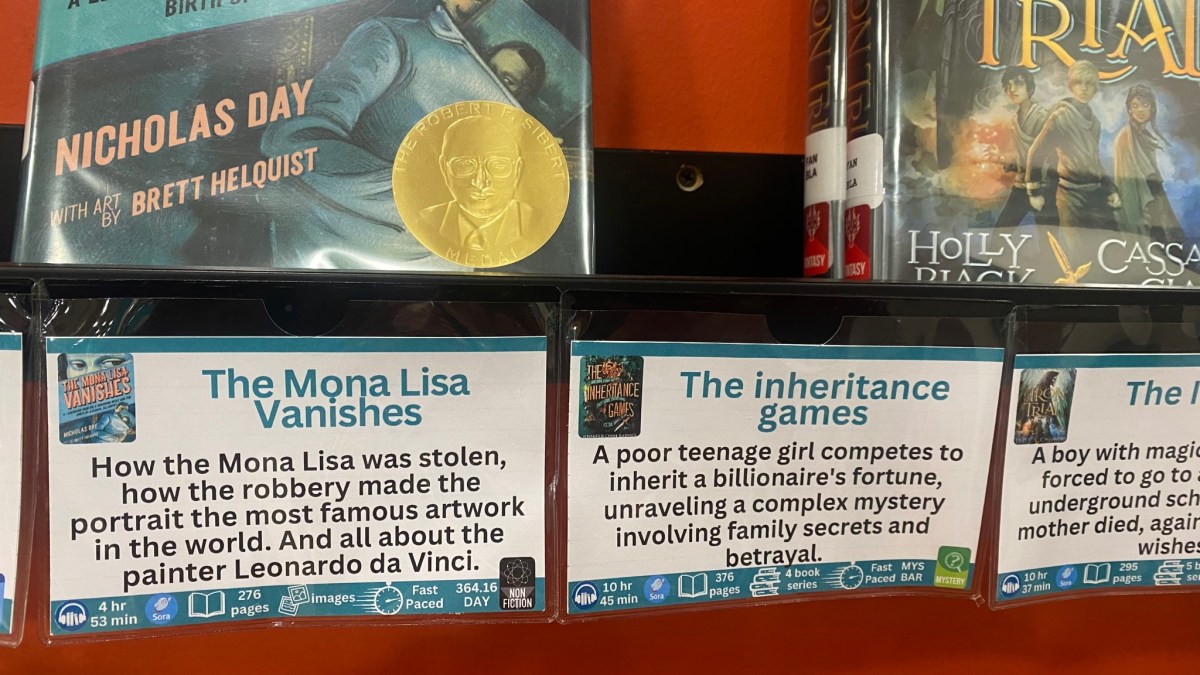
 

Digital Storytelling – an 8-week interactive program for Middle School students

Note: This is the example of the type of program that could be held for this age group – it is an academic submission and as such has not been tested in reality.

____________________________________________________________________
Assessment Item 1: Report and program for specified age group
INF 505 – Library Services for Children and Youth
Digital Storytelling – an 8-week interactive program for Middle School students at UWCSEA-East
Report prepared for the Librarian of UWCSEA-East by Nadine Bailey, September 2014

___________________________________________________________________


“For those associations and borrowed emotions, coming as they do from outside, carry young people over the dangerously spongy spiritual ground of the years during which one must signify something to oneself, while one is still too incomplete really to signify anything at all” (Musil, 2001, p. 10 writing on the value of literature for adolescents)


Part 1: Background and context

 
United World College of South East Asia East (UWCSEA-East) is an International School located in Singapore. It has a student population of 2,240 who come from 68 different countries and speak 50 different languages (UWCSEA, n.d.).  Around 40% of the students are bilingual and 12% speak more than two languages. As an international school drawing on an expatriate population, it has a high student turnover and the community can largely be described as cosmopolitan elite. The campus has two libraries, one for the Kindergarten and Primary students, and the other for Secondary students.
 
Section
 Number
Kindergarten
 353
Primary School
 654
Middle School
 587
High School
 324
IB
 321
Total
 2,239
Figure 1: Student breakdown by section
 
The school recently won the “21st Century school of the year award” (21stCL, 2013) and has a one-laptop-per-child program from Grade 6. Secondary school parents are ambivalent about the prevalence of computers in their children’s lives and often complain that their teenagers spend too much “non-productive” time on social media and online-game playing.
While the school offers a wide range of activities to the students, including outdoor adventure, sports, drama, music and socially driven clubs, there are no activities catering for creative writing or story-telling. There is a “techspert” club which deals with the technical rather than the creative aspects of technology and at present, besides the parents’ book club, the library does not run any programs outside of curriculum teaching, readers’ advisory, and reference or research assistance. Some teachers, learning support staff and librarians feel there is a need for a creative writing activity outside of the classroom to cater for younger adolescents who are introvert or struggle to express themselves due to shyness, learning differences or developing English skills and who would otherwise get “lost” in such a large, noisy, busy and extroverted campus.
The affordances of Web 2.0, social media and digital technology may have pedagogical and social benefits to secondary students, particularly those who are shy or socially awkward, and act as a bridge to physical relationships and interactions (Gorrindo, Fishel, & Beresin, 2012; Greenhow, Robelia, & Hughes, 2009). Educational research has indicated that exposure to technological tools in the creation of digital stories and book talks benefit students through increased motivation, engagement, ownership, control, confidence and deeper understanding. In turn, both the reading and writing aspects of textual literacy are improved (Barnard, 2011; Beach, 2012; Gunter & Kenny, 2008, 2012; Kenny & Gunter, 2004; Kenny, 2011; Ragen, 2012; Yoon, 2013).  It was therefore decided to combine the creative writing and technology aspects in a “Digital Storytelling” eight-week interactive program.
This program will be targeted to Middle School students, (grades 6 to 8) for a number of reasons. Firstly, as students move into Middle School (around age 12), they loose the structure and security of one class teacher and a fixed group of classmates while at the same time academic demands become higher. In addition, besides losing part of their peer group from the previous year due to international relocations, the school adds extra classes and pupils, resulting in about a third of the cohort being new to both Singapore and the school. This is the age group where, in Eriksonian terms, students are struggling with the commencement of puberty, and the related psychological stresses of developing and discovering an identity, negotiating social interaction and affiliating with friends, causes and ideals (Greenhow et al., 2009). Finally, this development takes place within a digital and online context which may be overwhelming to young teens as they explore the boundaries of online social behaviour and interaction (Gorrindo et al., 2012) and may not have positive role models in their home or peer environments.
“One reason that an afterschool program can have such a large impact relates back to the developmental needs of teenagers” (Jones & Waddle, 2002, p. 43).  These needs can be summarised as:
·      Positive social interaction with adults and peers
·      Structure and clear limits
·      Physical activity
·      Creative expression
·      Competence and achievement
·      Meaningful participation
·      Opportunities for self-definition (Jones & Waddle, 2002 cited in Meyers, Fisher, & Marcoux, 2007)
The secondary library that will host this program is a two-level open-plan space with moveable bookshelves.  Teenage students are comfortable in the welcoming library space which incorporates design thinking in creating zones for comfort, relaxation, reading and social interaction. The ground floor is mainly open plan with two study rooms with carousels and one large classroom (the Think Tank), while most of the collection is located on the first floor that additionally has two study rooms set up for audio-visual work.


Part 2: Design and develop a program

 
In this section, the following elements of program design will be covered: goals and objectives; cost and logistical considerations; marketing and promotion; and program delivery. Evaluation will be covered in the next section.


Goals and objectives

 
The primary goal is to design a program in which students can use technology in a positive and creative way to express themselves through storytelling in a safe environment that meets their developmental needs.
The program objectives, their relevance and how they will meet these needs are summarized below:

Objective
Relevance
Related Developmental need
1. Introduce students to concepts, examples and tools of digital storytelling
Students are familiar with literature and with digital tools, however not with digital storytelling.  This will broaden their competencies while scaffolding on what they already know.
Competence and achievement
Structure and clear limits
2. Support students in the creation of their own narratives using the tools of digital storytelling
For successful creative output, students will need technical, literacy and social support in an encouraging non-judgmental environment
Creative expression
Positive social interaction with Adults and Peers
Competence and Achievement
Opportunities for Self-definition
3. Provide a forum for sharing, promotion, collaboration and interaction
Student’s digital storytelling outputs receive validation through providing an appreciative audience while allowing them to contribute the same to their fellow participants.
Positive social interaction with Adults and peers
Meaningful participation

Figure 2: Objectives, relevance and developmental needs


Cost, staffing and other logistical considerations

 
Since the program will be run from the school library using school equipment, premises and staff, there are no associated program costs. Instruction time given to the program will count towards staff’s “educator activity contribution requirement”. Students will use their own laptops, pre-loaded with all the necessary software and digital tools for which the school has an education license.

·      Image – iPhoto and Photoshop
·      Moving image – iMovie
·      Text – Google documents or Pages
·      Music / sound / voice over – iTunes / Garage band / Voicethread

Thirteen Nikon D7000 cameras with tripods are available for loan during school hours to students and teachers. Besides the “Think Tank” meeting room where most of the sessions will be held, the library has two audio-visual rooms equipped with a television, projector and green or blue screen which will be reserved for program students during weeks 5 and 6, during the program time at lunch time. The program will run as an official school activity for eight weeks on a Monday afternoon from 15h15 to 17h00 so as not to clash with the sports and other activity programs. Sign up will be through the school activity sign up program. The activity is free and limited to 12 students selected from a pool of applicants in consultation with tutor mentors, learning support staff and the school counsellor.


Program delivery

 
Writing is a complex highly abstract process involving productive rather than receptive skills. These include cognitive, psychological and semiotic expertise within the social, cultural and historical context of the writer. Students often have an imbalance between their spoken and written abilities and get bored by the recursive steps of planning, prewriting, drafting, revising and editing (Thompson, 2012). Ways to encourage reluctant writers include ensuring that the topic is: relevant; of interest; taught naturally; understandable; engages emotions; expresses an inner world and is delivered in a playful manner (Vygotsky, 1978, cited in Nilsson, 2010). Fortunately, digital and technological tools have been shown to create new motivation and purpose in reluctant writers (Beach, 2012; Burke & Kafai, 2012; Dreon, Kerper, & Landis, 2011; Green, 2011; Hall, Hall, Hodgson, Hume, & Humphries, 2012; Morgan, 2014)
In the creation of this program, the above factors were considered, while the weekly structure follows the four P’s of digital storytelling (Knight, 2012):

·      Plan (Objective 1 – concept and tool introduction) – weeks 1-3,
·      Produce (Objective 2 – support students in their creation) – weeks 4-6,
·      Publish and Promote (Objective 3 – provide a forum for sharing) – week 7
Instructors were carefully selected to ensure they had a good rapport with this age group, but were not involved with them as classroom teachers, so did not have any pre-conceptions about their writing, technological or creative skills.
An overview of the activities is given in Appendix 1.


Week 1: Experience it!

 
During the first session, a variety of digital literature will be made available to the group. An example of each type will be briefly introduced and then students will be free to chose and borrow the example that most appealed to them, or to find other examples in that genre.


Week 2: Telling Tales

 
This week the elements of storytelling will be introduced.  Using the conceptual framework of Branigan (1992, cited in Kenny, 2011), story telling as a universal construct includes the interaction between a teller and the audience with the elements of time and place (background), cause (conflict or challenge) and effect (fight or flight) which result in a transformation as the story is resolved.
The acronym “I AM TOP CAMP” is a useful way to remember the principles of digital story telling, i.e. Interactive; Authentic; Meaningful; Technological; Organized; Productive; Collaborative; Appealing; Motivating; and Personalized (Yoon, 2013).


Figure 3: Storytelling process


Week 3: Storyboard

 
Building on the experiences of week one and learning of week two, students will be encouraged to start thinking about creating a storyboard for their own story. Comics and graphic books will be used to scaffold this activity (Hall et al., 2012). The elements of good design will be introduced, namely Contrast, Alignment, Repetition, Proximity otherwise known as CARP (Reynolds, 2008).


Week 4: Digital tool box

 
Each of the modal choices in digital storytelling (still and moving image, text, voiceover, music and sound (Buchholz, 2014)) requires the use of different technological tools, which can either be used separately, or in combination with each other.


Weeks 5 & 6: Production

 
Students are given the opportunity to create their own story. They have complete control over the type of story, tools to use and whether to work in a group or pairs or individually. Additional staff members will be available on a roving basis to trouble-shoot and assist students with any technical or story-telling difficulties they encounter.  Audio-visual rooms and digital cameras will also be available during lunchtimes should students wish to work on their story outside of the activity time.


Week 7:  Performance

 
One of the problems with creative writing is the perceived lack of an audience (Thompson, 2012). Although collaboration, interaction and sharing has been a part of all the activities up to now, this week the activity makes the audience explicit. The group’s productions will be shown at a special screening in the small black box theatre. Students can invite friends, parents and teachers.


Week 8: Reflection and celebration

 
In the final week, students will be able to reflect on their experiences during the last 7 weeks and provide feedback to the group (Survey – Appendix 4). This will be part of the evaluation discussed in the next section. Students will be allowed to bring along a snack for a celebratory party and will be invited to help as student volunteers in the Production stage of the next program.


Detailed activity plan – Week 1


Materials required

 
Laptop (MacBook) and iPads with preloaded eBook apps, screen, projector, apple TV for screening. The following digital literature should be preloaded onto iPads, available online or available for borrowing from the library catalog:


Type
Name
Link
Interactive Documentary
A global guide to the first world war (Panetta, 2014)
Twitterature
100 Greek Myths retold in 100 tweets (Crown Publishing, 2012)
Digital Novel
Inanimate Alice (DreamingMethods, 2012)
Vlog
Lizzie Bennet Diaries (Su, Noble, Rorick, & Austen, 2014)
Animated dreamtime stories
Dust Echoes (ABC, 2007)
iPad app and eBook
Shakespeare in Bits – Romeo and Juliette (Mindconnex Learning Ltd, 2012)

Figure 4: Digital Literature examples for screening


Step by step procedures of what is to be done 


Item
Equipment / Material
Timing
Greet students and ask for a brief introduction with name, class, where they are from and any experience or expectations they have from the program.
Stickers for students to write the names on
10 minutes
Perform a short icebreaker such as “two truths and one lie” with students in pairs.
n/a
10 minutes
Ask students to do initial survey using google forms.
Survey (Appendix 3)
5 minutes
Show snippets of the first three examples of digital story telling – A Global guide to the first world war, 100 Greek Myths and Inanimate Alice.
Laptop, projector and screen. Ensure various resources are open to minimise turnover time
3 resources, 5 minutes each = 15 minutes
Open discussion on what appeals to the students
Use the elements of successful digital story telling i.e. Interactive; Authentic; Meaningful; Technological; Organized; Productive; Collaborative; Appealing; Motivating; and Personalized (Yoon, 2013) to scaffold activity
20 minutes
Give students a break to have a snack, use the washroom, etc.
10 minutes
Show snippets of the next three examples of digital story telling – Lizzie Bennet Diaries, Dust Echoes and Shakespeare in Bits – Romeo and Juliette.
Laptop, projector and screen. Ensure various resources are open to minimise turnover time.
3 resources, 5 minutes each = 15 minutes
Ask students to choose the type of digital storytelling that most appeals to them; they can explore the resource in the remaining class time and borrow the resource to explore further at home.
Assist with loan and downloading of materials or searching of similar materials.
20 minutes
Finish in time for buses / pickup
Total 1 hour 45 minutes

Figure 5: Step by Step Procedure for week 1


Audience, staffing and other considerations

 
As discussed in Part 1, there will be 12 middle school students aged 12 – 15 years. All students should have a laptop and access to the library catalog and the Internet.  The secondary school librarian will demonstrate the material and show where similar material can be found in the catalog. An assistant librarian should be on hand to troubleshoot if students have problems loading the apps or eBooks, signing in or any other technical difficulties. Ensure room shades are all working so the room can be darkened sufficiently.


Marketing and promotion


The school markets all activities through the website and has a centralized signup program, however, as this is a new activity, additional promotion will be needed. A promotional calendar has been created including a short synopsis of each activity and its relevance (see Figure 2 below, and Appendix 1 for the promotional calendar).


Figure 6: Promotional Calendar


Printed posters will be put in the library, hallways, and elevator notice boards. In order to attract those students who would most benefit from the program a combination of “pull” and “push” promotion will be needed, so flyers will be given to Middle School language teachers, digital literacy coaches, learning support teachers and school counsellors who will be encouraged to discuss participation with students who may benefit from the program. A link to the calendar will also be placed on the library portal and in the school newsletter, the eBrief.


Part 3: Evaluation and reflection


How to evaluate the program

 
There are two main ways in which participants will evaluate the program.  In the first place a questionnaire will be completed (see Appendix 4). Secondly students will reflect on their own work and give feedback to other participants as part of the reflection in Week Eight.  Students are used to the PNI method of reflecting on the Positives, Negatives and possible Improvements. The most relevant evaluation however will be whether the activity is seen as interesting in subsequent semesters with demand and over-subscription from students during the Season 2 signup period. Although the student as “client” will be the main evaluator of the program, the teachers and digital, visual and text literacy coaches will also be asked to give feedback on the content, logistics and perceived usefulness of the program. 
Some digital storytelling programs have administered pre- and post- program literacy tests to students to evaluate the efficacy of the program (Barnard, 2011; Beach, 2012; Gunter & Kenny, 2008; Ragen, 2012; Yoon, 2013). But, since the primary goal of the program is to provide a social and creative outlet for students using digital tools, this will not be undertaken formally. However, the tutor mentors of the students participating in the program will be asked if they feel the program had any impact on the students socially or academically.


Reflection

 
One of the issues to be considered in this program will be the possible duality in the audience it attracts. On the one hand it may appeal to students with a passion for reading and writing, who already have a high level of sophistication and affiliation for writing. On the other, it may appeal to students who have difficulties in expressing themselves due to learning or language difficulties. They may be attracted by the expressive affordances of digital literature, the lure of technology or they may be encouraged to join in by their English teacher, learning or language support teacher or school counsellor. An important consideration would be how to cater to both these groups allowing each to build on their strengths without compromising the needs of either.  A further concern is that students will put a disproportionate amount of time into struggling with flashy technology and this will compromise the story-telling process. For this reason, digital tools are only introduced in the fourth week, after storytelling and the storyboard has been completed. During the mentoring, digital literacy coaches should remind students of academic honesty, consideration of DRM (digital rights management) and the correct accreditation or attribution of images and other material.
In setting up this program, older students were not considered, since once they move into High School and the International Baccalaureate program; study and exam pressures result in limited time for participation in activities. In the primary school, extensive writing workshops are already in place, led by the literacy coach. At a later stage, if the program is successful it could be expanded to include other groups of students.
Finally, it is important to reflect on the developmental needs of teenagers in the light of the objectives and characteristics of the program.


Objective
1. Introduce students to concepts, examples and tools of digital storytelling
2. Support students in the creation of their own narratives using the tools of digital storytelling
3. Provide a forum for sharing, promotion, collaboration and interaction

Figure 7: Objectives revisited


Developmental Need
Expression
Program Objectives
Program characteristics
Positive Social Interaction with Adults & Peers
Seek attention, socialization
2, 3
Small group of students with specialist teachers with a variety of skills and personalities
Structure & Clear Limits
Push boundaries, challenge authority
1, 2, 3
Program is limited to 8 sessions with a clear structure within which choice and autonomy is possible
Physical Activity
Running, jostling, roaming
n/a
Not applicable
Creative Expression
Vandalism, Vine, Instagram, Snapchat
2
Creative storytelling is the main thrust of the program
Competence & Achievement
Competitive behaviour, Minecraft, number of followers on social media
1,2,3
The program allows for mastery of technological and storytelling skills within a new format, end result is performed and published
Meaningful Participation
Opinionated, socialization, clique club or team membership
2, 3
Activities allow for interaction in the physical and virtual space
Opportunities for Self-Definition
Status symbols, dress and hair,
2
Students are encouraged to consider their culture, linguistic and social identities in producing their story

Figure 8: Summary of developmental needs, expression, program objectives and characteristics
(Adapted from: National Middle School Association (1996). Research Summary: Young Adolescent’s Developmental Needs, 2006, cited in Gallaway, 2008).


References


21stCL. (2013). School of The Year – 21st Century Learning International. Retrieved May 15, 2014, from http://21c-learning.com/awards/school-of-the-year/

ABC. (2007). Dust Echoes. Retrieved August 20, 2014, from http://www.abc.net.au/dustechoes/dustEchoesFlash.htm

Barnard, C., A. (2011). How Can Teachers Implement Multiple Modalities into the Classroom to Assist Struggling Male Readers? (Education Masters Paper 26). St. John Fisher College, Rochester, NY.

Beach, R. (2012). Uses of Digital Tools and Literacies in the English Language Arts Classroom. Research in the Schools, 19(1), 45–59.

Buchholz, B. (2014). “Actually, that’s not really how I imagined it”: Children’s divergent dispositions, identities, and practices in digital production. In Working Papers in Literacy, Culture, and Language Education (Vol. 3, pp. 25–53). Bloomington, IN: School of Education, Indiana University. Retrieved from http://education.indiana.edu/graduate/programs/literacy-culture-language/specialty/wplcle/index.html

Burke, Q., & Kafai, Y. B. (2012). The writers’ workshop for youth programmers: digital storytelling with scratch in middle school classrooms (pp. 433–438). Presented at the Proceedings of the 43rd ACM technical symposium on Computer Science Education, ACM.

Crown Publishing. (2012, November). @LucyCoats: 100 Greek Myths Retold in 100 Tweets (with tweets). Retrieved September 4, 2014, from https://storify.com/CrownPublishing/100-greek-myths-retold-in-100-tweets

DreamingMethods. (2012). Inanimate Alice – About the Project [Digital Novel]. Retrieved September 4, 2014, from http://www.inanimatealice.com/about.html

Dreon, O., Kerper, R. M., & Landis, J. (2011). Digital Storytelling: A Tool for Teaching and Learning in the YouTube Generation. Middle School Journal, 42(5), 4–9.

Gallaway, B. (2008). Pain in the Brain: Teen Library (mis)Behavior. Retrieved September 4, 2014, from http://www.slideshare.net/informationgoddess29/pain-in-the-brain-teen-library-misbehavior-presentation

Gorrindo, T., Fishel, A., & Beresin, E. (2012). Understanding Technology Use Throughout Development: What Erik Erikson Would Say About Toddler Tweets and Facebook Friends. Focus, X(3), 282–292. Retrieved from http://focus.psychiatryonline.org/data/Journals/FOCUS/24947/282.pdf

Green, M. R. (2011). Writing in the Digital Environment: Pre-service Teachers’ Perceptions of the Value of Digital Storytelling. In American Educational Research Association (pp. 8–12). Retrieved from http://worldroom.tamu.edu/Workshops/Storytelling13/Articles/Green.pdf

Greenhow, C., Robelia, B., & Hughes, J. E. (2009). Learning, Teaching, and Scholarship in a Digital Age: Web 2.0 and Classroom Research: What Path Should We Take Now? Educational Researcher, 38(4), 246–259. doi:10.3102/0013189X09336671

Gunter, G. A., & Kenny, R. F. (2008). Digital booktalk: Digital media for reluctant readers. Contemporary Issues in Technology and Teacher Education, 8(1), 84–99.

Gunter, G. A., & Kenny, R. F. (2012). UB the director: Utilizing digital book trailers to engage gifted and twice-exceptional students in reading. Gifted Education International, 28(2), 146–160. doi:10.1177/0261429412440378

Hall, M., Hall, L., Hodgson, J., Hume, C., & Humphries, L. (2012). Scaffolding the Story Creation Process. In 4th International Conference on Computer Supported Education. Porto, Portugal. Retrieved from http://www.lynnehall.co.uk/pubs/ScaffoldingTheStoryCreationProcess.pdf

Jones, P., & Waddle, L. L. (2002). New directions for library service to young adults. Chicago: American Library Association.

Kenny, R. F. (2011). Beyond the Gutenberg Parenthesis: Exploring New Paradigms in Media and Learning. Journal of Media Literacy Education, 3(1), 32–46. Retrieved from http://www.jmle.org

Kenny, R. F., & Gunter, G. A. (2004). Digital booktalk: Pairing books with potential readers. Association for Educational Communications and Technology, 27, 330–338.

Knight, S. (2012, June 20). Introduction to Digital Storytelling. Retrieved September 6, 2014, from http://www.slideshare.net/sknight/digital-storytelling-ed554?related=1

Meyers, E. M., Fisher, K. E., & Marcoux, E. (2007). Studying the everyday information behavior of tweens: Notes from the field. Library & Information Science Research, 29(3), 310–331. doi:10.1016/j.lisr.2007.04.011

Mindconnex Learning Ltd. (2012, January 25). Shakespeare In Bits: Romeo & Juliet iPad Edition on the App Store [iTunes]. Retrieved September 6, 2014, from https://itunes.apple.com/us/app/shakespeare-in-bits-romeo/id370803660?mt=8

Morgan, H. (2014). Using digital story projects to help students improve in reading and writing. Reading Improvement, 51(1), 20–26. Retrieved from http://search.proquest.com/docview/1540737338?accountid=10344

Musil, R. (2001). The confusions of young Törless. (S. Whiteside, Trans.). New York, N.Y.: Penguin Books.

Nilsson, M. (2010). Developing Voice in Digital Storytelling Through Creativity, Narrative and Multimodality. International Journal of Media, Technology and Lifelong Learning, 6(2), 148–160. Retrieved from http://seminar.net/index.php/volume-6-issue-2-2010/154-developing-voice-in-digital-storytelling-through-creativity-narrative-and-multimodality

Panetta, F. (2014). A global guide to the First World War [Interactive documentary]. Retrieved from http://www.theguardian.com/world/ng-interactive/2014/jul/23/a-global-guide-to-the-first-world-war-interactive-documentary

Ragen, M. (2012). Inspired technology, inspired readers: How book trailers foster a passion for reading. Access, 26(1), 8–13. Retrieved from http://search.proquest.com/docview/934354989?accountid=10344
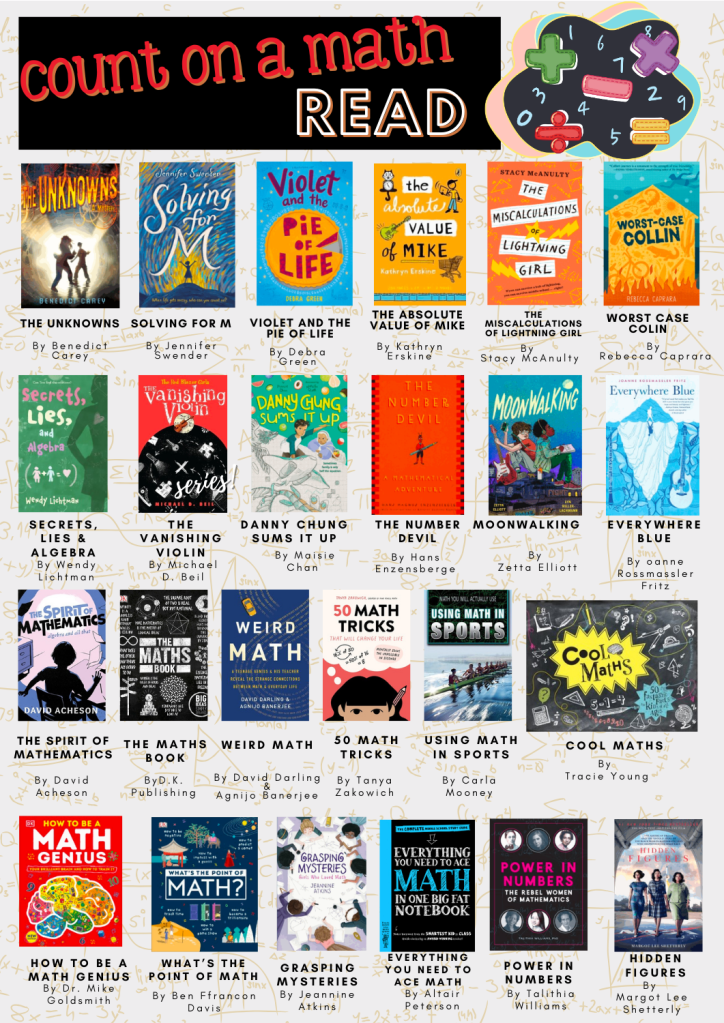
Reynolds, G. (2008). Chapter 6 Presentation Design: Principles and Techniques. In Presentation Zen: Simple Ideas on Presentation Design and Delivery (pp. 152–163). New Riders. Retrieved from http://www.presentationzen.com/chapter6_spread.pdf

Su, B., Noble, K., Rorick, K., & Austen, J. (2014). The secret diary of Lizzie Bennet. London ; Sydney: Simon & Schuster.

Thompson, I. (2012). Stimulating reluctant writers: a Vygotskian approach to teaching writing in secondary schools: Stimulating reluctant writers. English in Education, 46(1), 85–100. doi:10.1111/j.1754-8845.2011.01117.x

UWCSEA. (n.d.). Languages at UWCSEA. Retrieved from http://issuu.com/uwcsea/docs/uwcsea_languages

Yoon, T. (2013). Are you digitized? Ways to provide motivation for ELLs using digital storytelling. International Journal of Research Studies in Educational Technology, 2(1). doi:10.5861/ijrset.2012.204


Appendix 1: Program Overview


Element
Synopsis
Relevance
Instructor
Location
Week 1:
20 October 2014
Experience it!
A whirlwind tour of digital books, vlogs, interactive apps and tweeted poems.
Provide background to program and give understanding of what is possible.
Ms. Katie Day – secondary school librarian – expert in YA literature
Library Think Tank
Week 2:
27 October 2014
Telling tales
Elements of storytelling explained with particular reference to digital storytelling.
Storytelling, no matter what the medium is the basis of this program.
Ms. Kate Levy – high school English teacher
Library Think Tank
Week 3:
3 November 2014
Storyboard
Students shown how to create a storyboard using the example of cartoons and graphic novels and elements of good design are introduced.
Learn the elements of good design and how to incorporate these in your story.
Mr. Noah Katz – visual literacy coach
Library Think Tank
Week 4:
10 November 2014
Digital tool box
Digital tools for capturing and combining different modal choices (image, sound, text) are explained. Best practise is highlighted.
Bring students digital skills to a comparative level of mastery and show how to incorporate into their storytelling.
Mr. David Caleb – digital literacy coach, photographer and author of “The Photographer’s Toolkit”
Library Think Tank
Week 5:
17 November 2014
Production
Students will be given the time and resources to put their ideas and skills into practise. They can choose between individual, paired or group production.
Students will be aided in their creation of digital stories by competent experts they can achieve their creative goals within a clear structure.
All 7 school digital literacy coaches, librarian and Ms. Levy
Library – Emily Dickinson, Pablo Neruda rooms & Think Tank – green, blue or white screens available
Week 6:
24 November 2014
Production
Week 7:
1 December 2014
Performance!
Output is produced and promoted. Friends, family and teachers are invited to the Black Box Theatre watch the digital storytelling productions.
An explicit audience is an important aspect of storytelling. Students will have a sense of competency and achievement.
Ms. Katie Day, participants, digital literacy coaches
Black Box Theatre
Week 8:
8 December 2014


Reflection
Time is given for reflection and feedback of the last 7 weeks. The end results are celebrated and promoted further.
The end of the program is indicated by this activity both setting a limit to the formal program and allowing reflection and also validating participants by requesting their evaluation and suggestions for improvement.
All instructors
Library Think Tank


Appendix 2: Promotional Calendar


Appendix 3: Pre-program Survey


Digital Storytelling Program
Pre-program Surve
y
To give us an idea of your current understanding, preferences and skills please complete this survey. Thank you!
Definitely
Usually
Some-what
Not really
Not at all
I enjoy reading or watching
Fiction, stories, memoirs
Non-fiction or documentaries
Poetry
I can use the following technology
Digital Camera
Digital Video Camera
iPhoto
Photoshop
iTunes
Garage Band
iMovie
I use the following social media
Facebook
Instagram
Twitter
YouTube
Other – please state which ……
I express my creativity through
Writing
Art or photography
Music or dance
Drama and acting
Video or film
I am not creative
What do you expect from this program?


Appendix 4: Post Program Survey

 
Digital Storytelling Program
Post-program Survey
Now you have finished the program please reflect on your experiences and learning.
Definitely
Usually
Some-what
Not really
Not at all
I understand the concepts and tools of Digital Storytelling
Different types of digital stories
What is important in storytelling
How to create a storyboard
I can produce my own digital story
I can use the following technology
Digital Camera
Digital Video Camera
iPhoto
Photoshop
iTunes
Garage Band
iMovie
I would recommend this program
To friends / classmates
To teachers
What was the best / most positive part of this program?
What didn’t you enjoy about this program?
What improvements would you suggest?