Language, Bilingualism and Multi-lingualism in the news

I’ve started curating all the information I can find on the topic of language, language learning, and bilingualism into a Flipboard.  Flipboard is great for reading content on your iPad without any clutter or interference from advertisements and distractions.

There is a lot of information out there (I’ve found 575 articles in the last year alone), and there is a lot of repetition and there is a lot of nonsense, but plenty of gems as well.  Published “as it comes” and up to the reader to educate themselves and separate the hype from the reality.

Get flipboard here: https://about.flipboard.com/

And follow this board here: https://flipboard.com/section/bilingualism%2C-mother-tongue-%26-language-bxo7KX

Social networking – the dark side

I’ve been on the internet a long, long time.  There was some primitive stuff going on when I did my first degree around the mid-80’s (that’s 1980’s) but we only really got it going at home in 1994 – and then we were living in Brazil, where and when at that time, even having a home phone line was a luxury.  I remember hours and hours trying to get things up and running with a techie mate of mine, both of us with broken Portuguese, the old black screens with green writing and lots of C backslashes.  Besides email, social media for me only started in 2006 when we moved from Spain to Hong Kong and I started blogging.   And I discovered the wonderful community you could create through blogging, but I also found the dark side of trolls and anonymous comments that didn’t add much to the conversation except to satisfy some need in the writer.   Finally, when things got too personal and my thick skin had been worn down enough, it just didn’t seem worth carrying on, and besides that we’d moved countries and a lot of what I’d written was no longer interesting or relevant or current, so I just shut it down.  But I did make some truely wonderful friends through the experience, and they’ve remained friends, so the virtual to the reality.

Fast forward to now, and I’m using Pinterest and Flipboard for my work, and also dabbling in them a little privately.  Full disclosure – I have a child with ADHD.  It’s not a secret.  I’m not ashamed of it.  So when I come across things on ADHD or related matters, I flip them into an ADHD flipboard, and I keep track of nice infographics and articles and graphics and things on it in Pinterest.    Out of politeness and in the spirit of the social side of the internet, and being supportive of other people who take the time and trouble to curate things on the matter, I also “follow” their boards if I’ve pinned something from it.

And they follow me back.  But it can be dark.  So, recently one of the people I followed on the matter then followed me back and started inviting me to all sorts of boards along the lines of domestic violence, abused people, children of abuse and all sorts of psychological matters that, while I’m sympathetic to, just doesn’t have relevance to my life.  I had one of those “oops” moments, and kind of felt like I was being stalked, or having a bible basher (sorry, value judgement) put their foot into my living room door.

Will it stop me using social media?  No.  It just makes me more aware, and maybe I won’t follow someone quite so quickly without looking at the context of their other pins first.  Am I glad it happened? Yes.  Because I’m the parent of two pre-adolescents.  And it can and will happen to them, and I’m real glad it happened to me first, so we can talk about it, and they’ll know what it is, how it can happen and how to respond to it when it does.

new toys! new toys!

So I’m working away at the template for the libguides and at the same time I’m busy creating the psychology libguide.  Why I’m doing both simultaneously is that I’m trying to make the template a “how to” as well.
Today Ms. K showed me “Flipboard” which is a curating tool on the ipad.  Basically you use it to create your own online magazine.  It’s really really cool because it’s so nice and graphical and glossy. OMG what a great tool for teen girls – instead of all that crap served up in Seventeen and Cosmo you could curate and create a magazine for a girl with a mind!   No adverts, no self-loathing of the body after reading. The possibilities are endless.

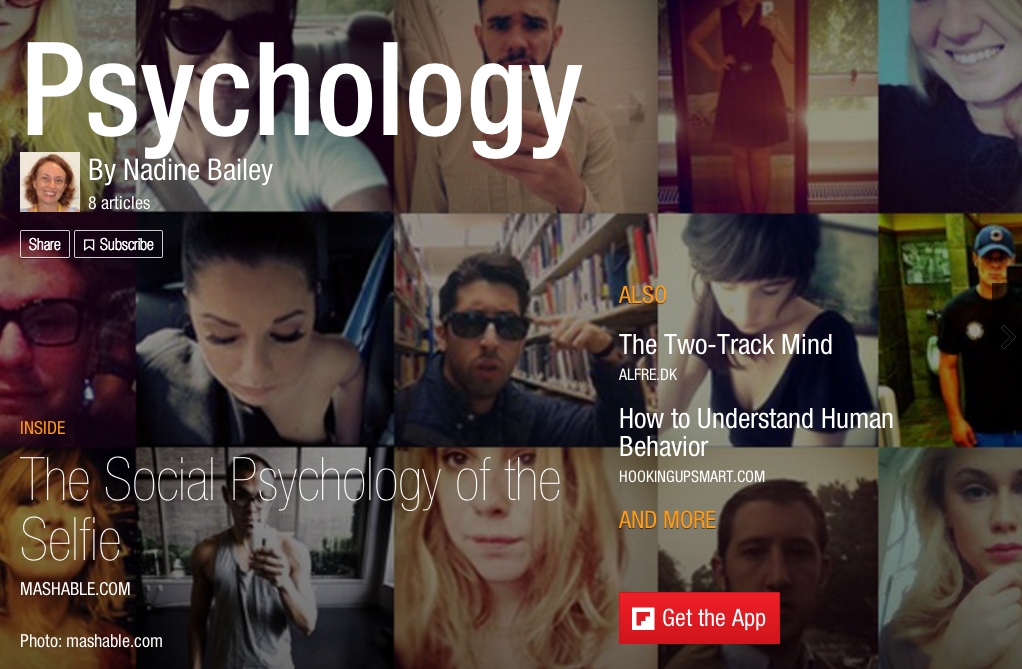
Anyway, I made up a little mock flipboard for psychology and populated it with some articles and then was shown a rather clever trick to get it into libguides.  Which I’ve promptly forgotten, so I’ll need to check out what I did and do it again …

OK, so the first thing I did was email the URL of the guide to myself, and then I made a screen shot of the cover (command / shift / 4)

Using free text edit, I put in the picture (using width = 100%) and then added a link to the flipboard behind the link…  It looks really cool in the libguide, but really was quite easy!

We’re jointly curating some flipboards for each of the subjects so that it can be part of our “in the news” section as a cool graphic.

Of course down the road the issue will be to keep it current and interesting and changing for the more dynamic subjects.  A really good example to look at is the WW1 flipboard created by Adrian van Klaveren he has (as of today) 3,691 readers, 81,166 page flips and 281 articles!

I’ve spent enough time on screen time now, so it’s time to log off and switch off.

First questions

(a) define what social networking is (in your own words);
In my opinion there are two types of social networking – that which occurs online, and that which occurs online. In both my online and offline worlds I enjoy having disparate networks of friends and connections who define parts of who I am and how I function in the world.  These days, my online and offline social networks often intertwine.
A network is basically a group of people who are connected to you by virtue of something you have in common.  For example, I have a network of friends who I work out with at crossfit.  We see each other at workouts and at functions organised by the box, but we’re also active through Facebook where we post articles and comments and questions to each other.
On the other hand, I’m a member of LinkedIn, where I’m connected to people who I’ve worked with or come into contact with professionally – a few of them are personal friends, and some are Facebook friends, but most are not.
For many years I wrote a blog on bilingual chinese / english education.  I wrote this anonymously and over the years built up quite a following of anonymous strangers, some of whom became friends – we were united in a social network but most of us never met.
The best social networks are the ones that give you a buzz, where you’re interacting, enjoying and learning and contributing all at the same time.  Funnily enough for me that usually works when I’m one on one with someone and we’re “jamming” – not in the musical sense but in the app sense, and it’s a case of “look what cool toy I found” and seeing how we can apply it to solve real world personal or professional problems (like today).  Or when you’re trying to plan thing and you or someone knows someone who then knows someone else who would be perfect for a talk or presentation or bit of information that will complete what you’re trying to achieve.
In order to have a good social network you need to be able to both “get out there” physically and network in real life, and “be out there” hanging out where your professional peers are hanging out – whether that’s blogging, twitter, Facebook, LinkedIn or whatever else the flavour of the month is.  – And if your kids aren’t doing it – it’s probably not worth spending much time on.
 In the context of this course, social networking is probably referring to the networking that happens online.  
(b) list what social networking technologies and sites you already use (for personal, work and
study purposes); and
LInkedIn, Facebook, Twitter, Diigo, Blogger, Flipboard, Youtube, Evernote, Goodreads, Whatsapp, Picassa, Google+, 


(c) describe what you expect to learn from completing INF506
Keep current, maximise and optimise my time online.  Coherence between the various platforms.