No excuses – Britannica Image Quest

This no excuses post has been a long time coming. One of the things that most librarians have in common is that they are long-suffering, friendly, helpful, accommodating types, ready to share knowledge, know-how and eager to grasp on any acknowledgement they receive from academic leadership and fellow teachers. While the grumbles and moans are prolific within our little echo chambers, few of us have the time or energy to actually be vocal. We’re generally just grateful we have jobs, in a market where libraries and librarians are sacrificed a the altars of economies and “it’s on the internet”. So many just put up and shut up. And are careful of the swords we’re prepared to fall on.

In the mean time, there are people and companies in this academic / learning / research space who are making a lot of money and who do get heard / listened to. If you read only one article about this, I’d recommend the Guardian Long Read : “Is the staggeringly profitable business of scientific publishing bad for science?” I’d love to ask if the profitable business of school databases is bad for research and learning.

So the saga began at the end of the last academic year.  I was teaching academic honesty to my Grade 4’s and they were just about at the point of grudgingly agreeing that it was a good idea (in IB PYP speak) to have “integrity, respect and appreciation” for other’s work and be “principled” in acknowledging where the images they were using in their research were coming from.

In order to limit their going too wildly astray on the world wild web, the teachers and I agreed that we’d limit the images they used to two sites – the paid Britannica Image Quest (available to schools as part of the school version of Britannica bundle for a mere US$6,000 per year depending on your size), and the unpaid “photosforclass” where the attribution is included in the photo watermark and they make an effort to ensure the photos are school appropriate and are under creative commons license.

So far so good until we got to the point of looking at the citations created by – no not the free tool but the really expensive one!

As we looked up the various things students were researching to my utter dismay I realised that each and every one had as creation date 25 May 2016.

One of the things that I try to keep in the back of my mind when teaching information literacy is where we are going in terms of threshold concepts.  We want to ensure that students are not going through the rote / skill part of academic honesty without really understanding the bigger information literacy picture.
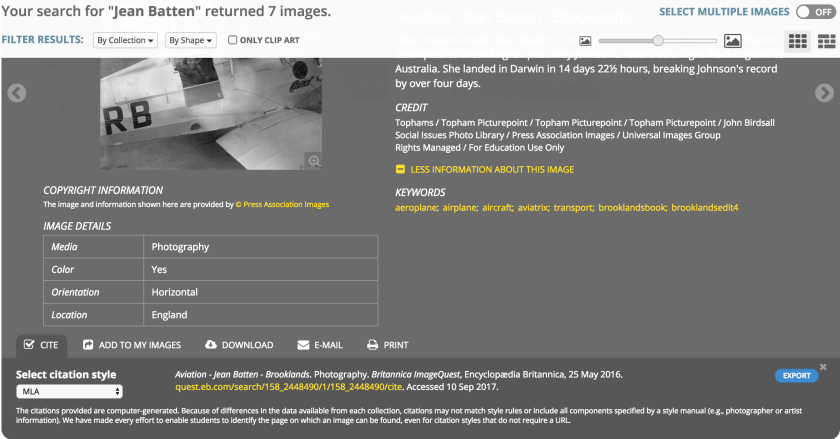
Screenshot Britannica Image Quest
Screenshot Jean Batten – Brooklands and citation, Britannica Image Quest, 10 September 2017.

So I wrote to our “local” Britannica representative questioning the date on the image. Surely it couldn’t have been May 2016? And who was the photographer? Surely they deserved a mention?

The correct structure for MLA8 (the system our school is using) is:

Creator’s last name, first name. “Title of the image.” Title of the journal or container that the image was found on, First name Last name of any other contributors responsible for the image, Version of the image (if applicable), Any numbers associated with the image (such as a volume and issue number, if applicable), Publisher, Publication date, Location. Title of the database or second container, URL or DOI number.

So the response I got back from Britannica was:

Many thanks for your email expressing your concern over our citation. I am guessing you are referring to the MLA format. We follow the required format for online publishing which does not require that particular information.

Example below.

HIV viruses (red). Photography. Britannica ImageQuest, Encyclopædia Britannica, 25 May 2016.
quest.eb.com/search/132_1274904/1/132_1274904/cite. Accessed 16 May 2017.

MLA citation requires a publication date which is considered a core element of the citation. That, of course, would be the date of the last image publish of that collection, May 25, 2016. Because the data from the images comes from more than 60 collections, it is very inconsistent or we don’t have it at all. Britannica tries never to provide information that we cannot guarantee to be correct. We suppress this from the site for that reason.

http://quest.eb.com/collections

I hope this assists your understanding of our difficulty here. Please come back to me if I can be of more assistance.

At which point I cried foul. And took my concern to a couple of librarian networks. Where it was roundly ignored. Or where it wasn’t ignored it was met with a powerless sigh. And I wrote back to them as said no, I was not satisfied with that. Are you serious? They get photos from 60+ databases and can’t be bothered to spend a few dollars on mapping the available data properly to their database? Only 60? That means you pay 60 something people, one to look at each of those databases and work out their tagging and map it to your tagging.  And then you pay somebodies to manually sort out the ones that don’t map nicely or you default to the cop-out citation for those. In the world of cheap accessible outsourced IT, that should be a no brainer. The entry about the privately owned Britannica on Wikipedia is illuminating.

In the world of fake news and fake photos and fake evidence and fake research and fake everything we need to be vigilant. When original primary research documents and images get scanned into databases we lose a trail if the creators and dates are no longer considered important enough to add. We are not talking about born-digital images here.

So I persisted and got this response:

Well you have certainly stirred thing up, in a good way I think. J

I’d like to share with you some of what has occurred since your concern was raised, in the hope it will be interesting and helpful in the future.

Our Editorial Team was consulted and they will be handling citations going forward. They did a full review of the MLA format and consulted with the MLA Handbook 8th Edition.

As I mentioned in a previous email, the reason we leave off the photographer is because the data we get from the partner is not in a format that would allow us to list it correctly on a consistent bases. The MLA Handbook states, “When a work is published without an author’s name. . .skip the author element and begin the entry with the work’s title” (p. 24). Since we cannot accurately list it, we are leaving it off. The editorial team are going to explore this a bit more and see if there is a way we can improve this, but for now we will leave it off. This will not be an easy thing to fix.

We are listing the publish date of the images (in addition to accessed date). According to the MLA Handbook, the publish date is appropriate. Because we didn’t always store the publish date in the database, when we revised for MLA 8  we had to fill in something so all images would have a date. We used the date of the most recent publish. From the point of making this change and going forward we now list the actual publish date of image. Since this did result in most, but not all, of the images having the same date we are going to go back and try to update the publish dates with the date the collection was first published on our site. This will hopefully make it easier to teach students what this date is for since the majority will not be the same. However just to reiterate, as new images are published they are now listing their actual publish date.

Over the next month or so, the Editorial Team will also complete a review of the other citation formats in ImageQuest and we will make changes as time allows. We will also create a citation page where we provide additional information to clarify our citation policy.

Nadine, I do hope it is clear that Britannica always endeavours to provide the most accurate information possible and that we do react, where we can, to try and improve on a valued customers suggestion.

and in fact, if you look at the bottom of every citation you’ll now see the following:

“The citations provided are computer-generated. Because of differences in the data available from each collection, citations may not match style rules or include all components specified by a style manual (e.g., photographer or artist information). We have made every effort to enable students to identify the page on which an image can be found, even for citation styles that do not require a URL.”

Why does this still bother me six months later? Let’s return to what we really want students to know about Information Literacy. What will carry them beyond their latest assignment, their Personal Project, their Extended essay. What will take them through life as sceptical consumers of information. Let’s go back to understanding the threshold concepts of information literacy.

We should rely on information that has authority.  So we check the credentials, experience and expertise of those giving the information. There is an image of a young woman and a claim she broke an aviation speed record in 1934. Who took that photo? Where was it taken? When was it taken? Was she leaving or arriving? If the photo was taken on another day or time was it just posed? Was that the triumphant photographic proof of her exploit?

Information has a format. And it’s format is related to its creation, production and dissemination, NOT how it is delivered or experienced. Usually this is considered when comparing journal articles in a journal in a database to the journal format of the past as in volumes of books. The fact that the format is now online, doesn’t impact on the fact that it’s a a peer reviewed journal article. A similar argument can be made for a historical photo. The fact that it’s now delivered digitally shouldn’t ignore the fact that it was once a photo taken with a camera at a point in time by a real photographer.

Information is a good (as in goods and services). As such there is a value and a cost to information, and we should be aware of that. At the moment the balance of financial cost and reward seems to be very one sided. Databases buy up collections of information, bundle it, and sell it on at a premium and add as little value to the images as they can get away with. Usually just giving information on the seller rather than the creator of the images.  The information structure – information is structured and accessed / searched in a certain way and that differs depending on the format and container.

The research process builds on existing knowledge. But if we ignore the existing knowledge and process whereby we get to the current point we’re negating this aspect. This also builds into the idea of scholarly discourse – that we’re entering an academic conversation at a certain moment.

So at this point I’d still be saying – no excuses. The fact that something is hard should never be an excuse not to do it properly.  Yes they are right – they are complying with the MLA8 structure. But they are not helping with the spirit of scholarship and information literacy.


No excuses: Syndetics

It must be an age thing – but as I’m getting further into my 50’s I’m becoming less tolerant of fancy sounding reasons and explanations that are actually just excuses for staving off change. This is the first of a series of posts on things that really annoy me as an international librarian, with a smattering of understanding of technology and a desire to serve ALL students, teachers, parents and administrators in my community as best I can. I have an overdeveloped sense of fairness and justice and I sometimes feel that librarians as a group are just too nice and suck up way too many things.

brazen

I’ll also admit to being emboldened by a FABULOUS new biography on women called “Brazen” (coming out in English next year – thank you Netgalley for the preview copy) You can preorder your copy now – suitable for High School 13+. And in fact this book just highlights what I’m going to write about today. This book originated in French. I’m currently totally inspired by the Guardian’s World library list and wanted to replicate it, adapted for primary school, particularly with a view to Uniting Nations day coming up in November.

bangladeshNow I work really hard at trying to transform my library into one that is representative of my students. I love the fact that my one Bangladeshi student asks me every week if I have any new books about or set in Bangladesh. And that at the beginning of term she came to proudly tell me that she was no longer the one and only but had been joined by another family. And when I showed her our new book about Bangladesh she took time out of her library browsing time to show me all the things the book depicted that were special to her.

I also work hard on my libguides to make sure that my books are showcased graphically and visually to make perusing them interesting for primary level students. So this is when I get really annoyed that Syndetics, the one interface for front covers that just about every system, from OPAC to libguides to LibraryThingsforLibraries uses does NOT seem to recognise that there is a publishing industry outside of the BANA (Britain, Australia, North America) countries – in fact they even struggle with Australia most the time. And don’t let me even consider China – well they cheat a bit – a lot actually – thinking that one ISBN number should suffice for a whole series of books – even if there are 57 books in the series.

This means that my libguide with my books from and about other countries, my catalog and my destiny discover new books respectively looks like this:


Spot the problem? And Syndetics actually prides itself in the fact that the covers of the coverless books are now colourful with title and author. NOT GOOD ENOUGH! For my catalog, my library assistants spend hours manually inserting the covers, and for the much touted, over promised under-delivered Destiny discover it’s just a blue boring nothing. So 5 of my 8 most recently purchased books are just blue blobs. So if you’re a librarian trying to diversify AND to make your new purchases appealing the cards are stacked against you.

Before I started writing this post I thought I’d do a bit of research into Syndetics, and the whole cover image thing. And then I thought no damnit. I won’t.  I don’t really care what the reason or excuse is. They’re selling an expensive service. They’re complicit in not improving the marketing of diversity of literature and I’m just going to put it out there and they can do the explaining, and hopefully a bit of soul searching on how they can make this better. What BIG things, what IMPORTANT and sea-change things they, as a big corporation as opposed to me as a little librarian in a little library serving 650 students from 40 nations can achieve.


Scheduling – priorities and dissonance

New year, new chances, old problems. The perennial one of scheduling library time. I kind of started commenting on people’s posts and questions on FaceBook and then decided it merited a blog post on its own. There is also a whole discussion on libraries and librarians going at the IBO level where priorities, recognition, roles, responsibilities etc. are also being hashed out. But coming from a corporate background and not an educational one, I sometimes can’t help seeing things a bit differently.

One of the most useful courses I followed during my librarian studies was “Designing spaces for learning”. And spaces weren’t just physical spaces, or even physical and online spaces, it includes temporal space – as I wrote about here  and design thinking. The thing is that time is the great leveller. We all have 24 hours of it a day, but what we choose to do with it is telling, because it will determine who we are as librarians and display our priorities more strongly than just about anything else we do.  I could even put money on the fact that if you walked into a school where there was a troubling relationship between the librarian and staff / admin and you asked to see the library timetable it could be used as both a diagnostic tool and a cure.

So I’ll begin this post by giving a shout-out to my principal who gives me the autonomy necessary to both think all this out and then to discuss it with her and implement it. She also gives me the support I need when things are not working optimally, if I’m reasonable in my requests and it supports student learning.  My PYP coordinators who are allowing me to be their educational partners also makes things a lot easier. And the school I’m at that generously allows for 3 support staff members in the library in their HR budget to open up time for me to be doing higher order teacher-librarian things rather than processing and circulating books. Now apologies for a barrage of management-type speak and jargon, please bear with me.

In library scheduling there are two main schools of thought, primarily defined as fixed scheduling (you set up a schedule each year / term, and every class gets their time to go to the library at that designated time) and flexible scheduling (the librarian’s time is bookable, on demand). Each have their benefits and drawbacks – with fixed you get to see everyone regularly, but in a large school you have no time left, or go on a two / three week schedule. With flexible you run the risk of never ever seeing some kids depending on the teacher’s ideas of the library, priorities etc. Most larger schools where the ratio of librarian to students is low (e.g. 1 librarian to 1500 students) opt for a flexible schedule. Our ratio is 1:630 with 34 classes so theoretically a fixed schedule can work, and I’ve tried to build some flex into it otherwise I’d never do the things that differentiate me from what a teacher or library assistant can do.

Priorities

The first part of the process is to decide what your priorities are. Now in education this is way harder than in corporate life, since often many of your priorities are set for you. It also took me a little while to get the experience and confidence to actually realise what my priorities should be and to advocate for them.  And also to decide what my priorities shouldn’t be and to draw a line in the sand.  Part of your priorities are governed by your school’s mission and value statement. Part is about your integrity to yourself as a professional (teacher) librarian and part is about the resources physical and financial your school has.

My personal priority statement is “I am about literacy“. So everything that has to do with any of the literacies (alphabetic, informational, numerical, multi-lingual and to a certain extent digital) I will prioritise.  I steer clear of discussions on makerspaces for that reason, partly because we have a dedicated STEAM department, and partly because if it has nothing to do with creating some form of reading, writing or research I consider it outside of my ambit. OK, shoot me, but you have to draw the line somewhere or you’ll have to compromise on something else, or just never stop working 24 hours a day.

The next thing is to think about how you are going to integrate yourself into teaching and learning in a collaborative way. There are two frequent laments heard in this regard “I don’t have time for meetings” and “I don’t get invited to meetings” – and here is where a supportive principal comes in. The very first thing that went into my timetable this year were the days and times for co-planning for each grade. It’s taken 2 years to get to this point and I only need / want to go to the meetings once a unit – usually a week or so before the unit starts so I’m involved in hearing where the team wants to go with the unit, what digital and physical resources they need and how I can meaningfully integrate information literacy or other ATL skills into the unit. I also only need to be there for about 10-20 minutes depending on whether it’s an old or new unit. So what about the other 4/5 weeks? Well I’m using the time to DO what the team needs. And if I’m teaching in that time, I can’t be doing. Doing includes making library guides (that’s how I have time for them), curating resources, ordering new resources, weeding old resources. Although I am not considered a HOD, my principal also kindly invites me to the weekly lead meetings so I know what is going on and coming up, and can involve the library in any way that is meaningful.

Then comes the fixed part, which fulfils my literacy priority. Since I do have a manageable ratio / number of students / classes, I have a fixed part of my schedule whereby each student gets to come to the library once a week. How has this been engineered? By chunking time and students. 40 lesson periods and 34 classes would mean no time for co-planning, co-teaching, own planning let alone the library facility management stuff. So, based on the advice of my predecessor and in the face of intense resistance from teachers, the timetable was split into 20 minute library times from G4 and under and kept at 40 minute sessions for G5 & 6. The compromise for lower level teachers is they can pair up with another teacher in the same grade had have 40 minutes with 2 classes. It’s not my preference, but they may choose this.  I do this because I want to see every single child every single week and make sure that I am helping them with free voluntary reading.  In Krashen’s (2004) words ” evidence from several areas continues to show that those who do more recreational reading show better development in reading, writing, grammar and vocabulary, These results hold for first and second language acquisition, and for children and adults. ”  I am an unabashed book pusher. I do everything I can to put books in the hands of children that they want to read. And to do that I need to see them and I need to know them. Especially the ones that will only come to the library that once a week.

Yes you can do a library lesson in 20 minutes, if you have staff who can do the check-in / check-out and shelving while you’re doing the reading, the mini-lesson and the reader-advisory, and if your teachers are in the library helping. Yes I do get that much support from my school and I’m very grateful for it.

Another small note on this section – switching costs nearly killed me in my first year. I was doing a G1 class then a G6 class then a G3 class then Kindergarten jumping around day in and day out. So I asked teachers to try and schedule in the library so that all the classes in a grade (or 2 grades, depending on number of classes) were on the same day. It worked last year and we kept it up this year – it was actually easier timetabling that way – constraints work. There were only 2 exceptions where the larger school timetable and teacher preps meant that I’m taking a class to help them out on a day different to the rest of the grade. That’s not bad going.

My next priority is multi-lingual literacy. Actually part of it comes in the fixed part. We are a bilingual English/Chinese school. I am the parent of two bilingual children. A child is NOT bilingual unless they are bi-literate. I will not compromise on that. I faced fierce opposition from parents complaining via teachers when I insisted that every child in the bilingual program had to take home a book in each of the languages irrespective of their ability to read in that language at that point*. I am very uncompromising on some things and this is one of them. At home, I have two bilingual teenagers, one in Chinese, one in Dutch who are still doing their languages as a first language only because I am uncompromising on the fact bilingual has to be bi-literate otherwise you are fooling yourself. And bi-literate means reading and writing. The classes that have “first dibs” on the library timetable are the bilingual teachers. One of my library assistants has to be fluent in Chinese and able to read aloud to my students and help me curate chinese resources.

So those are the bilingual classes. We also have ELL (English Language Learners) and students doing French as a second language. Their teachers also have (and take) the opportunity to bring their students into the library (or the library classroom where my world language resides) with their students every week. Language can just not be taught in isolation from books and reading.

The learning eco-system priority. Teaching and learning does not occur in a vacuum. Children are part of a family, a linguistic community, a social community, a cultural community. At the primary level, besides teachers,  parents are my best allies in my literacy goals for my students. So they get two periods once a week for library information sessions, for time to drop in for some reader advisory, for meetings the school needs to hold in my space for them.  I am a neutral zone. I am there to help them realise their goals for their family.

Then there is my co-teaching / information literacy teaching priority. I’m listing this last just because it’s last in the process, not because it’s last in priority. Doing all the above, specifically the 20 minute slots with the younger kids gives me 8 x 40 minute periods where I can make myself available for whatever lessons my teachers would like me to teach in the library or in the classroom. These are not used every week, but now that we’re integrated the research ATL into units they will be used far more.

My library facility priority, means I’ve blocked off 2 periods for inter-campus meetings, either by google-hangout or face2face with my fellow librarians and with my own staff.

These are my priorities and how I’ve structured my temporal space to accommodate them (see below). I’m in primary school – people in MS or HS may have other priorities and concerns. People in larger or smaller schools will have other issues. But the bottom line is your priorities need to be worked out (it’s taken me 2 years to get here and to articulate them), and reflected in your timetable. And you need to articulate them well so that if necessary you can argue your case with whoever is getting in the way of allowing you to reflect them in your timetable.  Things may and probably will change, but that’s it for now.

library timetable 2017:8

As a closing note – another part of the IBO library/librarian discussion was about the “super-librarian” archetype. I don’t want to be a super librarian. I want to be a great librarian. When Clark Kent is busy being superman, he neglects being Clark Kent. We cannot afford to be super-librarians because super librarians can and do burn out. And while everyone around this type of librarian says how super-librarianish they are, I don’t think they get the recognition they really deserve as librarians. And their successors have big shoes to fill, but not necessarily the right shoes to fill.


* Why do I insist on this? Often they can’t read the book, sometimes/ often their parents can’t read the book. Because they can’t read the book YET. Just like my kindergarten and pre-kindergarten children take home books they can’t read, so too my English / French / Dutch speaking kids take home Chinese books because the assumption has to be that they WILL be able to read those books. Otherwise get out of the bilingual program. Seriously. What do we do with mono-lingual kids who can’t read? We read to them. What if we can’t read? We sit and page through the books with them and we ask them to explain the pictures to us.  We ask them to point out the words they do recognise. We ask them to point out the letters they recognise.


Frustrations of a librarian

And it’s not the usual stuff about being poor misunderstood under-utilized bits of the school / community.  No, the frustration goes much much further.  It’s about how information, knowledge, books, data, well just about anything is NOT being tagged and catalogued and made generally searchable, available.
What prompted this?  Well my inbox. I subscribe to a few blog sites that are, well let’s say prolific is an understatement.  One is the NerdyBookClub and the other is  Global Literature in Libraries Initiative  and the last is Gathering Books. And do you know what is terribly frustrating – I get behind on the reading. Terribly behind. And I know there are all sorts of ways of IFTTTing your inbox, but what I’d prefer is that theses consortia of writers (because no one human can be so prolific, so usually the blogs are written by teams) would just tag their posts, and make the tags obvious at the TOP of the blog, so that I know whether to read it now or leave it for later or just delete it.

Let’s take some examples that I’ve been reading today in a desperate attempt to tame my inbox:

GLLI: French Graphic Novels in translation – not categorised and no tags. If I’d been writing that post it would have had the tags of: French, Translation, Graphic Novels, Middle Grade at the very least. Then I’d immediately know that it’s worth a read, because I need to increase the diversity of my collection, so some French books in translation are relevant. My students love GN’s so that would have caught my interest but NOT if the tag included YA, since right now I’m in K-6

NBC: A look at expository literature: again, the only tag is the author and their twitter tag. Not enough. I needed to know that they were talking about: picture books, nonfiction, mentor texts, and that it included a booklist. 

Gathering Books: Fears etc. again a fabulous site with resources, but the layout and curation makes my head spin and spin and spin. It’s really hard to find stuff, there are so much great reviews going on, but then sometimes it’s poetry, sometimes it’s other stuff. The posts are allocated to categories, but don’t seem to be tagged, so if I wanted to see all the book reviews on grief, or death, or migration for example I wouldn’t be able to do so.

And then the HUGE question of where all this goes?  And it’s a really big question. Because we all know the problems of finding great and diverse literature. Of finding authors with a unique voice who are new and interesting and not part of the publishing machinery. Ones that aren’t institutionalised onto the same old same old top 10 lists.But why do we keep going back to those lists? Because it’s so easy.

Where are all these fabulous blogs curating their book lists? Where are the catalogues? Are they on Goodreads with a proliferation of shelves or on LibraryThings with 100s of tags and collections?  Where are the links and the connections and the overlaps? Even the ones working together (like NBC) seem to be working on their own.Their site has a store selling mugs for heavens’ sake. The list on the side is a list of their bloggers, not of the books / categories / shelves. Even the Nerdies – their awards page, is an unlinked list of books that is not tagged or categories in any way… where are the librarians? This is not a criticism of what they’re doing – they’re doing some fabulous things – it’s about how they’re doing it, and how much easier it could be for their readers / followers!


But I was born here!

One of my favourite UOI (Units of inquiry) has started for my G3 students – in our library lesson last week I introduced the theme through reference to (a somewhat dated, but still very clear) video

Now one thing you can be certain about with students is that their responses will not be predictable. So too this time – what happened? They were cheering every-time their own flag appeared – irrespective whether it was to say that their nation was in the “top” for migration to or from – the subtlety of the relative positions totally escaped them.

At the point of the video where there is talk about how visa systems let people in or exclude them, I paused the video and mentioned the fact that actually all of them sitting there were migrants. Shocked silence for a few seconds followed by indignant cries of “but I’ve lived here all my life” or “but I was born here” or “my parents have lived here for 12 years”. I then asked how many of them were Singapore passport holders. In the 4 classes I had that afternoon, none. Yet they were all insistent on their rights not to be called migrants. I suspect they think of migrants as migrant workers in the sense of their helpers or construction workers.  When we got to the “push” and “pull” factors I said perhaps they should go home and ask their parents what were the push and pull reasons for being in Singapore.

How protected a life our students lead. A large number of leaving parents have come to me at the end of last year to have their library records cleared and signed off and told tales of the employment pass holder being made redundant and a home leave Christmas holiday being turned into a “packing up in a hurry and going home to an uncertain future” holiday. Those children leave and the ones left behind have no idea of the realities, are shielded from the realities.  I remember how few children could relate to Eve Buntings “Yard Sale” during the Global Read Aloud last year. They could only tell tales of moving to ever larger houses and getting more possessions rather than scaling down. The offspring of the 1%.
How much should our children know? How much should these sad, difficult and terrible things be made real and relevant to them instead of being images on screen or stories in books?  And if we make it more real, do we build empathy or fear?  I remember my daughter having weeks of nightmares after first learning about 9/11, combined with a trip to the coastal defense museum in HK and jets flying at the level of our apartment in HK. 5 year olds are not good with historical time perspective. Perhaps 8 year olds are not good with financial and living condition perspectives. Tough questions. Is this the right unit for Grade 3s?

You can find my research guide for the unit here, but I’d like to highlight some resources I find particular effective include:

Virtual reality

Clouds over Sidra

//player.with.in/embed/index.html?id=21

Interactive documentary

Refugee republic

Dynamic flow map

Also only until 2010, but a brilliant piece of interactive mapping of migrant flows too and from countries.

As educators we are expected to present information in a neutral fashion. I can only hope that some of our students are able to take what we present and link the past to the present and the future given the current changes in global politics – particularly with relation to human migration.

If we build it will they come?

In my past “homeless” week I’ve had opportunity to offer PD to my fellow librarians & library staff and to some teachers, and also to go into classrooms for a longer period of time and help with research, and I’ve had time to find, curate and put resources onto our libguides, and I’m hot-desking in the coordinator’s office. Its’ been a very informative time.

What I’ve learnt:

  • Never make assumptions about a basic level of digital literacy – just because you’re comfortable with screenshots, copying and pasting, using short-cuts etc. your audience may not be. Often they only know the very specific applications and programs (and operating systems) that they need for their specific tasks in their job.  You need to be very explicit and slow in explaining things.
  • Many many students do not know the difference between being in a browser window and typing in a URL (even a shortened one) and typing in a search term in a search box since the two have become ubiquitous to them – and Chrome as a Google product has played into that by allowing you to access either a search or an address from either. That’s something I never paused to think about, as a computer child of the 80’s they were very distinct things. This is philosophically interesting and I wonder if it impacts on understanding the nature of search and query?  I see a considerable amount of blurring generally – and if one thinks of aspects of information literacy in terms of threshold concepts I’m wondering if all these developments, while apparently making things easier are actually making them more difficult?

My biggest learning is that I have a poor understanding of how, where, why and when students and teachers access information. I’ve gone for a (at least) three times redundancy concept in providing access to anything –

  • in the OLP (Online Learning Platfrom – both on the homeroom page AND on the library page)
  • on the front page of our OPAC
  • on our Library Guides

In initial library lessons we’ve also had students (and teachers and parents – in our library bytes sessions) bookmark the 3 primary sites – the catalog, the library guides and then library OLP page. But the issues with information seem to be more deep-seated than that. I suspect that there is still confusion about not even knowing why you’d want to access anything – a kind of informational existential issue.

I’m guessing about 10-15% of the students in a class are making full use of the resources we’re providing.  Our school is probably not unique in this. I hear the same lament everywhere.  There is the saying of “meet your customer where they are” (not where you want them to be) and I think we neither really always know where they are – or we suspect they’re just on google, nor are we able to meet them there. AND OUR VENDORS ARE NOT HELPING US!  Let’s take our OPAC / Catalog as an example. Follett has finally woken up to the fact that google, and not our catalog or databases is the first place students look, so they’ve come up with a very nifty chrome extension that allows you to plug in your catalog (and webpath express) as the first search result – like below

screen-shot-2016-12-10-at-10-42-09-am

But, it only works with iOS on desktops / laptops. And we’re an iPad school (not an android / chromebook school). So it doesn’t work on iPads. So far so useless actually.

Oh, but there is a Destiny Discover App for iPads… except all it does is try to update every time you access it, and it gets to 31% and then crashes. And you can only set age / Lexile / grade level limiters to books, not databases or online resources, so it’s even more overwhelming than good ole google.

So at our last inter-campus librarian meeting we decided to try and encourage entry and access to our paid resources by making them options on our UOI guide resources page – so we’ve semi-standardised our boxes to have Books (with a link to the catalog via Librarythingsforlibraries book display widget), Videos (since Youtube is the 2nd only to google as the “go to” place for student research) and Resources (including Britannica, Brainpop, Epic Books and other curated links).

screen-shot-2016-12-10-at-10-51-56-am

The thought is, that they then don’t have to leave the page in order to go to a resource, they just click on the picture, and get to say Britannica, and once they’re there, the threshold is lower to then search for something from within there … we’ll see what the reality is.  I’ve also explicitly told them this in their last research lesson. Now to follow up and see if the usage stats change.

So what now? 

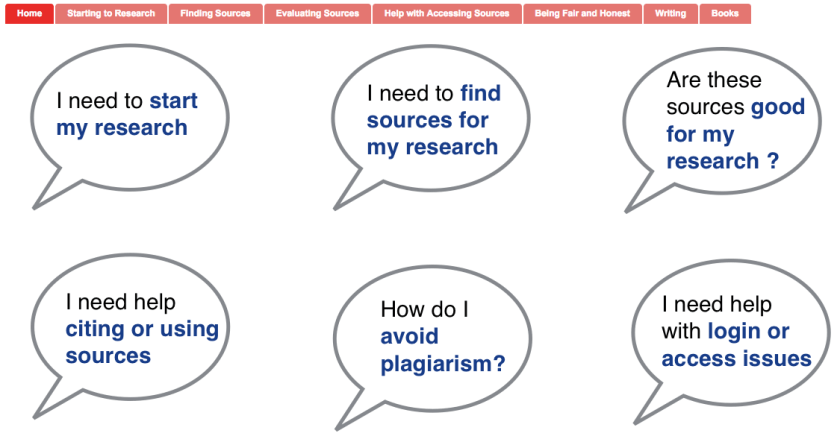
I think I need to move to a simpler and more intuitive layout – Following Katie Day’s layout for her research guide, perhaps making it student question related?

screen-shot-2016-12-10-at-11-08-41-am

At a whole different level is the services and guides that happen at Scotch College ….

screen-shot-2016-12-10-at-11-15-54-am

I think I need to sit down with teachers and students and really understand how they use information, how they look for it and where they expect to find it. Customer journey maps – something that I was thinking of as an alternative study avenue before I looked at our Blokes with Books club as my case study. Has anyone looked into that in the library context? I know people have looked at social media in library, but this is different – the physical and digital paths our patrons use to get information (or get frustrated by us). Any pointers?


Firmware (& Software)

Planning for a library expansion and renovation involves considerable time, thought and work on the “hardware” of the physical building. Including last week’s work of packing up the books and getting them put into storage. I’d blogged a little about how just prior to that we’d done a lot of weeding, and sorting out patron data on our system, as somehow the physical sorting out led to a drive for digital sort out and housekeeping.

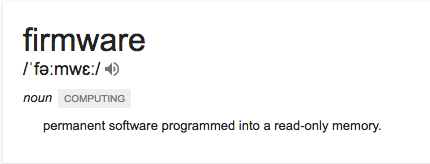
I’ve been promising for a while that I’ll talk a little about the “digital” side of the library, but first I’d like to talk about what I’d refer to as “Firmware”

screen-shot-2016-12-04-at-9-58-00-am

A characteristic of most international schools is the transience of its students, and often teaching staff. Naturally this includes the library.  In my current position I’m aware of the fact that I’m just one in a long line of librarians who have come and gone. I’m also extremely grateful to our permanent library staff, who keep things ticking over as teacher librarians come and go, each trying to put their mark on the physical and teaching environment.  They have institutional knowledge. They know what has been tried and worked or failed, and a pretty good idea of why.  I admire their unrelenting politeness and helpfulness as they cope with the latest “new broom” .

When you speak to other librarians, inevitably the conversation will come around to the fact that they’d like their staff to take more initiative, or upgrade their skills beyond shelving and circulation and basic queries.  But that is harder to realise than one would think. There appears to be a reluctance that sometimes is hard to fathom.  Some librarians have taken great initiatives in this direction – like the KL librarians under Robert George with their JAWs (Job Alike Workshop), and more recently the similar sessions initiated by Barb Reid in Singapore.  The problem with any professional development at any level is that there needs to be a compelling reason to take the learning and put it into action as soon as possible. But invariably the day-to-day tasks take over and there just isn’t enough space between relentless shelving and picking books for the next (18) Units to get the practise …

However in the last month, we’ve had to challenge the “read-only” part of the definition to its limits, with one staff member on maternity leave and the other on hospitalisation leave, and as a result, that once in a blue moon occurrence – a “firmware update” has become the new norm. So suddenly business as usual hasn’t been usual, and everyone has had to do everything all the time, with a lot of compromise and cobbling things together as we go along.  We haven’t had the luxury of designated tasks and roles, and suddenly we are all cataloguers, and weeders, and resource list creators.

I’d set aside a week for packing up the library. But I’d not calculated on the energy and enthusiasm of my staff and the maintenance staff, and the help of our Grade 5 students who made a “book train” from the library upstairs, so by the end of Tuesday we were pretty much done (and not dusted – boy oh boy, did we discover dirt and dust…). So I declared Wednesday to be systems and PD day, kept back 3 tables and chairs and we sat down and I taught everyone how to use Libguides.   We probably only spent about two hours on learning the basics, and that’s really all that is needed, because with everything it’s not about the theory it’s about using it.   Then back to some more boring stuff, getting images onto books in the collection.

And then more important, but still a little bit tedious – especially if you’re using Follett – checking through resource lists and updating visual search for all the UOIs.   Oh gosh, I’m embarrassed to say how many links were old or incorrect.

Next up was making resource lists for all the books related to all the countries our students came from. For Uniting Nations day I had made a cursory start by grouping books into continents as it was a “quick and dirty” way of getting lists out there for our “read around the world” challenge.  Now I wanted to dig deeper, so I took the list of all the student nationalities and we divided it up and started searching and added. We quickly saw the countries that were under-represented, or not even represented at all – books from / about Bulgaria anyone?

I also spent the better part of a day sorting out and adding books related to Social and Emotional Learning  based on the handout of Dr. Myra Bacsal after her talk. It also entailed adding nearly US$2,000 worth of books to a “to purchase” list, as I realised that while we did have many of the books recommended, we were also lacking in a few – and particularly in more diverse and more recent books.

Our final day in the library, around rapidly diminishing furniture – including at one point our desks, was spent putting the libguide PD into practice, as the 3 of us sat with a list of all units, all guides made and guides to be made and started putting libguides together!

screen-shot-2016-12-04-at-10-36-11-am

The previous day while my staff was helping their colleagues at our other campus, I’d been sitting with the librarians, helping them extend their knowledge of libguides, and us brainstorming ways of presenting physical and digital resources in the guides in such a way that it was easy to navigate and would ensure that students could benefit from knowing what books we had and also how to access other QUALITY resources (i.e. not just google) that we were paying for but were perhaps not being well utilized.

We decided on

  • having the central idea at the top in a floating box
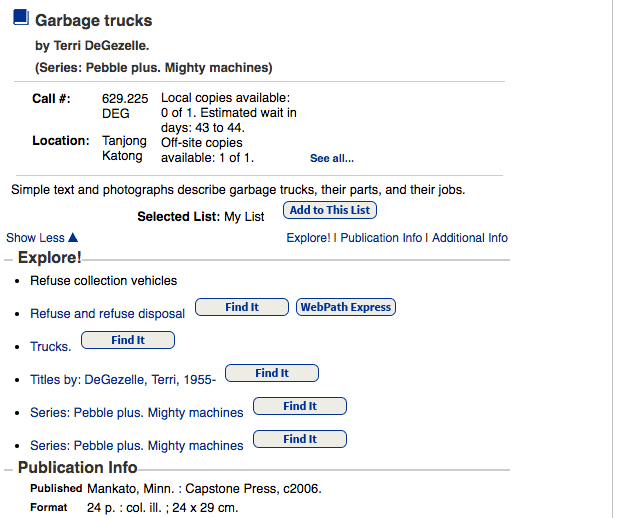
  • on the left – having a scrolling bookshelf of our unit books – using the Library Thing for Libraries book display unit. That way teachers and students could see all available books in a unit, even if they were distributed in a different classroom – and clicking on the link would take them to the book in the catalog – AND if they looked at the subject headings under Explore! would hopefully have a Webpath Express link to click on.
  • Putting some videos in the middle for our more visual / video liking students – also very handy for our ELL students with the paired speaking / images.
  • On the right having a tabbed box that could alternate between Brainpop (a staple in primary), Epic Books (easy to access and great free selection of nonfiction books for easy projection & assignment in class), Britannica (because Encyclopedia) and other links.

screen-shot-2016-12-04-at-10-40-52-am

screen-shot-2016-12-04-at-10-48-31-am

Of course nothing is simple – and even now as I look over the units, I see that some units have the UOI books around the central idea and inquiry in them and some have that plus what-ever literacy / math connection is being made (so more than half of the books are poetry for example). In the medium term all that needs to be straightened out and sorted out as well.

Also before you can add a scrolling list of books, you need a list of books … and to know how to get the books into Library things, and then into a book display widget – so I made a little screencast on how to do that!

The wonderful thing about all of this is the obvious enjoyment and pride that my staff got out of researching units and finding resources and adding them to a guide – they kept on saying “this is so interesting”, and “this is so creative”.  Of course it is not a “quick” thing, I’d say on average a very basic guide at primary level that is reasonably complete will take around 3 to 4 hours. And then one just has to hope that the units don’t change every year!

All in all, and incredibly productive week, and also my staff finally “gets” the fact that my drive for automating student update and photo import etc. etc. is not to put them out of a job, but to free them up to do more interesting and meaningful work.  After we talked about that, one staff member said “and now to automate the shelving!” amen to that!


MLA8 and Chinese …

A fellow librarian in Shanghai and I have been working on creating some new MLA8 posters in Chinese for her bilingual school / library.  It’s been an interesting process to put it mildly.

We started off with the MLA posters I created with Katie Day about 2 years ago, and which she updated recently to reflect the MLA8 changes. Now translation is as much an art as a science, and, with the help of a Chinese library assistant we made some rather silly mistakes along the way which in retrospect are obvious. Each round was accompanied by the refrain of my Chinese speaking daughter of “but they just don’t have that /do that in Chinese”

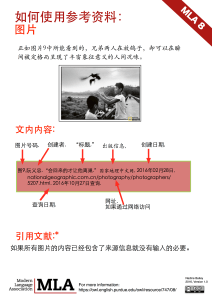
Round 1 – we just translated the English posters into Chinese – well duh, why on earth would you take an English book / video etc. and cite it in Chinese?

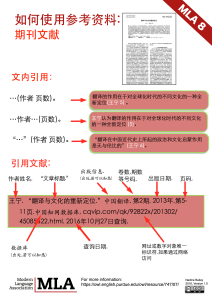
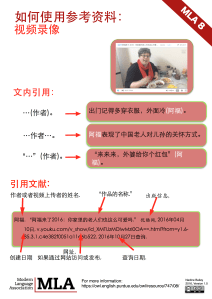
Round 2 – finding suitable Chinese originated materials in each basic format and creating citations for them. It may sound easy, but it’s actually harder than you’d think. I worked on the newspaper one with my daughter, and it took a whole evening! Then there was a great NatGeo chinese video, but it was way too complicated as it was a documentary with a director quoting from an interviewee – yes a nice challenge for advanced citations but not suitable for a beginner “basic” poster to get the main ideas across.

Round 3 – punctuation. I’m not entirely sure we’ve nailed this one completely. We ended up making an executive decision on making the in-text punctuation follow the Chinese punctuation – particularly for the full-stop / period “。” and the English punctuation in the “works cited” section. What we didn’t do, and my daughter insists we should have done, is to put the titles of the book in the chinese brackets instead of the inverted commas, i.e. 《。。。  》instead of “…”

Round 4 – italics. MLA8 asks for italics, and initially I spent a lot of time trying to italicise in IOS10, which an afternoon of searching will tell you is not possible.  Along the way I found out some truly fascinating things about Chinese fonts and typography, which you’re welcome to read up on – it really is very interesting. I learnt a new word – glyphs, and the fact that you need around 20,000 of them for a Chinese font! (I also coincidently found out how to add phonetic marks above characters in Pages – never know when you’ll need that!)

Two things cinched it, a comment on a CJK font forum (Chinese, Japanese Korean) ”

“I’m not solving your problem, but to remind you that this kind of “programmatic italic font” has really bad readability.
For CJK text, the right way to express emphasize (or quote) is to use another font (usually serif font). Especially for Simplified Chinese, use Songti, Fangsong, or Kaiti instead of italic font if your text font is Heiti (iOS default). I know it’s a little bit complicated, but this is really how we do italic.”

and secondly from the MLA itself (which is where I really should have started, but sometimes you go off on a tangent without really thinking properly).

Q: Do I italicize Cyrillic book titles in the list of works cited?

In the past, titles and terms in the Cyrillic alphabet were not italicized, partly because it is based on the Greek alphabet, which traditionally is not italicized (on this point, see Chicago Manual of Style, 16th ed., sec. 11.131). Letterspacing instead of italics was traditionally used to emphasize a word or phrase.

Today, Cyrillic cursive (the term italics is usually not used in this context) for titles and for emphasis seems to be used often in publications, including scholarly publications, perhaps because of progress in digital typesetting or because of a global trend toward standardization.

Note that there are many languages in the world that do not have an italic font—Japanese, Chinese, Korean, Armenian, for example. Arabic sometimes uses a typeface that slants to the left instead of to the right.

Given the complexity and specificity of historical, cultural, linguistic, and printing practices throughout the world, a writer should not use italics when a book title is in a foreign language that is not written in the Latin alphabet. If a work is being prepared for publication, let the author pass that buck to the publisher.

Round 5 – checking and checking actually we just finished this now – with adding the last missing closing bracket – and voila, the posters may see the light of day.

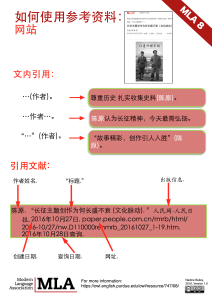
mla8-referencing-image-ib-version-chinese mla8-referencing-image-chinese mla8-referencing-article-journal-chinese mla8-referencing-video-chinese mla8-referencing-newspaper-chinese mla8-referencing-book-chinese mla8-referencing-website-chinese

And now, I nervously exhibit them for comment and criticism and correction by my peers! All posters are creative commons with attribution please. My next post will be what I refer to as “MLA8 Lite” – the posters I’ve made for my G6 PYP exhibition students. Just the works cited, without the in-text citation, with explanations in the form of the MLA8 Elements.


It’s so beautiful I want to cry …

It’s been a tough few weeks, and this morning I was reminded just what it’s all about. I was reading “All the lost things” by Kelly Canby to a Grade 2 class, and at the end, one little girl said “It’s so beautiful I want to cry” at which point I also wanted to plink a tear. Because it is beautiful. And what is even more beautiful is when a 7 year old recognises and empathises with beauty in a book.

lost-things

From an instructional point – it also has great links to the string of Lauren Castillo books we’ve been reading as part of the Global Read aloud  so we could refer back to “Nana in the City” and “Yard Sale”.

The other moment of sad beauty this morning was reading “Small Things” by Mel Tregonning. It was the third or fourth time I’ve started reading this, and each time I had to stop after a few pages since it’s not something you can just read in a hurry. It’s something that needs you to slow down and take your time. You also both need to not know the back story before reading it, and then to read the back story and then read it again.  Many young children suffer from stress and anxiety. The fact this is a wordless book makes it even more powerful. Look at the demons following him and eating away at his existence.

I’m almost at a loss at what to do with this. I can see parents being terrified by this, and yet we need to acknowledge the range of feelings and emotions our children endure. It would be a powerful book for use with bibliotherapy, but one almost doesn’t want it used wrongly.

Make-over update

When I tell people we’re getting to renovate and extend our library their first reaction is “wow, that’s amazing, you’re so lucky!”. And yes, prima facie it is so. But right now it’s feeling rather overwhelming. And ironically most of that is not so much to do with the change as the amount of preparation that needs to be done. Speaking of change – you HAVE to get “Bug in a Vacuum”

I am a veteran of moving. 10 countries in 24 years plus countless internal moves in those countries and 3 moves in the last 5 years. I know it pays to be prepared and to clean and clear before the move. And as I remarked in my last post, a lot of that cleaning and clearing happens behind the scene.  Things are slightly more complicated as well due to well, life. Unforeseen circumstances. Like one staff member on maternity and another on hospitalisation leave. And part of my gratitude thoughts each day are for my remaining staff member who is picking up a lot of the slack and the temporary staff member who is happy to learn the ropes and keep things ticking over. And the other temp who has been coming in and the occasional parent or volunteer for their kindness.  But it does slow things down as we adapt and learn.

So, significant but time consuming things that have been done this week – including taking up time in my weekends – those weekends that I thought would be computer and work free now that I’ve finished my M.Ed!

  • Putting patron photos into FollettDestiny  – easy in theory but quite a lot of preparation work – including learning all sorts of new Excel tricks on how to add things before and after text in cells!  And of course 90% goes well, but the 10% that bombs out, takes 90% of your time to trace why an upload didn’t work, what went wrong and how to remedy it.
  • Cleaning up patron data.  After the last patron update I found about nine pages of patron data that just wasn’t right. Parents marked as students or staff, students who had left years ago, staff who had left, incorrect emails etc.  Now bear in mind, when I prepare these lists, I then go into school with a full teaching schedule and it literally took 2 people 2 days to clear it all up in-between their regular tasks of circulation, shelving and THE PREP
  • Yes, the PREP. we have 9 different grades from Pre-Kindergarten to Grade 6, and each of those have 4 (Kindergarten) -6 (the rest) UOIs. The library has to be vacated by next Friday. Most UOI’s are changing over on Monday coming. Many UOIs have changed this year. So that means checking the central idea etc. checking previous year’s lists, quickly checking with the lead that my understanding of where the topic /theme / concept is going is the same as theirs, making new lists and then packing up 18 boxes of books and DVDs – 9 for the coming week when we’ll have over 1000 books returned from the last units and 9 for the first weeks of January 2017 – just in case. Because of course our handover of an empty library to the designers / constructors is 1 December and of course their hand-back to us is 1 January. But I am of little faith that things are flawless. So I err on the side of caution.  And bear in mind, we’re still having our 35 classes a week, plus all sorts of meetings that are using the library so we’re configuring and reconfiguring the space and arranging catchup classes…
  • The new books. And the wrongly processed books. I still hold vestiges of anger on our last big book order with Follett that went horribly wrong in every which way it could have gone wrong. They didn’t deliver on time or as arranged, they catalogued incorrectly, spine labels were wrong etc. So we’re still sorting out that mess. And then I put in a couple of other smaller orders, but our cataloguer is off on hospitalisation leave so we’re cataloging on the fly.  Now this is a GOOD thing I keep on telling myself. I’m all for final responsibility for tasks and work flow, but I’m also all for everyone pitching in and helping and knowing all aspects of the process. It’s been a little peeve of mine in the library world that there is so much segregation of duties and these past weeks have just proven that given the chance people can do way more than they or anyone else may have thought. But it is extra work – did I mention what else was going on?
  • The weeding. Saying goodbye is so hard to do!  I must admit having absolutely no problems ditching the disney fairy series that no-one was looking at or borrowing. But then there are other books – Michael Rosen’s “Sad”. I’m sad that no-one seems to have ever borrowed that. And I feel bad that I’ve not marketed it, or allowed it to see the light of day and be nurtured and treasured. Perhaps if I pair it with Bug in a Vacuum?  Weeding is sweet sorrow. It highlights our failings as book pushers. I feel like a neglectful parent when a book that’s been bought doesn’t get the attention it needs. I spend time with each of them and ponder whether putting them on a resource list would help. (No jokes about “will this bring me or someone else joy) Or perhaps asking students and teachers to ponder their fate. And I do both, and some survive for another day.
  • Acquisition plan – my kids ask me “if we’re getting a new library does that mean we’re getting new books?” This is the double edged sword of money and budget. I was talking to some fellow librarians last week – their budgets are double mine. Sometimes less is more. Our students and our teachers probably only have capacity for perhaps one really good reading book a week. Each. What should that book be? And for research / nonfiction? It’s so hard. I try so hard, but this week it has been stingrays and grasshoppers. Boats and jet planes. Last week it was fast cars and how to make your own vegetable garden (try getting one of those for an equatorial climate, suitable for G2 level), dinosaurs are totally out of favour. They want tornados and not hurricanes.  And “Miss where are your Indian books?”  and “there’s nothing on Bangladesh” I’m trying to diversify. They deserve Indian books, and overseas Chinese but not ABC (American born Chinese) books, and Korean protagonists and Japanese heroes. The triplet sister of acquisition and weeding is discoverability. I need to crack that nut in the new library. Does that mean genrefying, through label or location? Does it mean more work on resource lists or libguides or other pathfinders?

The problem with grappling with all these things is that they take up a lot of brainspace and thought space and discussion space. All of which is being take up by doing. I’m looking forward to the library being boxed up and having time to be more strategic, having time to go into classrooms and observe and understand.