School Year end 2025

We’ve been on summer break for just over a week now and I’m feeling sufficiently rested to sit down and write again.

Book returns

The end of the school year is always a busy time for librarians with the dual task of getting overdue books back and making sure that students have enough of the right books in their hands to entice them to do some reading over the summer. It really is a dichotomy – the students who most need to read more are the ones who have the hardest time keeping track of books – probably because they just borrow because they’re being told to do so and then promptly put the books somewhere never to be found again. And then of course when they become overdue it’s a fuss and bother and they are even less inclined to borrow.

Inventory

The big tasks include doing inventory – something we’ve turned more into a continual process so by the end of the year it’s more just following up on missing items – often they return – from students (or more often returned by nannies or parents) who consider going past the circulation desk as being optional. Unfortunately being in the middle east certain types of books also just disappear depending on the heat of current rhetoric – or in the case of this year actual bombing going on.

Core Collection

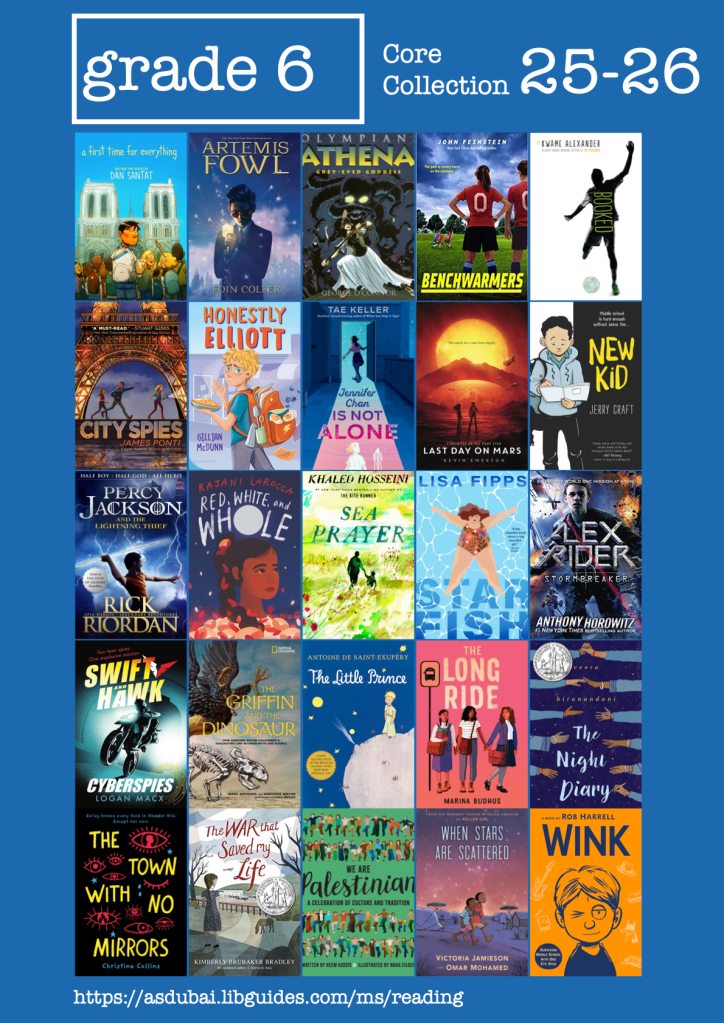
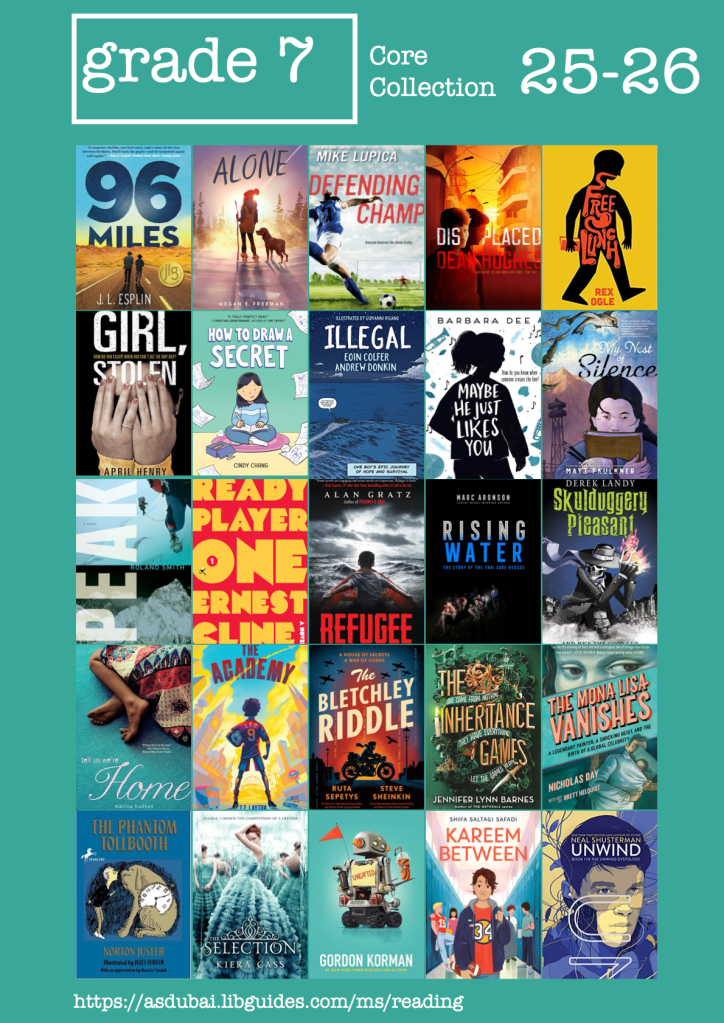
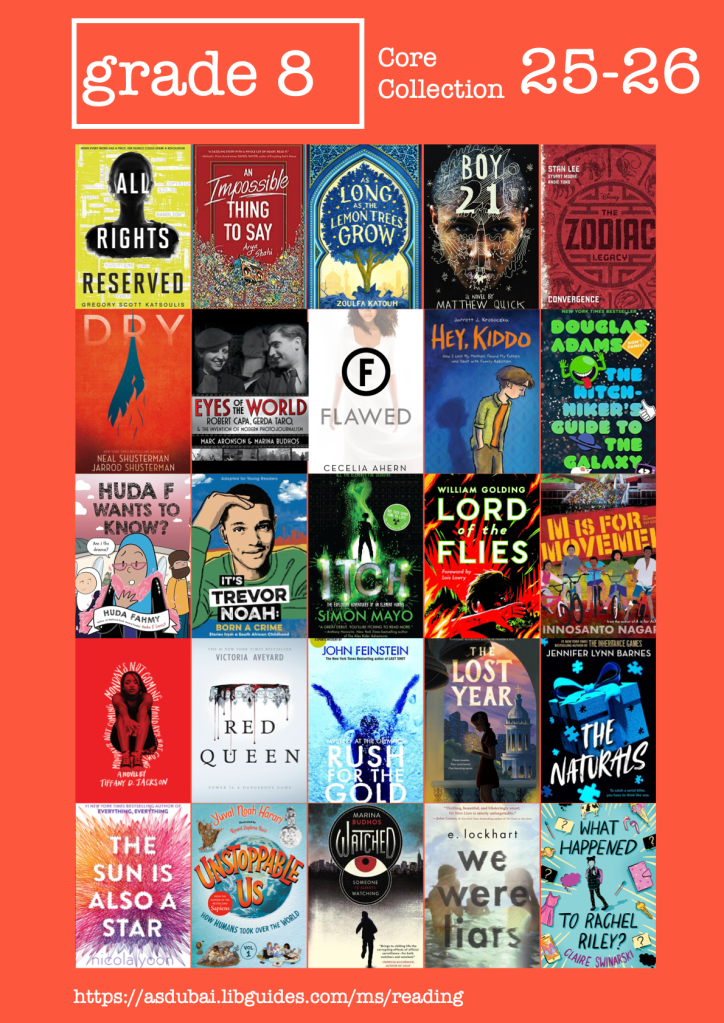
With our ELA (English Language Arts) department I’ve been very busy creating our new “Core Library Books” for the coming year (Grade 6; Grade 7; Grade 8)

And, continuing the tradition started last year, promoting them first with our middle school faculty. I’ll do a separate blog on the result of the core collection this year.

Summer reading

This also feeds into our Summer Reading Libguide which we try to promote as much as possible with students and parents. A few of the ELA classes had their students explore the guide and the various reading lists in detail and then make their own reading goals based on the lists and then email their parents with their reading plans and either borrow the books or request parents purchased them for the summer. I was also on hand with Sora Marketplace open to purchase the eBook or Audiobook for the students who wanted a digital copy. Our summer reading borrowing guideline is “as many books as you need and know you can take care of and return after the break

Annual Report

The most arduous task at the end of the year, and one which it seems many international school librarians have more or less given up on, is creating the annual report. I can see why people stop doing this. With declining borrowing / reading it can be quite a depressing exercise. It’s also remarkably difficult to get good data our of our systems. Follett Destiny is a dreadful platform to get good data from – in contrast with other systems. I was reading Rutger Bregman’s “Moral Ambition” (see video below) around the same time, and came across the concept of vanity metrics – basically just putting together data that makes you look good. With that at the back of my mind, putting the report together (Annual Report 2024-25) became this exercise in trying to show both that the situation with reading is not great while trying to show that as librarians and teachers we’re doing our darnest to turn the tide and hopefully all is not lost. And even when we lose in reading perhaps we’re making inroads in research. Much as I hated studying business / accounting and was glad to escape being financial person it did put me in good stead for being able to work with data.

I’m planning on doing a bit more blogging this break, so keep coming back! Comment on any topics you’d like to see covered.

The troops are so very tired

Week 11. And while partial opening has been announced at most schools in Beijing for G12 and G8, this probably going to result in more stress, uncertainty and questions rather than less.

Even more than ever before I am convinced we will need to radically change our teaching and learning practice. And now I’m not talking about the students but the adults. Everyone I’ve spoken to today has been really exhausted. In my conversations I’m trying to get to a better understanding of it – since we’re not feeling the joy right now. It’s wintertime in the trenches and the troops have foot-rot.

The reasons I can find are related to the need for some kind of assessment and evidence of learning. Which means assignments and marking. And lots and lots of feedback. I sense a huge reluctance on the part of teachers towards giving group feedback. Or even to let go of one-on-one emails in favour of using discussion forums to address anything – even banal requests for links to a document or small questions on assignments.

All this comes from a very good place. A very kind and caring place. And it’s really harming our teachers. Someone confessed to an 18 email exchange with a student on uploading a video file. I remarked that it could have been solved with a 2 minutes conversation with myself or the IT department but the person said they “wanted to work it out themselves and learn how to do it too”. Teachers are fiercely independent folk. I’m a fairly independent type myself, but I’ve re-qualified into one of the most collaborative parts of the teaching community possible – Teacher Librarianship. We have no shame in asking for help in our PLCs and (except for a few not so admirable souls, mainly found on TpT) openly share anything we create freely.

Independent, soldiering on with being too proud to ask for help is not going to help this. As my esteemed colleague Stephen always says

“We need to take time to make time”.

In my morning chat with my husband this morning – he’s been thrust into the hotel business this year in a managerial capacity – he reminded me of a saying in that business:

“Tell Everyone, Everything, Everyday”

when he first told me it months ago I thought it was a bit patronising. But I’m thinking it has some merit now. Bear with me.

Tell Everyone

With asynchronous online learning, people spread over the globe it’s easy to lose sight of who is or isn’t at meetings or training and who may be missing out on important communications or PD. Weekly updates tend to have content creep which means that there is so much to read through and absorb and so little time in which to do so that messages get missed or suffer from the consequences of the idea of “I’ll go back to that later”. Who are our messages missing and why? Just like we attempt dual coding and multi-modality in our messages to our students are we doing enough of that for all staff?

Everything

Everyone is overloaded. Too much content, too long emails, too bloated libguides, too many FAQs. But there are seasons to online learning too. What everything looks like this week as teachers are preparing for online meetings with families and students looks different to when they’re introducing new concepts or doing formative or summative assessments. I mentioned Atul Gawande’s “The Checklist Manifesto” to a colleague this morning and suggested we perhaps need to create one for the “hot topic” of the week. I mentioned it again to another colleague struggling under the weight of marking – I’d attended a great webinar (one of many that Microsoft is hosting – you just need to register to be able to view it) where Esam Baboukhan showed how he uses self- and peer-assessment checklists before student return their work for grading. I don’t think we’re above following the lead of pilots and surgeons in this regard, and found myself saying to someone I was helping today, “slow down, slow down, let’s just do this slowly and carefully and then you can use it as a template for the next thing.”

Notebook self and peer assessment

Everyday

In Atomic Habits, James Clear talks about the “compound effect of hundreds of small decisions”. When everything is topsy turvy and no one really has a proper routine (despite the plethora of nice looking examples all over twitter and on TV and in media) it’s probably less about having a schedule and more about having habits that can exist independently of time and space. I’m thinking it’s more in the nature of “when I’m doing this, I do it like that” It’s consistency and predictability that wins this battle. You can always find this information in this place. Things are always named in a certain way. Meetings are always found on the relevant shared calendar. Recordings are always found in a certain channel and named in a specific easy to find way. Because there is so much it is so easy for things to get out of hand. It’s easier to quickly reply to a student than to ask them to post the same question on the forum. It’s easier to troubleshoot the same question with a quick email than to do it the first time it arises and then commit that answer to a knowledge base. I remember when we moved over to https:// for all our systems. People had all their bookmarks and caches with the old http:// for things. It worked fine while at school but didn’t work for them at home. We got the question why all the time. In the end we put it on Yammer and “bumped” it up every day for weeks on end. People forget. Things slip their mind. Minds are overflowing.

Learning new tools is hard. Learning new ways of teaching is hard. Everyone is tired. I’m just not sure what it will take to get off this very fast spinning wheel. We’ve not yet reached cruising altitude and we’re about to go into another tail spin.

____________________________________________________________________________________________

Resist the list

I am convinced that there are generations of parents (and librarians) who think the main purpose of a librarian is to create age/grade related lists of books for students to read. When parent-teacher conference time comes around, if parents venture into the library and engage – as opposed to using us as a baby-sitting booth / place to drink coffee and wait / information-direction desk the one and only question they seem to have is “do you have a book list for Grade …”

So why don’t I have a book list for Grade …? When they allow me time to explain, and time to discuss their child(ren)’s reading needs – preferably with the child present these are the themes of the conversation:

What are your (their) favourite things in life?

I don’t start off with what books they like, because their parent(s) probably wouldn’t be having a conversation with me if they liked books or reading. But if I can get a feeling for what kind of person they are, I can start to think what kind of books may be an entry point to intersect with their lives.

I’m very much a “there’s a book for that” type of person and my staff always jokes with me that they can’t have a conversation with me without walking away with a “book for that”.  If a student likes gaming, we have gaming books. If they like art and they’re EAL (English as an additional language) I have no problem recommending starting with some of our fabulous wordless books, picture books or graphic novels. And I’m happy to discuss how sharing a (sophisticated or even just funny) picture book together is a way better and more productive use of time than forcing a child to plod through Shakespeare or whatever classic the parent loved when they were young.

Reading, like physical activity and learning, has to leave the person with the desire for more. The feeling that they’d like to keep doing this for a long, long time. Forever in fact. If we make them hate it now, we’re f*’d as a human race.

How much can you read?

This is a little open-ended. It’s a combination of the dreaded “reading level” and how much physical time they have for reading.

We have a lot of EAL students in our school. With very ambitious parents. Who are often well-meaning but misguided. During my 16 years in Asia, I have always been astounded at the high level of education and knowledge my Asian counter-parts have. Newly minted in Asia I had no idea of the classic / foundational texts of their countries / languages / cultures. They knew so much of the western foundational texts – Grimm, Shakespeare, Greek etc. Myths and Legends. I’m always humbled by this. However, they’re not helping their child when they insist that a child with a phase 2 EAL level reads Shakespeare in the original text.

I’ve not got much against Shakespeare (except inasmuch it’s part of the dead white male canon etc. etc.) and I have Shakespeare in my library in every form / format and level. And I’m happy to help these students to start with an abridged version, an illustrated version, a short story version, a graphic novel version. But when what they need is basic foundational functional language so they can survive and thrive in a classroom and canteen, honestly the Plantagenets is not going to help them.

Screen Shot 2019-10-06 at 09.26.20

reading

Having time for reading is another big issue. There is this romantic notion that all school-going children read for 20-30 minutes a day. You know all the charts … the funny thing is they all have exactly the same 1987 source, and it’s not even an accurate representation of what the article said – see * below.

I don’t know what your classrooms or homes look like, and I’m sure there are schools, classrooms and homes doing brilliantly on reading. Sustained reading. Uninterrupted reading. I fear the truth is otherwise. I suspect students spend a lot more time on Youtube for their learning. YouTube publishes some interesting statistics.  Of relevance is “YouTube is technically the second largest search engine in the world.” and “Average Viewing Session – 40 minutes, up 50% year-over-year”. If I had to put some money on what our students are watching most on YouTube, it wouldn’t be much to do with learning but rather they seem to spend a lot of time watching other students engaged in one kind of game or another.

I think if I had to ask a bunch of our middle-schoolers to preference-rank what they like to do, if reading wasn’t on the list, it wouldn’t even be mentioned. If it was on the list, except for maybe 5-10% of the students it would be way down at the bottom.

So this part is a little about whether the student is able and willing to make time in the day to read, and based on the little perceived time they have, what they could read.

I usually tell students that if they truly are reading every day, they should be able to get through at least a book a week. So the converse is also true. What size, format or type of book can I pair with this student that would guarantee they’d actually finish it in a period of time that will allow the book to remain meaningful?

We have this illusion that if only we could find the “right” book, a student will just want to read it non-stop and then will be converted to reading for life. I don’t think that is true. I think we need to find a succession of books that students will be successful with so that they can build up some kind of reading stamina that will result in them being “good enough” readers so they can be successful academically. And if we’re lucky they’ll pick up a book again after they leave school.

What are your friends reading?

The need to belong is second only to the need to breathe for teenagers. There are glorious moments when we can ride on the wave of “it” books (yes, like Harry Potter). Where there is a buzz around a book or an author that makes it possible for us as librarians to just ensure we have enough copies and that we get out of the way of the stampede to the check-out desk. And make sure we have enough read-alike lists.

That, for teenagers may be the critical bit – the herd immunity thing. Having a critical mass of “cool” students who are readers, who then infect the rest.

My only compromise to lists is having students recommend to each other. Before, when I was in primary and could see each class each week, I had a list per grade. Now, I’ve convinced one grade (6) to make a list as a gift to the incoming class.

What is your teacher reading (aloud) to you?

If only, if only. And when a teacher starts a habit of reading aloud to a class I can guarantee that book will become the favourite of just about every child in that class. Bonus points if the book is the first in a series, because they’ll then rush to complete the series independently.

I’m just going to put out a plug again for the Global ReadAloud. I’ve curated the resources for this year’s books in a Libguide. It’s not too late to start.  It’s never too late to start. Just read. Or read and connect. Read now, with the current great list of books. Or read some of the books from previous years. Or read this year’s books now and other books from previous years later. Honestly it doesn’t take much time. I’m reading aloud each morning from Front Desk before school to a small group of students. We have about 10-15 minutes and get through a chapter or two/three depending on the length of the chapter and what else we do / discuss around it.

Screen Shot 2019-10-06 at 10.46.53

And this is where I tell parents that if all else fails they should read to-and-with their student. Even if they’re 14. And I tell them how we still read aloud to our IB-level child who also doesn’t like reading. And they look askance at me. Or they make apologies for their own poor reading – and I tell them that’s exactly why they should be reading with their child. As an empathy building exercise. As a gesture of solidarity and understanding that it is not perhaps easy, but it is important. Important enough that we both spend time on this.

Lists are easy to make. Easy to ignore. Conversations are harder, take more time, but potentially have more value. What do you do in your schools / libraries?

————————————————————————————————————————————

*This is where things get very interesting – I went back to the original article and it says nothing like what the posters say … it’s about vocabulary acquisition and learning new words based on context (nothing about standardised tests!). AND they’re talking about students reading 15 minutes IN SCHOOL, plus out-of-school reading of newspapers, magazines and comic books. So the sum for an “average” 5th grader is:

600,000 words in school; 300,000-600,000 words out of school = +/- 1 million words

I doubt the average fifth-grader is reading anything near that amount in or out of school.

” Though the probability of learning a word from context may seem too
small to be of any practical value, one must consider the volume of reading
that children do to properly assess the contribution of learning from context
while reading to long-term vocabulary growth. How much does the average
child read? According to Anderson, Wilson, and Fielding (1986), the
median fifth-grade student reads about 300,000 words per year from books
outside of school; the amount of out-of-school reading increases to about
600,000 words per year if other reading material such as newspapers,
magazines, and comic books are included. If a student read 15 minutes a
day in school (see Allington, 1983; Dishaw, 1977; Leinhardt, Zigmond, &
Cooley, 1981) at 200 words per minute, 200 days per year, 600,000 words
of text would be covered. Thus, a rough estimate of the total annual
volume of reading for a typical fifth-grade student is a million words per
year; many children will easily double this figure. Reanalysis of data
collected by Anderson and Freebody (1983), using information on the
frequency of words in children’s reading material from Carroll, Davies,
and Richman (1971), indicates that a child reading a million words per
year probably encounters roughly 16,000 to 24,000 different unknown
words.
How many words per year do children learn from context while reading,
then? Given a .05 chance of learning a word from context, and an average
amount of reading, a child would learn approximately 800-1,200 words
well enough to pass fairly discriminating multiple-choice items.
These numbers are at the low end of the range that we have previously
estimated (Nagy, Herman, & Anderson, 1985; see also Nagy & Anderson,
1984), because of the lower estimate of the probability of learning a word
from context and a more conservative estimate of the number of unknown
words encountered during reading. Yet, the figures suggest that incidental
learning from written context represents about a third of a child’s annual
vocabulary growth, an increase in absolute vocabulary size that has not
even been approached by any program of direct vocabulary instruction.

Nagy, W., Anderson, R.C., & Herman, P. (1987). Learning word meanings from context during normal reading. American Educational Research Journal, 24, 237–270

Collaboration is air to us

And we need it to survive.

I meant to write this post a little while back, but then school started, and whoosh there went all my potential blogging time.

On one of the FB groups I follow someone was asking about teaching academic integrity / honesty. Naturally the librarians in the group responded with “ask your librarian”. To which the poster responded “I took it on. Go me!”

There are so many things wrong with this response it’s hard to know where to begin. And yet it is pretty common. Even in IBO programs. Maybe especially in IBO programs? You see a lot of IB educators (PYP, MYP, IBDP) are really smart people. Often they’re subject specialists. They’ve had additional post-graduate training specific to the IB, and often also have post-graduate degrees.

So what can be so hard for a person like that to teach information literacy / academic honesty etc? Why on earth should they involve their teacher-librarian (assuming that one still survives in their organisation and hasn’t been replaced by a (unqualified) parent volunteer or the principal’s wife?

In the first instance it’s not quite as easy and clear cut as people presume it is. Heck there are people like Mike Caulfield make it their life’s work to seriously consider information literacy and over the years boil it down to its most useful essence – perhaps in response to the “go me!” attitude of educators.

I’ve walked into classrooms where teachers have been talking old-fashioned nonsense that was relevant in the time they studied and had to go back to micro-fiches or dig through unfederated databases. Classrooms where teachers are mixing up APA in-text citations with MLA7 works cited lists in an environment where MLA8 is the norm. Classrooms where teachers have unattributed images or texts in use…

But worse than all of that, they have a black and white view of plagiarism. One that is unsubtle and non-nuanced. One that makes students “good or evil” and neglects the approach that academic honesty is a community effort. That it’s too late to make it a quick add on to a lesson. I’ve written on this in the past – plagiarism is not a simple matter, but mired in assumptions, teaching, culture and ignorance. And that’s the exact reason why it should be addressed centrally with common language, common understanding and be phased in over years with teachers and the rest of the community as role models.

Academic honesty is not just about consistent, correct citations. It is an integral part of how we look at research and inquiry. It’s not just a once off lesson taught in isolation, it’s part of us helping students to develop as researchers (please read this post on citations helping research in backward design). But if the teacher librarian is left out of the equation, it is not part of a progression, not part of ongoing development. And then we get teachers grumbling about how students are lazy and just copying and pasting, and having no integrity blah blah blah.

So don’t “go you” – unless you’re going to your teacher librarian (TL). And if you haven’t bothered to talk to, or collaborated with your TL, do yourself, and your students a favour and do so. Yes you’re smart and all that. But the TL is a specialist in this stuff (remember the two masters degrees they need?). And if they’re not used, you’ll be left with a bunch of apps and ignorance. And the problem will not go away with some nifty templates from teachers-pay-teachers or your mates on FaceBook.

——-

Photo by Fedor GoldBerg from Pexels

Collateral damage or passive Anura?

Classroom libraries vs. school libraries, teacher superstars marginalising teacher librarians – or is it our fault?

This post was first going to go one way and then through holiday laziness in posting, it has taken a kind of dual direction as I have more time for self-reflection and research.

The first offensive was launched by KC Boyd (2018) in her post “Easy Like Sunday Morning: School Libraries vs Classroom Libraries” where she reflects on Chicago School System and the impact on literacy of shifting from school libraries to (only) classroom libraries (hint – it wasn’t favourable). She refers to Ariel Sack’s post on the importance (and diminishing) role of school librarians who asks “Can this project be done by an individual teacher? Yes. But it’s something different when one person with a vision and the time to implement it leads it consistently for the entire school, every year” (Sacks, 2018). I’d argue there is another factor – one very rarely meets a librarian who doesn’t read (I have however met library assistants without any interest in books or reading); but the Peter Effect is well documented in teachers (Applegate & Applegate, 2004; Binks-Cantrell, Washburn, Joshi, & Hougen, 2012; Turner, Applegate, & Applegate, 2009) with studies in various places around the world documenting aliteracy in teachers / pre-service teachers – “Findings revealed that 54.3% of 195 teacher candidates were classified as unenthusiastic about reading and only 25.2% of teacher candidates reported unqualified enjoyment of reading.” (Binks-Cantrell et al., 2012, p. 526), and the picture appears to be getting worse rather than better (Skaar, Elvebakk, & Nilssen, 2018).

This is something easy to lose sight of when twitter, YouTube, Facebook, blogposts and podcasts are dominated by literacy superstars like Pernille Ripp, Colby Sharp, Mr. Schu, Jennifer Gonzalez, Angela Watson etc. But for every one of them, even a small imitation of them, there are likely to be three or more other teachers who are either not enthusiastic about reading, or, who actually don’t deign to read the types of books their students do – something I know my librarian mentor Katie Day, (successfully) worked very hard on with the teachers at UWCSEA-East when she was there. Based on my own experience I have encountered whole grades where not one teacher has been actively and passionately engaged in books and reading, and where this is apparently not seen as an issue (except when it is reflected in their students’ testing scores – but then the solution has been to work on the students rather than the teachers).

Regie Routman in her article “On the level with levelled books” (Routman, 2018), makes some valid arguments for free voluntary reading, and the choice of a selection of relevant and developmentally appropriate books for classroom libraries, but only makes oblique reference to public libraries and with no mention of school libraries or librarians – not even in a nostalgic or wishful manner. Relying on teachers who care and the intervention of a literacy expert is not a long term solution!

Colby Sharp, boasting a 3,000 book classroom library, ordered in a numbered system unfamiliar to any librarian I asked, talks about book checkout and is quick to dismiss the scanning system a librarian assisted him in setting up as “too much trouble”… (Sharp, 2018)

To which Day responded on FB “as long as he is on top of what all his students are reading, then, yes, it could work. But it’s not scaleable — and he doesn’t mention inventory checks — so at the end of the year you know which books might need to be replaced. With 3,000 books, it might be good for his students (other students? other teachers?) to be able to search and discover what books he has in his class library… Just sayin’… And LibraryThing’s TinyCat is definitely an option he might consider — to be able to see his collection online, whether he uses their circulation system or not.”

And then I found out what his library looked like – with a self-invented number system – ok so Dewey doesn’t do it for everyone, but those random numbers? (Sharp, 2017). I love the idea and potential of classroom libraries – I baulk at the cost, duplication of effort, waste of resources, money and time, lack of discoverability, lack of meaningful data and often stagnant nature of them. I have seen money wasted on thoughtless last minute purchasing without any clear strategy, collection management or development. I’ve seen classroom libraries with books that would better be relegated to pulping or, redistributed to older or younger students. I’d be the first to admit that often no one knows students better than their class-teacher, but just as we shouldn’t have to choose between classroom libraries and school libraries, so too the burden of creating dynamic exciting collections needn’t be the domain of only the class teacher or the librarian – together we definitely are better. Dialogue, collaboration, debate, relative expertise – all these things make us stronger as a learning community.

I started out being a little annoyed at the lack of mention of (school) librarians, but then reading the FB question of a librarian, (who shall remain nameless) challenging whether she should be expected to find a selection of books on a specific theme for a teacher because “she’d already shown the teacher how to find book in the system” and the responses I wondered how much of it was our own fault? We should be falling over ourselves to help teachers, parents, administrators, everyone in the community with lists and suggestions and books and resources they didn’t even to know to ask about. We should be anticipating and proactive. Not whining on FB as to where the limits of our job lie. I love the fact that this is one of the careers where you can pretty much be without boundary and limitless in what you can do – all in the interest of teaching and learning.

Spending a bit of time on Twitter I saw what was going on with Project Lit – something started in an English Classroom that is going viral (Riddell, 2018), (and what an excellent book collection they’ve created!) and I thought, darn it – we’re missing so many tricks here. Why aren’t teacher librarians initiating things like this, or the GRA? Why aren’t we leveraging our knowledge and experience in more ways than just fretting about our increasing marginalization and extinction? Why aren’t we taking more leadership and visibility in these arguments and discussions?

project lit

We aren’t part of these discussions and we’re not top of mind to any of the people who are getting attention. Whose problem is that? Do these “superstars” have a blind spot to anything NIH (not invented here), monstrous egos, or are we / have we become just so marginal to the whole reading / literacy scene that we don’t even merit a mention unless prompted (as the Sack article intimated)?

On FB again, another librarian spoke of her school that has gone from a thriving library system with two libraries run by two qualified librarians that’s been whittled down and compromised to one remaining librarian and was wondering what the moral of the story was – I commented “frog in a pot that slowly comes to boil”.

The problem with being a passive Anura is that no one else is going to turn the gas off and you don’t want to be left alone when the party is no longer in the kitchen – with apologies to Joan Lewie (WiggyOfStHelens2008, 2008).

 References

Applegate, A. J., & Applegate, M. D. (2004). The Peter Effect: Reading habits and attitudes of preservice teachers. The Reading Teacher, 57(6), 554–563.

Binks-Cantrell, E., Washburn, E. K., Joshi, R. M., & Hougen, M. (2012). Peter Effect in the Preparation of Reading Teachers. Scientific Studies of Reading, 16(6), 526–536. https://doi.org/10.1080/10888438.2011.601434

Boyd, K. c. (2018, June 3). Easy Like Sunday morning: School libraries vs classroom libraries [Web Log]. Retrieved 5 July 2018, from https://theaudaciouslibrarian.blogspot.com/2018/06/easy-like-sunday-morning-school.html

Sharp, C. (2018). My classroom library checkout system. Retrieved from https://www.youtube.com/watch?v=s9u6KHYoLVE

Sharp, C. (2017). Classroom library tour 2017-2018. Retrieved from https://www.youtube.com/watch?v=iGITHdb8tZ8

Riddell, R. (2018, March 12). Project LIT: How a Nashville educator turned a class project into a nationwide movement [Web Log]. Retrieved 5 July 2018, from https://www.educationdive.com/news/project-lit-how-a-nashville-educator-turned-a-class-project-into-a-nationw/518766/

Routman, R. (2018, June 24). On the level with leveled books [Web Log]. Retrieved 5 July 2018, from https://www.middleweb.com/37973/regie-routman-on-the-level-with-leveled-books/

Sacks, A. (2018, May 29). Why school librarians are the literacy leaders we need [Web Log]. Retrieved 5 July 2018, from https://mobile.edweek.org/c.jsp?cid=25920011&item=http%3A%2F%2Fapi.edweek.org%2Fv1%2Fblog%2F191%2Findex.html%3Fuuid%3D76470

Skaar, H., Elvebakk, L., & Nilssen, J. H. (2018). Literature in decline? Differences in pre-service and in-service primary school teachers’ reading experiences. Teaching and Teacher Education, 69, 312–323. https://doi.org/10.1016/j.tate.2017.10.019

Turner, J. D., Applegate, A. J., & Applegate, M. D. (2009). Teachers as literacy leaders. The Reading Teacher, 63(3), 254–256.

WiggyOfStHelens2008. (2008). Jona Lewie – You’ll Always Find Me In The Kitchen At Parties. Retrieved from https://www.youtube.com/watch?v=62eTq8ErUOQ


Species at risk

(Usual disclaimers – does not reflect the position at my current school but a comment on librarianship as a whole etc. etc.)

I’ve been prompted to think about the library / librarian as part of an ecosystem (as opposed to the library ecosystem itself, * an important distinction) a lot recently as a result of the continued dismal reports on the state of libraries globally, but particularly in the USA / UK.  On some of my librarian groups there are school librarians saying that their annual budget is US$100, to which hundreds of others reply theirs is zero. In the largely International School Librarian bubble that I operate that is luckily unthinkable except in a few rare for profit schools with little reputation to care about.

My Grade 1 students in their “Sharing the Planet” unit of inquiry investigate ecosystems, and I love learning along with them, as I continually update my knowledge and integrate aspects that were neglected in my own education. Last year I organised a great guest speaker, Jennifer Fox to come in to talk about “Saving the Rhino” and while she was talking about Rhino’s as “Umbrella Species” I was thinking about just how libraries and librarians are a little like crucial species at risk, and did a little research on the matter.  The National Wildlife Federation identifies three types of species they work to protect: Keystone, Umbrella and Indicator. I’d argue libraries have characteristics of all of these species. Let’s look at the definitions:

Keystone: “Keystone species are species that enrich ecosystem function in a unique and significant manner through their activities, and the effect is disproportionate to their
numerical abundance. Their removal initiates changes in ecosystem structure and often loss of diversity.”

Umbrella species: “An umbrella species are typically large and require a lot of habitat. By protecting this larger area, other species are protected as well. Umbrella species generally have the following characteristics: their biology is well known, they are easily observed or sampled, they have large home ranges, they are migratory, and have a long lifespan.” 

Indicator species: “A species that is particularly sensitive to environmental conditions and therefore can give early warning signals about ecosystem health. Because they are so sensitive, a decline in indicator species’ health can signal air and water pollution, soil contamination, climate change or habitat fragmentation. Indicator species are often threatened or endemic (native) species.” (quotes from National Wildlife Federation).

Libraries (when I say libraries I want you to read “libraries staffed by trained and competent specialised librarians”) are Keystone in the way they enrich the communities around them whether that be a local community, a school or university, or even a commercial entity with a library. In school environments often the number of librarians is vastly out of proportion (in the diminutive sense) to the community they serve, and yet all the teacher librarians I come in contact with are hugely influential in setting the tone for literacy and research in their schools. Exchanging information with each other to maximise their footprint and benefit to the community. Most of us strive to allow the voice of diversity to be heard and to have collections that reflect diversity. And if allowed are a counterbalance to other voices in the ecosystem as we generally have a longitudinal view of literacy and learning.  Umbrella – well, yes, libraries are large with a big footprint. We take up space. And space is often at a premium. And as a result there is often significant pressure for us to be all things to all people. Something I’d argue that results in the myth of the “super librarian” and doesn’t always have the desired outcome. In the International sphere, as I’ve just been noticing with the annual “musical chairs” of teacher librarian job positions opening and closing, I’d say even the “migratory” part is true.

The saddest is the way in which libraries are Indicator species. And there I’d say countries like the UK are in dire straights with the state of libraries and librarianship being the canary in the coal canary coal minemine. This has the most awful knockoff effect that is unfortunately felt world-wide. Over the summer I toured a number of very prestigious and expensive private (called public there) schools in the UK with my daughter who was looking for 6th form boarding. None of them had the school library on tour, and when we asked to see them, if we were allowed more than a peek through a locked door they were dismal to say the least. Collections were outdated, the library was cramped with limited space and big desktop computers had prominence. But besides that the library had no “presence” at the school in the sense of posters advertising books, announcements, classroom libraries, anything to say that the library was an active and valued part of the community. This is not only a pity for that particular school. Unfortunately the pool of international educators and particularly heads of schools and divisions is often taken from graduates and teachers from these institutions. And of course the Peter Effect applies – they too cannot give what they do not have. Show me a teacher-librarian struggling in a school ecosystem and you can probably follow the trail to an “under-libraried” principal or school head. Research and advocacy on the importance of reading and libraries be damned, they don’t feel it / have it in them, so it’s an intellectual construct for them. The converse is also true, I’m incredibly fortunate to have both a principal and head of schools who believe in libraries – yes, believe as in a tenant of faith, because I think that is actually what is needed – belief not just lip-service to borrow religious analogies along with my eco-system ones.

Digging around for some statistics I can see how circular reasoning is employed. Libraries are expensive, both in capital costs, in person-power and in keeping collections up to date, in the link above you can see a decline in spending and a decline in borrowing. Correlation is not causation, but the last “big spend” was around 2009 – are patrons interested in an outdated collection? I’m a member of the Singapore public library system. I actually physically visit the library once a year, to renew my membership card (and if I could do that online I would) but I borrow eBooks and audiobooks on a bi-weekly basis to get my “adult book fix” that’s not supplied by having K-6 books on tap in my school library. Beware of statistics.

Continuing on the ecosystem theme – who are the “big five” in education (if hunting refers to head-hunting)? To go back to a much read blog-post I wrote earlier on that dirty little word “power” again, looking at recruiting and search, I’m stunned that teacher librarians, a position requiring two masters degrees plus a teaching certification and “experience” are lumped in with teaching staff and are not part of the “leadership” positions. Librarians, like curriculum coordinators, heads of division and heads of schools have an overview of entire sections of schools. They give input into resourcing teaching and learning. Often have a dual role in learning technology as well as databases, digital and physical resources. Usually supervise library assistants and manage large budgets and a facility. Yet they are on teacher contracts and can and are regularly shoved back into the classroom when budget strings are tightened. There was much outrage on our International School Librarians’ group recently when a position in a prominent (UK) name brand school came up and the 13 page application form included such irrelevancies such as EVERY school attended since age 12 and EVERY job ever held as well as personal information such as whether your own children needed learning support (on the first page). Most people said they gave up after the first or second page as the information was largely irrelevant to the function, outdated or reeked of an exclusivity that didn’t align with their personal educational philosophies. Good luck finding a great librarian there, or maybe they’ll just staff it with the (unqualified) partner of a higher power or a nonfunctioning teacher (yes this happens more than you could imagine).

In saving libraries and qualified librarians we are not just saving buildings or people’s jobs, we’re saving the continued existence and perpetuation of literacy, learning, knowledge and wisdom. As crucial to a civilised society as the air we breath. Stop worrying about fake news, if we focus on good well run libraries the problem would take care of itself.


*Here is another great article using the eco-sytem metaphor – this time about feral and hybrid academic librarians!

How librarians can leverage the GRA

I firmly believe that one of the main role’s of a school librarian is to make teachers’ lives just that little bit easier. And if we can do this while fostering a love and enthusiasm for reading in students – well that’s a double win.  Over the last few years I’ve written about the things that make the biggest impact on students’ favourite book, and teachers’ reading aloud to them is right up there above author visits, peer recommendations, book clubs and parent read-aloud.

Last year was the first time I experimented with the Global Read Aloud. Since I was just getting my feet wet, and only see classes once a week, I did the picture-book series with the books of Lauren Castillo. I tried, but failed to read the middle grade book (Pax), since we ran out of time and students were over-committed and couldn’t join during recess time. A couple of teachers tried Pax (and one or two even finished it), but they found it way too USA-context specific and unfamiliar setting to our students, needing an excess of background information and explanation – a view I concur with.

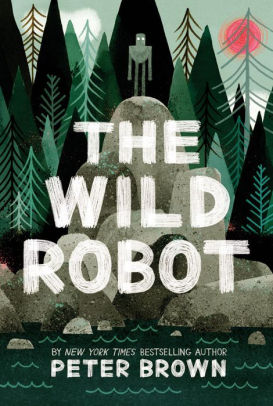
This year, with the books including some of my favourites – A Long Walk to Water, Wild Robot and Mem Fox as a picture book (and Fenway and Hattie – a book I didn’t enjoy but knew would strike a chord with my dog loving students) – I pushed a little harder with my G3-6 teachers. It helped that all had some pretty excellent Hyperdocs. I made an extensive library guide that could act as a one-stop-shop for teachers so they didn’t need to search awild robot.jpground for dates, documents, links etc. Ordered copies of the books and made sure students didn’t access them prior to the read-aloud, signed up for post-card exchanges and classroom partnerships. Then I subtly and not so subtly pushed teachers into agreeing to try it out. My pitch was basically that it was a great way to kick off literacy right at the start of the year without having to do any preparation besides deciding which parts (if any) of the brilliant Hyperdocs (e.g. Wild Robot) to use. In addition they’d get brownie points for making global connections!

I did the G2 classes myself, and had a great exchange through padlet with Tanja, the librarian at Hong Kong Academy. Luckily we had more or less the same holiday schedule, and in fact since she was in Singapore on holiday when we still had school, she was our mystery reader for one of the weeks! Our G2 students loved the Mem Fox books and really enjoyed sharing their lives and experiences with their buddies in Hong Kong.

The G3-6 classes who participated all reported that it had been successful. The main “complaint” being that they felt a little bit pressured to keep up with the schedule, amongst all else that was going on at school, but when they let go of that it was fine. Our G6 classes found substantial links between Long walk to water, to their curriculum unit of inquiry (WWAPT) of development and natural resources, particularly around the question of water, and also requested more text-to-text resources.

I was recently reading an article on the “Peter Effect” which basically posits that teachers’ cannot give what they don’t have – related to lack of reading engagement. This is one (painless) way of compensating for this effect by making it a very low barrier activity.

While the Global Read Aloud is a fantastic institution and I plan to continue to support it, I do however have to make a few points of what I hope is constructive criticism in the hope of making it even better.

At the moment “Global” is a bit of a misnomer, as it’s more of a “North American” plus some other internationals (albeit more than last year). For example in our postcard exchange, of the 60 cards we sent, 50 were to schools in the 50 states of the USA, plus 3 to Canadian schools and only 7 to schools in the rest of the world. Hopefully posts like this will increase recognition and participation.

I think a few things prevent it from truly being global. One of them is the timing – we agreed with our partners to shift the dates to take account for the fact that we had a two week autumn break in Asia right in the middle of the schedule. The other, I’m afraid to say is the choice of books.  As followers of this blog know, I’m a vociferous proponent of diversity and inclusion in literature and I must admit to some disappointment in the choice of authors / illustrators. There was some improvement this year with “Long walk to Water” (albeit the author still from the USA), and Mem Fox – but while Mem Fox may be somewhat exotic to the North American audience, she is anything but to the rest of us.  As someone who has been on the Red Dot Book Awards committee for the last few years, I know just how difficult it is to find the right mix of books for a book bundle. I also know how quickly and easily others criticise the choice once it is made and how difficult it is to solicit suggestions from just those people who later make the comments! So everyone, take some time to make suggestions on some truly global, international, diverse books and authors. And if you’ve not yet dipped your toes into the fun that is GRA – perhaps try one of this year’s books with the associated teaching guides.


The 10% problem

It’s a funny time of year in education, November and December. I never knew this before. It’s the time when educators need to decide if they’re staying or going in their current school or position, and if not, what the next move will be. I’m new to this game, and as I librarian I get to see all classes, all teachers and many parents. Observation and conversations are things that happen a lot.

The 10% use of the brain myth has been debunked I know, but I think it is still a useful meme to use in education. Because one of the things that keep coming up in the conversations I’m having with people who are leaving of their own volition (some are due to partner careers, or family issues) is the frustration that for one reason or another, all they have, know and are capable of is not being used or recognised. I know, because as an older educator coming late to the game with a longer “past” I feel this very acutely.

A little while back a group of us had an interesting lunch conversation along the lines of our former pre-teaching lives, or what we’d taught before we were teaching what we were teaching. There is so much unlocked knowledge, skill and potential in education. And I’ve just mentioned the teachers. Before I was a TL I was a sort-of SAHM (stay at home mum). Sort of, because I kept studying and doing stuff. Stuff that would keep me sane and my brain occupied while my body was present for young children and a partner who travelled anything from 70-90% of the time, and then we’d move country to spice things up a little more. And I kept bumping into women (mainly) with amazing brains. Women with fantastic pasts whose only outlet was pouring themselves into organising PTA/O fundraising and events and being class-mothers. Not that it’s unimportant, but really? Think of the energy equation – it’s like starting up a blast-furnace every-time you need enough fuel to drive around the block.

While the unlocked potential in teachers is particularly acute in primary, where teachers are often limited to their own classrooms, teaching a breadth of skills and subject areas they may or may not be optimally suited for, I heard the same while working in secondary. One person in particular sticks out. He was very bright, very capable in his own field, constantly seeking out new knowledge. He was also not from the dominant mono-lingual white male BANA pack, and such was an outsider. He left in frustration saying that while he’d been hired for all the bits and pieces he had, he was only being used for a small portion of them and wasn’t even consulted when his PhD specialisation was being looked at in the community (I won’t mention what this was as it would be a give away). I’ve spoken to language teachers a lot, who say they sit mute and unsolicited in meetings while mono-linguals decide language strategy and curricula. Parents who come from a huge diversity of educational and learning backgrounds who are literally NEVER consulted because they are “just” parents. And if they ever dare mention that things could be, and are different elsewhere, at least in some areas, they’re quickly shut down with “well, this is the way we do it here” while the dominant culture and pedagogy continues hurtling down the track.

school is easy

I use hurtling consciously. Because the sad thing in education is the pace. There is just so much busyness. It is no wonder that the 10% usage exists – there is just not enough time for anything else. And all the time there is that anxiety. Parents are skittish that their child is in the “right” school. Ready to run and change at the drop of a hat. Students mete out their time for subject by subject homework. Teachers are stretched thin juggling reporting, marking, teaching, preparation, running excursions and events. And somehow, most times, in the midst of this all, miraculously, learning takes place.

Another sadder thing I’m noticing at the moment is that there is a widespread occurrence of “losing weight after the divorce” to use another bad analogy. And that is, suddenly there is a bunch of people getting all sorts of qualifications (albeit sometimes the maligned-by-me google-educator badges), suddenly getting out there at teacher events and PD as they polish themselves up for the market. That’s more than just a little bit sad. And a lot of a bit of waste on both sides of the equation.


Advocacy is not enough we need power

Librarians are big on advocacy. Big on helping their peers when they’re not being heard in their communities or schools to build their “advocacy toolkit”. Most librarian courses include at least one module in one course on advocacy. Some academic librarians have built their careers on advocacy. But I’d like to cry foul. This has been going on for long enough.

Looking at advocacy it has a couple of tenants:

“Five Advocacy Tips
At the basic level advocacy is building relationships. The goal is to become a valuable resource for policymakers. No matter who the audience is, you should keep in mind the following:
1. Be confident.
2. Frame your message to answer the question, “So what?”
3. Plan and practice your message.
4. Present a clear and compelling message; less is more.
5. Offer yourself as an expert resource and provide examples from your community; stories are more compelling than statistics” (Advocacy toolkit).

I’d like to posit that the whole concept of advocacy is wrong. It is not advocacy that we need but a seat at the table. But the problem is that no one is going to shift over and make a place for people who are nicely, confidently giving compelling messages from experts. If anything after all these years of advocacy the situation has become worse rather than better. This is global, in all the countries that used to be bastions of (school / public) libraries and librarianship: the UK ; USA; Australia, and Canada.

I’d like to suggest that the decline in school libraries and school librarians is inversely correlated with the rise in EdTech or Digital Tech or Digital Literacy teams and resources. Those same UK schools claiming poverty when it comes to libraries have 900m to spend on edtech? And what I’m noticing is that the heads of these subsections do have a seat at the table, a link on the webpages and a say at every conceivable moment.  And I’m wondering, not saying this is a fact, just wondering out loud, whether it has anything to do with the fact that so many of those leading this corner of the education landscape are male as are most of the leadership in schools?  And while I’m a huge prosumer of tech and use it extensively in my teaching and learning, I’m suspecting it’s not really helping our students’ literacy – even their digital literacy ($129b pound investment by 2020 for students to have “basic” digital literacy and no one’s saying the numbers don’t add up?).

There have been two little discussions on the various librarian network groups I’m on that relate to these questions.

The first was about the merits of becoming Google Educator certified. It’s a push at most schools and apparently something sought after by  recruiters. I’m flabbergasted. Google is so frigging smart. And we’re being conned. And no one is crying foul. I grew up with computers as they burst into the scene in the early 80’s. I could use every iteration of word processing, presentation and spreadsheet tools from the very first most basic google librarytypes. When I say I can use, I REALLY can use. I know how to use templates, make an index, do auto-intext citation, add captions, make data tables, pivot tables, look ups, statistical analysis, import addresses into labels etc etc. And what I don’t know I know how to find out how to do, either online or because I know people who know their S*** around this type of stuff. People of my generation and younger. I also have an Education masters in knowledge networks and digital innovation and follow all sorts of trends and tools and try everything at least once.  I can use basic HTML and CSS and find out how to do anything if I get stuck. I know how to learn and where to learn anything I need to know and I’m prepared to put in the time to do so. This is in a “just-in- time-and-immediate-application-and-use-basis”, rather than a “just-in-case – and-I’ll-forget it-tomorrow-and-probably-never-use-it-basis”. So can you tell my why I would bother wasting my time and money becoming GAFE (or anything else) diploma’ed when the equivalent is for me to go from driving a high powered sports car to getting a tricycle license? I feel the same way about this as I feel about people saying you don’t need libraries now you have google. Well actually I feel stronger about it. It seems like every single for profit educational technology app or company is now convincing educators that the way for them to be taken seriously is to “certify” themselves on their tools, something that involves a couple of hours of mind-numbingly boring and simple video tutorials and/or multiple choice tests with or without a cheapish fee and then to add a row of downloadable certs into their email signatures like so many degree mill qualifications on a quack’s wall. And then these are held in higher regard (it seems) than the double masters degrees it takes to be a librarian??  Not a game I’m prepared to be playing.

Then next question was about an upcoming education conference – I’m not going to name names but it’s a biggie, and  one of my fellow (male) librarians managed to convince the organisers to include a library strand. Bravo for him – he’s obviously got a voice that’s being heard and this is a huge step forward. BUT, as he and I discussed off-line, privately, when I mentioned the word “echo-chamber” we’ll all be sitting at the wrong table. A nice table. An interesting table, a stimulating table, a worthwhile, practical, intelligent table with some wonderful people (librarians really are super people, I wish I’d discovered them a lot earlier), but the wrong table. And even if our “strand” is open to others, we’re in direct timetable competition with some pretty heavy hitters who are in other very enticing and compelling strands that just beg to be explored. Strands that I as a librarian with an M.Ed have covered in my degree with some of these hard hitting thought shapers. But I’ll not be at those tables, because I’ll be in the librarian strand, where we all agree, and where I can guarantee there will be some mutual hand wringing on budgets, staffing, literacy and advocacy issues. And I can almost certainly also guarantee that none of the librarian strand events will be attended by a single education powerbroker who is not a librarian (please prove me wrong – someone – anyone?).

So I’d say we don’t need advocacy we need power. And to get power we need to be political. And librarians, like language teachers are not very good at politics. We don’t like being unpopular, we want to be accepted and needed, but I would argue we no longer can ethically rely on advocacy, children’s literate lives are at stake, we have to enter the fray.

(I’ll add a personal disclaimer here, I work on a campus where my (female) leadership team is incredibly supportive of the library, invites me to leadership meetings and where I do have a seat on (some) tables. I also was highly flattered when one of the teachers rose up to bat for me last week on a visibility issue. But I’m aware that I’m probably in a minority, which is why I wrote this post).

How to get free PD

5968774554Quite a few schools in our network have cut-back on funding for professional development and have either started limiting the time off or financial support for PD. This is extremely disappointing, as PD can be the lifeblood of educators, and dare I say, particularly for teacher-librarians with their often solitary status within a school.  There is however a vast range of ways to get “free” PD in that it will only cost you your own personal time. Here are a few suggestions for things I’ve tried out.

Teach meets

Founded by one of my lecturers in designing spaces for learning, Ewan McIntosh, Just about every major city in the world holds TeachMeets. Basically they’re gatherings for teachers where very brief (5-10 minute) presentations are given on a variety of topics, preceded and followed by some social chitchat and networking. Usually the topics are very practical, actionable “hacks” or ways of solving common teaching questions. In Singapore they’re run by 21stC learning and seem to tend towards the geeky/techie side of things.

Another form of this, for PYP educators is the PYP Connect events. These are run by the Singapore Malaysia PYP network, and consist of longer workshop events hosted by one or another PYP school. Ask your PYP coordinator about the next one in November 2017.

Pros: You get out of your space, meet educators from different specialisations and different schools.

Cons: They’re only a few times a year, and if you can’t attend that’s it.

Read a book (or a blog)

Yup, this can be really really simple. The only tricky bit would be which book to read and finding the time to do so. Basically you need to find your reading tribe. People who share your educational and life philosophy and who are readers and find out what books are shaping their thinking. My criteria for this type of book is one where a chapter can be read and absorbed in the 15-20 minutes between getting into be and my eyes falling shut from exhaustion.  At the moment I’m really pleased I found Kylene Beers and Robert Probst’s books

36094448154though an ex-colleague. I started by reading Reading Nonfiction and I’m currently on Disrupting Thinking and both books have given plenty of food for thought and initiative for me to reflect on my teaching and literacy practices. They’re just the right balance of practical and thoughtful.

More powerful than just reading a book, is reading with someone or a group of people so that you can share ideas and more importantly, put those ideas into practice. At our school we’ve started running professional book clubs, started by our principal last year when we set up our ODC (Outdoor discover centre) with “Dirty Teaching” . This year we’re running around eight different groups, each with their own focus, based around a book of note. The group I’m in is doing “Making Thinking Visible” and we have (surprise, surprise) a particular focus on using picture books.

There are plenty of lists of books to read. A word of caution – of course the books on the list reflect the culture of the country / organisation from whence the list is coming. Here are a few: The Guardian (British / Commonwealth focus); Fractus Learning (what I’d call aspirational / holiday read books – not much to put into practice immediately); We are Teachers (USA – more focused on the whole child / success).  Funnily / ironically enough there doesn’t seem to be an up to date list for teacher-librarians – the last one was a Goodreads one from 2012, which was pretty meh. Maybe because we’re reading all the time? Maybe it’s time to make one! (Suggestions in comments below).

I know blogging is so 2013, but I still do it, and I still subscribe to a few good blogs such as HapgoodSLJ blog network, Stephen Downes, Global Literature in Libraries, Gathering Books, and Mrs. ReaderPants. Here is a list of the supposed top 50 librarian blogs  (Somewhat USA focused, many not recently updated and nope, I’m not on it)

Pros: You can do it any time / any place. Most books are quickly actionable. A lot of books are now available as audiobooks – so you can multi-task – listen and do exercise etc. (but I need to stop and write notes!)

Cons: You need to dedicate a regular time to reading so that you don’t lose the thread. If you want to join a group, you need to structure it so that you can meet regularly.

Listen to a PodCast

There are so many excellent PodCasts out there – both educational and for general edification. I’m constantly torn between listening to podcasts and to listening to audiobooks. And the best thing is – it really helps your general knowledge, so you and awe your students from time to time!

Some of my favourites for education: The Cult of Pedagogy; Truth for Teachers; 10 minute teacher podcast. 

Unfortunately, again teacher librarians are not out there on the podcast scene much, and some of the initial podcasts are not kept up, but to make up for it, there are lots of good book podcasts. My favourite is All the Wonders, because they often feature diverse books and KidLit Radio. The SLJ has The Yarn (which I haven’t listened to but will). Here is another list from The Guardian.

General edification podcasts: 99% Invisible; The Allusionist; The Infinite Monkey Cage; You are Not so Smart; Stuff Mom Never Told You; TED radio hour; RadioLab; Invisibilia; Hidden Brain; Freakonomics; Sources and Methods; and my current favourite In Our Time.

Pros: Anytime, anywhere, keep up with amazing knowledge and information

Cons: So many to choose from. Easy to get behind and iTunes new format for podcasts is AWFUL.

Librarian Groups

Here in Singapore we are most fortune in having the ISLN with regular meetings and access to PD. Besides our quarterly meetings we have regular meet ups on a social basis, and pretty much all our libraries are open for job shadowing and visits. When I was still in training and working part-time, I regularly asked librarians if I could come and spend a day with them, and even now I’m working full time, if my holidays are different to that of my colleagues I’ll often ask if I can come and spend a morning or afternoon with someone, just trailing them with lots of conversations and questions and seeing best practice. Likewise, I encourage my library assistants to spend a day at other libraries from time to time, chatting to the library assistants and picking up some tips and tricks. Likewise, while on holiday, it’s easy to invite yourself to a fellow teacher librarian’s library to have a look around and chat. I’ve recently been to Taipei and popped into TAS’s lovely libraries for a few hours.

Pros: Convenient, local, low barrier

Cons: some librarians do operate in remote areas, or places with vast distances between the libraries making this more difficult.

Webinars

Actually the idea for this post occurred as I signed myself up for a webinar with SLJ. Added to this one could put short courses on YouTube (how I intend to master photoshop, Adobe Illustrator and Adobe InDesign this vacation)

Pros: Most webinars are free, almost all of them have both a live and “after the event” viewing option – ideal if you’re not on American Time.

Cons: The “free” sometimes comes at a cost of at least some of the time being devoted to someone or another trying to sell you their product, but if you already have the product, it can deepen your understanding of how to best use it.

MOOCs

While MOOCs seem to have lost their lustre, they’re still incredibly good for learning stuff. It’s just that the format is so limiting. But be that as it may, you can audit most course free of charge with a small fee to be “qualified”. Over the summer my daughter and I did the exceptionally good 8 week course “Humanity and Nature in Chinese Thought” an introduction to Chinese Philosophy. It has nothing to do with librarianship but everything to do with life and living in a multi-cultural and therefore multi-philosophical environment. I’m currently enrolled in Making Sense of the News: News Literacy Lessons for Digital Citizens; also through HKU, and I’ve done Jo Boaler’s How to Learn Math. No I’m not a math teacher, but I am a math human with math learning students and children. 

Pros: Some excellent content; self-paced; you can watch the videos at 1.5/2x speed. Huge variety of offering by some exceptional teachers.

Cons: Video based learning is not my favourite medium. Some courses are only open for a limited time frame. The hype hasn’t quite been realised with the format. Time.

Skype and GoogleHangout

I’ve done this a couple of times in the last few months. During the vacation, I saw an awesome Libguide and I was determined to update my school’s libguides. So I emailed the librarian, and next thing we were having a google hangout and she was screensharing with me showing how she’d done it all!

Then last week I was worrying that I wasn’t using MackinVIA properly, and again reached out to someone who screenshared her set up. I’ve done some libguide training to a fellow librarian who was sitting next to me, while screensharing to another librarian remotely.

Twitter

Great for reaching out to people and keeping up with trends of what is going on. But hard for searching and following threads when you enter part way through is horrid.

Facebook

I put this last because it is truly terrible. The possible worst place in the world to put up information and exchange knowledge. It gets boring and repetitive as the same questions come up time and again. It’s awful for searching, it can be mindless and stupid – why on earth once a question has been asked do people persist on answering it again with the same information?? But the various librarian groups I’m in, are very useful, albeit that I need to keep / store the links immediately to Evernote.

Facebook groups I’ve joined include: Int’l School librarian Connection; SLATT; Global ReadAloud (only really active around the GRA activities in October/November); Future Ready Librarians (tends to be FollettDestiny dominated – the irony Follett and Future!); ISTE librarian Group (not very technological – too much talk about book lists);  ALATT (ALA think tank – great for if you are ever mired in self-pity – there are about 30,000 other librarians in way worse a situation than you could ever imagine – ignore the cat photos and memes and sit back and enjoy the political rants on all sides of the US spectrum).

Pros: Amusing, informative, occasional good advice / links; pretty display pictures

Cons: Frustrating format, hard to save; hard to search, huge time suck.