First the earthquake and then the tsunami

Six weeks done and we enter our virtual online Spring Break. And my social media both professional and personal is awash with questions from people about school closure and online learning from a teacher/librarian/tech/personal point of view. It’s the long tail, the tsunami hitting land after the earthquake at sea. And I know that’s just a pretty picture of a wave on my blog and nothing at all like a tsunami. We in China had the Earthquake and now as folk in the rest of the world start running from the Tsunami we’re inundated with questions.

I’m not sure we’re equipped to answer them.

As private international schools in Asia we are a bunch of extremely privileged people. Both educators and pupils. My “go to” people in the China EdTech /Education world are a relatively homogenous group in that we are all well resourced and can go back to our leadership and ask for the money we need for the things we need to support and sustain online learning.  We have strong and capable leadership in our school who have modeled best practice in their empathetic and compassionate attitude and behaviour to all constituents of our community. We haven’t had to deal with salary cuts, union rules, students in situations of extreme poverty, or unreasonable demands. My colleagues and peers are a sharing, giving bunch and the things we create or come up with are shared freely without cost to others as we build on what works. The companies we work with have been super helpful and responsive and generous.

But the Tsunami has hit shore, and the coastal dwellers include the most vulnerable and least equipped or prepared for this. Our solutions won’t and cannot be their solutions. We have to remain humble in our responses. Even as I realise this and write of my experience I realise this comes from a place of privilege. I have these resources I can rely on.

The personal and political

This blog is a little more personal as I sit in the early hours of the morning after a fitful sleep. The virus has come close to home. A child in my daughter’s boarding school in the UK was diagnosed with the virus yesterday. After he left the school to go back to Europe on Wednesday. We heard last night European time. My husband is still in Nanjing. My son is with me in Switzerland. She’s in the UK. Three jurisdictions. Three different social, ideological cultural and emotional responses to this event.  But what does that matter when you have to make decisions? Decisions that could put other people at risk – like her guardians in the UK. A country that won’t let her be tested privately or publicly before going to them. A place where a lot of air-traffic is still occurring due to bizarre travel decisions by the leader of yet another nation. Where schools won’t/can’t make autonomous decisions and need to look to their government, but where the government, unlike the Chinese government, has a more cavalier response to the situation. And it seems is putting economic and political expediency above people’s lives. I keep second guessing myself.

This much I know is true. She should not be in a boarding house/school with so many other people. She can self-isolate with our friends / her guardians. She should not be travelling internationally at this time – airports / planes = high risk. Virus statistics and reporting is a numbers game. Literally a game. You test, your infection stats go up your fatality rate goes down. You don’t test, you can pretend all is ok. But then people die.

These are my concerns. Is she infected? If so, she infects the people who are generous enough to take her in. They infect other people. She gets ill – she’s young and healthy – but what if she gets very ill? I’m relying on friends to take care of my child, my young adult?

Parenting online

Ok, so a bit more about parenting (or the lack thereof) during the virus.

I wrote this for parents on a libguide right at the start of school closure. It was recently included in an article by ISTE so I thought I’d better revisit it. Funnily enough I don’t think I’d change anything. I’ll just expand a little on what it looks like practically and in reality for people going into this.

I’ve been working crazy hours, so parenting has suffered. This is a good thing in some respects.  Above all I think it’s important to keep good relationships going in the home. A big part of that is me refraining from nagging my son. When I do try and take what he considers to be an unreasonable interest in what he’s doing / how / when / how much, it nearly always ends in a row. Unless he’s doing the asking for help – in which case I need to drop everything and attend to him. I just love this (old) NY Times article about being a potplant parent – that’s needed more than ever during online learning.

My son has ADHD. He was totally overwhelmed at first. So were his teachers, even though I don’t think any of them are similarly afflicted. The first inclination for everyone is to try and carry on as normal, just online. It took at least two weeks or more for everyone to “calm the f down” and settle into workable solutions and routines. A couple of strategies that helped for us at home:

  • Putting a desk in the guest room upstairs to stop him working in bed / on the sofa / at the dining table. I know if he’s on his laptop in any of the latter spaces he’s either doing “light” work or goofing off. So does he. When he’s got a serious assignment or a meeting with a teacher he’ll go upstairs to his desk to work. There’s a glass door to the space and my new standing desk (much needed based on the hours I’m spending online and the back and arm ache) on the landing is a few metres away so I’m there but not there.
  • At the end of the first week when he finally admitted that he was losing it and couldn’t cope, I bought a paper agenda and we agreed he’d just think about and focus on two subjects a day. Once he’d caught up he could go back to the regular schedule, we agreed on which subjects they’d be for a few days together and then he took charge again. The fact that our school has moved to an asynchronous learning model is very helpful here.
  • Letting teachers be the teachers. We’re extremely, extremely fortunate to be at WAB. I can’t emphasise this enough. I know that his teachers are supporting him and looking out for him. That means I don’t (and shouldn’t) micromanage his learning. He has regular face-to-face check-ins with his teachers and his class mentor. They have physical and emotional distance from him while still being on his side. I don’t have that. It helps. When he messes up or misses a deadline, or doesn’t respond I will hear about it, but not before. We needed to intervene once with a busy-work / communication style situation, but that’s hopefully been resolved.
  • Sharing the household burden. It’s taken nearly 17 years, but after a week of closure he spontaneously came to me and laid out what part of the household chores he’d take upon himself “without any prompting”. This includes cleaning the bathrooms and toilets, taking out the garbage, helping walk our elderly neighbour’s dog and helping with the cooking and cleaning the kitchen. He’s stuck to that for over a month now and I’m more proud of that (and walking into his room yesterday and seeing it tidy, with the bed made) than anything else during this period.
  • Giving each other space – we’ll each go off for walks on our own. Take time out to cool down if we have words or after a shout. Yes I shout. And swear. And so does he. We’re human and emotions can run high. But we’ve found a new type of equilibrium in our relationship, an understanding that that should be more important than all the other details. It’s been a long time coming.
  • And I think he’ll want me to add this, he’s not a gamer. That’s huge. I know families with big concerns about the vast amount of time online at the moment that’s spent gaming not learning. I am grateful to him that this is not the case, and he reminds me of it when he sees the impact on some of his friends and peers.

This gif shows how I felt by 7am yesterday morning after nearly 7 weeks non-stop working. We’re now in our Spring Break and I’m promising myself to get off the computer and do some reading. Of real physical books!

via GIPHY


____________________________________________________________________________________________

Photo by Joshua Dewey on Unsplash

Does Activism require Power?

One of my most popular blog posts was “Advocacy is not enough we need power” and I still stand by that. Ironically enough in my new role I am teacher librarian slash Edtech integrator, and I like to joke with my colleagues who need anything from data to access to fixing an issue to equipment that “I have the power”. But some stuff fluttering around twitter recently has made me wonder about librarians and power and about power in general.

In particular I think something amazing is happening in university librarian land with the ending of negotiations with Elsevier by UC – and the person in the cape is a librarian! But here is the strange thing – @Jmmason is getting three likes (plus mine) and two retweets on his guide for transitioning journals to open access.

Is this a case of “if a tree falls in a forest”? Where are all the OA activist librarians? Where even are all the “whinging about costs” librarians?

I like to follow a wide variety of people and Chris Bourg is one of my “go to” activist librarians. We need so much more of this ilk. But then I wondered about whether activism could exist in a vacuum of power. At the same time I know that power can both be given or assumed.

Most librarian groups now seem to have migrated to Facebook. Which is ironical because if we were better librarians and better curators we would not base the existence of our professional learning networks on a platform where groups are closed, information gets lost and the same questions are repeated ad-infinitum (see rant here). And judging by the posts we’re pretty good at complaining and most of the complaints (I’m talking the K-12 sector) are about budgets, job loss (or more accurately position loss as in “an unqualified teacher will do the library next year), or lack of acknowledgement. These are not the bleatings of people with real or perceived power.

The question is who can become activists? On the one hand you have people like Bill and Melinda Gates (see their annual letter, and particularly the bit about data can be sexist) who have the power. On the other you have people with next to nothing to lose. And then there are all the rest of us status quo huggers.

I say “us” deliberately, because I’m complicit. I think of a few things that we need to get activist about – some in the cost sphere, some in the service sphere (FollettDestiny are you listening) where we need to get organised, we need to share cost and pricing data but we don’t. Is it time? Is it being contractually bound to silence? Is it not wanting to be the tall poppy? Definitely in the diverse and relevant resource sphere as international school librarians we need to be in a constant state of outrage. And then there is the whole literature / translation thing going on – or not. Thanks to GLLI it’s moving in the right direction – albeit slowly and again why don’t they have tens of thousands of followers?

So we are librarians, a marginalised group within a sector in most countries (and in particular in many parts of the mighty trend setting US or A) that is marginalised economically, is it strange that you don’t encounter many activist librarians?

No use me merely complaining – What would my suggestions be to become an activist librarian?

  • Uncompromising values and standards
  • Unite, collaborate, be present
  • Champion diversity

Uncompromising values and standards

This is both personal and global. If you’re a qualified librarian be amazing at what you do and if you’re mediocre work on becoming better. If you’re amazing become even better and make sure you’re sharing and mentoring other librarians – and not just in your local network – we need more mentoring programs for regions where library science is under-represented.

And let’s not start on the levels above – the funding for library positions in schools and for university library programs. Who gets admitted into the library programs – are they taking the best of the best? Or the ones who want to get out of teaching for an “easy ride”?

It’s a bit the Finland / Singapore argument (to dig up an old trope) – well paid professions attract professionals.

Unite, collaborate, be present

Unite here not just to complain but unite in action. Collaborate and if necessary collude on matters that matter for knowledge, deep education, and investigation. Be present in the discussions and arguments. If you are not the leader be the first or subsequent follower.

If you’re a librarian in an international school join IntlLead a platform run by and for librarians not affiliated to any organisation.

Find examples of activism in other fields / areas that you can learn from or latch onto or use as examples.

Champion Diversity

I’m not just talking about #WeNeedDiverseBooks (see Meting out Diversity?). We also need diverse knowledge. Is that an oxymoron? And we need to personally be critical about what passes as knowledge and pass that critical stance on to our students. AT ALL LEVELS – not just when they’re in High School or doing TOK. Our G5 students need to know the information they consume for their PYP Exhibition is biased and deficient and that they can and should be adding to this from their cultural or geographical or linguistic perspective. We need to help publish. We need to interrogate the authors we invite to our schools on what they are doing to mentor and encourage no-name-brand authors in our locale, theirs, where they are appropriating stories for their books or elsewhere (and not just those who can afford expensive workshops). We need to invite speakers who do not repeat what we think we know but who challenge our assumptions.

Knowledge is biased

Look at this. As librarians are we passing on our outrage to our students? Do we follow sites like @WhoseKnowledge and tell our students to check the origins of what they’re reading? And that they whole darn point of learning and research is to make your own contribution to the world of knowledge and end this microscopic world view?

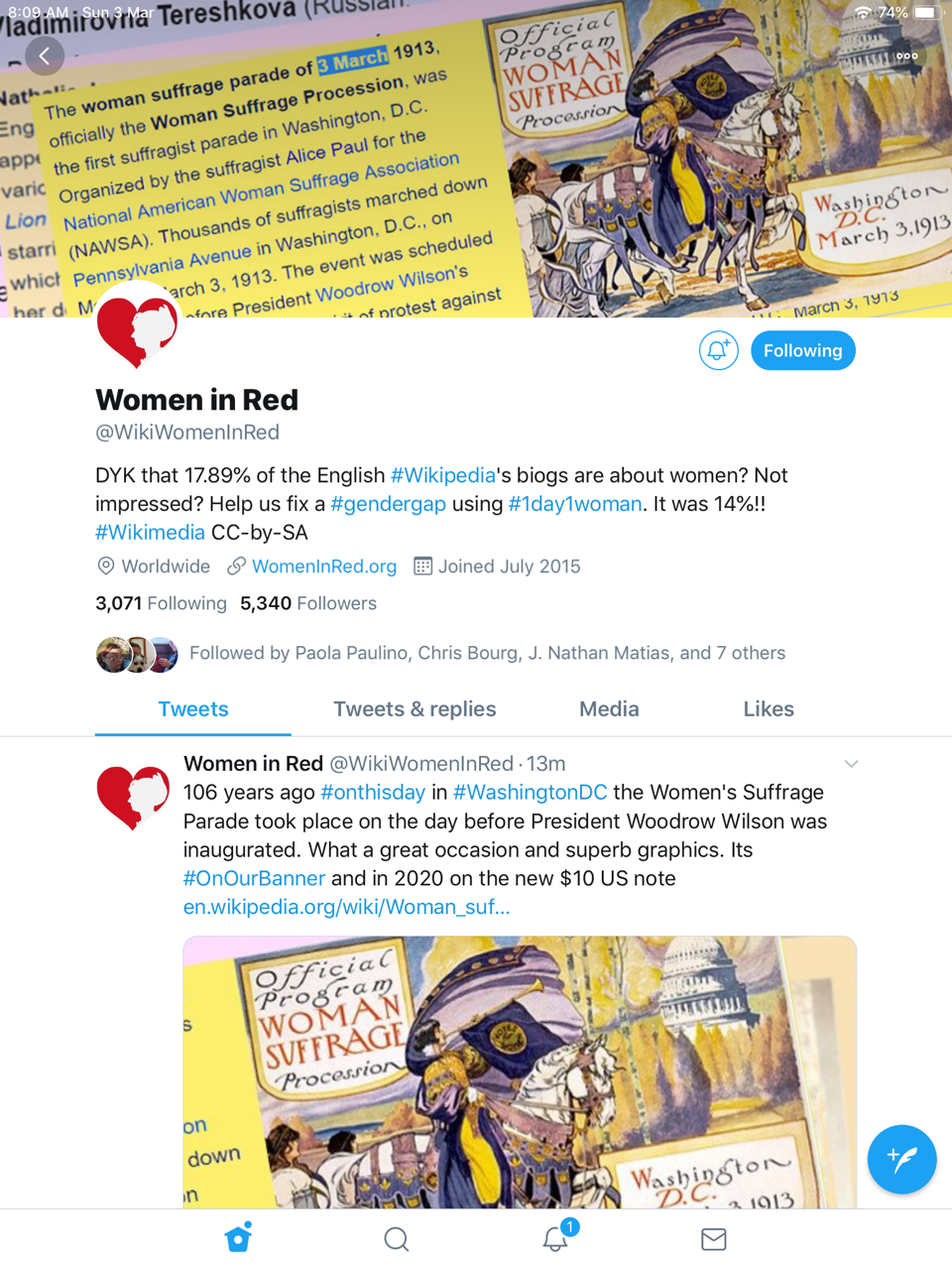
Here’s another one worth letting your students and fellow librarians know about – @WikiWomeninRed 

I don’t know how to end this. Just keep on being angry or outraged. And do something positive with that anger.

Collateral damage or passive Anura?

Classroom libraries vs. school libraries, teacher superstars marginalising teacher librarians – or is it our fault?

This post was first going to go one way and then through holiday laziness in posting, it has taken a kind of dual direction as I have more time for self-reflection and research.

The first offensive was launched by KC Boyd (2018) in her post “Easy Like Sunday Morning: School Libraries vs Classroom Libraries” where she reflects on Chicago School System and the impact on literacy of shifting from school libraries to (only) classroom libraries (hint – it wasn’t favourable). She refers to Ariel Sack’s post on the importance (and diminishing) role of school librarians who asks “Can this project be done by an individual teacher? Yes. But it’s something different when one person with a vision and the time to implement it leads it consistently for the entire school, every year” (Sacks, 2018). I’d argue there is another factor – one very rarely meets a librarian who doesn’t read (I have however met library assistants without any interest in books or reading); but the Peter Effect is well documented in teachers (Applegate & Applegate, 2004; Binks-Cantrell, Washburn, Joshi, & Hougen, 2012; Turner, Applegate, & Applegate, 2009) with studies in various places around the world documenting aliteracy in teachers / pre-service teachers – “Findings revealed that 54.3% of 195 teacher candidates were classified as unenthusiastic about reading and only 25.2% of teacher candidates reported unqualified enjoyment of reading.” (Binks-Cantrell et al., 2012, p. 526), and the picture appears to be getting worse rather than better (Skaar, Elvebakk, & Nilssen, 2018).

This is something easy to lose sight of when twitter, YouTube, Facebook, blogposts and podcasts are dominated by literacy superstars like Pernille Ripp, Colby Sharp, Mr. Schu, Jennifer Gonzalez, Angela Watson etc. But for every one of them, even a small imitation of them, there are likely to be three or more other teachers who are either not enthusiastic about reading, or, who actually don’t deign to read the types of books their students do – something I know my librarian mentor Katie Day, (successfully) worked very hard on with the teachers at UWCSEA-East when she was there. Based on my own experience I have encountered whole grades where not one teacher has been actively and passionately engaged in books and reading, and where this is apparently not seen as an issue (except when it is reflected in their students’ testing scores – but then the solution has been to work on the students rather than the teachers).

Regie Routman in her article “On the level with levelled books” (Routman, 2018), makes some valid arguments for free voluntary reading, and the choice of a selection of relevant and developmentally appropriate books for classroom libraries, but only makes oblique reference to public libraries and with no mention of school libraries or librarians – not even in a nostalgic or wishful manner. Relying on teachers who care and the intervention of a literacy expert is not a long term solution!

Colby Sharp, boasting a 3,000 book classroom library, ordered in a numbered system unfamiliar to any librarian I asked, talks about book checkout and is quick to dismiss the scanning system a librarian assisted him in setting up as “too much trouble”… (Sharp, 2018)

To which Day responded on FB “as long as he is on top of what all his students are reading, then, yes, it could work. But it’s not scaleable — and he doesn’t mention inventory checks — so at the end of the year you know which books might need to be replaced. With 3,000 books, it might be good for his students (other students? other teachers?) to be able to search and discover what books he has in his class library… Just sayin’… And LibraryThing’s TinyCat is definitely an option he might consider — to be able to see his collection online, whether he uses their circulation system or not.”

And then I found out what his library looked like – with a self-invented number system – ok so Dewey doesn’t do it for everyone, but those random numbers? (Sharp, 2017). I love the idea and potential of classroom libraries – I baulk at the cost, duplication of effort, waste of resources, money and time, lack of discoverability, lack of meaningful data and often stagnant nature of them. I have seen money wasted on thoughtless last minute purchasing without any clear strategy, collection management or development. I’ve seen classroom libraries with books that would better be relegated to pulping or, redistributed to older or younger students. I’d be the first to admit that often no one knows students better than their class-teacher, but just as we shouldn’t have to choose between classroom libraries and school libraries, so too the burden of creating dynamic exciting collections needn’t be the domain of only the class teacher or the librarian – together we definitely are better. Dialogue, collaboration, debate, relative expertise – all these things make us stronger as a learning community.

I started out being a little annoyed at the lack of mention of (school) librarians, but then reading the FB question of a librarian, (who shall remain nameless) challenging whether she should be expected to find a selection of books on a specific theme for a teacher because “she’d already shown the teacher how to find book in the system” and the responses I wondered how much of it was our own fault? We should be falling over ourselves to help teachers, parents, administrators, everyone in the community with lists and suggestions and books and resources they didn’t even to know to ask about. We should be anticipating and proactive. Not whining on FB as to where the limits of our job lie. I love the fact that this is one of the careers where you can pretty much be without boundary and limitless in what you can do – all in the interest of teaching and learning.

Spending a bit of time on Twitter I saw what was going on with Project Lit – something started in an English Classroom that is going viral (Riddell, 2018), (and what an excellent book collection they’ve created!) and I thought, darn it – we’re missing so many tricks here. Why aren’t teacher librarians initiating things like this, or the GRA? Why aren’t we leveraging our knowledge and experience in more ways than just fretting about our increasing marginalization and extinction? Why aren’t we taking more leadership and visibility in these arguments and discussions?

project lit

We aren’t part of these discussions and we’re not top of mind to any of the people who are getting attention. Whose problem is that? Do these “superstars” have a blind spot to anything NIH (not invented here), monstrous egos, or are we / have we become just so marginal to the whole reading / literacy scene that we don’t even merit a mention unless prompted (as the Sack article intimated)?

On FB again, another librarian spoke of her school that has gone from a thriving library system with two libraries run by two qualified librarians that’s been whittled down and compromised to one remaining librarian and was wondering what the moral of the story was – I commented “frog in a pot that slowly comes to boil”.

The problem with being a passive Anura is that no one else is going to turn the gas off and you don’t want to be left alone when the party is no longer in the kitchen – with apologies to Joan Lewie (WiggyOfStHelens2008, 2008).

 References

Applegate, A. J., & Applegate, M. D. (2004). The Peter Effect: Reading habits and attitudes of preservice teachers. The Reading Teacher, 57(6), 554–563.

Binks-Cantrell, E., Washburn, E. K., Joshi, R. M., & Hougen, M. (2012). Peter Effect in the Preparation of Reading Teachers. Scientific Studies of Reading, 16(6), 526–536. https://doi.org/10.1080/10888438.2011.601434

Boyd, K. c. (2018, June 3). Easy Like Sunday morning: School libraries vs classroom libraries [Web Log]. Retrieved 5 July 2018, from https://theaudaciouslibrarian.blogspot.com/2018/06/easy-like-sunday-morning-school.html

Sharp, C. (2018). My classroom library checkout system. Retrieved from https://www.youtube.com/watch?v=s9u6KHYoLVE

Sharp, C. (2017). Classroom library tour 2017-2018. Retrieved from https://www.youtube.com/watch?v=iGITHdb8tZ8

Riddell, R. (2018, March 12). Project LIT: How a Nashville educator turned a class project into a nationwide movement [Web Log]. Retrieved 5 July 2018, from https://www.educationdive.com/news/project-lit-how-a-nashville-educator-turned-a-class-project-into-a-nationw/518766/

Routman, R. (2018, June 24). On the level with leveled books [Web Log]. Retrieved 5 July 2018, from https://www.middleweb.com/37973/regie-routman-on-the-level-with-leveled-books/

Sacks, A. (2018, May 29). Why school librarians are the literacy leaders we need [Web Log]. Retrieved 5 July 2018, from https://mobile.edweek.org/c.jsp?cid=25920011&item=http%3A%2F%2Fapi.edweek.org%2Fv1%2Fblog%2F191%2Findex.html%3Fuuid%3D76470

Skaar, H., Elvebakk, L., & Nilssen, J. H. (2018). Literature in decline? Differences in pre-service and in-service primary school teachers’ reading experiences. Teaching and Teacher Education, 69, 312–323. https://doi.org/10.1016/j.tate.2017.10.019

Turner, J. D., Applegate, A. J., & Applegate, M. D. (2009). Teachers as literacy leaders. The Reading Teacher, 63(3), 254–256.

WiggyOfStHelens2008. (2008). Jona Lewie – You’ll Always Find Me In The Kitchen At Parties. Retrieved from https://www.youtube.com/watch?v=62eTq8ErUOQ


Ask the inhabitants

My online library network is getting excited about a couple of articles that are challenging beliefs.

There’s danah boyds’ You Think You Want Media Literacy… Do You? it is an incredibly powerful article that needs to be printed out and highlighted and read very slowly. A couple of times. One passage that struck me epitomised the near futility in what we’re trying to do on the “fake news” front.

“This is about making sense of an information landscape where the very tools that people use to make sense of the world around them have been strategically perverted by other people who believe themselves to be resisting the same powerful actors that we normally seek to critique.(boyd, 2018)

Her conclusion is that we need to “inoculate” students against their very human tendencies by approaches that “are designed to be cognitive strengthening exercises, to help students recognize their own fault lines, not the fault lines of the media landscape around them” (boyd, 2018).

And then Wilkinson’s (2017) very apt writing up of her presentation that boils down to the fact that it is humans, messy, opinionated humans, subject to confirmation bias who are doing the research and therefor takes a welcoming psychological approach to understanding how students research – the paragraph on “post truth psychology is particularly well worth reading.  Her point is to short-cut the evaluation part of resourcing research and cut to reliability.

So while all this was percolating in my brain, I went for a run while listening to 99% invisible, and they had a two part series on the Bijlmermeer. Having lived in the Netherlands in the 90’s – my first year was when the plane went down on one of the buildings – I was very interested to hear what an American podcast would have to say about it. And I realised that in many ways as librarians and teachers we are imposting a modernism/functionalism mindset on research. With our structures and mnemonics we are creating these concrete structures that get in the way of a more organic way of knowing and learning.

Furthermore, planners realized people didn’t want to live in huge concrete structures. Almost immediately after the Bijlmermeer was finished, another neighborhood in Amsterdam was redesigned — it was done with bricks, a traditional Dutch material.

The Bijlmermeer, and maybe a lot of Modernism, was architecture for architects. It was a top-down, paternalistic approach to city planning. The redesign of the Bijlmermeer did not make that mistake. People from the community were heavily involved in the redesign process (Mingle, 2018).

So yesterday evening I decided to ask the inhabitants. In this case my two high-school teenagers. I asked how they did research, how they decided where to search and what to use. The answers were enlightening. And frightening.

First my highly intellectual daughter who “does school” very well. She admitted that she didn’t have the first idea about doing “proper” research and that actually in the last seven years that she’s spent in a highly prestigious very expensive school she hasn’t had one single session with a librarian. Nor had her teachers taught her anything as up to now she’d never been asked to reference anything. And it’s only because I’d insisted and taught her Zotero for a recent Geography course-work project did she really know much about it. She blamed having to do the iGCSE, (something she absolutely hates) and if I had my time over I would never put my children in a school offering (i)GCSE. It’s a waste of time and intellect. Added teaching my daughter research before she goes off to do her IB onto my list of things to do in the next 3 months. Hahahahaha, crash course research. The irony.

Then my son. The dude who’s had a tough ride of school and teachers. The one that was fortunately rescued from prestige and arrogance. Well, he said, the need to spend time with the librarian on research was an extra bonus, but the problem wasn’t actually as “acute” (his own words!) as at his sister’s school as the teachers were “all over” researching well, so going to the library was reinforcement for what the teachers were doing. Well, I guess I use CRAAP he says. OK, I challenge, what does CRAAP stand for. He laughs embarrassed. Well, I don’t really use CRAAP he says – at the beginning of the year my teacher shared this site with us that gives reliable sources, so I know as long as I stick to those I’m ok. Touché.


Image-1 (1)


Back to the more structural part of all of this – Caulfield, who I greatly respect has a useful graphic and new open-source textbook – Web Literacy for student fact checkers for those who want to continue on the architectural part of research and learning.R

I like the first habit of “Check your emotions” – a bit like Tim Harford’s guide to understanding statistics in a misleading age.  Moi? I think I’m going to teach more psychology and less CRAAP to my students. A great place to start is “Your logical fallacy”  who have produced some excellent posters and other resources.

References:


#fakenews – symptom or disease?

Last week I attended a “#Call to Action: Fake News, Misinformation and Post-Truth” held by the SMU libraries in  Singapore. Library network groups are full of requests for student appropriate examples of fake news. Most librarians have a stock list starting from the spaghetti harvest (1957) / tree octopus (1988). And we’ve unfortunately become over excited that #fakenews will be the saviour of librarianship. Because yay – we’re good at research, we’re good at teaching and applying the C.R.A.A.P / E.S.C.A.P.E tests, we’re about literacy, we’ve got all these captive young minds in front of us.

But between the insightful comments of very intelligent people like Eugene Tan and Gulcin Cribb at this seminar, where one had to conclude that the usual antidotes – trying to outcrowd “fake” news with “good /solid” news, padding news consumption with self-imposed digital/information literacy filters like the above mentioned CRAAP/ESCAPE tests or attempting to regulate it, will only work selectively or not at all.

haythamcom_02a
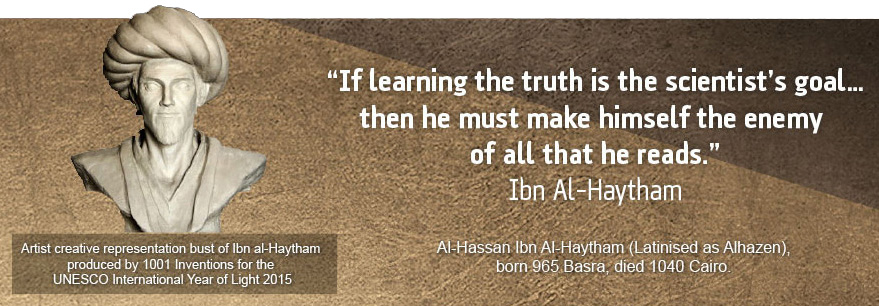
Best quote of the seminar – indeed there is nothing new under the sun

Caulfield in his blog has been hammering on about being able to distinguish between fake and real images, sourcing quotes,  but his latest post was one that threw the switch for me, on digital polarization on pinterest. (An aside, I gave up on pinterest because I can’t be bothered to log in every time I need to go past the first page and I prefer Evernote as a curation tool anyway). If you do nothing else in the fake news landscape ever, just watch this video he made.

And that, combined with the very disturbing article by James Bridle on Kid’s YouTube, following all the work that MathBabe, Cathy O’Neil, has been doing on web algorithms, and watching YouTube with my teenage son who is innately simultaneously curious about all sorts of scary (to mom) teenage stuff, combined with a reluctance to research beyond YouTube and Infographics* has made me really think about the way we’re approaching this conversation.

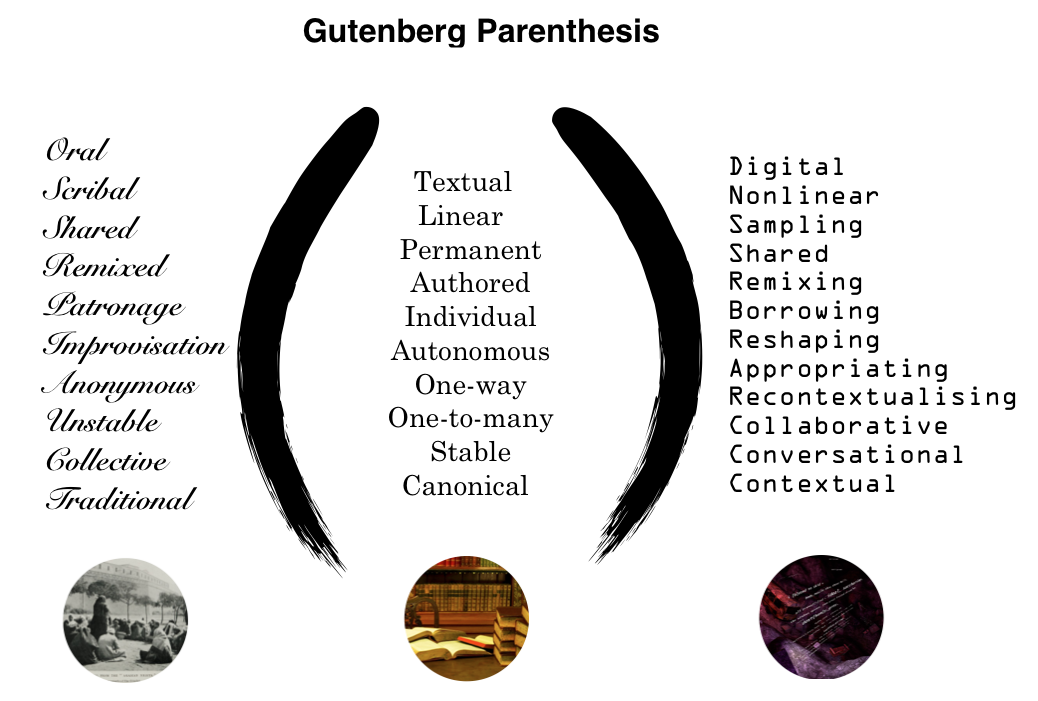
Let’s follow this thing upstream. Bear with me as I bring a couple of concepts that I think are related into this. A few things that have a lot to do with some human traits. The need to tell and listen to stories, The difficulty and recency of reading. The concept of the Gutenberg parenthesis. And last but not least, modern capitalism and/or the seven deadly sins (a concept I needed to explain to my kids the other night).

gutenberg parenthesis

So where does that veritable soup land one? Well, exactly where Mike Caulfield found himself as he clicked along in Pinterest, and like Alice in Wonderland found himself in a different universe to the one he started out in.  Pinterest is perhaps one of more extreme examples of algorithms at work. But the same is going on in Twitter (I was browsing through some UX stuff this morning and my feed and suggested people to follow changed suit in a matter of minutes) and Facebook and Instagram.

We have to face that honesty and a quest for truth doesn’t give one a monopoly on creating world class videos and infographics. That is the realm of those with a big enough budget to do it professionally. And that is how people like their information. So is the cure an infographic cold war, where every side builds up their arsenal of clickbait and point form iconic bite-sized digests? Or do we demand that algorithms are audited? Do we stop being curious and resist what we think is the “road less travelled” and the urge to click down paths that are actually carefully manipulated to pre-purchased outcomes?

So #fakenews is just a symptom. And by trying to treat the symptoms are going to get us nowhere. But unfortunately the disease is being human, and their is no vaccine against that. Except consciousness. Extreme consciousness. And consciousness takes time, and time is what technology is robbing us of. The irony.

————————————————-

* Shoot me – I’m human. That saying about cobblers and shoes? He came home the other day and told me his English teacher said reading was important for vocabulary and a whole host of things and that “just 20 minutes a day would make a difference” 

No excuses: Facebook

Continuing in my series of “no excuses” rants, I’m moving onto a biggie. Facebook. Except my rant isn’t so much against FB – everyone has done a better and more eloquent version of it in one form or another from one viewpoint or another. It’s more a rant against us librarians as consumers of FB (and yes this will be posted on FB – no irony?)

I’m writing this today in response to Philip Williams posting Alexandra Samuel’s “Can we build a better Facebook”  on Twitter, and following the links in the article to Beth Kanter’s article on the “Perils of Fake News” . You see I do agree Fake News is an issue. And I do see the valiant efforts of fellow librarians and concerned critical skeptical intelligent people putting the “fake” stamp on some of the rubbish twirling around. As I put in a comment, my concern with FB is that it is just like the stupid women’s magazines I eschewed from an early age.

The problem is even worse than you describe for reasons even beyond fake news and privacy and selling data. Basically FB is a useless tool that even information professionals like librarians have flocked to because of critical mass. But while it caters to our short term, immediate gratification needs it is terrible as a curation tool, unlike the relics of the past, the various internet groups which are still publicly searchable but went defunct around the rise of FB.
So now you have the “magazine cycle” in FB. Someone asks a question, gets 500 likes, 54 responses (the last 42 invariably just repeat what the first 12 said) and then gets buried. And then in a few days / months / quarters the same question comes up again. We don’t build knowledge. We don’t even build information.

I have a FB habit that consists of scrolling in the morning and evening, posting some of my shareable resources such as the PYP booklists, MLA8 posters , my blog posts and share any library worthy news. I ask questions about teacher-librarian practice, about books or booklists. But at the same time I am immensely frustrated by it. For these reasons.

Filing and searching

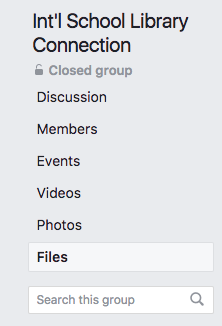
The same questions keep popping up regularly. Of course, because life has a cycle. But there is also a combination of laziness and the complete uselessness of the search Screen Shot 2017-10-21 at 10.39.16 AMfunction in FB. Many questions begin with the preamble “I know I saw X somewhere but I can’t for the life of me find it” On the left is one of the groups I’m a member of – it has 1,318 members. There are some great conversations that occur there. I went to check out “files” section – the one place where a semi-permanent record of anything could be kept. In the last 10 months exactly 20 files have been posted. That’s actually good – the “The School Librarian’s Workshop” 5,879 members and only 14 files since 2014!

So let’s take one of those things that regularly pop up – “Academic Honesty”. If I search the

Screen Shot 2017-10-21 at 10.45.22 AMgroup, I have quite a few options (honestly I think most people don’t even bother searching before asking a question – but that’s a whole different psycho-existential matter – like do we need to ask a question in order to “exist” / “be heard” in a group?). But the one option that would make a REAL difference in turning FB into a more useful tool for curation and knowledge building doesn’t exist – there is no option to search the files. So don’t we look at the files (no way of telling if they’re looked at) because they’re not searchable from the main menu (or in fact at all, so that’s a REAL disincentive to use them / add a lot of files to them) or because we don’t think to add to the files so we don’t use the files?

Whatever happened to databases?

Back in 1997 when I was doing my MBA I did a course on Knowledge Management (KM). It was to be “the” subject of the future. Actually it was more about how to extract employee knowhow and customer intelligence and make it accessible so as to make any given employee under the executive suite dispensable and therefore resistant as heck to it. During my MIS in 2015, I enrolled for the librarian version of KM, thinking I’d make it my major so I could then go in either direction, KM/corporate or librarianship. And found that in 18 years it hadn’t really moved much at all. Nothing new under the sun.  What has changed in the years that I’ve been on a computer, is that some type of database software used to be pretty standard issue with say the Microsoft suite etc. and now it’s not. I find that interesting in the same way I find it interesting that children’s fascination with space seems to have declined somewhat in proportion to the diminished ability to see the night sky due to pollution. And phobia for insects and dirt increasing in relation to the amount of time spent indoors and under protection of parents and iPads, along with a frightful decline in insects and birds.  Yes, tools like Excel have become way more sophisticated and can take on many of the functions that older databases used to. But we’re not using Excel really to its full extent are we? Most people can’t even make their way around the basic google “sheets” tool.

Book lists

Again it’s a search and curate problem. We have this “hive mind”, we have vested and interested and willing people. We don’t have the tools. Take an easy little book list challenge. I won’t ask you to find a middle grade book by an Austrian author translated into English in the last 4 years. Let’s just take something really easy like a book about bullying. So where are all the usual suspect places we can look?

  • Google search – 803,000 results, most in the form of “# books about bullying”.
  • Goodreads – search function 5,521 books, list search 63 lists – some with some VERY interesting descriptions.
  • Amazon – gives me 22,266 books, that I can narrow down to 942 if I chose age 6-8 and hardcover. I cannot however restrict it to published in the last 2 years, only the last 90 days
  • Bookdepository (which is just Amazon really, but a very different selection) – 5,889 down to 122 with 6-8 and hardcover.
  • I could (theoretically, but how many of us do this?) search some other libraries catalogs… but how do we know their protocols / subject set up?

But the more important question is what can I do with these lists? And the unfortunate answer is you can scroll through them, print them out, vote on them or add a book (goodreads), visually compare them. But you can’t import them into a database or spreadsheet. You can’t click on them to create a new list by combining parts of different lists. Librarians spend a LOT of time with booklists. Too much time if you really think about it. It really should be easier.

LibraryThings is much better in many respects. It’s partially open, and partially you need a subscription (like for the very useful TagMash tool). You can upload your holdings, so that means you can easily see which books you already have. But how often in the last year or so has someone referred you to LibraryThings when you’ve asked for a book list recommendation? How often have you used it (if at all)? But now, I get a tagmash list and again WHAT CAN I DO WITH IT? Nothing. I can’t add that tag to the 119 books I have (of which only 60 were tagged with bullying), I can’t add any books I like the sound of to a “to buy” list centrally – I’d have to click on each individually. I can’t easily share the list.


Why does all this matter?

Well one of the things that is important to me is the whole diversity question. But as mentioned in my last blog, diversity looks very different in different contexts. Putting on my librarian hat I want to help great initiatives like GLLI.  I want to make sure that my collection reflects my students. I want to have lists readily available and extractable (hence my database rant), so that when people say my school is 80% American born Chinese, or 50% Vietnamese, or 70% Thai or 80% of mixed parentage, or give me a Bulgarian book translated into English suitable for 6-8 year olds published in the last 4 years, the lists can be reconfigured and re-sorted and spit out the goodies. And can be added to and updated. I’m tired of stagnant static lists.

Likewise, if I have a folder of the academic honesty policies of about 20 schools that I used when our librarians were involved in setting up our school’s new policy – it should be easily and readily available to everyone who comes after me trying to do the same thing. But I’d prefer that the easily and readily available platform is NOT FB. Is NOT in a closed group.

Resist

So yes, resist FB, but not just because of Fake News etc. Resist it because it’s a useless platform that we’ve invested way to much time and energy into. Because we should be spending the time thinking about what we really need and creating it. Because we should be pressuring platforms that more closely meet our needs to improve their products.

No excuses: Syndetics

It must be an age thing – but as I’m getting further into my 50’s I’m becoming less tolerant of fancy sounding reasons and explanations that are actually just excuses for staving off change. This is the first of a series of posts on things that really annoy me as an international librarian, with a smattering of understanding of technology and a desire to serve ALL students, teachers, parents and administrators in my community as best I can. I have an overdeveloped sense of fairness and justice and I sometimes feel that librarians as a group are just too nice and suck up way too many things.

brazen

I’ll also admit to being emboldened by a FABULOUS new biography on women called “Brazen” (coming out in English next year – thank you Netgalley for the preview copy) You can preorder your copy now – suitable for High School 13+. And in fact this book just highlights what I’m going to write about today. This book originated in French. I’m currently totally inspired by the Guardian’s World library list and wanted to replicate it, adapted for primary school, particularly with a view to Uniting Nations day coming up in November.

bangladeshNow I work really hard at trying to transform my library into one that is representative of my students. I love the fact that my one Bangladeshi student asks me every week if I have any new books about or set in Bangladesh. And that at the beginning of term she came to proudly tell me that she was no longer the one and only but had been joined by another family. And when I showed her our new book about Bangladesh she took time out of her library browsing time to show me all the things the book depicted that were special to her.

I also work hard on my libguides to make sure that my books are showcased graphically and visually to make perusing them interesting for primary level students. So this is when I get really annoyed that Syndetics, the one interface for front covers that just about every system, from OPAC to libguides to LibraryThingsforLibraries uses does NOT seem to recognise that there is a publishing industry outside of the BANA (Britain, Australia, North America) countries – in fact they even struggle with Australia most the time. And don’t let me even consider China – well they cheat a bit – a lot actually – thinking that one ISBN number should suffice for a whole series of books – even if there are 57 books in the series.

This means that my libguide with my books from and about other countries, my catalog and my destiny discover new books respectively looks like this:


Spot the problem? And Syndetics actually prides itself in the fact that the covers of the coverless books are now colourful with title and author. NOT GOOD ENOUGH! For my catalog, my library assistants spend hours manually inserting the covers, and for the much touted, over promised under-delivered Destiny discover it’s just a blue boring nothing. So 5 of my 8 most recently purchased books are just blue blobs. So if you’re a librarian trying to diversify AND to make your new purchases appealing the cards are stacked against you.

Before I started writing this post I thought I’d do a bit of research into Syndetics, and the whole cover image thing. And then I thought no damnit. I won’t.  I don’t really care what the reason or excuse is. They’re selling an expensive service. They’re complicit in not improving the marketing of diversity of literature and I’m just going to put it out there and they can do the explaining, and hopefully a bit of soul searching on how they can make this better. What BIG things, what IMPORTANT and sea-change things they, as a big corporation as opposed to me as a little librarian in a little library serving 650 students from 40 nations can achieve.


Frustrations of a librarian

And it’s not the usual stuff about being poor misunderstood under-utilized bits of the school / community.  No, the frustration goes much much further.  It’s about how information, knowledge, books, data, well just about anything is NOT being tagged and catalogued and made generally searchable, available.

What prompted this?  Well my inbox. I subscribe to a few blog sites that are, well let’s say prolific is an understatement.  One is the NerdyBookClub and the other is  Global Literature in Libraries Initiative  and the last is Gathering Books. And do you know what is terribly frustrating – I get behind on the reading. Terribly behind. And I know there are all sorts of ways of IFTTTing your inbox, but what I’d prefer is that theses consortia of writers (because no one human can be so prolific, so usually the blogs are written by teams) would just tag their posts, and make the tags obvious at the TOP of the blog, so that I know whether to read it now or leave it for later or just delete it.

Let’s take some examples that I’ve been reading today in a desperate attempt to tame my inbox:

GLLI: French Graphic Novels in translation – not categorised and no tags. If I’d been writing that post it would have had the tags of: French, Translation, Graphic Novels, Middle Grade at the very least. Then I’d immediately know that it’s worth a read, because I need to increase the diversity of my collection, so some French books in translation are relevant. My students love GN’s so that would have caught my interest but NOT if the tag included YA, since right now I’m in K-6

NBC: A look at expository literature: again, the only tag is the author and their twitter tag. Not enough. I needed to know that they were talking about: picture books, nonfiction, mentor texts, and that it included a booklist. 

Gathering Books: Fears etc. again a fabulous site with resources, but the layout and curation makes my head spin and spin and spin. It’s really hard to find stuff, there are so much great reviews going on, but then sometimes it’s poetry, sometimes it’s other stuff. The posts are allocated to categories, but don’t seem to be tagged, so if I wanted to see all the book reviews on grief, or death, or migration for example I wouldn’t be able to do so.

And then the HUGE question of where all this goes?  And it’s a really big question. Because we all know the problems of finding great and diverse literature. Of finding authors with a unique voice who are new and interesting and not part of the publishing machinery. Ones that aren’t institutionalised onto the same old same old top 10 lists.But why do we keep going back to those lists? Because it’s so easy.

Where are all these fabulous blogs curating their book lists? Where are the catalogues? Are they on Goodreads with a proliferation of shelves or on LibraryThings with 100s of tags and collections?  Where are the links and the connections and the overlaps? Even the ones working together (like NBC) seem to be working on their own.Their site has a store selling mugs for heavens’ sake. The list on the side is a list of their bloggers, not of the books / categories / shelves. Even the Nerdies – their awards page, is an unlinked list of books that is not tagged or categories in any way… where are the librarians? This is not a criticism of what they’re doing – they’re doing some fabulous things – it’s about how they’re doing it, and how much easier it could be for their readers / followers!


Buying the future of research …

There’s been quite a to-do on librarian sites recently about the acquisition of RefMe, an academic citation tool by Chegg, a purveyor of online textbooks and tutors (and more). Before you click past this, let’s have a little look and think about this business model…

The citation engine issue

In the opinion of my peers – CiteThisForMe is an inferior product to its precursor RefMe. To be technical about this –
  • it doesn’t allow for importing .ris files from databases (a common standard)
  • you can’t create folders for citations
  • user interface is poor
  • numerous popup boxes for editing
  • no google SSO
  • no easy import function from existing products
  • it’s not terribly good or accurate
  • etc.

So far it seems one librarian wrote about the take-over with foreboding  but again, more from a technical point of view. It’s just not a very good product. As he pointed out – none of the “quick and dirty” products are very good. For non pure-academic sites (i.e. paid databases) It boils down to whether some back-end programmer has bothered to capture much (if any) meta-data on author, date, title etc. And I’m afraid to say that’s exactly the type of site most of our students cut their researching teeth on. Think of it as the crack-cocaine of citation. You add a chrome extension, you go to a website / youtube video / online newspaper and click the extension and like magic your citation is generated. But not quite. At worst it’ll just pick up the URL, at best perhaps a title and author. And I’m afraid to say most teachers grading “research” are long happy that even that’s been included in a bibliography or works cited or reference list.

From boring citation to sexy ‘critical moments’

But actually none of that really matters. Well it does, sort of, eventually to the people who matter who care. What is somewhat more concerning is this.
The first time RefMe came into the (financial) news in a serious way was in 2015 when GEMs Education threw some money at it. Educational companies don’t throw money at citation tools unless there’s something in it for them:

But it isn’t just students who are showing an interest in the platform, RefME has received £2.7 million backing from GEMs Education, the largest private education company in the world. They want to encourage more schoolchildren to use the app, as pupils are now increasingly having to reference too.

‘We’ve identified 150-200 million kids around the world who cite,’ said Hatton.
The platform also does more than create references – RefME collects information about what people cite, making a map of the data. This means it can give you recommendations based on what other people who used that same citation went on to find, something Hatton calls ‘removing the search from research’.

Then the Chegg acquisition 2 years later, and one of the first things you see when you open their site is side by side in the news is the financial results and the tie in between this “academic” provider and a “global media agency”
Screen Shot 2017-03-16 at 8.15.43 PM

Screen Shot 2017-03-16 at 8.11.25 PM
Bait and switch tactics …

and when you read the terms and conditions you find out:
The Services may collect “Personal Information” (which is information that can be used to identify or contact a specific individual, such as your name and email address), account information (such as a password or other information that helps us confirm that it is you accessing your account) and demographic or other information (such as your school, gender, age or birthdate and zip code and information about your interests and preferences).

And you thought FaceBook was bad …


“When you submit, post, upload, embed, display, communicate, link to, email or otherwise distribute or publish any review, problem, suggestion, idea, solution, question, answer, class notes, course outline bibliographic and citation information comment, testimonial, feedback, message, image, video, text, profile data or other material (“User Content”) to Chegg, any Chegg employee or contractor, or a Chegg Website, you grant Chegg and our affiliates, licensees, distributors, agents, representatives and other entities or individuals authorized by Chegg, a non-exclusive, worldwide, perpetual, unlimited, irrevocable, royalty-free, fully sublicensable (through multiple tiers) and fully transferable right to exercise any and all copyright, trademark, publicity, and database rights you have in the content, in any media known now or in the future, and to make, use, reproduce, copy, display, publish, exhibit, distribute, modify, sell, offer for sale, create derivative works based upon and otherwise use the User Content.
Note that we may create, facilitate or display social advertisements, whereby your name, profile and photo may be used to advertise products and services to your network based on your use of the Services and your interactions with Chegg. You agree that Chegg may use your name and profile picture in connection with social ads to advertise products and services to your network based on your use of the Services and your interactions with Chegg and third parties through the Services.
You further agree that Chegg is free to use any ideas or concepts contained in any User Content for any purposes whatsoever, including, without limitation, developing, manufacturing and marketing products and services; and creating informational articles, without any payment of any kind to you. You authorize Chegg to publish your User Content in a searchable format that may be accessed by users of the Services and the Internet. To the fullest extent permitted by law, you waive any moral rights you may have in any User Content you submit, even if such User Content is altered or changed in a manner not agreeable to you.” (Privacy Policy)
Well actually FaceBook is bad – the worst possible place to put all that information exchange and community knowledge and knowhow, (I’m looking at you my lovely library networks on Facebook), but we kind of know it’s bad and we live with it for all kinds of reasons, and most of us (I hope) extract the useful stuff and put it elsewhere like Evernote or GoogleDrive or … (oops who owns it then!?).
When Chegg bought Easybib, this is what the press release had to say:
“In the last 12 months, Imagine Easy’s bibliography and research tools powered about 240 million sessions and EasyBib alone saw more than 7 million unique users in March 2016, Chegg tells me. In total, all of these services together have helped students from mangling more than 1.4 billion bibliography entries.”
Bear in mind, nothing you do in their services is actually yours, not even the services you may have paid for:
Service Modifications
Chegg reserves the right, in our sole discretion, to make changes to or discontinue any of the Services at any time. Any description of the Services provided by Chegg is not a representation that the Services are working or will always work in that manner, as Chegg is continuously updating the Services, and these updates may not always be reflected in the Terms of Use.
Now this is one thing if you’re a Grade 5 student and with much blood sweat, tears and encouragement from your teachers, librarian and parents you’ve managed to come up with a bibliography of 3-5 items that say more that “wikipedia” or youtube.com. It’s quite another if you’re a serious researcher at say doctorate or post-doctorate level and have a few thousand articles referenced, with abstracts and perhaps attached documents or pdfs. Or if your 4,000 word extended essay is due in a few weeks time to finish off your IB, and the RefMe plug is pulled with practically no sensible communication from the company from the announcement at the end of January to about a week before the pulling of the plug on the 28th February (the Facebook trail of increasing panic and despair is awful – and that was just the librarians) – twitter showed some upset students but not as many as one would expect – perhaps the RefMe user base wasn’t that big or serious about social media – or they were too busy scrambling to migrate their data to an alternative platform.
So what is Chegg buying (by the way, the numbers are still relatively small potatoes in investment speak, but they’ve got ambition!)
If you have a look at last year’s financial report, this bit, where they refer to the acquisition of EasyBib is relevant:
With education representing a trillion-dollar opportunity in the U.S. alone, we believe that the number of students who will leverage online tools, use the services we have, and then benefit from new services that we plan to offer will increase dramatically over the next decade. That is why we continue to make strategic investments to take advantage of this growing opportunity. At the core of our success is reaching more students than anyone else, knowing more about them than anyone else, and leveraging that data to improve our products and services, acquire customers for less, and increase their customer satisfaction. That is the essence of what the Student Graph does, and we have been consistent in our product and business development strategies by investing in services that can both leverage and contribute to the Student Graph which accelerates our growth. That was the driving force behind our acquisition of Imagine Easy which has been one of the quickest and most successful integrations into the company. With 30 million annual unique visitors according to comScore, we continue to be confident that this acquisition is an enormous opportunity for students, for Chegg, and for our shareholders. There have been over 1.5 billion citations created to date with more than 400 million new ones added in 2016 alone. Already we are exceeding the expectations we have for the business and it is quickly becoming a core part of the Chegg Services platform.
The financial results are quite phenomenal actually – they’re making money, real money off a digital platform. They’ve got current students by the short and curlies and a pipeline of 200 million school kids to add to their existing user-base in the coming years. Lure them in with solving the citation hassle and then move them up the feeding chain to online textbook hire and tutors and test prep. As a former finance person I must say this is smart. I’m also wondering how much of their revenue is from selling their customer data on to media companies and all the social media / off-line entertainment type tie-ins?
So, that’s that for what’s going on in the otherwise boring old citation world… and now the next thing – online paraphrasing anyone?  Soon all you’ll have to do is get into a university (another service offered by Chegg) and the just physically sit out (or party through) your 3 or 4 years while the digital tools take care of all the messy bits of assignments and hand ins.
(ps. if you want to know what I recommend for what it’s worth? NoodleTools for K-12 students, and Zotero thereafter. And no, I don’t get a commission from either of them, and yes I pay for both for the premium service).

Whose history would you like to see?

FastCo had an interesting post yesterday about how you can download your browsing history on google (Twitter also lets you download your tweeting history) and how you could then see what marketeers and google knows about you.  I don’t think that’s nearly as interesting as the potential if you could see the browsing history of really interesting people. Or people who are making an impact on thought or research in a particular field.

I was reading “The Open Research Web” yesterday, and while reading it was thinking, wow this is wonderful combined with, but some of this is already happening with Google scholar (book is dated 2006, which is light-years ago in tech terms), but at the same time we could do more. And that more could be incorporating the searching of the experts.

I was just thinking of whose search history I’d like to be able to interrogate.  I like interrogating things like people’s bibliographies/references in their articles / books anyway, but by it’s very nature the references are only the stuff they used. What about the stuff they discarded but may be just the thing to complete your curiosity and research puzzle?

Right now at this moment I guess it would be people like Jane McGonigal, Stephen Downes (who kind of shares bits of what he curates after his searches and feeds), Carol Kuhlthau, David Weinberger, Esther Duflo, Jim Cummins just to name a few off the top of my head.  Next week it would be a different subset.

I’m not much into day-to-day politics, but wouldn’t it be fascinating for the historians of the future to have access to the search histories of the leaders of today?

It’s almost a pity all this information and raw data is just being sold to the highest bidder and grossed up and anonymised as it is personalised just for the sake of one-on-one grubby commercial marketing.  Sure, maybe google say the want to “do no evil” but what potential for good are they leaving on the table?