No excuses: Facebook

Continuing in my series of “no excuses” rants, I’m moving onto a biggie. Facebook. Except my rant isn’t so much against FB – everyone has done a better and more eloquent version of it in one form or another from one viewpoint or another. It’s more a rant against us librarians as consumers of FB (and yes this will be posted on FB – no irony?)

I’m writing this today in response to Philip Williams posting Alexandra Samuel’s “Can we build a better Facebook”  on Twitter, and following the links in the article to Beth Kanter’s article on the “Perils of Fake News” . You see I do agree Fake News is an issue. And I do see the valiant efforts of fellow librarians and concerned critical skeptical intelligent people putting the “fake” stamp on some of the rubbish twirling around. As I put in a comment, my concern with FB is that it is just like the stupid women’s magazines I eschewed from an early age.

The problem is even worse than you describe for reasons even beyond fake news and privacy and selling data. Basically FB is a useless tool that even information professionals like librarians have flocked to because of critical mass. But while it caters to our short term, immediate gratification needs it is terrible as a curation tool, unlike the relics of the past, the various internet groups which are still publicly searchable but went defunct around the rise of FB.
So now you have the “magazine cycle” in FB. Someone asks a question, gets 500 likes, 54 responses (the last 42 invariably just repeat what the first 12 said) and then gets buried. And then in a few days / months / quarters the same question comes up again. We don’t build knowledge. We don’t even build information.

I have a FB habit that consists of scrolling in the morning and evening, posting some of my shareable resources such as the PYP booklists, MLA8 posters , my blog posts and share any library worthy news. I ask questions about teacher-librarian practice, about books or booklists. But at the same time I am immensely frustrated by it. For these reasons.

Filing and searching

The same questions keep popping up regularly. Of course, because life has a cycle. But there is also a combination of laziness and the complete uselessness of the search Screen Shot 2017-10-21 at 10.39.16 AMfunction in FB. Many questions begin with the preamble “I know I saw X somewhere but I can’t for the life of me find it” On the left is one of the groups I’m a member of – it has 1,318 members. There are some great conversations that occur there. I went to check out “files” section – the one place where a semi-permanent record of anything could be kept. In the last 10 months exactly 20 files have been posted. That’s actually good – the “The School Librarian’s Workshop” 5,879 members and only 14 files since 2014!

So let’s take one of those things that regularly pop up – “Academic Honesty”. If I search the

Screen Shot 2017-10-21 at 10.45.22 AMgroup, I have quite a few options (honestly I think most people don’t even bother searching before asking a question – but that’s a whole different psycho-existential matter – like do we need to ask a question in order to “exist” / “be heard” in a group?). But the one option that would make a REAL difference in turning FB into a more useful tool for curation and knowledge building doesn’t exist – there is no option to search the files. So don’t we look at the files (no way of telling if they’re looked at) because they’re not searchable from the main menu (or in fact at all, so that’s a REAL disincentive to use them / add a lot of files to them) or because we don’t think to add to the files so we don’t use the files?

Whatever happened to databases?

Back in 1997 when I was doing my MBA I did a course on Knowledge Management (KM). It was to be “the” subject of the future. Actually it was more about how to extract employee knowhow and customer intelligence and make it accessible so as to make any given employee under the executive suite dispensable and therefore resistant as heck to it. During my MIS in 2015, I enrolled for the librarian version of KM, thinking I’d make it my major so I could then go in either direction, KM/corporate or librarianship. And found that in 18 years it hadn’t really moved much at all. Nothing new under the sun.  What has changed in the years that I’ve been on a computer, is that some type of database software used to be pretty standard issue with say the Microsoft suite etc. and now it’s not. I find that interesting in the same way I find it interesting that children’s fascination with space seems to have declined somewhat in proportion to the diminished ability to see the night sky due to pollution. And phobia for insects and dirt increasing in relation to the amount of time spent indoors and under protection of parents and iPads, along with a frightful decline in insects and birds.  Yes, tools like Excel have become way more sophisticated and can take on many of the functions that older databases used to. But we’re not using Excel really to its full extent are we? Most people can’t even make their way around the basic google “sheets” tool.

Book lists

Again it’s a search and curate problem. We have this “hive mind”, we have vested and interested and willing people. We don’t have the tools. Take an easy little book list challenge. I won’t ask you to find a middle grade book by an Austrian author translated into English in the last 4 years. Let’s just take something really easy like a book about bullying. So where are all the usual suspect places we can look?

  • Google search – 803,000 results, most in the form of “# books about bullying”.
  • Goodreads – search function 5,521 books, list search 63 lists – some with some VERY interesting descriptions.
  • Amazon – gives me 22,266 books, that I can narrow down to 942 if I chose age 6-8 and hardcover. I cannot however restrict it to published in the last 2 years, only the last 90 days
  • Bookdepository (which is just Amazon really, but a very different selection) – 5,889 down to 122 with 6-8 and hardcover.
  • I could (theoretically, but how many of us do this?) search some other libraries catalogs… but how do we know their protocols / subject set up?

But the more important question is what can I do with these lists? And the unfortunate answer is you can scroll through them, print them out, vote on them or add a book (goodreads), visually compare them. But you can’t import them into a database or spreadsheet. You can’t click on them to create a new list by combining parts of different lists. Librarians spend a LOT of time with booklists. Too much time if you really think about it. It really should be easier.

LibraryThings is much better in many respects. It’s partially open, and partially you need a subscription (like for the very useful TagMash tool). You can upload your holdings, so that means you can easily see which books you already have. But how often in the last year or so has someone referred you to LibraryThings when you’ve asked for a book list recommendation? How often have you used it (if at all)? But now, I get a tagmash list and again WHAT CAN I DO WITH IT? Nothing. I can’t add that tag to the 119 books I have (of which only 60 were tagged with bullying), I can’t add any books I like the sound of to a “to buy” list centrally – I’d have to click on each individually. I can’t easily share the list.


Why does all this matter?

Well one of the things that is important to me is the whole diversity question. But as mentioned in my last blog, diversity looks very different in different contexts. Putting on my librarian hat I want to help great initiatives like GLLI.  I want to make sure that my collection reflects my students. I want to have lists readily available and extractable (hence my database rant), so that when people say my school is 80% American born Chinese, or 50% Vietnamese, or 70% Thai or 80% of mixed parentage, or give me a Bulgarian book translated into English suitable for 6-8 year olds published in the last 4 years, the lists can be reconfigured and re-sorted and spit out the goodies. And can be added to and updated. I’m tired of stagnant static lists.

Likewise, if I have a folder of the academic honesty policies of about 20 schools that I used when our librarians were involved in setting up our school’s new policy – it should be easily and readily available to everyone who comes after me trying to do the same thing. But I’d prefer that the easily and readily available platform is NOT FB. Is NOT in a closed group.

Resist

So yes, resist FB, but not just because of Fake News etc. Resist it because it’s a useless platform that we’ve invested way to much time and energy into. Because we should be spending the time thinking about what we really need and creating it. Because we should be pressuring platforms that more closely meet our needs to improve their products.

How to get free PD

5968774554Quite a few schools in our network have cut-back on funding for professional development and have either started limiting the time off or financial support for PD. This is extremely disappointing, as PD can be the lifeblood of educators, and dare I say, particularly for teacher-librarians with their often solitary status within a school.  There is however a vast range of ways to get “free” PD in that it will only cost you your own personal time. Here are a few suggestions for things I’ve tried out.

Teach meets

Founded by one of my lecturers in designing spaces for learning, Ewan McIntosh, Just about every major city in the world holds TeachMeets. Basically they’re gatherings for teachers where very brief (5-10 minute) presentations are given on a variety of topics, preceded and followed by some social chitchat and networking. Usually the topics are very practical, actionable “hacks” or ways of solving common teaching questions. In Singapore they’re run by 21stC learning and seem to tend towards the geeky/techie side of things.

Another form of this, for PYP educators is the PYP Connect events. These are run by the Singapore Malaysia PYP network, and consist of longer workshop events hosted by one or another PYP school. Ask your PYP coordinator about the next one in November 2017.

Pros: You get out of your space, meet educators from different specialisations and different schools.

Cons: They’re only a few times a year, and if you can’t attend that’s it.

Read a book (or a blog)

Yup, this can be really really simple. The only tricky bit would be which book to read and finding the time to do so. Basically you need to find your reading tribe. People who share your educational and life philosophy and who are readers and find out what books are shaping their thinking. My criteria for this type of book is one where a chapter can be read and absorbed in the 15-20 minutes between getting into be and my eyes falling shut from exhaustion.  At the moment I’m really pleased I found Kylene Beers and Robert Probst’s books

36094448154though an ex-colleague. I started by reading Reading Nonfiction and I’m currently on Disrupting Thinking and both books have given plenty of food for thought and initiative for me to reflect on my teaching and literacy practices. They’re just the right balance of practical and thoughtful.

More powerful than just reading a book, is reading with someone or a group of people so that you can share ideas and more importantly, put those ideas into practice. At our school we’ve started running professional book clubs, started by our principal last year when we set up our ODC (Outdoor discover centre) with “Dirty Teaching” . This year we’re running around eight different groups, each with their own focus, based around a book of note. The group I’m in is doing “Making Thinking Visible” and we have (surprise, surprise) a particular focus on using picture books.

There are plenty of lists of books to read. A word of caution – of course the books on the list reflect the culture of the country / organisation from whence the list is coming. Here are a few: The Guardian (British / Commonwealth focus); Fractus Learning (what I’d call aspirational / holiday read books – not much to put into practice immediately); We are Teachers (USA – more focused on the whole child / success).  Funnily / ironically enough there doesn’t seem to be an up to date list for teacher-librarians – the last one was a Goodreads one from 2012, which was pretty meh. Maybe because we’re reading all the time? Maybe it’s time to make one! (Suggestions in comments below).

I know blogging is so 2013, but I still do it, and I still subscribe to a few good blogs such as HapgoodSLJ blog network, Stephen Downes, Global Literature in Libraries, Gathering Books, and Mrs. ReaderPants. Here is a list of the supposed top 50 librarian blogs  (Somewhat USA focused, many not recently updated and nope, I’m not on it)

Pros: You can do it any time / any place. Most books are quickly actionable. A lot of books are now available as audiobooks – so you can multi-task – listen and do exercise etc. (but I need to stop and write notes!)

Cons: You need to dedicate a regular time to reading so that you don’t lose the thread. If you want to join a group, you need to structure it so that you can meet regularly.

Listen to a PodCast

There are so many excellent PodCasts out there – both educational and for general edification. I’m constantly torn between listening to podcasts and to listening to audiobooks. And the best thing is – it really helps your general knowledge, so you and awe your students from time to time!

Some of my favourites for education: The Cult of Pedagogy; Truth for Teachers; 10 minute teacher podcast. 

Unfortunately, again teacher librarians are not out there on the podcast scene much, and some of the initial podcasts are not kept up, but to make up for it, there are lots of good book podcasts. My favourite is All the Wonders, because they often feature diverse books and KidLit Radio. The SLJ has The Yarn (which I haven’t listened to but will). Here is another list from The Guardian.

General edification podcasts: 99% Invisible; The Allusionist; The Infinite Monkey Cage; You are Not so Smart; Stuff Mom Never Told You; TED radio hour; RadioLab; Invisibilia; Hidden Brain; Freakonomics; Sources and Methods; and my current favourite In Our Time.

Pros: Anytime, anywhere, keep up with amazing knowledge and information

Cons: So many to choose from. Easy to get behind and iTunes new format for podcasts is AWFUL.

Librarian Groups

Here in Singapore we are most fortune in having the ISLN with regular meetings and access to PD. Besides our quarterly meetings we have regular meet ups on a social basis, and pretty much all our libraries are open for job shadowing and visits. When I was still in training and working part-time, I regularly asked librarians if I could come and spend a day with them, and even now I’m working full time, if my holidays are different to that of my colleagues I’ll often ask if I can come and spend a morning or afternoon with someone, just trailing them with lots of conversations and questions and seeing best practice. Likewise, I encourage my library assistants to spend a day at other libraries from time to time, chatting to the library assistants and picking up some tips and tricks. Likewise, while on holiday, it’s easy to invite yourself to a fellow teacher librarian’s library to have a look around and chat. I’ve recently been to Taipei and popped into TAS’s lovely libraries for a few hours.

Pros: Convenient, local, low barrier

Cons: some librarians do operate in remote areas, or places with vast distances between the libraries making this more difficult.

Webinars

Actually the idea for this post occurred as I signed myself up for a webinar with SLJ. Added to this one could put short courses on YouTube (how I intend to master photoshop, Adobe Illustrator and Adobe InDesign this vacation)

Pros: Most webinars are free, almost all of them have both a live and “after the event” viewing option – ideal if you’re not on American Time.

Cons: The “free” sometimes comes at a cost of at least some of the time being devoted to someone or another trying to sell you their product, but if you already have the product, it can deepen your understanding of how to best use it.

MOOCs

While MOOCs seem to have lost their lustre, they’re still incredibly good for learning stuff. It’s just that the format is so limiting. But be that as it may, you can audit most course free of charge with a small fee to be “qualified”. Over the summer my daughter and I did the exceptionally good 8 week course “Humanity and Nature in Chinese Thought” an introduction to Chinese Philosophy. It has nothing to do with librarianship but everything to do with life and living in a multi-cultural and therefore multi-philosophical environment. I’m currently enrolled in Making Sense of the News: News Literacy Lessons for Digital Citizens; also through HKU, and I’ve done Jo Boaler’s How to Learn Math. No I’m not a math teacher, but I am a math human with math learning students and children. 

Pros: Some excellent content; self-paced; you can watch the videos at 1.5/2x speed. Huge variety of offering by some exceptional teachers.

Cons: Video based learning is not my favourite medium. Some courses are only open for a limited time frame. The hype hasn’t quite been realised with the format. Time.

Skype and GoogleHangout

I’ve done this a couple of times in the last few months. During the vacation, I saw an awesome Libguide and I was determined to update my school’s libguides. So I emailed the librarian, and next thing we were having a google hangout and she was screensharing with me showing how she’d done it all!

Then last week I was worrying that I wasn’t using MackinVIA properly, and again reached out to someone who screenshared her set up. I’ve done some libguide training to a fellow librarian who was sitting next to me, while screensharing to another librarian remotely.

Twitter

Great for reaching out to people and keeping up with trends of what is going on. But hard for searching and following threads when you enter part way through is horrid.

Facebook

I put this last because it is truly terrible. The possible worst place in the world to put up information and exchange knowledge. It gets boring and repetitive as the same questions come up time and again. It’s awful for searching, it can be mindless and stupid – why on earth once a question has been asked do people persist on answering it again with the same information?? But the various librarian groups I’m in, are very useful, albeit that I need to keep / store the links immediately to Evernote.

Facebook groups I’ve joined include: Int’l School librarian Connection; SLATT; Global ReadAloud (only really active around the GRA activities in October/November); Future Ready Librarians (tends to be FollettDestiny dominated – the irony Follett and Future!); ISTE librarian Group (not very technological – too much talk about book lists);  ALATT (ALA think tank – great for if you are ever mired in self-pity – there are about 30,000 other librarians in way worse a situation than you could ever imagine – ignore the cat photos and memes and sit back and enjoy the political rants on all sides of the US spectrum).

Pros: Amusing, informative, occasional good advice / links; pretty display pictures

Cons: Frustrating format, hard to save; hard to search, huge time suck.

No excuses – Britannica Image Quest

This no excuses post has been a long time coming. One of the things that most librarians have in common is that they are long-suffering, friendly, helpful, accommodating types, ready to share knowledge, know-how and eager to grasp on any acknowledgement they receive from academic leadership and fellow teachers. While the grumbles and moans are prolific within our little echo chambers, few of us have the time or energy to actually be vocal. We’re generally just grateful we have jobs, in a market where libraries and librarians are sacrificed a the altars of economies and “it’s on the internet”. So many just put up and shut up. And are careful of the swords we’re prepared to fall on.

In the mean time, there are people and companies in this academic / learning / research space who are making a lot of money and who do get heard / listened to. If you read only one article about this, I’d recommend the Guardian Long Read : “Is the staggeringly profitable business of scientific publishing bad for science?” I’d love to ask if the profitable business of school databases is bad for research and learning.

So the saga began at the end of the last academic year.  I was teaching academic honesty to my Grade 4’s and they were just about at the point of grudgingly agreeing that it was a good idea (in IB PYP speak) to have “integrity, respect and appreciation” for other’s work and be “principled” in acknowledging where the images they were using in their research were coming from.

In order to limit their going too wildly astray on the world wild web, the teachers and I agreed that we’d limit the images they used to two sites – the paid Britannica Image Quest (available to schools as part of the school version of Britannica bundle for a mere US$6,000 per year depending on your size), and the unpaid “photosforclass” where the attribution is included in the photo watermark and they make an effort to ensure the photos are school appropriate and are under creative commons license.

So far so good until we got to the point of looking at the citations created by – no not the free tool but the really expensive one!

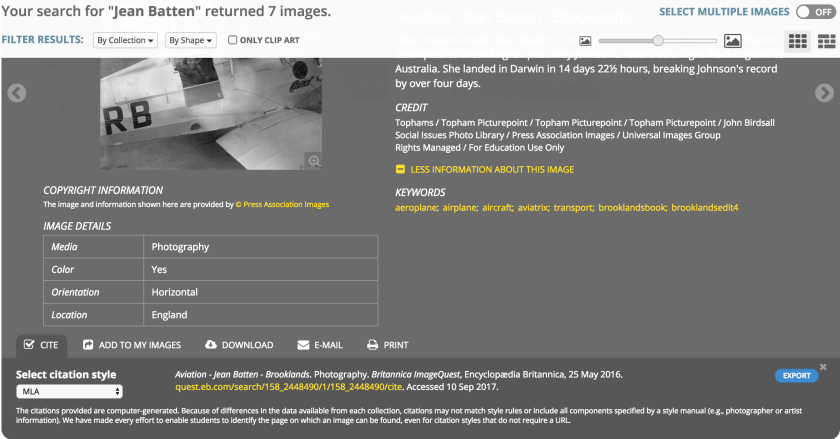
As we looked up the various things students were researching to my utter dismay I realised that each and every one had as creation date 25 May 2016.

One of the things that I try to keep in the back of my mind when teaching information literacy is where we are going in terms of threshold concepts.  We want to ensure that students are not going through the rote / skill part of academic honesty without really understanding the bigger information literacy picture.

Screenshot Britannica Image Quest
Screenshot Jean Batten – Brooklands and citation, Britannica Image Quest, 10 September 2017.

So I wrote to our “local” Britannica representative questioning the date on the image. Surely it couldn’t have been May 2016? And who was the photographer? Surely they deserved a mention?

The correct structure for MLA8 (the system our school is using) is:

Creator’s last name, first name. “Title of the image.” Title of the journal or container that the image was found on, First name Last name of any other contributors responsible for the image, Version of the image (if applicable), Any numbers associated with the image (such as a volume and issue number, if applicable), Publisher, Publication date, Location. Title of the database or second container, URL or DOI number.

So the response I got back from Britannica was:

Many thanks for your email expressing your concern over our citation. I am guessing you are referring to the MLA format. We follow the required format for online publishing which does not require that particular information.

Example below.

HIV viruses (red). Photography. Britannica ImageQuest, Encyclopædia Britannica, 25 May 2016.
quest.eb.com/search/132_1274904/1/132_1274904/cite. Accessed 16 May 2017.

MLA citation requires a publication date which is considered a core element of the citation. That, of course, would be the date of the last image publish of that collection, May 25, 2016. Because the data from the images comes from more than 60 collections, it is very inconsistent or we don’t have it at all. Britannica tries never to provide information that we cannot guarantee to be correct. We suppress this from the site for that reason.

http://quest.eb.com/collections

I hope this assists your understanding of our difficulty here. Please come back to me if I can be of more assistance.

At which point I cried foul. And took my concern to a couple of librarian networks. Where it was roundly ignored. Or where it wasn’t ignored it was met with a powerless sigh. And I wrote back to them as said no, I was not satisfied with that. Are you serious? They get photos from 60+ databases and can’t be bothered to spend a few dollars on mapping the available data properly to their database? Only 60? That means you pay 60 something people, one to look at each of those databases and work out their tagging and map it to your tagging.  And then you pay somebodies to manually sort out the ones that don’t map nicely or you default to the cop-out citation for those. In the world of cheap accessible outsourced IT, that should be a no brainer. The entry about the privately owned Britannica on Wikipedia is illuminating.

In the world of fake news and fake photos and fake evidence and fake research and fake everything we need to be vigilant. When original primary research documents and images get scanned into databases we lose a trail if the creators and dates are no longer considered important enough to add. We are not talking about born-digital images here.

So I persisted and got this response:

Well you have certainly stirred thing up, in a good way I think. J

I’d like to share with you some of what has occurred since your concern was raised, in the hope it will be interesting and helpful in the future.

Our Editorial Team was consulted and they will be handling citations going forward. They did a full review of the MLA format and consulted with the MLA Handbook 8th Edition.

As I mentioned in a previous email, the reason we leave off the photographer is because the data we get from the partner is not in a format that would allow us to list it correctly on a consistent bases. The MLA Handbook states, “When a work is published without an author’s name. . .skip the author element and begin the entry with the work’s title” (p. 24). Since we cannot accurately list it, we are leaving it off. The editorial team are going to explore this a bit more and see if there is a way we can improve this, but for now we will leave it off. This will not be an easy thing to fix.

We are listing the publish date of the images (in addition to accessed date). According to the MLA Handbook, the publish date is appropriate. Because we didn’t always store the publish date in the database, when we revised for MLA 8  we had to fill in something so all images would have a date. We used the date of the most recent publish. From the point of making this change and going forward we now list the actual publish date of image. Since this did result in most, but not all, of the images having the same date we are going to go back and try to update the publish dates with the date the collection was first published on our site. This will hopefully make it easier to teach students what this date is for since the majority will not be the same. However just to reiterate, as new images are published they are now listing their actual publish date.

Over the next month or so, the Editorial Team will also complete a review of the other citation formats in ImageQuest and we will make changes as time allows. We will also create a citation page where we provide additional information to clarify our citation policy.

Nadine, I do hope it is clear that Britannica always endeavours to provide the most accurate information possible and that we do react, where we can, to try and improve on a valued customers suggestion.

and in fact, if you look at the bottom of every citation you’ll now see the following:

“The citations provided are computer-generated. Because of differences in the data available from each collection, citations may not match style rules or include all components specified by a style manual (e.g., photographer or artist information). We have made every effort to enable students to identify the page on which an image can be found, even for citation styles that do not require a URL.”

Why does this still bother me six months later? Let’s return to what we really want students to know about Information Literacy. What will carry them beyond their latest assignment, their Personal Project, their Extended essay. What will take them through life as sceptical consumers of information. Let’s go back to understanding the threshold concepts of information literacy.

We should rely on information that has authority.  So we check the credentials, experience and expertise of those giving the information. There is an image of a young woman and a claim she broke an aviation speed record in 1934. Who took that photo? Where was it taken? When was it taken? Was she leaving or arriving? If the photo was taken on another day or time was it just posed? Was that the triumphant photographic proof of her exploit?

Information has a format. And it’s format is related to its creation, production and dissemination, NOT how it is delivered or experienced. Usually this is considered when comparing journal articles in a journal in a database to the journal format of the past as in volumes of books. The fact that the format is now online, doesn’t impact on the fact that it’s a a peer reviewed journal article. A similar argument can be made for a historical photo. The fact that it’s now delivered digitally shouldn’t ignore the fact that it was once a photo taken with a camera at a point in time by a real photographer.

Information is a good (as in goods and services). As such there is a value and a cost to information, and we should be aware of that. At the moment the balance of financial cost and reward seems to be very one sided. Databases buy up collections of information, bundle it, and sell it on at a premium and add as little value to the images as they can get away with. Usually just giving information on the seller rather than the creator of the images.  The information structure – information is structured and accessed / searched in a certain way and that differs depending on the format and container.

The research process builds on existing knowledge. But if we ignore the existing knowledge and process whereby we get to the current point we’re negating this aspect. This also builds into the idea of scholarly discourse – that we’re entering an academic conversation at a certain moment.

So at this point I’d still be saying – no excuses. The fact that something is hard should never be an excuse not to do it properly.  Yes they are right – they are complying with the MLA8 structure. But they are not helping with the spirit of scholarship and information literacy.


If we build it will they come?

In my past “homeless” week I’ve had opportunity to offer PD to my fellow librarians & library staff and to some teachers, and also to go into classrooms for a longer period of time and help with research, and I’ve had time to find, curate and put resources onto our libguides, and I’m hot-desking in the coordinator’s office. Its’ been a very informative time.

What I’ve learnt:

  • Never make assumptions about a basic level of digital literacy – just because you’re comfortable with screenshots, copying and pasting, using short-cuts etc. your audience may not be. Often they only know the very specific applications and programs (and operating systems) that they need for their specific tasks in their job.  You need to be very explicit and slow in explaining things.
  • Many many students do not know the difference between being in a browser window and typing in a URL (even a shortened one) and typing in a search term in a search box since the two have become ubiquitous to them – and Chrome as a Google product has played into that by allowing you to access either a search or an address from either. That’s something I never paused to think about, as a computer child of the 80’s they were very distinct things. This is philosophically interesting and I wonder if it impacts on understanding the nature of search and query?  I see a considerable amount of blurring generally – and if one thinks of aspects of information literacy in terms of threshold concepts I’m wondering if all these developments, while apparently making things easier are actually making them more difficult?

My biggest learning is that I have a poor understanding of how, where, why and when students and teachers access information. I’ve gone for a (at least) three times redundancy concept in providing access to anything –

  • in the OLP (Online Learning Platfrom – both on the homeroom page AND on the library page)
  • on the front page of our OPAC
  • on our Library Guides

In initial library lessons we’ve also had students (and teachers and parents – in our library bytes sessions) bookmark the 3 primary sites – the catalog, the library guides and then library OLP page. But the issues with information seem to be more deep-seated than that. I suspect that there is still confusion about not even knowing why you’d want to access anything – a kind of informational existential issue.

I’m guessing about 10-15% of the students in a class are making full use of the resources we’re providing.  Our school is probably not unique in this. I hear the same lament everywhere.  There is the saying of “meet your customer where they are” (not where you want them to be) and I think we neither really always know where they are – or we suspect they’re just on google, nor are we able to meet them there. AND OUR VENDORS ARE NOT HELPING US!  Let’s take our OPAC / Catalog as an example. Follett has finally woken up to the fact that google, and not our catalog or databases is the first place students look, so they’ve come up with a very nifty chrome extension that allows you to plug in your catalog (and webpath express) as the first search result – like below

screen-shot-2016-12-10-at-10-42-09-am

But, it only works with iOS on desktops / laptops. And we’re an iPad school (not an android / chromebook school). So it doesn’t work on iPads. So far so useless actually.

Oh, but there is a Destiny Discover App for iPads… except all it does is try to update every time you access it, and it gets to 31% and then crashes. And you can only set age / Lexile / grade level limiters to books, not databases or online resources, so it’s even more overwhelming than good ole google.

So at our last inter-campus librarian meeting we decided to try and encourage entry and access to our paid resources by making them options on our UOI guide resources page – so we’ve semi-standardised our boxes to have Books (with a link to the catalog via Librarythingsforlibraries book display widget), Videos (since Youtube is the 2nd only to google as the “go to” place for student research) and Resources (including Britannica, Brainpop, Epic Books and other curated links).

screen-shot-2016-12-10-at-10-51-56-am

The thought is, that they then don’t have to leave the page in order to go to a resource, they just click on the picture, and get to say Britannica, and once they’re there, the threshold is lower to then search for something from within there … we’ll see what the reality is.  I’ve also explicitly told them this in their last research lesson. Now to follow up and see if the usage stats change.

So what now? 

I think I need to move to a simpler and more intuitive layout – Following Katie Day’s layout for her research guide, perhaps making it student question related?

screen-shot-2016-12-10-at-11-08-41-am

At a whole different level is the services and guides that happen at Scotch College ….

screen-shot-2016-12-10-at-11-15-54-am

I think I need to sit down with teachers and students and really understand how they use information, how they look for it and where they expect to find it. Customer journey maps – something that I was thinking of as an alternative study avenue before I looked at our Blokes with Books club as my case study. Has anyone looked into that in the library context? I know people have looked at social media in library, but this is different – the physical and digital paths our patrons use to get information (or get frustrated by us). Any pointers?


Communicating across cultures

Communicating across cultures: cultural identity issues and the role of the multicultural, multilingual school library within the school community

Dr. Helen Boelens
School Library Researcher and Consultant, The Netherlands

John M. Cherek Jr. MSc
Project Manager, Zorgboerderij “De Kweektuin”, Mijdrecht, The Netherlands

Dr. Anthony Tilke
Head of Library Services & TOK Teacher, United World College of South-East Asia (Dover Campus), Singapore

Nadine Bailey
United World College of South East Asia (East Campus), Singapore

Abstract

The arrival of increasing numbers of refugees and immigrants has caused large increases in multicultural school populations.This interdisciplinary paper describes an ongoing study which began in 2012, discussing the role of the school library in multicultural, multilingual school communities and offering suggestions about how the school library could become a multicultural learning environment. It provides information to help school library staff to look closely at these issues and to provide help and useful suggestions to the entire school community. The prime objective is to help the school community to safely and constructively deal with the dynamics of a multi-cultural society, using the school library as a base.   Safe facilitation requires “trained” leaders from the school community. An e-learning program for school librarians is being adapted for this purpose.

Keywords: multi-culturalism, multi-lingualism, languages, cultural identity, global literacy.

Introduction

At the IASL Conference 2012, a paper discussed the role of the school library in multicultural, multilingual school communities and offered suggestions about how the school library could become a multicultural learning environment (Bloelens, van Dam and Tilke, 2012). Since 2012, various factors have affected multicultural school populations in many different types of primary and secondary schools in countries throughout the world.

Limitation of this study

This paper seeks to understand how learning experiences of multicultural, multilingual students can be accommodated in the school library. Boelens and Tilke (2015) recently described relevant trends and ideas which posits the role of the library in multicultural/lingual school communities from different areas of study: education and pedagogy, library and information science, psychology, sociology and anthropology, and linguistics.

Educational trends

Some international organisations have indicated educational trends. UNESCO’s statement on global education provides a set of objectives for international education until the year 2030. The Organisation for Economic Co-operation and Development (OECD) recommended that schools support both “the identifiable needs of today, and the uncertain demands of the future” (OECD, 2005); schools should provide an environment that will support and enhance the learning process, encourage innovation, foster positive human relationships – in short, be “a tool for learning”. The term “learning environment” suggests place and space: a school, a classroom, a library. However, in today’s interconnected and technology-driven world, a learning environment can be virtual, online, remote – it doesn’t have to be a physical place at all. Perhaps a better way to think of 21st century learning environments is as support systems that organize the conditions in which humans learn. How does this affect the school library?

Library and information Science trends

How do these changes in educational theories and expectations affect the school library? Commentators in North America have suggested that the library has now become part of the school learning commons (Canadian Library Association, 2014; Loertscher et al, 2011; Loertscher et al, 2008). Educuase (2011) considers that learning or information commons

has evolved from a combination library and computer lab into a full-service learning, research, and project space. … In response to course assignments, which have taken a creative and often collaborative turn … learning commons provides areas for group meetings, tools to support creative efforts, and on-staff specialists to provide help as needed. The strength of the learning commons lies in the relationships it supports, whether these are student-to-student, student-to-faculty, student-to-staff, student-to-equipment, or student-to-information (p. 1)

Can the needs of multicultural/lingual learners be specifically supported in a Learning Commons environment? Osborne (2014, p. 7) states that “more and more schools … are committing to provide physical spaces that align with, promote and encourage, a more modern vision for learning” and asks “how might the library act as a ‘third place’ to provide unique, compelling and engaging experiences for staff, students and community that aren’t offered elsewhere?” (p. 8)

Furthermore, librarians are co-teachers within multicultural/lingual school communities (Medaille and Shannon, 2014); co-teachers are “two equally-qualified individuals who may or may not have the same area of expertise jointly delivering instruction to a group of students” (Curry School of Education, 2012).

Racial, Cultural and Ethnicity issues (Psychology, Sociology, and Anthropology)

Key factors are:

  • Students cannot start learning until they feel safe, seen and valued;
  • Learning is diminished and/or does not occur without addressing equity and diversity topics;
  • Equity and diversity topics are intertwined with academic achievement.

This paper will also discuss subjects such as “diversity” and “difference” in multicultural situations within the school community and how these matters affect the school library, not only in developed countries, but also those which are located in emerging and developing countries (Boelens and Tilke, 2015, p. 2). Students from diverse cultural backgrounds, who differ from mainstream students in terms of ethnicity, socioeconomic status and primary language, are entering schools in growing numbers. The education which these students receive needs to address multicultural and intercultural issues. Intercultural education relates to culture, religion, cultural diversity and cultural heritage and respects the cultural identity of learners through the provision of culturally appropriate and responsive education, which focuses on key issues and interrelationships (UNESCO, 2006). It concerns the learning environment as a whole and impacts many different aspects of the educational processes, such as school life and decision making, teacher education and training, curricula, languages of instruction, teaching methods, student interactions and learning materials. (UNESCO, 2003a)

Language acquisition

Based on international research, practice and comment, Della Chiesa, Scott and Hinton (2012) identified strong connection between language and culture(s), looking for future benefits in human endeavour, partly as a result of recognizing that language acquisition and use does not develop in isolation from socio-cultural and indeed brain development.   International understanding is perceived as a desired social outcome of such interventions.

Features of language learning assist teachers of culturally and linguistically diverse students. Learners learn a language best when treated as individuals, experience authentic activities in communication in the target language and see teaching as relevant to their needs. Learning should be relevant to their needs and they benefit from seeing strong links between language and culture. They also benefit from having helpful feedback on their progress and where they can manage their own learning. (Vale, Scarino and McKay, 1991)

Background information

Demographic shifts, i.e. changes in the demo-linguistic situation, have taken place. Children from culturally and linguistically diverse backgrounds, including immigrant and refugee children, are entering schools all over the world; changing demographics will alter both school practices and policies (Center for Public Education, 2012). Features of experiences for students in various countries include:

Culturally and linguistically diverse students in Australia typically come from a wide range of language, socio-economic, cultural and religious backgrounds. Up to one-fifth of such students are newly arrived in Australia and with a language background other than English; even if some students are born in Australia, they may enter the school system with little or no English language. (Department of Education of Western Australia, 2011). Australian schools may experience large populations of immigrant and/or refugee students (Ho, 2011).

There were similar issues in Canada, where students did not have language skills in the main languages used for teaching and learning, though differences in educational performance reduced as students progressed through the school system (Statistics Canada, 2001).

The United Kingdom too experienced similar issues, where a focus on educating significant numbers of students who spoke English as an additional language (EAL) (British Council, 2014).

Looking at countries where English is not the main or major language of teaching and learning, the European Commission (2015) reported very similar issues for schools and for students, not least for asylum seekers.

The USA too has seen changing demographics in schools. Forty-seven percent of children younger than five belong to a racial or ethnic minority group, and “trends in immigration and birth rates indicate that soon there will be no majority racial or ethnic group in the United States” (Center for Public Education, 2012). Implications for such trends may include needs for qualified bilingual teachers, preschool programmes, concerns over drop-out rates from mainstream education, and other resource issues in schools.

Important identity issues in the context of the school community

This paper posits that the school library must be a safe space that welcomes all questions, perspectives and backgrounds. School libraries offer valuable resources (in both traditional and digital format), information, knowledge and insight. In a school context, a library space is one where students can explore their ideas and ask questions. Librarians provide specialised support within this domain and have a responsibility to support the growth of their students. Such healthy development of students can have a strong impact on self-esteem, academic performance and feelings of cohesion. In a multi-cultural school setting, issues of race, ethnicity and culture play a central role in the identity of the school and its students. Celebrating our differences is one way of acknowledging the diverse backgrounds of members of the school community, though such diversity can be overshadowed by a dominant culture and its narrative.

As professionals in education, it is our responsibility to develop competence in the areas that matter to our students, including our own understanding of race, culture and ethnicity, to ensure that young people receive targeted guidance and support they need in order to explore a healthy sense of self.

Identity

Central to identity formation is the “challenge of preserving one’s sense of personal continuity over time, of establishing a sense of sameness of oneself, despite the necessary changes that one must undergo in terms of redefining the self” (Harter, 1990). Adolescence is an important and formative period in life that influences many parts of identity development (sexual, racial, ethnic, gender, etc.). Identity development is a dynamic process that plays a central role in developing our relationship to the self, the other and our social environment. It is especially during adolescence that we play around with multiple identities, experiment with “the rules” and test the institutions around us. As a result of this process, parts of our identity are kept and nurtured, while others are briefly worn and discarded.

Much research about racial and ethnic identity development has focused on adolescent and college age individuals. (Helms (1990) in Phinney, 2007, p. 275) This makes sense because self-reflection is an important part of collecting data. It does not necessarily imply that younger children do not have the ability to reflect, but their process of reflection may be different. For example, younger children tend to describe themselves in a more simple, less sophisticated way, according to their perception of personality characteristics — “I am nice”/ “I like to make other people feel good”/ “I like to help people”. This is less about their relationship to things (toys, food) and more about their understanding of certain qualities (both good and bad). For example, “I am good at writing and bad at soccer”. This relates to ethnic identity development, when children become aware of good and bad qualities about their ethnic group. Understanding why society deems these certain qualities good or bad is perhaps one way to help prepare them for dealing with a multi-cultural environment with dominant ideas that are not their own. Ethnic identity has been studied largely with reference to one’s sense of belonging to an ethnic group, that is, a group defined by one’s cultural heritage, including values, traditions, and often language (Phinney 2007, p. 274). Finding interactive and “fun” ways to help children explore or even explain their understanding of these things is one role the school library can play; by facilitating access to information, librarians can guide students through relevant books, movies and other multimedia tools.

Adolescence is a developmental stage between childhood and adulthood when individuals experience biological, social and psychological change. According to psychoanalyst Erik Erikson (1968), ego identity versus role confusion. It is the psychosocial stage of personality development that adolescents encounter when faced with the question, “Who am I?”. A healthy resolution of this stage can lead to strong ego identity. Unhealthy resolution of this stage will contribute to role confusion. Role confusion challenges our ability to build connections and participate as members of society. Here, adolescents create and recreate meaning to provide themselves with a sense of connection. When a lack of connection exists, the ego struggles to build a foundation for fidelity, based on loyalty. If adolescents lack fidelity, they might encounter, in extreme cases, a future of social pathology, crime and prejudicial ideologies. These negative characteristics can manifest when the individual participates as an adult, for example, in religious, athletic, national, and military rites and ceremonies (Engler, 2014).

Racial, Cultural and Ethnic Identity

A healthy racial and ethnic identity can help youth establish a consistent view of themselves. Many aspects of adolescence are transient and changing. One day we love the color yellow and the next day it is the color red. Thus, by creating a permanent anchor from which to develop, we give our students a better chance at achieving positive outcomes; without these anchors, many young people may identify with a completely different culture which has nothing to do with “who they are”.

Identity issues and their importance in the school and the school library

The feeling of belonging is critical to every child’s well-being and helps him/her to fulfill his potential in many different areas of development: physical, social, emotional and cognitive (Welcoming Schools Childhood Education Program, 2015).

Cherek’s 2015 research is concerned with ways that students can develop a healthy racial and ethnic identity and improve their understanding and vocabulary around race and ethnicity, therefore contributing to increased cultural competence; this contributes to higher self-esteem and healthy development. By using these essential skills, students have the opportunity to take ownership over their ideas and are encouraged to examine the world around them — at home, school, work and in the media – thus preparing them to thrive in multicultural environments.

Essentially, children who feel good about themselves may be more successful, not only at school but in different aspects of their lives (Tough, 2012). Identity is not something that individuals automatically have. Identity develops over time, beginning in childhood, through a process of “reflection and observation” (Erikson 1968, p. 22) Important questions to ask about a child’s learning environment is does he/she see other teachers, parents or students in the school who represent his/her own culture or heritage? Who do these children identify with? Who do they see as a reflection of themselves, e.g. public figures?

Using these factors, the school library becomes a safe “public” space where a healthy and proactive sense of diversity encourages deep and meaningful conversations with all members of the school community about stereotypes such as discrimination and racism.

Involvement of the school library/ian in multicultural, multilingual education

Ultimately, the aim is that students, teachers and librarians are prepared to safely and constructively deal with the dynamics of a multi-cultural society. Safe facilitation requires “trained” leaders from the school community.

In larger schools with academic disciplinary silos, it may be difficult to create positive messages about mother tongue and cultural identity and pride across to members of the school community as a whole – school leaders, teachers, students and parents. The EAL (English as an Additional Language) teacher is most concerned about getting the students up to speed and may inadvertently give the wrong message. The teaching of the student’s (minority) language may not be part of the school language policy.

The Welcoming Schools Childhood Education Program (2015) suggests that children who are motivated and engaged in leaning are more committed to the school. By providing books, information and other resources, the library can “provide an important mirror for children to see themselves reflected in the world around them”. Here, library resources “also provide a window to the lives of others. … [and] students also find positive role models through literature”; benefits from such activities are best seen when coordinated in the school community. The library can provide a stable permanent base for the length of the student’s school career.

Research (Bedore and Peña, 2008) indicates that bilingualism can only be sustained if there is at least a 30% input in the less dominant language. If the less dominant language is not a language which is used and taught within the school community, then the library can provide access to relevant materials. This is an intellectual process of proving the benefit and a practical exercise of resource collection, curation, access, promotion and marketing.   These can be very simple, such as the creation of displays of books about diversity, multiculturalism and multilingualism and about national days of the countries which are represented by children at the school, and reflecting their cultures.

In any event, the school library is a helpful environment where students can reflect on these issues. It can highlight resources, or profile individuals relevent to various ethnic groups. This can be achieved by exploring literature authored by individuals from their ethnic own group or by reading about the history of their own ethnic group. Additionally, the library can give students the basic skills to find or locate this information.

Multicultural, multilingual school libraries

In 2012, Boelens, van Dam and Tilke focused on various aspects of multicultural and intercultural education, identifying a symbiotic relationship with school libraries. It reported on support needs for both children who were immigrants, i.e. those permanently moving from one country to another, as well as more geo-mobile children, known as Third Culture Kids or Global Nomads. Various relational features were identified: literacy, language, bilingual education, world languages.

Krashen and Bland (2014) have identified the need for second language learners to develop competencies in academic language acquisition. Before that, self-selected recreational reading habits were partly dependent on a varied, indeed wide, selection of reading matter. In itself, this reading matter did not provide access to academic language acquisition, but it prepared children to do so. This reading stamina also had an effective domain, in that it motivated students to become readers, and arguably gave them confidence. For some children who use school libraries in multicultural education environments, the digital age was not wholly relevant, as ebook use was associated with affluence. For children whose socio-economic experience is that of poverty, libraries represent the only stable source of access to reading materials, especially in developing and emerging countries. The provision, promotion and use of such reading materials is a feature of the work of (school) libraries/ians in these countries. These libraries/ians support students and teach them to to navigate abundant sources of information. Such skills and aptitudes are commonly known as information literacy skills. Sometimes, the prevalence of information literacy skills is perceived as being a main role of the school library/ian, however the teaching of these skills and the provision of reading materials need to be symbiotically linked.

Smallwood and Becnel (2012) identified various factors in successfully providing library services in multicultural settings – accessing and reaching the clientele; provision of appropriate materials; consideration of use of space; focusing services on linguistic and socio-economic needs; appropriate technology; professional development and awareness-raising amongst school librarians. Indeed, Welch (2011) promoted the idea of the library collection having an aim of influencing student behavior, in terms of increasing tolerance and sensitivity in a multicultural setting.

Whilst not substantially different from good practice elsewhere, the International Baccalaureate Organization (IBO or IB) has identified good practice in library support for multilingual learning environments (International Baccalaureate, 2012). Schools that offer IB programmes comprise state or government schools, semi-independent, independent and international schools. When a school adopts IB programmes, it needs to also take ownership of IB philosophy, including a holistic approach to language and international-mindedness (Singh and Qu, 2013). There is, therefore, a symbiotic link between language and intercultural education approaches in schools which may (or should) experience strong ESL (English as a Second Language) support (Carder, 2014), though the IB stance is that every teacher is a teacher of language (International Baccalaureate, 2011).

Therefore, the literature has identified a need to develop competencies in academic language proficiency and a resource/information role for (both public and school) libraries, especially for children, sometimes immigrants or refugees, who are affected by poverty. Therefore, libraries may be part of scaffolding strategies to support children who need language support, and which include resources and facilities (space). Thinking and planning for such library services and support needs to be holistic and wide-ranging (from facilities and plant to professional development), all based on an understanding of the needs and concerns of targeted client groups.

Focussing services on the needs of multicultural/ingual students

The librarian needs to establish the current and future users of the school and its library, and user demographics (i.e. how many students come from which minority or language group). Library collection and services should then be related to such information.

School libraries have roles related to literacy and reading, and teaching and learning of information literacy skills. To support this, resources – mainly physical – have been curated to serve a mainstream interpretation of students’ needs, often curricular, and in the dominant language (often English). This role could be broadened to meet the needs of the multicultural/lingual school community.

  • The library collection should contain books and information (in traditional and digital format) which reflect the diversity of the children in the school. The library exposes the entire school community to many different cultures and languages. This collection can help students to understand that while their families are unique, they share many common values, beliefs and traditions.
  • The collection should contain literature in the native language of students, and link to digital international children’s libraries and also digital libraries for children from relatively small indigenous groups. This could include online links to songs, poems and stories from many different cultures and in many different languages. It should also contain current information about student countries of origin. Parents could be asked to help the librarian with this task. (Smallwood and Becnel, 2012)

Using these guidelines, the school librarian can strengthen the collection, and then present this information in attractive ways to the entire school community, so that it becomes aware of the extent of their library’s resources.

Librarians can provide an enabling portal function for immigrant, refugee and Third Culture Kids. They may be hesitant to assume this role, perhaps due to mono-lingual experience or lack of expertise in the creation of digital personal learning environments (PLEs) or personal learning networks (PLNs).

The librarian may consider applying principles of information ecology to the school library. This multi-disciplinary emerging field offers a framework within which to analyse the relationships between organisations, information technology and information objects in a context whereby the human, information technology and social information environment is in harmony (Candela et al., 2007; Wang et al., 2015).

Steinerová (2011) and Candela et al., (2007) looked at features of digital libraries and suggested that librarians examine where value integration can take place between the library service, technology, scholarship and culture, adding value through new services or contributions to learning, user experience, research productivity, teaching or presenting and preserving cultural heritage. Applying these ideas to the school environment, constituents of the eco-system include teachers, teacher librarians, students administration, parents and custodial staff (Perrault, 2007). Elements of the system will co-exist but also compete and share, converge and diverge in a dynamic interactive, complex environment (García‐Marco, 2011). The role of the library is such that information ecology needs to be understood in order to support information-seeking behaviour and thereby discover zones of intervention and areas to leverage to optimise advance information-seeking, usage, creation and dissemination within that eco-system and beyond. In response, curriculum, content and subject delivery can be collaboratively reshaped and constructed according to changes in the environment or needs of students (O’Connell, 2014).

Different kinds of resources and adaptive technologies can optimally support students with special educational needs (Perrault, 2010, 2011; Perrault & Levesque, 2012). This type of thinking can be adapted to considering the needs of bi- and multi-lingual students who are part of the school’s information ecology, but have linguistic and cultural learning and informational needs. These can be seen as a potential zone of intervention for collaboration between the teacher, teacher librarian (TL), family and community.

Literature intended for school librarians generally discusses cultural diversity in materials and the building of a world literature collection in response to student diversity or as part of language and humanities curricula (Garrison, Forest, & Kimmel, 2014). Some schools build a “Languages other than English” (LOTE) collection. To do so, schools may try to recruit bilingual or minority TLs or ask for help from parents; schools can also provide training in competencies in multicultural education (Colbert-Lewis & Colbert-Lewis, 2013; Everhart, Mardis, & Johnston, 2010; Mestre, 2009).

The main educational and social issues within schools are to ensure students acquire the official language of instruction so that they can adapt to the new learning environment without loss of educational momentum, while maintaining and developing their mother tongue (Kim and Mizuishi, 2014). Carder (2007) and Cummins (2001; 2003) suggest that even though there is evidence that supports the maintenance of mother tongue (the most effective way of supporting such students), schools place most effort and resources on the official language of instruction of the school. Evidence now presented above suggests that by doing so, children may lose some of their own healthy cultural and ethnic identity.

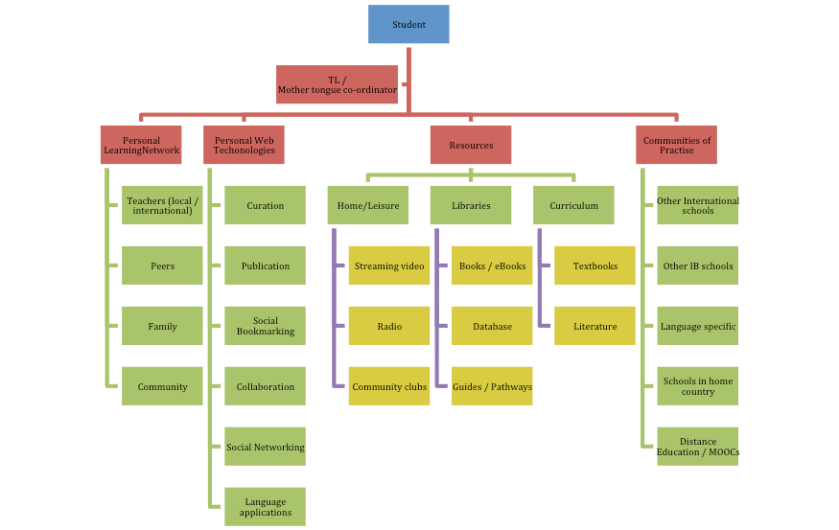
School librarians may be aware of geographically dispersed personal learning networks (PLNs) in order to create a personal learning environment (PLE) using various technological tools (McElvaney & Berge, 2009; O’Connell, 2014), and could assist different individuals throughout the school community to make use of a PLE. For instance, the International Baccalaureate (IB) allows students the option of guided mother tongue self-study if the school does not teach that specific language. Figure 1 below describes a PLE of an IB self-taught language student.
84ff0-pln2blanguage

Figure 1: PLE of an IB self-taught language student

A training program about multicultural/lingual issues for the school community

In 2015, Boelens and Cherek examined the possibility of creating a personal development training program for the entire school community, facilitated by the school library. This is an attempt to help teachers, school leaders, librarians and parents to better understand problems being confronted by the multicultural/lingual school community, especially immigrants and refugees. This program would be made available through the school’s electronic learning environment.

The first part is a 24-minute video that provides an open conversation about race and ethnicity between professionals and young people. Here, participants listen to different perspectives about race and ethnicity, and appreciate why these topics are important to both caregivers (teachers, social workers, child welfare professionals) and young people. Finally, with the help of a study guide, participants explore the possibility of integrating racial and ethnic identity development into daily practice.

The second part is an eLearning course that provides participants with necessary tools to develop a deeper understanding of issues related to racism and discrimination. The content is specifically designed so that professionals (adults, educators, caretakers) develop a vocabulary for discussing race and ethnicity with others who are interested in and concerned about these subjects. A constructive vocabulary is an essential tool when discussing identity development, as it enables participants to safely address issues of racism and discrimination. Finally, participants can further integrate this deepened knowledge into daily practice. This is an important part of the training because it prepares participants for a facilitated in-person learning event.

The third and final part of the curriculum is a two-day in-person learning event. In this face-to-face meeting, trained facilitator’s guide participants as they begin to incorporate their new skills into daily practice. The most effective and powerful events occur when both young people and professionals are present. The training is highly interactive and challenging. Participants are encouraged to openly discuss the impact of stereotypes and the social influences that affect their own racial and ethnic identity.

A similar training program is by The Welcoming Schools Childhood Education Program (2015), which provides a starter kit for a personal development training programme for members of the school community, relating to equity, school climate and academic achievement.

Tapping into the experiences and communities of practise (COP) of distance education, massive open online courses (MOOCs), school librarians could be trained to facilitate this training program through PLNs and PLEs, Training programs would be available at any time and in any geographic location providing internet access is available. Initially, a pilot program would be tested with one language group, and could later be extended to other groups.

This training program will help to establish a multicultural/lingual school community based not only on academic achievement but also on a healthy climate with regard tp racial, cultural and ethnicity issues. It will also contribute to a school´s goals of equity in teaching and will require the support and involvement of the entire school community. Since library staff will be facilitating this program, their reputation will be enhanced, and be perceived as integral members of the school community.

Conclusion

This paper has discussed a developing role for the school library in the multicultural/lingual school community in 2015. It promotes a training program for the entire school community which will be facilitated by the librarian. Because of their involvement in the school´s learning commons, the librarian is already involved in interdisciplinary activities related to the multicultural/lingual nature of the entire school.

While all aspects of identity development are valuable, one area that is often ignored, especially when talking about young people who are detached from their culture, is racial and ethnic identity. Along with ever-changing realities of society, demographics and politics, the impact of race and ethnicity have never been more important.

With an increasing number of migrant and immigrant students, the acute reality of living in multiple worlds becomes more apparent. Social norms and values become entangled. Home life, school life and street life compete for attention. Without proper guidance and support, alienation that occurs when individuals feel split between dissonant forces results in a confused sense of “Who am I?”. Addressing these issues in an educational setting means that we as educators have the power to create “safe spaces” for our captive student audience. Thus, students can be prepared to effectively deal with the realities of a multi-cultural society while at the same time developing a healthy sense of racial and ethnic identity.

As a result of the proposed training program, students at the school will learn more about `who they are`, especially those who come from an immigrant or refugee background. With the support of the entire school staff, they will some to terms with their own cultural identity and ethnicity in their new school and in their new place of residence, and have positive feelings, with an expected corollary that their academic achievement will increase.

References

Bedore, L. M. and Peña, E. D. (2008). ‘Assessment of Bilingual Children for Identification of Language Impairment: Current Findings and Implications for Practice’, International Journal of Bilingual Education and Bilingualism, 11(1), 1–29. doi: 10.2167/beb392.0.

Boelens,H. van Dam, H. and Tilke, A. (2012). School Libraries across cultures. Presented during the Research Forum of the 2012 IASL (International Association of School Librarianship) in Qatar.

Boelens, H. and Tilke, A. (2015). The role of school libraries in our multicultural, multilingual society. Submitted for publication to the CLELE (Children’s Literature in English Language Education) Journal, in March, 2015. Not yet published. Munster, Germany: CLELE.

Boelens, H. and Cherek, J. (2015). Education 2030 (EU), and Onderwijs 2032 and Excellent Education in the Netherlands: a vision of the role of the multicultural, multilingual school library within these concepts. To be presented during the IASL (International Association of School Librarianship) 2015 Conference in Maastricht.

British Council. (2014). How can UK schools support young children learning English? Retrieved from http://www.britishcouncil.org/blog/how-uk-schools-support-young-learners-english.

Canadian Library Association (2014). Leading Learning: Standards of Practice for School Library Learning Commons in Canada. Ottawa, On., Canada: Canadian Library Association. Retrieved from http://clatoolbox.ca/casl/slic/llsop.html

Candela, L., Castlli, D., Pagano, P., Thano, C., Ioannielis, Y., Koutrika, G., Ross, S., Schek, H-J., and Schuldt, H. (2007). Setting the Foundations of Digital Libraries: The DELOS Manifesto. D-Lib Magazine, 13 (3-4). Retrieved from http://dialnet.unirioja.es/ejemplar/157227

Carder, M. (2007). Bilingualism in international schools: a model for enriching language education. Clevedon, UK: Multilingual Matters.

Carder, M. (2014). Tracing the path of ESL provision in international schools over the last four decades. Part 1. International Schools Journal, 34 (1), 85-96.

Center for Public Education. (2012). The United States of education: The changing demographics of the United States and their schools. Retrieved from http://www.centerforpubliceducation.org/You-May-Also-Be-Interested-In-landing-page-level/Organizing-a-School-YMABI/The-United-States-of-education-The-changing-demographics-of-the-United-States-and-their-schools.html

Colbert-Lewis, D., & Colbert-Lewis, S. (2013). The Role of Teacher-Librarians in Encouraging Library Use by Multicultural Patrons. In C. Smallwood & K. Becnel (Eds.), Library services for multicultural patrons: strategies to encourage library use (pp. 73–81). Lanham, MA: The Scarecrow Press.

Cummins, J. (2001). Bilingual Children’s Mother Tongue: Why Is It Important for Education? Retrieved from http://iteachilearn.org/cummins/mother.htm

Cummins, J. (2003). Putting Language Proficiency in Its Place: Responding to Critiques of the Conversational – Academic Language Distinction. Retrieved from http://iteachilearn.org/cummins/converacademlangdisti.html

Curry School of Education, (2012). Co-teaching defined. Retrieved from http://faculty.virginia.edu/coteaching/definition.html

Della Chiesa, B., Scott, J., and Hinton, C. (2012). Language in a global world: learning for better cultural understanding. Paris: OECD Publishing.

Department of Education, Western Australia (2011). Gifted and talented: Developing the talents of gifted children. Retrieved from http://www.det.wa.edu.au/curriculumsupport/giftedandtalented/detcms/navigation/identification-provision-inclusivity-monitoring-and-assessment/inclusivity/culturally-and-linguistically-diverse-background/

Educause Learning Initiative (2011). Seven things you should know about the Modern Learning Commons. Retrieved from https://net.educause.edu/ir/library/pdf/eli7071.pdf

Engler, B. (2013). Personality theories : An introduction. 9th ed. London: Cengage Learning.

Erikson, E. (1968). Identity: Youth and crisis.New York: Norton.

European Commission, Eurostat. (2015). Retrieved from http://ec.europa.eu/eurostat/help/support

Everhart, N., Mardis, M. A., & Johnston, M. P. (2010). Diversity Challenge Resilience: School Libraries in Action. In Proceedings of the 12th Biennial School Library Association of Queensland. Brisbane, Australia: IASL.

Garcia-Marco, F- J. (2011). “Libraries in the digital ecology: reflections and trends”, The Electronic Library, 29(1), 105–120.

Garrison, K. L., Forest, D. E., & Kimmel, S. C. (2014). Curation in Translation: Promoting Global Citizenship through Literature. School Libraries Worldwide, 20(1), 70–96.

Harter, S. (1990). Self and identity development. In S. S. Feldman & G. R. Elliott (Eds.), At the threshold: The developing adolescent (pp. 352–387). Cambridge, MA: Harvard University Press.

Harter, S. (2012). The construction of the self : developmental and sociocultural foundations. 2nd ed. New York, N.Y.: Guilford Press.

Helms, J. (1990). Black and White racial identity: Theory, research, and practice.New York: Greenwood Press.

Ho, C. (2011). “My School” and others: Segregation and white flight. Australian Review of Public Affairs, 10(1). Retrieved from http://www.australianreview.net/digest/2011/05/ho.html

Horsley, A. (2011b). Acquiring languages. In G. Walker (Ed.), The changing face of international education: challenges for the IB (pp. 54-69). Cardiff, UK: International Baccalaureate Organization.

International Baccalaureate. (2011). Language and learning in IB programmes. Cardiff, UK: International Baccalaureate Organization.

International Baccalaureate. (2012). An IB educator’s story about the role of librarians in multilingual learning communities. International Baccalaureate Organization. Retrieved from http://www.isgr.se/nn13/pdf/Roleoflibrarians.pdf

Kim, M., & Mizuishi, K. (2014, December 10). Language and Cultural Differences and Barriers in an International School Setting – Personal Experiences and Reflections [Presentation]. UWCSEA-East.

Krashen, S., & Bland, M. (2014) Compelling comprehensive input, academic language and school libraries. Children’s Literature in English Language Education (CLELE) Journal, 2(2). Retrieved 8 March 2015 from http://clelejournal.org/article-1-2/

Loertscher, D et al. (2008). The New Learning Commons: Where Learners Win! Salt Lake City, UT: Hi Willow Research and Publishing.

Loertscher, D et al. (2011). The New Learning Commons: Where Learners Win! 2nd ed. Salt Lake City, UT: Hi Willow Research and Publishing.

McElvaney, J., & Berge, Z. (2009). Weaving a Personal Web: Using online technologies to create customized, connected, and dynamic learning environments. Canadian Journal of Learning and Technology, 35(2). Retrieved from http://www.cjlt.ca/index.php/cjlt/article/viewArticle/524/257

Medaille, A. and Shannon, A. (2014). Co-Teaching Relationships among Librarians and Other Information Professionals. Collaborative Librarianship, 6(4).

Mestre, L. (2009). Culturally responsive instruction for teacher-librarians. Teacher Librarian, 36(3), 8–12.

O’Connell, J. (2014). Researcher’s Perspective: Is Teacher Librarianship in Crisis in Digital Environments? An Australian Perspective. School Libraries Worldwide, 20(1), 1–19.

OECD, (2005) Design. As cited in Pink, Daniel. (2005). A Whole New Mind. New York: Riverhead. Organisation for Economic Co-operation and Development. (2001). Designs for Learning. Paris: OECD.

Osborne, M. (2014). Modern learning environments and libraries. Collected, SLANZA Magazine, 12.   Wellington, New Zealand: The School Library Association of New Zealand Aotearoa Te Puna Whare Mātauranga a Kura (SLANZA). Retrieved from http://www.slanza.org.nz/uploads/9/7/5/5/9755821/collected_june_2014.pdf

Perrault, A. M. (2007). The School as an Information Ecology: A Framework for Studying Changes in Information Use. School Libraries Worldwide, 13(2), 49–62. Retrieved from http://ezproxy.csu.edu.au/login?url=http://search.ebscohost.com/login.aspx?direct=true&db=ehh&AN=28746579&site=ehost-live

Perrault, A. M. (2010). Reaching All Learners: Understanding and Leveraging Points of Intersection for School Librarians and Special Education Teachers. School Library Media Research, 13, 1–10. Retrieved from http://ezproxy.csu.edu.au/login?url=http://search.ebscohost.com/login.aspx?direct=true&db=ehh&AN=67740987&site=ehost-live

Perrault, A. M. (2011). Rethinking School Libraries: Beyond Access to Empowerment. Knowledge Quest, 39(3), 6–7. Retrieved from http://ezproxy.csu.edu.au/login?url=http://search.ebscohost.com/login.aspx?direct=true&db=ehh&AN=58621336&site=ehost-live

Perrault, A. M., & Levesque, A. M. (2012). Caring for all students. Knowledge Quest, 40(5), 16–17. Retrieved from http://ezproxy.csu.edu.au/login?url=http://search.ebscohost.com/login.aspx?direct=true&db=ehh&AN=82564002&site=ehost-live

Phinney, J., and Ong, A. (2007). Conceptualization and Measurement of Ethnic Identity: Current Status and Future Direction. Journal of Counseling Psychology, 54(3) 271–281.

Singh, M. and Qi, J. (2013). 21st century international mindedness: An exploratory study of its conceptualisation and assessment. South Penrith: Centre for Educational Research, School of Education, University of Western Sydney. Retrieved from http://www.ibo.org/contentassets/ 2470e1b3d2dc4b8281649bc45b52a00f/singhqiibreport27julyfinalversion.pdf.

Smallwood, C., and Becnel, K. (2012). Library services for multicultural patrons: strategies to encourage library use. Lanham, Maryland: Scarecrow Press.

Statistics Canada (2001) School Performance of Children of Immigrants in Canada 1994-98, Statistics Canada catalogue number 11F0019MIE2001178. Retrieved from http://www5.statcan.gc.ca/olc-cel/olc.action?objId=11F0019M2001178&objType=46&lang=en&limit=0

Steinerová, J. (2011). Slovak Republic: Information Ecology of Digital Libraries. Uncommon Culture, 2(1), 150–157. Retrieved from http://pear.accc.uic.edu/ojs/index.php/UC/article/view/4081

The Welcoming Schools Childhood Education Programs (2015). Actions You Can Take as a Librarian. Retrieved from http://www.welcomingschools.org/pages/steps-you-can-take-as-a-librarian

Tough, P. M. (2012). How Children Succeed: Grit, Curiosity, and the Hidden Power of Character. United States: Tantor Media.

UNESCO. (2003). Education in a Multilingual World, UNESCO Education Position Paper. Paris: UNESCO. Retrieved from http://unesdoc.unesco.org/images/0012/001297/129728e.pdf

UNESCO, (2006). UNESCO Guidelines on Intercultural Education, Paris: UNESCO. Retrieved from  http://unesdoc.unesco.org/images/0014/001478/147878e.pdf

Vale, D., Scarino, A. and McKay, P. (1991). Pocket ALL: A user’s guide to the teaching of languages and ESL. Carlton, Vic. : Curriculum Corp.

Wang, X., Guo, Y., Yang, M., Chen, Y., & Zhang, W. (2015). Information ecology research: past, present, and future. Information Technology and Management, 1–13. http://doi.org/10.1007/s10799-015-0219-3

Welch, R. (2011). Multiculturalism in school libraries. Warrensburg: University of Central Missouri.

Biographical notes

Helen Boelens (PhD) was awarded a Ph.D. degree by Middlesex University, School of Arts and Education in 2010. She now focuses her work on the development of and assistance to hundreds of thousands of school libraries in developing countries. She is the former co-ordinator of the Research SIG of the IASL (International Association of School Librarianship). She is also one of the founders of the ENSIL Foundation (Stitching ENSIL).

John Martin Cherek Jr. (MSc) received a Master’s in Political Science from the University of Amsterdam in 2009. His thesis examined the post-reintegration needs of former child soldiers in Sierra Leone. Before moving to Amsterdam to study at the UvA, John worked Casey Family Programs. As the largest operating foundation the U.S.A dedicated to improving outcomes for children in foster care, John developed programs related to life skills education, identity development and child welfare policy. Originally from the United States, John holds a degree in Psychology from Seattle University (2004). He works primarily with vulnerable populations and specializes in education, mental health and youth & child development.

Anthony Tilke (PhD) has spent nearly 20 years in the international school sector, in Asia and Europe. His doctoral thesis (from Charles Sturt University, Australia) focused on the impact of an international school library on the International Baccalaureate (IB) Diploma Programme, and which subsequently fed into his book about the Diploma and the school library/ian. A common feature of his work is supporting mother tongue programmes in schools, and he has contributed to an IB document “An IB educator’s story about the role of librarians in multilingual learning communities”.

Nadine Bailey (M Phil, MBA, MIS) has lived and worked internationally for 20 years, in Africa, South America, Europe and Asia. Her area of interest lies in language and identity particularly related to students educated in a third culture environment. In an increasingly digitised educational environment she argues that librarians play an important curation and leadership role in guiding and enabling students to create personal learning networks in and for their mother tongue language. In that way libraries are both a safe physical and virtual space.

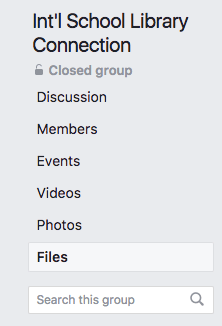
Literacy is not enough: Why we need to teach information literacy

Some weeks are just like hitting the jackpot in terms of the news and media world shouting out “yes, this is necessary” – although of course they don’t phrase it that way, and they certainly wouldn’t invoke libraries, librarians and information literacy in their communal hand wringing. But they should.

The first was the retraction of an article in Science. (Retraction watch – who knew that it even existed? And now I know it’s going to be on my reading list from time to time! They’re on twitter @RetractionWatch so that makes it easier – makes me think of “This idea must die” which is also on my reading list after hearing this talk).

Jesse Singal has written an excellent article – “The Case of the Amazing Gay-Marriage Data” – it really is worth reading the whole thing because it covers so many aspects of the world of academic publishing, how it can go badly wrong, and just how unlikely it is that it is found out and even if it’s found out, how hard it is to be a whistleblower.

The second, was about chocolate, and how unfortunately it doesn’t help in weight loss and in fact we’d all just been had as it was a bunch of science writers playing with journalists and our gullibility and lack of information literacy.  Here is John Bohannon, the culprit (?) ‘fessing up: “I Fooled Millions Into Thinking Chocolate Helps Weight Loss. Here’s How” and Rachel Ehrenberg’s indignant retort on behalf of journalists “Attempt to shame journalists with chocolate study is shameful
Obviously (one hopes) this is going to have repercussions in tertiary education and in journalism. But what can we learn from it in the K-12 environment?
Well a good place to start would probably be to introduce students to the concept of cognitive bias (and to do it WAY before they’re doing TOK at IB level).  Here is a great little article by George Dvorsky on the twelve most common cognitive biases. Let’s get everyone thinking – a little assignment for my readers – post in the comments what cognitive biases were present in each case! Just as we teach our G4’s about marketing tricks of the trade, I’m sure this can be presented in a way that is accessible and easy to understand and relate to their own lives. 
I’m also thinking about how we could expand the math curriculum to replace a fear of numbers and statistics with a healthy dose of scepticism and what questions to ask and how to dig behind the “headline” numbers. I sometimes wonder why it is that we don’t challenge our students more about their own data.  Thinking back to the exhibition presentations of our Grade 5’s – yes they did a great job, and it was amazing what they pulled together and the confidence with which they could present. But who was looking at the data? Each group had a mentor, who could (should?) challenge when things don’t add up, when what they’re saying and what they can back it up with doesn’t match. When things just don’t make common logical sense.   Now this is a tricky thing. A very tricky thing. We don’t like confrontation, and we’re not really good at it either.  Now look back at the first article.  If the co-author had applied a little common sense and said “hey, if you’ve sampled 100,000 people, how did you get the $1m budget? (simple multiplication / extrapolation)” 
… how about Brookman? Things don’t make sense to him, and what’s everyone saying? “don’t rock the boat”  And our students. Yes we want to created a safe learning environment where mistakes can be made.  BUT and this is a big BUT, we also want to be able to call them on their mistakes, give them a chance to correct them and build the resilience of being able to cope appropriately with (constructive) criticism AND the idea that this research thing is serious, and can and will be up to challenge, AND make them think more critically about how they interpret and use other’s research.  I was not a part of the whole process and I know our digital literacy coaches and librarian were involved, I’m wondering if the math coach was also involved or not?  And in a school without a math coach – who would be doing this?  How many teachers at any level feel comfortable and confident enough around numbers and the “math” side of research to assume this role?  I’d argue all should be, and if not that’s some PD that needs to be done as a priority. Because in the future and in the now, numbers are being used all around us, and the big big thing is “big data” and if we don’t know how to look at numbers and to ask the right kinds of questions we are going to be manipulated into making the wrong assumptions, making the wrong choices. This stuff is important. (See my favourite math blogger Mathbabe on this).
All of us are literate in the sense of reading and writing. And some of us are critical readers of literature, we can analyse and comment and dissect. And then we get into the realm of being information literate, on the basic level, the whole model thing of finding a question, finding information, interpreting and using it, reflecting etc.  And then only can we get to the point of understanding who is writing something and why and then really understanding the socio-cultural / political and meta-cognitive things that are going on behind information. And if we don’t start with the basics and make sure it’s embedded in everything we do, how will we ever get there?

Academic honesty should never be ambiguous

Ok, I know I have a somewhat ambivalent stance on what constitutes plagiarism and the value of collaborative and cooperative learning but one thing I’m clear on is academic honesty.  If you used something that someone else made just say that you did that. And depending on your age and level a simple copy and paste of the link is sufficient.I recently went around our G5’s exhibition project and was thoroughly impressed at their work. I did sneakily ask a few for their sources and most could point to at least a page of attribution as to where they’d got their numbers and facts.  Well done (here is a great video of it by the way).


G5 Exhibition Video 2015 from UWC South East Asia on Vimeo.

Fast forward to early this morning. I’m putting the washing in the machine and the kids are getting ready for school and finally my daughter lets me see the video she’s been working on for the last 4 days – one holidays and festivals in the middle ages. It’s a great video with her narrating the festivals of the year with lovely pictures and music from the middle ages in the background.  And then at the end “Thank you for watching” and black screen.

I told her I thought it was great, but that she didn’t have to thank anyone at the end, and instead a list of attribution for the images and music would be good. “Our teacher said we didn’t have to do it” was her reply. I told her that she knew that I expected it of her, and she then showed me that she had in fact made a list of the URLs but hadn’t put it into EasyBib to get into MLA format. I asked why not, and she came with some story about how citations / attribution hadn’t been in the original assignment nor in the rubric and the teacher didn’t want to add it on afterwards. I was a little annoyed at this. I said she could at least put it at the end of her video, but she didn’t think that would be “fair” on the others who didn’t. Fair? How about the fairness of the people to whom the images belonged? OK they’re all long dead now, and perhaps most of the images are in common domain, but still, it’s the principal.

I was annoyed at myself being annoyed at her, when actually I should be annoyed at the school. How can they go from being citation semi-stars in primary school to not having it expected at middle school. This is not the first instance, it is one of many, many, many in both my children’s grades across all subjects – academic honesty really does need to be institutionalised and inside every single assignment across the board! I’m at least glad my ranting has had an effect on my kids and they’re at now keeping lists to show me – but if it’s only for me for how long will my influence last?

Paying lip service to information

One of the paragraphs in this week’s modules struck me:

“It is often said that we live in an information age, and that the price of failing to act promptly to take advantage of positive new developments or to dampen the impact of negative ones is often likely to be rapid and painful. Yet there is plentiful evidence that sources of information, including both special and public libraries, are under-utilised by those in business and very often seriously underfunded. It is possible to conclude that business (like, one fears, some politicians, local government representatives, university administrators and school principals) is more likely to pay lip service to the importance of good information services than to support them in a practical way.” (INF538, Charles Sturt University, 2014)

I think it is something that librarians have to battle with on a daily – if not some days, hourly basis. Yesterday was a case in point. Our library received not one, but two, lengthy requests for materials and resources (mainly really expensive books) to support curriculum.   Oh, but that’s a good thing. It’s a great thing you may think.  Teachers reaching out to libraries to support their information needs.   Yes.  And no.    You see, the need for information, the seeking of and the request for and the acquisition and dissemination of the same is not so much an “on / off” switch (or email request) as a dialogue.  And what was missing from these interactions was the dialogue.

An information resource does not exist in a vacuum.  It has a context.  And in a school the context is made up of so many things.  And without the dialogue the quality is likely to suffer.

In our training, a big deal is made of the “information interview”  and there is reason for this.  We need to know details about what the client needs.  This includes the age group and reading and understanding level of the students.  Where the module fits into the curriculum for the year and where it fits into what has come before and what will happen in the next year.   The cultural composition of students.  The teacher needs to know what we have in the library.  What databases we have access to. What ebooks and digital materials are available.   Videos, youtube clips, and libguides we have created.  What other teachers have requested in the same and higher and lower grades.

This is why the first step and not the last should be to pop into the library and have a quick chat.  That way there is less waste of time while teachers make lists from google or amazon that may be entirely inappropriate, or a duplication for what already exists.

“support them in a practical way” … what does this mean for an organisation and a library service.  I think more than anything else, is to give it credit as an integral part of the information flow in the library.  Not an add on, but embedded.

And now the chicken and the egg question.  Is it the responsibility of the library / librarian or the administrator?  Where does one start?  How slowly must the process move?  At least one teacher said during a meeting yesterday (adhoc, impromptu and sudden for an ‘urgent’ reactive need)  “I wish I’d talked to you earlier”.    To which we responded by just fitting in with their plans and agreeing to meet their needs.   I can’t help thinking about the time management boxes that were so popular a while back with the “urgent, important etc. blocks”   Clearly something structural needs to occur.  But what and how?

Everyone is trying their best. Everyone has time and other pressures.  There never is a steady state.  So how do we become drivers, or at least co-pilots instead of passengers on this trip?

Blogging frenzy

Apologies in advance for what may appear as a blogging frenzy!  After too much vacation and free time and working and getting back to school activities and a kid with a broken hand (we think, in plaster until a new xray today), I’m catching up with my work for INF506, which involves – you guessed it – MORE BLOGGING!

I also finally got around to copying and pasting my research into online social networks for international school librarians in Asia, and I need to do about 3 more OLJ (Online Learning Journal) entries for module 4 before embarking on module 5.   It’s not true I “have” to do them, I think we’re only assessed on 3 of our entries, but the assignments are interesting and topics worth thinking about and doing further research into, so I’m kind of making myself do it.

I’m going to have to add a few pictures to keep people interested …  Or maybe a video.  Yes, I’ll add a time lapse video my son made of our evening walk in the Botanic Gardens.  The speeded up nature makes it epitomise life here in Asia better I think!

Time Lapse Singapore – Raphael Diederen

Comparative analysis of social networking tools and technologies for International School Librarians in Asia

Introduction

This report documents a Comparative analysis of social networking tools and technologies for International School librarians in Asia. The case study research methodology – defined as “examining contemporary phenomenon within its real-life context … and it relies on multiple sources of evidence” (Yin, 2003, p.13, cited in Shanks and Bekmamedova, 2013, p. 174) was employed in a critical paradigm <!–[if supportFields]> ADDIN ZOTERO_ITEM CSL_CITATION {“citationID”:”ZtjKUW0T”,”properties”:{“formattedCitation”:”(Shanks & Bekmamedova, 2013)”,”plainCitation”:”(Shanks & Bekmamedova, 2013)”},”citationItems”:[{“id”:750,”uris”:[“http://zotero.org/users/1210720/items/RHPEFQVA”%5D,”uri&#8221;:[“http://zotero.org/users/1210720/items/RHPEFQVA”%5D,”itemData&#8221;:{“id”:750,”type”:”chapter”,”title”:”Case study research in information systems”,”container-title”:”Research methods: information, systems and contexts”,”publisher”:”Tilde Publishing and distribution”,”publisher-place”:”Prahran, VIC”,”page”:”172-187″,”edition”:”First edition”,”source”:”Library of Congress ISBN”,”event-place”:”Prahran, VIC”,”ISBN”:”9780734611482″,”call-number”:”Q180.55.M4 R4734 2013″,”author”:[{“family”:”Shanks”,”given”:”Graeme”},{“family”:”Bekmamedova”,”given”:”Nargiza”}],”issued”:{“date-parts”:[[“2013″]]}}}],”schema”:”https://github.com/citation-style-language/schema/raw/master/csl-citation.json&#8221;} <![endif]–>(Shanks & Bekmamedova, 2013)<!–[if supportFields]><![endif]–> in order to critique the status quo.
The first part of this study investigated the academic school and teacher librarian environment in Asia.  This was followed by cataloguing the various networks available to school librarians and the social networking tools and technologies employed.  A visual mapping of the relationships between social and professional networks and libraries, schools, school libraries, countries, regions and curricula was made.  Finally, school librarians were surveyed on their participation in online social networks.
The report concludes with a critical analysis of the social networking tools and technologies and their participants with some recommendations for professional network organisations and for individual librarians.


Social media, networking, technologies and tools

According to Kaplan and Haenlein (2010) Web 2.0 provides an “ideological and technological foundation” (p.62) for social media to exist while it is user-generated content (UGC), which defines it.  Social media tools allow users to create, add, revise and change content (wiki, blog, forum, mashups, podcasts), tag and rate (social booking marking), curate (aggregators, RSS), maintain or build relationships or networks (Facebook, Google+, LinkedIn) and share content (text, video, photo etc.). When one adds in collaboration with others in online communities, social networking arises. <!–[if supportFields]> ADDIN ZOTERO_ITEM CSL_CITATION {“citationID”:”1fbvvjvgvd”,”properties”:{“formattedCitation”:”(Brouns et al., 2011; Kaplan & Haenlein, 2010)”,”plainCitation”:”(Brouns et al., 2011; Kaplan & Haenlein, 2010)”},”citationItems”:[{“id”:764,”uris”:[“http://zotero.org/users/1210720/items/ZG93QZCD”%5D,”uri&#8221;:[“http://zotero.org/users/1210720/items/ZG93QZCD”%5D,”itemData&#8221;:{“id”:764,”type”:”article-journal”,”title”:”A survey on social network sites to determine requirements for learning networks for professional development of university staff”,”container-title”:”International Journal of Web Based Communities”,”page”:”298″,”volume”:”7″,”issue”:”3″,”source”:”CrossRef”,”URL”:”http://www.inderscience.com/link.php?id=41200&#8243;,”DOI”:”10.1504/IJWBC.2011.041200″,”ISSN”:”1477-8394, 1741-8216″,”author”:[{“family”:”Brouns”,”given”:”Francis”},{“family”:”Berlanga”,”given”:”Adriana J.”},{“family”:”Fetter”,”given”:”Sibren”},{“family”:”Rijpkema”,”given”:”Marlies E. Bitter”},{“family”:”Bruggen”,”given”:”Jan M. Van”},{“family”:”Sloep”,”given”:”Peter B.”}],”issued”:{“date-parts”:[[“2011″]]},”accessed”:{“date-parts”:[[“2013″,12,30]]}},”label”:”page”},{“id”:763,”uris”:[“http://zotero.org/users/1210720/items/4G8GGMQ8″%5D,”uri&#8221;:[“http://zotero.org/users/1210720/items/4G8GGMQ8″%5D,”itemData&#8221;:{“id”:763,”type”:”article-journal”,”title”:”Users of the world, unite! The challenges and opportunities of Social Media”,”container-title”:”Business Horizons”,”page”:”59-68″,”volume”:”53″,”issue”:”1″,”source”:”CrossRef”,”URL”:”http://linkinghub.elsevier.com/retrieve/pii/S0007681309001232&#8243;,”DOI”:”10.1016/j.bushor.2009.09.003″,”ISSN”:”00076813″,”author”:[{“family”:”Kaplan”,”given”:”Andreas M.”},{“family”:”Haenlein”,”given”:”Michael”}],”issued”:{“date-parts”:[[“2010″,1]]},”accessed”:{“date-parts”:[[“2013″,12,30]]}},”label”:”page”}],”schema”:”https://github.com/citation-style-language/schema/raw/master/csl-citation.json&#8221;} <![endif]–>(Brouns et al., 2011; Kaplan & Haenlein, 2010)<!–[if supportFields]><![endif]–> “The main idea underlying collaborative projects is that the joint effort of many actors leads to a better outcome than any actor could achieve individually; this is similar to the efficient-market hypothesis in behavioral finance” <!–[if supportFields]> ADDIN ZOTERO_ITEM CSL_CITATION {“citationID”:”BzA5IK61″,”properties”:{“formattedCitation”:”(Kaplan & Haenlein, 2010)”,”plainCitation”:”(Kaplan & Haenlein, 2010)”},”citationItems”:[{“id”:763,”uris”:[“http://zotero.org/users/1210720/items/4G8GGMQ8″%5D,”uri&#8221;:[“http://zotero.org/users/1210720/items/4G8GGMQ8″%5D,”itemData&#8221;:{“id”:763,”type”:”article-journal”,”title”:”Users of the world, unite! The challenges and opportunities of Social Media”,”container-title”:”Business Horizons”,”page”:”59-68″,”volume”:”53″,”issue”:”1″,”source”:”CrossRef”,”URL”:”http://linkinghub.elsevier.com/retrieve/pii/S0007681309001232&#8243;,”DOI”:”10.1016/j.bushor.2009.09.003″,”ISSN”:”00076813″,”author”:[{“family”:”Kaplan”,”given”:”Andreas M.”},{“family”:”Haenlein”,”given”:”Michael”}],”issued”:{“date-parts”:[[“2010″,1]]},”accessed”:{“date-parts”:[[“2013″,12,30]]}}}],”schema”:”https://github.com/citation-style-language/schema/raw/master/csl-citation.json&#8221;} <![endif]–>(Kaplan & Haenlein, 2010, p.62)<!–[if supportFields]><![endif]–>.
<!–[if supportFields]> ADDIN ZOTERO_ITEM CSL_CITATION {“citationID”:”QQO6nd4a”,”properties”:{“formattedCitation”:”{\\rtf (D\\uc0\\u8217{}Andrea, Ferri, & Grifoni, 2010, p. 7)}”,”plainCitation”:”(D’Andrea, Ferri, & Grifoni, 2010, p. 7)”},”citationItems”:[{“id”:673,”uris”:[“http://zotero.org/users/1210720/items/DE36P3AJ”%5D,”uri&#8221;:[“http://zotero.org/users/1210720/items/DE36P3AJ”%5D,”itemData&#8221;:{“id”:673,”type”:”chapter”,”title”:”An Overview of Methods for Virtual Social Networks Analysis”,”container-title”:”Computational Social Network Analysis”,”publisher”:”Springer London”,”publisher-place”:”London”,”page”:”3-25″,”source”:”CrossRef”,”event-place”:”London”,”URL”:”http://www.springerlink.com/index/10.1007/978-1-84882-229-0_1&#8243;,”ISBN”:”978-1-84882-228-3, 978-1-84882-229-0″,”editor”:[{“family”:”Abraham”,”given”:”Ajith”},{“family”:”Hassanien”,”given”:”Aboul-Ella”},{“family”:”Sná¿el”,”given”:”Vaclav”}],”author”:[{“family”:”D’Andrea”,”given”:”Alessia”},{“family”:”Ferri”,”given”:”Fernando”},{“family”:”Grifoni”,”given”:”Patrizia”}],”issued”:{“date-parts”:[[“2010″]]},”accessed”:{“date-parts”:[[“2013″,12,6]]}},”locator”:”7″,”label”:”page”}],”schema”:”https://github.com/citation-style-language/schema/raw/master/csl-citation.json&#8221;} <![endif]–>D’Andrea, Ferri, & Grifoni, (2010, p. 7)<!–[if supportFields]><![endif]–>, identified four main motivational categories that lead people to join Social Networks: Exchange Information, Social aspect, Friendship and Recreation, as outlined in the table below.

Source: D’Andrea, Ferri, & Grifoni, (2010, p. 7),

One type of social networking is the Personal Learning Network (PLN), “a group of people who are connected by shared passions or common interests, and who benefit from shared learning.” (LaGarde and Whitehead, 2012, p. 9).  Learning is non-formal and contributes to professional development while the best sites make it easy to locate resources and information including people and content (Brouns et al., 2011) and combine the collective knowledge types as summarised by Hecker (2012, p.430).
Source: (Hecker, 2012, p. 430)

Background Study


Asian International School Landscape


The Asian region covers over 48 countries <!–[if supportFields]> ADDIN ZOTERO_ITEM CSL_CITATION {“citationID”:”0E0BwxLc”,”properties”:{“formattedCitation”:”(Asia-Pacific Center for Security Studies, n.d.)”,”plainCitation”:”(Asia-Pacific Center for Security Studies, n.d.)”},”citationItems”:[{“id”:741,”uris”:[“http://zotero.org/users/1210720/items/83E7FB6V”%5D,”uri&#8221;:[“http://zotero.org/users/1210720/items/83E7FB6V”%5D,”itemData&#8221;:{“id”:741,”type”:”webpage”,”title”:”Countries of the Asia-Pacific Region”,”URL”:”http://www.apcss.org/about-2/ap-countries/&#8221;,”author”:[{“family”:”Asia-Pacific Center for Security Studies”,”given”:””}],”accessed”:{“date-parts”:[[“2013″,12,29]]}}}],”schema”:”https://github.com/citation-style-language/schema/raw/master/csl-citation.json&#8221;} <![endif]–>(Asia-Pacific Center for Security Studies, n.d.)<!–[if supportFields]><![endif]–> and over 3,200 languages from 28 linguistic families <!–[if supportFields]> ADDIN ZOTERO_ITEM CSL_CITATION {“citationID”:”vFYWF64T”,”properties”:{“formattedCitation”:”(United Nations Office for the Coordination of Humanitarian Affairs (OCHA), 2011)”,”plainCitation”:”(United Nations Office for the Coordination of Humanitarian Affairs (OCHA), 2011)”},”citationItems”:[{“id”:739,”uris”:[“http://zotero.org/users/1210720/items/WHVTCEI3″%5D,”uri&#8221;:[“http://zotero.org/users/1210720/items/WHVTCEI3″%5D,”itemData&#8221;:{“id”:739,”type”:”webpage”,”title”:”Major Language Families in Asia-Pacific [pdf file]”,”URL”:”http://reliefweb.int/sites/reliefweb.int/files/resources/OCHA_ROAP_Language_v6_110519.pdf&#8221;,”note”:”United Nations Office for the Coordination of Humanitarian Affairs (OCHA)”,”author”:[{“family”:”United Nations Office for the Coordination of Humanitarian Affairs (OCHA)”,”given”:””}],”issued”:{“date-parts”:[[“2011″,5]]},”accessed”:{“date-parts”:[[“2013″,12,29]]}}}],”schema”:”https://github.com/citation-style-language/schema/raw/master/csl-citation.json&#8221;} <![endif]–>(United Nations Office for the Coordination of Humanitarian Affairs (OCHA), 2011)<!–[if supportFields]><![endif]–>.  While it is difficult to quantify the number of International Schools in the area, an indication can be given by the fact that the International Baccalaureate Organisation (IBO) covers 599 schools in 28 countries <!–[if supportFields]> ADDIN ZOTERO_ITEM CSL_CITATION {“citationID”:”hkjp7xzo”,”properties”:{“formattedCitation”:”(International Baccalaureate Organisation, n.d.)”,”plainCitation”:”(International Baccalaureate Organisation, n.d.)”},”citationItems”:[{“id”:744,”uris”:[“http://zotero.org/users/1210720/items/5FP6VMHS”%5D,”uri&#8221;:[“http://zotero.org/users/1210720/items/5FP6VMHS”%5D,”itemData&#8221;:{“id”:744,”type”:”webpage”,”title”:”IB World School statistics – Number of schools by programme combination and region”,”URL”:”http://www.ibo.org/facts/schoolstats/progcombinationsbyregion.cfm&#8221;,”author”:[{“family”:”International Baccalaureate Organisation”,”given”:””}],”accessed”:{“date-parts”:[[“2013″,12,29]]}}}],”schema”:”https://github.com/citation-style-language/schema/raw/master/csl-citation.json&#8221;} <![endif]–>(IBO, n.d. a&b)<!–[if supportFields]><![endif]–>, while The Federation of British International Schools in Asia (FOBISIA) has 40 schools in 12 countries <!–[if supportFields]> ADDIN ZOTERO_ITEM CSL_CITATION {“citationID”:”Gltln7p6″,”properties”:{“formattedCitation”:”(The Federation of British International Schools in Asia (FOBISIA), n.d.)”,”plainCitation”:”(The Federation of British International Schools in Asia (FOBISIA), n.d.)”,”dontUpdate”:true},”citationItems”:[{“id”:748,”uris”:[“http://zotero.org/users/1210720/items/E9SE7BZH”%5D,”uri&#8221;:[“http://zotero.org/users/1210720/items/E9SE7BZH”%5D,”itemData&#8221;:{“id”:748,”type”:”webpage”,”title”:”FOBISIA Member Schools”,”URL”:”http://www.fobissea.org/Members&#8221;,”author”:[{“family”:”Federation of British International Schools in Asia (FOBISIA)”,”given”:””}],”accessed”:{“date-parts”:[[“2013″,12,29]]}}}],”schema”:”https://github.com/citation-style-language/schema/raw/master/csl-citation.json&#8221;} <![endif]–>(FOBISIA, n.d.)<!–[if supportFields]><![endif]–>, and the East Asia regional council of schools (EARCOS) counts 134 schools in 21 countries <!–[if supportFields]> ADDIN ZOTERO_ITEM CSL_CITATION {“citationID”:”TGWDyqpg”,”properties”:{“formattedCitation”:”(The East Asia Regional Council of Schools (EARCOS), n.d.)”,”plainCitation”:”(The East Asia Regional Council of Schools (EARCOS), n.d.)”,”dontUpdate”:true},”citationItems”:[{“id”:746,”uris”:[“http://zotero.org/users/1210720/items/37HAVJKK”%5D,”uri&#8221;:[“http://zotero.org/users/1210720/items/37HAVJKK”%5D,”itemData&#8221;:{“id”:746,”type”:”webpage”,”title”:”EARCOS Member Schools”,”URL”:”http://www.earcos.org/mem_schools.php&#8221;,”author”:[{“family”:”East Asia Regional Council of Schools (EARCOS)”,”given”:””}],”accessed”:{“date-parts”:[[“2013″,12,29]]}}}],”schema”:”https://github.com/citation-style-language/schema/raw/master/csl-citation.json&#8221;} <![endif]–> (EARCOS, n.d.)<!–[if supportFields]><![endif]–>. For the purposes of this study, Australia and the United States of America (USA) were excluded and only schools providing education in the English Language were considered. 

Asian International School Librarian and professional social networks


According to LaGarde and Whitehead  “The school library can be a lonely place. These days, tight budgets and fiscal shortfalls have created a new breed of solo librarians—a group of educators who not only have to do more with less, but who, increasingly, also have to do it all alone.” (2012, p. 9).  This is particularly true for International school librarians in Asia, who may find themselves isolated from their professional peers due to a number of reasons, including limitations or cuts in library budget, limited social and cultural importance given to school libraries, language barriers and geographic dispersion.  As a result a number of physical and virtual professional and social networks have sprung up in order to cater to their learning, information exchange and social needs. 
Most networks rely on a combination of a wiki and a listserv.  All wikis were current and had an update in the last six months, although most of the recent updates were membership updates with some conference or professional development information. Most had quite a bit of non-current information such as newsletters from 2008 <!–[if supportFields]> ADDIN ZOTERO_ITEM CSL_CITATION {“citationID”:”9ZbdH4k4″,”properties”:{“formattedCitation”:”(IB Librarians Continuum, n.d.)”,”plainCitation”:”(IB Librarians Continuum, n.d.)”},”citationItems”:[{“id”:695,”uris”:[“http://zotero.org/users/1210720/items/EJ83RAC7″%5D,”uri&#8221;:[“http://zotero.org/users/1210720/items/EJ83RAC7″%5D,”itemData&#8221;:{“id”:695,”type”:”webpage”,”title”:”Home [Wiki]”,”URL”:”http://librarianscontinuum.wikispaces.com/&#8221;,”author”:[{“family”:”IB Librarians Continuum”,”given”:””}],”accessed”:{“date-parts”:[[“2013″,12,24]]}}}],”schema”:”https://github.com/citation-style-language/schema/raw/master/csl-citation.json&#8221;} <![endif]–>(IB Librarians Continuum, n.d.)<!–[if supportFields]><![endif]–>; adverts for a professional development conference “coming soon” … in 2011 <!–[if supportFields]> ADDIN ZOTERO_ITEM CSL_CITATION {“citationID”:”tUuhQICa”,”properties”:{“formattedCitation”:”(Schools International Library Cooperative ASIA (SILC-Asia), n.d.)”,”plainCitation”:”(Schools International Library Cooperative ASIA (SILC-Asia), n.d.)”},”citationItems”:[{“id”:651,”uris”:[“http://zotero.org/users/1210720/items/RBQE8KFX”%5D,”uri&#8221;:[“http://zotero.org/users/1210720/items/RBQE8KFX”%5D,”itemData&#8221;:{“id”:651,”type”:”webpage”,”title”:”Home [Wiki]”,”URL”:”http://silcasia.wikispaces.com/home&#8221;,”author”:[{“family”:”Schools International Library Cooperative ASIA (SILC-Asia)”,”given”:””}],”accessed”:{“date-parts”:[[“2013″,12,6]]}}}],”schema”:”https://github.com/citation-style-language/schema/raw/master/csl-citation.json&#8221;} <![endif]–>(Schools International Library Cooperative ASIA (SILC-Asia), n.d.)<!–[if supportFields]><![endif]–>, “next set of Author and Storytelling visits” … for 2006/2007 <!–[if supportFields]> ADDIN ZOTERO_ITEM CSL_CITATION {“citationID”:”32OSyRSv”,”properties”:{“formattedCitation”:”(Association of China and Mongolian International Schools (ACIMIS), n.d.)”,”plainCitation”:”(Association of China and Mongolian International Schools (ACIMIS), n.d.)”},”citationItems”:[{“id”:759,”uris”:[“http://zotero.org/users/1210720/items/2XP9E3RI”%5D,”uri&#8221;:[“http://zotero.org/users/1210720/items/2XP9E3RI”%5D,”itemData&#8221;:{“id”:759,”type”:”webpage”,”title”:”SLIC – Author and Storyteller Visits [Wiki]”,”URL”:”http://slic.wikispaces.com/Author+and+Storyteller+Visits&#8221;,”author”:[{“family”:”Association of China and Mongolian International Schools (ACIMIS)”,”given”:””}],”accessed”:{“date-parts”:[[“2013″,12,29]]}}}],”schema”:”https://github.com/citation-style-language/schema/raw/master/csl-citation.json&#8221;} <![endif]–>(Association of China and Mongolian International Schools (ACIMIS), n.d. -a)<!–[if supportFields]><![endif]–>
Membership
Knowledge Base
Listserv
Last update
ECIS (European Council of International Schools) iskoodle
  *
555
Moodle
iskoodle
Dec-13
IB Librarians Continuum **
352
wiki
none
Nov-13
ALESS (Association of Librarians in English Speaking Schools – Hong Kong)
61
wiki
Yahoo Groups
Nov-13
SilcAsia (Schools International Library Cooperative Asia)
31
wiki
Yahoo Groups
Apr-11
ISLN (International Schools of Singapore Library Network)
33
blog
Google Groups
Dec-13
SLN (Shanghai Librarians Network)
85
wiki
Yahoo Groups
Dec-13
BJLN (Beijing Librarians Network)
55
wiki
Yahoo Groups
Dec-13
ACIMIS (Association of China and Mongolian International Schools Librarians Network)
32
wiki
Yahoo Groups
Apr-13
VIETLIB (Librarians in Vietnam)
16
wiki
Yahoo Groups
Nov-13
*   of which ECIS Members in Asia
102
** No breakdown by country or region

An exception to currency and activity was the ECIS Library iSkoodle, where the Asian members were checked and it appeared that about 50% had been active in the last six months, although 25% of members had never participated on the forums.

ECIS Asia
Total
Active last 6 months
Never active
China
27
16
7
Singapore
21
12
5
Hong Kong
16
4
3
Thailand
13
2
6
Korea
11
6
2
Vietnam
8
4
2
Japan
2
2
0
Malaysia
2
0
0
Indonesia
1
1
0
Philippines
1
0
0
102
47
25
After reviewing available information on International Schools in Asia, School Networks, Librarian Networks, School library networks, curriculum options as well as national and regional networks, an attempt was made to create a schematic diagram of how these fit together as depicted below.

Survey

Methodology

After review of sites above, in order to gain an understanding of the availability, strengths and weaknesses of existing social networks and to analyse these, asurvey (Appendix B) was set up in Survey Monkey <!–[if supportFields]> ADDIN ZOTERO_ITEM CSL_CITATION {“citationID”:”79miC9DT”,”properties”:{“formattedCitation”:”(Bailey, 2013)”,”plainCitation”:”(Bailey, 2013)”},”citationItems”:[{“id”:761,”uris”:[“http://zotero.org/users/1210720/items/5569ZNQG”%5D,”uri&#8221;:[“http://zotero.org/users/1210720/items/5569ZNQG”%5D,”itemData&#8221;:{“id”:761,”type”:”webpage”,”title”:”Comparative analysis of social networking tools and technologies for International School librarians in Asia [Survey]”,”URL”:”https://www.surveymonkey.com/s/PXFRSV2&#8243;,”author”:[{“family”:”Bailey”,”given”:”Nadine”}],”issued”:{“date-parts”:[[“2013″,12]]},”accessed”:{“date-parts”:[[“2013″,12,29]]}}}],”schema”:”https://github.com/citation-style-language/schema/raw/master/csl-citation.json&#8221;} <![endif]–>(Bailey, 2013)<!–[if supportFields]><![endif]–> and posted on the forums or listservs of known international school librarian networks (Appendix A) with the assistance of members or moderators.
Participants were asked about the professional networks they had joined, their level of participation, motivation for membership, and also asked to indicate which other social networks they used privately and professionally.   They were then requested to indicate which network best met their needs and to speculate on what an ideal network would consist of.  To ensure respondents were from the area under study, they were asked which country the resided in, and their country of origin.

Results

76 people responded to the survey.  17 respondents were not residing or working in Asia, however one had worked in Shanghai previously and another was moving to Beijing and therefore participating in Asian networks so their surveys were therefore considered to be valid, leaving 61 useable responses.  Related to the professional networks where Asian membership was known, the response rate varied between 11% (SLN) and 45% for SilcAsia, which is statistically acceptable.
Responses
 Asian Members
Response rate
ECIS
26
102
25%
ALESS
15
61
25%
SilcAsia
14
31
45%
ISLN
13
33
39%
SLN
9
85
11%
BJLN
7
55
13%
ACIMIS
6
32
19%
VIETLIB
4
16
25%
Catalogue based
23
unknown
IB Librarians
22
unknown
Home country
20
unknown
IASL
19
unknown
KLLN
8
unknown
Congruent with most research on Virtual Social Networks (VSN), most of the respondents primarily read questions and answers on the forums as can be seen by the graph below. However, smaller networks that combined meetings with a VSN such as ALESS, ISLN, KLLN, and VIETLIB tended to show more participation in posting and answering questions. An exception to this trend is to be found in ECIS. This could be because it has a tight-knit community or it could be a self-selecting bias on the part of the people who decided to participate in the survey.


As far as the motivating factors for joining is concerned, as was expected, the professional networks were joined primarily out of a learning motivation.  It seems the more distant geographically from the respondent the network was, the more inclined they were to state “Education / Information Exchange” whereas local organisations which combined a physical / meeting element to their online presence had respondents responding on the social, friendship and recreational aspects.


In the case of social media, Twitter followed by Google+ were the preferred tools professionally, and Facebook privately.  This makes sense as research indicated that 2006 was the watershed year for blogging, when new social networks such as Twitter and Facebook became more important in the Library and Information sphere <!–[if supportFields]> ADDIN ZOTERO_ITEM CSL_CITATION {“citationID”:”FRgkgq6J”,”properties”:{“formattedCitation”:”{\\rtf (Torres-Salinas, Cabezas-Clavijo, Ruiz-Pe\\uc0\\u769{}rez, & Lo\\uc0\\u769{}pez-Co\\uc0\\u769{}zar, 2011)}”,”plainCitation”:”(Torres-Salinas, Cabezas-Clavijo, Ruiz-Pérez, & López-Cózar, 2011)”},”citationItems”:[{“id”:724,”uris”:[“http://zotero.org/users/1210720/items/2CT2IR74″%5D,”uri&#8221;:[“http://zotero.org/users/1210720/items/2CT2IR74″%5D,”itemData&#8221;:{“id”:724,”type”:”article-journal”,”title”:”State of the library and information science blogosphere after social networks boom: A metric approach”,”container-title”:”Library & Information Science Research”,”page”:”168-174″,”volume”:”33″,”issue”:”2″,”abstract”:”A metric analysis of blogs on library and information science (LIS) between November 2006 and June 2009 indexed on the Libworm search engine characterizes the community’s behavior quantitatively. An analysis of 1108 personal and corporate blogs with a total of 275,103 posts is used to calculate survival rate, production (number of posts published), and visibility via such indicators as links received, Technorati authority, and Google’s PagePank. Over the study period, there was a 52% decrease in the number of active blogs. Despite the drop in production over this period, the average number of posts per blog remained constant (14 per month). The most representative blogs in the discipline are identified. The emergence of such platforms as Facebook and Twitter seems to have meant that both personal and corporate blogs have lost some of their prominence.”,”author”:[{“family”:”Torres-Salinas”,”given”:”Daniel”},{“family”:”Cabezas-Clavijo”,”given”:”Álvaro”},{“family”:”Ruiz-Pérez”,”given”:”Rafael”},{“family”:”López-Cózar”,”given”:”Emilio Delgado”}],”issued”:{“date-parts”:[[“2011″]]}}}],”schema”:”https://github.com/citation-style-language/schema/raw/master/csl-citation.json&#8221;} <![endif]–>(Torres-Salinas, Cabezas-Clavijo, Ruiz-Pérez, & López-Cózar, 2011)<!–[if supportFields]><![endif]–>.   The hashtag #TLChat created and promoted by Joyce Valenza possibly assisted with this.
While almost all respondents used some form of social media (as seen by Bosque, 2013 too), many commented on the amount of time it took and the respondents living in China added that they had limited access to most of the popular sites.  Besides the sites indicated in the survey, other sites commented on included LinkedIn, Edmodo, Reddit, Instagram, ScoopIT and Yammer.


In response to which social network best met their needs, there were a wide range of answers with only ECIS iSkoodle (16 votes) and Twitter (8 votes) showing any superiority.  As one respondent commented “Follett-Talk for Library Automation Software needs; KLLN for local info and collaborative efforts; LM_Net, ALA and AASL for broader professional support…. Different networks for different needs.” This view is supported by an attempt to map the networks of two librarians living in Singapore.


Finally respondents needed to consider what their ideal network would look like assuming there were no technological or cost constraints.  Responses were analysed using thematic analysis and category coding, a methodology considered appropriate for unstructured data <!–[if supportFields]> ADDIN ZOTERO_ITEM CSL_CITATION {“citationID”:”YqotbdcW”,”properties”:{“formattedCitation”:”(Williamson, Given, & Scifleet, 2013)”,”plainCitation”:”(Williamson, Given, & Scifleet, 2013)”},”citationItems”:[{“id”:681,”uris”:[“http://zotero.org/users/1210720/items/ZXMTV67N”%5D,”uri&#8221;:[“http://zotero.org/users/1210720/items/ZXMTV67N”%5D,”itemData&#8221;:{“id”:681,”type”:”chapter”,”title”:”Qualitative data analysis”,”container-title”:”Research methods: information, systems and contexts”,”publisher”:”Tilde Publishing and distribution”,”publisher-place”:”Prahran, VIC”,”page”:”417-435″,”edition”:”First edition”,”source”:”Library of Congress ISBN”,”event-place”:”Prahran, VIC”,”ISBN”:”9780734611482″,”call-number”:”Q180.55.M4 R4734 2013″,”author”:[{“family”:”Williamson”,”given”:”Kirsty”},{“family”:”Given”,”given”:”Lisa, M”},{“family”:”Scifleet”,”given”:”Paul”}],”issued”:{“date-parts”:[[“2013″]]}}}],”schema”:”https://github.com/citation-style-language/schema/raw/master/csl-citation.json&#8221;} <![endif]–>(Williamson, Given, & Scifleet, 2013)<!–[if supportFields]><![endif]–>. In the search for common themes, the research of Brouns et al. <!–[if supportFields]> ADDIN ZOTERO_ITEM CSL_CITATION {“citationID”:”IXKmRPlS”,”properties”:{“formattedCitation”:”(Brouns et al., 2011)”,”plainCitation”:”(Brouns et al., 2011)”},”citationItems”:[{“id”:764,”uris”:[“http://zotero.org/users/1210720/items/ZG93QZCD”%5D,”uri&#8221;:[“http://zotero.org/users/1210720/items/ZG93QZCD”%5D,”itemData&#8221;:{“id”:764,”type”:”article-journal”,”title”:”A survey on social network sites to determine requirements for learning networks for professional development of university staff”,”container-title”:”International Journal of Web Based Communities”,”page”:”298″,”volume”:”7″,”issue”:”3″,”source”:”CrossRef”,”URL”:”http://www.inderscience.com/link.php?id=41200&#8243;,”DOI”:”10.1504/IJWBC.2011.041200″,”ISSN”:”1477-8394, 1741-8216″,”author”:[{“family”:”Brouns”,”given”:”Francis”},{“family”:”Berlanga”,”given”:”Adriana J.”},{“family”:”Fetter”,”given”:”Sibren”},{“family”:”Rijpkema”,”given”:”Marlies E. Bitter”},{“family”:”Bruggen”,”given”:”Jan M. Van”},{“family”:”Sloep”,”given”:”Peter B.”}],”issued”:{“date-parts”:[[“2011″]]},”accessed”:{“date-parts”:[[“2013″,12,30]]}}}],”schema”:”https://github.com/citation-style-language/schema/raw/master/csl-citation.json&#8221;} <![endif]–>(2011)<!–[if supportFields]><![endif]–> into “Learning Networks for professional development of university staff” was consulted, looking to identify unmet needs of this group and their suggestions of tools and platforms which could satisfy those needs.
The two most important themes identified are related – namely the time consuming nature of social networks and the need for a centralised networking possibility.  In the first instance phrases such as “simple”, “simple approach”, “don’t want to be online all the time”, “takes time”, “too much technology is time consuming”, “isn’t enough time”, “run out of time”, “finding the time to be part of something or setting something up”, “anything that saves time”, “sucks up time”, “does not require much of my time”, “with no TIME constraints” which were all stated in the negative sense – i.e. any tool or platform needed to be time efficient.  The latter included phrases such as “combination”, “central”, centralisation”, “centralized”, “one site”, “simple”, “simple approach”, “there is not one to do all”, “connect with each other”, “consolidated feed”, “consolidate the ‘most liked’ posting exchanges”, “one-stop shop”, “it would merge so not accessed individually”, “mix of”, “the three or four things I use now, combined into one”, “an integration”, “complete a variety of tasks”, “something multi-faceted”, “collaboratively tagging”, “large enough to encompass everything”,  emphasizing the desire for aggregation of information.
Other lesser themes included group based collaboration, including collaborative tagging, expert and best practise identification, information and resource sharing, discussion and organisation. 

Critical Evaluation

Already in 2008, Yeung, Liccardi, Lu, Seneviratne, & Berners-Lee, were suggesting that despite their popularity and advantages, Online Social networking sites created issues with privacy and information accountability and ownership.  Their suggestion of decentralized social networks has recently gained traction in the idea of aggregation of social media (ScoopIT, Paper.li, Scruddle, Sgrouples, Flipboard, Hootsuite etc.).  Few of the respondents mentioned these in the survey. This could be because currently it is an ever-changing landscape of small players trying to gain critical mass <!–[if supportFields]> ADDIN ZOTERO_ITEM CSL_CITATION {“citationID”:”1brqf38co9″,”properties”:{“formattedCitation”:”(Callari, 2011; Eisenberg, 2012; Kojetin, 2013)”,”plainCitation”:”(Callari, 2011; Eisenberg, 2012; Kojetin, 2013)”},”citationItems”:[{“id”:737,”uris”:[“http://zotero.org/users/1210720/items/85DCACJ4″%5D,”uri&#8221;:[“http://zotero.org/users/1210720/items/85DCACJ4″%5D,”itemData&#8221;:{“id”:737,”type”:”webpage”,”title”:”Top Ten Social Media Aggregators [Blogpost]”,”container-title”:”Inventor Spot”,”URL”:”http://inventorspot.com/articles/aggregators_spindex_google_buzz_streamline_social_media_experien_41426?page=1&#8243;,”author”:[{“family”:”Callari”,”given”:”Ron”}],”issued”:{“date-parts”:[[“2011″]]},”accessed”:{“date-parts”:[[“2013″,12,29]]}},”label”:”page”},{“id”:733,”uris”:[“http://zotero.org/users/1210720/items/5M25NU4C”%5D,”uri&#8221;:[“http://zotero.org/users/1210720/items/5M25NU4C”%5D,”itemData&#8221;:{“id”:733,”type”:”webpage”,”title”:”The Top 5 Social Media Managing Tools”,”container-title”:”Social Media Today”,”URL”:”http://socialmediatoday.com/jen-eisenberg/549608/top-5-social-media-managing-tools&#8221;,”author”:[{“family”:”Eisenberg”,”given”:”Jen”}],”issued”:{“date-parts”:[[“2012″,6,15]]},”accessed”:{“date-parts”:[[“2013″,12,29]]}},”label”:”page”},{“id”:735,”uris”:[“http://zotero.org/users/1210720/items/7ZRNSZ6K”%5D,”uri&#8221;:[“http://zotero.org/users/1210720/items/7ZRNSZ6K”%5D,”itemData&#8221;:{“id”:735,”type”:”webpage”,”title”:”Social Media Aggregators: What & Why [Blogpost]”,”container-title”:”ICUC”,”URL”:”http://www.icucmoderation.com/2013/05/07/social-media-aggregators/&#8221;,”author”:[{“family”:”Kojetin”,”given”:”Teri”}],”issued”:{“date-parts”:[[“2013″,5,7]]},”accessed”:{“date-parts”:[[“2013″,12,29]]}},”label”:”page”}],”schema”:”https://github.com/citation-style-language/schema/raw/master/csl-citation.json&#8221;} <![endif]–>(Callari, 2011; Eisenberg, 2012; Kojetin, 2013)<!–[if supportFields]><![endif]–>
Brouns et al. (2011) found that “boundary, sustainability, usability and privacy” affected participation (p.305) while Chapman (2009) suggested the following 10 elements are important in social network design: “Engage quickly, Let users express themselves, Dynamic, group Friends, portable profile, easy to communicate, show only relevant information, easy to take action, show avatar photos, include ways for members to connect” (p.24).  Katona, Zubcsek, & Sarvary, (2011) found an individuals decision to adopt a social network was affected by the number of relevant people connections (degree effect), the density of connections (cluster effect) and their relationship to them, and the characteristics and influence of these connections. 
Based on the (relative) success and popularity of ECIS iSkoodle it is suggested that simplicity in access and use as well as critical mass of members – in particular the ratio of active vs. lurker members is also important.

Social network creators / moderators and users

Mêgnigbêto, (2011) in researching the “Structure of the social network of Beninese library and information professionals” concluded  “the moderator and members of the board of the association are central to the network, and others who are in relations with them benefit from their centrality and are also central.” (p.191).  There is a burden on the proactive.  As within every social of professional grouping, some people take the lead in organizing and creating, possibly with the assumption that once things are in place, others will rise to the occasion.  In online networks this is evidenced by the wikis of the various groups, where it is obvious that a lot of work has gone into creating the wikis, an open platform that can easily be maintained and sustained by any member, but where many of the posts are dated.  Given the time constraints on any individual user, any tool or technology which does not have a high degree of automation / “self-updating” to ensure currency probably does not have a part of the future.
As Leonard Cohen wrote about his day “The day wasn’t exactly my own since I checked and found it on a public calendar” so too, school librarians find bureaucratic, policy, media tools or organizational barriers and constraints exist within their school, country (China), region or curriculum so their professional, social and learning networks are not necessarily their own to decide.  For example, one librarian responded that Facebook was banned at school, so that avenue was absent as a marketing tool. As can be seen from the following screenshot, there is frustration combined with an attempt to work around ineffective and out-dated systems.  


Conclusion

By mapping the landscape of the school library and individual librarians networks it becomes clear that the needs of this group are both diverse and multi-faceted, resulting in individuals joining a plethora of social networking sites in a “buckshot” manner hoping to meet their various learning, informational, developmental and practical needs locally, regionally and internationally.   The burden of creating, maintaining and updating online network information databases is unevenly shared between creators/moderators and users.
Social networking tools and technology, are moving towards the desired outcome of aggregation and personalisation but have not reached the point where they are sufficiently evolved or consolidated to result in the critical mass needed for adoption by groups such as these.
ECIS iSkoodle appears to fulfil the function of a gap filler where networks such as those created for librarians in IBO schools do not function optimally. Future action could include reviving SilcAsia in a new platform as a regional network hub integrating information from country based networks, and the creation of a better platform for IB-school librarians world-wide. 
Future research could take the form of identifying thought leaders, “go to” experts and highly networked individuals for more in-depth interviews.  


References

Asia-Pacific Center for Security Studies. (n.d.). Countries of the Asia-Pacific Region. Retrieved December 29, 2013, from http://www.apcss.org/about-2/ap-countries/
Association of China and Mongolian International Schools (ACIMIS). (n.d.-a). SLIC – Author and Storyteller Visits [Wiki]. Retrieved December 29, 2013, from http://slic.wikispaces.com/Author+and+Storyteller+Visits
Bailey, N. (2013, December). Comparative analysis of social networking tools and technologies for International School librarians in Asia [Survey]. Retrieved December 29, 2013, from https://www.surveymonkey.com/s/PXFRSV2
Bosque, D. D. (2013). Will you be my friend? Social networking in the workplace. New Library World, 114(9), 428–442. doi:10.1108/NLW-04-2013-0033
Brouns, F., Berlanga, A. J., Fetter, S., Rijpkema, M. E. B., Bruggen, J. M. V., & Sloep, P. B. (2011). A survey on social network sites to determine requirements for learning networks for professional development of university staff. International Journal of Web Based Communities, 7(3), 298–311. doi:10.1504/IJWBC.2011.041200
Callari, R. (2011). Top Ten Social Media Aggregators [Blogpost]. Inventor Spot. Retrieved December 29, 2013, from http://inventorspot.com/articles/aggregators_spindex_google_buzz_streamline_social_media_experien_41426?page=1
Chapman, C. (2009). Social Network Design: Examples and Best Practices. Smashing Magazine. Retrieved December 26, 2013, from http://www.smashingmagazine.com/2009/07/13/social-network-design-examples-and-best-practices/
D’Andrea, A., Ferri, F., & Grifoni, P. (2010). An Overview of Methods for Virtual Social Networks Analysis. In A. Abraham, A.-E. Hassanien, & V. Snášel (Eds.), Computational Social Network Analysis(pp. 3–25). London: Springer London. Retrieved from http://www.springerlink.com/index/10.1007/978-1-84882-229-0_1
East Asia Regional Council of Schools (EARCOS). (n.d.). EARCOS Member Schools. Retrieved December 29, 2013, from http://www.earcos.org/mem_schools.php
Eisenberg, J. (2012, June 15). The Top 5 Social Media Managing Tools. Social Media Today. Retrieved December 29, 2013, from http://socialmediatoday.com/jen-eisenberg/549608/top-5-social-media-managing-tools
Federation of British International Schools in Asia (FOBISIA). (n.d.). FOBISIA Member Schools. Retrieved December 29, 2013, from http://www.fobissea.org/Members
Hecker, A. (2012). Knowledge Beyond the Individual? Making Sense of a Notion of Collective Knowledge in Organization Theory. Organization Studies, 33(3), 423–445. doi:10.1177/0170840611433995
International Baccalaureate Organisation. (n.d.-a). IB World School statistics – Number of schools by programme combination and region. Retrieved December 29, 2013, from http://www.ibo.org/facts/schoolstats/progcombinationsbyregion.cfm
International Baccalaureate Organisation. (n.d.-b). The IB in Asia-Pacific. Retrieved December 29, 2013, from http://www.ibo.org/ibap/
Kaplan, A. M., & Haenlein, M. (2010). Users of the world, unite! The challenges and opportunities of Social Media. Business Horizons, 53(1), 59–68. doi:10.1016/j.bushor.2009.09.003
Katona, Z., Zubcsek, P. P., & Sarvary, M. (2011). Network Effects and Personal Influences: The Diffusion of an Online Social Network. Journal of Marketing Research, 48(3), 425–443.
Kojetin, T. (2013, May 7). Social Media Aggregators: What & Why [Blogpost]. ICUC. Retrieved December 29, 2013, from http://www.icucmoderation.com/2013/05/07/social-media-aggregators/
LaGarde, J., & Whitehead, T. (2012). Power up your Professional Learning. Knowledge Quest, 41(2), 8–13.
Librarians in Vietnam (VIETLIB). (n.d.). Home [Wiki]. Retrieved December 6, 2013, from http://vietlib.wikispaces.com/home
Library Media Net (LM-Net). (n.d.). Where School Librarians Connect [Blogpost]. Retrieved December 24, 2013, from http://lmnet.wordpress.com/
Mêgnigbêto, E. (2011). Structure of the social network of Beninese library and information professionals. The International Information & Library Review, 43(4), 184–191. doi:10.1016/j.iilr.2011.10.004
Scott, J., & Carrington, P. J. (Eds.). (2011). The SAGE handbook of social network analysis. London ; Thousand Oaks, Calif: SAGE.
Shanks, G., & Bekmamedova, N. (2013). Case study research in information systems. In Research methods: information, systems and contexts (First edition., pp. 172–187). Prahran, VIC: Tilde Publishing and distribution.
Torres-Salinas, D., Cabezas-Clavijo, A., Ruiz-Pérez, R., & López-Cózar, E. D. (2011). State of the library and information science blogosphere after social networks boom: A metric approach. Library & Information Science Research, 33(2), 168–174.
United Nations Office for the Coordination of Humanitarian Affairs (OCHA). (2011, May). Major Language Families in Asia-Pacific [pdf file]. Retrieved December 29, 2013, from http://reliefweb.int/sites/reliefweb.int/files/resources/OCHA_ROAP_Language_v6_110519.pdf
Williamson, K., Given, L., M., & Scifleet, P. (2013). Qualitative data analysis. In Research methods: information, systems and contexts (First edition., pp. 417–435). Prahran, VIC: Tilde Publishing and distribution.
Yeung, C. A., Liccardi, I., Lu, K., Seneviratne, O., & Berners-Lee, T. (2008). Decentralization: The Future of Online Social Networking. W3. Retrieved from http://www.w3.org/2008/09/msnws/papers/decentralization.pdf


Appendix A: URLs of social networking sites

School Associations
FOBISSEA Schools (The Federation of British International Schools in Asia)
ACIMIS (Association of China and Mongolian International Schools)
ECIS (European Council of International Schools)
EARCOS (East Asia regional council of schools)
KISAC (Korean International Schools Activities Conference)
Local or regional school librarian associations
ACIMIS (Association of China and Mongolian International Schools) Librarians Network
ALESS (Association of Librarians in English Speaking Schools – Hong Kong)
BJLN (Beijing Librarians Network)
Library Media-Net (LM-Net)
BLISS (Bangkok Librarians International Schools)
IB OCC (Online Curriculum Centre) – librarian forum
PASLI (Philippine Association of School Librarians)
ECIS (European Council of International Schools) Library Course
IBO OCC (Online Curriculum Centre)
IB Librarians Continuum
ISLN (International Schools of Singapore Library Network)
KLLN (Kuala Lumpur Library Network)
SilcAsia (Schools International Library Cooperative Asia)
SLN (Shanghai Librarians Network)
VIETLIB (Librarians in Vietnam)
National Library / International School Library Associations
SLA (School Library Association) – UK
OZTL (Australian Teacher Librarian Network)
ALIA (Australian Library and Information Association)
IASL (International Association of School Librarianship)
Teacher Librarian Ning
Catalogue Based
The CDS-ISIS user forum
Catalogue based Community (e.g. Follett or Oliver)
Social Networks
Twitter
Google+
Goodreads
Library Thing
Blog
Social Bookmarking – diigo
Social Bookmarking – delicious
Pinterest
Facebook
Shelfari
LinkedIn
Edmodo
Instagram
wechat
Only2clicks
MightyBell
Yammer
Curating / Aggregators
Reddit
ScoopIT
Paper.li
Scruddle
Sgrouples
Flipboard
Topsy
Tweetdeck
SocialOomph
Storify
RebelMouse
Hootsuite

REFERENCES FOR URLS:

Association of China and Mongolian International Schools (ACIMIS). (n.d.-b). SLIC Home [Wiki]. Retrieved December 6, 2013, from http://slic.wikispaces.com/ACAMIS
Association of Librarians in English Speaking Schools (ALESS). (n.d.). Home [Wiki]. Retrieved December 6, 2013, from http://aless.wikispaces.com/
Australian Library and Information Association (ALIA). (n.d.). Home. Retrieved December 24, 2013, from http://www.alia.org.au/
Australian Teacher Librarian Network (OZTL). (n.d.-a). OZTL_NET Info Page [Listserv]. Retrieved December 24, 2013, from http://lists.oztlnet.com/cgi-bin/mailman/listinfo/oztl_net
Australian Teacher Librarian Network (OZTL). (n.d.-b). OZTLNET – A community for information professionals in Australian schools. Retrieved December 24, 2013, from http://oztlnet.com/
Beijing Librarians Network (BJLN). (n.d.). BJLN – Yahoo Groups [Listserv]. Retrieved December 6, 2013, from http://groups.yahoo.com/neo/groups/bjln/info
Edmodo. (n.d.). Sign up, Sign In. Retrieved December 24, 2013, from https://www.edmodo.com/
European Council of International Schools (ECIS). (n.d.-a). Course: Library and Information Services [Moodle]. Retrieved December 29, 2013, from http://www.iskoodle.com/course/view.php?id=26
European Council of International Schools (ECIS). (n.d.-b). Home. Retrieved December 6, 2013, from http://www.ecis.org/
Federation of British International Schools in Asia (FOBISIA). (n.d.). FOBISIA Member Schools. Retrieved December 29, 2013, from http://www.fobissea.org/Members
Follett Community. (n.d.). Groups. Retrieved December 24, 2013, from https://www.follettcommunity.com/groups
IB Librarians Continuum. (n.d.). Home [Wiki]. Retrieved December 24, 2013, from http://librarianscontinuum.wikispaces.com/
IBO OCC (Online Curriculum Centre). (n.d.). Resourcing the PYP, MYP, & DP [Google Site]. Retrieved December 24, 2013, from https://sites.google.com/site/pypresources/home/occ
International Association of School Librarianship (IASL). (n.d.). Home. Retrieved December 24, 2013, from http://www.iasl-online.org/
International Schools of Singapore Library Network (ISLN). (n.d.-a). Forum [Google Group]. Retrieved December 6, 2013, from https://groups.google.com/forum/?hl=en-GB#!forum/issln
International Schools of Singapore Library Network (ISLN). (n.d.-b). Home Page [Blogpost]. Retrieved December 6, 2013, from http://silcsing.blogspot.sg/
Korean International Schools Activities Conference (KISAC). (n.d.). Home. Retrieved December 24, 2013, from http://kisac2013.weebly.com/
Kuala Lumpur Library Network (KLLN). (n.d.-a). KL Library Network [Google Group]. Retrieved December 24, 2013, from https://groups.google.com/forum/#!forum/klln
Kuala Lumpur Library Network (KLLN). (n.d.-b). Librarian’s Knowledge Sharing Workshop – Job Alike Weekend [LibGuide]. Retrieved December 6, 2013, from http://alice-smith.libguides.com/JAW
Moodle Trust. (n.d.). Open-source community-based tools for learning. Retrieved December 29, 2013, from https://moodle.org/
Philippine Association of School Librarians (PASLI). (n.d.-a). PASLI News [Blog]. Retrieved December 24, 2013, from http://paslinews.wordpress.com/
Philippine Association of School Librarians (PASLI). (n.d.-b). Philippine Assn. of School Librarians – Yahoo Groups [Listserv]. Retrieved December 29, 2013, from http://groups.yahoo.com/neo/groups/pasl_inc/conversations/topics/19
School Library Association (SLA ). (n.d.). SLA – Welcome to the SLA Website. Retrieved December 24, 2013, from http://www.sla.org.uk/
Schools International Library Cooperative ASIA (SILC-Asia). (n.d.). Home [Wiki]. Retrieved December 6, 2013, from http://silcasia.wikispaces.com/home
Shanghai Librarians Network. (n.d.-a). Home [Wiki]. Retrieved December 6, 2013, from http://schoollibrarysymposium.wikispaces.com/
Shanghai Librarians Network. (n.d.-b). Shanghai Librarians – Yahoo Groups [Listserv]. Retrieved December 6, 2013, from http://groups.yahoo.com/neo/groups/shanghailibrarians/info?v=1&t=search&ch=web&pub=groups&sec=group&slk=1
Smith, C. (n.d.). Shambles in S.E.Asia (The Education Project Asia) –  The School Library. Retrieved December 6, 2013, from http://www.shambles.net/librarian/
Teacher Librarian Ning. (n.d.-a). EARCOS Teacher Librarians [Ning Group]. Retrieved December 24, 2013, from http://teacherlibrarian.ning.com/group/earcos-teacher-librarians
Teacher Librarian Ning. (n.d.-b). TLNing – A community for teacher-librarians and other educators [Ning]. Retrieved December 24, 2013, from http://teacherlibrarian.ning.com/