All aboard? information literacy – citations

At times people will write to me and ask about things in library-land where they assume that somehow I or the (highly regarded) school I’m at have managed to “get it right” and they, poor normal human shouldn’t be struggling as there is a magic formula or secret sauce that could help. Alas we’re all human and all schools are the same in having struggles, perhaps the only difference being in what they struggle with and how good their marketing and communications departments are in convincing that it is otherwise.

A couple of weeks ago someone asked me about implementing NoodleTools as a citation tool in a school and how to do it. I promised a blog article as I said it wasn’t a simple thing. Ironically just yesterday I had to sincerely offer my apologies to a colleague as I had put zeal in front of our relationship around just that topic. So this is as much a “how to” as a “proceed with caution.

In the information literacy landscape, citations are a sub-topic of academic integrity. Any student who has passed through my hands in the last in the last 10 years will tell you I use the “brushing teeth” analogy with citations. As in – “you don’t just brush your teeth before you go to the dentist” you need to brush them regularly / daily. And I tell them about when I was grading Masters’ students at university how many had an absolute crisis just before submission as they didn’t have a works cited list. Heck I’ve known adult PhD students in a similar situation (and even out of perhaps misplaced righteousness refused to be paid to do it for them). It’s a nice analogy – especially when you add the idea of decayed teeth! It’s also a nice analogy because citations are what Herzberg (1959) would refer to as “hygiene factors” – ie. related to ‘the need to avoid unpleasantness’.

Now to take this a step further – parents and caregivers generally start helping very young children brush their teeth before they even have teeth, with special rubber gadgets they put on their fingers, and it’s even suggested to start early visits to the dentist to acclimatise kids to the idea of having dental checkups. Bear with me. Citations are not just a sub-topic of academic integrity, they’re part of the threshold concept in information literacy of “scholarly discourse”. Now in many areas of life, we learn how to “do” before we learn or understand “why” we do. When my kids were in Chinese Bilingual school aged 6-8 years, they learnt the San Zi Jing (三字經) and some of the three hundred Tang dynasty poems by heart without any comprehension of what they really meant – occasionally to my horror when I saw the translations of filial and patriarchal piety. Not being the kind of person or parent who ever takes things for granted I spent a lot of time trying to understand the mechanisms and reasons for this “learning by heart” and the best I could conclude was just like the English “Grammar” stage of the “Trivium” the ideas is that memorisation is best done at an early age so that logic and rhetoric (analysis and synthesis) can happen later.

So to bring this back to citations – the idea is to initially use a citation tool with pre-selected types and qualities of resources, and the students learn the steps of citing correctly and at a certain point this is expanded to understand what how these resources were selected, what scholarly discourse means along with the other threshold concepts.

Our school has chosen NoodleTools as the citation tool – you can see a set of slides I made on “5 reasons why to use it) including the ability to create inboxes for teachers to follow the process and it’s pedagogical merits of guiding students to make sure they have all the bits and pieces of a good citation. Now do all teachers and students love using it. No. Definitely not. There are a lot of things in education that are absolutely no fun initially but still somehow need to occur. The “hygiene” stuff I’d posit we want to create friction around initially so that they avoid the “unpleasantness” later. Under that heading I’d place things like times-tables, handwriting, spelling, vocabulary, learning facts etc. Now a funny thing about these things is that students will always grumble and grouse about them, but when they master the skills they are so disproportionally happy and proud of it. I notice that in the corridor talk. When in G6 they first encounter citations and NoodleTools they’re all jokey and will call me “Ms NoodleTools” in the hallway. After a couple of times, if teachers consistently use it in their research projects and I’m in the lessons refining and reminding – or rather getting them to do that – they’ll stop me – particularly the boys – and say “Ms, I did it, right? I could tell everyone in the class how to put a book/video/ website into NoodleTools!”

Why is NoodleTools suboptimal so much for so many people? Well, it’s what I’d call an MS-DOS tool. The UX (user experience) is just not what our typical Generation Alpha students or Millennial teachers are used to (or deserve). 12 point font and having to find the right box to click and bits hidden behind drop down menus are not the rizz. PalmPilot back in the 90’s already knew that users didn’t want to have to click several times in order to get to where they wanted to go.

Compare MyBib.com interface and adding a book below – two steps, both visible:
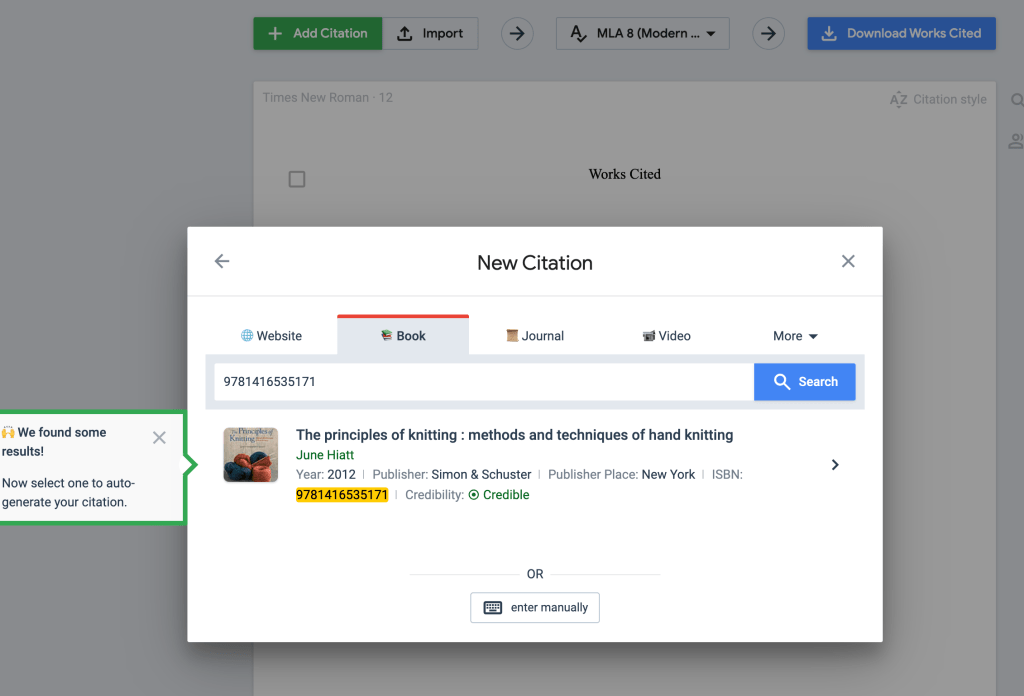
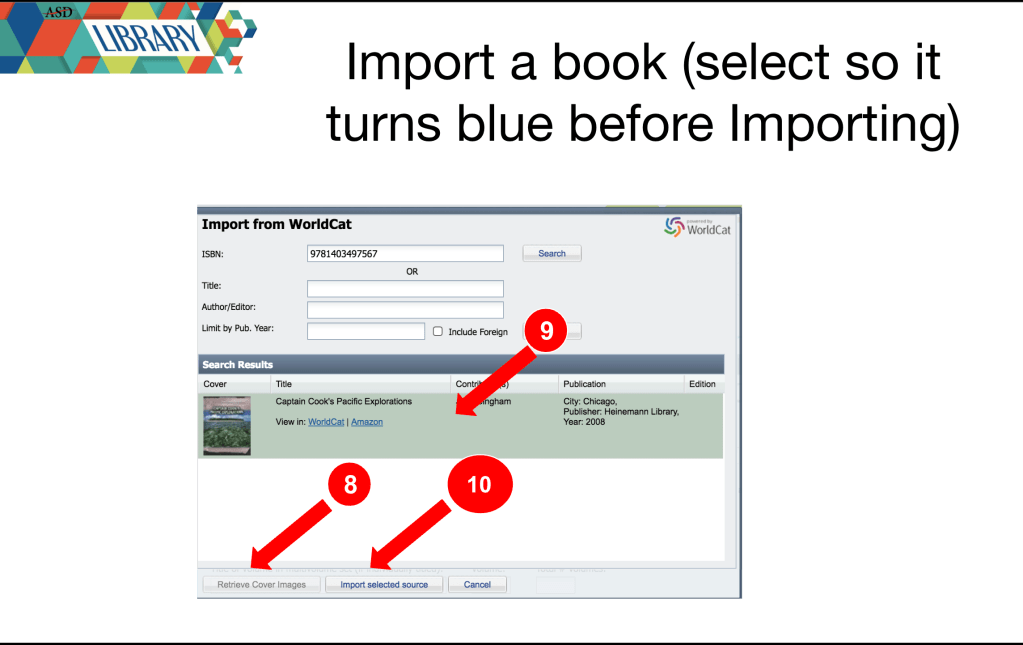
to NoodleTools – twelve steps in 7 consecutive screens (is it any wonder my kids are so proud of remembering it all and getting it right!) – see more here:

Of course there are a myriad of other citation tools, but these are the two more common ones in the secondary school landscape that are not predatory / try to sell you an essay along with your citations or steal your data / information?

So why not go for my.bib – and rather choose Noodletools IMHO? Well:

  • it’s not great with identify the Author and Date of sources – all these tools scrape the metadata from the sites you’re using and lazy webmasters and programmers won’t necessarily bother putting these in, or won’t identify them correctly with the correct tags.
  • It doesn’t play nice with databases, you need to export the citation in RIS or BibTex format and import it into your MyBib bibliography – where as NoodleTools have managed to integrate themselves into most of the common databases we use, including Credo, Gale, Infobase, JSTOR etc.
  • It doesn’t have the same level of pedagogical step-by-step guidance and error identification (for example capitalisation which is very easy to get wrong)
  • Teachers can’t follow the research process through a shared “inbox” (and the great thing is in trans-disciplinary assignments the same project can be shared with two different teachers with different class groupings.
  • It doesn’t have a notecard / outline function
  • It doesn’t have the collaborative features of NoodleTools where you can also see exactly which student contributed which citations / notecards to a project – a great feature when it comes to the “not fair” arguments on work division
  • It doesn’t have the “history” feature which allows teachers to see the unfolding of the research and the instances of “immaculate conception” of perfect research papers and notecards
  • Although my.bib is free, NoodleTools is only a couple of hundred dollars for nearly 1,000 students i.e incredibly cheap for the extra features
  • You actually WANT to create friction in the research process – a source needs to be relevant and credible to merit inclusion in the research and if there are speed-bumps in putting the source in students may be less inclined to go down the WWW (world wild web) route of random googling and more inclined to use our databases and sources in our Libguides.

So how to implement / “sell” the system
Basically it’s a push-me pull-you gig. It helps to have it as part of your information literacy scope and sequence as “the only tool recognised”. If we are student centred it is important that adults set aside some of their preferences and independence so that one system is used and students can become competent and not be confused.

Some of it is persuading departments to adopt it for the above-mentioned reasons, despite it’s ugly UX and multi-step process. Offering to set up inboxes for teachers for research projects helps. As does creating project templates with outlines and tailored notecard headings.

Students need to be taught step by step how to use the tool, and it has to be re-iterated for each assignment and the librarian needs to be prepared to be on hand to help out as there is a very long tail of students becoming competent in its use. And simultaneous to the “doing” skill, the work in the “understanding” has to begin. Why does it matter if something has n.d (no date) or n.a (no author)? How does that correlate to credibility and reliability?

So there was the very long answer to what may have seemed like a simple question. It’s great for Grade 5 to Grade 12. And what do I use personally? Well, if I’m doing an academic paper or helping an adult (or Extended Essay student) sort out their research life I still go for Zotero. I pay for the extra storage even now I’m not a student anymore and I love the integration of in-text citations and Bibliography/Works Cited in Word and GoogleDocs.

Nonfiction in the middle

Mediating between curiosity and research, curriculum and pleasure By Nadine Bailey and Katie Day

In the summer of 2024 we asked International School Middle School librarians to tell us the story of nonfiction in their libraries. We wanted to know their ambitions, frustrations, organisation and display as well as their collection development and usage plans. All books recommended in this article can be found tagged in our LibraryThing Shelf (https://www.librarything.com/catalog/middleNF). 

Curriculum and Research

Educators and librarians who have been around for a while know and recognise the pendulum of ideas and practice that upend things first in one direction and then another. Nonfiction is one of those things where some of the momentum is now moving back to the practice of reading subject matter in physical form. Many librarians responded that in a post-covid learning environment both they and the teachers they work with were moving back to giving information in print form – mainly books where they were available, but also printing out articles from online sites such as Britannica and Newsela in order to encourage deep reading, avoid distractions and teach nonfiction reading skills that could be later transferred to online reading. 

Schools following the IBO (International Baccalaureate Organisation) programmes (PYP/MYP) had particular interest in “transdisciplinary” and cross curricula books that would offer broader perspectives on curriculum or unit themes. Many librarians were investing in books that would support inquiry into aspects of the United Nations SDGs (Sustainable Development Goals). There was also a keen interest to ensure that sufficient “local” (country where the school is located) and “diverse” (countries of students’ origins) content was available in the library.

Many librarians have quite heavily weeded their nonfiction sections and are now looking to re-stock them based on this renewed interest in physical books. But it appears that publishers are not necessarily aware of what is happening on the ground and are not always updating and bringing out new editions of popular texts. 

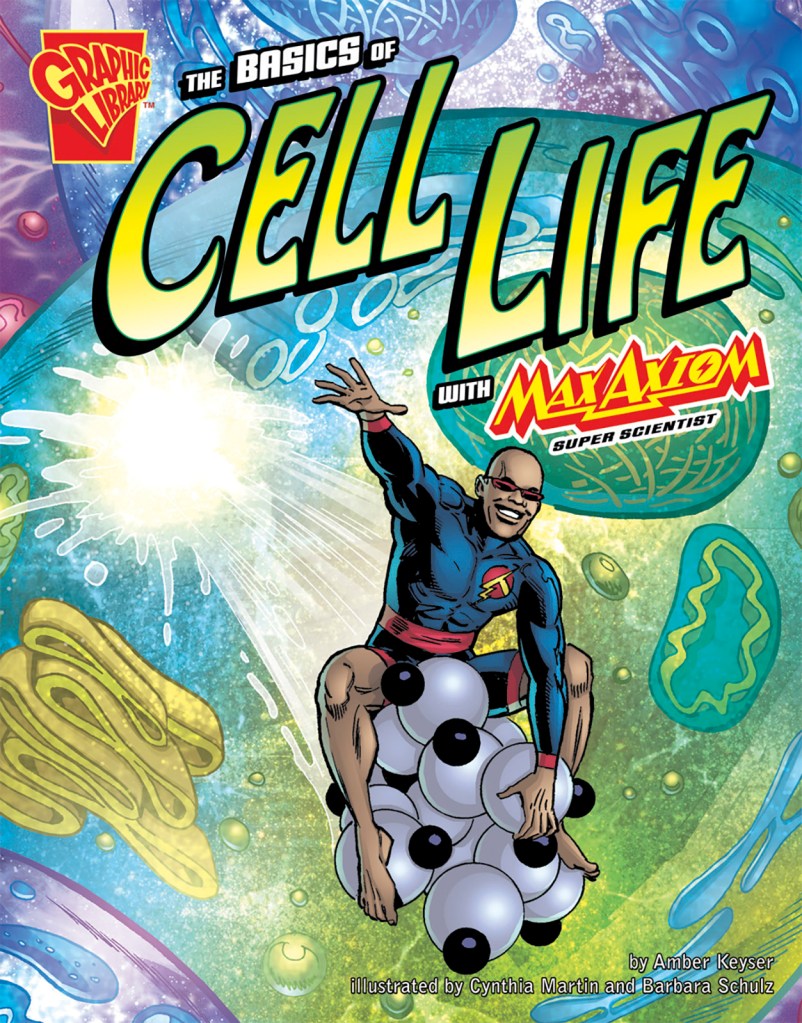
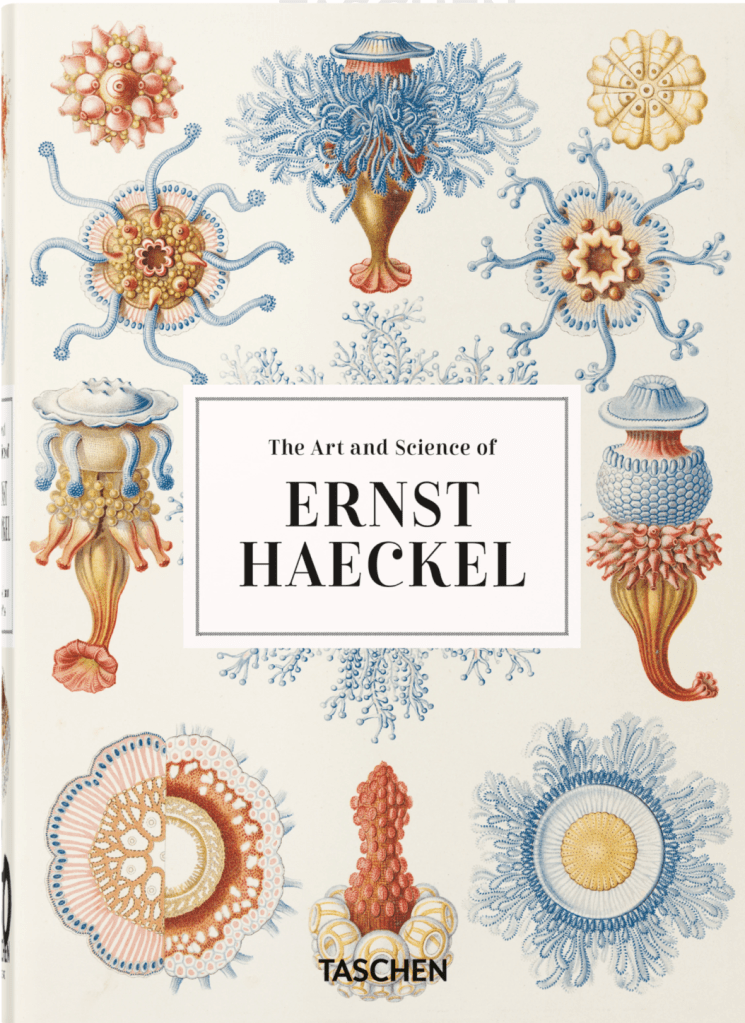
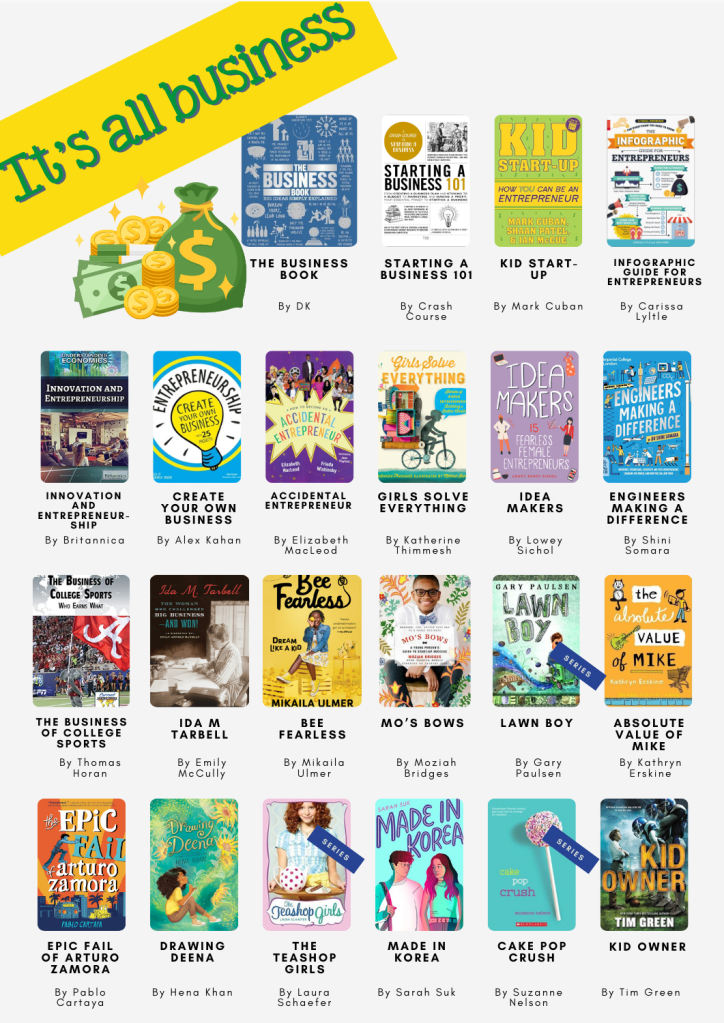
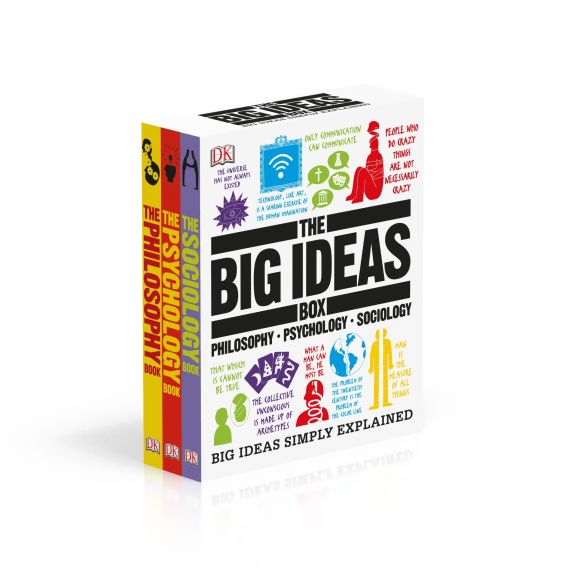
On the other hand, most respondents remarked on how much progress had been made in the last few years on the design, layout and illustrations in recent nonfiction texts. There was also a shoutout for the increase in different formats including “Oversize books” (see the books of “Big Picture Press – Welcome to the Museum”); Graphic and Manga imprints (series such HowToons; Cells at Work; and authors such as Don Brown and Jim Ottaviani); infographics (Infographic guides; ) Subject Summaries (The Big Fat Notebook series), Picture books (see this 2024 SLJ list) and Subject Overviews or introductions (DK Eyewitness, and DK Big Ideas).

Where curriculum and research is concerned, students can now often choose their favourite medium of access through a variety of formats.

Foster the flame of curiosity

Somewhere on the way to middle school, students amend their passions to fit in with their peers and ensure a sense of belonging. So out go the dinosaurs and big trucks to be replaced with their favourite sports personalities, music stars, books about their sports (soccer and basketball seem to be hits). Puberty hits this group hard and fast and strategic placement of sensitive materials can put paid to rumours and myths. It is also a time of self-absorption and worry about their physical and mental health – books on health and well being, relaxation, anxiety, meditation as well as psychology, are popular and an area of growth in most libraries. 

Given the demographics of our schools, students of this age are already taking a keen interest in finance, aspects of wealth and investment as well as entrepreneurship. They’re also interested in personally exploring hobbies and activities they may see online such as cooking, sewing and knitting or other crafts. 

History – particularly the world wars and more recent conflicts continue to fascinate and appal in equal measure – often mediated by historical fiction texts students may encounter in their literature studies or English classrooms and what they see on the news or social media. 

Shelving, organisation and display

In order to make nonfiction appealing and accessible, quite a few of our respondents mentioned they either had or were in the process of rethinking the way that nonfiction was shelved, organised and displayed in their libraries. There is a continuum from pure DDC (Dewey Decimal Classification) to a range of Book Shop or genrified models. Librarians were more interested in getting books seen and read than in a hypothetical need for their audience to be able to navigate a university library later. One of our respondents coined the lovely phrase of “emotional accessibility” in this respect. 

Of course most libraries have already taken the first step of putting “literature” or novels out of a straight Dewey 800 section into a fiction collection – genrified or or not. Other common “extractions” from the main Dewey structure include:

  • Taking Biographies, collective biographies and memoirs out of 910/920 and putting them in a separate section. Some libraries put collective biographies at the start of the section they pertain to (i.e. famous musicians go to 780).
  • Travel Books
  • Poetry
  • Drama and playscripts
  • Graphic Novels and Manga 
  • Narrative nonfiction
  • Myths, Legends and Fairytales
  • Parenting 
  • Well Being
  • Professional Development 
  • Sports 
  • Country specific collections
  • A specific nonfiction series that’s popular
Photo: American School of Dubai MSHS Sport Section

In the absence of permanently pulling out a section – many librarians make use of rotating “dynamic shelving” or temporary topical displays. The guideline here appears to be to follow the needs and interests of the community – teenagers want to be able to independently navigate the library without adult intervention that may be embarrassing. 

Related to that – signage and signposting was an area that nearly all librarians were investing in. Many mentioned significant weeding that had resulted in more space for forward facing displays and carving out sections of interest. 

Recommendations

To support the discovery of nonfiction titles for middle school, we’ve curated a shelf of 389 (and growing) books on Librarything that we consider to be worth investing in. It’s an ongoing labour of love, so not every book has been tagged at this point yet.

Examples of Some of the tagging we’ve employed are (not an exhaustive list):

  • Narrative nonfiction
  • Manga
  • Graphic
  • Topic_
    • WW2
    • Women
    • Science
    • Mathematics
    • Religion
    • History
    • Climate
    • SDGxx
    • Activism
    • Wellbeing
    • War
    • Technology
    • Sustainability
    • Sports
    • Space
    • Social Media
  • Geo_
    • Southeast Asia
    • China
    • USA
    • Europe
    • UK
    • Australia
  • Edition
    • Young Reader

Since such lists can quickly go out of date, we’d also like to generalise with some series, authors, titles and publishers that we recommend.

Great AUTHORS 

  • Marc Aronson
  • Don Brown
  • Marc Favreau
  • Candace Fleming
  • ​​Russell Freedman
  • Yuval Noah Harari
  • Deborah Hopkinson
  • Tanya Lloyd Kyi (Canadian)
  • Randall Munroe
  • Jim Ottaviani
  • Elizabeth Partridge
  • Gillian Richardson
  • Steve Sheinkin
  • Cory Silverberg (Puberty)
  • Dashka Slater
  • Tanya Lee Stone
  • Pamela S. Turner

Great PUBLISHERS

  • Annick Press (Canada)
  • DK (Eyewitness; Big Ideas; Children’s Timelines; How Things Work; How Stuff Works)
  • First Second (MacMillan)
  • National Geographic for Kids
  • Usborne (UK)
  • Crabtree Publishing Company
  • Flying Eye Books

Great SERIES

  • DK Eyewitness
  • DK Big Ideas
  • DK Children’s Timelines
  • DK How Things Work / How Stuff Works
  • From Playground to Pitch
  • HowToons
  • Hazardous Tales (Nathan Hale)
  • Little Histories 
  • World Citizen Comics
  • UN sustainable development goals

Great TITLES

There’s been a recent shift toward publishing a Young Adult version of popular nonfiction titles either simultaneously or shortly after the Adult version. These can be found by searching for “Young Readers” or “Young Reader’s edition” / “Young Reader’s Adaptation”.

Blogs and nonfiction websites

Nonfiction Book Awards

Pairing Nonfiction and Fiction

Last but not least, pairing a nonfiction book with a novel can enhance both texts.

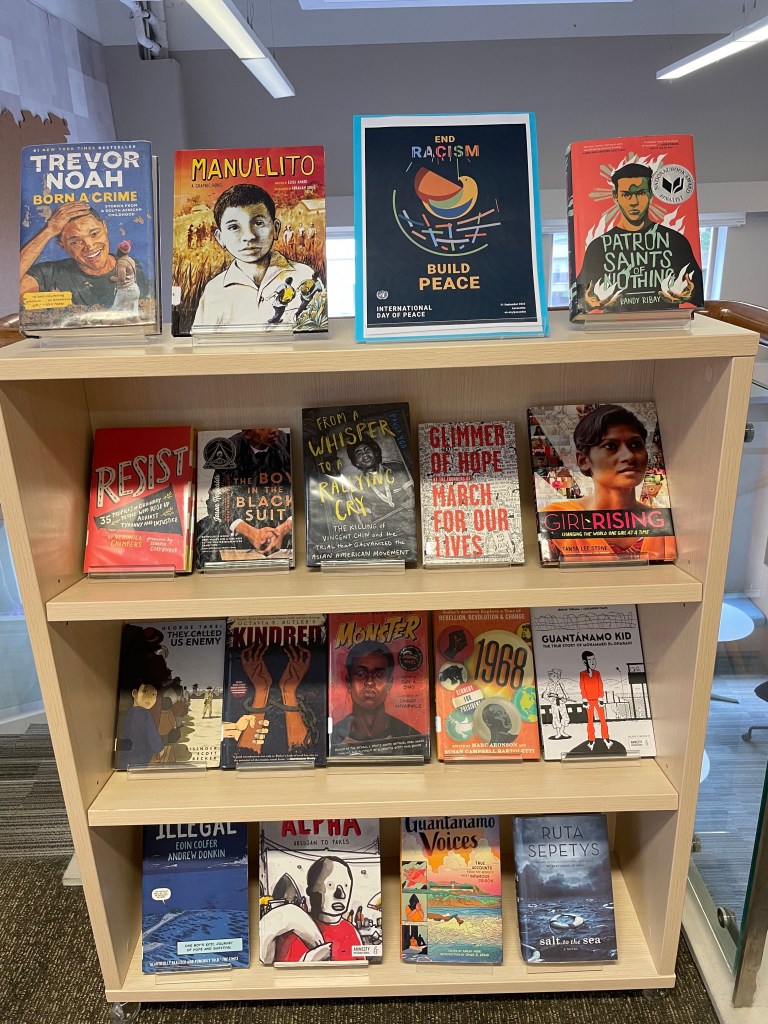
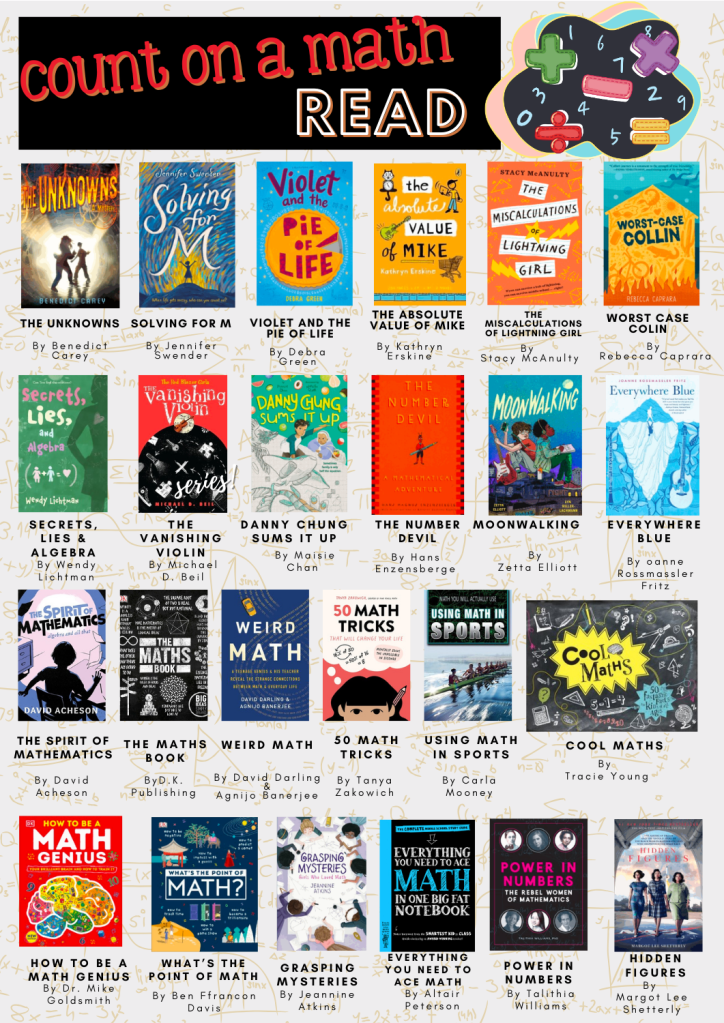
I initially started putting a fiction book on this libguide followed by suggestions of nonfiction, https://asdubai.libguides.com/ms/reading/nonfiction. I’ve now moved away from that somewhat and have started curating “Read Around the Curriculum” posters where either a curriculum topic is highlighted with fiction and nonfiction, or an “If you like / want to know more” poster is made of one of our book club fiction books with suggestions for finding out more about the context with other fiction/nonfiction books on the topic.

Katie Day and I would love to hear your suggestions for more nonfiction books, and perhaps we can expand the list to High School. Many of the books suggested in our list are suitable for High School and upper elementary as well.

Comments and suggestions much appreciated.

NOTE: Since the publication of this post we have been approached by commercial entities about using the list. While we cannot prevent the list from being used commercially this is our wish:

This list was created in order to freely help librarians all around the world. It was a labour of love which took a lot of our personal vacation time to create. If you are part of a commercial organization and you will be using the list commercially we would request that you attribute us and make a suitable donation in our names to “Biblioteca di Lampedusa” which serves refugees from around the world in their Silent Book initiative, https://www.facebook.com/BiblioLampedusa/ or the “IBBY Children in Crisis Fund”: https://www.ibby.org/awards-activities/ibby-children-in-crisis-fund.
Thanks. Nadine & Katie

Unlikely new nonfiction

Our G6 Language & Literature classes have just started a unit on “Unlikely Heroes” and I must admit I’ve been having an amazing time finding some fantastic new biographies and memoirs to entice them into reading this genre and keeping an interest in the lives of people who may not always make the headlines, or who they may not be aware of, or who they only have an inkling of.

Two very interesting stories from the sporting realm are those of Jesselyn Silva with “My Corner of the Ring” (boxing) and Ibtihaj Muhammad with “Proud: living my American dream” (fencing). These are a double win to my mind featuring both lesser written about sports for middle grade students AND featuring young girls from non-traditional backgrounds in those sport – I have a daughter who fences and I know exactly how expensive (and sometimes snobby/exclusive) we’ve found it. There’s also the recent cliffhanger with young football players in Thailand, excellently written about by Marc Aronson in “Rising Water : The Story of the Thai Cave Rescue”.

Through my privileged connection with the Neev Children’s book awards, I’m able to encounter books that I wouldn’t otherwise be aware of such as “Like A Girl: Real Stories for Tough Kids” by Aparna Jain that showcases the lives of 56 Indian ladies, who may not be familiar to our students. Another book worth mentioning is the hybrid graphic novel / biography Indira by Devapriya Roy and Priya Kuriyan (Illustrator). What makes that book special is the way it weaves in how writing research is conducted in present day with the historical facts.

Our students are also living through history making by people in the here and now such as Autumn Peltier and Greta Thunberg (We Are All Greta: Be Inspired to Save the World by Valentina Giannella, Manuela Marazzi (Illustrator)). And our school is extremely lucky to have had a long-standing relationship with Jane Goodall who will be attending our FOEN conference next week (Hope for animals and their world. Unfortunately I wonder if that message of hope still stands ten years later).

Finally we’re also seeing more books either featuring LGBTQ+ heroes or where they are part of the narrative of other history. In a fairly conservative International environment there is always the question of how (not whether) one brings this up. I find that someone like Alan Turing is a wonderful segue into the area. (Alan Turing by Jim Eldridge; The imitation game : Alan Turing decoded written by Jim Ottaviani; Genius inventions : the stories behind history’s greatest technological breakthroughs by Jack Challoner; Stories for boys who dare to be different : true tales of amazing boys who changed the world without killing dragons by Ben Brooks ; illustrated by Quinton Winter and Queer heroes by Arabelle Sicardi ; illustrated by Sarah Tanat-Jones.)

The last three books, are ones where he is part of an anthology. One thing that we’ve started doing as part of this unit, is where there are a number of “heroes” in one book, we’ve added all the names in the table of contents to our cataloging record. That helps students to find different perspectives, formats, lengths of explanation and viewpoints of the same person. We’re hoping that some students will start with one of our many combined biographies, for example the great series of “Forgotten Women” by Zing Tsjeng or the “Goodnight Stories for Rebel Girls; or The Good Guys or Stories for Boys; or Stories for Kids; or “A History of the world with the women put back in” by Kerstin Lücker & Ute Daenschel and end up further researching one particular person who catches their interest.

An amazing thing has happened to nonfiction since around 2016. The visuals, design and layout has improved to no end, so books have become so much more enticing. I’m also loving the fact that biographies of women are no longer so ugly and we’re finding out about other amazing women such as Didda the ruler of Kashmir from 958 CE to 1003 CE (Queen of Ice by Devika Rangachari).

More of the wonderful books and how we categorised the various types of heroes around this unit can be found on our library guide. The revolving book lists (created with LibraryThing for Libraries) on each section lead back to our catalogue where students can see if the book is available and if necessary put the book on hold.

Next time I hope to write about some more fabulous nonfiction recent finds related to other curriculum units.

Content plus

One regularly hears phrases bandied around schools such as “Every teacher is a language teacher”; or “Every class should start with 10 minutes of reading” and you’d be hard pressed to find a teacher who doesn’t agree in theory, that reading is a good thing. But then there is the “reality” of supposed too little time, too much pressure, too much content to cover and the theory of reading becomes such an abstract notion that there isn’t even a consideration of how it could be implemented.

Last week-end, Katie Day and myself gave a 90 minute presentation to around 100 educators at the Neev Literature Festival titled “Books & Beyond”. You can find a copy of the presentation here as well as other resources.

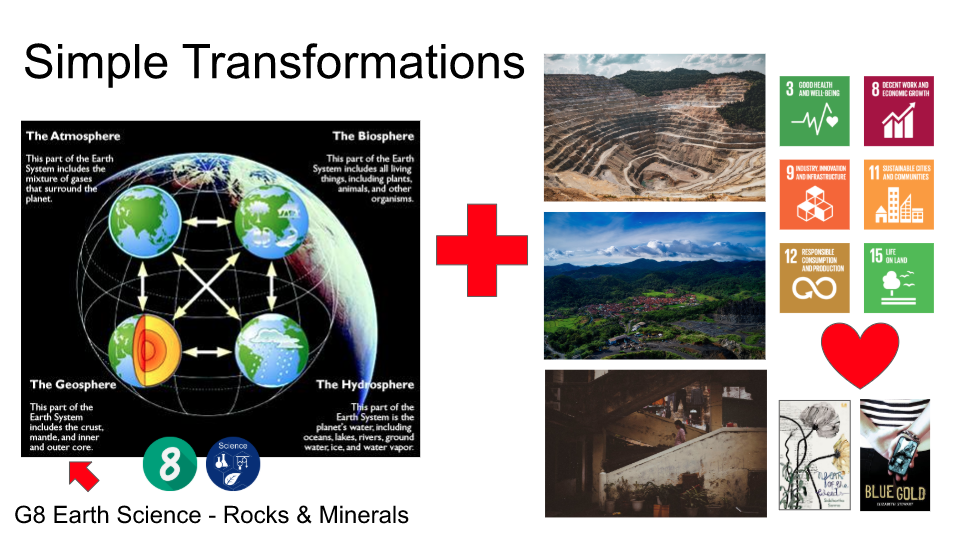
We’re on break now, and when we get back I was asked to present to our HODs for a few minutes on integrating reading into units in the middle school. I’ll probably just show this one slide:

I’d call it “content plus” – it’s from a G8 Earth Science unit that the Science team and I put together at the end of last year and they’re teaching now.

The idea is that you still have the science content as core to the unit – in this case Earth Science and learning about Sedimentary, igneous and metamorphic rocks and the minerals they contain and mining and the  products of mining. But to that you add the environmental and human impact, and the lens of the SDGs (Sustainable Development Goals).  And in order to help build empathy and understanding, add some literature.

Katie also had the brilliant idea, that she’s implemented in her school (and I’m going to be following quickly behind!), of getting good, relevant articles, stripping off the advertising etc (she uses Safari Reader View; I use Mercury Reader) putting them in binders and making them available in the library and classrooms – see slides 42-47).

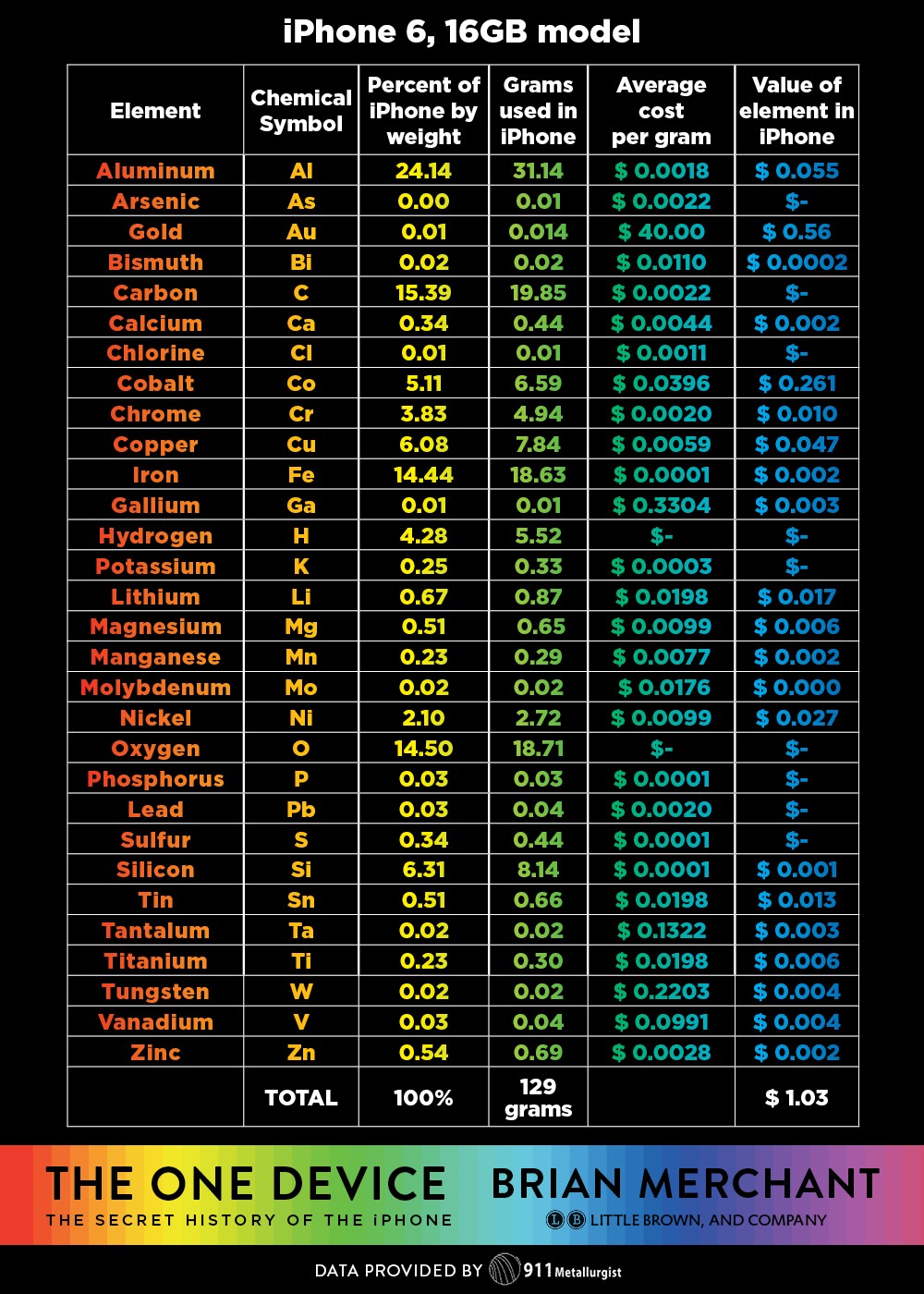
You can of course choose any minerals, but in this case to make it relevant to G8, we focused on the primary elements of an iPhone.


iPhone ingredients

Ideally, and this takes time, some of the science and or math units would be linked to Language & Literature or Individuals & Societies units allowing more time to explore literature.

In the mean time, one of the wonderful ways of adding literature into units is through picture books. In the guide we created for the Neev Festival, we made suggestions around groupings of the SDGs of the Neev shortlisted picture books plus lots of other books. It’s still a work in progress, but over time I’m hoping that for each and every global goal I have 10-20 picture books, (as well as 10-20 fiction books and 10-20 really good nonfiction books) that can easily and quickly be introduced to a class, thereby adding a very special element to learning, and truly making “every teacher a language teacher” and every teacher able to devote a tiny slice of their class to reading.

What research looks like

Lest I be accused of being too negative on the information literacy side of things I wanted to post something positive. A while back I was listening to an interesting enough book, (Gup, 2014) but the most fascinating part, and what sent me back to the eBook version was the part where the author explained how he’d conducted his research.

Now we often use mentor texts in education, and why not when we’re trying to teach research? In the extract below, Gup,  explains how he, a former Washington Post investigative journalist went about uncovering the story of his grandfather.

Research 1

Research 2
2 page extract from: “A secret gift” by T. Gup

This is the type of detail that is hidden to people who read a newspaper report. The amount of work is just staggering.

Perhaps that is why students struggle to understand what “real life” research looks like. After all what kind of research are they exposed to? Wikipedia is actually not bad, as it cites its sources at the bottom (to those who scorn it). Britannica for students hides behind editorship (as a substitute for identifiable authorship) and a lack of sources (this article on the depression has two authors but no sources and yet we’d rather students go to Brittanica than Wikipedia?). Books, when they’re used at all, do have sources, sometimes, depending on the target age and how scrupulous the publisher is. Newspaper or magazine articles – we have no idea of either the research process nor the sources of information except inasmuch it is divulged, for example, in movies such as Spotlight.

So our young researchers go off onto the internet, or maybe to Britannica and Brainpop and some books and then as they mature we coax students into using databases and journal articles. Where again, they see the end product rather than the process.

How often do we get researchers in to uncover their craft? Versus for example authors of fiction or poetry?  So is it by accident or design that they’re not breaking through those threshold concepts?

References:

Gup, T. (2014). A secret gift: how one man’s kindness–and a trove of letters–revealed the hidden history of the great depression. New York: Penguin Books. Retrieved from http://rbdigital.oneclickdigital.com


The Boston Globe. (2016). The Boston Globe Spotlight Team. Retrieved from https://www.youtube.com/watch?v=kJfyjq80Ths

Are we teaching dogs to chase cars?

I’d love a dollar for every time as a TL I’m asked to teach students “how to search” or “search terms” or “searching. Once upon a time I complied. I’ve become a bit more bolshie in my old age. I now try to engage. Engage in a conversation as to what exactly the teaching and learning aim is behind the request.

You see, we don’t need to teach dogs to chase cars. We need to teach them what to do with them once they’ve caught them. And we need to teach that bit first, so that they can decide with the right amount of information at their disposal that actually, cars are not edible and therefore not worth the chase.

I understand the impetus behind wanting to teach better searching. It comes from a good place. One which recognises that students are going to google anyway, it will probably be their first and last port of call and we may as well teach them how to use it better so at least the results somewhat resemble the information they’re looking for.

But without some kind of prior knowledge or context, how will they recognise what is in front of them for what it is? And without deep literacy skills, both on the reading and writing side, how will they do something with it? And why am I seeing two huge time sucks in student “research” – searching and gathering “information” and dressing it up in some kind of (digital) presentation form. aka, the dogs chasing the car and trying to make a silk purse out of a sows ear. Which leaves precious little time for the meat in the middle.

Am I overly cynical, or is this a more generic experience? And what can we / dare we do about it?

Beyond beyond search and cite

A long while ago (3 years) I wrote a post about the fact that we needed to look beyond “search and cite” in teaching information literacy and look at the threshold concepts of research, and a presentation I’d given on the theme. I remember at the time seeing half the audience (of librarians) eyes glazing over and thinking, “oh no, this isn’t going to work if it’s not something librarians get and relate to – and how on earth would students buy in?” I still believe that understanding threshold concepts in any discipline and for us librarians in research / information literacy is crucial in diagnosing misunderstandings and structuring our teaching. But then yesterday I had another insight on how this could be approached in a far better way.

studentIn my current position I’m considered to be part of the school wide coaching team, and as a group it was suggested we read “Student-Centered Coaching” by Diane Sweeney. I’ve been enjoying the fact that it’s a pretty practical book and one where you start to think that by taking the focus off the coach or even the teacher, you can actually take a lot of the emotion out of the coaching / teaching equation.

The book emphasises the use of data, but not necessarily the data provided by testing, but rather from the usual formative and summative assessment that is going on anyway.  One example used DRA testing – the equivalent of which occurs all over regularly anyway, and another a rubric from a writing program using a writing prompt. The idea is to select pieces of writing and score them on writing conventions and then group students into bands of “exceeding, experienced, competent, developing, emerging or below emerging” conventions. One then tries to move those groups / cluster using differentiated instruction up the scale.

I immediately thought of a lost opportunity last term, I’d had to teach citation to groups of students prior to their final assessment of a unit. It had been hectic both on my side and the teacher / classes and I’d been beating myself up a bit about it. Then my son (a different grade) came home and showed me an I&S assessment task (ungraded) he’d done and asked me what I thought of it. That’s a tough call. Because,  there was a lot going on there and not all of it was pretty.

And then I realised it was the perfect way to do a “backwards by design” session on searching and citing.

What if the “works cited list” and in-text citations of an assessment task of a whole class or grade were to be critically looked at?  It is a few lines that reveal so much of what’s going on in research. And then based on that one could group students according to where they were and what needed to be worked on and then individualise that part of the rubric in order to see if there was progress in understanding (and if they were approaching the thresholds!).

A quick reminder of the IL threshold concepts – research is/has:

  • Authority – Is constructed and contextual
  • Format – the creation, production and dissemination of research is not equivalent to its delivery or how it is experienced
  • Information goods – research has a cost and a value
  • Information structure (searching as strategic exploration) – an ability to look “under the hood” of databases and search engines (including more and more as we use things like Google scholar – the algorithms that spit out the results)
  • Research process – as iterative, difficult and building on the those who came before
  • Scholarly discourse – citation is a point of access into this discourse
  • (Research as inquiry – ongoing nature of research this is used by some but not all researchers)

Some of the things I noticed when looking at my son’s paper were –

Evidence (just two examples as an example): Not understanding that “Et al.” means “and others” – encountered in the in-text citation and works cited. The in-text citation followed the format (author, date) while the works cited was MLA8. Kind of.

Indication of not understanding:  

  • authorship = authority. But behind that was an understanding of the research process that included groups of people working on a topic
  • Format – since he’d used google scholar as a delivery point for the search. And from there had got to the database article without realising that it was an article in a database.  And didn’t understand the format or
    Screen Shot 2018-10-14 at 19.21.28information structure.
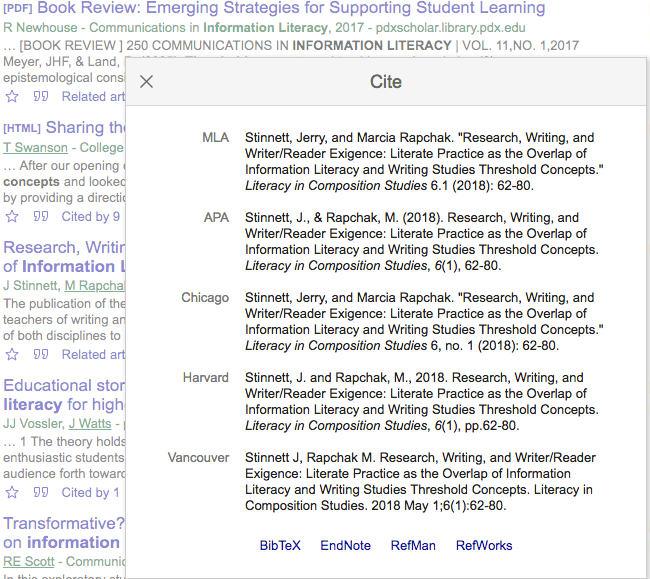
    This is something, if MLA8 is correctly taught and deployed, including its emphasis of a Russian Doll like structure of containers, should become obvious.  There is another – more simple aspect of formatthat of the format of citing and where that can be found. I showed him the  ”  marks in google scholar and how that led to the citation that could be copied into NoodleTools as is… a revelation
    for him. I also showed him in the original journal article of two other sources how he could find the citations and just copy and paste them – let’s consider small steps here!

Indication of understanding:

  • Scholarly discourse – here is where my own prejudice to APA versus MLA8 for the humanities come in – the date is probably a better indication of the point of scholarly discourse and understanding that something more recent would encompass prior research

The Scott (2017) article listed below is a particularly good one – because it asks students to rank their understanding of the concepts and to explain them. And this is where you can see the metacognitive value of “knowing what you don’t know” (please read Errol Morris’  series of articles on the anosognosics dilemma – the best ever on this, if you haven’t already) comes into play

“One mentioned domain knowledge as a barrier: “You have to have some type of familiarity with the topic to ‘enter the conversation.’” (Scott, 2017, p. 295)

To reign this back, we’re talking about middle and high school. So wading straight into threshold concepts may be going in too deep for the average student. But it may be a useful diagnostic tool.

Getting back to the coaching bit – doing an autopsy on in-text citations and the works cited list would reveal where the gaps and issues both in searching and citing were. The humanities teacher is probably looking at the assessment using a different lens – that of understanding and using the information and the ability to write it up in an academically acceptable manner using some kind of scaffolding (e.g. point, evidence). And at the end of the assessment, once a grade has been given and the focus has moved onto the next unit / assessment, the gaps in the ATL “research” may not have been identified, recognised, nor addressed in the teaching or assessment rubric for the next unit.

I believe in rubrics as a way of shaping teaching and focusing attention in student effort. If in a year, the teacher in conjunction with the librarian, moves through perhaps four iterative cycles of research, I’m sure we’d see real progress in both the practical ability and metacognition of students as they approach research and the threshold concepts.

=================

Here are some articles that explore further information literacy as a threshold concept in an interesting way:

Further reading:

Corrall, S. (2017). Crossing the threshold: reflective practice in information literacy development. Journal of Information Literacy, 11(1), 23. https://doi.org/10.11645/11.1.2241
Hofer, A. R., Townsend, L., & Brunetti, K. (2012). Troublesome concepts and information literacy: Investigating threshold concepts for IL instruction. Portal: Libraries & The Academy, 12(4), 387-405.
Hofer, A., Brunetti, K., Townsend, L., & Portland State University. (2013). A threshold concepts approach to the standards revision. Comminfolit, 7(2), 108. https://doi.org/10.15760/comminfolit.2013.7.2.141
Morris, E. (2010, June 20). The anosognosic’s dilemma: Something’s wrong but you’ll never know what it is (Part 1). Retrieved 4 February 2014, from http://opinionator.blogs.nytimes.com/2010/06/20/the-anosognosics-dilemma-1/?_php=true&_type=blogs&_php=true&_type=blogs&_r=1
Scott, R. (2017). Transformative? Integrative? Troublesome? Undergraduate student reflections on information literacy threshold concepts. Communications in Information Literacy, 11(2), 283–301. https://doi.org/10.15760/comminfolit.2017.11.2.3
Stinnett, J., & Rapchak, M. (2018). Research, writing, and writer/reader exigence: Literate practice as the overlap of information literacy and writing studies threshold concepts. Literacy in Composition Studies, 6(1), 62–80. Retrieved from http://licsjournal.org/OJS/index.php/LiCS/article/viewFile/180/239
Townsend, L., Hofer, A. R., Lin Hanick, S., & Brunetti, K. (2016). Identifying threshold concepts for information literacy: A Delphi Study. Communications in Information Literacy, 10 (1), 23-49. https://doi.org/10.15760/comminfolit.2016.10.1.13

Ask the inhabitants

My online library network is getting excited about a couple of articles that are challenging beliefs.

There’s danah boyds’ You Think You Want Media Literacy… Do You? it is an incredibly powerful article that needs to be printed out and highlighted and read very slowly. A couple of times. One passage that struck me epitomised the near futility in what we’re trying to do on the “fake news” front.

“This is about making sense of an information landscape where the very tools that people use to make sense of the world around them have been strategically perverted by other people who believe themselves to be resisting the same powerful actors that we normally seek to critique.(boyd, 2018)

Her conclusion is that we need to “inoculate” students against their very human tendencies by approaches that “are designed to be cognitive strengthening exercises, to help students recognize their own fault lines, not the fault lines of the media landscape around them” (boyd, 2018).

And then Wilkinson’s (2017) very apt writing up of her presentation that boils down to the fact that it is humans, messy, opinionated humans, subject to confirmation bias who are doing the research and therefor takes a welcoming psychological approach to understanding how students research – the paragraph on “post truth psychology is particularly well worth reading.  Her point is to short-cut the evaluation part of resourcing research and cut to reliability.

So while all this was percolating in my brain, I went for a run while listening to 99% invisible, and they had a two part series on the Bijlmermeer. Having lived in the Netherlands in the 90’s – my first year was when the plane went down on one of the buildings – I was very interested to hear what an American podcast would have to say about it. And I realised that in many ways as librarians and teachers we are imposting a modernism/functionalism mindset on research. With our structures and mnemonics we are creating these concrete structures that get in the way of a more organic way of knowing and learning.

Furthermore, planners realized people didn’t want to live in huge concrete structures. Almost immediately after the Bijlmermeer was finished, another neighborhood in Amsterdam was redesigned — it was done with bricks, a traditional Dutch material.

The Bijlmermeer, and maybe a lot of Modernism, was architecture for architects. It was a top-down, paternalistic approach to city planning. The redesign of the Bijlmermeer did not make that mistake. People from the community were heavily involved in the redesign process (Mingle, 2018).

So yesterday evening I decided to ask the inhabitants. In this case my two high-school teenagers. I asked how they did research, how they decided where to search and what to use. The answers were enlightening. And frightening.

First my highly intellectual daughter who “does school” very well. She admitted that she didn’t have the first idea about doing “proper” research and that actually in the last seven years that she’s spent in a highly prestigious very expensive school she hasn’t had one single session with a librarian. Nor had her teachers taught her anything as up to now she’d never been asked to reference anything. And it’s only because I’d insisted and taught her Zotero for a recent Geography course-work project did she really know much about it. She blamed having to do the iGCSE, (something she absolutely hates) and if I had my time over I would never put my children in a school offering (i)GCSE. It’s a waste of time and intellect. Added teaching my daughter research before she goes off to do her IB onto my list of things to do in the next 3 months. Hahahahaha, crash course research. The irony.

Then my son. The dude who’s had a tough ride of school and teachers. The one that was fortunately rescued from prestige and arrogance. Well, he said, the need to spend time with the librarian on research was an extra bonus, but the problem wasn’t actually as “acute” (his own words!) as at his sister’s school as the teachers were “all over” researching well, so going to the library was reinforcement for what the teachers were doing. Well, I guess I use CRAAP he says. OK, I challenge, what does CRAAP stand for. He laughs embarrassed. Well, I don’t really use CRAAP he says – at the beginning of the year my teacher shared this site with us that gives reliable sources, so I know as long as I stick to those I’m ok. Touché.


Image-1 (1)


Back to the more structural part of all of this – Caulfield, who I greatly respect has a useful graphic and new open-source textbook – Web Literacy for student fact checkers for those who want to continue on the architectural part of research and learning.R

I like the first habit of “Check your emotions” – a bit like Tim Harford’s guide to understanding statistics in a misleading age.  Moi? I think I’m going to teach more psychology and less CRAAP to my students. A great place to start is “Your logical fallacy”  who have produced some excellent posters and other resources.

References:


The second shift

Last night my daughter asked me about citations for her Geography project. Now let it be made clear, my children, while lovely human beings, are in the “potted plant” phase of adolescence. So this was pretty rare. It’s also rare for them to acknowledge my knowledge or specialisation either.  But despite her multi-big-$$ education in a big name school (not where I’m at), and the fact that she’s highly motivated and organised, good research habits have not been instilled in her. Her references consisted of a couple of URLs and the in-text citations were random with “I KNOW mum sigh” when I raised my eyebrows. I asked what referencing style she had to use – “we can chose”. So I suggested APA – because I love it more than MLA8 and because Geography as a humanities subject is probably better suited to it long term.

I then had to teach her a few of the research habits that have served me well through two back-to-back masters degrees. This stuff is not brain science. If anything it’s like washing dishes and putting them in the cupboard. We re-activated her Evernote account that she’d opened for one enthusiastic teacher some time in the last 6 years. We then clipped all the articles into a Geography file in Evernote and tagged them with the project name. Next up was getting her citations into Zotero, the tool I prefer for upper secondary.

(After the whole debacle about RefMe / EasyBib etc. I’m committed to one tool, not following the latest trend, which inevitably seems to be about who is trying to monetise education and learning.  For primary and Middle School, it’s Noodletools)

There are many things I like about Zotero. The fact that it’s amazingly accurate in its citations and the really really good customer support being the main ones, but also the intelligence and diligence of the user-base can’t be denied. I was pleased to see that in their latest update – getting set up and integrated into Word has been made a whole lot easier. Yes, good old fashioned Word. GoogleDocs have their place but when one moves from being a child, you need to be more sophisticated and demanding in your needs and GoogleDocs doesn’t cut it.

So then I had her put the references in, via the Chrome extension (download the extension), make sure she had the right citation type, put in the missing data. Showed her OWL Purdue for APA, bookmark it, showed her the APA style blog site which has more relevant Q&A type things – like how to cite Google Maps).

And then the magic could happen – click on the end of the sentence, open Zotero in Word, put in the in text citation, click at the end of the document and have all the references upload.  Two hours. But hopefully that will be a lifetime of research “washing up” as you go along rather than crisis at the end.

Then I asked her what the style guide was for her assessment. Again, nothing.  Really teachers, please just get in the habit of telling them what you want things to look like. Line spacing, headings, margins, citation style etc. It really will set them up for University where this type of thing is so important. Stupidly important maybe, but professors can and do deduct plenty of marks for not getting it right.


#fakenews – symptom or disease?

Last week I attended a “#Call to Action: Fake News, Misinformation and Post-Truth” held by the SMU libraries in  Singapore. Library network groups are full of requests for student appropriate examples of fake news. Most librarians have a stock list starting from the spaghetti harvest (1957) / tree octopus (1988). And we’ve unfortunately become over excited that #fakenews will be the saviour of librarianship. Because yay – we’re good at research, we’re good at teaching and applying the C.R.A.A.P / E.S.C.A.P.E tests, we’re about literacy, we’ve got all these captive young minds in front of us.

But between the insightful comments of very intelligent people like Eugene Tan and Gulcin Cribb at this seminar, where one had to conclude that the usual antidotes – trying to outcrowd “fake” news with “good /solid” news, padding news consumption with self-imposed digital/information literacy filters like the above mentioned CRAAP/ESCAPE tests or attempting to regulate it, will only work selectively or not at all.

haythamcom_02a
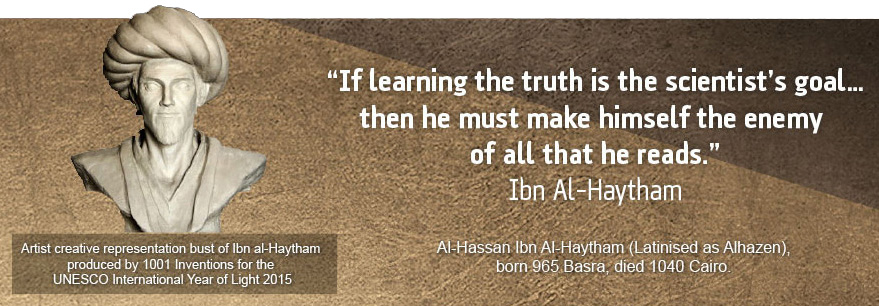
Best quote of the seminar – indeed there is nothing new under the sun

Caulfield in his blog has been hammering on about being able to distinguish between fake and real images, sourcing quotes,  but his latest post was one that threw the switch for me, on digital polarization on pinterest. (An aside, I gave up on pinterest because I can’t be bothered to log in every time I need to go past the first page and I prefer Evernote as a curation tool anyway). If you do nothing else in the fake news landscape ever, just watch this video he made.

And that, combined with the very disturbing article by James Bridle on Kid’s YouTube, following all the work that MathBabe, Cathy O’Neil, has been doing on web algorithms, and watching YouTube with my teenage son who is innately simultaneously curious about all sorts of scary (to mom) teenage stuff, combined with a reluctance to research beyond YouTube and Infographics* has made me really think about the way we’re approaching this conversation.

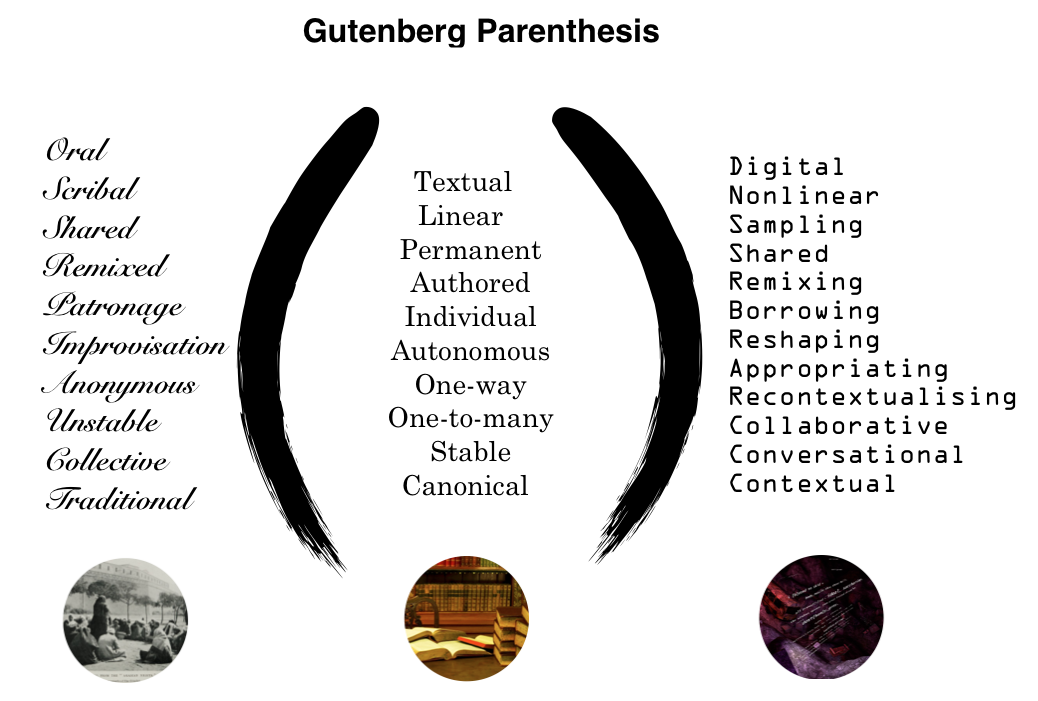
Let’s follow this thing upstream. Bear with me as I bring a couple of concepts that I think are related into this. A few things that have a lot to do with some human traits. The need to tell and listen to stories, The difficulty and recency of reading. The concept of the Gutenberg parenthesis. And last but not least, modern capitalism and/or the seven deadly sins (a concept I needed to explain to my kids the other night).

gutenberg parenthesis

So where does that veritable soup land one? Well, exactly where Mike Caulfield found himself as he clicked along in Pinterest, and like Alice in Wonderland found himself in a different universe to the one he started out in.  Pinterest is perhaps one of more extreme examples of algorithms at work. But the same is going on in Twitter (I was browsing through some UX stuff this morning and my feed and suggested people to follow changed suit in a matter of minutes) and Facebook and Instagram.

We have to face that honesty and a quest for truth doesn’t give one a monopoly on creating world class videos and infographics. That is the realm of those with a big enough budget to do it professionally. And that is how people like their information. So is the cure an infographic cold war, where every side builds up their arsenal of clickbait and point form iconic bite-sized digests? Or do we demand that algorithms are audited? Do we stop being curious and resist what we think is the “road less travelled” and the urge to click down paths that are actually carefully manipulated to pre-purchased outcomes?

So #fakenews is just a symptom. And by trying to treat the symptoms are going to get us nowhere. But unfortunately the disease is being human, and their is no vaccine against that. Except consciousness. Extreme consciousness. And consciousness takes time, and time is what technology is robbing us of. The irony.

————————————————-

* Shoot me – I’m human. That saying about cobblers and shoes? He came home the other day and told me his English teacher said reading was important for vocabulary and a whole host of things and that “just 20 minutes a day would make a difference”