Resist the list

I am convinced that there are generations of parents (and librarians) who think the main purpose of a librarian is to create age/grade related lists of books for students to read. When parent-teacher conference time comes around, if parents venture into the library and engage – as opposed to using us as a baby-sitting booth / place to drink coffee and wait / information-direction desk the one and only question they seem to have is “do you have a book list for Grade …”

So why don’t I have a book list for Grade …? When they allow me time to explain, and time to discuss their child(ren)’s reading needs – preferably with the child present these are the themes of the conversation:

What are your (their) favourite things in life?

I don’t start off with what books they like, because their parent(s) probably wouldn’t be having a conversation with me if they liked books or reading. But if I can get a feeling for what kind of person they are, I can start to think what kind of books may be an entry point to intersect with their lives.

I’m very much a “there’s a book for that” type of person and my staff always jokes with me that they can’t have a conversation with me without walking away with a “book for that”.  If a student likes gaming, we have gaming books. If they like art and they’re EAL (English as an additional language) I have no problem recommending starting with some of our fabulous wordless books, picture books or graphic novels. And I’m happy to discuss how sharing a (sophisticated or even just funny) picture book together is a way better and more productive use of time than forcing a child to plod through Shakespeare or whatever classic the parent loved when they were young.

Reading, like physical activity and learning, has to leave the person with the desire for more. The feeling that they’d like to keep doing this for a long, long time. Forever in fact. If we make them hate it now, we’re f*’d as a human race.

How much can you read?

This is a little open-ended. It’s a combination of the dreaded “reading level” and how much physical time they have for reading.

We have a lot of EAL students in our school. With very ambitious parents. Who are often well-meaning but misguided. During my 16 years in Asia, I have always been astounded at the high level of education and knowledge my Asian counter-parts have. Newly minted in Asia I had no idea of the classic / foundational texts of their countries / languages / cultures. They knew so much of the western foundational texts – Grimm, Shakespeare, Greek etc. Myths and Legends. I’m always humbled by this. However, they’re not helping their child when they insist that a child with a phase 2 EAL level reads Shakespeare in the original text.

I’ve not got much against Shakespeare (except inasmuch it’s part of the dead white male canon etc. etc.) and I have Shakespeare in my library in every form / format and level. And I’m happy to help these students to start with an abridged version, an illustrated version, a short story version, a graphic novel version. But when what they need is basic foundational functional language so they can survive and thrive in a classroom and canteen, honestly the Plantagenets is not going to help them.

Screen Shot 2019-10-06 at 09.26.20

reading

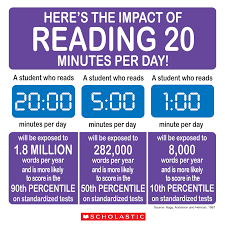
Having time for reading is another big issue. There is this romantic notion that all school-going children read for 20-30 minutes a day. You know all the charts … the funny thing is they all have exactly the same 1987 source, and it’s not even an accurate representation of what the article said – see * below.

I don’t know what your classrooms or homes look like, and I’m sure there are schools, classrooms and homes doing brilliantly on reading. Sustained reading. Uninterrupted reading. I fear the truth is otherwise. I suspect students spend a lot more time on Youtube for their learning. YouTube publishes some interesting statistics.  Of relevance is “YouTube is technically the second largest search engine in the world.” and “Average Viewing Session – 40 minutes, up 50% year-over-year”. If I had to put some money on what our students are watching most on YouTube, it wouldn’t be much to do with learning but rather they seem to spend a lot of time watching other students engaged in one kind of game or another.

I think if I had to ask a bunch of our middle-schoolers to preference-rank what they like to do, if reading wasn’t on the list, it wouldn’t even be mentioned. If it was on the list, except for maybe 5-10% of the students it would be way down at the bottom.

So this part is a little about whether the student is able and willing to make time in the day to read, and based on the little perceived time they have, what they could read.

I usually tell students that if they truly are reading every day, they should be able to get through at least a book a week. So the converse is also true. What size, format or type of book can I pair with this student that would guarantee they’d actually finish it in a period of time that will allow the book to remain meaningful?

We have this illusion that if only we could find the “right” book, a student will just want to read it non-stop and then will be converted to reading for life. I don’t think that is true. I think we need to find a succession of books that students will be successful with so that they can build up some kind of reading stamina that will result in them being “good enough” readers so they can be successful academically. And if we’re lucky they’ll pick up a book again after they leave school.

What are your friends reading?

The need to belong is second only to the need to breathe for teenagers. There are glorious moments when we can ride on the wave of “it” books (yes, like Harry Potter). Where there is a buzz around a book or an author that makes it possible for us as librarians to just ensure we have enough copies and that we get out of the way of the stampede to the check-out desk. And make sure we have enough read-alike lists.

That, for teenagers may be the critical bit – the herd immunity thing. Having a critical mass of “cool” students who are readers, who then infect the rest.

My only compromise to lists is having students recommend to each other. Before, when I was in primary and could see each class each week, I had a list per grade. Now, I’ve convinced one grade (6) to make a list as a gift to the incoming class.

What is your teacher reading (aloud) to you?

If only, if only. And when a teacher starts a habit of reading aloud to a class I can guarantee that book will become the favourite of just about every child in that class. Bonus points if the book is the first in a series, because they’ll then rush to complete the series independently.

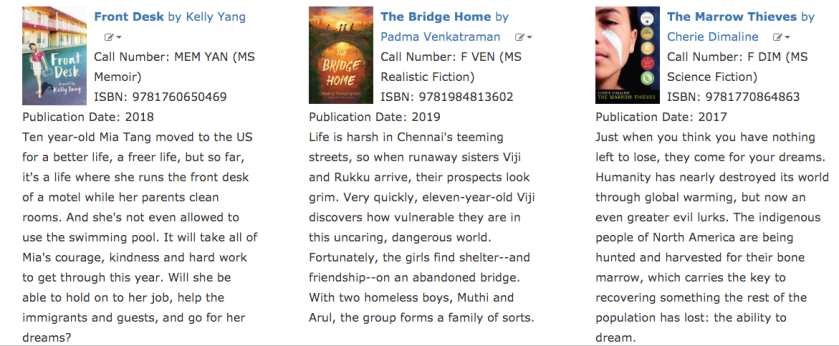
I’m just going to put out a plug again for the Global ReadAloud. I’ve curated the resources for this year’s books in a Libguide. It’s not too late to start.  It’s never too late to start. Just read. Or read and connect. Read now, with the current great list of books. Or read some of the books from previous years. Or read this year’s books now and other books from previous years later. Honestly it doesn’t take much time. I’m reading aloud each morning from Front Desk before school to a small group of students. We have about 10-15 minutes and get through a chapter or two/three depending on the length of the chapter and what else we do / discuss around it.
Screen Shot 2019-10-06 at 10.46.53

And this is where I tell parents that if all else fails they should read to-and-with their student. Even if they’re 14. And I tell them how we still read aloud to our IB-level child who also doesn’t like reading. And they look askance at me. Or they make apologies for their own poor reading – and I tell them that’s exactly why they should be reading with their child. As an empathy building exercise. As a gesture of solidarity and understanding that it is not perhaps easy, but it is important. Important enough that we both spend time on this.

Lists are easy to make. Easy to ignore. Conversations are harder, take more time, but potentially have more value. What do you do in your schools / libraries?

————————————————————————————————————————————

*This is where things get very interesting – I went back to the original article and it says nothing like what the posters say … it’s about vocabulary acquisition and learning new words based on context (nothing about standardised tests!). AND they’re talking about students reading 15 minutes IN SCHOOL, plus out-of-school reading of newspapers, magazines and comic books. So the sum for an “average” 5th grader is:

600,000 words in school; 300,000-600,000 words out of school = +/- 1 million words

I doubt the average fifth-grader is reading anything near that amount in or out of school.

” Though the probability of learning a word from context may seem too
small to be of any practical value, one must consider the volume of reading
that children do to properly assess the contribution of learning from context
while reading to long-term vocabulary growth. How much does the average
child read? According to Anderson, Wilson, and Fielding (1986), the
median fifth-grade student reads about 300,000 words per year from books
outside of school; the amount of out-of-school reading increases to about
600,000 words per year if other reading material such as newspapers,
magazines, and comic books are included. If a student read 15 minutes a
day in school (see Allington, 1983; Dishaw, 1977; Leinhardt, Zigmond, &
Cooley, 1981) at 200 words per minute, 200 days per year, 600,000 words
of text would be covered. Thus, a rough estimate of the total annual
volume of reading for a typical fifth-grade student is a million words per
year; many children will easily double this figure. Reanalysis of data
collected by Anderson and Freebody (1983), using information on the
frequency of words in children’s reading material from Carroll, Davies,
and Richman (1971), indicates that a child reading a million words per
year probably encounters roughly 16,000 to 24,000 different unknown
words.
How many words per year do children learn from context while reading,
then? Given a .05 chance of learning a word from context, and an average
amount of reading, a child would learn approximately 800-1,200 words
well enough to pass fairly discriminating multiple-choice items.
These numbers are at the low end of the range that we have previously
estimated (Nagy, Herman, & Anderson, 1985; see also Nagy & Anderson,
1984), because of the lower estimate of the probability of learning a word
from context and a more conservative estimate of the number of unknown
words encountered during reading. Yet, the figures suggest that incidental
learning from written context represents about a third of a child’s annual
vocabulary growth, an increase in absolute vocabulary size that has not
even been approached by any program of direct vocabulary instruction.

Nagy, W., Anderson, R.C., & Herman, P. (1987). Learning word meanings from context during normal reading. American Educational Research Journal, 24, 237–270

Content plus

One regularly hears phrases bandied around schools such as “Every teacher is a language teacher”; or “Every class should start with 10 minutes of reading” and you’d be hard pressed to find a teacher who doesn’t agree in theory, that reading is a good thing. But then there is the “reality” of supposed too little time, too much pressure, too much content to cover and the theory of reading becomes such an abstract notion that there isn’t even a consideration of how it could be implemented.

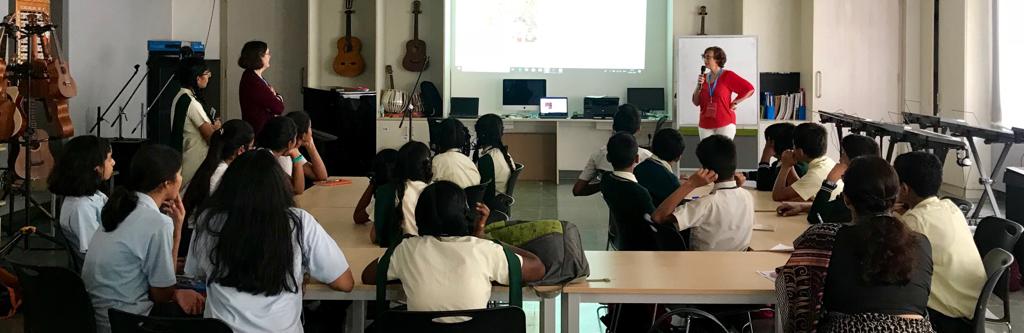
Last week-end, Katie Day and myself gave a 90 minute presentation to around 100 educators at the Neev Literature Festival titled “Books & Beyond”. You can find a copy of the presentation here as well as other resources.

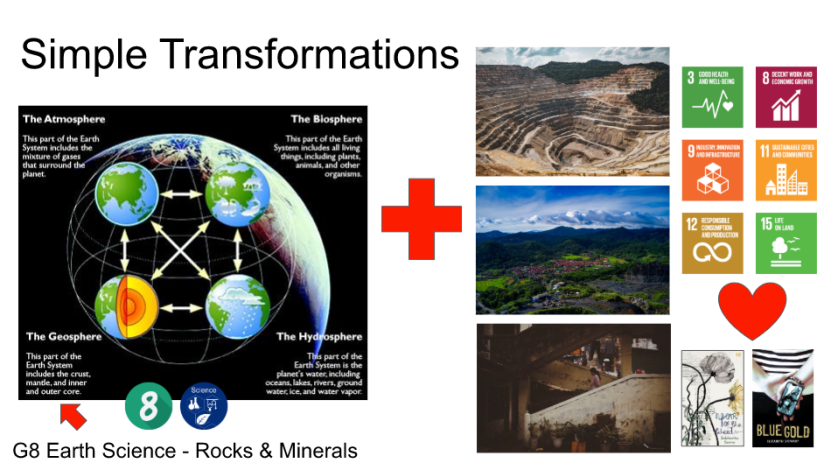
We’re on break now, and when we get back I was asked to present to our HODs for a few minutes on integrating reading into units in the middle school. I’ll probably just show this one slide:

I’d call it “content plus” – it’s from a G8 Earth Science unit that the Science team and I put together at the end of last year and they’re teaching now.

The idea is that you still have the science content as core to the unit – in this case Earth Science and learning about Sedimentary, igneous and metamorphic rocks and the minerals they contain and mining and the  products of mining. But to that you add the environmental and human impact, and the lens of the SDGs (Sustainable Development Goals).  And in order to help build empathy and understanding, add some literature.

Katie also had the brilliant idea, that she’s implemented in her school (and I’m going to be following quickly behind!), of getting good, relevant articles, stripping off the advertising etc (she uses Safari Reader View; I use Mercury Reader) putting them in binders and making them available in the library and classrooms – see slides 42-47).

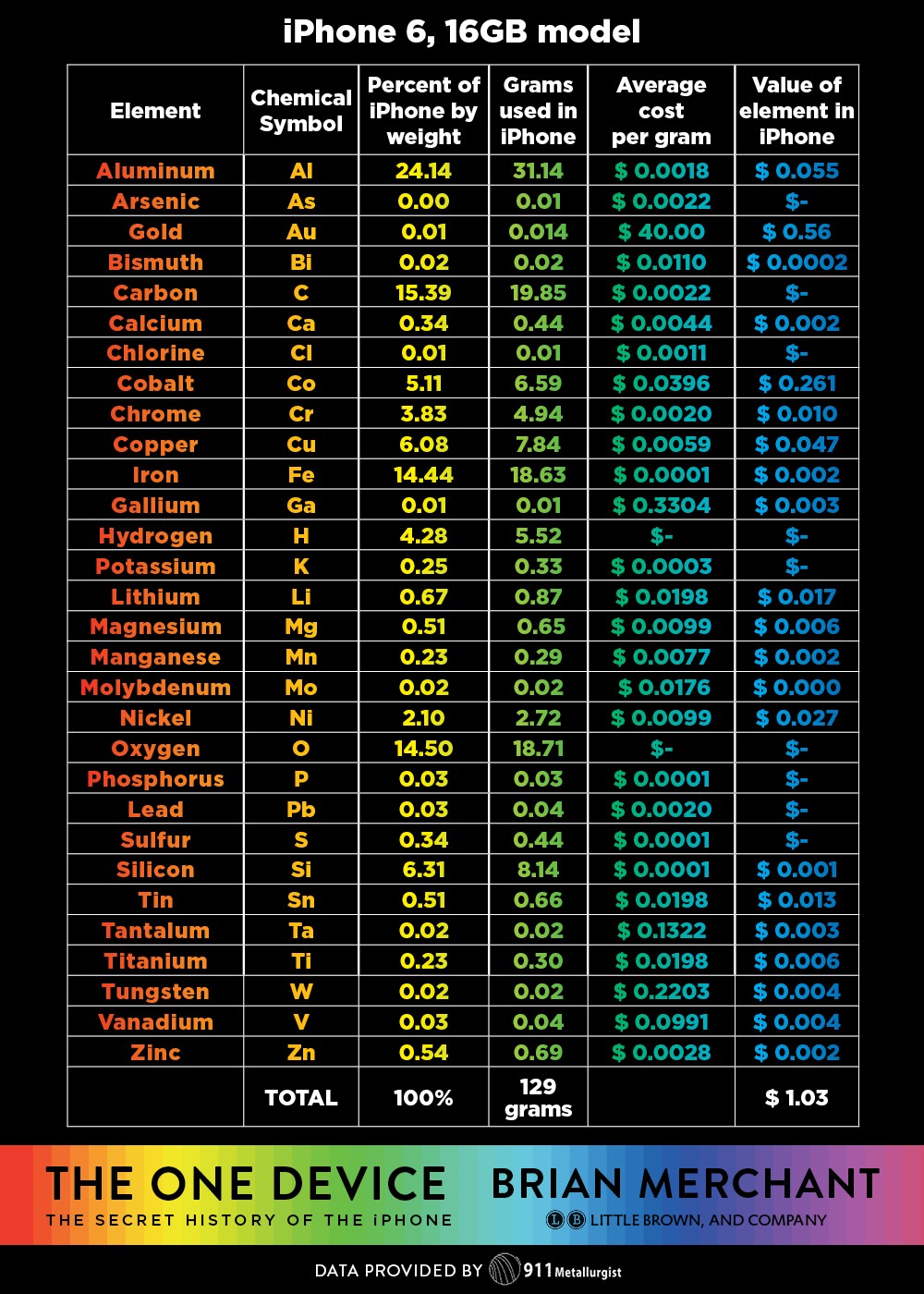
You can of course choose any minerals, but in this case to make it relevant to G8, we focused on the primary elements of an iPhone.


iPhone ingredients

Ideally, and this takes time, some of the science and or math units would be linked to Language & Literature or Individuals & Societies units allowing more time to explore literature.

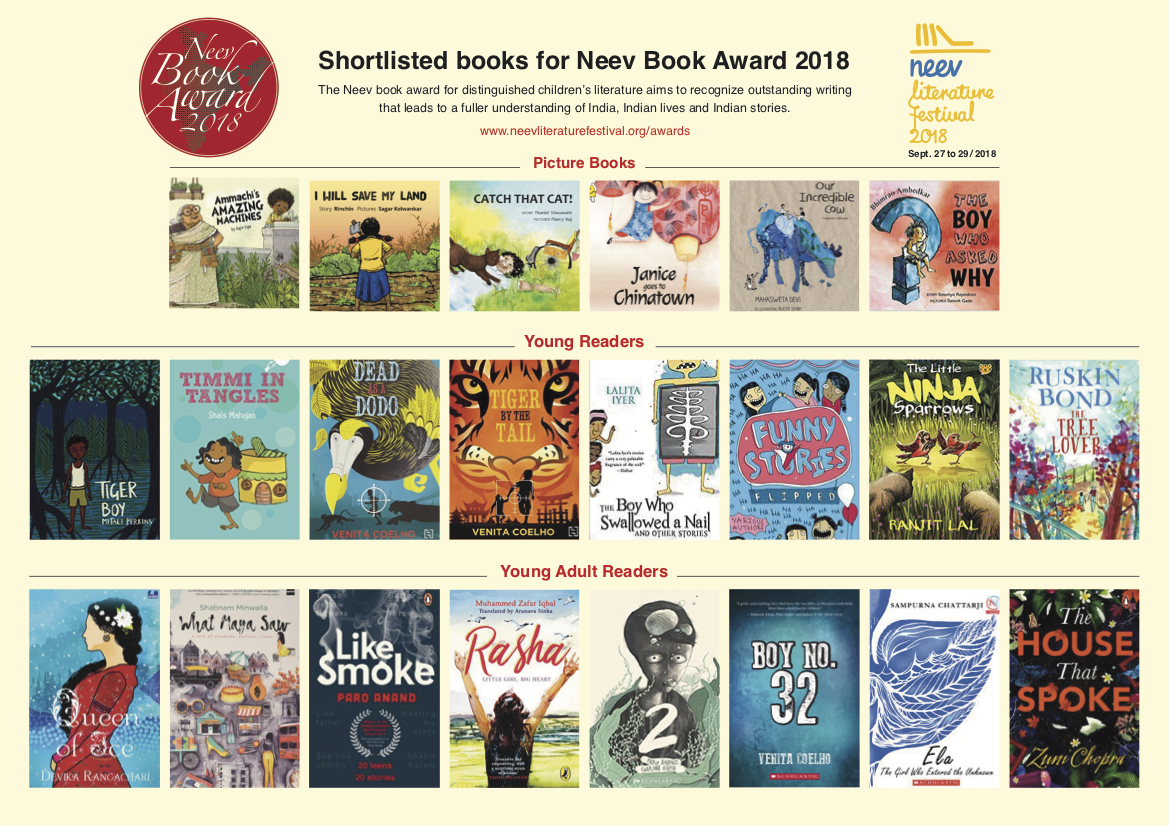
In the mean time, one of the wonderful ways of adding literature into units is through picture books. In the guide we created for the Neev Festival, we made suggestions around groupings of the SDGs of the Neev shortlisted picture books plus lots of other books. It’s still a work in progress, but over time I’m hoping that for each and every global goal I have 10-20 picture books, (as well as 10-20 fiction books and 10-20 really good nonfiction books) that can easily and quickly be introduced to a class, thereby adding a very special element to learning, and truly making “every teacher a language teacher” and every teacher able to devote a tiny slice of their class to reading.

When to read what how

First a shout-out – if you’re an international librarian and reading this – please join the International Librarians Lead (inTLlead) moodle – it aims to bring together a repository of resources, ideas and discussions on everything to do with being a 21C librarian in a global setting. We have 195 members and growing.

Further to my post about the difficulty in getting the right pitch in nonfiction reading in middle school, the discussion continued with science teachers about what students read (or don’t – thanks youtube) and how scientific time at school is used. And this is something I find incredibly weird as a non-science teacher, non science-curriculum creator, but as a parent of two kids having gone through science in PYP, iGCSE and MYP and DP. They spend a LOT of time and energy on lab-reports. Which often, no matter how heavily it’s scaffolded (and believe me I’m yet to see a lab report assignment that’s not heavily scaffolded) but they don’t spend any time until the IB reading a scientific journal article. And then probably only if they’re doing an EE (extended essay) on a scientific topic. And the skills required may or may not be explicitly taught depending on whether the librarian gets a look in, and depending on the supervisor and how much time they have.

Does anyone else find this strange? I’m wondering if we could somehow create a phased cross-walk between popular science articles in various areas to the original research that gave rise to those media interpretations (or misinterpretations as the case may be). Phased as in the sense of starting with the LCD of the abstract and conclusion and working up to sample size, statistics chosen and interpreted, hypothesis, methodology, experiment (link to the dreaded lab report) etc.

Am I talking nonsense? I’m thinking something very graphic so it’s pretty obvious. Or they create the graphic. By the time they get to the IB or university they don’t have the time to both do the writing needed and learning the decoding skills surely we should start earlier?

Are nonfiction books still relevant?

I was showing a fellow librarian around “my” new library today and we were chatting and discussing various aspects of middle school librarianship. We got to the nonfiction section and both sighed. I started that mine probably needed some significant weeding and that I’d made a start. I pointed out a few particularly nice books in the collection (Annick Press still does nonfiction well, the newish Theodore Gray Molecules and Reactions). But so much ages so badly and so quickly. And in an inquiry based system where one wants to encourage systems thinking and embrace the idea of interconnectivity it is almost anachronistic to maintain Dewey divisions and populate them with single topic books.

Gone are the days when teachers gave the librarian a content based topic and you could wheel a collection of books that covered the length and breadth of what there was to know at a specific grade level about that topic. Done and dusted. Now you’re not so much discussing WW1, so much as conflict, with WW1 as the bare-bones scaffold of the topic. There aren’t that many books that deal well with the nuances of conflict in an age appropriate, stimulating but accurate, culturally sensitive manner. One such book is Global Conflict, from the Children in our World series by Louise Spilsbury.  No, it probably isn’t written with 14 year olds in mind. And I had to offer it somewhat apologetically to one of the teachers and say I thought it actually covered the ground fairly well, and everything else on offer was probably pitched at a much too high level.

Besides which, students aren’t reading books anymore. The books I pulled out on WW1 for a display remained unread, un-borrowed. I dare not investigate too closely where they got their information for their assessment from, since, looking at the database statistics it wasn’t from databases either.

A month or so ago, I had a look at our “country” books – they ranged from 1999-2005. A lot has happened since 2005. So they had to go. But what to replace them with – if anything? I checked the curriculum, spoke to the lead of the one grade doing something on national cultures and offered a collection I’d made in Epic! that could cover it more or less. There are no students pouring over country books or atlases like perhaps we would have done. If they need information there’s wikipedia or facts on file.

All this time I’m reading “Reader Come Home” (it sure is taking a long time, but I’m distracted myself) and the issue of shallow reading and attention and focus and digital media. And I wouldn’t worry if it weren’t for the fact that the problem doesn’t seem to just be shallow reading, it seems to be a great divide between reading a lot, and not reading at all. I ran some statistics last night. Our top (G6) class read 4x as much as our bottom (G8) class (at least books from the library – to which everyone says “oh but they may be reading books at home – to which I say “evidence?”). But that’s not the problem – looking through numbers student by student so so many hadn’t borrowed even one book. I’m about to self-flagellate at this point and worry what I’m doing wrong. I need more data and then I need a strategy.

There’s no doubt quite a bit of the nonfiction must go – but what should I be replacing it with? Middle schoolers are just that little bit young to place popular nonfiction in – the Malcolm Gladwells and the like. What is everyone else doing?

Why lists and awards matter

Every year around this time, some parent will ask the teacher or myself what their child should be reading.

The “correct” response to this question is that we don’t make reading lists of prescribed or recommended books but prefer students to come and have a chat to us about what they like reading, what hobbies or interested they have and based on that we can personalise some recommendations for them. That we believe in free voluntary reading.

How many of you have had a follow up on that with the student popping by for that exciting interaction?  I started getting parents coming by personally around the end of my first year in my last job, and parents and children sometime in the second year and students on their own around the middle of my third year.

The truth is that people like lists and they like recommendations. This New Yorker article gives some ideas as to why lists matter – the most salient features are that lists “alleviates the paradox of choice” help with “reduction of uncertainty” and due to their finite nature are easier on the book budget both for school and home libraries!

Book Poster Neev Shortlist updated

So why are book awards important? According to Underdown:  ‘

“Awards are important in children’s books. They tell publishers, writers, and illustrators what is considered to be “the best,” and thus the standards they must strive to attain. Many children’s book awards, though not all, are selected by librarians. Award-winners then get orders from … both libraries and bookstores.  They will also stay in print longer. For writers and illustrators, getting to know the award-winning books … is one of the ways to understand what is considered to be the best today.

The idea of finding out what the best is “today” rather than when authors / illustrators or publishers – or parents and librarians were children is very important. I’d love a dollar for each time a parent wants to force the literature of their youth onto their progeny. Reading through the long list of the Neev awards, there was also quite the body of what I’d call “nostalgic” storytelling. Which is really hard to carry off, and generally appeals more to adults than children. Which is why, it may be important to consider a children’s choice option when moving from a short-list to the finalists.

Following last year’s very successful initial Neev Festival, during the feedback discussions the idea of an Indian Children’s book award was floated. One of the driving ideas was that India had a large body of children’s literature, published in English, but not widely known nor distributed internationally. And selfishly, as librarians in an (Asian) international context with 40-50% Indian diaspora making up our student bodies, we were just not able to provide our students with the “mirrors, windows and glass sliding doors they deserved – mirrors for the Indian students, and windows and doors for the other students. Kavita Gupta Sabharwal is a very special person, both visionary and someone who makes things happen, including this book award, both from a logistical and a financial point of view. Each award carries a cash prize of Rs 1 lakh (around US$ 1,400 – a substantial amount in the Indian publishing world).

Already, just based on circulating the short-list in social media groups, there has been substantial interest from the librarian community. The prize-winners saw their books fly off the tables following the award ceremony, with all books sold-out by the end of the festival. An award sends a powerful signal to publishers and the public – one that says “pay attention” this has value, create more like this. The award stickers on the books a “buy me” beacon.

The final step in the equation and the gauntlet to be thrown is whether the publishing and distribution channels will be able to push these books out into the wider world where they deserve their moment(s) in the sun. And in the longer term, creating teacher guides and author visits, websites, hyperdocs, quizzes, eBooks and audio-books. For that is what the world has come to expect. But first the small steps, make the books available for every child, parent, teacher or librarian in the world who wants to push a “buy” button and have the book delivered to them, anywhere in the world.

Culture eats strategy for breakfast

This phrase is attributed to Peter Drucker and made famous by Mark Fields (although can’t easily be authenticated). I firmly believe it to be a reality both in business and education, and many a manager has been burnt by this.

I’m currently in Bangalore, having spent the last three days at the Neev Literature Festival  where I had the honor to be invited back as a speaker / workshop leader and as a jury member of the inaugural Neev Book Award. It was touch and go whether I’d be able to attend, given that my passport has been tied up with either visa or customs arrangements since the beginning of August, but a little more than a week ago I got the go-ahead! I’m so glad I did. You see Neev is a very special place. Many schools claim to promote a culture of reading and spend vast amounts of money on classroom or central libraries. But sometimes to no avail as the individual teachers or heads don’t actually walk the walk.

Here the founder really and truly believes in reading, and has invested immensely to ensure that reading permeates the school – what other school hosts a free literature festival at their premises, flies over authors, illustrators, librarians, storytellers, interpretive dancers and then invites other schools and the public to partake of their largess?  I was talking to their new head last night, about admissions, and she said they were in a luxury position where demand was greater than supply of school places and one of the ways they decided on who gets a seat was based on the families being able to demonstrate that they supported a reading culture at home! Imagine that! Not portfolios, or CV’s or admission tests. And it shows. Listening to the young students as they described their reading lives I was astounded at the depth and breadth of their reading.

I spent the morning today with a few of the visiting authors, and one – the wonderful Nadia Hashami,  was telling me of a conversation with a reader who had read her book twice and was recommending it to everyone, and who had also attended her panel on “Protect or Prepare” difficult topics in literature – the discussions, chaired by Katie Day were around which topics could or should be out of bounds for children. This young lady’s take on it was that death was a part of life and had a place in literature as it was part of a normal life, however, she could not come to terms with rape and sexual violence because it was something that one would never want to be part of your life and which would never leave you or have a resolution. Astounding the maturity and empathy (some USA people could do with a little more empathy-powering literature obviously).

I had my own encounter with culture, which I’d like to reflect on. I did a workshop for 11-15 year olds using empathy mapping. I had the luxury of around 20 students and 90 minutes. So my strategy was to do a warm-up exercise by introducing the concept of empathy mapping using gender, and trying to take the view of the opposite gender based on what to Western sensibilities are rather sexist advertisements about mother/daughter bonding over dishwashing and father/son bonding over dude stuff like fishing and hanging out outside and drinking beers. It had worked extremely well in the international school environment I was coming from. But I hadn’t done my homework and had it “sensitivity tested” by my Indian friends … I quickly discovered that young Indian ladies (bar one or two) think that it is lovely to be able to bond with your mother over household chores, and that generally the students never needed to do chores, being of a class where chores were done for them by others! With a bit of prompting and help from my friends and the students’ teachers we managed to successfully complete the exercise and move on to phase 2 which was a reading of “No one walks on my father’s Moon” . It is a difficult text, despite being a picture book. However I like to use it, as even without an accompanying empathy mapping exercise, it provides a very powerful message of reconciliation and perspective taking.

file5This time the exercise really did work – on reflection, the “warm up” possibly did help the  success, despite not being optimal, because the students just weren’t used to giving their own views and in the first half kept looking to the adults for the “right / expected answer”. We had some powerful contributions from the groups, and some very interesting movement from utter condemnation for the father’s behaviour to understanding and empathy for the context and actions. And also the feeling that they could use this in their personal and academic lives.

Here’s a copy of the presentation – I believe that empathy cannot always be taken for granted despite the great potential of literature and us very much wanting it to be so. Hopefully this helps us and our students to take a step closer into “climbing into someone’s skin and walking around in it”

Collateral damage or passive Anura?

Classroom libraries vs. school libraries, teacher superstars marginalising teacher librarians – or is it our fault?

This post was first going to go one way and then through holiday laziness in posting, it has taken a kind of dual direction as I have more time for self-reflection and research.

The first offensive was launched by KC Boyd (2018) in her post “Easy Like Sunday Morning: School Libraries vs Classroom Libraries” where she reflects on Chicago School System and the impact on literacy of shifting from school libraries to (only) classroom libraries (hint – it wasn’t favourable). She refers to Ariel Sack’s post on the importance (and diminishing) role of school librarians who asks “Can this project be done by an individual teacher? Yes. But it’s something different when one person with a vision and the time to implement it leads it consistently for the entire school, every year” (Sacks, 2018). I’d argue there is another factor – one very rarely meets a librarian who doesn’t read (I have however met library assistants without any interest in books or reading); but the Peter Effect is well documented in teachers (Applegate & Applegate, 2004; Binks-Cantrell, Washburn, Joshi, & Hougen, 2012; Turner, Applegate, & Applegate, 2009) with studies in various places around the world documenting aliteracy in teachers / pre-service teachers – “Findings revealed that 54.3% of 195 teacher candidates were classified as unenthusiastic about reading and only 25.2% of teacher candidates reported unqualified enjoyment of reading.” (Binks-Cantrell et al., 2012, p. 526), and the picture appears to be getting worse rather than better (Skaar, Elvebakk, & Nilssen, 2018).

This is something easy to lose sight of when twitter, YouTube, Facebook, blogposts and podcasts are dominated by literacy superstars like Pernille Ripp, Colby Sharp, Mr. Schu, Jennifer Gonzalez, Angela Watson etc. But for every one of them, even a small imitation of them, there are likely to be three or more other teachers who are either not enthusiastic about reading, or, who actually don’t deign to read the types of books their students do – something I know my librarian mentor Katie Day, (successfully) worked very hard on with the teachers at UWCSEA-East when she was there. Based on my own experience I have encountered whole grades where not one teacher has been actively and passionately engaged in books and reading, and where this is apparently not seen as an issue (except when it is reflected in their students’ testing scores – but then the solution has been to work on the students rather than the teachers).

Regie Routman in her article “On the level with levelled books” (Routman, 2018), makes some valid arguments for free voluntary reading, and the choice of a selection of relevant and developmentally appropriate books for classroom libraries, but only makes oblique reference to public libraries and with no mention of school libraries or librarians – not even in a nostalgic or wishful manner. Relying on teachers who care and the intervention of a literacy expert is not a long term solution!

Colby Sharp, boasting a 3,000 book classroom library, ordered in a numbered system unfamiliar to any librarian I asked, talks about book checkout and is quick to dismiss the scanning system a librarian assisted him in setting up as “too much trouble”… (Sharp, 2018)

To which Day responded on FB “as long as he is on top of what all his students are reading, then, yes, it could work. But it’s not scaleable — and he doesn’t mention inventory checks — so at the end of the year you know which books might need to be replaced. With 3,000 books, it might be good for his students (other students? other teachers?) to be able to search and discover what books he has in his class library… Just sayin’… And LibraryThing’s TinyCat is definitely an option he might consider — to be able to see his collection online, whether he uses their circulation system or not.”

And then I found out what his library looked like – with a self-invented number system – ok so Dewey doesn’t do it for everyone, but those random numbers? (Sharp, 2017). I love the idea and potential of classroom libraries – I baulk at the cost, duplication of effort, waste of resources, money and time, lack of discoverability, lack of meaningful data and often stagnant nature of them. I have seen money wasted on thoughtless last minute purchasing without any clear strategy, collection management or development. I’ve seen classroom libraries with books that would better be relegated to pulping or, redistributed to older or younger students. I’d be the first to admit that often no one knows students better than their class-teacher, but just as we shouldn’t have to choose between classroom libraries and school libraries, so too the burden of creating dynamic exciting collections needn’t be the domain of only the class teacher or the librarian – together we definitely are better. Dialogue, collaboration, debate, relative expertise – all these things make us stronger as a learning community.

I started out being a little annoyed at the lack of mention of (school) librarians, but then reading the FB question of a librarian, (who shall remain nameless) challenging whether she should be expected to find a selection of books on a specific theme for a teacher because “she’d already shown the teacher how to find book in the system” and the responses I wondered how much of it was our own fault? We should be falling over ourselves to help teachers, parents, administrators, everyone in the community with lists and suggestions and books and resources they didn’t even to know to ask about. We should be anticipating and proactive. Not whining on FB as to where the limits of our job lie. I love the fact that this is one of the careers where you can pretty much be without boundary and limitless in what you can do – all in the interest of teaching and learning.

Spending a bit of time on Twitter I saw what was going on with Project Lit – something started in an English Classroom that is going viral (Riddell, 2018), (and what an excellent book collection they’ve created!) and I thought, darn it – we’re missing so many tricks here. Why aren’t teacher librarians initiating things like this, or the GRA? Why aren’t we leveraging our knowledge and experience in more ways than just fretting about our increasing marginalization and extinction? Why aren’t we taking more leadership and visibility in these arguments and discussions?

project lit

We aren’t part of these discussions and we’re not top of mind to any of the people who are getting attention. Whose problem is that? Do these “superstars” have a blind spot to anything NIH (not invented here), monstrous egos, or are we / have we become just so marginal to the whole reading / literacy scene that we don’t even merit a mention unless prompted (as the Sack article intimated)?

On FB again, another librarian spoke of her school that has gone from a thriving library system with two libraries run by two qualified librarians that’s been whittled down and compromised to one remaining librarian and was wondering what the moral of the story was – I commented “frog in a pot that slowly comes to boil”.

The problem with being a passive Anura is that no one else is going to turn the gas off and you don’t want to be left alone when the party is no longer in the kitchen – with apologies to Joan Lewie (WiggyOfStHelens2008, 2008).

 References

Applegate, A. J., & Applegate, M. D. (2004). The Peter Effect: Reading habits and attitudes of preservice teachers. The Reading Teacher, 57(6), 554–563.

Binks-Cantrell, E., Washburn, E. K., Joshi, R. M., & Hougen, M. (2012). Peter Effect in the Preparation of Reading Teachers. Scientific Studies of Reading, 16(6), 526–536. https://doi.org/10.1080/10888438.2011.601434

Boyd, K. c. (2018, June 3). Easy Like Sunday morning: School libraries vs classroom libraries [Web Log]. Retrieved 5 July 2018, from https://theaudaciouslibrarian.blogspot.com/2018/06/easy-like-sunday-morning-school.html

Sharp, C. (2018). My classroom library checkout system. Retrieved from https://www.youtube.com/watch?v=s9u6KHYoLVE

Sharp, C. (2017). Classroom library tour 2017-2018. Retrieved from https://www.youtube.com/watch?v=iGITHdb8tZ8

Riddell, R. (2018, March 12). Project LIT: How a Nashville educator turned a class project into a nationwide movement [Web Log]. Retrieved 5 July 2018, from https://www.educationdive.com/news/project-lit-how-a-nashville-educator-turned-a-class-project-into-a-nationw/518766/

Routman, R. (2018, June 24). On the level with leveled books [Web Log]. Retrieved 5 July 2018, from https://www.middleweb.com/37973/regie-routman-on-the-level-with-leveled-books/

Sacks, A. (2018, May 29). Why school librarians are the literacy leaders we need [Web Log]. Retrieved 5 July 2018, from https://mobile.edweek.org/c.jsp?cid=25920011&item=http%3A%2F%2Fapi.edweek.org%2Fv1%2Fblog%2F191%2Findex.html%3Fuuid%3D76470

Skaar, H., Elvebakk, L., & Nilssen, J. H. (2018). Literature in decline? Differences in pre-service and in-service primary school teachers’ reading experiences. Teaching and Teacher Education, 69, 312–323. https://doi.org/10.1016/j.tate.2017.10.019

Turner, J. D., Applegate, A. J., & Applegate, M. D. (2009). Teachers as literacy leaders. The Reading Teacher, 63(3), 254–256.

WiggyOfStHelens2008. (2008). Jona Lewie – You’ll Always Find Me In The Kitchen At Parties. Retrieved from https://www.youtube.com/watch?v=62eTq8ErUOQ


#NotOurDiversity

I’m busy preparing for next week’s library lessons. G5 has one of my favourite units in “How We Express Ourselves”

People create messages to target specific audiences

Ostensibly it’s about advertising, as the lines of inquiry indicate,

1. Advertising techniques can be used to influence society (Perspective)
2. Critically evaluating messages presented in the media (Reflection)
3. Ways adverts can cause people to form opinions (Causation)

however to paraphrase and misquote Twain I’ve never let reality get in the way of a good lesson. So I’m loosely interpreting “media” to include books, and advertising to include things like book covers.

My opening salvo last week was “Cover Bias” where we looked at the cover of a book as the way in which it was advertised and I showed the class some more egregious examples of stereotype and bias in the creation of book covers

This week is my chance to tackle something I feel very strongly about – how the concept of children’s book diversity has been cornered by a very specific type of diversity – i.e. the North American type, which to be honest in the lives of my students is #NotOurDiversity. So I’d like to provide a counterbalance to that, as well as to start my students and everything thinking and curating resources that do reflect their diversity.

This is tomorrow’s provocation:

And I’m hoping at the end we can start creating a padlet of the books which they consider to be their mirrors, windows and sliding glass doors.

What do I think their diversity looks like? Some of it is typical to 3CK (3 culture kids), but each place I’ve lived has delivered its own nuance:

  • Product of multi- cultural / linguistic parentage and heritage (including multi-racial if that is even a term that is at all relevant – I don’t think it is to them, but probably in other contexts, countries it would be)
  • Multi-national residential where home is defined more by current location of self, parents and siblings than by family and passport
  • Financial privilege that transcends typical migrant / immigrant issues and trauma
  • Underlying uncertainty on matters of identity and lack of sense of “place”
  • High expectations of resilience, grit and adaptability to constant change

Before anyone thinks that the market is too small to matter for book publishing for example should have a look at the numbers – 56.8m people estimated by 2017 and even more importantly the demographics of expatriation has changed dramatically and will continue to change – no more British administrator, the reality is more likely to be an Indian IT specialist or Korean Engineer. And so too our literature should be evolving to provide their children in international education the mirrors, windows and doors they are entitled to.

Ask the inhabitants

My online library network is getting excited about a couple of articles that are challenging beliefs.

There’s danah boyds’ You Think You Want Media Literacy… Do You? it is an incredibly powerful article that needs to be printed out and highlighted and read very slowly. A couple of times. One passage that struck me epitomised the near futility in what we’re trying to do on the “fake news” front.

“This is about making sense of an information landscape where the very tools that people use to make sense of the world around them have been strategically perverted by other people who believe themselves to be resisting the same powerful actors that we normally seek to critique.(boyd, 2018)

Her conclusion is that we need to “inoculate” students against their very human tendencies by approaches that “are designed to be cognitive strengthening exercises, to help students recognize their own fault lines, not the fault lines of the media landscape around them” (boyd, 2018).

And then Wilkinson’s (2017) very apt writing up of her presentation that boils down to the fact that it is humans, messy, opinionated humans, subject to confirmation bias who are doing the research and therefor takes a welcoming psychological approach to understanding how students research – the paragraph on “post truth psychology is particularly well worth reading.  Her point is to short-cut the evaluation part of resourcing research and cut to reliability.

So while all this was percolating in my brain, I went for a run while listening to 99% invisible, and they had a two part series on the Bijlmermeer. Having lived in the Netherlands in the 90’s – my first year was when the plane went down on one of the buildings – I was very interested to hear what an American podcast would have to say about it. And I realised that in many ways as librarians and teachers we are imposting a modernism/functionalism mindset on research. With our structures and mnemonics we are creating these concrete structures that get in the way of a more organic way of knowing and learning.

Furthermore, planners realized people didn’t want to live in huge concrete structures. Almost immediately after the Bijlmermeer was finished, another neighborhood in Amsterdam was redesigned — it was done with bricks, a traditional Dutch material.

The Bijlmermeer, and maybe a lot of Modernism, was architecture for architects. It was a top-down, paternalistic approach to city planning. The redesign of the Bijlmermeer did not make that mistake. People from the community were heavily involved in the redesign process (Mingle, 2018).

So yesterday evening I decided to ask the inhabitants. In this case my two high-school teenagers. I asked how they did research, how they decided where to search and what to use. The answers were enlightening. And frightening.

First my highly intellectual daughter who “does school” very well. She admitted that she didn’t have the first idea about doing “proper” research and that actually in the last seven years that she’s spent in a highly prestigious very expensive school she hasn’t had one single session with a librarian. Nor had her teachers taught her anything as up to now she’d never been asked to reference anything. And it’s only because I’d insisted and taught her Zotero for a recent Geography course-work project did she really know much about it. She blamed having to do the iGCSE, (something she absolutely hates) and if I had my time over I would never put my children in a school offering (i)GCSE. It’s a waste of time and intellect. Added teaching my daughter research before she goes off to do her IB onto my list of things to do in the next 3 months. Hahahahaha, crash course research. The irony.

Then my son. The dude who’s had a tough ride of school and teachers. The one that was fortunately rescued from prestige and arrogance. Well, he said, the need to spend time with the librarian on research was an extra bonus, but the problem wasn’t actually as “acute” (his own words!) as at his sister’s school as the teachers were “all over” researching well, so going to the library was reinforcement for what the teachers were doing. Well, I guess I use CRAAP he says. OK, I challenge, what does CRAAP stand for. He laughs embarrassed. Well, I don’t really use CRAAP he says – at the beginning of the year my teacher shared this site with us that gives reliable sources, so I know as long as I stick to those I’m ok. Touché.


Image-1 (1)


Back to the more structural part of all of this – Caulfield, who I greatly respect has a useful graphic and new open-source textbook – Web Literacy for student fact checkers for those who want to continue on the architectural part of research and learning.R

I like the first habit of “Check your emotions” – a bit like Tim Harford’s guide to understanding statistics in a misleading age.  Moi? I think I’m going to teach more psychology and less CRAAP to my students. A great place to start is “Your logical fallacy”  who have produced some excellent posters and other resources.

References:


The second shift

Last night my daughter asked me about citations for her Geography project. Now let it be made clear, my children, while lovely human beings, are in the “potted plant” phase of adolescence. So this was pretty rare. It’s also rare for them to acknowledge my knowledge or specialisation either.  But despite her multi-big-$$ education in a big name school (not where I’m at), and the fact that she’s highly motivated and organised, good research habits have not been instilled in her. Her references consisted of a couple of URLs and the in-text citations were random with “I KNOW mum sigh” when I raised my eyebrows. I asked what referencing style she had to use – “we can chose”. So I suggested APA – because I love it more than MLA8 and because Geography as a humanities subject is probably better suited to it long term.

I then had to teach her a few of the research habits that have served me well through two back-to-back masters degrees. This stuff is not brain science. If anything it’s like washing dishes and putting them in the cupboard. We re-activated her Evernote account that she’d opened for one enthusiastic teacher some time in the last 6 years. We then clipped all the articles into a Geography file in Evernote and tagged them with the project name. Next up was getting her citations into Zotero, the tool I prefer for upper secondary.

(After the whole debacle about RefMe / EasyBib etc. I’m committed to one tool, not following the latest trend, which inevitably seems to be about who is trying to monetise education and learning.  For primary and Middle School, it’s Noodletools)

There are many things I like about Zotero. The fact that it’s amazingly accurate in its citations and the really really good customer support being the main ones, but also the intelligence and diligence of the user-base can’t be denied. I was pleased to see that in their latest update – getting set up and integrated into Word has been made a whole lot easier. Yes, good old fashioned Word. GoogleDocs have their place but when one moves from being a child, you need to be more sophisticated and demanding in your needs and GoogleDocs doesn’t cut it.

So then I had her put the references in, via the Chrome extension (download the extension), make sure she had the right citation type, put in the missing data. Showed her OWL Purdue for APA, bookmark it, showed her the APA style blog site which has more relevant Q&A type things – like how to cite Google Maps).

And then the magic could happen – click on the end of the sentence, open Zotero in Word, put in the in text citation, click at the end of the document and have all the references upload.  Two hours. But hopefully that will be a lifetime of research “washing up” as you go along rather than crisis at the end.

Then I asked her what the style guide was for her assessment. Again, nothing.  Really teachers, please just get in the habit of telling them what you want things to look like. Line spacing, headings, margins, citation style etc. It really will set them up for University where this type of thing is so important. Stupidly important maybe, but professors can and do deduct plenty of marks for not getting it right.