Is Digital Scholarship limited by cultural myopia?


Introduction

The parameters of scholarship in education are often based on Boyer’s (1990) dimensions of discovery, integration, application and teaching. Healey further expands on the scholarship of teaching to include “research into teaching and learning, critical reflection of practice and communication and dissemination about the practice of one’s subject” (2000, p. 169).


Broadening the discussion to include the transformational aspects of “digital” technology, educational scholarship has been enriched through open data, open publishing, a blurring of the academic and ‘real’ world, open teaching and learning and a movement from the individual to the distributed scholar and global access (Pearce, Weller, Scanlon, & Kinsley, 2012). However, Pearce etal. (2012, p. 169) cautioned that technology is “a necessary but not sufficient condition” for true scholarship. The question is, given the potential and reality of technology, what else is needed to fulfil the obligations of a modern ‘digital’ scholar?

Argument statement

This essay will argue that the dominance of a Western cognitive constructivist tradition in online and offline education, led by British, Australasian and North American (BANA) institutions limits knowledge, understanding and progress not only of its students, but of its scholars as well in exploiting the true potential of open educational tools and resources.


There are four main reasons for situating this essay in the context of teaching and learning, in particular, a critical reflection of digital scholarship practice in relation to multi-cultural multi-lingual (MCML) learning environments. Firstly, demographic shifts in education are occurring at an unprecedented rate as a result of globalisation, immigration, migration, and war (Boelens, 2010; Boelens, Cherek, Tilke, & Bailey, 2015). Secondly a significant shift to online education where the global market is showing a 9.2% five year annual compound growth rate and is now worth $107 billion led by India and China (Pappas, 2015). Thirdly, work and employment increasingly is global, remote and disaggregated with globally mobile and fluid workforce and both employers and employees requiring “just in time” rather than “just in case” skills and knowledge. Finally, and perhaps most importantly, there is a moral, ethical and value-based argument. On the one hand, MCML students are prejudiced by the dominance of a Western cognitive constructivist tradition in education (Catterick, 2007; Sadykova, 2014; Zhang & Kenny, 2010) and on the other, ignoring the MCML dimension limits critical reflective practice, the potential of international digital scholarship and knowledge and understanding of a large part of the educational scholars’ field.

Interpretive Discussion

Background

Traditionally, creating culturally-responsive accommodations for MLMC students has faced considerable institutional opposition. The response of educational institutions, comprised a narrow range between non-accommodation and intervention in the form of student induction into ‘the system’ i.e. modify the student not the program (Catterick, 2007; Parrish & Linder-VanBerschot, 2010). Arguments against interventions cite costs, quality control, and expectations of the students themselves and their future employers that they are “Westernised” as a by-product of their education (Catterick, 2007).


Parrish and Linder-VanBerschot (2010) acknowledge these issues and suggest that institutions distinguish between entrenched cultural values and superficial practices, and create interventions with constructivist and instructivist alternatives or choices in learning activities and instructional format only where these are critical to learning success. Researchers sound a word of caution against cultural generalizations that lead to stereotyping and discrimination (Gazi, 2014; Hardy & Tolhurst, 2014; Parrish & Linder-VanBerschot, 2010). This can be ameliorated through a combination of embedding cultural considerations in each stage of the instructional design process, ensuring an iterative practice of reflection and modification and encouraging student interaction and feedback (Parrish & Linder-VanBerschot, 2010; Young, 2009).


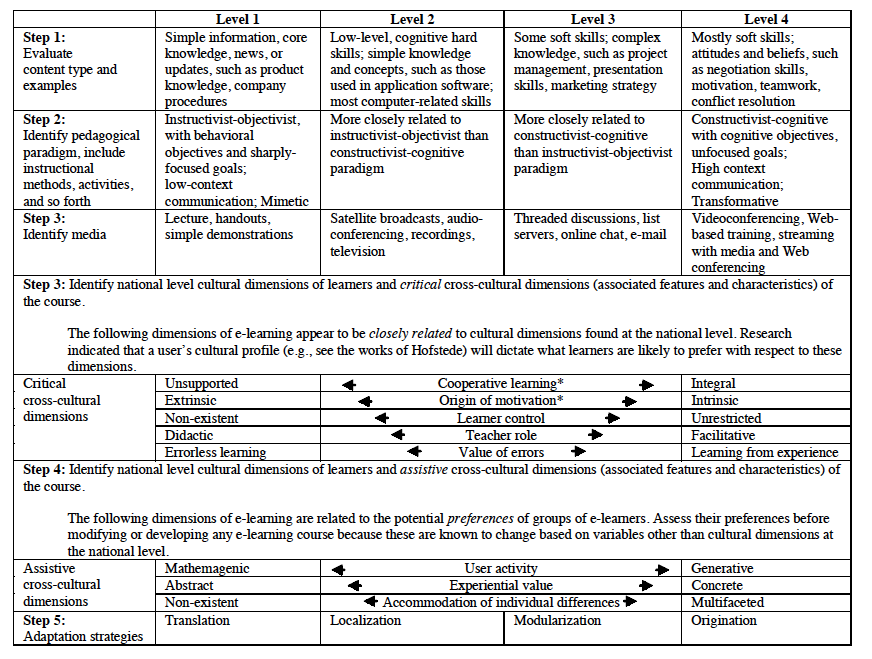
Models designed to foster awareness of cultural implications in education vary in their orientation. Initially research done in corporations (Hofstede, Hofstede, & Minkov, 2010) and physical classrooms led to classroom or systems originated and oriented models such as the Inclusion, Attitude, Meaning, Competence (IAMC) model of Ginsberg & Wlodkowski (2009, cited in Suzuki & Nemoto, 2012) and the Cultural Dimensions Learning Framework (CDLF) (Parrish & Linder-VanBerschot, 2010) which were adapted for online learning.


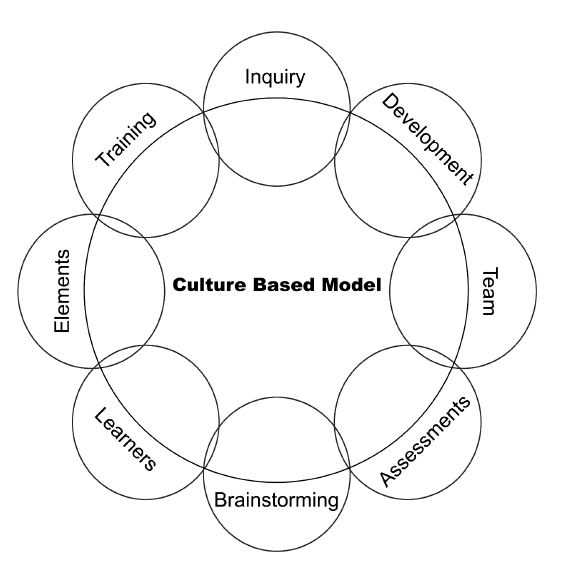
In contrast, the Culture Based Model (CBM) framework of Young (2009) and the Cultural Adaptation Process (CAP) model (Edmundson, 2007b) are product oriented with the aim of guiding designers to incorporate culture in the design of digital and online educational products. (See Appendix 1 for illustrations of these models).

Reflection on teaching and learning in a multi-cultural environment

Educational institutions are not the only suppliers of teaching and learning. Commercial entities, particularly multinational companies, go to an enormous amount of effort in creating culturally compatible user interfaces – see Edmundson’s (2007a) book “Globalized e-learning cultural challenges”. One could argue that this effort directly benefits their bottom line, however all institutions would benefit from this approach.


Fortunately there are some researchers open-minded enough to examine the assumptions of their own culture, reflect on the embedded cultural practices of teaching and learning and those of the digital platforms and applications and thoughtfully researching ways to reconcile the two so as to optimise the learning of their students (Chan & Rao, 2010; Looker, 2011; Ren & Montgomery, 2015; Sadykova, 2014). Critical examination of one’s own culture and introducing new technologies in a more considered and less forceful way, appears to result in more success and acceptance. Pedagogy aligned with sociocultural context allows scaffolding of current to new practice and understanding (Chan, 2010; Chan & Rao, 2010; Law et al., 2010; Rao & Chan, 2010).


Chan (2010) demonstrated aspects of the Confucian approach to teaching and learning were highly compatible with the values of digital scholarship, and showed how modifications in the way technological tools for collaborative learning were introduced positively impacted their acceptance by teachers and students in a high school setting.


More recently, in examining Korean students’ experiences of Massive Open Online Courses (MOOCs), Ahn, Yyon and Cha (2015) built on the CDLF of Parrish & Linder-VanBerschot (2010) showing how awareness, cultural sensitivity and relatively minor adjustments could enhance the online learning experience of such students without detracting from the quality and substance of the courses.


The introduction of digital innovation in the learning environment does not automatically lead to universal acceptance, but can resoundingly be rejected in any culture when it is felt basic assumptions and expectations are being violated – as the study of an online peer-to-peer review workshop tool revealed (Wilson, Diao, & Huang, 2015). Even if peer-to-peer review and data analytics have meta-cognitive benefits, their implementation is often poor and occurs within a context where cooperation and collaboration is espoused but underlying assumptions and pressures of competition and the importance of good grades prevail (Durall & Gros, 2014; Wilson et al., 2015). Similarly, suboptimal outcomes are seen if the social-emotional needs and group formation process is neglected in online scholarship or learning and made subservient to certification and task performance (Carabajal, LaPointe, & Gunawardena, 2003).


Current trends, futurist predictions, theoretical perspectives

Disaggregation and re-aggregation appears to be a theme in many of the discussions on trends and the future of education – something technology allows in ways previously not possible.


Ware, writing in 2011, predicted that the publication of academic research would be disaggregated between the repository process of registration and dissemination of work and the certification process which includes peer review and branding – an idea that harks back to the learned societies of the 18th and 19th centuries. (Ware, 2011). Four years later this is the reality in open access repositories in China (Ren & Montgomery, 2015). Retractions of research papers have also resulted in the calls for the publication of the complete research work flow including raw data – something that is now technologically possible and feasible as interrogation and data analytic tools develop (Larsen, 2008; Oransky & Marcus, 2010; Ware, 2011).


Technology enhances the agency of the self-directed learner (SDL) to re-aggregate OER to suit their learning needs. Mike Caulfield’s idea of choral explanations in OER textbooks:

“the text branches off into multiple available explanations of the same concept, explanations authored individually by a wide range of instructors, researchers, and students. You can keep reading until you find the explanation that makes sense, or you can start with simpler explanations and work your way to nuance.” (Caulfield, 2016, para. 63)

opens many possibilities for expanding textbooks to accommodate linguistic and cultural diversity – something international students already do when they purchase two (physical) textbooks, one that is not only in their home language but also in their home pedagogical culture (Bailey, 2016; Kim & Mizuishi, 2014)


Bates cautions that there is still an agency role to structure and accredit that knowledge acquisition (Bates, 2011), but in a globally mobile and fluid workforce, those aggregators will need to accommodate different cultures of learning. Public/private educational entities such as Singapore’s Institute of Technical Education are taking a regional lead in exporting their vocational training through their educational services division (Chong, 2014; ITEES, 2015; Li, Yao, & Chen, 2014).


Similarly consideration could be given to using the models and algorithms in the field of adaptive learning (Charles Sturt University, n.d.) and personalisation in order to create cultural adaptations based on parameters set by students.


Two universities, although very different in design are using innovative online technology, Kiron University to give refugees the opportunity to further their education (Bates, 2015) and Minerva University to give fee paying students a global education that is location independent for both students and professors (Wood, 2014). Such disruptive models of higher education raise all kinds of questions on the implications of digital learning including whether scholarship and research will continue if scholarship is not directly visible or rewarded (Harry Lewis, cited by Wood, 2014).

Implications for scholarly practice

In order to understand the role of technology, Kalantzis and Cope (2015) go back to the etymology of ‘media’ as agents bridging meaning across space and time to facilitate communication, understanding and learning. This has huge implications for scholarly practice.


Literature on global collaboration in the classroom (Higgitt et al., 2008; Thombs, Ivarsson, & Gillis, 2011), the research process (Siemens & Burr, 2013; Siemens, Cunningham, Duff, & Warwick, 2011) and online conferencing (LaPointe & Gunawardena, 2004) enumerates many benefits of such collaboration. These include but are not limited to the opening of and access to new knowledge; flattening of hierarchies, easier discovery and connection mechanisms; extending the reach and equity of scholars and reducing costs. Some of the problems however, include issues with technological difficulties and failure, differences in equipment standards and capabilities, scheduling issues due to time differences, misunderstandings due to language, the nature of computer-mediated communication including its text-basis, time-independence, asynchronous nature and inability to interpret culturally based non-verbal cues (Pearce et al., 2012; Selwyn, 2010; Veletsianos & Kimmons, 2012a, 2012b; Weller, 2011).


Of these, language remains a significant barrier to open access international research and learning. Even where all members of a research team are proficient in a language (usually English), research in other languages may not be accessible to non-speakers (Loan & Sheikh, 2016; Ren & Montgomery, 2015), and language and cultural norms may be intertwined where nuance can result in misunderstanding (Siemens & Burr, 2013). As translation software continue to evolve will more students be able to study and do internationally recognised and disseminated research in their home language, (Cheesman et al., 2016; Palaiologou, 2007; Sadykova, 2014)? Or will the dominance of English prevail – albeit with a move to “global English” as envisioned by Schell (2007) and what will be lost as a result?

Conclusion

Digital scholarship within the context of international and globalised education could benefit from additional critical reflection into the assumptions concerning and attitudes towards multi-cultural and multi-lingual students and fellow researchers. Given the plethora of technological tools, research, knowledge and practice in non-BANA educational institutions, of intrepid researchers in BANA institutions and of multi-national corporations there are ample examples of best practice and the potential to positively impact student learning and educational scholarship in the digital realm.


References

Ahn, M. L., Yoon, H. S., & Cha, H. J. (2015). Cultural sensitivity and design implications of MOOCs from Korean learners’ perspectives: Case studies on edX and Coursera. Educational Technology International, 16(2), 201–229. Retrieved from http://www.kset.or.kr/eti_ojs/index.php/instruction/article/viewFile/49/pdf_15

Bailey, N. (2016, August 27). OER textbooks and the potential for multicultural environment [Web Log]. Retrieved 27 August 2016, from http://thinkspace.csu.edu.au/informativeflights/2016/08/27/oer-textbooks-and-the-potential-for-multicultural-environment/

Bates, T. (2011). Understanding Web 2.0 and its implications for e-learning. In M. J. W. Lee & C. McLoughlin (Eds.), Web 2.0-Based E-Learning: Applying Social Informatics for Tertiary Teaching (pp. 20–42). Hershey, PA: Information Science Reference. Retrieved from 10.4018/978-1-60566-294-7

Bates, T. (2015, October 30). Using MOOCs to help refugees [Web Log]. Retrieved 27 August 2016, from http://www.tonybates.ca/2015/10/30/using-moocs-to-help-refugees/

Boelens, H. (2010). The evolving role of the school library and information centre in education in digital Europe (PhD Thesis). Middlesex University. Retrieved from http://eprints.mdx.ac.uk/7329/

Boelens, H., Cherek, J., Tilke, A., & Bailey, N. (2015). Communicating across cultures: Cultural identity issues and the role of the multicultural, multilingual school library within the school community. Presented at the ‘The school library rocks’ IASL 2015, Maastricht, Netherlands.

Boyer, E. L. (1990). Scholarship reconsidered: priorities of the professoriate. Princeton, N.J: Carnegie Foundation for the Advancement of Teaching.

Carabajal, K., LaPointe, D., & Gunawardena, C. (2003). Group development in online learning communities. In M. G. Moore & W. G. Anderson (Eds.), Handbook of distance education (pp. 217–234). Mahwah, N.J: L. Erlbaum Associates.

Catterick, D. (2007). Do the philosophical foundations of online learning disadvantage non-western students? In A. Edmundson (Ed.), Globalized E-Learning Cultural Challenges: (pp. 116–129). Hershey, PA: Information Science Pub.

Caulfield, M. (2016, July 12). Choral explanations and OER: A summary of thinking to date [Web Log]. Retrieved 27 August 2016, from https://hapgood.us/2016/07/12/choral-explanations-and-oer-a-summary-of-thinking-to-date/

Chan, C. K. K. (2010). Classroom innovation for the Chinese learner: Transcending dichotomies and transforming pedagogy. In C. K. K. Chan & N. Rao (Eds.), Revisiting The Chinese Learner (pp. 169–210). Dordrecht: Springer Netherlands.

Chan, C. K. K., & Rao, N. (Eds.). (2010). Revisiting the Chinese learner: changing contexts, changing education. Dordrecht: Springer.

Charles Sturt University. (n.d.). Flexible and adaptive learning. Retrieved 28 August 2016, from http://uimagine.edu.au/csulx/model/flexible-adaptive.html

Cheesman, T., Flanagan, K., Thiel, S., Rybicki, J., Laramee, R. S., Hope, J., & Roos, A. (2016). Multi-retranslation corpora: Visibility, variation, value, and virtue. Digital Scholarship in the Humanities. http://doi.org/10.1093/llc/fqw027

Chong, T. (2014). Vocational education in Singapore: meritocracy and hidden narratives. Discourse: Studies in the Cultural Politics of Education, 35(5), 637–648. http://doi.org/10.1080/01596306.2014.927165

Durall, E., & Gros, B. (2014). Learning analytics as a metacognitive tool (pp. 380–384). Presented at the CSEDU 2014 – 6th International Conference on Computer Supported Education.

Edmundson, A. (Ed.). (2007a). Globalized e-learning cultural challenges. Hershey, PA: Information Science Pub.

Edmundson, A. (2007b). The cultural adaptation process (CAP) model: Designing E-learning for another culture. In A. Edmundson (Ed.), Globalized E-Learning Cultural Challenges: (pp. 267–290). Hershey, PA: Information Science Pub.

Gazi, Y. (2014). Issues surrounding a heutagogical approach in global engineering education. In 360 of Engineering Education. Indianapolis: ASEE. Retrieved from https://peer.asee.org/issues-surrounding-a-heutagogical-approach-in-global-engineering-education.pdf

Hardy, C., & Tolhurst, D. (2014). Epistemological beliefs and cultural diversity matters in management education and learning: A critical review and future directions. Academy of Management Learning & Education, 13(2), 265–289. http://doi.org/10.5465/amle.2012.0063

Healey, M. (2000). Developing the scholarship of teaching in higher education: A discipline-based approach. Higher Education Research & Development, 19(2), 169–189. http://doi.org/10.1080/072943600445637

Higgitt, D., Donert, K., Healey, M., Klein, P., Solem, M., & Vajoczki, S. (2008). Developing and enhancing international collaborative learning. Journal of Geography in Higher Education, 32(1), 121–133. http://doi.org/10.1080/03098260701731629

Hofstede, G. H., Hofstede, G. J., & Minkov, M. (2010). Cultures and organizations: software of the mind: intercultural cooperation and its importance for survival (3rd ed). New York: McGraw-Hill.

ITEES. (2015). About ITE Education Services. Retrieved 27 August 2016, from http://www.itees.com.sg/

Kalantzis, M., & Cope, B. (2015). Learning and new media. In D. Scott & E. Hargreaves (Eds.), The Sage Handbook of learning (pp. 373–387). Thousand Oaks, CA: SAGE Publications Ltd. Retrieved from http://neamathisi.com/_uploads/Kalantzis_and_Cope_Learning_and_New_Media_2015.pdf

Kim, M., & Mizuishi, K. (2014, December). Language and cultural differences and barriers in an international school setting – personal experiences and reflections. UWCSEA-East.

LaPointe, D. K., & Gunawardena, C. N. (2004). Developing, testing and refining of a model to understand the relationship between peer interaction and learning outcomes in computer‐mediated conferencing. Distance Education, 25(1), 83–106. http://doi.org/10.1080/0158791042000212477

Larsen, R. L. (2008). On the threshold of cyberscholarship. The Journal of Electronic Publishing, 11(1). http://doi.org/10.3998/3336451.0011.102

Law, N. W. Y., Yuen, A. H. K., Chan, C. K. K., Yuen, J. K. L., Pan, N. F. C., Lai, M., & Lee, V. S. L. (2010). New experiences, new epistemology, and the pressures of change: The Chinese learner in transition. In C. K. K. Chan & N. Rao (Eds.), Revisiting The Chinese Learner (pp. 89–129). Dordrecht: Springer Netherlands.

Li, W., Yao, W., & Chen, N. (2014). Strategic development for advancing ODL institutions: A SWOT analysis from the Open University of China. In Advancing Open and Distance Learning: Research and Practices. Hong Kong: The Open University of Hong Kong. Retrieved from http://s3.amazonaws.com/academia.edu.documents/37915895/AAOU_Proceedings28th.pdf?AWSAccessKeyId=AKIAJ56TQJRTWSMTNPEA&Expires=1471741257&Signature=VzzGfsbMtx0%2ByQAEdqwbOxicq4E%3D&response-content-disposition=inline%3B%20filename%3DBlessing_or_Curse_Open_Educational_Resou.pdf#page=771

Loan, F. A., & Sheikh, S. (2016). Analytical study of open access health and medical repositories. The Electronic Library, 34(3), 419–434. http://doi.org/10.1108/EL-01-2015-0012

Looker, P. (2011). Globalising the local: The scholarship of teaching and learning in a larger context. Journal of the NUS Teaching Academy, 1(1), 21–31.

Oransky, I., & Marcus, A. (2010, August 3). Why write a blog about retractions? [Web Log]. Retrieved 20 August 2016, from http://retractionwatch.com/2010/08/03/why-write-a-blog-about-retractions/

Palaiologou, N. (2007). Intercultural dimensions in the information society: Reflections on designing and developing culturally-oriented learning. In A. Edmundson (Ed.), Globalized E-Learning Cultural Challenges: (pp. 267–290). Hershey, PA: Information Science Pub.

Pappas, C. (2015, January). The top eLearning statistics and facts for 2015 you need to know [Web Log]. Retrieved 28 August 2016, from https://elearningindustry.com/elearning-statistics-and-facts-for-2015

Parrish, P., & Linder-VanBerschot, J. A. (2010). Cultural dimensions of learning: Addressing the challenges of multicultural instruction. International Review of Research in Open & Distance Learning, 11(2), 1–19.

Pearce, N., Weller, M., Scanlon, E., & Kinsley, S. (2012). Digital scholarship considered: How new technologies could transform academic work. In Education, 16(1). Retrieved from http://ineducation.ca/ineducation/article/view/44

Rao, N., & Chan, C. K. K. (2010). Moving Beyond paradoxes: Understanding Chinese learners and their teachers. In C. K. K. Chan & N. Rao (Eds.), Revisiting The Chinese Learner (pp. 3–32). Dordrecht: Springer Netherlands.

Ren, X., & Montgomery, L. (2015). Open access and soft power: Chinese voices in international scholarship. Media, Culture & Society, 37(3), 394–408. http://doi.org/10.1177/0163443714567019

Sadykova, G. (2014). Mediating knowledge through peer-to-peer interaction in a multicultural online learning environment: A case of international students in the US. The International Review of Research in Open and Distributed Learning, 15(3).

Schell, M. (2007). How to globalize online course content. In A. Edmundson (Ed.), Globalized E-Learning Cultural Challenges: (pp. 155–167). Hershey, PA: Information Science Pub.

Selwyn, N. (2010). Looking beyond learning: notes towards the critical study of educational technology. Journal of Computer Assisted Learning, 26(1), 65–73. http://doi.org/10.1111/j.1365-2729.2009.00338.x

Siemens, L., & Burr, E. (2013). A trip around the world: Accommodating geographical, linguistic and cultural diversity in academic research teams. Literary and Linguistic Computing, 28(2), 331–343. http://doi.org/10.1093/llc/fqs018

Siemens, L., Cunningham, R., Duff, W., & Warwick, C. (2011). A tale of two cities: implications of the similarities and differences in collaborative approaches within the digital libraries and digital humanities communities. Literary and Linguistic Computing, 26(3), 335–348. http://doi.org/10.1093/llc/fqr028

Suzuki, K., & Nemoto, J. (2012). Cultural and social frameworks of instructional design (pp. 22–24). Presented at the 10th International Conference for Media in Education, Beijing.

Thombs, M., Ivarsson, L., & Gillis, M. (2011). Building bridges across the Atlantic: The impact of technology facilitated classroom partnerships on cultural competency and language skills. In M. Bhattacharya, N. Mach, & M. Moallem (Eds.), Emerging Technologies in Learning: Impact on Cognition and Culture (pp. 35–44). Association for the Advancement of Computing in Education (AACE). Retrieved from https://www.learntechlib.org/p/39252

Veletsianos, G., & Kimmons, R. (2012a). Assumptions and challenges of open scholarship. International Review of Research in Open and Distance Learning, 13(4). Retrieved from http://search.proquest.com/docview/1634473693?accountid=10344

Veletsianos, G., & Kimmons, R. (2012b). Networked participatory scholarship: Emergent techno-cultural pressures toward open and digital scholarship in online networks. Computers & Education, 58(2), 766–774. http://doi.org/10.1016/j.compedu.2011.10.001

Ware, M. (2011). Peer review: Recent experience and future directions. New Review of Information Networking, 16(1), 23–53. http://doi.org/10.1080/13614576.2011.566812

Weller, M. (2011). The nature of scholarship. In The Digital Scholar : How Technology Is Transforming Scholarly Practice (1st ed., pp. 41–51). London: Bloomsbury Academic. Retrieved from http://www.bloomsburycollections.com/book/the-digital-scholar-how-technology-is-transforming-scholarly-practice/ch4-the-nature-of-scholarship/

Wilson, M. J., Diao, M. M., & Huang, L. (2015). ‘I’m not here to learn how to mark someone else’s stuff’: an investigation of an online peer-to-peer review workshop tool. Assessment & Evaluation in Higher Education, 40(1), 15–32. http://doi.org/10.1080/02602938.2014.881980

Wood, G. (2014, September). The future of college? Retrieved 27 August 2016, from http://www.theatlantic.com/magazine/archive/2014/09/the-future-of-college/375071/

Young, P. A. (2009). The Culture-Based Model framework. In P. A. Young, Instructional Design Frameworks and Intercultural Models: (pp. 37–53). Hershey, PA: IGI Global. Retrieved from 10.4018/978-1-60566-426-2.ch003

Zhang, Z., & Kenny, R. F. (2010). Learning in an online distance education course: Experiences of three international students. International Review of Research in Open and Distance Learning, 11(1). Retrieved from http://www.irrodl.org/index.php/irrodl/article/view/775/1481


Appendix 1: Illustrations of Models
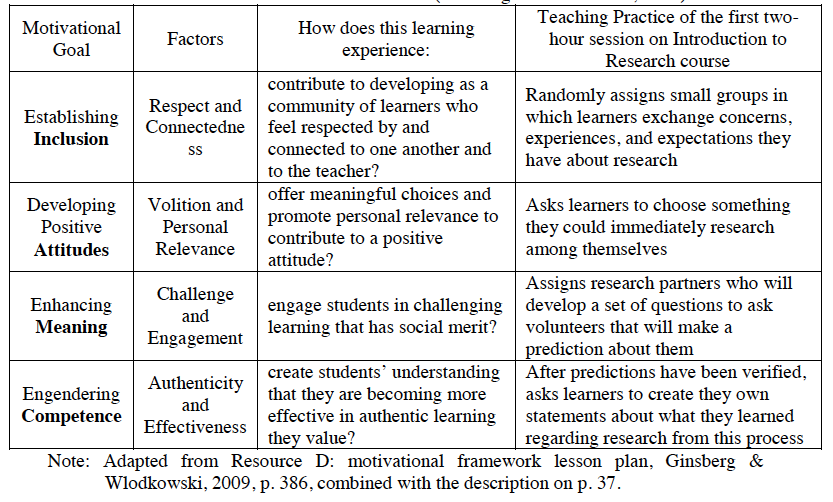
 

Screen Shot 2016-08-28 at 6.52.26 pm
Figure 1: IAMC model Ginsberg & Wlodkowski, 2009 (cited in Suzuki & Nemoto, 2012 p. 25)


Screen Shot 2016-08-28 at 7.03.27 pm
Figure 2: Cultural Dimensions Learning Framework (Parrish & Linder-VanBerschot, 2010, summarized in Ahn, Yoon & Cha, 2015, p.207)


Screen Shot 2016-08-28 at 7.11.51 pm
Figure 3: Culture Based Model, Young, 2009, p. 38


Screen Shot 2016-08-28 at 6.47.48 pm
Figure 4: Cultural Adaptation Process (Edmundson, 2007b, p. 269)

Why is multi-cultural understanding important in e-Learning?

Just came across this very interesting infographic while trying to justify a moral gut-feeling on why we need to care about multi-cultural, multi-lingual (MCML) learning environment accommodation for all students. If nothing else – it impacts on the bottom line!

Source: http://elearninginfographics.com/top-elearning-stats-and-facts-for-2015-infographic/?utm_campaign=elearningindustry.com&utm_source=%2Felearning-statistics-and-facts-for-2015&utm_medium=link

State of School Librarianship – Selected Asian Countries

Four of the speakers at the International Conference on School Librarianship of Asian Countries spoke about the “State of School Librarianship” in their relevant areas:

Since you are all perfectly capable of reading the presentations I am not going to repeat what was said, but rather to say what my key take-aways were in general.

Firstly I was super happy that I chose to come to this conference (at my own cost, although the conference itself was free …) instead of going to the EARCOS workshop in November at Taipei American School. “Tech-Integrated Libraries: Building the Future One Service at a Time”. The reason is that the longer I am in the field of teacher librarianship, the more I feel that we are operating in a number of little echo chambers where we keep on encountering the same people with the same things to share.  This view probably doesn’t make me very popular amongst my peers, however I do think that it has contributed greatly to the current state of school librarianship. Of course this conference was also an echo chamber, but it wasn’t one which I usually find myself in (mine is the “international school librarian” one).   And I think for all of us participating, we got to at least hear (if not share due to the time restrictions and presentation format) about what is going on elsewhere. And that is always incredibly interesting.

Next – it was comforting but disheartening to hear that school librarians everywhere suffer from the same “needed outsider” status.   In all the presentations we heard that the existence of the school library and its staffing by a tiered levels / qualifications of librarian almost always needed an act of legislation  at least in the public sector.   (In the private sector it is up to the budget of the individual school, and part of a long legacy personal and cultural, but that’s a whole other story).   Within the legislated necessity of a school library, there is a huge variation in the requirements – in Australia this is determined by state-by-state for example.

It seems that generally it is much easier to find funding for library buildings and the initial “hardware” – the problems arise with the ongoing budgeting for staffing by properly trained teacher-librarians who can make a difference in both the literacy and information literacy of the students. But those effects are hard to measure – it is easier to come up with statistics concerning collection size and ratios of materials to pupils – the quantitative data is more readily found, and definitions are more robust than the qualitative data. That is one of the “academic / research” criticisms I’d have of some of the presentations – a lot of data but what about the “so what” and “why” and “what now” – particularly when comparing one country to another.

Even Australia – who has long been seen as one of the bastions of school-teacher-librarianship -appears to be in decline due to all sorts of (mainly) political and funding issues. And there’s the rub. School-librarians just don’t seem to be political animals – up to now I have only ever met one Head of Libraries who has a seat-at-the-table by which I mean is considered part of the senior management team of a school.  The rest seem to dabble around the edges, cajoling, convincing, offering, pleading, giving, trying, quietly adding value as and when possible on an invitation basis, if not plain forgotten.

There is a distinct difference also between where school librarians are seen as partners for information literacy instruction versus their role in encouraging reading – or alphabetic literacy. The distinction is very important, because it can be argued (and is argued) that a librarian can provide the former, so it is not necessary to have a teacher-librarian. In fact, a passionate library technician with a love of books and reading would even suffice (sadly to say, a love of reading is not on the ‘necessary qualities” in the job descriptions of most library staff that I’ve encountered – nor, may I add of teachers.). It was interesting to see that the contribution from Singapore was an extremely excellent presentation on “Interactive Reading Activities” but since public schools here generally don’t have libraries or teacher librarians there was no-one to present on the “state of the nation” in this regard. It begs the question what this otherwise progressive nation-state is doing to raise the standards of information literacy in its schools.

At this point, for a bit of light relief, I want to put in one of those corny “what xx think I do” pictures

(sorry no citation – it was on Pinterest and the original link was dead)

What I really wish was I could say is “these guys are really getting it right – that’s the way to go and here’s the proof”. In reality all I can say is that it seems that we all share the same struggles and issues and that’s why I worry so very much about our librarian echo chambers.  Because we all agree with each other, and we all have similar stories to share – stories of triumph and success, of making a difference in the lives of individual students and in (school) communities as a whole – the second afternoon where teacher librarians from 3 schools presented the fantastic work they’d been doing in Taiwan – particularly in the field of inquiry learning was very inspirational.

But how do we get out of this loop and spiral upwards?  I’m one of the 407 librarians participating in the “Ideal Libraries Project” of the IBO. Even in that (private) organisation nothing is mandated or agreed around teacher-librarians. Yes there are recommendations, but judging by the responses from the cohort the interpretations are wide.

I have meandered far I fear. But to my colleagues in Asian countries I would say, fear not, you are not alone, we too struggle with ratios of 1:1,500 (TL:Students), even in private schools. We too would like to feel our voices are heard and that literacies are integrated into the curriculum.  But I think there is hope, if we can just get out of this quick-sand – perhaps when the hype around EdTech and Makerspaces is over we will have our turn – or perhaps it is time to rise up and take a seat at the table, because it is not about us. It’s about sending literate people out into the world, and we can’t faff around the edges and not send fully multi-literate students out into the world.

Design – Space, thinking and time (3) …

A whole month has now passed and we’re still making slow progress. In addition to the pretty pictures this week I’d like to post a little bit about “time” as a space and virtual spaces.

We have 35 classes and 35 periods of 40 minutes which are potential useable in a week, so one would think that’s a perfect match. But it’s not. In elementary school every class does need to spend time in the library exchanging books, looking around and just “being”, but different classes have different needs of different intensity as far as the teacher-librarian time is concerned.  One of the things the outgoing librarian advised me to do, was to move from fixed 40 minute time-tabling for every class every week, to fixed 20 minute fixed timetables, which freed up 17x 40 minute blocks for booking sessions which were Information Literacy focused and needs-based. And also a space in case classes missed their library period due to field-trips, school events, public holidays (of which there have been PLENTY, this term). In the ramp up of a new year and and being a new TL and a being in new school, this time has been invaluable to me to get things sorted out and on the rails to ensure the role of TL is not just to read stories and help with readers advisory (not that those are not important tasks, they are), but also to be a co-teacher co-thinker and collaborator in literacy and information literacy.

Slowly but surely I’m getting requests for those bookable times.  I myself have been a little slow in inviting myself to grade curriculum planning meetings – mainly because I’ve just not been ready for them yet.  That will start this week.  I’m having to keep my foot lightly on the brake and not try too much at once and have it backfire.  Luckily my colleagues have been very admirable in helping slow me down in the nicest possible way.

My virtual space is also at last moving forward. After a 4 week battle with IT and firewalls, I finally have access to Libguides and have started with my first priorities – a library libguide and an Information Literacy libguide. I’ve also started promoting the Destiny Quest app amongst the teachers. Slow progress is also progress.

IMG_0667
Phase 1 of sorting the literacy circle books. Next stop to put the unused ones back into circulation and to ensure they’re all levelled.
IMG_0666
White board installed and post-its for “to-do”


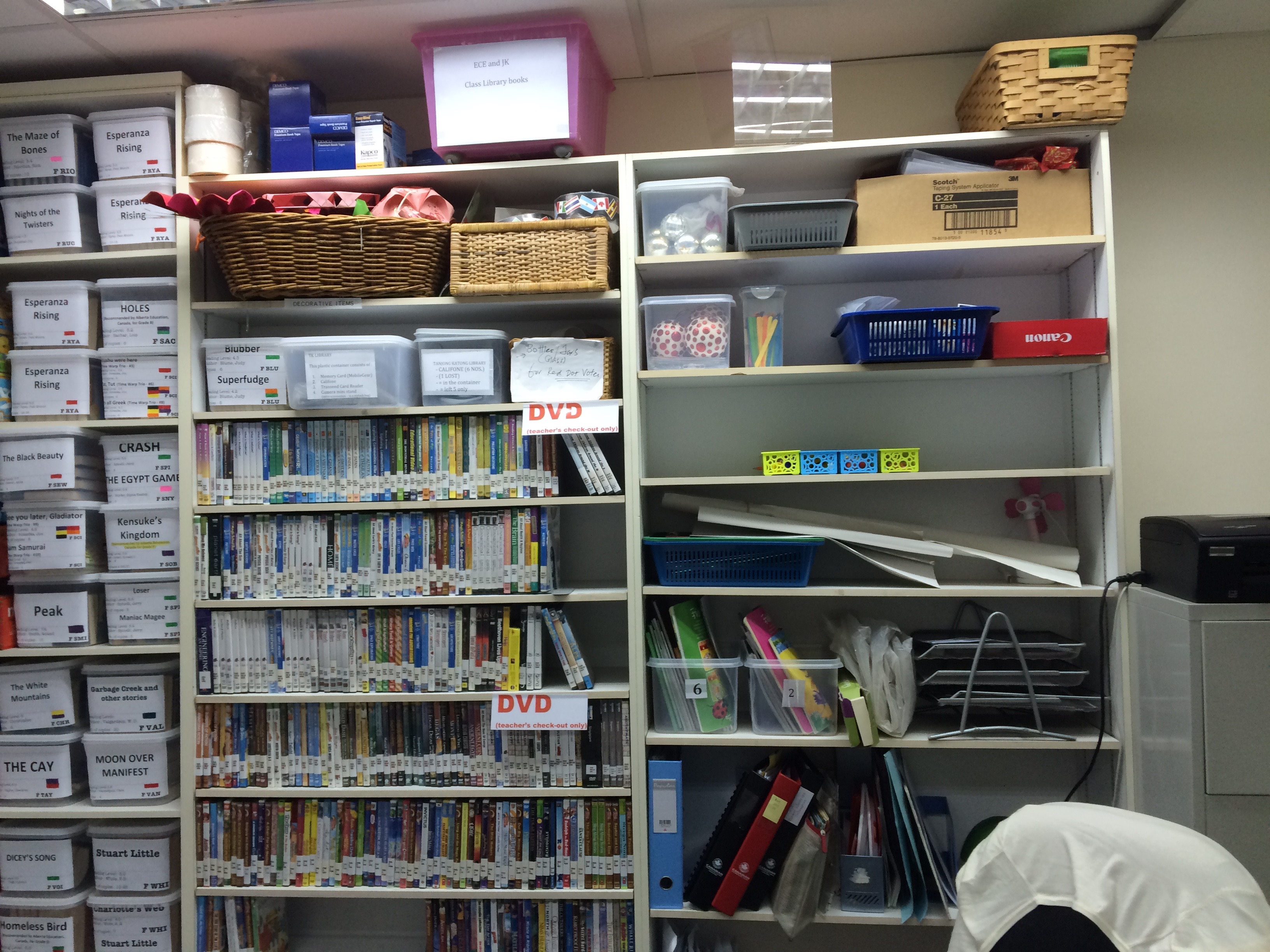
IMG_0670
What to do with all those DVDs? But I do have more shelf space now.

IMG_0708
First step of venturing into the digital realm with the library … that has been an uphill battle of a month … but we’re getting there!

IMG_0707
My flexible space turned into a meeting place for Open Day

IMG_0714
Open Day treats … reminder to self – make sure they don’t just replace the shelving but also vacuum the food remnants – little people are very close to the ground.

IMG_0705
Removed one desktop to create space for display … it’s not yet there, but a first step. Need to remove the chair, put some bins underneath and I’m thinking gutter shelving for the top

IMG_0720
My review wall is exploding! Yay, also thanks to some pictures from my group after watching “The Dot” and drawing for me.


Are we there yet? No … and this is why – an appeal to database owners and academic libraries

I’m about to write another assignment.  This must be about my 40th serious assignment of over 1,500 words requiring academic research, looking for good peer-reviewed studies, reading through 1,000’s of pages to try and distill exactly what is being said, whether it is of relevance (directly or tangentially), and once I’m finished that to pause and think and think and think and try to come up with some new insights, some different ways of applying the theory, some critiques that go beyond the obvious.

As I’ve written before, (unfair advantage, / how I used to write) the true work isn’t in the procuring of the articles, it’s in discerning their relevance, it’s in rejection rather than reading.

So why am I, Anno Domino / Common Era  2015 STILL spending so much time on the library database doing silly work. Honestly, those who lead academic libraries and who run academic databases please tell me why this isn’t easier, faster, more streamlined?  Is it me? Am I doing something fundamentally wrong?

Yes I know how far we’ve come and how much easier this is than 10-15-20 years ago. Yes I also studied in the days of micro-fiche where you didn’t even bother finding articles because it just went into the box of “too hard”.  But we do have the tools now and we have progressed further so there should be no excuse as to why the “stupid” work is taking up so much of my time.

Right now I’m looking for good literature on “Classroom Libraries” as opposed to “libraries” in the use of space and resources.  I put in a federated search. At the same time, I search Google Scholar.  I open tabs of dozens of potential articles, reject many, decide to proceed with some.

As you all know by now I’m a huge fan of Evernote.  I put my entire life, but particularly my academic life into Evernote.  And as I stuff it full of articles, I also at the same time put the citations straight into Zotero, (my citation manager of choice – yes I know there are other new ones like RefMe that everyone is raving about, but Zotero has served me well and they’re very responsive to comments and suggestions).  But WHY oh WHY is it still such a pain to get an article in a PDF format, a citation into a RIS format and both tucked up securely into the bedding of choice?

Time for some pictures … follow the captions for what I’m trying to say

Screen Shot 2015-09-20 at 11.46.32 am
Primo Search – CSU Libraries

Let the GAMES BEGIN!


Screen Shot 2015-09-20 at 11.20.22 am
Google Scholar (with the addition of the CSU library link)

Google Scholar (with the addition of the CSU library link) makes things much easier – I confess I’d rather click on a dubious link than the library link because it will take me straight to the article / pdf. It does make citation a bit more of a pain without the citation tools, but at least I can accept or discard it more quickly. On the other hand – there are way too few limiters for Google Scholar … as a distance learner, I don’t usually want books that I cannot access or where no eBook is available


Screen Shot 2015-09-20 at 11.20.34 amThe open tabs in my browser once I get searching for articles … and that’s on a slow day

Screen Shot 2015-09-20 at 11.21.21 am

delivery.ris? out? blah blah, how about downloading me some meaningful names?

Screen Shot 2015-09-20 at 11.19.52 am
When I click on an article, if I’m lucky I get something nice and neat and tidy like this

But it’s only after a year or so of using databases that I built up experience in knowing which would get me the article most efficiently and with the least number of clicks and doubts

Screen Shot 2015-09-20 at 11.20.03 am
If I’m not so lucky I get this –

Did you see all those tabs open on my browser – I don’t even have any idea what on earth is article was, so I just stab for my favourite database and hope for the best. If it goes wrong and I need to do an advanced search … expletive time

 Screen Shot 2015-09-20 at 11.20.52 am

So I ask you nicely for the pdf. But then it just opens in a new browser window and I STILL have to click “print” and then “print to pdf” and then if I’m lucky it will retain the title or author as file name, and if not it will be “out/pdf” or “23489038” or “gobblydy gook got you there” or even worse “something.html”.

Screen Shot 2015-09-20 at 11.22.07 am

The extra steps in getting a pdf onto your desktop and then into Evernote, don’t press “SAVE” because then you get an HTML file which is pretty useless!

Screen Shot 2015-09-20 at 11.20.59 am

Such a short life, so many choices. And so many of them don’t actually provide what you think’s on offer. Cite? Sounds good – no that just means you copy and paste the citation into your document. Which makes it “dumb” data – You actually need “export” and then you need to click through a couple of times until you get the RIS file in your downloads

Screen Shot 2015-09-20 at 11.21.08 am

Riddle me, Riddle me Rhy,
which of these options should I try?

Screen Shot 2015-09-20 at 11.21.36 am

Zotero – Yes I do want to import, otherwise I wouldn’t have clicked on the RIS file in the first place – why make a one click step into a 2 click process. (But don’t fret too much you’re not the worst of the redundant click club)

Files waiting for transfer

Phew … A subselection of files, tabbed and colour-coded waiting to be put into the correct notebook in Evernote.

Screen Shot 2015-09-20 at 12.28.01 pm Just drag and drop and then the real work starts – roughly an hour or so for 10-15 articles and their citations … if you don’t get sidetracked by writing a blog post on the whole process!

NOW … If I ran the circus …

Let’s be completely impractical and totally utopian. See the top photo in the top left column?  I’d add two buttons to each entry:

* One click *.pdf download (with tagging allowed)
* One click *.ris download

because you see, as long as I can get the article, I don’t give a &*^*&^ (insert expletive of choice) which database it comes from. Just give the me the pdf.  With a sensible name like the title. And believe me, I don’t have the time or patiences or hard-drive to keep articles that are of no use for me, so I read the abstract and  delete.

Another circus I’d like to run – those learning modules.  I’ve been around the block a bit, and I’ve seen inside libraries.  A certain academic library that shall not be named in a town that shall not be named has a whole department dedicated to copying articles for coursework for their students who then get a bundle. Hard copies. Trees dying.

At CSU we judiciously just add links to the articles in primo, which the student then has to click on and go through the whole rigamarole highlighted above. Oh for heaven sake, just stop the pretence and put the articles into subject reserve in pdf form.  Who are we kidding that this is meaningful work or adding to knowledge? And then the links that don’t work, and instead of everyone going off and sleuthing how to find the article and thereby actually learning something, there is just a host of complaints on the boards that the article isn’t there.  Finding coursework articles that have been pre-selected by a lecturer does not a good student make. And we’re foolish to pretend it is so.  The success is in the seeking out of related material from other fields and dimensions that may not be thought of, in finding links and relationships, and then seeking those articles and selection and casting aside and applying that to the task at hand or real life that is the mark of the better student.

So now I’ll get back to the boring work.  And just as an aside mention – the databases that do it half ok?  ScienceDirect I always like – clean and easy and good with recommendations on related articles.  Proquest isn’t bad, and I like their little sidebar extras like seeing how many articles in which years / decades so you can see the rise and fall of fads.  EBSCO and JSTOR you’re ugly and clunky and too-many clicky and I avoid you as much as possible.

And here’s an open invitation – if all this is my own  stupid fault because I have nary a clue what I’m doing, please comment and tell me so and let all of us know a better way.

Why can’t a library?

Be more like a store (with apologies to Frederick Loewe & Alan Jay Lerner)?

And if it were a store, what kind of store would it be? Please don’t say bookstore, because even though we apparently love them, they’re dying and going out of business. Except for those that evolve beyond books, earn the respect of customers, get into their communities, incorporate new ideas such as subscription services, “reading spas”, bibliotherapy, cafes, events and festivals with authors and celebrities (Butler, 2014).

The bookstore

Yet many libraries are adopting the bookstore model, by genre-fying their collection, ensuring that titles are front facing, having multiple copies of popular books (Day, 2013; Kindschy, 2015).

Even as many libraries have a huge online presence which they work hard at making visible to their clients through a wide variety of means including signage, display, print-outs, screens, bookmarks, social media etc. people like David Weinberger, are still implying that libraries are missing a trick while Gopnik laments “By atomizing our experience to the point of alienation—or, at best, by creating substitutes for common experience (“you might also like…” lists, Twitter exchanges instead of face-to-face conversations)—we lose the common thread of civil life” (Gopnik, 2015).

The fashion store

A few months ago, I had the most horrendous shopping experience – my son insisted that I accompanied him to an A&F store. Only after reading this article do I “get” why it was so awful.  The whole point of the loud music and low lights is to keep the wrinkly parentals OUT of the store, not to entice them in. There are those who lament that as libraries become more inclusive, more multifunctional hybrid spaces they are going the same way – keeping out the very people who have the need for scholarly quiet space (Miller, 2013; West, 2013).


On the other end of the spectrum, one has the Burberry model (Bath, 2014; Davis, 2014; Williams, 2014). Where there is seamless integration between the online and offline experience, which may go some of the way in addressing Weinberger’s concerns. What we are looking for is the omnichannel “an experience that takes consumers from their current channel of choice and seamlessly chaperones them within an uninterrupted brand experience through digital and physical worlds without the customer being consciously aware or concerned about where one channel started and the other finished” (Bath, 2014, para. 8).

The Grocery Store / kitchen

Joyce Valenza also uses a store metaphor “We need to stop thinking of the library as a grocery store a place to get stuff and start thinking of it as a kitchen a place to make stuff” (cited in Johnson, 2013). Further in the same article, referring to the mission of libraries, Johnson states “The library’s resources have changed, but not its mission: teaching people to effectively access information to meet their needs. The emphasis has shifted from teaching learners how to find and organize information to teaching them how to evaluate and use information” (2013, p. 85)
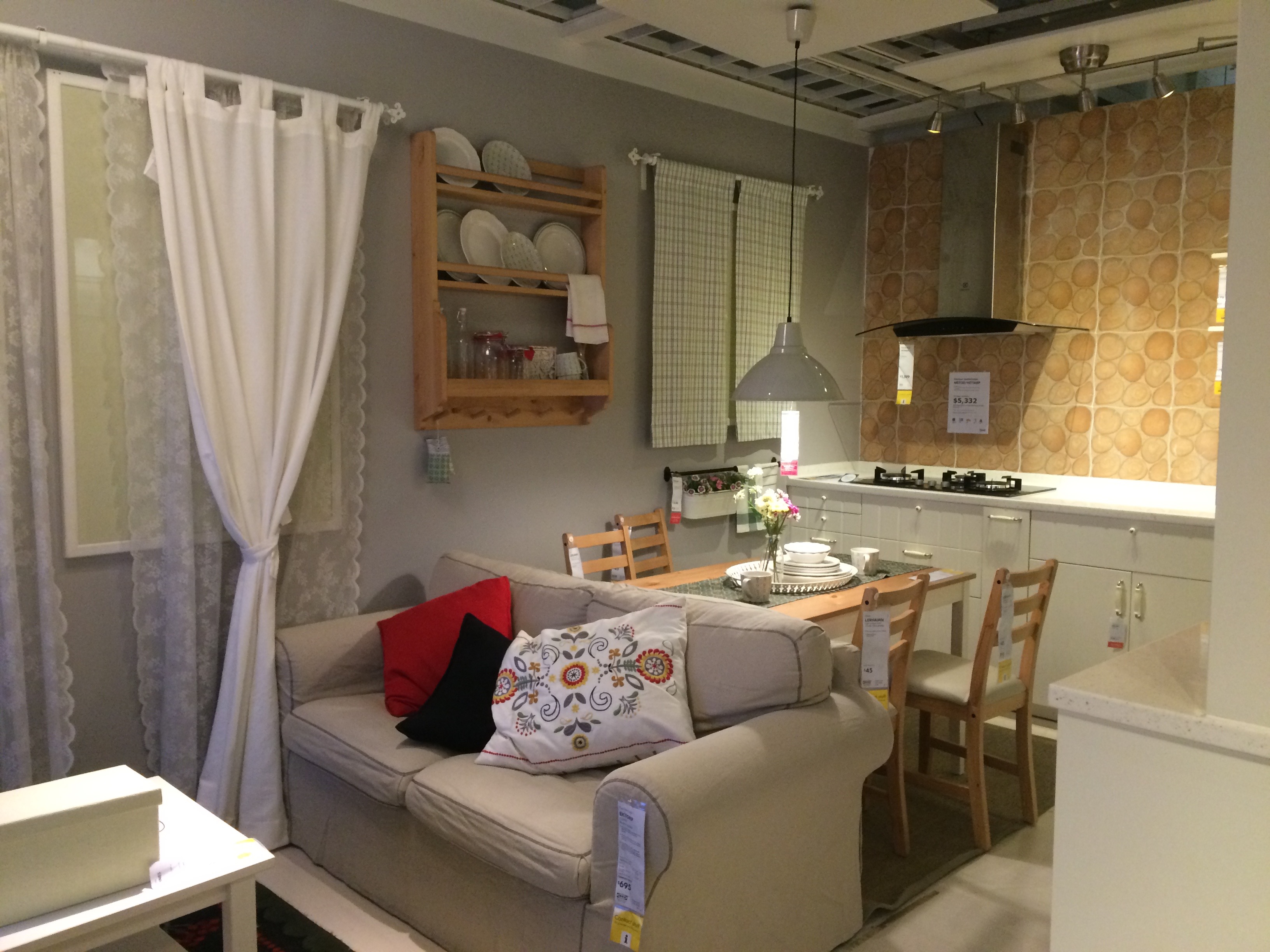
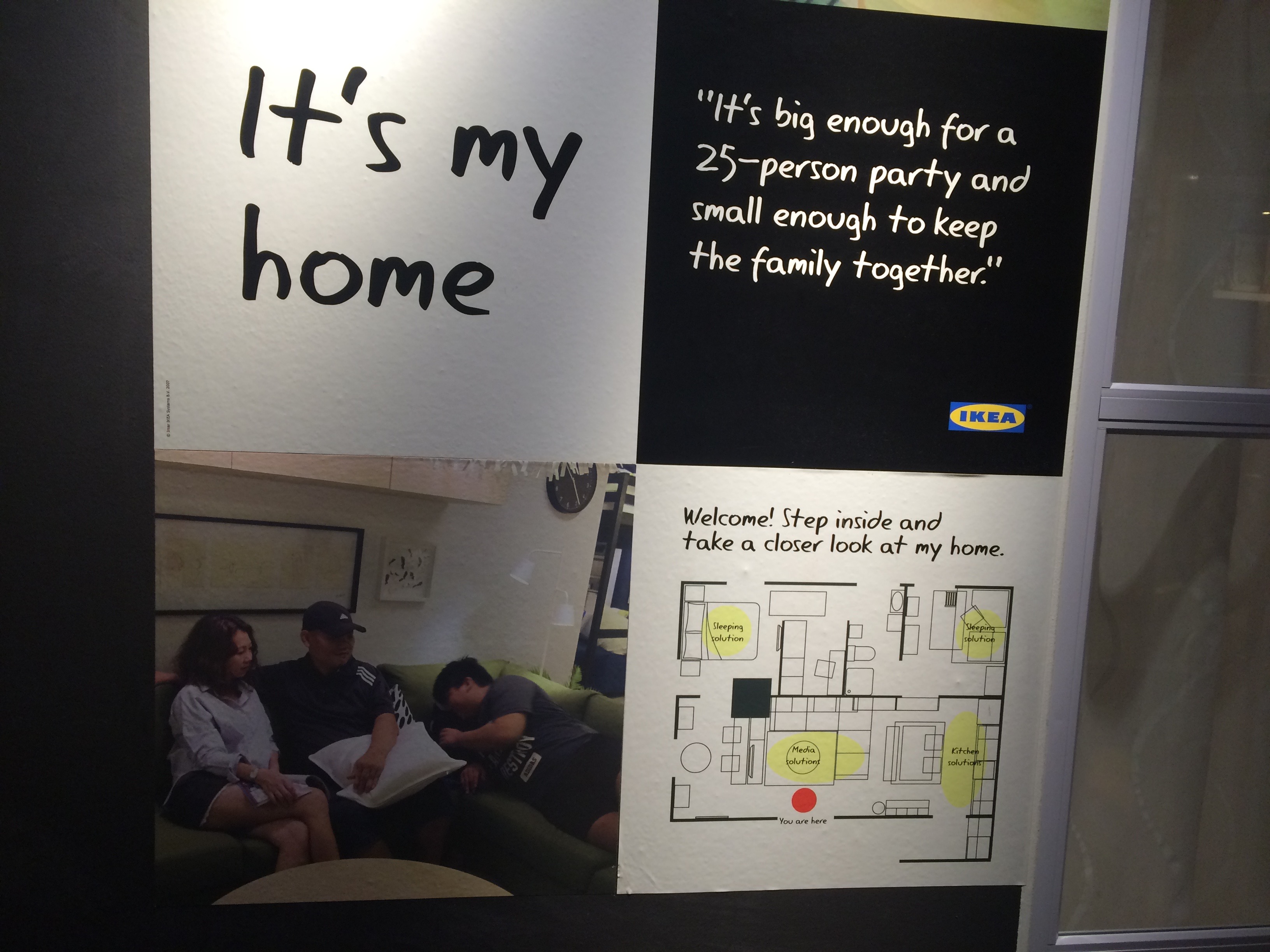
Strolling through Ikea yesterday on a mission to have a look at the design elements for a different assignment, I suddenly realised it had many elements and features that could be incorporated into a library.

Ikea

A couple of things work in the Ikea model:

  • It’s practically impossible to leave without buying something
  • Your route is determined by the store layout
  • Clear signage and explanations
  • The incorporation of demo-rooms and demo-apartments shows you how you can use what the store can offer – visualizing and envisaging
  • A price point where decision making is easy (Carlyle, 2015)
  • Few of the products are “ready to use” without customer engagement (assembly)
  • Trends of users and society are researched and analyzed (IKEA, 2012)
  • Extreme users can hack the basics and go beyond to create to meet their own needs – and share their experience / learning with others (IKEAHackers.net, 2014; Mars, 2014; McGauley, 2015).


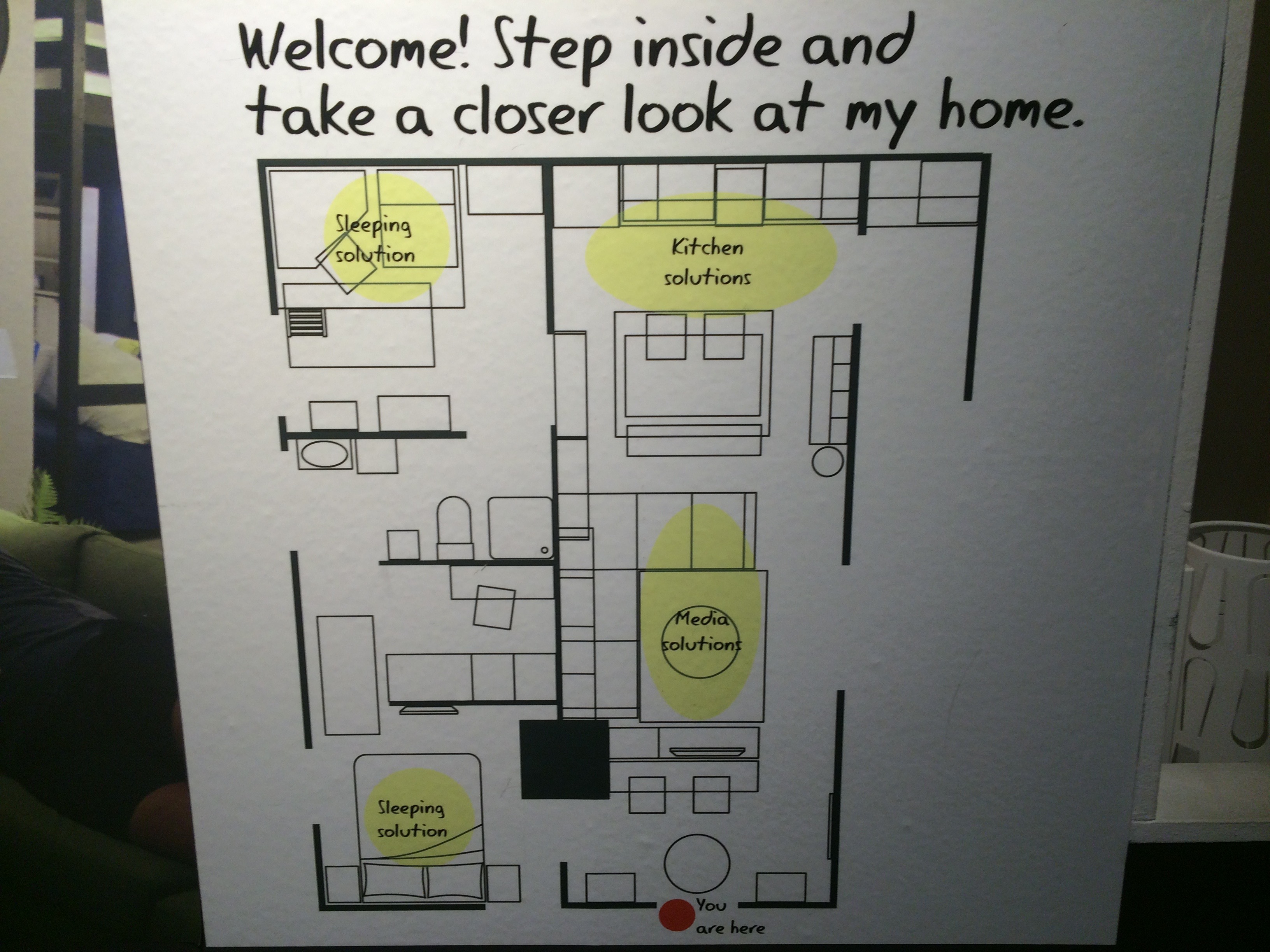
One of the things that struck me yesterday was that in addition to the traditional layout idea of “bedroom, living room, kitchen, bathroom” the signage in the demo-apartments referred to “solutions” as in “kitchen solutions, media solutions and sleeping solutions”, which is somewhat contradictory to the trends identified in the report by IKEA, that indicated a move towards hybrid functional spaces defined more by whether people wanted solitude or company than by their traditional function (IKEA, 2012).


IMG_0438
Full demo-apartment

IMG_0432
Floor plan

IMG_0434
Solution spaces configuration 1

IMG_0433
Solution spaces configuration 2

IMG_0439
Clear signage and explanations

IMG_0457
Instructions for self-packaging

But I like the idea of “solution” spaces. Especially for a library. It fits in a bit with the “campfire / watering hole / cave” ideas of Thornburg (2007) but I don’t think that goes far enough in providing users solutions for their learning needs. Yes it does allow for a variation in pace and intensity and communal versus individual effort, and facilitates knowledge gathering through listening, collaboration or research but are these solution spaces? I’d argue they aren’t. That’s not to say we haven’t by accident or design created solution spaces in the library. Thinking to the user needs in the secondary library where I worked:

  • Finding books to read for pleasure at the right interest / ability level
  • Hanging out with friends in an air-conditioned space (we live in the tropics!)
  • Having a “third space” that wasn’t home or classroom
  • Playing games (on-line and physical)
  • Lounging around reading dip-in dip-out books such as comics, graphic novels and poetry
  • Mother tongue resources
  • Resources – physical and online for school units or assignments
  • Resources – physical and online for personal questions or interests
  • Information literacy / literacy assistance for completing assignments to a high standard including academic honesty and scholarly value added.
  • ? more that I’ve not thought of at the moment.


With respect to the library space, I think we met most of the needs in a satisficing way given the constraints of space, resources and person-power. But I’d argue that if we were to combine the concepts of the omnichannel with solution spaces after careful observation and involvement of our users we could go so much further. Perhaps our library guides should have “hacking your grade 7 middle ages assignment” or “hacking citations”? Perhaps we should have a research zone where online and offline is seamlessly integrated with signage and demo-products?


These thoughts are in their infancy for me, somewhat half-formed and not “quite there” and I’d appreciate further comments and ideas and examples of where you’ve done this.

 References:

Bath, O. (2014, May 16). The Burberry model: why blending online and offline boosts success [Web Log]. Retrieved August 2, 2015, from http://wallblog.co.uk/2014/05/16/the-burberry-model-why-blending-online-and-offline-boosts-success/

Butler, S. (2014, February 21). Independent bookshops in decline as buying habits change [Newspaper]. Retrieved July 26, 2015, from http://www.theguardian.com/books/2014/feb/21/independent-bookshops-campaign

Carlyle, R. (2015, May 1). The secret of Ikea’s success [Newspaper]. Retrieved August 2, 2015, from http://www.express.co.uk/life-style/life/560828/Ikea-history-Swedish-furniture-design

Davis, S. (2014, March 27). Burberry’s Blurred Lines: The Integrated Customer Experience [Newspaper]. Retrieved August 2, 2015, from http://www.forbes.com/sites/scottdavis/2014/03/27/burberrys-blurred-lines-the-integrated-customer-experience/

Day, K. (2013, November). Liberate your book cupboards and create a more true “bookstore” model in your school library? [Web Log]. Retrieved July 26, 2015, from http://www.thelibrarianedge.com/libedge/2013/11/liberate-your-book-cupboards-and-create.html

Gopnik, A. (2015, June 12). When a Bookstore Closes, an Argument Ends – The New Yorker [Newspaper]. Retrieved July 26, 2015, from http://www.newyorker.com/news/daily-comment/when-a-bookstore-closes-an-argument-ends

IKEA. (2012). What goes on behind closed doors – Life at home in the UK (p. 23). United Kingdom. Retrieved from http://www.ikea.com/ms/en_GB/img/site_images/about_ikea/PDF/What%20goes%20on%20behind%20closed%20doors_Report_Spreads.pdf

IKEAHackers.net. (2014). IKEA Hackers – Clever ideas and hacks for your IKEA. Retrieved August 2, 2015, from http://www.ikeahackers.net/

Johnson, D. (2013). Power Up! The New School Library. Educational Leadership, 71(2), 84–85. Retrieved from http://www.ascd.org/publications/educational-leadership/oct13/vol71/num02/The-New-School-Library.aspx

Kindschy, H. E. (2015, January 13). Time to Ditch Dewey? Shelving Systems that Make Sense to Students (Learning Commons Model, Part 4) [Web Log]. Retrieved July 26, 2015, from http://www.clcd.com/blog/?p=186

Mars, R. (2014, August 19). Hacking IKEA [Podcast]. Retrieved August 2, 2015, from http://99percentinvisible.org/episode/hacking-ikea/

McGauley, J. (2015, February 19). Easy IKEA Hacks For Your Apartment – Best DIY Projects [Web Log]. Retrieved August 2, 2015, from http://www.supercompressor.com/home/easy-ikea-hacks-for-your-apartment-best-diy-projects

Miller, L. (2013, January 31). Bring back shushing librarians [Newspaper]. Retrieved August 2, 2015, from http://www.salon.com/2013/01/31/bring_back_shushing_librarians/

Thornburg, D. (2007, October). Campfires in cyberspace: Primordial metaphors for learning in the 21st Century. TCPD. Retrieved from http://tcpd.org/Thornburg/Handouts/Campfires.pdf

West, P. (2013, November 20). Libraries: a plea from a silence seeker [Newspaper]. Retrieved August 2, 2015, from http://www.spiked-online.com/newsite/article/libraries_a_plea_from_a_silence_seeker/14317#.Vb2l6JOqqko

Williams, G. (2014, March 19). Why the online/offline split no longer matters [Newspaper]. Retrieved August 2, 2015, from http://www.wired.co.uk/magazine/archive/2014/03/features/ecommerce-is-history

Don’t break my heart

I’ve just spent 5 days at the Suzuki European Convention, accompanying my cello playing daughter and viola playing son, which was a brilliant opportunity to observe some very hardworking and talented students and teachers in action. There are group classes, orchestra classes, concerts and a lot of playing and learning for the students, the teachers who are not teaching the class but observing classes and of course the parents.
Since my current course is INF536 “Designing spaces for learning” I was particularly interested in seeing how thinking about space and learning was incorporated into the lessons.  The idea of space is an interesting one. I do not have any power over changing a learning environment, since I am an observer and living in a hotel, however I can make some comments on what I have seen around me.
The first thing I have noticed is that we should not limit our considerations about space to physical space.  One of the interesting things is how the temporal space of timetabling is used.  Each group starts the morning with a “play in” – with all children at all levels attending. Then there are group classes depending on levels interspaced with orchestra (for the higher levels) and free time, during which students are free to wander into other orchestra rehearsals or to observe classes of their own or other instruments.  Building “space” into “time” can also have an impact on learning.
Within the structure of the class the teachers (who are all very skilled “master” teachers) build in playing and learning and working (Kuratko, Goldsby, & Hornsby, 2012) through alternating fun activities with advice on technique, dynamics and other musical issues, as well as the hard work of repetition until the desired effect is achieved.
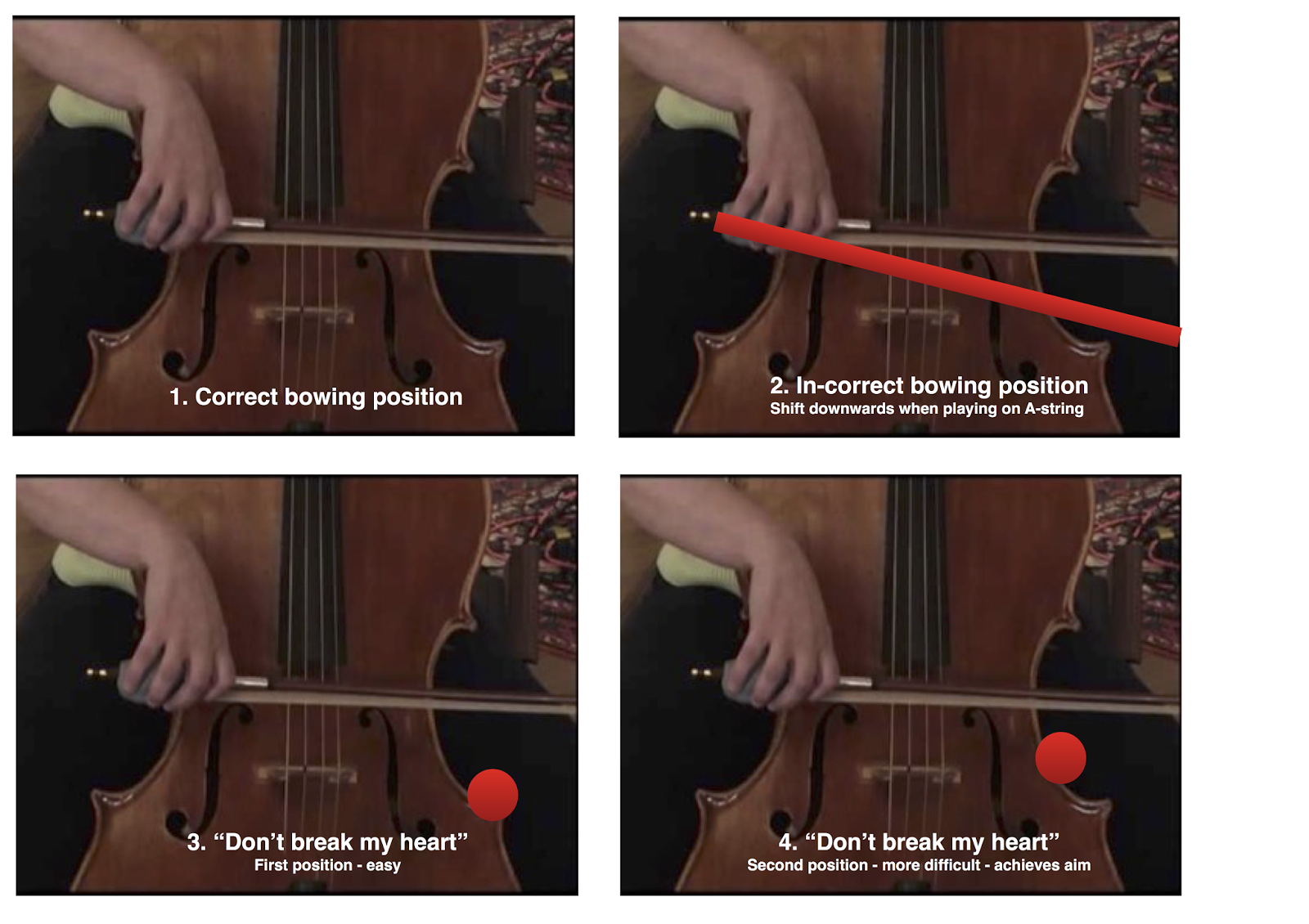
One lesson that stood out was an advanced class that was working on the Haydn Cello concerto with Takao Mizushima.  First the class all played a section together. Then each student had to play it separately while he made comments and suggestions for improvement. All students play to a very high standard, but over the years various habits and issues with posture can creep in which may be expeditious in the beginning, but over time will compromise the quality of sound.  In this instance the learning space is the cello and the bow and in fact limited to a very small section of the cello, namely the area from where the finger board ends to the bridge as well as the C Bouts (see below).
The area of learning indicated by the red circle
.
An important aspect of sound relates to bowing. Ideally the bow should be at right angles to the string and should remain at right angles even as the cellist moves from string to string – which requires adjustment of the whole arm.  The video below explains this – in a rather boring fashion. (Note there are exceptions to this “rule” such as in baroque playing or when a specific sound needs to be created).


Source: https://www.youtube.com/watch?v=v20gjN3yTLY


As the boy finishes playing, the teacher praises him for his interpretation and then says, “please don’t break my heart” – he moves to his bag and gets a roll of sticky tape and fashions a heart out of the tape. He then places the tape on the tip of the C Bout (as illustrated in 3 below) and instructs the student to play the passage again.  At no point does he tell the student he’s bowing incorrectly (as illustrated in 2 below) but the student in question and all the students around him immediately get the point of what was wrong.  He plays again, to animated “acting” by the teacher about his heart not being broken and the bowing is better.  The ‘goal post’ is then shifted (as illustrated in 4) and the bowing is even better.

An illustration of the lesson components

Enjoy the video – the quality is not very good as individuals are not focused on to protect their privacy.

Don’t break my heart from Nadine Bailey on Vimeo.

The lessons I drew from this were the making of a design change – in this case introducing a constraint, display (playing with the constraint) and replay (moving the constraint) with the feedback to both the participant in question and all the learners around, as well as to the audience of a teaching “trick” that is effective.

ePortfolio – a counterview

As part of my ‘onboarding’ I was watching this video and thinking about it as it relates to what I’ve been observing.

I’ve been blogging for a long time and have used it to document my learning and understanding about a wide range of things, including my children’s development, learning chinese, coming to grips with living in different cultures and most recently as I continue my tertiary education.

I think Dr. Barrett has some very valid points. BUT. It really all depends on who is initiating the creation of the portfolio.  If I look at my children for example. I have a child who is a serial obsessive and during an obsession will spend every waking moment learning everything he needs to know about his desired topic. This includes joining online chat groups, watching youtube videos, experimentation, talking to people, finding experts and grilling them.  However he’s not a keen writer or documenter so this will never go beyond what we as a family observe and what teachers may notice and appreciate (or even document themselves). If I look back at his “compulsory” school learning portfolio I see little or no evidence of this learning. Does this mean it didn’t happen? Or that it’s not appreciated or meaningless? It’s in fact one of the things that happen that allow me to have complete faith that regardless of school grades “he’ll be ok”.  Gee made the same point in his discussion on passionate affinity spaces.

A friend of mine recently confided that her son had decided to “drop out” of school just before his final year.  I know a couple of other highly intelligent very motivated high school students who are at risk. Their problem? Not that they’re struggling with the subject matter but that they’re struggling with the matter of subjects. Often they seem to be just the students who DO know what their calling is and everything else on offer (demand) is just so much noise.

Out of the school environment, with the assumption that individuals are studying a subject of interest and choice another issue seems to arise.  Fear / embarrassment. So many of my cohort – otherwise accomplished, intelligent and knowledgeable individuals struggle to the point of refusal to document their learning process. This belies the fact that the whole point is to document a process rather than an outcome. It’s also a very flawed view. What parent would refuse to video their child learning to roll over, sit, crawl, stand up and finally walk but say “I’ll wait until they walk because all the rest is just practise for that end goal”?  I think as adult learners we do everyone else coming after us a disservice by not showing our mistakes and errors in thinking and assumptions and unpolished learning – because if they can’t see the steps the end-goal seems so much less attainable.

So I guess the thing is yes to ePortfolios but perhaps negotiation as to the content and topics.

Academic honesty should never be ambiguous

Ok, I know I have a somewhat ambivalent stance on what constitutes plagiarism and the value of collaborative and cooperative learning but one thing I’m clear on is academic honesty.  If you used something that someone else made just say that you did that. And depending on your age and level a simple copy and paste of the link is sufficient.I recently went around our G5’s exhibition project and was thoroughly impressed at their work. I did sneakily ask a few for their sources and most could point to at least a page of attribution as to where they’d got their numbers and facts.  Well done (here is a great video of it by the way).


G5 Exhibition Video 2015 from UWC South East Asia on Vimeo.

Fast forward to early this morning. I’m putting the washing in the machine and the kids are getting ready for school and finally my daughter lets me see the video she’s been working on for the last 4 days – one holidays and festivals in the middle ages. It’s a great video with her narrating the festivals of the year with lovely pictures and music from the middle ages in the background.  And then at the end “Thank you for watching” and black screen.

I told her I thought it was great, but that she didn’t have to thank anyone at the end, and instead a list of attribution for the images and music would be good. “Our teacher said we didn’t have to do it” was her reply. I told her that she knew that I expected it of her, and she then showed me that she had in fact made a list of the URLs but hadn’t put it into EasyBib to get into MLA format. I asked why not, and she came with some story about how citations / attribution hadn’t been in the original assignment nor in the rubric and the teacher didn’t want to add it on afterwards. I was a little annoyed at this. I said she could at least put it at the end of her video, but she didn’t think that would be “fair” on the others who didn’t. Fair? How about the fairness of the people to whom the images belonged? OK they’re all long dead now, and perhaps most of the images are in common domain, but still, it’s the principal.

I was annoyed at myself being annoyed at her, when actually I should be annoyed at the school. How can they go from being citation semi-stars in primary school to not having it expected at middle school. This is not the first instance, it is one of many, many, many in both my children’s grades across all subjects – academic honesty really does need to be institutionalised and inside every single assignment across the board! I’m at least glad my ranting has had an effect on my kids and they’re at now keeping lists to show me – but if it’s only for me for how long will my influence last?

Unfair advantage

Following the release of the results of our first assignment, there has been some soul searching and discussion on how better results can be attained and what went wrong etc. I’ve seen this on various Facebook groups I’m a member of too. I’ve referred earlier to the whole privilege thing, and I’ll say it again.  No one mentioned it, but of course some of us (myself included) had an unfair advantage. When I write “the whole privilege thing” and then so easily reference the exact article, it’s because I’ve read it, and stored it on Evernote, and can easily access it.

Sichuan peppers at dinner in Chengdu last night

Let me ‘fess up on where my starting line was when this course started. I’m not doing this to brag, but to give courage. I started at ground zero in August 2012 and I too had the shock of getting back grades from assignments and not only beginning to understand where I’d gone wrong.  My starting line this time around:

* A collection of 3,350 academic, professional and lay articles on Evernote, to which I’ve added 269 articles since I started this course in this course’s notebook.  I can only find 5 articles for my first course (in electronic form), because then I was still printing it all out.  And I threw out all the printouts in my last house move. I don’t even have the course overview or modules. That’s how bad it all was.  In fact it’s even worse. I naively thought that Interact was forever so I didn’t even save my marked assignments! So I don’t even have a hard copy of that. I cringe when I thought how stupid I was. How little I knew, how I bumbled through the first year. How scared I was to ask for help. How I didn’t even know who to ask for help.

* A Zotero library of 1,697 references to articles I’ve read (the difference with Evernote above is I only put articles in that I’ve used in assignments, and Evernote has a lot of my “life” in it, not just academic life). Most (but not all) of those references are “clean” i.e. I’ve sorted out the metadata and added the fields I need to make my referencing better.  I also have the email of people at Zotero  if I find it behaving strangely and not doing things the ‘correct’ APA way.

* I’ve passed 14 subjects at CSU. If I wasn’t starting to get the hang of things by now I’d have dropped out a while ago.

* I’ve discovered the APA blog, and experienced first hand their 24 hour or less (sometimes less than an hour) response time to queries if you can’t find the answer you need. I’m a regular at OWL Purdue (I even know what OWL means!). I also have just been through an exercise at work whereby I’ve been making reference posters for our students. There I had to make 6 posters each for APA, MLA and Chicago, which are the referencing styles we use. That sure was an education on referencing!  Even after weeks of tweaking things and getting it ‘right’ after we put it out in the open (this link is the first version – so not all correct! first link is the latest version), we kept getting comments and corrections from people with more knowledge and experience – talk about crowd-sourcing!

* I’d been blogging privately since 2006 and had written 1,931 blog posts with nearly 200,000 page views by the time I stopped in 2013. When I started this course I’d done about 100 blog posts professionally. I also re-started blogging reluctantly, and totally intimidated by those older and wiser and more experienced than myself and then was forced to by my courses, and now find it a way of releasing pent up thoughts and organising my jumbled thoughts on what I’m reading and experiencing. The community is not the same as 9 years ago, I’m not getting the steady stream of comments and encouragement that I had in the past – so it is less motivating if one speaks of external motivation. But it is still a learning tool for me, and the more I write, the more I can write and the easier it becomes.

* I work with a terrific person. Katie Day  (googleplus link) is the best boss a starting out TL could wish to have. She pushes me when I want to hold back, she challenges my naive and unformed and uniformed thoughts. She throws articles and books and websites and blogs and names at me when I get stuck. She takes me out of my comfort zone and encourages me and supports me when I have self-doubt. And most importantly she knows her S***. Whether it’s on the literature front, the technical front, the digital front, the teaching front, the working with teachers and students front.

* My family is supportive. We’ve just come back from a weekend in Chengdu – but we haven’t had many weekends off in the last 2.5 years, where I’ve not been tied to my laptop or iPad reading articles or writing assignments. And to be completely honest, the fact that I wasn’t this weekend is only because the wifi was so unbearably slow it was better to just give up and quit trying to study than to keep battling it.  My 12 year old daughter reads through my assignments and picks out bad grammar and discusses where things don’t make sense. My husband reads through my assignments and tells me if I’m becoming too academic.   Neither of them always know what on earth I’m writing about, but they do make me a better writer, since if I can’t write well enough for them to at least understand the gist of what I’m saying, I’m doing something  wrong.My 11 year old son gives me hugs and moral support. And reminds me that everyone learns in their own way and at their own pace.

Of course my privilege didn’t start there. As Gee would point out, I had parents who spoke to me and read to me. I grew up in a bilingual environment. English is my mother tongue. I had a tertiary education. I am surrounded by intelligent people who read and write and discuss things.

While writing this I’m just humbled by what a long journey this learning thing is, and if anything each of us should have a handicap that we start with, like golf, to make it a little fairer and more equitable.  But on the other hand, looking back I can say there is hope and it does get better. A lot better and a lot easier.  I also both care a lot more and a lot less. That may sound strange. On the one hand I’ve become very passionate about learning (care more) but on the other I’m a lot less scared of making mistakes and putting myself out there (care less).  All these processes take time. A lot of time. And while I may be a few metres past the starting line compared to some, I’m nowhere near others, and I can’t even see the finishing line. And that is life. And that is fine.