Maths and beyond

A few weeks ago one Friday, just before our WEIRD (WAB Extended Independent Reading Day) there was a sudden surge in interest in maths books from our G8 students. Unfortunately a little further questioning revealed that it wasn’t so much math books on demand as some kind of math text very specifically on quadratic equations as the students had a test in the next block but couldn’t spend the WEIRD block cramming / practising spreadsheets but had to in fact borrow and read a book.

The only book that really sufficed unfortunately was Everything you need to Ace Maths. While this type of book is a necessary part of a middle school library collection (we are after all there to meet the needs of our students), it got me thinking about the other wonderful books we have in our collection that were summarily rejected by the students.

For a while one of my favourite has been Giorgia Lupi and Stefanie Posavec’s “Dear Data“. While not considered to be a traditional “Math” book it can help both teachers and students to change their pre-conceived ideas of how data can be represented. A book like this is particularly valuable in encouraging students who see themselves as more artistic and creative to seeing that one of the important parts of numbers is making the information contained in them visible visually. A point well made by Hans Rosling in his memoir “How I learned to understand the world” – a very enjoyable read by the late author of “Factfulness”.

Recently a most wonderful book landed on my desk. Actually the book that motivated me to write this post at all. Power in Numbers by Talithia Williams – it was an order from before the winter break that I’d made to expand the biographies available for our Grade 6 Unlikely Hero unit. Until now “Hidden Figures” (mainly as a result of the movie by the same name) was the main exposure our students had to the idea of women mathematicians. This type of combined biography is so exciting because it finally gives these women the exposure they deserve. And what I mean by deserve is in a big well designed hardcover glossy full colour book. It’s a trend started by “Goodnight stories for rebel girls” but goes far beyond both in form and content. The women are put in context both of the age within which they lived and the mathematics that they pursued. It’s a book that I was reluctant to let go of to be catalogued and one that I had to immediately share with the math teacher who shares my passion for books! For more from the author see her TED talk below.

Asian parents set a very high stake by their children’s abilities in maths. Our students at all ages are often exposed to acceleration in their arithmetic and math skills whether by Kumon or Abacus or other means. As my colleague is at pains to keep explaining, speed and the ability to use equations and “tricks” don’t always equate to true longevity in maths. One series of mystery books I enjoy exposing this age group to is “Red Blazer Girls” – where the boarding school based heroines use maths to solve mysteries. Often the kids with the so called “math smarts” struggle applying their skills to word / problem / real life based situations.

A few other books that I’ve added to our collection recently include “The Wonder Book of Geometry” , “How not to be Wrong” by Jordan Ellenberg, “Maths in Bite Sized Chunks” , “How to Bake PI“. Continuing in the line of trying to encourage creativity in Maths, there is the Mathematical Origami book and for historical context “Great Breakthroughs in Mathematics” and “17 Equations that changed the World” . Finally something for the sports mad – the Full STEAM in sports series such as “Full STEAM Basketball”

One of the Maths Teacher resource books that have been a hit recently is Peter Liljedah‘s “Building Thinking Classrooms in Mathematics. One of the benefits of social media includes being able to reach out to and engage with the authors of these books.

To end up this post, here is our Mathematics resource Library guide – happy to get more ideas of resources and the Maths books recommendations on a great website I was just introduced to today – Fivebooks.com! Worth some exploration as experts share their favourite top five books in various aspects of mathematics.

(Header Photo by Roman Mager on Unsplash)

Hiatus

I’m not blogging and it’s for a reason. I’m still trying to clear out the detritus of a rather busy and stressful year. Most of it spent online. Part of that is to seriously consider each and every subscription that is creating a digital deluge in my inboxes. It’s disheartening as I unsubscribe or delete or just archive things that are great, well written, well thought out but where I just don’t have time to read.

So then I had a crisis of confidence that I’m just one more thing creating other people the same problem, and that’s had me reluctant to write.

I’ve cleared about 700 items from my personal email, and have another 260 to go. Professionally it’s worse with about 900 items unread – many of them emails to myself of things to follow up on, curate, add to libguides, etc. etc.  And that’s even after spending time every weekend culling at least a 100 emails at a time – AND it’s better since I’ve moved most of my communications with colleagues to microsoft teams.

Right – to make this worth your read – here is a link to the Summer Guide that I created with Stephen Taylor. It’s a reminder to our families of the many and rich resources we have and the fact that they continue to be available over the summer.

Summer guide

I have a list of things I want to blog about when I’ve cleared my mind and other clutter in my life, until then – a happy restful summer.

Picture books as a panacea?

maia and what mattersI’ve always been a huge fan of picture books. I’m the librarian that will read “Maia and what Matters” to a group of Middle School teachers and struggle to continue through tears. I spend a reasonable chunk of my budget on picture books (or as some librarians like to refer to the “sophisticated picture books (SPB)” I’ve never see a book deal with anxiety with as much compassion and understanding as Mel Tregonning’s “Small Things”. I maintain a libguide for Social Emotional Learning (SEL) that relies heavily on the work of Dr. Myra Bacsal and her SEL booklists. 

So what is the problem? I’m worried that publishers are becoming complacent about plugging the gaps in information / knowledge / awareness of really big and worrisome things by having a picture book in that space. A case in point is my (and most librarians) quest to curate books related to the Sustainable Development Goals. And I’m afraid even the UN with it’s SDG book club plays into this.

It is easy enough to find a picture book about Wangari Maathai, about the plastic bags of Gambia. It is way harder to get a good (recent) nonfiction book geared at 11-14 year olds on deforestation or plastic bags for example. It seems the nonfiction publishing cycle is around 8-10 years (I found plenty from 2009-2011) between updates whereas the actual issues are accelerating faster.

Follow Your stuff

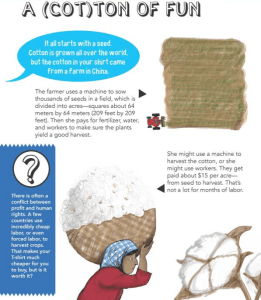
As mentioned in my previous blog – a big change has occurred in the presentation and design of nonfiction books, so it is important not only from an “up to date facts” point of view that we have these books, but also from an “enticing to read” point of view. When new books exist in a space (trees in this instance) they are truly fantastic. Like “Can you Hear the Trees Talking” by Peter Wohlleben – the young reader version of “The Hidden Life of Trees”. But that’s not really about deforestation, just a very positive reminder of why trees are so awesome and special and worth saving. Or Annick Press (one of my favourites) with Kevin Sylvester’s “Follow your Stuff” an exceptional book for the humanities tracing common items including T-shirts; Medications; Technology; books through geography, production, labour and economics.

The last thing I was looking for included something on sustainable cities and homes. The books in my collection were from 2007 and sorely needed updating. As is the case when a book is older than the students reading it. It’s a fascinating area. It’s something that most major cities in the world are pouring money and resources in. But you can find lofty tomes, heavy text books, coffee-table photo books and very little else. A fellow librarian pointed me to “No small Plans” which looks amazing, but very specific to Chicago, and not so easy to get to China.

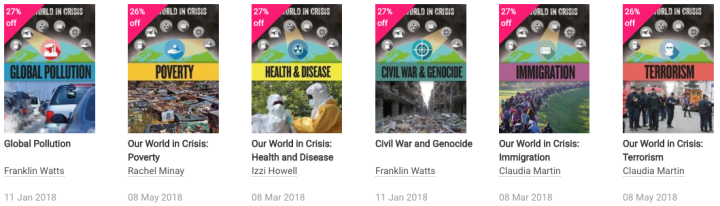
Rebecca Sjonger has written a new series of books around the UN Sustainable Development Goals which combines goals and is an overview. I’d argue that’s a good beginning, but actually each goal merits a well researched, curated and presented book for each of the different levels of education. Our world in Crisis is another recent series that covers pollution, poverty, health & disease, civil war & genocide, immigration and terrorism in an age appropriate but informative way.

Our world in Crisis

So there is a huge amount of hope and great steps in the right direction. But if we want to keep middle graders curious and inquiring beyond the hook of picture books, we need to keep feeding them nonfiction of this high calibre in all and any direction they want to research further.

I want it to be that the picture books are the appetiser and a couple of Youtube videos are the amuse bouche but that excellent nonfiction books are the main course, supplemented by databases (for context) and news (for the latest updated information).

What are your favourite books to support understanding the SDGs in Middle School?

Enough windows – where are the mirrors?

I was prompted to think about this again with the publication of the White Ravens 2019 list at the Frankfurt Book Fair. The issue of increasing diversity in an international school setting is a complex one, and something I’ve written about at length in the past.

In English

There’s the linguistic diversity bit – collections of books in “Languages other than English” (LOTE) (that post is getting a bit long in the tooth and probably needs updating) a more up to date article featuring Jeremy Willette can be found here.  Though I do object to the phrase “mother tongue” the reality of many of our dual language students is that the language other than English medium at school could be that of either parent, but is often that of the father. So I prefer to refer to “home language”. In 2014/15 I went through somewhat an obsession on language, researching it to death, you can find some of the posts on that here. The one thing I would definitely add to this conversation is that unless the LOTE collection is updated regularly and championed by teachers and parents or a language based club, they often don’t earn back the investment in purchasing and the real-estate they occupy. So if you want to invest in a linguistically diverse collection you also have to invest in a mindset of pride in home language and a sense of ownership over the collection and its maintenance within that linguistic community.

The hardest part internationally is that issue ofnot our diversity . If you have a moment, please read that post. Students who are in international education often defy the traditional (North American) definitions of diversity. They are not poor, black, hispanic, urban, immigrants. That is not to say that it’s unimportant for our students to be exposed to stories of all these groups of people and more. In fact their privilege demands that they access poverty, racism, immigration and need through the windows of literature. But those versions of diversity are not mirrors for them. With a great budget we have no shortage of windows. It’s the mirrors we lack.

And again, when we have these diverse books, we still need teachers and librarians and students and parents who will read them and champion them. Students who will dare to take a book with a cover of someone who doesn’t look like them and read it. Families and languages

The thing with international students is their lack of homogeneity – something I encountered when looking at linguistic diversity. This table (from my 2015 research) speaks to some of the many variations. (Yes, in those days I also referred to MT /Mother Tongue). So one of the most important sources of mirrors for our students often is books in translation. Particularly for the “globetrotter” subsection of our students. Looking at the White Ravens list above doesn’t give me that much comfort I’m afraid.  The issue I have is that most of the books in 2019 are BANA originated (Britain, Australia/NZ & North America) with the exception of one from the Philippines and one from India.  2018 was a bit better (one from Romania, India, Ghana and Korea). The list is unwieldy, you can’t search by age group. And you can’t get a print out.

Some more sources of inspiration include the various IBBY organisations. Including USBBY – even though the criteria for inclusion on the list is includes:  Books that help American children see the world from other points of view; Books that provide a perspective or address a topic otherwise missing from children’s literature in the U.S; and Books that are accessible to American readers (where accessible can mean a multitude of things). Again, painfully it’s hard to get a simple list to down load – no I don’t want a pptx, or a bookmark, I just want a list to print out to buy from.  And IBBY UK. Their latest publication: Children’s Literature in a Multiliterate World looks to be particularly interesting. One lives in hope.

One of the many things that concerns me with all of this, is the emphasis on picture books. Don’t get me wrong, I’m a HUGE fan of picture books. But the over-reliance on translating picture books? It just adds a PB to the five F’s (food, fashion, festivals, folklore, and flags) of pretending we’re oh-so-international and inclusive.

The Global Literature in Libraries Initiative is more cause for hope. Particularly as they reach out and co-opt people in-situ to aid with their uncovering of local treasures.

In this diversity quest, one is often more of a sleuth than anything else. For example needing to have a look at awards like the Astrid Lindgren Memorial Award and then looking at names of authors and illustrators and seeing if any of their works are translated and available. And how sad it is that many of those authors and illustrators don’t even have a web presence? Isn’t that one way in which IBBY could assist them? Just like publishers have a page on their site for each of their authors couldn’t these nominated people each have some kind of a presence. And many of the links don’t even work.

The “and available” thing. Holy hannah publishers. Get with the global world please. Honestly it’s hard enough just getting to know about Australian and New Zealand and Canadian books, not even to mention anything that is not from USA or Britain. What ever happened to the whole “print on demand” movement. I could possibly understand why it’s hard to find picture books, but middle grade / young adult / junior fiction? Surely that’s not an issue?

How are the rest of you doing with your diversity collection? What “sells” to your students what do you need to work on promoting? Do your teachers gravitate to them / read them or do they need to be pushed?


Resist the list

I am convinced that there are generations of parents (and librarians) who think the main purpose of a librarian is to create age/grade related lists of books for students to read. When parent-teacher conference time comes around, if parents venture into the library and engage – as opposed to using us as a baby-sitting booth / place to drink coffee and wait / information-direction desk the one and only question they seem to have is “do you have a book list for Grade …”

So why don’t I have a book list for Grade …? When they allow me time to explain, and time to discuss their child(ren)’s reading needs – preferably with the child present these are the themes of the conversation:

What are your (their) favourite things in life?

I don’t start off with what books they like, because their parent(s) probably wouldn’t be having a conversation with me if they liked books or reading. But if I can get a feeling for what kind of person they are, I can start to think what kind of books may be an entry point to intersect with their lives.

I’m very much a “there’s a book for that” type of person and my staff always jokes with me that they can’t have a conversation with me without walking away with a “book for that”.  If a student likes gaming, we have gaming books. If they like art and they’re EAL (English as an additional language) I have no problem recommending starting with some of our fabulous wordless books, picture books or graphic novels. And I’m happy to discuss how sharing a (sophisticated or even just funny) picture book together is a way better and more productive use of time than forcing a child to plod through Shakespeare or whatever classic the parent loved when they were young.

Reading, like physical activity and learning, has to leave the person with the desire for more. The feeling that they’d like to keep doing this for a long, long time. Forever in fact. If we make them hate it now, we’re f*’d as a human race.

How much can you read?

This is a little open-ended. It’s a combination of the dreaded “reading level” and how much physical time they have for reading.

We have a lot of EAL students in our school. With very ambitious parents. Who are often well-meaning but misguided. During my 16 years in Asia, I have always been astounded at the high level of education and knowledge my Asian counter-parts have. Newly minted in Asia I had no idea of the classic / foundational texts of their countries / languages / cultures. They knew so much of the western foundational texts – Grimm, Shakespeare, Greek etc. Myths and Legends. I’m always humbled by this. However, they’re not helping their child when they insist that a child with a phase 2 EAL level reads Shakespeare in the original text.

I’ve not got much against Shakespeare (except inasmuch it’s part of the dead white male canon etc. etc.) and I have Shakespeare in my library in every form / format and level. And I’m happy to help these students to start with an abridged version, an illustrated version, a short story version, a graphic novel version. But when what they need is basic foundational functional language so they can survive and thrive in a classroom and canteen, honestly the Plantagenets is not going to help them.

Screen Shot 2019-10-06 at 09.26.20

reading

Having time for reading is another big issue. There is this romantic notion that all school-going children read for 20-30 minutes a day. You know all the charts … the funny thing is they all have exactly the same 1987 source, and it’s not even an accurate representation of what the article said – see * below.

I don’t know what your classrooms or homes look like, and I’m sure there are schools, classrooms and homes doing brilliantly on reading. Sustained reading. Uninterrupted reading. I fear the truth is otherwise. I suspect students spend a lot more time on Youtube for their learning. YouTube publishes some interesting statistics.  Of relevance is “YouTube is technically the second largest search engine in the world.” and “Average Viewing Session – 40 minutes, up 50% year-over-year”. If I had to put some money on what our students are watching most on YouTube, it wouldn’t be much to do with learning but rather they seem to spend a lot of time watching other students engaged in one kind of game or another.

I think if I had to ask a bunch of our middle-schoolers to preference-rank what they like to do, if reading wasn’t on the list, it wouldn’t even be mentioned. If it was on the list, except for maybe 5-10% of the students it would be way down at the bottom.

So this part is a little about whether the student is able and willing to make time in the day to read, and based on the little perceived time they have, what they could read.

I usually tell students that if they truly are reading every day, they should be able to get through at least a book a week. So the converse is also true. What size, format or type of book can I pair with this student that would guarantee they’d actually finish it in a period of time that will allow the book to remain meaningful?

We have this illusion that if only we could find the “right” book, a student will just want to read it non-stop and then will be converted to reading for life. I don’t think that is true. I think we need to find a succession of books that students will be successful with so that they can build up some kind of reading stamina that will result in them being “good enough” readers so they can be successful academically. And if we’re lucky they’ll pick up a book again after they leave school.

What are your friends reading?

The need to belong is second only to the need to breathe for teenagers. There are glorious moments when we can ride on the wave of “it” books (yes, like Harry Potter). Where there is a buzz around a book or an author that makes it possible for us as librarians to just ensure we have enough copies and that we get out of the way of the stampede to the check-out desk. And make sure we have enough read-alike lists.

That, for teenagers may be the critical bit – the herd immunity thing. Having a critical mass of “cool” students who are readers, who then infect the rest.

My only compromise to lists is having students recommend to each other. Before, when I was in primary and could see each class each week, I had a list per grade. Now, I’ve convinced one grade (6) to make a list as a gift to the incoming class.

What is your teacher reading (aloud) to you?

If only, if only. And when a teacher starts a habit of reading aloud to a class I can guarantee that book will become the favourite of just about every child in that class. Bonus points if the book is the first in a series, because they’ll then rush to complete the series independently.

I’m just going to put out a plug again for the Global ReadAloud. I’ve curated the resources for this year’s books in a Libguide. It’s not too late to start.  It’s never too late to start. Just read. Or read and connect. Read now, with the current great list of books. Or read some of the books from previous years. Or read this year’s books now and other books from previous years later. Honestly it doesn’t take much time. I’m reading aloud each morning from Front Desk before school to a small group of students. We have about 10-15 minutes and get through a chapter or two/three depending on the length of the chapter and what else we do / discuss around it.

Screen Shot 2019-10-06 at 10.46.53

And this is where I tell parents that if all else fails they should read to-and-with their student. Even if they’re 14. And I tell them how we still read aloud to our IB-level child who also doesn’t like reading. And they look askance at me. Or they make apologies for their own poor reading – and I tell them that’s exactly why they should be reading with their child. As an empathy building exercise. As a gesture of solidarity and understanding that it is not perhaps easy, but it is important. Important enough that we both spend time on this.

Lists are easy to make. Easy to ignore. Conversations are harder, take more time, but potentially have more value. What do you do in your schools / libraries?

————————————————————————————————————————————

*This is where things get very interesting – I went back to the original article and it says nothing like what the posters say … it’s about vocabulary acquisition and learning new words based on context (nothing about standardised tests!). AND they’re talking about students reading 15 minutes IN SCHOOL, plus out-of-school reading of newspapers, magazines and comic books. So the sum for an “average” 5th grader is:

600,000 words in school; 300,000-600,000 words out of school = +/- 1 million words

I doubt the average fifth-grader is reading anything near that amount in or out of school.

” Though the probability of learning a word from context may seem too
small to be of any practical value, one must consider the volume of reading
that children do to properly assess the contribution of learning from context
while reading to long-term vocabulary growth. How much does the average
child read? According to Anderson, Wilson, and Fielding (1986), the
median fifth-grade student reads about 300,000 words per year from books
outside of school; the amount of out-of-school reading increases to about
600,000 words per year if other reading material such as newspapers,
magazines, and comic books are included. If a student read 15 minutes a
day in school (see Allington, 1983; Dishaw, 1977; Leinhardt, Zigmond, &
Cooley, 1981) at 200 words per minute, 200 days per year, 600,000 words
of text would be covered. Thus, a rough estimate of the total annual
volume of reading for a typical fifth-grade student is a million words per
year; many children will easily double this figure. Reanalysis of data
collected by Anderson and Freebody (1983), using information on the
frequency of words in children’s reading material from Carroll, Davies,
and Richman (1971), indicates that a child reading a million words per
year probably encounters roughly 16,000 to 24,000 different unknown
words.
How many words per year do children learn from context while reading,
then? Given a .05 chance of learning a word from context, and an average
amount of reading, a child would learn approximately 800-1,200 words
well enough to pass fairly discriminating multiple-choice items.
These numbers are at the low end of the range that we have previously
estimated (Nagy, Herman, & Anderson, 1985; see also Nagy & Anderson,
1984), because of the lower estimate of the probability of learning a word
from context and a more conservative estimate of the number of unknown
words encountered during reading. Yet, the figures suggest that incidental
learning from written context represents about a third of a child’s annual
vocabulary growth, an increase in absolute vocabulary size that has not
even been approached by any program of direct vocabulary instruction.

Nagy, W., Anderson, R.C., & Herman, P. (1987). Learning word meanings from context during normal reading. American Educational Research Journal, 24, 237–270

Content plus

One regularly hears phrases bandied around schools such as “Every teacher is a language teacher”; or “Every class should start with 10 minutes of reading” and you’d be hard pressed to find a teacher who doesn’t agree in theory, that reading is a good thing. But then there is the “reality” of supposed too little time, too much pressure, too much content to cover and the theory of reading becomes such an abstract notion that there isn’t even a consideration of how it could be implemented.

Last week-end, Katie Day and myself gave a 90 minute presentation to around 100 educators at the Neev Literature Festival titled “Books & Beyond”. You can find a copy of the presentation here as well as other resources.

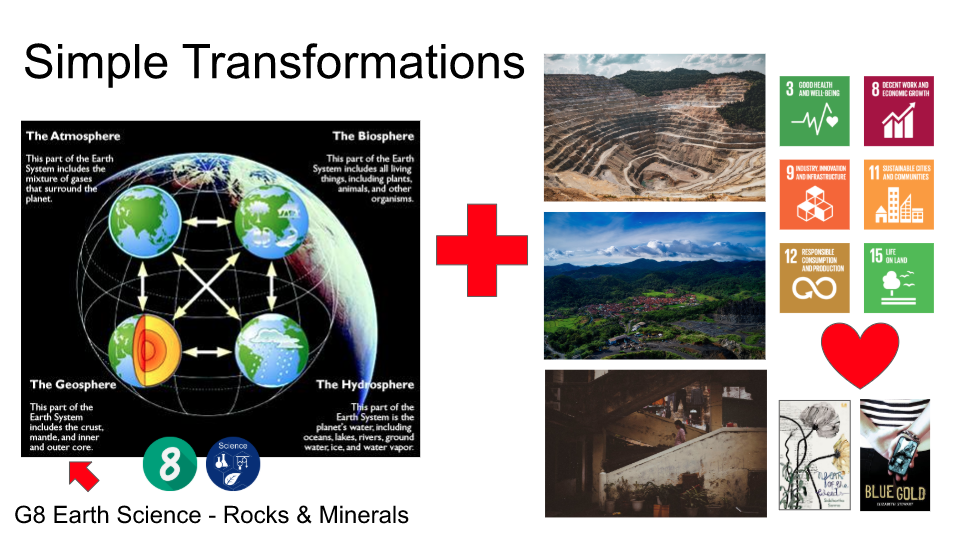
We’re on break now, and when we get back I was asked to present to our HODs for a few minutes on integrating reading into units in the middle school. I’ll probably just show this one slide:

I’d call it “content plus” – it’s from a G8 Earth Science unit that the Science team and I put together at the end of last year and they’re teaching now.

The idea is that you still have the science content as core to the unit – in this case Earth Science and learning about Sedimentary, igneous and metamorphic rocks and the minerals they contain and mining and the  products of mining. But to that you add the environmental and human impact, and the lens of the SDGs (Sustainable Development Goals).  And in order to help build empathy and understanding, add some literature.

Katie also had the brilliant idea, that she’s implemented in her school (and I’m going to be following quickly behind!), of getting good, relevant articles, stripping off the advertising etc (she uses Safari Reader View; I use Mercury Reader) putting them in binders and making them available in the library and classrooms – see slides 42-47).

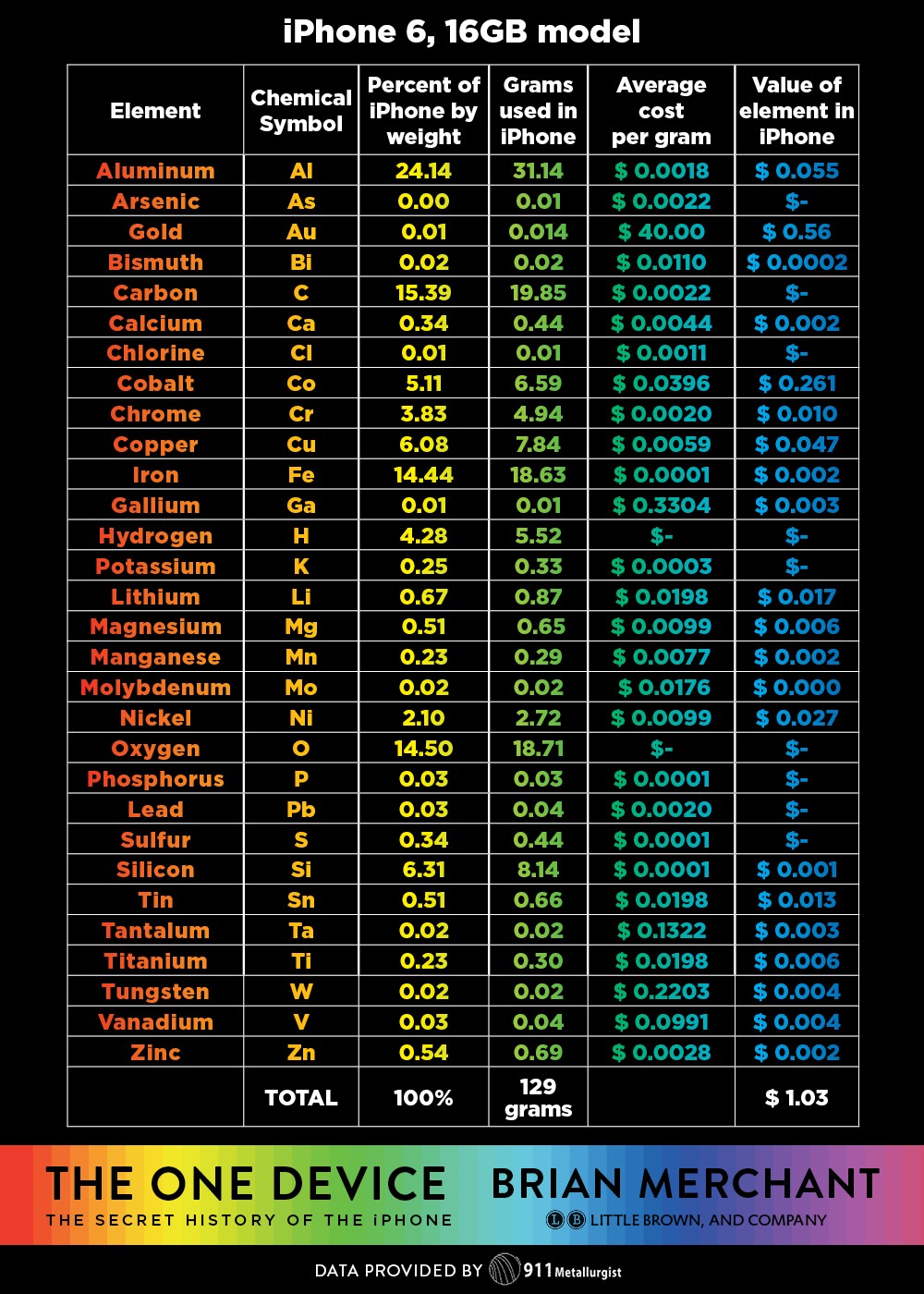
You can of course choose any minerals, but in this case to make it relevant to G8, we focused on the primary elements of an iPhone.


iPhone ingredients

Ideally, and this takes time, some of the science and or math units would be linked to Language & Literature or Individuals & Societies units allowing more time to explore literature.

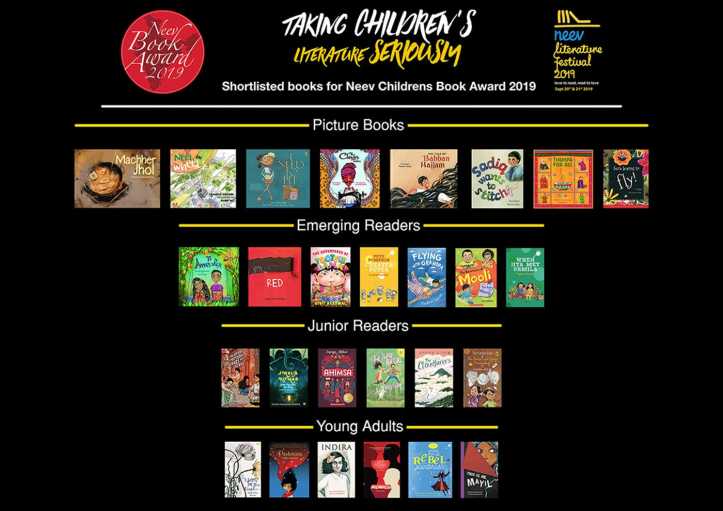
In the mean time, one of the wonderful ways of adding literature into units is through picture books. In the guide we created for the Neev Festival, we made suggestions around groupings of the SDGs of the Neev shortlisted picture books plus lots of other books. It’s still a work in progress, but over time I’m hoping that for each and every global goal I have 10-20 picture books, (as well as 10-20 fiction books and 10-20 really good nonfiction books) that can easily and quickly be introduced to a class, thereby adding a very special element to learning, and truly making “every teacher a language teacher” and every teacher able to devote a tiny slice of their class to reading.

Why awards?

This week’s blog post will be very brief as a function of my extreme exhaustion – just been up and down to Bangalore for the Neev Literature Festival 2019. Beijing-Bangalore is not a commute I’d recommend to anyone who prizes their sleep or sanity but WOW what an intense 2 days it was.

The theme this year was “Taking Children’s Literature Seriously” and I’ll write a bit more about the rest of the festival another time.

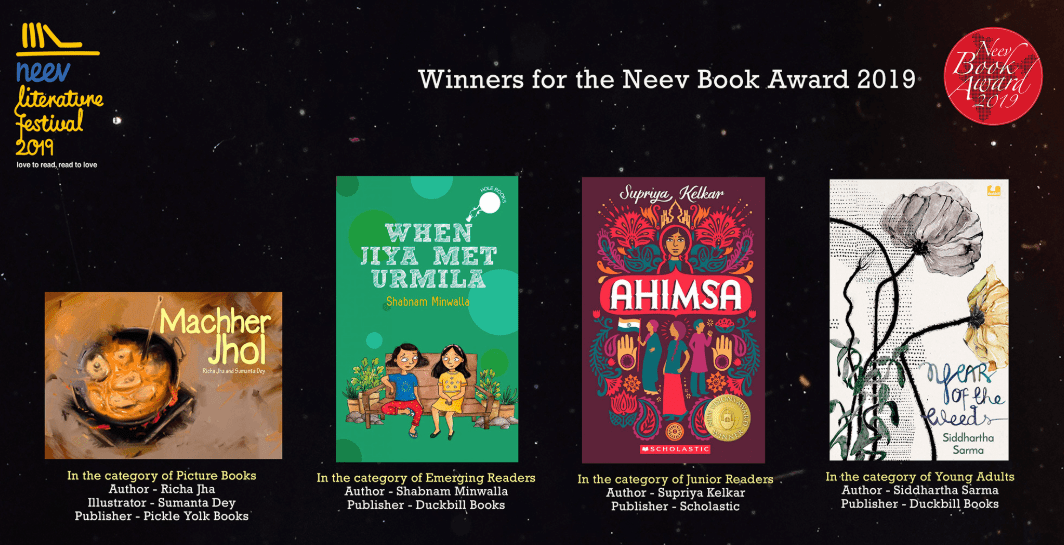
For now I just want to highlight the winners:

Screen Shot 2019-09-22 at 20.11.30

After a year of reading the long lists and short lists in four categories the awards were announced on Saturday for this year’s winners. I must say it was a surprisingly emotional moment even for me just as one of the jurors, I can’t imagine what it must be like for the authors!

There’s been a bit written recently about literary prizes – “Who Cares about Literary Prizes” is a wonderful article combining the idea of “canon” and popularity in this context with some very cool data representation. Book Prizes, the more the merrier, and A guide to the most prestigious prizes.

Book buyers, librarians, teachers, parents tend to rely on a fairly narrow range of sources for their book purchasing decisions. One of those is lists, and the other prize winners (and often lists of prize winners). In this context the existence of speciality or niche book prizes is incredibly important to shed light on otherwise neglected corners of excellent children’s literature.

Since Ahimsa is already relatively well known in international children’s literature circles, I’m going to just put in a few words about the other three books.

Machher Jhol is a richly illustrated book showing the journey of a young boy through the roads of Kolkata to get the ingredients for a fish stew for his father. There is a wonderful twist to this tale that will make it beloved of any class looking for books on resilience.

When Jiya met Urmila is written for that space of emerging readers where very few authors manage to successfully tell a great story but make the writing accessible to the beginning reader. The story gently probes how segregated childrens’ lives can be.

Year of the Weeds is one of those books that I can see becoming part of a canon of middle grade / young adult books that are used in the classroom to promote thinking about globalisation, sustainable development goals of economic growth (8); industry and infrastructure (9); sustainable cities and communities (11) responsible consumption and production (12); and Life on land (15) – while still being an excellent read.   The link above goes to a very interesting interview with the author.

neev awards.jpg

Another thing that awards do – reward publishers for taking chances on genres, topics and authors.  This year Duckbill publishers had two award winning books – here’s hoping they continue to bet on this calibre of writing AND even more importantly that their books get attention and distribution outside of India, because the world needs these books.

In response to requests – here is where to find the books:

Ahimsa

When Jiya Met Urmila

I will be sharing an email to contact if you are interested in buying the short-list or finalists in multiple copies.

In addition if you’re interested in other books:

Here is the short list:

Here is the complete LongList nominated by Indian publishers


How to WINN in the new school year

Part of my vacation time is usually spent doing personal learning and preparing for the new year for both my students and for how I can impact teaching and learning for teachers. Last year was my first in a new environment – both in terms of level (middle school rather than primary) and country/school (Beijing, China). This year I’m preparing with somewhat more hindsight and the fact that we have 12 new teachers starting. This post I’m going to focus more on how I hope to support teachers.

Last year, my predecessor very kindly typed up a long list of answers to my 100s of questions to help guide me in the new position. It’s something I refer to from time to time even further into the year. This year I compiled a “newbies” guide with the help and input of all my fellow (last year) new teachers, and the rest of the staff on the nitty-gritty things that we wish we’d known before starting. We sent it out into the world and based on the feedback added additional information. It seems to have had some success with 1,282 views since it was created in May. But it’s a lot of information to digest.

Today I stumbled on the videos (and book) of Nick Shackleton Jones via a tweet on a blogpost of his (yes, rabbit hole – but this time a good one). This has definitely changed my whole view on how to approach supporting teachers, and perhaps even how to work with students.

A brief summary of the takeaways of the videos

Part 1 – distinguish between content dumping (my newbie Libguide – and other Libguides) and performance support. In order to give performance support you need to understand / analyse what people are trying to do and provide resources that have DESIGN & UTILITY.

Find out from your audience WHAT I NEED NOW (WINN).

Part 2 – this session is particularly interesting for on-boarding and knowledge sharing. The basic elements are things that people need immediately (how to use the computer); advice from peers, understanding how things connect together; factsheets; one page guides; checklists.

Part 3 – discusses the affective (emotional) context of learning and how to alternate between providing resources (when the audience has a strong emotional response to the information) and experiences (when the emotional response / interest is lower). The 5Di design process is introduced (define, discover, design, develop, deploy & iterate). Of particular use in my context was the CONCERN-TASK-RESOURCES model. I think that is a great way of deciding what resources to focus on by working out the concerns of the audience, relating them to tasks and then providing the resources that can help with the tasks.

I can see this working really well for designing learning experiences for our Day 9s to ensure that they are student need rather than teacher driven.

So, what I thought I’ll do is during the newbie week and first week of teachers back have daily debrief sessions on a pop-in or digital basis called WINN where teachers can quickly and briefly address what their concerns or tasks are that they need immediate help with and to build up the resources they need. Pop in is easy enough, for the digital I’m thinking of using our “ask” function of Libguides that I just started populating at the end of last year, so that the questions can accumulate into a knowledge database.

========================

Here is a longer video on “how people learn” worth the 29 minute investment – and a link to the book “How People Learn : Designing Education and Training that Works to Improve Employee Performance” I have a small gripe on the “employee performance” part of the subtitle – as I think it’s pretty universally applicable – but I guess that’s his background.

Header Photo by Felix Staffler from Pexels

Trust me I’m a …

I’ve had this vague feeling ever since I started in the middle school that I’m just not serving my population well on the research side of things. I’ve tried putting my finger on it in the past but the unease has been growing. It started with being dissatisfied with nonfiction and that we’re not doing enough to uncover what research really looks like. I’ve not blogged much this year – partly due to having a lot on my plate with moving schools and school section, but also by choice since there’s just been so much to process and I’m not sure if writing it would be the best option.

It’s now near the end of May and my unease has not abated. A few things are going much better – I’m slowing getting some more collaboration going between the library and the various subjects. Which in some ways leads to more soul searching on how to best serve our students. I think I’m beginning to better understand the problem, not that I’m any closer to a solution. danah boyd gave yet another amazing talk recently and here is the transcript: “Agnotology and Epistemological Fragmentation” – bigger words than I’m accustomed to blogging on, but please indulge me and read the link, as it’s a good, albeit scary read. In particular what struck me was her discussion of the “data void” because that is exactly the description for what I’m experiencing as a middle school librarian.

In primary life was relatively easy – students had their passions – dinosaurs and trucks and kittens and ocean life and their inquiries, the rainforest, energy, etc. and I had a plethora of resources, mainly print books that could explain things in a simple yet clear and age appropriate way.

My latest existential crisis is the result of a rather good collaboration with G8 Biology, where we’re trying to take some biological understanding of cells and make it relevant to your average 13/14 year old in the throes of puberty where everything is more interesting than cellular details. So the idea was to try and help them examine what’s going on at a cellular basis when they indulge in typical teen behaviour – eating, drinking, going to the spa, putting on sunscreen, using makeup, experimenting with alcohol or smoking/vaping, dyeing their hair etc. I’m gathering some basic background information in a Libguide so that they don’t get bogged down in a google blackhole.

But that pulls me into the rabbit hole instead as I try to find scientific information. With the teachers we’d already decided that any books we had were largely irrelevant content detailed and superceded by better online models and information. But what we needed now was good information tailored to the unit.

I started with what I thought would be something relatively simple – deodorants – nothing could be further from the truth. On the one hand you have Dr. Mercola, and his ilk, countless hysterical “health” bloggers; Huffington post and on the other, the 200 page report on the matter from the EU scientific commission. Then there was the Doctor in the Harvard review (via Credo) answering questions posed by her daughter and her daughter’s friends and her mother and neighbour. With some pretty definitive answers, but not a citation or reference to back up her views. I don’t think so. So I had to eliminate that as a potential source – Harvard or not, Doctor or not.

As boyd so perfectly puts it “One of the best ways to seed agnotology is to make sure that doubtful and conspiratorial content is easier to reach than scientific material. YouTube is the primary search engine for people under 25. It’s where high school and college students go to do research. Digital Public Library of America works with many phenomenal partners who are all working to curate and make available their archives. Yet, how much of that work is available on YouTube?

I had a similar problem when I was trying to find some nonfiction books on vaping and e-cigarettes – the books were merely adequate. In particular I was interested in at least one chapter, or even a page that dealt with the science of nicotine / of what’s going on in the lungs, the science. A few good images that didn’t just include pictures of the hardware of vaping! But there isn’t anything.

Where does that leave us as teachers and teacher librarians? Caulfield, who I highly respect for his work on information literacy, has come up with an alternative to CRAAP – SIFT

  • (S)TOP
  • (I)nvestigate the Source
  • (F)ind better coverage
  • (T)race claims, quotes, and media back to the original context

It makes sense, I liked it, but it sat a little uneasily with me, and after reading boyd, I understand why. What happens when you’re going through SIFT and you get to the F and find that there is no better coverage? This can be due to a number of reasons –

  • The gap between what is accessible at your level of understanding / education / language /
  • the preferred mode of access gap (see the comment on YouTube earlier)
  • the void between what I would call the “Goop press” (see this, and this) and science journals.
  • The chasm between what student friendly sources publish and what students are actually researching – anyone find anything really good on micro-plastics recently? – Not in any of the databases my school subscribes to…
  • The fact that even the most intelligent and well meaning teacher in my environment is loath to consider allowing students to use wikipedia (that will be a whole blog post on its own)

You will not achieve an informed public simply by making sure that high quality content is publicly available and presuming that credibility is enough while you wait for people to come find it. You have to understand the networked nature of the information war we’re in, actively be there when people are looking, and blanket the information ecosystem with the information people need to make informed decisions (boyd).

In the mean time, I’m encouraging my teachers and students to use Beers & Probst’s Notice and Note for Nonfiction. At the very least I’m hoping that using it will give them a sense of unease. Of uncertainty, of wondering if what they are reading can be believed, and if not that if not now, at some point they’ll continue to mull over the topic and eventually be able to research it further, and if necessary change their minds or opinions on what they learnt back when they were in G8.

Does Activism require Power?

One of my most popular blog posts was “Advocacy is not enough we need power” and I still stand by that. Ironically enough in my new role I am teacher librarian slash Edtech integrator, and I like to joke with my colleagues who need anything from data to access to fixing an issue to equipment that “I have the power”. But some stuff fluttering around twitter recently has made me wonder about librarians and power and about power in general.

In particular I think something amazing is happening in university librarian land with the ending of negotiations with Elsevier by UC – and the person in the cape is a librarian! But here is the strange thing – @Jmmason is getting three likes (plus mine) and two retweets on his guide for transitioning journals to open access.

Is this a case of “if a tree falls in a forest”? Where are all the OA activist librarians? Where even are all the “whinging about costs” librarians?

I like to follow a wide variety of people and Chris Bourg is one of my “go to” activist librarians. We need so much more of this ilk. But then I wondered about whether activism could exist in a vacuum of power. At the same time I know that power can both be given or assumed.

Most librarian groups now seem to have migrated to Facebook. Which is ironical because if we were better librarians and better curators we would not base the existence of our professional learning networks on a platform where groups are closed, information gets lost and the same questions are repeated ad-infinitum (see rant here). And judging by the posts we’re pretty good at complaining and most of the complaints (I’m talking the K-12 sector) are about budgets, job loss (or more accurately position loss as in “an unqualified teacher will do the library next year), or lack of acknowledgement. These are not the bleatings of people with real or perceived power.

The question is who can become activists? On the one hand you have people like Bill and Melinda Gates (see their annual letter, and particularly the bit about data can be sexist) who have the power. On the other you have people with next to nothing to lose. And then there are all the rest of us status quo huggers.

I say “us” deliberately, because I’m complicit. I think of a few things that we need to get activist about – some in the cost sphere, some in the service sphere (FollettDestiny are you listening) where we need to get organised, we need to share cost and pricing data but we don’t. Is it time? Is it being contractually bound to silence? Is it not wanting to be the tall poppy? Definitely in the diverse and relevant resource sphere as international school librarians we need to be in a constant state of outrage. And then there is the whole literature / translation thing going on – or not. Thanks to GLLI it’s moving in the right direction – albeit slowly and again why don’t they have tens of thousands of followers?

So we are librarians, a marginalised group within a sector in most countries (and in particular in many parts of the mighty trend setting US or A) that is marginalised economically, is it strange that you don’t encounter many activist librarians?

No use me merely complaining – What would my suggestions be to become an activist librarian?

  • Uncompromising values and standards
  • Unite, collaborate, be present
  • Champion diversity

Uncompromising values and standards

This is both personal and global. If you’re a qualified librarian be amazing at what you do and if you’re mediocre work on becoming better. If you’re amazing become even better and make sure you’re sharing and mentoring other librarians – and not just in your local network – we need more mentoring programs for regions where library science is under-represented.

And let’s not start on the levels above – the funding for library positions in schools and for university library programs. Who gets admitted into the library programs – are they taking the best of the best? Or the ones who want to get out of teaching for an “easy ride”?

It’s a bit the Finland / Singapore argument (to dig up an old trope) – well paid professions attract professionals.

Unite, collaborate, be present

Unite here not just to complain but unite in action. Collaborate and if necessary collude on matters that matter for knowledge, deep education, and investigation. Be present in the discussions and arguments. If you are not the leader be the first or subsequent follower.

If you’re a librarian in an international school join IntlLead a platform run by and for librarians not affiliated to any organisation.

Find examples of activism in other fields / areas that you can learn from or latch onto or use as examples.

Champion Diversity

I’m not just talking about #WeNeedDiverseBooks (see Meting out Diversity?). We also need diverse knowledge. Is that an oxymoron? And we need to personally be critical about what passes as knowledge and pass that critical stance on to our students. AT ALL LEVELS – not just when they’re in High School or doing TOK. Our G5 students need to know the information they consume for their PYP Exhibition is biased and deficient and that they can and should be adding to this from their cultural or geographical or linguistic perspective. We need to help publish. We need to interrogate the authors we invite to our schools on what they are doing to mentor and encourage no-name-brand authors in our locale, theirs, where they are appropriating stories for their books or elsewhere (and not just those who can afford expensive workshops). We need to invite speakers who do not repeat what we think we know but who challenge our assumptions.

Knowledge is biased

Look at this. As librarians are we passing on our outrage to our students? Do we follow sites like @WhoseKnowledge and tell our students to check the origins of what they’re reading? And that they whole darn point of learning and research is to make your own contribution to the world of knowledge and end this microscopic world view?

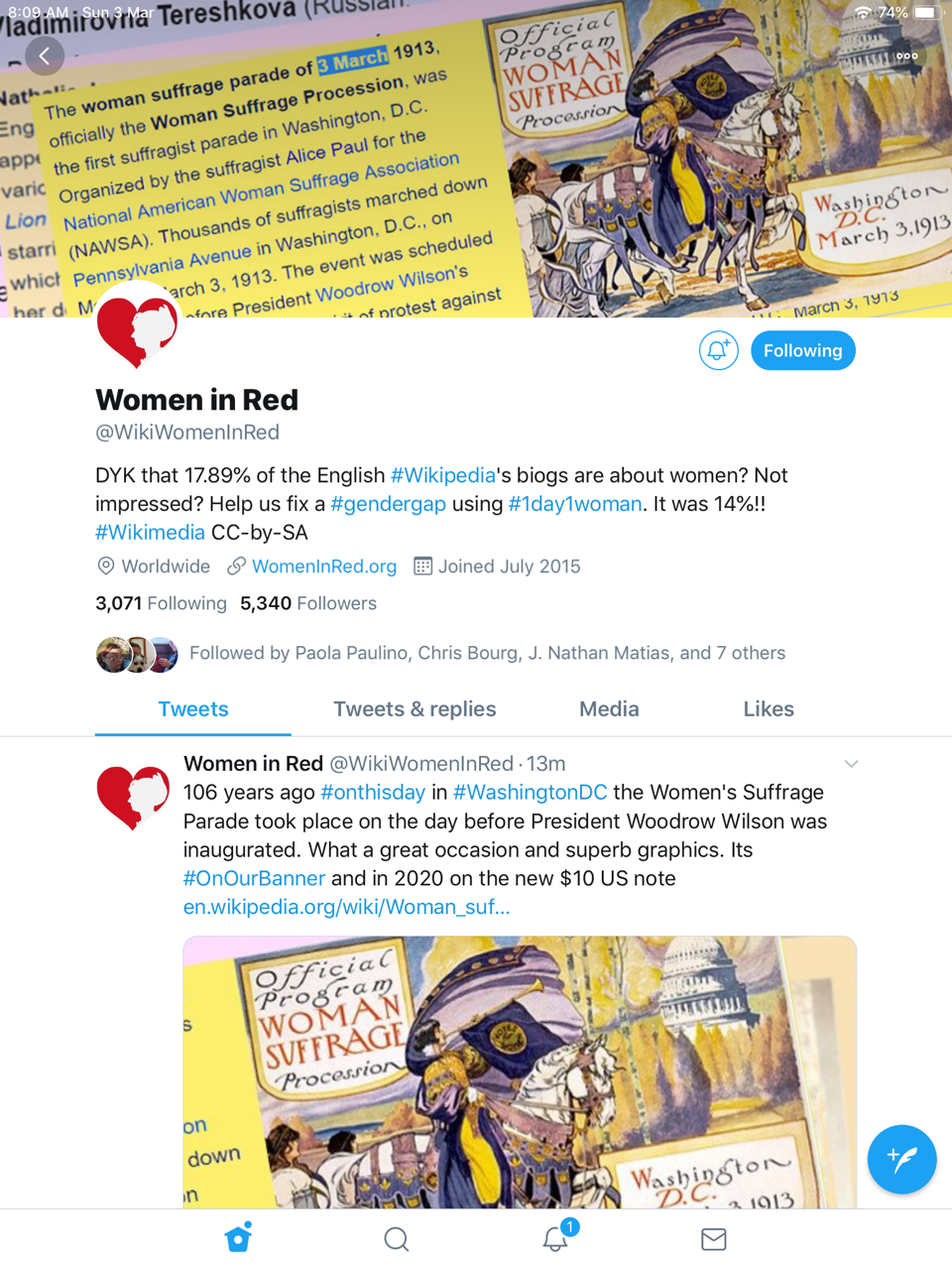
Here’s another one worth letting your students and fellow librarians know about – @WikiWomeninRed 

I don’t know how to end this. Just keep on being angry or outraged. And do something positive with that anger.