Introduction
This report documents a Comparative analysis of social networking tools and technologies for International School librarians in Asia. The case study research methodology – defined as “examining contemporary phenomenon within its real-life context … and it relies on multiple sources of evidence” (Yin, 2003, p.13, cited in Shanks and Bekmamedova, 2013, p. 174) was employed in a critical paradigm <!–[if supportFields]> ADDIN ZOTERO_ITEM CSL_CITATION {“citationID”:”ZtjKUW0T”,”properties”:{“formattedCitation”:”(Shanks & Bekmamedova, 2013)”,”plainCitation”:”(Shanks & Bekmamedova, 2013)”},”citationItems”:[{“id”:750,”uris”:[“http://zotero.org/users/1210720/items/RHPEFQVA”%5D,”uri”:[“http://zotero.org/users/1210720/items/RHPEFQVA”%5D,”itemData”:{“id”:750,”type”:”chapter”,”title”:”Case study research in information systems”,”container-title”:”Research methods: information, systems and contexts”,”publisher”:”Tilde Publishing and distribution”,”publisher-place”:”Prahran, VIC”,”page”:”172-187″,”edition”:”First edition”,”source”:”Library of Congress ISBN”,”event-place”:”Prahran, VIC”,”ISBN”:”9780734611482″,”call-number”:”Q180.55.M4 R4734 2013″,”author”:[{“family”:”Shanks”,”given”:”Graeme”},{“family”:”Bekmamedova”,”given”:”Nargiza”}],”issued”:{“date-parts”:[[“2013″]]}}}],”schema”:”https://github.com/citation-style-language/schema/raw/master/csl-citation.json”} <![endif]–>(Shanks & Bekmamedova, 2013)<!–[if supportFields]><![endif]–> in order to critique the status quo.
The first part of this study investigated the academic school and teacher librarian environment in Asia. This was followed by cataloguing the various networks available to school librarians and the social networking tools and technologies employed. A visual mapping of the relationships between social and professional networks and libraries, schools, school libraries, countries, regions and curricula was made. Finally, school librarians were surveyed on their participation in online social networks.
The report concludes with a critical analysis of the social networking tools and technologies and their participants with some recommendations for professional network organisations and for individual librarians.
Social media, networking, technologies and tools
According to Kaplan and Haenlein (2010) Web 2.0 provides an “ideological and technological foundation” (p.62) for social media to exist while it is user-generated content (UGC), which defines it. Social media tools allow users to create, add, revise and change content (wiki, blog, forum, mashups, podcasts), tag and rate (social booking marking), curate (aggregators, RSS), maintain or build relationships or networks (Facebook, Google+, LinkedIn) and share content (text, video, photo etc.). When one adds in collaboration with others in online communities, social networking arises. <!–[if supportFields]> ADDIN ZOTERO_ITEM CSL_CITATION {“citationID”:”1fbvvjvgvd”,”properties”:{“formattedCitation”:”(Brouns et al., 2011; Kaplan & Haenlein, 2010)”,”plainCitation”:”(Brouns et al., 2011; Kaplan & Haenlein, 2010)”},”citationItems”:[{“id”:764,”uris”:[“http://zotero.org/users/1210720/items/ZG93QZCD”%5D,”uri”:[“http://zotero.org/users/1210720/items/ZG93QZCD”%5D,”itemData”:{“id”:764,”type”:”article-journal”,”title”:”A survey on social network sites to determine requirements for learning networks for professional development of university staff”,”container-title”:”International Journal of Web Based Communities”,”page”:”298″,”volume”:”7″,”issue”:”3″,”source”:”CrossRef”,”URL”:”http://www.inderscience.com/link.php?id=41200″,”DOI”:”10.1504/IJWBC.2011.041200″,”ISSN”:”1477-8394, 1741-8216″,”author”:[{“family”:”Brouns”,”given”:”Francis”},{“family”:”Berlanga”,”given”:”Adriana J.”},{“family”:”Fetter”,”given”:”Sibren”},{“family”:”Rijpkema”,”given”:”Marlies E. Bitter”},{“family”:”Bruggen”,”given”:”Jan M. Van”},{“family”:”Sloep”,”given”:”Peter B.”}],”issued”:{“date-parts”:[[“2011″]]},”accessed”:{“date-parts”:[[“2013″,12,30]]}},”label”:”page”},{“id”:763,”uris”:[“http://zotero.org/users/1210720/items/4G8GGMQ8″%5D,”uri”:[“http://zotero.org/users/1210720/items/4G8GGMQ8″%5D,”itemData”:{“id”:763,”type”:”article-journal”,”title”:”Users of the world, unite! The challenges and opportunities of Social Media”,”container-title”:”Business Horizons”,”page”:”59-68″,”volume”:”53″,”issue”:”1″,”source”:”CrossRef”,”URL”:”http://linkinghub.elsevier.com/retrieve/pii/S0007681309001232″,”DOI”:”10.1016/j.bushor.2009.09.003″,”ISSN”:”00076813″,”author”:[{“family”:”Kaplan”,”given”:”Andreas M.”},{“family”:”Haenlein”,”given”:”Michael”}],”issued”:{“date-parts”:[[“2010″,1]]},”accessed”:{“date-parts”:[[“2013″,12,30]]}},”label”:”page”}],”schema”:”https://github.com/citation-style-language/schema/raw/master/csl-citation.json”} <![endif]–>(Brouns et al., 2011; Kaplan & Haenlein, 2010)<!–[if supportFields]><![endif]–> “The main idea underlying collaborative projects is that the joint effort of many actors leads to a better outcome than any actor could achieve individually; this is similar to the efficient-market hypothesis in behavioral finance” <!–[if supportFields]> ADDIN ZOTERO_ITEM CSL_CITATION {“citationID”:”BzA5IK61″,”properties”:{“formattedCitation”:”(Kaplan & Haenlein, 2010)”,”plainCitation”:”(Kaplan & Haenlein, 2010)”},”citationItems”:[{“id”:763,”uris”:[“http://zotero.org/users/1210720/items/4G8GGMQ8″%5D,”uri”:[“http://zotero.org/users/1210720/items/4G8GGMQ8″%5D,”itemData”:{“id”:763,”type”:”article-journal”,”title”:”Users of the world, unite! The challenges and opportunities of Social Media”,”container-title”:”Business Horizons”,”page”:”59-68″,”volume”:”53″,”issue”:”1″,”source”:”CrossRef”,”URL”:”http://linkinghub.elsevier.com/retrieve/pii/S0007681309001232″,”DOI”:”10.1016/j.bushor.2009.09.003″,”ISSN”:”00076813″,”author”:[{“family”:”Kaplan”,”given”:”Andreas M.”},{“family”:”Haenlein”,”given”:”Michael”}],”issued”:{“date-parts”:[[“2010″,1]]},”accessed”:{“date-parts”:[[“2013″,12,30]]}}}],”schema”:”https://github.com/citation-style-language/schema/raw/master/csl-citation.json”} <![endif]–>(Kaplan & Haenlein, 2010, p.62)<!–[if supportFields]><![endif]–>.
<!–[if supportFields]> ADDIN ZOTERO_ITEM CSL_CITATION {“citationID”:”QQO6nd4a”,”properties”:{“formattedCitation”:”{\\rtf (D\\uc0\\u8217{}Andrea, Ferri, & Grifoni, 2010, p. 7)}”,”plainCitation”:”(D’Andrea, Ferri, & Grifoni, 2010, p. 7)”},”citationItems”:[{“id”:673,”uris”:[“http://zotero.org/users/1210720/items/DE36P3AJ”%5D,”uri”:[“http://zotero.org/users/1210720/items/DE36P3AJ”%5D,”itemData”:{“id”:673,”type”:”chapter”,”title”:”An Overview of Methods for Virtual Social Networks Analysis”,”container-title”:”Computational Social Network Analysis”,”publisher”:”Springer London”,”publisher-place”:”London”,”page”:”3-25″,”source”:”CrossRef”,”event-place”:”London”,”URL”:”http://www.springerlink.com/index/10.1007/978-1-84882-229-0_1″,”ISBN”:”978-1-84882-228-3, 978-1-84882-229-0″,”editor”:[{“family”:”Abraham”,”given”:”Ajith”},{“family”:”Hassanien”,”given”:”Aboul-Ella”},{“family”:”Sná¿el”,”given”:”Vaclav”}],”author”:[{“family”:”D’Andrea”,”given”:”Alessia”},{“family”:”Ferri”,”given”:”Fernando”},{“family”:”Grifoni”,”given”:”Patrizia”}],”issued”:{“date-parts”:[[“2010″]]},”accessed”:{“date-parts”:[[“2013″,12,6]]}},”locator”:”7″,”label”:”page”}],”schema”:”https://github.com/citation-style-language/schema/raw/master/csl-citation.json”} <![endif]–>D’Andrea, Ferri, & Grifoni, (2010, p. 7)<!–[if supportFields]><![endif]–>, identified four main motivational categories that lead people to join Social Networks: Exchange Information, Social aspect, Friendship and Recreation, as outlined in the table below.
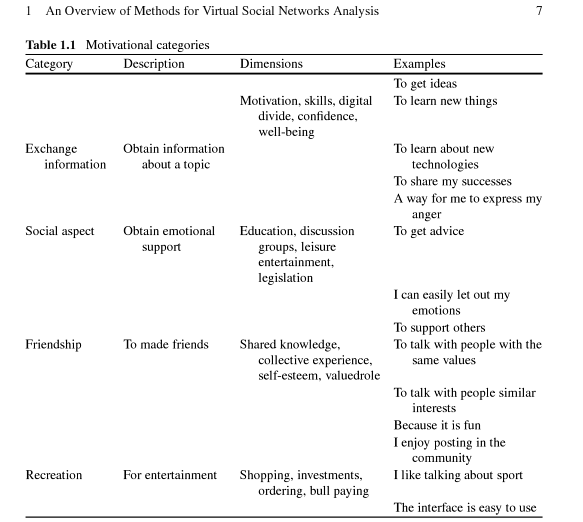 |
| Source: D’Andrea, Ferri, & Grifoni, (2010, p. 7), |
One type of social networking is the Personal Learning Network (PLN), “a group of people who are connected by shared passions or common interests, and who benefit from shared learning.” (LaGarde and Whitehead, 2012, p. 9). Learning is non-formal and contributes to professional development while the best sites make it easy to locate resources and information including people and content (Brouns et al., 2011) and combine the collective knowledge types as summarised by Hecker (2012, p.430).
 |
| Source: (Hecker, 2012, p. 430) |
Background Study
Asian International School Landscape
The Asian region covers over 48 countries <!–[if supportFields]> ADDIN ZOTERO_ITEM CSL_CITATION {“citationID”:”0E0BwxLc”,”properties”:{“formattedCitation”:”(Asia-Pacific Center for Security Studies, n.d.)”,”plainCitation”:”(Asia-Pacific Center for Security Studies, n.d.)”},”citationItems”:[{“id”:741,”uris”:[“http://zotero.org/users/1210720/items/83E7FB6V”%5D,”uri”:[“http://zotero.org/users/1210720/items/83E7FB6V”%5D,”itemData”:{“id”:741,”type”:”webpage”,”title”:”Countries of the Asia-Pacific Region”,”URL”:”http://www.apcss.org/about-2/ap-countries/”,”author”:[{“family”:”Asia-Pacific Center for Security Studies”,”given”:””}],”accessed”:{“date-parts”:[[“2013″,12,29]]}}}],”schema”:”https://github.com/citation-style-language/schema/raw/master/csl-citation.json”} <![endif]–>(Asia-Pacific Center for Security Studies, n.d.)<!–[if supportFields]><![endif]–> and over 3,200 languages from 28 linguistic families <!–[if supportFields]> ADDIN ZOTERO_ITEM CSL_CITATION {“citationID”:”vFYWF64T”,”properties”:{“formattedCitation”:”(United Nations Office for the Coordination of Humanitarian Affairs (OCHA), 2011)”,”plainCitation”:”(United Nations Office for the Coordination of Humanitarian Affairs (OCHA), 2011)”},”citationItems”:[{“id”:739,”uris”:[“http://zotero.org/users/1210720/items/WHVTCEI3″%5D,”uri”:[“http://zotero.org/users/1210720/items/WHVTCEI3″%5D,”itemData”:{“id”:739,”type”:”webpage”,”title”:”Major Language Families in Asia-Pacific [pdf file]”,”URL”:”http://reliefweb.int/sites/reliefweb.int/files/resources/OCHA_ROAP_Language_v6_110519.pdf”,”note”:”United Nations Office for the Coordination of Humanitarian Affairs (OCHA)”,”author”:[{“family”:”United Nations Office for the Coordination of Humanitarian Affairs (OCHA)”,”given”:””}],”issued”:{“date-parts”:[[“2011″,5]]},”accessed”:{“date-parts”:[[“2013″,12,29]]}}}],”schema”:”https://github.com/citation-style-language/schema/raw/master/csl-citation.json”} <![endif]–>(United Nations Office for the Coordination of Humanitarian Affairs (OCHA), 2011)<!–[if supportFields]><![endif]–>. While it is difficult to quantify the number of International Schools in the area, an indication can be given by the fact that the International Baccalaureate Organisation (IBO) covers 599 schools in 28 countries <!–[if supportFields]> ADDIN ZOTERO_ITEM CSL_CITATION {“citationID”:”hkjp7xzo”,”properties”:{“formattedCitation”:”(International Baccalaureate Organisation, n.d.)”,”plainCitation”:”(International Baccalaureate Organisation, n.d.)”},”citationItems”:[{“id”:744,”uris”:[“http://zotero.org/users/1210720/items/5FP6VMHS”%5D,”uri”:[“http://zotero.org/users/1210720/items/5FP6VMHS”%5D,”itemData”:{“id”:744,”type”:”webpage”,”title”:”IB World School statistics – Number of schools by programme combination and region”,”URL”:”http://www.ibo.org/facts/schoolstats/progcombinationsbyregion.cfm”,”author”:[{“family”:”International Baccalaureate Organisation”,”given”:””}],”accessed”:{“date-parts”:[[“2013″,12,29]]}}}],”schema”:”https://github.com/citation-style-language/schema/raw/master/csl-citation.json”} <![endif]–>(IBO, n.d. a&b)<!–[if supportFields]><![endif]–>, while The Federation of British International Schools in Asia (FOBISIA) has 40 schools in 12 countries <!–[if supportFields]> ADDIN ZOTERO_ITEM CSL_CITATION {“citationID”:”Gltln7p6″,”properties”:{“formattedCitation”:”(The Federation of British International Schools in Asia (FOBISIA), n.d.)”,”plainCitation”:”(The Federation of British International Schools in Asia (FOBISIA), n.d.)”,”dontUpdate”:true},”citationItems”:[{“id”:748,”uris”:[“http://zotero.org/users/1210720/items/E9SE7BZH”%5D,”uri”:[“http://zotero.org/users/1210720/items/E9SE7BZH”%5D,”itemData”:{“id”:748,”type”:”webpage”,”title”:”FOBISIA Member Schools”,”URL”:”http://www.fobissea.org/Members”,”author”:[{“family”:”Federation of British International Schools in Asia (FOBISIA)”,”given”:””}],”accessed”:{“date-parts”:[[“2013″,12,29]]}}}],”schema”:”https://github.com/citation-style-language/schema/raw/master/csl-citation.json”} <![endif]–>(FOBISIA, n.d.)<!–[if supportFields]><![endif]–>, and the East Asia regional council of schools (EARCOS) counts 134 schools in 21 countries <!–[if supportFields]> ADDIN ZOTERO_ITEM CSL_CITATION {“citationID”:”TGWDyqpg”,”properties”:{“formattedCitation”:”(The East Asia Regional Council of Schools (EARCOS), n.d.)”,”plainCitation”:”(The East Asia Regional Council of Schools (EARCOS), n.d.)”,”dontUpdate”:true},”citationItems”:[{“id”:746,”uris”:[“http://zotero.org/users/1210720/items/37HAVJKK”%5D,”uri”:[“http://zotero.org/users/1210720/items/37HAVJKK”%5D,”itemData”:{“id”:746,”type”:”webpage”,”title”:”EARCOS Member Schools”,”URL”:”http://www.earcos.org/mem_schools.php”,”author”:[{“family”:”East Asia Regional Council of Schools (EARCOS)”,”given”:””}],”accessed”:{“date-parts”:[[“2013″,12,29]]}}}],”schema”:”https://github.com/citation-style-language/schema/raw/master/csl-citation.json”} <![endif]–> (EARCOS, n.d.)<!–[if supportFields]><![endif]–>. For the purposes of this study, Australia and the United States of America (USA) were excluded and only schools providing education in the English Language were considered.
Asian International School Librarian and professional social networks
According to LaGarde and Whitehead “The school library can be a lonely place. These days, tight budgets and fiscal shortfalls have created a new breed of solo librarians—a group of educators who not only have to do more with less, but who, increasingly, also have to do it all alone.” (2012, p. 9). This is particularly true for International school librarians in Asia, who may find themselves isolated from their professional peers due to a number of reasons, including limitations or cuts in library budget, limited social and cultural importance given to school libraries, language barriers and geographic dispersion. As a result a number of physical and virtual professional and social networks have sprung up in order to cater to their learning, information exchange and social needs.
Most networks rely on a combination of a wiki and a listserv. All wikis were current and had an update in the last six months, although most of the recent updates were membership updates with some conference or professional development information. Most had quite a bit of non-current information such as newsletters from 2008 <!–[if supportFields]> ADDIN ZOTERO_ITEM CSL_CITATION {“citationID”:”9ZbdH4k4″,”properties”:{“formattedCitation”:”(IB Librarians Continuum, n.d.)”,”plainCitation”:”(IB Librarians Continuum, n.d.)”},”citationItems”:[{“id”:695,”uris”:[“http://zotero.org/users/1210720/items/EJ83RAC7″%5D,”uri”:[“http://zotero.org/users/1210720/items/EJ83RAC7″%5D,”itemData”:{“id”:695,”type”:”webpage”,”title”:”Home [Wiki]”,”URL”:”http://librarianscontinuum.wikispaces.com/”,”author”:[{“family”:”IB Librarians Continuum”,”given”:””}],”accessed”:{“date-parts”:[[“2013″,12,24]]}}}],”schema”:”https://github.com/citation-style-language/schema/raw/master/csl-citation.json”} <![endif]–>(IB Librarians Continuum, n.d.)<!–[if supportFields]><![endif]–>; adverts for a professional development conference “coming soon” … in 2011 <!–[if supportFields]> ADDIN ZOTERO_ITEM CSL_CITATION {“citationID”:”tUuhQICa”,”properties”:{“formattedCitation”:”(Schools International Library Cooperative ASIA (SILC-Asia), n.d.)”,”plainCitation”:”(Schools International Library Cooperative ASIA (SILC-Asia), n.d.)”},”citationItems”:[{“id”:651,”uris”:[“http://zotero.org/users/1210720/items/RBQE8KFX”%5D,”uri”:[“http://zotero.org/users/1210720/items/RBQE8KFX”%5D,”itemData”:{“id”:651,”type”:”webpage”,”title”:”Home [Wiki]”,”URL”:”http://silcasia.wikispaces.com/home”,”author”:[{“family”:”Schools International Library Cooperative ASIA (SILC-Asia)”,”given”:””}],”accessed”:{“date-parts”:[[“2013″,12,6]]}}}],”schema”:”https://github.com/citation-style-language/schema/raw/master/csl-citation.json”} <![endif]–>(Schools International Library Cooperative ASIA (SILC-Asia), n.d.)<!–[if supportFields]><![endif]–>, “next set of Author and Storytelling visits” … for 2006/2007 <!–[if supportFields]> ADDIN ZOTERO_ITEM CSL_CITATION {“citationID”:”32OSyRSv”,”properties”:{“formattedCitation”:”(Association of China and Mongolian International Schools (ACIMIS), n.d.)”,”plainCitation”:”(Association of China and Mongolian International Schools (ACIMIS), n.d.)”},”citationItems”:[{“id”:759,”uris”:[“http://zotero.org/users/1210720/items/2XP9E3RI”%5D,”uri”:[“http://zotero.org/users/1210720/items/2XP9E3RI”%5D,”itemData”:{“id”:759,”type”:”webpage”,”title”:”SLIC – Author and Storyteller Visits [Wiki]”,”URL”:”http://slic.wikispaces.com/Author+and+Storyteller+Visits”,”author”:[{“family”:”Association of China and Mongolian International Schools (ACIMIS)”,”given”:””}],”accessed”:{“date-parts”:[[“2013″,12,29]]}}}],”schema”:”https://github.com/citation-style-language/schema/raw/master/csl-citation.json”} <![endif]–>(Association of China and Mongolian International Schools (ACIMIS), n.d. -a)<!–[if supportFields]><![endif]–>
|
Membership
|
Knowledge Base
|
Listserv
|
Last update
|
|
|
ECIS (European Council of International Schools) iskoodle
*
|
555
|
Moodle
|
iskoodle
|
Dec-13
|
|
IB Librarians Continuum **
|
352
|
wiki
|
none
|
Nov-13
|
|
ALESS (Association of Librarians in English Speaking Schools – Hong Kong)
|
61
|
wiki
|
Yahoo Groups
|
Nov-13
|
|
SilcAsia (Schools International Library Cooperative Asia)
|
31
|
wiki
|
Yahoo Groups
|
Apr-11
|
|
ISLN (International Schools of Singapore Library Network)
|
33
|
blog
|
Google Groups
|
Dec-13
|
|
SLN (Shanghai Librarians Network)
|
85
|
wiki
|
Yahoo Groups
|
Dec-13
|
|
BJLN (Beijing Librarians Network)
|
55
|
wiki
|
Yahoo Groups
|
Dec-13
|
|
ACIMIS (Association of China and Mongolian International Schools Librarians Network)
|
32
|
wiki
|
Yahoo Groups
|
Apr-13
|
|
VIETLIB (Librarians in Vietnam)
|
16
|
wiki
|
Yahoo Groups
|
Nov-13
|
|
* of which ECIS Members in Asia
|
102
|
|||
|
** No breakdown by country or region
|
An exception to currency and activity was the ECIS Library iSkoodle, where the Asian members were checked and it appeared that about 50% had been active in the last six months, although 25% of members had never participated on the forums.
|
ECIS Asia
|
Total
|
Active last 6 months
|
Never active
|
||
|
China
|
27
|
16
|
7
|
||
|
Singapore
|
21
|
12
|
5
|
||
|
Hong Kong
|
16
|
4
|
3
|
||
|
Thailand
|
13
|
2
|
6
|
||
|
Korea
|
11
|
6
|
2
|
||
|
Vietnam
|
8
|
4
|
2
|
||
|
Japan
|
2
|
2
|
0
|
||
|
Malaysia
|
2
|
0
|
0
|
||
|
Indonesia
|
1
|
1
|
0
|
||
|
Philippines
|
1
|
0
|
0
|
||
|
102
|
47
|
25
|
|||
After reviewing available information on International Schools in Asia, School Networks, Librarian Networks, School library networks, curriculum options as well as national and regional networks, an attempt was made to create a schematic diagram of how these fit together as depicted below.

Survey
Methodology
After review of sites above, in order to gain an understanding of the availability, strengths and weaknesses of existing social networks and to analyse these, asurvey (Appendix B) was set up in Survey Monkey <!–[if supportFields]> ADDIN ZOTERO_ITEM CSL_CITATION {“citationID”:”79miC9DT”,”properties”:{“formattedCitation”:”(Bailey, 2013)”,”plainCitation”:”(Bailey, 2013)”},”citationItems”:[{“id”:761,”uris”:[“http://zotero.org/users/1210720/items/5569ZNQG”%5D,”uri”:[“http://zotero.org/users/1210720/items/5569ZNQG”%5D,”itemData”:{“id”:761,”type”:”webpage”,”title”:”Comparative analysis of social networking tools and technologies for International School librarians in Asia [Survey]”,”URL”:”https://www.surveymonkey.com/s/PXFRSV2″,”author”:[{“family”:”Bailey”,”given”:”Nadine”}],”issued”:{“date-parts”:[[“2013″,12]]},”accessed”:{“date-parts”:[[“2013″,12,29]]}}}],”schema”:”https://github.com/citation-style-language/schema/raw/master/csl-citation.json”} <![endif]–>(Bailey, 2013)<!–[if supportFields]><![endif]–> and posted on the forums or listservs of known international school librarian networks (Appendix A) with the assistance of members or moderators.
Participants were asked about the professional networks they had joined, their level of participation, motivation for membership, and also asked to indicate which other social networks they used privately and professionally. They were then requested to indicate which network best met their needs and to speculate on what an ideal network would consist of. To ensure respondents were from the area under study, they were asked which country the resided in, and their country of origin.
Results
76 people responded to the survey. 17 respondents were not residing or working in Asia, however one had worked in Shanghai previously and another was moving to Beijing and therefore participating in Asian networks so their surveys were therefore considered to be valid, leaving 61 useable responses. Related to the professional networks where Asian membership was known, the response rate varied between 11% (SLN) and 45% for SilcAsia, which is statistically acceptable.
|
Responses
|
Asian Members
|
Response rate
|
|
|
ECIS
|
26
|
102
|
25%
|
|
ALESS
|
15
|
61
|
25%
|
|
SilcAsia
|
14
|
31
|
45%
|
|
ISLN
|
13
|
33
|
39%
|
|
SLN
|
9
|
85
|
11%
|
|
BJLN
|
7
|
55
|
13%
|
|
ACIMIS
|
6
|
32
|
19%
|
|
VIETLIB
|
4
|
16
|
25%
|
|
Catalogue based
|
23
|
unknown
|
|
|
IB Librarians
|
22
|
unknown
|
|
|
Home country
|
20
|
unknown
|
|
|
IASL
|
19
|
unknown
|
|
|
KLLN
|
8
|
unknown
|
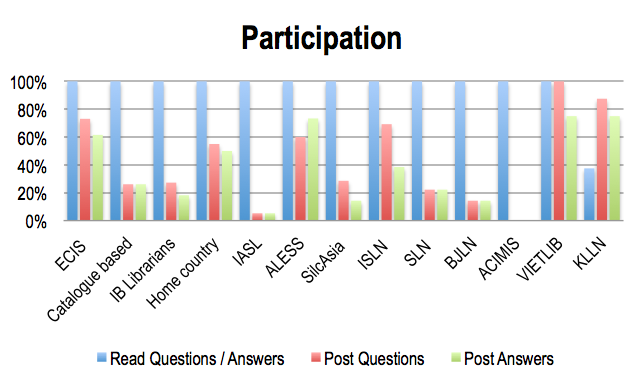
Congruent with most research on Virtual Social Networks (VSN), most of the respondents primarily read questions and answers on the forums as can be seen by the graph below. However, smaller networks that combined meetings with a VSN such as ALESS, ISLN, KLLN, and VIETLIB tended to show more participation in posting and answering questions. An exception to this trend is to be found in ECIS. This could be because it has a tight-knit community or it could be a self-selecting bias on the part of the people who decided to participate in the survey.
As far as the motivating factors for joining is concerned, as was expected, the professional networks were joined primarily out of a learning motivation. It seems the more distant geographically from the respondent the network was, the more inclined they were to state “Education / Information Exchange” whereas local organisations which combined a physical / meeting element to their online presence had respondents responding on the social, friendship and recreational aspects.

In the case of social media, Twitter followed by Google+ were the preferred tools professionally, and Facebook privately. This makes sense as research indicated that 2006 was the watershed year for blogging, when new social networks such as Twitter and Facebook became more important in the Library and Information sphere <!–[if supportFields]> ADDIN ZOTERO_ITEM CSL_CITATION {“citationID”:”FRgkgq6J”,”properties”:{“formattedCitation”:”{\\rtf (Torres-Salinas, Cabezas-Clavijo, Ruiz-Pe\\uc0\\u769{}rez, & Lo\\uc0\\u769{}pez-Co\\uc0\\u769{}zar, 2011)}”,”plainCitation”:”(Torres-Salinas, Cabezas-Clavijo, Ruiz-Pérez, & López-Cózar, 2011)”},”citationItems”:[{“id”:724,”uris”:[“http://zotero.org/users/1210720/items/2CT2IR74″%5D,”uri”:[“http://zotero.org/users/1210720/items/2CT2IR74″%5D,”itemData”:{“id”:724,”type”:”article-journal”,”title”:”State of the library and information science blogosphere after social networks boom: A metric approach”,”container-title”:”Library & Information Science Research”,”page”:”168-174″,”volume”:”33″,”issue”:”2″,”abstract”:”A metric analysis of blogs on library and information science (LIS) between November 2006 and June 2009 indexed on the Libworm search engine characterizes the community’s behavior quantitatively. An analysis of 1108 personal and corporate blogs with a total of 275,103 posts is used to calculate survival rate, production (number of posts published), and visibility via such indicators as links received, Technorati authority, and Google’s PagePank. Over the study period, there was a 52% decrease in the number of active blogs. Despite the drop in production over this period, the average number of posts per blog remained constant (14 per month). The most representative blogs in the discipline are identified. The emergence of such platforms as Facebook and Twitter seems to have meant that both personal and corporate blogs have lost some of their prominence.”,”author”:[{“family”:”Torres-Salinas”,”given”:”Daniel”},{“family”:”Cabezas-Clavijo”,”given”:”Álvaro”},{“family”:”Ruiz-Pérez”,”given”:”Rafael”},{“family”:”López-Cózar”,”given”:”Emilio Delgado”}],”issued”:{“date-parts”:[[“2011″]]}}}],”schema”:”https://github.com/citation-style-language/schema/raw/master/csl-citation.json”} <![endif]–>(Torres-Salinas, Cabezas-Clavijo, Ruiz-Pérez, & López-Cózar, 2011)<!–[if supportFields]><![endif]–>. The hashtag #TLChat created and promoted by Joyce Valenza possibly assisted with this.
While almost all respondents used some form of social media (as seen by Bosque, 2013 too), many commented on the amount of time it took and the respondents living in China added that they had limited access to most of the popular sites. Besides the sites indicated in the survey, other sites commented on included LinkedIn, Edmodo, Reddit, Instagram, ScoopIT and Yammer.

In response to which social network best met their needs, there were a wide range of answers with only ECIS iSkoodle (16 votes) and Twitter (8 votes) showing any superiority. As one respondent commented “Follett-Talk for Library Automation Software needs; KLLN for local info and collaborative efforts; LM_Net, ALA and AASL for broader professional support…. Different networks for different needs.” This view is supported by an attempt to map the networks of two librarians living in Singapore.

Finally respondents needed to consider what their ideal network would look like assuming there were no technological or cost constraints. Responses were analysed using thematic analysis and category coding, a methodology considered appropriate for unstructured data <!–[if supportFields]> ADDIN ZOTERO_ITEM CSL_CITATION {“citationID”:”YqotbdcW”,”properties”:{“formattedCitation”:”(Williamson, Given, & Scifleet, 2013)”,”plainCitation”:”(Williamson, Given, & Scifleet, 2013)”},”citationItems”:[{“id”:681,”uris”:[“http://zotero.org/users/1210720/items/ZXMTV67N”%5D,”uri”:[“http://zotero.org/users/1210720/items/ZXMTV67N”%5D,”itemData”:{“id”:681,”type”:”chapter”,”title”:”Qualitative data analysis”,”container-title”:”Research methods: information, systems and contexts”,”publisher”:”Tilde Publishing and distribution”,”publisher-place”:”Prahran, VIC”,”page”:”417-435″,”edition”:”First edition”,”source”:”Library of Congress ISBN”,”event-place”:”Prahran, VIC”,”ISBN”:”9780734611482″,”call-number”:”Q180.55.M4 R4734 2013″,”author”:[{“family”:”Williamson”,”given”:”Kirsty”},{“family”:”Given”,”given”:”Lisa, M”},{“family”:”Scifleet”,”given”:”Paul”}],”issued”:{“date-parts”:[[“2013″]]}}}],”schema”:”https://github.com/citation-style-language/schema/raw/master/csl-citation.json”} <![endif]–>(Williamson, Given, & Scifleet, 2013)<!–[if supportFields]><![endif]–>. In the search for common themes, the research of Brouns et al. <!–[if supportFields]> ADDIN ZOTERO_ITEM CSL_CITATION {“citationID”:”IXKmRPlS”,”properties”:{“formattedCitation”:”(Brouns et al., 2011)”,”plainCitation”:”(Brouns et al., 2011)”},”citationItems”:[{“id”:764,”uris”:[“http://zotero.org/users/1210720/items/ZG93QZCD”%5D,”uri”:[“http://zotero.org/users/1210720/items/ZG93QZCD”%5D,”itemData”:{“id”:764,”type”:”article-journal”,”title”:”A survey on social network sites to determine requirements for learning networks for professional development of university staff”,”container-title”:”International Journal of Web Based Communities”,”page”:”298″,”volume”:”7″,”issue”:”3″,”source”:”CrossRef”,”URL”:”http://www.inderscience.com/link.php?id=41200″,”DOI”:”10.1504/IJWBC.2011.041200″,”ISSN”:”1477-8394, 1741-8216″,”author”:[{“family”:”Brouns”,”given”:”Francis”},{“family”:”Berlanga”,”given”:”Adriana J.”},{“family”:”Fetter”,”given”:”Sibren”},{“family”:”Rijpkema”,”given”:”Marlies E. Bitter”},{“family”:”Bruggen”,”given”:”Jan M. Van”},{“family”:”Sloep”,”given”:”Peter B.”}],”issued”:{“date-parts”:[[“2011″]]},”accessed”:{“date-parts”:[[“2013″,12,30]]}}}],”schema”:”https://github.com/citation-style-language/schema/raw/master/csl-citation.json”} <![endif]–>(2011)<!–[if supportFields]><![endif]–> into “Learning Networks for professional development of university staff” was consulted, looking to identify unmet needs of this group and their suggestions of tools and platforms which could satisfy those needs.
The two most important themes identified are related – namely the time consuming nature of social networks and the need for a centralised networking possibility. In the first instance phrases such as “simple”, “simple approach”, “don’t want to be online all the time”, “takes time”, “too much technology is time consuming”, “isn’t enough time”, “run out of time”, “finding the time to be part of something or setting something up”, “anything that saves time”, “sucks up time”, “does not require much of my time”, “with no TIME constraints” which were all stated in the negative sense – i.e. any tool or platform needed to be time efficient. The latter included phrases such as “combination”, “central”, centralisation”, “centralized”, “one site”, “simple”, “simple approach”, “there is not one to do all”, “connect with each other”, “consolidated feed”, “consolidate the ‘most liked’ posting exchanges”, “one-stop shop”, “it would merge so not accessed individually”, “mix of”, “the three or four things I use now, combined into one”, “an integration”, “complete a variety of tasks”, “something multi-faceted”, “collaboratively tagging”, “large enough to encompass everything”, emphasizing the desire for aggregation of information.
Other lesser themes included group based collaboration, including collaborative tagging, expert and best practise identification, information and resource sharing, discussion and organisation.
Critical Evaluation
Already in 2008, Yeung, Liccardi, Lu, Seneviratne, & Berners-Lee, were suggesting that despite their popularity and advantages, Online Social networking sites created issues with privacy and information accountability and ownership. Their suggestion of decentralized social networks has recently gained traction in the idea of aggregation of social media (ScoopIT, Paper.li, Scruddle, Sgrouples, Flipboard, Hootsuite etc.). Few of the respondents mentioned these in the survey. This could be because currently it is an ever-changing landscape of small players trying to gain critical mass <!–[if supportFields]> ADDIN ZOTERO_ITEM CSL_CITATION {“citationID”:”1brqf38co9″,”properties”:{“formattedCitation”:”(Callari, 2011; Eisenberg, 2012; Kojetin, 2013)”,”plainCitation”:”(Callari, 2011; Eisenberg, 2012; Kojetin, 2013)”},”citationItems”:[{“id”:737,”uris”:[“http://zotero.org/users/1210720/items/85DCACJ4″%5D,”uri”:[“http://zotero.org/users/1210720/items/85DCACJ4″%5D,”itemData”:{“id”:737,”type”:”webpage”,”title”:”Top Ten Social Media Aggregators [Blogpost]”,”container-title”:”Inventor Spot”,”URL”:”http://inventorspot.com/articles/aggregators_spindex_google_buzz_streamline_social_media_experien_41426?page=1″,”author”:[{“family”:”Callari”,”given”:”Ron”}],”issued”:{“date-parts”:[[“2011″]]},”accessed”:{“date-parts”:[[“2013″,12,29]]}},”label”:”page”},{“id”:733,”uris”:[“http://zotero.org/users/1210720/items/5M25NU4C”%5D,”uri”:[“http://zotero.org/users/1210720/items/5M25NU4C”%5D,”itemData”:{“id”:733,”type”:”webpage”,”title”:”The Top 5 Social Media Managing Tools”,”container-title”:”Social Media Today”,”URL”:”http://socialmediatoday.com/jen-eisenberg/549608/top-5-social-media-managing-tools”,”author”:[{“family”:”Eisenberg”,”given”:”Jen”}],”issued”:{“date-parts”:[[“2012″,6,15]]},”accessed”:{“date-parts”:[[“2013″,12,29]]}},”label”:”page”},{“id”:735,”uris”:[“http://zotero.org/users/1210720/items/7ZRNSZ6K”%5D,”uri”:[“http://zotero.org/users/1210720/items/7ZRNSZ6K”%5D,”itemData”:{“id”:735,”type”:”webpage”,”title”:”Social Media Aggregators: What & Why [Blogpost]”,”container-title”:”ICUC”,”URL”:”http://www.icucmoderation.com/2013/05/07/social-media-aggregators/”,”author”:[{“family”:”Kojetin”,”given”:”Teri”}],”issued”:{“date-parts”:[[“2013″,5,7]]},”accessed”:{“date-parts”:[[“2013″,12,29]]}},”label”:”page”}],”schema”:”https://github.com/citation-style-language/schema/raw/master/csl-citation.json”} <![endif]–>(Callari, 2011; Eisenberg, 2012; Kojetin, 2013)<!–[if supportFields]><![endif]–>.
Brouns et al. (2011) found that “boundary, sustainability, usability and privacy” affected participation (p.305) while Chapman (2009) suggested the following 10 elements are important in social network design: “Engage quickly, Let users express themselves, Dynamic, group Friends, portable profile, easy to communicate, show only relevant information, easy to take action, show avatar photos, include ways for members to connect” (p.24). Katona, Zubcsek, & Sarvary, (2011) found an individuals decision to adopt a social network was affected by the number of relevant people connections (degree effect), the density of connections (cluster effect) and their relationship to them, and the characteristics and influence of these connections.
Based on the (relative) success and popularity of ECIS iSkoodle it is suggested that simplicity in access and use as well as critical mass of members – in particular the ratio of active vs. lurker members is also important.
Social network creators / moderators and users
Mêgnigbêto, (2011) in researching the “Structure of the social network of Beninese library and information professionals” concluded “the moderator and members of the board of the association are central to the network, and others who are in relations with them benefit from their centrality and are also central.” (p.191). There is a burden on the proactive. As within every social of professional grouping, some people take the lead in organizing and creating, possibly with the assumption that once things are in place, others will rise to the occasion. In online networks this is evidenced by the wikis of the various groups, where it is obvious that a lot of work has gone into creating the wikis, an open platform that can easily be maintained and sustained by any member, but where many of the posts are dated. Given the time constraints on any individual user, any tool or technology which does not have a high degree of automation / “self-updating” to ensure currency probably does not have a part of the future.
As Leonard Cohen wrote about his day “The day wasn’t exactly my own since I checked and found it on a public calendar” so too, school librarians find bureaucratic, policy, media tools or organizational barriers and constraints exist within their school, country (China), region or curriculum so their professional, social and learning networks are not necessarily their own to decide. For example, one librarian responded that Facebook was banned at school, so that avenue was absent as a marketing tool. As can be seen from the following screenshot, there is frustration combined with an attempt to work around ineffective and out-dated systems.

Conclusion
By mapping the landscape of the school library and individual librarians networks it becomes clear that the needs of this group are both diverse and multi-faceted, resulting in individuals joining a plethora of social networking sites in a “buckshot” manner hoping to meet their various learning, informational, developmental and practical needs locally, regionally and internationally. The burden of creating, maintaining and updating online network information databases is unevenly shared between creators/moderators and users.
Social networking tools and technology, are moving towards the desired outcome of aggregation and personalisation but have not reached the point where they are sufficiently evolved or consolidated to result in the critical mass needed for adoption by groups such as these.
ECIS iSkoodle appears to fulfil the function of a gap filler where networks such as those created for librarians in IBO schools do not function optimally. Future action could include reviving SilcAsia in a new platform as a regional network hub integrating information from country based networks, and the creation of a better platform for IB-school librarians world-wide.
Future research could take the form of identifying thought leaders, “go to” experts and highly networked individuals for more in-depth interviews.
References
Asia-Pacific Center for Security Studies. (n.d.). Countries of the Asia-Pacific Region. Retrieved December 29, 2013, from http://www.apcss.org/about-2/ap-countries/
Association of China and Mongolian International Schools (ACIMIS). (n.d.-a). SLIC – Author and Storyteller Visits [Wiki]. Retrieved December 29, 2013, from http://slic.wikispaces.com/Author+and+Storyteller+Visits
Bailey, N. (2013, December). Comparative analysis of social networking tools and technologies for International School librarians in Asia [Survey]. Retrieved December 29, 2013, from https://www.surveymonkey.com/s/PXFRSV2
Bosque, D. D. (2013). Will you be my friend? Social networking in the workplace. New Library World, 114(9), 428–442. doi:10.1108/NLW-04-2013-0033
Brouns, F., Berlanga, A. J., Fetter, S., Rijpkema, M. E. B., Bruggen, J. M. V., & Sloep, P. B. (2011). A survey on social network sites to determine requirements for learning networks for professional development of university staff. International Journal of Web Based Communities, 7(3), 298–311. doi:10.1504/IJWBC.2011.041200
Callari, R. (2011). Top Ten Social Media Aggregators [Blogpost]. Inventor Spot. Retrieved December 29, 2013, from http://inventorspot.com/articles/aggregators_spindex_google_buzz_streamline_social_media_experien_41426?page=1
Chapman, C. (2009). Social Network Design: Examples and Best Practices. Smashing Magazine. Retrieved December 26, 2013, from http://www.smashingmagazine.com/2009/07/13/social-network-design-examples-and-best-practices/
D’Andrea, A., Ferri, F., & Grifoni, P. (2010). An Overview of Methods for Virtual Social Networks Analysis. In A. Abraham, A.-E. Hassanien, & V. Snášel (Eds.), Computational Social Network Analysis(pp. 3–25). London: Springer London. Retrieved from http://www.springerlink.com/index/10.1007/978-1-84882-229-0_1
East Asia Regional Council of Schools (EARCOS). (n.d.). EARCOS Member Schools. Retrieved December 29, 2013, from http://www.earcos.org/mem_schools.php
Eisenberg, J. (2012, June 15). The Top 5 Social Media Managing Tools. Social Media Today. Retrieved December 29, 2013, from http://socialmediatoday.com/jen-eisenberg/549608/top-5-social-media-managing-tools
Federation of British International Schools in Asia (FOBISIA). (n.d.). FOBISIA Member Schools. Retrieved December 29, 2013, from http://www.fobissea.org/Members
Hecker, A. (2012). Knowledge Beyond the Individual? Making Sense of a Notion of Collective Knowledge in Organization Theory. Organization Studies, 33(3), 423–445. doi:10.1177/0170840611433995
International Baccalaureate Organisation. (n.d.-a). IB World School statistics – Number of schools by programme combination and region. Retrieved December 29, 2013, from http://www.ibo.org/facts/schoolstats/progcombinationsbyregion.cfm
International Baccalaureate Organisation. (n.d.-b). The IB in Asia-Pacific. Retrieved December 29, 2013, from http://www.ibo.org/ibap/
Kaplan, A. M., & Haenlein, M. (2010). Users of the world, unite! The challenges and opportunities of Social Media. Business Horizons, 53(1), 59–68. doi:10.1016/j.bushor.2009.09.003
Katona, Z., Zubcsek, P. P., & Sarvary, M. (2011). Network Effects and Personal Influences: The Diffusion of an Online Social Network. Journal of Marketing Research, 48(3), 425–443.
Kojetin, T. (2013, May 7). Social Media Aggregators: What & Why [Blogpost]. ICUC. Retrieved December 29, 2013, from http://www.icucmoderation.com/2013/05/07/social-media-aggregators/
LaGarde, J., & Whitehead, T. (2012). Power up your Professional Learning. Knowledge Quest, 41(2), 8–13.
Librarians in Vietnam (VIETLIB). (n.d.). Home [Wiki]. Retrieved December 6, 2013, from http://vietlib.wikispaces.com/home
Library Media Net (LM-Net). (n.d.). Where School Librarians Connect [Blogpost]. Retrieved December 24, 2013, from http://lmnet.wordpress.com/
Mêgnigbêto, E. (2011). Structure of the social network of Beninese library and information professionals. The International Information & Library Review, 43(4), 184–191. doi:10.1016/j.iilr.2011.10.004
Scott, J., & Carrington, P. J. (Eds.). (2011). The SAGE handbook of social network analysis. London ; Thousand Oaks, Calif: SAGE.
Shanks, G., & Bekmamedova, N. (2013). Case study research in information systems. In Research methods: information, systems and contexts (First edition., pp. 172–187). Prahran, VIC: Tilde Publishing and distribution.
Torres-Salinas, D., Cabezas-Clavijo, A., Ruiz-Pérez, R., & López-Cózar, E. D. (2011). State of the library and information science blogosphere after social networks boom: A metric approach. Library & Information Science Research, 33(2), 168–174.
United Nations Office for the Coordination of Humanitarian Affairs (OCHA). (2011, May). Major Language Families in Asia-Pacific [pdf file]. Retrieved December 29, 2013, from http://reliefweb.int/sites/reliefweb.int/files/resources/OCHA_ROAP_Language_v6_110519.pdf
Williamson, K., Given, L., M., & Scifleet, P. (2013). Qualitative data analysis. In Research methods: information, systems and contexts (First edition., pp. 417–435). Prahran, VIC: Tilde Publishing and distribution.
Yeung, C. A., Liccardi, I., Lu, K., Seneviratne, O., & Berners-Lee, T. (2008). Decentralization: The Future of Online Social Networking. W3. Retrieved from http://www.w3.org/2008/09/msnws/papers/decentralization.pdf
Appendix A: URLs of social networking sites
|
School Associations
|
|
|
FOBISSEA Schools (The Federation of British International Schools in Asia)
|
|
|
ACIMIS (Association of China and Mongolian International Schools)
|
|
|
ECIS (European Council of International Schools)
|
|
|
EARCOS (East Asia regional council of schools)
|
|
|
KISAC (Korean International Schools Activities Conference)
|
|
|
Local or regional school librarian associations
|
|
|
ACIMIS (Association of China and Mongolian International Schools) Librarians Network
|
|
|
ALESS (Association of Librarians in English Speaking Schools – Hong Kong)
|
|
|
BJLN (Beijing Librarians Network)
|
|
|
Library Media-Net (LM-Net)
|
|
|
BLISS (Bangkok Librarians International Schools)
|
|
|
IB OCC (Online Curriculum Centre) – librarian forum
|
|
|
PASLI (Philippine Association of School Librarians)
|
|
|
ECIS (European Council of International Schools) Library Course
|
|
|
IBO OCC (Online Curriculum Centre)
|
|
|
IB Librarians Continuum
|
|
|
ISLN (International Schools of Singapore Library Network)
|
|
|
KLLN (Kuala Lumpur Library Network)
|
|
|
SilcAsia (Schools International Library Cooperative Asia)
|
|
|
SLN (Shanghai Librarians Network)
|
|
|
VIETLIB (Librarians in Vietnam)
|
|
|
National Library / International School Library Associations
|
|
|
SLA (School Library Association) – UK
|
|
|
OZTL (Australian Teacher Librarian Network)
|
|
|
ALIA (Australian Library and Information Association)
|
|
|
IASL (International Association of School Librarianship)
|
|
|
Teacher Librarian Ning
|
|
|
Catalogue Based
|
|
|
The CDS-ISIS user forum
|
|
|
Catalogue based Community (e.g. Follett or Oliver)
|
|
|
Social Networks
|
|
|
Twitter
|
|
|
Google+
|
|
|
Goodreads
|
|
|
Library Thing
|
|
|
Blog
|
|
|
Social Bookmarking – diigo
|
|
|
Social Bookmarking – delicious
|
|
|
Pinterest
|
|
|
Facebook
|
|
|
Shelfari
|
|
|
LinkedIn
|
|
|
Edmodo
|
|
|
Instagram
|
|
|
wechat
|
|
|
Only2clicks
|
|
|
MightyBell
|
|
|
Yammer
|
|
|
Curating / Aggregators
|
|
|
Reddit
|
|
|
ScoopIT
|
|
|
Paper.li
|
|
|
Scruddle
|
|
|
Sgrouples
|
|
|
Flipboard
|
|
|
Topsy
|
|
|
Tweetdeck
|
|
|
SocialOomph
|
|
|
Storify
|
|
|
RebelMouse
|
|
|
Hootsuite
|
REFERENCES FOR URLS:
Association of China and Mongolian International Schools (ACIMIS). (n.d.-b). SLIC Home [Wiki]. Retrieved December 6, 2013, from http://slic.wikispaces.com/ACAMIS
Association of Librarians in English Speaking Schools (ALESS). (n.d.). Home [Wiki]. Retrieved December 6, 2013, from http://aless.wikispaces.com/
Australian Library and Information Association (ALIA). (n.d.). Home. Retrieved December 24, 2013, from http://www.alia.org.au/
Australian Teacher Librarian Network (OZTL). (n.d.-a). OZTL_NET Info Page [Listserv]. Retrieved December 24, 2013, from http://lists.oztlnet.com/cgi-bin/mailman/listinfo/oztl_net
Australian Teacher Librarian Network (OZTL). (n.d.-b). OZTLNET – A community for information professionals in Australian schools. Retrieved December 24, 2013, from http://oztlnet.com/
Beijing Librarians Network (BJLN). (n.d.). BJLN – Yahoo Groups [Listserv]. Retrieved December 6, 2013, from http://groups.yahoo.com/neo/groups/bjln/info
Edmodo. (n.d.). Sign up, Sign In. Retrieved December 24, 2013, from https://www.edmodo.com/
European Council of International Schools (ECIS). (n.d.-a). Course: Library and Information Services [Moodle]. Retrieved December 29, 2013, from http://www.iskoodle.com/course/view.php?id=26
European Council of International Schools (ECIS). (n.d.-b). Home. Retrieved December 6, 2013, from http://www.ecis.org/
Federation of British International Schools in Asia (FOBISIA). (n.d.). FOBISIA Member Schools. Retrieved December 29, 2013, from http://www.fobissea.org/Members
Follett Community. (n.d.). Groups. Retrieved December 24, 2013, from https://www.follettcommunity.com/groups
IB Librarians Continuum. (n.d.). Home [Wiki]. Retrieved December 24, 2013, from http://librarianscontinuum.wikispaces.com/
IBO OCC (Online Curriculum Centre). (n.d.). Resourcing the PYP, MYP, & DP [Google Site]. Retrieved December 24, 2013, from https://sites.google.com/site/pypresources/home/occ
International Association of School Librarianship (IASL). (n.d.). Home. Retrieved December 24, 2013, from http://www.iasl-online.org/
International Schools of Singapore Library Network (ISLN). (n.d.-a). Forum [Google Group]. Retrieved December 6, 2013, from https://groups.google.com/forum/?hl=en-GB#!forum/issln
International Schools of Singapore Library Network (ISLN). (n.d.-b). Home Page [Blogpost]. Retrieved December 6, 2013, from http://silcsing.blogspot.sg/
Korean International Schools Activities Conference (KISAC). (n.d.). Home. Retrieved December 24, 2013, from http://kisac2013.weebly.com/
Kuala Lumpur Library Network (KLLN). (n.d.-a). KL Library Network [Google Group]. Retrieved December 24, 2013, from https://groups.google.com/forum/#!forum/klln
Kuala Lumpur Library Network (KLLN). (n.d.-b). Librarian’s Knowledge Sharing Workshop – Job Alike Weekend [LibGuide]. Retrieved December 6, 2013, from http://alice-smith.libguides.com/JAW
Moodle Trust. (n.d.). Open-source community-based tools for learning. Retrieved December 29, 2013, from https://moodle.org/
Philippine Association of School Librarians (PASLI). (n.d.-a). PASLI News [Blog]. Retrieved December 24, 2013, from http://paslinews.wordpress.com/
Philippine Association of School Librarians (PASLI). (n.d.-b). Philippine Assn. of School Librarians – Yahoo Groups [Listserv]. Retrieved December 29, 2013, from http://groups.yahoo.com/neo/groups/pasl_inc/conversations/topics/19
School Library Association (SLA ). (n.d.). SLA – Welcome to the SLA Website. Retrieved December 24, 2013, from http://www.sla.org.uk/
Schools International Library Cooperative ASIA (SILC-Asia). (n.d.). Home [Wiki]. Retrieved December 6, 2013, from http://silcasia.wikispaces.com/home
Shanghai Librarians Network. (n.d.-a). Home [Wiki]. Retrieved December 6, 2013, from http://schoollibrarysymposium.wikispaces.com/
Shanghai Librarians Network. (n.d.-b). Shanghai Librarians – Yahoo Groups [Listserv]. Retrieved December 6, 2013, from http://groups.yahoo.com/neo/groups/shanghailibrarians/info?v=1&t=search&ch=web&pub=groups&sec=group&slk=1
Smith, C. (n.d.). Shambles in S.E.Asia (The Education Project Asia) – The School Library. Retrieved December 6, 2013, from http://www.shambles.net/librarian/
Teacher Librarian Ning. (n.d.-a). EARCOS Teacher Librarians [Ning Group]. Retrieved December 24, 2013, from http://teacherlibrarian.ning.com/group/earcos-teacher-librarians
Teacher Librarian Ning. (n.d.-b). TLNing – A community for teacher-librarians and other educators [Ning]. Retrieved December 24, 2013, from http://teacherlibrarian.ning.com/

 Informative Flights - Musings of a Teacher Librarian