English Language Learner (ELL) resources

One of the wonderful things about the school I’m teaching at, is that they accept ELLs up to Grade 6 at any level of English.  It is also one of the challenging things.  It impacts me slightly as I try to help them with making choices for reading books each week, somewhat more when I’m teaching a unit for example Information literacy to prepare G6 students for their PYP exhibition and I see that a few students in each class just cannot engage with the lesson as it is moving too fast and at a too high level for their comprehension. It impacts our teacher a LOT all the time.  And out of all the challenges and considerations that keep my brain buzzing overtime, this is one that concerns me the most.

Free resource from: http://www.clipartpanda.com/categories/english-language-learning

I’m looking to order some books for classroom libraries and the main school library, so I reached out to my networks asking for books for pleasure that would be suitable for our ELL students. I also did internet searches for ELL suitable books, books for reluctant readers (even though they often are NOT reluctant readers).

I would very much like to distinguish between reading to learn to read and reading for pleasure, because I believe (and research appears to back me up) but it is the pleasure and interest reading that will take my students both into the next level of reading and also help them to create, maintain and sustain a love of reading. Yes I know there is a plethora of resources for teaching reading to ELL students and that English as a language is richly blessed with a wide variety of graded readers. But that’s not what I’m looking for. I want books that they will WANT to read for the sake of the content or story or character. Not because it’s level D or 14 or 2.7. (Here is a great article with good resources on motivating ELL student readers).

It would also be very nice when all the students are reading literature circle books that there are also books available to ELL students to read.  Of course if you have two or three ELL students who share a language, there’s no reason why they shouldn’t read a book at the appropriate level in that language – however it does lead to some complications for teachers interacting with them if the book isn’t also available in English.

Here are a few of the suggestions / ideas:

With thanks and gratitude to the iSkoodle library folks and to Asia School Library Connection:

A few of the books in my catalog that I and our ELL department recommend to parents and teachers including wordless books.  Here are some suggestions for using wordless books. They are also useful for the interlingual classroom as Eithne Gallagher suggests.

Graphic novels and comics are a great bridge for ELL students, although this article deals with use in High School, the principles can be transferred to Primary (see “great comics for early readers” above).

And don’t forget AudioBooks – some great resources have just been released including a very good infographic on using listening by the Audio Publishers Association. I attribute my childrens’ large vocabulary and working knowledge and love of the classics, including poetry to Naxos’ Spoken Word library and CDs.

Accessing lessons and other material

Up to now, all I’ve been doing is ensuring that the Information Literacy classes I do are also on my libguides with all videos and links so that students can access them in their own time and go through them at their own pace at home or revisit them as and when needed. It would be helpful to have resources in multiple languages – UNESCO has such a guide with resources in many languages. The challenge would be to access and use these as appropriate in our environment.
Any comments or suggestions?  When I have time I’d like to try and “level” this list but I need to start reading some course work for my next M Ed. study unit.

State of School Librarianship – Selected Asian Countries

Four of the speakers at the International Conference on School Librarianship of Asian Countries spoke about the “State of School Librarianship” in their relevant areas:

Since you are all perfectly capable of reading the presentations I am not going to repeat what was said, but rather to say what my key take-aways were in general.

Firstly I was super happy that I chose to come to this conference (at my own cost, although the conference itself was free …) instead of going to the EARCOS workshop in November at Taipei American School. “Tech-Integrated Libraries: Building the Future One Service at a Time”. The reason is that the longer I am in the field of teacher librarianship, the more I feel that we are operating in a number of little echo chambers where we keep on encountering the same people with the same things to share.  This view probably doesn’t make me very popular amongst my peers, however I do think that it has contributed greatly to the current state of school librarianship. Of course this conference was also an echo chamber, but it wasn’t one which I usually find myself in (mine is the “international school librarian” one).   And I think for all of us participating, we got to at least hear (if not share due to the time restrictions and presentation format) about what is going on elsewhere. And that is always incredibly interesting.

Next – it was comforting but disheartening to hear that school librarians everywhere suffer from the same “needed outsider” status.   In all the presentations we heard that the existence of the school library and its staffing by a tiered levels / qualifications of librarian almost always needed an act of legislation  at least in the public sector.   (In the private sector it is up to the budget of the individual school, and part of a long legacy personal and cultural, but that’s a whole other story).   Within the legislated necessity of a school library, there is a huge variation in the requirements – in Australia this is determined by state-by-state for example.

It seems that generally it is much easier to find funding for library buildings and the initial “hardware” – the problems arise with the ongoing budgeting for staffing by properly trained teacher-librarians who can make a difference in both the literacy and information literacy of the students. But those effects are hard to measure – it is easier to come up with statistics concerning collection size and ratios of materials to pupils – the quantitative data is more readily found, and definitions are more robust than the qualitative data. That is one of the “academic / research” criticisms I’d have of some of the presentations – a lot of data but what about the “so what” and “why” and “what now” – particularly when comparing one country to another.

Even Australia – who has long been seen as one of the bastions of school-teacher-librarianship -appears to be in decline due to all sorts of (mainly) political and funding issues. And there’s the rub. School-librarians just don’t seem to be political animals – up to now I have only ever met one Head of Libraries who has a seat-at-the-table by which I mean is considered part of the senior management team of a school.  The rest seem to dabble around the edges, cajoling, convincing, offering, pleading, giving, trying, quietly adding value as and when possible on an invitation basis, if not plain forgotten.

There is a distinct difference also between where school librarians are seen as partners for information literacy instruction versus their role in encouraging reading – or alphabetic literacy. The distinction is very important, because it can be argued (and is argued) that a librarian can provide the former, so it is not necessary to have a teacher-librarian. In fact, a passionate library technician with a love of books and reading would even suffice (sadly to say, a love of reading is not on the ‘necessary qualities” in the job descriptions of most library staff that I’ve encountered – nor, may I add of teachers.). It was interesting to see that the contribution from Singapore was an extremely excellent presentation on “Interactive Reading Activities” but since public schools here generally don’t have libraries or teacher librarians there was no-one to present on the “state of the nation” in this regard. It begs the question what this otherwise progressive nation-state is doing to raise the standards of information literacy in its schools.

At this point, for a bit of light relief, I want to put in one of those corny “what xx think I do” pictures

(sorry no citation – it was on Pinterest and the original link was dead)

What I really wish was I could say is “these guys are really getting it right – that’s the way to go and here’s the proof”. In reality all I can say is that it seems that we all share the same struggles and issues and that’s why I worry so very much about our librarian echo chambers.  Because we all agree with each other, and we all have similar stories to share – stories of triumph and success, of making a difference in the lives of individual students and in (school) communities as a whole – the second afternoon where teacher librarians from 3 schools presented the fantastic work they’d been doing in Taiwan – particularly in the field of inquiry learning was very inspirational.

But how do we get out of this loop and spiral upwards?  I’m one of the 407 librarians participating in the “Ideal Libraries Project” of the IBO. Even in that (private) organisation nothing is mandated or agreed around teacher-librarians. Yes there are recommendations, but judging by the responses from the cohort the interpretations are wide.

I have meandered far I fear. But to my colleagues in Asian countries I would say, fear not, you are not alone, we too struggle with ratios of 1:1,500 (TL:Students), even in private schools. We too would like to feel our voices are heard and that literacies are integrated into the curriculum.  But I think there is hope, if we can just get out of this quick-sand – perhaps when the hype around EdTech and Makerspaces is over we will have our turn – or perhaps it is time to rise up and take a seat at the table, because it is not about us. It’s about sending literate people out into the world, and we can’t faff around the edges and not send fully multi-literate students out into the world.

Communicating across cultures

Communicating across cultures: cultural identity issues and the role of the multicultural, multilingual school library within the school community

Dr. Helen Boelens
School Library Researcher and Consultant, The Netherlands

John M. Cherek Jr. MSc
Project Manager, Zorgboerderij “De Kweektuin”, Mijdrecht, The Netherlands

Dr. Anthony Tilke
Head of Library Services & TOK Teacher, United World College of South-East Asia (Dover Campus), Singapore

Nadine Bailey
United World College of South East Asia (East Campus), Singapore

Abstract

The arrival of increasing numbers of refugees and immigrants has caused large increases in multicultural school populations.This interdisciplinary paper describes an ongoing study which began in 2012, discussing the role of the school library in multicultural, multilingual school communities and offering suggestions about how the school library could become a multicultural learning environment. It provides information to help school library staff to look closely at these issues and to provide help and useful suggestions to the entire school community. The prime objective is to help the school community to safely and constructively deal with the dynamics of a multi-cultural society, using the school library as a base.   Safe facilitation requires “trained” leaders from the school community. An e-learning program for school librarians is being adapted for this purpose.

Keywords: multi-culturalism, multi-lingualism, languages, cultural identity, global literacy.

Introduction

At the IASL Conference 2012, a paper discussed the role of the school library in multicultural, multilingual school communities and offered suggestions about how the school library could become a multicultural learning environment (Bloelens, van Dam and Tilke, 2012). Since 2012, various factors have affected multicultural school populations in many different types of primary and secondary schools in countries throughout the world.

Limitation of this study

This paper seeks to understand how learning experiences of multicultural, multilingual students can be accommodated in the school library. Boelens and Tilke (2015) recently described relevant trends and ideas which posits the role of the library in multicultural/lingual school communities from different areas of study: education and pedagogy, library and information science, psychology, sociology and anthropology, and linguistics.

Educational trends

Some international organisations have indicated educational trends. UNESCO’s statement on global education provides a set of objectives for international education until the year 2030. The Organisation for Economic Co-operation and Development (OECD) recommended that schools support both “the identifiable needs of today, and the uncertain demands of the future” (OECD, 2005); schools should provide an environment that will support and enhance the learning process, encourage innovation, foster positive human relationships – in short, be “a tool for learning”. The term “learning environment” suggests place and space: a school, a classroom, a library. However, in today’s interconnected and technology-driven world, a learning environment can be virtual, online, remote – it doesn’t have to be a physical place at all. Perhaps a better way to think of 21st century learning environments is as support systems that organize the conditions in which humans learn. How does this affect the school library?

Library and information Science trends

How do these changes in educational theories and expectations affect the school library? Commentators in North America have suggested that the library has now become part of the school learning commons (Canadian Library Association, 2014; Loertscher et al, 2011; Loertscher et al, 2008). Educuase (2011) considers that learning or information commons

has evolved from a combination library and computer lab into a full-service learning, research, and project space. … In response to course assignments, which have taken a creative and often collaborative turn … learning commons provides areas for group meetings, tools to support creative efforts, and on-staff specialists to provide help as needed. The strength of the learning commons lies in the relationships it supports, whether these are student-to-student, student-to-faculty, student-to-staff, student-to-equipment, or student-to-information (p. 1)

Can the needs of multicultural/lingual learners be specifically supported in a Learning Commons environment? Osborne (2014, p. 7) states that “more and more schools … are committing to provide physical spaces that align with, promote and encourage, a more modern vision for learning” and asks “how might the library act as a ‘third place’ to provide unique, compelling and engaging experiences for staff, students and community that aren’t offered elsewhere?” (p. 8)

Furthermore, librarians are co-teachers within multicultural/lingual school communities (Medaille and Shannon, 2014); co-teachers are “two equally-qualified individuals who may or may not have the same area of expertise jointly delivering instruction to a group of students” (Curry School of Education, 2012).

Racial, Cultural and Ethnicity issues (Psychology, Sociology, and Anthropology)

Key factors are:

  • Students cannot start learning until they feel safe, seen and valued;
  • Learning is diminished and/or does not occur without addressing equity and diversity topics;
  • Equity and diversity topics are intertwined with academic achievement.

This paper will also discuss subjects such as “diversity” and “difference” in multicultural situations within the school community and how these matters affect the school library, not only in developed countries, but also those which are located in emerging and developing countries (Boelens and Tilke, 2015, p. 2). Students from diverse cultural backgrounds, who differ from mainstream students in terms of ethnicity, socioeconomic status and primary language, are entering schools in growing numbers. The education which these students receive needs to address multicultural and intercultural issues. Intercultural education relates to culture, religion, cultural diversity and cultural heritage and respects the cultural identity of learners through the provision of culturally appropriate and responsive education, which focuses on key issues and interrelationships (UNESCO, 2006). It concerns the learning environment as a whole and impacts many different aspects of the educational processes, such as school life and decision making, teacher education and training, curricula, languages of instruction, teaching methods, student interactions and learning materials. (UNESCO, 2003a)

Language acquisition

Based on international research, practice and comment, Della Chiesa, Scott and Hinton (2012) identified strong connection between language and culture(s), looking for future benefits in human endeavour, partly as a result of recognizing that language acquisition and use does not develop in isolation from socio-cultural and indeed brain development.   International understanding is perceived as a desired social outcome of such interventions.

Features of language learning assist teachers of culturally and linguistically diverse students. Learners learn a language best when treated as individuals, experience authentic activities in communication in the target language and see teaching as relevant to their needs. Learning should be relevant to their needs and they benefit from seeing strong links between language and culture. They also benefit from having helpful feedback on their progress and where they can manage their own learning. (Vale, Scarino and McKay, 1991)

Background information

Demographic shifts, i.e. changes in the demo-linguistic situation, have taken place. Children from culturally and linguistically diverse backgrounds, including immigrant and refugee children, are entering schools all over the world; changing demographics will alter both school practices and policies (Center for Public Education, 2012). Features of experiences for students in various countries include:

Culturally and linguistically diverse students in Australia typically come from a wide range of language, socio-economic, cultural and religious backgrounds. Up to one-fifth of such students are newly arrived in Australia and with a language background other than English; even if some students are born in Australia, they may enter the school system with little or no English language. (Department of Education of Western Australia, 2011). Australian schools may experience large populations of immigrant and/or refugee students (Ho, 2011).

There were similar issues in Canada, where students did not have language skills in the main languages used for teaching and learning, though differences in educational performance reduced as students progressed through the school system (Statistics Canada, 2001).

The United Kingdom too experienced similar issues, where a focus on educating significant numbers of students who spoke English as an additional language (EAL) (British Council, 2014).

Looking at countries where English is not the main or major language of teaching and learning, the European Commission (2015) reported very similar issues for schools and for students, not least for asylum seekers.

The USA too has seen changing demographics in schools. Forty-seven percent of children younger than five belong to a racial or ethnic minority group, and “trends in immigration and birth rates indicate that soon there will be no majority racial or ethnic group in the United States” (Center for Public Education, 2012). Implications for such trends may include needs for qualified bilingual teachers, preschool programmes, concerns over drop-out rates from mainstream education, and other resource issues in schools.

Important identity issues in the context of the school community

This paper posits that the school library must be a safe space that welcomes all questions, perspectives and backgrounds. School libraries offer valuable resources (in both traditional and digital format), information, knowledge and insight. In a school context, a library space is one where students can explore their ideas and ask questions. Librarians provide specialised support within this domain and have a responsibility to support the growth of their students. Such healthy development of students can have a strong impact on self-esteem, academic performance and feelings of cohesion. In a multi-cultural school setting, issues of race, ethnicity and culture play a central role in the identity of the school and its students. Celebrating our differences is one way of acknowledging the diverse backgrounds of members of the school community, though such diversity can be overshadowed by a dominant culture and its narrative.

As professionals in education, it is our responsibility to develop competence in the areas that matter to our students, including our own understanding of race, culture and ethnicity, to ensure that young people receive targeted guidance and support they need in order to explore a healthy sense of self.

Identity

Central to identity formation is the “challenge of preserving one’s sense of personal continuity over time, of establishing a sense of sameness of oneself, despite the necessary changes that one must undergo in terms of redefining the self” (Harter, 1990). Adolescence is an important and formative period in life that influences many parts of identity development (sexual, racial, ethnic, gender, etc.). Identity development is a dynamic process that plays a central role in developing our relationship to the self, the other and our social environment. It is especially during adolescence that we play around with multiple identities, experiment with “the rules” and test the institutions around us. As a result of this process, parts of our identity are kept and nurtured, while others are briefly worn and discarded.

Much research about racial and ethnic identity development has focused on adolescent and college age individuals. (Helms (1990) in Phinney, 2007, p. 275) This makes sense because self-reflection is an important part of collecting data. It does not necessarily imply that younger children do not have the ability to reflect, but their process of reflection may be different. For example, younger children tend to describe themselves in a more simple, less sophisticated way, according to their perception of personality characteristics — “I am nice”/ “I like to make other people feel good”/ “I like to help people”. This is less about their relationship to things (toys, food) and more about their understanding of certain qualities (both good and bad). For example, “I am good at writing and bad at soccer”. This relates to ethnic identity development, when children become aware of good and bad qualities about their ethnic group. Understanding why society deems these certain qualities good or bad is perhaps one way to help prepare them for dealing with a multi-cultural environment with dominant ideas that are not their own. Ethnic identity has been studied largely with reference to one’s sense of belonging to an ethnic group, that is, a group defined by one’s cultural heritage, including values, traditions, and often language (Phinney 2007, p. 274). Finding interactive and “fun” ways to help children explore or even explain their understanding of these things is one role the school library can play; by facilitating access to information, librarians can guide students through relevant books, movies and other multimedia tools.

Adolescence is a developmental stage between childhood and adulthood when individuals experience biological, social and psychological change. According to psychoanalyst Erik Erikson (1968), ego identity versus role confusion. It is the psychosocial stage of personality development that adolescents encounter when faced with the question, “Who am I?”. A healthy resolution of this stage can lead to strong ego identity. Unhealthy resolution of this stage will contribute to role confusion. Role confusion challenges our ability to build connections and participate as members of society. Here, adolescents create and recreate meaning to provide themselves with a sense of connection. When a lack of connection exists, the ego struggles to build a foundation for fidelity, based on loyalty. If adolescents lack fidelity, they might encounter, in extreme cases, a future of social pathology, crime and prejudicial ideologies. These negative characteristics can manifest when the individual participates as an adult, for example, in religious, athletic, national, and military rites and ceremonies (Engler, 2014).

Racial, Cultural and Ethnic Identity

A healthy racial and ethnic identity can help youth establish a consistent view of themselves. Many aspects of adolescence are transient and changing. One day we love the color yellow and the next day it is the color red. Thus, by creating a permanent anchor from which to develop, we give our students a better chance at achieving positive outcomes; without these anchors, many young people may identify with a completely different culture which has nothing to do with “who they are”.

Identity issues and their importance in the school and the school library

The feeling of belonging is critical to every child’s well-being and helps him/her to fulfill his potential in many different areas of development: physical, social, emotional and cognitive (Welcoming Schools Childhood Education Program, 2015).

Cherek’s 2015 research is concerned with ways that students can develop a healthy racial and ethnic identity and improve their understanding and vocabulary around race and ethnicity, therefore contributing to increased cultural competence; this contributes to higher self-esteem and healthy development. By using these essential skills, students have the opportunity to take ownership over their ideas and are encouraged to examine the world around them — at home, school, work and in the media – thus preparing them to thrive in multicultural environments.

Essentially, children who feel good about themselves may be more successful, not only at school but in different aspects of their lives (Tough, 2012). Identity is not something that individuals automatically have. Identity develops over time, beginning in childhood, through a process of “reflection and observation” (Erikson 1968, p. 22) Important questions to ask about a child’s learning environment is does he/she see other teachers, parents or students in the school who represent his/her own culture or heritage? Who do these children identify with? Who do they see as a reflection of themselves, e.g. public figures?

Using these factors, the school library becomes a safe “public” space where a healthy and proactive sense of diversity encourages deep and meaningful conversations with all members of the school community about stereotypes such as discrimination and racism.

Involvement of the school library/ian in multicultural, multilingual education

Ultimately, the aim is that students, teachers and librarians are prepared to safely and constructively deal with the dynamics of a multi-cultural society. Safe facilitation requires “trained” leaders from the school community.

In larger schools with academic disciplinary silos, it may be difficult to create positive messages about mother tongue and cultural identity and pride across to members of the school community as a whole – school leaders, teachers, students and parents. The EAL (English as an Additional Language) teacher is most concerned about getting the students up to speed and may inadvertently give the wrong message. The teaching of the student’s (minority) language may not be part of the school language policy.

The Welcoming Schools Childhood Education Program (2015) suggests that children who are motivated and engaged in leaning are more committed to the school. By providing books, information and other resources, the library can “provide an important mirror for children to see themselves reflected in the world around them”. Here, library resources “also provide a window to the lives of others. … [and] students also find positive role models through literature”; benefits from such activities are best seen when coordinated in the school community. The library can provide a stable permanent base for the length of the student’s school career.

Research (Bedore and Peña, 2008) indicates that bilingualism can only be sustained if there is at least a 30% input in the less dominant language. If the less dominant language is not a language which is used and taught within the school community, then the library can provide access to relevant materials. This is an intellectual process of proving the benefit and a practical exercise of resource collection, curation, access, promotion and marketing.   These can be very simple, such as the creation of displays of books about diversity, multiculturalism and multilingualism and about national days of the countries which are represented by children at the school, and reflecting their cultures.

In any event, the school library is a helpful environment where students can reflect on these issues. It can highlight resources, or profile individuals relevent to various ethnic groups. This can be achieved by exploring literature authored by individuals from their ethnic own group or by reading about the history of their own ethnic group. Additionally, the library can give students the basic skills to find or locate this information.

Multicultural, multilingual school libraries

In 2012, Boelens, van Dam and Tilke focused on various aspects of multicultural and intercultural education, identifying a symbiotic relationship with school libraries. It reported on support needs for both children who were immigrants, i.e. those permanently moving from one country to another, as well as more geo-mobile children, known as Third Culture Kids or Global Nomads. Various relational features were identified: literacy, language, bilingual education, world languages.

Krashen and Bland (2014) have identified the need for second language learners to develop competencies in academic language acquisition. Before that, self-selected recreational reading habits were partly dependent on a varied, indeed wide, selection of reading matter. In itself, this reading matter did not provide access to academic language acquisition, but it prepared children to do so. This reading stamina also had an effective domain, in that it motivated students to become readers, and arguably gave them confidence. For some children who use school libraries in multicultural education environments, the digital age was not wholly relevant, as ebook use was associated with affluence. For children whose socio-economic experience is that of poverty, libraries represent the only stable source of access to reading materials, especially in developing and emerging countries. The provision, promotion and use of such reading materials is a feature of the work of (school) libraries/ians in these countries. These libraries/ians support students and teach them to to navigate abundant sources of information. Such skills and aptitudes are commonly known as information literacy skills. Sometimes, the prevalence of information literacy skills is perceived as being a main role of the school library/ian, however the teaching of these skills and the provision of reading materials need to be symbiotically linked.

Smallwood and Becnel (2012) identified various factors in successfully providing library services in multicultural settings – accessing and reaching the clientele; provision of appropriate materials; consideration of use of space; focusing services on linguistic and socio-economic needs; appropriate technology; professional development and awareness-raising amongst school librarians. Indeed, Welch (2011) promoted the idea of the library collection having an aim of influencing student behavior, in terms of increasing tolerance and sensitivity in a multicultural setting.

Whilst not substantially different from good practice elsewhere, the International Baccalaureate Organization (IBO or IB) has identified good practice in library support for multilingual learning environments (International Baccalaureate, 2012). Schools that offer IB programmes comprise state or government schools, semi-independent, independent and international schools. When a school adopts IB programmes, it needs to also take ownership of IB philosophy, including a holistic approach to language and international-mindedness (Singh and Qu, 2013). There is, therefore, a symbiotic link between language and intercultural education approaches in schools which may (or should) experience strong ESL (English as a Second Language) support (Carder, 2014), though the IB stance is that every teacher is a teacher of language (International Baccalaureate, 2011).

Therefore, the literature has identified a need to develop competencies in academic language proficiency and a resource/information role for (both public and school) libraries, especially for children, sometimes immigrants or refugees, who are affected by poverty. Therefore, libraries may be part of scaffolding strategies to support children who need language support, and which include resources and facilities (space). Thinking and planning for such library services and support needs to be holistic and wide-ranging (from facilities and plant to professional development), all based on an understanding of the needs and concerns of targeted client groups.

Focussing services on the needs of multicultural/ingual students

The librarian needs to establish the current and future users of the school and its library, and user demographics (i.e. how many students come from which minority or language group). Library collection and services should then be related to such information.

School libraries have roles related to literacy and reading, and teaching and learning of information literacy skills. To support this, resources – mainly physical – have been curated to serve a mainstream interpretation of students’ needs, often curricular, and in the dominant language (often English). This role could be broadened to meet the needs of the multicultural/lingual school community.

  • The library collection should contain books and information (in traditional and digital format) which reflect the diversity of the children in the school. The library exposes the entire school community to many different cultures and languages. This collection can help students to understand that while their families are unique, they share many common values, beliefs and traditions.
  • The collection should contain literature in the native language of students, and link to digital international children’s libraries and also digital libraries for children from relatively small indigenous groups. This could include online links to songs, poems and stories from many different cultures and in many different languages. It should also contain current information about student countries of origin. Parents could be asked to help the librarian with this task. (Smallwood and Becnel, 2012)

Using these guidelines, the school librarian can strengthen the collection, and then present this information in attractive ways to the entire school community, so that it becomes aware of the extent of their library’s resources.

Librarians can provide an enabling portal function for immigrant, refugee and Third Culture Kids. They may be hesitant to assume this role, perhaps due to mono-lingual experience or lack of expertise in the creation of digital personal learning environments (PLEs) or personal learning networks (PLNs).

The librarian may consider applying principles of information ecology to the school library. This multi-disciplinary emerging field offers a framework within which to analyse the relationships between organisations, information technology and information objects in a context whereby the human, information technology and social information environment is in harmony (Candela et al., 2007; Wang et al., 2015).

Steinerová (2011) and Candela et al., (2007) looked at features of digital libraries and suggested that librarians examine where value integration can take place between the library service, technology, scholarship and culture, adding value through new services or contributions to learning, user experience, research productivity, teaching or presenting and preserving cultural heritage. Applying these ideas to the school environment, constituents of the eco-system include teachers, teacher librarians, students administration, parents and custodial staff (Perrault, 2007). Elements of the system will co-exist but also compete and share, converge and diverge in a dynamic interactive, complex environment (García‐Marco, 2011). The role of the library is such that information ecology needs to be understood in order to support information-seeking behaviour and thereby discover zones of intervention and areas to leverage to optimise advance information-seeking, usage, creation and dissemination within that eco-system and beyond. In response, curriculum, content and subject delivery can be collaboratively reshaped and constructed according to changes in the environment or needs of students (O’Connell, 2014).

Different kinds of resources and adaptive technologies can optimally support students with special educational needs (Perrault, 2010, 2011; Perrault & Levesque, 2012). This type of thinking can be adapted to considering the needs of bi- and multi-lingual students who are part of the school’s information ecology, but have linguistic and cultural learning and informational needs. These can be seen as a potential zone of intervention for collaboration between the teacher, teacher librarian (TL), family and community.

Literature intended for school librarians generally discusses cultural diversity in materials and the building of a world literature collection in response to student diversity or as part of language and humanities curricula (Garrison, Forest, & Kimmel, 2014). Some schools build a “Languages other than English” (LOTE) collection. To do so, schools may try to recruit bilingual or minority TLs or ask for help from parents; schools can also provide training in competencies in multicultural education (Colbert-Lewis & Colbert-Lewis, 2013; Everhart, Mardis, & Johnston, 2010; Mestre, 2009).

The main educational and social issues within schools are to ensure students acquire the official language of instruction so that they can adapt to the new learning environment without loss of educational momentum, while maintaining and developing their mother tongue (Kim and Mizuishi, 2014). Carder (2007) and Cummins (2001; 2003) suggest that even though there is evidence that supports the maintenance of mother tongue (the most effective way of supporting such students), schools place most effort and resources on the official language of instruction of the school. Evidence now presented above suggests that by doing so, children may lose some of their own healthy cultural and ethnic identity.

School librarians may be aware of geographically dispersed personal learning networks (PLNs) in order to create a personal learning environment (PLE) using various technological tools (McElvaney & Berge, 2009; O’Connell, 2014), and could assist different individuals throughout the school community to make use of a PLE. For instance, the International Baccalaureate (IB) allows students the option of guided mother tongue self-study if the school does not teach that specific language. Figure 1 below describes a PLE of an IB self-taught language student.
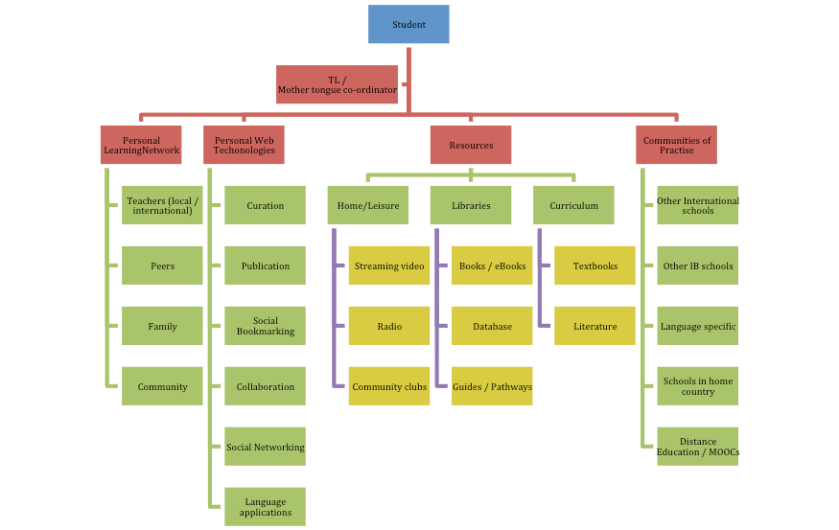
84ff0-pln2blanguage

Figure 1: PLE of an IB self-taught language student

A training program about multicultural/lingual issues for the school community

In 2015, Boelens and Cherek examined the possibility of creating a personal development training program for the entire school community, facilitated by the school library. This is an attempt to help teachers, school leaders, librarians and parents to better understand problems being confronted by the multicultural/lingual school community, especially immigrants and refugees. This program would be made available through the school’s electronic learning environment.

The first part is a 24-minute video that provides an open conversation about race and ethnicity between professionals and young people. Here, participants listen to different perspectives about race and ethnicity, and appreciate why these topics are important to both caregivers (teachers, social workers, child welfare professionals) and young people. Finally, with the help of a study guide, participants explore the possibility of integrating racial and ethnic identity development into daily practice.

The second part is an eLearning course that provides participants with necessary tools to develop a deeper understanding of issues related to racism and discrimination. The content is specifically designed so that professionals (adults, educators, caretakers) develop a vocabulary for discussing race and ethnicity with others who are interested in and concerned about these subjects. A constructive vocabulary is an essential tool when discussing identity development, as it enables participants to safely address issues of racism and discrimination. Finally, participants can further integrate this deepened knowledge into daily practice. This is an important part of the training because it prepares participants for a facilitated in-person learning event.

The third and final part of the curriculum is a two-day in-person learning event. In this face-to-face meeting, trained facilitator’s guide participants as they begin to incorporate their new skills into daily practice. The most effective and powerful events occur when both young people and professionals are present. The training is highly interactive and challenging. Participants are encouraged to openly discuss the impact of stereotypes and the social influences that affect their own racial and ethnic identity.

A similar training program is by The Welcoming Schools Childhood Education Program (2015), which provides a starter kit for a personal development training programme for members of the school community, relating to equity, school climate and academic achievement.

Tapping into the experiences and communities of practise (COP) of distance education, massive open online courses (MOOCs), school librarians could be trained to facilitate this training program through PLNs and PLEs, Training programs would be available at any time and in any geographic location providing internet access is available. Initially, a pilot program would be tested with one language group, and could later be extended to other groups.

This training program will help to establish a multicultural/lingual school community based not only on academic achievement but also on a healthy climate with regard tp racial, cultural and ethnicity issues. It will also contribute to a school´s goals of equity in teaching and will require the support and involvement of the entire school community. Since library staff will be facilitating this program, their reputation will be enhanced, and be perceived as integral members of the school community.

Conclusion

This paper has discussed a developing role for the school library in the multicultural/lingual school community in 2015. It promotes a training program for the entire school community which will be facilitated by the librarian. Because of their involvement in the school´s learning commons, the librarian is already involved in interdisciplinary activities related to the multicultural/lingual nature of the entire school.

While all aspects of identity development are valuable, one area that is often ignored, especially when talking about young people who are detached from their culture, is racial and ethnic identity. Along with ever-changing realities of society, demographics and politics, the impact of race and ethnicity have never been more important.

With an increasing number of migrant and immigrant students, the acute reality of living in multiple worlds becomes more apparent. Social norms and values become entangled. Home life, school life and street life compete for attention. Without proper guidance and support, alienation that occurs when individuals feel split between dissonant forces results in a confused sense of “Who am I?”. Addressing these issues in an educational setting means that we as educators have the power to create “safe spaces” for our captive student audience. Thus, students can be prepared to effectively deal with the realities of a multi-cultural society while at the same time developing a healthy sense of racial and ethnic identity.

As a result of the proposed training program, students at the school will learn more about `who they are`, especially those who come from an immigrant or refugee background. With the support of the entire school staff, they will some to terms with their own cultural identity and ethnicity in their new school and in their new place of residence, and have positive feelings, with an expected corollary that their academic achievement will increase.

References

Bedore, L. M. and Peña, E. D. (2008). ‘Assessment of Bilingual Children for Identification of Language Impairment: Current Findings and Implications for Practice’, International Journal of Bilingual Education and Bilingualism, 11(1), 1–29. doi: 10.2167/beb392.0.

Boelens,H. van Dam, H. and Tilke, A. (2012). School Libraries across cultures. Presented during the Research Forum of the 2012 IASL (International Association of School Librarianship) in Qatar.

Boelens, H. and Tilke, A. (2015). The role of school libraries in our multicultural, multilingual society. Submitted for publication to the CLELE (Children’s Literature in English Language Education) Journal, in March, 2015. Not yet published. Munster, Germany: CLELE.

Boelens, H. and Cherek, J. (2015). Education 2030 (EU), and Onderwijs 2032 and Excellent Education in the Netherlands: a vision of the role of the multicultural, multilingual school library within these concepts. To be presented during the IASL (International Association of School Librarianship) 2015 Conference in Maastricht.

British Council. (2014). How can UK schools support young children learning English? Retrieved from http://www.britishcouncil.org/blog/how-uk-schools-support-young-learners-english.

Canadian Library Association (2014). Leading Learning: Standards of Practice for School Library Learning Commons in Canada. Ottawa, On., Canada: Canadian Library Association. Retrieved from http://clatoolbox.ca/casl/slic/llsop.html

Candela, L., Castlli, D., Pagano, P., Thano, C., Ioannielis, Y., Koutrika, G., Ross, S., Schek, H-J., and Schuldt, H. (2007). Setting the Foundations of Digital Libraries: The DELOS Manifesto. D-Lib Magazine, 13 (3-4). Retrieved from http://dialnet.unirioja.es/ejemplar/157227

Carder, M. (2007). Bilingualism in international schools: a model for enriching language education. Clevedon, UK: Multilingual Matters.

Carder, M. (2014). Tracing the path of ESL provision in international schools over the last four decades. Part 1. International Schools Journal, 34 (1), 85-96.

Center for Public Education. (2012). The United States of education: The changing demographics of the United States and their schools. Retrieved from http://www.centerforpubliceducation.org/You-May-Also-Be-Interested-In-landing-page-level/Organizing-a-School-YMABI/The-United-States-of-education-The-changing-demographics-of-the-United-States-and-their-schools.html

Colbert-Lewis, D., & Colbert-Lewis, S. (2013). The Role of Teacher-Librarians in Encouraging Library Use by Multicultural Patrons. In C. Smallwood & K. Becnel (Eds.), Library services for multicultural patrons: strategies to encourage library use (pp. 73–81). Lanham, MA: The Scarecrow Press.

Cummins, J. (2001). Bilingual Children’s Mother Tongue: Why Is It Important for Education? Retrieved from http://iteachilearn.org/cummins/mother.htm

Cummins, J. (2003). Putting Language Proficiency in Its Place: Responding to Critiques of the Conversational – Academic Language Distinction. Retrieved from http://iteachilearn.org/cummins/converacademlangdisti.html

Curry School of Education, (2012). Co-teaching defined. Retrieved from http://faculty.virginia.edu/coteaching/definition.html

Della Chiesa, B., Scott, J., and Hinton, C. (2012). Language in a global world: learning for better cultural understanding. Paris: OECD Publishing.

Department of Education, Western Australia (2011). Gifted and talented: Developing the talents of gifted children. Retrieved from http://www.det.wa.edu.au/curriculumsupport/giftedandtalented/detcms/navigation/identification-provision-inclusivity-monitoring-and-assessment/inclusivity/culturally-and-linguistically-diverse-background/

Educause Learning Initiative (2011). Seven things you should know about the Modern Learning Commons. Retrieved from https://net.educause.edu/ir/library/pdf/eli7071.pdf

Engler, B. (2013). Personality theories : An introduction. 9th ed. London: Cengage Learning.

Erikson, E. (1968). Identity: Youth and crisis.New York: Norton.

European Commission, Eurostat. (2015). Retrieved from http://ec.europa.eu/eurostat/help/support

Everhart, N., Mardis, M. A., & Johnston, M. P. (2010). Diversity Challenge Resilience: School Libraries in Action. In Proceedings of the 12th Biennial School Library Association of Queensland. Brisbane, Australia: IASL.

Garcia-Marco, F- J. (2011). “Libraries in the digital ecology: reflections and trends”, The Electronic Library, 29(1), 105–120.

Garrison, K. L., Forest, D. E., & Kimmel, S. C. (2014). Curation in Translation: Promoting Global Citizenship through Literature. School Libraries Worldwide, 20(1), 70–96.

Harter, S. (1990). Self and identity development. In S. S. Feldman & G. R. Elliott (Eds.), At the threshold: The developing adolescent (pp. 352–387). Cambridge, MA: Harvard University Press.

Harter, S. (2012). The construction of the self : developmental and sociocultural foundations. 2nd ed. New York, N.Y.: Guilford Press.

Helms, J. (1990). Black and White racial identity: Theory, research, and practice.New York: Greenwood Press.

Ho, C. (2011). “My School” and others: Segregation and white flight. Australian Review of Public Affairs, 10(1). Retrieved from http://www.australianreview.net/digest/2011/05/ho.html

Horsley, A. (2011b). Acquiring languages. In G. Walker (Ed.), The changing face of international education: challenges for the IB (pp. 54-69). Cardiff, UK: International Baccalaureate Organization.

International Baccalaureate. (2011). Language and learning in IB programmes. Cardiff, UK: International Baccalaureate Organization.

International Baccalaureate. (2012). An IB educator’s story about the role of librarians in multilingual learning communities. International Baccalaureate Organization. Retrieved from http://www.isgr.se/nn13/pdf/Roleoflibrarians.pdf

Kim, M., & Mizuishi, K. (2014, December 10). Language and Cultural Differences and Barriers in an International School Setting – Personal Experiences and Reflections [Presentation]. UWCSEA-East.

Krashen, S., & Bland, M. (2014) Compelling comprehensive input, academic language and school libraries. Children’s Literature in English Language Education (CLELE) Journal, 2(2). Retrieved 8 March 2015 from http://clelejournal.org/article-1-2/

Loertscher, D et al. (2008). The New Learning Commons: Where Learners Win! Salt Lake City, UT: Hi Willow Research and Publishing.

Loertscher, D et al. (2011). The New Learning Commons: Where Learners Win! 2nd ed. Salt Lake City, UT: Hi Willow Research and Publishing.

McElvaney, J., & Berge, Z. (2009). Weaving a Personal Web: Using online technologies to create customized, connected, and dynamic learning environments. Canadian Journal of Learning and Technology, 35(2). Retrieved from http://www.cjlt.ca/index.php/cjlt/article/viewArticle/524/257

Medaille, A. and Shannon, A. (2014). Co-Teaching Relationships among Librarians and Other Information Professionals. Collaborative Librarianship, 6(4).

Mestre, L. (2009). Culturally responsive instruction for teacher-librarians. Teacher Librarian, 36(3), 8–12.

O’Connell, J. (2014). Researcher’s Perspective: Is Teacher Librarianship in Crisis in Digital Environments? An Australian Perspective. School Libraries Worldwide, 20(1), 1–19.

OECD, (2005) Design. As cited in Pink, Daniel. (2005). A Whole New Mind. New York: Riverhead. Organisation for Economic Co-operation and Development. (2001). Designs for Learning. Paris: OECD.

Osborne, M. (2014). Modern learning environments and libraries. Collected, SLANZA Magazine, 12.   Wellington, New Zealand: The School Library Association of New Zealand Aotearoa Te Puna Whare Mātauranga a Kura (SLANZA). Retrieved from http://www.slanza.org.nz/uploads/9/7/5/5/9755821/collected_june_2014.pdf

Perrault, A. M. (2007). The School as an Information Ecology: A Framework for Studying Changes in Information Use. School Libraries Worldwide, 13(2), 49–62. Retrieved from http://ezproxy.csu.edu.au/login?url=http://search.ebscohost.com/login.aspx?direct=true&db=ehh&AN=28746579&site=ehost-live

Perrault, A. M. (2010). Reaching All Learners: Understanding and Leveraging Points of Intersection for School Librarians and Special Education Teachers. School Library Media Research, 13, 1–10. Retrieved from http://ezproxy.csu.edu.au/login?url=http://search.ebscohost.com/login.aspx?direct=true&db=ehh&AN=67740987&site=ehost-live

Perrault, A. M. (2011). Rethinking School Libraries: Beyond Access to Empowerment. Knowledge Quest, 39(3), 6–7. Retrieved from http://ezproxy.csu.edu.au/login?url=http://search.ebscohost.com/login.aspx?direct=true&db=ehh&AN=58621336&site=ehost-live

Perrault, A. M., & Levesque, A. M. (2012). Caring for all students. Knowledge Quest, 40(5), 16–17. Retrieved from http://ezproxy.csu.edu.au/login?url=http://search.ebscohost.com/login.aspx?direct=true&db=ehh&AN=82564002&site=ehost-live

Phinney, J., and Ong, A. (2007). Conceptualization and Measurement of Ethnic Identity: Current Status and Future Direction. Journal of Counseling Psychology, 54(3) 271–281.

Singh, M. and Qi, J. (2013). 21st century international mindedness: An exploratory study of its conceptualisation and assessment. South Penrith: Centre for Educational Research, School of Education, University of Western Sydney. Retrieved from http://www.ibo.org/contentassets/ 2470e1b3d2dc4b8281649bc45b52a00f/singhqiibreport27julyfinalversion.pdf.

Smallwood, C., and Becnel, K. (2012). Library services for multicultural patrons: strategies to encourage library use. Lanham, Maryland: Scarecrow Press.

Statistics Canada (2001) School Performance of Children of Immigrants in Canada 1994-98, Statistics Canada catalogue number 11F0019MIE2001178. Retrieved from http://www5.statcan.gc.ca/olc-cel/olc.action?objId=11F0019M2001178&objType=46&lang=en&limit=0

Steinerová, J. (2011). Slovak Republic: Information Ecology of Digital Libraries. Uncommon Culture, 2(1), 150–157. Retrieved from http://pear.accc.uic.edu/ojs/index.php/UC/article/view/4081

The Welcoming Schools Childhood Education Programs (2015). Actions You Can Take as a Librarian. Retrieved from http://www.welcomingschools.org/pages/steps-you-can-take-as-a-librarian

Tough, P. M. (2012). How Children Succeed: Grit, Curiosity, and the Hidden Power of Character. United States: Tantor Media.

UNESCO. (2003). Education in a Multilingual World, UNESCO Education Position Paper. Paris: UNESCO. Retrieved from http://unesdoc.unesco.org/images/0012/001297/129728e.pdf

UNESCO, (2006). UNESCO Guidelines on Intercultural Education, Paris: UNESCO. Retrieved from  http://unesdoc.unesco.org/images/0014/001478/147878e.pdf

Vale, D., Scarino, A. and McKay, P. (1991). Pocket ALL: A user’s guide to the teaching of languages and ESL. Carlton, Vic. : Curriculum Corp.

Wang, X., Guo, Y., Yang, M., Chen, Y., & Zhang, W. (2015). Information ecology research: past, present, and future. Information Technology and Management, 1–13. http://doi.org/10.1007/s10799-015-0219-3

Welch, R. (2011). Multiculturalism in school libraries. Warrensburg: University of Central Missouri.

Biographical notes

Helen Boelens (PhD) was awarded a Ph.D. degree by Middlesex University, School of Arts and Education in 2010. She now focuses her work on the development of and assistance to hundreds of thousands of school libraries in developing countries. She is the former co-ordinator of the Research SIG of the IASL (International Association of School Librarianship). She is also one of the founders of the ENSIL Foundation (Stitching ENSIL).

John Martin Cherek Jr. (MSc) received a Master’s in Political Science from the University of Amsterdam in 2009. His thesis examined the post-reintegration needs of former child soldiers in Sierra Leone. Before moving to Amsterdam to study at the UvA, John worked Casey Family Programs. As the largest operating foundation the U.S.A dedicated to improving outcomes for children in foster care, John developed programs related to life skills education, identity development and child welfare policy. Originally from the United States, John holds a degree in Psychology from Seattle University (2004). He works primarily with vulnerable populations and specializes in education, mental health and youth & child development.

Anthony Tilke (PhD) has spent nearly 20 years in the international school sector, in Asia and Europe. His doctoral thesis (from Charles Sturt University, Australia) focused on the impact of an international school library on the International Baccalaureate (IB) Diploma Programme, and which subsequently fed into his book about the Diploma and the school library/ian. A common feature of his work is supporting mother tongue programmes in schools, and he has contributed to an IB document “An IB educator’s story about the role of librarians in multilingual learning communities”.

Nadine Bailey (M Phil, MBA, MIS) has lived and worked internationally for 20 years, in Africa, South America, Europe and Asia. Her area of interest lies in language and identity particularly related to students educated in a third culture environment. In an increasingly digitised educational environment she argues that librarians play an important curation and leadership role in guiding and enabling students to create personal learning networks in and for their mother tongue language. In that way libraries are both a safe physical and virtual space.

Do (reading) incentives work?

Last week I had the pleasure of attending the International Conference on School Librarianship of Asian Countries.  As the sole tweeter I created the hashtag #icslac  but I’m a rather poor multi-tasker and therefore incapable of listening and writing and tweeting, so I’ll write a couple of post about the proceedings and my musings on them.  For a copy of the proceedings papers, you can go to this site (don’t get put off by the Chinese, most of the proceedings were in English – much to my relief).

As the parent of a voracious and a reluctant reader, and as a teacher librarian seeing students passing through the library on either side of the spectrum or somewhere inbetween – the magic involved in creating self-motivated readers is one that is very close to my heart.

Two of the speakers touched on this theme.  Firstly Dr. Krashen with his talk on “The Great Fiction / Nonfiction Debate” and then Dr. Samuel Chu with “Interest and Ability through Gamification“.  It was greatly unfortunate that there just was not enough time for the issues to be discussed and debated at length given the very tight schedule, so I’d like to take this further in this blog.  I’d also like to plant the seed of thought that perhaps some of this has to do with culture – reading culture, testing culture, exam culture, learning culture, curriculum culture, homework culture, competitive culture.  Some has to do with availability and accessibility – of role models, of suitable books in the home, the school, the classroom, the (public / school) library and of course the availability of time.

Dr. Krashen successfully demolished the four fallacies of not allowing students unlimited self-selected pleasure reading of fiction

  • not academic
  • doesn’t provide knowledge
  • doesn’t challenge the mind
  • students stick with easy books
and provided research to argue against each point. Of course it is necessary to understand where Dr. Krashen is coming from to put this all into context – the environment of the USA gone crazy on Common Core Standards and an obsession with FOMO particularly as Asian nations top every possible educational league table. And so the pendulum is swinging to spending every waking moment on what is thought to be “constructive” and “educational” activity.  He recently did a very interesting podcast on TPRS that is worth a listen, and towards the end (at minute 47.30) you can get a feeling for this issue.
A little later Dr. Chu gave a very entertaining talk (let’s just say that while all the speakers are excellent in their field, the idea of TED type talks has not yet filtered down to the academic scene here) on his “Reading Battle” project.
Here is a video of the award ceremony – if you don’t have the patience for the full 11 minutes, I would say go to 5″50 and watch the mother of a child who was a reluctant reader – I challenge any parent of a reluctant reader to have dry eyes at the end of that segment! 
If you want to read more on how the project was rolled out at the Lam Tin Primary school, this is a great presentation – you can see how they have the buy-in of all the stakeholders.

Now for the meat … the audience was fairly evenly divided between those who support and those who oppose incentivising reading, with myself somewhere in the middle.  There comes a point I think in every parent and every educator’s life when the go for “whatever works” for whichever student.  Having spent 12 years in Asia, 3 of them with my kids being educated in a Chinese system, and the most of the rest of my parental life in other countries, I’m no longer amazed, confused, appalled or otherwise phased by how any one culture or community attempts to turn their offspring from mewling babies into functional adults.  Even within my household, sample size 2, what works for the one, definitely doesn’t work for the other.  Let’s say I now find everything “interesting” with the possibility for implementation wholesale or diluted in my professional and personal practice. Apart from scolding and beating or otherwise abusing kids physically or verbally.

Those opposed pointed to Alfie Kohn’s “Punished by Rewards”  and

The Book Whisperer: Awakening the Inner Reader in Every Child, written by Donalyn Miller

And Penny Kittle of book love… a question – where are the Asian authors writing about this? Are they just not part of the educational rock stars? Or is it languishing in a language that we English dominant people don’t read or access?
I posed the question to our School Librarian Facebook group and here is a selection of the replies I received:
==========

xxxx I offered a substantial amount of money to 2 young men to attempt a book once – they both didn’t bite or even grab the chance. … I dislike AR for this reason. Children need to want to read, and the reading needs to be challenging and interesting enough to engage them for readings sake. I am on Dr Krashen’s side. wink emoticon


xxxx The evidence is overwhelmingly against incentivized reading, not only from Stephen Krashen. Give the book Readicide a look. 
On the whole, reading skills and interest in reading decrease over time when programs such as AR are put to use. FVR (Free Voluntary Reading) is the way to go.
xxxx Do what works for who it works for. We don’t have to be so black and white about everything. It’s how nasty arguments start.

xxxx  Not black and white – just stating our opinion based on the peer reviewed research and personal experiences. Feel free to disagree without getting personal. That is when nasty arguments ensue. Plenty of schools use AR – I would like to hear their experiences too.

xxxx Nothing personal at all. Sorry you perceived it that way

xxxxx And something new that is being promoted related to this.https://www.learn2earn.org/whooos_reading?a_src=ba&a_l=t…

Learn2Earn’s Whooo’s Reading is a free CCSS aligned reading log for teachers to encourage daily reading…
LEARN2EARN.ORG

xxxx I was recently at a presentation of Book Battle by Dr Sam Chu. Dr Sam Chu has developed a program based on predominantly reading offline, then answering questions (predominantly comprehension based) and earning badges online. This style of reading program for reward may not suit everyone, but it has an appeal to the culture of education in Hong Kong. The program was set up for Hong Kong local schooling, where incentive (and competitive) based education is the norm. In May this year I was part of a group of international librarians who read and voted on papers submitted for the IASL conference paper award. The group unanimously voted on a paper which highlighted the bias when western academic research and findings are used across the globe. I am western educated and hold the values of an education system and library from both my upbringing and working experiences. I enjoy reading Dr Stephen Krashen’s research. I don’t however believe that it should be a global solution. Let us celebrate cultural differences if the aim is to get kids reading. Dr Sam Chu’s program does start with the reading of a book, and in the case of local Hong Kong schools, this means a trip to the local library to find it. It should be celebrated as a positive step for the audience it targets. P.S. I don’t have the name of the author and paper at hand, but would like to share when I do.

xxxx Dr Chu presentation on his gamification Reading Battlehttp://battle.cite.hku.hk/…/Chus-presentation-v2015-6…

xxxx One schools experience of Reading battle http://battle.cite.hku.hk/…/Lam-Tin-Methodist-Primary…

xxxx I wouldn’t chose to use it as curriculum, but this school does. Renaissance College and Lam Tin are great examples of schools just down the round from each other, but a world apart. This looks like a promotional report to support Book Battle. I am impressed that it profiles the importance of the library, teacher librarian and their collaboration with IT. Book Battle features on the school website as well. I would liked to know if there was curriculum for reading so well profiled by the school before Book Battle, did Book Battle replace something better due to it’s convenience?

Some of the responses above pointed to the AR (accelerated reader) program – that has its fans and opponents including the fact that it’s commercially driven and doesn’t have a lasting effect over time (Pavonetti et.al) – I would like to point out here, that even Miller bemoans the fact that once her students move onto another teacher without the same structure and passion for FVR the reading of her ex-students drops off.

I also have to wonder about the type of language being read.  Just about every (highly) literate native Chinese speaker has lamented to me that once their children become fluent English readers they will eschew reading in Chinese for reading in English.  We make an argument in FVR that it doesn’t matter what children read as long as they are reading … (although if you read what all the “gurus” have to say, it’s not quite as free and easy as all that, and the students under their care are heavily guided towards good children’s literature – which doesn’t by the way equate with “classics”, just in case you wondered).  Does this argument hold for it not mattering in which language you read?  I would argue very strongly that it matters very much in which language you are reading.

I don’t have any answers here, but would like to see what people have to say…

Virtual reality – the promise and the reality

Last month I had the pleasure of attending a workshop held by the LAS (Library Association of Singapore) run by 6 librarians from NTU.  Their enthusiasm was infectious and we were given a great opportunity of experiencing VR (virtual reality) and considering how it could be applied to our educational library contexts.  That prompted me to have a further look into the field.


What is VR? This is a brief background to VR and an introduction of the Oculus Rift hardware which will supposedly be a game changer in VR.


Can VR help us to develop empathy? – here is a video of Barbara Allen using VR to allow the viewer to experience events.

“Working with Stanford’s world-class virtual reality lab, documentary filmmaker Barbara E. Allen developed a prototype that lets users experience the aftermath of Hurricane Katrina from a New Orleans roof top. She gives a sneak peak into the project, which drew on her film making and storytelling skills as well as her love of video-gaming.”

VR in Education

What about the use of VR as a tool to expand exploration and scientific enquiry?  The following video shows some of the possibilities, while this article explores it’s application in training and education. At the moment, attention seems to be focused on higher education and on-the-job training – possibly as a result of the current high price points still involved. The “World of Comeniusis a project in a high school in Czech republic providing a VR biology lesson.


The virtual reality blog provides a comprehensive set of links that are worth exploring further and distinguishes between a immersible “cave” experience as highlighted below and the donning of a headset.

The five ways in which education will be transformed according to a Quora question include: 
  • “magic school bus”
  • Simulators
  • Virtual classroom
  • Virtual self-study
  • Values and socialisation 
Certainly in Singapore with the last month of hazy conditions that put paid to our students’ field trips, VR would be something worth exploring further.  As usual the USA is most developed, with many museums and historical sites providing access to their collections virtually – sometimes in 3D.  
Some advice can be found here:

There is a new experimental branch of google – google expeditions using google cardboard VR headsets. Unfortunately they’re not in Singapore yet – but perhaps if enough schools put in a request they could be swayed?  Anyone out there from Google listening?


Kaching!

And the businesses piling in:

Try for yourself

A first step would be to get hold of the cheap but effective Google cardboard and play around with some of the apps that are available for iOS or Android. 
Next up would be the oculus rift, which should be released in Q1 2016.

What does it mean for librarians?

This is a tricky one. Evidenced by the fact that our presenters from NTU were working with a budget of a mere S$ 2,500 to cover their explorations into the field. What would the role of the librarian be? Curator of content? Finder of resources? Cataloguer of equipment?

Applying spatial changes and design thinking to middle school reading– a three phase collaborative approach

Introduction

There is a long history of research into the value of and elements contributing to the success of classroom libraries. They have an important role in ensuring accessibility of written works to promote fluency and skill in literacy and thereby contributing to academic achievement. But the literature appears to concentrate on elementary schools (Hopenwasser & Noel, 2014; James, 1923; Jones, 2006; Krarup, 1955; Powell, 1966; Sanacore & Palumbo, 2010; Todd, Gordon, & Lu, 2011; Worthy, 1996). Although partnership and collaboration with the school and/or public library and librarian is recommended, the literature often deals with the two spaces in isolation. Further, the problem of aliteracy in middle school – whereby students can read but don’t want to – is well documented (Kelley & Decker, 2009; Krashen, 2004; Lesesne, 1991; Sheldon & Davis, 2015; Worthy, 1996). This case report will show how the two environments library and classroom, can successfully be seen as extensions of each other through the principles of design and design thinking and explicit cooperation between the language humanities (Eng/Hum) teachers, literacy coach and school librarian in order to promote voluntary reading.

Case development

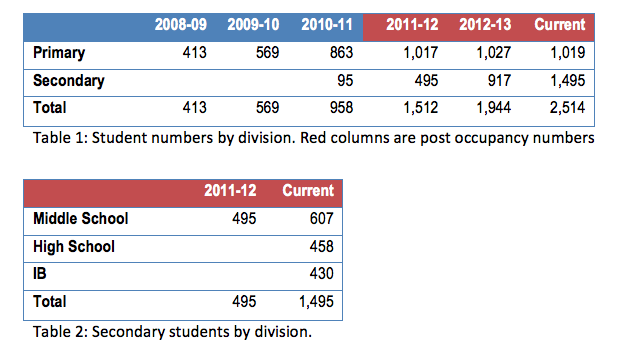
United World College South East Asia East (UWCSEA-East) is a K-12 international school located in Singapore. It commenced operations in 2008 and took occupancy of a purpose built campus in 2011. In this campus, the secondary school library initially served around 500 middle school students – see table 1. It now caters to three distinct communities, middle school, high school and the International Baccalaureate (IB) – see Table 2.
Screen Shot 2015-10-11 at 11.27.14 am
Despite consultation with the librarian in the planning phase, certain spaces of the library were designated different functions than agreed upon and furnished accordingly by the architect and building manager. One such area was upstairs overlooking the main school plaza with purpose built magazine racks. The idea was it would be a well-frequented showcase area for magazine reading. In reality a number of factors prevented this from being realised:
  • The furniture design didn’t accommodate its purpose as it was not deep or high enough and the storage area didn’t fit back copies
  • The zoning of the library post occupancy meant that materials affording quick casual reading such as graphic novels and periodicals were better located in the “noisier” and fast turnover area which allowed food and beverages, i.e. downstairs.
  • The trend in libraries is to move away from physical magazines and periodicals towards online providers including online databases and aggregators such as PressReader that provide the same product at a lower cost and without delays and issues with cataloguing and maintenance.
The question of what to do with the space was resolved by noticing that as the secondary school reached post occupancy capacity the lowest students in the pecking order i.e. middle school students were increasingly marginalised with students of higher sections taking over the prime library real estate (students are visually distinct due to different coloured polo shirts for their uniforms). In addition, middle school students no longer had library visits planned into their schedule. Furthermore, the large influx of new students and teachers meant that reading books in the classrooms were unevenly distributed both in terms of volume and quality without any structured form of classroom library, which the students had become accustomed to in the primary section. Finally, Eng/Hum teachers were noticing a decline in voluntary reading as students moved up through middle school.
These issues were addressed initially through collaboration between the librarian and Eng/Hum teachers and more recently by the new literacy coach over a period of three years as follows:
  • The conversion of the magazine area into a middle school reading zone
  • The establishing of a core library for each of the three middle school grades (Day, 2013b)
  • The creation of middle school classroom libraries in a formal and structured manner with materials integrated into the library catalogue (Day, 2015d)
  • The integration of informational / nonfiction texts into both areas
This is an on-going process and worth a critical analysis to examine the choice process, latent or existing attitudes and assumptions, exterior pressures and design constraints and collaboration and communication.

Critical analysis

Choice of process

The spatial change in the library was conceived and led by the teacher-librarian (TL) with the Eng/Hum teachers joining in the collaboration as the process evolved. Since the TL has experience in design thinking (Day, 2013a, 2015a, 2015c) the process followed the design thinking cycle of inspiration, ideation, iteration and getting to scale (Brown, 2008; IDEO, 2014).
This was achieved by:
  • Agreeing on a “core library” of 30 titles per grade for grades 6-8 which were prominently displayed
  • Adjusting shelving to accommodate front facing books
  • Relocating books of interest to this age group from the fiction collection
  • Using large posters to highlight the favourite books of middle school teachers in the library and class corridors and classroom walls
  • Ensuring multiple copies of books, by using class and literary circle sets
  • Adequate lighting, comfortable furniture and the creation of a private space
The above steps and final spatial design incorporated the elements that are recommended as enhancing school library spaces (Cha & Kim, 2015; Elliott-Burns, 2003; La Marca, 2008; A. McDonald, 2006; Serafini, 2011).
The design elements that contribute to successful classroom libraries are not dissimilar and include:
  • Sufficient space which is a focal area but partitioned and private
  • Comfortable furniture
  • Variety of material in range of complexity including different literary genres and informational texts
  • Category organisation and shelf labelling
  • Combination shelving allowing for quantity of books and display (front facing)
  • Advertising by means of posters and notices on whiteboards
  • Graphic organisation either thematic or by connections
  • Involvement of students in selection, organisation and maintenance (Fractor, Woodruff, Martinez, & Teale, 1993; Hopenwasser & Noel, 2014; Reutzel & Fawson, 2002, cited in Sanacore & Palumbo, 2010)
Discussion and research on the elements predominantly come from the elementary school environment, and the adoption to middle school requires some adjustments to account for the fact that students do not remain in one classroom, lessening the sense of ownership of a space on the part of students, and teachers needing to cater to multiple classes with different profiles and interests. Learning spaces are also typically smaller relative to the size of the students.
The creation of the library and classroom reading spaces and populating them with books is “necessary but not sufficient” (McGill-franzen, Allington, Yokoi, & Brooks, 1999). Other components of encouraging reading include training teachers to enhance their instructional routines to incorporate the material, and to ensure that teachers are familiar not only with their literary canon, but also the latest in good young adult fiction (Day, 2015b; McGill-franzen et al., 1999). The school has invested in training with Penny Kittle to assist in the instructional routines (Raisdana, 2015), while the librarian is working with the teachers on the latter.

Latent or existing attitudes and assumptions

An international school is blessed with diversity in cultures, languages and backgrounds both of their students and teachers. This results in a context of people coming from different systems with different attitudes, assumptions, beliefs and experiences around education, reading and libraries. In just the middle school, teachers come from Australia, United States, Philippines, Ireland, Canada and the United Kingdom, each with their own literary core. In addition, there are personal preferences and beliefs, for example around young adult literature (see Raisdana, 2014). Teachers may not be used to or have experience of collaboration with the TL, the benefits thereof, nor aware of the ways in which libraries have evolved (Gibbs, 2003; Montiel-Overall, 2006, 2008; Sullivan-Macdonald, 2015). And naturally there are assumptions around what constitutes an ideal learning or reading space and the balance between the two (Elliott-Burns, 2005). In a meta-review of access to print and educational outcomes, Lindsay (2010) concluded that limiting choices with a larger distribution interval led to more reading, particularly if it was accompanied by activities such as training and book talks. This is in contrast to the assumption that collections should be as large as possible. It also suggests that rotation of materials leads to better outcomes.

Exterior pressures and design constraints

The creation of the complementary spaces faced a number of constraints, design and otherwise. These included a small budget, limited time and variability in the reading level of students. In design thinking the presence of constraints is seen as a positive force that encourages creative solutions and exploring options that would not otherwise be considered, and this proved to be true in this case study (Brown & Katz, 2011; Hill, 1998; Ness, 2011).
Naturally budget was an important constraint that shaped the way in which the space was converted and books and furniture was acquired or moved and repurposed. As discussed earlier, the librarian was involved in the “fuzzy front end” (Sanders & Stappers, 2008, p. 6), of the secondary library design and once the space was completed it was not possible to change the space, only to adapt its purpose. In the classrooms the availability of furniture in the room to hold the books and the available space for the classroom library vis-à-vis other learning spaces determined how many books could effectively by stored and displayed. In this respect creative design thinking was deployed, for example by taking the doors off built-in cupboard space both in the classrooms and in the library, creating additional shelving. Comfortable furniture was either acquired by donations from the community or purchased to ensure equity between the classrooms.
Although the library and classes each have a budget for the acquisition of books, both wanted to ensure that existing resources were not wasted – for example the books already owned in multiple copies. However their repurposing had to be examined within the constraints of the reading level of the students and the curriculum themes for each grade.

Collaboration and communication

Collaboration and communication between the TL and teachers has received a lot of attention as has the ways in which spatial design and design thinking can enhance collaboration (Avallon & Schneider, 2013; Ferer, 2012; Gibbs, 2003; Knapp, 2014; Montiel-Overall, 2006; Williamson, Archibald, & McGregor, 2010). Enhancing collaboration between the TL and the Eng/Hum department has occurred on a number of fronts, both physical and virtual – such as book chat mornings to book talk new books, encouraging teachers and students to be involved with the selection of books for the Red Dot Awards (ISLN, 2015), processing and cataloguing the books, and the creation of a virtual space for the books (Day, 2015b).
Given time constraints and curriculum pressures, additional moments for collaboration and communication have had to be designed into the process. For example teachers can book the reading zone space to conduct lessons, and invite the TL to book talk new or noteworthy books. In addition the library receives supervision assistance from teachers during lunch, recess times and after school. The Eng/Hum teachers have first priority in requesting this duty, creating the opportunity for the important “casual conversations” that result in informal learning and information exchange (Oblinger, 2006; Somerville & Brown-Sica, 2011).

Conclusion

The process can neither be criticized for its efficacy nor results. Teachers, students and the librarian have largely viewed the change positively. Due to making small iterative changes to the spaces, starting with a small budget and a limited number of books in the first year, and subsequently adapting the choice of books, the selection and weeding process based on experience and feedback, the combined library / class library spaces appear to have grown organically despite a lot of “behind the scenes” work on book processing, cataloguing and making books classroom / shelf ready.
There are five main recommendations arising from the analysis of this case study, all which can be tackled through employing design thinking rather than further changes to the current spatial design:
  • Balance the contradictory forces of novelty and familiarity through how books are selected, displayed and rotated
  • Focus efforts on the most efficacious element of encouraging reading – book talks
  • Expand the space to include the home environment, particularly in the case of bilingual students
  • Increase involvement of students in the spatial design and change process
  • Quantify the benefits of this spatial / design thinking collaboration through evidence based research.
These will be elaborated in the next section.

Recommendations

Balance novelty and familiarity

Students like and respond to novelty in display and a constant supply of “new” titles, they would also possibly benefit from choice limitation (Iyengar, 2011). This can be achieved by a rotation of titles between spine and front facing, and through a rotation between the books in the various classes (Lindsay, 2010). At present the core and class libraries are refreshed annually and the class libraries are not rotated between classes or teachers. It is recommended this be considered to prevent staleness. The class library placement of books in bins rather than shelves with a mixture of front and spine facing, allowing changes is display is not best practise, nor is having all books available simultaneously (Fractor et al., 1993; Lindsay, 2010; Sanacore, 2000; Sanacore & Palumbo, 2010).

Book talks

The importance of teachers’, librarians’, students’ and the community’s increasing exposure of diverse books in all genres by book talking can’t be overstated (Bentheim, 2013; Gallo, 2001; L. McDonald, 2013; Serafini, 2011). But, as examined in the analysis, a number of barriers stand in the way of regular book talks. In addition, requiring reading related tasks from students runs the risk of resulting in unfavourable associations with reading and further reluctance (Eriksson, 2002; Gallo, 2001; Miller, 2009).
Many practioners have described how digital innovation and the creation of virtual spaces can enhance and augment traditional book talks as well as expand transliteracy skills of students (Dreon, Kerper, & Landis, 2011; Gogan & Marcus, 2013; Gunter & Kenny, 2008; Ragan, 2012). It is recommended that students be given ownership of exploring the potentials of the digital realm in this respect as a guided design thinking exercise.

Mother tongue material and the home environment

Access to mother tongue materials continues to be a weakness in the library and even more so in the classroom library. There are logistical and financial constraints including the wide spread of languages, the undervaluation of low status languages, and misinformation and misunderstanding on the value of reading in the mother tongue amongst students and parents (Bailey, 2014a, 2014b, 2015; Boelens, Cherek, Tilke, & Bailey, 2015). This is an area that would benefit greatly from increased collaboration between the college and parent body where previously “unknowable” resources could be tapped into through utilizing the analytical and process skills of design thinking (IDEO, 2014; Landis, Umolu, & Mancha, 2010; McIntosh, 2015).

Student involvement

While literature indicates collaboration by all stakeholders is essential for acceptance, particularly in learning environments (Hamilton, 2013; Jones, 2006; Sanders & Stappers, 2008), this has largely been a librarian / teacher initiative with some student involvement in book selection. Moving forward, the virtual or digital sphere is an area where students can also be encouraged to carve out a presence and take ownership with teachers taking on an enabler role as use of all seven learning spaces are maximised (Grisham & Wolsey, 2006; McIntosh, 2010; Thornburg, 2007; Wilson & Randall, 2012).

Quantify the benefits

Despite numerous hurdles in providing data and making analysis founded on circulation figures or student attainment records, there is considerable value in documenting and providing evidence for practises – not the least that it supports budget requests.
Circulation records do not provide a complete record or necessarily correlate with reading because:
  • Books may be read in library / class without being checked out
  • In affluent multi-cultural communities, students may have access to large personal libraries, including books in their mother tongue
  • Students may be borrowing books from the public library
Despite this, circulation is still the best proxy for reading. The decentralised nature of the class libraries results in less control over book checkout. Even in the library, that has no exit barriers, at the end of 2014/5 academic year roughly 20% of returned books had not been checked out of the system. While this can be lauded as an indication of the high moral and ethical standards of the students, it does pose difficulties in creating any evidence based data on the actual impact of either separating part of the library or decentralising the collection to class libraries in terms of increases in circulation.
It is recommended that both current and longitudinal research be carried out to see if there is any correlation between increased access to text, the amount of reading / circulation and other objective measures of attainment such as the annual PISA or TIMS tests. This will take the initiative beyond transformative individual anecdotal stories to evidence based research. The CLEP (Classroom Literacy Environmental Profile) (McGill-franzen et al., 1999; Wolfersberger, Reutzel, Sudweeks, & Fawson, 2004) and more recently the TEX-IN3 (Hoffman, Sailors, Duffy, & Beretvas, 2004) tools have successfully been used in the evaluation of elementary school class libraries and could be adapted for the middle school environment.
The recent inclusion of informational (nonfiction) texts in both the middle school zone and the classroom libraries is also one worth further investigation. Whether the expansion of the collections has impacted on the space, the ability to choose, and the completion of summative assessments in the individual subjects can be investigated in the light of the existing literature on the matter (Hopenwasser & Noel, 2014; Ness, 2011; Sanacore & Palumbo, 2010; Young & Moss, 2006; Young, Moss, & Cornwell, 2007).

References

Avallon, J., & Schneider, A. (2013). Building collaboration into workspace design. Facility Management Journal, (September / October), 34–38. Retrieved from http://cdn.ifma.org/sfcdn/fmj-supporting-documents/building-collaboration-into-workspace-design-fmj-sep-oct-2013.pdf?sfvrsn=0
Bailey, N. (2014a, November 12). Building a LOTE collection at an international school [Web Log]. Retrieved October 4, 2015, from http://informativeflights.blogspot.sg/2014/11/building-lote-collection-at.html
Bailey, N. (2014b, November 12). Research summary on language [Web Log]. Retrieved November 12, 2014, from http://informativeflights.blogspot.sg/2014/11/research-summary-on-language.html
Bailey, N. (2015). Digital language learning ecology. Singapore: iBooks. Retrieved from https://itunes.apple.com/us/book/digital-language-learning/id1000588637?ls=1&mt=11
Bentheim, C. A. (2013). Continuing the transition work from traditional library to learning commons. Teacher Librarian41(2), 29–36. Retrieved from http://ezproxy.csu.edu.au/login?url=http://search.ebscohost.com/login.aspx?direct=true&db=ehh&AN=92991111&site=ehost-live
Boelens, H., Cherek, J., Tilke, A., & Bailey, N. (2015). Communicating across cultures: cultural identity issues and the role of the multicultural, multilingual school library within the school community. Presented at the “The school library rocks” IASL 2015, Maastricht, Netherlands.
Brown, T. (2008). Design thinking. Harvard Business Review86(6), 84–92. Retrieved from http://ezproxy.csu.edu.au/login?url=http://search.ebscohost.com/login.aspx?direct=true&db=heh&AN=32108052&site=ehost-live
Brown, T., & Katz, B. (2011). Change by Design: Change by Design. Journal of Product Innovation Management28(3), 381–383. http://doi.org/10.1111/j.1540-5885.2011.00806.x
Cha, S. H., & Kim, T. W. (2015). What matters for students’ use of physical library space? The Journal of Academic Librarianship41(3), 274–279. http://doi.org/10.1016/j.acalib.2015.03.014
Day, K. (2013a, January 14). Carol Kuhlthau meets Tim Brown: Guided Inquiry {Design} Thinking [Web Log]. Retrieved October 3, 2015, from http://www.thelibrarianedge.com/libedge/2013/01/carol-kuhlthau-meets-tim-brown-guided.html?rq=design%20thinking
Day, K. (2013b, November). Liberate your book cupboards and create a more true “bookstore” model in your school library [Web Log]. Retrieved August 2, 2015, from http://www.thelibrarianedge.com/libedge/2013/11/liberate-your-book-cupboards-and-create.html
Day, K. (2015a, August 30). Expert learning in the library…. and classroom [Web Log]. Retrieved October 3, 2015, from http://www.thelibrarianedge.com/libedge/2015/8/30/a-sociologist-who-loves-the-research-process?rq=
Day, K. (2015b, September 3). Professional learning for teachers who read books students might read [Library Guide]. Retrieved September 6, 2015, from http://research.uwcsea.edu.sg/eastlibsec/classlibs
Day, K. (2015c, September 5). Design thinking for the research process (e.g., the IBO Extended Essay) [Web Log]. Retrieved September 6, 2015, from http://www.thelibrarianedge.com/libedge/2015/8/30/design-thinking-for-the-research-process
Day, K. (2015d, September 28). Center and satellite collections: connections between classrooms and the library [Web Log]. Retrieved October 3, 2015, from http://www.thelibrarianedge.com/libedge/2015/9/26/middle-school-classroom-libraries-and-the-central-library
Dreon, O., Kerper, R. M., & Landis, J. (2011). Digital storytelling: A tool for teaching and learning in the YouTube generation. Middle School Journal42(5), 4–9.
Elliott-Burns, R. (2003). Space, place, design and the school library. Journal of the Australian School Library Association17(2).
Elliott-Burns, R. (2005). Designing spaces for learning and living in schools: perspectives of a flaneuse. Presented at the Australian Curriculum Studies Association Biennial Conference, Queensland, Australia: University of the Sunshine Coast. Retrieved from http://eprints.qut.edu.au/4345/1/4345.pdf
Eriksson, K. (2002). Booktalk dilemmas: Teachers’ organisation of pupils’ reading. Scandinavian Journal of Educational Research46(4), 391–408. http://doi.org/10.1080/0031383022000024570
Ferer, E. (2012). Working together: library and writing center collaboration. Reference Services Review40(4), 543–557. http://doi.org/10.1108/00907321211277350
Fractor, J. S., Woodruff, M. C., Martinez, M. G., & Teale, W. H. (1993). Let’s not miss opportunities to promote voluntary reading: Classroom libraries in the elementary school. The Reading Teacher46(6), 476–484. Retrieved from http://www.jstor.org/stable/20201114
Gallo, D. R. (2001). How classics create an aliterate society. The English Journal90(3), 33–39. Retrieved from http://moormangb.ced.appstate.edu/5730_f11_h/unit1/Gallo.pdf
Gibbs, R. (2003). Reframing the role of the teacher-librarian : the case for collaboration and flexibility. Scan22(3), 4–7. Retrieved from http://search.informit.com.au.ezproxy.csu.edu.au/fullText;dn=129538;res=AEIPT
Gogan, B., & Marcus, A. (2013). Lost in transliteracy – how to expand student learning across a variety of platforms. Knowledge Quest41(5), 40–45.
Grisham, D. L., & Wolsey, T. D. (2006). Recentering the middle school classroom as a vibrant learning community: Students, literacy, and technology intersect. Journal of Adolescent & Adult Literacy49(8), 648–660. http://doi.org/10.1598/JAAL.49.8.2
Gunter, G. A., & Kenny, R. F. (2008). Digital booktalk: Digital media for reluctant readers. Contemporary Issues in Technology and Teacher Education8(1), 84–99.
Hamilton, B. (2013, November 14). A visit to the Lovett School story studio: Redesigning learning spaces, rewriting narratives of learning [Web Log]. Retrieved August 8, 2015, from https://theunquietlibrarian.wordpress.com/2013/11/14/a-visit-to-the-lovett-school-story-studio-redesigning-learning-spaces-rewriting-narratives-of-learning/
Hill, A. M. (1998). Problem solving in real-life contexts: An alternative for design in technology education. International Journal of Technology and Design Education8, 203–220.
Hoffman, J., Sailors, M., Duffy, G., & Beretvas, S. N. (2004). The effective elementary classroom literacy environment: Examining the validity of the TEX-IN3 observation system. Journal of Literacy Research36(3), 303–334. http://doi.org/10.1207/s15548430jlr3603_3
Hopenwasser, C. B., & Noel, A. M. (2014). Tackling text complexity with your classroom library. Kappa Delta Pi Record50(2), 81–84. http://doi.org/10.1080/00228958.2014.900851
IDEO. (2014). Design thinking for libraries – a toolkit for patron-centered design (p. 121).
IDEO, Bill & Melinda Gates Foundation. Retrieved from http://www.designthinkingforlibraries.com
ISLN. (2015). Red Dot Book Awards 2015-2016 [Google Site]. Retrieved October 8, 2015, from https://sites.google.com/site/reddotbookawards20152016/
Iyengar, S. (2011, November). How to make choosing easier [Video file]. Retrieved October 8, 2015, from https://www.ted.com/talks/sheena_iyengar_choosing_what_to_choose
James, M. E. (1923). Use of classroom libraries to stimulate interest and speed in reading. The Elementary School Journal23(8), 601–608. http://doi.org/10.2307/994550
Jones, J. A. (2006). Student-involved classroom libraries. The Reading Teacher59(6), 576–580. Retrieved from http://search.proquest.com/docview/203284680?accountid=10344
Kelley, M. J., & Decker, E. O. (2009). The Current State of Motivation to Read Among Middle School Students. Reading Psychology30(5), 466–485. http://doi.org/10.1080/02702710902733535
Knapp, J. (2014, May 1). Google Ventures: your design team needs a war room. Here’s how to set one up. Retrieved August 8, 2015, from http://www.fastcodesign.com/3028471/google-ventures-your-design-team-needs-a-war-room-heres-how-to-set-one-up
Krarup, A. (1955). Classroom libraries are not enough. The Reading Teacher8(4), 215–219. http://doi.org/10.2307/20196863
Krashen, S. D. (2004). The power of reading: insights from the research. Westport, Conn.; Portsmouth, N.H.: Libraries Unlimited ; Heinemann.
La Marca, S. (2008). Reading spaces (pp. 1–12). Presented at the 38th Annual Conference of the International Association of School Librarianship, Padua, Italy: International Association of School Librarianship. Retrieved from http://www.kzneducation.gov.za/Portals/0/ELITS%20website%20Homepage/IASL%202008/professional%20papers/lamarcaspacespp.pdf
Landis, D., Umolu, J., & Mancha, S. (2010). The power of language experience for cross-cultural reading and writing. The Reading Teacher63(7), 580–589. http://doi.org/10.1598/RT.63.7.5
Lesesne, T. S. (1991). Developing lifetime readers: Suggestions from fifty years of research. English Journal80(6), 61. Retrieved from http://search.proquest.com/docview/237285282?accountid=10344
Lindsay, J. (2010). Children’s access to print material and education-related outcomes: Findings from a meta-analytic review. Naperville, IL: Learning Point Associates. Retrieved from http://rif.org/documents/us/RIFandLearningPointMeta-FullReport.pdf
McDonald, A. (2006). The ten commandments revisited: the qualities of good library space. LIBER Quarterly16(2). Retrieved from http://liber.library.uu.nl/index.php/lq/article/view/7840/8010
McDonald, L. (2013). Literature for children and young adolescents. In A literature companion for teachers (pp. 1–7). Newtown, Australia: Primary English Teaching Association Australia (PETAA).
McGill-franzen, A., Allington, R. L., Yokoi, L., & Brooks, G. (1999). Putting books in the classroom seems necessary but not sufficient. The Journal of Educational Research93(2), 67–74. http://doi.org/10.1080/00220679909597631
McIntosh, E. (2010). Clicks & Bricks: When digital, learning and physical space meet. Educational Facility Planner45(1&2), 33–38. Retrieved from http://media.cefpi.org/efp/EFP45-1and2McIntosh.pdf
McIntosh, E. (2015, July). The unknown unknowns – test out your ideas [Web Log]. Retrieved July 19, 2015, from http://edu.blogs.com/edublogs/2015/07/the-unknown-unknowns-test-out-your-ideas.html
Miller, D. (2009). The book whisperer: awakening the inner reader in every child (1st ed). San Francisco, Calif: Jossey-Bass.
Montiel-Overall, P. (2006). Teacher and teacher-librarian collaboration: moving toward integration. Teacher Librarian34(2), 28–33. Retrieved from http://search.proquest.com/docview/224885770?accountid=10344
Montiel-Overall, P. (2008). Teacher and librarian collaboration: A qualitative study. Library & Information Science Research30(2), 145–155. http://doi.org/10.1016/j.lisr.2007.06.008
Ness, M. (2011). Teachers’ Use of and Attitudes Toward Informational Text in K-5 Classrooms. Reading Psychology32(1), 28–53. Retrieved from http://ezproxy.csu.edu.au/login?url=http://search.ebscohost.com/login.aspx?direct=true&db=pbh&AN=57420253&site=ehost-live
Oblinger, D. (2006). Learning spaces. Boulder, CO: EDUCAUSE.
Powell, W. R. (1966). Classroom libraries: their frequency of use. Elementary English43(4), 395–397. http://doi.org/10.2307/41387579
Ragan, M. (2012). Inspired technology, inspired readers – How book trailers foster a passion for reading. AccessMarch, 8–13.
Raisdana, J. (2014, March 10). Well-versed In books [Web Log]. Retrieved October 3, 2015, from http://www.jabizraisdana.com/blog/well-versed-in-books/
Raisdana, J. (2015, February 9). Leave with a suggestion [Web Log]. Retrieved October 3, 2015, from http://www.jabizraisdana.com/blog/leave-with-a-suggestion/
Sanacore, J. (2000). Promoting the lifetime reading habit in middle school students. The Clearing House73(3), 157–161. Retrieved from http://search.proquest.com/docview/196889420?accountid=10344
Sanacore, J., & Palumbo, A. (2010). Middle school students need more opportunities to read across the curriculum. The Clearing House83(5), 180–185. Retrieved from http://search.proquest.com/docview/744358835?accountid=10344
Sanders, E. B.-N., & Stappers, P. J. (2008). Co-creation and the new landscapes of design. CoDesign4(1), 5–18. http://doi.org/10.1080/15710880701875068
Serafini, F. (2011). Creating space for children’s literature. The Reading Teacher65(1), 30–34. http://doi.org/10.1598/RT.65.1.4
Sheldon, S., B., & Davis, M., H. (2015). “I wish everyone had a library like this” (The Baltimore Elementary and Middle School Library Project No. Year 2 Report). Baltimore, USA. Retrieved from http://baltimore-berc.org/wp-content/uploads/2015/06/ALibraryLikeThisJune2015.pdf
Somerville, M. M., & Brown-Sica, M. (2011). Library space planning: a participatory action research approach. The Electronic Library29(5), 669–681. http://doi.org/10.1108/02640471111177099
Sullivan-Macdonald, D. (2015, October 1). Teach more, librarian less, say SLJ leadership summit panelists [Web Log]. Retrieved October 3, 2015, from http://www.slj.com/2015/10/schools/teach-more-librarian-less-becoming-essential-panel-at-the-slj-leadership-summit/
Thornburg, D. (2007, October). Campfires in cyberspace: Primordial metaphors for learning in the 21st Century. TCPD. Retrieved from http://tcpd.org/Thornburg/Handouts/Campfires.pdf
Todd, R. J., Gordon, C. A., & Lu, Y.-L. (2011). One common goal: Student learning (Report of Findings and Recommendations of the New Jersey School Library Survey Phase 2). New Jersey, USA: New Jersey Association of School Librarians. Retrieved from http://www.njasl.info/wp-content/NJ_study/2011_Phase2Report.pdf
Williamson, K., Archibald, A., & McGregor, J. (2010). Shared vision: A key to successful collaboration? School Libraries Worldwide16(2), 16–30. Retrieved from http://ezproxy.csu.edu.au/login?url=http://search.ebscohost.com/login.aspx?direct=true&db=lih&AN=55415805&site=ehost-live
Wilson, G., & Randall, M. (2012). The implementation and evaluation of a new learning space: a pilot study. Research in Learning Technology20(2), 1–17. Retrieved from http://ezproxy.csu.edu.au/login?url=http://search.ebscohost.com/login.aspx?direct=true&db=ehh&AN=86214889&site=ehost-live
Wolfersberger, M., Reutzel, D. R., Sudweeks, R., & Fawson, P. (2004). Developing and validating the Classroom Literacy Environmental Profile (CLEP): A tool for examining the “print richness” of early childhood and elementary classrooms. Journal of Literacy Research36(2), 211–272. http://doi.org/10.1207/s15548430jlr3602_4
Worthy, J. (1996). Removing barriers to voluntary reading for reluctant readers: The role of school and classroom libraries. Language Arts73(7), 483–492. Retrieved from http://search.proquest.com/docview/196851690?accountid=10344
Young, T. A., & Moss, B. (2006). Nonfiction in the classroom library: A literacy necessity. Childhood Education82(4), 207–212. Retrieved from http://search.proquest.com/docview/210392168?accountid=10344
Young, T. A., Moss, B., & Cornwell, L. (2007). The classroom library: A place for nonfiction, nonfiction in its place. Reading Horizons48(1), 1–18. Retrieved from http://search.proquest.com/docview/236486012?accountid=10344

INF536: Critical Assessment

Looking back on this last semester, I can only sum it up by saying that change, beauty and progress in thought and learning is not only wrought by avalanche and volcano but also by the constant erosion by drops of water and bits of sand.  That combined with space and time.

9616353114

In the same way, this course has offered me space and time for learning by:

  • Forcing me to carve time out of a schedule that would otherwise be occupied by busyness
  • Exposing me to a variety of ideas, research, thoughts and concepts that I wouldn’t otherwise naturally encounter in my day-to-day professional or personal life
  • Making me DO things I’d otherwise shrug off as impossible (Bailey, 2015b)
  • Giving me a framework within which to analyse problems “wicked” and otherwise (Bailey, 2015a, 2015g; Buchanan, 1992; IDEO, 2014)
  • Grouping me with a set of people who are all approaching the course from a different context and set of experiences and knowledge
  • Creating a virtual (and at times physical) space for us to encounter each other and comment and share our learning – both formally and informally (“#INF536 – Twitter Search,” n.d.; McIntosh & CSU, n.d.)


It has be quite an experience, and, as someone once said – it’s not so much what you’ve learnt as what you remember. What has left a lasting impression is design thinking, the value of constraints and learning at the extremes.


As someone new to the education field, new to librarianship, operating under all kinds of constraints, the design thinking concepts of inspiration, ideation and implementation (Brown, 2008; Brown & Katz, 2011; IDEO, 2014) fits perfectly with that other concept of living and teaching in constant beta (Schroeder, 2013). As a fairly grounded, not terribly artistically (of the drawing and painting type) creative person this is the aspect of “design” that appeals to me as it is achievable with observation, thought, logic and research. However it also demands that I embody the principle of risk-taking and not just pay lip service to it sprouting it to my PYP (IB primary year program) students at regular intervals. There is something very empowering in the process of observing, thinking, asking, making small or not so small changes, and failing or succeeding, learning and trying again without fear and knowing that every time again one is moving every so slightly forward and nudging one’s students in the same direction.


My most effective intervention resulting from a budgetary constraint


Constraints, rather than hampering us, force rethinking options, relooking at alternatives and collaborating, asking, connecting in a way that is not always necessary when one is overwhelmed by choice and abundance. As documented in my blog posts: design – space, thinking and time 1, 2, 3 & 4 (Bailey, 2015c, 2015d, 2015e, 2015f) operating within the constraints of limited time, no budget, a small and almost unalterable space can result in creative solutions that are as ad hoc as they are successful.


We can learn a lot about education and learning in extreme conditions (Chohan, 2011; Leadbeater & Wong, 2010). But more immediate and accessible are the extremes in our own communities the students at the challenging edges of all the continuums we create. The teachers and parents who don’t toe some invisible line.


The name of my series of blog posts also reflects my thoughts about designing learning spaces. It’s not just about the physical space, it’s about reconstructing how we think about time and what we do in it, and carving out a presence physically, virtually and even emotionally. No matter how beautifully our surroundings have been designed, how much money has been spent on the furnishings and fittings, how much time is built into the curriculum if our students do not feel safe and have a willing and open space in their hearts and minds for learning, nothing will make an impact.

16807472897

References:

Bailey, N. (2015a, July 23). On the box, off the box – INF536 Blog Post 1 [Web Log]. Retrieved October 11, 2015, from http://thinkspace.csu.edu.au/informativeflights/2015/07/23/on-the-box-off-the-box/

Bailey, N. (2015b, August 7). Blog 2: Observation – Dog Walk [Web Log]. Retrieved October 11, 2015, from http://thinkspace.csu.edu.au/informativeflights/2015/08/07/blog-2-observation-dog-walk/

Bailey, N. (2015c, August 23). Design – space, thinking and time (1) [Web Log]. Retrieved October 4, 2015, from http://thinkspace.csu.edu.au/informativeflights/2015/08/23/design-space-thinking-and-time-1/

Bailey, N. (2015d, September 6). Design – space thinking and time (2) [Web Log]. Retrieved October 4, 2015, from http://thinkspace.csu.edu.au/informativeflights/2015/09/06/design-space-thinking-and-time-2/

Bailey, N. (2015e, September 20). Design – space, thinking and time (3) [Web Log]. Retrieved October 4, 2015, from http://thinkspace.csu.edu.au/informativeflights/2015/09/20/design-space-thinking-and-time-3/

Bailey, N. (2015f, October 4). Design – space, thinking and time (4) [Web Log]. Retrieved October 11, 2015, from http://thinkspace.csu.edu.au/informativeflights/2015/10/04/design-space-thinking-and-time-4/

Bailey, N. (2015g, October 11). INF536: Assessment 4 – Part A: Applying spatial changes and design thinking to middle school reading – a three phase collaborative approach [Web Log]. Retrieved October 11, 2015, from http://thinkspace.csu.edu.au/informativeflights/2015/10/11/inf536-assessment-4-part-a-applying-spatial-changes-and-design-thinking-to-middle-school-reading-a-three-phase-collaborative-approach/

Brown, T. (2008). Design thinking. Harvard Business Review, 86(6), 84–92. Retrieved from http://ezproxy.csu.edu.au/login?url=http://search.ebscohost.com/login.aspx?direct=true&db=heh&AN=32108052&site=ehost-live

Brown, T., & Katz, B. (2011). Change by Design: Change by Design. Journal of Product Innovation Management, 28(3), 381–383. http://doi.org/10.1111/j.1540-5885.2011.00806.x

Buchanan, R. (1992). Wicked problems in design thinking. Design Issues, 8(2), 5–21. Retrieved from http://www.jstor.org/stable/1511637

Chohan, A. (2011, January 25). Learning without frontiers [Video file]. Retrieved October 11, 2015, from https://www.youtube.com/watch?v=EARTcJkNrDA

IDEO. (2014). Design thinking for libraries – a toolkit for patron-centered design (p. 121). IDEO, Bill & Melinda Gates Foundation. Retrieved from http://www.designthinkingforlibraries.com

#INF536 – Twitter Search. (n.d.). [Twitter]. Retrieved October 11, 2015, from https://twitter.com/search?q=%23INF536&src=typd

Leadbeater, C., & Wong, A. (2010). Learning from the extremes. CISCO. Retrieved September 2, 2015 from https://www.cisco.com/web/about/citizenship/socio-economic/docs/LearningfromExtremes_WhitePaper.pdf

McIntosh, E., & CSU. (n.d.). Discussion Board – S-INF536_201560_W_D @CSU [Discussion Forum]. Retrieved October 11, 2015, from https://interact2.csu.edu.au/webapps/discussionboard/do/conference?toggle_mode=read&action=list_forums&course_id=_6652_1&nav=discussion_board_entry&mode=view

Schroeder, M. (2013, November 6). Living in beta [Video file]. Retrieved October 6, 2015, from https://www.youtube.com/watch?v=0nnYI3ePrY8


INF536: Assessment 4 – Part A: Applying spatial changes and design thinking to middle school reading– a three phase collaborative approach

Introduction

There is a long history of research into the value of and elements contributing to the success of classroom libraries. They have an important role in ensuring accessibility of written works to promote fluency and skill in literacy and thereby contributing to academic achievement. But the literature appears to concentrate on elementary schools (Hopenwasser & Noel, 2014; James, 1923; Jones, 2006; Krarup, 1955; Powell, 1966; Sanacore & Palumbo, 2010; Todd, Gordon, & Lu, 2011; Worthy, 1996). Although partnership and collaboration with the school and/or public library and librarian is recommended, the literature often deals with the two spaces in isolation. Further, the problem of aliteracy in middle school – whereby students can read but don’t want to – is well documented (Kelley & Decker, 2009; Krashen, 2004; Lesesne, 1991; Sheldon & Davis, 2015; Worthy, 1996). This case report will show how the two environments library and classroom, can successfully be seen as extensions of each other through the principles of design and design thinking and explicit cooperation between the language humanities (Eng/Hum) teachers, literacy coach and school librarian in order to promote voluntary reading.

Case development

United World College South East Asia East (UWCSEA-East) is a K-12 international school located in Singapore. It commenced operations in 2008 and took occupancy of a purpose built campus in 2011. In this campus, the secondary school library initially served around 500 middle school students – see table 1. It now caters to three distinct communities, middle school, high school and the International Baccalaureate (IB) – see Table 2.

Screen Shot 2015-10-11 at 11.27.14 am

Despite consultation with the librarian in the planning phase, certain spaces of the library were designated different functions than agreed upon and furnished accordingly by the architect and building manager. One such area was upstairs overlooking the main school plaza with purpose built magazine racks. The idea was it would be a well-frequented showcase area for magazine reading. In reality a number of factors prevented this from being realised:

  • The furniture design didn’t accommodate its purpose as it was not deep or high enough and the storage area didn’t fit back copies
  • The zoning of the library post occupancy meant that materials affording quick casual reading such as graphic novels and periodicals were better located in the “noisier” and fast turnover area which allowed food and beverages, i.e. downstairs.
  • The trend in libraries is to move away from physical magazines and periodicals towards online providers including online databases and aggregators such as PressReader that provide the same product at a lower cost and without delays and issues with cataloguing and maintenance.


The question of what to do with the space was resolved by noticing that as the secondary school reached post occupancy capacity the lowest students in the pecking order i.e. middle school students were increasingly marginalised with students of higher sections taking over the prime library real estate (students are visually distinct due to different coloured polo shirts for their uniforms). In addition, middle school students no longer had library visits planned into their schedule. Furthermore, the large influx of new students and teachers meant that reading books in the classrooms were unevenly distributed both in terms of volume and quality without any structured form of classroom library, which the students had become accustomed to in the primary section. Finally, Eng/Hum teachers were noticing a decline in voluntary reading as students moved up through middle school.


These issues were addressed initially through collaboration between the librarian and Eng/Hum teachers and more recently by the new literacy coach over a period of three years as follows:

  • The conversion of the magazine area into a middle school reading zone
  • The establishing of a core library for each of the three middle school grades (Day, 2013b)
  • The creation of middle school classroom libraries in a formal and structured manner with materials integrated into the library catalogue (Day, 2015d)
  • The integration of informational / nonfiction texts into both areas

This is an on-going process and worth a critical analysis to examine the choice process, latent or existing attitudes and assumptions, exterior pressures and design constraints and collaboration and communication.

Critical analysis

Choice of process

The spatial change in the library was conceived and led by the teacher-librarian (TL) with the Eng/Hum teachers joining in the collaboration as the process evolved. Since the TL has experience in design thinking (Day, 2013a, 2015a, 2015c) the process followed the design thinking cycle of inspiration, ideation, iteration and getting to scale (Brown, 2008; IDEO, 2014).


This was achieved by:

  • Agreeing on a “core library” of 30 titles per grade for grades 6-8 which were prominently displayed
  • Adjusting shelving to accommodate front facing books
  • Relocating books of interest to this age group from the fiction collection
  • Using large posters to highlight the favourite books of middle school teachers in the library and class corridors and classroom walls
  • Ensuring multiple copies of books, by using class and literary circle sets
  • Adequate lighting, comfortable furniture and the creation of a private space


The above steps and final spatial design incorporated the elements that are recommended as enhancing school library spaces (Cha & Kim, 2015; Elliott-Burns, 2003; La Marca, 2008; A. McDonald, 2006; Serafini, 2011).


The design elements that contribute to successful classroom libraries are not dissimilar and include:

  • Sufficient space which is a focal area but partitioned and private
  • Comfortable furniture
  • Variety of material in range of complexity including different literary genres and informational texts
  • Category organisation and shelf labelling
  • Combination shelving allowing for quantity of books and display (front facing)
  • Advertising by means of posters and notices on whiteboards
  • Graphic organisation either thematic or by connections
  • Involvement of students in selection, organisation and maintenance (Fractor, Woodruff, Martinez, & Teale, 1993; Hopenwasser & Noel, 2014; Reutzel & Fawson, 2002, cited in Sanacore & Palumbo, 2010)

Discussion and research on the elements predominantly come from the elementary school environment, and the adoption to middle school requires some adjustments to account for the fact that students do not remain in one classroom, lessening the sense of ownership of a space on the part of students, and teachers needing to cater to multiple classes with different profiles and interests. Learning spaces are also typically smaller relative to the size of the students.


The creation of the library and classroom reading spaces and populating them with books is “necessary but not sufficient” (McGill-franzen, Allington, Yokoi, & Brooks, 1999). Other components of encouraging reading include training teachers to enhance their instructional routines to incorporate the material, and to ensure that teachers are familiar not only with their literary canon, but also the latest in good young adult fiction (Day, 2015b; McGill-franzen et al., 1999). The school has invested in training with Penny Kittle to assist in the instructional routines (Raisdana, 2015), while the librarian is working with the teachers on the latter.

Latent or existing attitudes and assumptions

An international school is blessed with diversity in cultures, languages and backgrounds both of their students and teachers. This results in a context of people coming from different systems with different attitudes, assumptions, beliefs and experiences around education, reading and libraries. In just the middle school, teachers come from Australia, United States, Philippines, Ireland, Canada and the United Kingdom, each with their own literary core. In addition, there are personal preferences and beliefs, for example around young adult literature (see Raisdana, 2014). Teachers may not be used to or have experience of collaboration with the TL, the benefits thereof, nor aware of the ways in which libraries have evolved (Gibbs, 2003; Montiel-Overall, 2006, 2008; Sullivan-Macdonald, 2015). And naturally there are assumptions around what constitutes an ideal learning or reading space and the balance between the two (Elliott-Burns, 2005). In a meta-review of access to print and educational outcomes, Lindsay (2010) concluded that limiting choices with a larger distribution interval led to more reading, particularly if it was accompanied by activities such as training and book talks. This is in contrast to the assumption that collections should be as large as possible. It also suggests that rotation of materials leads to better outcomes.

Exterior pressures and design constraints

The creation of the complementary spaces faced a number of constraints, design and otherwise. These included a small budget, limited time and variability in the reading level of students. In design thinking the presence of constraints is seen as a positive force that encourages creative solutions and exploring options that would not otherwise be considered, and this proved to be true in this case study (Brown & Katz, 2011; Hill, 1998; Ness, 2011).


Naturally budget was an important constraint that shaped the way in which the space was converted and books and furniture was acquired or moved and repurposed. As discussed earlier, the librarian was involved in the “fuzzy front end” (Sanders & Stappers, 2008, p. 6), of the secondary library design and once the space was completed it was not possible to change the space, only to adapt its purpose. In the classrooms the availability of furniture in the room to hold the books and the available space for the classroom library vis-à-vis other learning spaces determined how many books could effectively by stored and displayed. In this respect creative design thinking was deployed, for example by taking the doors off built-in cupboard space both in the classrooms and in the library, creating additional shelving. Comfortable furniture was either acquired by donations from the community or purchased to ensure equity between the classrooms.


Although the library and classes each have a budget for the acquisition of books, both wanted to ensure that existing resources were not wasted – for example the books already owned in multiple copies. However their repurposing had to be examined within the constraints of the reading level of the students and the curriculum themes for each grade.

Collaboration and communication

Collaboration and communication between the TL and teachers has received a lot of attention as has the ways in which spatial design and design thinking can enhance collaboration (Avallon & Schneider, 2013; Ferer, 2012; Gibbs, 2003; Knapp, 2014; Montiel-Overall, 2006; Williamson, Archibald, & McGregor, 2010). Enhancing collaboration between the TL and the Eng/Hum department has occurred on a number of fronts, both physical and virtual – such as book chat mornings to book talk new books, encouraging teachers and students to be involved with the selection of books for the Red Dot Awards (ISLN, 2015), processing and cataloguing the books, and the creation of a virtual space for the books (Day, 2015b).


Given time constraints and curriculum pressures, additional moments for collaboration and communication have had to be designed into the process. For example teachers can book the reading zone space to conduct lessons, and invite the TL to book talk new or noteworthy books. In addition the library receives supervision assistance from teachers during lunch, recess times and after school. The Eng/Hum teachers have first priority in requesting this duty, creating the opportunity for the important “casual conversations” that result in informal learning and information exchange (Oblinger, 2006; Somerville & Brown-Sica, 2011).

Conclusion

The process can neither be criticized for its efficacy nor results. Teachers, students and the librarian have largely viewed the change positively. Due to making small iterative changes to the spaces, starting with a small budget and a limited number of books in the first year, and subsequently adapting the choice of books, the selection and weeding process based on experience and feedback, the combined library / class library spaces appear to have grown organically despite a lot of “behind the scenes” work on book processing, cataloguing and making books classroom / shelf ready.

There are five main recommendations arising from the analysis of this case study, all which can be tackled through employing design thinking rather than further changes to the current spatial design:

  • Balance the contradictory forces of novelty and familiarity through how books are selected, displayed and rotated
  • Focus efforts on the most efficacious element of encouraging reading – book talks
  • Expand the space to include the home environment, particularly in the case of bilingual students
  • Increase involvement of students in the spatial design and change process
  • Quantify the benefits of this spatial / design thinking collaboration through evidence based research.

These will be elaborated in the next section.

Recommendations

Balance novelty and familiarity

Students like and respond to novelty in display and a constant supply of “new” titles, they would also possibly benefit from choice limitation (Iyengar, 2011). This can be achieved by a rotation of titles between spine and front facing, and through a rotation between the books in the various classes (Lindsay, 2010). At present the core and class libraries are refreshed annually and the class libraries are not rotated between classes or teachers. It is recommended this be considered to prevent staleness. The class library placement of books in bins rather than shelves with a mixture of front and spine facing, allowing changes is display is not best practise, nor is having all books available simultaneously (Fractor et al., 1993; Lindsay, 2010; Sanacore, 2000; Sanacore & Palumbo, 2010).

Book talks

The importance of teachers’, librarians’, students’ and the community’s increasing exposure of diverse books in all genres by book talking can’t be overstated (Bentheim, 2013; Gallo, 2001; L. McDonald, 2013; Serafini, 2011). But, as examined in the analysis, a number of barriers stand in the way of regular book talks. In addition, requiring reading related tasks from students runs the risk of resulting in unfavourable associations with reading and further reluctance (Eriksson, 2002; Gallo, 2001; Miller, 2009).


Many practioners have described how digital innovation and the creation of virtual spaces can enhance and augment traditional book talks as well as expand transliteracy skills of students (Dreon, Kerper, & Landis, 2011; Gogan & Marcus, 2013; Gunter & Kenny, 2008; Ragan, 2012). It is recommended that students be given ownership of exploring the potentials of the digital realm in this respect as a guided design thinking exercise.

Mother tongue material and the home environment

Access to mother tongue materials continues to be a weakness in the library and even more so in the classroom library. There are logistical and financial constraints including the wide spread of languages, the undervaluation of low status languages, and misinformation and misunderstanding on the value of reading in the mother tongue amongst students and parents (Bailey, 2014a, 2014b, 2015; Boelens, Cherek, Tilke, & Bailey, 2015). This is an area that would benefit greatly from increased collaboration between the college and parent body where previously “unknowable” resources could be tapped into through utilizing the analytical and process skills of design thinking (IDEO, 2014; Landis, Umolu, & Mancha, 2010; McIntosh, 2015).

Student involvement

While literature indicates collaboration by all stakeholders is essential for acceptance, particularly in learning environments (Hamilton, 2013; Jones, 2006; Sanders & Stappers, 2008), this has largely been a librarian / teacher initiative with some student involvement in book selection. Moving forward, the virtual or digital sphere is an area where students can also be encouraged to carve out a presence and take ownership with teachers taking on an enabler role as use of all seven learning spaces are maximised (Grisham & Wolsey, 2006; McIntosh, 2010; Thornburg, 2007; Wilson & Randall, 2012).

Quantify the benefits

Despite numerous hurdles in providing data and making analysis founded on circulation figures or student attainment records, there is considerable value in documenting and providing evidence for practises – not the least that it supports budget requests.


Circulation records do not provide a complete record or necessarily correlate with reading because:

  • Books may be read in library / class without being checked out
  • In affluent multi-cultural communities, students may have access to large personal libraries, including books in their mother tongue
  • Students may be borrowing books from the public library

Despite this, circulation is still the best proxy for reading. The decentralised nature of the class libraries results in less control over book checkout. Even in the library, that has no exit barriers, at the end of 2014/5 academic year roughly 20% of returned books had not been checked out of the system. While this can be lauded as an indication of the high moral and ethical standards of the students, it does pose difficulties in creating any evidence based data on the actual impact of either separating part of the library or decentralising the collection to class libraries in terms of increases in circulation.


It is recommended that both current and longitudinal research be carried out to see if there is any correlation between increased access to text, the amount of reading / circulation and other objective measures of attainment such as the annual PISA or TIMS tests. This will take the initiative beyond transformative individual anecdotal stories to evidence based research. The CLEP (Classroom Literacy Environmental Profile) (McGill-franzen et al., 1999; Wolfersberger, Reutzel, Sudweeks, & Fawson, 2004) and more recently the TEX-IN3 (Hoffman, Sailors, Duffy, & Beretvas, 2004) tools have successfully been used in the evaluation of elementary school class libraries and could be adapted for the middle school environment.


The recent inclusion of informational (nonfiction) texts in both the middle school zone and the classroom libraries is also one worth further investigation. Whether the expansion of the collections has impacted on the space, the ability to choose, and the completion of summative assessments in the individual subjects can be investigated in the light of the existing literature on the matter (Hopenwasser & Noel, 2014; Ness, 2011; Sanacore & Palumbo, 2010; Young & Moss, 2006; Young, Moss, & Cornwell, 2007).

References

Avallon, J., & Schneider, A. (2013). Building collaboration into workspace design. Facility Management Journal, (September / October), 34–38. Retrieved from http://cdn.ifma.org/sfcdn/fmj-supporting-documents/building-collaboration-into-workspace-design-fmj-sep-oct-2013.pdf?sfvrsn=0

Bailey, N. (2014a, November 12). Building a LOTE collection at an international school [Web Log]. Retrieved October 4, 2015, from http://informativeflights.blogspot.sg/2014/11/building-lote-collection-at.html

Bailey, N. (2014b, November 12). Research summary on language [Web Log]. Retrieved November 12, 2014, from http://informativeflights.blogspot.sg/2014/11/research-summary-on-language.html

Bailey, N. (2015). Digital language learning ecology. Singapore: iBooks. Retrieved from https://itunes.apple.com/us/book/digital-language-learning/id1000588637?ls=1&mt=11

Bentheim, C. A. (2013). Continuing the transition work from traditional library to learning commons. Teacher Librarian, 41(2), 29–36. Retrieved from http://ezproxy.csu.edu.au/login?url=http://search.ebscohost.com/login.aspx?direct=true&db=ehh&AN=92991111&site=ehost-live

Boelens, H., Cherek, J., Tilke, A., & Bailey, N. (2015). Communicating across cultures: cultural identity issues and the role of the multicultural, multilingual school library within the school community. Presented at the “The school library rocks” IASL 2015, Maastricht, Netherlands.

Brown, T. (2008). Design thinking. Harvard Business Review, 86(6), 84–92. Retrieved from http://ezproxy.csu.edu.au/login?url=http://search.ebscohost.com/login.aspx?direct=true&db=heh&AN=32108052&site=ehost-live

Brown, T., & Katz, B. (2011). Change by Design: Change by Design. Journal of Product Innovation Management, 28(3), 381–383. http://doi.org/10.1111/j.1540-5885.2011.00806.x

Cha, S. H., & Kim, T. W. (2015). What matters for students’ use of physical library space? The Journal of Academic Librarianship, 41(3), 274–279. http://doi.org/10.1016/j.acalib.2015.03.014

Day, K. (2013a, January 14). Carol Kuhlthau meets Tim Brown: Guided Inquiry {Design} Thinking [Web Log]. Retrieved October 3, 2015, from http://www.thelibrarianedge.com/libedge/2013/01/carol-kuhlthau-meets-tim-brown-guided.html?rq=design%20thinking

Day, K. (2013b, November). Liberate your book cupboards and create a more true “bookstore” model in your school library [Web Log]. Retrieved August 2, 2015, from http://www.thelibrarianedge.com/libedge/2013/11/liberate-your-book-cupboards-and-create.html

Day, K. (2015a, August 30). Expert learning in the library…. and classroom [Web Log]. Retrieved October 3, 2015, from http://www.thelibrarianedge.com/libedge/2015/8/30/a-sociologist-who-loves-the-research-process?rq=

Day, K. (2015b, September 3). Professional learning for teachers who read books students might read [Library Guide]. Retrieved September 6, 2015, from http://research.uwcsea.edu.sg/eastlibsec/classlibs

Day, K. (2015c, September 5). Design thinking for the research process (e.g., the IBO Extended Essay) [Web Log]. Retrieved September 6, 2015, from http://www.thelibrarianedge.com/libedge/2015/8/30/design-thinking-for-the-research-process

Day, K. (2015d, September 28). Center and satellite collections: connections between classrooms and the library [Web Log]. Retrieved October 3, 2015, from http://www.thelibrarianedge.com/libedge/2015/9/26/middle-school-classroom-libraries-and-the-central-library

Dreon, O., Kerper, R. M., & Landis, J. (2011). Digital storytelling: A tool for teaching and learning in the YouTube generation. Middle School Journal, 42(5), 4–9.

Elliott-Burns, R. (2003). Space, place, design and the school library. Journal of the Australian School Library Association, 17(2).

Elliott-Burns, R. (2005). Designing spaces for learning and living in schools: perspectives of a flaneuse. Presented at the Australian Curriculum Studies Association Biennial Conference, Queensland, Australia: University of the Sunshine Coast. Retrieved from http://eprints.qut.edu.au/4345/1/4345.pdf

Eriksson, K. (2002). Booktalk dilemmas: Teachers’ organisation of pupils’ reading. Scandinavian Journal of Educational Research, 46(4), 391–408. http://doi.org/10.1080/0031383022000024570

Ferer, E. (2012). Working together: library and writing center collaboration. Reference Services Review, 40(4), 543–557. http://doi.org/10.1108/00907321211277350

Fractor, J. S., Woodruff, M. C., Martinez, M. G., & Teale, W. H. (1993). Let’s not miss opportunities to promote voluntary reading: Classroom libraries in the elementary school. The Reading Teacher, 46(6), 476–484. Retrieved from http://www.jstor.org/stable/20201114

Gallo, D. R. (2001). How classics create an aliterate society. The English Journal, 90(3), 33–39. Retrieved from http://moormangb.ced.appstate.edu/5730_f11_h/unit1/Gallo.pdf

Gibbs, R. (2003). Reframing the role of the teacher-librarian : the case for collaboration and flexibility. Scan, 22(3), 4–7. Retrieved from http://search.informit.com.au.ezproxy.csu.edu.au/fullText;dn=129538;res=AEIPT

Gogan, B., & Marcus, A. (2013). Lost in transliteracy – how to expand student learning across a variety of platforms. Knowledge Quest, 41(5), 40–45.

Grisham, D. L., & Wolsey, T. D. (2006). Recentering the middle school classroom as a vibrant learning community: Students, literacy, and technology intersect. Journal of Adolescent & Adult Literacy, 49(8), 648–660. http://doi.org/10.1598/JAAL.49.8.2

Gunter, G. A., & Kenny, R. F. (2008). Digital booktalk: Digital media for reluctant readers. Contemporary Issues in Technology and Teacher Education, 8(1), 84–99.

Hamilton, B. (2013, November 14). A visit to the Lovett School story studio: Redesigning learning spaces, rewriting narratives of learning [Web Log]. Retrieved August 8, 2015, from https://theunquietlibrarian.wordpress.com/2013/11/14/a-visit-to-the-lovett-school-story-studio-redesigning-learning-spaces-rewriting-narratives-of-learning/

Hill, A. M. (1998). Problem solving in real-life contexts: An alternative for design in technology education. International Journal of Technology and Design Education, 8, 203–220.

Hoffman, J., Sailors, M., Duffy, G., & Beretvas, S. N. (2004). The effective elementary classroom literacy environment: Examining the validity of the TEX-IN3 observation system. Journal of Literacy Research, 36(3), 303–334. http://doi.org/10.1207/s15548430jlr3603_3

Hopenwasser, C. B., & Noel, A. M. (2014). Tackling text complexity with your classroom library. Kappa Delta Pi Record, 50(2), 81–84. http://doi.org/10.1080/00228958.2014.900851

IDEO. (2014). Design thinking for libraries – a toolkit for patron-centered design (p. 121). IDEO, Bill & Melinda Gates Foundation. Retrieved from http://www.designthinkingforlibraries.com

ISLN. (2015). Red Dot Book Awards 2015-2016 [Google Site]. Retrieved October 8, 2015, from https://sites.google.com/site/reddotbookawards20152016/

Iyengar, S. (2011, November). How to make choosing easier [Video file]. Retrieved October 8, 2015, from https://www.ted.com/talks/sheena_iyengar_choosing_what_to_choose

James, M. E. (1923). Use of classroom libraries to stimulate interest and speed in reading. The Elementary School Journal, 23(8), 601–608. http://doi.org/10.2307/994550

Jones, J. A. (2006). Student-involved classroom libraries. The Reading Teacher, 59(6), 576–580. Retrieved from http://search.proquest.com/docview/203284680?accountid=10344

Kelley, M. J., & Decker, E. O. (2009). The Current State of Motivation to Read Among Middle School Students. Reading Psychology, 30(5), 466–485. http://doi.org/10.1080/02702710902733535

Knapp, J. (2014, May 1). Google Ventures: your design team needs a war room. Here’s how to set one up. Retrieved August 8, 2015, from http://www.fastcodesign.com/3028471/google-ventures-your-design-team-needs-a-war-room-heres-how-to-set-one-up

Krarup, A. (1955). Classroom libraries are not enough. The Reading Teacher, 8(4), 215–219. http://doi.org/10.2307/20196863

Krashen, S. D. (2004). The power of reading: insights from the research. Westport, Conn.; Portsmouth, N.H.: Libraries Unlimited ; Heinemann.

La Marca, S. (2008). Reading spaces (pp. 1–12). Presented at the 38th Annual Conference of the International Association of School Librarianship, Padua, Italy: International Association of School Librarianship. Retrieved from http://www.kzneducation.gov.za/Portals/0/ELITS%20website%20Homepage/IASL%202008/professional%20papers/lamarcaspacespp.pdf

Landis, D., Umolu, J., & Mancha, S. (2010). The power of language experience for cross-cultural reading and writing. The Reading Teacher, 63(7), 580–589. http://doi.org/10.1598/RT.63.7.5

Lesesne, T. S. (1991). Developing lifetime readers: Suggestions from fifty years of research. English Journal, 80(6), 61. Retrieved from http://search.proquest.com/docview/237285282?accountid=10344

Lindsay, J. (2010). Children’s access to print material and education-related outcomes: Findings from a meta-analytic review. Naperville, IL: Learning Point Associates. Retrieved from http://rif.org/documents/us/RIFandLearningPointMeta-FullReport.pdf

McDonald, A. (2006). The ten commandments revisited: the qualities of good library space. LIBER Quarterly, 16(2). Retrieved from http://liber.library.uu.nl/index.php/lq/article/view/7840/8010

McDonald, L. (2013). Literature for children and young adolescents. In A literature companion for teachers (pp. 1–7). Newtown, Australia: Primary English Teaching Association Australia (PETAA).

McGill-franzen, A., Allington, R. L., Yokoi, L., & Brooks, G. (1999). Putting books in the classroom seems necessary but not sufficient. The Journal of Educational Research, 93(2), 67–74. http://doi.org/10.1080/00220679909597631

McIntosh, E. (2010). Clicks & Bricks: When digital, learning and physical space meet. Educational Facility Planner, 45(1&2), 33–38. Retrieved from http://media.cefpi.org/efp/EFP45-1and2McIntosh.pdf

McIntosh, E. (2015, July). The unknown unknowns – test out your ideas [Web Log]. Retrieved July 19, 2015, from http://edu.blogs.com/edublogs/2015/07/the-unknown-unknowns-test-out-your-ideas.html

Miller, D. (2009). The book whisperer: awakening the inner reader in every child (1st ed). San Francisco, Calif: Jossey-Bass.

Montiel-Overall, P. (2006). Teacher and teacher-librarian collaboration: moving toward integration. Teacher Librarian, 34(2), 28–33. Retrieved from http://search.proquest.com/docview/224885770?accountid=10344

Montiel-Overall, P. (2008). Teacher and librarian collaboration: A qualitative study. Library & Information Science Research, 30(2), 145–155. http://doi.org/10.1016/j.lisr.2007.06.008

Ness, M. (2011). Teachers’ Use of and Attitudes Toward Informational Text in K-5 Classrooms. Reading Psychology, 32(1), 28–53. Retrieved from http://ezproxy.csu.edu.au/login?url=http://search.ebscohost.com/login.aspx?direct=true&db=pbh&AN=57420253&site=ehost-live

Oblinger, D. (2006). Learning spaces. Boulder, CO: EDUCAUSE.

Powell, W. R. (1966). Classroom libraries: their frequency of use. Elementary English, 43(4), 395–397. http://doi.org/10.2307/41387579

Ragan, M. (2012). Inspired technology, inspired readers – How book trailers foster a passion for reading. Access, March, 8–13.

Raisdana, J. (2014, March 10). Well-versed In books [Web Log]. Retrieved October 3, 2015, from http://www.jabizraisdana.com/blog/well-versed-in-books/

Raisdana, J. (2015, February 9). Leave with a suggestion [Web Log]. Retrieved October 3, 2015, from http://www.jabizraisdana.com/blog/leave-with-a-suggestion/

Sanacore, J. (2000). Promoting the lifetime reading habit in middle school students. The Clearing House, 73(3), 157–161. Retrieved from http://search.proquest.com/docview/196889420?accountid=10344

Sanacore, J., & Palumbo, A. (2010). Middle school students need more opportunities to read across the curriculum. The Clearing House, 83(5), 180–185. Retrieved from http://search.proquest.com/docview/744358835?accountid=10344

Sanders, E. B.-N., & Stappers, P. J. (2008). Co-creation and the new landscapes of design. CoDesign, 4(1), 5–18. http://doi.org/10.1080/15710880701875068

Serafini, F. (2011). Creating space for children’s literature. The Reading Teacher, 65(1), 30–34. http://doi.org/10.1598/RT.65.1.4

Sheldon, S., B., & Davis, M., H. (2015). “I wish everyone had a library like this” (The Baltimore Elementary and Middle School Library Project No. Year 2 Report). Baltimore, USA. Retrieved from http://baltimore-berc.org/wp-content/uploads/2015/06/ALibraryLikeThisJune2015.pdf

Somerville, M. M., & Brown-Sica, M. (2011). Library space planning: a participatory action research approach. The Electronic Library, 29(5), 669–681. http://doi.org/10.1108/02640471111177099

Sullivan-Macdonald, D. (2015, October 1). Teach more, librarian less, say SLJ leadership summit panelists [Web Log]. Retrieved October 3, 2015, from http://www.slj.com/2015/10/schools/teach-more-librarian-less-becoming-essential-panel-at-the-slj-leadership-summit/

Thornburg, D. (2007, October). Campfires in cyberspace: Primordial metaphors for learning in the 21st Century. TCPD. Retrieved from http://tcpd.org/Thornburg/Handouts/Campfires.pdf

Todd, R. J., Gordon, C. A., & Lu, Y.-L. (2011). One common goal: Student learning (Report of Findings and Recommendations of the New Jersey School Library Survey Phase 2). New Jersey, USA: New Jersey Association of School Librarians. Retrieved from http://www.njasl.info/wp-content/NJ_study/2011_Phase2Report.pdf

Williamson, K., Archibald, A., & McGregor, J. (2010). Shared vision: A key to successful collaboration? School Libraries Worldwide, 16(2), 16–30. Retrieved from http://ezproxy.csu.edu.au/login?url=http://search.ebscohost.com/login.aspx?direct=true&db=lih&AN=55415805&site=ehost-live

Wilson, G., & Randall, M. (2012). The implementation and evaluation of a new learning space: a pilot study. Research in Learning Technology, 20(2), 1–17. Retrieved from http://ezproxy.csu.edu.au/login?url=http://search.ebscohost.com/login.aspx?direct=true&db=ehh&AN=86214889&site=ehost-live

Wolfersberger, M., Reutzel, D. R., Sudweeks, R., & Fawson, P. (2004). Developing and validating the Classroom Literacy Environmental Profile (CLEP): A tool for examining the “print richness” of early childhood and elementary classrooms. Journal of Literacy Research, 36(2), 211–272. http://doi.org/10.1207/s15548430jlr3602_4

Worthy, J. (1996). Removing barriers to voluntary reading for reluctant readers: The role of school and classroom libraries. Language Arts, 73(7), 483–492. Retrieved from http://search.proquest.com/docview/196851690?accountid=10344

Young, T. A., & Moss, B. (2006). Nonfiction in the classroom library: A literacy necessity. Childhood Education, 82(4), 207–212. Retrieved from http://search.proquest.com/docview/210392168?accountid=10344

Young, T. A., Moss, B., & Cornwell, L. (2007). The classroom library: A place for nonfiction, nonfiction in its place. Reading Horizons, 48(1), 1–18. Retrieved from http://search.proquest.com/docview/236486012?accountid=10344


Design – Space, Thinking and Time (4)

September literally flew by, and I’m at the point of finishing up my final assessment for this course, and working on my critical reflection.  But first I wanted to critically reflect on where I was in my own library space.

I’m expanding the LibGuides to better resource our curriculum and to supplement the gaps in the curriculum.  Because only I know how to use them, the progress is slow and on a “just in time” basis populating them rather than a nice methodical roll-out, but the reception has been great from both the students and the teachers.  I’ve started showing it from Grade 3, and one of my Grade 5 pupils told me she’d spent an hour looking through the library Libguide before the lesson and “loved it”.

My next foray into the digital sphere for this learning environment has been to accost all the teachers to try and get them to download the Destiny App to access our catalog from their mobile phones and iPads.  The rollout to students will take a little longer as I have to apply to EdTech for permission to have apps loaded onto their iPads and that is reviewed and action taken only once a term.


I have to mention something about the value of constraints at this point.  Up to last Friday, more than 6 weeks into term, our library budget had not yet been approved and I had a bunch of kids whining that they were bored of the books and wanted new books.  I’d been fiddling around with the reporting tool of our OPAC trying to do a bit of a collection analysis and see what I had of which levels, what was popular etc. and I discovered that we had about 500 books that had never ever been circulated.

IMG_0765
One of my about 500 “neglected books”

What was the matter with them?  I got my staff to pull them all out.  I started with nonfiction – about 150 books and put them all on my table with books overflowing onto the floor and invited teachers to come and have a look and see if we could put it in a unit of inquiry resource list or if it would be useful for anything.  We whittled it down to about 20 books that are still homeless and unloved, but it was great as the books were “new to them” and hidden on the shelves.  The process was repeated for the picture books – but how to get young kids to identify the books and not have them lying on my desk or one of the few tables in the library – and that’s when I decided a little sad face paper clipped onto the book could do the trick.   And it did! You would have thought I’d put abandoned puppies free to a good home on display!  My staff and I started on a Monday morning and by Tuesday all the books had found a home.  So we continued with Junior Fiction and Fiction – with the same response, albeit a little more mature.  My older students gasped that award winning books hadn’t been borrowed.  They took up the challenge of taking a risk with a book or author they hadn’t tried yet.

These books haven’t flown off the shelves at quite such a fast pace, and there are more of them – particularly in the fiction section.  At that age students have become more selective and seem to be getting settled in their tastes.  Some have reported back that they’ve enjoyed the “new” books.  I’m working through some of the titles myself so I can book talk them as well.


So here are some captioned photos of how the space has evolved over the last two weeks and what we’ve been up to.

IMG_0794
A grade 1 class donates a finger counting poster they made

IMG_0777
Reverse psychology on teacher resources that hadn’t moved since I started – I don’t wait for them to come to me, I just look at the books and think who might like / need them for their class / self and check them out to them! So far a good response from all and no rejects returned yet…

IMG_0708
Notices everywhere to direct users to our online presence and virtual resources

IMG_0824
Stacks of books pulled out quickly as my G6 students did their 3 minute booktalk before their Information Literacy classes.

IMG_0666
The yellow post-its are the library “to do” list. As soon as something has been completed, it gets taken down and thrown away. When I think of something I write a note and put it up. Then if I or my staff has time, we tackle the next item that can be done …


Design – Space, thinking and time (3) …

A whole month has now passed and we’re still making slow progress. In addition to the pretty pictures this week I’d like to post a little bit about “time” as a space and virtual spaces.

We have 35 classes and 35 periods of 40 minutes which are potential useable in a week, so one would think that’s a perfect match. But it’s not. In elementary school every class does need to spend time in the library exchanging books, looking around and just “being”, but different classes have different needs of different intensity as far as the teacher-librarian time is concerned.  One of the things the outgoing librarian advised me to do, was to move from fixed 40 minute time-tabling for every class every week, to fixed 20 minute fixed timetables, which freed up 17x 40 minute blocks for booking sessions which were Information Literacy focused and needs-based. And also a space in case classes missed their library period due to field-trips, school events, public holidays (of which there have been PLENTY, this term). In the ramp up of a new year and and being a new TL and a being in new school, this time has been invaluable to me to get things sorted out and on the rails to ensure the role of TL is not just to read stories and help with readers advisory (not that those are not important tasks, they are), but also to be a co-teacher co-thinker and collaborator in literacy and information literacy.

Slowly but surely I’m getting requests for those bookable times.  I myself have been a little slow in inviting myself to grade curriculum planning meetings – mainly because I’ve just not been ready for them yet.  That will start this week.  I’m having to keep my foot lightly on the brake and not try too much at once and have it backfire.  Luckily my colleagues have been very admirable in helping slow me down in the nicest possible way.

My virtual space is also at last moving forward. After a 4 week battle with IT and firewalls, I finally have access to Libguides and have started with my first priorities – a library libguide and an Information Literacy libguide. I’ve also started promoting the Destiny Quest app amongst the teachers. Slow progress is also progress.

IMG_0667
Phase 1 of sorting the literacy circle books. Next stop to put the unused ones back into circulation and to ensure they’re all levelled.
IMG_0666
White board installed and post-its for “to-do”


IMG_0670
What to do with all those DVDs? But I do have more shelf space now.

IMG_0708
First step of venturing into the digital realm with the library … that has been an uphill battle of a month … but we’re getting there!

IMG_0707
My flexible space turned into a meeting place for Open Day

IMG_0714
Open Day treats … reminder to self – make sure they don’t just replace the shelving but also vacuum the food remnants – little people are very close to the ground.

IMG_0705
Removed one desktop to create space for display … it’s not yet there, but a first step. Need to remove the chair, put some bins underneath and I’m thinking gutter shelving for the top

IMG_0720
My review wall is exploding! Yay, also thanks to some pictures from my group after watching “The Dot” and drawing for me.