How to WINN in the new school year

Part of my vacation time is usually spent doing personal learning and preparing for the new year for both my students and for how I can impact teaching and learning for teachers. Last year was my first in a new environment – both in terms of level (middle school rather than primary) and country/school (Beijing, China). This year I’m preparing with somewhat more hindsight and the fact that we have 12 new teachers starting. This post I’m going to focus more on how I hope to support teachers.

Last year, my predecessor very kindly typed up a long list of answers to my 100s of questions to help guide me in the new position. It’s something I refer to from time to time even further into the year. This year I compiled a “newbies” guide with the help and input of all my fellow (last year) new teachers, and the rest of the staff on the nitty-gritty things that we wish we’d known before starting. We sent it out into the world and based on the feedback added additional information. It seems to have had some success with 1,282 views since it was created in May. But it’s a lot of information to digest.

Today I stumbled on the videos (and book) of Nick Shackleton Jones via a tweet on a blogpost of his (yes, rabbit hole – but this time a good one). This has definitely changed my whole view on how to approach supporting teachers, and perhaps even how to work with students.

A brief summary of the takeaways of the videos

Part 1 – distinguish between content dumping (my newbie Libguide – and other Libguides) and performance support. In order to give performance support you need to understand / analyse what people are trying to do and provide resources that have DESIGN & UTILITY.

Find out from your audience WHAT I NEED NOW (WINN).

Part 2 – this session is particularly interesting for on-boarding and knowledge sharing. The basic elements are things that people need immediately (how to use the computer); advice from peers, understanding how things connect together; factsheets; one page guides; checklists.

Part 3 – discusses the affective (emotional) context of learning and how to alternate between providing resources (when the audience has a strong emotional response to the information) and experiences (when the emotional response / interest is lower). The 5Di design process is introduced (define, discover, design, develop, deploy & iterate). Of particular use in my context was the CONCERN-TASK-RESOURCES model. I think that is a great way of deciding what resources to focus on by working out the concerns of the audience, relating them to tasks and then providing the resources that can help with the tasks.

I can see this working really well for designing learning experiences for our Day 9s to ensure that they are student need rather than teacher driven.

So, what I thought I’ll do is during the newbie week and first week of teachers back have daily debrief sessions on a pop-in or digital basis called WINN where teachers can quickly and briefly address what their concerns or tasks are that they need immediate help with and to build up the resources they need. Pop in is easy enough, for the digital I’m thinking of using our “ask” function of Libguides that I just started populating at the end of last year, so that the questions can accumulate into a knowledge database.

========================

Here is a longer video on “how people learn” worth the 29 minute investment – and a link to the book “How People Learn : Designing Education and Training that Works to Improve Employee Performance” I have a small gripe on the “employee performance” part of the subtitle – as I think it’s pretty universally applicable – but I guess that’s his background.

Header Photo by Felix Staffler from Pexels

How to get free PD

5968774554Quite a few schools in our network have cut-back on funding for professional development and have either started limiting the time off or financial support for PD. This is extremely disappointing, as PD can be the lifeblood of educators, and dare I say, particularly for teacher-librarians with their often solitary status within a school.  There is however a vast range of ways to get “free” PD in that it will only cost you your own personal time. Here are a few suggestions for things I’ve tried out.

Teach meets

Founded by one of my lecturers in designing spaces for learning, Ewan McIntosh, Just about every major city in the world holds TeachMeets. Basically they’re gatherings for teachers where very brief (5-10 minute) presentations are given on a variety of topics, preceded and followed by some social chitchat and networking. Usually the topics are very practical, actionable “hacks” or ways of solving common teaching questions. In Singapore they’re run by 21stC learning and seem to tend towards the geeky/techie side of things.

Another form of this, for PYP educators is the PYP Connect events. These are run by the Singapore Malaysia PYP network, and consist of longer workshop events hosted by one or another PYP school. Ask your PYP coordinator about the next one in November 2017.

Pros: You get out of your space, meet educators from different specialisations and different schools.

Cons: They’re only a few times a year, and if you can’t attend that’s it.

Read a book (or a blog)

Yup, this can be really really simple. The only tricky bit would be which book to read and finding the time to do so. Basically you need to find your reading tribe. People who share your educational and life philosophy and who are readers and find out what books are shaping their thinking. My criteria for this type of book is one where a chapter can be read and absorbed in the 15-20 minutes between getting into be and my eyes falling shut from exhaustion.  At the moment I’m really pleased I found Kylene Beers and Robert Probst’s books

36094448154though an ex-colleague. I started by reading Reading Nonfiction and I’m currently on Disrupting Thinking and both books have given plenty of food for thought and initiative for me to reflect on my teaching and literacy practices. They’re just the right balance of practical and thoughtful.

More powerful than just reading a book, is reading with someone or a group of people so that you can share ideas and more importantly, put those ideas into practice. At our school we’ve started running professional book clubs, started by our principal last year when we set up our ODC (Outdoor discover centre) with “Dirty Teaching” . This year we’re running around eight different groups, each with their own focus, based around a book of note. The group I’m in is doing “Making Thinking Visible” and we have (surprise, surprise) a particular focus on using picture books.

There are plenty of lists of books to read. A word of caution – of course the books on the list reflect the culture of the country / organisation from whence the list is coming. Here are a few: The Guardian (British / Commonwealth focus); Fractus Learning (what I’d call aspirational / holiday read books – not much to put into practice immediately); We are Teachers (USA – more focused on the whole child / success).  Funnily / ironically enough there doesn’t seem to be an up to date list for teacher-librarians – the last one was a Goodreads one from 2012, which was pretty meh. Maybe because we’re reading all the time? Maybe it’s time to make one! (Suggestions in comments below).

I know blogging is so 2013, but I still do it, and I still subscribe to a few good blogs such as HapgoodSLJ blog network, Stephen Downes, Global Literature in Libraries, Gathering Books, and Mrs. ReaderPants. Here is a list of the supposed top 50 librarian blogs  (Somewhat USA focused, many not recently updated and nope, I’m not on it)

Pros: You can do it any time / any place. Most books are quickly actionable. A lot of books are now available as audiobooks – so you can multi-task – listen and do exercise etc. (but I need to stop and write notes!)

Cons: You need to dedicate a regular time to reading so that you don’t lose the thread. If you want to join a group, you need to structure it so that you can meet regularly.

Listen to a PodCast

There are so many excellent PodCasts out there – both educational and for general edification. I’m constantly torn between listening to podcasts and to listening to audiobooks. And the best thing is – it really helps your general knowledge, so you and awe your students from time to time!

Some of my favourites for education: The Cult of Pedagogy; Truth for Teachers; 10 minute teacher podcast. 

Unfortunately, again teacher librarians are not out there on the podcast scene much, and some of the initial podcasts are not kept up, but to make up for it, there are lots of good book podcasts. My favourite is All the Wonders, because they often feature diverse books and KidLit Radio. The SLJ has The Yarn (which I haven’t listened to but will). Here is another list from The Guardian.

General edification podcasts: 99% Invisible; The Allusionist; The Infinite Monkey Cage; You are Not so Smart; Stuff Mom Never Told You; TED radio hour; RadioLab; Invisibilia; Hidden Brain; Freakonomics; Sources and Methods; and my current favourite In Our Time.

Pros: Anytime, anywhere, keep up with amazing knowledge and information

Cons: So many to choose from. Easy to get behind and iTunes new format for podcasts is AWFUL.

Librarian Groups

Here in Singapore we are most fortune in having the ISLN with regular meetings and access to PD. Besides our quarterly meetings we have regular meet ups on a social basis, and pretty much all our libraries are open for job shadowing and visits. When I was still in training and working part-time, I regularly asked librarians if I could come and spend a day with them, and even now I’m working full time, if my holidays are different to that of my colleagues I’ll often ask if I can come and spend a morning or afternoon with someone, just trailing them with lots of conversations and questions and seeing best practice. Likewise, I encourage my library assistants to spend a day at other libraries from time to time, chatting to the library assistants and picking up some tips and tricks. Likewise, while on holiday, it’s easy to invite yourself to a fellow teacher librarian’s library to have a look around and chat. I’ve recently been to Taipei and popped into TAS’s lovely libraries for a few hours.

Pros: Convenient, local, low barrier

Cons: some librarians do operate in remote areas, or places with vast distances between the libraries making this more difficult.

Webinars

Actually the idea for this post occurred as I signed myself up for a webinar with SLJ. Added to this one could put short courses on YouTube (how I intend to master photoshop, Adobe Illustrator and Adobe InDesign this vacation)

Pros: Most webinars are free, almost all of them have both a live and “after the event” viewing option – ideal if you’re not on American Time.

Cons: The “free” sometimes comes at a cost of at least some of the time being devoted to someone or another trying to sell you their product, but if you already have the product, it can deepen your understanding of how to best use it.

MOOCs

While MOOCs seem to have lost their lustre, they’re still incredibly good for learning stuff. It’s just that the format is so limiting. But be that as it may, you can audit most course free of charge with a small fee to be “qualified”. Over the summer my daughter and I did the exceptionally good 8 week course “Humanity and Nature in Chinese Thought” an introduction to Chinese Philosophy. It has nothing to do with librarianship but everything to do with life and living in a multi-cultural and therefore multi-philosophical environment. I’m currently enrolled in Making Sense of the News: News Literacy Lessons for Digital Citizens; also through HKU, and I’ve done Jo Boaler’s How to Learn Math. No I’m not a math teacher, but I am a math human with math learning students and children. 

Pros: Some excellent content; self-paced; you can watch the videos at 1.5/2x speed. Huge variety of offering by some exceptional teachers.

Cons: Video based learning is not my favourite medium. Some courses are only open for a limited time frame. The hype hasn’t quite been realised with the format. Time.

Skype and GoogleHangout

I’ve done this a couple of times in the last few months. During the vacation, I saw an awesome Libguide and I was determined to update my school’s libguides. So I emailed the librarian, and next thing we were having a google hangout and she was screensharing with me showing how she’d done it all!

Then last week I was worrying that I wasn’t using MackinVIA properly, and again reached out to someone who screenshared her set up. I’ve done some libguide training to a fellow librarian who was sitting next to me, while screensharing to another librarian remotely.

Twitter

Great for reaching out to people and keeping up with trends of what is going on. But hard for searching and following threads when you enter part way through is horrid.

Facebook

I put this last because it is truly terrible. The possible worst place in the world to put up information and exchange knowledge. It gets boring and repetitive as the same questions come up time and again. It’s awful for searching, it can be mindless and stupid – why on earth once a question has been asked do people persist on answering it again with the same information?? But the various librarian groups I’m in, are very useful, albeit that I need to keep / store the links immediately to Evernote.

Facebook groups I’ve joined include: Int’l School librarian Connection; SLATT; Global ReadAloud (only really active around the GRA activities in October/November); Future Ready Librarians (tends to be FollettDestiny dominated – the irony Follett and Future!); ISTE librarian Group (not very technological – too much talk about book lists);  ALATT (ALA think tank – great for if you are ever mired in self-pity – there are about 30,000 other librarians in way worse a situation than you could ever imagine – ignore the cat photos and memes and sit back and enjoy the political rants on all sides of the US spectrum).

Pros: Amusing, informative, occasional good advice / links; pretty display pictures

Cons: Frustrating format, hard to save; hard to search, huge time suck.

Frustrations of a librarian

And it’s not the usual stuff about being poor misunderstood under-utilized bits of the school / community.  No, the frustration goes much much further.  It’s about how information, knowledge, books, data, well just about anything is NOT being tagged and catalogued and made generally searchable, available.

What prompted this?  Well my inbox. I subscribe to a few blog sites that are, well let’s say prolific is an understatement.  One is the NerdyBookClub and the other is  Global Literature in Libraries Initiative  and the last is Gathering Books. And do you know what is terribly frustrating – I get behind on the reading. Terribly behind. And I know there are all sorts of ways of IFTTTing your inbox, but what I’d prefer is that theses consortia of writers (because no one human can be so prolific, so usually the blogs are written by teams) would just tag their posts, and make the tags obvious at the TOP of the blog, so that I know whether to read it now or leave it for later or just delete it.

Let’s take some examples that I’ve been reading today in a desperate attempt to tame my inbox:

GLLI: French Graphic Novels in translation – not categorised and no tags. If I’d been writing that post it would have had the tags of: French, Translation, Graphic Novels, Middle Grade at the very least. Then I’d immediately know that it’s worth a read, because I need to increase the diversity of my collection, so some French books in translation are relevant. My students love GN’s so that would have caught my interest but NOT if the tag included YA, since right now I’m in K-6

NBC: A look at expository literature: again, the only tag is the author and their twitter tag. Not enough. I needed to know that they were talking about: picture books, nonfiction, mentor texts, and that it included a booklist. 

Gathering Books: Fears etc. again a fabulous site with resources, but the layout and curation makes my head spin and spin and spin. It’s really hard to find stuff, there are so much great reviews going on, but then sometimes it’s poetry, sometimes it’s other stuff. The posts are allocated to categories, but don’t seem to be tagged, so if I wanted to see all the book reviews on grief, or death, or migration for example I wouldn’t be able to do so.

And then the HUGE question of where all this goes?  And it’s a really big question. Because we all know the problems of finding great and diverse literature. Of finding authors with a unique voice who are new and interesting and not part of the publishing machinery. Ones that aren’t institutionalised onto the same old same old top 10 lists.But why do we keep going back to those lists? Because it’s so easy.

Where are all these fabulous blogs curating their book lists? Where are the catalogues? Are they on Goodreads with a proliferation of shelves or on LibraryThings with 100s of tags and collections?  Where are the links and the connections and the overlaps? Even the ones working together (like NBC) seem to be working on their own.Their site has a store selling mugs for heavens’ sake. The list on the side is a list of their bloggers, not of the books / categories / shelves. Even the Nerdies – their awards page, is an unlinked list of books that is not tagged or categories in any way… where are the librarians? This is not a criticism of what they’re doing – they’re doing some fabulous things – it’s about how they’re doing it, and how much easier it could be for their readers / followers!


A tale of two systems

I’ve just spent the last 4 days at the #LKSW2017 where 80 librarians around the SE Asian region got together to learn and share (mainly teacher) librarian practise. I also hosted a Chinese lady from a school in China and gave a daily ride to another Canadian librarian working at a school in China. We had some great conversations.

The first workshop I attended was led by Brad Tyrell. He of the magnificent Libguides at Scotch College that induce envy in every other libguide – even if you know that there is a slew of very techie people behind the gloss. During the workshop he kept emphasizing that everything that they’ve done is on a creative commons basis, and in fact shared all the documentation and templates used to make the guides.  He also explained that their staff’s job descriptions include an imperative to share what they’ve done – so everytime they’ve created a new library guide, they not only share it with staff and students internally, but they also have to post it on the listserv / social media of their local library association.

This is something I’m very comfortable with, and in fact have had many discussions with my lecturers at CSU about plagiarism and the sharing of academic output amongst students, where my (slightly controversial) view was that every academic assignment I’ve made is, and should be public, and that if students abuse it, or lecturers can’t be bothered to change the assignment, the system should take care of it… discussions documented here.  My libguides are also open, and I encourage people to take what they need from them and to adapt them to their own situation – and in turn, I get inspiration and links and resources from the other community guides. What do we all want? A little acknowledgement and for it to be on a “I share so you don’t just take, but also share”.

Then there is the in-between state, I’d call it the TpT state (teachers pay teachers), where you’ve made something that’s taken so much work, it’s done in your spare time and has cost you time and effort and is of a quality that you feel you can sell it. Personally I don’t do this, I’m more on the open source side of things, but I have bought items from other teachers where I like what they’ve done and don’t think I could do a better job.  For a rationale for this model, please read this.

And then the opposite extreme.  Chatting to my two compatriots working in China, I was surprised to hear that neither their catalogues, nor their library guides were open.  I was asking about sourcing Chinese books for our program in particular, and specifically nonfiction books for our UOIs. While they were helpful, and the actual answer is due to the predominance of text-books their is a less developed nonfiction publishing market at the primary level, none of their catalogs or resource lists were open. So unlike many other schools where I could take a look into their lists to find some good resources, this wouldn’t be possible. They explained that the Chinese private school market is very very competitive and this is all considered to be proprietary and competitive information.

Which of course leads to the question – are you being stupid or reducing your own competitiveness by sharing?  I’d like to think not and that everyone is better off as a result of this and opening things up allows them to be improved upon. Provided of course that the person doing the adaptation and improving is similarly civic minded and pays the sharing forward – which isn’t always the case.

Firmware (& Software)

Planning for a library expansion and renovation involves considerable time, thought and work on the “hardware” of the physical building. Including last week’s work of packing up the books and getting them put into storage. I’d blogged a little about how just prior to that we’d done a lot of weeding, and sorting out patron data on our system, as somehow the physical sorting out led to a drive for digital sort out and housekeeping.

I’ve been promising for a while that I’ll talk a little about the “digital” side of the library, but first I’d like to talk about what I’d refer to as “Firmware”

screen-shot-2016-12-04-at-9-58-00-am

A characteristic of most international schools is the transience of its students, and often teaching staff. Naturally this includes the library.  In my current position I’m aware of the fact that I’m just one in a long line of librarians who have come and gone. I’m also extremely grateful to our permanent library staff, who keep things ticking over as teacher librarians come and go, each trying to put their mark on the physical and teaching environment.  They have institutional knowledge. They know what has been tried and worked or failed, and a pretty good idea of why.  I admire their unrelenting politeness and helpfulness as they cope with the latest “new broom” .

When you speak to other librarians, inevitably the conversation will come around to the fact that they’d like their staff to take more initiative, or upgrade their skills beyond shelving and circulation and basic queries.  But that is harder to realise than one would think. There appears to be a reluctance that sometimes is hard to fathom.  Some librarians have taken great initiatives in this direction – like the KL librarians under Robert George with their JAWs (Job Alike Workshop), and more recently the similar sessions initiated by Barb Reid in Singapore.  The problem with any professional development at any level is that there needs to be a compelling reason to take the learning and put it into action as soon as possible. But invariably the day-to-day tasks take over and there just isn’t enough space between relentless shelving and picking books for the next (18) Units to get the practise …

However in the last month, we’ve had to challenge the “read-only” part of the definition to its limits, with one staff member on maternity leave and the other on hospitalisation leave, and as a result, that once in a blue moon occurrence – a “firmware update” has become the new norm. So suddenly business as usual hasn’t been usual, and everyone has had to do everything all the time, with a lot of compromise and cobbling things together as we go along.  We haven’t had the luxury of designated tasks and roles, and suddenly we are all cataloguers, and weeders, and resource list creators.

I’d set aside a week for packing up the library. But I’d not calculated on the energy and enthusiasm of my staff and the maintenance staff, and the help of our Grade 5 students who made a “book train” from the library upstairs, so by the end of Tuesday we were pretty much done (and not dusted – boy oh boy, did we discover dirt and dust…). So I declared Wednesday to be systems and PD day, kept back 3 tables and chairs and we sat down and I taught everyone how to use Libguides.   We probably only spent about two hours on learning the basics, and that’s really all that is needed, because with everything it’s not about the theory it’s about using it.   Then back to some more boring stuff, getting images onto books in the collection.

And then more important, but still a little bit tedious – especially if you’re using Follett – checking through resource lists and updating visual search for all the UOIs.   Oh gosh, I’m embarrassed to say how many links were old or incorrect.

Next up was making resource lists for all the books related to all the countries our students came from. For Uniting Nations day I had made a cursory start by grouping books into continents as it was a “quick and dirty” way of getting lists out there for our “read around the world” challenge.  Now I wanted to dig deeper, so I took the list of all the student nationalities and we divided it up and started searching and added. We quickly saw the countries that were under-represented, or not even represented at all – books from / about Bulgaria anyone?

I also spent the better part of a day sorting out and adding books related to Social and Emotional Learning  based on the handout of Dr. Myra Bacsal after her talk. It also entailed adding nearly US$2,000 worth of books to a “to purchase” list, as I realised that while we did have many of the books recommended, we were also lacking in a few – and particularly in more diverse and more recent books.

Our final day in the library, around rapidly diminishing furniture – including at one point our desks, was spent putting the libguide PD into practice, as the 3 of us sat with a list of all units, all guides made and guides to be made and started putting libguides together!

screen-shot-2016-12-04-at-10-36-11-am

The previous day while my staff was helping their colleagues at our other campus, I’d been sitting with the librarians, helping them extend their knowledge of libguides, and us brainstorming ways of presenting physical and digital resources in the guides in such a way that it was easy to navigate and would ensure that students could benefit from knowing what books we had and also how to access other QUALITY resources (i.e. not just google) that we were paying for but were perhaps not being well utilized.

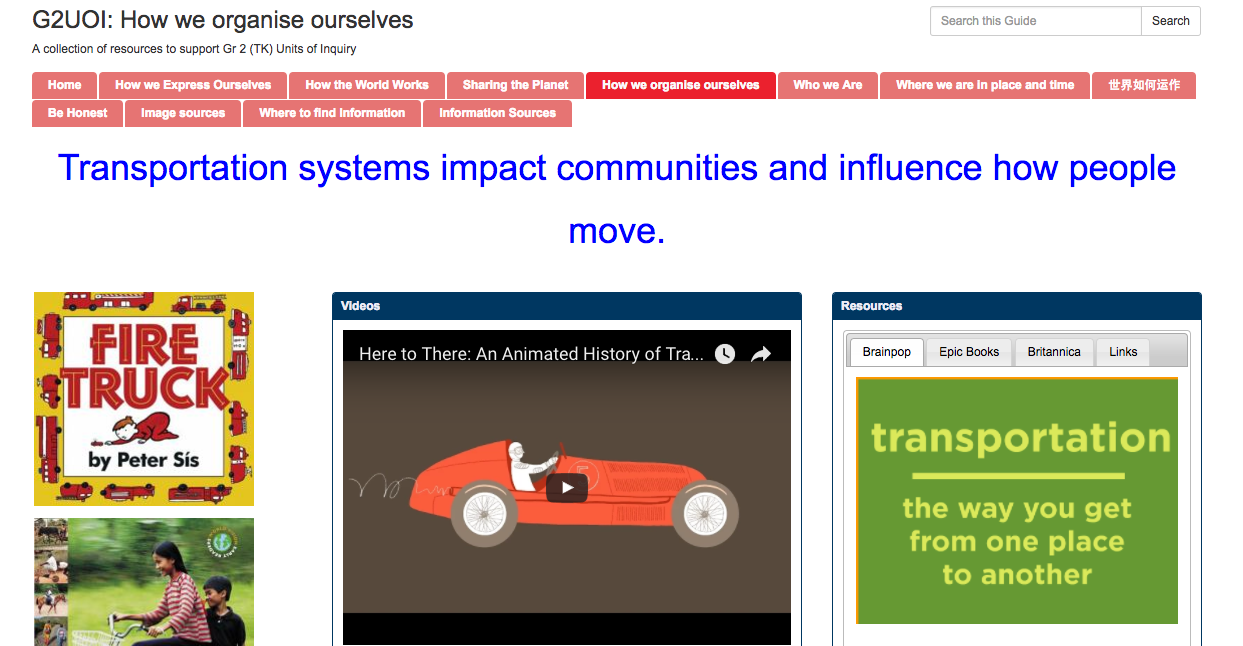
We decided on

  • having the central idea at the top in a floating box
  • on the left – having a scrolling bookshelf of our unit books – using the Library Thing for Libraries book display unit. That way teachers and students could see all available books in a unit, even if they were distributed in a different classroom – and clicking on the link would take them to the book in the catalog – AND if they looked at the subject headings under Explore! would hopefully have a Webpath Express link to click on.
  • Putting some videos in the middle for our more visual / video liking students – also very handy for our ELL students with the paired speaking / images.
  • On the right having a tabbed box that could alternate between Brainpop (a staple in primary), Epic Books (easy to access and great free selection of nonfiction books for easy projection & assignment in class), Britannica (because Encyclopedia) and other links.

screen-shot-2016-12-04-at-10-40-52-am

screen-shot-2016-12-04-at-10-48-31-am

Of course nothing is simple – and even now as I look over the units, I see that some units have the UOI books around the central idea and inquiry in them and some have that plus what-ever literacy / math connection is being made (so more than half of the books are poetry for example). In the medium term all that needs to be straightened out and sorted out as well.

Also before you can add a scrolling list of books, you need a list of books … and to know how to get the books into Library things, and then into a book display widget – so I made a little screencast on how to do that!

The wonderful thing about all of this is the obvious enjoyment and pride that my staff got out of researching units and finding resources and adding them to a guide – they kept on saying “this is so interesting”, and “this is so creative”.  Of course it is not a “quick” thing, I’d say on average a very basic guide at primary level that is reasonably complete will take around 3 to 4 hours. And then one just has to hope that the units don’t change every year!

All in all, and incredibly productive week, and also my staff finally “gets” the fact that my drive for automating student update and photo import etc. etc. is not to put them out of a job, but to free them up to do more interesting and meaningful work.  After we talked about that, one staff member said “and now to automate the shelving!” amen to that!


(Boys) Reading as a social activity

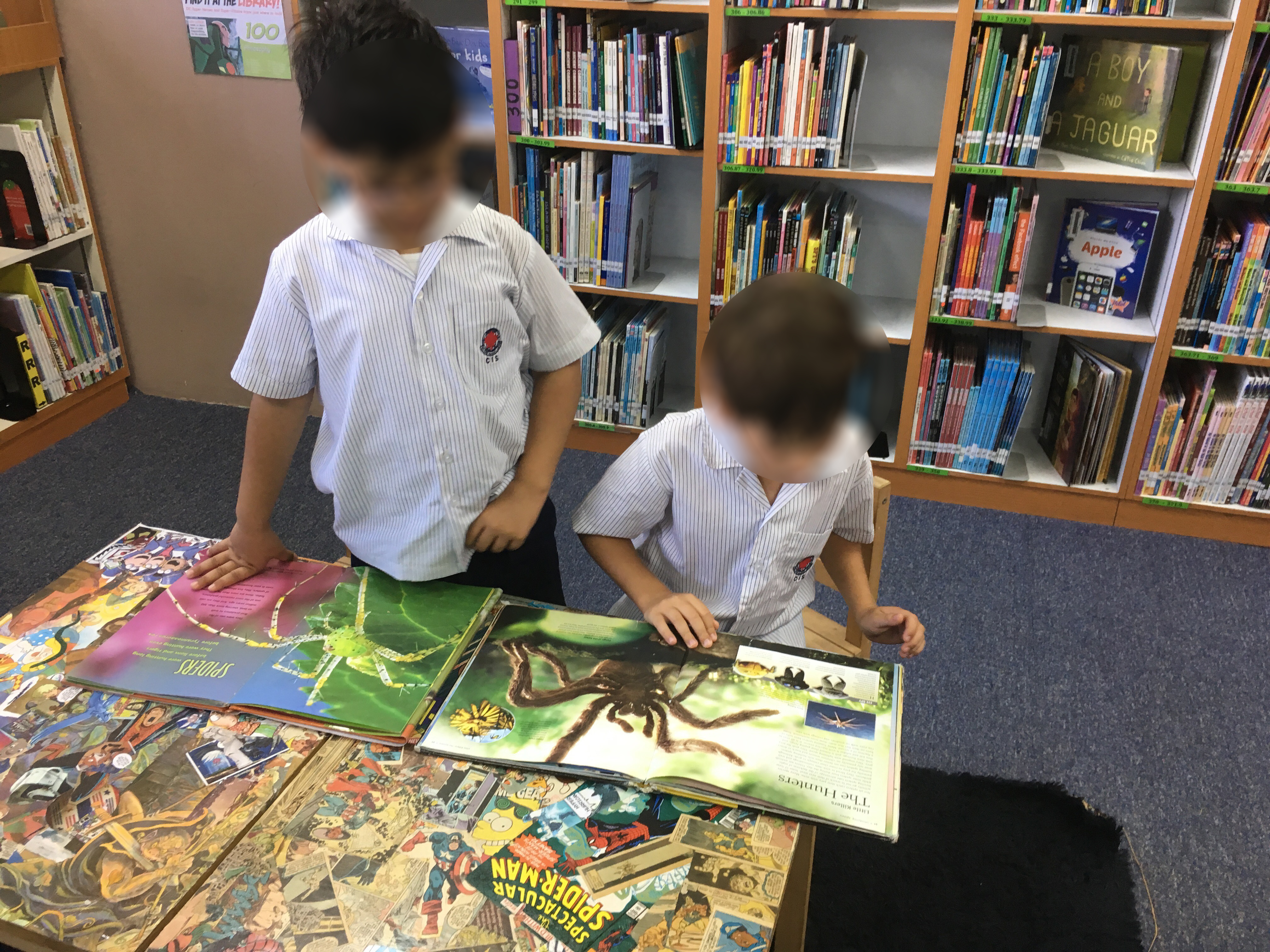
As I wander around my library during recess and lunchtime, before and after school, I realise more and more than reading is not the solitary quiet activity that it’s usually purported to be. I’ve taken to trying to capture this by photographing the communal reading that is going on – which takes me to an article that I’ve been reading that I think is quite important when thinking about boys’ literacy pursuits – “Morphing literacy: Boys reshaping their school-based literacy practices” (Blair & Sanford, 2004).

boys3


boys2 boys1


Who can relate to this in their school libraries?

  • A cluster of boys sitting around a boy with the Guinness Book of Records – pointing and chatting and oohing and aahing about some record or another, followed by a debate about if it has been surpassed, and grabbing the next years book?
  • Two or 3 boys sitting with a Minecraft or lego book trying to find out how to do something?
  • A couple of younger boys reading the same graphic novel (usually squish or lunch lady) and turning the pages at the same time or waiting to turn the page so they can read the same thing at the same time?
  • Requests for books that tell them how to progress in computer / online games
  • Needing books about the 2nd world war because their grandfather or great-grandfather fought in it?

Blair and Sanford (2004) relate boys’ reading to their need to acquire social-cultural capital – i.e. they read as long as it enhances their peers and their own view of themselves as “acceptable masculine beings” and creates connection, collaboration and camaraderie between themselves and their friends. The authors refer to “team-like literacy” involving participation and interaction that is purposeful.

In terms of the kinds of texts that engage and fulfil these needs, the “rules” are simple

  • action > relationships
  • excitement > unfolding characters
  • need to suit personal interests / fact finding / purpose / sharing information
  • humour and fun ++++ important

I would suggest that the literary market / publishing is NOT catering for these needs adequately or at all in fact. Let’s take “Jets” for example.  The current obsession of the Grade 1 / 2 students in my school at the moment. The available books we have are dumb. They’re not information rich enough and the publishers cater to their reading level rather than their interest level. They’re dated before they even hit the shelves. They want elaborate up to date images with lots of numbers and facts – never mind the silly narrative “here is a pilot” “this is the instrument console”.  Ditto Lego – I’ve said this a million times and I’ll say it again. There is nothing inbetween the little books “castles, towns, 101 things to make” and “Lego StarWars” that is so big and bulky and hard to take home.  Make each chapter into a book FFS. How much time do publishers even spend walking around school libraries and talking to boys? (or even librarians? or teachers? or parents?).

This type of article also explains why our “Blokes with Books” and “Readers’ Cup” clubs work so well at school. Connection, affinity, literacies growing out of relationships.

Now to make sure we leverage that in the classrooms and at home.

References:

Blair, H. A., & Sanford, K. (2004). Morphing literacy: Boys reshaping their school-based literacy practices. Language Arts, 81(6), 452.

OER textbooks and the potential for multicultural environment

For the longest time since I stumbled on the Hapgood blog I’ve been intrigued by the ideas of Mike Caulfield on OER and it’s taken a little time and a lot of reading around the concepts of digital scholarship, and in particular the lack of the multicultural viewpoint / input / adaptation of educational resources in general (those global educational companies are scary) for me, after re-reading his article on “Choral explanations and OER” to try and understand just what was so appealing and for it to finally click.

It was this paragraph :

The idea of choral explanations in OER is that the textbook becomes an operating system on which multiple parallel community-provided explanations run. From the student perspective, the text branches off into multiple available explanations of the same concept, explanations authored individually by a wide range of instructors, researchers, and students. You can keep reading until you find the explanation that makes sense, or you can start with simpler explanations and work your way to nuance.” (Caulfield, 2016, para 63I think – hard to count!)

And then I had to think back to a presentation given by some of the international students at UWCSEA when I was working there.  They were showing how they were using their Korean / Japanese textbooks side-by-side with their ‘Western’ – BANA (British, Autralasian, North American) textbooks  in order to master the required material. Note – it was not ‘just’ a language issue. It was the fact that information was presented differently. Presented not just in the sense of how the words and diagrams were physically placed on the page, but also the conceptual pedagogical understanding as to how information should be summarised for example, what the assumptions were on how students learnt and what they needed (Kim & Mizuishi, 2014).  I still have a feeling of dread when I think back to the response the presentation got. There was a serious lack of deep understanding. A lack of curiosity. Of empathy. Of interest.   And a surfeit of what Tim Hartford so succinctly refers to as “The God Complex” . As educators we have a duty, a responsibility to educate students so that they can claim their part in intellectual conversations.  When doing my reading I came across this quote and wrote it on a page of its own with a big question mark because I wasn’t sure what to make of it:

“The goal of education should never be directly to change students psychologically or culturally any more than educators would want their own children to join a cult” (McCarthy, 2007, p. 112)

Wow. If I was a professor of education I would set an assignment on that question. Just that quote and “discuss”.  3 years in a Chinese immersion school in Hong Kong DEFINITELY changed my daughter psychologically and culturally – but is it inevitable? My thesis is yes – if you want to learn in that environment. My son didn’t embrace the culture and psychology of chinese education and he didn’t learn Chinese (or much else) in the two years he was there.   Now think of all the millions of students partaking in an “international” education in their own countries or abroad, and think of the unconsidered enforcement of a western dominated cult of pedagogy and psychology we enforce … and that’s before we even start to think about the damages of non-mother tongue instruction (read all the UNESCO research for more on this).

Ok, that was a long aside – but back to the original point – multi-lingual, multi-cultural OER choral explanations in a student accessible textbook system is the cool aid I’d be happy to drink.

References:

Caulfield, M. (2016, July 12). Choral explanations and OER: A summary of thinking to date [Web Log]. Retrieved 27 August 2016, from https://hapgood.us/2016/07/12/choral-explanations-and-oer-a-summary-of-thinking-to-date/
Kim, M., & Mizuishi, K. (2014, December). Language and Cultural Differences and Barriers in an International School Setting – Personal Experiences and Reflections. UWCSEA-East.
McCarty, S. (2007). Theorizing and realizing the globalized classroom. In A. Edmundson (Ed.), Globalized E-Learning Cultural Challenges: (pp. 90–115). Hershey, PA: Information Science Pub. Retrieved from http://services.igi-global.com/resolvedoi/resolve.aspx?doi=10.4018/978-1-59904-301-2.ch009

Rambling thought organisation

I need to write an interpretive discussion paper. I’m trying to organise my thoughts. My first and foremost thought is that writing this paper is in direct contravention to the topic of the paper, which is “Digital scholarship in education, in the context of interdisciplinary knowledge and research” – because my digital scholarship is leading me down all sorts of other avenues and thoughts which definitely do NOT fit into the marking rubric. I’m also immensely frustrated at being a distance learner and not knowing who in the zoo to discuss these thoughts with. I’m tired of rehashing the articles that all say the same thing about the evolution from web 1.0 to 2.0 to 3.0 and the fact that we all can be producers and not just consumers, open access (OA), MOOCs, twitter, blogs blah blah.

Transformative?

What are my thoughts right now – on the exact topic?  In the first place that digital has not been transformative enough to scholarship.  Yes in theory, no in fact. The digital spaces I see in education have been highjacked not by scholars but by self-promoting practitioners of the twitterati. There is a lot of anecdotal rather than research based evidence. And they’re echo-chambers of white middle-class educators, often male. I need to expand my networks, and I’ve been making a concerted effort to follow people who are publishing real peer-reviewed research – some of which are on social media and some of which aren’t.  Some who tweet about their research, most who don’t. Or just refer to conferences they’re talking at or have talked at, or their followers enticingly frustratingly refer to such presentations. The thing is that for all this to be transformative it also needs to be heretical. And heretics are not welcome in institutions. Because they threaten the control and status quo of institutions, and by definition are persona-non-grata and there are pathways of recognition (leading to tenure at which point hopefully you’d be entrenched enough to say what the damn you please but by then you’d probably be entrenched enough to buy into the status quo and have a stake in maintaining it). Yes they are clever. Who runs the MOOCs? Who feeds them, who controls them, finances them and their content? – the institutions.  And the money. Yes, always follow the money. All those wonderful digital tools. Those databases, those journals, encyclopedias.  My gold standard for testing anything a salesman throws at me as a school librarian is looking up “socialism” and “communism” in their search engines. Try it. Just try it.

What is education for?  I’ll buy the ‘transformative’ bit on the micro individual well-heeled personal level, – but take it local or regional or national and you have the ‘productive literate citizen’ emerging. What do we want from the 21st Century learner? Link looks great doesn’t it.  Global citizens and all those skills (not content or facts), and then you click on “pricing” and you can clone plans. I repeat. You can pay to clone plans.  You can pay someone else to do your thinking and planning for you can you can teach to that plan and create clones of every other global child whose school or teacher can afford this.  It’s so slick it’s so nicely designed, it’s so intuitive and easy.

Confrontational and Challenging

Easy. Am I a puritan that I think things have to be a struggle and difficult? Not really, I like Vygotsky and the ideal of proximal development.  I don’t like when kids are proximally developed to be led by the nose or to follow the breadcrumbs to the cottage in the woods made of candy only to find out that they’ll be trapped by the witch of educational debt in a cage that is not of their making.  No, I think that education does not really have so much to be difficult as in inaccessible and alienating, but I think it needs to be difficult in that it should be confrontational and challenging.  And education dominated by packaging – of textbooks, of websites, of learning platforms, of learning plans – created by big corporations and big non-profits cannot be confrontational. It can only be nationalistic or capitalistic or serve the needs of the society in which it finds itself. Or the version of what that society thinks its needs are.  Good productive (national) citizens. Because often being a global citizen is at odds with being a national citizen. Because then you might just want to open the borders and let the refugees in.  You may not vote for the hawks. You’d want to leak confidential documents, hack into university databases, give maternity & paternity leave, free education, a minimum wage, universal health coverage AND WHO WOULD PAY FOR ALL THAT? Huh?

Tower of Babel
Tower of Babel

So the digital. The open borders, the open access. The flat earth. Where a researcher / research at the other end of the world is at the touch of a button or a click of a mouse. As long as you both have the internet. And speak each other’s language (or preferably that current god of all language, English), as long as that research is in a bundle paid for by your institution. As long as you’re part of an institution, because paying $39.95 per article for research that may or may not be relevant, may or may not be any good is no joke for the casual dilettante. And when you leave formal education, when you graduate and lose access to all that body of formal knowledge, lose your writing on fora and institutional blogs, when the gates to the ivory towers slam shut? Are you no longer a scholar? Are you an ex-scholar? A practitioner? I think about this a lot as I reach the end of this degree.

Language and culture

Coming back to the whole language thing.  According to Ren and Montgomery (2015) from 1996 to 2012 – 2,680,395 scholarly articles were published internationally by Chinese authors, 35% of which have never been cited, and the average citation per publication is 6.17 versus 20.45 for an American author. 95% of its most important research “are now published by foreign commercial publisher and locked behind pay-walls” (p. 397).  Most scholars do not have the English proficiency, there are not enough translators and therefore the research remains trapped in Chinese repository systems.  The article is a fascinating glimpse into the profundity of linguistic barriers, cultural and ideological differences in writing, research and performance metrics that are seldom if ever mentioned in the jubilant digital scholarship literature.

Interdisciplinary

As a fairly recent migrant from the world of commerce and industry to the world of education, one of the other articles I read was cause for inner ironical chuckling. Interdisciplinary. What does that mean? That you stay in your academic ivory tower but build bridges to other towers in the same academic village, or even across the pond to another tower where there are English speakers? And you interact only with the grubby world of business when they sell you OLP (online learning platforms) and data analytic systems and student interfaces and lesson plans and databases. But do you consider that you may be able to learn from that world? Even within business schools, the frenetic search for pertinent case studies is to inform and guide practise by current or potential business people.  And so I turn to Siemens and Burr (2013) – who I must say I have a huge amount for respect for, because they are talking, reading about and DOING  research in international research teams. They are grappling with linguistic and cultural barriers. And I read their article and the whole time I’m thinking – you’ve got to be kidding me. Yes, you’re probably breaking new ground in your context, but global companies have been doing this for decades. For eons. Your average wet-nosed graduate in a developing country working for a multi-national could have told you of all these challenges AND how they’re resolved in commerce and industry. I have to wonder, when a paper cites Hofstede – 1980 * if they’ve read and understood it’s context (Shell oil company), why they don’t think – heck – those multinational companies must know a thing or two about this – let’s go and ask them how to resolve this rather than us having to reinvent the wheel. Just pop over to your local business school or track down a travelling salesman with a passport to find out more.

I realise I’ve nearly written 1,500 words right now, and I don’t even begin to cover all the ground that I’d want to cover but can’t. I’ll just end by referring back to Gee and Hayes (2011). The first six chapters are a great read to understand the context of current education, language and literacy as part of a continuum of education across the ages – and they can express this background so much better than my amateur fumblings.  And after giving a context what is the future?  It would have to be in machine translation. In non-affiliation to a single academic organisation or nation. The return of the professional amateur, of “royal societies” that are not royal or national.  Different pathways of legitimisation and accreditation. More cooperation and collaboration but also more confrontation. Assignments that are conceptually bound but content liberated.  Radically open access to both published and rejected research, with commentary as to the rejection – a bit of meta-cognition anyone? Access to assignments with grading. Plagiarism is only an option in a closed rigid system with unimaginative content related assignments.  And those do nothing to further scholarship, digital or otherwise.

(And apologies to all those authors and researchers who are not cited but who are informing my thinking, but were not read in the last few days).

References:

Gee, J. P., & Hayes, E. (2011). Language and learning in the digital age (1st ed). New York, NY: Routledge.
Ren, X., & Montgomery, L. (2015). Open access and soft power: Chinese voices in international scholarship. Media, Culture & Society, 37(3), 394–408. http://doi.org/10.1177/0163443714567019
Siemens, L., & Burr, E. (2013). A trip around the world: Accommodating geographical, linguistic and cultural diversity in academic research teams. Literary and Linguistic Computing, 28(2), 331–343. http://doi.org/10.1093/llc/fqs018
————————

(* As a side note, Hofstede was taught to me as an expat 101 in the early 1990’s before my husband and I left on our first international assignment in Brazil. There is an updated version of his book – co-written by his son and Michael Minkov. Should be read by every ‘global’ educator and student interested in global collaboration and cooperation :

Hofstede, G. H., Hofstede, G. J., & Minkov, M. (2010). Cultures and organizations: software of the mind: intercultural cooperation and its importance for survival (3rd ed). New York: McGraw-Hill.)

Fortunate coincidence

After our leadership meeting this week I asked our principal what she thought of my various options for my case-study and which would be most beneficial and meaningful for the school.   By happy coincidence the senior leadership is looking at a number of things that tie in nicely with my ideas of what would be a viable case-study

  • Using the cumulated data we have on reading scores from the last few years in an interpretive and meaningful way
  • Examining a small section of students to see if anything can be extrapolated to the wider student body and inform teaching and learning
  • Raising the “bottom” – i.e. looking at our struggling students in a holistic way and seeing how we can help them on their learning journeys

In our conversations we also discussed how struggling students can influence the whole ambiance in a classroom, both in the student body and in the teachers response to the individual student and the class as a whole.

The question of course is what is ‘success’ and how do you measure it?  Must it be an improvement in reading or other academic measureables? Something ‘concrete’? Or can we think about the more ‘fuzzy’ aspects of learning that are harder to pin down.  Like affinity and belonging – nicely spoken about in this (non academic) article. Certainly we know that students who have (excessive) stress have difficulty learning. But is it skill, is it motivation that starts the negative spiral? And who can help? Is it a bootstraps issue, is it parents, peers, teachers, mentors, siblings?  What formats and genres?

I’ve just downloaded hundreds of articles around these themes, so it’s time to start digging in and try to get a research question out of it all.

This book should die …

Our library has just received a big shipment of books and I need to make some space so that the new books don’t get lost.  On Friday I therefore did a little exercise with my Grade 6 students that I called “this book must die”.

Since many of them had either read “The Hunger Games” or “American Sniper” or seen the movie, we discussed it in terms of “what are the survival skills needed” by a book to ensure it’s continued existence on the shelves and “which books are a library / librarian / students’ friends and which are enemies“.  The students came up with some great ideas, and showed real insight into the dilemmas and choices facing a librarian.  It was also wonderful to see how much more “literarily” mature they had become, with groups of students arguing that books such as the “Rainbow Fairies” and “Horrid Henry” series shouldn’t be in our collection, that they were formulaic with no qualities, and with other students equally passionately defending them – including some boys arguing that their younger sisters loved Rainbow Fairies and had the right to read them until they knew better!  I wish I’d video’d them to show to parents who enter long convoluted arguments with me about introducing more “classics” (i.e. the books of their book deprived youth) at a younger age to my students.  They proved the case of “free voluntary choice” of books for students and that if you trust your students they’ll rise to the occasion.

Although I asked them to focus on fiction, a couple brought some very outdated nonfiction books to my attention (think moustachioed librarians straight out of the 80’s), and one even brought a more recent book on scuba diving where all the information wasn’t current anymore to my attention.

I also let them had a go at the “hallowed hall” of literature circle kits – they did ask.  And there definitely were a very strongly felt sentiments about text that they were expected to read either as a class or in small groups.  Luckily the “class texts” passed muster (I suspect because the teachers have actually read them – either with the students or independently or even as a read-aloud), but the smaller sets of 4-6 books had three books that will need to be eliminated.  The “deal” I made with them is that if even one student came to the passionate defence of a book, it would stay.  We had a long discussion about whether or not “award winning” books had any kind of immunity from weeding – again I loved their perceptive comments about the fact that most of the awards originated in America and this didn’t necessarily reflect their world view, interests or priorities.

Besides arbitrary titles that weren’t particularly important, the following ‘text set’ books, some of which are award winning by “important” authors were condemned:

Stowaway – Karen Hesse.  60 students unanimously said they’d struggled through it hating every minute and that it had no redeeming features whatsoever in their eyes.

Criss Cross – Lynne Rae Perkins – they found it boring, found no connection to their lives

The Heaven Shop – Deborah Ellis – I promise I didn’t say a word about this. But their sentiments echoed my privately held sentiments exactly.  It was superficial, it was written by an outsider, it had too many coincidences so they felt they could no longer suspend belief.

After 3 exhausting but exhilarating classes the exercise was completed.  Then yesterday my Grade 5 classes came for library class and their first question was ‘Ms. please can we also do “this book must die’?” – don’t you love it when a library lesson echoes in the school hallways?