BWB where are we at?

After a flurry of research and completing my final paper for my M. Ed, one may think that it’s all over with the inquiry into reluctant readers, boys reading etc. etc.  But it’s not. Far from it in fact. I’ve been a little distracted with the library renovation, a series of unfortunate events with library assistants having close encounters with pregnancy and injuries leading to somewhat more of a day to day burden on my shoulders etc. etc (it’s called “life” I keep reminding myself). But anyway, we carry on unabated with our BWB club (Blokes with Books) and you can come and hear me at the AFCC if you’d like to find out more!

Tim, the teacher leading the club and I had some conversations at the end of last year about how we needed to take things up a notch and really go deeper into the whole reading thing. The question of course is how do you make sure it’s still fun, that they still are committed, while deepening and expanding what they’re reading? We’re talking about 11/12 year old boys after all, and while my dry academic papers sound all unemotional and cool the truth is far from it.  We have spats and have to have firm words about “it’s just a game” and “if you don’t quit fighting about the chairs / beanbags / who got the book first, you will have to stop coming for a while” etc. etc.

But something special has been happening in the two weeks since we’ve been back. Sometimes you just get so caught unawares that you’re not recording or documenting and now I feel I need to document it. Last week our counsellor (who’s joined our team) was sharing how he’d seen an interview with Jamie Oliver about the fact that he’d read his first book at age 38. The boys were actually incredulous. And then a couple started spontaneously sharing how before BWB club they’d never finished a book either, or if they did it was just a quick and easy book and how much more they’re reading now and how it takes practice and perseverance. Note – it also takes courage for a boy this age to come out and say these things to his peers.

This week we reflected on Obama’s reading list and how he’d said it helped calm and focus him in times of stress. And again, a couple of boys put their hands up and said how reading helped them calm down, when they were angry or upset.

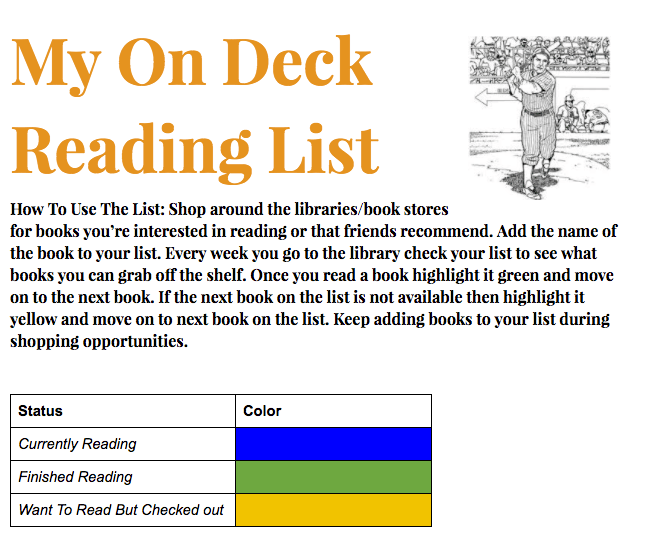
So, whscreen-shot-2017-01-21-at-1-47-36-pmat’s new.  Right now I’m trying to drill into every student at school the necessity of having a “what’s next” list – either a mental list or a  physical list or a pile of books that are the “books in waiting”.  And the great thing about a club like this is that we can try things out on them and see how effective they are.

This week we used Leigh Collazo’s Genre Personality test which you can purchase from TPT (a $5 well spent). My assistants and I spend quite a bit of time this week updating the bookmarks in order to make the book suggestions specific to our library.  The boys did the quiz during the BWB session on Friday and they really enjoyed doing it. It was fun and light-hearted and we kept emphasizing that there was no right or wrong answer and it wasn’t scientific. After they’d tallied up I made a spreadsheet of the topscreen-shot-2017-01-21-at-1-48-01-pm 3 categories of each boy, and as we read out the descriptions there were cries of “yes, that’s exactly how I am” and “I agree” and “yes!”  With their permission we then displayed the results. Most were evenly spread between A, (questioner); B (Escapist) and C (Innovator) with surprisingly few G’s (class clown) which is what I would have expected. Since that took up most of the hour we have with them – we didn’t get around to sharing the bookmarks, and
only introduced the “on deck” spreadsheet to help them keep track of their “what’s next” list – that’s next week’s work.


Read around the World

With view to the fact that our school is celebrating uniting nations week in October, this year we’re trying to add a literary bent to the proceedings.

There are a number of steps to this, which are easy or complicated, depending on how “ready” your collection is.

A little while back, I created resource lists on Destiny, and a visual search button for “read around the world”. Since I didn’t have a lot of time I grouped them by continent, with a separate section for Singapore which is where we live.  It involved doing subject searches on our catalog for various countries on each continent and then grouping them together.  Actually this wasn’t that easy. A book like “Inside out and Back again” – takes place in USA, about a Vietnamese immigrant – where do you put it and its ilk (of which we have many). What if an american author is writing about Africa? Generally I tended to put the books according to where they took place rather than the origin of the author. But I’ve allowed my students to decide how they want to categorise it when they add a comment to their shelfie (more later).

Before the summer break, I also ordered all the books suitable for primary school on the USBBY list for 2016 so they were ready for the school year. Again I didn’t have anything specific in mind, except to diversify my collection.  As an aside – I must say I’m incredibly impressed with the selection in this list and I’m going to order from it again this year, and from the backlists of prior years. Books like “My Two Blankets” are just phenomenal and just so appropriate for a multi-lingual environment.

This term, I joined the UN committee and put my idea forward to do a “read around the world” as part of the activities so it would not just be a “costume, food and flags” affair. I also convinced the parade organisers that it may be a nice idea to parade by country grouped by continent (to tie in what was feasible in the library with my limited display space).
Next I created a library guide and a padlet so the students could put up their pictures (we’re an iPad school so that’s one of the easiest ways).
Then last week I started introducing the concept to my students in the library lesson.  I adjusted it according to the age. For some, I asked how were ways we could find out about people around the world. We got the usual, go there, live their, eat food, have a friend etc. Then I introduced travelling their through books (depending on the age I told them the library was a magic travel machine), then I read a book from South Africa, my home country (Niki Daly’s “Where’s Jamela”), and then we had a tour around the world past all the displays and they could pick up a “souvenir” book on the way of whatever they liked.
For other classes my colleague met them at the door and said she was a tour guide and would take them around the world and they could pick up books along the way.
We then showed the library guide and explained how to get a picture onto padlet, and that they could then put a sticker on the map.
Some classes were more enthusiastic than others – generally the younger students were not very interested in books from other places, they wanted a book from the country they came from – fair enough.
It was interesting to see where students put books when they made a comment – the aforementioned “inside out” was labeled “Vietnam” by a student, while “Amulet” got a Japanese label based on the author name and origin (although born in Japan, he has lived in the USA since he was 10).
We’ve agreed that for the actual UN week each class well get a bundle of 20-30 books from various countries delivered to the classrooms to read during their DEAR time (they get 20 minutes a day).
Hopefully it will all work out! I’m also hoping our parents will want to get involved with their children.

Reading reluctance – factors

Writing a case study with 3,000 words of which 80% are limited by procedural bits and pieces is proving to be a little frustrating because I am learning SO MUCH.  So I thought I’d share some of it here, because heaven knows it could help someone somewhere somehow.

Remember the whole thing about motivation? That there was extrinsic and intrinsic and the latter was way way better? Turns out there are a lot more bits and pieces to motivation than psych 101 would have you believe. And more importantly there is such interplay between them and external factors and I’d like to add developmental ages and phases as well.


So with reading motivation we have:

  • Extrinsic (rewards, physical, achievement or emotional if you read more)
  • Intrinsic (reading is its own reward – interest, satisfaction etc.)
  • Social (currency gained by knowing stuff, sharing books and reading – turns negative around G5 with peer devaluation)
  • Self-efficacy (belief in ability – changes over time)
  • Work avoidance (starts in G2, avoid reading tasks due to low motivation and/or reading difficulties)

If you want to read just one study on the matter, I’d recommend Lee & Zentall (2015). They summarize most of the knowledge to date, have an excellent bibliography and most importantly add the longitudinal dimension. I really like longitudinal studies, and I know why they’re difficult and costly, but as a parent and an educator, what can be more valuable than recognizing and anticipating bumps along the road for what they are and taking preventative action before a student/child lands in a pot-hole?


I’d like to spend a little more time on self-efficacy. It has to do with self-concept as a reader (Förster & Souvignier, 2014; Proctor, Daley, Louick, Leider, & Gardner, 2014; Smith, Smith, Gilmore, & Jameson, 2012). I find it very interesting that self-efficacy takes a dive around Grade 3. Why? Because that is just the moment when the majority our self-confident readers, having spent 2 or 3 years soaring through the levels of their reading program are suddenly let loose into the big world of both “real chapter books” and needing to access their reading skills in order to “read to learn”. It’s that pivot point. The point at which I tell over anxious parents, “yes, now you can start worrying if the reading is not happening.”


So the question is what should our response be as parents and educators (another good point of the Lee & Zentall article – they add the “so what” bit). Remember the “terrible twos”? Well I think there is nothing more comforting in know that when behavior goes wonky, you have a frame of reference that says “oh, it’s this” accompanied by “I / my child / my student is not alone” and “this is normal” plus, hopefully some strategies in place that can be applied. I’ve just sent my blokes with books a set of positive affirmations that he can use in the Blokes with books club. It was one of a set of resources included in this very handy, practical and readable guide from Ireland (NEPS, 2012).


Then looking at the skill side of things. This is dangerous ground, because if a child is reading below the 30% percentile, (and they’re not 3 or 4 years old – I kid you not – I’ve had pre-kindergarten parents concerned their children are not reading yet – on that topic, please read this article (Suggate, Schaughency, & Reese, 2013)) and they’re over 8 years old, then there may be a problem.


What is the problem – well I’ll say mainly “beware, there be EGOS”. When there is a reading skill issue it is probably as a result of an experiential instructional deficit or a reading related cognitive problem (Scanlon, Gelzheiser, Vellutino, Schatschneider, & Sweeney, 2008). To put it simply, either they haven’t been taught properly at school or the home situation isn’t reinforcing adequately (hear those egos bristling), OR, the child has a reading related cognitive problem (Reading Disability – RD). This can be in decoding (like dyslexia); comprehension or retention and each have a different (here is a lay-person’s article) set of signs and ways of being addressed.


So, what does one do in this case – I like the NEPS article because they call for short, one-on-one or one-on-few and limited interventions of around 12 weeks. Obviously one can start with trying to overcome any instructional deficit, and if that fails, to move onto educational testing and specific RD related interventions. Once again there be Egos in the way – and if it helps at all, I can say “been there, done that, got the tears to prove it”. It’s hard to acknowledge that your child is anything than perfect, or at a pinch that they’re “normally” imperfect. But denial leads to more harm that good, and particularly because early intervention is so much more effective. Embedded in this article on dyslexia (Korbey, 2015) is an awesome scientific journal article (free to read! Yay) on RD, by Norton and Wolf that is very dense and brain spinning, but very good (Norton & Wolf, 2012). Personally I found the discussion on colour naming to be very interesting – talk about an early warning sign that we noticed but didn’t know was important.


I’m going to stop at this point – happy reading in the mean time. As always, interested in your thoughts and comments.

References:

Förster, N., & Souvignier, E. (2014). Learning progress assessment and goal setting: Effects on reading achievement, reading motivation and reading self-concept. Learning and Instruction, 32, 91–100. http://doi.org/10.1016/j.learninstruc.2014.02.002

Korbey, H. (2015, October 1). Understanding dyslexia and the reading brain in kids [Web Log]. Retrieved 11 September 2016, from https://ww2.kqed.org/mindshift/2015/10/01/understanding-dyslexia-and-the-reading-brain-in-kids/

Lee, J., & Zentall, S. S. (2015). Reading motivation and later reading achievement for students with reading disabilities and comparison groups (ADHD and typical): A 3-year longitudinal study. Contemporary Educational Psychology. http://doi.org/10.1016/j.cedpsych.2015.11.001

NEPS. (2012). Effective interventions for struggling readers. National Educational Psychological Service. Retrieved from http://www.education.ie/en/Education-Staff/Information/NEPS-Literacy-Resource/neps_literacy_good_practice_guide.pdf

Norton, E. S., & Wolf, M. (2012). Rapid automatized naming (RAN) and reading fluency: Implications for understanding and treatment of reading disabilities. Annual Review of Psychology, 63(1), 427–452. http://doi.org/10.1146/annurev-psych-120710-100431

Proctor, C. P., Daley, S., Louick, R., Leider, C. M., & Gardner, G. L. (2014). How motivation and engagement predict reading comprehension among native English-speaking and English-learning middle school students with disabilities in a remedial reading curriculum. Learning and Individual Differences, 36, 76–83. http://doi.org/10.1016/j.lindif.2014.10.014

Scanlon, D. M., Gelzheiser, L. M., Vellutino, F. R., Schatschneider, C., & Sweeney, J. M. (2008). Reducing the incidence of early reading difficulties: Professional Development for classroom teachers versus direct interventions for children. Learning and Individual Differences, 18(3), 346–359. http://doi.org/10.1016/j.lindif.2008.05.002

Smith, J. K., Smith, L. F., Gilmore, A., & Jameson, M. (2012). Students’ self-perception of reading ability, enjoyment of reading and reading achievement. Learning and Individual Differences, 22(2), 202–206. http://doi.org/10.1016/j.lindif.2011.04.010

Suggate, S. P., Schaughency, E. A., & Reese, E. (2013). Children learning to read later catch up to children reading earlier. Early Childhood Research Quarterly, 28(1), 33–48. http://doi.org/10.1016/j.ecresq.2012.04.004

A short tale of grit and resilience

As a teacher-librarian who still has one foot deeply immersed in academia I spend a considerable time wondering if the things we do are the “right” things. And that’s before I’ve opened any social media related to the profession where people are posting articles about the wrongs of everything from levelled reading to literature circles, reading competitions, to accelerated reading programs, to not ‘over’ encouraging reading, even down to whether we’ve really considered academic honesty properly.

So sure, we probably do somethings wrong. In fact daily I’m deeply aware that I’m failing some students some of the days, and a small number of students all of the time. And yet.  There are moments when I do think things come together and they allow our students to shine – and those are the tales of grit and resilience that the popular educational press love. And so too, at the danger of following the bandwagon, I’ll add my tales too.

Yesterday, our school had their trials to select the students who would form the teams for the “Readers’ Cup” competition.  We’ve been meeting weekly preparing for this competition, students have busily been reading the 6 books in their category, creating questions, quizzing each other and re-reading the books. We had about 40 students and could only choose 4 teams of 6.  At which point some educators would be crying “foul” and “no fair”. But hear me out, and the tales of 3 students.

The first is an ELL (English Language Learner) student – been learning English for about 2 years. Nervous about joining at all initially, bolstered by a friend who was also taking part. Enters the library to take part in the competition yesterday with a little notebook which is promptly removed by me. Look of dismay. I explain that we only allow a pencil and the iPad for the multiple choice round.  The competition ends. She’s a solid contender, right there in the middle of the pack. She’s in!  While tidying up, we find the notebook we’d put aside. Extensive notes on each and every book… *

The next, a student who decides to join the competition just before the Spring break. She’s read none of the books, but I tell her she’s welcome to try anyway, and the library is open all holiday.  From time-to-time in the vacation I get a little email to say she’s finished another book and I congratulate her. Then on Saturday the blow falls – she’d been reading the books in the wrong (higher) category and had only actually read two books at the right level… I write back to her and tell her not to panic, she still has 4 days, and I suggest a schedule whereby she reads the longest most challenging books first and leaves the picture book for last, and say if necessary I’ll come into the library over the weekend to open it for her, and she can come and read in the library every recess and lunch time (usually the times are staggered by grade). She says it’s OK, she’ll manage. And manage she does. Not only does she finish all 6 books by the deadline, but she’s the highest scorer in her category.

The third are two sisters. One a very strong reader, one a little less so, and younger. The older student is constantly encouraging the younger to keep reading. Spends time both at home and at school quizzing her on the books she’s completed. Keeps me updated on their progress.  Both sisters are selected in their categories, both top scorers. But I’m pretty sure the younger student would not have done as well without the home support and encouragement.

Invariably there are disappointments. We selected two “back-up” students per category, and after attrition from conflicts with other activities and last minute dropping out for various reasons, each category had 3 students who wouldn’t take part. Of the 6 students, 5 had not finished all the books, didn’t take it perhaps as seriously as they could have if they’d truly wanted to take part. Didn’t attend meetings or make questions or really try. But one I feel responsible for, he’s a good reader. A voracious reader. He’d wanted to take part in they younger category, but I convinced him to try for the older, but it was apparently too much for him. A misjudgement on my part. And I’m not sure what I should do now. Certainly in the future I’ll trust a students’ own judgement more and not try to convince them otherwise.

——————–
* She was not the only student who had an ELL background, for a large percentage of our students English is a second language, but she’s still in the ELL program, whereas the rest have ‘graduated’ over the years.

Diversity and "multicultural" literature

Deep into my readings on this topic and it’s not making me feel particularly cheerful.  The statistics are appalling.
On the one hand one should be glad that there are enough people who care enough to keep count. On the other, it doesn’t appear that the counting leads to any measurable improvement.

Here are the statistics from 2002 to 2014 from Cooperative Children’s Book Center School of Education, University of Wisconsin-Madison.  And to take note of their criteria – it’s only the diversity of the United States that is counted – i.e. African / African Americans; American Indians; Asian Pacifics / Asian Pacific Americans and Latinos. The diversity in the rest of the world? Well who is counting? Who cares? Or are we just not able to access it?  What about the glory of the international librarian networks? Or are we really just still in our bubbles?

Looking at the translation scene in the USA via the Batchelder Awards; Garrison, Forest and Kimmel (2014) remark how:

“A brief skim of the most recent winners and honors shows that most of the books derive from European languages including French, German, and Dutch. The story settings show somewhat broader geographic diversity including places throughout Europe as well as Asia, Africa, and South America. Garrison and Kimmel (in press) found that a composite Batchelder Award winner or honor from the years 1997-­2013 would be a realistic fiction novel set in Western Europe featuring a male protagonist and dealing with a serious topic like World War II.” (Garrison, Forest & Kimmel, 2014, p. 72).
The absolute skewness in publishing is highlighted in this (dated, but probably still relevant and apparently not recently updated) dichotomy:
While children’s literature from so-called developing countries hardly ever reaches European and American readers, a recent survey revealed that 80 per cent of books for children set in non-European and non-American cultures are written by European and American authors (Fremde Welten 2001) (O’Sullivan, 2004, p.20)Alongside these countries which only export children’s books while almost failing entirely to import any are those which provide a market for the global corporations – 70 to 90 per cent of books available to reading children in non-European/American cultures are by European or American authors – but whose own books rarely cross the linguistic, political or cultural divide to partake in the Western market (O’Sullivan, 2004 p.22).”
Other low points include the depiction or even existence of racially / culturally mixed children or people (Chaudhri, 2013) – a reality that is strikingly obvious the moment you walk into any (international) school.
Onwards and upwards… it can’t get any worse after all.

References:

Chaudhri, A. (2013). Growing up mixed/up: Multiracial identity in children’s and young adult literature. In J. C. Naidoo & S. P. Dahlen (Eds.), Diversity in youth literature: opening doors through reading (pp. 95–123). Chicago, Ill: ALA-Ed.
Garrison, K. L., Forest, D. E., & Kimmel, S. C. (2014). Curation in translation: Promoting global citizenship through literature. School Libraries Worldwide20(1), 70–96. 
O’Sullivan, E. (2004). Internationalism, the universal child and the world of children’s literature. In P. Hunt (Ed.), International companion encyclopedia of children’s literature (2nd ed., pp. 13–25). London ; New York: Routledge. Retrieved from EBook Library


Picking the locks one-by-one

A few months ago a tradesman came to the door to fix something. Here in Singapore such people are often Muslim and therefore petrified of dogs. So my helper put the dog in a separate part of the house and closed the door, not knowing that it was one of those doors that lock themselves if the button is pressed in, which it was for some inexplicable reason. And although that part of the house has two doors leading to outside which are usually open all day every day, they’d been closed and locked due to a late afternoon rainstorm accompanied by a lot of wind.  Before calling the landlord’s agent for a spare key, I did what every other independent woman would do, I googled “how to pick a lock”. The instructions, video and otherwise all boiled down to the same simple steps.

Since I could access the garage and all the tools and assorted things like paperclips and hairclips (grateful for once for stuff lying around the house instead of being tidied up) – I set to work. In the process I discovered that the lock was “the wrong way round” to my sensibilities – do you notice that – doors and locks having to be turned “the other way” to what you’re used to in your home country?
Needless to say, there is a good reason why I’m not a burglar, nor a locksmith and the spare key had to be called into action. If you want to find out more about locks and security – here’s a great episode of 99% invisible.
After that huge digression to come to my point. As I wrote earlier, I have a large population of ELL students who come through the library and I’m always trying to find “that” book that will unlock their desire to read in English (actually I’m trying that for everyone, just this population seems to have the highest and most immediate needs.
Sometimes things happen quite by accident.
My G4 classes have been doing a unit on poetry as part of “how we express ourselves” and besides some great activities with spine poetry (much to the horror of my library assistants who are not used to such free-wheeling attitudes to taking books off the shelf) one day I decided to promote verse novels.
I’ll be the first to admit that I’m no expert on any aspect of children’s literature, but I’m a keen learner, so I looked for some lists of verse novels for elementary students and then tried to see how many I had on hand. I’d read “inside out and back again” which is a fabulous book, so I felt it may work.
For each of my next G4 classes I had a pile of verse novels and I picked out one page to read from each.  Since my darling dog had just been put down the previous night, it was with a chocked voice I read from “Love that Dog” and luckily I had a whole pile of those to dish out since one of my predecessors had the foresight to order them in duplicate.
After the lesson a few of the books were borrowed and I didn’t think that much of it. Then a week later one of my Chinese students sidled up to me during lunch time and asked me for a book “like that dog” book, and I gave him “Hate that cat”, and yesterday he came to me and said he’d finished it and wanted more books like that.  I said “more about animals, or more like poetry” and he affirmed more like poetry, and I passed on “Inside out and back again” and told him it was one of my personal favourite – he quickly scanned inside the book and happily said “yes”.
And yes of course it would work.  I’ve not studied this stuff and I’m feeling my way along, but sometimes our students just help us to discover what it is they want and need.  Coming back to it rationally – verse is short and beautiful and evocative and free. And now it’s just one more tool in my arsenal of lock-picking equipment.
Here are some resources:


Digital Storytelling – an 8-week interactive program for Middle School students

Note: This is the example of the type of program that could be held for this age group – it is an academic submission and as such has not been tested in reality.

____________________________________________________________________
Assessment Item 1: Report and program for specified age group
INF 505 – Library Services for Children and Youth
Digital Storytelling – an 8-week interactive program for Middle School students at UWCSEA-East
Report prepared for the Librarian of UWCSEA-East by Nadine Bailey, September 2014

___________________________________________________________________


“For those associations and borrowed emotions, coming as they do from outside, carry young people over the dangerously spongy spiritual ground of the years during which one must signify something to oneself, while one is still too incomplete really to signify anything at all” (Musil, 2001, p. 10 writing on the value of literature for adolescents)


Part 1: Background and context

 
United World College of South East Asia East (UWCSEA-East) is an International School located in Singapore. It has a student population of 2,240 who come from 68 different countries and speak 50 different languages (UWCSEA, n.d.).  Around 40% of the students are bilingual and 12% speak more than two languages. As an international school drawing on an expatriate population, it has a high student turnover and the community can largely be described as cosmopolitan elite. The campus has two libraries, one for the Kindergarten and Primary students, and the other for Secondary students.
 
Section
 Number
Kindergarten
 353
Primary School
 654
Middle School
 587
High School
 324
IB
 321
Total
 2,239
Figure 1: Student breakdown by section
 
The school recently won the “21st Century school of the year award” (21stCL, 2013) and has a one-laptop-per-child program from Grade 6. Secondary school parents are ambivalent about the prevalence of computers in their children’s lives and often complain that their teenagers spend too much “non-productive” time on social media and online-game playing.
While the school offers a wide range of activities to the students, including outdoor adventure, sports, drama, music and socially driven clubs, there are no activities catering for creative writing or story-telling. There is a “techspert” club which deals with the technical rather than the creative aspects of technology and at present, besides the parents’ book club, the library does not run any programs outside of curriculum teaching, readers’ advisory, and reference or research assistance. Some teachers, learning support staff and librarians feel there is a need for a creative writing activity outside of the classroom to cater for younger adolescents who are introvert or struggle to express themselves due to shyness, learning differences or developing English skills and who would otherwise get “lost” in such a large, noisy, busy and extroverted campus.
The affordances of Web 2.0, social media and digital technology may have pedagogical and social benefits to secondary students, particularly those who are shy or socially awkward, and act as a bridge to physical relationships and interactions (Gorrindo, Fishel, & Beresin, 2012; Greenhow, Robelia, & Hughes, 2009). Educational research has indicated that exposure to technological tools in the creation of digital stories and book talks benefit students through increased motivation, engagement, ownership, control, confidence and deeper understanding. In turn, both the reading and writing aspects of textual literacy are improved (Barnard, 2011; Beach, 2012; Gunter & Kenny, 2008, 2012; Kenny & Gunter, 2004; Kenny, 2011; Ragen, 2012; Yoon, 2013).  It was therefore decided to combine the creative writing and technology aspects in a “Digital Storytelling” eight-week interactive program.
This program will be targeted to Middle School students, (grades 6 to 8) for a number of reasons. Firstly, as students move into Middle School (around age 12), they loose the structure and security of one class teacher and a fixed group of classmates while at the same time academic demands become higher. In addition, besides losing part of their peer group from the previous year due to international relocations, the school adds extra classes and pupils, resulting in about a third of the cohort being new to both Singapore and the school. This is the age group where, in Eriksonian terms, students are struggling with the commencement of puberty, and the related psychological stresses of developing and discovering an identity, negotiating social interaction and affiliating with friends, causes and ideals (Greenhow et al., 2009). Finally, this development takes place within a digital and online context which may be overwhelming to young teens as they explore the boundaries of online social behaviour and interaction (Gorrindo et al., 2012) and may not have positive role models in their home or peer environments.
“One reason that an afterschool program can have such a large impact relates back to the developmental needs of teenagers” (Jones & Waddle, 2002, p. 43).  These needs can be summarised as:
·      Positive social interaction with adults and peers
·      Structure and clear limits
·      Physical activity
·      Creative expression
·      Competence and achievement
·      Meaningful participation
·      Opportunities for self-definition (Jones & Waddle, 2002 cited in Meyers, Fisher, & Marcoux, 2007)
The secondary library that will host this program is a two-level open-plan space with moveable bookshelves.  Teenage students are comfortable in the welcoming library space which incorporates design thinking in creating zones for comfort, relaxation, reading and social interaction. The ground floor is mainly open plan with two study rooms with carousels and one large classroom (the Think Tank), while most of the collection is located on the first floor that additionally has two study rooms set up for audio-visual work.


Part 2: Design and develop a program

 
In this section, the following elements of program design will be covered: goals and objectives; cost and logistical considerations; marketing and promotion; and program delivery. Evaluation will be covered in the next section.


Goals and objectives

 
The primary goal is to design a program in which students can use technology in a positive and creative way to express themselves through storytelling in a safe environment that meets their developmental needs.
The program objectives, their relevance and how they will meet these needs are summarized below:

Objective
Relevance
Related Developmental need
1. Introduce students to concepts, examples and tools of digital storytelling
Students are familiar with literature and with digital tools, however not with digital storytelling.  This will broaden their competencies while scaffolding on what they already know.
Competence and achievement
Structure and clear limits
2. Support students in the creation of their own narratives using the tools of digital storytelling
For successful creative output, students will need technical, literacy and social support in an encouraging non-judgmental environment
Creative expression
Positive social interaction with Adults and Peers
Competence and Achievement
Opportunities for Self-definition
3. Provide a forum for sharing, promotion, collaboration and interaction
Student’s digital storytelling outputs receive validation through providing an appreciative audience while allowing them to contribute the same to their fellow participants.
Positive social interaction with Adults and peers
Meaningful participation

Figure 2: Objectives, relevance and developmental needs


Cost, staffing and other logistical considerations

 
Since the program will be run from the school library using school equipment, premises and staff, there are no associated program costs. Instruction time given to the program will count towards staff’s “educator activity contribution requirement”. Students will use their own laptops, pre-loaded with all the necessary software and digital tools for which the school has an education license.

·      Image – iPhoto and Photoshop
·      Moving image – iMovie
·      Text – Google documents or Pages
·      Music / sound / voice over – iTunes / Garage band / Voicethread

Thirteen Nikon D7000 cameras with tripods are available for loan during school hours to students and teachers. Besides the “Think Tank” meeting room where most of the sessions will be held, the library has two audio-visual rooms equipped with a television, projector and green or blue screen which will be reserved for program students during weeks 5 and 6, during the program time at lunch time. The program will run as an official school activity for eight weeks on a Monday afternoon from 15h15 to 17h00 so as not to clash with the sports and other activity programs. Sign up will be through the school activity sign up program. The activity is free and limited to 12 students selected from a pool of applicants in consultation with tutor mentors, learning support staff and the school counsellor.


Program delivery

 
Writing is a complex highly abstract process involving productive rather than receptive skills. These include cognitive, psychological and semiotic expertise within the social, cultural and historical context of the writer. Students often have an imbalance between their spoken and written abilities and get bored by the recursive steps of planning, prewriting, drafting, revising and editing (Thompson, 2012). Ways to encourage reluctant writers include ensuring that the topic is: relevant; of interest; taught naturally; understandable; engages emotions; expresses an inner world and is delivered in a playful manner (Vygotsky, 1978, cited in Nilsson, 2010). Fortunately, digital and technological tools have been shown to create new motivation and purpose in reluctant writers (Beach, 2012; Burke & Kafai, 2012; Dreon, Kerper, & Landis, 2011; Green, 2011; Hall, Hall, Hodgson, Hume, & Humphries, 2012; Morgan, 2014)
In the creation of this program, the above factors were considered, while the weekly structure follows the four P’s of digital storytelling (Knight, 2012):

·      Plan (Objective 1 – concept and tool introduction) – weeks 1-3,
·      Produce (Objective 2 – support students in their creation) – weeks 4-6,
·      Publish and Promote (Objective 3 – provide a forum for sharing) – week 7
Instructors were carefully selected to ensure they had a good rapport with this age group, but were not involved with them as classroom teachers, so did not have any pre-conceptions about their writing, technological or creative skills.
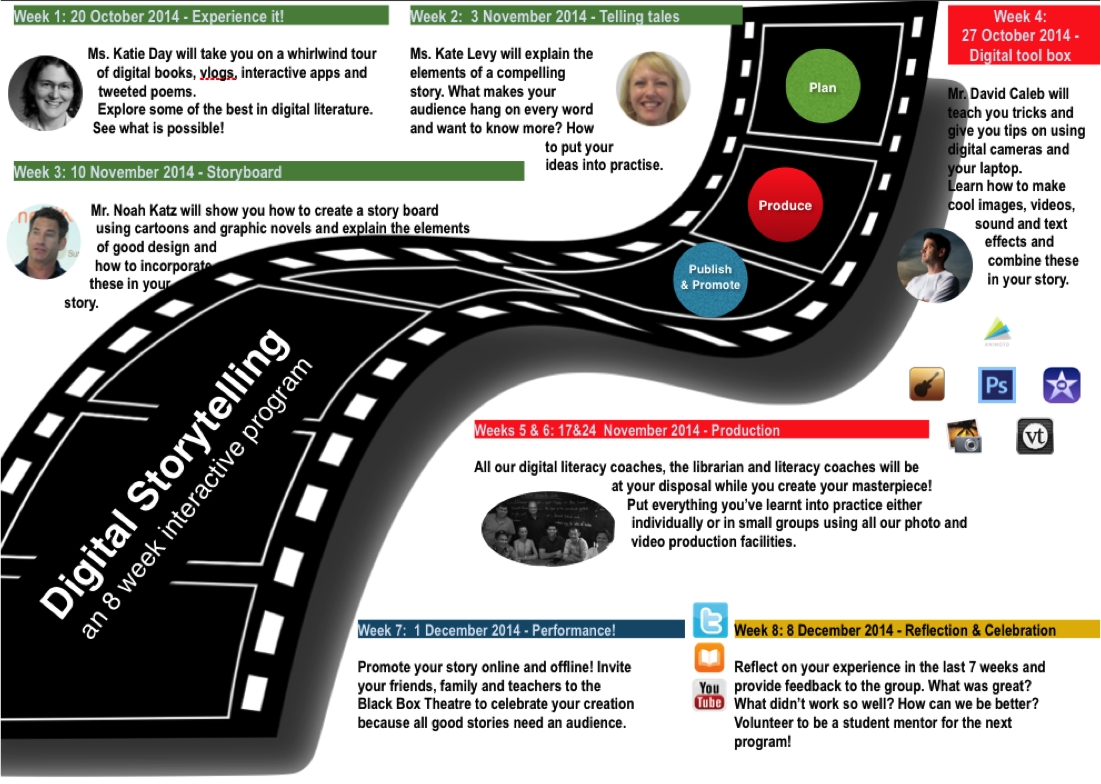
An overview of the activities is given in Appendix 1.


Week 1: Experience it!

 
During the first session, a variety of digital literature will be made available to the group. An example of each type will be briefly introduced and then students will be free to chose and borrow the example that most appealed to them, or to find other examples in that genre.


Week 2: Telling Tales

 
This week the elements of storytelling will be introduced.  Using the conceptual framework of Branigan (1992, cited in Kenny, 2011), story telling as a universal construct includes the interaction between a teller and the audience with the elements of time and place (background), cause (conflict or challenge) and effect (fight or flight) which result in a transformation as the story is resolved.
The acronym “I AM TOP CAMP” is a useful way to remember the principles of digital story telling, i.e. Interactive; Authentic; Meaningful; Technological; Organized; Productive; Collaborative; Appealing; Motivating; and Personalized (Yoon, 2013).


Figure 3: Storytelling process


Week 3: Storyboard

 
Building on the experiences of week one and learning of week two, students will be encouraged to start thinking about creating a storyboard for their own story. Comics and graphic books will be used to scaffold this activity (Hall et al., 2012). The elements of good design will be introduced, namely Contrast, Alignment, Repetition, Proximity otherwise known as CARP (Reynolds, 2008).


Week 4: Digital tool box

 
Each of the modal choices in digital storytelling (still and moving image, text, voiceover, music and sound (Buchholz, 2014)) requires the use of different technological tools, which can either be used separately, or in combination with each other.


Weeks 5 & 6: Production

 
Students are given the opportunity to create their own story. They have complete control over the type of story, tools to use and whether to work in a group or pairs or individually. Additional staff members will be available on a roving basis to trouble-shoot and assist students with any technical or story-telling difficulties they encounter.  Audio-visual rooms and digital cameras will also be available during lunchtimes should students wish to work on their story outside of the activity time.


Week 7:  Performance

 
One of the problems with creative writing is the perceived lack of an audience (Thompson, 2012). Although collaboration, interaction and sharing has been a part of all the activities up to now, this week the activity makes the audience explicit. The group’s productions will be shown at a special screening in the small black box theatre. Students can invite friends, parents and teachers.


Week 8: Reflection and celebration

 
In the final week, students will be able to reflect on their experiences during the last 7 weeks and provide feedback to the group (Survey – Appendix 4). This will be part of the evaluation discussed in the next section. Students will be allowed to bring along a snack for a celebratory party and will be invited to help as student volunteers in the Production stage of the next program.


Detailed activity plan – Week 1


Materials required

 
Laptop (MacBook) and iPads with preloaded eBook apps, screen, projector, apple TV for screening. The following digital literature should be preloaded onto iPads, available online or available for borrowing from the library catalog:


Type
Name
Link
Interactive Documentary
A global guide to the first world war (Panetta, 2014)
Twitterature
100 Greek Myths retold in 100 tweets (Crown Publishing, 2012)
Digital Novel
Inanimate Alice (DreamingMethods, 2012)
Vlog
Lizzie Bennet Diaries (Su, Noble, Rorick, & Austen, 2014)
Animated dreamtime stories
Dust Echoes (ABC, 2007)
iPad app and eBook
Shakespeare in Bits – Romeo and Juliette (Mindconnex Learning Ltd, 2012)

Figure 4: Digital Literature examples for screening


Step by step procedures of what is to be done 


Item
Equipment / Material
Timing
Greet students and ask for a brief introduction with name, class, where they are from and any experience or expectations they have from the program.
Stickers for students to write the names on
10 minutes
Perform a short icebreaker such as “two truths and one lie” with students in pairs.
n/a
10 minutes
Ask students to do initial survey using google forms.
Survey (Appendix 3)
5 minutes
Show snippets of the first three examples of digital story telling – A Global guide to the first world war, 100 Greek Myths and Inanimate Alice.
Laptop, projector and screen. Ensure various resources are open to minimise turnover time
3 resources, 5 minutes each = 15 minutes
Open discussion on what appeals to the students
Use the elements of successful digital story telling i.e. Interactive; Authentic; Meaningful; Technological; Organized; Productive; Collaborative; Appealing; Motivating; and Personalized (Yoon, 2013) to scaffold activity
20 minutes
Give students a break to have a snack, use the washroom, etc.
10 minutes
Show snippets of the next three examples of digital story telling – Lizzie Bennet Diaries, Dust Echoes and Shakespeare in Bits – Romeo and Juliette.
Laptop, projector and screen. Ensure various resources are open to minimise turnover time.
3 resources, 5 minutes each = 15 minutes
Ask students to choose the type of digital storytelling that most appeals to them; they can explore the resource in the remaining class time and borrow the resource to explore further at home.
Assist with loan and downloading of materials or searching of similar materials.
20 minutes
Finish in time for buses / pickup
Total 1 hour 45 minutes

Figure 5: Step by Step Procedure for week 1


Audience, staffing and other considerations

 
As discussed in Part 1, there will be 12 middle school students aged 12 – 15 years. All students should have a laptop and access to the library catalog and the Internet.  The secondary school librarian will demonstrate the material and show where similar material can be found in the catalog. An assistant librarian should be on hand to troubleshoot if students have problems loading the apps or eBooks, signing in or any other technical difficulties. Ensure room shades are all working so the room can be darkened sufficiently.


Marketing and promotion


The school markets all activities through the website and has a centralized signup program, however, as this is a new activity, additional promotion will be needed. A promotional calendar has been created including a short synopsis of each activity and its relevance (see Figure 2 below, and Appendix 1 for the promotional calendar).


Figure 6: Promotional Calendar


Printed posters will be put in the library, hallways, and elevator notice boards. In order to attract those students who would most benefit from the program a combination of “pull” and “push” promotion will be needed, so flyers will be given to Middle School language teachers, digital literacy coaches, learning support teachers and school counsellors who will be encouraged to discuss participation with students who may benefit from the program. A link to the calendar will also be placed on the library portal and in the school newsletter, the eBrief.


Part 3: Evaluation and reflection


How to evaluate the program

 
There are two main ways in which participants will evaluate the program.  In the first place a questionnaire will be completed (see Appendix 4). Secondly students will reflect on their own work and give feedback to other participants as part of the reflection in Week Eight.  Students are used to the PNI method of reflecting on the Positives, Negatives and possible Improvements. The most relevant evaluation however will be whether the activity is seen as interesting in subsequent semesters with demand and over-subscription from students during the Season 2 signup period. Although the student as “client” will be the main evaluator of the program, the teachers and digital, visual and text literacy coaches will also be asked to give feedback on the content, logistics and perceived usefulness of the program. 
Some digital storytelling programs have administered pre- and post- program literacy tests to students to evaluate the efficacy of the program (Barnard, 2011; Beach, 2012; Gunter & Kenny, 2008; Ragen, 2012; Yoon, 2013). But, since the primary goal of the program is to provide a social and creative outlet for students using digital tools, this will not be undertaken formally. However, the tutor mentors of the students participating in the program will be asked if they feel the program had any impact on the students socially or academically.


Reflection

 
One of the issues to be considered in this program will be the possible duality in the audience it attracts. On the one hand it may appeal to students with a passion for reading and writing, who already have a high level of sophistication and affiliation for writing. On the other, it may appeal to students who have difficulties in expressing themselves due to learning or language difficulties. They may be attracted by the expressive affordances of digital literature, the lure of technology or they may be encouraged to join in by their English teacher, learning or language support teacher or school counsellor. An important consideration would be how to cater to both these groups allowing each to build on their strengths without compromising the needs of either.  A further concern is that students will put a disproportionate amount of time into struggling with flashy technology and this will compromise the story-telling process. For this reason, digital tools are only introduced in the fourth week, after storytelling and the storyboard has been completed. During the mentoring, digital literacy coaches should remind students of academic honesty, consideration of DRM (digital rights management) and the correct accreditation or attribution of images and other material.
In setting up this program, older students were not considered, since once they move into High School and the International Baccalaureate program; study and exam pressures result in limited time for participation in activities. In the primary school, extensive writing workshops are already in place, led by the literacy coach. At a later stage, if the program is successful it could be expanded to include other groups of students.
Finally, it is important to reflect on the developmental needs of teenagers in the light of the objectives and characteristics of the program.


Objective
1. Introduce students to concepts, examples and tools of digital storytelling
2. Support students in the creation of their own narratives using the tools of digital storytelling
3. Provide a forum for sharing, promotion, collaboration and interaction

Figure 7: Objectives revisited


Developmental Need
Expression
Program Objectives
Program characteristics
Positive Social Interaction with Adults & Peers
Seek attention, socialization
2, 3
Small group of students with specialist teachers with a variety of skills and personalities
Structure & Clear Limits
Push boundaries, challenge authority
1, 2, 3
Program is limited to 8 sessions with a clear structure within which choice and autonomy is possible
Physical Activity
Running, jostling, roaming
n/a
Not applicable
Creative Expression
Vandalism, Vine, Instagram, Snapchat
2
Creative storytelling is the main thrust of the program
Competence & Achievement
Competitive behaviour, Minecraft, number of followers on social media
1,2,3
The program allows for mastery of technological and storytelling skills within a new format, end result is performed and published
Meaningful Participation
Opinionated, socialization, clique club or team membership
2, 3
Activities allow for interaction in the physical and virtual space
Opportunities for Self-Definition
Status symbols, dress and hair,
2
Students are encouraged to consider their culture, linguistic and social identities in producing their story

Figure 8: Summary of developmental needs, expression, program objectives and characteristics
(Adapted from: National Middle School Association (1996). Research Summary: Young Adolescent’s Developmental Needs, 2006, cited in Gallaway, 2008).


References


21stCL. (2013). School of The Year – 21st Century Learning International. Retrieved May 15, 2014, from http://21c-learning.com/awards/school-of-the-year/

ABC. (2007). Dust Echoes. Retrieved August 20, 2014, from http://www.abc.net.au/dustechoes/dustEchoesFlash.htm

Barnard, C., A. (2011). How Can Teachers Implement Multiple Modalities into the Classroom to Assist Struggling Male Readers? (Education Masters Paper 26). St. John Fisher College, Rochester, NY.

Beach, R. (2012). Uses of Digital Tools and Literacies in the English Language Arts Classroom. Research in the Schools, 19(1), 45–59.

Buchholz, B. (2014). “Actually, that’s not really how I imagined it”: Children’s divergent dispositions, identities, and practices in digital production. In Working Papers in Literacy, Culture, and Language Education (Vol. 3, pp. 25–53). Bloomington, IN: School of Education, Indiana University. Retrieved from http://education.indiana.edu/graduate/programs/literacy-culture-language/specialty/wplcle/index.html

Burke, Q., & Kafai, Y. B. (2012). The writers’ workshop for youth programmers: digital storytelling with scratch in middle school classrooms (pp. 433–438). Presented at the Proceedings of the 43rd ACM technical symposium on Computer Science Education, ACM.

Crown Publishing. (2012, November). @LucyCoats: 100 Greek Myths Retold in 100 Tweets (with tweets). Retrieved September 4, 2014, from https://storify.com/CrownPublishing/100-greek-myths-retold-in-100-tweets

DreamingMethods. (2012). Inanimate Alice – About the Project [Digital Novel]. Retrieved September 4, 2014, from http://www.inanimatealice.com/about.html

Dreon, O., Kerper, R. M., & Landis, J. (2011). Digital Storytelling: A Tool for Teaching and Learning in the YouTube Generation. Middle School Journal, 42(5), 4–9.

Gallaway, B. (2008). Pain in the Brain: Teen Library (mis)Behavior. Retrieved September 4, 2014, from http://www.slideshare.net/informationgoddess29/pain-in-the-brain-teen-library-misbehavior-presentation

Gorrindo, T., Fishel, A., & Beresin, E. (2012). Understanding Technology Use Throughout Development: What Erik Erikson Would Say About Toddler Tweets and Facebook Friends. Focus, X(3), 282–292. Retrieved from http://focus.psychiatryonline.org/data/Journals/FOCUS/24947/282.pdf

Green, M. R. (2011). Writing in the Digital Environment: Pre-service Teachers’ Perceptions of the Value of Digital Storytelling. In American Educational Research Association (pp. 8–12). Retrieved from http://worldroom.tamu.edu/Workshops/Storytelling13/Articles/Green.pdf

Greenhow, C., Robelia, B., & Hughes, J. E. (2009). Learning, Teaching, and Scholarship in a Digital Age: Web 2.0 and Classroom Research: What Path Should We Take Now? Educational Researcher, 38(4), 246–259. doi:10.3102/0013189X09336671

Gunter, G. A., & Kenny, R. F. (2008). Digital booktalk: Digital media for reluctant readers. Contemporary Issues in Technology and Teacher Education, 8(1), 84–99.

Gunter, G. A., & Kenny, R. F. (2012). UB the director: Utilizing digital book trailers to engage gifted and twice-exceptional students in reading. Gifted Education International, 28(2), 146–160. doi:10.1177/0261429412440378

Hall, M., Hall, L., Hodgson, J., Hume, C., & Humphries, L. (2012). Scaffolding the Story Creation Process. In 4th International Conference on Computer Supported Education. Porto, Portugal. Retrieved from http://www.lynnehall.co.uk/pubs/ScaffoldingTheStoryCreationProcess.pdf

Jones, P., & Waddle, L. L. (2002). New directions for library service to young adults. Chicago: American Library Association.

Kenny, R. F. (2011). Beyond the Gutenberg Parenthesis: Exploring New Paradigms in Media and Learning. Journal of Media Literacy Education, 3(1), 32–46. Retrieved from http://www.jmle.org

Kenny, R. F., & Gunter, G. A. (2004). Digital booktalk: Pairing books with potential readers. Association for Educational Communications and Technology, 27, 330–338.

Knight, S. (2012, June 20). Introduction to Digital Storytelling. Retrieved September 6, 2014, from http://www.slideshare.net/sknight/digital-storytelling-ed554?related=1

Meyers, E. M., Fisher, K. E., & Marcoux, E. (2007). Studying the everyday information behavior of tweens: Notes from the field. Library & Information Science Research, 29(3), 310–331. doi:10.1016/j.lisr.2007.04.011

Mindconnex Learning Ltd. (2012, January 25). Shakespeare In Bits: Romeo & Juliet iPad Edition on the App Store [iTunes]. Retrieved September 6, 2014, from https://itunes.apple.com/us/app/shakespeare-in-bits-romeo/id370803660?mt=8

Morgan, H. (2014). Using digital story projects to help students improve in reading and writing. Reading Improvement, 51(1), 20–26. Retrieved from http://search.proquest.com/docview/1540737338?accountid=10344

Musil, R. (2001). The confusions of young Törless. (S. Whiteside, Trans.). New York, N.Y.: Penguin Books.

Nilsson, M. (2010). Developing Voice in Digital Storytelling Through Creativity, Narrative and Multimodality. International Journal of Media, Technology and Lifelong Learning, 6(2), 148–160. Retrieved from http://seminar.net/index.php/volume-6-issue-2-2010/154-developing-voice-in-digital-storytelling-through-creativity-narrative-and-multimodality

Panetta, F. (2014). A global guide to the First World War [Interactive documentary]. Retrieved from http://www.theguardian.com/world/ng-interactive/2014/jul/23/a-global-guide-to-the-first-world-war-interactive-documentary

Ragen, M. (2012). Inspired technology, inspired readers: How book trailers foster a passion for reading. Access, 26(1), 8–13. Retrieved from http://search.proquest.com/docview/934354989?accountid=10344

Reynolds, G. (2008). Chapter 6 Presentation Design: Principles and Techniques. In Presentation Zen: Simple Ideas on Presentation Design and Delivery (pp. 152–163). New Riders. Retrieved from http://www.presentationzen.com/chapter6_spread.pdf

Su, B., Noble, K., Rorick, K., & Austen, J. (2014). The secret diary of Lizzie Bennet. London ; Sydney: Simon & Schuster.

Thompson, I. (2012). Stimulating reluctant writers: a Vygotskian approach to teaching writing in secondary schools: Stimulating reluctant writers. English in Education, 46(1), 85–100. doi:10.1111/j.1754-8845.2011.01117.x

UWCSEA. (n.d.). Languages at UWCSEA. Retrieved from http://issuu.com/uwcsea/docs/uwcsea_languages

Yoon, T. (2013). Are you digitized? Ways to provide motivation for ELLs using digital storytelling. International Journal of Research Studies in Educational Technology, 2(1). doi:10.5861/ijrset.2012.204


Appendix 1: Program Overview


Element
Synopsis
Relevance
Instructor
Location
Week 1:
20 October 2014
Experience it!
A whirlwind tour of digital books, vlogs, interactive apps and tweeted poems.
Provide background to program and give understanding of what is possible.
Ms. Katie Day – secondary school librarian – expert in YA literature
Library Think Tank
Week 2:
27 October 2014
Telling tales
Elements of storytelling explained with particular reference to digital storytelling.
Storytelling, no matter what the medium is the basis of this program.
Ms. Kate Levy – high school English teacher
Library Think Tank
Week 3:
3 November 2014
Storyboard
Students shown how to create a storyboard using the example of cartoons and graphic novels and elements of good design are introduced.
Learn the elements of good design and how to incorporate these in your story.
Mr. Noah Katz – visual literacy coach
Library Think Tank
Week 4:
10 November 2014
Digital tool box
Digital tools for capturing and combining different modal choices (image, sound, text) are explained. Best practise is highlighted.
Bring students digital skills to a comparative level of mastery and show how to incorporate into their storytelling.
Mr. David Caleb – digital literacy coach, photographer and author of “The Photographer’s Toolkit”
Library Think Tank
Week 5:
17 November 2014
Production
Students will be given the time and resources to put their ideas and skills into practise. They can choose between individual, paired or group production.
Students will be aided in their creation of digital stories by competent experts they can achieve their creative goals within a clear structure.
All 7 school digital literacy coaches, librarian and Ms. Levy
Library – Emily Dickinson, Pablo Neruda rooms & Think Tank – green, blue or white screens available
Week 6:
24 November 2014
Production
Week 7:
1 December 2014
Performance!
Output is produced and promoted. Friends, family and teachers are invited to the Black Box Theatre watch the digital storytelling productions.
An explicit audience is an important aspect of storytelling. Students will have a sense of competency and achievement.
Ms. Katie Day, participants, digital literacy coaches
Black Box Theatre
Week 8:
8 December 2014


Reflection
Time is given for reflection and feedback of the last 7 weeks. The end results are celebrated and promoted further.
The end of the program is indicated by this activity both setting a limit to the formal program and allowing reflection and also validating participants by requesting their evaluation and suggestions for improvement.
All instructors
Library Think Tank


Appendix 2: Promotional Calendar


Appendix 3: Pre-program Survey


Digital Storytelling Program
Pre-program Surve
y
To give us an idea of your current understanding, preferences and skills please complete this survey. Thank you!
Definitely
Usually
Some-what
Not really
Not at all
I enjoy reading or watching
Fiction, stories, memoirs
Non-fiction or documentaries
Poetry
I can use the following technology
Digital Camera
Digital Video Camera
iPhoto
Photoshop
iTunes
Garage Band
iMovie
I use the following social media
Facebook
Instagram
Twitter
YouTube
Other – please state which ……
I express my creativity through
Writing
Art or photography
Music or dance
Drama and acting
Video or film
I am not creative
What do you expect from this program?


Appendix 4: Post Program Survey

 
Digital Storytelling Program
Post-program Survey
Now you have finished the program please reflect on your experiences and learning.
Definitely
Usually
Some-what
Not really
Not at all
I understand the concepts and tools of Digital Storytelling
Different types of digital stories
What is important in storytelling
How to create a storyboard
I can produce my own digital story
I can use the following technology
Digital Camera
Digital Video Camera
iPhoto
Photoshop
iTunes
Garage Band
iMovie
I would recommend this program
To friends / classmates
To teachers
What was the best / most positive part of this program?
What didn’t you enjoy about this program?
What improvements would you suggest?


Paying lip service to information

One of the paragraphs in this week’s modules struck me:

“It is often said that we live in an information age, and that the price of failing to act promptly to take advantage of positive new developments or to dampen the impact of negative ones is often likely to be rapid and painful. Yet there is plentiful evidence that sources of information, including both special and public libraries, are under-utilised by those in business and very often seriously underfunded. It is possible to conclude that business (like, one fears, some politicians, local government representatives, university administrators and school principals) is more likely to pay lip service to the importance of good information services than to support them in a practical way.” (INF538, Charles Sturt University, 2014)

I think it is something that librarians have to battle with on a daily – if not some days, hourly basis. Yesterday was a case in point. Our library received not one, but two, lengthy requests for materials and resources (mainly really expensive books) to support curriculum.   Oh, but that’s a good thing. It’s a great thing you may think.  Teachers reaching out to libraries to support their information needs.   Yes.  And no.    You see, the need for information, the seeking of and the request for and the acquisition and dissemination of the same is not so much an “on / off” switch (or email request) as a dialogue.  And what was missing from these interactions was the dialogue.

An information resource does not exist in a vacuum.  It has a context.  And in a school the context is made up of so many things.  And without the dialogue the quality is likely to suffer.

In our training, a big deal is made of the “information interview”  and there is reason for this.  We need to know details about what the client needs.  This includes the age group and reading and understanding level of the students.  Where the module fits into the curriculum for the year and where it fits into what has come before and what will happen in the next year.   The cultural composition of students.  The teacher needs to know what we have in the library.  What databases we have access to. What ebooks and digital materials are available.   Videos, youtube clips, and libguides we have created.  What other teachers have requested in the same and higher and lower grades.

This is why the first step and not the last should be to pop into the library and have a quick chat.  That way there is less waste of time while teachers make lists from google or amazon that may be entirely inappropriate, or a duplication for what already exists.

“support them in a practical way” … what does this mean for an organisation and a library service.  I think more than anything else, is to give it credit as an integral part of the information flow in the library.  Not an add on, but embedded.

And now the chicken and the egg question.  Is it the responsibility of the library / librarian or the administrator?  Where does one start?  How slowly must the process move?  At least one teacher said during a meeting yesterday (adhoc, impromptu and sudden for an ‘urgent’ reactive need)  “I wish I’d talked to you earlier”.    To which we responded by just fitting in with their plans and agreeing to meet their needs.   I can’t help thinking about the time management boxes that were so popular a while back with the “urgent, important etc. blocks”   Clearly something structural needs to occur.  But what and how?

Everyone is trying their best. Everyone has time and other pressures.  There never is a steady state.  So how do we become drivers, or at least co-pilots instead of passengers on this trip?

Day 2: ebooks & audiobooks

This is a tough one.  The library I’m with at school hasn’t jumped on board.  And all for very good reasons.  Personally though, in my home library I’ve been embracing audio books ever since my kids were very small – (about 10 years ago) when we were living in Spain and I had a long commute to take them to and from kindergarten every day.  We started off with Peter Pan, and we’ve never stopped since then.  Even now when we drive from Netherlands to Switzerland in the summer – a good 8 hour trip we’ll arrive at the destination and they’ll clamour to stay in the car until the chapter is over.  It’s always been Naxos audio-books, as they have such wonderful voice artists, and we must have the CD of just about everything they’ve ever published (and if I ever have to listen to Professor Branestawn which has been on repeat mode for about 1 million time … again ….).  I also listen to the adult ones, and “A history of the world in 10 1/2 chapters” must be one of my all time favourites – it almost demands to be read aloud.   We had a subscription to the Naxos spoken word library – and that was wonderful – the kids used to dip in and out of books every evening before going to bed – particularly the children’s poetry – again something that is wonderful to hear rather than to read.

eBooks – I was an early kindle adopter, and I’m slowly but surely replacing all my old mouldy and yellowing classics with the online versions.  I love it for holiday.  I also have “overdrive” on my ipad, where I borrow books non-stop from the NLB, particularly when I’m travelling.  They also have audio-books for kids and my kids had great fun listening to the “Just William” books.

As a consumer therefore, yes, but as a librarian I know there are all sorts of issues with rights and ownership, not even to mention needing to train staff to train clients on the use thereof.  So that concludes day 2 of the challenge.

And if anyone knows how to get Gutenberg books into your Follett Destiny Catalogue – I’m all ears!