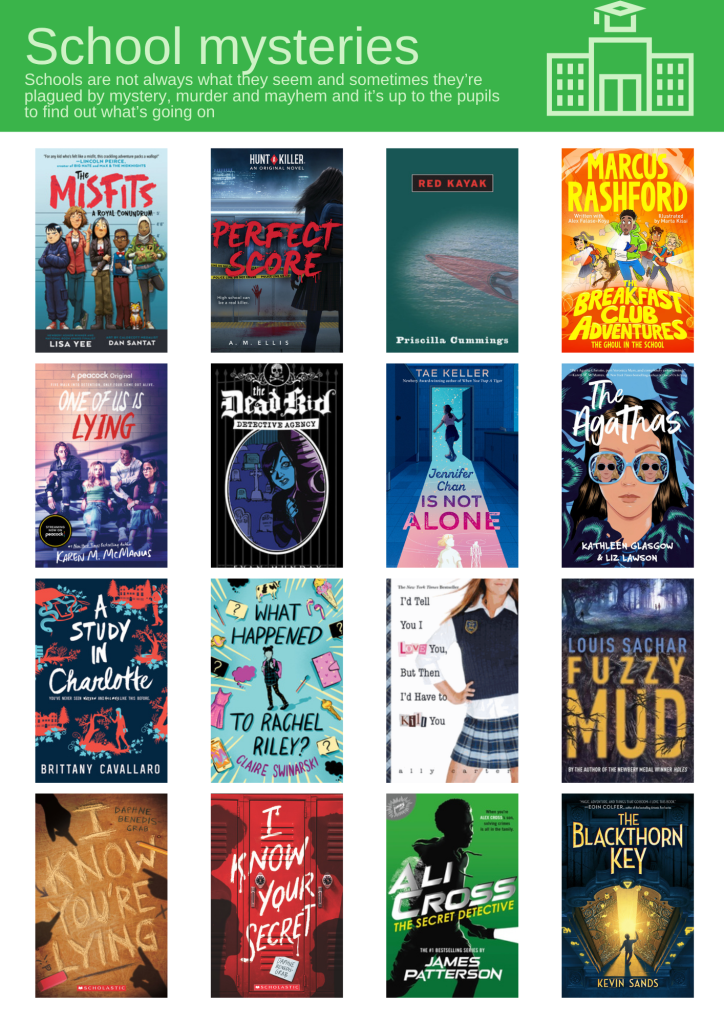
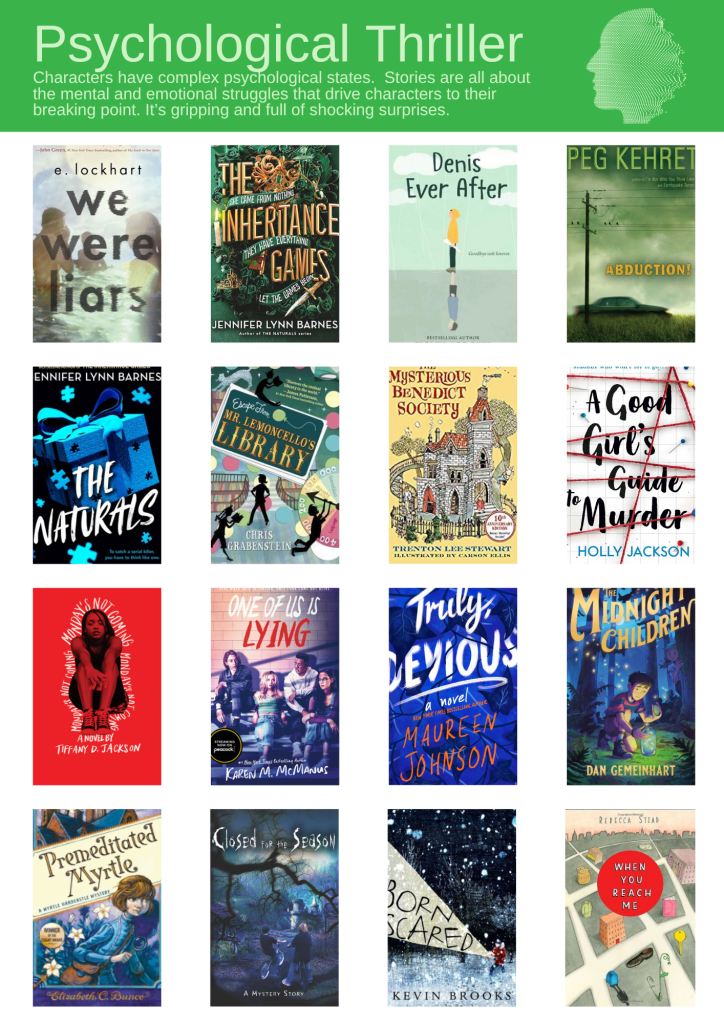
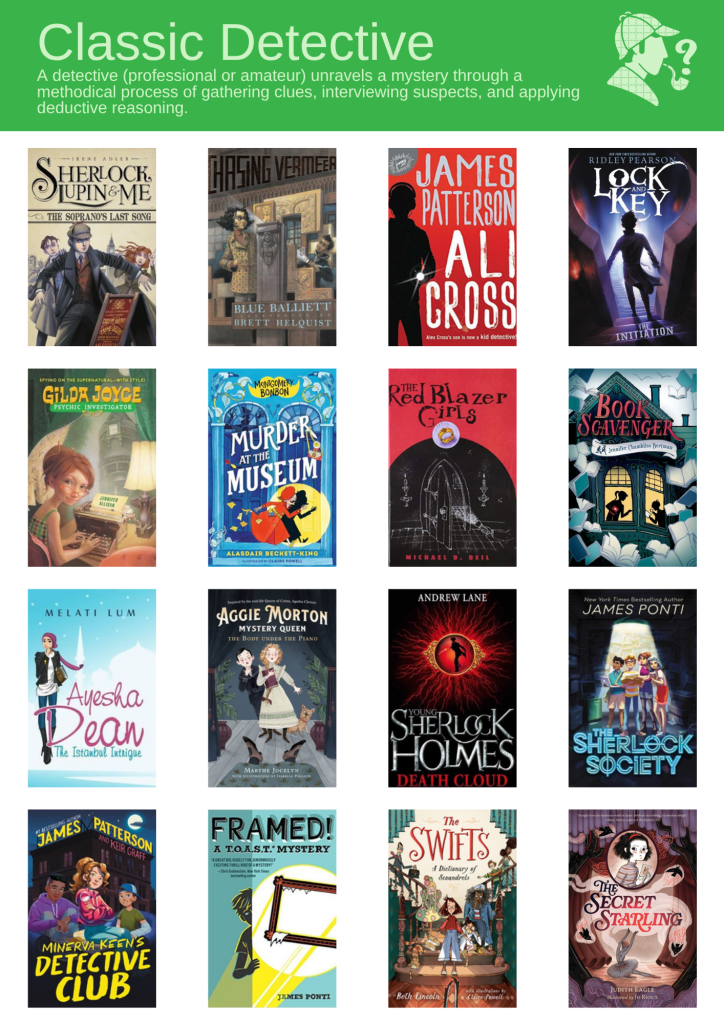
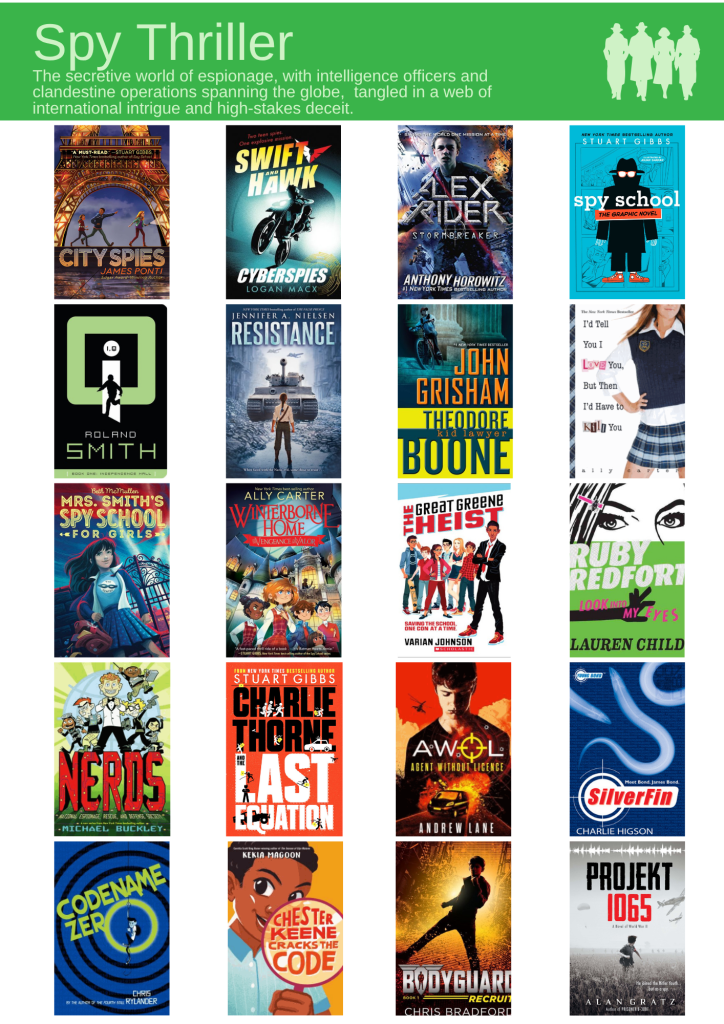
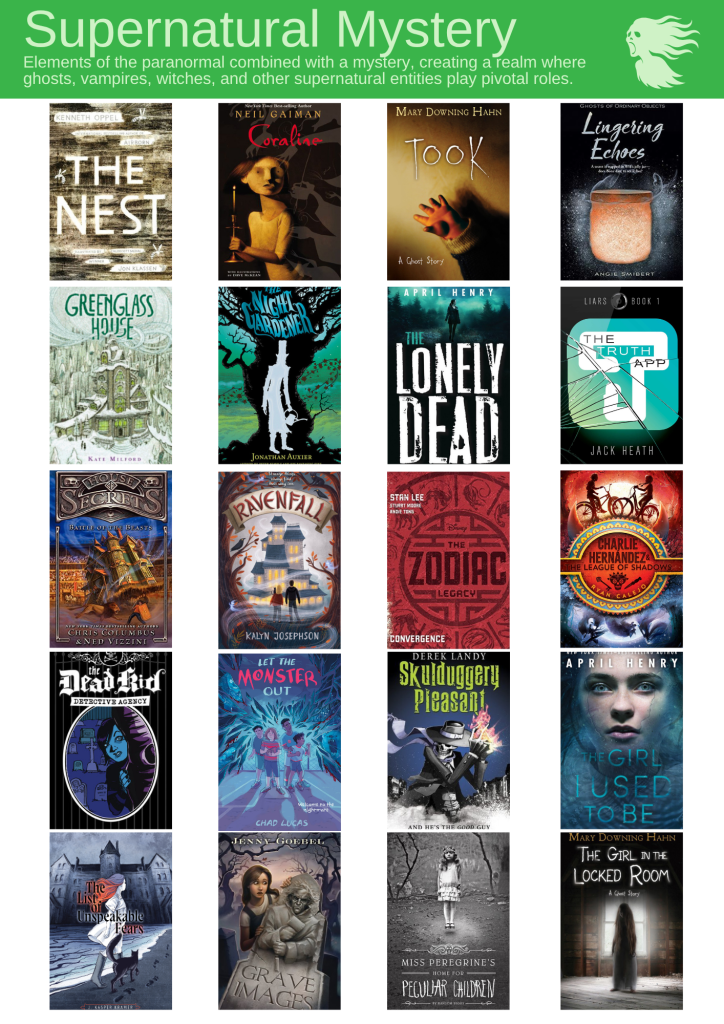
At the moment the Mystery genre is getting a lot of love from everyone from middle school to adult and a lot of great books are being released. Since we’re in a middle/high school library I wanted to showcase the mystery books that are not too spicy / intense. In our G8 core library we have “We were liars” and “The Naturals” which is probably at the upper level particularly in the later books in the series.
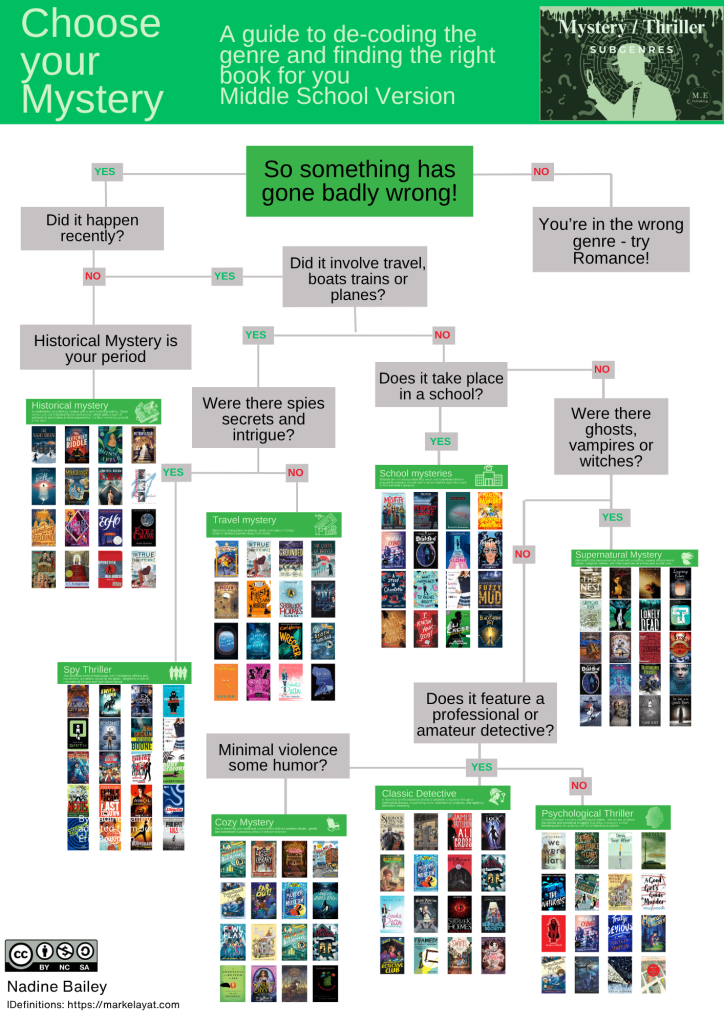
Along the lines of the work I did a couple of years back on Dystopian Fiction, I started to work on doing the same for sub-genres of Mystery. This time around I didn’t have some flowchart work others had already prepared to riff-off and I wanted to focus particularly on books suitable for middle school. I’ve relied on the excellent sub-genre descriptions of Mark Eleyat (who also has great pages on other genres and subgenres) and tried to make some kind of a flow to it. Somehow so many other things have intervened so it’s taken months to get to this point. I would love some feedback / suggestions for improvement on the flowchart.
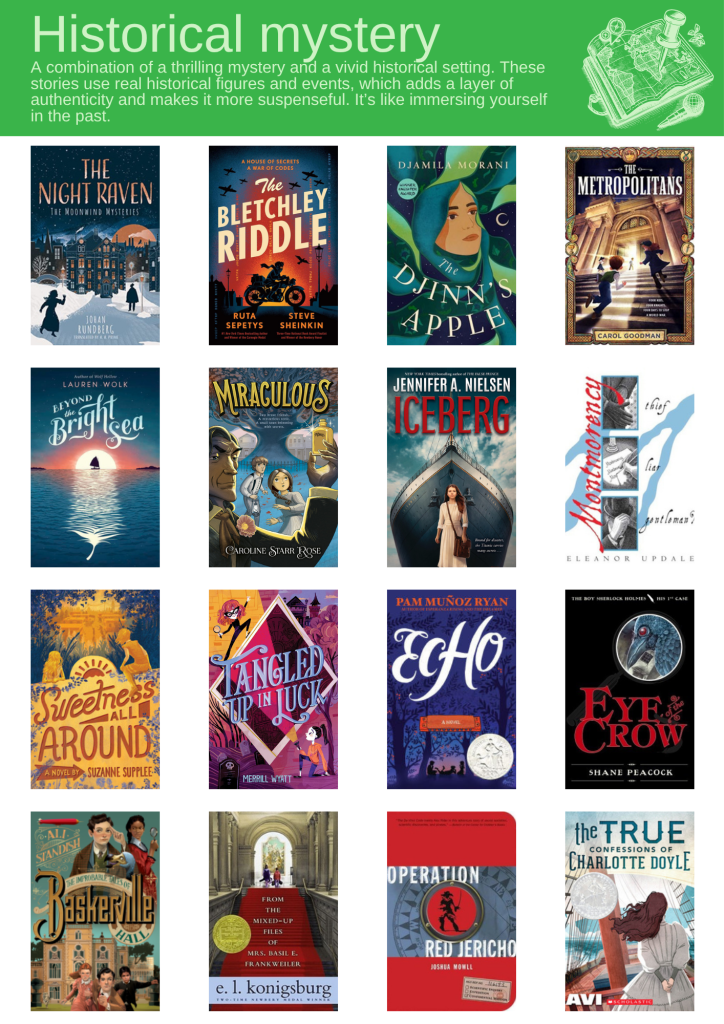
And I’ve created these Middle School posters. The Canva Template is available for you to adapt to your situation – one day I hope to be able to expand it for YA and even adult, as I’m personally a big mystery/thriller. If you create anything based on this for YA or adult please feel free to share in a comment.
Tomorrow marks 74 days since we saw our students face-to-face. Since we had the luxury of physical indoor and outdoor spaces. A library. Fields to play in. Classrooms. We’re at the point of the year now where we’ve started talking about assessments and report cards and student led conferences. Where there are fewer days left until the end of the school year (67 days) than we’ve been doing online learning. And everyone I speak to is so very tired. Students, parents, teachers.
If this becomes our new normal, even in some kind of hybrid online/off-line model as articles such as this from the Atlantic Get Used to It: This Lockdown Won’t Be the Last suggest that we may be moving between the two for a while to come, then we’re going to have to rethink online learning in a major way.
I listened to an interesting podcast with Sam Harris and Matt Mullenweg little over a week ago, on the New Future of Work wanted to blog on it but then had to do some more thinking and revisiting the points, but it was nearly a 2 hour podcast and I didn’t have the time to re-listen to it (even on my usual double speed), and there was no transcript – so the hack I employed was to open a word document and activate dictate, play the podcast in the background and use Microsoft’s pretty impressive assistive technologies help me. I can read way faster than I can listen which is why video-based education always annoys the heck out of me. Podcasts are ok as I can do them while walking, cleaning, cooking etc.
Levels of Online Work:
Getting back to the point. Mullenweg identified five levels of online working. And I think this is probably true of online learning. He also had a great little anecdote about the early days of radio drama in the 1920’s when people didn’t take advantage of the medium and tried to recreate plays including costume etc and then broadcast it. Online everything is a bit like that – we take the physical and try to recreate it but online, not fully adapting to the medium.
The levels are:
Level 1: Occasional at home work for example due to emergencies / illness using basic equipment like phones / internet
Level 2: Attempt to recreate the office environment at home without taking advantage of the medium – i.e. synchronous, mandated online hours, surveillance by company, little freedom and agency.
Level 3: Take more advantage of the medium – e.g. shared documents, real-time editing for example during meetings for clarification and shared understanding, better home equipment, companies investing in hiring people with really good written communication skills.
Level 4: Going asynchronous giving agency to people to design their day and productivity. Performance is judged on production / output not on how it’s produced. The baton is passed on over time zones. Decisions take longer but allow for longer and better contemplation, less power dynamics and give space for introverts and people for whom English is a second language.
Level 5: Nirvana with better work and more fun. Environment is designed around health including mental health and wellness. People operated at a higher level being “heroicly productive”. A sense of a world of “infinite abundance” and where there is a noticeable divergence between peers in terms of their deliverables/output. The biases of online environments such as dress / self-presentation / image disappear.
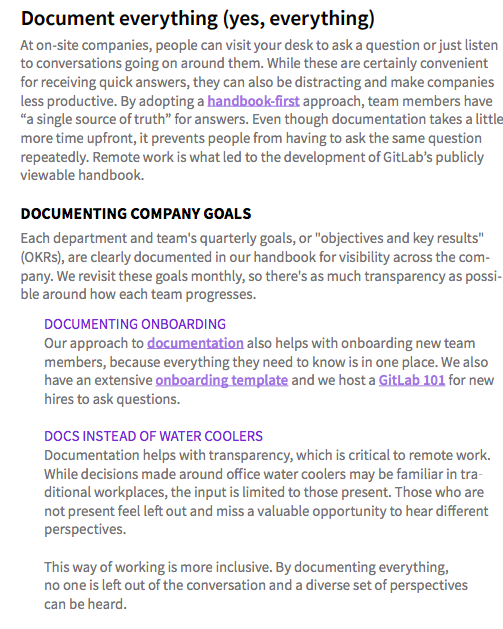
I really like some of their suggestions – including the one about documenting everything and having a single source of truth. Honestly that was one of the most time-consuming things I did initially and it remains tough to keep it updated and relevant, but our Middle School online learning guide (7,745 views) and the more detailed Teachers guide (5,476 views) remain the best time-investment I’ve made so far.
“sometimes I .. get under 5 emails per month, well and some months it might just be one or two basically all I get with email is like private HR stuff things that need to be one to one private communication everything else happens on these internal” (discussion boards / forums)
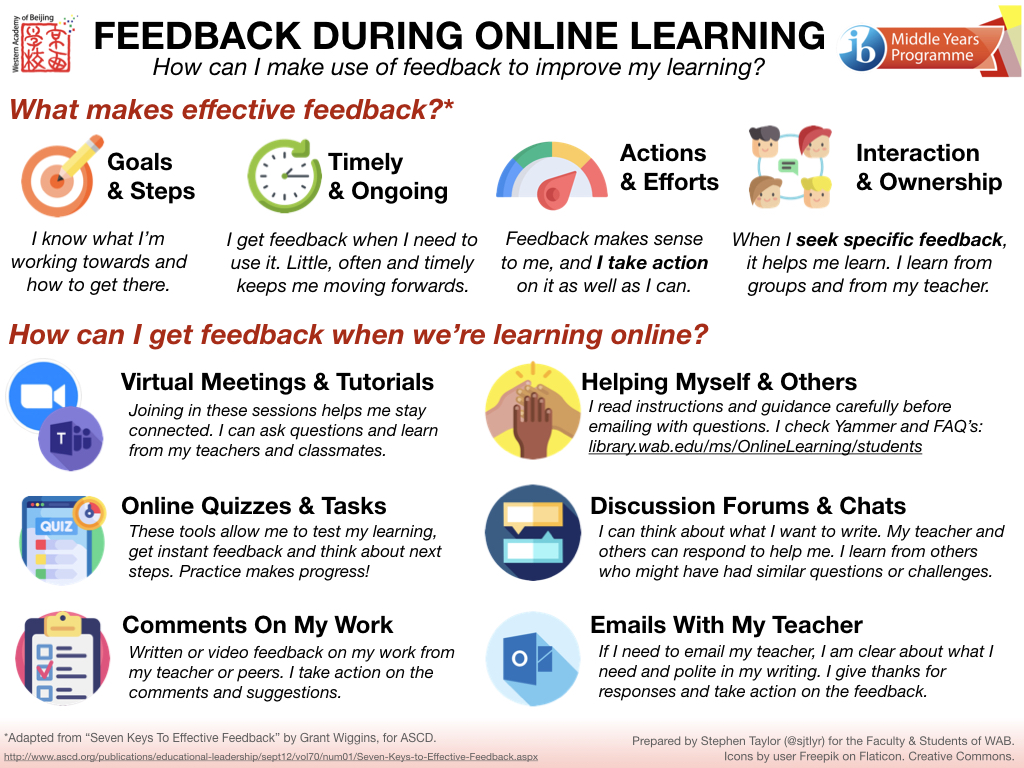
One of the most stressful parts of online learning I think for everyone has been the continual flow of single-purpose single-person emails all asking / saying the same thing. From the EdTech / IT side of things we’ve taken a load off with Libguides. I don’t get the feeling that’s happening so much in the various subjects. We’re not at Nirvana yet – or even close because there is still some pride in saying how many emails you have / have sent / how many hours you’ve been working. I had a really bad day on Friday. I’d been up late giving online PD to some educators in North America, followed by finishing off some points that had arisen from the PD plus internal stresses as our permission to stay is becoming an issue as we can’t return to China and my son and I were creating home-made application photos and filling in forms (in French – thank you Google translate) into the next morning. Then up early to do the first grocery shop in 3 weeks at 7.30am before the shops got busy. And then I was dead. I checked the most important emails and dealt with them – often just pointing people to our knowledge base. I left a bunch. And by the end of the day got “don’t worry I managed to solve it” from a few. The more robust our knowledge base can be, the easier this is going to become. I also need to make a huge investment in getting everything to ASK.wab.edu and then pointing to individual pages / boxes.
That’s going to take a huge investment not just in putting it all in “ask”, but also in getting our whole community to check there first as a habit.
Rethinking it all
But I diverge from the real point of this blog and that is the increasing realisation that perhaps we need to rethink teaching and learning. I attended a Zoom webinar with around 50 MYP educators last week, led by the indomitable Lenny Dutton and the consensus seemed to be converging around the fact that huge scaling down of the curriculum and content expectations was occurring – with 50% being the most common number suggested. (Side note, it also made me incredibly proud of the leadership, foresight and guidance of WAB as we’ve been asynchronous from the start). Perhaps it’s my A-type personality, or perhaps it was the question from my son “will all this result in the IB changing its exams next year to take account that we’re missing so much this year” that made me wonder what the heck we’re doing? Yes I’m not uncaring and I know all about Maslow vs. Bloom etc. I also know that there is less room for anxiety, worry and endless media scrolling when there’s useful and engaging work to be done.
I have to keep wondering if there is a different way, besides the asynchronous and slower pace to do this. My colleagues know I have two phrases of our greatest enemy in education that I repeat all the time “continual partial attention” and “switching costs“. I think education does particularly badly in helping students to find their flow or in adhering to Daniel Pinks’ tenants of motivation “autonomy, mastery and purpose”
I’m a veteran of (adult) distance learning, having done two back-to-back masters’ degrees remotely over four plus years. It was hard. Really hard. And it took a while (at least 3 subjects, lots of tears and feedback) before I managed to work out the best way to organise myself and my work flow and to find the balance between (part-time) work, full-time motherhood with a spouse who was on the road a lot and being a student.
The sweet spot for me was only two subjects per semester, and only working on one subject at a time each day.
Granted these were masters level subjects with an enormous course load and tons of academic reading to do. But then again I’m a highly literate adult, with hopefully more defined study skills and work habits. So if we’re asking students to do 8 or more subjects and teachers to be teaching 5 block – sometimes of different grades/subjects (middle school) is it any wonder we may be over-reaching? (The poor completion record of MOOCs is also something at the back of my mind).
As you know, I’ve also been grappling with that beast called Teams, and I’m trying to think out of the box and learn from all the questions and webinars and videos out there. One completely out of the box idea I had was perhaps we’re thinking of it the wrong way around – this is in particular to my thoughts about student agency, self-directed learning, portfolios and evidence of learning/mastery. What if instead of having class/subject teams, each STUDENT had a team they were owner of. They’d have channels for their various subjects, and they’d choose which two or three subjects they’d focus on at any time and when they’d do it. Subject groups would have department teams with all the teachers, the curriculum and curriculum content that then could be pushed down to students and mentors would help guide students in their choices. Instead of semesters, for this age group we’d probably have to look at shorter periods of time to ensure that the “forgetting” curve didn’t kick in – especially in continual practice type subjects (I’m in dire danger with my Chinese according to my memrise app, not to mention muscle loss on the fitness side of things).
What are you thinking?
In a conversation with a fellow educator last week, he said “Well WAB is just so far ahead in thinking about these things, we’re probably at least two or three years behind even putting theses discussions out in the open” and perhaps that is so with our Flow21 initiatives. I’m also wondering how far away we are from becoming a global rather than location based entity – for example some of our students were at one point enrolled in local schools where they were based and have now returned to the fold – what’s stopping us from enrolling other poorly served students into our programmes?
I’m thinking the IBO is also going to need to be far more proactive to fit the new reality. Personally I was not impressed with the timeline of action (exam cancellation and alternatives proposed) only coming after it was apparent that this wasn’t just a China problem. Value based leadership is essential in these times and that includes checking bias.
I do think the IBO focus on ATLs (Approaches to Learning), particularly communication would remain foremost – again from Mullenweg:
“and writing quality, clarity, and skill becomes more and more valuable I think in all organizations but the more distributed you are for sure. This is going to be a windfall for all the humanities degrees. Absolutely we screened for it very heavily in hiring process. Like I actually don’t care where you went to college or anything like that but we do a lot to screen for writing ability both in the how you apply how we interact will hire many many people without ever actually talking to them in real time or on voice we do it entirely through slack and tickets and other things because that’s how we work”
If we were to explode education what would it look like? Please comment.
In the interests of trying new things myself, and also making library orientation and searching the catalog / tracing items from the catalog to the physical copy more fun, I decided to create a library breakout.
I’d watched the “Breakout” phenomenon ebb and flow about 3-4 years ago and had always put it in the “fun, but how?” box, and this year finally decided to get into action. Our HS Edtech person had purchased the official “Breakout box” so I could have a look at that and the resources in the official site, and our ES Edtech person had deconstructed the idea and had a bunch of Stanley boxes, suitcases with locks and locks, so I had a lot to play around with. The first port of call was the official Breakout Site. Like all great ideas, this seems to be one that had its hey-day around 2015 and many of the potentially interesting links to library orientation were either broken, or the video instruction didn’t work or there were other issues, so, I left, muttering “maintenance” . I found a few good breakout description online (Library Media TechTalk; The Bright Ideas Library; LibraryStew; Ms. Kochel’s book blog;) and then, after getting an idea of how it could work, sat down and thought of what my aims would be.
I wanted to highlight the “Panda” books – the annual students’ choice books that are on a huge display in the library but often get overlooked by students and teachers alike – we order 5/6 copies of each book each year and students vote on their favourite in March.
I wanted students to be familiar with the library guides and bookmark the front page.
I wanted to make sure students could log onto the library catalog, search for a book and then find the physical copy in the library
I wanted each student to know how to use the “self-checkout” station
I wanted the students to search the catalog to find more obscure items (in titles, in descriptions of books, number of books in a series etc)
With my “ISTE educator” hat on, I wanted to ensure I could work on the role of “Facilitator”:
Educators facilitate learning with technology to support student achievement of the 2016 ISTE Standards for Students. Educators:
a. Foster a culture where students take ownership of their learning goals and outcomes in both independent and group settings.
b. Manage the use of technology and student learning strategies in digital platforms, virtual environments, hands-on makerspaces or in the field.
c. Create learning opportunities that challenge students to use a design process and computational thinking to innovate and solve problems.
In this case they would be “Knowledge constructors”
3. Knowledge Constructor
Students critically curate a variety of resources using digital tools to construct knowledge, produce creative artifacts and make meaningful learning experiences for themselves and others. Students:
a. plan and employ effective research strategies to locate information and other resources for their intellectual or creative pursuits.
ATLS (approaches to learning):
Thinking– Creative thinking / problem solving
Self Management – Affective – show resilience; Demonstrate persistence and perseverance
Social– Collaborative – share responsibility and roles with others
Universal design for learning:
Multiple means of Engagement:Provide options for Sustaining Effort & Persistence
Multiple means of Action and Expression:Provide options for Physical Action
The guide for the breakout can be found here with the clues. Students could access this guide through a QR code on the box. Most of them didn’t examine the box for the QR code but went straight for the printed instructions.
The activity needed at least 50-60 minutes – with some classes we had that, and generally those were the more successful classes who managed to complete all locks.
Some teams / classes didn’t complete for various reasons, and they didn’t get anything. Nothing. No compensatory prizes, no consolation prizes. The teams who did succeed could trade in their “key for success” cards in the box for boxes of “smarties” or chocolates – and the feeling of success.
Main takeaways:
Students need to be carefully guided to read the instructions completely and carefully
Their enthusiasm and “let’s run here” inclinations needs to be tempered with “hey guys, how about stopping and thinking about …”
Where an activity led them to need to get a next clue from the library staff, our staff was instructed that they only proceeded if they were politely addressed and asked (part of the hidden agenda that my staff are people with feelings who need to be treated respectfully)
Students (and teachers) often don’t see displays and look over them – their attention needs to be brought to things deliberately
Don’t assume anything – some 14 year olds have never done puzzles or have any idea of what a cipher wheel is!
Or perhaps big little things? The theme for this year’s Collaboration for Growth MYP session is “School Cultures; How do we shape them? How do they shape us?”
It made me think about what is different this year to last year culturally (besides feeling less like a deer in the headlights as it’s my 2nd year). A big thing has been the change in our school food provider. One would think that food is food and there’s not much difference between one and the other, but there has been quite a big shift. Last year many of us descended to one of the lounges and ate communally. It was fun to see on any particular day who would be there, and such interesting conversations would be had between Elementary, Middle and High school teachers and staff. You never knew who you’d bump into and all sorts of know-how and information would be passed along over lunch.
As someone not particularly inclined to shop and cook (and who’s trying to teach my teen to cook for himself, so increasingly leaving him up to fending for his dinners himself) it meant having a nutritious main meal for lunch and not bothering about dinner.
These days, the lounge is semi-deserted. I hardly ever see the people I used to bump into unless we make a point of meeting after school or for an external lunch – so much more effort. No more chatter about what’s going on educationally or personally in our lives. No more great ideas plotted out. Now I make a double meal at night and warm it up in our divisional microwave in our divisional staffroom if I can be bothered, or just eat at my desk when things are too overwhelming.
A little thing. A little big thing. But many have been mentioning the loss. And so culture changes. Without intent, positive or negative.
Part of my vacation time is usually spent doing personal learning and preparing for the new year for both my students and for how I can impact teaching and learning for teachers. Last year was my first in a new environment – both in terms of level (middle school rather than primary) and country/school (Beijing, China). This year I’m preparing with somewhat more hindsight and the fact that we have 12 new teachers starting. This post I’m going to focus more on how I hope to support teachers.
Last year, my predecessor very kindly typed up a long list of answers to my 100s of questions to help guide me in the new position. It’s something I refer to from time to time even further into the year. This year I compiled a “newbies” guide with the help and input of all my fellow (last year) new teachers, and the rest of the staff on the nitty-gritty things that we wish we’d known before starting. We sent it out into the world and based on the feedback added additional information. It seems to have had some success with 1,282 views since it was created in May. But it’s a lot of information to digest.
Today I stumbled on the videos (and book) of Nick Shackleton Jones via a tweet on a blogpost of his (yes, rabbit hole – but this time a good one). This has definitely changed my whole view on how to approach supporting teachers, and perhaps even how to work with students.
A brief summary of the takeaways of the videos
Part 1 – distinguish between content dumping (my newbie Libguide – and other Libguides) and performance support. In order to give performance support you need to understand / analyse what people are trying to do and provide resources that have DESIGN & UTILITY.
Find out from your audience WHAT I NEED NOW (WINN).
Part 2 – this session is particularly interesting for on-boarding and knowledge sharing. The basic elements are things that people need immediately (how to use the computer); advice from peers, understanding how things connect together; factsheets; one page guides; checklists.
Part 3 – discusses the affective (emotional) context of learning and how to alternate between providing resources (when the audience has a strong emotional response to the information) and experiences (when the emotional response / interest is lower). The 5Di design process is introduced (define, discover, design, develop, deploy & iterate). Of particular use in my context was the CONCERN-TASK-RESOURCES model. I think that is a great way of deciding what resources to focus on by working out the concerns of the audience, relating them to tasks and then providing the resources that can help with the tasks.
I can see this working really well for designing learning experiences for our Day 9s to ensure that they are student need rather than teacher driven.
So, what I thought I’ll do is during the newbie week and first week of teachers back have daily debrief sessions on a pop-in or digital basis called WINN where teachers can quickly and briefly address what their concerns or tasks are that they need immediate help with and to build up the resources they need. Pop in is easy enough, for the digital I’m thinking of using our “ask” function of Libguides that I just started populating at the end of last year, so that the questions can accumulate into a knowledge database.
First a shout-out – if you’re an international librarian and reading this – please join the International Librarians Lead (inTLlead) moodle – it aims to bring together a repository of resources, ideas and discussions on everything to do with being a 21C librarian in a global setting. We have 195 members and growing.
Further to my post about the difficulty in getting the right pitch in nonfiction reading in middle school, the discussion continued with science teachers about what students read (or don’t – thanks youtube) and how scientific time at school is used. And this is something I find incredibly weird as a non-science teacher, non science-curriculum creator, but as a parent of two kids having gone through science in PYP, iGCSE and MYP and DP. They spend a LOT of time and energy on lab-reports. Which often, no matter how heavily it’s scaffolded (and believe me I’m yet to see a lab report assignment that’s not heavily scaffolded) but they don’t spend any time until the IB reading a scientific journal article. And then probably only if they’re doing an EE (extended essay) on a scientific topic. And the skills required may or may not be explicitly taught depending on whether the librarian gets a look in, and depending on the supervisor and how much time they have.
Does anyone else find this strange? I’m wondering if we could somehow create a phased cross-walk between popular science articles in various areas to the original research that gave rise to those media interpretations (or misinterpretations as the case may be). Phased as in the sense of starting with the LCD of the abstract and conclusion and working up to sample size, statistics chosen and interpreted, hypothesis, methodology, experiment (link to the dreaded lab report) etc.
Am I talking nonsense? I’m thinking something very graphic so it’s pretty obvious. Or they create the graphic. By the time they get to the IB or university they don’t have the time to both do the writing needed and learning the decoding skills surely we should start earlier?
A long while ago (3 years) I wrote a post about the fact that we needed to look beyond “search and cite” in teaching information literacy and look at the threshold concepts of research, and a presentation I’d given on the theme. I remember at the time seeing half the audience (of librarians) eyes glazing over and thinking, “oh no, this isn’t going to work if it’s not something librarians get and relate to – and how on earth would students buy in?” I still believe that understanding threshold concepts in any discipline and for us librarians in research / information literacy is crucial in diagnosing misunderstandings and structuring our teaching. But then yesterday I had another insight on how this could be approached in a far better way.
In my current position I’m considered to be part of the school wide coaching team, and as a group it was suggested we read “Student-Centered Coaching” by Diane Sweeney. I’ve been enjoying the fact that it’s a pretty practical book and one where you start to think that by taking the focus off the coach or even the teacher, you can actually take a lot of the emotion out of the coaching / teaching equation.
The book emphasises the use of data, but not necessarily the data provided by testing, but rather from the usual formative and summative assessment that is going on anyway. One example used DRA testing – the equivalent of which occurs all over regularly anyway, and another a rubric from a writing program using a writing prompt. The idea is to select pieces of writing and score them on writing conventions and then group students into bands of “exceeding, experienced, competent, developing, emerging or below emerging” conventions. One then tries to move those groups / cluster using differentiated instruction up the scale.
I immediately thought of a lost opportunity last term, I’d had to teach citation to groups of students prior to their final assessment of a unit. It had been hectic both on my side and the teacher / classes and I’d been beating myself up a bit about it. Then my son (a different grade) came home and showed me an I&S assessment task (ungraded) he’d done and asked me what I thought of it. That’s a tough call. Because, there was a lot going on there and not all of it was pretty.
And then I realised it was the perfect way to do a “backwards by design” session on searching and citing.
What if the “works cited list” and in-text citations of an assessment task of a whole class or grade were to be critically looked at? It is a few lines that reveal so much of what’s going on in research. And then based on that one could group students according to where they were and what needed to be worked on and then individualise that part of the rubric in order to see if there was progress in understanding (and if they were approaching the thresholds!).
A quick reminder of the IL threshold concepts – research is/has:
Authority – Is constructed and contextual
Format – the creation, production and dissemination of research is not equivalent to its delivery or how it is experienced
Information goods – research has a cost and a value
Information structure (searching as strategic exploration) – an ability to look “under the hood” of databases and search engines (including more and more as we use things like Google scholar – the algorithms that spit out the results)
Research process – as iterative, difficult and building on the those who came before
Scholarly discourse – citation is a point of access into this discourse
(Research as inquiry – ongoing nature of research this is used by some but not all researchers)
Some of the things I noticed when looking at my son’s paper were –
Evidence (just two examples as an example): Not understanding that “Et al.” means “and others” – encountered in the in-text citation and works cited. The in-text citation followed the format (author, date) while the works cited was MLA8. Kind of.
Indication of not understanding:
authorship = authority. But behind that was an understanding of the research process that included groups of people working on a topic
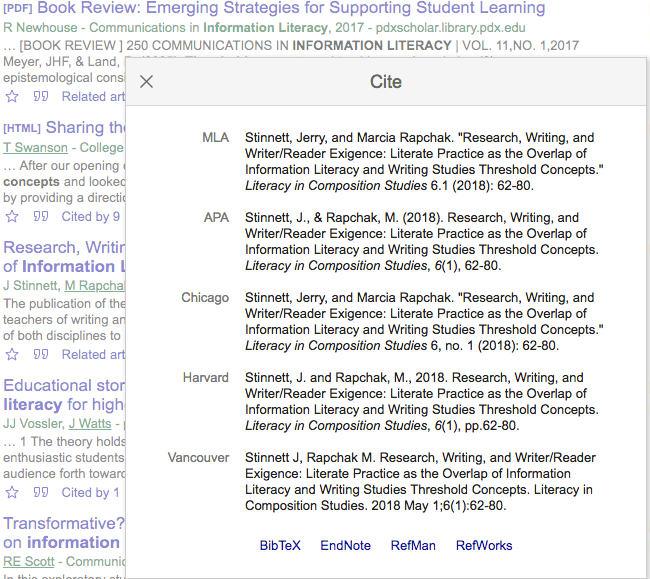
Format – since he’d used google scholar as a delivery point for the search. And from there had got to the database article without realising that it was an article in a database. And didn’t understand the format or information structure. This is something, if MLA8 is correctly taught and deployed, including its emphasis of a Russian Doll like structure of containers, should become obvious. There is another – more simple aspect of format – that of the format of citing and where that can be found. I showed him the ” marks in google scholar and how that led to the citation that could be copied into NoodleTools as is… a revelation
for him. I also showed him in the original journal article of two other sources how he could find the citations and just copy and paste them – let’s consider small steps here!
Indication of understanding:
Scholarly discourse – here is where my own prejudice to APA versus MLA8 for the humanities come in – the date is probably a better indication of the point of scholarly discourse and understanding that something more recent would encompass prior research
“One mentioned domain knowledge as a barrier: “You have to have some type of familiarity with the topic to ‘enter the conversation.’” (Scott, 2017, p. 295)
To reign this back, we’re talking about middle and high school. So wading straight into threshold concepts may be going in too deep for the average student. But it may be a useful diagnostic tool.
Getting back to the coaching bit – doing an autopsy on in-text citations and the works cited list would reveal where the gaps and issues both in searching and citing were. The humanities teacher is probably looking at the assessment using a different lens – that of understanding and using the information and the ability to write it up in an academically acceptable manner using some kind of scaffolding (e.g. point, evidence). And at the end of the assessment, once a grade has been given and the focus has moved onto the next unit / assessment, the gaps in the ATL “research” may not have been identified, recognised, nor addressed in the teaching or assessment rubric for the next unit.
I believe in rubrics as a way of shaping teaching and focusing attention in student effort. If in a year, the teacher in conjunction with the librarian, moves through perhaps four iterative cycles of research, I’m sure we’d see real progress in both the practical ability and metacognition of students as they approach research and the threshold concepts.
=================
Here are some articles that explore further information literacy as a threshold concept in an interesting way:
Further reading:
Corrall, S. (2017). Crossing the threshold: reflective practice in information literacy development. Journal of Information Literacy, 11(1), 23. https://doi.org/10.11645/11.1.2241
Hofer, A. R., Townsend, L., & Brunetti, K. (2012). Troublesome concepts and information literacy: Investigating threshold concepts for IL instruction. Portal: Libraries & The Academy, 12(4), 387-405.
Hofer, A., Brunetti, K., Townsend, L., & Portland State University. (2013). A threshold concepts approach to the standards revision. Comminfolit, 7(2), 108. https://doi.org/10.15760/comminfolit.2013.7.2.141
Scott, R. (2017). Transformative? Integrative? Troublesome? Undergraduate student reflections on information literacy threshold concepts. Communications in Information Literacy, 11(2), 283–301. https://doi.org/10.15760/comminfolit.2017.11.2.3
Stinnett, J., & Rapchak, M. (2018). Research, writing, and writer/reader exigence: Literate practice as the overlap of information literacy and writing studies threshold concepts. Literacy in Composition Studies, 6(1), 62–80. Retrieved from http://licsjournal.org/OJS/index.php/LiCS/article/viewFile/180/239
Townsend, L., Hofer, A. R., Lin Hanick, S., & Brunetti, K. (2016). Identifying threshold concepts for information literacy: A Delphi Study. Communications in Information Literacy, 10 (1), 23-49. https://doi.org/10.15760/comminfolit.2016.10.1.13
There are problems with reflection. Seeped in the IB tradition, first through my children and now as an educator, I know that no matter how well it’s disguised or re-engineered most students do not like reflection. In my own children, the response to me asking them about the reflection process resulted in one saying, “it’s over, let’s move on and what difference will the reflection make anyway?” and the other saying “I do my own reflection and it’s deeply personal so I’m definitely not going to share that with a teacher, let alone my class, so I just tell them what I know they’ll want to hear”. And with the adults in my life so far I think most fall somewhere on that continuum, with the rare exception of those prepared to be/risk being truly vulnerable.
This blog is my exercise in reflection, and heaven knows I screw up often enough, but how much of that is reflected in this? I’m afraid probably not enough. Because as a teacher one is also a public persona and unless your blog is private – in which case, why would you blog if not to receive feedback – you run the risk of incurring the ire or approbation of someone, somewhere in the organisation. Because to reflect in a way that it is meaningful one has to be open to change – either internally or in the environment – and change is one of those very hard things. Changing the self is difficult enough even if you ostensibly / presumably have control over self (I’ve just finished reading Homo Deus, where these philosophical questions were even better and more extremely expressed). As Harari wrote of power “The entire contract can be summarised in a single phrase: humans agree to give up meaning in exchange for power.” I think we give up more than just meaning for power. And I suspect one of the reasons reflection avoidance seems to hardwired from they youngest age, is that reluctance to show our soft underbellies, because for sure, the power-hungry will pounce.
Another part of reflection is the existence of pathways and an environment allowing for honesty without it being labelled as negativity. And that is a two way street that needs a rare combination of humility, excellent communication skills, acceptance skills and the intellectual rigour to have emotional detachment from ideas and practices.
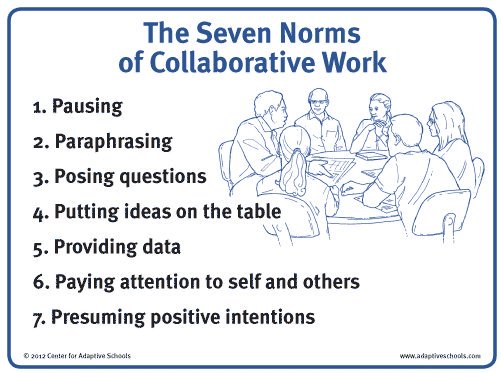
Adaptive schools / cognitive coaching and the 7 Norms of collaboration go a long way towards bridging these human fallibilities. But there are many enemies (besides power) to the process including time pressure, face, and the very human difficulty in accepting sunk costs.
So who can reflect honestly? The very very young, the naive, the elders – provided they are still allowed to be seen as relevant, the very wealthy and perhaps the court jesters / devil’s advocates. The rest of us I fear go so far and no further. Or tell people what they want to hear.
Recently I’ve been given to much pause of thought about learning and education, not the least following watching the movie “The imitation game” about Alan Turing’s code breaking during WW2 on the plane, followed by three days of intensive attending of presentations at 21CLHK. It’s taken a while to try and crystallise my thoughts, and they’re probably still not as coherent as they should be, but these are my main takeaways.
While Turing is attempting to build a machine that will, in the long term, take over the work of cracking this (and other) codes, everyone around him is desperately engaged in a race against the clock. And at midnight each day the clock is reset, all work they did that day is useless and they start again from nothing the next day. While I know that education is not exactly like that, I sometimes feel that a school year is like that Bletchley park day with a teacher racing against the daily clock, against the time-tabled period which they’re allotted to do one thing or another and then the bell goes or the summer holiday starts and we’re back at square one, but the child is handed over to the next person. I’ve said before this is fine for the “middle”. It’s the children at the extremes where this handing over is most acutely observed, either in a positive or negative sense as they lurch through the process of learning and hopefully becoming educated beings.
Far worse is not only is Turing not supported, but the mediocre middle are out to destroy not only his machine, but him as well.
Ironically it is always easier, and more appreciated, to work extremely hard at a huge volume of output, than to openly take a step back and reconsider the foundation upon which practices and assumptions lie.
I’ve often decried the lack of longitudinal research in education. Our current high schoolers, what do they “look” like now (from a literacy standpoint which is my optical focus) and what did they look like when they were in G4 (my area of concern for my BWB club). And my G4’s where did they come from? How soon did their literacy attempts start to diverge from the middle? How about the ELL students? We know that the process of learning a language to CALP (cognitive academic language proficiency) level is a 5-7 year process. So when they exit an ELL programme after 2-3 years we haven’t even scratched the surface.
I attended quite a few sessions / presentations at 21CLHK that were symptomatic and typical of this “information” age. A deluge of ideas and devices and applications, delivered at a rate exceeding the absorption of most of the (highly intelligent) brains present. I fear we employ the same methodology with our students. I know that I do. I get 40 minutes a week with my G5&6s and 20 minutes a week with the rest. Lessons and wisdom (in as much as I can claim to have any) needs to be imparted within a fraction of that to allow time for browsing of books. Teach the teacher they admonish. The teacher who has no time, as they race through a curriculum, that while enquiry based, demands 6 inquiries in 8 months. And where none of the units in G1 look at cars and planes or dinosaurs or dogs and cats or insects or space or the other obsessions a 6 year old has.
I can read stories. Stories that I hope will cut through the clutter and touch their hearts. And I can but try to shove the right books in the right hands before the next group of wonderful eager expectant hugging children walk in. I sometimes say to my more illustrious and famous ex-MBA friends that I’m paid in hugs rather than dollars, and its true. I can try to show, not tell, them that mistakes aren’t important, it’s what you do with them that matters.
And then the Social-emotional (SE) dimension. Back to Turing. By the movie depiction he was socially inept, cared more for his work and ideas and machine than for the people around him. The movie at least gave a nice nod to the ideas of development of relationships and collaboration and the notion that a good team needs more than just raw intelligence. I do badger on a bit on SE Learning and the need for books and picture books to aid discussions and self-exploration / understanding. I am confronted daily with students who struggle in this area, many of whom don’t have the “brilliant mind” that people like Turing had to perhaps compensate. The children who return a book and say – “it was an important book, because you know I’m also being bullied” and I look at them and I can see why their cohort would target them and how hard it is to protect them and turn the tide of otherwise nice kids performing macro and micro aggressions on children who are just slightly off kilter enough to merit the worst kind of attention.
And then you see an article like this one, announcing an OECD Pisa-like test for Social-Emotional skills. Please take the time to read and absorb the article and its implications. There is part of me that says perhaps the children who so desperately need interventions will get them. There is another (larger) part of me that knows that we do all sorts of other math and literacy testing that doesn’t lead to additional help so how on earth would we find the people, the expertise, the money, the time to devote to this area? And once it’s tested, and the tests are far reaching – even into the untouchable of untouchables in education – student’s homes, what will happen to the results? I’ve seen students desperately in need of having reading disability testing where parents have refused as they’re terrified of the stigma of a label even as innocuous as dyslexia as the child goes through school.
So I wonder, what can and should our responses be? Can we, should we, slow things down? Try to look at school as the whole process and learning as life-long – as we so often purport to do or hear the meaninglessly bandied phrase “life long learning” when all we actually do in schools is cut short every attempt a child makes at extending learning?
Chris Crutcher (author of Whale talk amongst other books) posted this on his Facebook in December (it takes a while to find amongst all his US-politics angst, so I will repost it here). I’ll leave you to think about it.
Almost everyone I know who dismisses the teaching profession wouldn’t last a day with this cool little dude (age 6!) – in a classroom where a whole bunch of kids see the world 180 degrees from him – before making him think he’s awful. This is the gamut range in EVERY classroom, k-16 and beyond. His teachers KNOW there isn’t an easy answer, but they come back and come back and come back, looking for what works; in an American educational environment crafted largely by non educators who would rather score high on mind-numbing tests of memory, than celebrate – and PAY for – creativity and expression and wildly different learning styles.
SO…this is for anyone who ever tells you teachers take that job so they can have three months off, or that “Those who can, do; those who can’t, teach,” and for anyone who needs a great example of why it isn’t:
WORD FOR WORD
12-4-17
N. School is hard.
?
N. I want them to leave me alone.
?
N. Grown ups. They want me to do work, but I am too tired. Then they keep bothering me with words. I just want to stay one hour cause school bothers me. I hate school.
?
N. Boring. It’s so boring. I don’t want to go to school.
?
N. I want to stay home and have fun. I can teach myself. I like to use my brain and think and learn without being in a big building. They don’t help us learn, they just suspend us. I already know what they say. I’m just bored. Games help me learn. Building things help me learn. I study things and learn and not in a big building. Computers help me learn. They tell me stuff I don’t know. They don’t let me learn there at school. I have to sit there and listen. I want to learn non-fiction because I’m a scientist. They are wasting my time.
?
I could be learning. I want non-fiction so I can study. They read fiction stories but I like non-fiction books and computers. They’re making me dumb cause they don’t tell me non-fiction. They want me to be normal, but I want to be a robot maker. They try to make me normal but I don’t want to.
? Normal?
N. Sit there and listen which I don’t want to. That is so dumb. I want to do stuff so I can learn.
? If you were the teacher?
N. I would have kids do cool stuff like learn how to build cool bridges. I never got to go to the computer lab. They make me do dumb papers but I want to use the computer, cause computers know cool stuff. I want to learn everything, but school is holding me back.
?
It takes me away from studying and learning. (Chris Crutcher, Facebook, 11 December 2017)
In the last blog on Libguides this year I just wanted to show a little bit of what is going on “under the hood” with “forcing” things to look in a certain way around the possibilities and constraints of Libguides.
Our school got a great new brand update last year, and this meant that we needed to update our colour scheme for our Libguides. The only issue how-ever is that our corporate colour red, is wonderful for many things, but there are some cautionary notes in its use on websites, including it being tiring on the eyes (particularly red with white text). In addition, young children like bright colours and different colours, so I wanted a way to introduce some colour into the Libguides without disrespecting the hard work and thought that had gone into our branding. The way I did this was by using, our marketing designed, UOI logos and their colours in the UOI guides – which are the most frequently used sites by our students. There I had some great colours to work with.
The question was how to do this without throwing away all the work I’d done previously on the guides?
This was done by using a “front-end” / “back-end” trick. i.e. all the original guides were still where they’d been, with one guide per grade for all UOI’s (the back-end), however the new front-end incorporated the colours of the UOI, the larger fonts, the missing breadcrumbs etc, that I’ve mentioned in this blog.
On the left you can see the final product – in this case the “Who we are” units for all the grades, highlighting G4.
There are two ways of doing the “front-end/back-end” thing.
1. Redirect
The first way is to create a page that then is redirected to another page on another guide.
Advantages:
You maintain the formatting and particular style of the page on the other guide, while still having a tab on the current guide to that page. For example, on each page of the UOI guides I have a “back to TK library” page, that isn’t actually so much a “page” as a quick link back to the main page. (I still need to work out how to make that a little home icon rather than the cumbersome script!)
You can use the same page multiple times on lots of guides without any extra work
You can use the same page for different target groups.
Disadvantages:
Your viewers are suddenly taken out of one “reality” (e.g. a UOI guide) into another reality (your home page); so you need to “open in a new tab” and then you get the tab proliferation issue
The page you open into won’t have the same look and feel as the guide they left.
Below I’ve put a few screen shots as to how to realise this option. And what it looks like
2. Mapped page
With this option you actually insert a page from another guide, and it takes on the style / look and feel of the guide you’re adding it to. This is the option I used for the UOI guides. That way each page would have the coloured tabs depending on the UOI colour, the large font, etc.
Advantages:
You don’t have to “reinvent” the wheel if you have otherwise good content in existing guides, but they don’t look so great.
You get to keep “standard” Libguide variable column types in the same guide (i.e. one page can have 4 columns, one 3, one 2 etc.)
Disadvantages:
Unless you’re pretty rigorous in your adherence to some kind of uniformity in style, you could end up with a guide that is a hodge-podge of style and content – this is something I’m trying to clean up now – each time we move onto a new UOI, I spend some time “cleaning up” the back end so it conforms to the new layout.
You cannot map a page that has a weird and wonderful formatting to a guide that has a plain vanilla style sheet
See the images below how to realise this – I’ve deliberately mapped a page that has special formatting to a “normal” page to show how it doesn’t work well!
Finally to end off, here are a few shots of what the mapped G4 guide looks like “behind the scenes”
For the librarians in Singapore, I’ll be hosting a few sessions in the evenings on how to create this type of Libguide in January. So contact me if you’d like to join in. Free of charge, the only obligation is to contribute to the work on one of our ISLN committees and take your new-found knowledge and spread it forward.





 As you know, I’ve also been




 In my current position I’m considered to be part of the school wide coaching team, and as a group it was suggested we read “
 information structure





 Informative Flights - Musings of a Teacher Librarian