Until we make our own questions we are NOT embracing digital scholarship

Ok, I’ll admit it right up front. I’m in a bad mood. I’ve had a tough week, with 2 days of staying at school until 8pm (with a 7am start so that I get all my thinking work in before the crush of students and teachers and action). I’ve been waking at 4am with ideas and thoughts swirling around my mind. I’ve done nothing on my assignments. I’ve not done what I needed to do on the new and unexpected expectation of the voice-thread, and I’m tired of the digital education hype. Very tired of it in fact.

I was over at Kathryn’s blog, and she started a post saying:

“We need, first, to take charge of our own learning, and next, help others take charge of their own learning. We need to move beyond the idea that an education is something that is provided for us, and toward the idea that an education is something that we create for ourselves. It is time, in other words, that we change our attitude toward learning and the educational system in general” (Downes, 2010, para 16).2467263441

And then (unintended consequences I’m sure), I got even madder. Because I’m not feeling in charge of my own learning. I’m still feeling powerless and I’m still feeling that I’m not being a digital scholar. I’ve had one experience of co-writing a paper with other researchers and it was definitely not the whole scholarly conversation thing. It was more a case of cobbling each of our own bits of the research and thought together and then doing some good editing to make it somewhat seamless seeming. Maybe because none of us are really scholars, digital or otherwise. We’re teachers, or lecturers, or administrators, with full time jobs, way out of the ivory tower. Maybe because the pace of production has to beat to a drum of at a tempo someone else’s metronome. Maybe because only quantity and superficiality and perpetual beta is the order of the day. I cannot precisely put my finger on the itch – but I suspect it’s a sandfly bite. One that only gets worse the more you touch it.  You’re better off pretending it isn’t there. Smiling and distracting yourself. Because the minute you scratch it, it will be awful and the pain will last longer, far longer than the momentary relief of the scratch. And the outcome will be far worse than if you just grin and bear it.

How would I design an assessment this course? I’d say, pick a topic, any topic, any burning issue you’re really really passionate about and you really want to pursue further in this course, design an assessment or assessments for yourself on that topic or topics. Decide if you want to do it on your own or with a classmate or in a group. Decide what digital medium / media you’re going to use. Ada3333357665pt a marking rubric template to fit your assessment.  Broadcast your question as widely as possible. Start a conversation about your topic somewhere on social media. Create a twitter storm. Kill a current holy cow. Go against the goose-stepping flow.  Engage a segment of the education community – either in the traditional hug fest or having them flame you down. But DO something.

Blog. Blog every week. Blog a lot and don’t blog alone. Blog collaboratively. Blog in sequence and/or in parallel with someone else or somebodies else. Blog in a network of like-minded or oppositional people who can create a debate, an argument a disagreement, an agreement but agree to disagree on at least a few key points. Don’t blog blah that repeats the established arguments.  Respond to blogs. Where are the ‘suffragettes’ and ‘black panthers’ the ‘radicals’? Where are those who hate what you say but will die defending your right to say it? (A quote which has a fascinating history btw).  Blogging should be part of the assessment. Or don’t blog – but offer an alternative to blogging that creates or enters an intellectual and scholarly (digital) conversation and defend your use of this alternative.

References:
Downes, S. (2010). A world to change. Huffpost Education. Retrieved from http://www.huffingtonpost.com/stephen-downes/a-world-to-change_b_762738.html

Grouchy cynical educator

Why my current twitter feed is not working – it’s one huge hug fest of “awesome educators” brimming with “positivity” and hugs. And asking questions for apps to track things that have no academic or learning legitimacy. And no one challenges them as to “why”.

It’s the same in school – everyone is positive and upbeat and being critical is not appreciated.  Are we creating a monster?

Hug Fest
  Hug Fest

Rambling thought organisation

I need to write an interpretive discussion paper. I’m trying to organise my thoughts. My first and foremost thought is that writing this paper is in direct contravention to the topic of the paper, which is “Digital scholarship in education, in the context of interdisciplinary knowledge and research” – because my digital scholarship is leading me down all sorts of other avenues and thoughts which definitely do NOT fit into the marking rubric. I’m also immensely frustrated at being a distance learner and not knowing who in the zoo to discuss these thoughts with. I’m tired of rehashing the articles that all say the same thing about the evolution from web 1.0 to 2.0 to 3.0 and the fact that we all can be producers and not just consumers, open access (OA), MOOCs, twitter, blogs blah blah.

Transformative?

What are my thoughts right now – on the exact topic?  In the first place that digital has not been transformative enough to scholarship.  Yes in theory, no in fact. The digital spaces I see in education have been highjacked not by scholars but by self-promoting practitioners of the twitterati. There is a lot of anecdotal rather than research based evidence. And they’re echo-chambers of white middle-class educators, often male. I need to expand my networks, and I’ve been making a concerted effort to follow people who are publishing real peer-reviewed research – some of which are on social media and some of which aren’t.  Some who tweet about their research, most who don’t. Or just refer to conferences they’re talking at or have talked at, or their followers enticingly frustratingly refer to such presentations. The thing is that for all this to be transformative it also needs to be heretical. And heretics are not welcome in institutions. Because they threaten the control and status quo of institutions, and by definition are persona-non-grata and there are pathways of recognition (leading to tenure at which point hopefully you’d be entrenched enough to say what the damn you please but by then you’d probably be entrenched enough to buy into the status quo and have a stake in maintaining it). Yes they are clever. Who runs the MOOCs? Who feeds them, who controls them, finances them and their content? – the institutions.  And the money. Yes, always follow the money. All those wonderful digital tools. Those databases, those journals, encyclopedias.  My gold standard for testing anything a salesman throws at me as a school librarian is looking up “socialism” and “communism” in their search engines. Try it. Just try it.

What is education for?  I’ll buy the ‘transformative’ bit on the micro individual well-heeled personal level, – but take it local or regional or national and you have the ‘productive literate citizen’ emerging. What do we want from the 21st Century learner? Link looks great doesn’t it.  Global citizens and all those skills (not content or facts), and then you click on “pricing” and you can clone plans. I repeat. You can pay to clone plans.  You can pay someone else to do your thinking and planning for you can you can teach to that plan and create clones of every other global child whose school or teacher can afford this.  It’s so slick it’s so nicely designed, it’s so intuitive and easy.

Confrontational and Challenging

Easy. Am I a puritan that I think things have to be a struggle and difficult? Not really, I like Vygotsky and the ideal of proximal development.  I don’t like when kids are proximally developed to be led by the nose or to follow the breadcrumbs to the cottage in the woods made of candy only to find out that they’ll be trapped by the witch of educational debt in a cage that is not of their making.  No, I think that education does not really have so much to be difficult as in inaccessible and alienating, but I think it needs to be difficult in that it should be confrontational and challenging.  And education dominated by packaging – of textbooks, of websites, of learning platforms, of learning plans – created by big corporations and big non-profits cannot be confrontational. It can only be nationalistic or capitalistic or serve the needs of the society in which it finds itself. Or the version of what that society thinks its needs are.  Good productive (national) citizens. Because often being a global citizen is at odds with being a national citizen. Because then you might just want to open the borders and let the refugees in.  You may not vote for the hawks. You’d want to leak confidential documents, hack into university databases, give maternity & paternity leave, free education, a minimum wage, universal health coverage AND WHO WOULD PAY FOR ALL THAT? Huh?

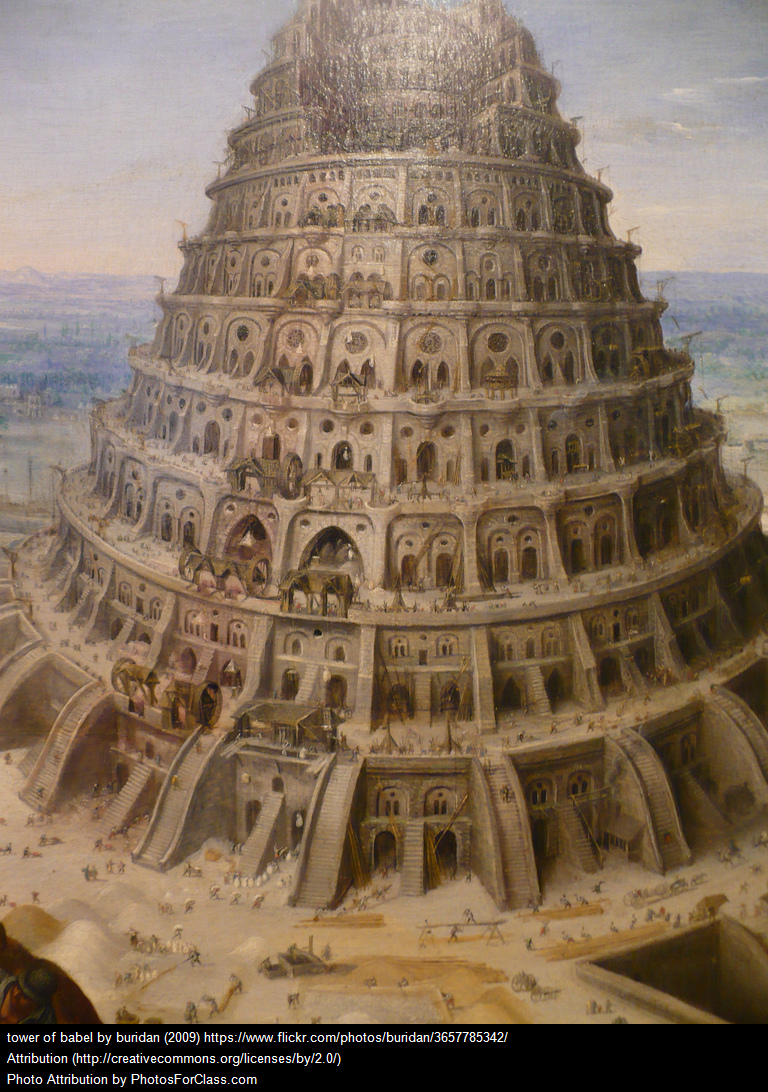
Tower of Babel
Tower of Babel

So the digital. The open borders, the open access. The flat earth. Where a researcher / research at the other end of the world is at the touch of a button or a click of a mouse. As long as you both have the internet. And speak each other’s language (or preferably that current god of all language, English), as long as that research is in a bundle paid for by your institution. As long as you’re part of an institution, because paying $39.95 per article for research that may or may not be relevant, may or may not be any good is no joke for the casual dilettante. And when you leave formal education, when you graduate and lose access to all that body of formal knowledge, lose your writing on fora and institutional blogs, when the gates to the ivory towers slam shut? Are you no longer a scholar? Are you an ex-scholar? A practitioner? I think about this a lot as I reach the end of this degree.

Language and culture

Coming back to the whole language thing.  According to Ren and Montgomery (2015) from 1996 to 2012 – 2,680,395 scholarly articles were published internationally by Chinese authors, 35% of which have never been cited, and the average citation per publication is 6.17 versus 20.45 for an American author. 95% of its most important research “are now published by foreign commercial publisher and locked behind pay-walls” (p. 397).  Most scholars do not have the English proficiency, there are not enough translators and therefore the research remains trapped in Chinese repository systems.  The article is a fascinating glimpse into the profundity of linguistic barriers, cultural and ideological differences in writing, research and performance metrics that are seldom if ever mentioned in the jubilant digital scholarship literature.

Interdisciplinary

As a fairly recent migrant from the world of commerce and industry to the world of education, one of the other articles I read was cause for inner ironical chuckling. Interdisciplinary. What does that mean? That you stay in your academic ivory tower but build bridges to other towers in the same academic village, or even across the pond to another tower where there are English speakers? And you interact only with the grubby world of business when they sell you OLP (online learning platforms) and data analytic systems and student interfaces and lesson plans and databases. But do you consider that you may be able to learn from that world? Even within business schools, the frenetic search for pertinent case studies is to inform and guide practise by current or potential business people.  And so I turn to Siemens and Burr (2013) – who I must say I have a huge amount for respect for, because they are talking, reading about and DOING  research in international research teams. They are grappling with linguistic and cultural barriers. And I read their article and the whole time I’m thinking – you’ve got to be kidding me. Yes, you’re probably breaking new ground in your context, but global companies have been doing this for decades. For eons. Your average wet-nosed graduate in a developing country working for a multi-national could have told you of all these challenges AND how they’re resolved in commerce and industry. I have to wonder, when a paper cites Hofstede – 1980 * if they’ve read and understood it’s context (Shell oil company), why they don’t think – heck – those multinational companies must know a thing or two about this – let’s go and ask them how to resolve this rather than us having to reinvent the wheel. Just pop over to your local business school or track down a travelling salesman with a passport to find out more.

I realise I’ve nearly written 1,500 words right now, and I don’t even begin to cover all the ground that I’d want to cover but can’t. I’ll just end by referring back to Gee and Hayes (2011). The first six chapters are a great read to understand the context of current education, language and literacy as part of a continuum of education across the ages – and they can express this background so much better than my amateur fumblings.  And after giving a context what is the future?  It would have to be in machine translation. In non-affiliation to a single academic organisation or nation. The return of the professional amateur, of “royal societies” that are not royal or national.  Different pathways of legitimisation and accreditation. More cooperation and collaboration but also more confrontation. Assignments that are conceptually bound but content liberated.  Radically open access to both published and rejected research, with commentary as to the rejection – a bit of meta-cognition anyone? Access to assignments with grading. Plagiarism is only an option in a closed rigid system with unimaginative content related assignments.  And those do nothing to further scholarship, digital or otherwise.

(And apologies to all those authors and researchers who are not cited but who are informing my thinking, but were not read in the last few days).

References:

Gee, J. P., & Hayes, E. (2011). Language and learning in the digital age (1st ed). New York, NY: Routledge.
Ren, X., & Montgomery, L. (2015). Open access and soft power: Chinese voices in international scholarship. Media, Culture & Society, 37(3), 394–408. http://doi.org/10.1177/0163443714567019
Siemens, L., & Burr, E. (2013). A trip around the world: Accommodating geographical, linguistic and cultural diversity in academic research teams. Literary and Linguistic Computing, 28(2), 331–343. http://doi.org/10.1093/llc/fqs018
————————

(* As a side note, Hofstede was taught to me as an expat 101 in the early 1990’s before my husband and I left on our first international assignment in Brazil. There is an updated version of his book – co-written by his son and Michael Minkov. Should be read by every ‘global’ educator and student interested in global collaboration and cooperation :

Hofstede, G. H., Hofstede, G. J., & Minkov, M. (2010). Cultures and organizations: software of the mind: intercultural cooperation and its importance for survival (3rd ed). New York: McGraw-Hill.)

Tricky timetabling in the library

15029248516Back to school for my classes tomorrow after the long 8 week summer vacation.  Teachers have been back a week and it’s been a productive but quite busy week getting everything ready. Is one every really ready? Who knows what the year will bring. What combination of students and teachers and classes will evolve as the year progresses.

As a  (with the emphasis on the “oneness” of A) Teacher librarian the timetable is probably one of the most tricky aspects. We’re just small enough to be able to have a hybrid timetable, where I can squeeze in every class once a week for a 20 minute slot (40 minutes for my grades 5 & 6, who need more “taught” and hands on higher level information literacy). I also have bookable periods where I can teach in class or classes can come to the library.  Based on the mistakes, observations and learnings of last year I made a few changes this year.

  • Blocking time so I can attend co-planning sessions for each grade with the PYP coordinators – that was a big failing on my part last year, and as a result I was always one step behind trying to play catch-up, relying on what was formally documented rather than actually happening and not being in the loop if things evolved – as they should in an inquiry based program.  Also, I’ve noticed that I need to promote new and different books as our collection evolves, and that would probably be the best forum.
  • Blocking time for ELL and language B students.  I’m an absolute believer in the importance of literature and literacy in language learning, but my practice was not supporting my beliefs. Of course it’s possible in library time to say to students “borrow a mother tongue book” or “borrow a Chinese / French book” – but with such a limited library time, it was an after thought rather than structurally built into the program. Also the French teachers were very supportive of my presentation to students on creating a language PLN and COP to their students and wanted me to revisit that early on in the year.  The time in the library has me as an optional extra – it’s more the space they’re using, so I’m available for in classroom teaching when I’m not needed by the language teachers.  Same with the ELL students.  Library time is intimidating if you’re only able to read “baby books” and asking a swamped librarian for advice is not always easy. This way the interactions can be more leisurely, students can book-talk lower level books without shame and they can get recommendations from each other. We’ll watch this space to see if it makes a difference. Also it would allow me to go through some of the research tools more thoroughly with the students at a slower pace.
  • Our bilingual classes are going to alternate days over 2 weeks in English and Chinese, so one week we’ll have them for English library, and one week for Chinese library. That was a logistical challenge, (to understand what we needed to do, most of all), hopefully we can support them in this.
  • Trying to group grades by day – i.e. G5&6 on Monday, G2 & 4 on Tuesday G3 on Wednesday, G1 on Thursday, Kindergarten on Friday.  Last year was mentally very taxing as I switched from Kindergarten to G6 to G3 back to Kindergarten to G1 all within a few minutes or hours of each other.  I’d have moments of complete blackout trying to remember which group was doing what (even having picture books labeled ready to go at my door, and tabs open for each class on my computer for presentations didn’t always help). With the exception of running out of time that suited one class it’s worked out fine – and teachers were quite receptive to the idea.  I did ask each grade lead which day would best suit them, and actually this year setting the timetable was a little easier than last year.  Having only 3 new teachers on board definitely helped the process as well.
  • Setting aside time for parent, librarian, teacher and community collaboration.  Last year’s series of “Library Bytes” for parents was well received on both campuses, and started bearing fruit towards the end of the year as we received more sophisticated and directed requests from parents – both those who had attended the sessions and those who had heard about them and wanted to know more.  This year I want to continue with the momentum, and even present some sessions in Chinese (not by me!) for our Chinese community.  The library staff is also going to start keeping track of teacher / parent questions so that we can make sure that all front-desk staff can handle all the questions, and we have material on our Libguide for parents who can’t come to the session.
  • Setting aside time for librarian meetings – both within our library and also between the librarians of our two campuses.  We have a new TL on board in our other primary section and I can learn a lot from her – but we need to make space for that learning.

Now, hold thumbs that we don’t have too many new classes added (as soon as we have enough students they open a new class at my school) or that there’s a major shift in the timetable!

How do other schools do the timetabling? Does it work for you?  For your teachers?  Are people unhappy with aspects of it? What compromises do you have to make?

Fortunate coincidence

After our leadership meeting this week I asked our principal what she thought of my various options for my case-study and which would be most beneficial and meaningful for the school.   By happy coincidence the senior leadership is looking at a number of things that tie in nicely with my ideas of what would be a viable case-study

  • Using the cumulated data we have on reading scores from the last few years in an interpretive and meaningful way
  • Examining a small section of students to see if anything can be extrapolated to the wider student body and inform teaching and learning
  • Raising the “bottom” – i.e. looking at our struggling students in a holistic way and seeing how we can help them on their learning journeys

In our conversations we also discussed how struggling students can influence the whole ambiance in a classroom, both in the student body and in the teachers response to the individual student and the class as a whole.

The question of course is what is ‘success’ and how do you measure it?  Must it be an improvement in reading or other academic measureables? Something ‘concrete’? Or can we think about the more ‘fuzzy’ aspects of learning that are harder to pin down.  Like affinity and belonging – nicely spoken about in this (non academic) article. Certainly we know that students who have (excessive) stress have difficulty learning. But is it skill, is it motivation that starts the negative spiral? And who can help? Is it a bootstraps issue, is it parents, peers, teachers, mentors, siblings?  What formats and genres?

I’ve just downloaded hundreds of articles around these themes, so it’s time to start digging in and try to get a research question out of it all.

Ever so slightly (very) intimidated

Since this is my M. Ed capstone course of course the bar has been set high for our final project – a case study. I’ve spent the week being intimidated – firstly reading the case-study research of other people, and then the Colloquium with Pip Cleaves – where my brain and my writing hand lost sync with each other as I was in awe with what she’s doing in her classroom and school.

I think my main takeaway is that I need to take baby steps and to limit, limit, limit my ambitions as to what is possible in a few week’s case study.  One of the most interesting case studies, and one that was exemplified by Pip’s talk was by Hofer & Swan (2006) – primarily because they unravelled the strands of technological, pedagogical and content knowledge that teachers need to bring to bear when attempting to introduce technology in the classroom.

Image source: https://en.wikipedia.org/wiki/Technological_pedagogical_content_knowledge

Back to the case study. As long term readers will be aware, I’m really interested in language, bilingualism and maintaining and sustaining mother tongue. Ideally I’d like to do something along those lines, but the area is just so huge I’m going to have to be very specific. One of the things I was considering was the information seeking behaviour of ELL families. There is so much information inherent and implicit in a school / schooling system, and how do students and their families tap into the explicit and implicit information where the dominant language is weak or absent?  Most international schools are adamant in not translating materials (erroneously in my opinion) – is there any way to prove this one way or another? What specific interventions or availability of information and in what form would make a difference? And how to realise this?


Another alternative would be about reading.  Early in my first position as Teacher-Librarian I quickly realised that we were just not meeting the needs of a whole segment of ‘reluctant’ readers. Unravelling reluctance is worth of tomes of research – is it a skill issue, an identification of suitable books issue, a time issue or a combination of them all or something else entirely? In response, with the excellent assistance of a very cool young male teacher, we formed a “blokes with books” club.  The uptake has been great with a core of around 10-15 boys attending the weekly meetings. They’ve invited their friends and it’s a rowdy, exuberant crowd who now feel much more at home in the library.  Together we agreed on a rough program of highlighting various genres, different authors and types of books in the hope they’d find “the magic key”. But did it make a difference really, or just anecdotally? How would we go about finding out the efficacy of the program generally and which aspects if any are particularly efficacious?


Other things that have caught my fancy recently is the concept of the “customer journey maps” in the library (perhaps linked to the information seeking idea) and the use of virtual badges for teaching information literacy – (teacher? student?)


Those are my thoughts that need refining and consideration at the moment. I have another 2 weeks to investigate and consider more!


Hofer, M., & Swan, K. O. (2008). Technological pedagogical content knowledge in action: A case study of a middle school digital documentary project. Journal of Research on Technology in Education (International Society for Technology in Education), 41(2), 179–200.

Keeping our struggles silent and our successes public?

I’ve had the good fortune of starting this course during my vacation, which has allowed more reading and contemplation time than I’d usually have at the start of a course. As such, I’ve started reading the case studies of module 3, and would like to dwell a little on Using Blogging in Support of Teacher Professional Identity Development – A Case Study (Luehmann, 2008). Yes, the date of 2008 is about right, as is the period under review 2003-2006, since that was probably the hey-day of blogging.


I’ve written before about the unfortunate demise of blogging, and having read this article, I once again am reinvigorated to take up the keyboard and dust off my professional blog. I must admit to have neglected it somewhat in the space last year that was not occupied by formal study and therefore an externally imposed blogging regime.


Considering blogging as a learning tool, and the blogging and commenting community as part of ones’ PLN, the question then is what has replaced blogging? The obvious answers would be Facebook and Twitter. However I would suggest that they miss the target in a number of ways. As Luehmann (2008, p. 332) explains – “… blog provides the quintessential example of capitalizing on the potential of blogging for reflection and metacognition. She was especially strong at using specific stories from her personal and professional experience as catalysts for engaging in critical inquiries about more general issues …” I have to wonder however if anonymous blogging allows for better self-reflection and a questioning stance than public blogging – which is the currently “preferred mode” according to those in the know and those who write and think about these things – “claiming one’s name” and all that.


In contrast, my experience of FaceBook is substantial positive “impression management” (Krämer & Winter, 2008), intersperced with passing on pre-digested and edited pieces written by successful professionals. What it misses is the observable struggle and growth of the individual in getting from point novice to point successful professional – something that blogs did. As a learning network, the FB groups I am in, are excellent for asking quick questions and getting convergent answers – top graphic novels, best tools for citation, what to wear to a job interview, what questions to expect etc. And answers tend to converge if the network is big enough. It’s also great for moral outrage – what unforgivable ones’ boss or lecturer or client or political opponent did now… There is little sign of vulnerability or deep questioning.


Twitter. Hmm. Does anyone else get tired of the chest beating alpha-monkey behaviour of the twitterati or is it just me? Again it’s about triumph and trumpeting. It’s not about the daily confrontation of things you’d like to see different that you’re trying to change and the barriers that are erected along the way. And when something really interesting comes up – like a whole blow-up about twitter plagiarism by a professor (of course I can’t find a reference to this as it happened last year on twitter …) it is difficult to unravel the threads or work out who is referring to what or when and in which order. On the positive side, educators do appreciate the professional development opportunities of Twitter and Twitter Chats as a way to keep up with developments in the profession as well as the ability to connect with other educators globally (Carpenter & Krutka, 2015; Trust, Krutka, & Carpenter, 2016).


Like everyone on this course, I too read prolifically and from a variety of sources, including social media originated, popular press, journals, books etc. The most infuriating part of social media is the difficulty of finding something back days or months later if you haven’t carefully diigo’d it or saved it to Flipboard or Evernote or the like.


And finally what is great about blogging? Well it gives you writing experience. Lots of it. And the more you write and the more you get feedback on your writing, the better you get at it. And right now I can just feel how out of touch I am with writing after the last 4 months of not doing so! Onwards and upwards.

References:

Carpenter, J. P., & Krutka, D. G. (2015). Engagement through microblogging: educator professional development via Twitter. Professional Development in Education, 41(4), 707–728. http://doi.org/10.1080/19415257.2014.939294

Krämer, N. C., & Winter, S. (2008). Impression management 2.0: The relationship of self-esteem, extraversion, self-eficacy, and self-presentation within social networking sites. Journal of Media Psychology, 20(3), 106–116. http://doi.org/10.1027/1864-1105.20.3.106

Luehmann, A. L. (2008). Using blogging in support of teacher professional identity development: A case study. Journal of the Learning Sciences, 17(3), 287–337. http://doi.org/10.1080/10508400802192706

Trust, T., Krutka, D. G., & Carpenter, J. P. (2016). ‘Together we are better’: Professional learning networks for teachers. Computers & Education, 102, 15–34. http://doi.org/10.1016/j.compedu.2016.06.007


Communicating across cultures

Communicating across cultures: cultural identity issues and the role of the multicultural, multilingual school library within the school community

Dr. Helen Boelens
School Library Researcher and Consultant, The Netherlands

John M. Cherek Jr. MSc
Project Manager, Zorgboerderij “De Kweektuin”, Mijdrecht, The Netherlands

Dr. Anthony Tilke
Head of Library Services & TOK Teacher, United World College of South-East Asia (Dover Campus), Singapore

Nadine Bailey
United World College of South East Asia (East Campus), Singapore

Abstract

The arrival of increasing numbers of refugees and immigrants has caused large increases in multicultural school populations.This interdisciplinary paper describes an ongoing study which began in 2012, discussing the role of the school library in multicultural, multilingual school communities and offering suggestions about how the school library could become a multicultural learning environment. It provides information to help school library staff to look closely at these issues and to provide help and useful suggestions to the entire school community. The prime objective is to help the school community to safely and constructively deal with the dynamics of a multi-cultural society, using the school library as a base.   Safe facilitation requires “trained” leaders from the school community. An e-learning program for school librarians is being adapted for this purpose.

Keywords: multi-culturalism, multi-lingualism, languages, cultural identity, global literacy.

Introduction

At the IASL Conference 2012, a paper discussed the role of the school library in multicultural, multilingual school communities and offered suggestions about how the school library could become a multicultural learning environment (Bloelens, van Dam and Tilke, 2012). Since 2012, various factors have affected multicultural school populations in many different types of primary and secondary schools in countries throughout the world.

Limitation of this study

This paper seeks to understand how learning experiences of multicultural, multilingual students can be accommodated in the school library. Boelens and Tilke (2015) recently described relevant trends and ideas which posits the role of the library in multicultural/lingual school communities from different areas of study: education and pedagogy, library and information science, psychology, sociology and anthropology, and linguistics.

Educational trends

Some international organisations have indicated educational trends. UNESCO’s statement on global education provides a set of objectives for international education until the year 2030. The Organisation for Economic Co-operation and Development (OECD) recommended that schools support both “the identifiable needs of today, and the uncertain demands of the future” (OECD, 2005); schools should provide an environment that will support and enhance the learning process, encourage innovation, foster positive human relationships – in short, be “a tool for learning”. The term “learning environment” suggests place and space: a school, a classroom, a library. However, in today’s interconnected and technology-driven world, a learning environment can be virtual, online, remote – it doesn’t have to be a physical place at all. Perhaps a better way to think of 21st century learning environments is as support systems that organize the conditions in which humans learn. How does this affect the school library?

Library and information Science trends

How do these changes in educational theories and expectations affect the school library? Commentators in North America have suggested that the library has now become part of the school learning commons (Canadian Library Association, 2014; Loertscher et al, 2011; Loertscher et al, 2008). Educuase (2011) considers that learning or information commons

has evolved from a combination library and computer lab into a full-service learning, research, and project space. … In response to course assignments, which have taken a creative and often collaborative turn … learning commons provides areas for group meetings, tools to support creative efforts, and on-staff specialists to provide help as needed. The strength of the learning commons lies in the relationships it supports, whether these are student-to-student, student-to-faculty, student-to-staff, student-to-equipment, or student-to-information (p. 1)

Can the needs of multicultural/lingual learners be specifically supported in a Learning Commons environment? Osborne (2014, p. 7) states that “more and more schools … are committing to provide physical spaces that align with, promote and encourage, a more modern vision for learning” and asks “how might the library act as a ‘third place’ to provide unique, compelling and engaging experiences for staff, students and community that aren’t offered elsewhere?” (p. 8)

Furthermore, librarians are co-teachers within multicultural/lingual school communities (Medaille and Shannon, 2014); co-teachers are “two equally-qualified individuals who may or may not have the same area of expertise jointly delivering instruction to a group of students” (Curry School of Education, 2012).

Racial, Cultural and Ethnicity issues (Psychology, Sociology, and Anthropology)

Key factors are:

  • Students cannot start learning until they feel safe, seen and valued;
  • Learning is diminished and/or does not occur without addressing equity and diversity topics;
  • Equity and diversity topics are intertwined with academic achievement.

This paper will also discuss subjects such as “diversity” and “difference” in multicultural situations within the school community and how these matters affect the school library, not only in developed countries, but also those which are located in emerging and developing countries (Boelens and Tilke, 2015, p. 2). Students from diverse cultural backgrounds, who differ from mainstream students in terms of ethnicity, socioeconomic status and primary language, are entering schools in growing numbers. The education which these students receive needs to address multicultural and intercultural issues. Intercultural education relates to culture, religion, cultural diversity and cultural heritage and respects the cultural identity of learners through the provision of culturally appropriate and responsive education, which focuses on key issues and interrelationships (UNESCO, 2006). It concerns the learning environment as a whole and impacts many different aspects of the educational processes, such as school life and decision making, teacher education and training, curricula, languages of instruction, teaching methods, student interactions and learning materials. (UNESCO, 2003a)

Language acquisition

Based on international research, practice and comment, Della Chiesa, Scott and Hinton (2012) identified strong connection between language and culture(s), looking for future benefits in human endeavour, partly as a result of recognizing that language acquisition and use does not develop in isolation from socio-cultural and indeed brain development.   International understanding is perceived as a desired social outcome of such interventions.

Features of language learning assist teachers of culturally and linguistically diverse students. Learners learn a language best when treated as individuals, experience authentic activities in communication in the target language and see teaching as relevant to their needs. Learning should be relevant to their needs and they benefit from seeing strong links between language and culture. They also benefit from having helpful feedback on their progress and where they can manage their own learning. (Vale, Scarino and McKay, 1991)

Background information

Demographic shifts, i.e. changes in the demo-linguistic situation, have taken place. Children from culturally and linguistically diverse backgrounds, including immigrant and refugee children, are entering schools all over the world; changing demographics will alter both school practices and policies (Center for Public Education, 2012). Features of experiences for students in various countries include:

Culturally and linguistically diverse students in Australia typically come from a wide range of language, socio-economic, cultural and religious backgrounds. Up to one-fifth of such students are newly arrived in Australia and with a language background other than English; even if some students are born in Australia, they may enter the school system with little or no English language. (Department of Education of Western Australia, 2011). Australian schools may experience large populations of immigrant and/or refugee students (Ho, 2011).

There were similar issues in Canada, where students did not have language skills in the main languages used for teaching and learning, though differences in educational performance reduced as students progressed through the school system (Statistics Canada, 2001).

The United Kingdom too experienced similar issues, where a focus on educating significant numbers of students who spoke English as an additional language (EAL) (British Council, 2014).

Looking at countries where English is not the main or major language of teaching and learning, the European Commission (2015) reported very similar issues for schools and for students, not least for asylum seekers.

The USA too has seen changing demographics in schools. Forty-seven percent of children younger than five belong to a racial or ethnic minority group, and “trends in immigration and birth rates indicate that soon there will be no majority racial or ethnic group in the United States” (Center for Public Education, 2012). Implications for such trends may include needs for qualified bilingual teachers, preschool programmes, concerns over drop-out rates from mainstream education, and other resource issues in schools.

Important identity issues in the context of the school community

This paper posits that the school library must be a safe space that welcomes all questions, perspectives and backgrounds. School libraries offer valuable resources (in both traditional and digital format), information, knowledge and insight. In a school context, a library space is one where students can explore their ideas and ask questions. Librarians provide specialised support within this domain and have a responsibility to support the growth of their students. Such healthy development of students can have a strong impact on self-esteem, academic performance and feelings of cohesion. In a multi-cultural school setting, issues of race, ethnicity and culture play a central role in the identity of the school and its students. Celebrating our differences is one way of acknowledging the diverse backgrounds of members of the school community, though such diversity can be overshadowed by a dominant culture and its narrative.

As professionals in education, it is our responsibility to develop competence in the areas that matter to our students, including our own understanding of race, culture and ethnicity, to ensure that young people receive targeted guidance and support they need in order to explore a healthy sense of self.

Identity

Central to identity formation is the “challenge of preserving one’s sense of personal continuity over time, of establishing a sense of sameness of oneself, despite the necessary changes that one must undergo in terms of redefining the self” (Harter, 1990). Adolescence is an important and formative period in life that influences many parts of identity development (sexual, racial, ethnic, gender, etc.). Identity development is a dynamic process that plays a central role in developing our relationship to the self, the other and our social environment. It is especially during adolescence that we play around with multiple identities, experiment with “the rules” and test the institutions around us. As a result of this process, parts of our identity are kept and nurtured, while others are briefly worn and discarded.

Much research about racial and ethnic identity development has focused on adolescent and college age individuals. (Helms (1990) in Phinney, 2007, p. 275) This makes sense because self-reflection is an important part of collecting data. It does not necessarily imply that younger children do not have the ability to reflect, but their process of reflection may be different. For example, younger children tend to describe themselves in a more simple, less sophisticated way, according to their perception of personality characteristics — “I am nice”/ “I like to make other people feel good”/ “I like to help people”. This is less about their relationship to things (toys, food) and more about their understanding of certain qualities (both good and bad). For example, “I am good at writing and bad at soccer”. This relates to ethnic identity development, when children become aware of good and bad qualities about their ethnic group. Understanding why society deems these certain qualities good or bad is perhaps one way to help prepare them for dealing with a multi-cultural environment with dominant ideas that are not their own. Ethnic identity has been studied largely with reference to one’s sense of belonging to an ethnic group, that is, a group defined by one’s cultural heritage, including values, traditions, and often language (Phinney 2007, p. 274). Finding interactive and “fun” ways to help children explore or even explain their understanding of these things is one role the school library can play; by facilitating access to information, librarians can guide students through relevant books, movies and other multimedia tools.

Adolescence is a developmental stage between childhood and adulthood when individuals experience biological, social and psychological change. According to psychoanalyst Erik Erikson (1968), ego identity versus role confusion. It is the psychosocial stage of personality development that adolescents encounter when faced with the question, “Who am I?”. A healthy resolution of this stage can lead to strong ego identity. Unhealthy resolution of this stage will contribute to role confusion. Role confusion challenges our ability to build connections and participate as members of society. Here, adolescents create and recreate meaning to provide themselves with a sense of connection. When a lack of connection exists, the ego struggles to build a foundation for fidelity, based on loyalty. If adolescents lack fidelity, they might encounter, in extreme cases, a future of social pathology, crime and prejudicial ideologies. These negative characteristics can manifest when the individual participates as an adult, for example, in religious, athletic, national, and military rites and ceremonies (Engler, 2014).

Racial, Cultural and Ethnic Identity

A healthy racial and ethnic identity can help youth establish a consistent view of themselves. Many aspects of adolescence are transient and changing. One day we love the color yellow and the next day it is the color red. Thus, by creating a permanent anchor from which to develop, we give our students a better chance at achieving positive outcomes; without these anchors, many young people may identify with a completely different culture which has nothing to do with “who they are”.

Identity issues and their importance in the school and the school library

The feeling of belonging is critical to every child’s well-being and helps him/her to fulfill his potential in many different areas of development: physical, social, emotional and cognitive (Welcoming Schools Childhood Education Program, 2015).

Cherek’s 2015 research is concerned with ways that students can develop a healthy racial and ethnic identity and improve their understanding and vocabulary around race and ethnicity, therefore contributing to increased cultural competence; this contributes to higher self-esteem and healthy development. By using these essential skills, students have the opportunity to take ownership over their ideas and are encouraged to examine the world around them — at home, school, work and in the media – thus preparing them to thrive in multicultural environments.

Essentially, children who feel good about themselves may be more successful, not only at school but in different aspects of their lives (Tough, 2012). Identity is not something that individuals automatically have. Identity develops over time, beginning in childhood, through a process of “reflection and observation” (Erikson 1968, p. 22) Important questions to ask about a child’s learning environment is does he/she see other teachers, parents or students in the school who represent his/her own culture or heritage? Who do these children identify with? Who do they see as a reflection of themselves, e.g. public figures?

Using these factors, the school library becomes a safe “public” space where a healthy and proactive sense of diversity encourages deep and meaningful conversations with all members of the school community about stereotypes such as discrimination and racism.

Involvement of the school library/ian in multicultural, multilingual education

Ultimately, the aim is that students, teachers and librarians are prepared to safely and constructively deal with the dynamics of a multi-cultural society. Safe facilitation requires “trained” leaders from the school community.

In larger schools with academic disciplinary silos, it may be difficult to create positive messages about mother tongue and cultural identity and pride across to members of the school community as a whole – school leaders, teachers, students and parents. The EAL (English as an Additional Language) teacher is most concerned about getting the students up to speed and may inadvertently give the wrong message. The teaching of the student’s (minority) language may not be part of the school language policy.

The Welcoming Schools Childhood Education Program (2015) suggests that children who are motivated and engaged in leaning are more committed to the school. By providing books, information and other resources, the library can “provide an important mirror for children to see themselves reflected in the world around them”. Here, library resources “also provide a window to the lives of others. … [and] students also find positive role models through literature”; benefits from such activities are best seen when coordinated in the school community. The library can provide a stable permanent base for the length of the student’s school career.

Research (Bedore and Peña, 2008) indicates that bilingualism can only be sustained if there is at least a 30% input in the less dominant language. If the less dominant language is not a language which is used and taught within the school community, then the library can provide access to relevant materials. This is an intellectual process of proving the benefit and a practical exercise of resource collection, curation, access, promotion and marketing.   These can be very simple, such as the creation of displays of books about diversity, multiculturalism and multilingualism and about national days of the countries which are represented by children at the school, and reflecting their cultures.

In any event, the school library is a helpful environment where students can reflect on these issues. It can highlight resources, or profile individuals relevent to various ethnic groups. This can be achieved by exploring literature authored by individuals from their ethnic own group or by reading about the history of their own ethnic group. Additionally, the library can give students the basic skills to find or locate this information.

Multicultural, multilingual school libraries

In 2012, Boelens, van Dam and Tilke focused on various aspects of multicultural and intercultural education, identifying a symbiotic relationship with school libraries. It reported on support needs for both children who were immigrants, i.e. those permanently moving from one country to another, as well as more geo-mobile children, known as Third Culture Kids or Global Nomads. Various relational features were identified: literacy, language, bilingual education, world languages.

Krashen and Bland (2014) have identified the need for second language learners to develop competencies in academic language acquisition. Before that, self-selected recreational reading habits were partly dependent on a varied, indeed wide, selection of reading matter. In itself, this reading matter did not provide access to academic language acquisition, but it prepared children to do so. This reading stamina also had an effective domain, in that it motivated students to become readers, and arguably gave them confidence. For some children who use school libraries in multicultural education environments, the digital age was not wholly relevant, as ebook use was associated with affluence. For children whose socio-economic experience is that of poverty, libraries represent the only stable source of access to reading materials, especially in developing and emerging countries. The provision, promotion and use of such reading materials is a feature of the work of (school) libraries/ians in these countries. These libraries/ians support students and teach them to to navigate abundant sources of information. Such skills and aptitudes are commonly known as information literacy skills. Sometimes, the prevalence of information literacy skills is perceived as being a main role of the school library/ian, however the teaching of these skills and the provision of reading materials need to be symbiotically linked.

Smallwood and Becnel (2012) identified various factors in successfully providing library services in multicultural settings – accessing and reaching the clientele; provision of appropriate materials; consideration of use of space; focusing services on linguistic and socio-economic needs; appropriate technology; professional development and awareness-raising amongst school librarians. Indeed, Welch (2011) promoted the idea of the library collection having an aim of influencing student behavior, in terms of increasing tolerance and sensitivity in a multicultural setting.

Whilst not substantially different from good practice elsewhere, the International Baccalaureate Organization (IBO or IB) has identified good practice in library support for multilingual learning environments (International Baccalaureate, 2012). Schools that offer IB programmes comprise state or government schools, semi-independent, independent and international schools. When a school adopts IB programmes, it needs to also take ownership of IB philosophy, including a holistic approach to language and international-mindedness (Singh and Qu, 2013). There is, therefore, a symbiotic link between language and intercultural education approaches in schools which may (or should) experience strong ESL (English as a Second Language) support (Carder, 2014), though the IB stance is that every teacher is a teacher of language (International Baccalaureate, 2011).

Therefore, the literature has identified a need to develop competencies in academic language proficiency and a resource/information role for (both public and school) libraries, especially for children, sometimes immigrants or refugees, who are affected by poverty. Therefore, libraries may be part of scaffolding strategies to support children who need language support, and which include resources and facilities (space). Thinking and planning for such library services and support needs to be holistic and wide-ranging (from facilities and plant to professional development), all based on an understanding of the needs and concerns of targeted client groups.

Focussing services on the needs of multicultural/ingual students

The librarian needs to establish the current and future users of the school and its library, and user demographics (i.e. how many students come from which minority or language group). Library collection and services should then be related to such information.

School libraries have roles related to literacy and reading, and teaching and learning of information literacy skills. To support this, resources – mainly physical – have been curated to serve a mainstream interpretation of students’ needs, often curricular, and in the dominant language (often English). This role could be broadened to meet the needs of the multicultural/lingual school community.

  • The library collection should contain books and information (in traditional and digital format) which reflect the diversity of the children in the school. The library exposes the entire school community to many different cultures and languages. This collection can help students to understand that while their families are unique, they share many common values, beliefs and traditions.
  • The collection should contain literature in the native language of students, and link to digital international children’s libraries and also digital libraries for children from relatively small indigenous groups. This could include online links to songs, poems and stories from many different cultures and in many different languages. It should also contain current information about student countries of origin. Parents could be asked to help the librarian with this task. (Smallwood and Becnel, 2012)

Using these guidelines, the school librarian can strengthen the collection, and then present this information in attractive ways to the entire school community, so that it becomes aware of the extent of their library’s resources.

Librarians can provide an enabling portal function for immigrant, refugee and Third Culture Kids. They may be hesitant to assume this role, perhaps due to mono-lingual experience or lack of expertise in the creation of digital personal learning environments (PLEs) or personal learning networks (PLNs).

The librarian may consider applying principles of information ecology to the school library. This multi-disciplinary emerging field offers a framework within which to analyse the relationships between organisations, information technology and information objects in a context whereby the human, information technology and social information environment is in harmony (Candela et al., 2007; Wang et al., 2015).

Steinerová (2011) and Candela et al., (2007) looked at features of digital libraries and suggested that librarians examine where value integration can take place between the library service, technology, scholarship and culture, adding value through new services or contributions to learning, user experience, research productivity, teaching or presenting and preserving cultural heritage. Applying these ideas to the school environment, constituents of the eco-system include teachers, teacher librarians, students administration, parents and custodial staff (Perrault, 2007). Elements of the system will co-exist but also compete and share, converge and diverge in a dynamic interactive, complex environment (García‐Marco, 2011). The role of the library is such that information ecology needs to be understood in order to support information-seeking behaviour and thereby discover zones of intervention and areas to leverage to optimise advance information-seeking, usage, creation and dissemination within that eco-system and beyond. In response, curriculum, content and subject delivery can be collaboratively reshaped and constructed according to changes in the environment or needs of students (O’Connell, 2014).

Different kinds of resources and adaptive technologies can optimally support students with special educational needs (Perrault, 2010, 2011; Perrault & Levesque, 2012). This type of thinking can be adapted to considering the needs of bi- and multi-lingual students who are part of the school’s information ecology, but have linguistic and cultural learning and informational needs. These can be seen as a potential zone of intervention for collaboration between the teacher, teacher librarian (TL), family and community.

Literature intended for school librarians generally discusses cultural diversity in materials and the building of a world literature collection in response to student diversity or as part of language and humanities curricula (Garrison, Forest, & Kimmel, 2014). Some schools build a “Languages other than English” (LOTE) collection. To do so, schools may try to recruit bilingual or minority TLs or ask for help from parents; schools can also provide training in competencies in multicultural education (Colbert-Lewis & Colbert-Lewis, 2013; Everhart, Mardis, & Johnston, 2010; Mestre, 2009).

The main educational and social issues within schools are to ensure students acquire the official language of instruction so that they can adapt to the new learning environment without loss of educational momentum, while maintaining and developing their mother tongue (Kim and Mizuishi, 2014). Carder (2007) and Cummins (2001; 2003) suggest that even though there is evidence that supports the maintenance of mother tongue (the most effective way of supporting such students), schools place most effort and resources on the official language of instruction of the school. Evidence now presented above suggests that by doing so, children may lose some of their own healthy cultural and ethnic identity.

School librarians may be aware of geographically dispersed personal learning networks (PLNs) in order to create a personal learning environment (PLE) using various technological tools (McElvaney & Berge, 2009; O’Connell, 2014), and could assist different individuals throughout the school community to make use of a PLE. For instance, the International Baccalaureate (IB) allows students the option of guided mother tongue self-study if the school does not teach that specific language. Figure 1 below describes a PLE of an IB self-taught language student.
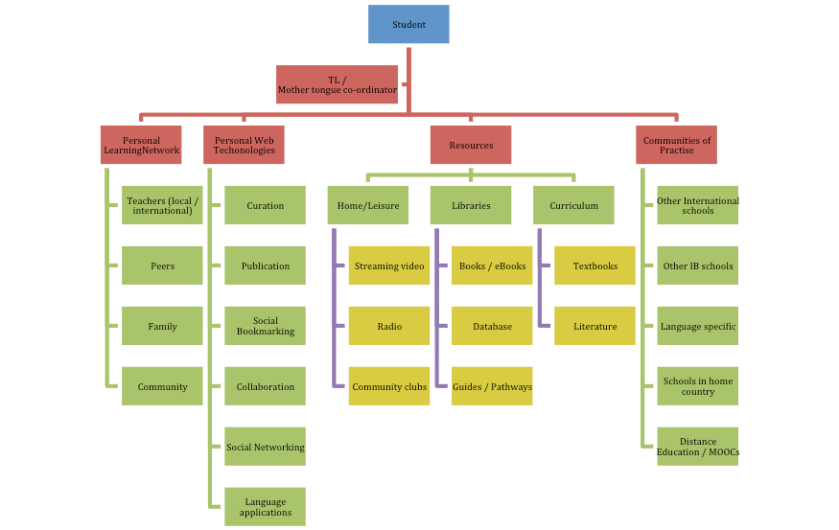
84ff0-pln2blanguage

Figure 1: PLE of an IB self-taught language student

A training program about multicultural/lingual issues for the school community

In 2015, Boelens and Cherek examined the possibility of creating a personal development training program for the entire school community, facilitated by the school library. This is an attempt to help teachers, school leaders, librarians and parents to better understand problems being confronted by the multicultural/lingual school community, especially immigrants and refugees. This program would be made available through the school’s electronic learning environment.

The first part is a 24-minute video that provides an open conversation about race and ethnicity between professionals and young people. Here, participants listen to different perspectives about race and ethnicity, and appreciate why these topics are important to both caregivers (teachers, social workers, child welfare professionals) and young people. Finally, with the help of a study guide, participants explore the possibility of integrating racial and ethnic identity development into daily practice.

The second part is an eLearning course that provides participants with necessary tools to develop a deeper understanding of issues related to racism and discrimination. The content is specifically designed so that professionals (adults, educators, caretakers) develop a vocabulary for discussing race and ethnicity with others who are interested in and concerned about these subjects. A constructive vocabulary is an essential tool when discussing identity development, as it enables participants to safely address issues of racism and discrimination. Finally, participants can further integrate this deepened knowledge into daily practice. This is an important part of the training because it prepares participants for a facilitated in-person learning event.

The third and final part of the curriculum is a two-day in-person learning event. In this face-to-face meeting, trained facilitator’s guide participants as they begin to incorporate their new skills into daily practice. The most effective and powerful events occur when both young people and professionals are present. The training is highly interactive and challenging. Participants are encouraged to openly discuss the impact of stereotypes and the social influences that affect their own racial and ethnic identity.

A similar training program is by The Welcoming Schools Childhood Education Program (2015), which provides a starter kit for a personal development training programme for members of the school community, relating to equity, school climate and academic achievement.

Tapping into the experiences and communities of practise (COP) of distance education, massive open online courses (MOOCs), school librarians could be trained to facilitate this training program through PLNs and PLEs, Training programs would be available at any time and in any geographic location providing internet access is available. Initially, a pilot program would be tested with one language group, and could later be extended to other groups.

This training program will help to establish a multicultural/lingual school community based not only on academic achievement but also on a healthy climate with regard tp racial, cultural and ethnicity issues. It will also contribute to a school´s goals of equity in teaching and will require the support and involvement of the entire school community. Since library staff will be facilitating this program, their reputation will be enhanced, and be perceived as integral members of the school community.

Conclusion

This paper has discussed a developing role for the school library in the multicultural/lingual school community in 2015. It promotes a training program for the entire school community which will be facilitated by the librarian. Because of their involvement in the school´s learning commons, the librarian is already involved in interdisciplinary activities related to the multicultural/lingual nature of the entire school.

While all aspects of identity development are valuable, one area that is often ignored, especially when talking about young people who are detached from their culture, is racial and ethnic identity. Along with ever-changing realities of society, demographics and politics, the impact of race and ethnicity have never been more important.

With an increasing number of migrant and immigrant students, the acute reality of living in multiple worlds becomes more apparent. Social norms and values become entangled. Home life, school life and street life compete for attention. Without proper guidance and support, alienation that occurs when individuals feel split between dissonant forces results in a confused sense of “Who am I?”. Addressing these issues in an educational setting means that we as educators have the power to create “safe spaces” for our captive student audience. Thus, students can be prepared to effectively deal with the realities of a multi-cultural society while at the same time developing a healthy sense of racial and ethnic identity.

As a result of the proposed training program, students at the school will learn more about `who they are`, especially those who come from an immigrant or refugee background. With the support of the entire school staff, they will some to terms with their own cultural identity and ethnicity in their new school and in their new place of residence, and have positive feelings, with an expected corollary that their academic achievement will increase.

References

Bedore, L. M. and Peña, E. D. (2008). ‘Assessment of Bilingual Children for Identification of Language Impairment: Current Findings and Implications for Practice’, International Journal of Bilingual Education and Bilingualism, 11(1), 1–29. doi: 10.2167/beb392.0.

Boelens,H. van Dam, H. and Tilke, A. (2012). School Libraries across cultures. Presented during the Research Forum of the 2012 IASL (International Association of School Librarianship) in Qatar.

Boelens, H. and Tilke, A. (2015). The role of school libraries in our multicultural, multilingual society. Submitted for publication to the CLELE (Children’s Literature in English Language Education) Journal, in March, 2015. Not yet published. Munster, Germany: CLELE.

Boelens, H. and Cherek, J. (2015). Education 2030 (EU), and Onderwijs 2032 and Excellent Education in the Netherlands: a vision of the role of the multicultural, multilingual school library within these concepts. To be presented during the IASL (International Association of School Librarianship) 2015 Conference in Maastricht.

British Council. (2014). How can UK schools support young children learning English? Retrieved from http://www.britishcouncil.org/blog/how-uk-schools-support-young-learners-english.

Canadian Library Association (2014). Leading Learning: Standards of Practice for School Library Learning Commons in Canada. Ottawa, On., Canada: Canadian Library Association. Retrieved from http://clatoolbox.ca/casl/slic/llsop.html

Candela, L., Castlli, D., Pagano, P., Thano, C., Ioannielis, Y., Koutrika, G., Ross, S., Schek, H-J., and Schuldt, H. (2007). Setting the Foundations of Digital Libraries: The DELOS Manifesto. D-Lib Magazine, 13 (3-4). Retrieved from http://dialnet.unirioja.es/ejemplar/157227

Carder, M. (2007). Bilingualism in international schools: a model for enriching language education. Clevedon, UK: Multilingual Matters.

Carder, M. (2014). Tracing the path of ESL provision in international schools over the last four decades. Part 1. International Schools Journal, 34 (1), 85-96.

Center for Public Education. (2012). The United States of education: The changing demographics of the United States and their schools. Retrieved from http://www.centerforpubliceducation.org/You-May-Also-Be-Interested-In-landing-page-level/Organizing-a-School-YMABI/The-United-States-of-education-The-changing-demographics-of-the-United-States-and-their-schools.html

Colbert-Lewis, D., & Colbert-Lewis, S. (2013). The Role of Teacher-Librarians in Encouraging Library Use by Multicultural Patrons. In C. Smallwood & K. Becnel (Eds.), Library services for multicultural patrons: strategies to encourage library use (pp. 73–81). Lanham, MA: The Scarecrow Press.

Cummins, J. (2001). Bilingual Children’s Mother Tongue: Why Is It Important for Education? Retrieved from http://iteachilearn.org/cummins/mother.htm

Cummins, J. (2003). Putting Language Proficiency in Its Place: Responding to Critiques of the Conversational – Academic Language Distinction. Retrieved from http://iteachilearn.org/cummins/converacademlangdisti.html

Curry School of Education, (2012). Co-teaching defined. Retrieved from http://faculty.virginia.edu/coteaching/definition.html

Della Chiesa, B., Scott, J., and Hinton, C. (2012). Language in a global world: learning for better cultural understanding. Paris: OECD Publishing.

Department of Education, Western Australia (2011). Gifted and talented: Developing the talents of gifted children. Retrieved from http://www.det.wa.edu.au/curriculumsupport/giftedandtalented/detcms/navigation/identification-provision-inclusivity-monitoring-and-assessment/inclusivity/culturally-and-linguistically-diverse-background/

Educause Learning Initiative (2011). Seven things you should know about the Modern Learning Commons. Retrieved from https://net.educause.edu/ir/library/pdf/eli7071.pdf

Engler, B. (2013). Personality theories : An introduction. 9th ed. London: Cengage Learning.

Erikson, E. (1968). Identity: Youth and crisis.New York: Norton.

European Commission, Eurostat. (2015). Retrieved from http://ec.europa.eu/eurostat/help/support

Everhart, N., Mardis, M. A., & Johnston, M. P. (2010). Diversity Challenge Resilience: School Libraries in Action. In Proceedings of the 12th Biennial School Library Association of Queensland. Brisbane, Australia: IASL.

Garcia-Marco, F- J. (2011). “Libraries in the digital ecology: reflections and trends”, The Electronic Library, 29(1), 105–120.

Garrison, K. L., Forest, D. E., & Kimmel, S. C. (2014). Curation in Translation: Promoting Global Citizenship through Literature. School Libraries Worldwide, 20(1), 70–96.

Harter, S. (1990). Self and identity development. In S. S. Feldman & G. R. Elliott (Eds.), At the threshold: The developing adolescent (pp. 352–387). Cambridge, MA: Harvard University Press.

Harter, S. (2012). The construction of the self : developmental and sociocultural foundations. 2nd ed. New York, N.Y.: Guilford Press.

Helms, J. (1990). Black and White racial identity: Theory, research, and practice.New York: Greenwood Press.

Ho, C. (2011). “My School” and others: Segregation and white flight. Australian Review of Public Affairs, 10(1). Retrieved from http://www.australianreview.net/digest/2011/05/ho.html

Horsley, A. (2011b). Acquiring languages. In G. Walker (Ed.), The changing face of international education: challenges for the IB (pp. 54-69). Cardiff, UK: International Baccalaureate Organization.

International Baccalaureate. (2011). Language and learning in IB programmes. Cardiff, UK: International Baccalaureate Organization.

International Baccalaureate. (2012). An IB educator’s story about the role of librarians in multilingual learning communities. International Baccalaureate Organization. Retrieved from http://www.isgr.se/nn13/pdf/Roleoflibrarians.pdf

Kim, M., & Mizuishi, K. (2014, December 10). Language and Cultural Differences and Barriers in an International School Setting – Personal Experiences and Reflections [Presentation]. UWCSEA-East.

Krashen, S., & Bland, M. (2014) Compelling comprehensive input, academic language and school libraries. Children’s Literature in English Language Education (CLELE) Journal, 2(2). Retrieved 8 March 2015 from http://clelejournal.org/article-1-2/

Loertscher, D et al. (2008). The New Learning Commons: Where Learners Win! Salt Lake City, UT: Hi Willow Research and Publishing.

Loertscher, D et al. (2011). The New Learning Commons: Where Learners Win! 2nd ed. Salt Lake City, UT: Hi Willow Research and Publishing.

McElvaney, J., & Berge, Z. (2009). Weaving a Personal Web: Using online technologies to create customized, connected, and dynamic learning environments. Canadian Journal of Learning and Technology, 35(2). Retrieved from http://www.cjlt.ca/index.php/cjlt/article/viewArticle/524/257

Medaille, A. and Shannon, A. (2014). Co-Teaching Relationships among Librarians and Other Information Professionals. Collaborative Librarianship, 6(4).

Mestre, L. (2009). Culturally responsive instruction for teacher-librarians. Teacher Librarian, 36(3), 8–12.

O’Connell, J. (2014). Researcher’s Perspective: Is Teacher Librarianship in Crisis in Digital Environments? An Australian Perspective. School Libraries Worldwide, 20(1), 1–19.

OECD, (2005) Design. As cited in Pink, Daniel. (2005). A Whole New Mind. New York: Riverhead. Organisation for Economic Co-operation and Development. (2001). Designs for Learning. Paris: OECD.

Osborne, M. (2014). Modern learning environments and libraries. Collected, SLANZA Magazine, 12.   Wellington, New Zealand: The School Library Association of New Zealand Aotearoa Te Puna Whare Mātauranga a Kura (SLANZA). Retrieved from http://www.slanza.org.nz/uploads/9/7/5/5/9755821/collected_june_2014.pdf

Perrault, A. M. (2007). The School as an Information Ecology: A Framework for Studying Changes in Information Use. School Libraries Worldwide, 13(2), 49–62. Retrieved from http://ezproxy.csu.edu.au/login?url=http://search.ebscohost.com/login.aspx?direct=true&db=ehh&AN=28746579&site=ehost-live

Perrault, A. M. (2010). Reaching All Learners: Understanding and Leveraging Points of Intersection for School Librarians and Special Education Teachers. School Library Media Research, 13, 1–10. Retrieved from http://ezproxy.csu.edu.au/login?url=http://search.ebscohost.com/login.aspx?direct=true&db=ehh&AN=67740987&site=ehost-live

Perrault, A. M. (2011). Rethinking School Libraries: Beyond Access to Empowerment. Knowledge Quest, 39(3), 6–7. Retrieved from http://ezproxy.csu.edu.au/login?url=http://search.ebscohost.com/login.aspx?direct=true&db=ehh&AN=58621336&site=ehost-live

Perrault, A. M., & Levesque, A. M. (2012). Caring for all students. Knowledge Quest, 40(5), 16–17. Retrieved from http://ezproxy.csu.edu.au/login?url=http://search.ebscohost.com/login.aspx?direct=true&db=ehh&AN=82564002&site=ehost-live

Phinney, J., and Ong, A. (2007). Conceptualization and Measurement of Ethnic Identity: Current Status and Future Direction. Journal of Counseling Psychology, 54(3) 271–281.

Singh, M. and Qi, J. (2013). 21st century international mindedness: An exploratory study of its conceptualisation and assessment. South Penrith: Centre for Educational Research, School of Education, University of Western Sydney. Retrieved from http://www.ibo.org/contentassets/ 2470e1b3d2dc4b8281649bc45b52a00f/singhqiibreport27julyfinalversion.pdf.

Smallwood, C., and Becnel, K. (2012). Library services for multicultural patrons: strategies to encourage library use. Lanham, Maryland: Scarecrow Press.

Statistics Canada (2001) School Performance of Children of Immigrants in Canada 1994-98, Statistics Canada catalogue number 11F0019MIE2001178. Retrieved from http://www5.statcan.gc.ca/olc-cel/olc.action?objId=11F0019M2001178&objType=46&lang=en&limit=0

Steinerová, J. (2011). Slovak Republic: Information Ecology of Digital Libraries. Uncommon Culture, 2(1), 150–157. Retrieved from http://pear.accc.uic.edu/ojs/index.php/UC/article/view/4081

The Welcoming Schools Childhood Education Programs (2015). Actions You Can Take as a Librarian. Retrieved from http://www.welcomingschools.org/pages/steps-you-can-take-as-a-librarian

Tough, P. M. (2012). How Children Succeed: Grit, Curiosity, and the Hidden Power of Character. United States: Tantor Media.

UNESCO. (2003). Education in a Multilingual World, UNESCO Education Position Paper. Paris: UNESCO. Retrieved from http://unesdoc.unesco.org/images/0012/001297/129728e.pdf

UNESCO, (2006). UNESCO Guidelines on Intercultural Education, Paris: UNESCO. Retrieved from  http://unesdoc.unesco.org/images/0014/001478/147878e.pdf

Vale, D., Scarino, A. and McKay, P. (1991). Pocket ALL: A user’s guide to the teaching of languages and ESL. Carlton, Vic. : Curriculum Corp.

Wang, X., Guo, Y., Yang, M., Chen, Y., & Zhang, W. (2015). Information ecology research: past, present, and future. Information Technology and Management, 1–13. http://doi.org/10.1007/s10799-015-0219-3

Welch, R. (2011). Multiculturalism in school libraries. Warrensburg: University of Central Missouri.

Biographical notes

Helen Boelens (PhD) was awarded a Ph.D. degree by Middlesex University, School of Arts and Education in 2010. She now focuses her work on the development of and assistance to hundreds of thousands of school libraries in developing countries. She is the former co-ordinator of the Research SIG of the IASL (International Association of School Librarianship). She is also one of the founders of the ENSIL Foundation (Stitching ENSIL).

John Martin Cherek Jr. (MSc) received a Master’s in Political Science from the University of Amsterdam in 2009. His thesis examined the post-reintegration needs of former child soldiers in Sierra Leone. Before moving to Amsterdam to study at the UvA, John worked Casey Family Programs. As the largest operating foundation the U.S.A dedicated to improving outcomes for children in foster care, John developed programs related to life skills education, identity development and child welfare policy. Originally from the United States, John holds a degree in Psychology from Seattle University (2004). He works primarily with vulnerable populations and specializes in education, mental health and youth & child development.

Anthony Tilke (PhD) has spent nearly 20 years in the international school sector, in Asia and Europe. His doctoral thesis (from Charles Sturt University, Australia) focused on the impact of an international school library on the International Baccalaureate (IB) Diploma Programme, and which subsequently fed into his book about the Diploma and the school library/ian. A common feature of his work is supporting mother tongue programmes in schools, and he has contributed to an IB document “An IB educator’s story about the role of librarians in multilingual learning communities”.

Nadine Bailey (M Phil, MBA, MIS) has lived and worked internationally for 20 years, in Africa, South America, Europe and Asia. Her area of interest lies in language and identity particularly related to students educated in a third culture environment. In an increasingly digitised educational environment she argues that librarians play an important curation and leadership role in guiding and enabling students to create personal learning networks in and for their mother tongue language. In that way libraries are both a safe physical and virtual space.
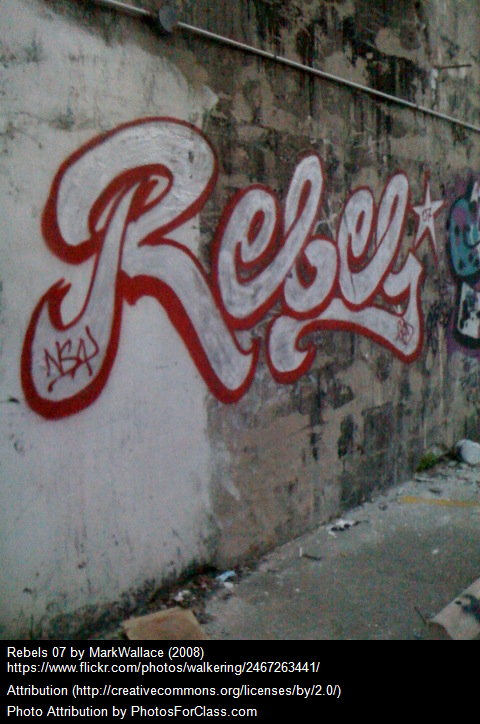

INF536: Critical Assessment

Looking back on this last semester, I can only sum it up by saying that change, beauty and progress in thought and learning is not only wrought by avalanche and volcano but also by the constant erosion by drops of water and bits of sand.  That combined with space and time.

9616353114

In the same way, this course has offered me space and time for learning by:

  • Forcing me to carve time out of a schedule that would otherwise be occupied by busyness
  • Exposing me to a variety of ideas, research, thoughts and concepts that I wouldn’t otherwise naturally encounter in my day-to-day professional or personal life
  • Making me DO things I’d otherwise shrug off as impossible (Bailey, 2015b)
  • Giving me a framework within which to analyse problems “wicked” and otherwise (Bailey, 2015a, 2015g; Buchanan, 1992; IDEO, 2014)
  • Grouping me with a set of people who are all approaching the course from a different context and set of experiences and knowledge
  • Creating a virtual (and at times physical) space for us to encounter each other and comment and share our learning – both formally and informally (“#INF536 – Twitter Search,” n.d.; McIntosh & CSU, n.d.)


It has be quite an experience, and, as someone once said – it’s not so much what you’ve learnt as what you remember. What has left a lasting impression is design thinking, the value of constraints and learning at the extremes.


As someone new to the education field, new to librarianship, operating under all kinds of constraints, the design thinking concepts of inspiration, ideation and implementation (Brown, 2008; Brown & Katz, 2011; IDEO, 2014) fits perfectly with that other concept of living and teaching in constant beta (Schroeder, 2013). As a fairly grounded, not terribly artistically (of the drawing and painting type) creative person this is the aspect of “design” that appeals to me as it is achievable with observation, thought, logic and research. However it also demands that I embody the principle of risk-taking and not just pay lip service to it sprouting it to my PYP (IB primary year program) students at regular intervals. There is something very empowering in the process of observing, thinking, asking, making small or not so small changes, and failing or succeeding, learning and trying again without fear and knowing that every time again one is moving every so slightly forward and nudging one’s students in the same direction.


My most effective intervention resulting from a budgetary constraint


Constraints, rather than hampering us, force rethinking options, relooking at alternatives and collaborating, asking, connecting in a way that is not always necessary when one is overwhelmed by choice and abundance. As documented in my blog posts: design – space, thinking and time 1, 2, 3 & 4 (Bailey, 2015c, 2015d, 2015e, 2015f) operating within the constraints of limited time, no budget, a small and almost unalterable space can result in creative solutions that are as ad hoc as they are successful.


We can learn a lot about education and learning in extreme conditions (Chohan, 2011; Leadbeater & Wong, 2010). But more immediate and accessible are the extremes in our own communities the students at the challenging edges of all the continuums we create. The teachers and parents who don’t toe some invisible line.


The name of my series of blog posts also reflects my thoughts about designing learning spaces. It’s not just about the physical space, it’s about reconstructing how we think about time and what we do in it, and carving out a presence physically, virtually and even emotionally. No matter how beautifully our surroundings have been designed, how much money has been spent on the furnishings and fittings, how much time is built into the curriculum if our students do not feel safe and have a willing and open space in their hearts and minds for learning, nothing will make an impact.

16807472897

References:

Bailey, N. (2015a, July 23). On the box, off the box – INF536 Blog Post 1 [Web Log]. Retrieved October 11, 2015, from http://thinkspace.csu.edu.au/informativeflights/2015/07/23/on-the-box-off-the-box/

Bailey, N. (2015b, August 7). Blog 2: Observation – Dog Walk [Web Log]. Retrieved October 11, 2015, from http://thinkspace.csu.edu.au/informativeflights/2015/08/07/blog-2-observation-dog-walk/

Bailey, N. (2015c, August 23). Design – space, thinking and time (1) [Web Log]. Retrieved October 4, 2015, from http://thinkspace.csu.edu.au/informativeflights/2015/08/23/design-space-thinking-and-time-1/

Bailey, N. (2015d, September 6). Design – space thinking and time (2) [Web Log]. Retrieved October 4, 2015, from http://thinkspace.csu.edu.au/informativeflights/2015/09/06/design-space-thinking-and-time-2/

Bailey, N. (2015e, September 20). Design – space, thinking and time (3) [Web Log]. Retrieved October 4, 2015, from http://thinkspace.csu.edu.au/informativeflights/2015/09/20/design-space-thinking-and-time-3/

Bailey, N. (2015f, October 4). Design – space, thinking and time (4) [Web Log]. Retrieved October 11, 2015, from http://thinkspace.csu.edu.au/informativeflights/2015/10/04/design-space-thinking-and-time-4/

Bailey, N. (2015g, October 11). INF536: Assessment 4 – Part A: Applying spatial changes and design thinking to middle school reading – a three phase collaborative approach [Web Log]. Retrieved October 11, 2015, from http://thinkspace.csu.edu.au/informativeflights/2015/10/11/inf536-assessment-4-part-a-applying-spatial-changes-and-design-thinking-to-middle-school-reading-a-three-phase-collaborative-approach/

Brown, T. (2008). Design thinking. Harvard Business Review, 86(6), 84–92. Retrieved from http://ezproxy.csu.edu.au/login?url=http://search.ebscohost.com/login.aspx?direct=true&db=heh&AN=32108052&site=ehost-live

Brown, T., & Katz, B. (2011). Change by Design: Change by Design. Journal of Product Innovation Management, 28(3), 381–383. http://doi.org/10.1111/j.1540-5885.2011.00806.x

Buchanan, R. (1992). Wicked problems in design thinking. Design Issues, 8(2), 5–21. Retrieved from http://www.jstor.org/stable/1511637

Chohan, A. (2011, January 25). Learning without frontiers [Video file]. Retrieved October 11, 2015, from https://www.youtube.com/watch?v=EARTcJkNrDA

IDEO. (2014). Design thinking for libraries – a toolkit for patron-centered design (p. 121). IDEO, Bill & Melinda Gates Foundation. Retrieved from http://www.designthinkingforlibraries.com

#INF536 – Twitter Search. (n.d.). [Twitter]. Retrieved October 11, 2015, from https://twitter.com/search?q=%23INF536&src=typd

Leadbeater, C., & Wong, A. (2010). Learning from the extremes. CISCO. Retrieved September 2, 2015 from https://www.cisco.com/web/about/citizenship/socio-economic/docs/LearningfromExtremes_WhitePaper.pdf

McIntosh, E., & CSU. (n.d.). Discussion Board – S-INF536_201560_W_D @CSU [Discussion Forum]. Retrieved October 11, 2015, from https://interact2.csu.edu.au/webapps/discussionboard/do/conference?toggle_mode=read&action=list_forums&course_id=_6652_1&nav=discussion_board_entry&mode=view

Schroeder, M. (2013, November 6). Living in beta [Video file]. Retrieved October 6, 2015, from https://www.youtube.com/watch?v=0nnYI3ePrY8


INF536: Assessment 4 – Part A: Applying spatial changes and design thinking to middle school reading– a three phase collaborative approach

Introduction

There is a long history of research into the value of and elements contributing to the success of classroom libraries. They have an important role in ensuring accessibility of written works to promote fluency and skill in literacy and thereby contributing to academic achievement. But the literature appears to concentrate on elementary schools (Hopenwasser & Noel, 2014; James, 1923; Jones, 2006; Krarup, 1955; Powell, 1966; Sanacore & Palumbo, 2010; Todd, Gordon, & Lu, 2011; Worthy, 1996). Although partnership and collaboration with the school and/or public library and librarian is recommended, the literature often deals with the two spaces in isolation. Further, the problem of aliteracy in middle school – whereby students can read but don’t want to – is well documented (Kelley & Decker, 2009; Krashen, 2004; Lesesne, 1991; Sheldon & Davis, 2015; Worthy, 1996). This case report will show how the two environments library and classroom, can successfully be seen as extensions of each other through the principles of design and design thinking and explicit cooperation between the language humanities (Eng/Hum) teachers, literacy coach and school librarian in order to promote voluntary reading.

Case development

United World College South East Asia East (UWCSEA-East) is a K-12 international school located in Singapore. It commenced operations in 2008 and took occupancy of a purpose built campus in 2011. In this campus, the secondary school library initially served around 500 middle school students – see table 1. It now caters to three distinct communities, middle school, high school and the International Baccalaureate (IB) – see Table 2.

Screen Shot 2015-10-11 at 11.27.14 am

Despite consultation with the librarian in the planning phase, certain spaces of the library were designated different functions than agreed upon and furnished accordingly by the architect and building manager. One such area was upstairs overlooking the main school plaza with purpose built magazine racks. The idea was it would be a well-frequented showcase area for magazine reading. In reality a number of factors prevented this from being realised:

  • The furniture design didn’t accommodate its purpose as it was not deep or high enough and the storage area didn’t fit back copies
  • The zoning of the library post occupancy meant that materials affording quick casual reading such as graphic novels and periodicals were better located in the “noisier” and fast turnover area which allowed food and beverages, i.e. downstairs.
  • The trend in libraries is to move away from physical magazines and periodicals towards online providers including online databases and aggregators such as PressReader that provide the same product at a lower cost and without delays and issues with cataloguing and maintenance.


The question of what to do with the space was resolved by noticing that as the secondary school reached post occupancy capacity the lowest students in the pecking order i.e. middle school students were increasingly marginalised with students of higher sections taking over the prime library real estate (students are visually distinct due to different coloured polo shirts for their uniforms). In addition, middle school students no longer had library visits planned into their schedule. Furthermore, the large influx of new students and teachers meant that reading books in the classrooms were unevenly distributed both in terms of volume and quality without any structured form of classroom library, which the students had become accustomed to in the primary section. Finally, Eng/Hum teachers were noticing a decline in voluntary reading as students moved up through middle school.


These issues were addressed initially through collaboration between the librarian and Eng/Hum teachers and more recently by the new literacy coach over a period of three years as follows:

  • The conversion of the magazine area into a middle school reading zone
  • The establishing of a core library for each of the three middle school grades (Day, 2013b)
  • The creation of middle school classroom libraries in a formal and structured manner with materials integrated into the library catalogue (Day, 2015d)
  • The integration of informational / nonfiction texts into both areas

This is an on-going process and worth a critical analysis to examine the choice process, latent or existing attitudes and assumptions, exterior pressures and design constraints and collaboration and communication.

Critical analysis

Choice of process

The spatial change in the library was conceived and led by the teacher-librarian (TL) with the Eng/Hum teachers joining in the collaboration as the process evolved. Since the TL has experience in design thinking (Day, 2013a, 2015a, 2015c) the process followed the design thinking cycle of inspiration, ideation, iteration and getting to scale (Brown, 2008; IDEO, 2014).


This was achieved by:

  • Agreeing on a “core library” of 30 titles per grade for grades 6-8 which were prominently displayed
  • Adjusting shelving to accommodate front facing books
  • Relocating books of interest to this age group from the fiction collection
  • Using large posters to highlight the favourite books of middle school teachers in the library and class corridors and classroom walls
  • Ensuring multiple copies of books, by using class and literary circle sets
  • Adequate lighting, comfortable furniture and the creation of a private space


The above steps and final spatial design incorporated the elements that are recommended as enhancing school library spaces (Cha & Kim, 2015; Elliott-Burns, 2003; La Marca, 2008; A. McDonald, 2006; Serafini, 2011).


The design elements that contribute to successful classroom libraries are not dissimilar and include:

  • Sufficient space which is a focal area but partitioned and private
  • Comfortable furniture
  • Variety of material in range of complexity including different literary genres and informational texts
  • Category organisation and shelf labelling
  • Combination shelving allowing for quantity of books and display (front facing)
  • Advertising by means of posters and notices on whiteboards
  • Graphic organisation either thematic or by connections
  • Involvement of students in selection, organisation and maintenance (Fractor, Woodruff, Martinez, & Teale, 1993; Hopenwasser & Noel, 2014; Reutzel & Fawson, 2002, cited in Sanacore & Palumbo, 2010)

Discussion and research on the elements predominantly come from the elementary school environment, and the adoption to middle school requires some adjustments to account for the fact that students do not remain in one classroom, lessening the sense of ownership of a space on the part of students, and teachers needing to cater to multiple classes with different profiles and interests. Learning spaces are also typically smaller relative to the size of the students.


The creation of the library and classroom reading spaces and populating them with books is “necessary but not sufficient” (McGill-franzen, Allington, Yokoi, & Brooks, 1999). Other components of encouraging reading include training teachers to enhance their instructional routines to incorporate the material, and to ensure that teachers are familiar not only with their literary canon, but also the latest in good young adult fiction (Day, 2015b; McGill-franzen et al., 1999). The school has invested in training with Penny Kittle to assist in the instructional routines (Raisdana, 2015), while the librarian is working with the teachers on the latter.

Latent or existing attitudes and assumptions

An international school is blessed with diversity in cultures, languages and backgrounds both of their students and teachers. This results in a context of people coming from different systems with different attitudes, assumptions, beliefs and experiences around education, reading and libraries. In just the middle school, teachers come from Australia, United States, Philippines, Ireland, Canada and the United Kingdom, each with their own literary core. In addition, there are personal preferences and beliefs, for example around young adult literature (see Raisdana, 2014). Teachers may not be used to or have experience of collaboration with the TL, the benefits thereof, nor aware of the ways in which libraries have evolved (Gibbs, 2003; Montiel-Overall, 2006, 2008; Sullivan-Macdonald, 2015). And naturally there are assumptions around what constitutes an ideal learning or reading space and the balance between the two (Elliott-Burns, 2005). In a meta-review of access to print and educational outcomes, Lindsay (2010) concluded that limiting choices with a larger distribution interval led to more reading, particularly if it was accompanied by activities such as training and book talks. This is in contrast to the assumption that collections should be as large as possible. It also suggests that rotation of materials leads to better outcomes.

Exterior pressures and design constraints

The creation of the complementary spaces faced a number of constraints, design and otherwise. These included a small budget, limited time and variability in the reading level of students. In design thinking the presence of constraints is seen as a positive force that encourages creative solutions and exploring options that would not otherwise be considered, and this proved to be true in this case study (Brown & Katz, 2011; Hill, 1998; Ness, 2011).


Naturally budget was an important constraint that shaped the way in which the space was converted and books and furniture was acquired or moved and repurposed. As discussed earlier, the librarian was involved in the “fuzzy front end” (Sanders & Stappers, 2008, p. 6), of the secondary library design and once the space was completed it was not possible to change the space, only to adapt its purpose. In the classrooms the availability of furniture in the room to hold the books and the available space for the classroom library vis-à-vis other learning spaces determined how many books could effectively by stored and displayed. In this respect creative design thinking was deployed, for example by taking the doors off built-in cupboard space both in the classrooms and in the library, creating additional shelving. Comfortable furniture was either acquired by donations from the community or purchased to ensure equity between the classrooms.


Although the library and classes each have a budget for the acquisition of books, both wanted to ensure that existing resources were not wasted – for example the books already owned in multiple copies. However their repurposing had to be examined within the constraints of the reading level of the students and the curriculum themes for each grade.

Collaboration and communication

Collaboration and communication between the TL and teachers has received a lot of attention as has the ways in which spatial design and design thinking can enhance collaboration (Avallon & Schneider, 2013; Ferer, 2012; Gibbs, 2003; Knapp, 2014; Montiel-Overall, 2006; Williamson, Archibald, & McGregor, 2010). Enhancing collaboration between the TL and the Eng/Hum department has occurred on a number of fronts, both physical and virtual – such as book chat mornings to book talk new books, encouraging teachers and students to be involved with the selection of books for the Red Dot Awards (ISLN, 2015), processing and cataloguing the books, and the creation of a virtual space for the books (Day, 2015b).


Given time constraints and curriculum pressures, additional moments for collaboration and communication have had to be designed into the process. For example teachers can book the reading zone space to conduct lessons, and invite the TL to book talk new or noteworthy books. In addition the library receives supervision assistance from teachers during lunch, recess times and after school. The Eng/Hum teachers have first priority in requesting this duty, creating the opportunity for the important “casual conversations” that result in informal learning and information exchange (Oblinger, 2006; Somerville & Brown-Sica, 2011).

Conclusion

The process can neither be criticized for its efficacy nor results. Teachers, students and the librarian have largely viewed the change positively. Due to making small iterative changes to the spaces, starting with a small budget and a limited number of books in the first year, and subsequently adapting the choice of books, the selection and weeding process based on experience and feedback, the combined library / class library spaces appear to have grown organically despite a lot of “behind the scenes” work on book processing, cataloguing and making books classroom / shelf ready.

There are five main recommendations arising from the analysis of this case study, all which can be tackled through employing design thinking rather than further changes to the current spatial design:

  • Balance the contradictory forces of novelty and familiarity through how books are selected, displayed and rotated
  • Focus efforts on the most efficacious element of encouraging reading – book talks
  • Expand the space to include the home environment, particularly in the case of bilingual students
  • Increase involvement of students in the spatial design and change process
  • Quantify the benefits of this spatial / design thinking collaboration through evidence based research.

These will be elaborated in the next section.

Recommendations

Balance novelty and familiarity

Students like and respond to novelty in display and a constant supply of “new” titles, they would also possibly benefit from choice limitation (Iyengar, 2011). This can be achieved by a rotation of titles between spine and front facing, and through a rotation between the books in the various classes (Lindsay, 2010). At present the core and class libraries are refreshed annually and the class libraries are not rotated between classes or teachers. It is recommended this be considered to prevent staleness. The class library placement of books in bins rather than shelves with a mixture of front and spine facing, allowing changes is display is not best practise, nor is having all books available simultaneously (Fractor et al., 1993; Lindsay, 2010; Sanacore, 2000; Sanacore & Palumbo, 2010).

Book talks

The importance of teachers’, librarians’, students’ and the community’s increasing exposure of diverse books in all genres by book talking can’t be overstated (Bentheim, 2013; Gallo, 2001; L. McDonald, 2013; Serafini, 2011). But, as examined in the analysis, a number of barriers stand in the way of regular book talks. In addition, requiring reading related tasks from students runs the risk of resulting in unfavourable associations with reading and further reluctance (Eriksson, 2002; Gallo, 2001; Miller, 2009).


Many practioners have described how digital innovation and the creation of virtual spaces can enhance and augment traditional book talks as well as expand transliteracy skills of students (Dreon, Kerper, & Landis, 2011; Gogan & Marcus, 2013; Gunter & Kenny, 2008; Ragan, 2012). It is recommended that students be given ownership of exploring the potentials of the digital realm in this respect as a guided design thinking exercise.

Mother tongue material and the home environment

Access to mother tongue materials continues to be a weakness in the library and even more so in the classroom library. There are logistical and financial constraints including the wide spread of languages, the undervaluation of low status languages, and misinformation and misunderstanding on the value of reading in the mother tongue amongst students and parents (Bailey, 2014a, 2014b, 2015; Boelens, Cherek, Tilke, & Bailey, 2015). This is an area that would benefit greatly from increased collaboration between the college and parent body where previously “unknowable” resources could be tapped into through utilizing the analytical and process skills of design thinking (IDEO, 2014; Landis, Umolu, & Mancha, 2010; McIntosh, 2015).

Student involvement

While literature indicates collaboration by all stakeholders is essential for acceptance, particularly in learning environments (Hamilton, 2013; Jones, 2006; Sanders & Stappers, 2008), this has largely been a librarian / teacher initiative with some student involvement in book selection. Moving forward, the virtual or digital sphere is an area where students can also be encouraged to carve out a presence and take ownership with teachers taking on an enabler role as use of all seven learning spaces are maximised (Grisham & Wolsey, 2006; McIntosh, 2010; Thornburg, 2007; Wilson & Randall, 2012).

Quantify the benefits

Despite numerous hurdles in providing data and making analysis founded on circulation figures or student attainment records, there is considerable value in documenting and providing evidence for practises – not the least that it supports budget requests.


Circulation records do not provide a complete record or necessarily correlate with reading because:

  • Books may be read in library / class without being checked out
  • In affluent multi-cultural communities, students may have access to large personal libraries, including books in their mother tongue
  • Students may be borrowing books from the public library

Despite this, circulation is still the best proxy for reading. The decentralised nature of the class libraries results in less control over book checkout. Even in the library, that has no exit barriers, at the end of 2014/5 academic year roughly 20% of returned books had not been checked out of the system. While this can be lauded as an indication of the high moral and ethical standards of the students, it does pose difficulties in creating any evidence based data on the actual impact of either separating part of the library or decentralising the collection to class libraries in terms of increases in circulation.


It is recommended that both current and longitudinal research be carried out to see if there is any correlation between increased access to text, the amount of reading / circulation and other objective measures of attainment such as the annual PISA or TIMS tests. This will take the initiative beyond transformative individual anecdotal stories to evidence based research. The CLEP (Classroom Literacy Environmental Profile) (McGill-franzen et al., 1999; Wolfersberger, Reutzel, Sudweeks, & Fawson, 2004) and more recently the TEX-IN3 (Hoffman, Sailors, Duffy, & Beretvas, 2004) tools have successfully been used in the evaluation of elementary school class libraries and could be adapted for the middle school environment.


The recent inclusion of informational (nonfiction) texts in both the middle school zone and the classroom libraries is also one worth further investigation. Whether the expansion of the collections has impacted on the space, the ability to choose, and the completion of summative assessments in the individual subjects can be investigated in the light of the existing literature on the matter (Hopenwasser & Noel, 2014; Ness, 2011; Sanacore & Palumbo, 2010; Young & Moss, 2006; Young, Moss, & Cornwell, 2007).

References

Avallon, J., & Schneider, A. (2013). Building collaboration into workspace design. Facility Management Journal, (September / October), 34–38. Retrieved from http://cdn.ifma.org/sfcdn/fmj-supporting-documents/building-collaboration-into-workspace-design-fmj-sep-oct-2013.pdf?sfvrsn=0

Bailey, N. (2014a, November 12). Building a LOTE collection at an international school [Web Log]. Retrieved October 4, 2015, from http://informativeflights.blogspot.sg/2014/11/building-lote-collection-at.html

Bailey, N. (2014b, November 12). Research summary on language [Web Log]. Retrieved November 12, 2014, from http://informativeflights.blogspot.sg/2014/11/research-summary-on-language.html

Bailey, N. (2015). Digital language learning ecology. Singapore: iBooks. Retrieved from https://itunes.apple.com/us/book/digital-language-learning/id1000588637?ls=1&mt=11

Bentheim, C. A. (2013). Continuing the transition work from traditional library to learning commons. Teacher Librarian, 41(2), 29–36. Retrieved from http://ezproxy.csu.edu.au/login?url=http://search.ebscohost.com/login.aspx?direct=true&db=ehh&AN=92991111&site=ehost-live

Boelens, H., Cherek, J., Tilke, A., & Bailey, N. (2015). Communicating across cultures: cultural identity issues and the role of the multicultural, multilingual school library within the school community. Presented at the “The school library rocks” IASL 2015, Maastricht, Netherlands.

Brown, T. (2008). Design thinking. Harvard Business Review, 86(6), 84–92. Retrieved from http://ezproxy.csu.edu.au/login?url=http://search.ebscohost.com/login.aspx?direct=true&db=heh&AN=32108052&site=ehost-live

Brown, T., & Katz, B. (2011). Change by Design: Change by Design. Journal of Product Innovation Management, 28(3), 381–383. http://doi.org/10.1111/j.1540-5885.2011.00806.x

Cha, S. H., & Kim, T. W. (2015). What matters for students’ use of physical library space? The Journal of Academic Librarianship, 41(3), 274–279. http://doi.org/10.1016/j.acalib.2015.03.014

Day, K. (2013a, January 14). Carol Kuhlthau meets Tim Brown: Guided Inquiry {Design} Thinking [Web Log]. Retrieved October 3, 2015, from http://www.thelibrarianedge.com/libedge/2013/01/carol-kuhlthau-meets-tim-brown-guided.html?rq=design%20thinking

Day, K. (2013b, November). Liberate your book cupboards and create a more true “bookstore” model in your school library [Web Log]. Retrieved August 2, 2015, from http://www.thelibrarianedge.com/libedge/2013/11/liberate-your-book-cupboards-and-create.html

Day, K. (2015a, August 30). Expert learning in the library…. and classroom [Web Log]. Retrieved October 3, 2015, from http://www.thelibrarianedge.com/libedge/2015/8/30/a-sociologist-who-loves-the-research-process?rq=

Day, K. (2015b, September 3). Professional learning for teachers who read books students might read [Library Guide]. Retrieved September 6, 2015, from http://research.uwcsea.edu.sg/eastlibsec/classlibs

Day, K. (2015c, September 5). Design thinking for the research process (e.g., the IBO Extended Essay) [Web Log]. Retrieved September 6, 2015, from http://www.thelibrarianedge.com/libedge/2015/8/30/design-thinking-for-the-research-process

Day, K. (2015d, September 28). Center and satellite collections: connections between classrooms and the library [Web Log]. Retrieved October 3, 2015, from http://www.thelibrarianedge.com/libedge/2015/9/26/middle-school-classroom-libraries-and-the-central-library

Dreon, O., Kerper, R. M., & Landis, J. (2011). Digital storytelling: A tool for teaching and learning in the YouTube generation. Middle School Journal, 42(5), 4–9.

Elliott-Burns, R. (2003). Space, place, design and the school library. Journal of the Australian School Library Association, 17(2).

Elliott-Burns, R. (2005). Designing spaces for learning and living in schools: perspectives of a flaneuse. Presented at the Australian Curriculum Studies Association Biennial Conference, Queensland, Australia: University of the Sunshine Coast. Retrieved from http://eprints.qut.edu.au/4345/1/4345.pdf

Eriksson, K. (2002). Booktalk dilemmas: Teachers’ organisation of pupils’ reading. Scandinavian Journal of Educational Research, 46(4), 391–408. http://doi.org/10.1080/0031383022000024570

Ferer, E. (2012). Working together: library and writing center collaboration. Reference Services Review, 40(4), 543–557. http://doi.org/10.1108/00907321211277350

Fractor, J. S., Woodruff, M. C., Martinez, M. G., & Teale, W. H. (1993). Let’s not miss opportunities to promote voluntary reading: Classroom libraries in the elementary school. The Reading Teacher, 46(6), 476–484. Retrieved from http://www.jstor.org/stable/20201114

Gallo, D. R. (2001). How classics create an aliterate society. The English Journal, 90(3), 33–39. Retrieved from http://moormangb.ced.appstate.edu/5730_f11_h/unit1/Gallo.pdf

Gibbs, R. (2003). Reframing the role of the teacher-librarian : the case for collaboration and flexibility. Scan, 22(3), 4–7. Retrieved from http://search.informit.com.au.ezproxy.csu.edu.au/fullText;dn=129538;res=AEIPT

Gogan, B., & Marcus, A. (2013). Lost in transliteracy – how to expand student learning across a variety of platforms. Knowledge Quest, 41(5), 40–45.

Grisham, D. L., & Wolsey, T. D. (2006). Recentering the middle school classroom as a vibrant learning community: Students, literacy, and technology intersect. Journal of Adolescent & Adult Literacy, 49(8), 648–660. http://doi.org/10.1598/JAAL.49.8.2

Gunter, G. A., & Kenny, R. F. (2008). Digital booktalk: Digital media for reluctant readers. Contemporary Issues in Technology and Teacher Education, 8(1), 84–99.

Hamilton, B. (2013, November 14). A visit to the Lovett School story studio: Redesigning learning spaces, rewriting narratives of learning [Web Log]. Retrieved August 8, 2015, from https://theunquietlibrarian.wordpress.com/2013/11/14/a-visit-to-the-lovett-school-story-studio-redesigning-learning-spaces-rewriting-narratives-of-learning/

Hill, A. M. (1998). Problem solving in real-life contexts: An alternative for design in technology education. International Journal of Technology and Design Education, 8, 203–220.

Hoffman, J., Sailors, M., Duffy, G., & Beretvas, S. N. (2004). The effective elementary classroom literacy environment: Examining the validity of the TEX-IN3 observation system. Journal of Literacy Research, 36(3), 303–334. http://doi.org/10.1207/s15548430jlr3603_3

Hopenwasser, C. B., & Noel, A. M. (2014). Tackling text complexity with your classroom library. Kappa Delta Pi Record, 50(2), 81–84. http://doi.org/10.1080/00228958.2014.900851

IDEO. (2014). Design thinking for libraries – a toolkit for patron-centered design (p. 121). IDEO, Bill & Melinda Gates Foundation. Retrieved from http://www.designthinkingforlibraries.com

ISLN. (2015). Red Dot Book Awards 2015-2016 [Google Site]. Retrieved October 8, 2015, from https://sites.google.com/site/reddotbookawards20152016/

Iyengar, S. (2011, November). How to make choosing easier [Video file]. Retrieved October 8, 2015, from https://www.ted.com/talks/sheena_iyengar_choosing_what_to_choose

James, M. E. (1923). Use of classroom libraries to stimulate interest and speed in reading. The Elementary School Journal, 23(8), 601–608. http://doi.org/10.2307/994550

Jones, J. A. (2006). Student-involved classroom libraries. The Reading Teacher, 59(6), 576–580. Retrieved from http://search.proquest.com/docview/203284680?accountid=10344

Kelley, M. J., & Decker, E. O. (2009). The Current State of Motivation to Read Among Middle School Students. Reading Psychology, 30(5), 466–485. http://doi.org/10.1080/02702710902733535

Knapp, J. (2014, May 1). Google Ventures: your design team needs a war room. Here’s how to set one up. Retrieved August 8, 2015, from http://www.fastcodesign.com/3028471/google-ventures-your-design-team-needs-a-war-room-heres-how-to-set-one-up

Krarup, A. (1955). Classroom libraries are not enough. The Reading Teacher, 8(4), 215–219. http://doi.org/10.2307/20196863

Krashen, S. D. (2004). The power of reading: insights from the research. Westport, Conn.; Portsmouth, N.H.: Libraries Unlimited ; Heinemann.

La Marca, S. (2008). Reading spaces (pp. 1–12). Presented at the 38th Annual Conference of the International Association of School Librarianship, Padua, Italy: International Association of School Librarianship. Retrieved from http://www.kzneducation.gov.za/Portals/0/ELITS%20website%20Homepage/IASL%202008/professional%20papers/lamarcaspacespp.pdf

Landis, D., Umolu, J., & Mancha, S. (2010). The power of language experience for cross-cultural reading and writing. The Reading Teacher, 63(7), 580–589. http://doi.org/10.1598/RT.63.7.5

Lesesne, T. S. (1991). Developing lifetime readers: Suggestions from fifty years of research. English Journal, 80(6), 61. Retrieved from http://search.proquest.com/docview/237285282?accountid=10344

Lindsay, J. (2010). Children’s access to print material and education-related outcomes: Findings from a meta-analytic review. Naperville, IL: Learning Point Associates. Retrieved from http://rif.org/documents/us/RIFandLearningPointMeta-FullReport.pdf

McDonald, A. (2006). The ten commandments revisited: the qualities of good library space. LIBER Quarterly, 16(2). Retrieved from http://liber.library.uu.nl/index.php/lq/article/view/7840/8010

McDonald, L. (2013). Literature for children and young adolescents. In A literature companion for teachers (pp. 1–7). Newtown, Australia: Primary English Teaching Association Australia (PETAA).

McGill-franzen, A., Allington, R. L., Yokoi, L., & Brooks, G. (1999). Putting books in the classroom seems necessary but not sufficient. The Journal of Educational Research, 93(2), 67–74. http://doi.org/10.1080/00220679909597631

McIntosh, E. (2010). Clicks & Bricks: When digital, learning and physical space meet. Educational Facility Planner, 45(1&2), 33–38. Retrieved from http://media.cefpi.org/efp/EFP45-1and2McIntosh.pdf

McIntosh, E. (2015, July). The unknown unknowns – test out your ideas [Web Log]. Retrieved July 19, 2015, from http://edu.blogs.com/edublogs/2015/07/the-unknown-unknowns-test-out-your-ideas.html

Miller, D. (2009). The book whisperer: awakening the inner reader in every child (1st ed). San Francisco, Calif: Jossey-Bass.

Montiel-Overall, P. (2006). Teacher and teacher-librarian collaboration: moving toward integration. Teacher Librarian, 34(2), 28–33. Retrieved from http://search.proquest.com/docview/224885770?accountid=10344

Montiel-Overall, P. (2008). Teacher and librarian collaboration: A qualitative study. Library & Information Science Research, 30(2), 145–155. http://doi.org/10.1016/j.lisr.2007.06.008

Ness, M. (2011). Teachers’ Use of and Attitudes Toward Informational Text in K-5 Classrooms. Reading Psychology, 32(1), 28–53. Retrieved from http://ezproxy.csu.edu.au/login?url=http://search.ebscohost.com/login.aspx?direct=true&db=pbh&AN=57420253&site=ehost-live

Oblinger, D. (2006). Learning spaces. Boulder, CO: EDUCAUSE.

Powell, W. R. (1966). Classroom libraries: their frequency of use. Elementary English, 43(4), 395–397. http://doi.org/10.2307/41387579

Ragan, M. (2012). Inspired technology, inspired readers – How book trailers foster a passion for reading. Access, March, 8–13.

Raisdana, J. (2014, March 10). Well-versed In books [Web Log]. Retrieved October 3, 2015, from http://www.jabizraisdana.com/blog/well-versed-in-books/

Raisdana, J. (2015, February 9). Leave with a suggestion [Web Log]. Retrieved October 3, 2015, from http://www.jabizraisdana.com/blog/leave-with-a-suggestion/

Sanacore, J. (2000). Promoting the lifetime reading habit in middle school students. The Clearing House, 73(3), 157–161. Retrieved from http://search.proquest.com/docview/196889420?accountid=10344

Sanacore, J., & Palumbo, A. (2010). Middle school students need more opportunities to read across the curriculum. The Clearing House, 83(5), 180–185. Retrieved from http://search.proquest.com/docview/744358835?accountid=10344

Sanders, E. B.-N., & Stappers, P. J. (2008). Co-creation and the new landscapes of design. CoDesign, 4(1), 5–18. http://doi.org/10.1080/15710880701875068

Serafini, F. (2011). Creating space for children’s literature. The Reading Teacher, 65(1), 30–34. http://doi.org/10.1598/RT.65.1.4

Sheldon, S., B., & Davis, M., H. (2015). “I wish everyone had a library like this” (The Baltimore Elementary and Middle School Library Project No. Year 2 Report). Baltimore, USA. Retrieved from http://baltimore-berc.org/wp-content/uploads/2015/06/ALibraryLikeThisJune2015.pdf

Somerville, M. M., & Brown-Sica, M. (2011). Library space planning: a participatory action research approach. The Electronic Library, 29(5), 669–681. http://doi.org/10.1108/02640471111177099

Sullivan-Macdonald, D. (2015, October 1). Teach more, librarian less, say SLJ leadership summit panelists [Web Log]. Retrieved October 3, 2015, from http://www.slj.com/2015/10/schools/teach-more-librarian-less-becoming-essential-panel-at-the-slj-leadership-summit/

Thornburg, D. (2007, October). Campfires in cyberspace: Primordial metaphors for learning in the 21st Century. TCPD. Retrieved from http://tcpd.org/Thornburg/Handouts/Campfires.pdf

Todd, R. J., Gordon, C. A., & Lu, Y.-L. (2011). One common goal: Student learning (Report of Findings and Recommendations of the New Jersey School Library Survey Phase 2). New Jersey, USA: New Jersey Association of School Librarians. Retrieved from http://www.njasl.info/wp-content/NJ_study/2011_Phase2Report.pdf

Williamson, K., Archibald, A., & McGregor, J. (2010). Shared vision: A key to successful collaboration? School Libraries Worldwide, 16(2), 16–30. Retrieved from http://ezproxy.csu.edu.au/login?url=http://search.ebscohost.com/login.aspx?direct=true&db=lih&AN=55415805&site=ehost-live

Wilson, G., & Randall, M. (2012). The implementation and evaluation of a new learning space: a pilot study. Research in Learning Technology, 20(2), 1–17. Retrieved from http://ezproxy.csu.edu.au/login?url=http://search.ebscohost.com/login.aspx?direct=true&db=ehh&AN=86214889&site=ehost-live

Wolfersberger, M., Reutzel, D. R., Sudweeks, R., & Fawson, P. (2004). Developing and validating the Classroom Literacy Environmental Profile (CLEP): A tool for examining the “print richness” of early childhood and elementary classrooms. Journal of Literacy Research, 36(2), 211–272. http://doi.org/10.1207/s15548430jlr3602_4

Worthy, J. (1996). Removing barriers to voluntary reading for reluctant readers: The role of school and classroom libraries. Language Arts, 73(7), 483–492. Retrieved from http://search.proquest.com/docview/196851690?accountid=10344

Young, T. A., & Moss, B. (2006). Nonfiction in the classroom library: A literacy necessity. Childhood Education, 82(4), 207–212. Retrieved from http://search.proquest.com/docview/210392168?accountid=10344

Young, T. A., Moss, B., & Cornwell, L. (2007). The classroom library: A place for nonfiction, nonfiction in its place. Reading Horizons, 48(1), 1–18. Retrieved from http://search.proquest.com/docview/236486012?accountid=10344