796-799 Sports

The best compliment I’ve received in the last two years was from one of my (non reading) grade 8 books who said to me during an athletics event, “you know miss – I used to think you’re just the librarian, but now I know you’re so much more”. The history behind that is that after many years of being a middle of the pack longer distance runner (i.e after each event I was pretty much very much in the middle for my age group and distance), our athletics director at WAB was looking for some more coaching volunteers and I did some online certifications in track & field and cross country and joined the after/before school coaches as an extra warm body in Beijing. Here in Dubai I’ve mainly done track and in contrast with my teams in Beijing who were primarily the more academic types, I’m finding myself amongst some great kids who are very athletic but have an aversion to reading. Have I performed any miracles in making them readers? Well no, I don’t really think so. But I’d like to think I’ve gained some credibility and relationships that can open up conversations around what they could be reading. And it’s helped me in creating a new blended section in the library – our sports section.

New genre – sports

It started with noticing a lot of students were asking for books about “basketball” or “soccer” during our library classes, so initially a new genre of “sports” books was created split out of our realistic fiction section. That helped some during the first year in the new library. Then students were asking for more biographies of their favourite sports people and more books (nonfiction) on their favourite sports. Our nonfiction section in that regard needed some boosting, so we bought more books.

A new blended section – Sports

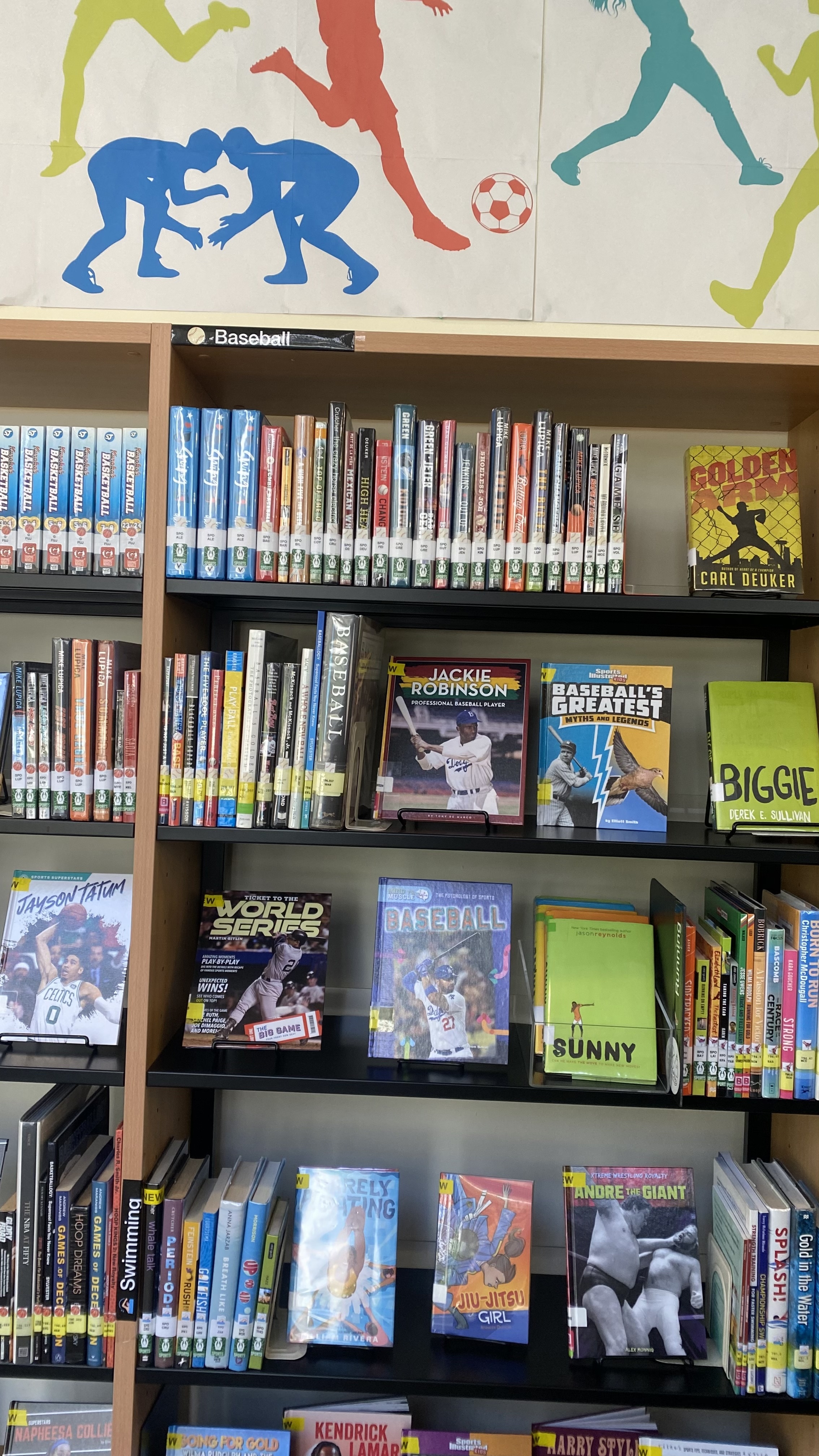
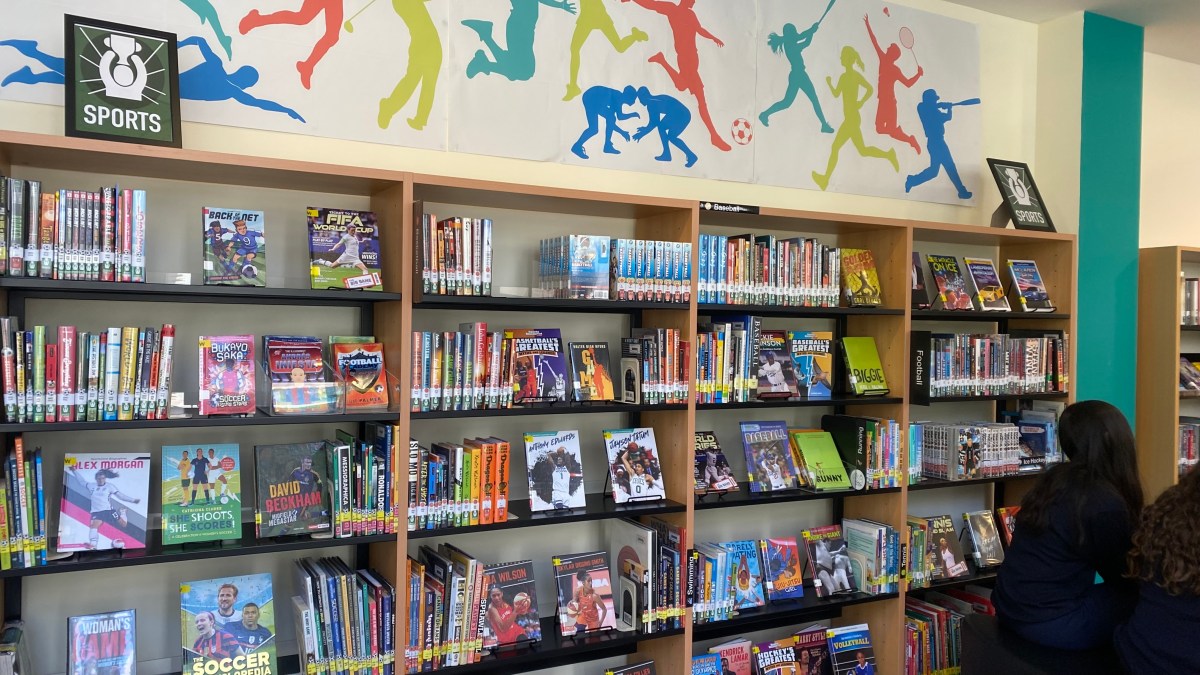
Since nonfiction, memoirs and biographies were upstairs and fiction sports downstairs it seemed logical to move them all to one place. So we trialed putting all our sports books together in a dedicated area. That meant pulling fiction, nonfiction, memoirs, biography, graphic novels and manga and sorting them by sport. Our poster was made in Canva in our library colours and is 3 panels representing the sports of our three sports seasons (template link). Our book spines have a small sticker of the sport represented to help with shelving.

We’ve probably doubled the circulation of our nonfiction sports books and it’s an area that garners a lot of attention. Unfortunately it is still really hard to find good fiction with sports themes. There are more good biographies and a small uptick in graphic novels and manga. Here are some of our best circulating titles.

Fiction

As you can see it’s heavily dominated by Jason Reynolds and Kwame Alexander. How I wish there were more authors writing shorter easy to ready and/or verse novels without naff babyish covers for this demographic!

  1. Ghost – Jason Reynolds
  2. The crossover – Kwame Alexander
  3. Booked – Kwame Alexander
  4. World in between : based on a true refugee story – Kenan Trebinčević
  5. Patina – Jason Reynolds
  6. Rebound Kwame Alexander
  7. Stanford Wong flunks big-time – Lisa Yee
  8. Defending champ – Mike Lupica
  9. Boy 21 – Matthew Quick
  10. Sunny – Jason Reynolds

Memoirs & Biographies

In particular the series by Matt and Tom Oldfield (from the playground to the pitch) and any of the Luca Caioli books are popular. And if you’re wondering who the GOAT is according to our students – Neymar and/or Ronaldo books outrank all the others.

Nonfiction

Anything soccer seems to dominate with basketball and F1 making an appearance. I was pleased to see one of my personal favourites – “The boys in the boat” tying with “The Barcelona complex” for 10th place as I’ve been promoting it heavily this year – I’m hoping the release of the movie will help it along as well.

  1. Stars of world soccer – Jökulsson Illugi
  2. The official history of the FIFA World Cup – FIFA World Football Museum
  3. Outcasts united : the story of a refugee soccer team that changed a town – Warren St. John
  4. THE FOOTBALL BOOK : the leagues, the teams, the tactics, the laws – David Goldblatt
  5. Return of the king : Lebron James, the Cleveland Cavaliers, and the greatest comeback in NBA history – Brian Windhorst
  6. The rise : Kobe Bryant and the pursuit of immortality – Mike Sielski
  7. All thirteen : the incredible cave rescue of the Thai boys’ soccer team – Christina Soontornvat
  8. F1 : the pinnacle : the pivotal events that made F1 the greatest motorsport series – Simon Arron
  9. The race of the century : the battle to break the four-minute mile – Neal Bascomb
  10. The Barcelona complex : Lionel Messi and the making–and unmaking–of the world’s greatest soccer club – Simon Kuper
  11. The boys in the boat : the true story of an American team’s epic journey to win gold at the 1936 Olympics – Daniel James Brown (we have both the YA and the original version)

What are we missing?

All the books by Mike Lupica / John Feinstein / John Coy are unfortunately showing their age now and are also very much written for an American rather than international audience.

We’ve had some more interest in cricket recently and just haven’t found enough books – fiction or nonfiction to meet that need. While there are more graphic novels coming up we need more of them.

If you have any great suggestions I’d love to hear them.

90% there …

Well we’re getting close to completion (all the yellow stickers are things the contractor needs to work on and the pink ones, things we need to do!) on our library project  (more links to the history here, here and here) and I’m feeling a little more relaxed. And even in the mood to discuss what has gone well (and what didn’t go so well / what I would have done differently will be the next post).

I’ve added 3 pano photos, from the front and back of the library and from our new “classroom” space.

img_4508
View from front

img_4509
View from back

img_4513
New Classroom

Let me start and devote this blog post with what I’m happy with – a comment from one of my Facebook groups prompted me to start with this, because I’m beginning to realise I’m way too much of a glass 1/2 empty kind of person, and if I have anything in the way of resolutions this year it is to be more positive! I’ll put some before / during and after shots in so you can see the difference!

I’m loving:

That I was fully part of the design process – in fact I was the designer and I only have myself (or maybe budget constraints or misinterpretations) to blame for what didn’t work out.  Plus my principal was immensely supportive all along the way, pretty much gave me free reign and was there when I needed her as a sounding board or to confirm a decision.

The wooden floors  

Oh I hated our old carpeting. Despite the fact that it was only about 2 years old it was pretty dirty and yucky – we get a lot of kids through the library each week and kids ain’t (and shouldn’t be) clean beasts. And because they were floor tiles, they could replace them, which meant colour differences, and that picky kid fingers could lift them up so they had to be re-glued regularly.

The extra display space

We librarians love to display and show case our collections. Whether it’s for a special event or to highlight new books, kindness week, a particular theme, whatever. I had no display space except for that which I’d artificially created by leaving shelves empty, and removing a computer from the dreaded pillar!  In the new configuration I’ve been able to convert the pillar to a wonderful wrap around display space.  I’ve also copied an idea from UWCSEA-East primary and added book ledges at the front door (they’re not perfect yet – too big and heavy on themselves but that’s another story).


Teaching spaces

I don’t have great pictures of before, or actually of after, so I’ll have to add these later. Basically my teaching space was a couch and a pulldown screen and a heavy very low flipboard I could drag out of my office when I needed to write anything, but couldn’t leave anywhere because there was no space for it!  Now there is not just one, but two teaching spaces as we knocked down the wall between the library and the staff room and the staff room was divided into a classroom and workroom.  Each has a projector with apple TV and each has a whiteboard space – the classroom a portable whiteboard and the main library will have two writeable glass sliding doors on either side of the projector screen on which to write. As a bonus, they’ve put blinds in front of all the windows that we can pull down so that the audience can also see what’s on the screen after 2pm!

Front Desk

I have very conscientious and neat staff, but open cupboards and a lack of space and no book drop meant that the front desk always looked messy even if it was actually pretty organised.  We went for a curved desk, for the show. I wasn’t 100% happy with that but it looks pretty good. I really like the design and the work surface (the top drawers are actually pull out work spaces) extra cupboard space and the fact that the cupboards have doors. I’ve very worried that the seating space is going to be very tight for three staff members, even if they’re all very petite. The compromise was I wanted the desk to be open on both sides because when (not if) there’s a “situation” on the library floor staff needs to be able to get to it very quickly.

White walls

Did I ever mention how much I hated the babypoop and maroon colour combination? Initially all I really really wanted was a paint-job and different seating furniture – but I got spoilt and got a whole new library!  Having white walls and light floor makes the whole space so much lighter – even though we’ve blocked off the windows on one side.

Collection flow

As the school has grown, so too had the collection. And choices I made last year on where to put what helped some parts of the collection (Fiction and Junior fiction) at a cost to others – nonfiction – where I split 000-399 and 400-999.  Now each part of my collection has it’s own section and I have an entire wall of nonfiction 000-999. It’s impressive even if I say so myself. And it’s “overzichtelijk” a wonderful word for which the English translation is apparently “clear” but what it really means is that you can take everything in in one glance.

There is also enough space on each shelf that books are not crammed together and we can put out front facing book(s) at the end.

I also ordered signage from Merchandising Libraries, both for A-Z for each fiction collection and with words and pictures for the nonfiction section and “shelf talkers” for various sections.

Another good thing is behind the teaching space / projector sliding doors we can now put in all the “kit” boxes – the multiple copies for literature circles and communal reading. Our school is in an old building so we don’t have grade pods or communal areas so all these books are stored in the library, and were stored in my office. I didn’t like this because it meant they were out of sight and mind of teachers and students and the door was a bit of a barrier (especially in the beginning when they didn’t know me) for them to come and browse the books. Now the office space can be used for sorting UOI books (so they won’t be on the floor in front of the main desk anymore), and the books will be easily accessed by everyone.

Teachers’ resources are also all together at adult height!

That’s all I have time for today. I’ll talk furniture and what could have gone better in the next post.

If we build it will they come?

In my past “homeless” week I’ve had opportunity to offer PD to my fellow librarians & library staff and to some teachers, and also to go into classrooms for a longer period of time and help with research, and I’ve had time to find, curate and put resources onto our libguides, and I’m hot-desking in the coordinator’s office. Its’ been a very informative time.

What I’ve learnt:

  • Never make assumptions about a basic level of digital literacy – just because you’re comfortable with screenshots, copying and pasting, using short-cuts etc. your audience may not be. Often they only know the very specific applications and programs (and operating systems) that they need for their specific tasks in their job.  You need to be very explicit and slow in explaining things.
  • Many many students do not know the difference between being in a browser window and typing in a URL (even a shortened one) and typing in a search term in a search box since the two have become ubiquitous to them – and Chrome as a Google product has played into that by allowing you to access either a search or an address from either. That’s something I never paused to think about, as a computer child of the 80’s they were very distinct things. This is philosophically interesting and I wonder if it impacts on understanding the nature of search and query?  I see a considerable amount of blurring generally – and if one thinks of aspects of information literacy in terms of threshold concepts I’m wondering if all these developments, while apparently making things easier are actually making them more difficult?

My biggest learning is that I have a poor understanding of how, where, why and when students and teachers access information. I’ve gone for a (at least) three times redundancy concept in providing access to anything –

  • in the OLP (Online Learning Platfrom – both on the homeroom page AND on the library page)
  • on the front page of our OPAC
  • on our Library Guides

In initial library lessons we’ve also had students (and teachers and parents – in our library bytes sessions) bookmark the 3 primary sites – the catalog, the library guides and then library OLP page. But the issues with information seem to be more deep-seated than that. I suspect that there is still confusion about not even knowing why you’d want to access anything – a kind of informational existential issue.

I’m guessing about 10-15% of the students in a class are making full use of the resources we’re providing.  Our school is probably not unique in this. I hear the same lament everywhere.  There is the saying of “meet your customer where they are” (not where you want them to be) and I think we neither really always know where they are – or we suspect they’re just on google, nor are we able to meet them there. AND OUR VENDORS ARE NOT HELPING US!  Let’s take our OPAC / Catalog as an example. Follett has finally woken up to the fact that google, and not our catalog or databases is the first place students look, so they’ve come up with a very nifty chrome extension that allows you to plug in your catalog (and webpath express) as the first search result – like below

screen-shot-2016-12-10-at-10-42-09-am

But, it only works with iOS on desktops / laptops. And we’re an iPad school (not an android / chromebook school). So it doesn’t work on iPads. So far so useless actually.

Oh, but there is a Destiny Discover App for iPads… except all it does is try to update every time you access it, and it gets to 31% and then crashes. And you can only set age / Lexile / grade level limiters to books, not databases or online resources, so it’s even more overwhelming than good ole google.

So at our last inter-campus librarian meeting we decided to try and encourage entry and access to our paid resources by making them options on our UOI guide resources page – so we’ve semi-standardised our boxes to have Books (with a link to the catalog via Librarythingsforlibraries book display widget), Videos (since Youtube is the 2nd only to google as the “go to” place for student research) and Resources (including Britannica, Brainpop, Epic Books and other curated links).

screen-shot-2016-12-10-at-10-51-56-am

The thought is, that they then don’t have to leave the page in order to go to a resource, they just click on the picture, and get to say Britannica, and once they’re there, the threshold is lower to then search for something from within there … we’ll see what the reality is.  I’ve also explicitly told them this in their last research lesson. Now to follow up and see if the usage stats change.

So what now? 

I think I need to move to a simpler and more intuitive layout – Following Katie Day’s layout for her research guide, perhaps making it student question related?

screen-shot-2016-12-10-at-11-08-41-am

At a whole different level is the services and guides that happen at Scotch College ….

screen-shot-2016-12-10-at-11-15-54-am

I think I need to sit down with teachers and students and really understand how they use information, how they look for it and where they expect to find it. Customer journey maps – something that I was thinking of as an alternative study avenue before I looked at our Blokes with Books club as my case study. Has anyone looked into that in the library context? I know people have looked at social media in library, but this is different – the physical and digital paths our patrons use to get information (or get frustrated by us). Any pointers?


Library redesign – current issues

As librarians we often make it our life and vacation’s mission to visit other libraries and drool over what they have (or haven’t got), how they’re organised things, what their displays look like – how the signage works out etc etc. and then we come home and try and adapt our current situation to optimise our own assets and spaces into something even more user friendly, accessible, with better book visibility etc. etc.

It’s not often we have a chance to go back to the drawing board and redo it. And then, suddenly you get what you wish for!  For the last year I’ve been tweaking and rearranging and moving things (documented here – see all 4 posts for the progression). Now finally we’ve had the funding approved to break through a wall and expand the library and to reconfigure it so that it better fits the needs of (must I say it?) 21C learning. Of course we’re still waiting for Government approval – so I better not count my chickens …

Ok, let’s say that in normal terms.  I’ve got a lovely library. It’s a bit cosy and run down, and a lot of things are improvised, but I love it, and (most) my students love it. It does have several rather important detracting factors though:

Instructional space

I have 35 classes a week, ranging from 20 to 40 minutes or sometimes longer depending on teacher needs. During that time, I typically give a micro-lesson (5 minutes) involving storytelling, a provocation, a video clip, booktalk by students or myself, or a slightly longer lesson that can involve explanation followed by a task, right up to a full 40 minute information literacy session that includes teaching and skill development.

But I don’t have an instructional space. I have a beat up, heavy black leather couch, next to a pull down projector screen (which is permanently down), next to a window without any blinds, behind glaring florescent lighting that has to be switched off. And nothing to write on, unless I drag a heavy flipboard in front of the screen and crouch down to write on it, as it’s not on adult human height.   My students sit on the mat on the carpet, or on too high chairs with legs that jut out and trip people up as they walk past, and write on too high tables.  And it’s OK. We do just fine.  But it could be a lot better.

Communal space

I just love the fact that the library is (my own quote) “the centre of the universe” in our school. But the disadvantage is that it gets used a lot for all sorts of other things. It doesn’t help that our school hall is enormous and acoustically dysfunctional, so any smaller gatherings get diverted to the library.

Fortunately, a far sighted predecessor made sure all the bookshelves were on wheels, so the library can relatively quickly be transformed into a biggish but comfortable open space. Unfortunately, that often occurs when actually, one of my classes has a library lesson, so they end up missing the lesson or having to reschedule. Rescheduling is a real issue when my calendar is pretty filled to the brim!

Display space

Short answer now – there isn’t really any. I’ve cleared a few shelves in the bookcase at the entrance, and eliminated a computer at the OPAC pillar, but it’s not enough, it’s not nice, it’s not visible and students don’t gravitate to it. I have a notice board at the entrance, but it’s not really in the line of sight, and only one wall is not covered with bookshelves.

Seating

We have the aforementioned awful leg-sticking-out chairs, a big heavy black leather couch, with a matching big heavy armchair, 6 little Ikea pool chairs, 2 long floor cushions, 2 little Ikea wooden tables and chairs.  Funnily enough, everytime I put down a floor rug (hand-me-downs from home) a new “reading / lounging” zone is created.

Shelving

Nice that it’s on wheels. Not always fit for purpose in that some of the kindergarten and junior elementary shelving is just too high for the students who are supposed to be using it. Further the dimensions are such that a lot of space is wasted when I put my series “boxes” in, as only two fit per shelf rather than three.

Returns / Circulation / Processing

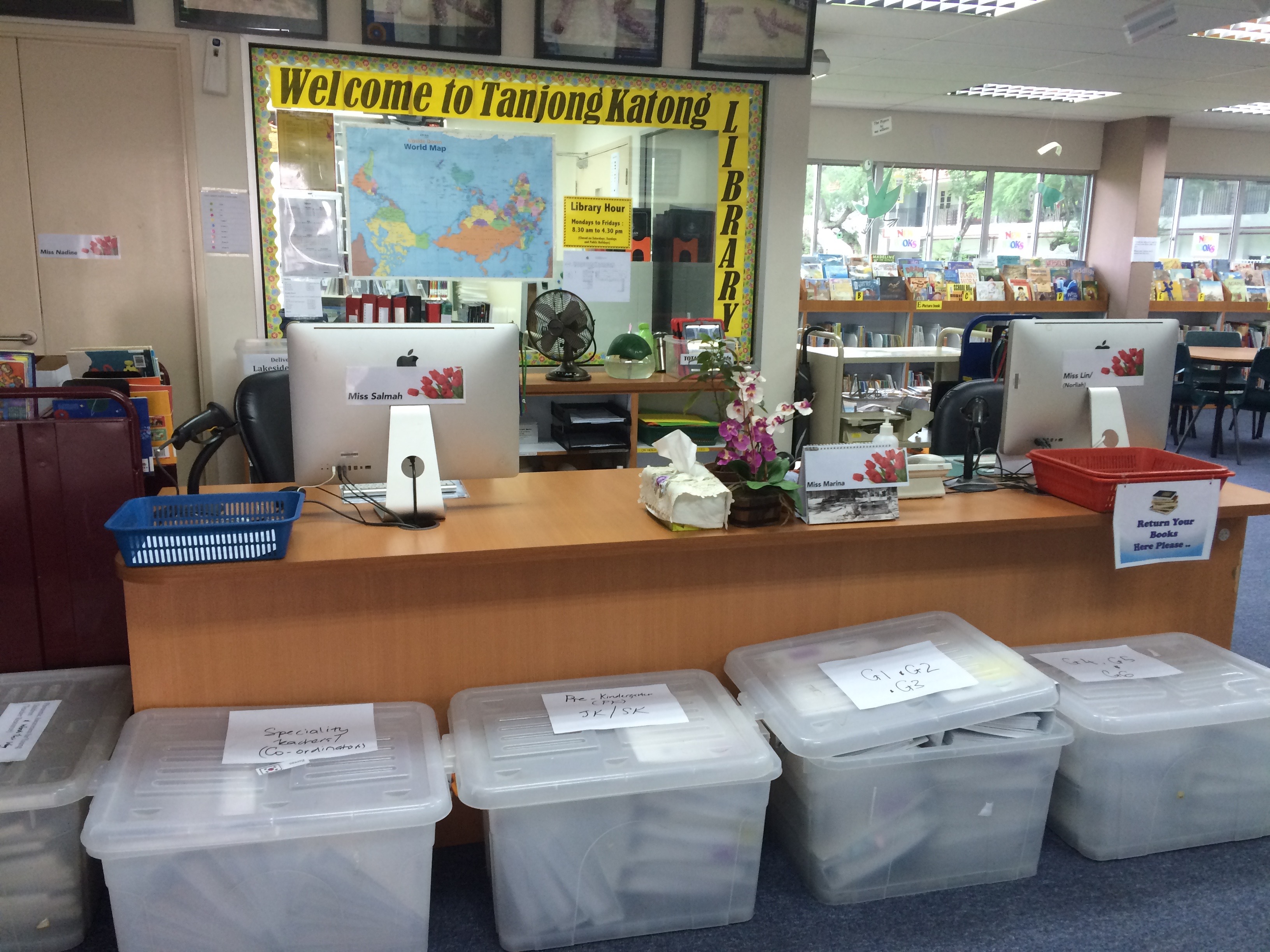
IMG_0466Returns are plonked into two little red baskets – which overflow in the shortest possible time.

Not enough space around the front desk to form multiple check-out lines without blocking access to library entrance / rest of library.

Not enough space on front desk to even process check-in and check-out – especially when multiple copies are being processed – like the check-in/out of UOI resources.

Not enough space for book processing (cataloguing, stickering, stamping, etc.)

Cupboards behind desk inadequate in size and no doors, so look untidy when they’re not.

Back Office

I’ll be the first to admit that I’m not the tidiest person on the planet, but what-a-mess! It’s an office, a dump, a store-room, a place for our literature kits and DVDs, a place for processing, for meetings, for privacy and tears (yes teachers sometimes need to cry, as do students and my office has tissues and sympathy/empathy).

Issues that were, and still remain – no visibility over library when in office, no space at desk to be out of office! No working space in office, too much junk. Not enough planning / writing space.

Meeting table / chair takes up too much space as chairs can’t be tucked underneath. Need space for “pending books” – the one’s I’m reading / reviewing / about to use in lessons. Don’t need big fat filing cabinet.

Conclusion

I’m happy I’ve had a year to be in the space, make the changes I could make, observe how the library is used, consider the problems and what does work before having to consider how I’d like it differently.

Next blog – the design process ….

(here is the completed series of posts:

https://informativeflights.wordpress.com/2016/10/30/library-redesign-current-issues/

https://informativeflights.wordpress.com/2016/10/30/library-redesign-checklist/

https://informativeflights.wordpress.com/2016/11/19/make-over-update/

https://informativeflights.wordpress.com/2017/01/08/90-there/

https://informativeflights.wordpress.com/2017/01/21/reduce-reuse-recycle-and-repurpose/

INF536: Critical Assessment

Looking back on this last semester, I can only sum it up by saying that change, beauty and progress in thought and learning is not only wrought by avalanche and volcano but also by the constant erosion by drops of water and bits of sand.  That combined with space and time.

9616353114

In the same way, this course has offered me space and time for learning by:

  • Forcing me to carve time out of a schedule that would otherwise be occupied by busyness
  • Exposing me to a variety of ideas, research, thoughts and concepts that I wouldn’t otherwise naturally encounter in my day-to-day professional or personal life
  • Making me DO things I’d otherwise shrug off as impossible (Bailey, 2015b)
  • Giving me a framework within which to analyse problems “wicked” and otherwise (Bailey, 2015a, 2015g; Buchanan, 1992; IDEO, 2014)
  • Grouping me with a set of people who are all approaching the course from a different context and set of experiences and knowledge
  • Creating a virtual (and at times physical) space for us to encounter each other and comment and share our learning – both formally and informally (“#INF536 – Twitter Search,” n.d.; McIntosh & CSU, n.d.)


It has be quite an experience, and, as someone once said – it’s not so much what you’ve learnt as what you remember. What has left a lasting impression is design thinking, the value of constraints and learning at the extremes.


As someone new to the education field, new to librarianship, operating under all kinds of constraints, the design thinking concepts of inspiration, ideation and implementation (Brown, 2008; Brown & Katz, 2011; IDEO, 2014) fits perfectly with that other concept of living and teaching in constant beta (Schroeder, 2013). As a fairly grounded, not terribly artistically (of the drawing and painting type) creative person this is the aspect of “design” that appeals to me as it is achievable with observation, thought, logic and research. However it also demands that I embody the principle of risk-taking and not just pay lip service to it sprouting it to my PYP (IB primary year program) students at regular intervals. There is something very empowering in the process of observing, thinking, asking, making small or not so small changes, and failing or succeeding, learning and trying again without fear and knowing that every time again one is moving every so slightly forward and nudging one’s students in the same direction.


My most effective intervention resulting from a budgetary constraint


Constraints, rather than hampering us, force rethinking options, relooking at alternatives and collaborating, asking, connecting in a way that is not always necessary when one is overwhelmed by choice and abundance. As documented in my blog posts: design – space, thinking and time 1, 2, 3 & 4 (Bailey, 2015c, 2015d, 2015e, 2015f) operating within the constraints of limited time, no budget, a small and almost unalterable space can result in creative solutions that are as ad hoc as they are successful.


We can learn a lot about education and learning in extreme conditions (Chohan, 2011; Leadbeater & Wong, 2010). But more immediate and accessible are the extremes in our own communities the students at the challenging edges of all the continuums we create. The teachers and parents who don’t toe some invisible line.


The name of my series of blog posts also reflects my thoughts about designing learning spaces. It’s not just about the physical space, it’s about reconstructing how we think about time and what we do in it, and carving out a presence physically, virtually and even emotionally. No matter how beautifully our surroundings have been designed, how much money has been spent on the furnishings and fittings, how much time is built into the curriculum if our students do not feel safe and have a willing and open space in their hearts and minds for learning, nothing will make an impact.

16807472897

References:

Bailey, N. (2015a, July 23). On the box, off the box – INF536 Blog Post 1 [Web Log]. Retrieved October 11, 2015, from http://thinkspace.csu.edu.au/informativeflights/2015/07/23/on-the-box-off-the-box/

Bailey, N. (2015b, August 7). Blog 2: Observation – Dog Walk [Web Log]. Retrieved October 11, 2015, from http://thinkspace.csu.edu.au/informativeflights/2015/08/07/blog-2-observation-dog-walk/

Bailey, N. (2015c, August 23). Design – space, thinking and time (1) [Web Log]. Retrieved October 4, 2015, from http://thinkspace.csu.edu.au/informativeflights/2015/08/23/design-space-thinking-and-time-1/

Bailey, N. (2015d, September 6). Design – space thinking and time (2) [Web Log]. Retrieved October 4, 2015, from http://thinkspace.csu.edu.au/informativeflights/2015/09/06/design-space-thinking-and-time-2/

Bailey, N. (2015e, September 20). Design – space, thinking and time (3) [Web Log]. Retrieved October 4, 2015, from http://thinkspace.csu.edu.au/informativeflights/2015/09/20/design-space-thinking-and-time-3/

Bailey, N. (2015f, October 4). Design – space, thinking and time (4) [Web Log]. Retrieved October 11, 2015, from http://thinkspace.csu.edu.au/informativeflights/2015/10/04/design-space-thinking-and-time-4/

Bailey, N. (2015g, October 11). INF536: Assessment 4 – Part A: Applying spatial changes and design thinking to middle school reading – a three phase collaborative approach [Web Log]. Retrieved October 11, 2015, from http://thinkspace.csu.edu.au/informativeflights/2015/10/11/inf536-assessment-4-part-a-applying-spatial-changes-and-design-thinking-to-middle-school-reading-a-three-phase-collaborative-approach/

Brown, T. (2008). Design thinking. Harvard Business Review, 86(6), 84–92. Retrieved from http://ezproxy.csu.edu.au/login?url=http://search.ebscohost.com/login.aspx?direct=true&db=heh&AN=32108052&site=ehost-live

Brown, T., & Katz, B. (2011). Change by Design: Change by Design. Journal of Product Innovation Management, 28(3), 381–383. http://doi.org/10.1111/j.1540-5885.2011.00806.x

Buchanan, R. (1992). Wicked problems in design thinking. Design Issues, 8(2), 5–21. Retrieved from http://www.jstor.org/stable/1511637

Chohan, A. (2011, January 25). Learning without frontiers [Video file]. Retrieved October 11, 2015, from https://www.youtube.com/watch?v=EARTcJkNrDA

IDEO. (2014). Design thinking for libraries – a toolkit for patron-centered design (p. 121). IDEO, Bill & Melinda Gates Foundation. Retrieved from http://www.designthinkingforlibraries.com

#INF536 – Twitter Search. (n.d.). [Twitter]. Retrieved October 11, 2015, from https://twitter.com/search?q=%23INF536&src=typd

Leadbeater, C., & Wong, A. (2010). Learning from the extremes. CISCO. Retrieved September 2, 2015 from https://www.cisco.com/web/about/citizenship/socio-economic/docs/LearningfromExtremes_WhitePaper.pdf

McIntosh, E., & CSU. (n.d.). Discussion Board – S-INF536_201560_W_D @CSU [Discussion Forum]. Retrieved October 11, 2015, from https://interact2.csu.edu.au/webapps/discussionboard/do/conference?toggle_mode=read&action=list_forums&course_id=_6652_1&nav=discussion_board_entry&mode=view

Schroeder, M. (2013, November 6). Living in beta [Video file]. Retrieved October 6, 2015, from https://www.youtube.com/watch?v=0nnYI3ePrY8


Design – Space, Thinking and Time (4)

September literally flew by, and I’m at the point of finishing up my final assessment for this course, and working on my critical reflection.  But first I wanted to critically reflect on where I was in my own library space.

I’m expanding the LibGuides to better resource our curriculum and to supplement the gaps in the curriculum.  Because only I know how to use them, the progress is slow and on a “just in time” basis populating them rather than a nice methodical roll-out, but the reception has been great from both the students and the teachers.  I’ve started showing it from Grade 3, and one of my Grade 5 pupils told me she’d spent an hour looking through the library Libguide before the lesson and “loved it”.

My next foray into the digital sphere for this learning environment has been to accost all the teachers to try and get them to download the Destiny App to access our catalog from their mobile phones and iPads.  The rollout to students will take a little longer as I have to apply to EdTech for permission to have apps loaded onto their iPads and that is reviewed and action taken only once a term.


I have to mention something about the value of constraints at this point.  Up to last Friday, more than 6 weeks into term, our library budget had not yet been approved and I had a bunch of kids whining that they were bored of the books and wanted new books.  I’d been fiddling around with the reporting tool of our OPAC trying to do a bit of a collection analysis and see what I had of which levels, what was popular etc. and I discovered that we had about 500 books that had never ever been circulated.

IMG_0765
One of my about 500 “neglected books”

What was the matter with them?  I got my staff to pull them all out.  I started with nonfiction – about 150 books and put them all on my table with books overflowing onto the floor and invited teachers to come and have a look and see if we could put it in a unit of inquiry resource list or if it would be useful for anything.  We whittled it down to about 20 books that are still homeless and unloved, but it was great as the books were “new to them” and hidden on the shelves.  The process was repeated for the picture books – but how to get young kids to identify the books and not have them lying on my desk or one of the few tables in the library – and that’s when I decided a little sad face paper clipped onto the book could do the trick.   And it did! You would have thought I’d put abandoned puppies free to a good home on display!  My staff and I started on a Monday morning and by Tuesday all the books had found a home.  So we continued with Junior Fiction and Fiction – with the same response, albeit a little more mature.  My older students gasped that award winning books hadn’t been borrowed.  They took up the challenge of taking a risk with a book or author they hadn’t tried yet.

These books haven’t flown off the shelves at quite such a fast pace, and there are more of them – particularly in the fiction section.  At that age students have become more selective and seem to be getting settled in their tastes.  Some have reported back that they’ve enjoyed the “new” books.  I’m working through some of the titles myself so I can book talk them as well.


So here are some captioned photos of how the space has evolved over the last two weeks and what we’ve been up to.

IMG_0794
A grade 1 class donates a finger counting poster they made

IMG_0777
Reverse psychology on teacher resources that hadn’t moved since I started – I don’t wait for them to come to me, I just look at the books and think who might like / need them for their class / self and check them out to them! So far a good response from all and no rejects returned yet…

IMG_0708
Notices everywhere to direct users to our online presence and virtual resources

IMG_0824
Stacks of books pulled out quickly as my G6 students did their 3 minute booktalk before their Information Literacy classes.

IMG_0666
The yellow post-its are the library “to do” list. As soon as something has been completed, it gets taken down and thrown away. When I think of something I write a note and put it up. Then if I or my staff has time, we tackle the next item that can be done …


Assessment Item 3: Literature Critique


The challenges of the school library as an evolving learning space

Word Count: 2,628


Bibliographic details:

IDEO. (2014). Design thinking for libraries – a toolkit for patron-centered design (p. 121). IDEO, Bill & Melinda Gates Foundation. Retrieved from www.designthinkingforlibraries.com

Haycock, K. (2007). Collaboration: Critical success factors for student learning. School Libraries Worldwide, 13(1), 25–35.

La Marca, S. (2008). Reading spaces (pp. 1–12). Presented at the 38th Annual Conference of the International Association of School Librarianship, Padua, Italy: International Association of School Librarianship. Retrieved from http://www.kzneducation.gov.za/Portals/0/ELITS%20website%20Homepage/IASL%202008/professional%20papers/lamarcaspacespp.pdf

Lin, P., Chen, K., & Chang, S.-S. (2010). Before there was a place called library – Library space as an invisible factor affecting students’ learning. Libri: International Journal of Libraries & Information Services, 60(4), 339–351.

Oblinger, D., G. (2006). Learning how to see. In D. Oblinger G. (Ed.), Learning Spaces (pp. 14.1–14.11). Boulder, CO: Educause. Retrieved from http://www.educause.edu/learningspaces

Willis, J., Bland, D., Hughes, H., & Elliott-Burns, R. (2013). Reimagining school libraries: emerging teacher pedagogic practices. Presented at the International Conference of the Australian Association for Research in Education, Adelaide, South Australia. Retrieved from http://eprints.qut.edu.au/66925/7/66925.pdf
 

Outline

This essay will specifically focus on the libraries of educational institutions – in particular school libraries – their role in learning and the way in which design, design thinking and the design process can optimise student outcomes given the financial, physical and time constraints inherent to the school environment.


A critique of literature necessitates criterion from which to evaluate the material. One of the weaknesses in design literature in general and school library design in particular is the reliance on single story or anecdotal evidence to support decisions and change. The aforementioned six pieces of literature will be judged to see whether they incorporate an understanding and discussion of

  • how research-based educational discourse has influenced the design space,
  • the relationships between educational trends and physical and virtual spaces,
  • the incorporation of technical and physical standards of interoperability, usability and sustainability,
  • how collaboration can be enhanced through the design process, design thinking or physical, virtual or temporal spatial design

Educational Discourse

A number of themes characterise current educational discourse. Following a meta-analysis of evidence-based influences on student achievement, the conclusion was reached that major sources of variance in student’s achievement lie in the learners themselves (50%) and their teachers (30%) (Hattie, 2003, 2009). Claxton’s work on the qualities of successful learners and their underlying motivations – including responsibility, respect, real world application, choice, challenge and collaboration are of relevance to this discussion (McIntosh, 2011), as are any ways in which design thinking or changes to physical, virtual or temporal spaces can enhance the work of teachers in particular collaboration, co-planning and co-teaching with teacher librarians (Loertscher, 2014; Montiel-Overall, 2006, 2008; Todd, 2008).


Literature supports evidence that learner needs can be met by creating physical and virtual spaces, as well as using design thinking to allow learners greater autonomy (La Marca, 2008). Users should be involved in the design of learning spaces and programs (IDEO, 2014; Oblinger, 2006). Greater choice is provided by spaces that accommodate different learning styles, and promote informal learning while extending learner experience. Well-designed social spaces have a positive impact on motivation and the ability to learn by encouraging ‘conversations’ and interaction between faculty and students and intra-faculty collaboration (Haycock, 2007; IDEO, 2014; La Marca, 2008; Lin, Chen, & Chang, 2010; Oblinger, 2006; Willis, Bland, Hughes, & Elliott-Burns, 2013).

Educational Trends

The trends that have been identified that impact on the school library as a space include; learning no longer being limited by geography, time or physical spaces, the emergence of digital and virtual spaces (Joint, 2011; Kurvink, 2008; La Marca, 2008; Oblinger, 2006), a movement away from a fixed curriculum to inquiry based learning (Kuhlthau & Maniotes, 2010; Kuhlthau, Maniotes, & Caspari, 2012; Short, 2009), rapid globalisation with more multi-lingual/cultural learners in any learning environment, (Gee & Hayes, 2011; Kutner & Armstrong, 2012; Vega, 2014) learning no longer confined to educational institutions but becoming life-long and personalized (Gee & Hayes, 2011; McLoughlin & Lee, 2009) and learning is moving away from being individual, school bound and information based to being collaborative and interactive with an emphasis on analysis, thinking problem solving and knowledge building (Chau & Cheng, 2011; Ellis & Phillips, 2013; Sinclair, 2007; Vasiliou, Ioannou, & Zaphiris, 2014; Vaughan, Nickle, Silovs, & Zimmer, 2011). One of the merits of design thinking is that while it cannot always anticipate educational trends, it provides librarians and educators with the tools to respond to the challenges inherent in change (IDEO, 2014) – provided of course they are recognised on time. Oblinger (2006) also encourages experimentation, innovation and prototyping in educational spaces.


Education space is no longer defined by physical rooms and teaching but by learning and the means of providing access to shared specialist resources both physical and virtual that is flexible, responsive to individual needs, allows self-directed learning and opportunities for interaction and collaboration (La Marca, 2008; Oblinger, 2006; Willis et al., 2013). Instead of grades and diplomas “learning is the unit of success” (IDEO, 2014, p. 97), even when the outcome appears not to be favourable.

Technical and physical environment

The literature appears to agree on the importance of setting pedagogical, philosophical and social goals before planning learning spaces and evaluating these e against the mission and values of the organisation (La Marca, 2008; Lin et al., 2010; Oblinger, 2006; Willis et al., 2013). Discussions range from the social construction of space, and how this can catalyse encounters (Oblinger, 2006) and impact on functional areas, relationships and the service philosophy (Lin et al., 2010), power structures and the messaging of signage (Willis et al., 2013) to more practical issues around the importance of useable, interoperable, flexible and sustainable spaces with a discussion of physical elements, ambiance, lighting, colour, acoustics temperature, display and ‘agile’ furniture (La Marca, 2008; Willis et al., 2013).


Sustainability is an important theme due to the longevity of building structures relative to internal components such as hard/software and furnishings with an emphasis on the importance of continual flexibility and renewal to ensure the environment aligns with pedagogy, curricula, assumed practices and social factors (Hauke & Werner, 2012; Lin et al., 2010; Oblinger, 2006; Willis et al., 2013). The employment of design thinking allows for the rapid prototyping, mini-piloting and implementation responding to changes while working within constraints and involving all stakeholders in the space (IDEO, 2014).

Collaboration

A substantial body of research points to the value of teacher and librarian collaboration (Ferer, 2012; Gibbs, 2003; Haycock, 1998, 2007; Jones & Green, 2012; Kachel, 2013; Loertscher, 2014; Lonsdale, 2003; Montiel-Overall, 2006, 2008; Todd, 2008; Williamson, Archibald, & McGregor, 2010), yet little practical implementable advices is given on how libraries can change their physical, virtual or temporal spaces, or even implement design thinking in order to improve the likelihood of collaboration and integration.


Literature primarily focuses on the need to merge the academic and social dimensions of learning through flexible and adaptive spaces which cater for collaborative learning amongst users and patrons, recognising the communal character of knowledge and allowing for spontaneous user interactivity (Lin et al., 2010). A convincing argument is made for considering the way in which the new constructivist pedagogies of collaboration, interactive learning and analytic thinking have impacted design practices in order to situate physical and digital information geographically and symbolically into the social context of learning in order to advance and perpetuate knowledge (Lin et al., 2010). To meet these changes, library space design has evolved to favour ample ‘agile’ mobile spaces and flexible movable furnishings to facilitate the creation of a third space that offers resources and services above and beyond what the home, office or classroom is able to provide (La Marca, 2008; Willis et al., 2013) while flexible scheduling allows the “temporal space” within which collaboration has the time to occur (Gavigan, Pribesh, & Dickinson, 2010; Haycock, 1998, 2007).

Collaboration with users allows them to be acknowledged and heard, and the design thinking process offers some practical advices with a methodology which can be extended to enhancing collaboration within programs, services, spaces and systems (IDEO, 2014).


Analysis

One of the first hurdles in considering which practices translate best into practice is how to evaluate the success of an educational library space. While schools and teachers can be assessed on common standards, examination results, literacy and numeracy scores, the librarian is tasked with providing evidence for the more nebulous concepts of enhancing student and teacher learning, resourcing the curriculum, providing access to information and a pleasant physical environment (Gillespie & Hughes, 2014). Research attempting to quantify a link between achievement in the form of test scores and school libraries suggests the following characteristics of a successful school library:

  • Integration of information literacy skills in the curriculum
  • Adequate staffing, resourcing and funding
  • Collaborative planning between librarians and teachers
  • Extended library and staff hours
  • In-service training by librarians to teachers
  • Good quality, larger and newer collections
  • More student visits
  • Flexible scheduling (Kachel, 2013; Lonsdale, 2003).


However, academic achievement is just one aspect of the outcome indicators identified by the Victoria Department of Education in their evaluation of built learning spaces – others include engagement, interpersonal interactions, physical and psychological wellbeing and behavioural features – (Blackmore, Bateman, Loughlin, O’Mara, & Aranda, 2011). These features presume pre-conditions for learning receptiveness that learning spaces are burdened with assuming, and for which research indicates there is little empirical evidence.


Unfortunately this appears to also be the case with respect to the design considerations that most easily translate into practice, the “low hanging fruit” – often extolled by “library design” workshop participants (Hennah, n.d.-b) including an emphasis on ambiance, contemporising spaces, employing visual display and retailing techniques that probably all contribute to increased footfall and perhaps circulation, which however has no rigorous evidence based research that can link it with enhancing learning.


La Marca’s writing on Reading Spaces (2008) comes closest to looking at the links between library spaces and achievement attesting that giving an activity a space gives it value. Building on her own (La Marca, 2003) and other’s research (Elliott-Burns, 2003; Lackney, 2001) she identifies ambiance, access and ownership, flexibility, individuality, physical and student concerns as elements contributing to successful library reading space design, which, by implication, create successful readers with the resultant improvement in academic attainment. One could challenge this type of assumed causality as a case of post hoc fallacy.


Interestingly, none of the articles referred to above at any time indicate that any of the positive effects attributed to changes in design or placement of space may be a result of the “Hawthorne” or “novelty” effects, in which improvements may be a result of change in the environment and people’s interest in and response to the innovation or the feeling of being accorded attention when the spatial change is researched. In fact, school libraries may be doing themselves a disservice by following literature, research or anecdotes based on public libraries or perceived user needs. While innovation and novelty can increase footfall and circulation figures, (Bentheim, 2013; Hennah, n.d.-a) as Lippincott (2006) points out, after entry the library has to engage the patron in order to enhance learning and scholarship. In fact, research from museums seems to indicate that decreasing novelty could help create a non-distracting familiar environment where learning can take place (Kubota & Olstad, 1991). The need for novelty was experienced recently where, following a successful Valentine’s Day pink and red wrapped “book date” campaign (Eastlib, 2015a), the following month’s black covered “mystery book” campaign attracted little attention (Eastlib, 2015b).


Despite the importance of librarian / teacher collaboration on academic attainment, there is little mention of how physical and virtual space can enhance this – most articles focus exclusively on peer-to-peer or teacher-to-student collaboration. In an article on library staff spaces a wide range of issues is covered with only a brief mention of collaborative spaces and learning – that is focused on internal staff interaction (Felix, 2015). One has to look outside the discipline for suggestions as to how spaces can ‘manipulate and order engagement’ (Elliott-Burns, 2003, 2005; Willis et al., 2013) or ‘catalyze social encounters’ (Oblinger, 2006) – practices that have become the norm in business organisations such as Pixar, Apple and Google with their “braintrusts”, single staircases, war rooms and free meals allowing both for deliberate collaboration and ‘serendipitous interaction’ (Avallon & Schneider, 2013; Catmull, 2014; Knapp, 2014). Although Haycock (2007) includes environment, process and structure, communication and resources among the factors that positively influence collaboration, no mention is made of reconstruction of physical or virtual spaces or applying any type of design thinking to facilitate collaboration.

Conclusion

Peer-learning is a valuable but under-utilized method of engaging students, (Hattie & Yates, 2013), and could also assist the professional development of teachers and teacher-librarians. Communal learning spaces in libraries transformed to “learning commons” or “information commons” encourage peer-learning and collaboration between students of different ages, interests and values (Hay, 2006, 2010; Hay & Todd, 2010; Oblinger, 2006), however discussion of inter-collegial teacher / teacher librarian use of spaces is neglected. The ability to book spaces, librarians or other specialists online as well as the affordances of large flexible accommodating spaces impact how teachers learn, balancing equilibrium and disequilibrium, collaborative and individual space and enhancing shared beliefs (Willis et al., 2013).


Acoustics is mentioned with relative frequency in the literature, however discussion appears to be limited to the desirability of consideration of controlling noise levels or managing them according to the purpose of the space and acoustic standards (Blackmore et al., 2011; Cha & Kim, 2015; Elliott-Burns, 2005; Lackney, 2001; Lin et al., 2010; McDonald, 2010; Treasure, 2012). In practice, space, design or financial constraints may lead to sub-optimal acoustic environments which are difficult or expensive to remedy once a building is in use, standards change or when spaces are re-purposed (Hauke & Werner, 2012).


Much of the design literature and related research is “front-loaded” to the planning and design stages, with little literature and less evidence available on the implementation and transition phase; consolidation phase; and sustainability/re-evaluation phase with more emphasis on anecdote and design standards than educational practice and student outcomes (Blackmore et al., 2011). This may be due to the aforementioned “novelty effect” – once a new or renovated space is taken into operation, attention is on the new “next big thing” and few people are interested in measuring actual experience with design briefs or mock-up promises – this is unfortunate since significant learning is thereby neglected (Latimer, 2011). Spending time on post-occupancy evaluation (POE) literature is probably as worthwhile a pursuit as the emphasis on the design process and planning – including practical real life experiences, involving the voice and feedback of users who may not have been involved in the design process or may have had their comments and suggestions ignored (Baker, 2011; DeClercq & Cranz, 2014; Latimer, 2011).


Discussion on building and interior planning and design forms the bulk of discourse, in the chosen readings, but IDEO’s toolkit (2014) will possibly prove to be the most significant in practice. Design thinking is an empathic and intuitive process that assesses and responds to learner’s needs in as much as it is transformative and provides innovative solutions at the intersection of desirability, viability and feasibility (IDEO, 2014).


While not specifically geared to school libraries, it methodically takes the reader through the design thinking process of inspiration, ideation and iteration (Brown, 2008; Kimbell, 2011, 2012; Kuratko, Goldsby, & Hornsby, 2012) giving practical advice and concrete examples of implementation and results. Due to its public library focus however, it emphasizes meeting patron needs. It is suggested that school librarians would have to distance themselves somewhat from patron’s perceived and expressed needs and work towards applying these tools to the “wicked” (Buchanan, 1992) and “ill structured” (Simon, 1973) problems such as integration of information literacy into the curriculum, collaborative planning, extended hours, and flexible schedules, that, if solved, can best contribute to enhancing learning in the school community (Kachel, 2013; Lonsdale, 2003).


Haycock (2007) reminds us that educator / librarian collaboration is the single behaviour that most affects student achievement and that this behaviour models partnership, cooperative planning and teaching to students and other members of the community while integrating the library program into the curriculum and changing the role of the librarian from resourcer to learning facilitator. Design thinking interventions that have been observed include: giving language-arts teachers first opportunity to sign up for recess and lunch-time library supervision enhancing opportunity for deliberate and chance encounters with the librarian, as do booktalk pre-school “coffee mornings” (Day, 2015a); moving the library into the classroom through class libraries – for all subjects not just for language-arts classrooms (Day, 2013); and incorporating design thinking teaching into the research process (Day, 2015b). In practice, design thinking type interventions are likely to have lasting impact on teaching practice and enhanced student learning and merit more attention and research.

References:

Avallon, J., & Schneider, A. (2013). Building collaboration into workspace design. Facility Management Journal, September / October, 34–38. Retrieved from http://cdn.ifma.org/sfcdn/fmj-supporting-documents/building-collaboration-into-workspace-design-fmj-sep-oct-2013.pdf?sfvrsn=0

Baker, L. (2011). What school buildings can teach us: Post-Occupancy Evaluation surveys in K-12 learning environments (Master’s Thesis). UC Berkeley, California, USA. Retrieved from http://escholarship.org/uc/item/2kw2g6rs

Bentheim, C. A. (2013). Continuing the transition work from traditional library to learning commons. Teacher Librarian, 41(2), 29–36. Retrieved from http://ezproxy.csu.edu.au/login?url=http://search.ebscohost.com/login.aspx?direct=true&db=ehh&AN=92991111&site=ehost-live

Blackmore, J., Bateman, D., Loughlin, J., O’Mara, J., & Aranda, G. (2011). Research into the connection between built learning spaces and student outcomes (Literature review No. 22). Melbourne, Australia: Victoria Department of Education and Early Childhood Development. Retrieved from http://www.deakin.edu.au/__data/assets/pdf_file/0018/365202/built-learning-spaces.pdf

Brown, T. (2008). Design thinking. Harvard Business Review, 86(6), 84–92. Retrieved from http://ezproxy.csu.edu.au/login?url=http://search.ebscohost.com/login.aspx?direct=true&db=heh&AN=32108052&site=ehost-live

Buchanan, R. (1992). Wicked problems in design thinking. Design Issues, 8(2), 5–21. Retrieved from http://www.jstor.org/stable/1511637

Catmull, E. (2014, March 12). Inside the Pixar Braintrust. Retrieved August 8, 2015, from http://www.fastcompany.com/3027135/lessons-learned/inside-the-pixar-braintrust

Cha, S. H., & Kim, T. W. (2015). What matters for students’ use of physical library space? The Journal of Academic Librarianship, 41(3), 274–279. http://doi.org/10.1016/j.acalib.2015.03.014

Chau, J., & Cheng, G. (2011). A comparative study of using blogs and wikis for collaborative knowledge construction. International Journal of Instructional Media, 38(1), 71–78. Retrieved from http://go.galegroup.com/ps/i.do?id=GALE%7CA273786679&v=2.1&u=csu_au&it=r&p=EAIM&sw=w&asid=697a2b7ca89f45e1ef9b982cfe6ddf75

Day, K. (2013, November). Liberate your book cupboards and create a more true “bookstore” model in your school library? [Web Log]. Retrieved July 26, 2015, from http://www.thelibrarianedge.com/libedge/2013/11/liberate-your-book-cupboards-and-create.html

Day, K. (2015a, September 3). Professional learning for teachers who read books students might read [Library Guide]. Retrieved September 6, 2015, from http://research.uwcsea.edu.sg/eastlibsec/classlibs

Day, K. (2015b, September 5). Design thinking for the research process (e.g., the IBO Extended Essay) [Web Log]. Retrieved September 6, 2015, from http://www.thelibrarianedge.com/libedge/2015/8/30/design-thinking-for-the-research-process

DeClercq, C. P., & Cranz, G. (2014). Moving beyond seating-centered learning environments: Opportunities and challenges identified in a POE of a campus library. The Journal of Academic Librarianship, 40(6), 574–584. http://doi.org/10.1016/j.acalib.2014.08.005

Eastlib. (2015a, February 10). Pick up your blind date with a book in the… [Tumblr]. Retrieved September 6, 2015, from http://kmlib.tumblr.com/post/110669646836/pick-up-your-blind-date-with-a-book-in-the

Eastlib. (2015b, March 2). Last month’s Blind Date with a Book was so… [Tumblr]. Retrieved September 6, 2015, from http://kmlib.tumblr.com/post/112508706586/last-months-blind-date-with-a-book-was-so

Elliott-Burns, R. (2003). Space, place, design and the school library. Journal of the Australian School Library Association, 17(2).

Elliott-Burns, R. (2005). Designing spaces for learning and living in schools: perspectives of a flaneuse. Presented at the Australian Curriculum Studies Association Biennial Conference, Queensland, Australia: University of the Sunshine Coast. Retrieved from http://eprints.qut.edu.au/4345/1/4345.pdf

Ellis, J., & Phillips, A. (2013). Re-defining the service experience: forging collaboration between librarians and students. Library Management, 34(8/9), 603–618. http://doi.org/10.1108/LM-10-2012-0070

Felix, E. (2015). Rethink the staff workplace – Library by design. Library Journal, Spring, 7–9. Retrieved from http://lj.libraryjournal.com/2015/05/buildings/lbd/rethink-the-staff-workplace-library-by-design-spring-2015/

Ferer, E. (2012). Working together: library and writing center collaboration. Reference Services Review, 40(4), 543–557. http://doi.org/10.1108/00907321211277350

Gavigan, K., Pribesh, S., & Dickinson, G. (2010). Fixed or flexible schedule? Schedule impacts and school library circulation. Library & Information Science Research, 32(2), 131–137. http://doi.org/10.1016/j.lisr.2009.10.005

Gee, J. P., & Hayes, E. (2011). Language and learning in the digital age (1st ed). New York, NY: Routledge.

Gibbs, R. (2003). Reframing the role of the teacher-librarian : the case for collaboration and flexibility. Scan, 22(3), 4–7. Retrieved from http://search.informit.com.au.ezproxy.csu.edu.au/fullText;dn=129538;res=AEIPT

Gillespie, A., & Hughes, H. (2014). Snapshots of teacher librarians as evidence based practitioners. Access, (September), 26–40. Retrieved from http://www.researchgate.net/profile/Ann_Gillespie/publication/265786959_Snapshots_of_teacher_librarians_as_evidence-based_practitioners/links/541b93f80cf2218008c4b8c2.pdf

Hattie, J. (2003). Teachers Make a Difference: What is the research evidence? Camberwell: Australian Council for Educational Research. Retrieved from http://www.decd.sa.gov.au/limestonecoast/files/pages/new%20page/PLC/teachers_make_a_difference.pdf

Hattie, J. (2009). Visible learning: a synthesis of over 800 meta-analyses relating to achievement. London ; New York: Routledge.

Hattie, J., & Yates, G. (2013). Visible Learning and the Science of How We Learn. Milton Park, Abingdon, Oxon: Routledge. Retrieved from http://ezproxy.csu.edu.au/login?url=http://search.ebscohost.com/login.aspx?direct=true&db=nlebk&AN=649114&site=ehost-live

Hauke, P., & Werner, K. U. (2012). The second hand library building: Sustainable thinking through recycling old buildings into new libraries. IFLA Journal, 38(1), 60–67. http://doi.org/10.1177/0340035211435394

Haycock, K. (1998). What works: Collaborative cultures, team planning and flexible scheduling. Emergency Librarian, 25(5), 28. Retrieved from http://search.proquest.com/docview/224890121?accountid=10344

Haycock, K. (2007). Collaboration: Critical success factors for student learning. School Libraries Worldwide, 13(1), 25–35. Retrieved from http://ezproxy.csu.edu.au/login?url=http://search.ebscohost.com/login.aspx?direct=true&db=lih&AN=25545933&site=ehost-live

Hay, L. (2006). School libraries as flexible and dynamic learning laboratories … that’s what Aussie kids want. Scan, 25(2), 19–27. Retrieved from http://search.informit.com.au.ezproxy.csu.edu.au/fullText;dn=151835;res=AEIPT

Hay, L. (2010). Shift happens. It’s time to rethink, rebuild and rebrand. Access, 5–10.

Hay, L., & Todd, R. (2010). School libraries 21C: A school libraries futures project. New South Wales, Australia: School Libraries and Information Literacy Unit, Curriculum K–12 Directorate, NSW Department of Education and Training. Retrieved from http://www.curriculumsupport.education.nsw.gov.au/schoollibraries/

Hennah, K. (n.d.-a). Library experience [Website]. Retrieved August 30, 2015, from http://www.kevinhennah.com.au/libraries/library-experience/

Hennah, K. (n.d.-b). Testimonials – Kevin Hennah [Website]. Retrieved September 5, 2015, from http://www.kevinhennah.com.au/testimonials/

IDEO. (2014). Design thinking for libraries – a toolkit for patron-centered design (p. 121). IDEO, Bill & Melinda Gates Foundation. Retrieved from http://www.designthinkingforlibraries.com

Joint, N. (2011). If Google makes you stupid, what should librarians do about it? Library Review, 60(4), 269–278. http://doi.org/10.1108/00242531111127839

Jones, S. A., & Green, L. S. (2012). Transforming collaboration. Teacher Librarian, 40(2), 26–31. Retrieved from http://search.proquest.com/docview/1271626536?accountid=10344

Kachel, D. (2013). School library research summary (A graduate class project) (p. 16). Mansfield, PA: Mansfield University. Retrieved from http://sl-it.mansfield.edu/upload/MU-LibAdvoBklt2013.pdf

Kimbell, L. (2011). Rethinking design thinking: Part I. Design and Culture, 3(3), 285–306. http://doi.org/10.2752/175470811X13071166525216

Kimbell, L. (2012). Rethinking design thinking: Part II. Design and Culture, 4(2), 129–148. http://doi.org/10.2752/175470812X13281948975413

Knapp, J. (2014, May 1). Google Ventures: your design team needs a war room. Here’s how to set one up. Retrieved August 8, 2015, from http://www.fastcodesign.com/3028471/google-ventures-your-design-team-needs-a-war-room-heres-how-to-set-one-up

Kubota, C. A., & Olstad, R. G. (1991). Effects of novelty-reducing preparation on exploratory behavior and cognitive learning in a science museum setting. Journal of Research in Science Teaching, 28(3), 225–234.

Kuhlthau, C. C., & Maniotes, L. K. (2010). Building Guided Inquiry Teams for 21st-Century Learners. School Library Monthly, 26(5), 18.

Kuhlthau, C. C., Maniotes, L. K., & Caspari, A. K. (2012). The research behind the design. In Guided inquiry design: a framework for inquiry in your school (pp. 17–36). Santa Barbara, California: Libraries Unlimited.

Kuratko, D. F., Goldsby, M. G., & Hornsby, J. S. (2012). The design-thinking process. In Innovation acceleration: transforming organizational thinking (1st ed, pp. 103–123). Boston: Pearson.

Kurvink, W. (2008). A new paradigm for reference librarians in the on-line world: developing relationships around research and learning with library users. In Libraries / Changing Spaces, Virtual Places. Melbourne, Australia: VALA. Retrieved from http://www.valaconf.org.au/vala2008/papers2008/133_Kurvink_Final.pdf

Kutner, L., & Armstrong, A. (2012). Rethinking Information Literacy in a Globalized World. Communications in Information Literacy, 6(1), 24–33.

Lackney, J. (2001, updated: 2007). Thirty-three educational design principles for schools and community learning centers [Digital Document]. Retrieved from http://schoolstudio.typepad.com/school_design_studio/33-educational-design-pri.html

La Marca, S. (2003). The enabling adult: The role of the teacher-librarian in creating a reading environment (PhD Thesis). University of Melbourne, Melbourne, Australia.

La Marca, S. (2008). Reading spaces (pp. 1–12). Presented at the 38th Annual Conference of the International Association of School Librarianship, Padua, Italy: International Association of School Librarianship. Retrieved from http://www.kzneducation.gov.za/Portals/0/ELITS%20website%20Homepage/IASL%202008/professional%20papers/lamarcaspacespp.pdf

Latimer, K. (2011). Collections to connections: Changing spaces and new challenges in academic library buildings. Library Trends, 60(1), 112–133. Retrieved from http://search.proquest.com/docview/903206239?accountid=10344

Lin, P., Chen, K., & Chang, S.-S. (2010). Before there was a place called library – Library space as an invisible factor affecting students’ learning. Libri: International Journal of Libraries & Information Services, 60(4), 339–351. Retrieved from http://ezproxy.csu.edu.au/login?url=http://search.ebscohost.com/login.aspx?direct=true&db=a9h&AN=55774124&site=ehost-live

Lippincott, J. K. (2006). Linking the information commons to learning. In D. Oblinger (Ed.), Learning Spaces (pp. 7.1–7.18). Boulder, CO: EDUCAUSE.

Loertscher, D. V. (2014). Collaboration and coteaching: A new measure of impact. Teacher Librarian, 42(2), 8–19,71. Retrieved from http://search.proquest.com/docview/1637635976?accountid=10344

Lonsdale, M. (2003). Impact of school libraries on student achievement: a review of the research. Melbourne: Australian Council for Educational Research.

McDonald, A. (2010). Libraries as places: challenges for the future. In S. McKnight (Ed.), Envisioning future academic library services initiatives, ideas and challenges (pp. 31–54). London: Facet. Retrieved from http://search.ebscohost.com/login.aspx?direct=true&scope=site&db=nlebk&db=nlabk&AN=558450

McIntosh, E. (2011, November 29). Guy Claxton: What’s the point of school? [Web Log]. Retrieved September 6, 2015, from http://edu.blogs.com/edublogs/2011/11/guy-claxton-whats-the-point-of-school.html

McLoughlin, C., & Lee, M. J. W. (2009). Personalised learning spaces and self-regulated learning: Global examples of effective pedagogy. Presented at the ASCILITE, Auckland. Retrieved from http://bilby.unilinc.edu.au:1801/webclient/StreamGate?folder_id=0&dvs=1430638262238~769&usePid1=true&usePid2=true

Montiel-Overall, P. (2006). Teacher and teacher-librarian collaboration: moving toward integration. Teacher Librarian, 34(2), 28–33. Retrieved from http://search.proquest.com/docview/224885770?accountid=10344

Montiel-Overall, P. (2008). Teacher and librarian collaboration: A qualitative study. Library & Information Science Research, 30(2), 145–155. http://doi.org/10.1016/j.lisr.2007.06.008

Oblinger, D., G. (2006). Learning how to see. In D. Oblinger G. (Ed.), Learning Spaces (pp. 14.1–14.11). Boulder, CO: Educause. Retrieved from http://www.educause.edu/learningspaces

Short, K. (2009). Inquiry as a stance on curriculum. In S. Davidson & S. Carber (Eds.), Taking the PYP forward (pp. 11–26). Melton, Woodbridge U.K.: John Catt Educational Ltd.

Simon, H., A. (1973). The structure of ill structured problems. Artificial Intelligence, 4, 181–201.

Sinclair, B. (2007). Commons 2.0: Library spaces designed for collaborative learning. Educause Quarterly, 4, 4–6. Retrieved from http://er.educause.edu/~/media/files/article-downloads/eqm0740.pdf

Todd, R. J. (2008). The dynamics of classroom teacher and teacher librarian instructional collaborations. Scan, 27(2), 19–28.

Treasure, J. (2012, June). Why architects need to use their ears [Video file]. Retrieved August 8, 2015, from http://www.ted.com/talks/julian_treasure_why_architects_need_to_use_their_ears/transcript?language=en#t-30790

Vasiliou, C., Ioannou, A., & Zaphiris, P. (2014). Understanding collaborative learning activities in an information ecology: A distributed cognition account. Computers in Human Behavior, 41(0), 544–553. http://doi.org/10.1016/j.chb.2014.09.057

Vaughan, N., Nickle, T., Silovs, J., & Zimmer, J. (2011). Moving to their own beat: Exploring how students use Web 2.0 technologies to support group work outside of class time. Journal of Interactive Online Learning, 10(3), 113–127. Retrieved from http://ezproxy.csu.edu.au/login?url=http://search.ebscohost.com/login.aspx?direct=true&db=ehh&AN=69835261&site=ehost-live

Vega, V. (2014, April 21). Research supports global curriculum. Retrieved April 22, 2014, from http://www.edutopia.org/stw-global-competence-research?utm_source=facebook&utm_medium=post&utm_content=stw&utm_campaign=JSISresearch-repost#graph2

Williamson, K., Archibald, A., & McGregor, J. (2010). Shared vision: A key to successful collaboration? School Libraries Worldwide, 16(2), 16–30. Retrieved from http://ezproxy.csu.edu.au/login?url=http://search.ebscohost.com/login.aspx?direct=true&db=lih&AN=55415805&site=ehost-live

Willis, J., Bland, D., Hughes, H., & Elliott-Burns, R. (2013). Reimagining school libraries: emerging teacher pedagogic practices. Presented at the International Conference of the Australian Association for Research in Education, Adelaide, South Australia. Retrieved from http://eprints.qut.edu.au/66925/7/66925.pdf


Designed for a purpose

On one day this week, spend 30 minutes on your way to work, at the gym or in a restaurant, taking care to observe, and note in a sketchpad, everything that you think has been designed for a purpose, without which the journey, gym or restaurant experience would be more difficult, or less pleasant. Has anything been designed for one purpose but harnessed for another?

==============================================================

Since I’m still on holiday, I considered the area I’m in at the moment. Vevey is located on Lac Leman in the southern part of Switzerland. It is home to Nestlé, where about 6,000 of its employees work in a beautiful building on the lake.

When we’re here in the summer we often come down to the lake to picnic in the park and s to take out the paddle boats or swim in the lake, and in the evenings I notice the employees coming out of the office and decided to document the ‘design’ experience of their commute home or to have fun next to the lake after work.

Commuting options:

Straight outside the office complex their is a funicular which takes one up the hill into the Lavaux where one can hike or walk or bike for hours.  There is also a “freecycle” stand with bicycles that can be taken and used and returned at another spot. The trolley bus line passes by which links to the train station with 2 trains per hour with a commute of 1 hour to Geneva (the closest big airport), or 30 minutes to Lausanne.

There is also a lovely pedestrian promenade along the lake which is extremely well maintained with lovely flowers.

A great design “nudge” was the display in the bus which said (translated from French) “90% of your fellow passengers have paid their fare”.   In addition, during the Montreux Jazz festival (which has just finished), the bus has extended hours and provides free trips to Montreux to prevent the use of passenger cars with the resulting congestion and parking problems.

Vevey promenade
Images: Nadine Bailey, Map – Vevey Tourist office

Recreation options:

It seems like many people leave work on time (around 5pm) and since it’s still light until about 9.30pm they’ll stop by the park and bathing areas and meet their partners and children there and have a picnic dinner or BBQ on small portable stands. The whole area transforms into a space of families after 5pm.  The best form of design “repurposing” are the fountains.  Unlike in most parts of the world where putting body parts into the decorative fountains is strictly prohibited, here it seems to be encouraged, and all 3 of the fountains are repurposed as bathing areas for the little ones for whom the lake would be too cold or too deep (see images 1-3 above).

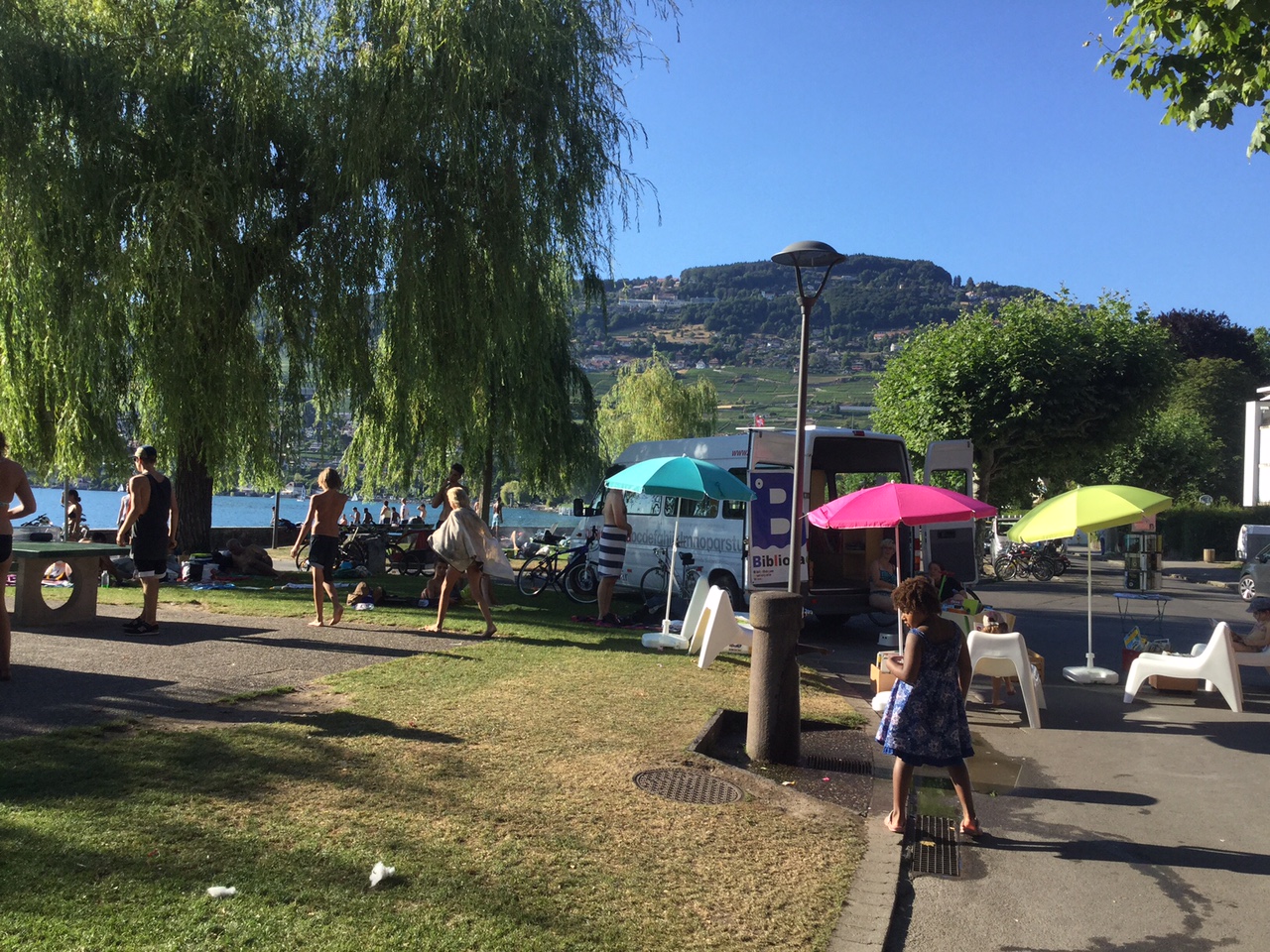
When I walked past on Tuesday, the local library had brought along their van with a pop-up library with books for kids in a cute little trolley and chairs to curl up into – and of course a friendly librarian to help with your choice.

IMG_0623 IMG_0624
IMG_0626 IMG_0625

Images: Nadine Bailey

The community also provides free wifi – albeit at not a very fast bandwidth.

Aesthetics

The whole area is surrounded by beauty both in nature, but also in the man-made and maintained flowerbeds and the placement of sculpture – including the wonderful kinetic sculptures of Charles Morgan, who is a local inhabitant.

In conclusion, this environment definitely reflects the words of Tim Brown in his TED talk in that it makes life easier, more enjoyable with an understanding of culture and context and where a focus on the systems (such as public transport) have a bigger impact on the society as a whole.

New Semester, new course: Designing spaces for Learning

Just started delving into the outline and introduction of INF536 my new course for this semester.  It feels like INF530 has barely finished and now it’s already time to move on.

I’m moving on in more ways that one. At the end of last term I unexpectedly found a “look-see” at a school library after expressing vague interest in an opening turning into a job interview and then a job offer and then another interview at another school and another job offer and then the agonising choice between two excellent but very very different opportunities!  The tyranny of choice.  After a sleepless night and an early morning (like 4am early – another interesting TED talk by Rives – see below), and the input of my entire family a choice was made and I’m going to be leaving my great but part-time and low-paying apprenticeship type job for a real “the buck stops here” job as Teacher-Librarian.

https://embed-ssl.ted.com/talks/rives_on_4_a_m.html

Which makes me even more excited about this course, because I must admit my heart did sink just a tiny little bit when I saw the small space that will be my new “domain”. But then I am heartened by the idea that there is value to be found in constraint. And that the physical space is but one part of where learning takes place. And that I’m going to be learning and doing and learning so this will be a “just in time” course for me.