Ask the inhabitants

My online library network is getting excited about a couple of articles that are challenging beliefs.

There’s danah boyds’ You Think You Want Media Literacy… Do You? it is an incredibly powerful article that needs to be printed out and highlighted and read very slowly. A couple of times. One passage that struck me epitomised the near futility in what we’re trying to do on the “fake news” front.

“This is about making sense of an information landscape where the very tools that people use to make sense of the world around them have been strategically perverted by other people who believe themselves to be resisting the same powerful actors that we normally seek to critique.(boyd, 2018)

Her conclusion is that we need to “inoculate” students against their very human tendencies by approaches that “are designed to be cognitive strengthening exercises, to help students recognize their own fault lines, not the fault lines of the media landscape around them” (boyd, 2018).

And then Wilkinson’s (2017) very apt writing up of her presentation that boils down to the fact that it is humans, messy, opinionated humans, subject to confirmation bias who are doing the research and therefor takes a welcoming psychological approach to understanding how students research – the paragraph on “post truth psychology is particularly well worth reading.  Her point is to short-cut the evaluation part of resourcing research and cut to reliability.

So while all this was percolating in my brain, I went for a run while listening to 99% invisible, and they had a two part series on the Bijlmermeer. Having lived in the Netherlands in the 90’s – my first year was when the plane went down on one of the buildings – I was very interested to hear what an American podcast would have to say about it. And I realised that in many ways as librarians and teachers we are imposting a modernism/functionalism mindset on research. With our structures and mnemonics we are creating these concrete structures that get in the way of a more organic way of knowing and learning.

Furthermore, planners realized people didn’t want to live in huge concrete structures. Almost immediately after the Bijlmermeer was finished, another neighborhood in Amsterdam was redesigned — it was done with bricks, a traditional Dutch material.

The Bijlmermeer, and maybe a lot of Modernism, was architecture for architects. It was a top-down, paternalistic approach to city planning. The redesign of the Bijlmermeer did not make that mistake. People from the community were heavily involved in the redesign process (Mingle, 2018).

So yesterday evening I decided to ask the inhabitants. In this case my two high-school teenagers. I asked how they did research, how they decided where to search and what to use. The answers were enlightening. And frightening.

First my highly intellectual daughter who “does school” very well. She admitted that she didn’t have the first idea about doing “proper” research and that actually in the last seven years that she’s spent in a highly prestigious very expensive school she hasn’t had one single session with a librarian. Nor had her teachers taught her anything as up to now she’d never been asked to reference anything. And it’s only because I’d insisted and taught her Zotero for a recent Geography course-work project did she really know much about it. She blamed having to do the iGCSE, (something she absolutely hates) and if I had my time over I would never put my children in a school offering (i)GCSE. It’s a waste of time and intellect. Added teaching my daughter research before she goes off to do her IB onto my list of things to do in the next 3 months. Hahahahaha, crash course research. The irony.

Then my son. The dude who’s had a tough ride of school and teachers. The one that was fortunately rescued from prestige and arrogance. Well, he said, the need to spend time with the librarian on research was an extra bonus, but the problem wasn’t actually as “acute” (his own words!) as at his sister’s school as the teachers were “all over” researching well, so going to the library was reinforcement for what the teachers were doing. Well, I guess I use CRAAP he says. OK, I challenge, what does CRAAP stand for. He laughs embarrassed. Well, I don’t really use CRAAP he says – at the beginning of the year my teacher shared this site with us that gives reliable sources, so I know as long as I stick to those I’m ok. Touché.


Image-1 (1)


Back to the more structural part of all of this – Caulfield, who I greatly respect has a useful graphic and new open-source textbook – Web Literacy for student fact checkers for those who want to continue on the architectural part of research and learning.R

I like the first habit of “Check your emotions” – a bit like Tim Harford’s guide to understanding statistics in a misleading age.  Moi? I think I’m going to teach more psychology and less CRAAP to my students. A great place to start is “Your logical fallacy”  who have produced some excellent posters and other resources.

References:


Between competition and cooperation

At the moment I’m busy setting up for Readers’ Cup season. And I have yet again a chance to think about the balance between competition and cooperation. This time in the light of having attended the AISC in Hong Kong in December (which I still need to write about) and and particularly having attended David Gleason’s session “At what cost?” (You can purchase his book here).

Some educators, and most parents (particularly the competitive types themselves –  and high fee paying schools are full of those types – because they’re the “winners“, if they weren’t they couldn’t have afforded the fees) will tell you that kids “love” competition. That it’s an artificial construct to pretend otherwise. And the whole movement towards medals for all is “stupid” or “unnatural” etc.  I’m not entirely sure. And bits of evidence appear to be pointing in different directions. I’ve not done any academic study of this, and won’t be able to point to any peer reviewed research, but things I’ve been hearing and reading seem to think there is substantial nuance in the matter.

The most interesting of these was the following: “Do Nobel Laureates Create Prize-Winning Networks? An Analysis of Collaborative Research in Physiology or Medicine“:

Nobel Laureates in Physiology or Medicine who received the Prize between 1969 and 2011 are compared to a matched group of scientists to examine productivity, impact, coauthorship and international collaboration patterns embedded within research networks. After matching for research domain, h-index, and year of first of publication, we compare bibliometric statistics and network measures. We find that the Laureates produce fewer papers but with higher average citations. The Laureates also produce more sole-authored papers both before and after winning the Prize. The Laureates have a lower number of coauthors across their entire careers than the matched group, but are equally collaborative on average. Further, we find no differences in international collaboration patterns. The Laureates coauthor network reveals significant differences from the non-Laureate network. Laureates are more likely to build bridges across a network when measuring by average degree, density, modularity, and communities. Both the Laureate and non-Laureate networks have “small world” properties, but the Laureates appear to exploit “structural holes” by reaching across the network in a brokerage style that may add social capital to the network. The dynamic may be making the network itself highly attractive and selective. These findings suggest new insights into the role “star scientists” in social networks and the production of scientific discoveries.

Things seem to have shifted in the last 50 years, as interestingly enough, in 1967,  Harriet Zuckerman found that:

“Nobel laureates in science publish more and are more apt to collaborate than a matched sample of scientists. Interviews with 41 of 55 laureates and comparison of their research output with the output of the matched sample indicate that these patterns hold at every stage of the life-work-cycle. As laureates report and as their publications corroborate, they exercise noblesse oblige in arranging co-authorship in collaborative publications. Receipt of the Nobel prize is followed by declining productivity and changed work practices, as a result of changed role obligations and activities. Reductions in productivity are more severe for laureates who experience comparatively large increments in prestige through the prize than for those who were already eminent. The prize generates strain in collaborative associations so that most of these terminate soon after the award.”

And then of course the Google findings that what they needed in their employees wasn’t necessarily STEM skills or coding, but actually empathy.

“Project Oxygen shocked everyone by concluding that, among the eight most important qualities of Google’s top employees, STEM expertise comes in dead last. The seven top characteristics of success at Google are all soft skills: being a good coach; communicating and listening well; possessing insights into others (including others different values and points of view); having empathy toward and being supportive of one’s colleagues; being a good critical thinker and problem solver; and being able to make connections across complex ideas.”

How should this knowledge change my approach both to my own students and my practice as a librarian within the greater network of librarians both in Singapore and generally?  Besides evangelising our school’s Blokes with Books clubs at a number of different conferences this academic year – because I believe SOCIAL BELONGING is such a vital ingredient in learning; I’ve also started pushing the Global Read Aloud whenever I can. It has its flaws, as I’ve documented, but it’s a good start for cooperative connection and reading.  It’s a model that we can emulate at a national or regional level where we form connections between students in our own book clubs, and can reach out to students at other schools as well. The technology is there, synchronous and asynchronous, we just need the will to create the time and enthusiasm.

The typical relationship between schools (if any) is adversarial. We compete for students to ensure “bums on seats” so we can ensure our continued existence. We compete in sports, in chess, in lego robotics, in the math / science olympiads, battle of the books / readers’ cup. Schools like to be “exclusive” where the emphasis is on “exclude” . And yet all the research on motivation, academic and otherwise shows us that the things that count are autonomy, mastery, affiliation and purpose (using those words or a variation of them). In all the 100s of studies I’ve read over the last years, not one article has ever suggested that competition is the way to go – except to say it doesn’t work, nor does other types of extrinsic reward.

So why do my students get rabid with excitement at the mention of a kahoot? And yet the flip side of that is that there are always tears and panic – human nature, human emotion, adrenaline?

I’d love to be able to keep central the idea of “I’m improving” “we’re improving” “we’re in this together”. As Jeremy Farrar stated, reflecting on the 2017 Nobel prize winners:

“And if we look towards some of the great challenges of our time – tackling the problem of clean and sustainable energy, providing sufficient food for a growing planet, developing new genetic technologies to improve health, or harnessing the power of the digital revolution, we start to see how difficult it will be for any one individual to take any of them on alone. The same is true for fundamental science such as understanding the working of the brain or the origin of the universe.

Collaboration brings fresh ideas and new perspectives. Bringing people together from diverse backgrounds, often across borders, leads to new ways of thinking, better solutions and faster progress.”

References:

Farrar, J. (2017, September 30). We hail individual geniuses, but success in science comes through collaboration. Retrieved 24 February 2018, from http://www.theguardian.com/commentisfree/2017/sep/30/we-hail-individual-geniuses-success-in-science-collaboration-nobel-prize
Gleason, D. L. (2017). At what cost?: defending adolescent development in fiercely competitive schools.
Strauss, V. (2017, December 20). The surprising thing Google learned about its employees — and what it means for today’s students – [Newspaper]. Retrieved 24 February 2018, from https://www.washingtonpost.com/news/answer-sheet/wp/2017/12/20/the-surprising-thing-google-learned-about-its-employees-and-what-it-means-for-todays-students/?utm_term=.125a0277f88b
Wagner, C. S., Horlings, E., Whetsell, T. A., Mattsson, P., & Nordqvist, K. (2015). Do Nobel Laureates create prize-winning networks? An analysis of collaborative research in physiology or medicine. PLOS ONE, 10(7), e0134164. https://doi.org/10.1371/journal.pone.0134164
Zuckerman, H. (1967). Nobel laureates in science: Patterns of productivity, collaboration, and authorship. American Sociological Review, 32(3), 391. https://doi.org/10.2307/2091086

The Imitation Game

Recently I’ve been given to much pause of thought about learning and education, not the least following watching the movie “The imitation game” about Alan Turing’s code breaking during WW2 on the plane, followed by three days of intensive attending of presentations at 21CLHK.   It’s taken a while to try and crystallise my thoughts, and they’re probably still not as coherent as they should be, but these are my main takeaways.

While Turing is attempting to build a machine that will, in the long term, take over the work of cracking this (and other) codes, everyone around him is desperately engaged in a race against the clock. And at midnight each day the clock is reset, all work they did that day is useless and they start again from nothing the next day.  While I know that education is not exactly like that, I sometimes feel that a school year is like that Bletchley park day with a teacher racing against the daily clock, against the time-tabled period which they’re allotted to do one thing or another and then the bell goes or the summer holiday starts and we’re back at square one, but the child is handed over to the next person.  I’ve said before this is fine for the “middle”. It’s the children at the extremes where this handing over is most acutely observed, either in a positive or negative sense as they lurch through the process of learning and hopefully becoming educated beings.

Far worse is not only is Turing not supported, but the mediocre middle are out to destroy not only his machine, but him as well.

Ironically it is always easier, and more appreciated,  to work extremely hard at a huge volume of output,  than to openly take a step back and reconsider the foundation upon which practices and assumptions lie.

I’ve often decried the lack of longitudinal research in education. Our current high schoolers, what do they “look” like now (from a literacy standpoint which is my optical focus) and what did they look like when they were in G4 (my area of concern for my BWB club). And my G4’s where did they come from? How soon did their literacy attempts start to diverge from the middle? How about the ELL students? We know that the process of learning a language to CALP (cognitive academic language proficiency) level is a 5-7 year process. So when they exit an ELL programme after 2-3 years we haven’t even scratched the surface.

I attended quite a few sessions / presentations at 21CLHK that were symptomatic and typical of this “information” age. A deluge of ideas and devices and applications, delivered at a rate exceeding the absorption of most of the (highly intelligent) brains present.  I fear we employ the same methodology with our students. I know that I do. I get 40 minutes a week with my G5&6s and 20 minutes a week with the rest. Lessons and wisdom (in as much as I can claim to have any) needs to be imparted within a fraction of that to allow time for browsing of books. Teach the teacher they admonish. The teacher who has no time, as they race through a curriculum, that while enquiry based, demands 6 inquiries in 8 months. And where none of the units in G1 look at cars and planes or dinosaurs or dogs and cats or insects or space or the other obsessions a 6 year old has.

book-of-mistakes.jpg

I can read stories. Stories that I hope will cut through the clutter and touch their hearts. And I can but try to shove the right books in the right hands before the next group of wonderful eager expectant hugging children walk in. I sometimes say to my more illustrious and famous ex-MBA friends that I’m paid in hugs rather than dollars, and its true. I can try to show, not tell, them that mistakes aren’t important, it’s what you do with them that matters.

And then the Social-emotional (SE) dimension. Back to Turing. By the movie depiction he was socially inept, cared more for his work and ideas and machine than for the people around him. The movie at least gave a nice nod to the ideas of development of relationships and collaboration and the notion that a good team needs more than just raw intelligence. I do badger on a bit on SE Learning and the need for books and picture books to aid discussions and self-exploration / understanding.  I am confronted daily with students who struggle in this area, many of whom don’t have the “brilliant mind” that people like Turing had to perhaps compensate. The children who return a book and say – “it was an important book, because you know I’m also being bullied” and I look at them and I can see why their cohort would target them and how hard it is to protect them and turn the tide of otherwise nice kids performing macro and micro aggressions on children who are just slightly off kilter enough to merit the worst kind of attention.

And then you see an article like this one, announcing an OECD Pisa-like test for Social-Emotional skills. Please take the time to read and absorb the article and its implications. There is part of me that says perhaps the children who so desperately need interventions will get them. There is another (larger) part of me that knows that we do all sorts of other math and literacy testing that doesn’t lead to additional help so how on earth would we find the people, the expertise, the money, the time to devote to this area? And once it’s tested, and the tests are far reaching – even into the untouchable of untouchables in education – student’s homes, what will happen to the results? I’ve seen students desperately in need of having reading disability testing where parents have refused as they’re terrified of the stigma of a label even as innocuous as dyslexia as the child goes through school.

So I wonder, what can and should our responses be? Can we, should we, slow things down? Try to look at school as the whole process and learning as life-long – as we so often purport to do or hear the meaninglessly bandied phrase “life long learning” when all we actually do in schools is cut short every attempt a child makes at extending learning?

Chris Crutcher (author of Whale talk amongst other books) posted this on his Facebook in December (it takes a while to find amongst all his US-politics angst, so I will repost it here). I’ll leave you to think about it.

Almost everyone I know who dismisses the teaching profession wouldn’t last a day with this cool little dude (age 6!) – in a classroom where a whole bunch of kids see the world 180 degrees from him – before making him think he’s awful. This is the gamut range in EVERY classroom, k-16 and beyond. His teachers KNOW there isn’t an easy answer, but they come back and come back and come back, looking for what works; in an American educational environment crafted largely by non educators who would rather score high on mind-numbing tests of memory, than celebrate – and PAY for – creativity and expression and wildly different learning styles.

SO…this is for anyone who ever tells you teachers take that job so they can have three months off, or that “Those who can, do; those who can’t, teach,” and for anyone who needs a great example of why it isn’t:

WORD FOR WORD

12-4-17

N. School is hard.

?

N. I want them to leave me alone.

?

N. Grown ups. They want me to do work, but I am too tired. Then they keep bothering me with words. I just want to stay one hour cause school bothers me. I hate school.

?

N. Boring. It’s so boring. I don’t want to go to school.

?

N. I want to stay home and have fun. I can teach myself. I like to use my brain and think and learn without being in a big building. They don’t help us learn, they just suspend us. I already know what they say. I’m just bored. Games help me learn. Building things help me learn. I study things and learn and not in a big building. Computers help me learn. They tell me stuff I don’t know. They don’t let me learn there at school. I have to sit there and listen. I want to learn non-fiction because I’m a scientist. They are wasting my time.

?

I could be learning. I want non-fiction so I can study. They read fiction stories but I like non-fiction books and computers. They’re making me dumb cause they don’t tell me non-fiction. They want me to be normal, but I want to be a robot maker. They try to make me normal but I don’t want to.

? Normal?

N. Sit there and listen which I don’t want to. That is so dumb. I want to do stuff so I can learn.

? If you were the teacher?

N. I would have kids do cool stuff like learn how to build cool bridges. I never got to go to the computer lab. They make me do dumb papers but I want to use the computer, cause computers know cool stuff. I want to learn everything, but school is holding me back.

?

It takes me away from studying and learning. (Chris Crutcher, Facebook, 11 December 2017)


Species at risk

(Usual disclaimers – does not reflect the position at my current school but a comment on librarianship as a whole etc. etc.)

I’ve been prompted to think about the library / librarian as part of an ecosystem (as opposed to the library ecosystem itself, * an important distinction) a lot recently as a result of the continued dismal reports on the state of libraries globally, but particularly in the USA / UK.  On some of my librarian groups there are school librarians saying that their annual budget is US$100, to which hundreds of others reply theirs is zero. In the largely International School Librarian bubble that I operate that is luckily unthinkable except in a few rare for profit schools with little reputation to care about.

My Grade 1 students in their “Sharing the Planet” unit of inquiry investigate ecosystems, and I love learning along with them, as I continually update my knowledge and integrate aspects that were neglected in my own education. Last year I organised a great guest speaker, Jennifer Fox to come in to talk about “Saving the Rhino” and while she was talking about Rhino’s as “Umbrella Species” I was thinking about just how libraries and librarians are a little like crucial species at risk, and did a little research on the matter.  The National Wildlife Federation identifies three types of species they work to protect: Keystone, Umbrella and Indicator. I’d argue libraries have characteristics of all of these species. Let’s look at the definitions:

Keystone: “Keystone species are species that enrich ecosystem function in a unique and significant manner through their activities, and the effect is disproportionate to their
numerical abundance. Their removal initiates changes in ecosystem structure and often loss of diversity.”

Umbrella species: “An umbrella species are typically large and require a lot of habitat. By protecting this larger area, other species are protected as well. Umbrella species generally have the following characteristics: their biology is well known, they are easily observed or sampled, they have large home ranges, they are migratory, and have a long lifespan.” 

Indicator species: “A species that is particularly sensitive to environmental conditions and therefore can give early warning signals about ecosystem health. Because they are so sensitive, a decline in indicator species’ health can signal air and water pollution, soil contamination, climate change or habitat fragmentation. Indicator species are often threatened or endemic (native) species.” (quotes from National Wildlife Federation).

Libraries (when I say libraries I want you to read “libraries staffed by trained and competent specialised librarians”) are Keystone in the way they enrich the communities around them whether that be a local community, a school or university, or even a commercial entity with a library. In school environments often the number of librarians is vastly out of proportion (in the diminutive sense) to the community they serve, and yet all the teacher librarians I come in contact with are hugely influential in setting the tone for literacy and research in their schools. Exchanging information with each other to maximise their footprint and benefit to the community. Most of us strive to allow the voice of diversity to be heard and to have collections that reflect diversity. And if allowed are a counterbalance to other voices in the ecosystem as we generally have a longitudinal view of literacy and learning.  Umbrella – well, yes, libraries are large with a big footprint. We take up space. And space is often at a premium. And as a result there is often significant pressure for us to be all things to all people. Something I’d argue that results in the myth of the “super librarian” and doesn’t always have the desired outcome. In the International sphere, as I’ve just been noticing with the annual “musical chairs” of teacher librarian job positions opening and closing, I’d say even the “migratory” part is true.

The saddest is the way in which libraries are Indicator species. And there I’d say countries like the UK are in dire straights with the state of libraries and librarianship being the canary in the coal canary coal minemine. This has the most awful knockoff effect that is unfortunately felt world-wide. Over the summer I toured a number of very prestigious and expensive private (called public there) schools in the UK with my daughter who was looking for 6th form boarding. None of them had the school library on tour, and when we asked to see them, if we were allowed more than a peek through a locked door they were dismal to say the least. Collections were outdated, the library was cramped with limited space and big desktop computers had prominence. But besides that the library had no “presence” at the school in the sense of posters advertising books, announcements, classroom libraries, anything to say that the library was an active and valued part of the community. This is not only a pity for that particular school. Unfortunately the pool of international educators and particularly heads of schools and divisions is often taken from graduates and teachers from these institutions. And of course the Peter Effect applies – they too cannot give what they do not have. Show me a teacher-librarian struggling in a school ecosystem and you can probably follow the trail to an “under-libraried” principal or school head. Research and advocacy on the importance of reading and libraries be damned, they don’t feel it / have it in them, so it’s an intellectual construct for them. The converse is also true, I’m incredibly fortunate to have both a principal and head of schools who believe in libraries – yes, believe as in a tenant of faith, because I think that is actually what is needed – belief not just lip-service to borrow religious analogies along with my eco-system ones.

Digging around for some statistics I can see how circular reasoning is employed. Libraries are expensive, both in capital costs, in person-power and in keeping collections up to date, in the link above you can see a decline in spending and a decline in borrowing. Correlation is not causation, but the last “big spend” was around 2009 – are patrons interested in an outdated collection? I’m a member of the Singapore public library system. I actually physically visit the library once a year, to renew my membership card (and if I could do that online I would) but I borrow eBooks and audiobooks on a bi-weekly basis to get my “adult book fix” that’s not supplied by having K-6 books on tap in my school library. Beware of statistics.

Continuing on the ecosystem theme – who are the “big five” in education (if hunting refers to head-hunting)? To go back to a much read blog-post I wrote earlier on that dirty little word “power” again, looking at recruiting and search, I’m stunned that teacher librarians, a position requiring two masters degrees plus a teaching certification and “experience” are lumped in with teaching staff and are not part of the “leadership” positions. Librarians, like curriculum coordinators, heads of division and heads of schools have an overview of entire sections of schools. They give input into resourcing teaching and learning. Often have a dual role in learning technology as well as databases, digital and physical resources. Usually supervise library assistants and manage large budgets and a facility. Yet they are on teacher contracts and can and are regularly shoved back into the classroom when budget strings are tightened. There was much outrage on our International School Librarians’ group recently when a position in a prominent (UK) name brand school came up and the 13 page application form included such irrelevancies such as EVERY school attended since age 12 and EVERY job ever held as well as personal information such as whether your own children needed learning support (on the first page). Most people said they gave up after the first or second page as the information was largely irrelevant to the function, outdated or reeked of an exclusivity that didn’t align with their personal educational philosophies. Good luck finding a great librarian there, or maybe they’ll just staff it with the (unqualified) partner of a higher power or a nonfunctioning teacher (yes this happens more than you could imagine).

In saving libraries and qualified librarians we are not just saving buildings or people’s jobs, we’re saving the continued existence and perpetuation of literacy, learning, knowledge and wisdom. As crucial to a civilised society as the air we breath. Stop worrying about fake news, if we focus on good well run libraries the problem would take care of itself.


*Here is another great article using the eco-sytem metaphor – this time about feral and hybrid academic librarians!

How librarians can leverage the GRA

I firmly believe that one of the main role’s of a school librarian is to make teachers’ lives just that little bit easier. And if we can do this while fostering a love and enthusiasm for reading in students – well that’s a double win.  Over the last few years I’ve written about the things that make the biggest impact on students’ favourite book, and teachers’ reading aloud to them is right up there above author visits, peer recommendations, book clubs and parent read-aloud.

Last year was the first time I experimented with the Global Read Aloud. Since I was just getting my feet wet, and only see classes once a week, I did the picture-book series with the books of Lauren Castillo. I tried, but failed to read the middle grade book (Pax), since we ran out of time and students were over-committed and couldn’t join during recess time. A couple of teachers tried Pax (and one or two even finished it), but they found it way too USA-context specific and unfamiliar setting to our students, needing an excess of background information and explanation – a view I concur with.

This year, with the books including some of my favourites – A Long Walk to Water, Wild Robot and Mem Fox as a picture book (and Fenway and Hattie – a book I didn’t enjoy but knew would strike a chord with my dog loving students) – I pushed a little harder with my G3-6 teachers. It helped that all had some pretty excellent Hyperdocs. I made an extensive library guide that could act as a one-stop-shop for teachers so they didn’t need to search awild robot.jpground for dates, documents, links etc. Ordered copies of the books and made sure students didn’t access them prior to the read-aloud, signed up for post-card exchanges and classroom partnerships. Then I subtly and not so subtly pushed teachers into agreeing to try it out. My pitch was basically that it was a great way to kick off literacy right at the start of the year without having to do any preparation besides deciding which parts (if any) of the brilliant Hyperdocs (e.g. Wild Robot) to use. In addition they’d get brownie points for making global connections!

I did the G2 classes myself, and had a great exchange through padlet with Tanja, the librarian at Hong Kong Academy. Luckily we had more or less the same holiday schedule, and in fact since she was in Singapore on holiday when we still had school, she was our mystery reader for one of the weeks! Our G2 students loved the Mem Fox books and really enjoyed sharing their lives and experiences with their buddies in Hong Kong.

The G3-6 classes who participated all reported that it had been successful. The main “complaint” being that they felt a little bit pressured to keep up with the schedule, amongst all else that was going on at school, but when they let go of that it was fine. Our G6 classes found substantial links between Long walk to water, to their curriculum unit of inquiry (WWAPT) of development and natural resources, particularly around the question of water, and also requested more text-to-text resources.

I was recently reading an article on the “Peter Effect” which basically posits that teachers’ cannot give what they don’t have – related to lack of reading engagement. This is one (painless) way of compensating for this effect by making it a very low barrier activity.

While the Global Read Aloud is a fantastic institution and I plan to continue to support it, I do however have to make a few points of what I hope is constructive criticism in the hope of making it even better.

At the moment “Global” is a bit of a misnomer, as it’s more of a “North American” plus some other internationals (albeit more than last year). For example in our postcard exchange, of the 60 cards we sent, 50 were to schools in the 50 states of the USA, plus 3 to Canadian schools and only 7 to schools in the rest of the world. Hopefully posts like this will increase recognition and participation.

I think a few things prevent it from truly being global. One of them is the timing – we agreed with our partners to shift the dates to take account for the fact that we had a two week autumn break in Asia right in the middle of the schedule. The other, I’m afraid to say is the choice of books.  As followers of this blog know, I’m a vociferous proponent of diversity and inclusion in literature and I must admit to some disappointment in the choice of authors / illustrators. There was some improvement this year with “Long walk to Water” (albeit the author still from the USA), and Mem Fox – but while Mem Fox may be somewhat exotic to the North American audience, she is anything but to the rest of us.  As someone who has been on the Red Dot Book Awards committee for the last few years, I know just how difficult it is to find the right mix of books for a book bundle. I also know how quickly and easily others criticise the choice once it is made and how difficult it is to solicit suggestions from just those people who later make the comments! So everyone, take some time to make suggestions on some truly global, international, diverse books and authors. And if you’ve not yet dipped your toes into the fun that is GRA – perhaps try one of this year’s books with the associated teaching guides.


Libguides – back-end/front-end (3)

In the last blog on Libguides this year I just wanted to show a little bit of what is going on “under the hood” with “forcing” things to look in a certain way around the possibilities and constraints of Libguides.

Our school got a great new brand update last year, and this meant that we needed to update our colour scheme for our Libguides. The only issue how-ever is that our corporate colour red, is wonderful for many things, but there are some cautionary notes in its use on websites, including it being tiring on the eyes (particularly red with white text). In addition, young children like bright colours and different colours, so I wanted a way to introduce some colour into the Libguides without  disrespecting the hard work and thought that had gone into our branding. The way I did this was by using, our marketing designed, UOI logos and their colours in the UOI guides – which are the most frequently used sites by our students.  There I had some great colours to work with.

Screen Shot 2017-12-20 at 11.15.47

The question was how to do this without throwing away all the work I’d done previously on the guides?

This was done by using a “front-end” / “back-end” trick. i.e. all the original guides were still where they’d been, with one guide per grade for all UOI’s (the back-end), however the new front-end incorporated the colours of the UOI, the larger fonts, the missing breadcrumbs etc, that I’ve mentioned in this blog.

WWA G4 front end

On the left you can see the final product – in this case the “Who we are” units for all the grades, highlighting G4.

There are two ways of doing the “front-end/back-end” thing.

1. Redirect

The first way is to create a page that then is redirected to another page on another guide.

Advantages: 

  • You maintain the formatting and particular style of the page on the other guide, while still having a tab on the current guide to that page. For example, on each page of the UOI guides I have a “back to TK library” page, that isn’t actually so much a “page” as a quick link back to the main page. (I still need to work out how to make that a little home icon rather than the cumbersome script!)
  • You can use the same page multiple times on lots of guides without any extra work
  • You can use the same page for different target groups.

Disadvantages:

  • Your viewers are suddenly taken out of one “reality” (e.g. a UOI guide) into another reality (your home page); so you need to “open in a new tab” and then you get the tab proliferation issue
  • The page you open into won’t have the same look and feel as the guide they left.

Below I’ve put a few screen shots as to how to realise this option. And what it looks like


2. Mapped page

With this option you actually insert a page from another guide, and it takes on the style / look and feel of the guide you’re adding it to. This is the option I used for the UOI guides. That way each page would have the coloured tabs depending on the UOI colour, the large font, etc.

Advantages:

  • You don’t have to “reinvent” the wheel if you have otherwise good content in existing guides, but they don’t look so great.
  • You get to keep “standard” Libguide variable column types in the same guide (i.e. one page can have 4 columns, one 3, one 2 etc.)

Disadvantages:

  • Unless you’re pretty rigorous in your adherence to some kind of uniformity in style, you could end up with a guide that is a hodge-podge of style and content – this is something I’m trying to clean up now – each time we move onto a new UOI, I spend some time “cleaning up” the back end so it conforms to the new layout.
  • You cannot map a page that has a weird and wonderful formatting to a guide that has a plain vanilla style sheet

See the images below how to realise this – I’ve deliberately mapped a page that has special formatting to a “normal” page to show how it doesn’t work well!


Finally to end off, here are a few shots of what the mapped G4 guide looks like “behind the scenes”


For the librarians in Singapore, I’ll be hosting a few sessions in the evenings on how to create this type of Libguide in January. So contact me if you’d like to join in.  Free of charge, the only obligation is to contribute to the work on one of our ISLN committees and take your new-found knowledge and spread it forward.

Libguides – not so easy (2)

The basic page view of libguides is the option of a top and bottom row of one column, sandwiching a number of rows of either 1, 2, 3 or 4 columns. But the constraint is that then all the boxes in subsequent rows need to be in the chosen number of columns.  And sometimes – particularly for front pages / landing pages you’d like a variety of rows / columns.

So today a little bit about how to get from an idea to the actual guide with extra rows and up to six columns.

In the sketch above you can see what I’ve called “student template” On my home page I have an icon called “students” and I wanted a secondary launch page where my students could find everything they needed on one page. It’s probably a little too busy, and I’d perhaps eliminate the second row of many icons – the “go to” one in retrospect. Anyway how to do it.

Unlike in the previous post, where adjustments to a guide were made in the “Guide Custom JS / CSS” these changes are “programmed” into the guide template at the “look and feel” level.

Admin – Look and Feel – Page Layout

Screen Shot 2017-12-12 at 04.15.25

Here you can either choose a template that you’ve created, or create or edit a template. You can see the last one is called “Students Homepage Template”

The main thing in this somewhat scary process of rewiring a page is to make sure you create a plan before you start – which is why I put the plan and actual side by side.

Again, as stated in “how I built a libguide” you will need to have a web-text editor, (like Atom) so that you can try and mess up and try again without impacting your users.

I don’t have time to write about everything, so I’ll just explain the basics and then give you the bits of code to make the 5 different rows.

Overview

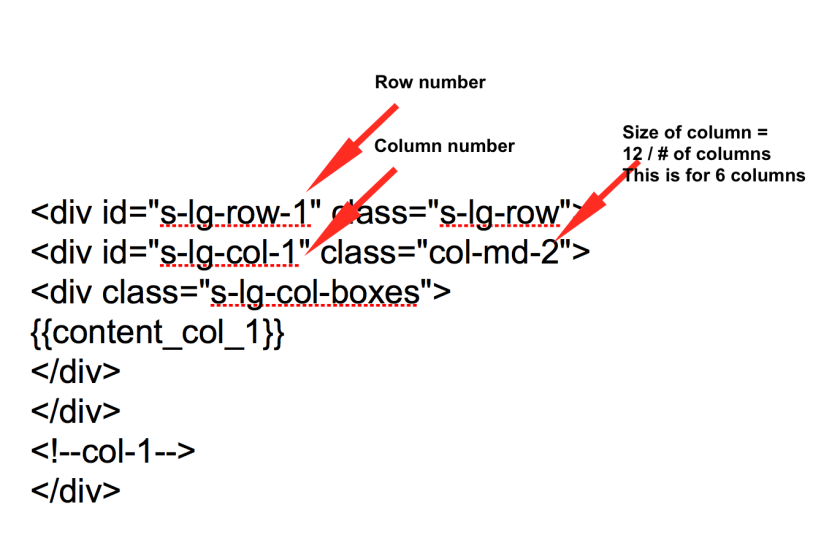
The libguide page is divided into 12. I think having 12 columns would be eye-boggling and since I have 6 Units of Inquiry and 6 grades, the maximum number of columns I needed was 6.  So the size of 6 columns is 2 each, of 4 columns is 3 each etc.

A few other considerations are seeing the guide on the iPad (default for my students) or phone (default for the parents). I won’t claim to have gotten that part correct, or even to understand it entirely – you’ll need to get more expert for that, but I’ve put in a best effort. My guides are best on the desktop, followed by iPad in landscape mode.

Planning

Sketch out what you want your page to look like and number the rows, and then number each column. You can see I actually have 5 rows and 19 columns. It is necessary to be able to keep track of things, as row, and each column in that row needs its own little bit of code.

This is the basic coding:

Screen Shot 2017-12-12 at 08.41.16

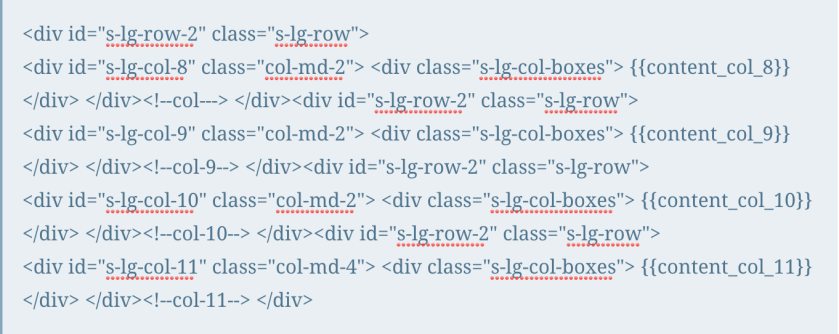
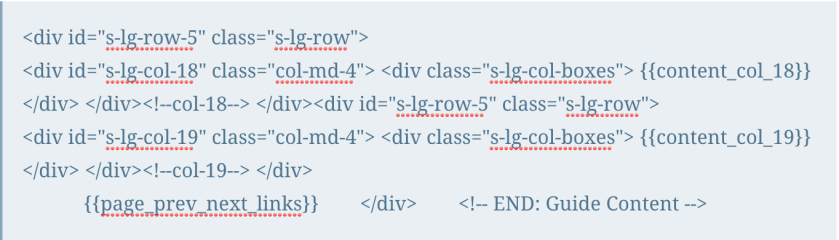
And here it is row by row. My apologies – I wanted it to be easy to copy and paste and originally had it in quote boxes, but WordPress does NOT like you putting bits of code into your posts, so in the end I had to screen shot the relevant bits. And I see I’ve mixed up bits of row 2 in row 1. But I’m sure you’ll get the idea.

Row 1

Screen Shot 2017-12-12 at 08.44.09

Row 2

Screen Shot 2017-12-12 at 08.44.00

Row 3

Screen Shot 2017-12-12 at 08.43.54

Row 4

Screen Shot 2017-12-12 at 08.43.47

Row 5

Screen Shot 2017-12-12 at 08.43.34

Once you’ve changed the template and uploaded it into your look and feel, you now need to apply it to your guide.

Once again this is done under the “picture” icon on the top right hand side, and this time you choose “guide navigation layout” and from the drop down box choose the template you created.

I’ve shared this template with the community, so you should be able to get the whole template and use and adjust as you want.

Screen Shot 2017-12-12 at 04.57.52

WARNING

Please do this all in a test environment with guides that are not live. Things can and do go horribly wrong and I’ve had to be “rescued” on a number of occasions by Springshare due to faulty code wiping out my ability to do anything!

Libguides: a couple of easy things (1)

Well, the response to my last post was quite surprising. So I’ll continue with a few posts on very easy things to change the look and feel of your guide.

First off though, please do consider joining the Springshare lounge – help is literally there for the asking, and no question is too basic.  You join a group based on your usage.

Secondly in response to what we use: Libguides CMS V2. If you’re on V1 still, update (free) to V2 as it offers so much more. We also have a paid subscription to LTFL (library things for libraries), we’ve just subscribed to their book display widget,  it’s an extra cost, but it’s for our 3 libraries at what I consider a reasonable cost, and they’re very generous on their trial period. Cost depends on how many of their services you use. If I had more budget I’d subscribe to their series and tagging services as well.

Finally – if you’re looking for non-video guidance on libguides, I’ve found the University Libguides to be the best, (Kent for HTML/CSS, Illinois for getting startedNorthwestern, Calgary, etc. )as they’re the most extensive and intensive users of Libguides, but I’d like to also give a shout out to RILINK schools, as their guide is also very comprehensive.

OK finally, a few easy things

Changing font size just for one guide:

Screen Shot 2017-12-05 at 04.40.41

This is done by changing the “Guide Custom JS/CSS” which is found under the picture icon.

(note for beginners: I’ve placed the coding inbetween: /* text */ : so it doesn’t mess up my blog! you’ll need to remove that for it to work – i.e just copy from <style> to </style> if you want to include more than one element just include them all in-between the style and style elements)

How to make the font size bigger in your boxes:

Since some of my boxes do need text, I’ve made them 24 point so they’re easier to read for little ones.

Screen Shot 2017-12-05 at 04.54.38


/*

<style>

/* increases font size on box headers */
.s-lib-box .s-lib-box-title {font-size:24px;}


</style>

*/

How to make the font size bigger in your tabs:

Ditto for tabs – all these tabs are 18 point – also as good practise this forces you to keep the number of tabs under control and only on one line!

Screen Shot 2017-12-05 at 04.59.14


/*

<style>

/* increases font size on tabs*/
#s-lg-guide-tabs {font-size:18px; font-weight; normal;}

</style>

*/

How to make link description under link and bigger

These elements are all links (so I can get the stats), but I didn’t want the description to be tiny and at the side, and have a dot next to the image.

Screen Shot 2017-12-05 at 04.54.03

*/

<style>


/*link description center and bigger font*/
.s-lg-link-desc {font-size: 14px; font-weight: bold; text-align: center; display: block; margin-right: auto; margin-left: auto;}
.s-lg-tn {margin-left: 0px;}

</style>

*/

How to remove breadcrumbs

that’s all the stuff that makes your header look cluttered on the left you see the standard libguide with the blue breadcrumbs and all the tags etc, on the right the “clean” version with only the guide name and top banner:

*/

<style>

/* removes breadcrumbs */
#s-lib-bc{display: none;}

</style>

*/

That’s all I have time for now! Requests and questions welcome in the comments.

And please remember I didn’t invent any of this, most of it was the result of asking Springshare or in the lounge how to do something I envisaged. Their customer service and response is amazing.


How I built a libguide

aka I think I’d better think it out again …

Over the summer I completely rethought our school library libguides, and I’ve received quite a few positive comments and questions as to how I made the guides. Unfortunately there is not quick and easy answer, as the process resembles more closely this TED talk on building a toaster from scratch than a few lessons on embedding photos, files and links.  So a little warning that things may get a little geeky.

When I started building libguides at UWCSEA-East nearly 5 years ago, I really had very little idea what I was doing.  Content wise I was OK – I’d interview the teacher or head of department who wanted the guide, or Katie Day would tell me what she had in mind, and off I’d go finding interesting bits and bobs, do some extensive research and put them in a guide in some kind of logical flow and predictability.  We started with making IB subject guides, really something to help students think about and around their subject and to perhaps pique interest in an area for their Extended Essays. Then teachers would ask to expand on a specific area (like development economics).  Anyway, when I left to take up a position in a PYP library at CIS, I resurrected our libguides and continued in the same line with the thought of uniting our digital and physical resources. Except primary and secondary are two very different ballgames. Aside from the obvious content issues – videos and links need to be age appropriate, the way that younger students access web-based information is very different to older students.  And so my journey began.

During the LKSW at UWCSEA-East last February I attended a workshop by Brad Tyrell of Scotch College. Now Scotch probably has the most awesome looking libguides around.  They also have a team of developers and designers and IT-type specialists and vastly more staff than most libraries could dream of.  So let’s say they’re the Koenigsegg CCXR Trevita, and up to then I’d been the Tata Nano, I reckoned there had to be a way I could get to at least a Toyota level, or maybe a basic Tesla.

Unfortunately that workshop was a little too basic, but I did learn a few tips and tricks, including to watch out to use items that were counted statistically (books, links, databases) rather than just RTF and images, so you could have an idea of what people were finding useful / using and what not. There were also good hints on workflow and guide organisation.  After the workshop I jazzed up my homepage and it looked like this:

Old libguide

While it was colourful, and to my mind logical and easy to access all the bits and pieces (plus each box was a link rather than rtf, so I could track where users were going), the overwhelming response from students when I and teachers asked for feedback at the end of the term was that there were “too many words”.

This is a common refrain in schools about just about anything with words – from websites to encyclopaedias, to books and beyond. In fact my teenage son introduced me to the concept of TL.DR (too long, didn’t read) along with a chrome extension to take away the grief of wordiness.

Luckily it was just in time for summer break and I had plenty of time on my hands to dig into this.

As I’m no longer a child, and fully, if not hyper- literate,  I needed to understand a bit more about children and websites. There were more than enough articles on this, with this one from Canva the most useful. Conclusion after a few day’s reading was basically to go bright, use images and icons and moving and clickable things.

The next step was to brush up on some HTML and CSS. I’d previously run through some tutorials of W3Schools that were really good, and in fact used their scratch pads to do the limited coding I’d needed for the previous libguides. But I needed to think not just coding, but coding and kids. So I did a basic course for kids, kind of because I thought I’d need to think like a kid.  It actually was a brilliant way of seeing the relationship between HTML and CSS in a very tangible way.

Next up was looking through lots of Libguides. Luckily Springshare, the purveyor of Libguides is excellent at sharing information and customer service, as are most of the librarians who use Libguides – making their guides (most of the 550k) open to access and copy and use. They have a collection of their “Springypicks“. I saw one I rather liked, the Mary Baldwin university library, but couldn’t figure out what they were doing. So I reached out to their librarians, and Anya Jones was online at the time and wonderful enough to do a google video-chat with me, to point me in the right direction of the knowledge I was missing to go further. How important knowing what you don’t know can be!

So it was back to the learning site, and off to SpringyCamp. SpringyCamp is this awesome online learning platform provided by Springshare free of charge whereby at certain times you sign up for whatever course at whatever level you’re at and they show you how to do stuff. Since I was in Europe there was only a 6 hour time difference rather than they usual 12 hour night and day problem so I could attend one live. The best part is if things went too fast, or you’re in the wrong time-zone you can watch the videos afterwards. A tip in this regard – I usually watch the video on my iPad while “doing” the stuff on my laptop – this means I can pause, try out, rewind, retry etc. otherwise it’s in one ear and out the other by the time I try to implement anything.

Then I discovered how primitive and naive I’d been, and moved one step closer by downloading a web-text editor (in this case Atom) that made my life infinitely easier. (Ok, I was really starting from zero, so don’t laugh).  The most useful course I followed on the Springshare Video site was CMS Libguide / CSS.

Since it was vacation, I had the luxury of two teenagers at my disposal, and although they are way past primary age, they could critique what I was doing, and my daughter was put to work helping me select icons (mainly  flat iron and envato) to purchase, or to make icons by adapting graphics from noun-project (like the ones she made for the PYP site). This helped me through a short-cut not have to add yet another tool into my kit – learning adobe illustrator.

The last bit involved using LibraryThings for Libraries book display widget to have scrolling book covers. Luckily this was something I’ve used before, so it was just a case of uploading our most recent Marc records and creating separate widgets for new books (front page) and the various other pages and familiarising myself with their upgraded version.

Once you have all the tools and skills at hand, there is of course a fairly long process of trial and error and planning as to how to put it all together, some of that just plain old pen and paper. And even then you keep tweaking things as it doesn’t quite gel or look like you’d like it to.

Here is the end result for the home page:

TK library front page


Of course changing one thing means you really need to change everything, because you’ve set new standards for the way things have to be.  This is time consuming, but you also have the advantage that it gives you lots of practise, so you don’t forget what you’ve just learnt. I also revamped all the UOI guides as they’re the most frequently used, and

G6 HTWW


I’m moving my way through other guides. And they’re not perfect, every time I look at one I need to change a bit more. As we move towards new unit’s I’m updating the old guides so that the look and feel is the same, that the same elements can be found in the same places, and responding to student and teacher feedback. Some guides are a lot longer with more information on them – depending mainly on how intensively they’re used by the teacher, and some are more perfunctory – basically just a minimal presence because they’re not used / valued as much. That’s fine by me.

When I tell people who ask that I do libguides inbetween everything else, often in 10 minute chunks of time it is completely true. I don’t have a lot of time for this, which is why I do set-up and brain work in vacation time, so during term time is just filling work.

The next phase of the process has been to do some staff development so that my staff can take over the maintenance of sites. For example every time we have a new batch of books, they scan the ISBN’s into the “new books” LTFL widget, delete the previous list and my front page is automatically updated. While I was waiting for a new Chinese assistant, I also roped a bunch of Chinese speaking mothers (see my point on 10% in my last blog – one of them has a degree in Chinese literature) to read through all my Chinese picture books and put them into resource lists based on the PYP essential elements. These could then be linked to the PYP guide.

As a school with bilingual classes we have an increased responsibility in the library to ensure there is equity in the provision of help and resources to our Chinese classes. This is easier said than done. My new Chinese speaking assistant has been tasked with a more extensive involvement, including creating the Chinese Guides, as that is not something my limited Chinese extends to. The great thing is that they actually love this work, finding it more creative and fun than the check-in/check-out and shelving tasks that is their usual daily fare. pyp concepts

The next next phase for me is student curation. We’ve done a little of that, for example by asking G6 students to recommend the 3 best sources of information during their exhibition project.   Last year we also started experimenting with Flipboard for the curation of articles by G5 & 6 students and teachers, and then embedding the Flipboard into the guide . We could do a lot more in that respect, but we’re being cautious with articles vetted by teachers or myself before being added.

Of course 4 months later I’m not entirely satisfied with everything. There is still a lot of work to be done on consistency and getting older guides up to standard. I need to work out a better process of guide building and handover. And after chatting to Kim Beeman at Tanglin, who is redoing her guides – albeit with a good number of dedicated qualified design and technical staff, I know I need to delve into UX.  She’s recommended a couple of web accessibility evaluation tools such as mouseflow, WAVE, and crazyegg. But that will have to wait for the Christmas break, as this is just a small part of my job!


The 10% problem

It’s a funny time of year in education, November and December. I never knew this before. It’s the time when educators need to decide if they’re staying or going in their current school or position, and if not, what the next move will be. I’m new to this game, and as I librarian I get to see all classes, all teachers and many parents. Observation and conversations are things that happen a lot.

The 10% use of the brain myth has been debunked I know, but I think it is still a useful meme to use in education. Because one of the things that keep coming up in the conversations I’m having with people who are leaving of their own volition (some are due to partner careers, or family issues) is the frustration that for one reason or another, all they have, know and are capable of is not being used or recognised. I know, because as an older educator coming late to the game with a longer “past” I feel this very acutely.

A little while back a group of us had an interesting lunch conversation along the lines of our former pre-teaching lives, or what we’d taught before we were teaching what we were teaching. There is so much unlocked knowledge, skill and potential in education. And I’ve just mentioned the teachers. Before I was a TL I was a sort-of SAHM (stay at home mum). Sort of, because I kept studying and doing stuff. Stuff that would keep me sane and my brain occupied while my body was present for young children and a partner who travelled anything from 70-90% of the time, and then we’d move country to spice things up a little more. And I kept bumping into women (mainly) with amazing brains. Women with fantastic pasts whose only outlet was pouring themselves into organising PTA/O fundraising and events and being class-mothers. Not that it’s unimportant, but really? Think of the energy equation – it’s like starting up a blast-furnace every-time you need enough fuel to drive around the block.

While the unlocked potential in teachers is particularly acute in primary, where teachers are often limited to their own classrooms, teaching a breadth of skills and subject areas they may or may not be optimally suited for, I heard the same while working in secondary. One person in particular sticks out. He was very bright, very capable in his own field, constantly seeking out new knowledge. He was also not from the dominant mono-lingual white male BANA pack, and such was an outsider. He left in frustration saying that while he’d been hired for all the bits and pieces he had, he was only being used for a small portion of them and wasn’t even consulted when his PhD specialisation was being looked at in the community (I won’t mention what this was as it would be a give away). I’ve spoken to language teachers a lot, who say they sit mute and unsolicited in meetings while mono-linguals decide language strategy and curricula. Parents who come from a huge diversity of educational and learning backgrounds who are literally NEVER consulted because they are “just” parents. And if they ever dare mention that things could be, and are different elsewhere, at least in some areas, they’re quickly shut down with “well, this is the way we do it here” while the dominant culture and pedagogy continues hurtling down the track.

school is easy

I use hurtling consciously. Because the sad thing in education is the pace. There is just so much busyness. It is no wonder that the 10% usage exists – there is just not enough time for anything else. And all the time there is that anxiety. Parents are skittish that their child is in the “right” school. Ready to run and change at the drop of a hat. Students mete out their time for subject by subject homework. Teachers are stretched thin juggling reporting, marking, teaching, preparation, running excursions and events. And somehow, most times, in the midst of this all, miraculously, learning takes place.

Another sadder thing I’m noticing at the moment is that there is a widespread occurrence of “losing weight after the divorce” to use another bad analogy. And that is, suddenly there is a bunch of people getting all sorts of qualifications (albeit sometimes the maligned-by-me google-educator badges), suddenly getting out there at teacher events and PD as they polish themselves up for the market. That’s more than just a little bit sad. And a lot of a bit of waste on both sides of the equation.