Something’s off

In the last few weeks I’ve had a few teachers (middle school level) come to me with assignments of students asking me how they could check if they’re plagiarised. At this level we only have access to Grammarly, not the supposedly more powerful Turnitin (prohibitively expensive).

I like that teachers’ have instincts and follow them. They know their students best, and know what they are capable of (or not). I also appreciate that they are now including me in their circle of “let’s have a closer look” at this, because I believe that we shouldn’t be out to catch students in a punitive way but we need to be able to catch them before they fall into a web of lies about research and academic work and help them onto a more constructive path.

Nature recently had an article on plagiarism checkers and their limitations. It took the stance of common sense too – knowing that “something’s off”. My fellow librarian John Royce, also writes about the limitations at the IB level.

One of the things that I’m suspecting, that hasn’t been addressed, after looking at a couple of our students “dodgy” submissions is that they may be taking things written in other languages and then putting it through google translate and then polishing it. It’s just the strange turns of phrase and way of putting things with a combination of sophisticated words and phrases combined with sentence structures that are not quite right.

Do you think that may be going on at your school / university? How would that ever be detected?

Does Activism require Power?

One of my most popular blog posts was “Advocacy is not enough we need power” and I still stand by that. Ironically enough in my new role I am teacher librarian slash Edtech integrator, and I like to joke with my colleagues who need anything from data to access to fixing an issue to equipment that “I have the power”. But some stuff fluttering around twitter recently has made me wonder about librarians and power and about power in general.

In particular I think something amazing is happening in university librarian land with the ending of negotiations with Elsevier by UC – and the person in the cape is a librarian! But here is the strange thing – @Jmmason is getting three likes (plus mine) and two retweets on his guide for transitioning journals to open access.

Is this a case of “if a tree falls in a forest”? Where are all the OA activist librarians? Where even are all the “whinging about costs” librarians?

I like to follow a wide variety of people and Chris Bourg is one of my “go to” activist librarians. We need so much more of this ilk. But then I wondered about whether activism could exist in a vacuum of power. At the same time I know that power can both be given or assumed.

Most librarian groups now seem to have migrated to Facebook. Which is ironical because if we were better librarians and better curators we would not base the existence of our professional learning networks on a platform where groups are closed, information gets lost and the same questions are repeated ad-infinitum (see rant here). And judging by the posts we’re pretty good at complaining and most of the complaints (I’m talking the K-12 sector) are about budgets, job loss (or more accurately position loss as in “an unqualified teacher will do the library next year), or lack of acknowledgement. These are not the bleatings of people with real or perceived power.

The question is who can become activists? On the one hand you have people like Bill and Melinda Gates (see their annual letter, and particularly the bit about data can be sexist) who have the power. On the other you have people with next to nothing to lose. And then there are all the rest of us status quo huggers.

I say “us” deliberately, because I’m complicit. I think of a few things that we need to get activist about – some in the cost sphere, some in the service sphere (FollettDestiny are you listening) where we need to get organised, we need to share cost and pricing data but we don’t. Is it time? Is it being contractually bound to silence? Is it not wanting to be the tall poppy? Definitely in the diverse and relevant resource sphere as international school librarians we need to be in a constant state of outrage. And then there is the whole literature / translation thing going on – or not. Thanks to GLLI it’s moving in the right direction – albeit slowly and again why don’t they have tens of thousands of followers?

So we are librarians, a marginalised group within a sector in most countries (and in particular in many parts of the mighty trend setting US or A) that is marginalised economically, is it strange that you don’t encounter many activist librarians?

No use me merely complaining – What would my suggestions be to become an activist librarian?

  • Uncompromising values and standards
  • Unite, collaborate, be present
  • Champion diversity

Uncompromising values and standards

This is both personal and global. If you’re a qualified librarian be amazing at what you do and if you’re mediocre work on becoming better. If you’re amazing become even better and make sure you’re sharing and mentoring other librarians – and not just in your local network – we need more mentoring programs for regions where library science is under-represented.

And let’s not start on the levels above – the funding for library positions in schools and for university library programs. Who gets admitted into the library programs – are they taking the best of the best? Or the ones who want to get out of teaching for an “easy ride”?

It’s a bit the Finland / Singapore argument (to dig up an old trope) – well paid professions attract professionals.

Unite, collaborate, be present

Unite here not just to complain but unite in action. Collaborate and if necessary collude on matters that matter for knowledge, deep education, and investigation. Be present in the discussions and arguments. If you are not the leader be the first or subsequent follower.

If you’re a librarian in an international school join IntlLead a platform run by and for librarians not affiliated to any organisation.

Find examples of activism in other fields / areas that you can learn from or latch onto or use as examples.

Champion Diversity

I’m not just talking about #WeNeedDiverseBooks (see Meting out Diversity?). We also need diverse knowledge. Is that an oxymoron? And we need to personally be critical about what passes as knowledge and pass that critical stance on to our students. AT ALL LEVELS – not just when they’re in High School or doing TOK. Our G5 students need to know the information they consume for their PYP Exhibition is biased and deficient and that they can and should be adding to this from their cultural or geographical or linguistic perspective. We need to help publish. We need to interrogate the authors we invite to our schools on what they are doing to mentor and encourage no-name-brand authors in our locale, theirs, where they are appropriating stories for their books or elsewhere (and not just those who can afford expensive workshops). We need to invite speakers who do not repeat what we think we know but who challenge our assumptions.

Knowledge is biased

Look at this. As librarians are we passing on our outrage to our students? Do we follow sites like @WhoseKnowledge and tell our students to check the origins of what they’re reading? And that they whole darn point of learning and research is to make your own contribution to the world of knowledge and end this microscopic world view?

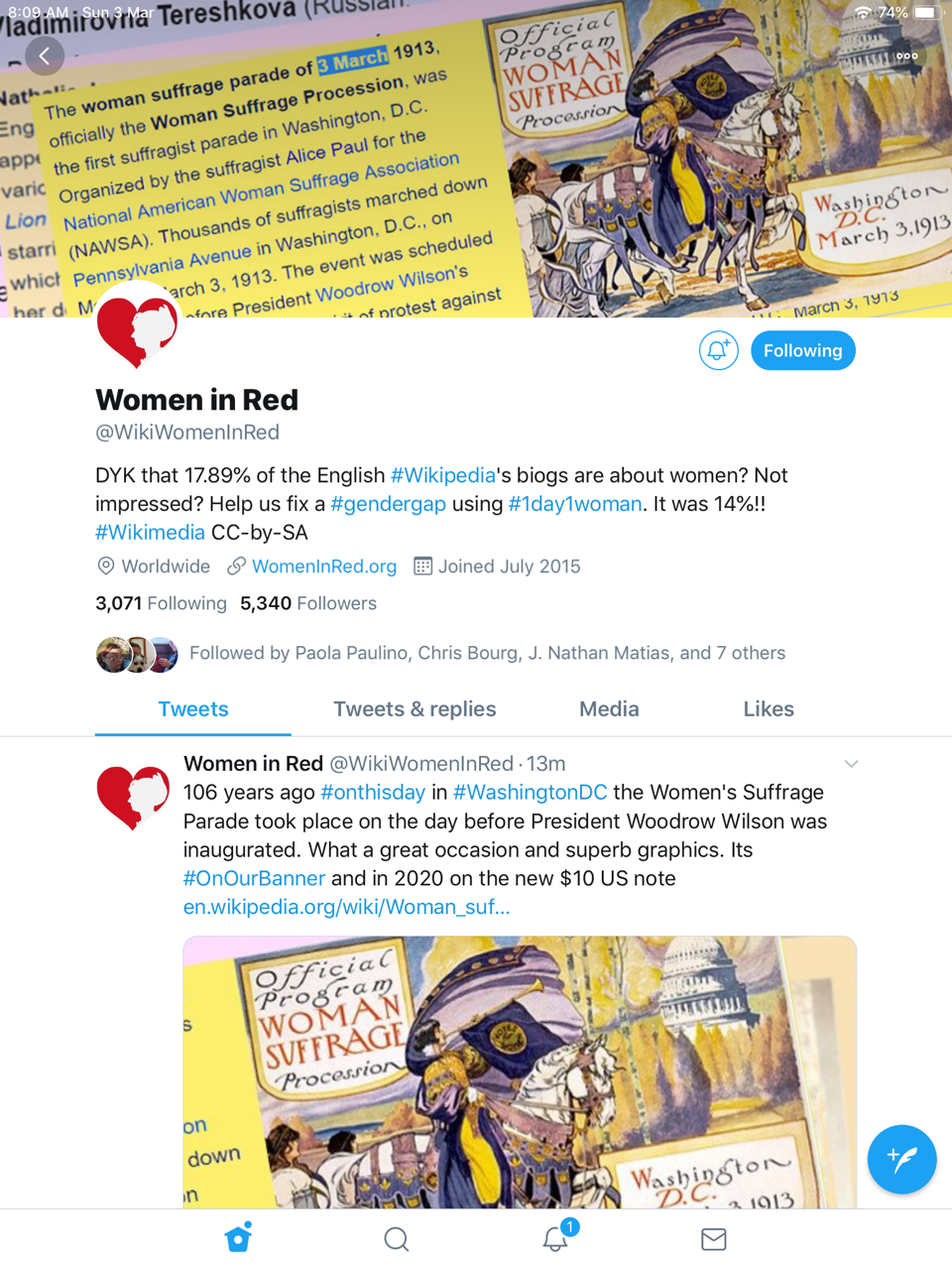
Here’s another one worth letting your students and fellow librarians know about – @WikiWomeninRed 

I don’t know how to end this. Just keep on being angry or outraged. And do something positive with that anger.

Facts getting in the way of a good story

It’s been a while – quite a stressful last few weeks of term – make that a stressful first half of the year. And now the last day of the vacation. Here’s a somewhat lighter post on two movies we saw that I’d like to comment on.

The first was Bohemian Rhapsody. The whole family is a fan of Queen, and given that Freddy Mercury has a special place in Montreux, our holiday stamping ground, we went to see it there. It’s a great movie – the music of course is amazing – it couldn’t not be, and you walk out with a whole nostalgic good feelings afterwards with a little sadness that he is not more.

But then my husband, who’d listened to Live Aid on the day from the Netherlands (I was living in South Africa which had a cultural ban still going at the time), disputed the play order of the songs, and my daughter, who studied Bohemian Rhapsody as part of her GCSE questioned the inclusion of some song in the “wrong” timeline so we set about googling the movie. And found the plenty on the inaccuracies in the movie. It seems yet again the problem of not letting the facts get in the way of a good story. But as I’ve stated before in my occasional review of historical fiction – one has a duty of care with the facts as not many people fact check what they’ve read or seen, and that becomes the new “reality” for them.

The next movie I watched with my son – he’s a big EDM fan and so we watched Avicii, True Stories, together (now available on Netflix). I’ll admit I asked about 20 times “where’s his mother” as things continued to spiral out of control more and more – but she didn’t feature besides one phone call. My son was more interested in naming the music, expensive watches and brand clothing … I was interested in the fact that so much of his life had been documented. And then my son said “you know he’s dead?” which led to another round of googling. Yes, in fact he did commit suicide, in April 2018, after the movie was made. This movie was more “factual” as it was a documentary – there was no hindsight as was finished before his death, and was more as an explanation as to why he wanted to stop performing than why he’d want to take his life.

In some ways the movies were very similar, each showing an extremely talented person spiralling out of control, and becoming victims of their own success and the manipulations of those around them whole fed at the same trough. Each also showed the story they wanted to show and left out some of the 18+ details (sex and drugs). I didn’t think that the Avicii movie was any less engrossing for the fact that it was a documentary.

In this interview, Rosenberg argues:

“I myself am a victim to narrative,” says Alex Rosenberg, a Duke University philosophy professor whose new book hopes to convince readers that narratives — and especially narrative history — are flawed as tools of knowledge.

Some more from Duke – this time the dispute between an author and the professor of History and Public Policy.

In the UK, Antony Beevor raises his concerns – this time it’s personal – concerning his Great-great-grandmother. And I remember another article – but can’t for the life of me find it – where a history professor complained that students coming into history programmes at university level have no idea that the latest Hilary Mantel or Philippa Gregory book is not a primary or even secondary source of historical information!

I love the fact that movies and books bring the past to life and that powerful storytelling is being used. I do think that we need to “immunise” our children and students so they can take the extra step of fact-checking and maintain a healthy scepticism of the “speculative” elements.

What research looks like

Lest I be accused of being too negative on the information literacy side of things I wanted to post something positive. A while back I was listening to an interesting enough book, (Gup, 2014) but the most fascinating part, and what sent me back to the eBook version was the part where the author explained how he’d conducted his research.

Now we often use mentor texts in education, and why not when we’re trying to teach research? In the extract below, Gup,  explains how he, a former Washington Post investigative journalist went about uncovering the story of his grandfather.

Research 1

Research 2
2 page extract from: “A secret gift” by T. Gup

This is the type of detail that is hidden to people who read a newspaper report. The amount of work is just staggering.

Perhaps that is why students struggle to understand what “real life” research looks like. After all what kind of research are they exposed to? Wikipedia is actually not bad, as it cites its sources at the bottom (to those who scorn it). Britannica for students hides behind editorship (as a substitute for identifiable authorship) and a lack of sources (this article on the depression has two authors but no sources and yet we’d rather students go to Brittanica than Wikipedia?). Books, when they’re used at all, do have sources, sometimes, depending on the target age and how scrupulous the publisher is. Newspaper or magazine articles – we have no idea of either the research process nor the sources of information except inasmuch it is divulged, for example, in movies such as Spotlight.

So our young researchers go off onto the internet, or maybe to Britannica and Brainpop and some books and then as they mature we coax students into using databases and journal articles. Where again, they see the end product rather than the process.

How often do we get researchers in to uncover their craft? Versus for example authors of fiction or poetry?  So is it by accident or design that they’re not breaking through those threshold concepts?

References:

Gup, T. (2014). A secret gift: how one man’s kindness–and a trove of letters–revealed the hidden history of the great depression. New York: Penguin Books. Retrieved from http://rbdigital.oneclickdigital.com


The Boston Globe. (2016). The Boston Globe Spotlight Team. Retrieved from https://www.youtube.com/watch?v=kJfyjq80Ths

Are we teaching dogs to chase cars?

I’d love a dollar for every time as a TL I’m asked to teach students “how to search” or “search terms” or “searching. Once upon a time I complied. I’ve become a bit more bolshie in my old age. I now try to engage. Engage in a conversation as to what exactly the teaching and learning aim is behind the request.

You see, we don’t need to teach dogs to chase cars. We need to teach them what to do with them once they’ve caught them. And we need to teach that bit first, so that they can decide with the right amount of information at their disposal that actually, cars are not edible and therefore not worth the chase.

I understand the impetus behind wanting to teach better searching. It comes from a good place. One which recognises that students are going to google anyway, it will probably be their first and last port of call and we may as well teach them how to use it better so at least the results somewhat resemble the information they’re looking for.

But without some kind of prior knowledge or context, how will they recognise what is in front of them for what it is? And without deep literacy skills, both on the reading and writing side, how will they do something with it? And why am I seeing two huge time sucks in student “research” – searching and gathering “information” and dressing it up in some kind of (digital) presentation form. aka, the dogs chasing the car and trying to make a silk purse out of a sows ear. Which leaves precious little time for the meat in the middle.

Am I overly cynical, or is this a more generic experience? And what can we / dare we do about it?

Beyond beyond search and cite

A long while ago (3 years) I wrote a post about the fact that we needed to look beyond “search and cite” in teaching information literacy and look at the threshold concepts of research, and a presentation I’d given on the theme. I remember at the time seeing half the audience (of librarians) eyes glazing over and thinking, “oh no, this isn’t going to work if it’s not something librarians get and relate to – and how on earth would students buy in?” I still believe that understanding threshold concepts in any discipline and for us librarians in research / information literacy is crucial in diagnosing misunderstandings and structuring our teaching. But then yesterday I had another insight on how this could be approached in a far better way.

studentIn my current position I’m considered to be part of the school wide coaching team, and as a group it was suggested we read “Student-Centered Coaching” by Diane Sweeney. I’ve been enjoying the fact that it’s a pretty practical book and one where you start to think that by taking the focus off the coach or even the teacher, you can actually take a lot of the emotion out of the coaching / teaching equation.

The book emphasises the use of data, but not necessarily the data provided by testing, but rather from the usual formative and summative assessment that is going on anyway.  One example used DRA testing – the equivalent of which occurs all over regularly anyway, and another a rubric from a writing program using a writing prompt. The idea is to select pieces of writing and score them on writing conventions and then group students into bands of “exceeding, experienced, competent, developing, emerging or below emerging” conventions. One then tries to move those groups / cluster using differentiated instruction up the scale.

I immediately thought of a lost opportunity last term, I’d had to teach citation to groups of students prior to their final assessment of a unit. It had been hectic both on my side and the teacher / classes and I’d been beating myself up a bit about it. Then my son (a different grade) came home and showed me an I&S assessment task (ungraded) he’d done and asked me what I thought of it. That’s a tough call. Because,  there was a lot going on there and not all of it was pretty.

And then I realised it was the perfect way to do a “backwards by design” session on searching and citing.

What if the “works cited list” and in-text citations of an assessment task of a whole class or grade were to be critically looked at?  It is a few lines that reveal so much of what’s going on in research. And then based on that one could group students according to where they were and what needed to be worked on and then individualise that part of the rubric in order to see if there was progress in understanding (and if they were approaching the thresholds!).

A quick reminder of the IL threshold concepts – research is/has:

  • Authority – Is constructed and contextual
  • Format – the creation, production and dissemination of research is not equivalent to its delivery or how it is experienced
  • Information goods – research has a cost and a value
  • Information structure (searching as strategic exploration) – an ability to look “under the hood” of databases and search engines (including more and more as we use things like Google scholar – the algorithms that spit out the results)
  • Research process – as iterative, difficult and building on the those who came before
  • Scholarly discourse – citation is a point of access into this discourse
  • (Research as inquiry – ongoing nature of research this is used by some but not all researchers)

Some of the things I noticed when looking at my son’s paper were –

Evidence (just two examples as an example): Not understanding that “Et al.” means “and others” – encountered in the in-text citation and works cited. The in-text citation followed the format (author, date) while the works cited was MLA8. Kind of.

Indication of not understanding:  

  • authorship = authority. But behind that was an understanding of the research process that included groups of people working on a topic
  • Format – since he’d used google scholar as a delivery point for the search. And from there had got to the database article without realising that it was an article in a database.  And didn’t understand the format or
    Screen Shot 2018-10-14 at 19.21.28information structure.
    This is something, if MLA8 is correctly taught and deployed, including its emphasis of a Russian Doll like structure of containers, should become obvious.  There is another – more simple aspect of formatthat of the format of citing and where that can be found. I showed him the  ”  marks in google scholar and how that led to the citation that could be copied into NoodleTools as is… a revelation
    for him. I also showed him in the original journal article of two other sources how he could find the citations and just copy and paste them – let’s consider small steps here!

Indication of understanding:

  • Scholarly discourse – here is where my own prejudice to APA versus MLA8 for the humanities come in – the date is probably a better indication of the point of scholarly discourse and understanding that something more recent would encompass prior research

The Scott (2017) article listed below is a particularly good one – because it asks students to rank their understanding of the concepts and to explain them. And this is where you can see the metacognitive value of “knowing what you don’t know” (please read Errol Morris’  series of articles on the anosognosics dilemma – the best ever on this, if you haven’t already) comes into play

“One mentioned domain knowledge as a barrier: “You have to have some type of familiarity with the topic to ‘enter the conversation.’” (Scott, 2017, p. 295)

To reign this back, we’re talking about middle and high school. So wading straight into threshold concepts may be going in too deep for the average student. But it may be a useful diagnostic tool.

Getting back to the coaching bit – doing an autopsy on in-text citations and the works cited list would reveal where the gaps and issues both in searching and citing were. The humanities teacher is probably looking at the assessment using a different lens – that of understanding and using the information and the ability to write it up in an academically acceptable manner using some kind of scaffolding (e.g. point, evidence). And at the end of the assessment, once a grade has been given and the focus has moved onto the next unit / assessment, the gaps in the ATL “research” may not have been identified, recognised, nor addressed in the teaching or assessment rubric for the next unit.

I believe in rubrics as a way of shaping teaching and focusing attention in student effort. If in a year, the teacher in conjunction with the librarian, moves through perhaps four iterative cycles of research, I’m sure we’d see real progress in both the practical ability and metacognition of students as they approach research and the threshold concepts.

=================

Here are some articles that explore further information literacy as a threshold concept in an interesting way:

Further reading:

Corrall, S. (2017). Crossing the threshold: reflective practice in information literacy development. Journal of Information Literacy, 11(1), 23. https://doi.org/10.11645/11.1.2241
Hofer, A. R., Townsend, L., & Brunetti, K. (2012). Troublesome concepts and information literacy: Investigating threshold concepts for IL instruction. Portal: Libraries & The Academy, 12(4), 387-405.
Hofer, A., Brunetti, K., Townsend, L., & Portland State University. (2013). A threshold concepts approach to the standards revision. Comminfolit, 7(2), 108. https://doi.org/10.15760/comminfolit.2013.7.2.141
Morris, E. (2010, June 20). The anosognosic’s dilemma: Something’s wrong but you’ll never know what it is (Part 1). Retrieved 4 February 2014, from http://opinionator.blogs.nytimes.com/2010/06/20/the-anosognosics-dilemma-1/?_php=true&_type=blogs&_php=true&_type=blogs&_r=1
Scott, R. (2017). Transformative? Integrative? Troublesome? Undergraduate student reflections on information literacy threshold concepts. Communications in Information Literacy, 11(2), 283–301. https://doi.org/10.15760/comminfolit.2017.11.2.3
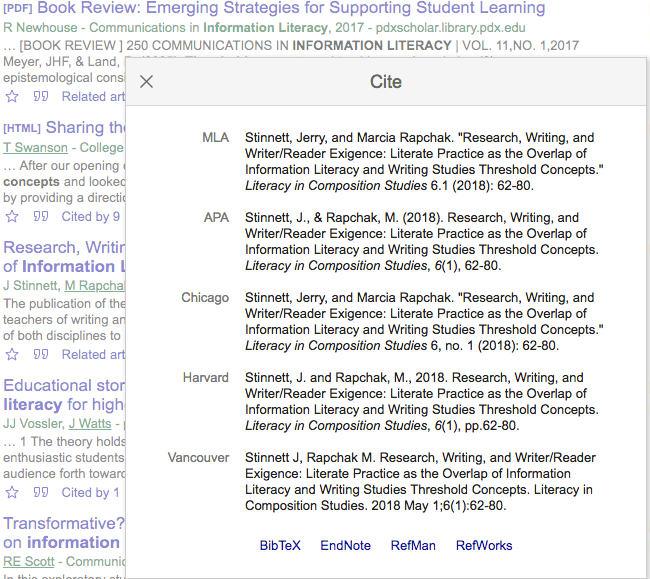
Stinnett, J., & Rapchak, M. (2018). Research, writing, and writer/reader exigence: Literate practice as the overlap of information literacy and writing studies threshold concepts. Literacy in Composition Studies, 6(1), 62–80. Retrieved from http://licsjournal.org/OJS/index.php/LiCS/article/viewFile/180/239
Townsend, L., Hofer, A. R., Lin Hanick, S., & Brunetti, K. (2016). Identifying threshold concepts for information literacy: A Delphi Study. Communications in Information Literacy, 10 (1), 23-49. https://doi.org/10.15760/comminfolit.2016.10.1.13

Are nonfiction books still relevant?

I was showing a fellow librarian around “my” new library today and we were chatting and discussing various aspects of middle school librarianship. We got to the nonfiction section and both sighed. I started that mine probably needed some significant weeding and that I’d made a start. I pointed out a few particularly nice books in the collection (Annick Press still does nonfiction well, the newish Theodore Gray Molecules and Reactions). But so much ages so badly and so quickly. And in an inquiry based system where one wants to encourage systems thinking and embrace the idea of interconnectivity it is almost anachronistic to maintain Dewey divisions and populate them with single topic books.

Gone are the days when teachers gave the librarian a content based topic and you could wheel a collection of books that covered the length and breadth of what there was to know at a specific grade level about that topic. Done and dusted. Now you’re not so much discussing WW1, so much as conflict, with WW1 as the bare-bones scaffold of the topic. There aren’t that many books that deal well with the nuances of conflict in an age appropriate, stimulating but accurate, culturally sensitive manner. One such book is Global Conflict, from the Children in our World series by Louise Spilsbury.  No, it probably isn’t written with 14 year olds in mind. And I had to offer it somewhat apologetically to one of the teachers and say I thought it actually covered the ground fairly well, and everything else on offer was probably pitched at a much too high level.

Besides which, students aren’t reading books anymore. The books I pulled out on WW1 for a display remained unread, un-borrowed. I dare not investigate too closely where they got their information for their assessment from, since, looking at the database statistics it wasn’t from databases either.

A month or so ago, I had a look at our “country” books – they ranged from 1999-2005. A lot has happened since 2005. So they had to go. But what to replace them with – if anything? I checked the curriculum, spoke to the lead of the one grade doing something on national cultures and offered a collection I’d made in Epic! that could cover it more or less. There are no students pouring over country books or atlases like perhaps we would have done. If they need information there’s wikipedia or facts on file.

All this time I’m reading “Reader Come Home” (it sure is taking a long time, but I’m distracted myself) and the issue of shallow reading and attention and focus and digital media. And I wouldn’t worry if it weren’t for the fact that the problem doesn’t seem to just be shallow reading, it seems to be a great divide between reading a lot, and not reading at all. I ran some statistics last night. Our top (G6) class read 4x as much as our bottom (G8) class (at least books from the library – to which everyone says “oh but they may be reading books at home – to which I say “evidence?”). But that’s not the problem – looking through numbers student by student so so many hadn’t borrowed even one book. I’m about to self-flagellate at this point and worry what I’m doing wrong. I need more data and then I need a strategy.

There’s no doubt quite a bit of the nonfiction must go – but what should I be replacing it with? Middle schoolers are just that little bit young to place popular nonfiction in – the Malcolm Gladwells and the like. What is everyone else doing?

Why lists and awards matter

Every year around this time, some parent will ask the teacher or myself what their child should be reading.

The “correct” response to this question is that we don’t make reading lists of prescribed or recommended books but prefer students to come and have a chat to us about what they like reading, what hobbies or interested they have and based on that we can personalise some recommendations for them. That we believe in free voluntary reading.

How many of you have had a follow up on that with the student popping by for that exciting interaction?  I started getting parents coming by personally around the end of my first year in my last job, and parents and children sometime in the second year and students on their own around the middle of my third year.

The truth is that people like lists and they like recommendations. This New Yorker article gives some ideas as to why lists matter – the most salient features are that lists “alleviates the paradox of choice” help with “reduction of uncertainty” and due to their finite nature are easier on the book budget both for school and home libraries!

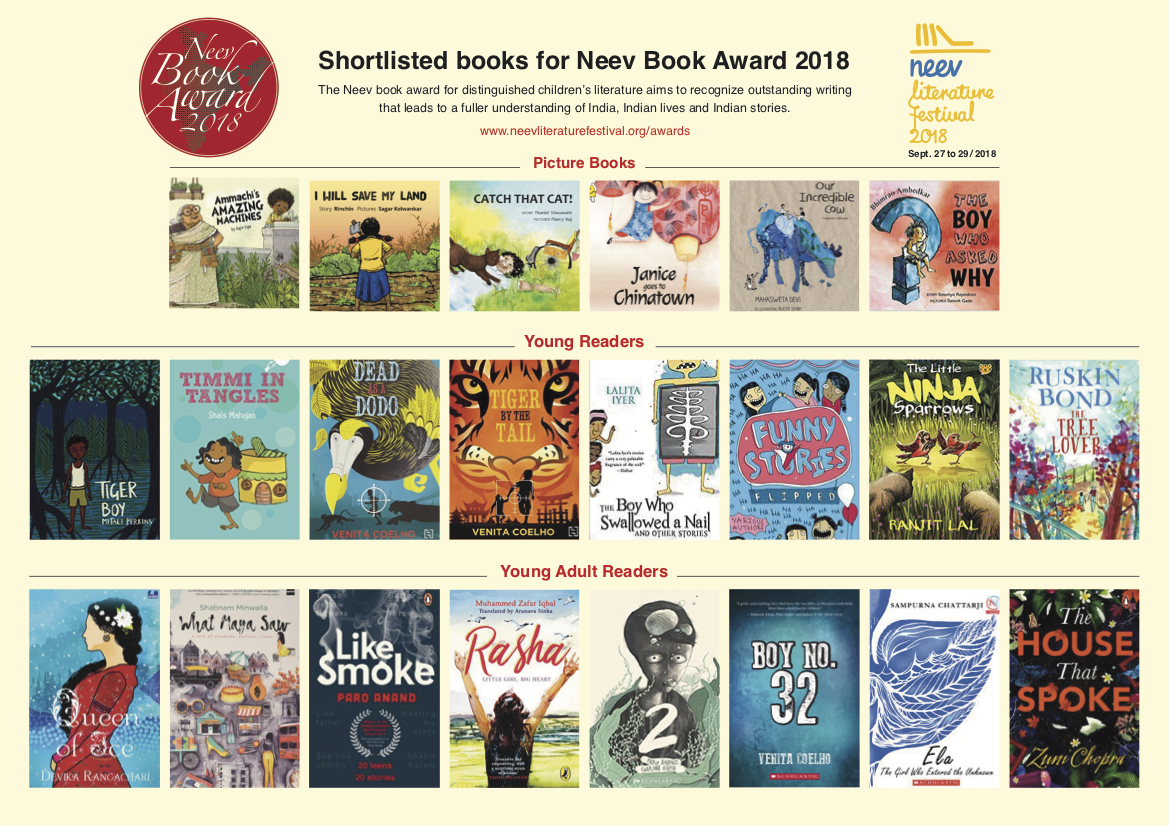
Book Poster Neev Shortlist updated

So why are book awards important? According to Underdown:  ‘

“Awards are important in children’s books. They tell publishers, writers, and illustrators what is considered to be “the best,” and thus the standards they must strive to attain. Many children’s book awards, though not all, are selected by librarians. Award-winners then get orders from … both libraries and bookstores.  They will also stay in print longer. For writers and illustrators, getting to know the award-winning books … is one of the ways to understand what is considered to be the best today.

The idea of finding out what the best is “today” rather than when authors / illustrators or publishers – or parents and librarians were children is very important. I’d love a dollar for each time a parent wants to force the literature of their youth onto their progeny. Reading through the long list of the Neev awards, there was also quite the body of what I’d call “nostalgic” storytelling. Which is really hard to carry off, and generally appeals more to adults than children. Which is why, it may be important to consider a children’s choice option when moving from a short-list to the finalists.

Following last year’s very successful initial Neev Festival, during the feedback discussions the idea of an Indian Children’s book award was floated. One of the driving ideas was that India had a large body of children’s literature, published in English, but not widely known nor distributed internationally. And selfishly, as librarians in an (Asian) international context with 40-50% Indian diaspora making up our student bodies, we were just not able to provide our students with the “mirrors, windows and glass sliding doors they deserved – mirrors for the Indian students, and windows and doors for the other students. Kavita Gupta Sabharwal is a very special person, both visionary and someone who makes things happen, including this book award, both from a logistical and a financial point of view. Each award carries a cash prize of Rs 1 lakh (around US$ 1,400 – a substantial amount in the Indian publishing world).

Already, just based on circulating the short-list in social media groups, there has been substantial interest from the librarian community. The prize-winners saw their books fly off the tables following the award ceremony, with all books sold-out by the end of the festival. An award sends a powerful signal to publishers and the public – one that says “pay attention” this has value, create more like this. The award stickers on the books a “buy me” beacon.

The final step in the equation and the gauntlet to be thrown is whether the publishing and distribution channels will be able to push these books out into the wider world where they deserve their moment(s) in the sun. And in the longer term, creating teacher guides and author visits, websites, hyperdocs, quizzes, eBooks and audio-books. For that is what the world has come to expect. But first the small steps, make the books available for every child, parent, teacher or librarian in the world who wants to push a “buy” button and have the book delivered to them, anywhere in the world.

Culture eats strategy for breakfast

This phrase is attributed to Peter Drucker and made famous by Mark Fields (although can’t easily be authenticated). I firmly believe it to be a reality both in business and education, and many a manager has been burnt by this.

I’m currently in Bangalore, having spent the last three days at the Neev Literature Festival  where I had the honor to be invited back as a speaker / workshop leader and as a jury member of the inaugural Neev Book Award. It was touch and go whether I’d be able to attend, given that my passport has been tied up with either visa or customs arrangements since the beginning of August, but a little more than a week ago I got the go-ahead! I’m so glad I did. You see Neev is a very special place. Many schools claim to promote a culture of reading and spend vast amounts of money on classroom or central libraries. But sometimes to no avail as the individual teachers or heads don’t actually walk the walk.

Here the founder really and truly believes in reading, and has invested immensely to ensure that reading permeates the school – what other school hosts a free literature festival at their premises, flies over authors, illustrators, librarians, storytellers, interpretive dancers and then invites other schools and the public to partake of their largess?  I was talking to their new head last night, about admissions, and she said they were in a luxury position where demand was greater than supply of school places and one of the ways they decided on who gets a seat was based on the families being able to demonstrate that they supported a reading culture at home! Imagine that! Not portfolios, or CV’s or admission tests. And it shows. Listening to the young students as they described their reading lives I was astounded at the depth and breadth of their reading.

I spent the morning today with a few of the visiting authors, and one – the wonderful Nadia Hashami,  was telling me of a conversation with a reader who had read her book twice and was recommending it to everyone, and who had also attended her panel on “Protect or Prepare” difficult topics in literature – the discussions, chaired by Katie Day were around which topics could or should be out of bounds for children. This young lady’s take on it was that death was a part of life and had a place in literature as it was part of a normal life, however, she could not come to terms with rape and sexual violence because it was something that one would never want to be part of your life and which would never leave you or have a resolution. Astounding the maturity and empathy (some USA people could do with a little more empathy-powering literature obviously).

I had my own encounter with culture, which I’d like to reflect on. I did a workshop for 11-15 year olds using empathy mapping. I had the luxury of around 20 students and 90 minutes. So my strategy was to do a warm-up exercise by introducing the concept of empathy mapping using gender, and trying to take the view of the opposite gender based on what to Western sensibilities are rather sexist advertisements about mother/daughter bonding over dishwashing and father/son bonding over dude stuff like fishing and hanging out outside and drinking beers. It had worked extremely well in the international school environment I was coming from. But I hadn’t done my homework and had it “sensitivity tested” by my Indian friends … I quickly discovered that young Indian ladies (bar one or two) think that it is lovely to be able to bond with your mother over household chores, and that generally the students never needed to do chores, being of a class where chores were done for them by others! With a bit of prompting and help from my friends and the students’ teachers we managed to successfully complete the exercise and move on to phase 2 which was a reading of “No one walks on my father’s Moon” . It is a difficult text, despite being a picture book. However I like to use it, as even without an accompanying empathy mapping exercise, it provides a very powerful message of reconciliation and perspective taking.

file5This time the exercise really did work – on reflection, the “warm up” possibly did help the  success, despite not being optimal, because the students just weren’t used to giving their own views and in the first half kept looking to the adults for the “right / expected answer”. We had some powerful contributions from the groups, and some very interesting movement from utter condemnation for the father’s behaviour to understanding and empathy for the context and actions. And also the feeling that they could use this in their personal and academic lives.

Here’s a copy of the presentation – I believe that empathy cannot always be taken for granted despite the great potential of literature and us very much wanting it to be so. Hopefully this helps us and our students to take a step closer into “climbing into someone’s skin and walking around in it”

The other normal

We’re nearly 2 months into our Beijing experience and I was just pausing to think about how living elsewhere makes you question your sense of what is “normal” as you view a new context. Perhaps the first experience one has with this is when, as a child, you go for a sleepover at another child’s house. That is if sleepovers are normal. I remember my son in first or second grade once bringing a young classmate home on the bus who had never been on a sleepover, and so they decided that it would be a good idea for him to try it out at our house.  The poor frantic mother when her son didn’t get home, but we managed to iron it all out and said child was lent a pair of pyjamas and a new toothbrush was procured and sleepovers became a new normal for him too. In someone else’s home you experience different norms and conventions for communication, discipline, eating, sleeping and relationships.

A more extreme experience of this was when, as an 18 year old I left home to spend a year in the Netherlands as a rotary exchange student. Inter-cultural differences in the home became intra-cultural differences and at times it was hard to know what was due to different cultures and what was due to just different human relationships.

So too, when you change a country and a school and a division all at once, you’re thrown into a whole new situation and then that laborious process of sinking under and trying to swim upward begins. While seeing what is truly different, what just looks different, how it relates to what you already know, what you still need to learn, or find someone to explain to you.

That was my state of being on Friday. I’d begun to work out what I didn’t know. It may sound trivial, but it meant I could start to move forward on finding the people and resources I need to bridge those gaps.

I’m also starting to try to tease out what is middle-school culture, what is my-school culture and what is being-in-China culture. That’s going to take a while because our school is in a process of immense change, so that adds a layer of complexity to the process as it’s not a simple process of just asking around some trusted colleagues what the way is of doing things, as at times they’re grappling of the new way themselves.  The uncertainty of change can have an underestimated pernicious effect on relationships and communication as a group attempts to move to a new normal. It’s an interesting time.