Dyslexia – don’t make it about you

I had lunch with an old friend of mine yesterday. We’ve kept in touch over the last 20+ years when we did an MBA together. She’s had a successful career in finance while I’ve had a liquorice all-sorts type of constantly changing occupational therapy for a mind that can’t stay at rest too long.

Anyway, she of the child-free existence still dotes on the children of others and takes a keen interest in how the offspring of her friends are doing, and, knowing both my current librarian / teaching situation and the background of the fact that I have a SEN (ADHD) teen asked me about the potential dyslexia of the son of a close friend. The issue was typical and one that I come across often enough that I could be quite wealthy if I got a dollar each time I encountered it, or a variant in any area of educational need.

Child has an undefined issue with reading / spelling / learning. Otherwise bright. Mom / school / teacher thinks that he should be tested. Dad is totally against it. Because he doesn’t want the “label”. Because he’s going to take it upon himself to teach his 8 year old to read.

My friend stressed this was a father who truly loved his son. Who had the means, financial and otherwise to get the best help for his son if it was needed. As long as it didn’t involved testing and a diagnosis. She was asking me of the ways to make sure the son got what he needed.

I gave her the usual. The positive messages. You wouldn’t prevent a child from having an eye-test and getting glasses if they couldn’t see properly. The earlier you understand what is going on the better in terms of interventions, help, accommodations etc. We know so much more about the reading brain than we ever did before, that it’s not a calamity. I also mentioned that I’d just been through some of Microsoft Education’s Educator courses on inclusive and assistive technology and that he may want to have a look at the interventions available.

And then I hit hard with the real issues. At 8 years old, you have a compliant child, willing to please the adults around him. You have a surrounding where children are all over the shop still with reading. But you have the beginning of the big academic sorting. Between those who are learning to read and those who are reading to learn. And that divide just keeps on widening. And kids know it and are acutely aware of where they stand in this sorting. I saw those kids in primary when I was teaching there and now I see them in middle school. They’re no longer 8, they’re 14. And they know every trick in the book to deflect attention from the fact that they (still) can’t read (well). They are the class clowns, the exasperating kids who are still falling off their chairs, annoying the teacher and the rest of the class. They will do anything to not appear stupid. They are not stupid. But in their minds they equate the reading issue with intelligence. They may or may not be talking to their parents, let alone being compliant with any reading intervention. They’re frustrated and angry, not hopeful any more.

There is so much that can be done when you have an 8 year old. Of course you can help anyone at any age, but why let your own darn ego get in the way and not do things earlier?

There’s another very important piece to all of this. Children, even “your” children, are not yours. They need to know themselves and their learning. They need to become their own advocates. To know what they need and have the strength to stand up for it. For all the wonderful teachers and administrators out there, there also are a lot of very harmful people. So even if you have a diagnosis, and interventions and recommendations, there are enough people who will take the attitude that “it’s not an excuse” and that the child is “lazy” or “naughty” or “bad”. I speak from very bitter experience in that respect.

teacher GIF

via GIPHY


She asked me for an article, anything to give to him. I asked how much the father would be prepared to read. I scrolled through my Evernote. I have 238 articles / notes on dyslexia. The one I consider to be the bench mark one is “Rapid automatized naming (RAN) and reading fluency: implications for understanding and treatment of reading disabilities.” but that weighs in at over 30 pages, so we settled on the KQED article “Understanding Dyslexia and the Reading Brain in Kids“; the name Maryanne Wolf as an expert, and the one home intervention I know of that apparently has some research backing (in case dad was still going to teach his kid in 100 days … face palm).

fozzie bear facepalm GIF

via GIPHY

The last presumption makes my blood boil. People spend a life-time specialising in teaching children (and adults) to read, with or without dyslexia. People like the reading guru Pernille Ripp whose daughter has issues reading  do not deign to come up with easy platitudes in this area. If you’ve ever read the first few chapters of “Reader, come Home” you’ll be in awe of how anyone ever learns to read. And yet this parent, this father who professes to love his child is prepared to squander another 100 days to muddle around, just so that he can save face or something.

How do you, my readers, deal with this type of question? Are there other resources out there that are “parent” friendly? Are there better ways of broaching these conversations?

==========================

Header Photo by Akshar Dave from Pexels

Pretending to learn

One of the hidden advantages of learning Chinese is that I often catch myself pretending to learn and it gives me an acute insight and experience into the nature of real vs. faux learning. I’m doing a lot of “busy” work today on trying to get my document together for my ISTE certification (faux learning) so this will be brief.

Real learning literally makes your brain hurt. Sometimes I feel like my brain is creaking when I’m concentrating hard. It’s hard to keep up for very long and you tend to need physical breaks. Some of the things that I’d include in real learning is when you’re not just trying to remember characters but when you’re using them to make sentences – and incorporating previously learnt characters and sentence structure. That’s hard work. Memorising and reproducing a list of characters is easy. It’s also easy to use apps to go through lists of words and pick the right word / sound / character combination from 4 or 6 options. That’s my “pretend I’m learning Chinese in the taxi on the way to work” learning. Funnily enough if I do the same at home at my desk with a pen and paper, and look up the etymology of the words as I go along and write the sentence examples from my dictionary it’s coming closer to real learning. Similar actions but a twist that enhances.

Something similar happens when you’re practising music. Playing a piece through is great fun. But just focusing on one part that’s tricky and repeating that until it’s fluid, and even perhaps breaking it down into smaller and smaller bits – that’s real learning. Anton Nel in his DSS talk at WAB hinted at this. Others have also talked about it in the “10,000 hour debate” that morphs into the “deliberate practice” discussion.

Real learning takes place when you do the things that you like to avoid by doing other things – like fill in the blank sentences and worksheet versus reading an authentic text. I really do understand why so many students avoid reading a book. Because it’s hard work. Really really hard work. Especially in another language. You’re recognising characters, thinking about the meaning, flipping sentence around in mental gymnastics so it makes sense in your mother tongue grammatical structures. Looking words up. Looking pronunciation/pinyin up.

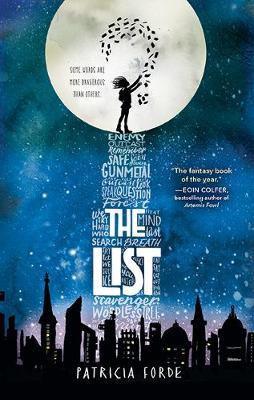
I’m reading “The List” with my group of early morning read-aloud students. It describes a dystopian world where one has only 500 words to use. When we started the book I joked with my crew that that was my Chinese language reality. I also recently finished “All Rights Reserved” where each spoken word and gesture is billed to you. Imagine how reality and potential is limited in these scenarios. Now have a look at this site – this is mind blowing and what a fabulous way of joining research, art, reality and literature by Dr Pip Thornton. Her piece NEWSPEAK shows the whole text of Orwell’s 1984 as a stock market ticker-tape, with the word prices fluctuating according to live data from Google Ads.

NEWSPEAK 2019 from Pip on Vimeo.

I’ve recently subscribed to “The Syllabus” of Evgeny Morozov – the best description of how this came about is in a Dutch podcast (with the worst cover art I’ve ever see outside a primary classroom). It is the epitome of going against the easy consumption of media and information through human and algorithmic curation of a weekly reading list within various fields. Which is how I stumbled on the whole art around the above discussion.

Keep those brains creaking everyone!


Picture books as a panacea?

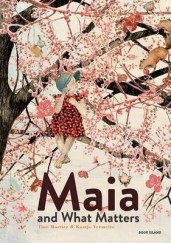
maia and what mattersI’ve always been a huge fan of picture books. I’m the librarian that will read “Maia and what Matters” to a group of Middle School teachers and struggle to continue through tears. I spend a reasonable chunk of my budget on picture books (or as some librarians like to refer to the “sophisticated picture books (SPB)” I’ve never see a book deal with anxiety with as much compassion and understanding as Mel Tregonning’s “Small Things”. I maintain a libguide for Social Emotional Learning (SEL) that relies heavily on the work of Dr. Myra Bacsal and her SEL booklists. 

So what is the problem? I’m worried that publishers are becoming complacent about plugging the gaps in information / knowledge / awareness of really big and worrisome things by having a picture book in that space. A case in point is my (and most librarians) quest to curate books related to the Sustainable Development Goals. And I’m afraid even the UN with it’s SDG book club plays into this.

It is easy enough to find a picture book about Wangari Maathai, about the plastic bags of Gambia. It is way harder to get a good (recent) nonfiction book geared at 11-14 year olds on deforestation or plastic bags for example. It seems the nonfiction publishing cycle is around 8-10 years (I found plenty from 2009-2011) between updates whereas the actual issues are accelerating faster.

Follow Your stuff

As mentioned in my previous blog – a big change has occurred in the presentation and design of nonfiction books, so it is important not only from an “up to date facts” point of view that we have these books, but also from an “enticing to read” point of view. When new books exist in a space (trees in this instance) they are truly fantastic. Like “Can you Hear the Trees Talking” by Peter Wohlleben – the young reader version of “The Hidden Life of Trees”. But that’s not really about deforestation, just a very positive reminder of why trees are so awesome and special and worth saving. Or Annick Press (one of my favourites) with Kevin Sylvester’s “Follow your Stuff” an exceptional book for the humanities tracing common items including T-shirts; Medications; Technology; books through geography, production, labour and economics.

The last thing I was looking for included something on sustainable cities and homes. The books in my collection were from 2007 and sorely needed updating. As is the case when a book is older than the students reading it. It’s a fascinating area. It’s something that most major cities in the world are pouring money and resources in. But you can find lofty tomes, heavy text books, coffee-table photo books and very little else. A fellow librarian pointed me to “No small Plans” which looks amazing, but very specific to Chicago, and not so easy to get to China.

Rebecca Sjonger has written a new series of books around the UN Sustainable Development Goals which combines goals and is an overview. I’d argue that’s a good beginning, but actually each goal merits a well researched, curated and presented book for each of the different levels of education. Our world in Crisis is another recent series that covers pollution, poverty, health & disease, civil war & genocide, immigration and terrorism in an age appropriate but informative way.

Our world in Crisis

So there is a huge amount of hope and great steps in the right direction. But if we want to keep middle graders curious and inquiring beyond the hook of picture books, we need to keep feeding them nonfiction of this high calibre in all and any direction they want to research further.

I want it to be that the picture books are the appetiser and a couple of Youtube videos are the amuse bouche but that excellent nonfiction books are the main course, supplemented by databases (for context) and news (for the latest updated information).

What are your favourite books to support understanding the SDGs in Middle School?

Unlikely new nonfiction

Our G6 Language & Literature classes have just started a unit on “Unlikely Heroes” and I must admit I’ve been having an amazing time finding some fantastic new biographies and memoirs to entice them into reading this genre and keeping an interest in the lives of people who may not always make the headlines, or who they may not be aware of, or who they only have an inkling of.

Two very interesting stories from the sporting realm are those of Jesselyn Silva with “My Corner of the Ring” (boxing) and Ibtihaj Muhammad with “Proud: living my American dream” (fencing). These are a double win to my mind featuring both lesser written about sports for middle grade students AND featuring young girls from non-traditional backgrounds in those sport – I have a daughter who fences and I know exactly how expensive (and sometimes snobby/exclusive) we’ve found it. There’s also the recent cliffhanger with young football players in Thailand, excellently written about by Marc Aronson in “Rising Water : The Story of the Thai Cave Rescue”.

Through my privileged connection with the Neev Children’s book awards, I’m able to encounter books that I wouldn’t otherwise be aware of such as “Like A Girl: Real Stories for Tough Kids” by Aparna Jain that showcases the lives of 56 Indian ladies, who may not be familiar to our students. Another book worth mentioning is the hybrid graphic novel / biography Indira by Devapriya Roy and Priya Kuriyan (Illustrator). What makes that book special is the way it weaves in how writing research is conducted in present day with the historical facts.

Our students are also living through history making by people in the here and now such as Autumn Peltier and Greta Thunberg (We Are All Greta: Be Inspired to Save the World by Valentina Giannella, Manuela Marazzi (Illustrator)). And our school is extremely lucky to have had a long-standing relationship with Jane Goodall who will be attending our FOEN conference next week (Hope for animals and their world. Unfortunately I wonder if that message of hope still stands ten years later).

Finally we’re also seeing more books either featuring LGBTQ+ heroes or where they are part of the narrative of other history. In a fairly conservative International environment there is always the question of how (not whether) one brings this up. I find that someone like Alan Turing is a wonderful segue into the area. (Alan Turing by Jim Eldridge; The imitation game : Alan Turing decoded written by Jim Ottaviani; Genius inventions : the stories behind history’s greatest technological breakthroughs by Jack Challoner; Stories for boys who dare to be different : true tales of amazing boys who changed the world without killing dragons by Ben Brooks ; illustrated by Quinton Winter and Queer heroes by Arabelle Sicardi ; illustrated by Sarah Tanat-Jones.)

The last three books, are ones where he is part of an anthology. One thing that we’ve started doing as part of this unit, is where there are a number of “heroes” in one book, we’ve added all the names in the table of contents to our cataloging record. That helps students to find different perspectives, formats, lengths of explanation and viewpoints of the same person. We’re hoping that some students will start with one of our many combined biographies, for example the great series of “Forgotten Women” by Zing Tsjeng or the “Goodnight Stories for Rebel Girls; or The Good Guys or Stories for Boys; or Stories for Kids; or “A History of the world with the women put back in” by Kerstin Lücker & Ute Daenschel and end up further researching one particular person who catches their interest.

An amazing thing has happened to nonfiction since around 2016. The visuals, design and layout has improved to no end, so books have become so much more enticing. I’m also loving the fact that biographies of women are no longer so ugly and we’re finding out about other amazing women such as Didda the ruler of Kashmir from 958 CE to 1003 CE (Queen of Ice by Devika Rangachari).

More of the wonderful books and how we categorised the various types of heroes around this unit can be found on our library guide. The revolving book lists (created with LibraryThing for Libraries) on each section lead back to our catalogue where students can see if the book is available and if necessary put the book on hold.

Next time I hope to write about some more fabulous nonfiction recent finds related to other curriculum units.

Enough windows – where are the mirrors?

I was prompted to think about this again with the publication of the White Ravens 2019 list at the Frankfurt Book Fair. The issue of increasing diversity in an international school setting is a complex one, and something I’ve written about at length in the past.

In English

There’s the linguistic diversity bit – collections of books in “Languages other than English” (LOTE) (that post is getting a bit long in the tooth and probably needs updating) a more up to date article featuring Jeremy Willette can be found here.  Though I do object to the phrase “mother tongue” the reality of many of our dual language students is that the language other than English medium at school could be that of either parent, but is often that of the father. So I prefer to refer to “home language”. In 2014/15 I went through somewhat an obsession on language, researching it to death, you can find some of the posts on that here. The one thing I would definitely add to this conversation is that unless the LOTE collection is updated regularly and championed by teachers and parents or a language based club, they often don’t earn back the investment in purchasing and the real-estate they occupy. So if you want to invest in a linguistically diverse collection you also have to invest in a mindset of pride in home language and a sense of ownership over the collection and its maintenance within that linguistic community.

The hardest part internationally is that issue ofnot our diversity . If you have a moment, please read that post. Students who are in international education often defy the traditional (North American) definitions of diversity. They are not poor, black, hispanic, urban, immigrants. That is not to say that it’s unimportant for our students to be exposed to stories of all these groups of people and more. In fact their privilege demands that they access poverty, racism, immigration and need through the windows of literature. But those versions of diversity are not mirrors for them. With a great budget we have no shortage of windows. It’s the mirrors we lack.

And again, when we have these diverse books, we still need teachers and librarians and students and parents who will read them and champion them. Students who will dare to take a book with a cover of someone who doesn’t look like them and read it. Families and languages

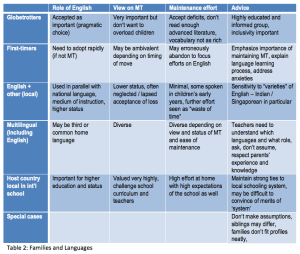
The thing with international students is their lack of homogeneity – something I encountered when looking at linguistic diversity. This table (from my 2015 research) speaks to some of the many variations. (Yes, in those days I also referred to MT /Mother Tongue). So one of the most important sources of mirrors for our students often is books in translation. Particularly for the “globetrotter” subsection of our students. Looking at the White Ravens list above doesn’t give me that much comfort I’m afraid.  The issue I have is that most of the books in 2019 are BANA originated (Britain, Australia/NZ & North America) with the exception of one from the Philippines and one from India.  2018 was a bit better (one from Romania, India, Ghana and Korea). The list is unwieldy, you can’t search by age group. And you can’t get a print out.

Some more sources of inspiration include the various IBBY organisations. Including USBBY – even though the criteria for inclusion on the list is includes:  Books that help American children see the world from other points of view; Books that provide a perspective or address a topic otherwise missing from children’s literature in the U.S; and Books that are accessible to American readers (where accessible can mean a multitude of things). Again, painfully it’s hard to get a simple list to down load – no I don’t want a pptx, or a bookmark, I just want a list to print out to buy from.  And IBBY UK. Their latest publication: Children’s Literature in a Multiliterate World looks to be particularly interesting. One lives in hope.

One of the many things that concerns me with all of this, is the emphasis on picture books. Don’t get me wrong, I’m a HUGE fan of picture books. But the over-reliance on translating picture books? It just adds a PB to the five F’s (food, fashion, festivals, folklore, and flags) of pretending we’re oh-so-international and inclusive.

The Global Literature in Libraries Initiative is more cause for hope. Particularly as they reach out and co-opt people in-situ to aid with their uncovering of local treasures.

In this diversity quest, one is often more of a sleuth than anything else. For example needing to have a look at awards like the Astrid Lindgren Memorial Award and then looking at names of authors and illustrators and seeing if any of their works are translated and available. And how sad it is that many of those authors and illustrators don’t even have a web presence? Isn’t that one way in which IBBY could assist them? Just like publishers have a page on their site for each of their authors couldn’t these nominated people each have some kind of a presence. And many of the links don’t even work.

The “and available” thing. Holy hannah publishers. Get with the global world please. Honestly it’s hard enough just getting to know about Australian and New Zealand and Canadian books, not even to mention anything that is not from USA or Britain. What ever happened to the whole “print on demand” movement. I could possibly understand why it’s hard to find picture books, but middle grade / young adult / junior fiction? Surely that’s not an issue?

How are the rest of you doing with your diversity collection? What “sells” to your students what do you need to work on promoting? Do your teachers gravitate to them / read them or do they need to be pushed?


Resist the list

I am convinced that there are generations of parents (and librarians) who think the main purpose of a librarian is to create age/grade related lists of books for students to read. When parent-teacher conference time comes around, if parents venture into the library and engage – as opposed to using us as a baby-sitting booth / place to drink coffee and wait / information-direction desk the one and only question they seem to have is “do you have a book list for Grade …”

So why don’t I have a book list for Grade …? When they allow me time to explain, and time to discuss their child(ren)’s reading needs – preferably with the child present these are the themes of the conversation:

What are your (their) favourite things in life?

I don’t start off with what books they like, because their parent(s) probably wouldn’t be having a conversation with me if they liked books or reading. But if I can get a feeling for what kind of person they are, I can start to think what kind of books may be an entry point to intersect with their lives.

I’m very much a “there’s a book for that” type of person and my staff always jokes with me that they can’t have a conversation with me without walking away with a “book for that”.  If a student likes gaming, we have gaming books. If they like art and they’re EAL (English as an additional language) I have no problem recommending starting with some of our fabulous wordless books, picture books or graphic novels. And I’m happy to discuss how sharing a (sophisticated or even just funny) picture book together is a way better and more productive use of time than forcing a child to plod through Shakespeare or whatever classic the parent loved when they were young.

Reading, like physical activity and learning, has to leave the person with the desire for more. The feeling that they’d like to keep doing this for a long, long time. Forever in fact. If we make them hate it now, we’re f*’d as a human race.

How much can you read?

This is a little open-ended. It’s a combination of the dreaded “reading level” and how much physical time they have for reading.

We have a lot of EAL students in our school. With very ambitious parents. Who are often well-meaning but misguided. During my 16 years in Asia, I have always been astounded at the high level of education and knowledge my Asian counter-parts have. Newly minted in Asia I had no idea of the classic / foundational texts of their countries / languages / cultures. They knew so much of the western foundational texts – Grimm, Shakespeare, Greek etc. Myths and Legends. I’m always humbled by this. However, they’re not helping their child when they insist that a child with a phase 2 EAL level reads Shakespeare in the original text.

I’ve not got much against Shakespeare (except inasmuch it’s part of the dead white male canon etc. etc.) and I have Shakespeare in my library in every form / format and level. And I’m happy to help these students to start with an abridged version, an illustrated version, a short story version, a graphic novel version. But when what they need is basic foundational functional language so they can survive and thrive in a classroom and canteen, honestly the Plantagenets is not going to help them.

Screen Shot 2019-10-06 at 09.26.20

reading

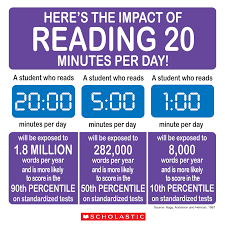
Having time for reading is another big issue. There is this romantic notion that all school-going children read for 20-30 minutes a day. You know all the charts … the funny thing is they all have exactly the same 1987 source, and it’s not even an accurate representation of what the article said – see * below.

I don’t know what your classrooms or homes look like, and I’m sure there are schools, classrooms and homes doing brilliantly on reading. Sustained reading. Uninterrupted reading. I fear the truth is otherwise. I suspect students spend a lot more time on Youtube for their learning. YouTube publishes some interesting statistics.  Of relevance is “YouTube is technically the second largest search engine in the world.” and “Average Viewing Session – 40 minutes, up 50% year-over-year”. If I had to put some money on what our students are watching most on YouTube, it wouldn’t be much to do with learning but rather they seem to spend a lot of time watching other students engaged in one kind of game or another.

I think if I had to ask a bunch of our middle-schoolers to preference-rank what they like to do, if reading wasn’t on the list, it wouldn’t even be mentioned. If it was on the list, except for maybe 5-10% of the students it would be way down at the bottom.

So this part is a little about whether the student is able and willing to make time in the day to read, and based on the little perceived time they have, what they could read.

I usually tell students that if they truly are reading every day, they should be able to get through at least a book a week. So the converse is also true. What size, format or type of book can I pair with this student that would guarantee they’d actually finish it in a period of time that will allow the book to remain meaningful?

We have this illusion that if only we could find the “right” book, a student will just want to read it non-stop and then will be converted to reading for life. I don’t think that is true. I think we need to find a succession of books that students will be successful with so that they can build up some kind of reading stamina that will result in them being “good enough” readers so they can be successful academically. And if we’re lucky they’ll pick up a book again after they leave school.

What are your friends reading?

The need to belong is second only to the need to breathe for teenagers. There are glorious moments when we can ride on the wave of “it” books (yes, like Harry Potter). Where there is a buzz around a book or an author that makes it possible for us as librarians to just ensure we have enough copies and that we get out of the way of the stampede to the check-out desk. And make sure we have enough read-alike lists.

That, for teenagers may be the critical bit – the herd immunity thing. Having a critical mass of “cool” students who are readers, who then infect the rest.

My only compromise to lists is having students recommend to each other. Before, when I was in primary and could see each class each week, I had a list per grade. Now, I’ve convinced one grade (6) to make a list as a gift to the incoming class.

What is your teacher reading (aloud) to you?

If only, if only. And when a teacher starts a habit of reading aloud to a class I can guarantee that book will become the favourite of just about every child in that class. Bonus points if the book is the first in a series, because they’ll then rush to complete the series independently.

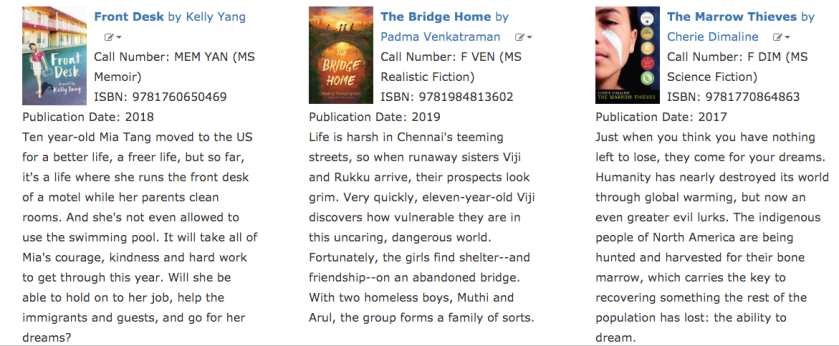
I’m just going to put out a plug again for the Global ReadAloud. I’ve curated the resources for this year’s books in a Libguide. It’s not too late to start.  It’s never too late to start. Just read. Or read and connect. Read now, with the current great list of books. Or read some of the books from previous years. Or read this year’s books now and other books from previous years later. Honestly it doesn’t take much time. I’m reading aloud each morning from Front Desk before school to a small group of students. We have about 10-15 minutes and get through a chapter or two/three depending on the length of the chapter and what else we do / discuss around it.
Screen Shot 2019-10-06 at 10.46.53

And this is where I tell parents that if all else fails they should read to-and-with their student. Even if they’re 14. And I tell them how we still read aloud to our IB-level child who also doesn’t like reading. And they look askance at me. Or they make apologies for their own poor reading – and I tell them that’s exactly why they should be reading with their child. As an empathy building exercise. As a gesture of solidarity and understanding that it is not perhaps easy, but it is important. Important enough that we both spend time on this.

Lists are easy to make. Easy to ignore. Conversations are harder, take more time, but potentially have more value. What do you do in your schools / libraries?

————————————————————————————————————————————

*This is where things get very interesting – I went back to the original article and it says nothing like what the posters say … it’s about vocabulary acquisition and learning new words based on context (nothing about standardised tests!). AND they’re talking about students reading 15 minutes IN SCHOOL, plus out-of-school reading of newspapers, magazines and comic books. So the sum for an “average” 5th grader is:

600,000 words in school; 300,000-600,000 words out of school = +/- 1 million words

I doubt the average fifth-grader is reading anything near that amount in or out of school.

” Though the probability of learning a word from context may seem too
small to be of any practical value, one must consider the volume of reading
that children do to properly assess the contribution of learning from context
while reading to long-term vocabulary growth. How much does the average
child read? According to Anderson, Wilson, and Fielding (1986), the
median fifth-grade student reads about 300,000 words per year from books
outside of school; the amount of out-of-school reading increases to about
600,000 words per year if other reading material such as newspapers,
magazines, and comic books are included. If a student read 15 minutes a
day in school (see Allington, 1983; Dishaw, 1977; Leinhardt, Zigmond, &
Cooley, 1981) at 200 words per minute, 200 days per year, 600,000 words
of text would be covered. Thus, a rough estimate of the total annual
volume of reading for a typical fifth-grade student is a million words per
year; many children will easily double this figure. Reanalysis of data
collected by Anderson and Freebody (1983), using information on the
frequency of words in children’s reading material from Carroll, Davies,
and Richman (1971), indicates that a child reading a million words per
year probably encounters roughly 16,000 to 24,000 different unknown
words.
How many words per year do children learn from context while reading,
then? Given a .05 chance of learning a word from context, and an average
amount of reading, a child would learn approximately 800-1,200 words
well enough to pass fairly discriminating multiple-choice items.
These numbers are at the low end of the range that we have previously
estimated (Nagy, Herman, & Anderson, 1985; see also Nagy & Anderson,
1984), because of the lower estimate of the probability of learning a word
from context and a more conservative estimate of the number of unknown
words encountered during reading. Yet, the figures suggest that incidental
learning from written context represents about a third of a child’s annual
vocabulary growth, an increase in absolute vocabulary size that has not
even been approached by any program of direct vocabulary instruction.

Nagy, W., Anderson, R.C., & Herman, P. (1987). Learning word meanings from context during normal reading. American Educational Research Journal, 24, 237–270

Content plus

One regularly hears phrases bandied around schools such as “Every teacher is a language teacher”; or “Every class should start with 10 minutes of reading” and you’d be hard pressed to find a teacher who doesn’t agree in theory, that reading is a good thing. But then there is the “reality” of supposed too little time, too much pressure, too much content to cover and the theory of reading becomes such an abstract notion that there isn’t even a consideration of how it could be implemented.

Last week-end, Katie Day and myself gave a 90 minute presentation to around 100 educators at the Neev Literature Festival titled “Books & Beyond”. You can find a copy of the presentation here as well as other resources.

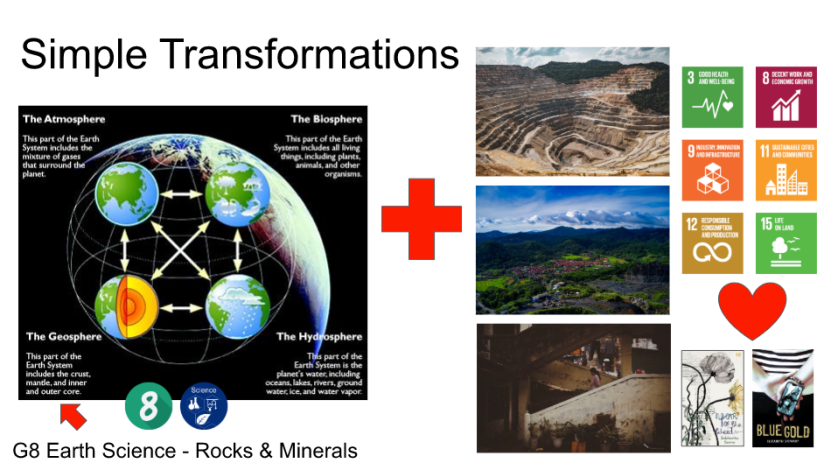
We’re on break now, and when we get back I was asked to present to our HODs for a few minutes on integrating reading into units in the middle school. I’ll probably just show this one slide:

I’d call it “content plus” – it’s from a G8 Earth Science unit that the Science team and I put together at the end of last year and they’re teaching now.

The idea is that you still have the science content as core to the unit – in this case Earth Science and learning about Sedimentary, igneous and metamorphic rocks and the minerals they contain and mining and the  products of mining. But to that you add the environmental and human impact, and the lens of the SDGs (Sustainable Development Goals).  And in order to help build empathy and understanding, add some literature.

Katie also had the brilliant idea, that she’s implemented in her school (and I’m going to be following quickly behind!), of getting good, relevant articles, stripping off the advertising etc (she uses Safari Reader View; I use Mercury Reader) putting them in binders and making them available in the library and classrooms – see slides 42-47).

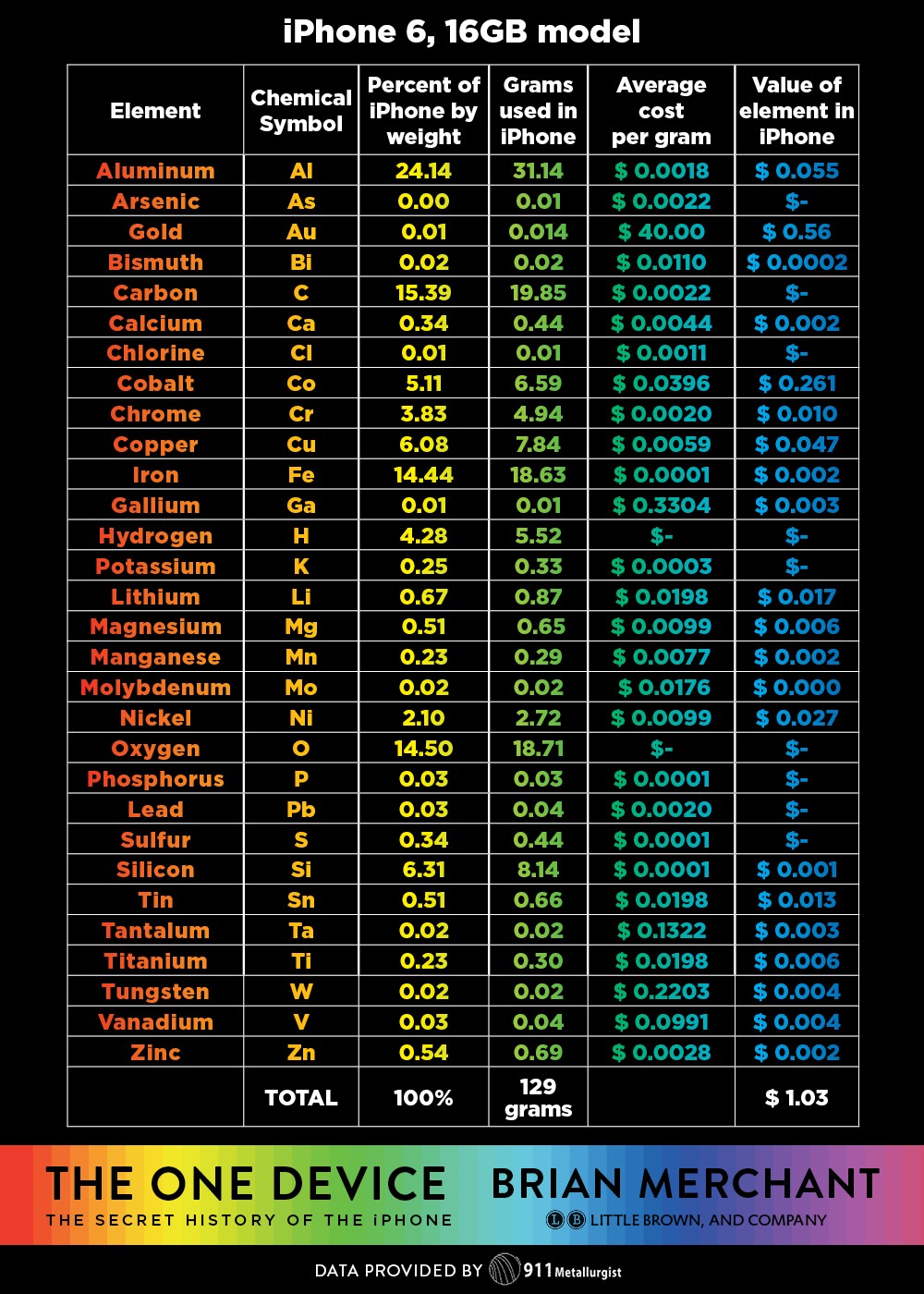
You can of course choose any minerals, but in this case to make it relevant to G8, we focused on the primary elements of an iPhone.


iPhone ingredients

Ideally, and this takes time, some of the science and or math units would be linked to Language & Literature or Individuals & Societies units allowing more time to explore literature.

In the mean time, one of the wonderful ways of adding literature into units is through picture books. In the guide we created for the Neev Festival, we made suggestions around groupings of the SDGs of the Neev shortlisted picture books plus lots of other books. It’s still a work in progress, but over time I’m hoping that for each and every global goal I have 10-20 picture books, (as well as 10-20 fiction books and 10-20 really good nonfiction books) that can easily and quickly be introduced to a class, thereby adding a very special element to learning, and truly making “every teacher a language teacher” and every teacher able to devote a tiny slice of their class to reading.

Why awards?

This week’s blog post will be very brief as a function of my extreme exhaustion – just been up and down to Bangalore for the Neev Literature Festival 2019. Beijing-Bangalore is not a commute I’d recommend to anyone who prizes their sleep or sanity but WOW what an intense 2 days it was.

The theme this year was “Taking Children’s Literature Seriously” and I’ll write a bit more about the rest of the festival another time.

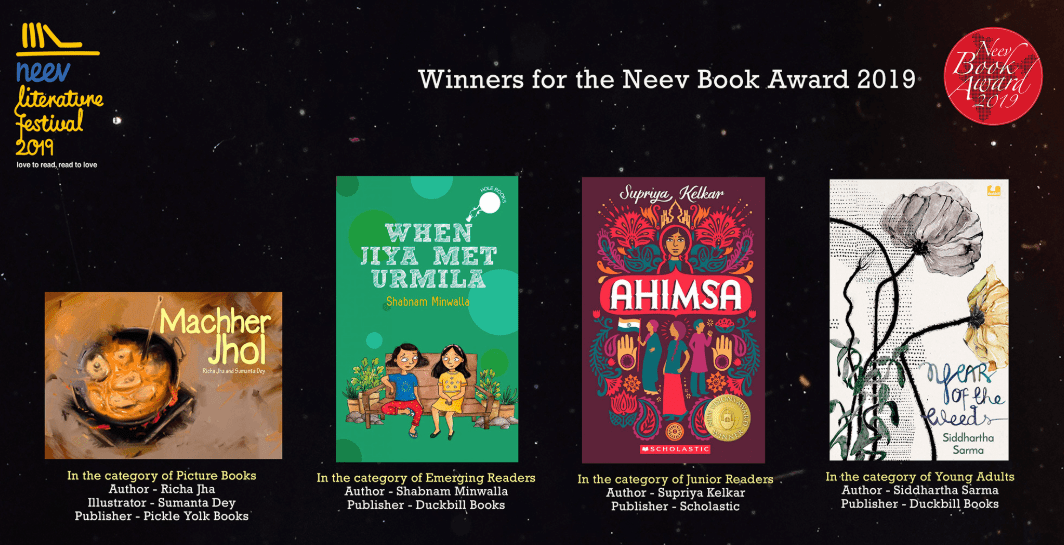
For now I just want to highlight the winners:

Screen Shot 2019-09-22 at 20.11.30

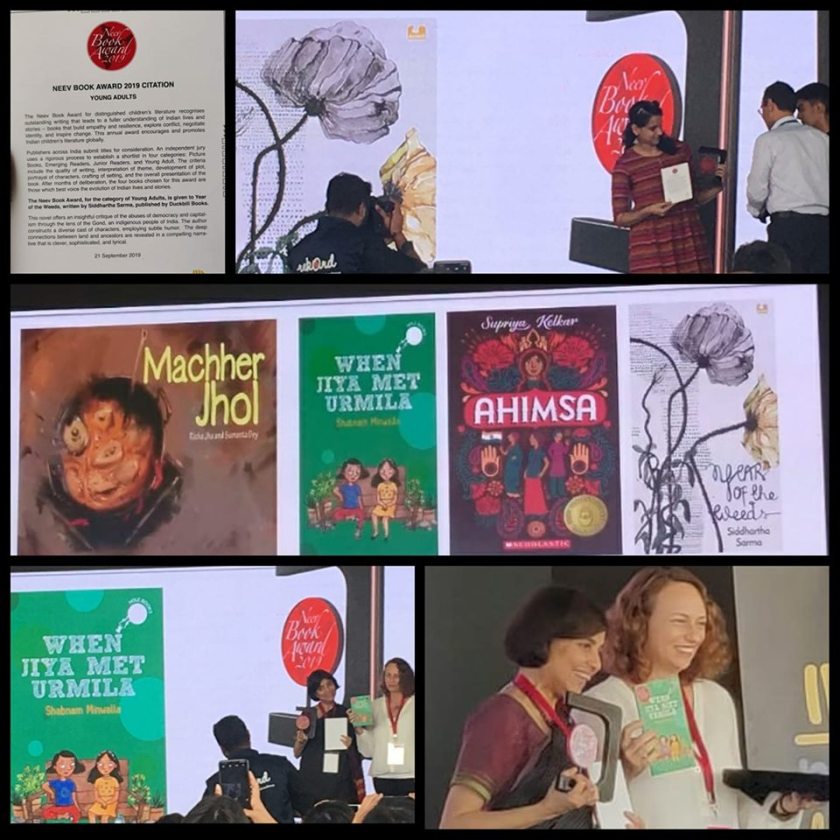
After a year of reading the long lists and short lists in four categories the awards were announced on Saturday for this year’s winners. I must say it was a surprisingly emotional moment even for me just as one of the jurors, I can’t imagine what it must be like for the authors!

There’s been a bit written recently about literary prizes – “Who Cares about Literary Prizes” is a wonderful article combining the idea of “canon” and popularity in this context with some very cool data representation. Book Prizes, the more the merrier, and A guide to the most prestigious prizes.

Book buyers, librarians, teachers, parents tend to rely on a fairly narrow range of sources for their book purchasing decisions. One of those is lists, and the other prize winners (and often lists of prize winners). In this context the existence of speciality or niche book prizes is incredibly important to shed light on otherwise neglected corners of excellent children’s literature.

Since Ahimsa is already relatively well known in international children’s literature circles, I’m going to just put in a few words about the other three books.

Machher Jhol is a richly illustrated book showing the journey of a young boy through the roads of Kolkata to get the ingredients for a fish stew for his father. There is a wonderful twist to this tale that will make it beloved of any class looking for books on resilience.

When Jiya met Urmila is written for that space of emerging readers where very few authors manage to successfully tell a great story but make the writing accessible to the beginning reader. The story gently probes how segregated childrens’ lives can be.

Year of the Weeds is one of those books that I can see becoming part of a canon of middle grade / young adult books that are used in the classroom to promote thinking about globalisation, sustainable development goals of economic growth (8); industry and infrastructure (9); sustainable cities and communities (11) responsible consumption and production (12); and Life on land (15) – while still being an excellent read.   The link above goes to a very interesting interview with the author.

neev awards.jpg

Another thing that awards do – reward publishers for taking chances on genres, topics and authors.  This year Duckbill publishers had two award winning books – here’s hoping they continue to bet on this calibre of writing AND even more importantly that their books get attention and distribution outside of India, because the world needs these books.

In response to requests – here is where to find the books:

Ahimsa

When Jiya Met Urmila

I will be sharing an email to contact if you are interested in buying the short-list or finalists in multiple copies.

In addition if you’re interested in other books:

Here is the short list:

Here is the complete LongList nominated by Indian publishers


Librarian Crush – Folks I’m loving right now

About to start our second week of school, and after the first 3 days of teacher planning week I’d just like to make a quick shout-out to some people who make a librarian’s heart very happy!

  • The new teacher, overloaded with moving continents with a family who came into the library and borrowed 4 books to be reading what her students are reading
  • The teachers who took it on blind faith and my raving that the Global Readaloud is something they should “sacrifice” class time for and agreed to participate for the first time this year.
  • The outdoor teacher who came to me to discuss what books and short stories we had that would be suitable to take on camp for reading aloud
  • My staff who worked like trojans to get the library looking wonderful for the start of the year – including cataloging piles of books that arrived during the summer “because the students would like to see something new”
  • The HOD who spoke up during a meeting to support the idea of reading aloud for at least 10 minutes before the start of all and any lessons (including the ones where teachers said “even in my (XXX) subject?”
  • People like Buffy Hamilton and Pernille Ripp who blog continuously and consistently about making reading and writing work in the Middle / High School classroom. Including admitting with humility when things don’t work.
  • People on twitter who engage in conversations about why students post-primary have stopped reading and how to re-ignite the passion for reading.
  • Departments and teams who think it’s not only necessary but normal to include the librarian in planning units.
  • Fellow librarians who are keeping in touch over long distances to brain storm how we’re going to make this a great year of engagement for our students and fellow faculty.

Happy Monday morning everyone – hope you all have a great week and a great year of sharing and reading.

When to read what how

First a shout-out – if you’re an international librarian and reading this – please join the International Librarians Lead (inTLlead) moodle – it aims to bring together a repository of resources, ideas and discussions on everything to do with being a 21C librarian in a global setting. We have 195 members and growing.

Further to my post about the difficulty in getting the right pitch in nonfiction reading in middle school, the discussion continued with science teachers about what students read (or don’t – thanks youtube) and how scientific time at school is used. And this is something I find incredibly weird as a non-science teacher, non science-curriculum creator, but as a parent of two kids having gone through science in PYP, iGCSE and MYP and DP. They spend a LOT of time and energy on lab-reports. Which often, no matter how heavily it’s scaffolded (and believe me I’m yet to see a lab report assignment that’s not heavily scaffolded) but they don’t spend any time until the IB reading a scientific journal article. And then probably only if they’re doing an EE (extended essay) on a scientific topic. And the skills required may or may not be explicitly taught depending on whether the librarian gets a look in, and depending on the supervisor and how much time they have.

Does anyone else find this strange? I’m wondering if we could somehow create a phased cross-walk between popular science articles in various areas to the original research that gave rise to those media interpretations (or misinterpretations as the case may be). Phased as in the sense of starting with the LCD of the abstract and conclusion and working up to sample size, statistics chosen and interpreted, hypothesis, methodology, experiment (link to the dreaded lab report) etc.

Am I talking nonsense? I’m thinking something very graphic so it’s pretty obvious. Or they create the graphic. By the time they get to the IB or university they don’t have the time to both do the writing needed and learning the decoding skills surely we should start earlier?