Don’t try this at home!

Week 12. The TV in our household has been quiet for most of the Covid-19 period. This isn’t unusual, since I grew up in South Africa, we only got TV when I was 9, and it was a little black and white thing to boot, so the habit never caught on. Since my son is doing film, we’ll occasionally watch something that he’s seeing for film together, or the odd Netflix series. I switched on the TV the other night and stood amazed as a home-schooling mum told a reporter about how she managed everything, the brilliant schedule*, her children diligently working at whatever was laid out, the chores everyone was merrily doing and sighed. And felt inadequate. And laughed a little hysterically. (And switched channels). And remembered that I’d never chosen homeschooling, ever, at any point of my parenting existence. In fact sending my kids to school was a sure way of ensuring that they survived past childhood.

I think a lot of us “educator/administrator / parents” are feeling the pressure that somehow we should have more a grip on online-learning – well spoiler alert – this one certainly doesn’t.

This past weekend I closed my laptop and only lightly touched my phone to connect with friends and family. Because my son needed my help. He had a film assignment to complete and I was the only warm body able to be camera-person. He needed synchronous conversation and meals with me, as we’ve been completely asynchronous all week with him waking up just as I’m at the end of my physical and emotional tether with all the work I’m doing online. We needed to have some meals together. Go for a walk. Get in the car and visit our local vegetable farmer to stock up and try a local farmer who had a meat self-service stall.

I still consider myself to be fortunate. One 16 yo in the house with me, one 18yo stuck in the UK with her guardians, trying to discuss university options and counselling not to feel despondent that the first choices were not achieved. Single and remote parenting isn’t something I’ve chosen but has been thrust on me with a husband still in China.

It was a tough week. Our landlord refused to extend our lease for even another year as she had $$ signs dancing in her eyes (good luck with that), and we needed to virtually find a new place (my husband can’t return to Beijing without 14 day quarantine, and he can’t be away from his job that long, as life is back to normal where he works). Thank heavens for kind colleagues who were leaving and prepared to have a long conversation about the place they were vacating. Now the ROTW (rest of the world) has joined the online party every single system is creaking and groaning and, more often than not, just lying down and dying. Professional stress plus personal stress are not a great combination. My son had a terrible week last week – 11 weeks of online learning for an extreme extrovert with ADHD is not a joke. Plus a physically absent father and an emotionally absent mother – or at least not present at the hours that he was present. He did a lot of sleeping. And cooking. And neighbour’s dog walking. And panicking. So did I, except for the sleeping bit.

As with most things these days, it seems like online-learning while parenting is a binary thing. On the one hand there are the perfect parents with their schedules and advice, and on the other there are those shouting out for help, discussing tantrums and refusals to cooperate. Or those like me occasionally whimpering that it’s not easy.

The other binary seems to be the “refuseniks” who are taking a stand against any online learning as an affront to their authority in the home, or who say it should take a back-seat to emotional / physical wellness vs the group who want it to all be “business as usual” and are reactive to any hint of a slackening of pace.

I suspect all and any responses are responses driven by culture, experience, financial means and dare I say anxiety. While on the one hand I do think this is the ideal opportunity to rethink so much in life, there is the constant sword of Damocles I feel hanging over my head. Single parts of a machine that change, run the risk of being flung out. Will a term out of school really matter? This article based on the Christchurch experience argues it won’t. NWEA – who is selling a tool, but does have the data that so many crave during uncertainty compare the Covid-19 slide to the summer slide. And some private schools are already preparing to mitigate against any slide. I know that working and learning in our household does create the semblance of a structure and the idea that there is some lurching forwards towards academic goals, or at least well-trodden pathways.

It is of course a privilege thing above everything else.

romanticising quarantine - .jpgThe people cited in the first article weren’t sitting around doing nothing while their children were un-supervised, left to their own devices and anxieties. The loudest voices in the “I’m going to do nothing” won’t really be doing nothing. They’ll be playing games, cooking, gardening, reading and a plethora of other stimulating activities in the (larger) indoor and outdoor spaces they have at their disposal. They’ll know what to do because their background and privilege will allow them to make choices that mean things will turn out OK. Structured schooling is unfortunately one of the few options for many other students to do the school and life learning that will make their futures more bearable.

Not just privilege but also assumptions – they’ve not really changed – the idea of homeschooling presupposes that there is someone at home to do the schooling. Now there may be somebodies at home – but those bodies may be working pretty darn hard to keep their own jobs, or in fact be the ones pushing out the online-learning while juggling the education of their own.

A few of the articles I’ve found interesting this week are “prepare for the ultimate gaslighting” That counts not only for consumption of goods, but also I think for the consumption of learning. What will happen when we go back? The universe hates a vacuum. Will it be swiftly filled by more of the same?

____________________________________________________________________________________

*There are circles of hell for online/remote/home schooling schedules – and the ones closest to the fire are the ones that are colour-coded and for sale on TpP (Teachers pay Teachers – for the uninitiated) ! schedule.jpg
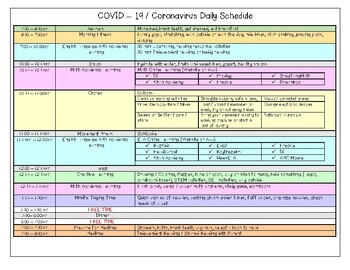
The troops are so very tired

Week 11. And while partial opening has been announced at most schools in Beijing for G12 and G8, this probably going to result in more stress, uncertainty and questions rather than less.

Even more than ever before I am convinced we will need to radically change our teaching and learning practice. And now I’m not talking about the students but the adults. Everyone I’ve spoken to today has been really exhausted. In my conversations I’m trying to get to a better understanding of it – since we’re not feeling the joy right now. It’s wintertime in the trenches and the troops have foot-rot.

The reasons I can find are related to the need for some kind of assessment and evidence of learning. Which means assignments and marking. And lots and lots of feedback. I sense a huge reluctance on the part of teachers towards giving group feedback. Or even to let go of one-on-one emails in favour of using discussion forums to address anything – even banal requests for links to a document or small questions on assignments.

All this comes from a very good place. A very kind and caring place. And it’s really harming our teachers. Someone confessed to an 18 email exchange with a student on uploading a video file. I remarked that it could have been solved with a 2 minutes conversation with myself or the IT department but the person said they “wanted to work it out themselves and learn how to do it too”. Teachers are fiercely independent folk. I’m a fairly independent type myself, but I’ve re-qualified into one of the most collaborative parts of the teaching community possible – Teacher Librarianship. We have no shame in asking for help in our PLCs and (except for a few not so admirable souls, mainly found on TpT) openly share anything we create freely.

Independent, soldiering on with being too proud to ask for help is not going to help this. As my esteemed colleague Stephen always says

“We need to take time to make time”.

In my morning chat with my husband this morning – he’s been thrust into the hotel business this year in a managerial capacity – he reminded me of a saying in that business:

“Tell Everyone, Everything, Everyday”

when he first told me it months ago I thought it was a bit patronising. But I’m thinking it has some merit now. Bear with me.

Tell Everyone

With asynchronous online learning, people spread over the globe it’s easy to lose sight of who is or isn’t at meetings or training and who may be missing out on important communications or PD. Weekly updates tend to have content creep which means that there is so much to read through and absorb and so little time in which to do so that messages get missed or suffer from the consequences of the idea of “I’ll go back to that later”. Who are our messages missing and why? Just like we attempt dual coding and multi-modality in our messages to our students are we doing enough of that for all staff?

Everything

Everyone is overloaded. Too much content, too long emails, too bloated libguides, too many FAQs. But there are seasons to online learning too. What everything looks like this week as teachers are preparing for online meetings with families and students looks different to when they’re introducing new concepts or doing formative or summative assessments. I mentioned Atul Gawande’s “The Checklist Manifesto” to a colleague this morning and suggested we perhaps need to create one for the “hot topic” of the week. I mentioned it again to another colleague struggling under the weight of marking – I’d attended a great webinar (one of many that Microsoft is hosting – you just need to register to be able to view it) where Esam Baboukhan showed how he uses self- and peer-assessment checklists before student return their work for grading. I don’t think we’re above following the lead of pilots and surgeons in this regard, and found myself saying to someone I was helping today, “slow down, slow down, let’s just do this slowly and carefully and then you can use it as a template for the next thing.”

Notebook self and peer assessment

Everyday

In Atomic Habits, James Clear talks about the “compound effect of hundreds of small decisions”. When everything is topsy turvy and no one really has a proper routine (despite the plethora of nice looking examples all over twitter and on TV and in media) it’s probably less about having a schedule and more about having habits that can exist independently of time and space. I’m thinking it’s more in the nature of “when I’m doing this, I do it like that” It’s consistency and predictability that wins this battle. You can always find this information in this place. Things are always named in a certain way. Meetings are always found on the relevant shared calendar. Recordings are always found in a certain channel and named in a specific easy to find way. Because there is so much it is so easy for things to get out of hand. It’s easier to quickly reply to a student than to ask them to post the same question on the forum. It’s easier to troubleshoot the same question with a quick email than to do it the first time it arises and then commit that answer to a knowledge base. I remember when we moved over to https:// for all our systems. People had all their bookmarks and caches with the old http:// for things. It worked fine while at school but didn’t work for them at home. We got the question why all the time. In the end we put it on Yammer and “bumped” it up every day for weeks on end. People forget. Things slip their mind. Minds are overflowing.

Learning new tools is hard. Learning new ways of teaching is hard. Everyone is tired. I’m just not sure what it will take to get off this very fast spinning wheel. We’ve not yet reached cruising altitude and we’re about to go into another tail spin.

____________________________________________________________________________________________

How long will it take to rethink online learning?

Tomorrow marks 74 days since we saw our students face-to-face. Since we had the luxury of physical indoor and outdoor spaces. A library. Fields to play in. Classrooms. We’re at the point of the year now where we’ve started talking about assessments and report cards and student led conferences. Where there are fewer days left until the end of the school year (67 days) than we’ve been doing online learning. And everyone I speak to is so very tired. Students, parents, teachers.

If this becomes our new normal, even in some kind of hybrid online/off-line model as articles such as this from the Atlantic Get Used to It: This Lockdown Won’t Be the Last  suggest that we may be moving between the two for a while to come, then we’re going to have to rethink online learning in a major way.

I listened to an interesting podcast with Sam Harris and Matt Mullenweg little over a week ago, on the New Future of Work wanted to blog on it but then had to do some more thinking and revisiting the points, but it was nearly a 2 hour podcast and I didn’t have the time to re-listen to it (even on my usual double speed), and there was no transcript – so the hack I employed was to open a word document and activate dictate, play the podcast in the background and use Microsoft’s pretty impressive assistive technologies help me.  I can read way faster than I can listen which is why video-based education always annoys the heck out of me. Podcasts are ok as I can do them while walking, cleaning, cooking etc.

Levels of Online Work:

Getting back to the point. Mullenweg identified five levels of online working. And I think this is probably true of online learning.  He also had a great little anecdote about the early days of radio drama in the 1920’s when people didn’t take advantage of the medium and tried to recreate plays including costume etc and then broadcast it. Online everything is a bit like that – we take the physical and try to recreate it but online, not fully adapting to the medium.

The levels are:

Level 1: Occasional at home work for example due to emergencies / illness using basic equipment like phones / internet

Level 2: Attempt to recreate the office environment at home without taking advantage of the medium – i.e. synchronous, mandated online hours, surveillance by company, little freedom and agency.

Level 3: Take more advantage of the medium – e.g. shared documents, real-time editing for example during meetings for clarification and shared understanding, better home equipment, companies investing in hiring people with really good written communication skills.

Level 4: Going asynchronous giving agency to people to design their day and productivity. Performance is judged on production / output not on how it’s produced. The baton is passed on over time zones. Decisions take longer but allow for longer and better contemplation, less power dynamics and give space for introverts and people for whom English is a second language.

Level 5: Nirvana with better work and more fun. Environment is designed around health including mental health and wellness. People operated at a higher level being “heroicly productive”. A sense of a world of “infinite abundance” and where there is a noticeable divergence between peers in terms of their deliverables/output. The biases of online environments such as dress / self-presentation / image disappear.

In their “The Remote Playbook from the largest All-Remote company in the world” Gitlab have their own levels:

  • No remote
  • Remote-allowed
  • Hybrid-remote
  • Remote, biased towards one time zone
  • All-remote, asynchronous across time zones

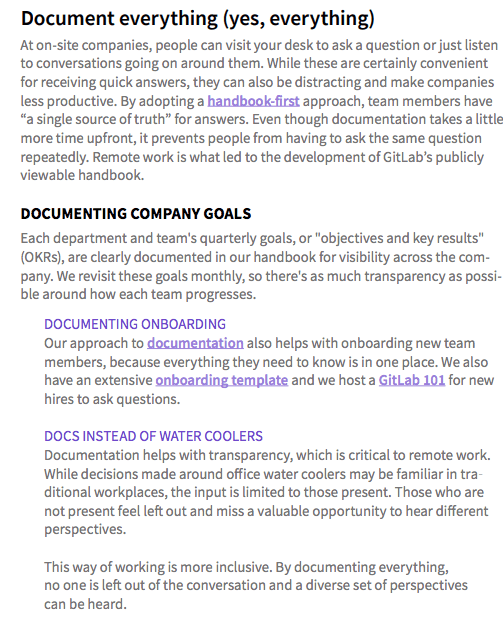
Document everything

I really like some of their suggestions – including the one about documenting everything and having a single source of truth. Honestly that was one of the most time-consuming things I did initially and it remains tough to keep it updated and relevant, but our Middle School online learning guide (7,745 views) and the more detailed Teachers guide (5,476 views) remain the best time-investment I’ve made so far.

Document Everything
From: The Remote Playbook by Gitlab – see more here: https://about.gitlab.com/handbook/handbook-usage/#why-handbook-first

Get off email

The most impressive statement Mullenweg made was:

“sometimes I .. get under 5 emails per month, well and some months it might just be one or two basically all I get with email is like private HR stuff things that need to be one to one private communication everything else happens on these internal” (discussion boards / forums)

One of the most stressful parts of online learning I think for everyone has been the continual flow of single-purpose single-person emails all asking / saying the same thing. From the EdTech / IT side of things we’ve taken a load off with Libguides. I don’t get the feeling that’s happening so much in the various subjects. We’re not at Nirvana yet – or even close because there is still some pride in saying how many emails you have / have sent / how many hours you’ve been working. I had a really bad day on Friday. I’d been up late giving online PD to some educators in North America, followed by finishing off some points that had arisen from the PD plus internal stresses as our permission to stay is becoming an issue as we can’t return to China and my son and I were creating home-made application photos and filling in forms (in French – thank you Google translate) into the next morning. Then up early to do the first grocery shop in 3 weeks at 7.30am before the shops got busy. And then I was dead. I checked the most important emails and dealt with them – often just pointing people to our knowledge base. I left a bunch. And by the end of the day got “don’t worry I managed to solve it” from a few. The more robust our knowledge base can be, the easier this is going to become. I also need to make a huge investment in getting everything to ASK.wab.edu and then pointing to individual pages / boxes.

That’s going to take a huge investment not just in putting it all in “ask”, but also in getting our whole community to check there first as a habit. 

Rethinking it all

But I diverge from the real point of this blog and that is the increasing realisation that perhaps we need to rethink teaching and learning. I attended a Zoom webinar with around 50 MYP educators last week, led by the indomitable Lenny Dutton and the consensus seemed to be converging around the fact that huge scaling down of the curriculum and content expectations was occurring – with 50% being the most common number suggested. (Side note, it also made me incredibly proud of the leadership, foresight and guidance of WAB as we’ve been asynchronous from the start).  Perhaps it’s my A-type personality, or perhaps it was the question from my son “will all this result in the IB changing its exams next year to take account that we’re missing so much this year” that made me wonder what the heck we’re doing? Yes I’m not uncaring and I know all about Maslow vs. Bloom etc. I also know that there is less room for anxiety, worry and endless media scrolling when there’s useful and engaging work to be done.

I have to keep wondering if there is a different way, besides the asynchronous and slower pace to do this. My colleagues know I have two phrases of our greatest enemy in education that I repeat all the time “continual partial attention” and “switching costs“. I think education does particularly badly in helping students to find their flow or in adhering to Daniel Pinks’ tenants of motivation “autonomy, mastery and purpose”

I’m a veteran of (adult) distance learning, having done two back-to-back masters’ degrees remotely over four plus years. It was hard. Really hard. And it took a while (at least 3 subjects, lots of tears and feedback) before I managed to work out the best way to organise myself and my work flow and to find the balance between (part-time) work, full-time motherhood with a spouse who was on the road a lot and being a student.

The sweet spot for me was only two subjects per semester, and only working on one subject at a time each day.

Granted these were masters level subjects with an enormous course load and tons of academic reading to do. But then again I’m a highly literate adult, with hopefully more defined study skills and work habits. So if we’re asking students to do 8 or more subjects and teachers to be teaching 5 block – sometimes of different grades/subjects (middle school) is it any wonder we may be over-reaching? (The poor completion record of MOOCs is also something at the back of my mind).

004-teamsAs you know, I’ve also been grappling with that beast called Teams, and I’m trying to think out of the box and learn from all the questions and webinars and videos out there. One completely out of the box idea I had was perhaps we’re thinking of it the wrong way around – this is in particular to my thoughts about student agency, self-directed learning, portfolios and evidence of learning/mastery.  What if instead of having class/subject teams, each STUDENT had a team they were owner of. They’d have channels for their various subjects, and they’d choose which two or three subjects they’d focus on at any time and when they’d do it. Subject groups would have department teams with all the teachers, the curriculum and curriculum content that then could be pushed down to students and mentors would help guide students in their choices. Instead of semesters, for this age group we’d probably have to look at shorter periods of time to ensure that the “forgetting” curve didn’t kick in – especially in continual practice type subjects (I’m in dire danger with my Chinese according to my memrise app, not to mention muscle loss on the fitness side of things).
combating-the-forgetting-curve

What are you thinking?

In a conversation with a fellow educator last week, he said “Well WAB is just so far ahead in thinking about these things, we’re probably at least two or three years behind even putting theses discussions out in the open” and perhaps that is so with our Flow21 initiatives. I’m also wondering how far away we are from becoming a global rather than location based entity – for example some of our students were at one point enrolled in local schools where they were based and have now returned to the fold – what’s stopping us from enrolling other poorly served students into our programmes?

I’m thinking the IBO is also going to need to be far more proactive to fit the new reality. Personally I was not impressed with the timeline of action (exam cancellation and alternatives proposed) only coming after it was apparent that this wasn’t just a China problem. Value based leadership is essential in these times and that includes checking bias.

FeedbackOnlineMYP.001

I do think the IBO focus on ATLs (Approaches to Learning), particularly communication would remain foremost – again from Mullenweg:

“and writing quality, clarity, and skill becomes more and more valuable I think in all organizations but the more distributed you are for sure. This is going to be a windfall for all the humanities degrees. Absolutely we screened for it very heavily in hiring process. Like I actually don’t care where you went to college or anything like that but we do a lot to screen for writing ability both in the how you apply how we interact will hire many many people without ever actually talking to them in real time or on voice we do it entirely through slack and tickets and other things because that’s how we work”

If we were to explode education what would it look like? Please comment.

___________________________________________________________________________________________

Feedback during Online Learning by Stephen Taylor
Photo by Glen Carrie on Unsplash
Copy

Teamin’ up

IMG_6391

This blog post is brought to you in-between too much stuff to do with online learning but as an absolute PLEA to Microsoft Education with their wonderful but exasperating Teams product to do some more heavy lifting to get Teams for Education into a shape and form that will get us through the next few months of online learning.

Why Teams is great – especially during online learning

Ok, I’ll do a sandwich – Teams has been wonderful for just existing. For making meetings quick and easy. For their integrated class/teacher/student notebooks (albeit they crash way too often and can refuse to sync properly). For their great way of setting up assignments making it quick and easy to have an overview, to mark and give feedback, for the rubrics.  (Although you can’t see assignment dates on the calendar – please vote for this!) They’re doing a really really good job of a lot of what we need.

And now for the BUT.

The big but. And I understand how it happened. It happened like a lot of things to do with education happen, including a lot of LMS (Learning management systems). They do something for the big people, in corporations or in universities, and schools are crying out for a functioning and functional LMS that’s mobile and cloud based and so something gets adapted and pushed down to secondary school or even primary. Ditto the other way, things are made for primary school where you have one classroom with kids and a few specialist teachers / classes and someone tries to push it up to secondary.

So, we’ve been doing online learning for nearly 8 weeks now (I think, I’m losing track, and last week was a week “off”). And we’re really needing to change gear. We can no longer stay in first gear as if we’re climbing a steep mountain while on the flat-endless prairies. So it’s time to take stock and adapt practices for the longer term.

What is not working that in education we actually really really need to work? And pretty fast? (And all the mistakes I made along the way as bonus crash-viewing – hopefully this will help someone else just starting on this path) .

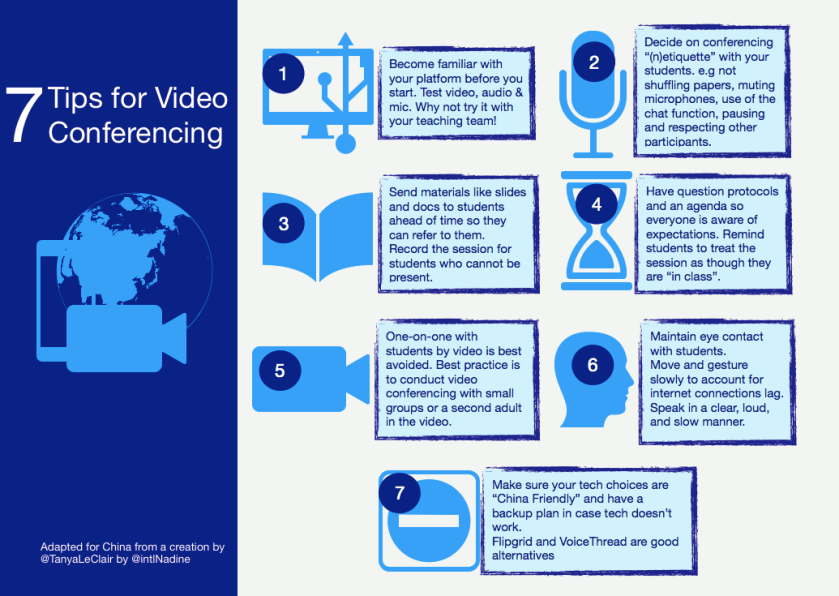
7 tips for video conferencing

Child protection needs to be a priority

Teams was really new this year and has been adding great features along the way. So for a long while, it was an experimental sandpit for us where we were letting our early adopter teachers play around in, create as many teams as they wanted with no real oversight. It was great, we learnt a bunch and all was fine, because we were still having physical classes and mainly using it for assignments. Then Covid-19 hit and we went full stream online. We went from a handful of teams/teachers with regular feedback to over 300 teams and all teachers overnight. Despite having naming conventions (to easily find / sort teams) and requesting that EdTech and senior leadership were co-owners of all teams, that didn’t necessarily happen. Humans in panic and all. We set up protocols for online meetings. We requested teachers to record and save meetings.

  • People forget to record (meetings can’t be set to automatically record).
  • People forgot to put meetings on the public calendar(s) (we have one per grade)
  • Students start meetings before the meeting time/teacher is present.
  • Teams only keeps a meeting recording for 20 days.
  • Meetings in private channels can’t be recorded

These are things that were “nice” to have automated / sorted out before we went online but now are really important if we want to safe-guard students and protect teachers from (potential) unjustified accusations.

Here are the links to Microsoft teams UserVoice to request these things are implemented – please add your voice and vote:

Schools have children in them – they do stupid things!

We have a number of teams for professional purposes, and even we have problems with basic organisation – such as putting things in the right channel, starting conversations in the right channel etc. We were so glad when Teams started the option of private channels, but then so disappointed when they didn’t have the full functionality of open channels. Open channels are fine. But not for 10-11 year olds. They need to be corralled into private channels so they don’t mess things up for themselves and others.

Teams has an endlessly flat non-hierarchical structure

Yes ideally and eventually we’re going to kill grade levels and age-based learning and all of that. But it hasn’t happened yet. And it’s not going to happen in the next few months of online learning. And yes fortunately and for the better of all we’re moving from thinking about students and classes as “my” student/class/subject.

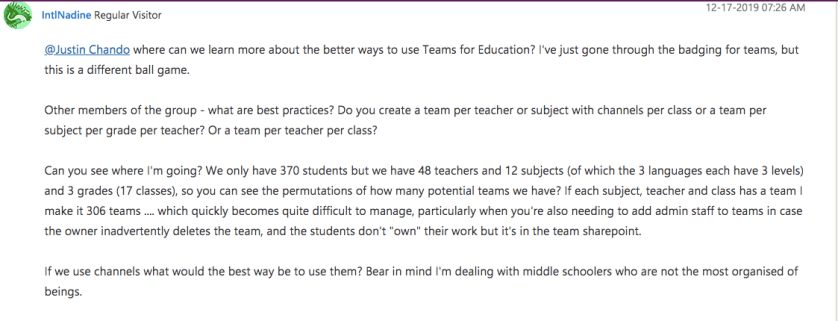
The very basic question we all grapple with in creating teams is how to structure it. Because there isn’t really a structure in teams.

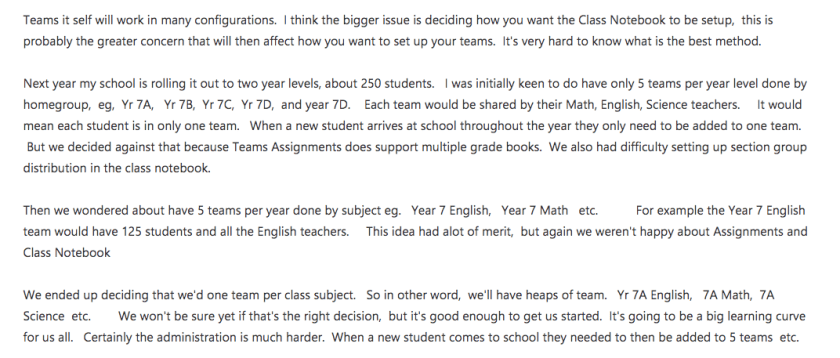
Here is something I posted to the Tech Community educator group early on in December 2019 about the sheer math of the matter and some responses:

Screen Shot 2020-03-24 at 6.53.50 PMScreen Shot 2020-03-24 at 6.54.25 PMScreen Shot 2020-03-24 at 6.55.41 PM

I still don’t really have the optimal answer to that, particularly given the restrictions of private channels (maximum of 30 per team, no meeting scheduling and no meeting recording).

The thing is it’s better to think this all out in advance and to have a plan rather than to start and then have to reconfigure things afterwards because

  • you can’t change a private channel into a public channel after creating it as private
  • you can’t change a team into a channel – private or public or vice-versa
  • you can’t move a channel into another team
  • you can’t rename a team or change a teams name (well you may “think” you can and do it,  but you have potential real problems in the back-end in Sharepoint)
  • you can’t sort teams or put them into folders or pin them – you can drag them around – easy enough if you have a couple of teams not so if you have 300 of them, you can filter them – but that only works if you’ve named them all properly and consistently.

There is no dashboard / entry point

When you enter teams it is a full on experience. There is no dashboard with your calendar / assignments / meetings about to happen. You can scroll and scroll and still miss things – sometimes I have a meeting to attend and I even know in which team and it’s started but I still can’t find it quickly!

The analytics are very rudimentary

I’m the first to admit I’m a little bit of a data nerd – ok a lot. I have seen a lot of responses in the twitter-sphere along the lines of “no one is going to tell my child what to do during school closure” or “I don’t care if they learn or not as long as they’re happy” – but that’s not my demographic. Our families are paying a lot of money for their children’s education and learning and they have high expectations of us and their children.

[Personally I’d also say an engaged, purposefully busy and cared for child (not just by the parents but by the educator too) is a happier child than one left to endless repeats of anxiety creating bad-news on social media or TV. ].

So we spend a lot of time and energy making sure we’re mentoring students, monitoring their engagement and that they’re not falling too far behind their peers. Moodle, our usual LMS (but the clunky old stead) has great analytics. I can see exactly who’s been online and when, for how long and what they’ve been engaged in – but for many reasons our students and teachers like the intuitive feel of Teams more.

Teams has basic analytics for the week and month BUT I can’t click on anything! I can see the number of active / inactive users but I can’t click further and see WHO is inactive – so here’s one class for example – 9 kids’ haven’t re-engaged in the first 3 days after spring break. Who are they? Without looking through comments and assignments in detail I don’t know. I look at 28 days and see it’s just 1 person – who is that?

But that’s just one teacher for one subject – say I’m a mentor for 11 students and I need to report weekly on all my students and see who’s falling behind and whether it’s just one subject or all of them. No can do.

Lack of portfolios

Using portfolios as evidence of learning is really important as we progress in our understanding of education as a process of learning rather than students needing to jump through some curriculum and examination hoops at certain points in time in their lives (really relevant now as IB, GCSE and A level exams were cancelled this year). The structure of teams is that the Team in Sharepoint “owns” the work students have done as assignments. There is no easy and quick way to gather all the evidence of learning from the assignments and “give” it back to students to add to their portfolios as they move through the system or from one school / teacher / grade to another.

This may seem minor but it’s a major philosophical shift that need to happen in education. Learning is not something that happens to students from teachers, but something that students own and are accountable for. Especially now. Especially in concept-based education like the MYP.

There are many ways of showing mastery and the current set-up still puts the teacher in the control panel.

I’m way over my time and word limit now, so to end my sandwich:

What else works really well

Add on apps and integration with things like Zoom. A fabulous user-base in China with the inimitable James Rong – check out his blog – we have a joke here that if we ask a question to Microsoft, they ask James and then come back to us with his answer. Our other “joke” is that he posts an answer on his blog to a question we didn’t even know we had until we see the answer!

If you’re rockin’ teams and have some suggestions on best practice, please don’t give them on twitter or facebook where they’ll disappear, but add them as a comment here so that as a community we can all learn together. 

____________________________________________________________________________________________

I don’t know who created the image on my blog header but it’s amazing – it was passed onto me in a chat as a meme, if it’s yours please let me know so I can credit you.


First the earthquake and then the tsunami

Six weeks done and we enter our virtual online Spring Break. And my social media both professional and personal is awash with questions from people about school closure and online learning from a teacher/librarian/tech/personal point of view. It’s the long tail, the tsunami hitting land after the earthquake at sea. And I know that’s just a pretty picture of a wave on my blog and nothing at all like a tsunami. We in China had the Earthquake and now as folk in the rest of the world start running from the Tsunami we’re inundated with questions.

I’m not sure we’re equipped to answer them.

As private international schools in Asia we are a bunch of extremely privileged people. Both educators and pupils. My “go to” people in the China EdTech /Education world are a relatively homogenous group in that we are all well resourced and can go back to our leadership and ask for the money we need for the things we need to support and sustain online learning.  We have strong and capable leadership in our school who have modeled best practice in their empathetic and compassionate attitude and behaviour to all constituents of our community. We haven’t had to deal with salary cuts, union rules, students in situations of extreme poverty, or unreasonable demands. My colleagues and peers are a sharing, giving bunch and the things we create or come up with are shared freely without cost to others as we build on what works. The companies we work with have been super helpful and responsive and generous.

But the Tsunami has hit shore, and the coastal dwellers include the most vulnerable and least equipped or prepared for this. Our solutions won’t and cannot be their solutions. We have to remain humble in our responses. Even as I realise this and write of my experience I realise this comes from a place of privilege. I have these resources I can rely on.

The personal and political

This blog is a little more personal as I sit in the early hours of the morning after a fitful sleep. The virus has come close to home. A child in my daughter’s boarding school in the UK was diagnosed with the virus yesterday. After he left the school to go back to Europe on Wednesday. We heard last night European time. My husband is still in Nanjing. My son is with me in Switzerland. She’s in the UK. Three jurisdictions. Three different social, ideological cultural and emotional responses to this event.  But what does that matter when you have to make decisions? Decisions that could put other people at risk – like her guardians in the UK. A country that won’t let her be tested privately or publicly before going to them. A place where a lot of air-traffic is still occurring due to bizarre travel decisions by the leader of yet another nation. Where schools won’t/can’t make autonomous decisions and need to look to their government, but where the government, unlike the Chinese government, has a more cavalier response to the situation. And it seems is putting economic and political expediency above people’s lives. I keep second guessing myself.

This much I know is true. She should not be in a boarding house/school with so many other people. She can self-isolate with our friends / her guardians. She should not be travelling internationally at this time – airports / planes = high risk. Virus statistics and reporting is a numbers game. Literally a game. You test, your infection stats go up your fatality rate goes down. You don’t test, you can pretend all is ok. But then people die.

These are my concerns. Is she infected? If so, she infects the people who are generous enough to take her in. They infect other people. She gets ill – she’s young and healthy – but what if she gets very ill? I’m relying on friends to take care of my child, my young adult?

Parenting online

Ok, so a bit more about parenting (or the lack thereof) during the virus.

I wrote this for parents on a libguide right at the start of school closure. It was recently included in an article by ISTE so I thought I’d better revisit it. Funnily enough I don’t think I’d change anything. I’ll just expand a little on what it looks like practically and in reality for people going into this.

I’ve been working crazy hours, so parenting has suffered. This is a good thing in some respects.  Above all I think it’s important to keep good relationships going in the home. A big part of that is me refraining from nagging my son. When I do try and take what he considers to be an unreasonable interest in what he’s doing / how / when / how much, it nearly always ends in a row. Unless he’s doing the asking for help – in which case I need to drop everything and attend to him. I just love this (old) NY Times article about being a potplant parent – that’s needed more than ever during online learning.

My son has ADHD. He was totally overwhelmed at first. So were his teachers, even though I don’t think any of them are similarly afflicted. The first inclination for everyone is to try and carry on as normal, just online. It took at least two weeks or more for everyone to “calm the f down” and settle into workable solutions and routines. A couple of strategies that helped for us at home:

  • Putting a desk in the guest room upstairs to stop him working in bed / on the sofa / at the dining table. I know if he’s on his laptop in any of the latter spaces he’s either doing “light” work or goofing off. So does he. When he’s got a serious assignment or a meeting with a teacher he’ll go upstairs to his desk to work. There’s a glass door to the space and my new standing desk (much needed based on the hours I’m spending online and the back and arm ache) on the landing is a few metres away so I’m there but not there.
  • At the end of the first week when he finally admitted that he was losing it and couldn’t cope, I bought a paper agenda and we agreed he’d just think about and focus on two subjects a day. Once he’d caught up he could go back to the regular schedule, we agreed on which subjects they’d be for a few days together and then he took charge again. The fact that our school has moved to an asynchronous learning model is very helpful here.
  • Letting teachers be the teachers. We’re extremely, extremely fortunate to be at WAB. I can’t emphasise this enough. I know that his teachers are supporting him and looking out for him. That means I don’t (and shouldn’t) micromanage his learning. He has regular face-to-face check-ins with his teachers and his class mentor. They have physical and emotional distance from him while still being on his side. I don’t have that. It helps. When he messes up or misses a deadline, or doesn’t respond I will hear about it, but not before. We needed to intervene once with a busy-work / communication style situation, but that’s hopefully been resolved.
  • Sharing the household burden. It’s taken nearly 17 years, but after a week of closure he spontaneously came to me and laid out what part of the household chores he’d take upon himself “without any prompting”. This includes cleaning the bathrooms and toilets, taking out the garbage, helping walk our elderly neighbour’s dog and helping with the cooking and cleaning the kitchen. He’s stuck to that for over a month now and I’m more proud of that (and walking into his room yesterday and seeing it tidy, with the bed made) than anything else during this period.
  • Giving each other space – we’ll each go off for walks on our own. Take time out to cool down if we have words or after a shout. Yes I shout. And swear. And so does he. We’re human and emotions can run high. But we’ve found a new type of equilibrium in our relationship, an understanding that that should be more important than all the other details. It’s been a long time coming.
  • And I think he’ll want me to add this, he’s not a gamer. That’s huge. I know families with big concerns about the vast amount of time online at the moment that’s spent gaming not learning. I am grateful to him that this is not the case, and he reminds me of it when he sees the impact on some of his friends and peers.

This gif shows how I felt by 7am yesterday morning after nearly 7 weeks non-stop working. We’re now in our Spring Break and I’m promising myself to get off the computer and do some reading. Of real physical books!

via GIPHY


____________________________________________________________________________________________

Photo by Joshua Dewey on Unsplash

Online learning is not new shiny things

I’ll be the first to admit I’m an old boring Cassandra. It possibly / probably has to do with my age. Just to put things into context. Once upon a quarter century plus ago I was an auditor finishing up my articles. It was in the days when “calling” existed. Not the kind of cold-calling or call-centre type of calling, but when every single document that left the accounting firm’s doors would be read by one accountant to another (not secretarial staff, the actual articled clerks with three or four years university behind them) and checked to ensure there were no typos or spelling or number mistakes. This was the 1980’s just at the cusp of personal computers. It was tedious but important work, because the reputation of the firm and profession was at stake – or so we were told.

messengersA podcast episode that made a particularly profound impact on me was Freakanomics’ “In Praise of Maintenance” . Another favourite is Hidden Brain’s The Cassandra Curse which is particularly pertinent at the moment – with the fudging of Corona Virus numbers by a person who shall not be named in a country that should know better. A great book to read on Messengers and Messages is “Messengers” by Stephen Martin – valuable lessons on who gets listened to and why – spoiler – middle aged women are generally not listened to.

What does this have to do with online learning due to school closure in the time of Corona? That doesn’t quite trip off the tongue like “Love in the Time of cholera“… Well basically people are spending a lot of time exchanging tips on what tools to acquire and how to use them. All the tech giants and wanna-be’s are out there touting their wares and offering freebies (but what happens when everyone invests time and effort into content in them and we go back to having to pay???). Twitter and Facebook are awash with what tools to use for communication, teaching, feedback and learning. Padlets and Wakelets abound – that will all be redundant or fall into disuse or no longer be updated before you can blink your eye – because maintenance is well, boring. About one in 100 things I read are about sensible boring matters like setting up procedures, making sure systems are secure, robust and accurate.

And yet probably 99% of my time is spent documenting, testing, and fixing things that go wrong as people rush from the one new shiny thing to the other. It’s the boring maintenance stuff I’d recommend you spend some time on –

  • is all student data up to date in your student information system – we’ve had some poor souls join school during closure!
  • Are all students in the right classes / groups for every tool you’re using?
  • Is there a central entry point that students/parents can find information and get the daily/weekly learning and ask questions / get answers and where attendance can be taken?
  • Is there a place where information and knowledge management / FAQs can be accumulated for Teachers and Students (ours are in libguides)?
  • Are expectations for Teachers and Students clear, unambiguous and enforced (if necessary)?
  • Are there central calendars, preferably by grade where students and parents can check for online classes and meetings and assignment/assessment dates?
  • Are the lines of communication for Edtech / IT support / curriculum support etc. clear and easily found and used.
  • Are we working hard or are we working smart? Witness the overwhelming inboxes of some teachers who don’t make use of central forums for Q&A but still answer individual “same same” questions time after time.

A very valuable (but time consuming) exercise is to pick one student per grade and follow their “expected” path online checking from morning check-in, class to class, tool by tool and including the calendar to see that everything works as expected.

To parody the old saying of “an heir and a spare” – for each teaching and learning outcome you probably only need a pair of tools. One that is your trusty old steed that you preferably already were using before closure and everyone is familiar with (I nearly said “happy” there, but I deleted it, because hardly anyone is ever happy with the familiar old steed, they want the “next thing”) and you can use for 95% of things and the other is the one you have as a back up for when things collapse for one reason or another .

OREO online learning I still like Alison Yang’s graphic that came out waaaay at the start of the closures – about a million years ago (actually only five weeks but it feels much longer). Since not all the tools she recommended were “China Friendly) I used it (with permission) as the basis for the summary of the tools we’re using – each link in the guide leads to a page of explanations and usage tips and recommendations.

There comes a time in online-learning when as a community you have to agree to say “no” more often than “yes” because there is only so much a community can absorb, process and use effectively. You also need to be able to focus on just one thing each week on the back-end and do it properly.

This week was my “week of the calendar”. One could possibly not think of anything more boring and less “sexy”. But I was floundering under the 100s of zoom and team meetings that were popping up everywhere, some clashing with each other, many invisible or rendered invisible by poor naming strategies. I think I’ll change this into a separate post to minimise a TW/DR problem in blogs.

Have a great week – and don’t forget the plumbing.

Addition: 18 March 2020 – this is getting a lot of attention so I thought I’d add the infographic I made yesterday – happy to improve it based on suggestions (please add as a comment in the comments)

EdTech this and this


Photo by Sharon McCutcheon on Unsplash