A little writing about writing

I threw down the gauntlet to my mentor, Katie Day last night. She who taught me all I know about being a teacher librarian in the weeks and months that I sat by her side while doing my MIS and part of my M.Ed before I was thrust into the world of a library of my own. I was mentioning how I was a little shocked and disappointed at the standard of writing of Masters’ level students, and she mentioned that in her current position she was seeing more student writing and had decided to give that a focus this school year. I have a mentor group for the first time this year, and I want to try to emulate a wonderful teacher in my previous position, Christene, who used back and forth journalling with her G6 class as a way of getting to know them deeper, while developing their writing and depth of thought – particularly over what they were reading.

Now Katie is a phenomenal librarian – probably one of the best in the Asian international school network. She suffers from one immense flaw generally – the fact that she doesn’t market herself, and currently, she’s gone silent and no longer stimulates and challenges the rest of our thinking frequently enough  through her blog. This is where a biblical reference is most apt – that of hiding your light under a bushel. Like most newbies to a profession, I’m still greedy for knowledge and advancing my skills and look to thought-leadership in the field to advance my own understanding. So, the blogging challenge is on – at least a blog a week between now and Christmas.

In our first week at school, we were asked to do a Strengths Finder test – I’ve done one previously, but this was a different one. I found it a little repetitive as it kept bringing up the same questions differently phrased – I know, internal validity and all that. And then was a little surprised – bearing in mind the results of a previous such test – when the top strength spat out at me was “writing”. I immediately wanted to reject this, as actually I do precious little writing in my job. And it sounded such a stagnant non-sexy non-innovative type of thing that I felt undervalued me as a thinking, teaching, doing, researching, active professional.

As a librarian I read a prolific amount, a lot of it mediocre if I have to be honest, and I’ve always said that you’d never find me writing a book, in response to everyone who asks. I know enough authors to know that besides anything, it’s a poorly paid mugs’ game where you spend a disproportionate amount of time trying to get out there and promote the book rather than write – plus the financial returns are so poor that you inevitably need a second or third career to sustain your writing. So I don’t actually see myself as a writer. But then I realised, that I’ve been blogging now for 15 years, and that actually I have a need to write my experience. And I’m forever encouraging students and fellow professionals to do the same.

So here goes everyone – if you still have a blog out there – dust it off, start writing, or continue writing! Post your URL’s in the comments so we can follow and comment on each other’s posts.

#NotOurDiversity

I’m busy preparing for next week’s library lessons. G5 has one of my favourite units in “How We Express Ourselves”

People create messages to target specific audiences

Ostensibly it’s about advertising, as the lines of inquiry indicate,

1. Advertising techniques can be used to influence society (Perspective)
2. Critically evaluating messages presented in the media (Reflection)
3. Ways adverts can cause people to form opinions (Causation)

however to paraphrase and misquote Twain I’ve never let reality get in the way of a good lesson. So I’m loosely interpreting “media” to include books, and advertising to include things like book covers.

My opening salvo last week was “Cover Bias” where we looked at the cover of a book as the way in which it was advertised and I showed the class some more egregious examples of stereotype and bias in the creation of book covers

This week is my chance to tackle something I feel very strongly about – how the concept of children’s book diversity has been cornered by a very specific type of diversity – i.e. the North American type, which to be honest in the lives of my students is #NotOurDiversity. So I’d like to provide a counterbalance to that, as well as to start my students and everything thinking and curating resources that do reflect their diversity.

This is tomorrow’s provocation:

And I’m hoping at the end we can start creating a padlet of the books which they consider to be their mirrors, windows and sliding glass doors.

What do I think their diversity looks like? Some of it is typical to 3CK (3 culture kids), but each place I’ve lived has delivered its own nuance:

  • Product of multi- cultural / linguistic parentage and heritage (including multi-racial if that is even a term that is at all relevant – I don’t think it is to them, but probably in other contexts, countries it would be)
  • Multi-national residential where home is defined more by current location of self, parents and siblings than by family and passport
  • Financial privilege that transcends typical migrant / immigrant issues and trauma
  • Underlying uncertainty on matters of identity and lack of sense of “place”
  • High expectations of resilience, grit and adaptability to constant change

Before anyone thinks that the market is too small to matter for book publishing for example should have a look at the numbers – 56.8m people estimated by 2017 and even more importantly the demographics of expatriation has changed dramatically and will continue to change – no more British administrator, the reality is more likely to be an Indian IT specialist or Korean Engineer. And so too our literature should be evolving to provide their children in international education the mirrors, windows and doors they are entitled to.

Ask the inhabitants

My online library network is getting excited about a couple of articles that are challenging beliefs.

There’s danah boyds’ You Think You Want Media Literacy… Do You? it is an incredibly powerful article that needs to be printed out and highlighted and read very slowly. A couple of times. One passage that struck me epitomised the near futility in what we’re trying to do on the “fake news” front.

“This is about making sense of an information landscape where the very tools that people use to make sense of the world around them have been strategically perverted by other people who believe themselves to be resisting the same powerful actors that we normally seek to critique.(boyd, 2018)

Her conclusion is that we need to “inoculate” students against their very human tendencies by approaches that “are designed to be cognitive strengthening exercises, to help students recognize their own fault lines, not the fault lines of the media landscape around them” (boyd, 2018).

And then Wilkinson’s (2017) very apt writing up of her presentation that boils down to the fact that it is humans, messy, opinionated humans, subject to confirmation bias who are doing the research and therefor takes a welcoming psychological approach to understanding how students research – the paragraph on “post truth psychology is particularly well worth reading.  Her point is to short-cut the evaluation part of resourcing research and cut to reliability.

So while all this was percolating in my brain, I went for a run while listening to 99% invisible, and they had a two part series on the Bijlmermeer. Having lived in the Netherlands in the 90’s – my first year was when the plane went down on one of the buildings – I was very interested to hear what an American podcast would have to say about it. And I realised that in many ways as librarians and teachers we are imposting a modernism/functionalism mindset on research. With our structures and mnemonics we are creating these concrete structures that get in the way of a more organic way of knowing and learning.

Furthermore, planners realized people didn’t want to live in huge concrete structures. Almost immediately after the Bijlmermeer was finished, another neighborhood in Amsterdam was redesigned — it was done with bricks, a traditional Dutch material.

The Bijlmermeer, and maybe a lot of Modernism, was architecture for architects. It was a top-down, paternalistic approach to city planning. The redesign of the Bijlmermeer did not make that mistake. People from the community were heavily involved in the redesign process (Mingle, 2018).

So yesterday evening I decided to ask the inhabitants. In this case my two high-school teenagers. I asked how they did research, how they decided where to search and what to use. The answers were enlightening. And frightening.

First my highly intellectual daughter who “does school” very well. She admitted that she didn’t have the first idea about doing “proper” research and that actually in the last seven years that she’s spent in a highly prestigious very expensive school she hasn’t had one single session with a librarian. Nor had her teachers taught her anything as up to now she’d never been asked to reference anything. And it’s only because I’d insisted and taught her Zotero for a recent Geography course-work project did she really know much about it. She blamed having to do the iGCSE, (something she absolutely hates) and if I had my time over I would never put my children in a school offering (i)GCSE. It’s a waste of time and intellect. Added teaching my daughter research before she goes off to do her IB onto my list of things to do in the next 3 months. Hahahahaha, crash course research. The irony.

Then my son. The dude who’s had a tough ride of school and teachers. The one that was fortunately rescued from prestige and arrogance. Well, he said, the need to spend time with the librarian on research was an extra bonus, but the problem wasn’t actually as “acute” (his own words!) as at his sister’s school as the teachers were “all over” researching well, so going to the library was reinforcement for what the teachers were doing. Well, I guess I use CRAAP he says. OK, I challenge, what does CRAAP stand for. He laughs embarrassed. Well, I don’t really use CRAAP he says – at the beginning of the year my teacher shared this site with us that gives reliable sources, so I know as long as I stick to those I’m ok. Touché.


Image-1 (1)


Back to the more structural part of all of this – Caulfield, who I greatly respect has a useful graphic and new open-source textbook – Web Literacy for student fact checkers for those who want to continue on the architectural part of research and learning.R

I like the first habit of “Check your emotions” – a bit like Tim Harford’s guide to understanding statistics in a misleading age.  Moi? I think I’m going to teach more psychology and less CRAAP to my students. A great place to start is “Your logical fallacy”  who have produced some excellent posters and other resources.

References:


The Imitation Game

Recently I’ve been given to much pause of thought about learning and education, not the least following watching the movie “The imitation game” about Alan Turing’s code breaking during WW2 on the plane, followed by three days of intensive attending of presentations at 21CLHK.   It’s taken a while to try and crystallise my thoughts, and they’re probably still not as coherent as they should be, but these are my main takeaways.

While Turing is attempting to build a machine that will, in the long term, take over the work of cracking this (and other) codes, everyone around him is desperately engaged in a race against the clock. And at midnight each day the clock is reset, all work they did that day is useless and they start again from nothing the next day.  While I know that education is not exactly like that, I sometimes feel that a school year is like that Bletchley park day with a teacher racing against the daily clock, against the time-tabled period which they’re allotted to do one thing or another and then the bell goes or the summer holiday starts and we’re back at square one, but the child is handed over to the next person.  I’ve said before this is fine for the “middle”. It’s the children at the extremes where this handing over is most acutely observed, either in a positive or negative sense as they lurch through the process of learning and hopefully becoming educated beings.

Far worse is not only is Turing not supported, but the mediocre middle are out to destroy not only his machine, but him as well.

Ironically it is always easier, and more appreciated,  to work extremely hard at a huge volume of output,  than to openly take a step back and reconsider the foundation upon which practices and assumptions lie.

I’ve often decried the lack of longitudinal research in education. Our current high schoolers, what do they “look” like now (from a literacy standpoint which is my optical focus) and what did they look like when they were in G4 (my area of concern for my BWB club). And my G4’s where did they come from? How soon did their literacy attempts start to diverge from the middle? How about the ELL students? We know that the process of learning a language to CALP (cognitive academic language proficiency) level is a 5-7 year process. So when they exit an ELL programme after 2-3 years we haven’t even scratched the surface.

I attended quite a few sessions / presentations at 21CLHK that were symptomatic and typical of this “information” age. A deluge of ideas and devices and applications, delivered at a rate exceeding the absorption of most of the (highly intelligent) brains present.  I fear we employ the same methodology with our students. I know that I do. I get 40 minutes a week with my G5&6s and 20 minutes a week with the rest. Lessons and wisdom (in as much as I can claim to have any) needs to be imparted within a fraction of that to allow time for browsing of books. Teach the teacher they admonish. The teacher who has no time, as they race through a curriculum, that while enquiry based, demands 6 inquiries in 8 months. And where none of the units in G1 look at cars and planes or dinosaurs or dogs and cats or insects or space or the other obsessions a 6 year old has.

book-of-mistakes.jpg

I can read stories. Stories that I hope will cut through the clutter and touch their hearts. And I can but try to shove the right books in the right hands before the next group of wonderful eager expectant hugging children walk in. I sometimes say to my more illustrious and famous ex-MBA friends that I’m paid in hugs rather than dollars, and its true. I can try to show, not tell, them that mistakes aren’t important, it’s what you do with them that matters.

And then the Social-emotional (SE) dimension. Back to Turing. By the movie depiction he was socially inept, cared more for his work and ideas and machine than for the people around him. The movie at least gave a nice nod to the ideas of development of relationships and collaboration and the notion that a good team needs more than just raw intelligence. I do badger on a bit on SE Learning and the need for books and picture books to aid discussions and self-exploration / understanding.  I am confronted daily with students who struggle in this area, many of whom don’t have the “brilliant mind” that people like Turing had to perhaps compensate. The children who return a book and say – “it was an important book, because you know I’m also being bullied” and I look at them and I can see why their cohort would target them and how hard it is to protect them and turn the tide of otherwise nice kids performing macro and micro aggressions on children who are just slightly off kilter enough to merit the worst kind of attention.

And then you see an article like this one, announcing an OECD Pisa-like test for Social-Emotional skills. Please take the time to read and absorb the article and its implications. There is part of me that says perhaps the children who so desperately need interventions will get them. There is another (larger) part of me that knows that we do all sorts of other math and literacy testing that doesn’t lead to additional help so how on earth would we find the people, the expertise, the money, the time to devote to this area? And once it’s tested, and the tests are far reaching – even into the untouchable of untouchables in education – student’s homes, what will happen to the results? I’ve seen students desperately in need of having reading disability testing where parents have refused as they’re terrified of the stigma of a label even as innocuous as dyslexia as the child goes through school.

So I wonder, what can and should our responses be? Can we, should we, slow things down? Try to look at school as the whole process and learning as life-long – as we so often purport to do or hear the meaninglessly bandied phrase “life long learning” when all we actually do in schools is cut short every attempt a child makes at extending learning?

Chris Crutcher (author of Whale talk amongst other books) posted this on his Facebook in December (it takes a while to find amongst all his US-politics angst, so I will repost it here). I’ll leave you to think about it.

Almost everyone I know who dismisses the teaching profession wouldn’t last a day with this cool little dude (age 6!) – in a classroom where a whole bunch of kids see the world 180 degrees from him – before making him think he’s awful. This is the gamut range in EVERY classroom, k-16 and beyond. His teachers KNOW there isn’t an easy answer, but they come back and come back and come back, looking for what works; in an American educational environment crafted largely by non educators who would rather score high on mind-numbing tests of memory, than celebrate – and PAY for – creativity and expression and wildly different learning styles.

SO…this is for anyone who ever tells you teachers take that job so they can have three months off, or that “Those who can, do; those who can’t, teach,” and for anyone who needs a great example of why it isn’t:

WORD FOR WORD

12-4-17

N. School is hard.

?

N. I want them to leave me alone.

?

N. Grown ups. They want me to do work, but I am too tired. Then they keep bothering me with words. I just want to stay one hour cause school bothers me. I hate school.

?

N. Boring. It’s so boring. I don’t want to go to school.

?

N. I want to stay home and have fun. I can teach myself. I like to use my brain and think and learn without being in a big building. They don’t help us learn, they just suspend us. I already know what they say. I’m just bored. Games help me learn. Building things help me learn. I study things and learn and not in a big building. Computers help me learn. They tell me stuff I don’t know. They don’t let me learn there at school. I have to sit there and listen. I want to learn non-fiction because I’m a scientist. They are wasting my time.

?

I could be learning. I want non-fiction so I can study. They read fiction stories but I like non-fiction books and computers. They’re making me dumb cause they don’t tell me non-fiction. They want me to be normal, but I want to be a robot maker. They try to make me normal but I don’t want to.

? Normal?

N. Sit there and listen which I don’t want to. That is so dumb. I want to do stuff so I can learn.

? If you were the teacher?

N. I would have kids do cool stuff like learn how to build cool bridges. I never got to go to the computer lab. They make me do dumb papers but I want to use the computer, cause computers know cool stuff. I want to learn everything, but school is holding me back.

?

It takes me away from studying and learning. (Chris Crutcher, Facebook, 11 December 2017)


Educational advice – from Facebook?

I subscribe to way too many Facebook groups. I need to stop it actually, they’ve become like women’s magazines. But worse. You keep seeing the same things come up over and over again, but instead of ignoring them you can actually have a say, which is giving yourself the delusion of helpfulness, but actually the smartest person in the room of Facebook groups is not the room itself, to misquote David Weinberger.

Some of the smartest people I know don’t do Facebook and when they do, they’re lurkers not participators. So I guess that’s making me stupid. I just can’t help myself because the fact that someone may actually genuinely want an accurate answer AND follow up is illusionary enough to put up with the ignorance of echo-chambers and the chance that you may learn something.

No where is worse than education groups, and within those groups nothing is worse than questions and answers about bilingualism and language. Except perhaps dinner parties between parents of children of roughly the same age that are excruciating examples of passive aggressive one-upmanship.  Right now the sum of my parenting advice can be summed up as:

  • It’s hard to kill a baby (i.e. CTFD)
  • Regularity, sleep and reading (and don’t be too poor)
  • Avoid dinner parties with other parents unless their children are at least 10 years older than yours
  • Pick two languages and give them all you’ve got

It’s the last point I’d like to write about today. On one of the groups the following was posted:

2yr old (born NOV 2015) who is trilingual (if you can even say this about a 2yr old). German mum, French dad, English spoken with nanny and language between parents. I’m looking for kindergarten options from around next summer … have no idea where to start.
No preference towards public/private or towards any language even though I’m wondering if adding mandarin might be a bit confusing given that there are already the other 3. What do you think? Focus is more on play/social activities rather than academics

This is a pretty typical question and the answers were also pretty typical – a combination of shouting out school names that have either French or German, alternating with saying that children can easily learn any amount of languages (the number 12 was even suggested), compared with humblebrags about how “fluent” their 5 year old was in any number of languages.

I must admit to entering the fray and suggesting that they chose the language of the school based on their future plans if known – i.e. go back to a French / German speaking environment or continue in the international sphere, and based on who would be at home to support the homework and reading. And to choose 2 languages and do them properly.  There are language experts who can help people on this. There are books and research papers written on this.  And don’t ask parents of young children – they know not what they say. Don’t even talk to educators in primary schools.  speak to parents with teenagers, preferably at the point where they have to choose their IB language. Talk to teenagers, and talk to teachers of IB languages.

Being bilingual is NOT just speaking a language. It is reading and writing. Being literate. And that takes formal lesson time, time spent reading and writing AT grade level. There are so many barriers to that. I’m now talking general international schools, of course there are exceptions / bilingual schools. If you’re lucky you’ll get 40 minutes a day in the language at school.  Probably in that language as a SECOND language, i.e. language learning may just be a combination of groundhog day (learning the same things year after year) and/or teaching to the lowest common denominator.  So you’re going to have to supplement at home. Either by classes in the afternoon / weekends, online or with a tutor. Besides having to read to and with your child in that language. And dedicate at least part of your holidays to immersion in that language environment.  As one expert who recently visited our school said “language is not buy one, get one free”. My personal statement is always “you don’t learn a language by breathing the same air as others who speak it”. Bottom line is it takes planning, time and money.

As I write (Saturday afternoon) my husband is in my son’s room reading in Dutch with him. He’s 14. He has in-school after hours Dutch classes for 3 hours a week plus out-of-school additional tutoring for about 2 hours a week / fortnight depending on his needs. According to his Dutch teacher there are many students who cannot enter the program as the level of their “literate” Dutch is too low.  And many of the students in the program are doing Dutch at a much lower level than their chronological age.  We took action when he was 9 and started intensive work on his Dutch after he was failing at Chinese. It’s been expensive and time-consuming but he’s on track for a bilingual diploma plus he can communicate with his Dutch family and if necessary could student there in Dutch at university level.

My daughter thrived in the bilingual English-Chinese environment in Hong Kong, hated the only alternative of Chinese second language at her primary school, Had me nagging her to continue reading and writing chinese in her spare time with a tutor until middle school, got into the native stream for middle school / iGCSE where she’s the only caucasian / non-Chinese-heritage child left in a class of about 8 students only.  This is only because she’s an exceptionally diligent child and kept up her reading and writing. She bemoans the low expectations and standards at school. Most of the students in her class are only doing Chinese on the insistence of their parents. She may do first language IB and has been recommended for it, but has lost motivation.

All of my French friends who have had children come up the system internationally have, to their regret, children doing French second language.

If you’re interested in reading more on this topic, I’ve read, thought and written reams about it. 


Meting out diversity

The whole diversity thing bothers me. Has for some time. We seem to love the optics of diversity, but not so much the reality.  And so we mete out our diversity in acceptable chunks at acceptable moments. And in doing so we can fool ourselves – most of the time. We also mete out our encounters with diversity such that they don’t necessarily have to touch us in ways that are meaningful. We thereby send clear messages to all our students, diverse and – well what is the word not for diverse – dominant? Oh, begin to define dominant in an international school and don’t bother looking at the nationalities of the students, or pictures of them. You

meteprobably need only to look at a handful of people. Those in leadership. And chances are they’ll all be white male of a certain age, background and education, with a judicious sprinkling of women.


Before anyone gets excited about that, think about the following reported encounter by prospective parents in an ethnically mixed marriage. The primary school I’m at is wonderfully diverse in the composition of the teacher body. On entering a classroom with a caucasian teacher, one of the parents exclaimed “at last, a proper English teacher” (for the record, she wasn’t English, but obviously appearance counts). When at the Neev festival in Bangalore, I remarked to my friend how gorgeous and natural she looked in her salwar kameez and asked her why I hadn’t seen her wearing one at school in Singapore while working for a big name, self-proclaimed “diverse” school. She looked at me aghast and said there was no way it would have been possible outside of the UN celebrations and that all staff was expected to dress professionally and adopt the school values and world view irrespective of their personal beliefs or experience. Now this is a school that prides itself on the fact that they have a uniform but don’t police the interpretation of its manifestation. Where I attended a lecture today, and saw every possible variation in student “teen dress expression” but not so in the teaching body.

DiversityInChildrensBooks2015_f

So we get to the mundane part of throwing some books in the library that reflect the culture, language and backgrounds of our students. Can we even do that without breaking through the cultural myopia? I still have to keep thinking back to this experience when I realised that truly we are up against so much, and putting books in the library is a bandaid on the wound of an amputee. If we struggle even conceptually with putting textbooks from different countries whose educational philosophy we “disagree” with (how dare we?), what happens with literature, that is so much more subversive?


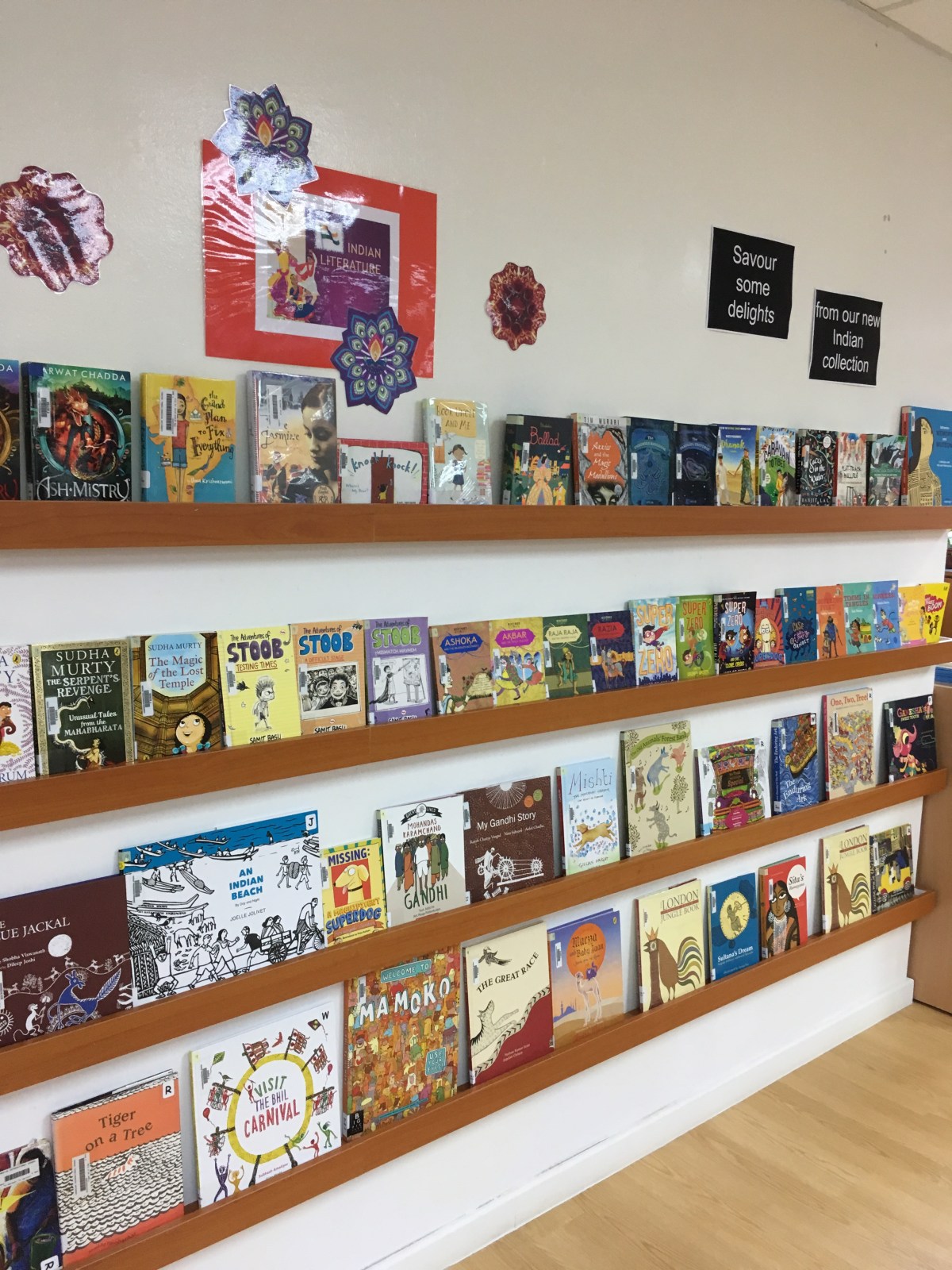
I recently purchased around 100 books written and/or illustrated by Indian authors. It was hard work “selling them” to my students. Even the Indian students. Especially the Indian students. I used the above infographic to explain to students how skewed their world view is.  And the worst of it all, is this in itself is a North American view. Let’s not even talk about the fact that most of the 73.3% white characters and 12.5% animal, truck etc. characters are male. By the end of the week, after discussions about being open-minded and balanced and being a risk-taker, most of my books were borrowed.

A few of my students exclaimed they “loved” one or another of the authors. Some parents expressed surprise that I had so many books, and amazement that I’d used my 30kg luggage allowance to lug back books. Now Indian books are possibly one of the lowest barrier “diverse” books an international school could add to their collection. Quite simply because English is a common language. No translation is required. There is a thriving publishing industry. A huge diaspora. Many schools have 25-30% of their student body from the Indian subcontinent. And yet, until a month ago I probably had fewer than 10 “Indian” books in my collection. Most of them picture books from Tara Books.  Little to nothing in Junior fiction and a few Ash Mistry books in fiction. And now? I have the books. Students have borrowed them once. Will they go back into the shelves along with the Diwali books only to make a reappearance next year this time when it’s acceptable to celebrate and embrace Indian culture?

Any literature on language and culture will quickly point to dominant / aspirational and socio-economic preferred language and culture. As a South African who spent most of her life mired in shame, unable and unwilling to admit to my heritage, I truly “get” the ambivalence (while remaining astounded by continued British bluster – particularly here in Asia).

And that is the problem with every article ever written about diversity. We lament the absence of the optic. We gloss over some of the “hardware” issues (authors, illustrators, translators), we may even get to structural problems (publishing houses, editors, market sizes). But we neglect to think about how the structure of our education and schools will support those tender shoots, will allow our communities to claim not just their heritage, but current philosophies. We close down libraries, we limit budgets, we operate in echo chambers, we fail to make library education affordable and accessible to local staff. We concentrate our online efforts to gadgets and gizmos instead of access, community and understanding.

What do I do in our library / school?

Of course the five f’s: food, fashion, famous people, festivals, and flags. Mea culpa here. I have books about (just about) every nation in our school, and scramble each year to make sure there’s at least one book by the time Uniting Nations comes around.

I buy all the books suitable for my elementary school from the USBBY list – cognisant of the fact that it is the US – i.e. pre-digested for USA sensibilities.

I follow blogs of avid supporters of diverse literature such as Dr. Myra Bacsal’s “Gathering Books” and Rachel Hildebrandt ‘s Global Literature in Libraries (seriously, I’m one of only 200 odd people following this AWESOME Blog??  – they also have a facebook page btw if that’s more your thing).  Who give exposure to people like Avery Fischer Udagawa with her new list for 2017 of 100 more works translated for kids, following Marcia Lynx Qualey’s 2016 100 Great Translated Children’s Books from Around the World.

Following what’s being published via the Bologna book fair. Reading reports such as those created by Wischenbart.

And then I devote part of my budget to buy the books, and make sure they’re slotted into resource lists for our units of inquiry, and read them aloud, and “sell” them to teachers and my PYP coordinators.

Put out google alerts for diverse books, join FB groups of librarians around the world. Ask, ask, ask, in the community, parents, librarians, teachers, students.

Write about it. Write about it again, and again.

What more can we do?

Hard stuff. Advocacy. Fostering a sense of national / cultural pride in all our students – not just those from the dominant / desirable communities. Conversations with teachers and administrators. Looking at what our students are writing about – who are the characters in their writing? Ignoring the deluge of books from BANA countries. Being tireless. Fighting even with institutions doing brilliant work like “Global Readaloud” about the choice of their books that are NOT global. Even when all of this is very very tiring and makes you seem like a harpy.

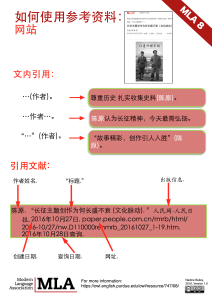
MLA8 and Chinese …

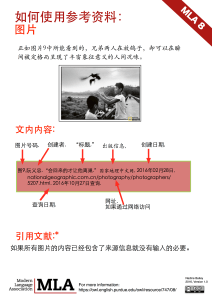
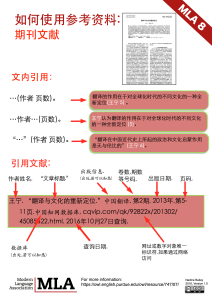
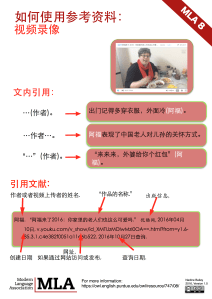
A fellow librarian in Shanghai and I have been working on creating some new MLA8 posters in Chinese for her bilingual school / library.  It’s been an interesting process to put it mildly.

We started off with the MLA posters I created with Katie Day about 2 years ago, and which she updated recently to reflect the MLA8 changes. Now translation is as much an art as a science, and, with the help of a Chinese library assistant we made some rather silly mistakes along the way which in retrospect are obvious. Each round was accompanied by the refrain of my Chinese speaking daughter of “but they just don’t have that /do that in Chinese”

Round 1 – we just translated the English posters into Chinese – well duh, why on earth would you take an English book / video etc. and cite it in Chinese?

Round 2 – finding suitable Chinese originated materials in each basic format and creating citations for them. It may sound easy, but it’s actually harder than you’d think. I worked on the newspaper one with my daughter, and it took a whole evening! Then there was a great NatGeo chinese video, but it was way too complicated as it was a documentary with a director quoting from an interviewee – yes a nice challenge for advanced citations but not suitable for a beginner “basic” poster to get the main ideas across.

Round 3 – punctuation. I’m not entirely sure we’ve nailed this one completely. We ended up making an executive decision on making the in-text punctuation follow the Chinese punctuation – particularly for the full-stop / period “。” and the English punctuation in the “works cited” section. What we didn’t do, and my daughter insists we should have done, is to put the titles of the book in the chinese brackets instead of the inverted commas, i.e. 《。。。  》instead of “…”

Round 4 – italics. MLA8 asks for italics, and initially I spent a lot of time trying to italicise in IOS10, which an afternoon of searching will tell you is not possible.  Along the way I found out some truly fascinating things about Chinese fonts and typography, which you’re welcome to read up on – it really is very interesting. I learnt a new word – glyphs, and the fact that you need around 20,000 of them for a Chinese font! (I also coincidently found out how to add phonetic marks above characters in Pages – never know when you’ll need that!)

Two things cinched it, a comment on a CJK font forum (Chinese, Japanese Korean) ”

“I’m not solving your problem, but to remind you that this kind of “programmatic italic font” has really bad readability.
For CJK text, the right way to express emphasize (or quote) is to use another font (usually serif font). Especially for Simplified Chinese, use Songti, Fangsong, or Kaiti instead of italic font if your text font is Heiti (iOS default). I know it’s a little bit complicated, but this is really how we do italic.”

and secondly from the MLA itself (which is where I really should have started, but sometimes you go off on a tangent without really thinking properly).

Q: Do I italicize Cyrillic book titles in the list of works cited?

In the past, titles and terms in the Cyrillic alphabet were not italicized, partly because it is based on the Greek alphabet, which traditionally is not italicized (on this point, see Chicago Manual of Style, 16th ed., sec. 11.131). Letterspacing instead of italics was traditionally used to emphasize a word or phrase.

Today, Cyrillic cursive (the term italics is usually not used in this context) for titles and for emphasis seems to be used often in publications, including scholarly publications, perhaps because of progress in digital typesetting or because of a global trend toward standardization.

Note that there are many languages in the world that do not have an italic font—Japanese, Chinese, Korean, Armenian, for example. Arabic sometimes uses a typeface that slants to the left instead of to the right.

Given the complexity and specificity of historical, cultural, linguistic, and printing practices throughout the world, a writer should not use italics when a book title is in a foreign language that is not written in the Latin alphabet. If a work is being prepared for publication, let the author pass that buck to the publisher.

Round 5 – checking and checking actually we just finished this now – with adding the last missing closing bracket – and voila, the posters may see the light of day.

mla8-referencing-image-ib-version-chinese mla8-referencing-image-chinese mla8-referencing-article-journal-chinese mla8-referencing-video-chinese mla8-referencing-newspaper-chinese mla8-referencing-book-chinese mla8-referencing-website-chinese

And now, I nervously exhibit them for comment and criticism and correction by my peers! All posters are creative commons with attribution please. My next post will be what I refer to as “MLA8 Lite” – the posters I’ve made for my G6 PYP exhibition students. Just the works cited, without the in-text citation, with explanations in the form of the MLA8 Elements.


L1 and the role of the school

I received an email last night from someone who had read my blog on Building a LOTE collection in an international school and she quite rightly pointed out that it’s a relatively easy thing for a librarian thing to do.  Here is her question:

I am a school librarian in an IB candidate school. We are trying to find strategies to promote mother tongues within the school. As far as the library is concerned, I can develop LOTE collections as you call them, but I was wondering would you know of strategies that would help teachers develop their foreign students’ mother tongues.
Thank you very much for your help.

Now fortunately for me (since I’m chest deep in pre-library renovation stuff I’d just run a PYP connect workshop on the very matter 2 weeks ago, and that question prompted me to put this out! So I’m going to embed the presentation here for everyone to see my (sometimes controversial) views.  And I’ll explain my philosophy and “ingredients” a little.

Ingredients for a successful L1 program in any school

  1. A champion. A committed champion
  2. A supportive and imaginative leadership
  3. Knowledge and information & the dissemination thereof
  4. A committed language group

1. Committed champion

I think the cartoon below will explain this. Although the metaphor I always use is that one cannot be a little bit pregnant. Asking a mono-lingual to be your language champion is probably not the way to go.

agile-safari-pig-and-chicken-part1

The champion does not have to be a teacher or in admin – at my last school I did it as a passionate parent working part time in the library. I’d like to think that, in conjunction with our mother-tongue coordinator we made a huge difference. But I ruffled a lot of (mono-lingual leadership) feathers and perhaps I could only do what I did do, because my job was not at stake. But that’s another story.   This point sounds very easy but it’s not easy being a language champion, even in an international school. I’d even dare to say especially in an international school. Because unfortunately most of them are run by an ‘elite’ corps of white anglo-saxon middle aged monolingual men who are exceptional in paying lip service to language and particularly bad in putting their money (or even support) where their mouths are. There are exceptions. But usually the person is not mono-lingual. The champion needs to be exceptionally knowledgeable, very thick-skinned, very imaginative, networked, and not willing to see problems but only possibilities.

2. A supportive and imaginative leadership

As said before, leadership is the elephant in the room of L1 support. Scratch the surface of almost any international school’s language policy (outside of non-British Europe, since they “get” language) and you will find immense resistance to the language factor unless it serves marketing and certification requirements. Similarly you will see that very seldom do former language teachers rise to power, and existing language teachers are often not power-mongers (research bears this out, but don’t have time to find the citation).

I keep telling leadership at my schools that the lack of a L1* program is a failure of imagination rather than a lack of resources.  I think every 50-something year old knows people who learnt English through bootlegged Beatles cassettes or French learners through chansons. I find it incredible that we think it is so hard now when it’s never been easier to access resources and people at our fingertips.

3. Knowledge and information and the dissemination thereof

We need to make sure our language champion is “powered up” with what works, and what doesn’t and what the potential issues and pitfalls are. We similarly need to educate our educators, from the top down and our parents. Way too little time is spent on this. Instead we send our leadership to leadership PD, our math teachers to math PD, our teachers to “making the PYP happen” countless times in 100s of variations and our language teachers to language PD.  And we never talk to our parents about language except when they’re struggling as ELL (English Language learner) students. As Virginia Rojas always says “Every teacher is a language teacher”.  I have railed countless times against our echo-chambers in education!

In my experience over the last 5 years, if you just bother telling and explaining the whole language thing to parents on time – i.e. when the students are still in primary you get a moment when suddenly you see the cogs in the minds of your audience ticking in over-drive. They totally get it. And the most important messages you need to give them are things that are glaringly obvious to any high-school language teacher but NOT on the radar of a parent concerned about bed-wetting or why Johnny didn’t get invited to Sven’s birthday party:

  • You need 2 languages for IB (I cannot tell you how many early primary or even late primary parents don’t know this.  Yup, it sounds ridiculous, but it’s true)
  • One of those languages COULD be your L1, either school-or self-taught
  • BUT Language takes time – 5-7 years for CALP (i.e the level you need for IB) and YOU (not the school) needs to make sure your child is functionally literate, by the end of primary (i.e. reading and writing at or near native level) because
  • THERE IS LITTLE OR NO TIME even with the best will in the world by the time they get to middle school to catch up. Plus, your influence over them and how they spend their time will diminish rapidly the older they get so you must make sure they have the necessary autonomy and mastery by then.

4.  A Committed language group

Ok, so after your meeting or session with parents it will quickly become apparent who cares. In my experience over the last few years, I can make a guess at who will generally step forward. Usually it’s the French, Japanese, Koreans and Chinese. Sometimes the Dutch and Scandinavians (depending how long they’ve been abroad). And we do a huge disservice to these communities by not making it easier for them to get to full native literacy by the end of primary.

We force them into one of the school languages, (in my children’s personal instance it was Spanish, Chinese or French). Then we teach it as a “fun” and “cultural” experience – something that frustrates both the teachers and the committed students. We teach it as an initio course nearly year after year – ground hog day. So we don’t get the mastery, our students don’t see any purpose. And worst of all, we don’t cater for the ‘natives’ in that language so they either give up and learn a 3rd or 4th language rather than endure the frustration and boredom of their L1.

But there are possibilities. There are schools with “one room school-houses” with different students learning different languages at the same time in small groups.

It can be expensive – personally our family has paid the equivalent of an extra term’s school fees in private tuition for one-on-one Dutch classes to get my son up to speed on his Dutch. It takes time, time that kids would otherwise be playing around, doing sport, watching TV, hanging out.  Commitment is hard. But it pays off. Speak to any IB student doing self-taught L1 and you will see their pride and accomplishment.

How to create commitment – I have just one question that usually decides that matter

What about your grandchildren?

When I ask that suddenly parents decide which side of the fence they’re on. Because that really is the bottom line. Kill your language with neglect and the chances are your grandchildren will have neither your language nor your identity. Some people are totally fine with that. They’re not committed and probably never will be. Don’t waste your time with them. Some care very very deeply and they will be the sparks that will ignite your L1 program. Use them, work with them, allow them to help you talk about and frame your L1 program.

Amazing things can happen from small beginnings.

* I prefer L1 to mother-tongue as my household speaks the father-tongue as well as the mother-tongue


Why is multi-cultural understanding important in e-Learning?

Just came across this very interesting infographic while trying to justify a moral gut-feeling on why we need to care about multi-cultural, multi-lingual (MCML) learning environment accommodation for all students. If nothing else – it impacts on the bottom line!

Source: http://elearninginfographics.com/top-elearning-stats-and-facts-for-2015-infographic/?utm_campaign=elearningindustry.com&utm_source=%2Felearning-statistics-and-facts-for-2015&utm_medium=link

A short tale of grit and resilience

As a teacher-librarian who still has one foot deeply immersed in academia I spend a considerable time wondering if the things we do are the “right” things. And that’s before I’ve opened any social media related to the profession where people are posting articles about the wrongs of everything from levelled reading to literature circles, reading competitions, to accelerated reading programs, to not ‘over’ encouraging reading, even down to whether we’ve really considered academic honesty properly.

So sure, we probably do somethings wrong. In fact daily I’m deeply aware that I’m failing some students some of the days, and a small number of students all of the time. And yet.  There are moments when I do think things come together and they allow our students to shine – and those are the tales of grit and resilience that the popular educational press love. And so too, at the danger of following the bandwagon, I’ll add my tales too.

Yesterday, our school had their trials to select the students who would form the teams for the “Readers’ Cup” competition.  We’ve been meeting weekly preparing for this competition, students have busily been reading the 6 books in their category, creating questions, quizzing each other and re-reading the books. We had about 40 students and could only choose 4 teams of 6.  At which point some educators would be crying “foul” and “no fair”. But hear me out, and the tales of 3 students.

The first is an ELL (English Language Learner) student – been learning English for about 2 years. Nervous about joining at all initially, bolstered by a friend who was also taking part. Enters the library to take part in the competition yesterday with a little notebook which is promptly removed by me. Look of dismay. I explain that we only allow a pencil and the iPad for the multiple choice round.  The competition ends. She’s a solid contender, right there in the middle of the pack. She’s in!  While tidying up, we find the notebook we’d put aside. Extensive notes on each and every book… *

The next, a student who decides to join the competition just before the Spring break. She’s read none of the books, but I tell her she’s welcome to try anyway, and the library is open all holiday.  From time-to-time in the vacation I get a little email to say she’s finished another book and I congratulate her. Then on Saturday the blow falls – she’d been reading the books in the wrong (higher) category and had only actually read two books at the right level… I write back to her and tell her not to panic, she still has 4 days, and I suggest a schedule whereby she reads the longest most challenging books first and leaves the picture book for last, and say if necessary I’ll come into the library over the weekend to open it for her, and she can come and read in the library every recess and lunch time (usually the times are staggered by grade). She says it’s OK, she’ll manage. And manage she does. Not only does she finish all 6 books by the deadline, but she’s the highest scorer in her category.

The third are two sisters. One a very strong reader, one a little less so, and younger. The older student is constantly encouraging the younger to keep reading. Spends time both at home and at school quizzing her on the books she’s completed. Keeps me updated on their progress.  Both sisters are selected in their categories, both top scorers. But I’m pretty sure the younger student would not have done as well without the home support and encouragement.

Invariably there are disappointments. We selected two “back-up” students per category, and after attrition from conflicts with other activities and last minute dropping out for various reasons, each category had 3 students who wouldn’t take part. Of the 6 students, 5 had not finished all the books, didn’t take it perhaps as seriously as they could have if they’d truly wanted to take part. Didn’t attend meetings or make questions or really try. But one I feel responsible for, he’s a good reader. A voracious reader. He’d wanted to take part in they younger category, but I convinced him to try for the older, but it was apparently too much for him. A misjudgement on my part. And I’m not sure what I should do now. Certainly in the future I’ll trust a students’ own judgement more and not try to convince them otherwise.

——————–
* She was not the only student who had an ELL background, for a large percentage of our students English is a second language, but she’s still in the ELL program, whereas the rest have ‘graduated’ over the years.