I’ve just been exposed to a few discussions on plagiarism which I share in a post here.
Author: Nadine Bailey
Third time requires a post – plagiarism
This morning plagiarism crossed my screen for the third time in a week, which means the topic is demanding to be written about!
The first time was during an academic discussion last week. A group of us were being asked our opinion about the proliferation of study groups on FaceBook and other social media platforms and their role not only in mutual support during study, but the potential for plagiarism and other forms of academic dishonesty.
I have a somewhat contrarian view on the thin lines between collaboration and theft. Perhaps I am naive, perhaps I’ve not felt the very real repercussions of having had my work plagiarised. Perhaps I’m reading too much utopian digital future type articles and books.
Through my blog I share a lot of what I’m thinking and doing and researching. I also have posted most of my academic submissions of the last 2 years online where they can be freely read. Of course much of what I’m writing about are things I’m particularly interested and passionate about, and I’ve abridged or edited things so as not to post too many details of my school or colleagues that would not be relevant or appropriate for public consumption. To me, the most useful parts of anyone else’s academic submission would be the layout / structure of the essay / paper / report and the bibliography. I’ll happily share my bibliography with anyone and everyone.
And now it starts to get tricky. On the one hand, the whole point of academic publishing and journal articles is to make your work publicly (albeit behind a paywall) available and for your work to be part of an ongoing quest to knowledge or the resolution of societal or scientific problems. On the other hand, in the grey area of being on the path to accreditation and while doing so jumping through academic hoops while writing essays and papers and having them marked and moderated by the system, you’re supposed to keep all that knowledge and learning private or secret, just between yourself and your lecturer? Can you see the problem? The double standard? The irony? So part of my argument, is that if a lecturer can’t be bothered to sufficiently change the topic of the assessments and the way in which the course is evaluated, then if another student were to use the work of a former student the lecturer is kind of to blame. Although I would hope that the student would at least credit the work of the first student. Which because the whole system is rotten they are obviously incapable of doing, because then the whole thing becomes uncomfortably transparent. Ditto the lecturers who are obtuse or unhelpful.
The second time was this article in the Telegraph which appeared 2 days ago. A couple of interesting points are highlighted (I must say, #1700 for a dissertation is very cheap – if I think what each of my courses cost individually, that wouldn’t even pay for one course / semester, so whoever is writing that stuff is either undervaluing themselves, or the whole academic thing is such a farce as to be worthless). I think the topic is a whole lot bigger than many (particularly academics) think. It is not as simple as “plagiarism is an act of fraud. It involves both stealing someone else’s work and lying about it afterward” (plagiarism.org). As the article points out – plagiarism happens more often in mass courses where there is little contact between the tutor and the student. It also happens when there are language difficulties experienced by students and the stakes are high. And, we are obviously (sic) trying to root out “copying and collusion” – at least while our youth is studying. Once they get into the world of work it’s called collaboration and teamwork. I’m wondering about this Prof. Braisby who is so keen to educate his students on the evils of plagiarism. Is any time being spent in dialogue between the students, tutors, professors, administrators and powers that be in institutions to look more closely at the subject. Or are we all very quick to make the subject black and white?
Finally this morning, LibraryGrits, weighed in on the topic with a very nice little graphic which was the most nuanced look at the subject – the symptoms of plagiarism.
References:
Cockroaches, beetles and ants
INF530: Blog post 2: Digital Information Ecology
In information ecology, an information system is compared to a natural organism or ecological system whereby internal and external knowledge is integrated in a balanced manner, and information objects, services and products are managed using organisational and digital tools, and sense making “cleaning filters” which adapt and change in response to changes in the environment or the constituents (Candela et al., 2007; Steinerová, 2011; Wang, Guo, Yang, Chen, & Zhang, 2015).
Information ecology is a multi-disciplinary emerging field that covers digital libraries, information ecosystems, e-commerce, networked environments and the issues around rapidly developing new technologies. It offers a framework within which to analyse the relationships between organisations, information technology and information objects in a context whereby the human, information technology and social information environment is in harmony (Candela et al., 2007; Wang et al., 2015). It provides an alternative point of view to the traditional systems design and engineering perspective of information flow, and answers the central question of how to apply knowledge into a dynamic complex organisation.
Nardi and O’Day (1999) explain the interrelationship between people, tools, and practises (cited in Perrault, 2007; Wang et al., 2015) within the context of a shared environment (eco-system) with a cognitive, language, social and value system. The inter-relationship or dependency between the constituents means that changes impact the whole system. Steinerová (2011) and (Candela et al., 2007) looked at the elements of digital libraries and suggested that librarians examine where value integration can take place between the library service, technology, scholarship and culture adding value through new services or contributions to learning, user experience, research productivity, teaching or presenting and preserving cultural heritage.
Applying these ideas to the school environment, constituents of the eco-system include teachers, teacher librarians, students administration, parents and custodial staff (Perrault, 2007). Elements of the system will co-exist but also compete and share, converge and diverge in a dynamic interactive, complex environment (García‐Marco, 2011). The role of the library is such that the information ecology needs to be understood in order to support information seeking behaviour and thereby discover the zones of intervention and areas to leverage to optimise advance information seeking, usage, creation and dissemination within that eco-system and beyond. In response curriculum, content and subject delivery that can be reshaped and constructed dynamically and in a collaborative way according to changes in the environment or needs of students (O’Connell, 2014).
Relating this to my current work, I found the work of Perrault relevant in looking at how multimodal resources and adaptive technologies can best serve students with special educational needs (Perrault, 2010, 2011; Perrault & Levesque, 2012). This type of thinking can be adapted to considering the needs of bi- and multi-lingual students who are part of the school’s information ecology, but have a linguistic and cultural learning and informational need which can be seen as a potential zone of intervention for collaboration between the teacher, teacher librarian, family and community. Provided of course that within the international school group dynamic and context it is understood what is specific to particular linguistic and cultural groups and what is generalizable (Vasiliou, Ioannou, & Zaphiris, 2014) and how best to integrate systematic change and innovation, cognizant of the consequences that may be direct, indirect, desirable and undesirable, and often unanticipated despite our best efforts (Perrault, 2007).
References:
Candela, L., Castelli, D., Pagano, P., Thanos, C., Ioannidis, Y., Koutrika, G., … Schuldt, H. (2007). Setting the Foundations of Digital Libraries – The DELOS Manifesto. D-Lib Magazine, 13(3/4).
García‐Marco, F. (2011). Libraries in the digital ecology: reflections and trends. The Electronic Library, 29(1), 105–120. http://doi.org/10.1108/02640471111111460
O’Connell, J. (2014, July 19). Information ecology at the heart of knowledge [Web Log]. Retrieved March 28, 2015, from http://judyoconnell.com/2014/07/19/information-ecology-at-the-heart-of-knowledge/
Perrault, A. M. (2007). The School as an Information Ecology: A Framework for Studying Changes in Information Use. School Libraries Worldwide, 13(2), 49–62. Retrieved from http://ezproxy.csu.edu.au/login?url=http://search.ebscohost.com/login.aspx?direct=true&db=ehh&AN=28746579&site=ehost-live
Perrault, A. M. (2010). Reaching All Learners: Understanding and Leveraging Points of Intersection for School Librarians and Special Education Teachers. School Library Media Research, 13, 1–10. Retrieved from http://ezproxy.csu.edu.au/login?url=http://search.ebscohost.com/login.aspx?direct=true&db=ehh&AN=67740987&site=ehost-live
Perrault, A. M. (2011). Rethinking School Libraries: Beyond Access to Empowerment. Knowledge Quest, 39(3), 6–7. Retrieved from http://ezproxy.csu.edu.au/login?url=http://search.ebscohost.com/login.aspx?direct=true&db=ehh&AN=58621336&site=ehost-live
Perrault, A. M., & Levesque, A. M. (2012). Caring for all students. Knowledge Quest, 40(5), 16–17. Retrieved from http://ezproxy.csu.edu.au/login?url=http://search.ebscohost.com/login.aspx?direct=true&db=ehh&AN=82564002&site=ehost-live
Steinerová, J. (2011). Slovak Republic: Information Ecology of Digital Libraries. Uncommon Culture, 2(1), 150–157. Retrieved from http://pear.accc.uic.edu/ojs/index.php/UC/article/view/4081
Vasiliou, C., Ioannou, A., & Zaphiris, P. (2014). Understanding collaborative learning activities in an information ecology: A distributed cognition account. Computers in Human Behavior, 41(0), 544–553. http://doi.org/10.1016/j.chb.2014.09.057
Wang, X., Guo, Y., Yang, M., Chen, Y., & Zhang, W. (2015). Information ecology research: past, present, and future. Information Technology and Management, 1–13. http://doi.org/10.1007/s10799-015-0219-3
What to read when
In the last three days I’ve recommended “Crucial Conversations” to four different people, for different reasons. I think it is a book that stands out in providing ways of tackling life’s grittier questions and confrontations that are necessary but often avoided because one doesn’t always know how to go about it without making a difficult situation even worse. I also subscribe to their “crucial skills” newsletter which has some pretty good ongoing discussions. And every time I’m reminded how I fall short in reality!
There are a few other “go to” books that I always come back to when people ask me about issues with kids
- How to talk so kids and listen so kids will talk
- Mom they’re teasing me, and/or Best Friends, Worst Enemies and/or anything by Michael Thompson
- Buddhism for Mothers (and her follow on books for as the kids get older)
Digital reading and studying – teachers are students too…
Last night I saw a flurry of posts on one of my Facebook groups – the one with teachers who are students, often back to school after a gap of years or even decades. That was me 30 months ago. Yes I had spent two years studying Chinese at HKU more recently, but that was a more hands / ears / body on task physical exercise than the more recent CSU experience of first doing my MIS and now my M Ed (KNDI). I promised if I had time after my assignment for today, I’d post a little about how I manage using a combination of paper, coloured pens and Evernote to keep on top of my reading and modules. I’ve written briefly about using tools to organise one’s studying, an article in Incite which unfortunately wasted too much space on a picture of me in lieu of what I wanted, which was screen shots of how to do stuff. At some point I’d like to do some screen casting of how this all works in reality, but since I’m moving house next week, I just don’t have the time to edit it down to something quick and slick and presentable!
Here is a step by step account of what I do (CSU resources, plus Evernote Premium (paid) plus Zotero (free) plus Word for Mac 2011 and a desire to print as little as possible):
1. Open a new notebook in Evernote for my new course
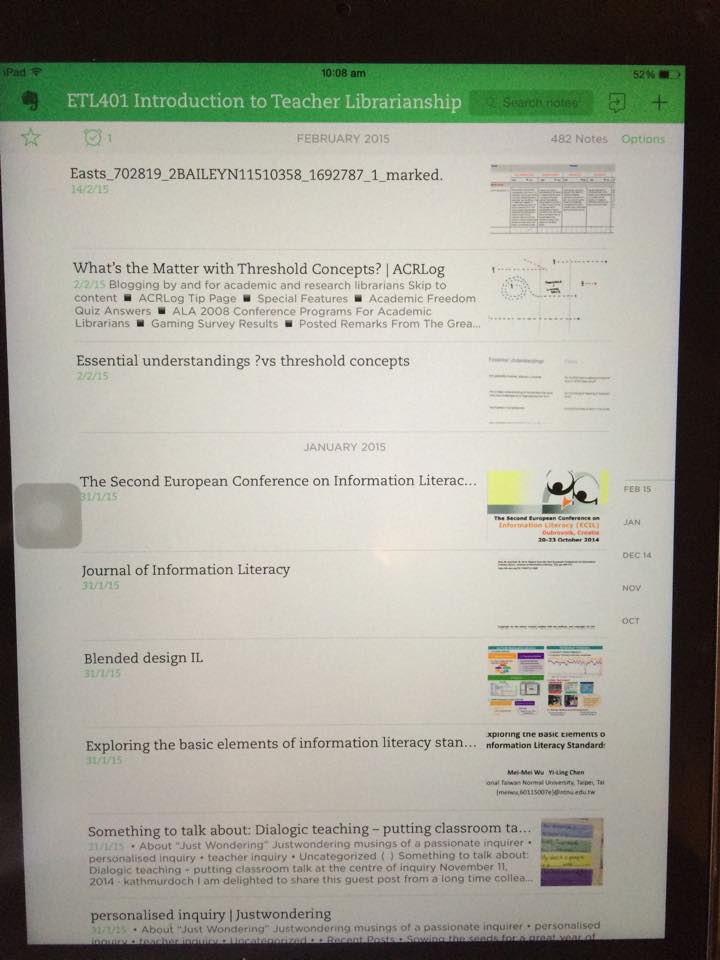
As you can see here my whole life is on Evernote – personal, professional and learning, each have their own notebook. You can also group notebooks together (I’ve put all my CSU courses into the CSU group, although I keep my most current course floating as it’s then easier – less clicks) to add to the notebook. Because Evernote is so wonderfully searchable, there is no need to file by module or topic, you can just tag notes if you want, or not.
2. Go into the modules and download the Subject Overview and individual Modules
I then go into Interact (2) and download the subject overview and individual modules and save as PDF files. I also print these, single sided and file them. This is the only printing I do during the course. It was not always so, but I couldn’t stand the waste of paper and needed a more efficient way!
I put all the module pdf’s onto my desktop and then drag them into my Evernote Notebook. I also have the Evernote app on my iPad, and I make sure that at the end of each day I synchronise between my laptop and my iPad so that they’re both current. Because I have Evernote premium I can read all my notes OFFLINE – very important to me, as I don’t have 3/4G on my iPad, only Wifi, and I don’t always have Wifi in the places I’m snatching moments of study!
3. Find the Schedule and put the dates into your physical / virtual calendar with reminders!
4. Start populating Evernote with everything you need to read
I usually take a moment when I’m tired and want to feel productive but I just don’t have the energy to do hard thinking or reading or writing work. I open the modules and start clicking on every link.
Then I do the following:
Journal Articles
Go to Primo, find the article, save / download as a PDF (I just tag it and dump it on my desktop).
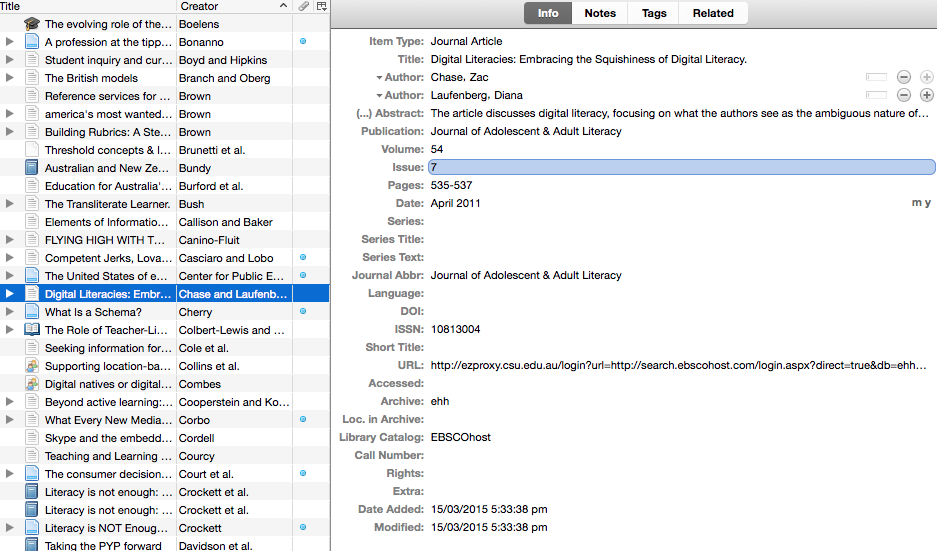
At the same time find the “cite / export citation” button and save the citation in the format you need for your citation tool (I use Zotero, so it is a RIS file.
In Zotero I open a new collection
And then I import the
“RIS” file into Zotero, (just need to click on it, with Zotero open on the correct collection) making sure all the files are completed correctly.

Websites
For websites, I use the Evernote Addon, so I just need to click on it, and I can save the article / site onto Evernote into whatever notebook I choose:

I
In order to save the citation, I right-click in order to activate the Zotero addon, which will save the URL and any correctly coded information (usually this is not much, only URL and title – so you need to manually put in the author, date, website name, etc. to ensure a co
rrect citation)
I repeat this process for eBooks (“print” the relevant chapter to PDF, put the ISBN into the Zotero wizard), and other material. You can save the links to YouTube and Vimeo videos, I’ve not bothered to put them in Evernote – I try to watch them on my laptop – if anyone has a good solution for that besides downloading and taking up a lot of memory to watch offline …
I then have a desktop littered with lots and lots of pdf files, and I then just drag and drop the lot into the correct notebook.
5. Sync Evernote on iPad to Laptop
Because I’m working and a mother and taxi-driver, I spend quite a bit of “lost” time waiting for kids at sports or picking them up etc. Often I then don’t have access to wifi. I’ve paid for the premium version of Evernote for this reason. In any event, with or without wifi, my way of studying is then as follows (obviously this is personal).
I will add another few things about Evernote. It is very collaborative. So you can share notebooks with fellow Evernote users. If you get yourselves organised you can share who collates the information for which module and set up a group. Or ask a fellow student who has done the course already … but please consider academic honesty, plagiarism, digital citizenship and all that when you do these things.
6. Start reading and reflecting
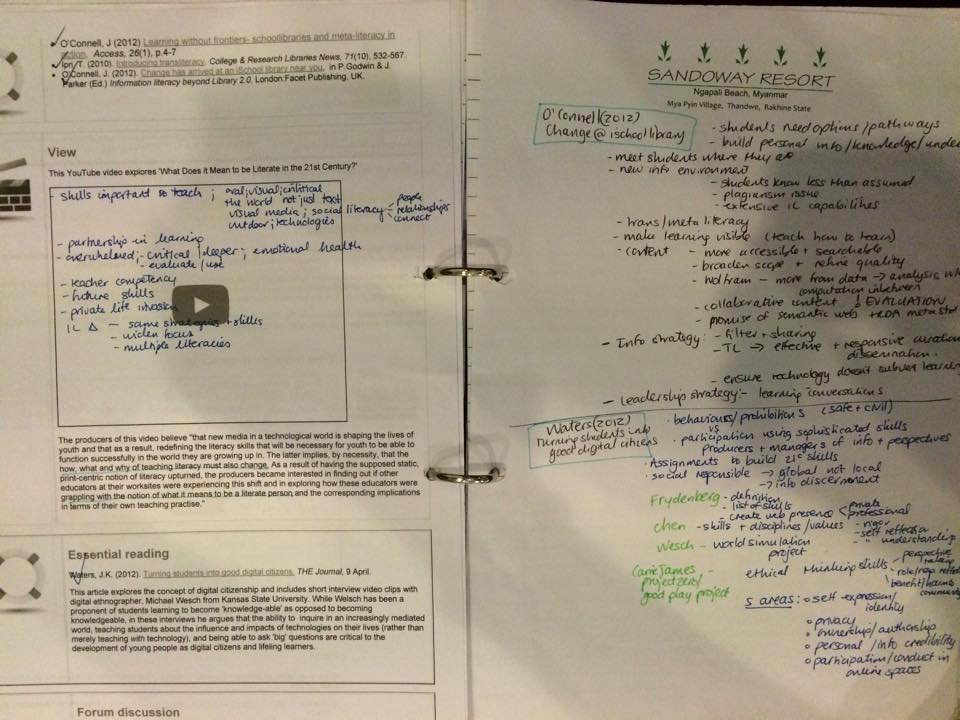
I take the next chunk of work I need to do and put the printed out modules in front of me. As I read the module, I tick the paragraphs. When I get to a reading, I will then open the reading in Evernote ( the search function is amazing) and start reading. As I read, I take notes on the blank left hand side of the module so it is opposite to where it is referred to in the module. I’ve made a personal convention for my note-taking. I do it in blue or black and put references to people and other readings in green and important items that I’ll want to refer to later in my assignments or blog posts or think more about in red. This is what it looks like (If I’ve printed the modules double sided, I put my notes on other paper as close to the module where it is referred to as possible). I don’t skim much to be honest, but some articles / book chapters etc. merit more note taking than others. Some are just a repetition and some are gold mines.
7. Writing an assignment
When it gets to writing an assignment I just glance through my modules and find the relevant sections / key words. I then glance at my notes and focus on the purple / green bits. I look for more articles in Primo by referring to the authors who have written on the subject and are frequently mentioned. I also “file” those articles into Evernote and the citations into Zotero as I collect them.
When I’m writing, I try to plan out what I want to say, and then I will try and find research to back it up. Because Evernote is so searchable, I can search on key phrases or words or combinations of words and get a listing of all the articles they appear in. I can then quickly scan these and see if they are worth citing.
Since Zotero has a word add on, I just have to Click on “insert citation” and it jumps into Zotero
I can then choose the author / article title and decide whether it is a direct quotation (add the page or paragraph number) and how I’m going to cite (author, date); author (date); author …. (date) etc.
When I’m finished I just say “insert bibliography”
and it completes the entire bibliography in APA style, alphabetical order etc.
If I’m editing and I delete a citation / paragraph, I just have to update it, and it’s all correct again.
NOTE:
This is just one way of getting organised. There are many ways and many tools, you need to experiment and find your own way as to what is comfortable for you. For example, one lecturer suggested we just print the first page (with the abstract) of each article and make a summary on that page. If anyone has further tips and tricks, please add comments to this. I’d also like to learn of other ways to make things easier.
Blog Task 1: INF530
At the risk of being facetious I’d like to compare my current state of knowledge to the old jaw about being “as old as your tongue and a little older than your teeth”. It is so hard to define where one is in terms of knowledge and understanding in just about any field, particularly this one. Throughout my journey in the MIS (Master of Information Studies) I’ve attempted to grasp at every opportunity to not only be exposed to the digital concepts and practices of information studies and education, but also to integrate them into my own professional, educational and private life. Yet I don’t know what I don’t know. I’ve written before about the anosognosic’s dilemma, and each course refer back to the excellent article by Morris (2010).
The context of my learning professionally is working part-time as an “apprentice” in the secondary library of a K-12 international school in Singapore while I complete my Masters in Education. My “master” is well entrenched in the digital world and steps bravely where many shy away. We spoke recently about the teachers who employ the old tactics of the formerly illiterate, the phrases “I’ve forgotten my glasses, / it’s too dark / too small can you just read that for me?” have been replaced by “I don’t have time / you’re so much quicker at doing that / do you mind quickly finding …” or more defensive negations of the entire digital realm.
A school has a number of constituencies; one that I like to try and focus time and energy on as a librarian are the parents. I’ve also spent quite a few years discovering where the intersection of my interests, passions and profession lies. As a person who grew up bilingual and has spent the last 23 years living in different places around the world, each time learning new languages, the idea of language, mother tongue maintenance and sustainability preoccupies me. I also believe it is an area where we (as teacher librarians) can make a significant difference by leveraging our knowledge of personal learning networks / environments and communities of practice even if we are not bi or multi-lingual ourselves. I recently held a parents’ forum at school with our self-taught language coordinator that was very well received. I have fallen into this area by dint of interest and co-incidence, however with the benefit of hindsight I make some guesses at why this would be a good area to commence evangelizing about the benefits of digital learning. There is a need / deficit in the current models, specialization is globally dispersed, and the current practices and lack of emphasis make it a low stakes area for experimentation. Given global mobility through choice or circumstance it is also an area that will need considerable attention in the future.
In my opinion the central theme in all these discussions is that of ownership and control. And the battling for or relinquishing of control and ownership over learning is at the heart of conflicts over curriculum, teaching and learning philosophy – how threatening guided inquiry, collaboration and formative assessment can be! Following through on the concepts, practice and promise of what we are learning may prove to be very unsettling for the status quo and vested interests. Which side are we on personally in our own learning and professionally as gatekeepers or conduits of the learning of others?
Morris, E. (2010, June 20). The Anosognosic’s Dilemma: Something’s Wrong but You’ll Never Know What It Is (Part 1). Retrieved February 4, 2014, from http://opinionator.blogs.nytimes.com/2010/06/20/the-anosognosics-dilemma-1/?_php=true&_type=blogs&_php=true&_type=blogs&_r=1
Taking ownership and control over language learning
I’m always somewhat surprised at how many parents assume that the school will take care of all aspects of their children’s education. Perhaps I’ve been around the block (or world) too long to take anything for granted, or maybe I care too much or have made too many mistakes along the way. Or it could be that I’m at the point where a “little knowledge is a dangerous thing” (Alexander Pope, 1709).
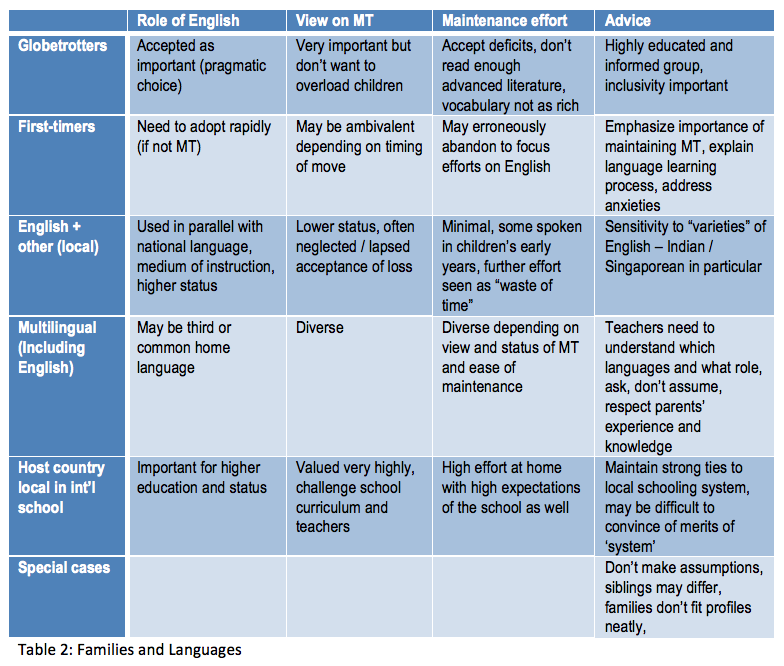
Anyway, here are a couple of images from the parent’s forum I put together with our self-taught language coordinator (the whole presentation can be found here). The main points I’d like to make are
- Language pathways need to be planned consciously and not left to chance
- you only have control over what and how much language your child is exposed to for a brief period of time – what then?
- your language community is no longer bounded geographically
- you have many community allies where you can exchange best practise irrespective of the language
- Digital tools are not the enemy – you can use them to create a language immersion environment
![]() |
Avoid type 1 at all costs by investing in your mother tongue and working towards abstract language in both languages. Types 2 & 3 are OK, and result if you have up to 20% input in mother tongue. If you want types 4-6, ensure at least 30% input in the language that is not taught / dominant at school. Work with the teachers on this. Can your child read 1:3 books in their mother tongue (MT)? Are their pieces of work they can research in their MT? Work with the system and enhance it. There is no “better” type of bilingualism after 4, it’s semantics and circumstance.
Think about what type of family you are and what roles you assign to your language and to English.
Do a language audit for your family so you have a realistic idea of what you can do to ensure success. Look at all aspects that contribute to success including the child, family, school and community. Make some strategic choices and frame your goals and priorities as a result of this. You can see my audit here.
Getting back to the question of control and ownership:
Personal Learning Environment (PLE)
Personal Learning Network (PLN)
Community of Practise (COP)
There are a number of language communities online – you just need to find their champions and tap into their resources. And then it’s a question of sharing and community building.
On twitter try: #langchat (WL teachers) #frimm (French teachers)#ClavEd #WLteach #flteach
The two sites below have some great resources:
http://catherine-ousselin.org/technology.html
http://www.cybraryman.com/foreignlanguagelinks.html
Digital Tools
Flipboard can be used to curate any digital material on any topic in any language. This one is specifically on bilingualism, mother tongue and language, however there is no limit! Football in Dutch, Fashion in French Philosophy in German, rock music in Swedish. Start a flipboard with your language community or have your kids start one with theirs.
Subscription based apps like PressReader can provide families access to their local newspapers and magazines in their home language. It is also a useful tool in the language classroom.
Referencing
At times one has to get right back to basics and the last few weeks I’ve been huddled over my computer becoming more familiar with “Pages” than any non-design person would ever want to become. All for the sake of trying to make simple basic posters outlining the most common example of the referencing styles we employ here at school.
We use MLA up to IB level, and then subject heads can decide what citation style is most appropriate for their discipline, choosing between MLA, APA and Chicago. We decided to use the most commonly cited resources of our students, Journal Article, Website, Book, Video, Image and Newspaper Article.
The 80:20 rule definitely came into play here. After I thought I was 80%+ finished, Katie started looking through it and then spent further hours and hours refining things. We asked for opinions and checking and refined things further. Of course by simplifying one leaves out all the infinite varieties and complexities, but we also home that it illustrates the basic principles and we can then help out with the refinements as required.
Here is a link to the Google+ sites where they’ve been posted for:
All the posters are available under a CC license and we welcome comments and improvements.
A linguistic trio …
Does this have much / anything to do with the library? Well yes in the sense that language and literacy is at the core of what we provide. Particularly if we’re operating in a multi-lingual environment I believe it is our responsibility to have a background understanding of the current thinking on language and learning and education. However I had to invite myself to two of the talks and was invited by a teacher to attend the third which was held at another international school … perhaps we are more marginal to the bigger picture than we’d like to imagine.
The three lectures were by: Virginia Rojas, Eowyn Crisfield, and Bruno della Chiesa.
Since each posting will be fairly lengthy I’ve split them so that this post doesn’t not get made as it’s too long in the making!
Here are the links: