What to do with your nonfiction?


(Found this unpublished from 23 Jul 2022 – no idea why I didn’t publish it!)

Just as an aside – I’ve been having the most fantastic summer since I don’t know when – well definitely way before covid with reunification with my children after one and two years respectively as well as with so many friends from around the world that our home is nearly needing a booking calendar – such a wonderful thing! I’ve been trying to avoid my computer and work as much as possible, but I had to work on a questionnaire for possible participation on a possible book on “Innovative Marketing, Branding & Community Engagement Programmes Amongst Leading National, Public, and Academic Libraries Worldwide” so I decided it was time to round of this series of three posts on nonfiction (see parts one: “Waves of nonfiction” and two: “Nonfiction’s right to exist“)

If you build it will they come?

As discussed previously it takes considerable time, effort and resources to build and maintain a good nonfiction collection. But the existence thereof does not presuppose its use. Just as we cannot assume that the fact as our students have laptops they know how to use them (the digital native myth) so too we cannot assume that teachers and students know how to get the most out of a nonfiction collection just because they can read. In fact it’s something that I’ve had to learn as a teacher librarian and something I’m still consistently engaging in and learning more about.

I’m going to highlight a few things that have helped me in my learning.

Reading nonfiction (Notice and Note)

Probably the most transformational book I read on helping students to scaffold their reading of nonfiction and be able to develop the critical skills they need to navigate today’s information society was Kylene Beers “Reading Nonfiction”. It’s not only helped my thinking about reading nonfiction but also the approach of every teacher who has allowed me to eulogise the approach and incorporate it into their teaching.

The signposts consist of five items to look out for in a text and how to recognise them and approaches to thinking about the texts. It goes beyond the usual acronyms for assessing the reliability and credibility of a text into some pretty good meta-cognition and thinking skills. The signposts are:

  • Contrasts and Contradictions
  • Absolute and Extreme Language
  • Numbers and Stats
  • Quoted Words
  • Word Gaps

The way I usually introduce them to students is through a workshop where I give them a Newsela article – my favourite is “How now digital cow” which I like as it includes all the elements and because it’s fun and from my motherland. Using a Newsela article allows me to also have the article available at a number of different levels so it can be accessed by all students no matter their reading / English level.

I print it out, explain the signposts briefly and students in groups of 5 each get a copy to read and a different coloured highlighters to highlight the text pertaining to the signpost they’re looking at. They read the text with a particular interest in “their” signpost. They can then defend their choice in their group and meet up with students in other groups with the same signpost to compare. An alternative is to have the signpost questions on posters and students read the article and then do a poster walk and write their findings after reading the article on the posters. I’m not going to link to any resources on TpT or other sites besides that of the publisher because unfortunately this is one of the most plagiarised and abused resource in the educational community. So I’d encourage you to purchase copies and read the book because it’s more than just a bunch of nice posters and bookmarks.

Elements of nonfiction

Now here is where a great many people are going to cry foul and say “not true”, but I’m afraid it is. Most students do no know the elements that comprise nonfiction, and even if given a list of the names of the elements cannot correctly identify them in a nonfiction book. There are 22 features that I identified and teach to students using the very simple technique of taking a nonfiction book and taking pictures of the elements and adding them to a google slide – see this

Once students understand the elements of nonfiction in print you can start relating those to their digital counterparts, making links between informational ecosystem – eBooks, physical books, videos, databases,

Here are some ideas on ways to promote your nonfiction collection from librarian Kerry O’Malley Cerra. Besides that I’ve found bringing some new and exciting books to any meeting or event – not just planning meetings but also coffee mornings, parent-teacher conferences, PD, etc along with a mobile scanner so people can check them out immediately works really well. This blog by Melissa Stewart is well worth subscribing to for great ideas and also thoughts about the relevance of nonfiction and it’s place in the lives of our students. The SLJ has a section called “nonfiction notions” that addresses new book reviews and how to use nonfiction.

Content plus

One regularly hears phrases bandied around schools such as “Every teacher is a language teacher”; or “Every class should start with 10 minutes of reading” and you’d be hard pressed to find a teacher who doesn’t agree in theory, that reading is a good thing. But then there is the “reality” of supposed too little time, too much pressure, too much content to cover and the theory of reading becomes such an abstract notion that there isn’t even a consideration of how it could be implemented.

Last week-end, Katie Day and myself gave a 90 minute presentation to around 100 educators at the Neev Literature Festival titled “Books & Beyond”. You can find a copy of the presentation here as well as other resources.

We’re on break now, and when we get back I was asked to present to our HODs for a few minutes on integrating reading into units in the middle school. I’ll probably just show this one slide:

I’d call it “content plus” – it’s from a G8 Earth Science unit that the Science team and I put together at the end of last year and they’re teaching now.

The idea is that you still have the science content as core to the unit – in this case Earth Science and learning about Sedimentary, igneous and metamorphic rocks and the minerals they contain and mining and the  products of mining. But to that you add the environmental and human impact, and the lens of the SDGs (Sustainable Development Goals).  And in order to help build empathy and understanding, add some literature.

Katie also had the brilliant idea, that she’s implemented in her school (and I’m going to be following quickly behind!), of getting good, relevant articles, stripping off the advertising etc (she uses Safari Reader View; I use Mercury Reader) putting them in binders and making them available in the library and classrooms – see slides 42-47).

You can of course choose any minerals, but in this case to make it relevant to G8, we focused on the primary elements of an iPhone.


iPhone ingredients

Ideally, and this takes time, some of the science and or math units would be linked to Language & Literature or Individuals & Societies units allowing more time to explore literature.

In the mean time, one of the wonderful ways of adding literature into units is through picture books. In the guide we created for the Neev Festival, we made suggestions around groupings of the SDGs of the Neev shortlisted picture books plus lots of other books. It’s still a work in progress, but over time I’m hoping that for each and every global goal I have 10-20 picture books, (as well as 10-20 fiction books and 10-20 really good nonfiction books) that can easily and quickly be introduced to a class, thereby adding a very special element to learning, and truly making “every teacher a language teacher” and every teacher able to devote a tiny slice of their class to reading.

Librarian Crush – Folks I’m loving right now

About to start our second week of school, and after the first 3 days of teacher planning week I’d just like to make a quick shout-out to some people who make a librarian’s heart very happy!

  • The new teacher, overloaded with moving continents with a family who came into the library and borrowed 4 books to be reading what her students are reading
  • The teachers who took it on blind faith and my raving that the Global Readaloud is something they should “sacrifice” class time for and agreed to participate for the first time this year.
  • The outdoor teacher who came to me to discuss what books and short stories we had that would be suitable to take on camp for reading aloud
  • My staff who worked like trojans to get the library looking wonderful for the start of the year – including cataloging piles of books that arrived during the summer “because the students would like to see something new”
  • The HOD who spoke up during a meeting to support the idea of reading aloud for at least 10 minutes before the start of all and any lessons (including the ones where teachers said “even in my (XXX) subject?”
  • People like Buffy Hamilton and Pernille Ripp who blog continuously and consistently about making reading and writing work in the Middle / High School classroom. Including admitting with humility when things don’t work.
  • People on twitter who engage in conversations about why students post-primary have stopped reading and how to re-ignite the passion for reading.
  • Departments and teams who think it’s not only necessary but normal to include the librarian in planning units.
  • Fellow librarians who are keeping in touch over long distances to brain storm how we’re going to make this a great year of engagement for our students and fellow faculty.

Happy Monday morning everyone – hope you all have a great week and a great year of sharing and reading.

Celebrating the joy of reading

Last weekend I had the privilege of being invited to join the first children’s literature festival in India, hosted by Neev Academy in Bangalore.  What a fabulous weekend it was.

IMG_6326

One of my constant concerns as a librarian here in Singapore in an international school is that I don’t feel that my collection reflects the many rich and varied cultures and identities that my students have. So I must admit (selfishly) one of the first things that crossed my mind when I was invited was YAY, I don’t have to wait until ECISlibrary2018 to go on an Indian book buying spree for my library!

When I arrived on Thursday evening, I met up with Maya Thiagarajan, author of “Beyond the Tiger Mom“, friend, ex-colleague and fabulous once-a-month book-club member. Getting together is always so exciting as we have a million-and-one things to chat about, and her move to Chennai has created a huge gap for me, but is a wonderful thing for India as she can share her knowledge, experience and expertise with schools there. We brainstormed together for a presentation we were doing for parents and the public on “grow to read and read to grow” and then she gave me her perspectives as a classroom teacher on my workshop for teachers and administrators on Classroom libraries. Then we decided to do the workshop together instead of separately as it would add a multi-perspective to it!

On Friday, the first thing that struck me as I entered the school, besides the warm welcome, was the wonderful posters and signage and set up.

The Friday was set aside for celebrating storytelling, books and literature with children. I must say I was really happy to see the emphasis on storytelling, since it is the basis of everything. In fact, when I was asked to run a workshop for 5 year olds, that’s the first thing I thought of – using a wordless book as a prompt to encourage students to tell a story.

My session used the wordless books “Chalk” and “The Typewriter” by Bill Thomson to introduce the basic elements of a story – build up to a problem and a solution. First I told them they’d been tricked and I wasn’t going to read a story to them, but they were going to read to me (groans all around) and then they proceeded to do so, with “Chalk” lured by the images! We then spoke a little about the problem and solution and I said I had another book where something similar was going on and they could read it to me as well. I then projected “The Typewriter” (as I didn’t have a hardcopy) and we went through the same procedure, adding more prediction in this time.  Then they went off to tables we’d set up with plain black goodie bags and cut out gold moons and stars to make their own “magic chalk” bag. They came back to the carpet and were told they were going to make their own story without words with magic chalk. We brainstormed some ideas of what kind of problems could happen and what their solutions would be. Such wonderful ideas, ranging from torrential rainstorms and flooding, to a meteorite crashing into earth, sharks attacking a mermaid, ghosts coming into the a house and scaring people etc.! We also chatted about how you would (in the case of the ghost story) show that time had passed and the ghost left and they came up with having a moon in some of the pictures with the ghost and a sun when the ghost fled. What was great was that some then said they wanted to do it in “teams”.  Off they then went, armed with A1 black paper, folded into 6 panels and unfolded to de-mark scenes and lots of coloured chalk.  As they were drawing I wandered the class with their teachers talking to them about the stories as they unfolded.  90 minutes without a break was barely enough to have everything finished and they proudly left with their magic bags and story creations.

The rest of the day flew by, popping in and out of classes and storytelling sessions, followed by the teacher workshop on classroom libraries.  I’d somehow misheard that it was for 15/16 teachers… actually it was for 50-60 teachers – their whole staff!  Maya and I had already (luckily, as that’s our philosophy) decided to take the tack that the existence or not of a classroom library was merely one part of creating a culture and eco-system of reading in a school. The session was lively and interactive.  That’s  one of the things I grew to really appreciate about what is going on a Neev academy – the vision of creating an alternative to traditional teaching and learning in their school, using the frameworks of the IB system and the encouragement of pleasure reading.  As a non-international school they shine out as a beacon for local students.

Saturday’s sessions were opened to the wider community and public with a rousing speech by visionary Neev Academy founder Kavita Gupta Sabharwal. 

Maya had the honour of being on a panel with Dr. Shyam Bhat and Sudha Murty and all three spoke of the importance of reading and storytelling, emotionally, from a neuro-science and educational point of view.  My panel on “trends vs. traditions” co-hosted with Jane DeSouza with Ankit Chadha;  Timeri Murari; Sohini Mitra and Reena Puri looked at the threats and potential of globalisation and the digital era on traditional storytelling, publishing and writing.

Then in-between another book buying spree at Lightroom Bookstore (who had a pop-up store at the festival). What a fabulous bookseller – I really really love independent bookstores with knowledgeable founders and staff who delight in the books as much as I do. Ones where you just have to start describing the book whose name you’ve forgotten and it’s suddenly in your hands! I had chance to meet up with the lovely librarians at both Neev Academy and Stonehill International School and we did what librarians do best – geek out on what our favourite resources were, what our websites included, how we resource our respective curricula and darn, there just wasn’t enough time so we have to continue our conversations online and through librarian facebook groups.

I then caught the tail end of  a lively discussion “Should we fear the Dark?” that explored dark themes in children’s literature – luckily I shared a taxi with Paro Anand afterwards so we could continue the conversation together afterwards. I love fearless authors!

Maya and I shared the closing session of the day, focusing on how to hook children on reading and keep them reading with some great audience participation, and before we knew it, it was all over!

A great weekend, incredibly well organised and curated, buzzing with ideas and thought stimulation, discovering new books and authors. My biggest regret was the inability to clone myself so that I could join all the sessions simultaneously. Well done to Neev Academy and Kavita.

(PS Here is a selection of the book loot – invited our Singapore librarian network librarians around to have a look last week!


Can we be smarter with communicating benefits of reading?

During the vacation I’ve been catching up with some podcasts, including listening to a few new ones that were recommended to me by friends. While there are some great educational podcasts out there, sometimes while one is looking outside of the field that you are struck by things that are relevant.

So it was with this podcast from “You are not so Smart” based on research on how to deal with climate deniers with Per Espen Stocknes.

Because sometimes (most the time) when looking at reluctant readers I’m pretty sure I’m missing the boat on how to communicate effectively and meaningfully with them. Like the time I asked a group why they thought I kept trying to get them to read more and they basically said “because it’s your job Ms!”

So the thing is, there are 5 different ways that you can mess up your communication, which result in the “backfire effect” whereby people negate your message and turn all defensive on you. So you’d be better off saying nothing, than saying something that gets folks’ psychological back’s up.  While the talk related this to climate change I’ll re-interpret them along the lines of getting kids and their families (and even gasp, teachers) to read more, read together, read-aloud.

  • Doom and Gloom
  • Distance
  • Dissonance
  • Denial
  • iDentity

In the doom and gloom scenario you’re telling kids that if they don’t read they’re going to fail, drop out, go to prison, not get a good job, not get into college etc. if they don’t read. Psychologically this leads to a guilt and fear mind frame in the audience, increased passivity and avoidance. When what we really want is for parents and students to jump into action with a plan of daily reading! Another problem with those messages – it’s all too abstract and too distant. It’s the issue that that the problematic future is well, in the future, and right now they’d rather be playing an online game, or kicking a soccer ball. The locus of control is also presumed to be outside their scope of influence, there is reduced urgency and personal agency leading to a feeling of helplessness.

Cognitive dissonance is a very tricky thing when dealing with parents. Every parent, no matter what they may be struggling with privately or publicly with their children have to be believed to be doing the best they can with the knowledge and tools at their disposal. Ditto teachers (I include teachers as there are many teachers who do not read, and do not find reading pleasurable, and struggle with “walking the talk”). When people tell you that you should be reading to your child or reading more, or reading differently that kind of flies in the face of your image of yourself as a good and successful parent and person. And so what one often hears is “I/my husband / his grandpa/ never was much of a reader, and they turned out OK”  or even “we have plenty of books at home” or “he/she borrows books every week“. All of which may be perfectly true, even if those books may never be opened and read … and it’s the “right” answer to shut up a concerned teacher / librarian.

Denial is another mechanism frequently employed – one comes out with some latest research or study that reading is the answer to life, the universe and everything, and all sorts of things get thrown back at you – like “I read that if you read online it’s not effective” or “all they want to read is graphic novels” or some kind of moral licensing – “but he/she is very involved with the school play / the band / Kumon worksheets and doesn’t have the time for reading” and “he/she is doing just fine in class” or even worse “but X is struggling much more“.

The final point has to do with identity.  Everyone, from young students up need to protect their self-esteem and keep their identity intact. For some of my students it’s very important to be cool. And being cool doesn’t involve struggling or appearing to struggle at anything. For many families caught up in the fairyland of expatriate existence, a veneer of “everything is fine” is also very important. Problems with reading – fluency, comprehension, language, and admitting to those problems does not gel with that identity.  At this point a lot of blame gets thrown around. The teacher who didn’t teach properly. The librarian who put them off borrowing after they lost a book. The teacher who won’t let them borrow batman books or insists on “just right” books.  It’s a tough one and part of what we attempted to do with “Blokes with Books” is to make reading cool and social.

Right, so what to do about this.  There were 5 solutions offered by Stocknes and I’ll relate these to what I’m trying to do, and plan to do in the new school year.

  • Social
  • Signals
  • Simple
  • Supportive
  • Storytelling

Keeping things social is something I absolutely subscribe to. As I’ve said so often before, contrary to belief, reading is not a solitary activity. It is social. The kind of things that my students enjoy are book clubs, sitting and reading the same book at the same time and turning the pages at the same time. Reading in a group of three of four and raucously pointing at things and exclaiming.

Feedback and signals need to be those that people can relate to and are relevant.The antidote to distant gloom and doom is making things near and personal, since good behaviour can be contagious – particularly if it’s acknowledged and there is some positive comparison going on. Now this works brilliantly with electricity consumption in the examples given, but I’m a little wary of competitive reading. Cue in all the research done by Krashen et.al and the dangers of extrinsic versus intrinsic rewards and the virtues of free voluntary reading. I’d be the last to deny that (some) kids appear to be motivated by reading points, scores, levels etc. But I’m still not prepared to make that the focus of my efforts. I’ve been thinking long and hard about what kind of comparisons are relevant and meaningful.  One that I’ve used on my students has been to work out the median number of books students in their class and grade read each month and ask them to compare themselves.  The best thing we’ve done for our reluctant (male) readers has been the “blokes with books” club, which has helped both with identity and social belonging.

Schools and homes are incredibly busy environments. It’s imperative to keep things simple and easy, with low barriers.  Some things I’ve already put in place, like allowing students to borrow books on four occasions daily (before and after school at recess and at lunch) on any day of the week, in addition to their normal weekly library lesson with their class. There kind of are limits on the number of books they can borrow based on their age, but they all know that’s negotiable. Likewise parents can now join and supposedly borrow three books at a time, but we have some parents who borrow more and one who gets around 10-20 every Friday, as she’s a working parent and doesn’t get to the library every day. I don’t mind, as long as they keep returning.  Classroom libraries are also a great way of ensuring books are in the hands of students.  That still needs more work.  All our classes have class-libraries, but they’re not functioning optimally. This is a loaded area. The library is “my” domain (but not really) and the class “theirs”, so I can implement best practice with abandon in the former and have to tread carefully in the latter.  What would I like to see / do differently?  More movement more regularly in the class libraries – now books are checked out for the year. Self-checkout / check-in in the classrooms – my fault in prior years and I really need to get that going this year. More weeding of old, tattered and yucky books – it’s starting to happen.  Nicer display – need to think about that as it’s definitely crossing the line. Maybe a workshop on class libraries?

Providing a supportive framework – takes time. Time for you to get to know the students, the teachers the parents. Sticking to the message of the importance of reading without the judgement. Being there and listening when one of the parts of the reading ecosystem need to unburden or get a book list or suggestions without jumping to conclusions or formulaic solutions. I’m incredibly fortunate to have a supportive administration and principal and (so far) an adequate budget, and library assistants who are buying into creating an environment conducive to encouraging reading.

Finally incorporating the storytelling format in communication. Stories need to be personal and individual and incorporate an element of dream actualisation.  I’ve been doing a bit of this around the PYP and Singapore environment (most recently at the AFCC), the stories of the gains my formerly reluctant readers have made compared to their peers really is motivating.  Success stories are wonderful.  But struggle stories are also relevant, and the fact that I have a reluctant reader at home keeps things real and personal. I have no pedestal to preach from as I’ve been exposed to every excuse, every battle, and tried every possible solution myself and I’m still only partially successful in my efforts.

As the new school year starts I hope all your reading dreams for your students come true!

Case Study – social intervention

How and to what extent can social intervention make a difference in boy’s reading motivation and skills at primary level?

1.    Introduction and Context

1.1      Context of the case study report

This case study is a post-hoc and ongoing action research analysis of an apparently successful reading club for primary school boys in an international school in Singapore. After the first year of operation – 2015/6, the club received positive feedback from teachers, parents and the members themselves. Drawing on the academic context of reading motivation, reading skills, and the role of social belonging in motivation and academic achievement, the study attempts to unpack whether the perceived success is grounded in verifiable data and if further analysis in combination with peer reviewed academic research can further improve practice and allow generalisation to other groups.

The importance of reading to academic achievement and the reciprocal relationship between reading motivation, ability, self-efficacy and skill is well documented (De Naeghel, Van Keer, Vansteenkiste, & Rosseel, 2012; Förster & Souvignier, 2014; Retelsdorf, Köller, & Möller, 2014). Alas, so too is the fact that boys persistently lag girls in reading level at every grade and are more likely to be reluctant readers or aliterate – able to read but not willing to do so (Hamston & Love, 2005; Loveless, 2015; Maynard, 2011; OECD, 2014; Retelsdorf, Schwartz, & Asbrock, 2015).

According to motivational research, belonging, or relatedness, along with autonomy and competence are considered basic essential ongoing needs. In the school context, belongingness correlates with student success, as students have a more positive academic attitude and are more engaged. But boys are less likely to have a sense of belonging (Dweck, Walton, & Cohen, 2014; Goodenow, 1993; Osterman, 2000).

The substantial body of literature on reading motivation, particularly as related to reluctant male readers can be summarized briefly as follows:

  • Extrinsic motivation in the form of physical, achievement or emotional rewards for reading is considered less effective in the long term than intrinsic motivation where reading is its own reward (Guthrie et al., 2007; Logan, Medford, & Hughes, 2011; Schaffner, Schiefele, & Ulferts, 2013; Stutz, Schaffner, & Schiefele, 2016).
  • Young students can gain social currency by “knowing stuff”, sharing books and reading however this diminishes around grade five as a result of peer devaluation of reading (Proctor, Daley, Louick, Leider, & Gardner, 2014).
  • Self-concept/efficacy – the belief in one’s own ability is usually overstated in boys and understated in girls and changes over time (De Naeghel et al., 2012; Förster & Souvignier, 2014; Klauda & Guthrie, 2015; Marinak & Gambrell, 2010; Retelsdorf et al., 2014). There are critical moments in this respect such as when students switch from “learning to read” to “reading to learn” (mid primary) and when reading load increases (upper primary) and low reading self-concept may result in work avoidance when students begin to avoid reading tasks due to low motivation and/or reading difficulties (Lee & Zentall, 2015).

1.2      School Context

The case study takes place at the primary school campus of an international school in Singapore with 620 students from Kindergarten to Grade 6. Up to a quarter of the students may be English Language Learners (ELL) and more than 40% of the students are bilingual. Student turnover in an international school can be up to 25% a year, making individualized longitudinal data collection difficult. The schools’ MAP (Measures of Academic Progress) testing, a computerised adaptive test of reading and mathematics (NWEA, 2016) mirrored global data (Loveless, 2015; Mullis et al., 2012; National Literacy Trust, 2012; OECD, 2014) in that boys lag girls in literacy at every grade while outperforming in mathematics.

At the beginning of the 2015/6 school year, the teacher librarian (TL) identified a number of ‘lost’ boys in grades 3-6 with little interest in borrowing books or reading. In response, a social club “Blokes with Books” (BWB) reading club was formed with voluntary membership led by a young male digital literacy coach with support in the background by the TL.

1.3      Case Study Purpose

The expected outcomes of this project are to reach a better understanding of a group of students as readers and to inform best practice going forward.  The label of “reluctant” by teachers, parents or librarians may mask a more complex interplay of factors including motivation, gender or other attitudes towards reading, (Love & Hamston, 2003; Martino, 2001; Mc Kenna, 1990) or underlying problems with reading skills, either as a result of teaching deficits or reading, learning or language issues (NEPS, 2012; Norton & Wolf, 2012; Scanlon, Gelzheiser, Vellutino, Schatschneider, & Sweeney, 2008; Silinskas et al., 2016; Zentall & Lee, 2012). The role of belonging to a social group as having a positive impact on boys at pivotal moments for reading and academic development is also a consideration (Osterman, 2000).

1.4      Case Study Questions

The main question is: “How and to what extent can social intervention make a difference in boy’s reading motivation and skills at primary level?” A number of sub-questions were designed:

  1. Is there any difference in reading progress between boys belonging to the BWB club and their peers?
  2. What is their attitude to reading and their self-concept as readers?
  3. Is there a difference in the number of books they read?
  4. Can digital technologies enhance reading experience or motivation for this group of students?
  5. How can the school best use data analytics to inform practice?

2. Methodology

2.1 Method and Participants

This was a qualitative, exploratory individual case study using data available from the school, supplemented by surveys, observations and interviews. The case study method is recommended where research is description, bounded, real-life with less control from the researcher and phenomena is studied in its context in order to develop theories or interventions and evaluate programs (Baxter & Jack, 2008; Gerring, 2004).

Participants were student members of the BWB club in September 2016 (n=24, ELL=3, all male, Modal age 10y0m, range 9y7m to 11y1m) and/or who had been members of the club since its inception in September 2015 (n=17). Where available, comparative data from all G5 students was used (n=71, ELL=9, male=36, female=35, Modal age 10y7m, Range 9y7m to 11y5m).

2.2  Data Collection and analysis

Prior to the study a consent form was provided to the BWB students’ parents (Appendix A, n=24), and the head of school was asked for permission do the case study and to use aggregated student data. Beside the survey and reading assessment data, comments of the BWB coordinator, teachers and parents were taken into account.

2.2.1   Reading ability

All mainstream (non-ELL) students from Grade one do in-class teacher-led reading assessments (RA) in September, January and April. A variety of benchmark tests are used so data were standardized to Lexile measures (Appendix E). Since the majority of the BWB students were currently in Grade 5 (n=24), it was decided to focus on the data of the 2015/6 Grade 4 cohort into Grade 5 in 2016/7 who were still at the school in September 2016. Students were coded as male (1) or female (2) and as being a member of BWB (BWB#) for the full year 2015/6 and start of 2016/7 (n=17) or just 2016/7 (n=6).

The second, comparative set of quantitative data came from the triannual NWEA MAP testing of all non-ELL students from Grades three to eight in mathematics and reading. The reading component includes a RIT (Rasch unit) score for the whole school by grade, by gender (Appendix G). Individual reports include an equivalent Lexile range and a growth rate compared to a growth projection.

Using both the RA and MAP test results, BWB students’ progress could be tracked over the years using two different test measures and also be compared to their peers.

2.2.2    Attitude and self-concept

The Elementary Reading Attitude (ERA) survey as adapted by Jung (2016) to measure effects of masculinity on motivation (Appendix B) was administered (n=23) during a BWB meeting by the coordinator. All G5 students took a reading self-concept survey “Me as a Reader” (MAAR) either in class or at home, using the nine self-concept questions from the MRP-R test (Malloy, Marinak, Gambrell, & Mazzoni, 2013) – Appendix D.

The ERA and MAAR survey results were rated on a Lickert scale with scores of one to four given for least positive to most positive responses. ERA questions were identified as either reading attitude or male reading attitude related (10 questions each). Statements were then ranked in order of most to least favourable to make inferences on student attitudes (Appendix C). Likewise, students were given a total “self-concept” score based on their responses.

2.2.3    Reading Volume and digital technologies

Library circulation statistics were downloaded from the Follett Destiny library system. Lesson plans and attendance sheets were available on a shared google drive and informal observation and documentation by photo and video was also done.

3.   Findings and Discussion

Parents and teachers were very enthusiastic about the effect of the club on students (Appendix L). It would appear that this school-wide club was more effective in meeting student social belonging needs and motivating them to read than efforts in individual classrooms. It is a non-threatening, non-pressurized environment that emphasizes books and reading as a pleasurable dynamic social activity rather than individual and silent (Studlo, 2016). According to the school counsellor, the BWB club complements the social-emotional work done with some of the students (Upston, 2016).

3.1      Reading Progress

According to a reading assessment data comparison between September 2015 (or first assessment date for new students) and September 2016 the following can be summarised:

RA Improvement All Girls Boys BWB 15/16
>15% 32 14 18 11
7-14% 4 2 2 0
0-6% 10 3 7 4
Negative 8 4 4 1
No Assessment / New 17 12 5 1
Total 69 31 38 17

Table 1: Reading Assessment Improvement September 2015-6

Although reading assessments are subjective, and results may depend on the individual teachers’ interpretation of the test and knowledge of the particular student being assessed, the data clearly shows that participation in a social reading club has a significant effect on reading progress. More than half of the boys showing improvement in reading were a member of BWB, most of them making a significant improvement (more than 15%). In the case of the BWB students who did not make an improvement, teachers thought further investigation needed to be undertaken to understand if there are underlying reading or language skill issues.

A longitudinal overview of the MAP RIT reading scores from Grade 3 to 5 for the whole school shows an interesting anomaly as the boys’ score exceeds that of the girls in September 2016.

  Gr 3 Gr 3 Gr 3 G4 G4 G4 G5
  Sep-14 Feb-15 May-15 Sep-15 Feb-16 May-16 Sep-16
All 196.1 202.4 204.6 206.0 209.9 213.4 214.4
Girls 197.0 202.7 204.0 206.8 210.7 213.9 213.7
Boys 195.3 202.1 205.1 205.3 209.1 212.9 215.0
BWB Average 197.3 207.5 204.4 206.4 213.4 214.2 214.5
NWEA 189.9 194.6 199.2 197.7 202.5 205.9 205.7

Table 2: MAP RIT scores 2014-2016

The average improvement of the BWB includes some individual variation:

MAP Improvement All BWB 15/16 BWB 16/17
7-14% 5 3 2
1-6% 11 7 4
0% 4 4 0
No Assessment / New 4 3 1
Total 24 17 7

Table 3: MAP score improvement

Although improvements are seen, they are not as substantial as those of the RA, so a detailed comparison was made for the BWB students, for whom all data was available.

# Students
Not tested 3
MAP ≅ RA 10
MAP < RA 4
MAP > RA 7
24

Table 4: MAP Lexile vs. RA Lexile for BWB students

As can be seen in Appendix I, compared to the MAP testing Lexile results, RA results varied with consistent bias. Discussion with individual teachers indicated lack of training and experience, time pressures and unreliable or absent data from prior years as significant factors impacting on the reliability of their data points.

3.2      Attitude, motivation and self-concept

Overall the students had a more positive attitude towards reading than to reading as a masculine activity. Drilling into the scores of specific students, struggling readers had a more negative attitude to reading than more successful readers, highlighting the importance of success in motivation (Allington, 2002).

Attitude score as % of 80 Overall Reading Masculine
Low < 65% 4 3 7
Medium 66-79% 13 7 7
High >80% 6 13 9
23 23 23

Table 5: Reading Attitude score

As can be seen below an analysis of the scores of individual questions yielded some interesting results. Students particularly liked it when a favourite author wrote a new book, and going to the library / bookstore was also highly ranked. In contrast, having to read in what they considered “their time” either during vacation, at playtime or in their free time at home was not appreciated. The results echo the findings of Martino (2001), that reading is devalued as a passive practice particularly when there are active hetero-masculine alternative activities (Frank, Kehler, Lovell, & Davison, 2003). The club focus on lively action related activities that increase exposure to books and genres (see lesson plans – Appendix K), rather than silent reading, to play into this need.

Since reading during the vacation ameliorates summer learning losses (Allington et al., 2010; Downey, von Hippel, & Broh, 2004; Hilsmier et al., 2014), and volume of reading predicts success (see next section) ways need to be found to make this more enticing (Shapiro & Whitney, 1997). Because reading during school time, either in class, during silent reading or free school time appears more acceptable, and this is more controllable by the school, the onus is on making it as effective as possible (Allington, 2002; Damber, Samuelsson, & Taube, 2012; Scanlon et al., 2008).

Q # Topic – reading attitude Score
14 Favourite author writes a new book 88
6 Going to the library 81
10 Going to a bookstore 79
17 Time for reading at school reading 78
13 Going to the bookfair 77
1 Reading in your free time at school 76
9 Reading different kinds of books 71
2 Reading in your free time at home 70
18 Reading on vacation 59
5 Reading instead of playing 49

Table 6: Reading Attitude Ranking

Male leaders (the Obama effect?) and grown men were seen to have a positive attitude to reading; male athletes aren’t seen in the same light. Ironically students enjoy it when other boys do book talks and make suggestions, but are loath to do so themselves, or to be seen reading during their free time.

Q # Topic – masculine attitude Score
20 Male leaders feel about reading 77
16 Grown men feel about reading 76
4 Other boys tell you about books they’ve read 73
12 Other boys give you suggestions about what to read 70
8 Other boys your age feel about reading 67
19 Male celebrities feel about reading 67
11 Older boys feel about reading 64
7 Other boys see you reading in your free time 58
3 Telling other boys about books you’ve read 55
15 Male athletes feel about reading 53

Table 7: Masculine Attitude Ranking

This would appear to indicate that the current spontaneous trend of voluntary book talks at the start of the BWB sessions is a positive development, as are their virtual recommendations on the BWB page of the online learning platform (OLP).

Looking at students’ self-concept as a reader would appear to confirm the gender bias of ability over-estimation by boys and under-estimation by girls (Marinak & Gambrell, 2010). But four of the five boys with a low self-concept were members of the BWB club and merit further investigation. For detailed data see Appendix D.

Self-concept as a reader All Girls Boys BWB
Low:         20-25 14 9 5 4
Medium:   26-31 38 18 20 13
High:       32-36 17 7 10 6
Absent 2 1 1 1
Total 71 35 36 24

Table 8: Self-concept as a reader comparison

3.3      Reading volume

Reading volume is an important predictor of both reading success and motivation (Damber et al., 2012; De Naeghel et al., 2012; Lee & Zentall, 2015; Schaffner et al., 2013; Smith, Smith, Gilmore, & Jameson, 2012; Stutz et al., 2016). Looking at the circulation data of students that generally shows an increase, only shows part of the picture, as students may have access to books at home or through the classroom or public library and not need to rely on the school library. Also, borrowing a book doesn’t guarantee that it is read. From the available data we can see the following:

  2014/5 to 2015/6 2015/6 to 2016/7
New students 4 2
Increased borrowing 12 18
Decreased borrowing 7 5
Total 23 25

Table 9: Reading volume – number of students per category

Number of books borrowed is not always a good indicator of the quality of reading. Decreases in number of books borrowed in some cases were due to mainstream and ELL students tackling longer and more advanced books. More concerning, for a few students the decrease appears to be the result of reading difficulties related to skills rather than motivation that need to be addressed separately.

3.4      Use of data analytics

One of the strengths of data analytics is that the amalgamation of large number of data points can show broad trends in an entire population. However drilling down to individual cases, particularly where subjective input created data, threw up inconsistencies as was seen in the analysis above. The problem with the current form of reading assessments is that they are subjective, missing data, use different standards and benchmarks and are cumbersome to use to extract and compare longitudinal data (Kame’enui et al., 2006).

While each piece of data is interesting in itself, this research would suggest in the case of multivariate phenomena such as reading, the combination of different types of data would improve its predictive and signalling power. An attempt to do this and incorporate the use of ‘warning’ parameters is seen in an extract below (full data in Appendix J). Parameters could be weighted according to their predictive ability and action taken accordingly. For example, that students with the most tags are monitored carefully with the involvement of the school counselling team, while the next group are flagged to their class teachers and receive a form of reading recovery and an eye is kept on others.

BYB # ERAS R ERAS M MAP Lexile MAP Δ GvP* RA Lexile Ave Circ 15/16 Ave Circ Aug-Sep 16 Self Concept # Tags
1 18 19 522 1% > 550 7.4 1.3 20 7
2 21 26 612 4% > 650 1.4 2.7 5
13 33 29 738 0% > 750 4.1 2.0 29 4
9 29 30 846 3% > 700 2.0 2.7 29 4
24 856 6% < 750 4.1 4.7 25 4
16 33 30 882 0% < 750 4.7 8.0 28 4
21 37 35 594 6% < 750 4.9 9.3 30 3
11 28 33 702 0% > 750 11.0 10.7 26 3
22 39 35 720 0% > 700 9.0 8.0 27 3
23 225 2.9 4.0 27 2
Criteria ≤ 25 ≤ 25 <900 ≤ 1% < <900 ≤ 3 ≤ 3 < 25

Table 10: Criteria combined warning tags

3.5      Role of digital technologies

Although students generally do not appear to enjoy reading digital books, one form of digital integration that has had success is the combination of print and digital in one of the books read communally in the club in 2015/6: “Adventures of a Kid Magician” (Flom, Flom-Hill, & Blom, 2015). Careful reading of each chapter unlocked the key to access a video showing a magic trick. Both the students and teacher in charge thought this to be an ideal integration and expressed a wish for more books of this nature. Interactive eBooks show promise in motivating students in leisure reading (Colombo & Landoni, 2014).

Photo 1: BWB member book recommendations

screen-shot-2016-10-09-at-2-35-21-pm

Photo 2: October break reading Challenge

screen-shot-2016-10-09-at-2-34-53-pm

From September 2016 the club had its own page on the new OLP, and boys were encouraged to add book reviews. Between 9 September and 6 October, boys contributed ten reviews on the platform. Within two days of a 14 item vacation reading challenge being announced, (with a prize of an exclusive viewing and borrowing of all new books received after the autumn break) 11 students had attempted one or more of the items and two students had completed the whole challenge.

4. Recommendations

4.1      Reading Progress

Reading progress or growth is a function of initial reading status, velocity and acceleration (Williamson, Fitzgerald, & Stenner, 2014). Each of these can be influenced through deliberate policy and practice. Initial status by early-intervention reading programs, velocity by increased deliberate practice and velocity by ensuring all year reading exposure, i.e. including vacation time, and systematically anticipating and compensating for moments of decreased social motivation, self-concept and work-avoidance discussed in section 1 above. This would require buy-in and effort from the whole school learning ecology including leadership, teachers, students, and parents. Feedback from parents appeared to indicate lack of awareness of the respective roles of home and school, so further parent education seems to be in order.

4.2      Attitude and Motivation

Consideration should be given to annually administering a validated test that signals recreational and academic reading motivation incorporating self-determination theory to students from Grade 3. In this way students at risk of aliteracy can be identified. Activities that position reading as a fun, collaborative social activity outside the classroom should be encouraged. Ways to enhance the appeal of summer/vacation reading need to be investigated.

4.3      Reading Volume

A library / classroom based alert system needs to be set up to identify students who need more assistance with finding the right book. Further work can be done on comparing student reading levels with library / class library collection data as a tool for collection development to ensure provision of interesting, relevant materials in student’s proximal reading zone (Williamson, 2015). Successful reading should increase reading motivation, volume and progress further (Stenner, Burdick, Sanford, & Burdick, 2007).

4.4      Data Analytics

Data in the form of MAP tests and RA needs to be compared and correlated in order to identify trends on a school-wide scale, but also to drill down to specific classes, grades and individuals to find any inconsistencies and comparative bias between teachers or grades or benchmarks used, such as were identified in this study. Teachers need better training in the tools, and follow up on missing data or discrepancies should be made in a timely manner. Students identified as being at risk based on a combination of markers including reading motivation and self-concept, volume of reading and reading growth need to be closely monitored with action taken to increase the velocity of reading gains or avoid deceleration on time.

It is suggested that a system be put in place, with thresholds for each criteria as suggested in the analysis above. Students can then be given a score for number of “warning tags” and follow up arranged accordingly.

Finally, although the school is above NWEA norms, at each grade level, caution should be exercised as to what benchmark is used given the socio-economic and education level of the school community – for example, Williamson (2015) suggests a Lexile of L925 would be appropriate for beginning G5 students but at present only 28 out of 62 non-ELL students meet a benchmark of L900 – although some of the non-ELL students may have been ELL at some point in the previous years, and therefor had a lower initial status.

4.5      Digital

Instead of waiting for authors or other providers to create print and digitally integrated books, our students could be encouraged to supplement their favourite books with digital content on the OLP. This would transform students from being digital consumers, to digital creators – one of the learning goals of the 21st Century learner (Ito et al., 2013; Kalantzis & Cope, 2015; Rickard, 2014). Students with reading skills or learning difficulties should be encouraged to explore read-along and audio books to reap the benefits of audio such as improving comprehension, fluency, reading accuracy and motivation (Audio Publishers Association, 2016).

5.   Conclusion

For most participants, this specific social intervention made a difference in boy’s reading motivation through enhancing their sense of social belonging and “masculinizing” reading activities. For most of those in the club since September 2015, reading skills improved at a rate higher than predicted by Lexile growth rate models, and higher than their peers, probably due to higher quantity and quality of reading.

One of the issues with this intervention is its scalability and reliance on key-personnel. At the moment the club has grown to its limits of 30 students, an additional staff member is helping during the meetings, and there is a waiting list of students. Although it has helped a group of students, more integrated school-wide, permanent solutions will need to be sought that benefit all students that involve the predictive ability of combining various indicators of reading motivation, self-concept and skill with reading for pleasure as a social activity and allowing timely rehabilitation where necessary. The predictive ability of combining reading assessments, MAP testing, motivation and self-efficacy surveys to identify at risk students needs to be investigated further on larger populations.

6.    References

Allington, R. L. (2002). What I’ve learned about effective reading instruction from a decade of studying exemplary elementary classroom teachers. The Phi Delta Kappan, 83(10), 740–747. Retrieved from http://www.jstor.org/stable/20440246

Allington, R. L., McGill-Franzen, A., Camilli, G., Williams, L., Graff, J., Zeig, J., … Nowak, R. (2010). Addressing summer reading setback among economically disadvantaged elementary students. Reading Psychology, 31(5), 411–427. https://doi.org/10.1080/02702711.2010.505165

Audio Publishers Association. (2016). How audio promotes literacy: Benefits of audio to learning how to read. Retrieved 24 September 2016, from https://www.audiopub.org/uploads/pdf/sound-learning_infographic_2016.pdf#asset:4417

Baxter, P., & Jack, S. (2008). Qualitative case study methodology: Study design and implementation for novice researchers. The Qualitative Report, 13(4), 544–559. Retrieved from http://nsuworks.nova.edu/tqr/vol13/iss4/2

Colombo, L., & Landoni, M. (2014). Serious games or playful books? How interactive eBooks can better support leisure reading. Retrieved from http://idc2014-ebooks.fbk.eu/sites/idc2014-ebooks.fbk.eu/files/ColomboLandoni-2014.pdf

Damber, U., Samuelsson, S., & Taube, K. (2012). Differences between overachieving and underachieving classes in reading: Teacher, classroom and student characteristics. Journal of Early Childhood Literacy, 12(4), 339–366. https://doi.org/10.1177/1468798411417376

De Naeghel, J., Van Keer, H., Vansteenkiste, M., & Rosseel, Y. (2012). The relation between elementary students’ recreational and academic reading motivation, reading frequency, engagement, and comprehension: A self-determination theory perspective. Journal of Educational Psychology, 104(4), 1006–1021. https://doi.org/10.1037/a0027800

Downey, D. B., von Hippel, P. T., & Broh, B. A. (2004). Are schools the great equalizer? Cognitive inequality during the summer months and the school year. American Sociological Review, 69(5), 613–635. Retrieved from http://www.jstor.org/stable/3593031

Dweck, C., Walton, G., & Cohen, G. (2014). Academic tenacity: Mindsets and skills that promote long-term learning. Bill & Melinda Gates Foundation. Retrieved from https://ed.stanford.edu/sites/default/files/manual/dweck-walton-cohen-2014.pdf

Flom, S., Flom-Hill, J., & Blom, D. (2015). Adventures of a kid magician: From the magical life of Justin Flom. Eden Prairie, MN: Magic Life LLC.

Förster, N., & Souvignier, E. (2014). Learning progress assessment and goal setting: Effects on reading achievement, reading motivation and reading self-concept. Learning and Instruction, 32, 91–100. https://doi.org/10.1016/j.learninstruc.2014.02.002

Frank, B., Kehler, M., Lovell, T., & Davison, K. (2003). A tangle of trouble: Boys, masculinity and schooling – future directions. Educational Review, 55(2), 119–133. https://doi.org/10.1080/0013191032000072173

Gerring, J. (2004). What is a case study and what is it good for? American Political Science Review, 98(2). https://doi.org/10.1017/S0003055404001182

Goodenow, C. (1993). The psychological sense of school membership among adolescents: Scale development and educational correlates. Psychology in the Schools, 30(1), 79–90. https://doi.org/10.1002/1520-6807(199301)30:13.0.CO;2-X

Guthrie, J. T., Hoa, A. L. W., Wigfield, A., Tonks, S. M., Humenick, N. M., & Littles, E. (2007). Reading motivation and reading comprehension growth in the later elementary years. Contemporary Educational Psychology, 32(3), 282–313. https://doi.org/10.1016/j.cedpsych.2006.05.004

Hamston, J., & Love, K. (2005). Voicing Resistance: Adolescent boys and the cultural practice of leisure reading. Discourse: Studies in the Cultural Politics of Education, 26(2), 183–202. https://doi.org/10.1080/01596300500143161

Hilsmier, A. S., Wood, P. F., Wirt, S., McTamney, D., Malone, M. B., & Milstead, B. (2014). Pathway to graduation: A pilot reading project for middle school students during the summer months. SRATE Journal, 24(1), 10–18.

Ito, M., Gutiérrez, K., Livingstone, S., Penuel, B., Rhodes, J., Salen, K., … Watkins, S. C. (2013). Connected learning: An agenda for research and design. Irvine, CA: Digital Media and Learning Research Hub. Retrieved from http://dmlhub.net/publications/connected-learning-agenda-for-research-and-design/

Jung, A. W. (2016, July). The effect of male reading role models on the reading attitudes of fourth grade male students (Master of Education). Goucher College.

Kalantzis, M., & Cope, B. (2015). Learning and new media. In D. Scott & E. Hargreaves (Eds.), The Sage Handbook of learning (pp. 373–387). Thousand Oaks, CA: SAGE Publications Ltd. Retrieved from http://neamathisi.com/_uploads/Kalantzis_and_Cope_Learning_and_New_Media_2015.pdf

Kame’enui, E. J., Fuchs, L., Francis, D. J., Good, R., O’Connor, R. E., Simmons, D. C., … Torgesen, J. K. (2006). The adequacy of tools for assessing reading competence: A framework and review. Educational Researcher, 35(4), 3–11. Retrieved from http://www.jstor.org/stable/3699866

Klauda, S. L., & Guthrie, J. T. (2015). Comparing relations of motivation, engagement, and achievement among struggling and advanced adolescent readers. Reading and Writing, 28(2), 239–269. https://doi.org/10.1007/s11145-014-9523-2

Lee, J., & Zentall, S. S. (2015). Reading motivation and later reading achievement for students with reading disabilities and comparison groups (ADHD and typical): A 3-year longitudinal study. Contemporary Educational Psychology. https://doi.org/10.1016/j.cedpsych.2015.11.001

Logan, S., Medford, E., & Hughes, N. (2011). The importance of intrinsic motivation for high and low ability readers’ reading comprehension performance. Learning and Individual Differences, 21(1), 124–128. https://doi.org/10.1016/j.lindif.2010.09.011

Love, K., & Hamston, J. (2003). Teenage Boys’ Leisure Reading Dispositions: Juggling male youth culture and family cultural capital. Educational Review, 55(2), 161–177. https://doi.org/10.1080/0013191032000072209

Loveless, T. (2015, March 24). Girls, boys, and reading. Retrieved 10 September 2016, from https://www.brookings.edu/research/girls-boys-and-reading/

Malloy, J. A., Marinak, B. A., Gambrell, L. B., & Mazzoni, S. A. (2013). Assessing motivation to read: The motivation to read profile-revised. The Reading Teacher, 67(4), 273–282. https://doi.org/10.1002/trtr.1215

Marinak, B. A., & Gambrell, L. B. (2010). Reading motivation: Exploring the elementary gender gap. Literacy Research and Instruction, 49(2), 129–141. https://doi.org/10.1080/19388070902803795

Martino, W. (2001). Boys and reading: Investigating the impact of masculinities on boys’ reading preferences and involvement in literacy. Australian Journal of Language and Literacy, 24(1), 61.

Maynard, S. (2011). Children’s reading habits and attitudes. In Libraries and Society (pp. 219–234). Elsevier.

Mc Kenna, M. C. (1990). Measuring attitude toward reading: A new tool for teachers. The Reading Teacher, 43(9), 626–639.

Mullis, I. V. S., Martin, M. O., Foy, P., Drucker, K. T., International Association for the Evaluation of Educational Achievement, & Progress in International Reading Literacy Study (Eds.). (2012). PIRLS 2011 international results in reading. Chestnut Hill, MA: IEA, TIMSS & PIRLS, International Study Center, Lynch School of Education, Boston College.

National Literacy Trust. (2012). Boys’ reading commission. National Literacy Trust. Retrieved from https://www.literacytrust.org.uk/assets/0001/4056/Boys_Commission_Report.pdf

NEPS. (2012). Effective interventions for struggling readers. National Educational Psychological Service. Retrieved from http://www.education.ie/en/Education-Staff/Information/NEPS-Literacy-Resource/neps_literacy_good_practice_guide.pdf

Norton, E. S., & Wolf, M. (2012). Rapid automatized naming (RAN) and reading fluency: Implications for understanding and treatment of reading disabilities. Annual Review of Psychology, 63(1), 427–452. https://doi.org/10.1146/annurev-psych-120710-100431

NWEA. (2016). Accelerate Measure student progress with MAP for K – 12. Retrieved 12 September 2016, from https://www.nwea.org/assessments/map/

OECD. (2014). Reading performance (PISA). OECD Publishing. Retrieved from http://www.oecd-ilibrary.org/education/reading-performance-pisa/indicator/english_79913c69-en

Osterman, K. F. (2000). Students’ need for belonging in the school community. Review of Educational Research, 70(3), 323–367. https://doi.org/10.3102/00346543070003323

Proctor, C. P., Daley, S., Louick, R., Leider, C. M., & Gardner, G. L. (2014). How motivation and engagement predict reading comprehension among native English-speaking and English-learning middle school students with disabilities in a remedial reading curriculum. Learning and Individual Differences, 36, 76–83. https://doi.org/10.1016/j.lindif.2014.10.014

Retelsdorf, J., Köller, O., & Möller, J. (2014). Reading achievement and reading self-concept – Testing the reciprocal effects model. Learning and Instruction, 29, 21–30. https://doi.org/10.1016/j.learninstruc.2013.07.004

Retelsdorf, J., Schwartz, K., & Asbrock, F. (2015). ‘Michael can’t read!’ Teachers’ gender stereotypes and boys’ reading self-concept. Journal of Educational Psychology, 107(1), 186–194. https://doi.org/10.1037/a0037107

Rickard, R. L. (2014). Wimps, dorks, and reluctant readers: Redefining literacy in multimodal middle grade diary books (Master Dissertation). Eastern Michigan University, Michigan. Retrieved from http://commons.emich.edu/cgi/viewcontent.cgi?article=1943&context=theses

Scanlon, D. M., Gelzheiser, L. M., Vellutino, F. R., Schatschneider, C., & Sweeney, J. M. (2008). Reducing the incidence of early reading difficulties: Professional Development for classroom teachers versus direct interventions for children. Learning and Individual Differences, 18(3), 346–359. https://doi.org/10.1016/j.lindif.2008.05.002

Schaffner, E., Schiefele, U., & Ulferts, H. (2013). Reading amount as a mediator of the effects of intrinsic and extrinsic reading motivation on reading comprehension. Reading Research Quarterly, 48(4), 369–385. https://doi.org/10.1002/rrq.52

Shapiro, J., & Whitney, P. (1997). Factors involved in the leisure reading of upper elementary school students. Reading Psychology, 18(4), 343–370. https://doi.org/10.1080/0270271970180402

Silinskas, G., Pakarinen, E., Niemi, P., Lerkkanen, M.-K., Poikkeus, A.-M., & Nurmi, J.-E. (2016). The effectiveness of increased support in reading and its relationship to teachers’ affect and children’s motivation. Learning and Individual Differences, 45, 53–64. https://doi.org/10.1016/j.lindif.2015.11.025

Smith, J. K., Smith, L. F., Gilmore, A., & Jameson, M. (2012). Students’ self-perception of reading ability, enjoyment of reading and reading achievement. Learning and Individual Differences, 22(2), 202–206. https://doi.org/10.1016/j.lindif.2011.04.010

Stenner, A. J., Burdick, H., Sanford, E. E., & Burdick, D. S. (2007). The Lexile Framework® for reading technical report (Technical Report). Durham, NC: Metametrics. Retrieved from https://lexile-website-media-2011091601.s3.amazonaws.com/resources/materials/Stenner_Burdick_Sanford__Burdick-_The_LFR_Technical_Report.pdf

Studlo, T. (2016, October 5). Perceptions on the effectiveness of the ‘Blokes with Books’ club.

Stutz, F., Schaffner, E., & Schiefele, U. (2016). Relations among reading motivation, reading amount, and reading comprehension in the early elementary grades. Learning and Individual Differences, 45, 101–113. https://doi.org/10.1016/j.lindif.2015.11.022

Upston, G. (2016, October 7). Social dynamics and the ‘Blokes with Books’ club.

Williamson, G. L. (2015). Novel interpretations of academic growth. Retrieved from http://lexile-website-media-2011091601.s3.amazonaws.com/resources/materials/Novel_Interpretations_of_Academic_Growth.pdf

Williamson, G. L., Fitzgerald, J., & Stenner, A. J. (2014). Student reading growth illuminates the common core text-complexity standard. Elementary School Journal, 115(2), 230–254. Retrieved from http://ezproxy.csu.edu.au/login?url=http://search.ebscohost.com/login.aspx?direct=true&db=ehh&AN=99417740&site=ehost-live

Zentall, S. S., & Lee, J. (2012). A reading motivation intervention with differential outcomes for students at risk for reading disabilities, ADHD, and typical comparisons: ‘Clever is and clever does’. Learning Disability Quarterly, 35(4), 248–259. https://doi.org/10.1177/0731948712438556

APPENDICIES

Not included in order to protect privacy of school and students

Graphical lies and semi truths

I’ve been geeking out a little with some data in the last 24 hours, looking at the circulation stats of my blokes for the last 2 years plus the last month.  Glancing through the table leads to the conclusion that they are in fact borrowing more books – I know that doesn’t necessarily lead to more reading, but I also know that just having books around is a good thing.  One of the issues is that inherent in international schools is the fact that students come and go. Most of our students have been here for the last 2 years, and a few entered mid-way – so I averaged the monthly book borrowing by assuming 8 months of school (yup, we’re off for 16 weeks of the year), and then apportioned appropriately. (Note 2016/7 data needs to be updated at end of September to give the full 1.5 months).bar

But no-one likes looking at a table of data, so how to get this into a graph?  Now even a 3rd grader would (hopefully) be able to tell you that discrete data = bar chart.  So that leads to this:

That kind of shows you the picture – that the green bars are generally the highest (although maybe I need to invert the colours).

Now, let me show you another picture. This time I am quite incorrectly showing you a line graph.  Why is it wrong – well because a line graph is to show the relationship between two sets of values, with one set being dependent on another. Well, as each point is a different child’s reading,  and one child’s data has nothing to do with another child’s data, so obviously a line graph is nonsense. Except for the fact that it much more clearly shows that students have increased their borrowing since they’ve joined BWB. Quite wrong, but more graphically. I’ve been even linemore deceptive by ordering the data by number of books by date (mainly because the first 6 boys were not at the school in 2014/5 and the next 3 not last year so it made things look more confusing if I didn’t order it.

The next graph is even more pretty but it’s wrong wrong wrong and very deceptive – because I used a “stacked line” it’s no longer showing the boys who they read less than the previous year (s) as I’m adding up their reading over time.

No wonder they say “lie, damned lies and statistic” – maybe they need to add “graphs” to that one.

stacked-lineMore problems with this type of data – it tells you about the quantity, but nothing about the quality of what’s being borrowed. If I drill into various circulation histories I see a lot of “churn” of graphic novels. I’m assuming the lads who’ve read 15 or 20 books in the past month are reading nearly one book a day. That’s assuming they’re reading them. In fact one of the boys who seems to be borrowing and reading less is the boy who is tackling much more sophisticated literature and longer books.

Which shows just how individualised one’s approach needs to be to students, and data, and even goals and aims.  I like to think I’m employing a “bait and switch” tactic in the long term – I wonder if that can be quantified? Thinking aloud – if my books were lexiled and I could for each child see a lexile trail that gets stronger over time … unfortunately wishful thinking at this point as our books aren’t lexiled. I’m wondering if any longitudinal research has been done in this respect? I was watching a demo of Scholastic’s Literacy Pro yesterday and maybe that’s influencing my thinking. Because once you’re in that kind of program the program in itself corrupts the data by only feeding the student books in their lexile range, so you have animals in captivity rather than in the wild, if you see what I mean.

Now to see what the reading data tells me, and to see if there is any way to tie it all together in a pretty picture.  I need a spare mathematician to guide me through this – first year university stats is just not going to cut it I fear!

Reading reluctance – factors

Writing a case study with 3,000 words of which 80% are limited by procedural bits and pieces is proving to be a little frustrating because I am learning SO MUCH.  So I thought I’d share some of it here, because heaven knows it could help someone somewhere somehow.

Remember the whole thing about motivation? That there was extrinsic and intrinsic and the latter was way way better? Turns out there are a lot more bits and pieces to motivation than psych 101 would have you believe. And more importantly there is such interplay between them and external factors and I’d like to add developmental ages and phases as well.


So with reading motivation we have:

  • Extrinsic (rewards, physical, achievement or emotional if you read more)
  • Intrinsic (reading is its own reward – interest, satisfaction etc.)
  • Social (currency gained by knowing stuff, sharing books and reading – turns negative around G5 with peer devaluation)
  • Self-efficacy (belief in ability – changes over time)
  • Work avoidance (starts in G2, avoid reading tasks due to low motivation and/or reading difficulties)

If you want to read just one study on the matter, I’d recommend Lee & Zentall (2015). They summarize most of the knowledge to date, have an excellent bibliography and most importantly add the longitudinal dimension. I really like longitudinal studies, and I know why they’re difficult and costly, but as a parent and an educator, what can be more valuable than recognizing and anticipating bumps along the road for what they are and taking preventative action before a student/child lands in a pot-hole?


I’d like to spend a little more time on self-efficacy. It has to do with self-concept as a reader (Förster & Souvignier, 2014; Proctor, Daley, Louick, Leider, & Gardner, 2014; Smith, Smith, Gilmore, & Jameson, 2012). I find it very interesting that self-efficacy takes a dive around Grade 3. Why? Because that is just the moment when the majority our self-confident readers, having spent 2 or 3 years soaring through the levels of their reading program are suddenly let loose into the big world of both “real chapter books” and needing to access their reading skills in order to “read to learn”. It’s that pivot point. The point at which I tell over anxious parents, “yes, now you can start worrying if the reading is not happening.”


So the question is what should our response be as parents and educators (another good point of the Lee & Zentall article – they add the “so what” bit). Remember the “terrible twos”? Well I think there is nothing more comforting in know that when behavior goes wonky, you have a frame of reference that says “oh, it’s this” accompanied by “I / my child / my student is not alone” and “this is normal” plus, hopefully some strategies in place that can be applied. I’ve just sent my blokes with books a set of positive affirmations that he can use in the Blokes with books club. It was one of a set of resources included in this very handy, practical and readable guide from Ireland (NEPS, 2012).


Then looking at the skill side of things. This is dangerous ground, because if a child is reading below the 30% percentile, (and they’re not 3 or 4 years old – I kid you not – I’ve had pre-kindergarten parents concerned their children are not reading yet – on that topic, please read this article (Suggate, Schaughency, & Reese, 2013)) and they’re over 8 years old, then there may be a problem.


What is the problem – well I’ll say mainly “beware, there be EGOS”. When there is a reading skill issue it is probably as a result of an experiential instructional deficit or a reading related cognitive problem (Scanlon, Gelzheiser, Vellutino, Schatschneider, & Sweeney, 2008). To put it simply, either they haven’t been taught properly at school or the home situation isn’t reinforcing adequately (hear those egos bristling), OR, the child has a reading related cognitive problem (Reading Disability – RD). This can be in decoding (like dyslexia); comprehension or retention and each have a different (here is a lay-person’s article) set of signs and ways of being addressed.


So, what does one do in this case – I like the NEPS article because they call for short, one-on-one or one-on-few and limited interventions of around 12 weeks. Obviously one can start with trying to overcome any instructional deficit, and if that fails, to move onto educational testing and specific RD related interventions. Once again there be Egos in the way – and if it helps at all, I can say “been there, done that, got the tears to prove it”. It’s hard to acknowledge that your child is anything than perfect, or at a pinch that they’re “normally” imperfect. But denial leads to more harm that good, and particularly because early intervention is so much more effective. Embedded in this article on dyslexia (Korbey, 2015) is an awesome scientific journal article (free to read! Yay) on RD, by Norton and Wolf that is very dense and brain spinning, but very good (Norton & Wolf, 2012). Personally I found the discussion on colour naming to be very interesting – talk about an early warning sign that we noticed but didn’t know was important.


I’m going to stop at this point – happy reading in the mean time. As always, interested in your thoughts and comments.

References:

Förster, N., & Souvignier, E. (2014). Learning progress assessment and goal setting: Effects on reading achievement, reading motivation and reading self-concept. Learning and Instruction, 32, 91–100. http://doi.org/10.1016/j.learninstruc.2014.02.002

Korbey, H. (2015, October 1). Understanding dyslexia and the reading brain in kids [Web Log]. Retrieved 11 September 2016, from https://ww2.kqed.org/mindshift/2015/10/01/understanding-dyslexia-and-the-reading-brain-in-kids/

Lee, J., & Zentall, S. S. (2015). Reading motivation and later reading achievement for students with reading disabilities and comparison groups (ADHD and typical): A 3-year longitudinal study. Contemporary Educational Psychology. http://doi.org/10.1016/j.cedpsych.2015.11.001

NEPS. (2012). Effective interventions for struggling readers. National Educational Psychological Service. Retrieved from http://www.education.ie/en/Education-Staff/Information/NEPS-Literacy-Resource/neps_literacy_good_practice_guide.pdf

Norton, E. S., & Wolf, M. (2012). Rapid automatized naming (RAN) and reading fluency: Implications for understanding and treatment of reading disabilities. Annual Review of Psychology, 63(1), 427–452. http://doi.org/10.1146/annurev-psych-120710-100431

Proctor, C. P., Daley, S., Louick, R., Leider, C. M., & Gardner, G. L. (2014). How motivation and engagement predict reading comprehension among native English-speaking and English-learning middle school students with disabilities in a remedial reading curriculum. Learning and Individual Differences, 36, 76–83. http://doi.org/10.1016/j.lindif.2014.10.014

Scanlon, D. M., Gelzheiser, L. M., Vellutino, F. R., Schatschneider, C., & Sweeney, J. M. (2008). Reducing the incidence of early reading difficulties: Professional Development for classroom teachers versus direct interventions for children. Learning and Individual Differences, 18(3), 346–359. http://doi.org/10.1016/j.lindif.2008.05.002

Smith, J. K., Smith, L. F., Gilmore, A., & Jameson, M. (2012). Students’ self-perception of reading ability, enjoyment of reading and reading achievement. Learning and Individual Differences, 22(2), 202–206. http://doi.org/10.1016/j.lindif.2011.04.010

Suggate, S. P., Schaughency, E. A., & Reese, E. (2013). Children learning to read later catch up to children reading earlier. Early Childhood Research Quarterly, 28(1), 33–48. http://doi.org/10.1016/j.ecresq.2012.04.004

Lovely little things

Did I ever mention how sweet my blokes are? And it must also be in large part since they have great supportive parents. Isn’t it super when a parent sends in a permission form with this on the back?

IMG_2823

And when your students have been filling in a survey form on a lickert scale and they just can’t resist adding their own opinion – I mean how limiting can we sometimes be? Take note authors – they don’t just LOVE IT! when you write a new book they Love it 10x!
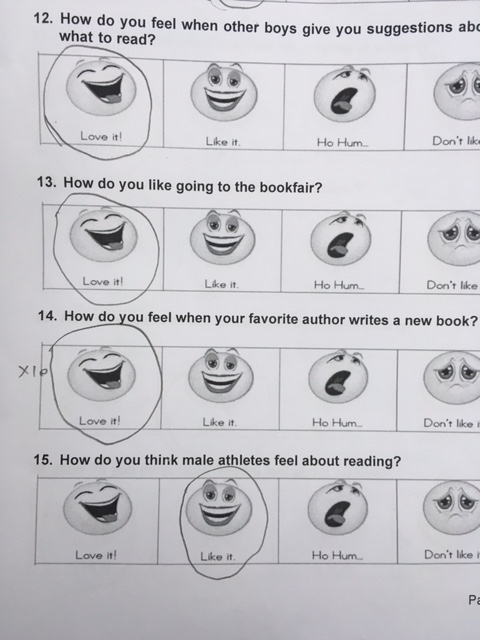
IMG_2824

and then when I was administering the survey to a group of 5 of the boys who were absent when the rest were surveyed, there was a long discussion after around whether male readers liked reading or not. The gist being that they probably had to do a heck of a lot of reading, but that the topics and types of reading were probably not under their control or choice and that may result in them disliking reading instead of loving it!  Oh boys you are SO right!  That’s the whole point of FVR (free voluntary reading). Moments like that I wish I had my camera / microphone on and recording! But of course I didn’t because I was doing a survey and not an interview…

Fortunate coincidence

After our leadership meeting this week I asked our principal what she thought of my various options for my case-study and which would be most beneficial and meaningful for the school.   By happy coincidence the senior leadership is looking at a number of things that tie in nicely with my ideas of what would be a viable case-study

  • Using the cumulated data we have on reading scores from the last few years in an interpretive and meaningful way
  • Examining a small section of students to see if anything can be extrapolated to the wider student body and inform teaching and learning
  • Raising the “bottom” – i.e. looking at our struggling students in a holistic way and seeing how we can help them on their learning journeys

In our conversations we also discussed how struggling students can influence the whole ambiance in a classroom, both in the student body and in the teachers response to the individual student and the class as a whole.

The question of course is what is ‘success’ and how do you measure it?  Must it be an improvement in reading or other academic measureables? Something ‘concrete’? Or can we think about the more ‘fuzzy’ aspects of learning that are harder to pin down.  Like affinity and belonging – nicely spoken about in this (non academic) article. Certainly we know that students who have (excessive) stress have difficulty learning. But is it skill, is it motivation that starts the negative spiral? And who can help? Is it a bootstraps issue, is it parents, peers, teachers, mentors, siblings?  What formats and genres?

I’ve just downloaded hundreds of articles around these themes, so it’s time to start digging in and try to get a research question out of it all.