Last week I attended a “#Call to Action: Fake News, Misinformation and Post-Truth” held by the SMU libraries in Singapore. Library network groups are full of requests for student appropriate examples of fake news. Most librarians have a stock list starting from the spaghetti harvest (1957) / tree octopus (1988). And we’ve unfortunately become over excited that #fakenews will be the saviour of librarianship. Because yay – we’re good at research, we’re good at teaching and applying the C.R.A.A.P / E.S.C.A.P.E tests, we’re about literacy, we’ve got all these captive young minds in front of us.
But between the insightful comments of very intelligent people like Eugene Tan and Gulcin Cribb at this seminar, where one had to conclude that the usual antidotes – trying to outcrowd “fake” news with “good /solid” news, padding news consumption with self-imposed digital/information literacy filters like the above mentioned CRAAP/ESCAPE tests or attempting to regulate it, will only work selectively or not at all.
Caulfield in his blog has been hammering on about being able to distinguish between fake and real images, sourcing quotes, but his latest post was one that threw the switch for me, on digital polarization on pinterest. (An aside, I gave up on pinterest because I can’t be bothered to log in every time I need to go past the first page and I prefer Evernote as a curation tool anyway). If you do nothing else in the fake news landscape ever, just watch this video he made.
And that, combined with the very disturbing article by James Bridle on Kid’s YouTube, following all the work that MathBabe, Cathy O’Neil, has been doing on web algorithms, and watching YouTube with my teenage son who is innately simultaneously curious about all sorts of scary (to mom) teenage stuff, combined with a reluctance to research beyond YouTube and Infographics* has made me really think about the way we’re approaching this conversation.
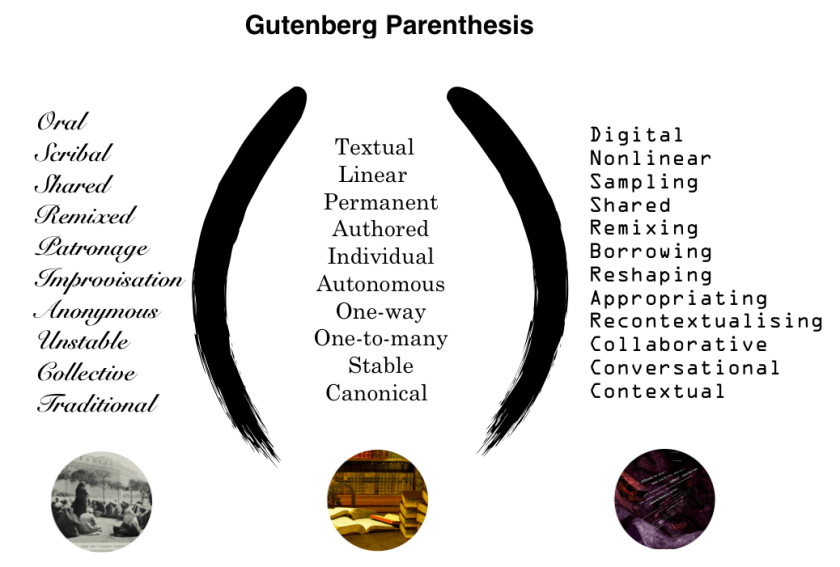
Let’s follow this thing upstream. Bear with me as I bring a couple of concepts that I think are related into this. A few things that have a lot to do with some human traits. The need to tell and listen to stories, The difficulty and recency of reading. The concept of the Gutenberg parenthesis. And last but not least, modern capitalism and/or the seven deadly sins (a concept I needed to explain to my kids the other night).
So where does that veritable soup land one? Well, exactly where Mike Caulfield found himself as he clicked along in Pinterest, and like Alice in Wonderland found himself in a different universe to the one he started out in. Pinterest is perhaps one of more extreme examples of algorithms at work. But the same is going on in Twitter (I was browsing through some UX stuff this morning and my feed and suggested people to follow changed suit in a matter of minutes) and Facebook and Instagram.
We have to face that honesty and a quest for truth doesn’t give one a monopoly on creating world class videos and infographics. That is the realm of those with a big enough budget to do it professionally. And that is how people like their information. So is the cure an infographic cold war, where every side builds up their arsenal of clickbait and point form iconic bite-sized digests? Or do we demand that algorithms are audited? Do we stop being curious and resist what we think is the “road less travelled” and the urge to click down paths that are actually carefully manipulated to pre-purchased outcomes?
So #fakenews is just a symptom. And by trying to treat the symptoms are going to get us nowhere. But unfortunately the disease is being human, and their is no vaccine against that. Except consciousness. Extreme consciousness. And consciousness takes time, and time is what technology is robbing us of. The irony.
————————————————-
* Shoot me – I’m human. That saying about cobblers and shoes? He came home the other day and told me his English teacher said reading was important for vocabulary and a whole host of things and that “just 20 minutes a day would make a difference”
 Informative Flights - Musings of a Teacher Librarian