Role of the TL trends and more assignment

I’m in the process of complete immersion and drowning in information, data points, ideas, readings literature, to do my latest assignments. I’ve been trying mind mapping – does that make any sense? It does to me it’s life the universe and everything of TLship.  The issue is to translate that into 2500 words, no more no less appropriately referenced.

TL


I also have other stuff. Lots and lots of other stuff.  Way too much stuff. Like the matrix I made of all the issues around being a TL. Beautifully referenced even.

Issue Implication Response
Demographic shift to students with more linguistic and cultural diversity (Australian Bureau of Statistics, 2013; “Canadian Demographics at a Glance: Some facts about the demographic and ethnocultural composition of the population,” n.d.; Center for Public Education, 2012; Ho, 2011) Issues around equity and access to learning and resources (Mestre, 2009)Teaching strategies to address strengths and needs of students (Australian School Library Association, 2014) Resources, staffing and collections necessary to reflect diversity of students and scaffold to language of instruction (Center for Public Education, 2012) 
CCSS and other centrally determined standards and assessment (Dow, 2013; Lewis & Loertscher, 2014) 

Emphasis on testing / learning outcomes (Weaver, 2010)

Need strategies and deep understanding of standardsProvide teacher support & student instruction


TL should show how their existence enhances testing / learning outcomes


10 initiatives to put library at center of learning (Lewis & Loertscher, 2014)Content and inquiry skills support opportunities by TL (Todd, 2012)

Examine ways to integrate resources / tools in teacher in learning

Extend textbook

Teach IL – retrieval / search terms

Tap into discussion at national and professional level

Librarian as co-teacher with curriculum overview

Show importance of reading to academic success

Focus on learner needs


Budgetary constraints coupled with under-estimating value of TL (Weaver, 2010) 


Return on Investment (ROI) for TL needs to be evident (Gillespie & Hughes, 2014)

Staffing shifted to teachers, aides, or librarians rather than teacher librarians 

Accountability and evidence based practice


Reconsider time and priority managementMaximize opportunity for adding value

Outsource / terminate or streamline activities not focused on learner needs

Provide qualitative and quantitative evidence of impact

Only librarian at a school (Valenza, 2011)  Cannot fulfil all aspects of role / spread thin across school Mastery of publishing platforms to enhance website and web-based path-finders

And how about the current and future trends?  All there.

Trend Implication TL response
Shift to inquiry based learning / project based learning / resource based learning (Boss & Krauss, 2007) Curriculum resourcing needs to be more sophisticatedLearning not limited by time or space Guide process with teachersCreate guides / pathways

Integrate technology

Networks for meaningful collaboration

Technology integration in classrooms; BYOD; 1:1 programs (Everhart, Mardis, & Johnston, 2010; Johnston, 2012; Lagarde & Johnson, 2014) 


Part of collection is digital (particularly non-fiction)

Physical space (Lagarde & Johnson, 2014)

LT’s need to have knowledge, skills and strategies to assume leadershipIssues with DRM (digital rights management), academic honesty, intellectual property,

Ethical and plagiarism issues due to ease of copying

Information literacy becomes more important

Use of space in library changes – fewer stacks more collaborative spaces; change in balance from “consumption” to “creation”


Lead / teach teachers and students, be positive role model / expertUnderstand DRM and IP

Ensure digital collection is visible

Teach searching internet  & databases

Teaching and coaching academic honesty

Rethink collection and space

Shift to flexible teaching, meeting, collaborating and presentation space (Hay & Todd, 2010)

Rethink promotion and display

Think also about psychological space – not just physical (Todd, 2012)


5 Trends (International society for technology in Education)

  • Big data
  • Augmented reality
  • Semantic Web
  • BYOD
  • Transmedia story telling (Marcoux, 2014)
Easy to be overwhelmed hard to discern what is effective / fits learning needs / goals Know what is trending and what the implication is for teaching / learning / information literacyBe discerning, what is valuable / effective for learning

Network / make connections

Deconstruct technology

Access to all and any information (Marcoux, 2014) Possibility of students using irrelevant / incorrect or unsafe information Information literacy instruction, separate, embedded in curriculum, learning themes, at every opportunity
Inter-textuality, transmediation and semiotics (Schmit, 2013) 

Post literate society (Todd, 2012)


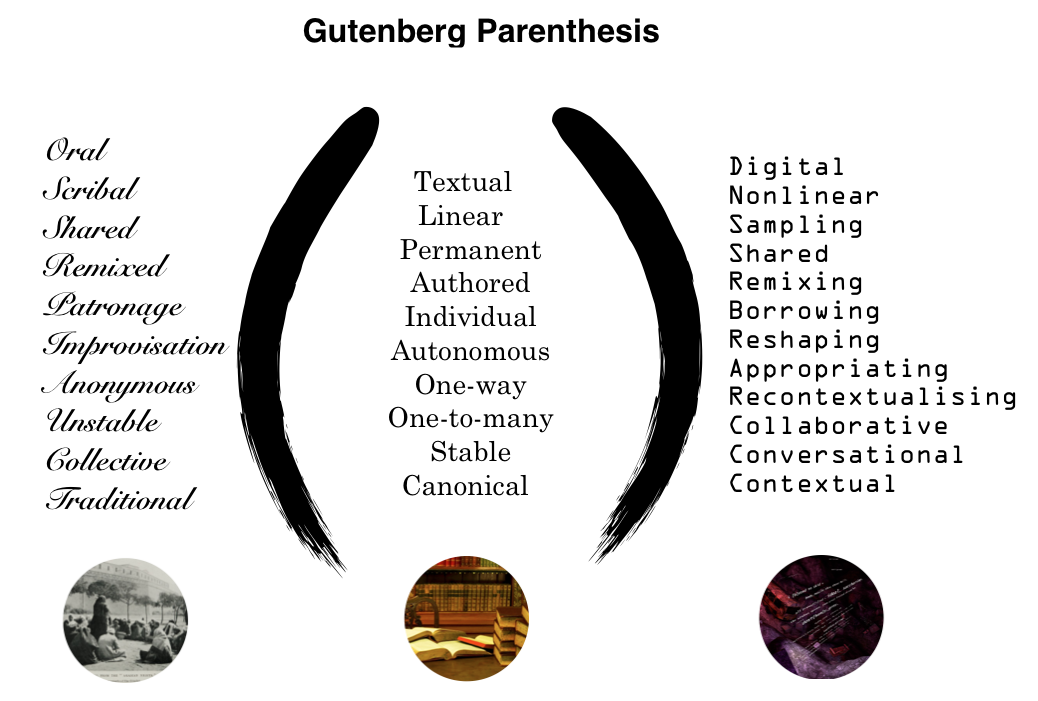
Gutenberg parenthesis (Pettitt, Donaldson, & Paradis, 2010)


Shift from Information literacy to meta-literacy (O’Connell, 2012b)

Shift from text to other sign symbols (audio, spatial, visual, gestural, linguistic) 

Change in type and media of collections


Adapt (information) literacy teaching


Literacy and text definition expanded to “architecture, art, dance, drama, mathematics, kinaesthetic, play, technology, and so forth,” (Schmit, 2013, p. 44), transmediation in curriculum and lesson planning, use of technology, digital storytelling.
Distance Learning / MOOC (Massive Open Online Courses)/ Professional learning communities (PLC) / Professional Learning Networks (PLN) and Communities of practice (COP) (Lagarde & Johnson, 2014) Learning no longer bounded by time, space and location

And all useless. Totally totally useless.  I just can’t find a structure. I can’t find a thread, meaning, a theme, something to tie it all together. Something wonderful and powerful and amazing.  It is too much. It’s probably enough for a dozen blog posts and 4 articles.

I know. Simplify. Stick to one or two things. Let the rest go.  But I don’t have any clarity yet…


References:


Australian Bureau of Statistics. (2013). Australian Social Trends, April 2013. Retrieved December 14, 2014, from http://www.abs.gov.au/AUSSTATS/abs@.nsf/Lookup/4102.0Main+Features30April+2013

Australian School Library Association. (2014, January). Evidence Guide for Teacher Librarians in the Highly Accomplished Career Stage. Australian School Library Association.

Boss, S., & Krauss, J. (2007). Mapping the Journey – Seeing the Big Picture. In Reinventing Project Based Learning: Your Field Guide to Real-World Projects in the Digital Age (pp. 11–24). Eugene, OR: International Society for Technology in Education. Retrieved from http://www.iste.org/images/excerpts/REINVT-excerpt.pdf

Canadian Demographics at a Glance: Some facts about the demographic and ethnocultural composition of the population. (n.d.). Retrieved December 14, 2014, from http://www.statcan.gc.ca/pub/91-003-x/2007001/4129904-eng.htm

Center for Public Education. (2012, May). The United States of education: The changing demographics of the United States and their schools. Retrieved December 14, 2014, from http://www.centerforpubliceducation.org/You-May-Also-Be-Interested-In-landing-page-level/Organizing-a-School-YMABI/The-United-States-of-education-The-changing-demographics-of-the-United-States-and-their-schools.html

Dow, M. J. (2013). Meeting Needs: Effective Use of First Principles of Instruction. School Library Monthly, 29(8), 8–10. Retrieved from http://ezproxy.csu.edu.au/login?url=http://search.ebscohost.com/login.aspx?direct=true&db=iih&AN=87773552&site=ehost-live

Everhart, N., Mardis, M. A., & Johnston, M. P. (2010). Diversity Challenge Resilience: School Libraries in Action. In Proceedings of the 12th Biennial School Library Association of Queensland. Brisbane, Australia: IASL.

Gillespie, A., & Hughes, H. (2014). Snapshots of teacher librarians as evidence-based practitioners [online]. Access, 28(3), 26–40. Retrieved from http://search.informit.com.au.ezproxy.csu.edu.au/documentSummary;dn=589128468876375;res=IELAPA

Hay, L., & Todd, R. (2010). School libraries 21C : the conversation begins. Scan, 29(1), 30–42. Retrieved from http://search.informit.com.au.ezproxy.csu.edu.au/fullText;dn=183676;res=AEIPT

Ho, C. (2011). “My School” and others: Segregation and white flight. Australian Review of Public Affairs, 10(1). Retrieved from http://www.australianreview.net/digest/2011/05/ho.html

Johnston, M. P. (2012). School Librarians as Technology Integration Leaders: Enablers and Barriers to Leadership Enactment. School Library Research, 15, 1–33. Retrieved from http://ezproxy.csu.edu.au/login?url=http://search.ebscohost.com/login.aspx?direct=true&db=ehh&AN=82442509&site=ehost-live

Lagarde, J., & Johnson, D. (2014). Why Do I Still Need a Library When I Have One in My Pocket? The Teacher Librarian’s Role in 1:1/BYOD Learning Environments. Teacher Librarian, 41(5), 40–44. Retrieved from http://search.proquest.com/docview/1548230103?accountid=10344

Lewis, K. R., & Loertscher, D. V. (2014). The Possible Is Now: The CCSS Moves Librarians to the Center of Teaching and Learning. Teacher Librarian, 41(3), 48–52,67. Retrieved from http://search.proquest.com/docview/1504428059?accountid=10344

Marcoux, E. “Betty.” (2014). When Winning Doesn’t Mean Getting Everything. Teacher Librarian, 41(4), 61–63. Retrieved from http://search.proquest.com/docview/1523915729?accountid=10344

Mestre, L. (2009). Culturally responsive instruction for teacher-librarians. Teacher Librarian, 36(3), 8–12. Retrieved from http://go.galegroup.com.ezproxy.csu.edu.au/ps/i.do?id=GALE%7CA195325714&v=2.1&u=csu_au&it=r&p=EAIM&sw=w&asid=fc46665000eaf30a53c320a0b77bc226

O’Connell, J. (2012). Learning without frontiers: School libraries and meta-literacy in action. Access, 26(1), 4–7. Retrieved from http://search.proquest.com/docview/934355007?accountid=10344

Pettitt, T., Donaldson, P., & Paradis, J. (2010, April 1). The Gutenberg Parenthesis: oral tradition and digital technologies. Retrieved August 29, 2014, from http://web.mit.edu/comm-forum/forums/gutenberg_parenthesis.html

Schmit, K. M. (2013). Making the Connection: Transmediation and Children’s Literature in Library Settings. New Review of Children’s Literature and Librarianship, 19(1), 33–46. doi:10.1080/13614541.2013.752667

Todd, R. J. (2012). Visibility, Core Standards, and the Power of the Story: Creating a Visible Future for School Libraries. Teacher Librarian, 39(6), 8–14. Retrieved from http://web.b.ebscohost.com.ezproxy.csu.edu.au/ehost/detail/detail?sid=db2eaed5-c51c-48a2-adf5-8caa9a624d24%40sessionmgr113&vid=0&hid=115&bdata=JnNpdGU9ZWhvc3QtbGl2ZQ%3d%3d

Valenza, J. (2011). Fully Loaded: Outfitting a Teacher Librarian for the 21st Century. Here’s What It Takes. School Library Journal, 57(1), 36–38. Retrieved from http://search.proquest.com/docview/881456147?accountid=10344

Weaver, A. (2010). Teacher librarians: polymaths or dinosaurs? Access, 24(1), 18–19. Retrieved from http://search.proquest.com/docview/219618343?accountid=10344

Does inquiry based learning work?

A little personal anecdotal aside here.  I’m drowning in an assignment where while I know and understand all the individual parts I feel incapable of putting it all together in a coherent whole, so instead I’ll write a little story about inquiry based learning.  It is one of the topics in my course, where it is written about as if it were something new and interesting whereas it’s been around a long long time in the IB / PYP world and therefor has been part of our lives for the last 8 years.

Scene – the dermatologist’s office.  After a friend of mine had some basal cancer cells removed last month I went into “living in the tropics / sunshine all these years” alert and had myself checked out, and yesterday, being school holidays, hauled the kids in for their examination.

The receptionist handed me some intake forms to fill in, and the kids automatically reached for them to fill them in themselves.  With hilarious results.  Besides the obvious of name and date of birth, they wanted to know why all the other details were necessary.  Marital status? “If I write single,” said my son, “are they going to stalk me because they think I’m available?  Can’t I write “taken” instead? Is that why they want my home address?”  “What does caucasian mean? Why do they need to know my race?”  And then a further discussion into what information would be relevant for identification, for insurance purposes, for medical use (in this cause – dermatologically speaking – caucasian would be relevant) or just because no one has ever questioned what goes onto the forms and what is necessary.  Certainly Singapore is very big on forms and lots and lots of details. And race is always included, and so too is religion.  It makes my kids squirm when people insist on putting them in a belief box and people tend to persist until they’re satisfied – it took me a while to understand that the term here that shuts them up is “free thinker”. OK if you insist.

So perhaps that’s what is at the heart of inquiry based learning. Always questioning. What you’re doing, what’s being done to you, what you’re being asked for, what you’re being asked to do.  It is exhausting to parent at times, and must be even more so to teach.  But hopefully the lack of blind obedience and following the crowd will have some benefit in the long run.

To turn it all around then, the inquiry would be what should be on an intake form for a dermatologist and how you’d design one that was relevant but not personally invasive.  Or perhaps the inquiry is how much privacy we out to give away each time we fill something in and to what purpose.   There are big questions lurking behind innocent little forms to be completed.  I’m glad my kids are starting to get a glimpse of that.

360 degree whiteboards

Reflecting back on the past week, I actually had an abundance of opportunities for professional development beyond the “daily grind” of my studies.  It’s not really a daily grind, by my polymath brain does need a bit of light, or not so light or at least completely diverse and out of the box relief from the straight and narrow – (which isn’t really that straight and narrow I’m fortunate to say) of librarianship and teacher-librarianship.

Anyway, on Wednesday I stumbled on some PD on 360 degrees Math, thanks to my librarian edge boss who had chosen this as one of the topics to follow.

I’ll be upfront – of course I had a hidden agenda in attending.  I have a child who is struggling in math. Or let me put it otherwise, he alternates between coping really well and enjoying, nay loving the subject and his teacher, and failing every test or assessment placed in front of him. Between independently doing the homework assigned and falling way behind.  Basically I suspect he just does not “get” numbers. Something my more creative and design and interesting friends with well established creative careers tell me is totally acceptable and fine. Were it not for the coming 6 years of schooling he has to do math in.  So any tricks or wizardry or clues as how to make this process a little more palatable to the both of us is much appreciated.

The concept of 360 degree math was apparently launched by Sean Kavanaugh as a way to engage students. By having the students stand and solve problems at white-boards that surround the classroom, teachers see “evidence of the students’ thought processes as they unfold”.  In the old model of students hunched over their workbooks, “mistakes are usually caught long after they’re made and instructors may have trouble pinpointing where a student first went off the rails.”
The five steps of the structure includes:
  • “The Exchange: As each student enters the classroom, they’re personally greeted by the teacher—a sign of respect and welcome.
  • The Rewind: Students solve three relatively simple problems at the whiteboard to build their confidence.
  • The Micro-Lecture: The teacher gives a short lecture that’s kept between eight to 10 minutes in order to go over new concepts. 
  • The Practice: Students return to the whiteboard, where they spend the bulk of the class, to solve more challenging problems, facilitated by group discussions and collaboration.
  • The Proof: Work is done individually on the boards and reviewed by the teacher to help her plan the next lesson and understand where each student is in his or her mastery of skills.  ” (Antoniades, 2013, para. 10)
First we were the guinea pigs – trying to solve a range of problems pinned up on the board. Then we heard a little about the background to the idea of 360 degree math, and it’s variations – like writing problems or solutions on windows and then putting down the window blinds and gradually opening them to reveal the answers.   We considered the positive elements – having children stand and walk around rather than sit glued to their desks all day, the possibility of erasing mistakes and false logic easily and without leaving a trace or marks in a school notebook, the idea of making thought visible and mapped and seeing the process and strategy evolve.  The luxury of an expanse of whiteboard rather than a few lines in a book.   A few of the cons were the fact there wasn’t a permanent record unless the solutions and workings were copied down.  The chance that some students would copy answers rather than collaborate or work on the problem themselves.
As a mixed bunch of educators ranging from Maths and Science, to English and second language and of course the library we were immediately enthused with ideas as to how this could be translated to our environments.  
For the library, we are already using one table with a writeable surface, and have noticed that students use it a lot for collaborative learning, funnily enough, particularly in math, and the small portable whiteboard in the office behind the main desk gets a regular workout when we brainstorm as a library team.  If the library is to continue in its function as a collaborative learning space, designed as much for consumption as creation of information, of course we should be encouraging writing on the walls and windows. 
And I went home, cleared my son’s desk and took it out of his room, measured the walls where his desk had been and ordered a large whiteboard. I also cleared all the surfaces in his room, took out all the boxes of lego and blocks and bricks that he hadn’t been using for a while and put them into the storeroom.  It’s amazing the difference that less clutter makes. He wasn’t using the desk anyway – it was far to full of clutter, and he can never sit still at the table to do his homework anyway, so the loss of a chair doesn’t matter.  I put a tiny little table against one wall which he can use for his assignment if necessary.  It’s now Christmas break, so we’ll be using this method for revision of the  content areas that he failed his most recent tests on, and then use it for “real” once term starts again.  I’m feeling strangely hopeful.  We’ll see how it goes.

References:


360 Degree Math – Home. (n.d.). Retrieved December 14, 2014, from http://www.360degreemath.com/

Antoniades, A. (2013, October 1). Get Up, Stand Up! 360 Degree Math Revolutionizes Classrooms. Retrieved December 14, 2014, from http://www.takepart.com/article/2013/10/01/math-is-fun-360-degree-math

Teach (2013) 360 Math Whiteboards and Khan Academy Excerpt. (n.d.). [You Tube]. Retrieved December 14, 2014, from https://www.youtube.com/watch?v=7FQlXN9YZAI

ETL401 Blog Task 1: The role of the TL in schools

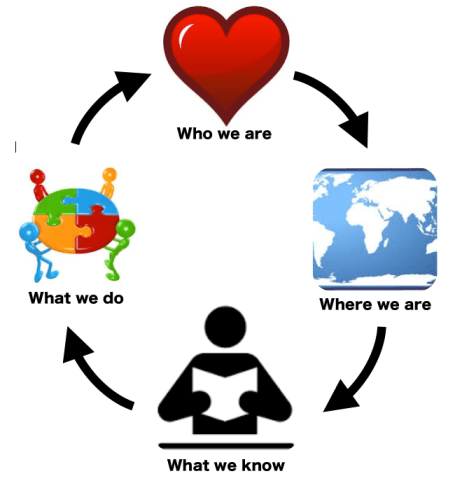
The role of the teacher librarian (TL) can broadly be understood by looking at the elements of:

  • Who we are
  • Where we are
  • What we need to know and
  • What we need to do.

Screen Shot 2014-12-07 at 10.12.01 am

Who we are

To misquote Karl Menninger “What the teacher (librarian) is, is more important than what he teaches.” (“Karl A. Menninger Quote,” n.d.).  It is the way in which individuals fulfil their role as TL that defines how both the profession and the individual is viewed. Aspects of this include strength of character (Bonanno, 2011), communication, cooperation, collaboration, interaction and relationships with those they come in contact with including students, teachers, principals and other members of the school community (Bonanno, 2011; Farmer, 2007; Gong, 2013; Lamb & Johnson, 2004a; Morris & Packard, 2007; Oberg, 2006, 2007; Valenza, 2010).  Being a positive role model as a life long learner, inquirer and innovator with impeccable honesty and ethics is considered to be at the basis of who a TL is (Farmer, 2007; Lamb & Johnson, 2004b; Oberg, 2006; Valenza, 2010). Drawing from research in the corporate world, it would appear that likeability is more important than competence in fostering collaboration and working relationships (Casciaro & Lobo, 2005).

Where we are

The context within which the TL operates cannot be ignored (Bonanno, 2011; Morris & Packard, 2007).  This includes the national educational or LIS (Library Information Science) ideology or systems and the background and personal experiences of all the school library stakeholders. Even within the relatively homogenous environment of a single country and culture, differences exist from school to school while in the context of an International school this can be amplified (Tilke, 2009).

When looking at the literature on school libraries in less developed economies, with single textbook, chalk and talk teaching methods, where there is an absence of policy and research, lack of specialist staff in either the teaching or librarian sphere, and a weak or neglected presence in the information society, (Abdullahi, 2009; Alomran, 2009; Odongo, 2009; Rengifo, 2009) the old Persian proverb “I cried because I had no shoes, until I met a man who had no feet” rings true.

What we need to know

The TL is expected to be a specialist both in teaching and in LIS. They need to combine knowledge, skills and experience in collection and resource management, information literacy, technology integration, curriculum and learning (Herring, 2007; Kaplan, 2007; O’Connell, 2012, 2014; Purcell, 2010; Valenza, 2010a). Various national and international professional organisations attempt to codify the skills and knowledge required in their standards and benchmarks for school librarians and set aspirational standards of excellence (ASLA, n.d.; “Australian School Library Association,” n.d., “International Association of School Librarianship – IASL,” n.d., “SLASA School Library Association of SA,” n.d.; IFLA, n.d.; Kaplan, 2007).

What we need to do

The core of what the TL does is advance school goals in an evidence based and accountable manner (Everhart, 2006; Farmer, 2007; Lamb & Johnson, 2004a; Oberg, 2002; R. Todd, 2003; R. J. Todd, 2007). The principal way in which these goals are achieved is through teaching and collaborating with other teachers (Herring, 2007; Purcell, 2010; Valenza, 2010). In addition, TLs managing people, resources and facilities (Everhart, 2006; Farmer, 2007; Tilke, 2009; Valenza, 2010).

In conclusion, the role of the TL is multi-faceted and dynamic as it continually adapts to the environment.   In each of our individual contexts it is worth taking heed of S.I. Hayakawa’s comment that “Good teachers never teach anything. What they do is create the conditions under which learning takes place.”  Those conditions are a combination of attitude, knowledge, skills and actions.

References

Abdullahi, I. (Ed.). (2009). Global library and information science: a textbook for students and educators: with contributions from Africa, Asia, Australia, New Zealand, Europe, Latin America and the Caribbean, the Middle East, and North America. München: K.G. Saur.

Alomran, H. I. (2009). Middle East: School libraries. In I. Abdullahi (Ed.), Global library and information science: a textbook for students and educators: with contributions from Africa, Asia, Australia, New Zealand, Europe, Latin America and the Caribbean, the Middle East, and North America (pp. 467–473). München: K.G. Saur.

ASLA. (n.d.). Standards of professional excellence for teacher librarians. Retrieved November 26, 2014, from http://www.asla.org.au/policy/standards.aspx

Australian School Library Association. (n.d.). Retrieved December 6, 2014, from http://www.asla.org.au/

Bonanno, K. (2011). A profession at the tipping point: Time to change the game plan. Keynote speaker: ASLA 2011 [Vimeo]. Retrieved December 4, 2014, from https://vimeo.com/31003940

Casciaro, T., & Lobo, M. S. (2005). Competent Jerks, Lovable Fools, and the Formation of Social Networks. Harvard Business Review, 83(6), 92–100. Retrieved from https://hbr.org/2005/06/competent-jerks-lovable-fools-and-the-formation-of-social-networks/ar/1

Everhart, N. (2006). Principals’ Evaluation of School Librarians: A Study of Strategic and Nonstrategic Evidence-based Approaches. School Libraries Worldwide, 12(2), 38–51. Retrieved from http://ezproxy.csu.edu.au/login?url=http://search.ebscohost.com/login.aspx?direct=true&db=lih&AN=24234089&site=ehost-live

Farmer, L. (2007). Principals: Catalysts for Collaboration. School Libraries Worldwide, 13(1), 56–65. Retrieved from http://ezproxy.csu.edu.au/login?url=http://search.ebscohost.com/login.aspx?direct=true&db=lih&AN=25545935&site=ehost-live

Gong, L. (2013). Technicality, humanity and spirituality – 3-dimensional proactive library service toward lifelong learning. Presented at the LIANZA Conference, Hamilton, New Zealand. Retrieved from http://www.lianza.org.nz/sites/default/files/Lidu%20Gong%20-%20Technicality%20humanity%20and%20spirituality%20-%203%20dimensional%20proactive%20library%20service%20toward%20lifelong%20learning.pdf

Herring, J. E. (2007). Teacher librarians and the school library. In S. Ferguson (Ed.), Libraries in the twenty-first century : charting new directions in information (pp. 27–42). Wagga Wagga, N.S.W: Centre for Information Studies, Charles Sturt University.

IFLA. (n.d.). IFLA/UNESCO School Library Manifesto. Retrieved November 26, 2014, from http://archive.ifla.org/VII/s11/pubs/manifest.htm

International Association of School Librarianship – IASL. (n.d.). Retrieved November 26, 2014, from http://www.iasl-online.org/about/handbook/policysl.html

Kaplan, A. G. (2007). Is Your School Librarian “Highly Qualified”? Phi Delta Kappan, 89(4), 300–303. Retrieved from http://ezproxy.csu.edu.au/login?url=http://search.ebscohost.com/login.aspx?direct=true&db=a9h&AN=27757339&site=ehost-live

Karl A. Menninger Quote. (n.d.). Retrieved December 6, 2014, from http://izquotes.com/quote/290881

Lamb, A., & Johnson, L. (2004a, 2014). Library Media Program: Accountability. Retrieved November 25, 2014, from http://eduscapes.com/sms/program/accountability.html

Lamb, A., & Johnson, L. (2004b, 2014). Library Media Program: Evaluation. Retrieved November 25, 2014, from http://eduscapes.com/sms/program/evaluation.html

Morris, B. J., & Packard, A. (2007). The Principal’s Support of Classroom Teacher-Media Specialist Collaboration. School Libraries Worldwide, 13(1), 36–55. Retrieved from http://ezproxy.csu.edu.au/login?url=http://search.ebscohost.com/login.aspx?direct=true&db=lih&AN=25545934&site=ehost-live

Oberg, D. (2002). Looking for the evidence: Do school libraries improve student achievement? School Libraries in Canada, 22(2), 10–13+. Retrieved from http://search.proquest.com/docview/222527406?accountid=10344

Oberg, D. (2006). Developing the respect and support of school administrators. Teacher Librarian, 33(3), 13–18. Retrieved from http://search.proquest.com/docview/224879111?accountid=10344

Oberg, D. (2007). Taking the Library Out of the Library into the School. School Libraries Worldwide, 13(2), i–ii. Retrieved from http://ezproxy.csu.edu.au/login?url=http://search.ebscohost.com/login.aspx?direct=true&db=lih&AN=28746574&site=ehost-live

O’Connell, J. (2012). So you think they can learn. Scan, 31(May), 5–11. Retrieved from http://heyjude.files.wordpress.com/2006/06/joc_scan_may-2012.pdf

O’Connell, J. (2014). Researcher’s Perspective: Is Teacher Librarianship in Crisis in Digital Environments? An Australian Perspective. School Libraries Worldwide, 20(1), 1–19. Retrieved from http://search.proquest.com/docview/1543805459?accountid=10344

Odongo, R. I. (2009). Africa: School Libraries. In I. Abdullahi (Ed.), Global library and information science: a textbook for students and educators: with contributions from Africa, Asia, Australia, New Zealand, Europe, Latin America and the Caribbean, the Middle East, and North America (pp. 91–107). München: K.G. Saur.

Purcell, M. (2010). All Librarians Do Is Check Out Books, Right? A Look at the Roles of a School Library Media Specialist. Library Media Connection, 29(3), 30. Retrieved from http://ezproxy.csu.edu.au/login?url=http://search.ebscohost.com/login.aspx?direct=true&db=f5h&AN=55822153&site=ehost-live

Rengifo, M. G. (2009). Latin America: School Libraries. In I. Abdullahi (Ed.), Global library and information science: a textbook for students and educators: with contributions from Africa, Asia, Australia, New Zealand, Europe, Latin America and the Caribbean, the Middle East, and North America. München: K.G. Saur.

SLASA School Library Association of SA. (n.d.). Retrieved November 26, 2014, from http://www.slasa.asn.au/Advocacy/rolestatement.html

Tilke, A. (2009, September). Factors affecting the impact of a library and information service on the International Baccalaureate Diploma Programme in an international school: A constructivist grounded theory approach. (A thesis submitted for the degree of Doctor of Philosophy). Charles Sturt University, Wagga Wagga, N.S.W.

Todd, R. (2003). Irrefutable evidence: how to prove you boost student achievement. (Cover Story). School Library Journal, 49(4), 52+. Retrieved from http://go.galegroup.com.ezproxy.csu.edu.au/ps/i.do?id=GALE%7CA100608794&v=2.1&u=csu_au&it=r&p=EAIM&sw=w&asid=194fea091c82b000bb3b69ca05004411

Todd, R. J. (2007). Evidenced-based practice and school libraries : from advocacy to action. In S. Hughes-Hassell & V. H. Harada (Eds.), School reform and the school library media  specialist (pp. 57–78). Westport, CY: Libraries Unlimited.

Valenza, J. (2010, December). A revised manifesto [Web Log]. Retrieved May 21, 2014, from http://blogs.slj.com/neverendingsearch/2010/12/03/a-revised-manifesto/

Image Credits:

Teamwork: http://upload.wikimedia.org/wikipedia/commons/b/ba/Working_Together_Teamwork_Puzzle_Concept.jpg

Heart: https://openclipart.org/detail/-by-pianobrad-137125

World map:  http://upload.wikimedia.org/wikipedia/commons/4/43/World_Map_Icon.svg

Knowledge:  https://openclipart.org/image/300px/svg_to_png/184627/learn-icon.png
Meanwhile back at my other blog…

For my current course ETL401 Introduction to Teacher Librarianship I’m required to keep a blog on WordPress in their “thinkspace”.   After a couple of months of WordPress I must say I’m still not terribly good at it, nor convinced of its superiority (at least not for someone who isn’t doing this professionally) but anyway, if you don’t find anything here, I’ll be there.  They’re named the same so as to avoid any confusion. I’ve just not worked out how to double post there and here, without having administrator rights “there” so as a compromise I’ll just link the lastest posts from either blog to the other.

School Librarian Connections – My presentation(s)

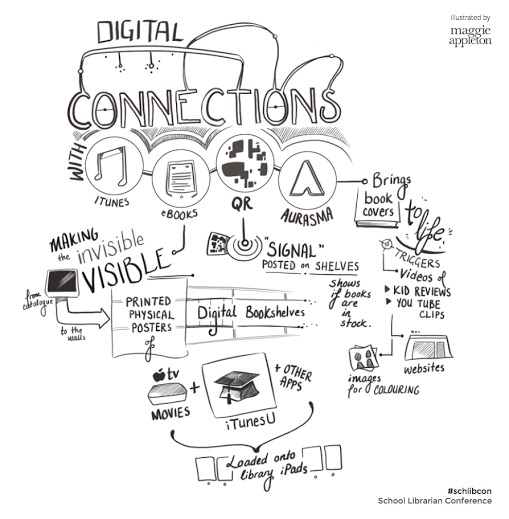
I contributed to two presentations at the conference over the weekend, one as part of our school library team on “Making the invisible visible” which was how through the use of posters, placeholders and QR codes we try to show our patrons and users what our digital tools and resources are.  The other was to highlight some aspects of INF533 on digital literature and to encourage teacher librarians to think about how digital story telling could be incorporated into library programs or at least to build some awareness of its potential.

Katie, Barb, Nadine DigiConnections


My presentation is here (my other professional blog), and I also put up some resources and further reading as I only had a 5 minute presentation!

School Librarian Connection Conference Hong Kong

Over the weekend I was fortunate enough to attend some professional development in Hong Kong, SCHOOL LIBRARIAN CONNECTION created and co-ordinated by the super-librarian Dianne McKenzie of LibraryGrits fame (subscribe to her blog – it keeps me learning and thinking inbetween formal conference opportunities – she also writes some very interesting reflections as part of her COETAIL learning experience in “Wagging my Coetail”).

All the presentations were excellent, and Dianne had done a great job on creating themes around which the presentations were grouped. We also had the very talented Maggie Appleton doing some visual note taking (see below)

Image by Maggie Appleton


which was an exciting new development in PD for me – enhanced by Shirley Chan telling us how to involve our students (and ourselves) in visual note taking with some hand tips and tools of implementation.  For example, a visual notetaking blog and a rather nice video for getting started

Other interesting bits and pieces were the talk on library advocacy – using the 6 principles of influence of Cialdini Reciprocity; Commitment (and Consistency); Social Proof; Liking; Authority and Scarcity from a course by Wendy Newman in Edx.

The ongoing genrefication of the non-fiction section.


Digital Storytelling tools worth looking at (1)

There is a plethora of tools in the virgin outback of digital storytelling.  This does not make one’s life any easier, plus there is the chorus of cellos in the background warning you that most of these tools that you invest time and effort into learning and using may not be around forever, or even for very long.  So what’s one to do?  Certainly it shouldn’t stop one from playing around and experimenting – particularly with the more common tools that are handy to know anyway (think iMovie / window’s movie maker etc.) I’d love to hear comments of what you’ve used and what has worked for you or your students

Here are a few of the tools I’ve experimented with personally, or have seen well used during my INF533 Literature in Digital Environments course at CSU (if you’re looking for a great course to upskill yourself, I can thoroughly recommend it – you can take it as a single course “just for fun” and it is fun).

Creativist is an example of “scrollitelling”.  It’s a really low-barrier tool where you can combine pictures and video with a story.  The free version limits the size of your files (150 MB).  DW Academie gives a rather nice guide here which is worth reading through before you try.

https://www.creatavist.com/featured

Inklewriter by Inklestudios is a platform for interactive choice based stories.  It is really easy to get started on and in its simplest version one can just add text.  Photos can be added relatively easily but there is no video option, which is a pity.  I can see great possibilities for use with students who are exploring options for example of subject choice or university or study choices – they could explore options and alternatives in a “safe” and personal environment imagining “what if…”

http://www.inklestudios.com/firstdraft/

Popcorn Webmaker by Mozilla is another easy “plug and play” tool. It uses some of the basic conventions of video editing with various layers (sound, video, picture) and allows one to embed elements in a story.  One of the interesting variations on this is that the interactive element allows the audience to remix the original and make their own stories.

https://urbanstorytellers.makes.org/thimble/MzY3OTE5MTA0/urban-storytelling-a-how-to-guide-start-here

More ideas and lists:
Finally Storygami – something that is unfortunately still in Beta and where one can hire the team to realise your storytelling dreams, but where I see great potential for use in educational settings.

Digital Storytelling – The role of the library – presentation for School Librarian Connection Conference Hong Kong November 2014