Why lists and awards matter

Every year around this time, some parent will ask the teacher or myself what their child should be reading.

The “correct” response to this question is that we don’t make reading lists of prescribed or recommended books but prefer students to come and have a chat to us about what they like reading, what hobbies or interested they have and based on that we can personalise some recommendations for them. That we believe in free voluntary reading.

How many of you have had a follow up on that with the student popping by for that exciting interaction?  I started getting parents coming by personally around the end of my first year in my last job, and parents and children sometime in the second year and students on their own around the middle of my third year.

The truth is that people like lists and they like recommendations. This New Yorker article gives some ideas as to why lists matter – the most salient features are that lists “alleviates the paradox of choice” help with “reduction of uncertainty” and due to their finite nature are easier on the book budget both for school and home libraries!

Book Poster Neev Shortlist updated

So why are book awards important? According to Underdown:  ‘

“Awards are important in children’s books. They tell publishers, writers, and illustrators what is considered to be “the best,” and thus the standards they must strive to attain. Many children’s book awards, though not all, are selected by librarians. Award-winners then get orders from … both libraries and bookstores.  They will also stay in print longer. For writers and illustrators, getting to know the award-winning books … is one of the ways to understand what is considered to be the best today.

The idea of finding out what the best is “today” rather than when authors / illustrators or publishers – or parents and librarians were children is very important. I’d love a dollar for each time a parent wants to force the literature of their youth onto their progeny. Reading through the long list of the Neev awards, there was also quite the body of what I’d call “nostalgic” storytelling. Which is really hard to carry off, and generally appeals more to adults than children. Which is why, it may be important to consider a children’s choice option when moving from a short-list to the finalists.

Following last year’s very successful initial Neev Festival, during the feedback discussions the idea of an Indian Children’s book award was floated. One of the driving ideas was that India had a large body of children’s literature, published in English, but not widely known nor distributed internationally. And selfishly, as librarians in an (Asian) international context with 40-50% Indian diaspora making up our student bodies, we were just not able to provide our students with the “mirrors, windows and glass sliding doors they deserved – mirrors for the Indian students, and windows and doors for the other students. Kavita Gupta Sabharwal is a very special person, both visionary and someone who makes things happen, including this book award, both from a logistical and a financial point of view. Each award carries a cash prize of Rs 1 lakh (around US$ 1,400 – a substantial amount in the Indian publishing world).

Already, just based on circulating the short-list in social media groups, there has been substantial interest from the librarian community. The prize-winners saw their books fly off the tables following the award ceremony, with all books sold-out by the end of the festival. An award sends a powerful signal to publishers and the public – one that says “pay attention” this has value, create more like this. The award stickers on the books a “buy me” beacon.

The final step in the equation and the gauntlet to be thrown is whether the publishing and distribution channels will be able to push these books out into the wider world where they deserve their moment(s) in the sun. And in the longer term, creating teacher guides and author visits, websites, hyperdocs, quizzes, eBooks and audio-books. For that is what the world has come to expect. But first the small steps, make the books available for every child, parent, teacher or librarian in the world who wants to push a “buy” button and have the book delivered to them, anywhere in the world.

Culture eats strategy for breakfast

This phrase is attributed to Peter Drucker and made famous by Mark Fields (although can’t easily be authenticated). I firmly believe it to be a reality both in business and education, and many a manager has been burnt by this.

I’m currently in Bangalore, having spent the last three days at the Neev Literature Festival  where I had the honor to be invited back as a speaker / workshop leader and as a jury member of the inaugural Neev Book Award. It was touch and go whether I’d be able to attend, given that my passport has been tied up with either visa or customs arrangements since the beginning of August, but a little more than a week ago I got the go-ahead! I’m so glad I did. You see Neev is a very special place. Many schools claim to promote a culture of reading and spend vast amounts of money on classroom or central libraries. But sometimes to no avail as the individual teachers or heads don’t actually walk the walk.

Here the founder really and truly believes in reading, and has invested immensely to ensure that reading permeates the school – what other school hosts a free literature festival at their premises, flies over authors, illustrators, librarians, storytellers, interpretive dancers and then invites other schools and the public to partake of their largess?  I was talking to their new head last night, about admissions, and she said they were in a luxury position where demand was greater than supply of school places and one of the ways they decided on who gets a seat was based on the families being able to demonstrate that they supported a reading culture at home! Imagine that! Not portfolios, or CV’s or admission tests. And it shows. Listening to the young students as they described their reading lives I was astounded at the depth and breadth of their reading.

I spent the morning today with a few of the visiting authors, and one – the wonderful Nadia Hashami,  was telling me of a conversation with a reader who had read her book twice and was recommending it to everyone, and who had also attended her panel on “Protect or Prepare” difficult topics in literature – the discussions, chaired by Katie Day were around which topics could or should be out of bounds for children. This young lady’s take on it was that death was a part of life and had a place in literature as it was part of a normal life, however, she could not come to terms with rape and sexual violence because it was something that one would never want to be part of your life and which would never leave you or have a resolution. Astounding the maturity and empathy (some USA people could do with a little more empathy-powering literature obviously).

I had my own encounter with culture, which I’d like to reflect on. I did a workshop for 11-15 year olds using empathy mapping. I had the luxury of around 20 students and 90 minutes. So my strategy was to do a warm-up exercise by introducing the concept of empathy mapping using gender, and trying to take the view of the opposite gender based on what to Western sensibilities are rather sexist advertisements about mother/daughter bonding over dishwashing and father/son bonding over dude stuff like fishing and hanging out outside and drinking beers. It had worked extremely well in the international school environment I was coming from. But I hadn’t done my homework and had it “sensitivity tested” by my Indian friends … I quickly discovered that young Indian ladies (bar one or two) think that it is lovely to be able to bond with your mother over household chores, and that generally the students never needed to do chores, being of a class where chores were done for them by others! With a bit of prompting and help from my friends and the students’ teachers we managed to successfully complete the exercise and move on to phase 2 which was a reading of “No one walks on my father’s Moon” . It is a difficult text, despite being a picture book. However I like to use it, as even without an accompanying empathy mapping exercise, it provides a very powerful message of reconciliation and perspective taking.

file5This time the exercise really did work – on reflection, the “warm up” possibly did help the  success, despite not being optimal, because the students just weren’t used to giving their own views and in the first half kept looking to the adults for the “right / expected answer”. We had some powerful contributions from the groups, and some very interesting movement from utter condemnation for the father’s behaviour to understanding and empathy for the context and actions. And also the feeling that they could use this in their personal and academic lives.

Here’s a copy of the presentation – I believe that empathy cannot always be taken for granted despite the great potential of literature and us very much wanting it to be so. Hopefully this helps us and our students to take a step closer into “climbing into someone’s skin and walking around in it”

Collateral damage or passive Anura?

Classroom libraries vs. school libraries, teacher superstars marginalising teacher librarians – or is it our fault?

This post was first going to go one way and then through holiday laziness in posting, it has taken a kind of dual direction as I have more time for self-reflection and research.

The first offensive was launched by KC Boyd (2018) in her post “Easy Like Sunday Morning: School Libraries vs Classroom Libraries” where she reflects on Chicago School System and the impact on literacy of shifting from school libraries to (only) classroom libraries (hint – it wasn’t favourable). She refers to Ariel Sack’s post on the importance (and diminishing) role of school librarians who asks “Can this project be done by an individual teacher? Yes. But it’s something different when one person with a vision and the time to implement it leads it consistently for the entire school, every year” (Sacks, 2018). I’d argue there is another factor – one very rarely meets a librarian who doesn’t read (I have however met library assistants without any interest in books or reading); but the Peter Effect is well documented in teachers (Applegate & Applegate, 2004; Binks-Cantrell, Washburn, Joshi, & Hougen, 2012; Turner, Applegate, & Applegate, 2009) with studies in various places around the world documenting aliteracy in teachers / pre-service teachers – “Findings revealed that 54.3% of 195 teacher candidates were classified as unenthusiastic about reading and only 25.2% of teacher candidates reported unqualified enjoyment of reading.” (Binks-Cantrell et al., 2012, p. 526), and the picture appears to be getting worse rather than better (Skaar, Elvebakk, & Nilssen, 2018).

This is something easy to lose sight of when twitter, YouTube, Facebook, blogposts and podcasts are dominated by literacy superstars like Pernille Ripp, Colby Sharp, Mr. Schu, Jennifer Gonzalez, Angela Watson etc. But for every one of them, even a small imitation of them, there are likely to be three or more other teachers who are either not enthusiastic about reading, or, who actually don’t deign to read the types of books their students do – something I know my librarian mentor Katie Day, (successfully) worked very hard on with the teachers at UWCSEA-East when she was there. Based on my own experience I have encountered whole grades where not one teacher has been actively and passionately engaged in books and reading, and where this is apparently not seen as an issue (except when it is reflected in their students’ testing scores – but then the solution has been to work on the students rather than the teachers).

Regie Routman in her article “On the level with levelled books” (Routman, 2018), makes some valid arguments for free voluntary reading, and the choice of a selection of relevant and developmentally appropriate books for classroom libraries, but only makes oblique reference to public libraries and with no mention of school libraries or librarians – not even in a nostalgic or wishful manner. Relying on teachers who care and the intervention of a literacy expert is not a long term solution!

Colby Sharp, boasting a 3,000 book classroom library, ordered in a numbered system unfamiliar to any librarian I asked, talks about book checkout and is quick to dismiss the scanning system a librarian assisted him in setting up as “too much trouble”… (Sharp, 2018)

To which Day responded on FB “as long as he is on top of what all his students are reading, then, yes, it could work. But it’s not scaleable — and he doesn’t mention inventory checks — so at the end of the year you know which books might need to be replaced. With 3,000 books, it might be good for his students (other students? other teachers?) to be able to search and discover what books he has in his class library… Just sayin’… And LibraryThing’s TinyCat is definitely an option he might consider — to be able to see his collection online, whether he uses their circulation system or not.”

And then I found out what his library looked like – with a self-invented number system – ok so Dewey doesn’t do it for everyone, but those random numbers? (Sharp, 2017). I love the idea and potential of classroom libraries – I baulk at the cost, duplication of effort, waste of resources, money and time, lack of discoverability, lack of meaningful data and often stagnant nature of them. I have seen money wasted on thoughtless last minute purchasing without any clear strategy, collection management or development. I’ve seen classroom libraries with books that would better be relegated to pulping or, redistributed to older or younger students. I’d be the first to admit that often no one knows students better than their class-teacher, but just as we shouldn’t have to choose between classroom libraries and school libraries, so too the burden of creating dynamic exciting collections needn’t be the domain of only the class teacher or the librarian – together we definitely are better. Dialogue, collaboration, debate, relative expertise – all these things make us stronger as a learning community.

I started out being a little annoyed at the lack of mention of (school) librarians, but then reading the FB question of a librarian, (who shall remain nameless) challenging whether she should be expected to find a selection of books on a specific theme for a teacher because “she’d already shown the teacher how to find book in the system” and the responses I wondered how much of it was our own fault? We should be falling over ourselves to help teachers, parents, administrators, everyone in the community with lists and suggestions and books and resources they didn’t even to know to ask about. We should be anticipating and proactive. Not whining on FB as to where the limits of our job lie. I love the fact that this is one of the careers where you can pretty much be without boundary and limitless in what you can do – all in the interest of teaching and learning.

Spending a bit of time on Twitter I saw what was going on with Project Lit – something started in an English Classroom that is going viral (Riddell, 2018), (and what an excellent book collection they’ve created!) and I thought, darn it – we’re missing so many tricks here. Why aren’t teacher librarians initiating things like this, or the GRA? Why aren’t we leveraging our knowledge and experience in more ways than just fretting about our increasing marginalization and extinction? Why aren’t we taking more leadership and visibility in these arguments and discussions?

project lit

We aren’t part of these discussions and we’re not top of mind to any of the people who are getting attention. Whose problem is that? Do these “superstars” have a blind spot to anything NIH (not invented here), monstrous egos, or are we / have we become just so marginal to the whole reading / literacy scene that we don’t even merit a mention unless prompted (as the Sack article intimated)?

On FB again, another librarian spoke of her school that has gone from a thriving library system with two libraries run by two qualified librarians that’s been whittled down and compromised to one remaining librarian and was wondering what the moral of the story was – I commented “frog in a pot that slowly comes to boil”.

The problem with being a passive Anura is that no one else is going to turn the gas off and you don’t want to be left alone when the party is no longer in the kitchen – with apologies to Joan Lewie (WiggyOfStHelens2008, 2008).

 References

Applegate, A. J., & Applegate, M. D. (2004). The Peter Effect: Reading habits and attitudes of preservice teachers. The Reading Teacher, 57(6), 554–563.

Binks-Cantrell, E., Washburn, E. K., Joshi, R. M., & Hougen, M. (2012). Peter Effect in the Preparation of Reading Teachers. Scientific Studies of Reading, 16(6), 526–536. https://doi.org/10.1080/10888438.2011.601434

Boyd, K. c. (2018, June 3). Easy Like Sunday morning: School libraries vs classroom libraries [Web Log]. Retrieved 5 July 2018, from https://theaudaciouslibrarian.blogspot.com/2018/06/easy-like-sunday-morning-school.html

Sharp, C. (2018). My classroom library checkout system. Retrieved from https://www.youtube.com/watch?v=s9u6KHYoLVE

Sharp, C. (2017). Classroom library tour 2017-2018. Retrieved from https://www.youtube.com/watch?v=iGITHdb8tZ8

Riddell, R. (2018, March 12). Project LIT: How a Nashville educator turned a class project into a nationwide movement [Web Log]. Retrieved 5 July 2018, from https://www.educationdive.com/news/project-lit-how-a-nashville-educator-turned-a-class-project-into-a-nationw/518766/

Routman, R. (2018, June 24). On the level with leveled books [Web Log]. Retrieved 5 July 2018, from https://www.middleweb.com/37973/regie-routman-on-the-level-with-leveled-books/

Sacks, A. (2018, May 29). Why school librarians are the literacy leaders we need [Web Log]. Retrieved 5 July 2018, from https://mobile.edweek.org/c.jsp?cid=25920011&item=http%3A%2F%2Fapi.edweek.org%2Fv1%2Fblog%2F191%2Findex.html%3Fuuid%3D76470

Skaar, H., Elvebakk, L., & Nilssen, J. H. (2018). Literature in decline? Differences in pre-service and in-service primary school teachers’ reading experiences. Teaching and Teacher Education, 69, 312–323. https://doi.org/10.1016/j.tate.2017.10.019

Turner, J. D., Applegate, A. J., & Applegate, M. D. (2009). Teachers as literacy leaders. The Reading Teacher, 63(3), 254–256.

WiggyOfStHelens2008. (2008). Jona Lewie – You’ll Always Find Me In The Kitchen At Parties. Retrieved from https://www.youtube.com/watch?v=62eTq8ErUOQ


#NotOurDiversity

I’m busy preparing for next week’s library lessons. G5 has one of my favourite units in “How We Express Ourselves”

People create messages to target specific audiences

Ostensibly it’s about advertising, as the lines of inquiry indicate,

1. Advertising techniques can be used to influence society (Perspective)
2. Critically evaluating messages presented in the media (Reflection)
3. Ways adverts can cause people to form opinions (Causation)

however to paraphrase and misquote Twain I’ve never let reality get in the way of a good lesson. So I’m loosely interpreting “media” to include books, and advertising to include things like book covers.

My opening salvo last week was “Cover Bias” where we looked at the cover of a book as the way in which it was advertised and I showed the class some more egregious examples of stereotype and bias in the creation of book covers

This week is my chance to tackle something I feel very strongly about – how the concept of children’s book diversity has been cornered by a very specific type of diversity – i.e. the North American type, which to be honest in the lives of my students is #NotOurDiversity. So I’d like to provide a counterbalance to that, as well as to start my students and everything thinking and curating resources that do reflect their diversity.

This is tomorrow’s provocation:

And I’m hoping at the end we can start creating a padlet of the books which they consider to be their mirrors, windows and sliding glass doors.

What do I think their diversity looks like? Some of it is typical to 3CK (3 culture kids), but each place I’ve lived has delivered its own nuance:

  • Product of multi- cultural / linguistic parentage and heritage (including multi-racial if that is even a term that is at all relevant – I don’t think it is to them, but probably in other contexts, countries it would be)
  • Multi-national residential where home is defined more by current location of self, parents and siblings than by family and passport
  • Financial privilege that transcends typical migrant / immigrant issues and trauma
  • Underlying uncertainty on matters of identity and lack of sense of “place”
  • High expectations of resilience, grit and adaptability to constant change

Before anyone thinks that the market is too small to matter for book publishing for example should have a look at the numbers – 56.8m people estimated by 2017 and even more importantly the demographics of expatriation has changed dramatically and will continue to change – no more British administrator, the reality is more likely to be an Indian IT specialist or Korean Engineer. And so too our literature should be evolving to provide their children in international education the mirrors, windows and doors they are entitled to.

How librarians can leverage the GRA

I firmly believe that one of the main role’s of a school librarian is to make teachers’ lives just that little bit easier. And if we can do this while fostering a love and enthusiasm for reading in students – well that’s a double win.  Over the last few years I’ve written about the things that make the biggest impact on students’ favourite book, and teachers’ reading aloud to them is right up there above author visits, peer recommendations, book clubs and parent read-aloud.

Last year was the first time I experimented with the Global Read Aloud. Since I was just getting my feet wet, and only see classes once a week, I did the picture-book series with the books of Lauren Castillo. I tried, but failed to read the middle grade book (Pax), since we ran out of time and students were over-committed and couldn’t join during recess time. A couple of teachers tried Pax (and one or two even finished it), but they found it way too USA-context specific and unfamiliar setting to our students, needing an excess of background information and explanation – a view I concur with.

This year, with the books including some of my favourites – A Long Walk to Water, Wild Robot and Mem Fox as a picture book (and Fenway and Hattie – a book I didn’t enjoy but knew would strike a chord with my dog loving students) – I pushed a little harder with my G3-6 teachers. It helped that all had some pretty excellent Hyperdocs. I made an extensive library guide that could act as a one-stop-shop for teachers so they didn’t need to search awild robot.jpground for dates, documents, links etc. Ordered copies of the books and made sure students didn’t access them prior to the read-aloud, signed up for post-card exchanges and classroom partnerships. Then I subtly and not so subtly pushed teachers into agreeing to try it out. My pitch was basically that it was a great way to kick off literacy right at the start of the year without having to do any preparation besides deciding which parts (if any) of the brilliant Hyperdocs (e.g. Wild Robot) to use. In addition they’d get brownie points for making global connections!

I did the G2 classes myself, and had a great exchange through padlet with Tanja, the librarian at Hong Kong Academy. Luckily we had more or less the same holiday schedule, and in fact since she was in Singapore on holiday when we still had school, she was our mystery reader for one of the weeks! Our G2 students loved the Mem Fox books and really enjoyed sharing their lives and experiences with their buddies in Hong Kong.

The G3-6 classes who participated all reported that it had been successful. The main “complaint” being that they felt a little bit pressured to keep up with the schedule, amongst all else that was going on at school, but when they let go of that it was fine. Our G6 classes found substantial links between Long walk to water, to their curriculum unit of inquiry (WWAPT) of development and natural resources, particularly around the question of water, and also requested more text-to-text resources.

I was recently reading an article on the “Peter Effect” which basically posits that teachers’ cannot give what they don’t have – related to lack of reading engagement. This is one (painless) way of compensating for this effect by making it a very low barrier activity.

While the Global Read Aloud is a fantastic institution and I plan to continue to support it, I do however have to make a few points of what I hope is constructive criticism in the hope of making it even better.

At the moment “Global” is a bit of a misnomer, as it’s more of a “North American” plus some other internationals (albeit more than last year). For example in our postcard exchange, of the 60 cards we sent, 50 were to schools in the 50 states of the USA, plus 3 to Canadian schools and only 7 to schools in the rest of the world. Hopefully posts like this will increase recognition and participation.

I think a few things prevent it from truly being global. One of them is the timing – we agreed with our partners to shift the dates to take account for the fact that we had a two week autumn break in Asia right in the middle of the schedule. The other, I’m afraid to say is the choice of books.  As followers of this blog know, I’m a vociferous proponent of diversity and inclusion in literature and I must admit to some disappointment in the choice of authors / illustrators. There was some improvement this year with “Long walk to Water” (albeit the author still from the USA), and Mem Fox – but while Mem Fox may be somewhat exotic to the North American audience, she is anything but to the rest of us.  As someone who has been on the Red Dot Book Awards committee for the last few years, I know just how difficult it is to find the right mix of books for a book bundle. I also know how quickly and easily others criticise the choice once it is made and how difficult it is to solicit suggestions from just those people who later make the comments! So everyone, take some time to make suggestions on some truly global, international, diverse books and authors. And if you’ve not yet dipped your toes into the fun that is GRA – perhaps try one of this year’s books with the associated teaching guides.


#fakenews – symptom or disease?

Last week I attended a “#Call to Action: Fake News, Misinformation and Post-Truth” held by the SMU libraries in  Singapore. Library network groups are full of requests for student appropriate examples of fake news. Most librarians have a stock list starting from the spaghetti harvest (1957) / tree octopus (1988). And we’ve unfortunately become over excited that #fakenews will be the saviour of librarianship. Because yay – we’re good at research, we’re good at teaching and applying the C.R.A.A.P / E.S.C.A.P.E tests, we’re about literacy, we’ve got all these captive young minds in front of us.

But between the insightful comments of very intelligent people like Eugene Tan and Gulcin Cribb at this seminar, where one had to conclude that the usual antidotes – trying to outcrowd “fake” news with “good /solid” news, padding news consumption with self-imposed digital/information literacy filters like the above mentioned CRAAP/ESCAPE tests or attempting to regulate it, will only work selectively or not at all.

haythamcom_02a
Best quote of the seminar – indeed there is nothing new under the sun

Caulfield in his blog has been hammering on about being able to distinguish between fake and real images, sourcing quotes,  but his latest post was one that threw the switch for me, on digital polarization on pinterest. (An aside, I gave up on pinterest because I can’t be bothered to log in every time I need to go past the first page and I prefer Evernote as a curation tool anyway). If you do nothing else in the fake news landscape ever, just watch this video he made.

And that, combined with the very disturbing article by James Bridle on Kid’s YouTube, following all the work that MathBabe, Cathy O’Neil, has been doing on web algorithms, and watching YouTube with my teenage son who is innately simultaneously curious about all sorts of scary (to mom) teenage stuff, combined with a reluctance to research beyond YouTube and Infographics* has made me really think about the way we’re approaching this conversation.

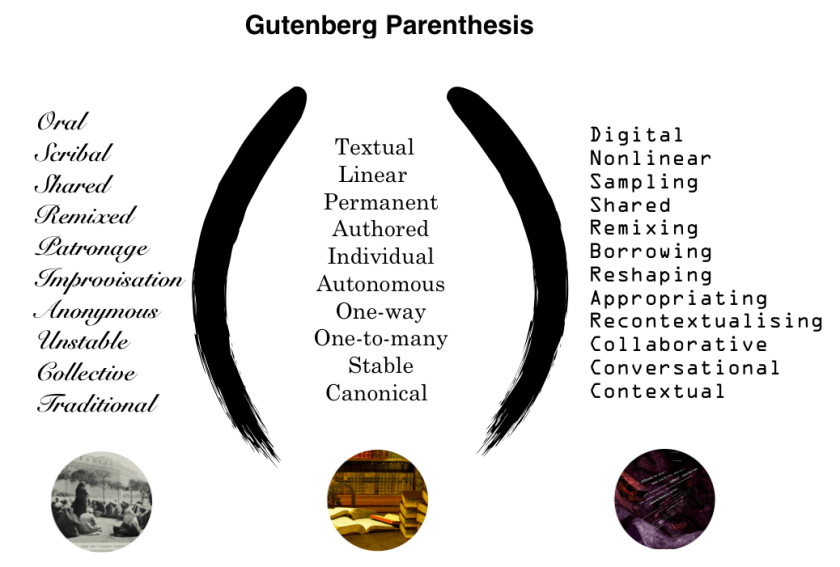
Let’s follow this thing upstream. Bear with me as I bring a couple of concepts that I think are related into this. A few things that have a lot to do with some human traits. The need to tell and listen to stories, The difficulty and recency of reading. The concept of the Gutenberg parenthesis. And last but not least, modern capitalism and/or the seven deadly sins (a concept I needed to explain to my kids the other night).

gutenberg parenthesis

So where does that veritable soup land one? Well, exactly where Mike Caulfield found himself as he clicked along in Pinterest, and like Alice in Wonderland found himself in a different universe to the one he started out in.  Pinterest is perhaps one of more extreme examples of algorithms at work. But the same is going on in Twitter (I was browsing through some UX stuff this morning and my feed and suggested people to follow changed suit in a matter of minutes) and Facebook and Instagram.

We have to face that honesty and a quest for truth doesn’t give one a monopoly on creating world class videos and infographics. That is the realm of those with a big enough budget to do it professionally. And that is how people like their information. So is the cure an infographic cold war, where every side builds up their arsenal of clickbait and point form iconic bite-sized digests? Or do we demand that algorithms are audited? Do we stop being curious and resist what we think is the “road less travelled” and the urge to click down paths that are actually carefully manipulated to pre-purchased outcomes?

So #fakenews is just a symptom. And by trying to treat the symptoms are going to get us nowhere. But unfortunately the disease is being human, and their is no vaccine against that. Except consciousness. Extreme consciousness. And consciousness takes time, and time is what technology is robbing us of. The irony.

————————————————-

* Shoot me – I’m human. That saying about cobblers and shoes? He came home the other day and told me his English teacher said reading was important for vocabulary and a whole host of things and that “just 20 minutes a day would make a difference” 

How to get free PD

5968774554Quite a few schools in our network have cut-back on funding for professional development and have either started limiting the time off or financial support for PD. This is extremely disappointing, as PD can be the lifeblood of educators, and dare I say, particularly for teacher-librarians with their often solitary status within a school.  There is however a vast range of ways to get “free” PD in that it will only cost you your own personal time. Here are a few suggestions for things I’ve tried out.

Teach meets

Founded by one of my lecturers in designing spaces for learning, Ewan McIntosh, Just about every major city in the world holds TeachMeets. Basically they’re gatherings for teachers where very brief (5-10 minute) presentations are given on a variety of topics, preceded and followed by some social chitchat and networking. Usually the topics are very practical, actionable “hacks” or ways of solving common teaching questions. In Singapore they’re run by 21stC learning and seem to tend towards the geeky/techie side of things.

Another form of this, for PYP educators is the PYP Connect events. These are run by the Singapore Malaysia PYP network, and consist of longer workshop events hosted by one or another PYP school. Ask your PYP coordinator about the next one in November 2017.

Pros: You get out of your space, meet educators from different specialisations and different schools.

Cons: They’re only a few times a year, and if you can’t attend that’s it.

Read a book (or a blog)

Yup, this can be really really simple. The only tricky bit would be which book to read and finding the time to do so. Basically you need to find your reading tribe. People who share your educational and life philosophy and who are readers and find out what books are shaping their thinking. My criteria for this type of book is one where a chapter can be read and absorbed in the 15-20 minutes between getting into be and my eyes falling shut from exhaustion.  At the moment I’m really pleased I found Kylene Beers and Robert Probst’s books

36094448154though an ex-colleague. I started by reading Reading Nonfiction and I’m currently on Disrupting Thinking and both books have given plenty of food for thought and initiative for me to reflect on my teaching and literacy practices. They’re just the right balance of practical and thoughtful.

More powerful than just reading a book, is reading with someone or a group of people so that you can share ideas and more importantly, put those ideas into practice. At our school we’ve started running professional book clubs, started by our principal last year when we set up our ODC (Outdoor discover centre) with “Dirty Teaching” . This year we’re running around eight different groups, each with their own focus, based around a book of note. The group I’m in is doing “Making Thinking Visible” and we have (surprise, surprise) a particular focus on using picture books.

There are plenty of lists of books to read. A word of caution – of course the books on the list reflect the culture of the country / organisation from whence the list is coming. Here are a few: The Guardian (British / Commonwealth focus); Fractus Learning (what I’d call aspirational / holiday read books – not much to put into practice immediately); We are Teachers (USA – more focused on the whole child / success).  Funnily / ironically enough there doesn’t seem to be an up to date list for teacher-librarians – the last one was a Goodreads one from 2012, which was pretty meh. Maybe because we’re reading all the time? Maybe it’s time to make one! (Suggestions in comments below).

I know blogging is so 2013, but I still do it, and I still subscribe to a few good blogs such as HapgoodSLJ blog network, Stephen Downes, Global Literature in Libraries, Gathering Books, and Mrs. ReaderPants. Here is a list of the supposed top 50 librarian blogs  (Somewhat USA focused, many not recently updated and nope, I’m not on it)

Pros: You can do it any time / any place. Most books are quickly actionable. A lot of books are now available as audiobooks – so you can multi-task – listen and do exercise etc. (but I need to stop and write notes!)

Cons: You need to dedicate a regular time to reading so that you don’t lose the thread. If you want to join a group, you need to structure it so that you can meet regularly.

Listen to a PodCast

There are so many excellent PodCasts out there – both educational and for general edification. I’m constantly torn between listening to podcasts and to listening to audiobooks. And the best thing is – it really helps your general knowledge, so you and awe your students from time to time!

Some of my favourites for education: The Cult of Pedagogy; Truth for Teachers; 10 minute teacher podcast. 

Unfortunately, again teacher librarians are not out there on the podcast scene much, and some of the initial podcasts are not kept up, but to make up for it, there are lots of good book podcasts. My favourite is All the Wonders, because they often feature diverse books and KidLit Radio. The SLJ has The Yarn (which I haven’t listened to but will). Here is another list from The Guardian.

General edification podcasts: 99% Invisible; The Allusionist; The Infinite Monkey Cage; You are Not so Smart; Stuff Mom Never Told You; TED radio hour; RadioLab; Invisibilia; Hidden Brain; Freakonomics; Sources and Methods; and my current favourite In Our Time.

Pros: Anytime, anywhere, keep up with amazing knowledge and information

Cons: So many to choose from. Easy to get behind and iTunes new format for podcasts is AWFUL.

Librarian Groups

Here in Singapore we are most fortune in having the ISLN with regular meetings and access to PD. Besides our quarterly meetings we have regular meet ups on a social basis, and pretty much all our libraries are open for job shadowing and visits. When I was still in training and working part-time, I regularly asked librarians if I could come and spend a day with them, and even now I’m working full time, if my holidays are different to that of my colleagues I’ll often ask if I can come and spend a morning or afternoon with someone, just trailing them with lots of conversations and questions and seeing best practice. Likewise, I encourage my library assistants to spend a day at other libraries from time to time, chatting to the library assistants and picking up some tips and tricks. Likewise, while on holiday, it’s easy to invite yourself to a fellow teacher librarian’s library to have a look around and chat. I’ve recently been to Taipei and popped into TAS’s lovely libraries for a few hours.

Pros: Convenient, local, low barrier

Cons: some librarians do operate in remote areas, or places with vast distances between the libraries making this more difficult.

Webinars

Actually the idea for this post occurred as I signed myself up for a webinar with SLJ. Added to this one could put short courses on YouTube (how I intend to master photoshop, Adobe Illustrator and Adobe InDesign this vacation)

Pros: Most webinars are free, almost all of them have both a live and “after the event” viewing option – ideal if you’re not on American Time.

Cons: The “free” sometimes comes at a cost of at least some of the time being devoted to someone or another trying to sell you their product, but if you already have the product, it can deepen your understanding of how to best use it.

MOOCs

While MOOCs seem to have lost their lustre, they’re still incredibly good for learning stuff. It’s just that the format is so limiting. But be that as it may, you can audit most course free of charge with a small fee to be “qualified”. Over the summer my daughter and I did the exceptionally good 8 week course “Humanity and Nature in Chinese Thought” an introduction to Chinese Philosophy. It has nothing to do with librarianship but everything to do with life and living in a multi-cultural and therefore multi-philosophical environment. I’m currently enrolled in Making Sense of the News: News Literacy Lessons for Digital Citizens; also through HKU, and I’ve done Jo Boaler’s How to Learn Math. No I’m not a math teacher, but I am a math human with math learning students and children. 

Pros: Some excellent content; self-paced; you can watch the videos at 1.5/2x speed. Huge variety of offering by some exceptional teachers.

Cons: Video based learning is not my favourite medium. Some courses are only open for a limited time frame. The hype hasn’t quite been realised with the format. Time.

Skype and GoogleHangout

I’ve done this a couple of times in the last few months. During the vacation, I saw an awesome Libguide and I was determined to update my school’s libguides. So I emailed the librarian, and next thing we were having a google hangout and she was screensharing with me showing how she’d done it all!

Then last week I was worrying that I wasn’t using MackinVIA properly, and again reached out to someone who screenshared her set up. I’ve done some libguide training to a fellow librarian who was sitting next to me, while screensharing to another librarian remotely.

Twitter

Great for reaching out to people and keeping up with trends of what is going on. But hard for searching and following threads when you enter part way through is horrid.

Facebook

I put this last because it is truly terrible. The possible worst place in the world to put up information and exchange knowledge. It gets boring and repetitive as the same questions come up time and again. It’s awful for searching, it can be mindless and stupid – why on earth once a question has been asked do people persist on answering it again with the same information?? But the various librarian groups I’m in, are very useful, albeit that I need to keep / store the links immediately to Evernote.

Facebook groups I’ve joined include: Int’l School librarian Connection; SLATT; Global ReadAloud (only really active around the GRA activities in October/November); Future Ready Librarians (tends to be FollettDestiny dominated – the irony Follett and Future!); ISTE librarian Group (not very technological – too much talk about book lists);  ALATT (ALA think tank – great for if you are ever mired in self-pity – there are about 30,000 other librarians in way worse a situation than you could ever imagine – ignore the cat photos and memes and sit back and enjoy the political rants on all sides of the US spectrum).

Pros: Amusing, informative, occasional good advice / links; pretty display pictures

Cons: Frustrating format, hard to save; hard to search, huge time suck.

Celebrating the joy of reading

Last weekend I had the privilege of being invited to join the first children’s literature festival in India, hosted by Neev Academy in Bangalore.  What a fabulous weekend it was.

IMG_6326

One of my constant concerns as a librarian here in Singapore in an international school is that I don’t feel that my collection reflects the many rich and varied cultures and identities that my students have. So I must admit (selfishly) one of the first things that crossed my mind when I was invited was YAY, I don’t have to wait until ECISlibrary2018 to go on an Indian book buying spree for my library!

When I arrived on Thursday evening, I met up with Maya Thiagarajan, author of “Beyond the Tiger Mom“, friend, ex-colleague and fabulous once-a-month book-club member. Getting together is always so exciting as we have a million-and-one things to chat about, and her move to Chennai has created a huge gap for me, but is a wonderful thing for India as she can share her knowledge, experience and expertise with schools there. We brainstormed together for a presentation we were doing for parents and the public on “grow to read and read to grow” and then she gave me her perspectives as a classroom teacher on my workshop for teachers and administrators on Classroom libraries. Then we decided to do the workshop together instead of separately as it would add a multi-perspective to it!

On Friday, the first thing that struck me as I entered the school, besides the warm welcome, was the wonderful posters and signage and set up.

The Friday was set aside for celebrating storytelling, books and literature with children. I must say I was really happy to see the emphasis on storytelling, since it is the basis of everything. In fact, when I was asked to run a workshop for 5 year olds, that’s the first thing I thought of – using a wordless book as a prompt to encourage students to tell a story.

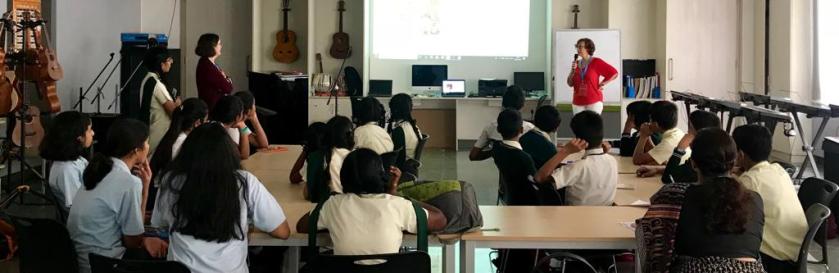
My session used the wordless books “Chalk” and “The Typewriter” by Bill Thomson to introduce the basic elements of a story – build up to a problem and a solution. First I told them they’d been tricked and I wasn’t going to read a story to them, but they were going to read to me (groans all around) and then they proceeded to do so, with “Chalk” lured by the images! We then spoke a little about the problem and solution and I said I had another book where something similar was going on and they could read it to me as well. I then projected “The Typewriter” (as I didn’t have a hardcopy) and we went through the same procedure, adding more prediction in this time.  Then they went off to tables we’d set up with plain black goodie bags and cut out gold moons and stars to make their own “magic chalk” bag. They came back to the carpet and were told they were going to make their own story without words with magic chalk. We brainstormed some ideas of what kind of problems could happen and what their solutions would be. Such wonderful ideas, ranging from torrential rainstorms and flooding, to a meteorite crashing into earth, sharks attacking a mermaid, ghosts coming into the a house and scaring people etc.! We also chatted about how you would (in the case of the ghost story) show that time had passed and the ghost left and they came up with having a moon in some of the pictures with the ghost and a sun when the ghost fled. What was great was that some then said they wanted to do it in “teams”.  Off they then went, armed with A1 black paper, folded into 6 panels and unfolded to de-mark scenes and lots of coloured chalk.  As they were drawing I wandered the class with their teachers talking to them about the stories as they unfolded.  90 minutes without a break was barely enough to have everything finished and they proudly left with their magic bags and story creations.

The rest of the day flew by, popping in and out of classes and storytelling sessions, followed by the teacher workshop on classroom libraries.  I’d somehow misheard that it was for 15/16 teachers… actually it was for 50-60 teachers – their whole staff!  Maya and I had already (luckily, as that’s our philosophy) decided to take the tack that the existence or not of a classroom library was merely one part of creating a culture and eco-system of reading in a school. The session was lively and interactive.  That’s  one of the things I grew to really appreciate about what is going on a Neev academy – the vision of creating an alternative to traditional teaching and learning in their school, using the frameworks of the IB system and the encouragement of pleasure reading.  As a non-international school they shine out as a beacon for local students.

Saturday’s sessions were opened to the wider community and public with a rousing speech by visionary Neev Academy founder Kavita Gupta Sabharwal. 

Maya had the honour of being on a panel with Dr. Shyam Bhat and Sudha Murty and all three spoke of the importance of reading and storytelling, emotionally, from a neuro-science and educational point of view.  My panel on “trends vs. traditions” co-hosted with Jane DeSouza with Ankit Chadha;  Timeri Murari; Sohini Mitra and Reena Puri looked at the threats and potential of globalisation and the digital era on traditional storytelling, publishing and writing.

Then in-between another book buying spree at Lightroom Bookstore (who had a pop-up store at the festival). What a fabulous bookseller – I really really love independent bookstores with knowledgeable founders and staff who delight in the books as much as I do. Ones where you just have to start describing the book whose name you’ve forgotten and it’s suddenly in your hands! I had chance to meet up with the lovely librarians at both Neev Academy and Stonehill International School and we did what librarians do best – geek out on what our favourite resources were, what our websites included, how we resource our respective curricula and darn, there just wasn’t enough time so we have to continue our conversations online and through librarian facebook groups.

I then caught the tail end of  a lively discussion “Should we fear the Dark?” that explored dark themes in children’s literature – luckily I shared a taxi with Paro Anand afterwards so we could continue the conversation together afterwards. I love fearless authors!

Maya and I shared the closing session of the day, focusing on how to hook children on reading and keep them reading with some great audience participation, and before we knew it, it was all over!

A great weekend, incredibly well organised and curated, buzzing with ideas and thought stimulation, discovering new books and authors. My biggest regret was the inability to clone myself so that I could join all the sessions simultaneously. Well done to Neev Academy and Kavita.

(PS Here is a selection of the book loot – invited our Singapore librarian network librarians around to have a look last week!


Can we be smarter with communicating benefits of reading?

During the vacation I’ve been catching up with some podcasts, including listening to a few new ones that were recommended to me by friends. While there are some great educational podcasts out there, sometimes while one is looking outside of the field that you are struck by things that are relevant.

So it was with this podcast from “You are not so Smart” based on research on how to deal with climate deniers with Per Espen Stocknes.

Because sometimes (most the time) when looking at reluctant readers I’m pretty sure I’m missing the boat on how to communicate effectively and meaningfully with them. Like the time I asked a group why they thought I kept trying to get them to read more and they basically said “because it’s your job Ms!”

So the thing is, there are 5 different ways that you can mess up your communication, which result in the “backfire effect” whereby people negate your message and turn all defensive on you. So you’d be better off saying nothing, than saying something that gets folks’ psychological back’s up.  While the talk related this to climate change I’ll re-interpret them along the lines of getting kids and their families (and even gasp, teachers) to read more, read together, read-aloud.

  • Doom and Gloom
  • Distance
  • Dissonance
  • Denial
  • iDentity

In the doom and gloom scenario you’re telling kids that if they don’t read they’re going to fail, drop out, go to prison, not get a good job, not get into college etc. if they don’t read. Psychologically this leads to a guilt and fear mind frame in the audience, increased passivity and avoidance. When what we really want is for parents and students to jump into action with a plan of daily reading! Another problem with those messages – it’s all too abstract and too distant. It’s the issue that that the problematic future is well, in the future, and right now they’d rather be playing an online game, or kicking a soccer ball. The locus of control is also presumed to be outside their scope of influence, there is reduced urgency and personal agency leading to a feeling of helplessness.

Cognitive dissonance is a very tricky thing when dealing with parents. Every parent, no matter what they may be struggling with privately or publicly with their children have to be believed to be doing the best they can with the knowledge and tools at their disposal. Ditto teachers (I include teachers as there are many teachers who do not read, and do not find reading pleasurable, and struggle with “walking the talk”). When people tell you that you should be reading to your child or reading more, or reading differently that kind of flies in the face of your image of yourself as a good and successful parent and person. And so what one often hears is “I/my husband / his grandpa/ never was much of a reader, and they turned out OK”  or even “we have plenty of books at home” or “he/she borrows books every week“. All of which may be perfectly true, even if those books may never be opened and read … and it’s the “right” answer to shut up a concerned teacher / librarian.

Denial is another mechanism frequently employed – one comes out with some latest research or study that reading is the answer to life, the universe and everything, and all sorts of things get thrown back at you – like “I read that if you read online it’s not effective” or “all they want to read is graphic novels” or some kind of moral licensing – “but he/she is very involved with the school play / the band / Kumon worksheets and doesn’t have the time for reading” and “he/she is doing just fine in class” or even worse “but X is struggling much more“.

The final point has to do with identity.  Everyone, from young students up need to protect their self-esteem and keep their identity intact. For some of my students it’s very important to be cool. And being cool doesn’t involve struggling or appearing to struggle at anything. For many families caught up in the fairyland of expatriate existence, a veneer of “everything is fine” is also very important. Problems with reading – fluency, comprehension, language, and admitting to those problems does not gel with that identity.  At this point a lot of blame gets thrown around. The teacher who didn’t teach properly. The librarian who put them off borrowing after they lost a book. The teacher who won’t let them borrow batman books or insists on “just right” books.  It’s a tough one and part of what we attempted to do with “Blokes with Books” is to make reading cool and social.

Right, so what to do about this.  There were 5 solutions offered by Stocknes and I’ll relate these to what I’m trying to do, and plan to do in the new school year.

  • Social
  • Signals
  • Simple
  • Supportive
  • Storytelling

Keeping things social is something I absolutely subscribe to. As I’ve said so often before, contrary to belief, reading is not a solitary activity. It is social. The kind of things that my students enjoy are book clubs, sitting and reading the same book at the same time and turning the pages at the same time. Reading in a group of three of four and raucously pointing at things and exclaiming.

Feedback and signals need to be those that people can relate to and are relevant.The antidote to distant gloom and doom is making things near and personal, since good behaviour can be contagious – particularly if it’s acknowledged and there is some positive comparison going on. Now this works brilliantly with electricity consumption in the examples given, but I’m a little wary of competitive reading. Cue in all the research done by Krashen et.al and the dangers of extrinsic versus intrinsic rewards and the virtues of free voluntary reading. I’d be the last to deny that (some) kids appear to be motivated by reading points, scores, levels etc. But I’m still not prepared to make that the focus of my efforts. I’ve been thinking long and hard about what kind of comparisons are relevant and meaningful.  One that I’ve used on my students has been to work out the median number of books students in their class and grade read each month and ask them to compare themselves.  The best thing we’ve done for our reluctant (male) readers has been the “blokes with books” club, which has helped both with identity and social belonging.

Schools and homes are incredibly busy environments. It’s imperative to keep things simple and easy, with low barriers.  Some things I’ve already put in place, like allowing students to borrow books on four occasions daily (before and after school at recess and at lunch) on any day of the week, in addition to their normal weekly library lesson with their class. There kind of are limits on the number of books they can borrow based on their age, but they all know that’s negotiable. Likewise parents can now join and supposedly borrow three books at a time, but we have some parents who borrow more and one who gets around 10-20 every Friday, as she’s a working parent and doesn’t get to the library every day. I don’t mind, as long as they keep returning.  Classroom libraries are also a great way of ensuring books are in the hands of students.  That still needs more work.  All our classes have class-libraries, but they’re not functioning optimally. This is a loaded area. The library is “my” domain (but not really) and the class “theirs”, so I can implement best practice with abandon in the former and have to tread carefully in the latter.  What would I like to see / do differently?  More movement more regularly in the class libraries – now books are checked out for the year. Self-checkout / check-in in the classrooms – my fault in prior years and I really need to get that going this year. More weeding of old, tattered and yucky books – it’s starting to happen.  Nicer display – need to think about that as it’s definitely crossing the line. Maybe a workshop on class libraries?

Providing a supportive framework – takes time. Time for you to get to know the students, the teachers the parents. Sticking to the message of the importance of reading without the judgement. Being there and listening when one of the parts of the reading ecosystem need to unburden or get a book list or suggestions without jumping to conclusions or formulaic solutions. I’m incredibly fortunate to have a supportive administration and principal and (so far) an adequate budget, and library assistants who are buying into creating an environment conducive to encouraging reading.

Finally incorporating the storytelling format in communication. Stories need to be personal and individual and incorporate an element of dream actualisation.  I’ve been doing a bit of this around the PYP and Singapore environment (most recently at the AFCC), the stories of the gains my formerly reluctant readers have made compared to their peers really is motivating.  Success stories are wonderful.  But struggle stories are also relevant, and the fact that I have a reluctant reader at home keeps things real and personal. I have no pedestal to preach from as I’ve been exposed to every excuse, every battle, and tried every possible solution myself and I’m still only partially successful in my efforts.

As the new school year starts I hope all your reading dreams for your students come true!

Junior fiction – what’s hot and what’s not

It’s a public holiday today, so instead of doing what I should be doing (making questions for the Readers’ Cup), I’ve been ordering replacement FollettBound books – for the ones that have fallen apart and are now out of print.  Easier said than done. There’s a reason (some) books go out of print. And junior fiction is a very special and dare I say, very fickle, niche in children’s books.

I started looking through our lists of what’s circulating and what’s not and it was rather fascinating how tastes, and perhaps even reading ability is changing over the years. Our Junior section caters for the Grade 1 to 3 crowds (6-8 year olds). Or to be more accurate, those who have gone past the early readers and are not quite ready for more substantial chapter books yet.

[Have I ever moaned about Follett Destiny before? If not, just a little aside about how difficult it is to get the kind of reports you’d like to have easily. So for this exercise I ran a “Shelf List” by call number, grouping call numbers together, and requested circulations for the last 2 years and publication date (price is the other alternative – economically useless because for my purposes cost is sunk cost, the only relevant piece of information here would be publication date and acquisition date – since newer books have had less time to circulate… are there any real current or former librarians actually working at Follett one has to wonder?). ]

Looking mainly at series – because this is so the age of reading series, what’s happening amongst my elite little bunch of international kids in Singapore?

What’s Hot 

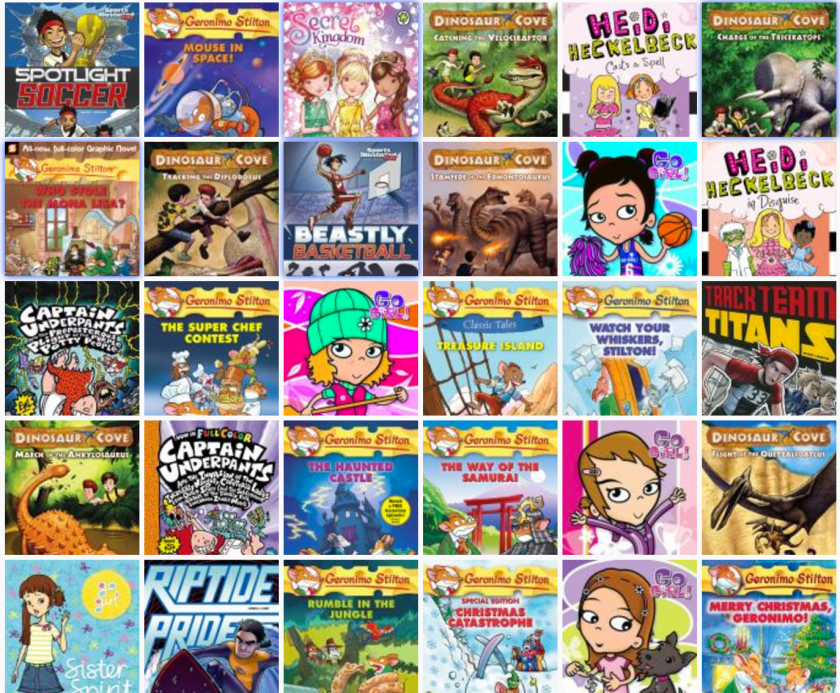
Screen Shot 2017-05-10 at 15.03.32

  • Geronimo and Thea Stilton (may I admit I’m not rushing to replace these as they die a natural death through over-circulation?)
  • Billie B Brown
  • Star Wars
  • Heidi Hecklebeck
  • Go Girl
  • Captain Underpants
  • Jake Maddox
  • Sports Illustrated Kids / Jake Maddox
  • Dinosaur Cove (and oldie, still hanging in there)
  • Minecraft adventures / Zombies (I don’t think they’re actually reading these as the level is too high for them – need to replace them with something easier)
  • Secret Kingdom
  • Danger Dan (yay for local authors visiting who make a difference)
  • Jill Tomlinson (yay for teachers who champion good authors)
  • Red Dot Books (anything on the current and prior year’s list)

What’s gaining Traction

  • Scholastic Branches series – especially Princess Pink & Owl Diaries
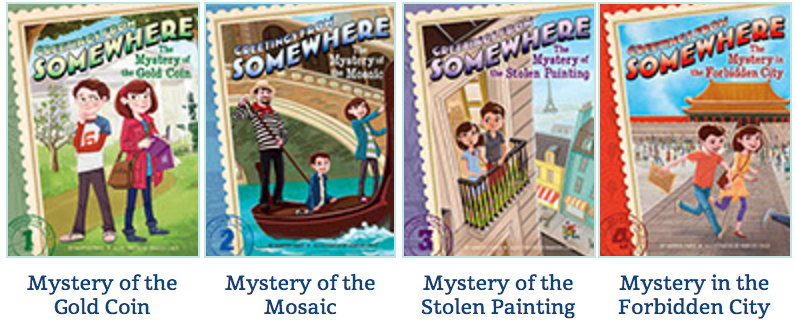
  • Greetings from Somewhere
  • Galaxy Zack
  • Dragonbreath
  • Kingdom of Wrenly
  • Dory Fantasmagory

What’s Surviving

These titles are circulating regularly but not spectacularly – but not badly enough to be culled. And some may have merit imho so I probably need to push some of them more

Screen Shot 2017-05-10 at 14.50.50

  • Zac Power
  • EJ12
  • My Weird School
  • Judy Moody
  • Magic Treehouse
  • A-Z mysteries
  • Clementine (I personally love this, so need to push it as a read-aloud)
  • Roald Dahl (the older books do better than the early books)
  • Ready Freddy
  • Cam Jansen
  • Horrid Henry – but not Horrible Harry (both I think are awful)
  • Rainbow Magic (although some titles are not going so may be time to cull a box of these)

What’s Not

  • Marvin Redpost
  • Nancy Drew Notebooks
  • Tashi
  • Bailey School Kids
  • Box Car Children
  • Owen Foote

Find out more about what our students like by visiting our “top 10” lists of Fiction, Junior Fiction, Picture Books and Graphic Novels.