Teaching academic honesty is always a tricky one. Last year, my involvement was limited to showing a tool (Noodletools) to large groups of students, howling in protest that they preferred the predatory alternative EasyBib, too late in the year and being a second opinion on whether submitted work was honest or not.
This year, I’m more of a “known factor” and when I offered to start the year with a more general discussion on honesty rather than just getting into the nitty gritty of citation, a fellow teacher offered to lend a hand in a Day 9 session.
In order to get more than three nerds to sign up, I billeted it as “How to lie and cheat your way to academic success” and an unprecedented 30 students signed up for the session – the maximum allowed. During the planning we set out to find out a little more about the motivations of students and to ensure we engaged MYP ATLs, and I wanted to make sure we covered the ISTE student standards of Digital Citizen and the UDL (Universal Design for Learning) standard of “Multiple means of Engagement”.
ATLs (Approaches to Learning)
Thinking skills
Critical Thinking
Creative Thinking
Research Skills
Information Literacy
ISTE Student:
2. Digital Citizen Students recognize the rights, responsibilities and opportunities of living, learning and working in an interconnected digital world, and they act and model in ways that are safe, legal and ethical. Students:
b. engage in positive, safe, legal and ethical behavior when using technology, including social interactions online or when using networked devices. c. demonstrate an understanding of and respect for the rights and obligations of using and sharing intellectual property.
My co-teacher Jo had some valuable day-to-day insights from the classroom of where students had a lack of understanding or were mis-understanding the topic which helped guide our planning and thinking about the session.
We started with a quick survey using Mentimeter to get an understanding where any potential plagiarism could arise. The questions were adapted from the “Symptoms of Plagiarism” by Dianne MacKenzie, further discussed here. We explained that all answers were anonymous and it wasn’t any reflection on them but rather feedback to us as teachers. We zoomed in on discussing “must do well” to better understand whether the pressure was internal (self) or external (parental) or a mixture and found it was pretty evenly spread. As teachers and creators of assignments the 25% who said they “didn’t understand the assignment” gave further pause for thought on how we set and word assessments and assessment rubrics, and also credence to our new MYP coordinator’s emphasis on ensuring teachers and students are familiar with the MYP command terms (Libguide by Stephen Taylor).
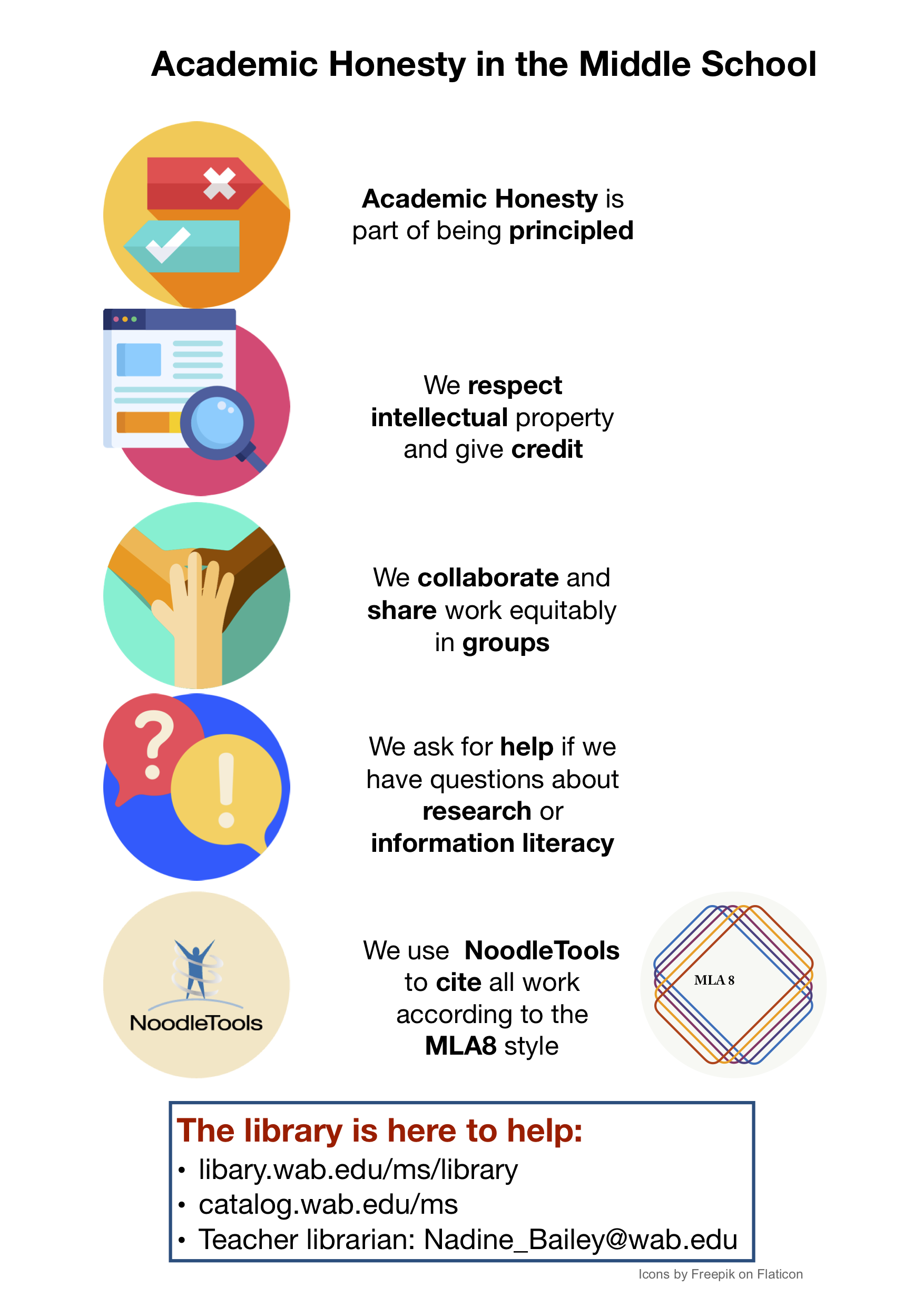
After this, we showed them their homework diaries, where at the back we’d included a graphic of our Middle School Academic Honesty Policy, and an adapted summary of Turnitin’s spectrum of plagiarism. Yet another example of not assuming “if you put it there they will notice” since none of them had noticed what was at the back of their homework agenda! Following the Turnitin spectrum we discussed the various types with real life examples. They didn’t have any idea there were so many variations, and in particular were interested in the fact that reusing your own work was not ethical if you
didn’t cite yourself. As was making up data for lab reports or “client requests” for design.
Then they played a matching game of plagiarised text to type of plagiarism. And successfully matched all types.
In four groups they were given a moral compass and allocated 10-12 “Got Ethics” cards to discuss and place on the compass based on group consensus. And when they were finished they could rank the cards in the “wrong” sector by increasing level of “wrongness” Interestingly here, one of the groups of girls were critical of the cards themselves saying the clothing of the girls images (exposed stomachs) was sexist and not gender neutral!
The final 15 minutes were spent on a Kahoot where we wrapped up all the elements of the session with a quiz where we explained that some of the questions had no right answer or a few options, and we’d pause every now and again to discuss things like what the difference was between copying a story and writing fan-fiction and fractured fairytales.
We felt it was 70 minutes well spent with engaged and interested students throughout and will probably run the session again.
I meant to write this post a little while back, but then school started, and whoosh there went all my potential blogging time.
On one of the FB groups I follow someone was asking about teaching academic integrity / honesty. Naturally the librarians in the group responded with “ask your librarian”. To which the poster responded “I took it on. Go me!”
There are so many things wrong with this response it’s hard to know where to begin. And yet it is pretty common. Even in IBO programs. Maybe especially in IBO programs? You see a lot of IB educators (PYP, MYP, IBDP) are really smart people. Often they’re subject specialists. They’ve had additional post-graduate training specific to the IB, and often also have post-graduate degrees.
So what can be so hard for a person like that to teach information literacy / academic honesty etc? Why on earth should they involve their teacher-librarian (assuming that one still survives in their organisation and hasn’t been replaced by a (unqualified) parent volunteer or the principal’s wife?
In the first instance it’s not quite as easy and clear cut as people presume it is. Heck there are people like Mike Caulfield make it their life’s work to seriously consider information literacy and over the years boil it down to its most useful essence – perhaps in response to the “go me!” attitude of educators.
I’ve walked into classrooms where teachers have been talking old-fashioned nonsense that was relevant in the time they studied and had to go back to micro-fiches or dig through unfederated databases. Classrooms where teachers are mixing up APA in-text citations with MLA7 works cited lists in an environment where MLA8 is the norm. Classrooms where teachers have unattributed images or texts in use…
But worse than all of that, they have a black and white view of plagiarism. One that is unsubtle and non-nuanced. One that makes students “good or evil” and neglects the approach that academic honesty is a community effort. That it’s too late to make it a quick add on to a lesson. I’ve written on this in the past – plagiarism is not a simple matter, but mired in assumptions, teaching, culture and ignorance. And that’s the exact reason why it should be addressed centrally with common language, common understanding and be phased in over years with teachers and the rest of the community as role models.
So don’t “go you” – unless you’re going to your teacher librarian (TL). And if you haven’t bothered to talk to, or collaborated with your TL, do yourself, and your students a favour and do so. Yes you’re smart and all that. But the TL is a specialist in this stuff (remember the two masters degrees they need?). And if they’re not used, you’ll be left with a bunch of apps and ignorance. And the problem will not go away with some nifty templates from teachers-pay-teachers or your mates on FaceBook.
A long while ago (3 years) I wrote a post about the fact that we needed to look beyond “search and cite” in teaching information literacy and look at the threshold concepts of research, and a presentation I’d given on the theme. I remember at the time seeing half the audience (of librarians) eyes glazing over and thinking, “oh no, this isn’t going to work if it’s not something librarians get and relate to – and how on earth would students buy in?” I still believe that understanding threshold concepts in any discipline and for us librarians in research / information literacy is crucial in diagnosing misunderstandings and structuring our teaching. But then yesterday I had another insight on how this could be approached in a far better way.
In my current position I’m considered to be part of the school wide coaching team, and as a group it was suggested we read “Student-Centered Coaching” by Diane Sweeney. I’ve been enjoying the fact that it’s a pretty practical book and one where you start to think that by taking the focus off the coach or even the teacher, you can actually take a lot of the emotion out of the coaching / teaching equation.
The book emphasises the use of data, but not necessarily the data provided by testing, but rather from the usual formative and summative assessment that is going on anyway. One example used DRA testing – the equivalent of which occurs all over regularly anyway, and another a rubric from a writing program using a writing prompt. The idea is to select pieces of writing and score them on writing conventions and then group students into bands of “exceeding, experienced, competent, developing, emerging or below emerging” conventions. One then tries to move those groups / cluster using differentiated instruction up the scale.
I immediately thought of a lost opportunity last term, I’d had to teach citation to groups of students prior to their final assessment of a unit. It had been hectic both on my side and the teacher / classes and I’d been beating myself up a bit about it. Then my son (a different grade) came home and showed me an I&S assessment task (ungraded) he’d done and asked me what I thought of it. That’s a tough call. Because, there was a lot going on there and not all of it was pretty.
And then I realised it was the perfect way to do a “backwards by design” session on searching and citing.
What if the “works cited list” and in-text citations of an assessment task of a whole class or grade were to be critically looked at? It is a few lines that reveal so much of what’s going on in research. And then based on that one could group students according to where they were and what needed to be worked on and then individualise that part of the rubric in order to see if there was progress in understanding (and if they were approaching the thresholds!).
A quick reminder of the IL threshold concepts – research is/has:
Authority – Is constructed and contextual
Format – the creation, production and dissemination of research is not equivalent to its delivery or how it is experienced
Information goods – research has a cost and a value
Information structure (searching as strategic exploration) – an ability to look “under the hood” of databases and search engines (including more and more as we use things like Google scholar – the algorithms that spit out the results)
Research process – as iterative, difficult and building on the those who came before
Scholarly discourse – citation is a point of access into this discourse
(Research as inquiry – ongoing nature of research this is used by some but not all researchers)
Some of the things I noticed when looking at my son’s paper were –
Evidence (just two examples as an example): Not understanding that “Et al.” means “and others” – encountered in the in-text citation and works cited. The in-text citation followed the format (author, date) while the works cited was MLA8. Kind of.
Indication of not understanding:
authorship = authority. But behind that was an understanding of the research process that included groups of people working on a topic
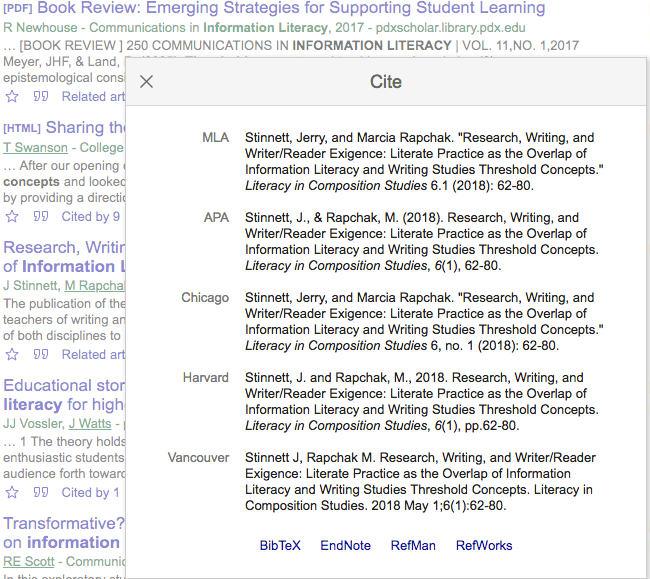
Format – since he’d used google scholar as a delivery point for the search. And from there had got to the database article without realising that it was an article in a database. And didn’t understand the format or information structure. This is something, if MLA8 is correctly taught and deployed, including its emphasis of a Russian Doll like structure of containers, should become obvious. There is another – more simple aspect of format – that of the format of citing and where that can be found. I showed him the ” marks in google scholar and how that led to the citation that could be copied into NoodleTools as is… a revelation
for him. I also showed him in the original journal article of two other sources how he could find the citations and just copy and paste them – let’s consider small steps here!
Indication of understanding:
Scholarly discourse – here is where my own prejudice to APA versus MLA8 for the humanities come in – the date is probably a better indication of the point of scholarly discourse and understanding that something more recent would encompass prior research
“One mentioned domain knowledge as a barrier: “You have to have some type of familiarity with the topic to ‘enter the conversation.’” (Scott, 2017, p. 295)
To reign this back, we’re talking about middle and high school. So wading straight into threshold concepts may be going in too deep for the average student. But it may be a useful diagnostic tool.
Getting back to the coaching bit – doing an autopsy on in-text citations and the works cited list would reveal where the gaps and issues both in searching and citing were. The humanities teacher is probably looking at the assessment using a different lens – that of understanding and using the information and the ability to write it up in an academically acceptable manner using some kind of scaffolding (e.g. point, evidence). And at the end of the assessment, once a grade has been given and the focus has moved onto the next unit / assessment, the gaps in the ATL “research” may not have been identified, recognised, nor addressed in the teaching or assessment rubric for the next unit.
I believe in rubrics as a way of shaping teaching and focusing attention in student effort. If in a year, the teacher in conjunction with the librarian, moves through perhaps four iterative cycles of research, I’m sure we’d see real progress in both the practical ability and metacognition of students as they approach research and the threshold concepts.
=================
Here are some articles that explore further information literacy as a threshold concept in an interesting way:
Further reading:
Corrall, S. (2017). Crossing the threshold: reflective practice in information literacy development. Journal of Information Literacy, 11(1), 23. https://doi.org/10.11645/11.1.2241
Hofer, A. R., Townsend, L., & Brunetti, K. (2012). Troublesome concepts and information literacy: Investigating threshold concepts for IL instruction. Portal: Libraries & The Academy, 12(4), 387-405.
Hofer, A., Brunetti, K., Townsend, L., & Portland State University. (2013). A threshold concepts approach to the standards revision. Comminfolit, 7(2), 108. https://doi.org/10.15760/comminfolit.2013.7.2.141
Scott, R. (2017). Transformative? Integrative? Troublesome? Undergraduate student reflections on information literacy threshold concepts. Communications in Information Literacy, 11(2), 283–301. https://doi.org/10.15760/comminfolit.2017.11.2.3
Stinnett, J., & Rapchak, M. (2018). Research, writing, and writer/reader exigence: Literate practice as the overlap of information literacy and writing studies threshold concepts. Literacy in Composition Studies, 6(1), 62–80. Retrieved from http://licsjournal.org/OJS/index.php/LiCS/article/viewFile/180/239
Townsend, L., Hofer, A. R., Lin Hanick, S., & Brunetti, K. (2016). Identifying threshold concepts for information literacy: A Delphi Study. Communications in Information Literacy, 10 (1), 23-49. https://doi.org/10.15760/comminfolit.2016.10.1.13
Last night my daughter asked me about citations for her Geography project. Now let it be made clear, my children, while lovely human beings, are in the “potted plant” phase of adolescence. So this was pretty rare. It’s also rare for them to acknowledge my knowledge or specialisation either. But despite her multi-big-$$ education in a big name school (not where I’m at), and the fact that she’s highly motivated and organised, good research habits have not been instilled in her. Her references consisted of a couple of URLs and the in-text citations were random with “I KNOW mum sigh” when I raised my eyebrows. I asked what referencing style she had to use – “we can chose”. So I suggested APA – because I love it more than MLA8 and because Geography as a humanities subject is probably better suited to it long term.
I then had to teach her a few of the research habits that have served me well through two back-to-back masters degrees. This stuff is not brain science. If anything it’s like washing dishes and putting them in the cupboard. We re-activated her Evernote account that she’d opened for one enthusiastic teacher some time in the last 6 years. We then clipped all the articles into a Geography file in Evernote and tagged them with the project name. Next up was getting her citations into Zotero, the tool I prefer for upper secondary.
(After the whole debacle about RefMe / EasyBib etc. I’m committed to one tool, not following the latest trend, which inevitably seems to be about who is trying to monetise education and learning. For primary and Middle School, it’s Noodletools)
There are many things I like about Zotero. The fact that it’s amazingly accurate in its citations and the really really good customer support being the main ones, but also the intelligence and diligence of the user-base can’t be denied. I was pleased to see that in their latest update – getting set up and integrated into Word has been made a whole lot easier. Yes, good old fashioned Word. GoogleDocs have their place but when one moves from being a child, you need to be more sophisticated and demanding in your needs and GoogleDocs doesn’t cut it.
So then I had her put the references in, via the Chrome extension (download the extension), make sure she had the right citation type, put in the missing data. Showed her OWL Purdue for APA, bookmark it, showed her the APA style blog site which has more relevant Q&A type things – like how to cite Google Maps).
And then the magic could happen – click on the end of the sentence, open Zotero in Word, put in the in text citation, click at the end of the document and have all the references upload. Two hours. But hopefully that will be a lifetime of research “washing up” as you go along rather than crisis at the end.
Then I asked her what the style guide was for her assessment. Again, nothing. Really teachers, please just get in the habit of telling them what you want things to look like. Line spacing, headings, margins, citation style etc. It really will set them up for University where this type of thing is so important. Stupidly important maybe, but professors can and do deduct plenty of marks for not getting it right.
This no excuses post has been a long time coming. One of the things that most librarians have in common is that they are long-suffering, friendly, helpful, accommodating types, ready to share knowledge, know-how and eager to grasp on any acknowledgement they receive from academic leadership and fellow teachers. While the grumbles and moans are prolific within our little echo chambers, few of us have the time or energy to actually be vocal. We’re generally just grateful we have jobs, in a market where libraries and librarians are sacrificed a the altars of economies and “it’s on the internet”. So many just put up and shut up. And are careful of the swords we’re prepared to fall on.
In the mean time, there are people and companies in this academic / learning / research space who are making a lot of money and who do get heard / listened to. If you read only one article about this, I’d recommend the Guardian Long Read : “Is the staggeringly profitable business of scientific publishing bad for science?” I’d love to ask if the profitable business of school databases is bad for research and learning.
So the saga began at the end of the last academic year. I was teaching academic honesty to my Grade 4’s and they were just about at the point of grudgingly agreeing that it was a good idea (in IB PYP speak) to have “integrity, respect and appreciation” for other’s work and be “principled” in acknowledging where the images they were using in their research were coming from.
In order to limit their going too wildly astray on the world wild web, the teachers and I agreed that we’d limit the images they used to two sites – the paid Britannica Image Quest (available to schools as part of the school version of Britannica bundle for a mere US$6,000 per year depending on your size), and the unpaid “photosforclass” where the attribution is included in the photo watermark and they make an effort to ensure the photos are school appropriate and are under creative commons license.
So far so good until we got to the point of looking at the citations created by – no not the free tool but the really expensive one!
As we looked up the various things students were researching to my utter dismay I realised that each and every one had as creation date 25 May 2016.
One of the things that I try to keep in the back of my mind when teaching information literacy is where we are going in terms of threshold concepts. We want to ensure that students are not going through the rote / skill part of academic honesty without really understanding the bigger information literacy picture.
Screenshot Jean Batten – Brooklands and citation, Britannica Image Quest, 10 September 2017.
So I wrote to our “local” Britannica representative questioning the date on the image. Surely it couldn’t have been May 2016? And who was the photographer? Surely they deserved a mention?
The correct structure for MLA8 (the system our school is using) is:
Creator’s last name, first name. “Title of the image.” Title of the journal or container that the image was found on, First name Last name of any other contributors responsible for the image, Version of the image (if applicable), Any numbers associated with the image (such as a volume and issue number, if applicable), Publisher, Publication date, Location. Title of the database or second container, URL or DOI number.
So the response I got back from Britannica was:
Many thanks for your email expressing your concern over our citation. I am guessing you are referring to the MLA format. We follow the required format for online publishing which does not require that particular information.
Example below.
HIV viruses (red). Photography. Britannica ImageQuest, Encyclopædia Britannica, 25 May 2016.
quest.eb.com/search/132_1274904/1/132_1274904/cite. Accessed 16 May 2017.
MLA citation requires a publication date which is considered a core element of the citation. That, of course, would be the date of the last image publish of that collection, May 25, 2016. Because the data from the images comes from more than 60 collections, it is very inconsistent or we don’t have it at all. Britannica tries never to provide information that we cannot guarantee to be correct. We suppress this from the site for that reason.
I hope this assists your understanding of our difficulty here. Please come back to me if I can be of more assistance.
At which point I cried foul. And took my concern to a couple of librarian networks. Where it was roundly ignored. Or where it wasn’t ignored it was met with a powerless sigh. And I wrote back to them as said no, I was not satisfied with that. Are you serious? They get photos from 60+ databases and can’t be bothered to spend a few dollars on mapping the available data properly to their database? Only 60? That means you pay 60 something people, one to look at each of those databases and work out their tagging and map it to your tagging. And then you pay somebodies to manually sort out the ones that don’t map nicely or you default to the cop-out citation for those. In the world of cheap accessible outsourced IT, that should be a no brainer. The entry about the privately owned Britannica on Wikipedia is illuminating.
In the world of fake news and fake photos and fake evidence and fake research and fake everything we need to be vigilant. When original primary research documents and images get scanned into databases we lose a trail if the creators and dates are no longer considered important enough to add. We are not talking about born-digital images here.
So I persisted and got this response:
Well you have certainly stirred thing up, in a good way I think. J
I’d like to share with you some of what has occurred since your concern was raised, in the hope it will be interesting and helpful in the future.
Our Editorial Team was consulted and they will be handling citations going forward. They did a full review of the MLA format and consulted with the MLA Handbook 8th Edition.
As I mentioned in a previous email, the reason we leave off the photographer is because the data we get from the partner is not in a format that would allow us to list it correctly on a consistent bases. The MLA Handbook states, “When a work is published without an author’s name. . .skip the author element and begin the entry with the work’s title” (p. 24). Since we cannot accurately list it, we are leaving it off. The editorial team are going to explore this a bit more and see if there is a way we can improve this, but for now we will leave it off. This will not be an easy thing to fix.
We are listing the publish date of the images (in addition to accessed date). According to the MLA Handbook, the publish date is appropriate. Because we didn’t always store the publish date in the database, when we revised for MLA 8 we had to fill in something so all images would have a date. We used the date of the most recent publish. From the point of making this change and going forward we now list the actual publish date of image. Since this did result in most, but not all, of the images having the same date we are going to go back and try to update the publish dates with the date the collection was first published on our site. This will hopefully make it easier to teach students what this date is for since the majority will not be the same. However just to reiterate, as new images are published they are now listing their actual publish date.
Over the next month or so, the Editorial Team will also complete a review of the other citation formats in ImageQuest and we will make changes as time allows. We will also create a citation page where we provide additional information to clarify our citation policy.
Nadine, I do hope it is clear that Britannica always endeavours to provide the most accurate information possible and that we do react, where we can, to try and improve on a valued customers suggestion.
and in fact, if you look at the bottom of every citation you’ll now see the following:
“The citations provided are computer-generated. Because of differences in the data available from each collection, citations may not match style rules or include all components specified by a style manual (e.g., photographer or artist information). We have made every effort to enable students to identify the page on which an image can be found, even for citation styles that do not require a URL.”
Why does this still bother me six months later? Let’s return to what we really want students to know about Information Literacy. What will carry them beyond their latest assignment, their Personal Project, their Extended essay. What will take them through life as sceptical consumers of information. Let’s go back to understanding the threshold concepts of information literacy.
We should rely on information that has authority. So we check the credentials, experience and expertise of those giving the information. There is an image of a young woman and a claim she broke an aviation speed record in 1934. Who took that photo? Where was it taken? When was it taken? Was she leaving or arriving? If the photo was taken on another day or time was it just posed? Was that the triumphant photographic proof of her exploit?
Information has a format. And it’s format is related to its creation, production and dissemination, NOT how it is delivered or experienced. Usually this is considered when comparing journal articles in a journal in a database to the journal format of the past as in volumes of books. The fact that the format is now online, doesn’t impact on the fact that it’s a a peer reviewed journal article. A similar argument can be made for a historical photo. The fact that it’s now delivered digitally shouldn’t ignore the fact that it was once a photo taken with a camera at a point in time by a real photographer.
Information is a good (as in goods and services). As such there is a value and a cost to information, and we should be aware of that. At the moment the balance of financial cost and reward seems to be very one sided. Databases buy up collections of information, bundle it, and sell it on at a premium and add as little value to the images as they can get away with. Usually just giving information on the seller rather than the creator of the images. The information structure – information is structured and accessed / searched in a certain way and that differs depending on the format and container.
The research process builds on existing knowledge. But if we ignore the existing knowledge and process whereby we get to the current point we’re negating this aspect. This also builds into the idea of scholarly discourse – that we’re entering an academic conversation at a certain moment.
So at this point I’d still be saying – no excuses. The fact that something is hard should never be an excuse not to do it properly. Yes they are right – they are complying with the MLA8 structure. But they are not helping with the spirit of scholarship and information literacy.
I’ve just spent the last 4 days at the #LKSW2017 where 80 librarians around the SE Asian region got together to learn and share (mainly teacher) librarian practise. I also hosted a Chinese lady from a school in China and gave a daily ride to another Canadian librarian working at a school in China. We had some great conversations.
The first workshop I attended was led by Brad Tyrell. He of the magnificent Libguides at Scotch College that induce envy in every other libguide – even if you know that there is a slew of very techie people behind the gloss. During the workshop he kept emphasizing that everything that they’ve done is on a creative commons basis, and in fact shared all the documentation and templates used to make the guides. He also explained that their staff’s job descriptions include an imperative to share what they’ve done – so everytime they’ve created a new library guide, they not only share it with staff and students internally, but they also have to post it on the listserv / social media of their local library association.
This is something I’m very comfortable with, and in fact have had many discussions with my lecturers at CSU about plagiarism and the sharing of academic output amongst students, where my (slightly controversial) view was that every academic assignment I’ve made is, and should be public, and that if students abuse it, or lecturers can’t be bothered to change the assignment, the system should take care of it… discussions documented here. My libguides are also open, and I encourage people to take what they need from them and to adapt them to their own situation – and in turn, I get inspiration and links and resources from the other community guides. What do we all want? A little acknowledgement and for it to be on a “I share so you don’t just take, but also share”.
Then there is the in-between state, I’d call it the TpT state (teachers pay teachers), where you’ve made something that’s taken so much work, it’s done in your spare time and has cost you time and effort and is of a quality that you feel you can sell it. Personally I don’t do this, I’m more on the open source side of things, but I have bought items from other teachers where I like what they’ve done and don’t think I could do a better job. For a rationale for this model, please read this.
And then the opposite extreme. Chatting to my two compatriots working in China, I was surprised to hear that neither their catalogues, nor their library guides were open. I was asking about sourcing Chinese books for our program in particular, and specifically nonfiction books for our UOIs. While they were helpful, and the actual answer is due to the predominance of text-books their is a less developed nonfiction publishing market at the primary level, none of their catalogs or resource lists were open. So unlike many other schools where I could take a look into their lists to find some good resources, this wouldn’t be possible. They explained that the Chinese private school market is very very competitive and this is all considered to be proprietary and competitive information.
Which of course leads to the question – are you being stupid or reducing your own competitiveness by sharing? I’d like to think not and that everyone is better off as a result of this and opening things up allows them to be improved upon. Provided of course that the person doing the adaptation and improving is similarly civic minded and pays the sharing forward – which isn’t always the case.
Ok, I know I have a somewhat ambivalent stance on what constitutes plagiarism and the value of collaborative and cooperative learning but one thing I’m clear on is academic honesty. If you used something that someone else made just say that you did that. And depending on your age and level a simple copy and paste of the link is sufficient.I recently went around our G5’s exhibition project and was thoroughly impressed at their work. I did sneakily ask a few for their sources and most could point to at least a page of attribution as to where they’d got their numbers and facts. Well done (here is a great video of it by the way).
G5 Exhibition Video 2015 from UWC South East Asia on Vimeo.
Fast forward to early this morning. I’m putting the washing in the machine and the kids are getting ready for school and finally my daughter lets me see the video she’s been working on for the last 4 days – one holidays and festivals in the middle ages. It’s a great video with her narrating the festivals of the year with lovely pictures and music from the middle ages in the background. And then at the end “Thank you for watching” and black screen.
I told her I thought it was great, but that she didn’t have to thank anyone at the end, and instead a list of attribution for the images and music would be good. “Our teacher said we didn’t have to do it” was her reply. I told her that she knew that I expected it of her, and she then showed me that she had in fact made a list of the URLs but hadn’t put it into EasyBib to get into MLA format. I asked why not, and she came with some story about how citations / attribution hadn’t been in the original assignment nor in the rubric and the teacher didn’t want to add it on afterwards. I was a little annoyed at this. I said she could at least put it at the end of her video, but she didn’t think that would be “fair” on the others who didn’t. Fair? How about the fairness of the people to whom the images belonged? OK they’re all long dead now, and perhaps most of the images are in common domain, but still, it’s the principal.
I was annoyed at myself being annoyed at her, when actually I should be annoyed at the school. How can they go from being citation semi-stars in primary school to not having it expected at middle school. This is not the first instance, it is one of many, many, many in both my children’s grades across all subjects – academic honesty really does need to be institutionalised and inside every single assignment across the board! I’m at least glad my ranting has had an effect on my kids and they’re at now keeping lists to show me – but if it’s only for me for how long will my influence last?
This morning plagiarism crossed my screen for the third time in a week, which means the topic is demanding to be written about!
The first time was during an academic discussion last week. A group of us were being asked our opinion about the proliferation of study groups on FaceBook and other social media platforms and their role not only in mutual support during study, but the potential for plagiarism and other forms of academic dishonesty.
I have a somewhat contrarian view on the thin lines between collaboration and theft. Perhaps I am naive, perhaps I’ve not felt the very real repercussions of having had my work plagiarised. Perhaps I’m reading too much utopian digital future type articles and books.
Through my blog I share a lot of what I’m thinking and doing and researching. I also have posted most of my academic submissions of the last 2 years online where they can be freely read. Of course much of what I’m writing about are things I’m particularly interested and passionate about, and I’ve abridged or edited things so as not to post too many details of my school or colleagues that would not be relevant or appropriate for public consumption. To me, the most useful parts of anyone else’s academic submission would be the layout / structure of the essay / paper / report and the bibliography. I’ll happily share my bibliography with anyone and everyone.
And now it starts to get tricky. On the one hand, the whole point of academic publishing and journal articles is to make your work publicly (albeit behind a paywall) available and for your work to be part of an ongoing quest to knowledge or the resolution of societal or scientific problems. On the other hand, in the grey area of being on the path to accreditation and while doing so jumping through academic hoops while writing essays and papers and having them marked and moderated by the system, you’re supposed to keep all that knowledge and learning private or secret, just between yourself and your lecturer? Can you see the problem? The double standard? The irony? So part of my argument, is that if a lecturer can’t be bothered to sufficiently change the topic of the assessments and the way in which the course is evaluated, then if another student were to use the work of a former student the lecturer is kind of to blame. Although I would hope that the student would at least credit the work of the first student. Which because the whole system is rotten they are obviously incapable of doing, because then the whole thing becomes uncomfortably transparent. Ditto the lecturers who are obtuse or unhelpful.
The second time was this article in the Telegraph which appeared 2 days ago. A couple of interesting points are highlighted (I must say, #1700 for a dissertation is very cheap – if I think what each of my courses cost individually, that wouldn’t even pay for one course / semester, so whoever is writing that stuff is either undervaluing themselves, or the whole academic thing is such a farce as to be worthless). I think the topic is a whole lot bigger than many (particularly academics) think. It is not as simple as “plagiarism is an act of fraud. It involves both stealing someone else’s work and lying about it afterward” (plagiarism.org). As the article points out – plagiarism happens more often in mass courses where there is little contact between the tutor and the student. It also happens when there are language difficulties experienced by students and the stakes are high. And, we are obviously (sic) trying to root out “copying and collusion” – at least while our youth is studying. Once they get into the world of work it’s called collaboration and teamwork. I’m wondering about this Prof. Braisby who is so keen to educate his students on the evils of plagiarism. Is any time being spent in dialogue between the students, tutors, professors, administrators and powers that be in institutions to look more closely at the subject. Or are we all very quick to make the subject black and white?
Finally this morning, LibraryGrits, weighed in on the topic with a very nice little graphic which was the most nuanced look at the subject – the symptoms of plagiarism.
Although, I’d be pedantic and say that plagiarism was symptomatic of the other causes which she named as symptoms.
Having a closer look at her list, I would say that different items need to be addressed in different ways. I’m wondering if newer versions could reflect this by the grouping / colouring?
In my personal value system “don’t care about ethics” would be a serious problem.
Anything to do with the policing and lack of consequences is an institutional / teacher problem.
The rest, including laziness (please read “the myth of laziness” before jumping to laziness conclusions) need to systematically be addressed and scaffolded and worked on in combination with the teacher, school and probably parents. And here is where my tendency to put my work out there in the open comes into play – by putting examples out, we address the issues of “ignorance of formatting / protocols” and “exposure to modelling of best practise”.
Issues of language barriers, search and retrieval skills, organisation and time management skills need to sorted out while the student is at school, isn’t that part of creating “life long learners” as opposed to “life long plagiarisers, thieves and frauds”? I think the pressure to achieve high grades absolutely cannot be divorced from this whole discussion. Anyone else been following the Palo Alto suicides and all the press around it?
We are living in very interesting times in terms of knowledge dissemination, acquisition and creation and the formal institutions of school, university and college are struggling to keep up as bastions of certification, accreditation and credibility. The dear Professor in the Telegraph article alluded to this, but I don’t think he really “got it”.
And language. Yes language. So many of our students at every level are studying in a language that is not their own. Their tongues and their minds are slashed and offered to the gods of English and sacrificed to the hopes of a better life in that illusionary magical tongue. I can only imagine based on what I know from living in tongues other than English in various times of my life how much is lost and distorted in translation.
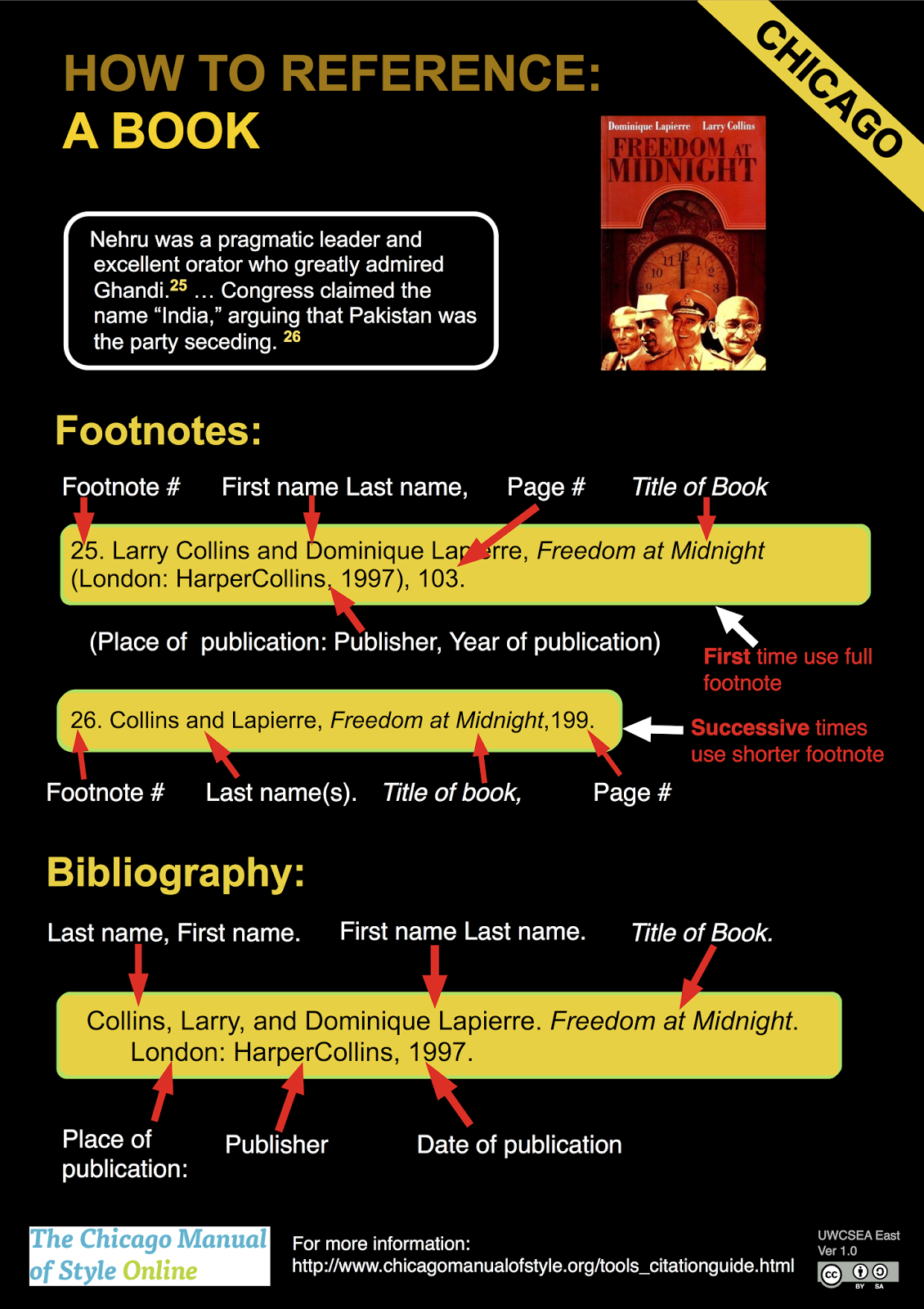
At times one has to get right back to basics and the last few weeks I’ve been huddled over my computer becoming more familiar with “Pages” than any non-design person would ever want to become. All for the sake of trying to make simple basic posters outlining the most common example of the referencing styles we employ here at school.
We use MLA up to IB level, and then subject heads can decide what citation style is most appropriate for their discipline, choosing between MLA, APA and Chicago. We decided to use the most commonly cited resources of our students, Journal Article, Website, Book, Video, Image and Newspaper Article.
The 80:20 rule definitely came into play here. After I thought I was 80%+ finished, Katie started looking through it and then spent further hours and hours refining things. We asked for opinions and checking and refined things further. Of course by simplifying one leaves out all the infinite varieties and complexities, but we also home that it illustrates the basic principles and we can then help out with the refinements as required.
Here is a link to the Google+ sites where they’ve been posted for:




 In my current position I’m considered to be part of the school wide coaching team, and as a group it was suggested we read “
 information structure


 Informative Flights - Musings of a Teacher Librarian