Who do we publish for?

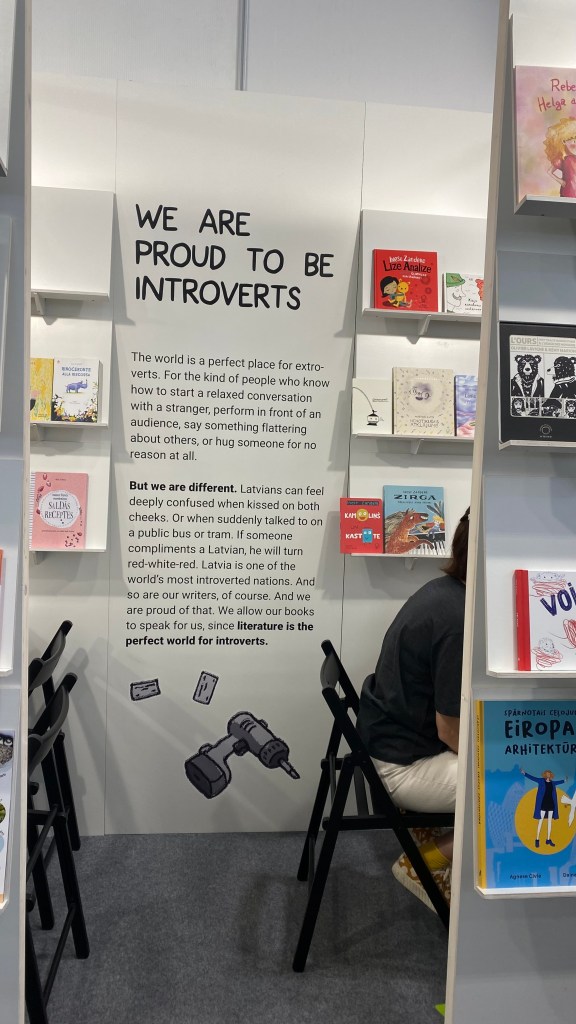
One of my book related highlights this year was being able to attend the Bologna Children’s Book Fair in April 2024. It’s been on my radar for years and the fact it took place during our school vacation and I could join a bunch of fellow librarians who were similarly disposed made it less of a “thing” to attend. For I am not fond of very large crowds in overwhelmingly big exhibition spaces (thank heavens for the Latvians who are proud to be introverts and celebrated that in their stand!) . Below are a few of my thoughts on the event.

The place of librarians

I’m not sure how to say this politely, but, like any other system, the publishing world for children is its very own special little ecosystem – this being the European version – I guess a kind of sub-species of the dominant USA version, where of course all the neighbours and relatives were free to join. Don’t get me wrong, I’m happy where-ever books and reading are celebrated, but I was quite fiercely put in my place during one of the sessions “PISA IN BOLOGNA. HOW TO FIGHT LOW READING SKILLS”. After the session – not during (I would not have dared) I asked the moderator Daan Beeke, Network Manager EURead, Stichting Lezen, how it could be that libraries and librarians were not mentioned once during the whole panel session and I was rebuked for thinking that this event was for anyone but publishers and marketers for the sales of books. Bam. And there I was thinking that us librarians were at the forefront of encouraging reading and fighting low reading skills. Or maybe could it be that there is a correlation between low reading skills and lack of support and funding for public and school libraries? Just maybe?

The place of the environment

I was extremely happy to see that “the environment” was featured prominently both in the exhibition spaces and on the event programme.

There was a glorious exhibit of “Reading for a healthy planet” with the 70+ books from around the world available to browse (link takes you to a list).


The events: “READING FOR A HEALTHY PLANET: INSPIRING CHILDREN’S BOOKS TO HELP ACHIEVE A SUSTAINABLE FUTURE” organised by the United Nations, and “UTILIZING STORYTELLING IN PRODUCT, MEDIA, PUBLISHING AND CONTENT TO CATALYSE SOCIAL AND ENVIRONMENTAL CHANGE” moderated by Helena Mansell-Stopher of Products of Change, and “SEA OF STORIES”

For 2024 the Special Category for the “BolognaRagazzi Award” was THE SEA. WINNER:
Gianumberto Accinelli, Giulia Zaffaroni, Giù nel blu – Dalla superficie agli abissi: viaggio sottomarino sfogliabile. Nomos Edizioni, Italy, 2021 SPECIAL MENTIONS
Antoine Guilloppé, Pleine Mer. Gautier-Languereau, France, 2018
Masakatsu Shimoda, 死んだかいぞく (The Dead Pirate). Poplar Publishing, Japan, 2020

One thing that super saddened me was that the whole event didn’t have the environment at the forefront as plastic bottles abounded and I didn’t notice any water fountains or water filling facilities – we brought our own bottles and of course the tap water from the bathrooms is 100% fine, but it would have been wonderful to see the events – in particular the ones on sustainability featuring reusable rather than plastic bottles.

The place of indigenous literature & language

I’m not sure that everyone is aware, but we’re in the International Decade of Indigenous Languages (2022-2032).

The fair had two events around this topic: “ORIGINS: INDIGENOUS VOICES IN CHILDREN’S BOOKS” Moderator Dolores Prades, Founder, Director and editor, Istituto Emília, Brazil
Panel
Nat Cardozo, author and illustrator, Uruguay; Adolfo Córdova, author, Mexico; Jason Low, publisher and Co-owner, Lee & Low Books, USA; Aviaq Johnston, Inuk author, Canada; Victor D.O. Santos, linguist and children’s books author, Brazil/USA; David Unger, author and translator, Guatemala/USA; Eboni Waitere, Director, Huia Publishers, New Zealand.

The representative of The Indigenous Literacy Foundation (ILF) of Australia who won the prestigious Astrid Lindgren Memorial Award (ALMA) and is the 2024 ALMA Laureate, is a late inclusion on the panel and her discussion at 45.06 of the video below about the work they do, is worth listening to.

and “THE MOST PRECIOUS THING: VICTOR D.O. SANTOS IN CONVERSATION WITH VERA GHENO” – I wish the English publishers had retained “the most precious thing” as a title instead of “what makes us human” – just a personal quibble.

The place of dissent

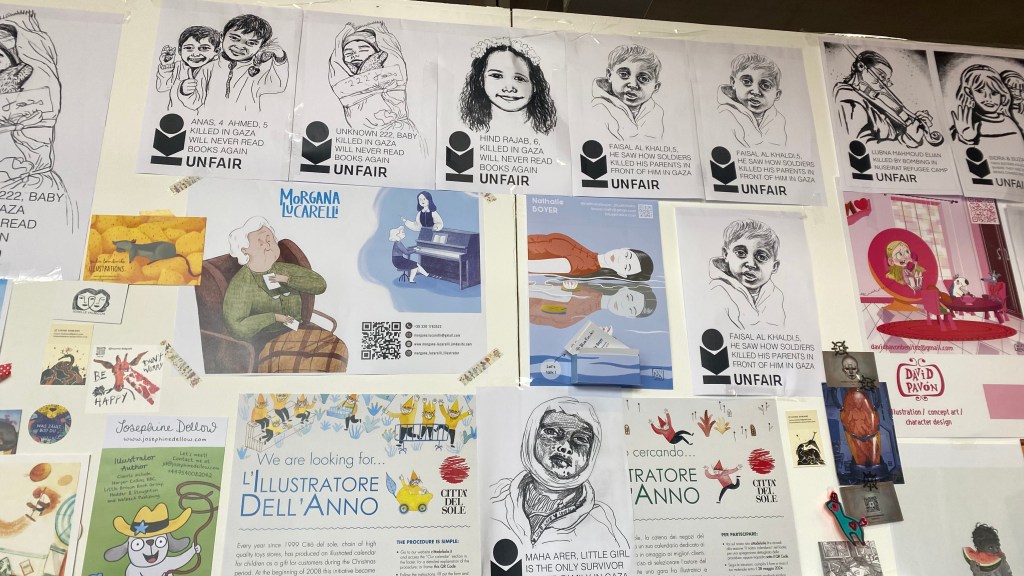
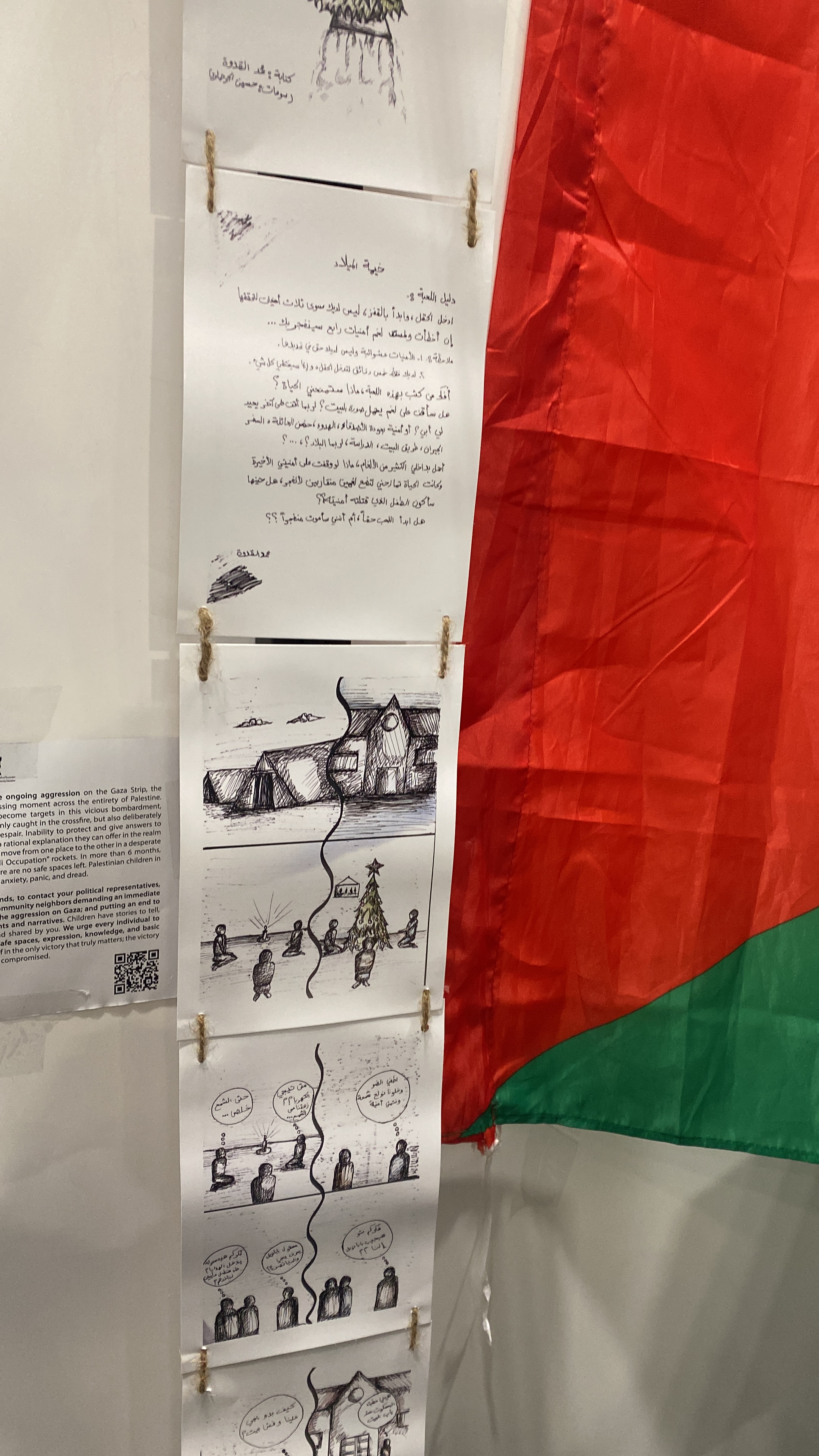
Following the issues around the 2023 LiBeraturpreis which was to be awarded to Adania Shibli, at the Frankfurt book fair last year, I was interested to see how and if dissent and awareness of geo-political issues would be handled in Bologna. There appeared to be a guerilla type of image bombing in the illustrator walls, some of which seemed to appear and disappear. Both Isreal and Palestine had representation.

It saddens me that while children are expected to live and die through wars, they have very little representation and “place” in children’s literature – yet – and what there is still focuses very heavily on the second world war experiences.

I find this type of header in the NYTimes to be quite disturbing “Teaching Young Children About War Without Frightening Them – Four new picture books tackle the subject in sensitive, reassuring ways.” I literally have no words about how insensitive that heading is.

I’ll write a whole separate blog on this some time – in the meantime please have a look at the lists created by Dr. Myra Bacsal on her Gathering Books Blog.

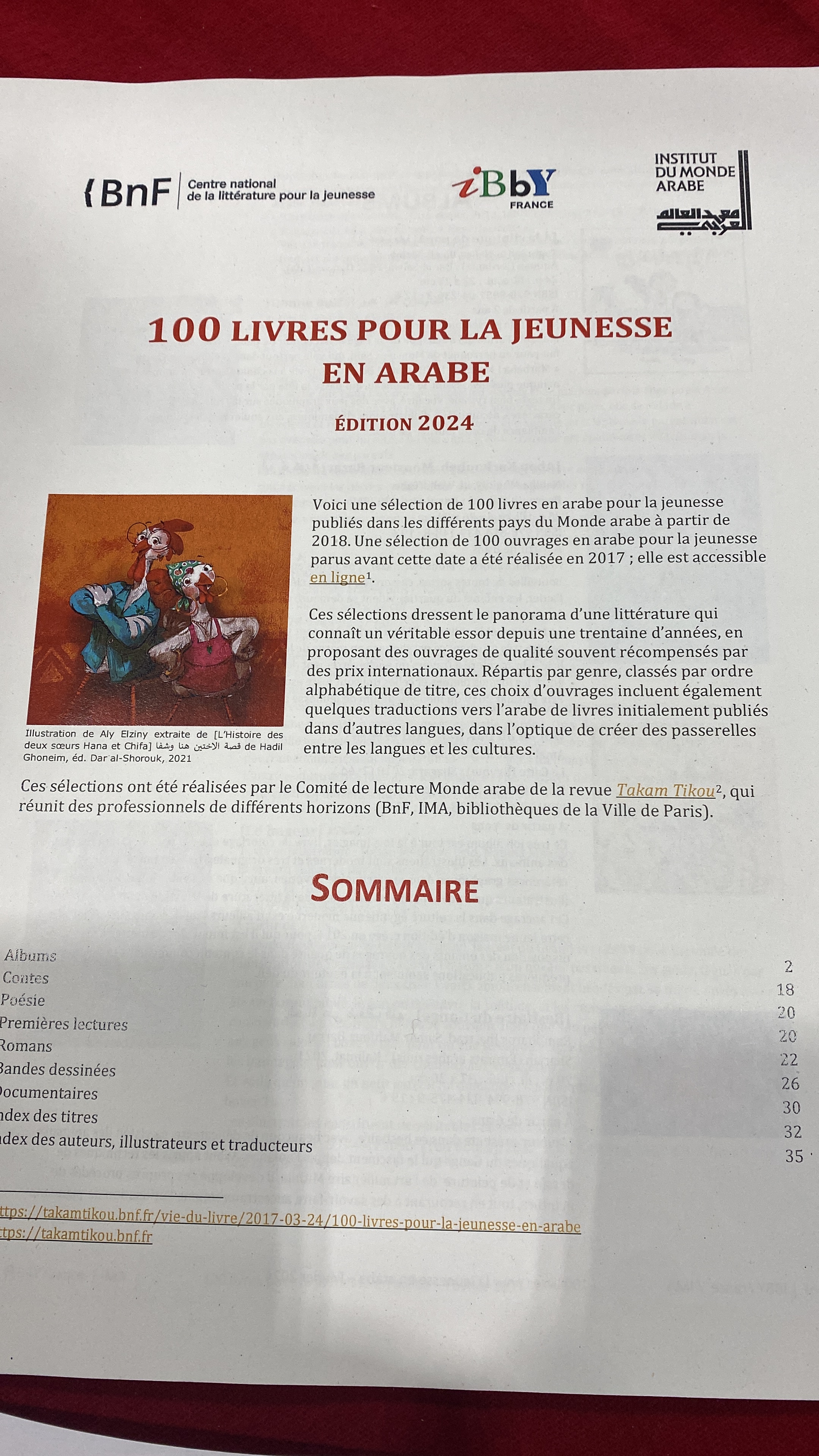
Given my own geo-location at the moment, I was interested to see that IBBY France has created a list of 100 books for young people in Arabic – here’s the link for the English version.

The place for silence

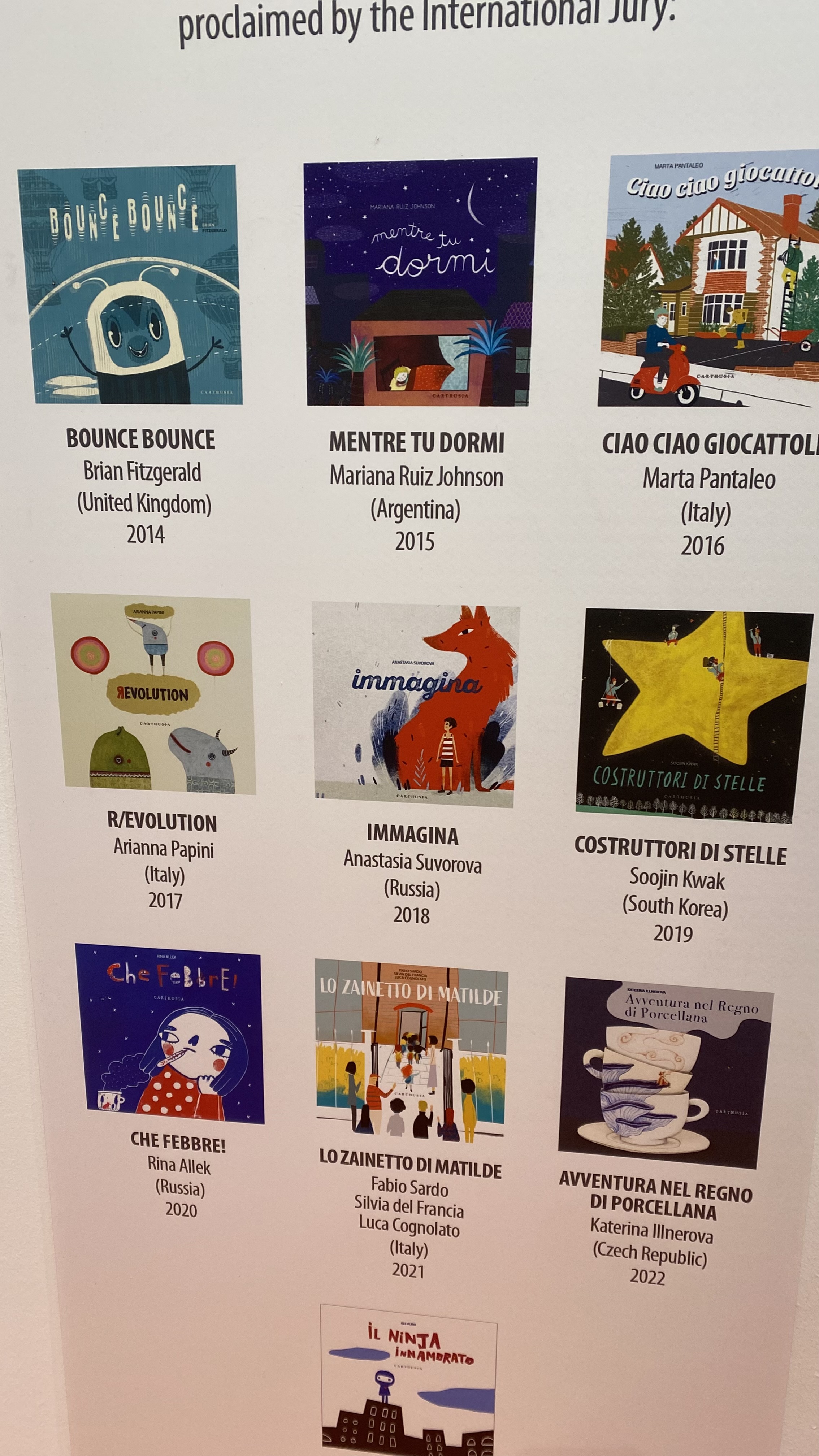
There is a special place in my heart and every library I’ve had the pleasure of working in for “wordless” or “silent” books, and the fair didn’t disappoint in that regard. Of course the highlight is the Silent Book Contest – Gianni De Conno Award and the exhibitions of the artwork around the award, as well as the previous years award winners. These are just the best books to have in your library for accessibility, thought provoking conversations and writing prompts.

Educational advice – from Facebook?

I subscribe to way too many Facebook groups. I need to stop it actually, they’ve become like women’s magazines. But worse. You keep seeing the same things come up over and over again, but instead of ignoring them you can actually have a say, which is giving yourself the delusion of helpfulness, but actually the smartest person in the room of Facebook groups is not the room itself, to misquote David Weinberger.

Some of the smartest people I know don’t do Facebook and when they do, they’re lurkers not participators. So I guess that’s making me stupid. I just can’t help myself because the fact that someone may actually genuinely want an accurate answer AND follow up is illusionary enough to put up with the ignorance of echo-chambers and the chance that you may learn something.

No where is worse than education groups, and within those groups nothing is worse than questions and answers about bilingualism and language. Except perhaps dinner parties between parents of children of roughly the same age that are excruciating examples of passive aggressive one-upmanship.  Right now the sum of my parenting advice can be summed up as:

  • It’s hard to kill a baby (i.e. CTFD)
  • Regularity, sleep and reading (and don’t be too poor)
  • Avoid dinner parties with other parents unless their children are at least 10 years older than yours
  • Pick two languages and give them all you’ve got

It’s the last point I’d like to write about today. On one of the groups the following was posted:

2yr old (born NOV 2015) who is trilingual (if you can even say this about a 2yr old). German mum, French dad, English spoken with nanny and language between parents. I’m looking for kindergarten options from around next summer … have no idea where to start.
No preference towards public/private or towards any language even though I’m wondering if adding mandarin might be a bit confusing given that there are already the other 3. What do you think? Focus is more on play/social activities rather than academics

This is a pretty typical question and the answers were also pretty typical – a combination of shouting out school names that have either French or German, alternating with saying that children can easily learn any amount of languages (the number 12 was even suggested), compared with humblebrags about how “fluent” their 5 year old was in any number of languages.

I must admit to entering the fray and suggesting that they chose the language of the school based on their future plans if known – i.e. go back to a French / German speaking environment or continue in the international sphere, and based on who would be at home to support the homework and reading. And to choose 2 languages and do them properly.  There are language experts who can help people on this. There are books and research papers written on this.  And don’t ask parents of young children – they know not what they say. Don’t even talk to educators in primary schools.  speak to parents with teenagers, preferably at the point where they have to choose their IB language. Talk to teenagers, and talk to teachers of IB languages.

Being bilingual is NOT just speaking a language. It is reading and writing. Being literate. And that takes formal lesson time, time spent reading and writing AT grade level. There are so many barriers to that. I’m now talking general international schools, of course there are exceptions / bilingual schools. If you’re lucky you’ll get 40 minutes a day in the language at school.  Probably in that language as a SECOND language, i.e. language learning may just be a combination of groundhog day (learning the same things year after year) and/or teaching to the lowest common denominator.  So you’re going to have to supplement at home. Either by classes in the afternoon / weekends, online or with a tutor. Besides having to read to and with your child in that language. And dedicate at least part of your holidays to immersion in that language environment.  As one expert who recently visited our school said “language is not buy one, get one free”. My personal statement is always “you don’t learn a language by breathing the same air as others who speak it”. Bottom line is it takes planning, time and money.

As I write (Saturday afternoon) my husband is in my son’s room reading in Dutch with him. He’s 14. He has in-school after hours Dutch classes for 3 hours a week plus out-of-school additional tutoring for about 2 hours a week / fortnight depending on his needs. According to his Dutch teacher there are many students who cannot enter the program as the level of their “literate” Dutch is too low.  And many of the students in the program are doing Dutch at a much lower level than their chronological age.  We took action when he was 9 and started intensive work on his Dutch after he was failing at Chinese. It’s been expensive and time-consuming but he’s on track for a bilingual diploma plus he can communicate with his Dutch family and if necessary could student there in Dutch at university level.

My daughter thrived in the bilingual English-Chinese environment in Hong Kong, hated the only alternative of Chinese second language at her primary school, Had me nagging her to continue reading and writing chinese in her spare time with a tutor until middle school, got into the native stream for middle school / iGCSE where she’s the only caucasian / non-Chinese-heritage child left in a class of about 8 students only.  This is only because she’s an exceptionally diligent child and kept up her reading and writing. She bemoans the low expectations and standards at school. Most of the students in her class are only doing Chinese on the insistence of their parents. She may do first language IB and has been recommended for it, but has lost motivation.

All of my French friends who have had children come up the system internationally have, to their regret, children doing French second language.

If you’re interested in reading more on this topic, I’ve read, thought and written reams about it. 


Scheduling – priorities and dissonance

New year, new chances, old problems. The perennial one of scheduling library time. I kind of started commenting on people’s posts and questions on FaceBook and then decided it merited a blog post on its own. There is also a whole discussion on libraries and librarians going at the IBO level where priorities, recognition, roles, responsibilities etc. are also being hashed out. But coming from a corporate background and not an educational one, I sometimes can’t help seeing things a bit differently.

One of the most useful courses I followed during my librarian studies was “Designing spaces for learning”. And spaces weren’t just physical spaces, or even physical and online spaces, it includes temporal space – as I wrote about here  and design thinking. The thing is that time is the great leveller. We all have 24 hours of it a day, but what we choose to do with it is telling, because it will determine who we are as librarians and display our priorities more strongly than just about anything else we do.  I could even put money on the fact that if you walked into a school where there was a troubling relationship between the librarian and staff / admin and you asked to see the library timetable it could be used as both a diagnostic tool and a cure.

So I’ll begin this post by giving a shout-out to my principal who gives me the autonomy necessary to both think all this out and then to discuss it with her and implement it. She also gives me the support I need when things are not working optimally, if I’m reasonable in my requests and it supports student learning.  My PYP coordinators who are allowing me to be their educational partners also makes things a lot easier. And the school I’m at that generously allows for 3 support staff members in the library in their HR budget to open up time for me to be doing higher order teacher-librarian things rather than processing and circulating books. Now apologies for a barrage of management-type speak and jargon, please bear with me.

In library scheduling there are two main schools of thought, primarily defined as fixed scheduling (you set up a schedule each year / term, and every class gets their time to go to the library at that designated time) and flexible scheduling (the librarian’s time is bookable, on demand). Each have their benefits and drawbacks – with fixed you get to see everyone regularly, but in a large school you have no time left, or go on a two / three week schedule. With flexible you run the risk of never ever seeing some kids depending on the teacher’s ideas of the library, priorities etc. Most larger schools where the ratio of librarian to students is low (e.g. 1 librarian to 1500 students) opt for a flexible schedule. Our ratio is 1:630 with 34 classes so theoretically a fixed schedule can work, and I’ve tried to build some flex into it otherwise I’d never do the things that differentiate me from what a teacher or library assistant can do.

Priorities

The first part of the process is to decide what your priorities are. Now in education this is way harder than in corporate life, since often many of your priorities are set for you. It also took me a little while to get the experience and confidence to actually realise what my priorities should be and to advocate for them.  And also to decide what my priorities shouldn’t be and to draw a line in the sand.  Part of your priorities are governed by your school’s mission and value statement. Part is about your integrity to yourself as a professional (teacher) librarian and part is about the resources physical and financial your school has.

My personal priority statement is “I am about literacy“. So everything that has to do with any of the literacies (alphabetic, informational, numerical, multi-lingual and to a certain extent digital) I will prioritise.  I steer clear of discussions on makerspaces for that reason, partly because we have a dedicated STEAM department, and partly because if it has nothing to do with creating some form of reading, writing or research I consider it outside of my ambit. OK, shoot me, but you have to draw the line somewhere or you’ll have to compromise on something else, or just never stop working 24 hours a day.

The next thing is to think about how you are going to integrate yourself into teaching and learning in a collaborative way. There are two frequent laments heard in this regard “I don’t have time for meetings” and “I don’t get invited to meetings” – and here is where a supportive principal comes in. The very first thing that went into my timetable this year were the days and times for co-planning for each grade. It’s taken 2 years to get to this point and I only need / want to go to the meetings once a unit – usually a week or so before the unit starts so I’m involved in hearing where the team wants to go with the unit, what digital and physical resources they need and how I can meaningfully integrate information literacy or other ATL skills into the unit. I also only need to be there for about 10-20 minutes depending on whether it’s an old or new unit. So what about the other 4/5 weeks? Well I’m using the time to DO what the team needs. And if I’m teaching in that time, I can’t be doing. Doing includes making library guides (that’s how I have time for them), curating resources, ordering new resources, weeding old resources. Although I am not considered a HOD, my principal also kindly invites me to the weekly lead meetings so I know what is going on and coming up, and can involve the library in any way that is meaningful.

Then comes the fixed part, which fulfils my literacy priority. Since I do have a manageable ratio / number of students / classes, I have a fixed part of my schedule whereby each student gets to come to the library once a week. How has this been engineered? By chunking time and students. 40 lesson periods and 34 classes would mean no time for co-planning, co-teaching, own planning let alone the library facility management stuff. So, based on the advice of my predecessor and in the face of intense resistance from teachers, the timetable was split into 20 minute library times from G4 and under and kept at 40 minute sessions for G5 & 6. The compromise for lower level teachers is they can pair up with another teacher in the same grade had have 40 minutes with 2 classes. It’s not my preference, but they may choose this.  I do this because I want to see every single child every single week and make sure that I am helping them with free voluntary reading.  In Krashen’s (2004) words ” evidence from several areas continues to show that those who do more recreational reading show better development in reading, writing, grammar and vocabulary, These results hold for first and second language acquisition, and for children and adults. ”  I am an unabashed book pusher. I do everything I can to put books in the hands of children that they want to read. And to do that I need to see them and I need to know them. Especially the ones that will only come to the library that once a week.

Yes you can do a library lesson in 20 minutes, if you have staff who can do the check-in / check-out and shelving while you’re doing the reading, the mini-lesson and the reader-advisory, and if your teachers are in the library helping. Yes I do get that much support from my school and I’m very grateful for it.

Another small note on this section – switching costs nearly killed me in my first year. I was doing a G1 class then a G6 class then a G3 class then Kindergarten jumping around day in and day out. So I asked teachers to try and schedule in the library so that all the classes in a grade (or 2 grades, depending on number of classes) were on the same day. It worked last year and we kept it up this year – it was actually easier timetabling that way – constraints work. There were only 2 exceptions where the larger school timetable and teacher preps meant that I’m taking a class to help them out on a day different to the rest of the grade. That’s not bad going.

My next priority is multi-lingual literacy. Actually part of it comes in the fixed part. We are a bilingual English/Chinese school. I am the parent of two bilingual children. A child is NOT bilingual unless they are bi-literate. I will not compromise on that. I faced fierce opposition from parents complaining via teachers when I insisted that every child in the bilingual program had to take home a book in each of the languages irrespective of their ability to read in that language at that point*. I am very uncompromising on some things and this is one of them. At home, I have two bilingual teenagers, one in Chinese, one in Dutch who are still doing their languages as a first language only because I am uncompromising on the fact bilingual has to be bi-literate otherwise you are fooling yourself. And bi-literate means reading and writing. The classes that have “first dibs” on the library timetable are the bilingual teachers. One of my library assistants has to be fluent in Chinese and able to read aloud to my students and help me curate chinese resources.

So those are the bilingual classes. We also have ELL (English Language Learners) and students doing French as a second language. Their teachers also have (and take) the opportunity to bring their students into the library (or the library classroom where my world language resides) with their students every week. Language can just not be taught in isolation from books and reading.

The learning eco-system priority. Teaching and learning does not occur in a vacuum. Children are part of a family, a linguistic community, a social community, a cultural community. At the primary level, besides teachers,  parents are my best allies in my literacy goals for my students. So they get two periods once a week for library information sessions, for time to drop in for some reader advisory, for meetings the school needs to hold in my space for them.  I am a neutral zone. I am there to help them realise their goals for their family.

Then there is my co-teaching / information literacy teaching priority. I’m listing this last just because it’s last in the process, not because it’s last in priority. Doing all the above, specifically the 20 minute slots with the younger kids gives me 8 x 40 minute periods where I can make myself available for whatever lessons my teachers would like me to teach in the library or in the classroom. These are not used every week, but now that we’re integrated the research ATL into units they will be used far more.

My library facility priority, means I’ve blocked off 2 periods for inter-campus meetings, either by google-hangout or face2face with my fellow librarians and with my own staff.

These are my priorities and how I’ve structured my temporal space to accommodate them (see below). I’m in primary school – people in MS or HS may have other priorities and concerns. People in larger or smaller schools will have other issues. But the bottom line is your priorities need to be worked out (it’s taken me 2 years to get here and to articulate them), and reflected in your timetable. And you need to articulate them well so that if necessary you can argue your case with whoever is getting in the way of allowing you to reflect them in your timetable.  Things may and probably will change, but that’s it for now.
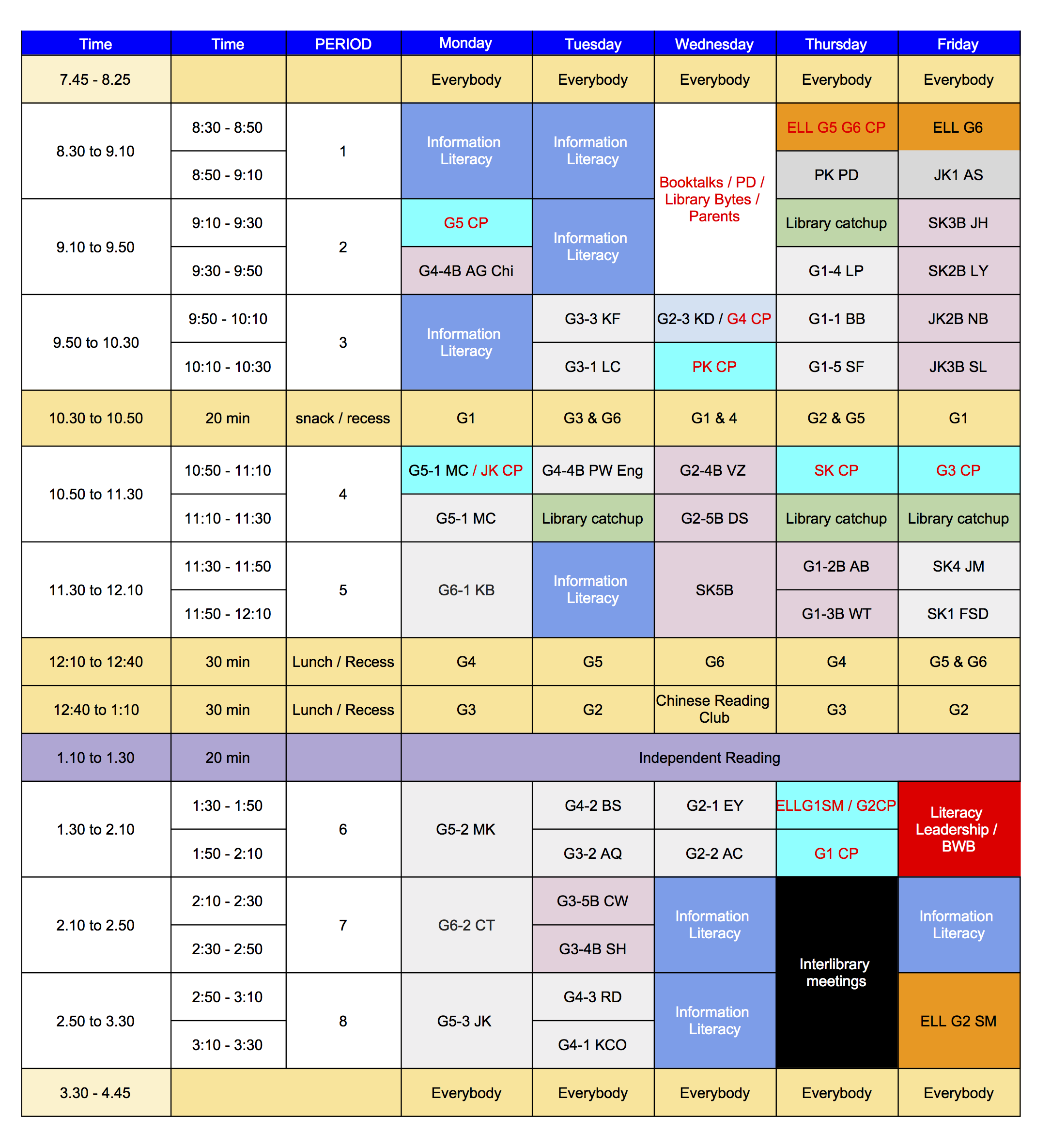
library timetable 2017:8

As a closing note – another part of the IBO library/librarian discussion was about the “super-librarian” archetype. I don’t want to be a super librarian. I want to be a great librarian. When Clark Kent is busy being superman, he neglects being Clark Kent. We cannot afford to be super-librarians because super librarians can and do burn out. And while everyone around this type of librarian says how super-librarianish they are, I don’t think they get the recognition they really deserve as librarians. And their successors have big shoes to fill, but not necessarily the right shoes to fill.


* Why do I insist on this? Often they can’t read the book, sometimes/ often their parents can’t read the book. Because they can’t read the book YET. Just like my kindergarten and pre-kindergarten children take home books they can’t read, so too my English / French / Dutch speaking kids take home Chinese books because the assumption has to be that they WILL be able to read those books. Otherwise get out of the bilingual program. Seriously. What do we do with mono-lingual kids who can’t read? We read to them. What if we can’t read? We sit and page through the books with them and we ask them to explain the pictures to us.  We ask them to point out the words they do recognise. We ask them to point out the letters they recognise.



L1 and the role of the school

I received an email last night from someone who had read my blog on Building a LOTE collection in an international school and she quite rightly pointed out that it’s a relatively easy thing for a librarian thing to do.  Here is her question:

I am a school librarian in an IB candidate school. We are trying to find strategies to promote mother tongues within the school. As far as the library is concerned, I can develop LOTE collections as you call them, but I was wondering would you know of strategies that would help teachers develop their foreign students’ mother tongues.
Thank you very much for your help.

Now fortunately for me (since I’m chest deep in pre-library renovation stuff I’d just run a PYP connect workshop on the very matter 2 weeks ago, and that question prompted me to put this out! So I’m going to embed the presentation here for everyone to see my (sometimes controversial) views.  And I’ll explain my philosophy and “ingredients” a little.

Ingredients for a successful L1 program in any school

  1. A champion. A committed champion
  2. A supportive and imaginative leadership
  3. Knowledge and information & the dissemination thereof
  4. A committed language group

1. Committed champion

I think the cartoon below will explain this. Although the metaphor I always use is that one cannot be a little bit pregnant. Asking a mono-lingual to be your language champion is probably not the way to go.

agile-safari-pig-and-chicken-part1

The champion does not have to be a teacher or in admin – at my last school I did it as a passionate parent working part time in the library. I’d like to think that, in conjunction with our mother-tongue coordinator we made a huge difference. But I ruffled a lot of (mono-lingual leadership) feathers and perhaps I could only do what I did do, because my job was not at stake. But that’s another story.   This point sounds very easy but it’s not easy being a language champion, even in an international school. I’d even dare to say especially in an international school. Because unfortunately most of them are run by an ‘elite’ corps of white anglo-saxon middle aged monolingual men who are exceptional in paying lip service to language and particularly bad in putting their money (or even support) where their mouths are. There are exceptions. But usually the person is not mono-lingual. The champion needs to be exceptionally knowledgeable, very thick-skinned, very imaginative, networked, and not willing to see problems but only possibilities.

2. A supportive and imaginative leadership

As said before, leadership is the elephant in the room of L1 support. Scratch the surface of almost any international school’s language policy (outside of non-British Europe, since they “get” language) and you will find immense resistance to the language factor unless it serves marketing and certification requirements. Similarly you will see that very seldom do former language teachers rise to power, and existing language teachers are often not power-mongers (research bears this out, but don’t have time to find the citation).

I keep telling leadership at my schools that the lack of a L1* program is a failure of imagination rather than a lack of resources.  I think every 50-something year old knows people who learnt English through bootlegged Beatles cassettes or French learners through chansons. I find it incredible that we think it is so hard now when it’s never been easier to access resources and people at our fingertips.

3. Knowledge and information and the dissemination thereof

We need to make sure our language champion is “powered up” with what works, and what doesn’t and what the potential issues and pitfalls are. We similarly need to educate our educators, from the top down and our parents. Way too little time is spent on this. Instead we send our leadership to leadership PD, our math teachers to math PD, our teachers to “making the PYP happen” countless times in 100s of variations and our language teachers to language PD.  And we never talk to our parents about language except when they’re struggling as ELL (English Language learner) students. As Virginia Rojas always says “Every teacher is a language teacher”.  I have railed countless times against our echo-chambers in education!

In my experience over the last 5 years, if you just bother telling and explaining the whole language thing to parents on time – i.e. when the students are still in primary you get a moment when suddenly you see the cogs in the minds of your audience ticking in over-drive. They totally get it. And the most important messages you need to give them are things that are glaringly obvious to any high-school language teacher but NOT on the radar of a parent concerned about bed-wetting or why Johnny didn’t get invited to Sven’s birthday party:

  • You need 2 languages for IB (I cannot tell you how many early primary or even late primary parents don’t know this.  Yup, it sounds ridiculous, but it’s true)
  • One of those languages COULD be your L1, either school-or self-taught
  • BUT Language takes time – 5-7 years for CALP (i.e the level you need for IB) and YOU (not the school) needs to make sure your child is functionally literate, by the end of primary (i.e. reading and writing at or near native level) because
  • THERE IS LITTLE OR NO TIME even with the best will in the world by the time they get to middle school to catch up. Plus, your influence over them and how they spend their time will diminish rapidly the older they get so you must make sure they have the necessary autonomy and mastery by then.

4.  A Committed language group

Ok, so after your meeting or session with parents it will quickly become apparent who cares. In my experience over the last few years, I can make a guess at who will generally step forward. Usually it’s the French, Japanese, Koreans and Chinese. Sometimes the Dutch and Scandinavians (depending how long they’ve been abroad). And we do a huge disservice to these communities by not making it easier for them to get to full native literacy by the end of primary.

We force them into one of the school languages, (in my children’s personal instance it was Spanish, Chinese or French). Then we teach it as a “fun” and “cultural” experience – something that frustrates both the teachers and the committed students. We teach it as an initio course nearly year after year – ground hog day. So we don’t get the mastery, our students don’t see any purpose. And worst of all, we don’t cater for the ‘natives’ in that language so they either give up and learn a 3rd or 4th language rather than endure the frustration and boredom of their L1.

But there are possibilities. There are schools with “one room school-houses” with different students learning different languages at the same time in small groups.

It can be expensive – personally our family has paid the equivalent of an extra term’s school fees in private tuition for one-on-one Dutch classes to get my son up to speed on his Dutch. It takes time, time that kids would otherwise be playing around, doing sport, watching TV, hanging out.  Commitment is hard. But it pays off. Speak to any IB student doing self-taught L1 and you will see their pride and accomplishment.

How to create commitment – I have just one question that usually decides that matter

What about your grandchildren?

When I ask that suddenly parents decide which side of the fence they’re on. Because that really is the bottom line. Kill your language with neglect and the chances are your grandchildren will have neither your language nor your identity. Some people are totally fine with that. They’re not committed and probably never will be. Don’t waste your time with them. Some care very very deeply and they will be the sparks that will ignite your L1 program. Use them, work with them, allow them to help you talk about and frame your L1 program.

Amazing things can happen from small beginnings.

* I prefer L1 to mother-tongue as my household speaks the father-tongue as well as the mother-tongue


Read around the World

With view to the fact that our school is celebrating uniting nations week in October, this year we’re trying to add a literary bent to the proceedings.

There are a number of steps to this, which are easy or complicated, depending on how “ready” your collection is.

A little while back, I created resource lists on Destiny, and a visual search button for “read around the world”. Since I didn’t have a lot of time I grouped them by continent, with a separate section for Singapore which is where we live.  It involved doing subject searches on our catalog for various countries on each continent and then grouping them together.  Actually this wasn’t that easy. A book like “Inside out and Back again” – takes place in USA, about a Vietnamese immigrant – where do you put it and its ilk (of which we have many). What if an american author is writing about Africa? Generally I tended to put the books according to where they took place rather than the origin of the author. But I’ve allowed my students to decide how they want to categorise it when they add a comment to their shelfie (more later).

Before the summer break, I also ordered all the books suitable for primary school on the USBBY list for 2016 so they were ready for the school year. Again I didn’t have anything specific in mind, except to diversify my collection.  As an aside – I must say I’m incredibly impressed with the selection in this list and I’m going to order from it again this year, and from the backlists of prior years. Books like “My Two Blankets” are just phenomenal and just so appropriate for a multi-lingual environment.

This term, I joined the UN committee and put my idea forward to do a “read around the world” as part of the activities so it would not just be a “costume, food and flags” affair. I also convinced the parade organisers that it may be a nice idea to parade by country grouped by continent (to tie in what was feasible in the library with my limited display space).
Next I created a library guide and a padlet so the students could put up their pictures (we’re an iPad school so that’s one of the easiest ways).
Then last week I started introducing the concept to my students in the library lesson.  I adjusted it according to the age. For some, I asked how were ways we could find out about people around the world. We got the usual, go there, live their, eat food, have a friend etc. Then I introduced travelling their through books (depending on the age I told them the library was a magic travel machine), then I read a book from South Africa, my home country (Niki Daly’s “Where’s Jamela”), and then we had a tour around the world past all the displays and they could pick up a “souvenir” book on the way of whatever they liked.
For other classes my colleague met them at the door and said she was a tour guide and would take them around the world and they could pick up books along the way.
We then showed the library guide and explained how to get a picture onto padlet, and that they could then put a sticker on the map.
Some classes were more enthusiastic than others – generally the younger students were not very interested in books from other places, they wanted a book from the country they came from – fair enough.
It was interesting to see where students put books when they made a comment – the aforementioned “inside out” was labeled “Vietnam” by a student, while “Amulet” got a Japanese label based on the author name and origin (although born in Japan, he has lived in the USA since he was 10).
We’ve agreed that for the actual UN week each class well get a bundle of 20-30 books from various countries delivered to the classrooms to read during their DEAR time (they get 20 minutes a day).
Hopefully it will all work out! I’m also hoping our parents will want to get involved with their children.

A short tale of grit and resilience

As a teacher-librarian who still has one foot deeply immersed in academia I spend a considerable time wondering if the things we do are the “right” things. And that’s before I’ve opened any social media related to the profession where people are posting articles about the wrongs of everything from levelled reading to literature circles, reading competitions, to accelerated reading programs, to not ‘over’ encouraging reading, even down to whether we’ve really considered academic honesty properly.

So sure, we probably do somethings wrong. In fact daily I’m deeply aware that I’m failing some students some of the days, and a small number of students all of the time. And yet.  There are moments when I do think things come together and they allow our students to shine – and those are the tales of grit and resilience that the popular educational press love. And so too, at the danger of following the bandwagon, I’ll add my tales too.

Yesterday, our school had their trials to select the students who would form the teams for the “Readers’ Cup” competition.  We’ve been meeting weekly preparing for this competition, students have busily been reading the 6 books in their category, creating questions, quizzing each other and re-reading the books. We had about 40 students and could only choose 4 teams of 6.  At which point some educators would be crying “foul” and “no fair”. But hear me out, and the tales of 3 students.

The first is an ELL (English Language Learner) student – been learning English for about 2 years. Nervous about joining at all initially, bolstered by a friend who was also taking part. Enters the library to take part in the competition yesterday with a little notebook which is promptly removed by me. Look of dismay. I explain that we only allow a pencil and the iPad for the multiple choice round.  The competition ends. She’s a solid contender, right there in the middle of the pack. She’s in!  While tidying up, we find the notebook we’d put aside. Extensive notes on each and every book… *

The next, a student who decides to join the competition just before the Spring break. She’s read none of the books, but I tell her she’s welcome to try anyway, and the library is open all holiday.  From time-to-time in the vacation I get a little email to say she’s finished another book and I congratulate her. Then on Saturday the blow falls – she’d been reading the books in the wrong (higher) category and had only actually read two books at the right level… I write back to her and tell her not to panic, she still has 4 days, and I suggest a schedule whereby she reads the longest most challenging books first and leaves the picture book for last, and say if necessary I’ll come into the library over the weekend to open it for her, and she can come and read in the library every recess and lunch time (usually the times are staggered by grade). She says it’s OK, she’ll manage. And manage she does. Not only does she finish all 6 books by the deadline, but she’s the highest scorer in her category.

The third are two sisters. One a very strong reader, one a little less so, and younger. The older student is constantly encouraging the younger to keep reading. Spends time both at home and at school quizzing her on the books she’s completed. Keeps me updated on their progress.  Both sisters are selected in their categories, both top scorers. But I’m pretty sure the younger student would not have done as well without the home support and encouragement.

Invariably there are disappointments. We selected two “back-up” students per category, and after attrition from conflicts with other activities and last minute dropping out for various reasons, each category had 3 students who wouldn’t take part. Of the 6 students, 5 had not finished all the books, didn’t take it perhaps as seriously as they could have if they’d truly wanted to take part. Didn’t attend meetings or make questions or really try. But one I feel responsible for, he’s a good reader. A voracious reader. He’d wanted to take part in they younger category, but I convinced him to try for the older, but it was apparently too much for him. A misjudgement on my part. And I’m not sure what I should do now. Certainly in the future I’ll trust a students’ own judgement more and not try to convince them otherwise.

——————–
* She was not the only student who had an ELL background, for a large percentage of our students English is a second language, but she’s still in the ELL program, whereas the rest have ‘graduated’ over the years.

Diversity and "multicultural" literature

Deep into my readings on this topic and it’s not making me feel particularly cheerful.  The statistics are appalling.
On the one hand one should be glad that there are enough people who care enough to keep count. On the other, it doesn’t appear that the counting leads to any measurable improvement.

Here are the statistics from 2002 to 2014 from Cooperative Children’s Book Center School of Education, University of Wisconsin-Madison.  And to take note of their criteria – it’s only the diversity of the United States that is counted – i.e. African / African Americans; American Indians; Asian Pacifics / Asian Pacific Americans and Latinos. The diversity in the rest of the world? Well who is counting? Who cares? Or are we just not able to access it?  What about the glory of the international librarian networks? Or are we really just still in our bubbles?

Looking at the translation scene in the USA via the Batchelder Awards; Garrison, Forest and Kimmel (2014) remark how:

“A brief skim of the most recent winners and honors shows that most of the books derive from European languages including French, German, and Dutch. The story settings show somewhat broader geographic diversity including places throughout Europe as well as Asia, Africa, and South America. Garrison and Kimmel (in press) found that a composite Batchelder Award winner or honor from the years 1997-­2013 would be a realistic fiction novel set in Western Europe featuring a male protagonist and dealing with a serious topic like World War II.” (Garrison, Forest & Kimmel, 2014, p. 72).
The absolute skewness in publishing is highlighted in this (dated, but probably still relevant and apparently not recently updated) dichotomy:
While children’s literature from so-called developing countries hardly ever reaches European and American readers, a recent survey revealed that 80 per cent of books for children set in non-European and non-American cultures are written by European and American authors (Fremde Welten 2001) (O’Sullivan, 2004, p.20)Alongside these countries which only export children’s books while almost failing entirely to import any are those which provide a market for the global corporations – 70 to 90 per cent of books available to reading children in non-European/American cultures are by European or American authors – but whose own books rarely cross the linguistic, political or cultural divide to partake in the Western market (O’Sullivan, 2004 p.22).”
Other low points include the depiction or even existence of racially / culturally mixed children or people (Chaudhri, 2013) – a reality that is strikingly obvious the moment you walk into any (international) school.
Onwards and upwards… it can’t get any worse after all.

References:

Chaudhri, A. (2013). Growing up mixed/up: Multiracial identity in children’s and young adult literature. In J. C. Naidoo & S. P. Dahlen (Eds.), Diversity in youth literature: opening doors through reading (pp. 95–123). Chicago, Ill: ALA-Ed.
Garrison, K. L., Forest, D. E., & Kimmel, S. C. (2014). Curation in translation: Promoting global citizenship through literature. School Libraries Worldwide20(1), 70–96. 
O’Sullivan, E. (2004). Internationalism, the universal child and the world of children’s literature. In P. Hunt (Ed.), International companion encyclopedia of children’s literature (2nd ed., pp. 13–25). London ; New York: Routledge. Retrieved from EBook Library


Taking ownership and control over language learning

I’m always somewhat surprised at how many parents assume that the school will take care of all aspects of their children’s education. Perhaps I’ve been around the block (or world) too long to take anything for granted, or maybe I care too much or have made too many mistakes along the way.  Or it could be that I’m at the point where a “little knowledge is a dangerous thing” (Alexander Pope, 1709).

Anyway, here are a couple of images from the parent’s forum I put together with our self-taught language coordinator (the whole presentation can be found here).   The main points I’d like to make are

  • Language pathways need to be planned consciously and not left to chance
  • you only have control over what and how much language your child is exposed to for a brief period of time – what then?
  • your language community is no longer bounded geographically
  • you have many community allies where you can exchange best practise irrespective of the language
  • Digital tools are not the enemy – you can use them to create a language immersion environment

 Avoid type 1 at all costs by investing in your mother tongue and working towards abstract language in both languages. Types 2 & 3 are OK, and result if you have up to 20% input in mother tongue. If you want types 4-6, ensure at least 30% input in the language that is not taught  / dominant at school. Work with the teachers on this. Can your child read 1:3 books in their mother tongue (MT)? Are their pieces of work they can research in their MT? Work with the system and enhance it.  There is no “better” type of bilingualism after 4, it’s semantics and circumstance.

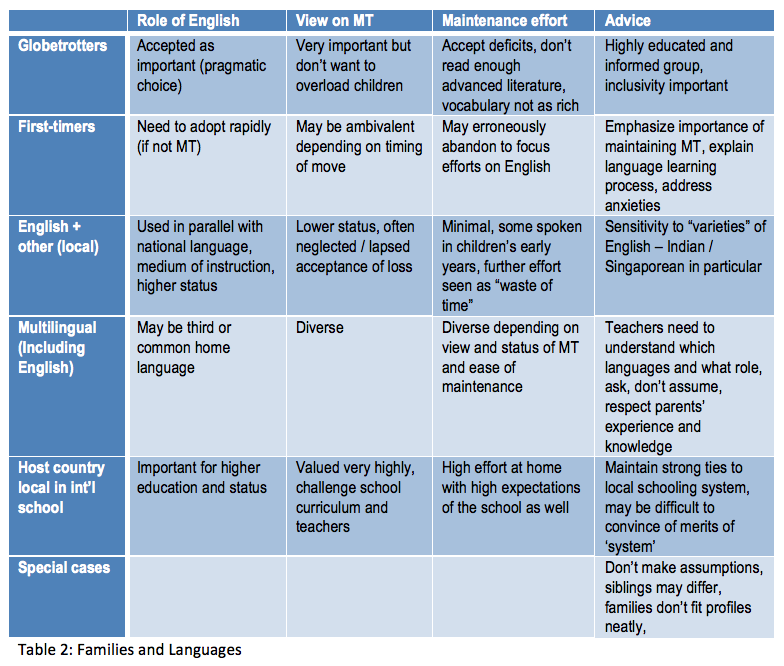
 Think about what type of family you are and what roles you assign to your language and to English.

Do a language audit for your family so you have a realistic idea of what you can do to ensure success. Look at all aspects that contribute to success including the child, family, school and community. Make some strategic choices and frame your goals and priorities as a result of this.  You can see my audit here.

Getting back to the question of control and ownership: 

Personal Learning Environment (PLE)

Use some digital tools to create your personal learning environment. You can ensure input and output for listening, speaking reading and writing. Do you know what the current best books are for your child right now? Does your language have literary prizes for picture books and young adult books? Are your children reading them? Are they keeping up to date with radio programs, TV shows? Movies?  

Personal Learning Network (PLN)

Which people and organisations are in your network? Both physical and virtual proximity can be created. Your students can find people to add to their community, from their family, peers, older or younger students in the same country or other countries. In their school and in other schools. 

Community of Practise (COP)

This is where you find out what is best practise and what other people are doing. The “experts” or people who may have experience in one or more aspects of learning. They may be people with children learning the same language, or other parents struggling with the same socio-emotional issues with priority setting and time and logistical constraints. 

There are a number of language communities online – you just need to find their champions and tap into their resources. And then it’s a question of sharing and community building.
On twitter try: #langchat (WL teachers) #frimm (French teachers)#ClavEd #WLteach #flteach

The two sites below have some great resources:
http://catherine-ousselin.org/technology.html 
http://www.cybraryman.com/foreignlanguagelinks.html

Digital Tools

Just because a tool was created in English doesn’t mean it’s exclusively for English use. The whole point of Web 2.0 is you can create and curate to suit your need in ANY language.   Don’t complain about a lack of (age appropriate) resources – create your own. Borrow and extrapolate from material in other languages. Share and share and share. This is not an exhaustive list, just a sampling.

Flipboard can be used to curate any digital material on any topic in any language. This one is specifically on bilingualism, mother tongue and language, however there is no limit! Football in Dutch, Fashion in French Philosophy in German, rock music in Swedish. Start a flipboard with your language community or have your kids start one with theirs.

 Subscription based apps like PressReader can provide families access to their local newspapers and magazines in their home language. It is also a useful tool in the language classroom.

A linguistic trio …

In the last few weeks I’ve been lucky to attend the lectures of three specialists in the field of language, bilingualism and mother tongue.  Before I forget the salient points of their presentations I thought I’d write it up and do a little compare and contrast and provide some links for further investigation and thought.

Does this have much / anything to do with the library? Well yes in the sense that language and literacy is at the core of what we provide. Particularly if we’re operating in a multi-lingual environment I believe it is our responsibility to have a background understanding of the current thinking on language and learning and education.  However I had to invite myself to two of the talks and was invited by a teacher to attend the third which was held at another international school … perhaps we are more marginal to the bigger picture than we’d like to imagine.

The three lectures were by: Virginia Rojas, Eowyn Crisfield,  and Bruno della Chiesa.

Since each posting will be fairly lengthy I’ve split them so that this post doesn’t not get made as it’s too long in the making!

Here are the links:

Rojas

Crisfield

Della Chiesa

A linguistic trio – Part 1 – Rojas

Virginia Rojas

Before I embark on my summary, here are a couple of links written by other people quoting her, from Patana, the Telegraph,  and some very useful myth busting on language (worth a read).

Rojas commenced her talk by going through the common myths on children and language (see myth busting above). She then explained the 5 types of bilinguals (for more you can read this summary)

  • Compound bilingual / Dominant Bilingual (A person being more proficient in one of the two languages).
  • Co-ordinate bilingual (person develops two parallel linguistic systems, usually when the two parents have different mother tongues and each parent speaks only his or her own mother tongue to the child. In response, the person constructs two separate linguistic systems and can handle each of them easily.)
  • Balanced bilingual (people who are more or less equally proficient in both languages, but will not necessarily pass for a native speaker in both languages).
  • Ambi-bilingual / Equilingual (person who passes in any situation in both languages for a native speaker, i.e. he or she is indistinguishable from a native speaker). 
  • Passive Bilingual (A person who is a native speaker in one and is capable of understanding but not speaking another language.)
  • Semi-bilingual (not strong in either language)
and explained that with the exception of semi-bilingual (not desirable at all), each the type of bilingualism your children ended up with was a matter of choice and planning for the families and children concerned depending on circumstances and goals.

At school

She went on to explain that every teacher is a language teacher – not just language teachers as language comes with content, and pointed to research done at Stanford University on language and literacy learning in the content areas.  A positive learning environment for bilinguals is one where the home language and culture is regarded as an asset, instruction is adapted to meet different needs, children are “immersed but not submersed”, progression is seen from speaking to reading and writing and the child is monitored to ensure growth and progress.  In a later session for teachers she went into detail about “being nice with high expectations” for students who were learning English, and distinguished between the three kinds of vocabulary: basic (T1); high frequency, multiple meaning, cross disciplinary (T2) and low frequency discipline specific (T3).  The most important were the T2 words, which were necessary for bilingualism and achievement and were transferable and allowed for connections (e.g. describe, observe, explain, illustrate, on the other hand, contrast, compare, similar, like, prove etc.). Strategies should include distinguishing between shades of meaning among verbs differing in manner and adjectives differing in intensity. T1 words were the domain of language teachers and T3 of subject specific teachers.

At home

Parents should work on maintaining and improving the home language and not leave this to the school (even if the school provides the language).  Children should be given a “wait-time” of 5-7 years for language to develop, allowing each child it’s own time and way of achieving bilingualism. Parents need to be informed and act accordingly, and to plan their childrens’ bilingualism. In her opinion at least 3 hours a week had to be spend on formal lessons in the home language including reading and writing with additional time during the summer vacation.  Texts and materials should be provided in the home language at home.

In the library

I asked her separately about the library and what role it could play. She reiterated the need for books in other languages to be visible, to have text books in mother tongue available, and to integrate (non-fiction) books into the collection.

Practically for us it wouldn’t make sense to integrate the non-fiction books as we’ve concentrated on fiction except for the odd donated book. It would probably be a good idea to try and get a used text-book donation drive to add to our collection.