Make-over update

When I tell people we’re getting to renovate and extend our library their first reaction is “wow, that’s amazing, you’re so lucky!”. And yes, prima facie it is so. But right now it’s feeling rather overwhelming. And ironically most of that is not so much to do with the change as the amount of preparation that needs to be done. Speaking of change – you HAVE to get “Bug in a Vacuum”

I am a veteran of moving. 10 countries in 24 years plus countless internal moves in those countries and 3 moves in the last 5 years. I know it pays to be prepared and to clean and clear before the move. And as I remarked in my last post, a lot of that cleaning and clearing happens behind the scene.  Things are slightly more complicated as well due to well, life. Unforeseen circumstances. Like one staff member on maternity and another on hospitalisation leave. And part of my gratitude thoughts each day are for my remaining staff member who is picking up a lot of the slack and the temporary staff member who is happy to learn the ropes and keep things ticking over. And the other temp who has been coming in and the occasional parent or volunteer for their kindness.  But it does slow things down as we adapt and learn.

So, significant but time consuming things that have been done this week – including taking up time in my weekends – those weekends that I thought would be computer and work free now that I’ve finished my M.Ed!

  • Putting patron photos into FollettDestiny  – easy in theory but quite a lot of preparation work – including learning all sorts of new Excel tricks on how to add things before and after text in cells!  And of course 90% goes well, but the 10% that bombs out, takes 90% of your time to trace why an upload didn’t work, what went wrong and how to remedy it.
  • Cleaning up patron data.  After the last patron update I found about nine pages of patron data that just wasn’t right. Parents marked as students or staff, students who had left years ago, staff who had left, incorrect emails etc.  Now bear in mind, when I prepare these lists, I then go into school with a full teaching schedule and it literally took 2 people 2 days to clear it all up in-between their regular tasks of circulation, shelving and THE PREP
  • Yes, the PREP. we have 9 different grades from Pre-Kindergarten to Grade 6, and each of those have 4 (Kindergarten) -6 (the rest) UOIs. The library has to be vacated by next Friday. Most UOI’s are changing over on Monday coming. Many UOIs have changed this year. So that means checking the central idea etc. checking previous year’s lists, quickly checking with the lead that my understanding of where the topic /theme / concept is going is the same as theirs, making new lists and then packing up 18 boxes of books and DVDs – 9 for the coming week when we’ll have over 1000 books returned from the last units and 9 for the first weeks of January 2017 – just in case. Because of course our handover of an empty library to the designers / constructors is 1 December and of course their hand-back to us is 1 January. But I am of little faith that things are flawless. So I err on the side of caution.  And bear in mind, we’re still having our 35 classes a week, plus all sorts of meetings that are using the library so we’re configuring and reconfiguring the space and arranging catchup classes…
  • The new books. And the wrongly processed books. I still hold vestiges of anger on our last big book order with Follett that went horribly wrong in every which way it could have gone wrong. They didn’t deliver on time or as arranged, they catalogued incorrectly, spine labels were wrong etc. So we’re still sorting out that mess. And then I put in a couple of other smaller orders, but our cataloguer is off on hospitalisation leave so we’re cataloging on the fly.  Now this is a GOOD thing I keep on telling myself. I’m all for final responsibility for tasks and work flow, but I’m also all for everyone pitching in and helping and knowing all aspects of the process. It’s been a little peeve of mine in the library world that there is so much segregation of duties and these past weeks have just proven that given the chance people can do way more than they or anyone else may have thought. But it is extra work – did I mention what else was going on?
  • The weeding. Saying goodbye is so hard to do!  I must admit having absolutely no problems ditching the disney fairy series that no-one was looking at or borrowing. But then there are other books – Michael Rosen’s “Sad”. I’m sad that no-one seems to have ever borrowed that. And I feel bad that I’ve not marketed it, or allowed it to see the light of day and be nurtured and treasured. Perhaps if I pair it with Bug in a Vacuum?  Weeding is sweet sorrow. It highlights our failings as book pushers. I feel like a neglectful parent when a book that’s been bought doesn’t get the attention it needs. I spend time with each of them and ponder whether putting them on a resource list would help. (No jokes about “will this bring me or someone else joy) Or perhaps asking students and teachers to ponder their fate. And I do both, and some survive for another day.
  • Acquisition plan – my kids ask me “if we’re getting a new library does that mean we’re getting new books?” This is the double edged sword of money and budget. I was talking to some fellow librarians last week – their budgets are double mine. Sometimes less is more. Our students and our teachers probably only have capacity for perhaps one really good reading book a week. Each. What should that book be? And for research / nonfiction? It’s so hard. I try so hard, but this week it has been stingrays and grasshoppers. Boats and jet planes. Last week it was fast cars and how to make your own vegetable garden (try getting one of those for an equatorial climate, suitable for G2 level), dinosaurs are totally out of favour. They want tornados and not hurricanes.  And “Miss where are your Indian books?”  and “there’s nothing on Bangladesh” I’m trying to diversify. They deserve Indian books, and overseas Chinese but not ABC (American born Chinese) books, and Korean protagonists and Japanese heroes. The triplet sister of acquisition and weeding is discoverability. I need to crack that nut in the new library. Does that mean genrefying, through label or location? Does it mean more work on resource lists or libguides or other pathfinders?

The problem with grappling with all these things is that they take up a lot of brainspace and thought space and discussion space. All of which is being take up by doing. I’m looking forward to the library being boxed up and having time to be more strategic, having time to go into classrooms and observe and understand.


Library redesign – checklist

One of the librarians on a FB group I’m in asked me if I had a check-list for our library redesign.  Which made me realise that no, I didn’t. I’ve more or less had a running checklist in my mind all year, and particularly since I did INF536 – Designing Spaces for Learning (you can see more posts under category INF536). But I think it’s probably time to get all that stuff out of the swirling mind space and onto paper – and please – if I’ve missed anything feel free to add in some comments below.

(and please read this article – it’s gold! : Schlipf, F. (2011). The dark side of library architecture: The persistence of dysfunctional designs. Library Trends, 60(1), 227–255. Retrieved from http://search.proquest.com/docview/903205684?accountid=10344; another ‘must read’ is “design thinking for libraries“)

Pre-design

  1. Know your current space
  2. Know your usage / pathways
  3. Know your collection

Communication

  1. Write it down
  2. Take photos (of what you have and what you want)
  3. Take videos (time lapse)
  4. Walk people through it
  5. Invite them to spend time in the space
  6. Have a shared (google) document / folder
  7. Involve everyone who uses the space in the process

Design iteration

  1. Make sure everything is as flexible / moveable as possible
  2. For the immovable / inflexible bits keep asking for second / third / fourth / 99th opinions – you don’t want to get that wrong
  3. Keep on finding and showing them pictures of what’s in your head – make it really concrete, so that you can go back and say “not like that, like this”
  4. Don’t be scared to ask for changes now – before it’s too late
  5. Be careful you don’t create book/people ghettos if you have multiple physical spaces
  6. Don’t forget the furniture
  7. Involve the marketing department and admissions – the library is a showcase and they’re going to want to have a say in the look and feel
  8. Involve your staff – often they’ve been around longer than you have!
  9. Involve students and parents – it’s their space too

Elements – Space

In my previous post I wrote at length about the space we have and the issues it has.

One of the things that we will have in the enlarged space is one wall will be knocked down, but another wall is structural, so that’s going to create a classroom space. The designers put bookshelves on both of the side walls, but that created the problem of which part of my collection I’d actually put into that space (see my comment about creating a book / person ghetto.

As a result I went back and had a relook at my collections.  This involved me looking at all parts of my collection,

  1.  Itemising how many physical books there were in that part of the collection (i.e. for us that was board books, picture books; junior fiction; junior series; fiction; fiction series; world language; nonfiction; literacy circle kits; graphic novels; reference; teacher resources; “too hot to loan” read in the library books; picture books for older students; wordless books; Chinese collection; poetry; fairy tales and legends; etc )- now is your time to genrify or to group or extract parts of the collection as you’d desire.
  2. Working out how much shelf space (length, breadth, height) each part of the collection needs typically (bearing in mind how much of the collection is in circulation at any time). Height is particularly relevant for the picture books and junior books. Accessibility is always an issue. Also think about having enough space for front facing books at the end of each shelf section, how much space boxes take up for your series so you can adjust your requested shelf length (I have wasted space here).  In the first design iteration, the designers gave me 49m2 of shelf space, and we calculated we had 72m2 of space in use… Don’t assume they’re going to measure and calculate – check! Even after the third lot of design drawings I was chasing them to put shelf heights in the drawings.
  3. Think about how you want to group bits of your collection. Besides the obvious zone of Kindergarten /  lower elementary / upper elementary and nonfiction, I want to keep my board books “fun to read in the library” books like graphic novels, “too hot”, poetry, wordless and picture books for older students books together. And ensure the latter are near a seating zone.
  4. Weed, weed, weed. I still need to do more of this, and the deadline is looming. I need to get rid of all the “just in case” books, all the ugly discoloured no-one wants to borrow books. All the books about baseball (no one ever borrows anything where baseball is a main feature). All the books that are great for a North American environment but fail to find an audience here – even amongst our North American students.

That’s left me with the question what to put in the “classroom” shelves – and that also affects the type of shelving. Then at the 11th hour, the principal decided that all the “learning to read” PM readers; all 350 boxes of them, also had to come into the library. Well, that solved the problem of what to put in that space, but also meant that those shelves would need (sliding) doors so they weren’t an eye-sore of file boxes.  It also meant we needed more shelving in the main part of the library to make up our needed M2 of shelving.

Elements – furniture

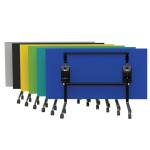
If I hadfliptable no money for anything else, and the whole thing fell apart, the one thing I would still try to do is to get better (non-shelving) furniture in the library. I get the feeling we’ve been a bit of the “hand-me-down” zone, and the furniture is just not appropriate. My checklist for furniture would be:

  1. Light – little people need to be able to move it around
  2. Moveable and stackable – chairs should be stackable and tables should be able to be locked vertically
  3. Size-appropriate – all our tables and chairs are adult size, since we cater for 3-13 year olds, we’ll need to hit around the 9-10 year mark (the littlies usually don’t use the tables and chairs)
  4. Safe – no bits sticking out, everything must be tucked in under the tables, nothing to trip over. The first 3-D images showed big bean-bag chairs and my first thought was –  they’ll be used as slides and launching pads to jump off of! Think like a 6 year old when reviewing this.
  5. Clusterable – communal reading is a big thing in our library. Very few students sit down and read on their own (and most who do will go into the swivel chair and swing it to face the wall).

Elements – flow

This really has three parts

  1. the flow in the library – entry and exit (especially if one class is trying to check-out / line-up / exit at the same time as another class is trying to enter / check-in / sit down.
  2. The work process flow – circulation, shelving, curating books for UOIs / classrooms / processing new books
  3. The flow during recess / break-time and after or before school. (I have videos, but my wordpress free plan won’t let me upload them!)

Elements – Signage and discoverability

As I write this, I realise that we haven’t paid nearly enough attention to this in the design phase. At the back of my mind I have the idea that this can be an “add-on” at least for the physical bits. In a sense you create discoverability by ensuring your “pathways” are logical and you group elements of your collection together.  But discoverability is a never-ending issue in all libraries.  Our current signage is terrible. I particularly like how HKA has done their signage – big and yellow and unmissable.

Elements – lighting

display-with-lighting
Page one Hong Kong (picture by Dianne Mackenzie)

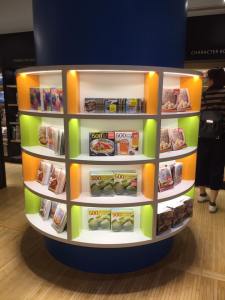
This is really big, and I really don’t know enough about it all, and that’s worrying me. Schlipf (2011) writes about it at length in his article. On the one hand I’m glad it’s not that complicated in our case, in the other … how to set right what’s pretty bad. We have florescent downlighting, light from windows on three sides (one of which will be blocked by shelving).

One really has to spend time in stores, particularly book stores to see the ones who get it right. I keep on telling my designers “I’m selling books, treat me like a retailer”!

I’m going to go back and re-read the library design-thinking handbook to see if I’ve missed anything.

PLEASE comment! I’m so terribly scared I’m missing anything and I’ll get it all wrong!

(here is the completed series of posts:

https://informativeflights.wordpress.com/2016/10/30/library-redesign-current-issues/

https://informativeflights.wordpress.com/2016/10/30/library-redesign-checklist/

https://informativeflights.wordpress.com/2016/11/19/make-over-update/

https://informativeflights.wordpress.com/2017/01/08/90-there/

https://informativeflights.wordpress.com/2017/01/21/reduce-reuse-recycle-and-repurpose/

Library redesign – current issues

As librarians we often make it our life and vacation’s mission to visit other libraries and drool over what they have (or haven’t got), how they’re organised things, what their displays look like – how the signage works out etc etc. and then we come home and try and adapt our current situation to optimise our own assets and spaces into something even more user friendly, accessible, with better book visibility etc. etc.

It’s not often we have a chance to go back to the drawing board and redo it. And then, suddenly you get what you wish for!  For the last year I’ve been tweaking and rearranging and moving things (documented here – see all 4 posts for the progression). Now finally we’ve had the funding approved to break through a wall and expand the library and to reconfigure it so that it better fits the needs of (must I say it?) 21C learning. Of course we’re still waiting for Government approval – so I better not count my chickens …

Ok, let’s say that in normal terms.  I’ve got a lovely library. It’s a bit cosy and run down, and a lot of things are improvised, but I love it, and (most) my students love it. It does have several rather important detracting factors though:

Instructional space

I have 35 classes a week, ranging from 20 to 40 minutes or sometimes longer depending on teacher needs. During that time, I typically give a micro-lesson (5 minutes) involving storytelling, a provocation, a video clip, booktalk by students or myself, or a slightly longer lesson that can involve explanation followed by a task, right up to a full 40 minute information literacy session that includes teaching and skill development.

But I don’t have an instructional space. I have a beat up, heavy black leather couch, next to a pull down projector screen (which is permanently down), next to a window without any blinds, behind glaring florescent lighting that has to be switched off. And nothing to write on, unless I drag a heavy flipboard in front of the screen and crouch down to write on it, as it’s not on adult human height.   My students sit on the mat on the carpet, or on too high chairs with legs that jut out and trip people up as they walk past, and write on too high tables.  And it’s OK. We do just fine.  But it could be a lot better.

Communal space

I just love the fact that the library is (my own quote) “the centre of the universe” in our school. But the disadvantage is that it gets used a lot for all sorts of other things. It doesn’t help that our school hall is enormous and acoustically dysfunctional, so any smaller gatherings get diverted to the library.

Fortunately, a far sighted predecessor made sure all the bookshelves were on wheels, so the library can relatively quickly be transformed into a biggish but comfortable open space. Unfortunately, that often occurs when actually, one of my classes has a library lesson, so they end up missing the lesson or having to reschedule. Rescheduling is a real issue when my calendar is pretty filled to the brim!

Display space

Short answer now – there isn’t really any. I’ve cleared a few shelves in the bookcase at the entrance, and eliminated a computer at the OPAC pillar, but it’s not enough, it’s not nice, it’s not visible and students don’t gravitate to it. I have a notice board at the entrance, but it’s not really in the line of sight, and only one wall is not covered with bookshelves.

Seating

We have the aforementioned awful leg-sticking-out chairs, a big heavy black leather couch, with a matching big heavy armchair, 6 little Ikea pool chairs, 2 long floor cushions, 2 little Ikea wooden tables and chairs.  Funnily enough, everytime I put down a floor rug (hand-me-downs from home) a new “reading / lounging” zone is created.

Shelving

Nice that it’s on wheels. Not always fit for purpose in that some of the kindergarten and junior elementary shelving is just too high for the students who are supposed to be using it. Further the dimensions are such that a lot of space is wasted when I put my series “boxes” in, as only two fit per shelf rather than three.

Returns / Circulation / Processing

IMG_0466Returns are plonked into two little red baskets – which overflow in the shortest possible time.

Not enough space around the front desk to form multiple check-out lines without blocking access to library entrance / rest of library.

Not enough space on front desk to even process check-in and check-out – especially when multiple copies are being processed – like the check-in/out of UOI resources.

Not enough space for book processing (cataloguing, stickering, stamping, etc.)

Cupboards behind desk inadequate in size and no doors, so look untidy when they’re not.

Back Office

I’ll be the first to admit that I’m not the tidiest person on the planet, but what-a-mess! It’s an office, a dump, a store-room, a place for our literature kits and DVDs, a place for processing, for meetings, for privacy and tears (yes teachers sometimes need to cry, as do students and my office has tissues and sympathy/empathy).

Issues that were, and still remain – no visibility over library when in office, no space at desk to be out of office! No working space in office, too much junk. Not enough planning / writing space.

Meeting table / chair takes up too much space as chairs can’t be tucked underneath. Need space for “pending books” – the one’s I’m reading / reviewing / about to use in lessons. Don’t need big fat filing cabinet.

Conclusion

I’m happy I’ve had a year to be in the space, make the changes I could make, observe how the library is used, consider the problems and what does work before having to consider how I’d like it differently.

Next blog – the design process ….

(here is the completed series of posts:

https://informativeflights.wordpress.com/2016/10/30/library-redesign-current-issues/

https://informativeflights.wordpress.com/2016/10/30/library-redesign-checklist/

https://informativeflights.wordpress.com/2016/11/19/make-over-update/

https://informativeflights.wordpress.com/2017/01/08/90-there/

https://informativeflights.wordpress.com/2017/01/21/reduce-reuse-recycle-and-repurpose/

Applying spatial changes and design thinking to middle school reading– a three phase collaborative approach

Introduction

There is a long history of research into the value of and elements contributing to the success of classroom libraries. They have an important role in ensuring accessibility of written works to promote fluency and skill in literacy and thereby contributing to academic achievement. But the literature appears to concentrate on elementary schools (Hopenwasser & Noel, 2014; James, 1923; Jones, 2006; Krarup, 1955; Powell, 1966; Sanacore & Palumbo, 2010; Todd, Gordon, & Lu, 2011; Worthy, 1996). Although partnership and collaboration with the school and/or public library and librarian is recommended, the literature often deals with the two spaces in isolation. Further, the problem of aliteracy in middle school – whereby students can read but don’t want to – is well documented (Kelley & Decker, 2009; Krashen, 2004; Lesesne, 1991; Sheldon & Davis, 2015; Worthy, 1996). This case report will show how the two environments library and classroom, can successfully be seen as extensions of each other through the principles of design and design thinking and explicit cooperation between the language humanities (Eng/Hum) teachers, literacy coach and school librarian in order to promote voluntary reading.

Case development

United World College South East Asia East (UWCSEA-East) is a K-12 international school located in Singapore. It commenced operations in 2008 and took occupancy of a purpose built campus in 2011. In this campus, the secondary school library initially served around 500 middle school students – see table 1. It now caters to three distinct communities, middle school, high school and the International Baccalaureate (IB) – see Table 2.
Screen Shot 2015-10-11 at 11.27.14 am
Despite consultation with the librarian in the planning phase, certain spaces of the library were designated different functions than agreed upon and furnished accordingly by the architect and building manager. One such area was upstairs overlooking the main school plaza with purpose built magazine racks. The idea was it would be a well-frequented showcase area for magazine reading. In reality a number of factors prevented this from being realised:
  • The furniture design didn’t accommodate its purpose as it was not deep or high enough and the storage area didn’t fit back copies
  • The zoning of the library post occupancy meant that materials affording quick casual reading such as graphic novels and periodicals were better located in the “noisier” and fast turnover area which allowed food and beverages, i.e. downstairs.
  • The trend in libraries is to move away from physical magazines and periodicals towards online providers including online databases and aggregators such as PressReader that provide the same product at a lower cost and without delays and issues with cataloguing and maintenance.
The question of what to do with the space was resolved by noticing that as the secondary school reached post occupancy capacity the lowest students in the pecking order i.e. middle school students were increasingly marginalised with students of higher sections taking over the prime library real estate (students are visually distinct due to different coloured polo shirts for their uniforms). In addition, middle school students no longer had library visits planned into their schedule. Furthermore, the large influx of new students and teachers meant that reading books in the classrooms were unevenly distributed both in terms of volume and quality without any structured form of classroom library, which the students had become accustomed to in the primary section. Finally, Eng/Hum teachers were noticing a decline in voluntary reading as students moved up through middle school.
These issues were addressed initially through collaboration between the librarian and Eng/Hum teachers and more recently by the new literacy coach over a period of three years as follows:
  • The conversion of the magazine area into a middle school reading zone
  • The establishing of a core library for each of the three middle school grades (Day, 2013b)
  • The creation of middle school classroom libraries in a formal and structured manner with materials integrated into the library catalogue (Day, 2015d)
  • The integration of informational / nonfiction texts into both areas
This is an on-going process and worth a critical analysis to examine the choice process, latent or existing attitudes and assumptions, exterior pressures and design constraints and collaboration and communication.

Critical analysis

Choice of process

The spatial change in the library was conceived and led by the teacher-librarian (TL) with the Eng/Hum teachers joining in the collaboration as the process evolved. Since the TL has experience in design thinking (Day, 2013a, 2015a, 2015c) the process followed the design thinking cycle of inspiration, ideation, iteration and getting to scale (Brown, 2008; IDEO, 2014).
This was achieved by:
  • Agreeing on a “core library” of 30 titles per grade for grades 6-8 which were prominently displayed
  • Adjusting shelving to accommodate front facing books
  • Relocating books of interest to this age group from the fiction collection
  • Using large posters to highlight the favourite books of middle school teachers in the library and class corridors and classroom walls
  • Ensuring multiple copies of books, by using class and literary circle sets
  • Adequate lighting, comfortable furniture and the creation of a private space
The above steps and final spatial design incorporated the elements that are recommended as enhancing school library spaces (Cha & Kim, 2015; Elliott-Burns, 2003; La Marca, 2008; A. McDonald, 2006; Serafini, 2011).
The design elements that contribute to successful classroom libraries are not dissimilar and include:
  • Sufficient space which is a focal area but partitioned and private
  • Comfortable furniture
  • Variety of material in range of complexity including different literary genres and informational texts
  • Category organisation and shelf labelling
  • Combination shelving allowing for quantity of books and display (front facing)
  • Advertising by means of posters and notices on whiteboards
  • Graphic organisation either thematic or by connections
  • Involvement of students in selection, organisation and maintenance (Fractor, Woodruff, Martinez, & Teale, 1993; Hopenwasser & Noel, 2014; Reutzel & Fawson, 2002, cited in Sanacore & Palumbo, 2010)
Discussion and research on the elements predominantly come from the elementary school environment, and the adoption to middle school requires some adjustments to account for the fact that students do not remain in one classroom, lessening the sense of ownership of a space on the part of students, and teachers needing to cater to multiple classes with different profiles and interests. Learning spaces are also typically smaller relative to the size of the students.
The creation of the library and classroom reading spaces and populating them with books is “necessary but not sufficient” (McGill-franzen, Allington, Yokoi, & Brooks, 1999). Other components of encouraging reading include training teachers to enhance their instructional routines to incorporate the material, and to ensure that teachers are familiar not only with their literary canon, but also the latest in good young adult fiction (Day, 2015b; McGill-franzen et al., 1999). The school has invested in training with Penny Kittle to assist in the instructional routines (Raisdana, 2015), while the librarian is working with the teachers on the latter.

Latent or existing attitudes and assumptions

An international school is blessed with diversity in cultures, languages and backgrounds both of their students and teachers. This results in a context of people coming from different systems with different attitudes, assumptions, beliefs and experiences around education, reading and libraries. In just the middle school, teachers come from Australia, United States, Philippines, Ireland, Canada and the United Kingdom, each with their own literary core. In addition, there are personal preferences and beliefs, for example around young adult literature (see Raisdana, 2014). Teachers may not be used to or have experience of collaboration with the TL, the benefits thereof, nor aware of the ways in which libraries have evolved (Gibbs, 2003; Montiel-Overall, 2006, 2008; Sullivan-Macdonald, 2015). And naturally there are assumptions around what constitutes an ideal learning or reading space and the balance between the two (Elliott-Burns, 2005). In a meta-review of access to print and educational outcomes, Lindsay (2010) concluded that limiting choices with a larger distribution interval led to more reading, particularly if it was accompanied by activities such as training and book talks. This is in contrast to the assumption that collections should be as large as possible. It also suggests that rotation of materials leads to better outcomes.

Exterior pressures and design constraints

The creation of the complementary spaces faced a number of constraints, design and otherwise. These included a small budget, limited time and variability in the reading level of students. In design thinking the presence of constraints is seen as a positive force that encourages creative solutions and exploring options that would not otherwise be considered, and this proved to be true in this case study (Brown & Katz, 2011; Hill, 1998; Ness, 2011).
Naturally budget was an important constraint that shaped the way in which the space was converted and books and furniture was acquired or moved and repurposed. As discussed earlier, the librarian was involved in the “fuzzy front end” (Sanders & Stappers, 2008, p. 6), of the secondary library design and once the space was completed it was not possible to change the space, only to adapt its purpose. In the classrooms the availability of furniture in the room to hold the books and the available space for the classroom library vis-à-vis other learning spaces determined how many books could effectively by stored and displayed. In this respect creative design thinking was deployed, for example by taking the doors off built-in cupboard space both in the classrooms and in the library, creating additional shelving. Comfortable furniture was either acquired by donations from the community or purchased to ensure equity between the classrooms.
Although the library and classes each have a budget for the acquisition of books, both wanted to ensure that existing resources were not wasted – for example the books already owned in multiple copies. However their repurposing had to be examined within the constraints of the reading level of the students and the curriculum themes for each grade.

Collaboration and communication

Collaboration and communication between the TL and teachers has received a lot of attention as has the ways in which spatial design and design thinking can enhance collaboration (Avallon & Schneider, 2013; Ferer, 2012; Gibbs, 2003; Knapp, 2014; Montiel-Overall, 2006; Williamson, Archibald, & McGregor, 2010). Enhancing collaboration between the TL and the Eng/Hum department has occurred on a number of fronts, both physical and virtual – such as book chat mornings to book talk new books, encouraging teachers and students to be involved with the selection of books for the Red Dot Awards (ISLN, 2015), processing and cataloguing the books, and the creation of a virtual space for the books (Day, 2015b).
Given time constraints and curriculum pressures, additional moments for collaboration and communication have had to be designed into the process. For example teachers can book the reading zone space to conduct lessons, and invite the TL to book talk new or noteworthy books. In addition the library receives supervision assistance from teachers during lunch, recess times and after school. The Eng/Hum teachers have first priority in requesting this duty, creating the opportunity for the important “casual conversations” that result in informal learning and information exchange (Oblinger, 2006; Somerville & Brown-Sica, 2011).

Conclusion

The process can neither be criticized for its efficacy nor results. Teachers, students and the librarian have largely viewed the change positively. Due to making small iterative changes to the spaces, starting with a small budget and a limited number of books in the first year, and subsequently adapting the choice of books, the selection and weeding process based on experience and feedback, the combined library / class library spaces appear to have grown organically despite a lot of “behind the scenes” work on book processing, cataloguing and making books classroom / shelf ready.
There are five main recommendations arising from the analysis of this case study, all which can be tackled through employing design thinking rather than further changes to the current spatial design:
  • Balance the contradictory forces of novelty and familiarity through how books are selected, displayed and rotated
  • Focus efforts on the most efficacious element of encouraging reading – book talks
  • Expand the space to include the home environment, particularly in the case of bilingual students
  • Increase involvement of students in the spatial design and change process
  • Quantify the benefits of this spatial / design thinking collaboration through evidence based research.
These will be elaborated in the next section.

Recommendations

Balance novelty and familiarity

Students like and respond to novelty in display and a constant supply of “new” titles, they would also possibly benefit from choice limitation (Iyengar, 2011). This can be achieved by a rotation of titles between spine and front facing, and through a rotation between the books in the various classes (Lindsay, 2010). At present the core and class libraries are refreshed annually and the class libraries are not rotated between classes or teachers. It is recommended this be considered to prevent staleness. The class library placement of books in bins rather than shelves with a mixture of front and spine facing, allowing changes is display is not best practise, nor is having all books available simultaneously (Fractor et al., 1993; Lindsay, 2010; Sanacore, 2000; Sanacore & Palumbo, 2010).

Book talks

The importance of teachers’, librarians’, students’ and the community’s increasing exposure of diverse books in all genres by book talking can’t be overstated (Bentheim, 2013; Gallo, 2001; L. McDonald, 2013; Serafini, 2011). But, as examined in the analysis, a number of barriers stand in the way of regular book talks. In addition, requiring reading related tasks from students runs the risk of resulting in unfavourable associations with reading and further reluctance (Eriksson, 2002; Gallo, 2001; Miller, 2009).
Many practioners have described how digital innovation and the creation of virtual spaces can enhance and augment traditional book talks as well as expand transliteracy skills of students (Dreon, Kerper, & Landis, 2011; Gogan & Marcus, 2013; Gunter & Kenny, 2008; Ragan, 2012). It is recommended that students be given ownership of exploring the potentials of the digital realm in this respect as a guided design thinking exercise.

Mother tongue material and the home environment

Access to mother tongue materials continues to be a weakness in the library and even more so in the classroom library. There are logistical and financial constraints including the wide spread of languages, the undervaluation of low status languages, and misinformation and misunderstanding on the value of reading in the mother tongue amongst students and parents (Bailey, 2014a, 2014b, 2015; Boelens, Cherek, Tilke, & Bailey, 2015). This is an area that would benefit greatly from increased collaboration between the college and parent body where previously “unknowable” resources could be tapped into through utilizing the analytical and process skills of design thinking (IDEO, 2014; Landis, Umolu, & Mancha, 2010; McIntosh, 2015).

Student involvement

While literature indicates collaboration by all stakeholders is essential for acceptance, particularly in learning environments (Hamilton, 2013; Jones, 2006; Sanders & Stappers, 2008), this has largely been a librarian / teacher initiative with some student involvement in book selection. Moving forward, the virtual or digital sphere is an area where students can also be encouraged to carve out a presence and take ownership with teachers taking on an enabler role as use of all seven learning spaces are maximised (Grisham & Wolsey, 2006; McIntosh, 2010; Thornburg, 2007; Wilson & Randall, 2012).

Quantify the benefits

Despite numerous hurdles in providing data and making analysis founded on circulation figures or student attainment records, there is considerable value in documenting and providing evidence for practises – not the least that it supports budget requests.
Circulation records do not provide a complete record or necessarily correlate with reading because:
  • Books may be read in library / class without being checked out
  • In affluent multi-cultural communities, students may have access to large personal libraries, including books in their mother tongue
  • Students may be borrowing books from the public library
Despite this, circulation is still the best proxy for reading. The decentralised nature of the class libraries results in less control over book checkout. Even in the library, that has no exit barriers, at the end of 2014/5 academic year roughly 20% of returned books had not been checked out of the system. While this can be lauded as an indication of the high moral and ethical standards of the students, it does pose difficulties in creating any evidence based data on the actual impact of either separating part of the library or decentralising the collection to class libraries in terms of increases in circulation.
It is recommended that both current and longitudinal research be carried out to see if there is any correlation between increased access to text, the amount of reading / circulation and other objective measures of attainment such as the annual PISA or TIMS tests. This will take the initiative beyond transformative individual anecdotal stories to evidence based research. The CLEP (Classroom Literacy Environmental Profile) (McGill-franzen et al., 1999; Wolfersberger, Reutzel, Sudweeks, & Fawson, 2004) and more recently the TEX-IN3 (Hoffman, Sailors, Duffy, & Beretvas, 2004) tools have successfully been used in the evaluation of elementary school class libraries and could be adapted for the middle school environment.
The recent inclusion of informational (nonfiction) texts in both the middle school zone and the classroom libraries is also one worth further investigation. Whether the expansion of the collections has impacted on the space, the ability to choose, and the completion of summative assessments in the individual subjects can be investigated in the light of the existing literature on the matter (Hopenwasser & Noel, 2014; Ness, 2011; Sanacore & Palumbo, 2010; Young & Moss, 2006; Young, Moss, & Cornwell, 2007).

References

Avallon, J., & Schneider, A. (2013). Building collaboration into workspace design. Facility Management Journal, (September / October), 34–38. Retrieved from http://cdn.ifma.org/sfcdn/fmj-supporting-documents/building-collaboration-into-workspace-design-fmj-sep-oct-2013.pdf?sfvrsn=0
Bailey, N. (2014a, November 12). Building a LOTE collection at an international school [Web Log]. Retrieved October 4, 2015, from http://informativeflights.blogspot.sg/2014/11/building-lote-collection-at.html
Bailey, N. (2014b, November 12). Research summary on language [Web Log]. Retrieved November 12, 2014, from http://informativeflights.blogspot.sg/2014/11/research-summary-on-language.html
Bailey, N. (2015). Digital language learning ecology. Singapore: iBooks. Retrieved from https://itunes.apple.com/us/book/digital-language-learning/id1000588637?ls=1&mt=11
Bentheim, C. A. (2013). Continuing the transition work from traditional library to learning commons. Teacher Librarian41(2), 29–36. Retrieved from http://ezproxy.csu.edu.au/login?url=http://search.ebscohost.com/login.aspx?direct=true&db=ehh&AN=92991111&site=ehost-live
Boelens, H., Cherek, J., Tilke, A., & Bailey, N. (2015). Communicating across cultures: cultural identity issues and the role of the multicultural, multilingual school library within the school community. Presented at the “The school library rocks” IASL 2015, Maastricht, Netherlands.
Brown, T. (2008). Design thinking. Harvard Business Review86(6), 84–92. Retrieved from http://ezproxy.csu.edu.au/login?url=http://search.ebscohost.com/login.aspx?direct=true&db=heh&AN=32108052&site=ehost-live
Brown, T., & Katz, B. (2011). Change by Design: Change by Design. Journal of Product Innovation Management28(3), 381–383. http://doi.org/10.1111/j.1540-5885.2011.00806.x
Cha, S. H., & Kim, T. W. (2015). What matters for students’ use of physical library space? The Journal of Academic Librarianship41(3), 274–279. http://doi.org/10.1016/j.acalib.2015.03.014
Day, K. (2013a, January 14). Carol Kuhlthau meets Tim Brown: Guided Inquiry {Design} Thinking [Web Log]. Retrieved October 3, 2015, from http://www.thelibrarianedge.com/libedge/2013/01/carol-kuhlthau-meets-tim-brown-guided.html?rq=design%20thinking
Day, K. (2013b, November). Liberate your book cupboards and create a more true “bookstore” model in your school library [Web Log]. Retrieved August 2, 2015, from http://www.thelibrarianedge.com/libedge/2013/11/liberate-your-book-cupboards-and-create.html
Day, K. (2015a, August 30). Expert learning in the library…. and classroom [Web Log]. Retrieved October 3, 2015, from http://www.thelibrarianedge.com/libedge/2015/8/30/a-sociologist-who-loves-the-research-process?rq=
Day, K. (2015b, September 3). Professional learning for teachers who read books students might read [Library Guide]. Retrieved September 6, 2015, from http://research.uwcsea.edu.sg/eastlibsec/classlibs
Day, K. (2015c, September 5). Design thinking for the research process (e.g., the IBO Extended Essay) [Web Log]. Retrieved September 6, 2015, from http://www.thelibrarianedge.com/libedge/2015/8/30/design-thinking-for-the-research-process
Day, K. (2015d, September 28). Center and satellite collections: connections between classrooms and the library [Web Log]. Retrieved October 3, 2015, from http://www.thelibrarianedge.com/libedge/2015/9/26/middle-school-classroom-libraries-and-the-central-library
Dreon, O., Kerper, R. M., & Landis, J. (2011). Digital storytelling: A tool for teaching and learning in the YouTube generation. Middle School Journal42(5), 4–9.
Elliott-Burns, R. (2003). Space, place, design and the school library. Journal of the Australian School Library Association17(2).
Elliott-Burns, R. (2005). Designing spaces for learning and living in schools: perspectives of a flaneuse. Presented at the Australian Curriculum Studies Association Biennial Conference, Queensland, Australia: University of the Sunshine Coast. Retrieved from http://eprints.qut.edu.au/4345/1/4345.pdf
Eriksson, K. (2002). Booktalk dilemmas: Teachers’ organisation of pupils’ reading. Scandinavian Journal of Educational Research46(4), 391–408. http://doi.org/10.1080/0031383022000024570
Ferer, E. (2012). Working together: library and writing center collaboration. Reference Services Review40(4), 543–557. http://doi.org/10.1108/00907321211277350
Fractor, J. S., Woodruff, M. C., Martinez, M. G., & Teale, W. H. (1993). Let’s not miss opportunities to promote voluntary reading: Classroom libraries in the elementary school. The Reading Teacher46(6), 476–484. Retrieved from http://www.jstor.org/stable/20201114
Gallo, D. R. (2001). How classics create an aliterate society. The English Journal90(3), 33–39. Retrieved from http://moormangb.ced.appstate.edu/5730_f11_h/unit1/Gallo.pdf
Gibbs, R. (2003). Reframing the role of the teacher-librarian : the case for collaboration and flexibility. Scan22(3), 4–7. Retrieved from http://search.informit.com.au.ezproxy.csu.edu.au/fullText;dn=129538;res=AEIPT
Gogan, B., & Marcus, A. (2013). Lost in transliteracy – how to expand student learning across a variety of platforms. Knowledge Quest41(5), 40–45.
Grisham, D. L., & Wolsey, T. D. (2006). Recentering the middle school classroom as a vibrant learning community: Students, literacy, and technology intersect. Journal of Adolescent & Adult Literacy49(8), 648–660. http://doi.org/10.1598/JAAL.49.8.2
Gunter, G. A., & Kenny, R. F. (2008). Digital booktalk: Digital media for reluctant readers. Contemporary Issues in Technology and Teacher Education8(1), 84–99.
Hamilton, B. (2013, November 14). A visit to the Lovett School story studio: Redesigning learning spaces, rewriting narratives of learning [Web Log]. Retrieved August 8, 2015, from https://theunquietlibrarian.wordpress.com/2013/11/14/a-visit-to-the-lovett-school-story-studio-redesigning-learning-spaces-rewriting-narratives-of-learning/
Hill, A. M. (1998). Problem solving in real-life contexts: An alternative for design in technology education. International Journal of Technology and Design Education8, 203–220.
Hoffman, J., Sailors, M., Duffy, G., & Beretvas, S. N. (2004). The effective elementary classroom literacy environment: Examining the validity of the TEX-IN3 observation system. Journal of Literacy Research36(3), 303–334. http://doi.org/10.1207/s15548430jlr3603_3
Hopenwasser, C. B., & Noel, A. M. (2014). Tackling text complexity with your classroom library. Kappa Delta Pi Record50(2), 81–84. http://doi.org/10.1080/00228958.2014.900851
IDEO. (2014). Design thinking for libraries – a toolkit for patron-centered design (p. 121).
IDEO, Bill & Melinda Gates Foundation. Retrieved from http://www.designthinkingforlibraries.com
ISLN. (2015). Red Dot Book Awards 2015-2016 [Google Site]. Retrieved October 8, 2015, from https://sites.google.com/site/reddotbookawards20152016/
Iyengar, S. (2011, November). How to make choosing easier [Video file]. Retrieved October 8, 2015, from https://www.ted.com/talks/sheena_iyengar_choosing_what_to_choose
James, M. E. (1923). Use of classroom libraries to stimulate interest and speed in reading. The Elementary School Journal23(8), 601–608. http://doi.org/10.2307/994550
Jones, J. A. (2006). Student-involved classroom libraries. The Reading Teacher59(6), 576–580. Retrieved from http://search.proquest.com/docview/203284680?accountid=10344
Kelley, M. J., & Decker, E. O. (2009). The Current State of Motivation to Read Among Middle School Students. Reading Psychology30(5), 466–485. http://doi.org/10.1080/02702710902733535
Knapp, J. (2014, May 1). Google Ventures: your design team needs a war room. Here’s how to set one up. Retrieved August 8, 2015, from http://www.fastcodesign.com/3028471/google-ventures-your-design-team-needs-a-war-room-heres-how-to-set-one-up
Krarup, A. (1955). Classroom libraries are not enough. The Reading Teacher8(4), 215–219. http://doi.org/10.2307/20196863
Krashen, S. D. (2004). The power of reading: insights from the research. Westport, Conn.; Portsmouth, N.H.: Libraries Unlimited ; Heinemann.
La Marca, S. (2008). Reading spaces (pp. 1–12). Presented at the 38th Annual Conference of the International Association of School Librarianship, Padua, Italy: International Association of School Librarianship. Retrieved from http://www.kzneducation.gov.za/Portals/0/ELITS%20website%20Homepage/IASL%202008/professional%20papers/lamarcaspacespp.pdf
Landis, D., Umolu, J., & Mancha, S. (2010). The power of language experience for cross-cultural reading and writing. The Reading Teacher63(7), 580–589. http://doi.org/10.1598/RT.63.7.5
Lesesne, T. S. (1991). Developing lifetime readers: Suggestions from fifty years of research. English Journal80(6), 61. Retrieved from http://search.proquest.com/docview/237285282?accountid=10344
Lindsay, J. (2010). Children’s access to print material and education-related outcomes: Findings from a meta-analytic review. Naperville, IL: Learning Point Associates. Retrieved from http://rif.org/documents/us/RIFandLearningPointMeta-FullReport.pdf
McDonald, A. (2006). The ten commandments revisited: the qualities of good library space. LIBER Quarterly16(2). Retrieved from http://liber.library.uu.nl/index.php/lq/article/view/7840/8010
McDonald, L. (2013). Literature for children and young adolescents. In A literature companion for teachers (pp. 1–7). Newtown, Australia: Primary English Teaching Association Australia (PETAA).
McGill-franzen, A., Allington, R. L., Yokoi, L., & Brooks, G. (1999). Putting books in the classroom seems necessary but not sufficient. The Journal of Educational Research93(2), 67–74. http://doi.org/10.1080/00220679909597631
McIntosh, E. (2010). Clicks & Bricks: When digital, learning and physical space meet. Educational Facility Planner45(1&2), 33–38. Retrieved from http://media.cefpi.org/efp/EFP45-1and2McIntosh.pdf
McIntosh, E. (2015, July). The unknown unknowns – test out your ideas [Web Log]. Retrieved July 19, 2015, from http://edu.blogs.com/edublogs/2015/07/the-unknown-unknowns-test-out-your-ideas.html
Miller, D. (2009). The book whisperer: awakening the inner reader in every child (1st ed). San Francisco, Calif: Jossey-Bass.
Montiel-Overall, P. (2006). Teacher and teacher-librarian collaboration: moving toward integration. Teacher Librarian34(2), 28–33. Retrieved from http://search.proquest.com/docview/224885770?accountid=10344
Montiel-Overall, P. (2008). Teacher and librarian collaboration: A qualitative study. Library & Information Science Research30(2), 145–155. http://doi.org/10.1016/j.lisr.2007.06.008
Ness, M. (2011). Teachers’ Use of and Attitudes Toward Informational Text in K-5 Classrooms. Reading Psychology32(1), 28–53. Retrieved from http://ezproxy.csu.edu.au/login?url=http://search.ebscohost.com/login.aspx?direct=true&db=pbh&AN=57420253&site=ehost-live
Oblinger, D. (2006). Learning spaces. Boulder, CO: EDUCAUSE.
Powell, W. R. (1966). Classroom libraries: their frequency of use. Elementary English43(4), 395–397. http://doi.org/10.2307/41387579
Ragan, M. (2012). Inspired technology, inspired readers – How book trailers foster a passion for reading. AccessMarch, 8–13.
Raisdana, J. (2014, March 10). Well-versed In books [Web Log]. Retrieved October 3, 2015, from http://www.jabizraisdana.com/blog/well-versed-in-books/
Raisdana, J. (2015, February 9). Leave with a suggestion [Web Log]. Retrieved October 3, 2015, from http://www.jabizraisdana.com/blog/leave-with-a-suggestion/
Sanacore, J. (2000). Promoting the lifetime reading habit in middle school students. The Clearing House73(3), 157–161. Retrieved from http://search.proquest.com/docview/196889420?accountid=10344
Sanacore, J., & Palumbo, A. (2010). Middle school students need more opportunities to read across the curriculum. The Clearing House83(5), 180–185. Retrieved from http://search.proquest.com/docview/744358835?accountid=10344
Sanders, E. B.-N., & Stappers, P. J. (2008). Co-creation and the new landscapes of design. CoDesign4(1), 5–18. http://doi.org/10.1080/15710880701875068
Serafini, F. (2011). Creating space for children’s literature. The Reading Teacher65(1), 30–34. http://doi.org/10.1598/RT.65.1.4
Sheldon, S., B., & Davis, M., H. (2015). “I wish everyone had a library like this” (The Baltimore Elementary and Middle School Library Project No. Year 2 Report). Baltimore, USA. Retrieved from http://baltimore-berc.org/wp-content/uploads/2015/06/ALibraryLikeThisJune2015.pdf
Somerville, M. M., & Brown-Sica, M. (2011). Library space planning: a participatory action research approach. The Electronic Library29(5), 669–681. http://doi.org/10.1108/02640471111177099
Sullivan-Macdonald, D. (2015, October 1). Teach more, librarian less, say SLJ leadership summit panelists [Web Log]. Retrieved October 3, 2015, from http://www.slj.com/2015/10/schools/teach-more-librarian-less-becoming-essential-panel-at-the-slj-leadership-summit/
Thornburg, D. (2007, October). Campfires in cyberspace: Primordial metaphors for learning in the 21st Century. TCPD. Retrieved from http://tcpd.org/Thornburg/Handouts/Campfires.pdf
Todd, R. J., Gordon, C. A., & Lu, Y.-L. (2011). One common goal: Student learning (Report of Findings and Recommendations of the New Jersey School Library Survey Phase 2). New Jersey, USA: New Jersey Association of School Librarians. Retrieved from http://www.njasl.info/wp-content/NJ_study/2011_Phase2Report.pdf
Williamson, K., Archibald, A., & McGregor, J. (2010). Shared vision: A key to successful collaboration? School Libraries Worldwide16(2), 16–30. Retrieved from http://ezproxy.csu.edu.au/login?url=http://search.ebscohost.com/login.aspx?direct=true&db=lih&AN=55415805&site=ehost-live
Wilson, G., & Randall, M. (2012). The implementation and evaluation of a new learning space: a pilot study. Research in Learning Technology20(2), 1–17. Retrieved from http://ezproxy.csu.edu.au/login?url=http://search.ebscohost.com/login.aspx?direct=true&db=ehh&AN=86214889&site=ehost-live
Wolfersberger, M., Reutzel, D. R., Sudweeks, R., & Fawson, P. (2004). Developing and validating the Classroom Literacy Environmental Profile (CLEP): A tool for examining the “print richness” of early childhood and elementary classrooms. Journal of Literacy Research36(2), 211–272. http://doi.org/10.1207/s15548430jlr3602_4
Worthy, J. (1996). Removing barriers to voluntary reading for reluctant readers: The role of school and classroom libraries. Language Arts73(7), 483–492. Retrieved from http://search.proquest.com/docview/196851690?accountid=10344
Young, T. A., & Moss, B. (2006). Nonfiction in the classroom library: A literacy necessity. Childhood Education82(4), 207–212. Retrieved from http://search.proquest.com/docview/210392168?accountid=10344
Young, T. A., Moss, B., & Cornwell, L. (2007). The classroom library: A place for nonfiction, nonfiction in its place. Reading Horizons48(1), 1–18. Retrieved from http://search.proquest.com/docview/236486012?accountid=10344