Does Activism require Power?

One of my most popular blog posts was “Advocacy is not enough we need power” and I still stand by that. Ironically enough in my new role I am teacher librarian slash Edtech integrator, and I like to joke with my colleagues who need anything from data to access to fixing an issue to equipment that “I have the power”. But some stuff fluttering around twitter recently has made me wonder about librarians and power and about power in general.

In particular I think something amazing is happening in university librarian land with the ending of negotiations with Elsevier by UC – and the person in the cape is a librarian! But here is the strange thing – @Jmmason is getting three likes (plus mine) and two retweets on his guide for transitioning journals to open access.

Is this a case of “if a tree falls in a forest”? Where are all the OA activist librarians? Where even are all the “whinging about costs” librarians?

I like to follow a wide variety of people and Chris Bourg is one of my “go to” activist librarians. We need so much more of this ilk. But then I wondered about whether activism could exist in a vacuum of power. At the same time I know that power can both be given or assumed.

Most librarian groups now seem to have migrated to Facebook. Which is ironical because if we were better librarians and better curators we would not base the existence of our professional learning networks on a platform where groups are closed, information gets lost and the same questions are repeated ad-infinitum (see rant here). And judging by the posts we’re pretty good at complaining and most of the complaints (I’m talking the K-12 sector) are about budgets, job loss (or more accurately position loss as in “an unqualified teacher will do the library next year), or lack of acknowledgement. These are not the bleatings of people with real or perceived power.

The question is who can become activists? On the one hand you have people like Bill and Melinda Gates (see their annual letter, and particularly the bit about data can be sexist) who have the power. On the other you have people with next to nothing to lose. And then there are all the rest of us status quo huggers.

I say “us” deliberately, because I’m complicit. I think of a few things that we need to get activist about – some in the cost sphere, some in the service sphere (FollettDestiny are you listening) where we need to get organised, we need to share cost and pricing data but we don’t. Is it time? Is it being contractually bound to silence? Is it not wanting to be the tall poppy? Definitely in the diverse and relevant resource sphere as international school librarians we need to be in a constant state of outrage. And then there is the whole literature / translation thing going on – or not. Thanks to GLLI it’s moving in the right direction – albeit slowly and again why don’t they have tens of thousands of followers?

So we are librarians, a marginalised group within a sector in most countries (and in particular in many parts of the mighty trend setting US or A) that is marginalised economically, is it strange that you don’t encounter many activist librarians?

No use me merely complaining – What would my suggestions be to become an activist librarian?

  • Uncompromising values and standards
  • Unite, collaborate, be present
  • Champion diversity

Uncompromising values and standards

This is both personal and global. If you’re a qualified librarian be amazing at what you do and if you’re mediocre work on becoming better. If you’re amazing become even better and make sure you’re sharing and mentoring other librarians – and not just in your local network – we need more mentoring programs for regions where library science is under-represented.

And let’s not start on the levels above – the funding for library positions in schools and for university library programs. Who gets admitted into the library programs – are they taking the best of the best? Or the ones who want to get out of teaching for an “easy ride”?

It’s a bit the Finland / Singapore argument (to dig up an old trope) – well paid professions attract professionals.

Unite, collaborate, be present

Unite here not just to complain but unite in action. Collaborate and if necessary collude on matters that matter for knowledge, deep education, and investigation. Be present in the discussions and arguments. If you are not the leader be the first or subsequent follower.

If you’re a librarian in an international school join IntlLead a platform run by and for librarians not affiliated to any organisation.

Find examples of activism in other fields / areas that you can learn from or latch onto or use as examples.

Champion Diversity

I’m not just talking about #WeNeedDiverseBooks (see Meting out Diversity?). We also need diverse knowledge. Is that an oxymoron? And we need to personally be critical about what passes as knowledge and pass that critical stance on to our students. AT ALL LEVELS – not just when they’re in High School or doing TOK. Our G5 students need to know the information they consume for their PYP Exhibition is biased and deficient and that they can and should be adding to this from their cultural or geographical or linguistic perspective. We need to help publish. We need to interrogate the authors we invite to our schools on what they are doing to mentor and encourage no-name-brand authors in our locale, theirs, where they are appropriating stories for their books or elsewhere (and not just those who can afford expensive workshops). We need to invite speakers who do not repeat what we think we know but who challenge our assumptions.

Knowledge is biased

Look at this. As librarians are we passing on our outrage to our students? Do we follow sites like @WhoseKnowledge and tell our students to check the origins of what they’re reading? And that they whole darn point of learning and research is to make your own contribution to the world of knowledge and end this microscopic world view?

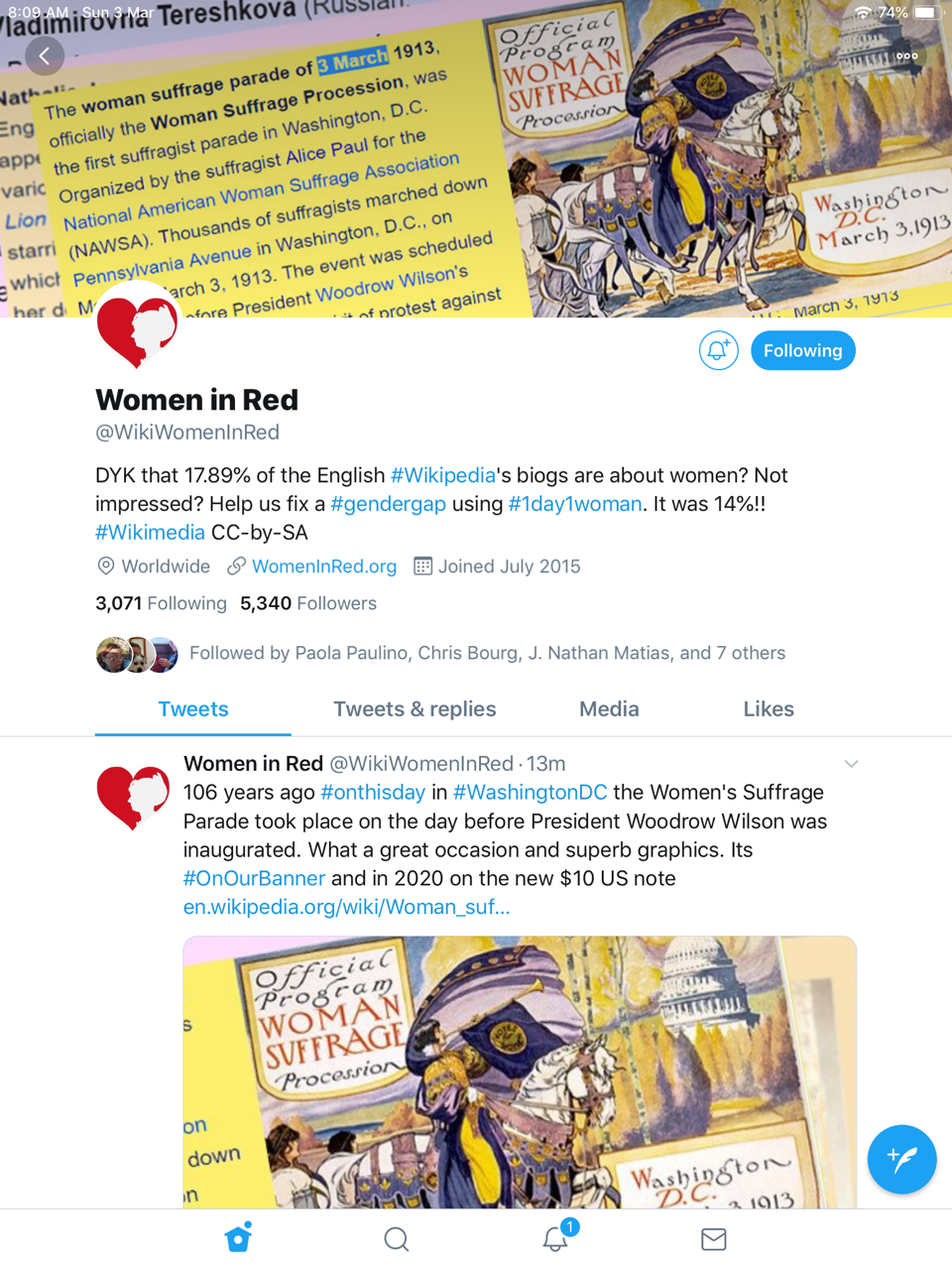
Here’s another one worth letting your students and fellow librarians know about – @WikiWomeninRed 
I don’t know how to end this. Just keep on being angry or outraged. And do something positive with that anger.

The Imitation Game

Recently I’ve been given to much pause of thought about learning and education, not the least following watching the movie “The imitation game” about Alan Turing’s code breaking during WW2 on the plane, followed by three days of intensive attending of presentations at 21CLHK.   It’s taken a while to try and crystallise my thoughts, and they’re probably still not as coherent as they should be, but these are my main takeaways.

While Turing is attempting to build a machine that will, in the long term, take over the work of cracking this (and other) codes, everyone around him is desperately engaged in a race against the clock. And at midnight each day the clock is reset, all work they did that day is useless and they start again from nothing the next day.  While I know that education is not exactly like that, I sometimes feel that a school year is like that Bletchley park day with a teacher racing against the daily clock, against the time-tabled period which they’re allotted to do one thing or another and then the bell goes or the summer holiday starts and we’re back at square one, but the child is handed over to the next person.  I’ve said before this is fine for the “middle”. It’s the children at the extremes where this handing over is most acutely observed, either in a positive or negative sense as they lurch through the process of learning and hopefully becoming educated beings.

Far worse is not only is Turing not supported, but the mediocre middle are out to destroy not only his machine, but him as well.

Ironically it is always easier, and more appreciated,  to work extremely hard at a huge volume of output,  than to openly take a step back and reconsider the foundation upon which practices and assumptions lie.

I’ve often decried the lack of longitudinal research in education. Our current high schoolers, what do they “look” like now (from a literacy standpoint which is my optical focus) and what did they look like when they were in G4 (my area of concern for my BWB club). And my G4’s where did they come from? How soon did their literacy attempts start to diverge from the middle? How about the ELL students? We know that the process of learning a language to CALP (cognitive academic language proficiency) level is a 5-7 year process. So when they exit an ELL programme after 2-3 years we haven’t even scratched the surface.

I attended quite a few sessions / presentations at 21CLHK that were symptomatic and typical of this “information” age. A deluge of ideas and devices and applications, delivered at a rate exceeding the absorption of most of the (highly intelligent) brains present.  I fear we employ the same methodology with our students. I know that I do. I get 40 minutes a week with my G5&6s and 20 minutes a week with the rest. Lessons and wisdom (in as much as I can claim to have any) needs to be imparted within a fraction of that to allow time for browsing of books. Teach the teacher they admonish. The teacher who has no time, as they race through a curriculum, that while enquiry based, demands 6 inquiries in 8 months. And where none of the units in G1 look at cars and planes or dinosaurs or dogs and cats or insects or space or the other obsessions a 6 year old has.

book-of-mistakes.jpg

I can read stories. Stories that I hope will cut through the clutter and touch their hearts. And I can but try to shove the right books in the right hands before the next group of wonderful eager expectant hugging children walk in. I sometimes say to my more illustrious and famous ex-MBA friends that I’m paid in hugs rather than dollars, and its true. I can try to show, not tell, them that mistakes aren’t important, it’s what you do with them that matters.

And then the Social-emotional (SE) dimension. Back to Turing. By the movie depiction he was socially inept, cared more for his work and ideas and machine than for the people around him. The movie at least gave a nice nod to the ideas of development of relationships and collaboration and the notion that a good team needs more than just raw intelligence. I do badger on a bit on SE Learning and the need for books and picture books to aid discussions and self-exploration / understanding.  I am confronted daily with students who struggle in this area, many of whom don’t have the “brilliant mind” that people like Turing had to perhaps compensate. The children who return a book and say – “it was an important book, because you know I’m also being bullied” and I look at them and I can see why their cohort would target them and how hard it is to protect them and turn the tide of otherwise nice kids performing macro and micro aggressions on children who are just slightly off kilter enough to merit the worst kind of attention.

And then you see an article like this one, announcing an OECD Pisa-like test for Social-Emotional skills. Please take the time to read and absorb the article and its implications. There is part of me that says perhaps the children who so desperately need interventions will get them. There is another (larger) part of me that knows that we do all sorts of other math and literacy testing that doesn’t lead to additional help so how on earth would we find the people, the expertise, the money, the time to devote to this area? And once it’s tested, and the tests are far reaching – even into the untouchable of untouchables in education – student’s homes, what will happen to the results? I’ve seen students desperately in need of having reading disability testing where parents have refused as they’re terrified of the stigma of a label even as innocuous as dyslexia as the child goes through school.

So I wonder, what can and should our responses be? Can we, should we, slow things down? Try to look at school as the whole process and learning as life-long – as we so often purport to do or hear the meaninglessly bandied phrase “life long learning” when all we actually do in schools is cut short every attempt a child makes at extending learning?

Chris Crutcher (author of Whale talk amongst other books) posted this on his Facebook in December (it takes a while to find amongst all his US-politics angst, so I will repost it here). I’ll leave you to think about it.

Almost everyone I know who dismisses the teaching profession wouldn’t last a day with this cool little dude (age 6!) – in a classroom where a whole bunch of kids see the world 180 degrees from him – before making him think he’s awful. This is the gamut range in EVERY classroom, k-16 and beyond. His teachers KNOW there isn’t an easy answer, but they come back and come back and come back, looking for what works; in an American educational environment crafted largely by non educators who would rather score high on mind-numbing tests of memory, than celebrate – and PAY for – creativity and expression and wildly different learning styles.

SO…this is for anyone who ever tells you teachers take that job so they can have three months off, or that “Those who can, do; those who can’t, teach,” and for anyone who needs a great example of why it isn’t:

WORD FOR WORD

12-4-17

N. School is hard.

?

N. I want them to leave me alone.

?

N. Grown ups. They want me to do work, but I am too tired. Then they keep bothering me with words. I just want to stay one hour cause school bothers me. I hate school.

?

N. Boring. It’s so boring. I don’t want to go to school.

?

N. I want to stay home and have fun. I can teach myself. I like to use my brain and think and learn without being in a big building. They don’t help us learn, they just suspend us. I already know what they say. I’m just bored. Games help me learn. Building things help me learn. I study things and learn and not in a big building. Computers help me learn. They tell me stuff I don’t know. They don’t let me learn there at school. I have to sit there and listen. I want to learn non-fiction because I’m a scientist. They are wasting my time.

?

I could be learning. I want non-fiction so I can study. They read fiction stories but I like non-fiction books and computers. They’re making me dumb cause they don’t tell me non-fiction. They want me to be normal, but I want to be a robot maker. They try to make me normal but I don’t want to.

? Normal?

N. Sit there and listen which I don’t want to. That is so dumb. I want to do stuff so I can learn.

? If you were the teacher?

N. I would have kids do cool stuff like learn how to build cool bridges. I never got to go to the computer lab. They make me do dumb papers but I want to use the computer, cause computers know cool stuff. I want to learn everything, but school is holding me back.

?

It takes me away from studying and learning. (Chris Crutcher, Facebook, 11 December 2017)


Advocacy is not enough we need power

Librarians are big on advocacy. Big on helping their peers when they’re not being heard in their communities or schools to build their “advocacy toolkit”. Most librarian courses include at least one module in one course on advocacy. Some academic librarians have built their careers on advocacy. But I’d like to cry foul. This has been going on for long enough.

Looking at advocacy it has a couple of tenants:

“Five Advocacy Tips
At the basic level advocacy is building relationships. The goal is to become a valuable resource for policymakers. No matter who the audience is, you should keep in mind the following:
1. Be confident.
2. Frame your message to answer the question, “So what?”
3. Plan and practice your message.
4. Present a clear and compelling message; less is more.
5. Offer yourself as an expert resource and provide examples from your community; stories are more compelling than statistics” (Advocacy toolkit).

I’d like to posit that the whole concept of advocacy is wrong. It is not advocacy that we need but a seat at the table. But the problem is that no one is going to shift over and make a place for people who are nicely, confidently giving compelling messages from experts. If anything after all these years of advocacy the situation has become worse rather than better. This is global, in all the countries that used to be bastions of (school / public) libraries and librarianship: the UK ; USA; Australia, and Canada.

I’d like to suggest that the decline in school libraries and school librarians is inversely correlated with the rise in EdTech or Digital Tech or Digital Literacy teams and resources. Those same UK schools claiming poverty when it comes to libraries have 900m to spend on edtech? And what I’m noticing is that the heads of these subsections do have a seat at the table, a link on the webpages and a say at every conceivable moment.  And I’m wondering, not saying this is a fact, just wondering out loud, whether it has anything to do with the fact that so many of those leading this corner of the education landscape are male as are most of the leadership in schools?  And while I’m a huge prosumer of tech and use it extensively in my teaching and learning, I’m suspecting it’s not really helping our students’ literacy – even their digital literacy ($129b pound investment by 2020 for students to have “basic” digital literacy and no one’s saying the numbers don’t add up?).

There have been two little discussions on the various librarian network groups I’m on that relate to these questions.

The first was about the merits of becoming Google Educator certified. It’s a push at most schools and apparently something sought after by  recruiters. I’m flabbergasted. Google is so frigging smart. And we’re being conned. And no one is crying foul. I grew up with computers as they burst into the scene in the early 80’s. I could use every iteration of word processing, presentation and spreadsheet tools from the very first most basic google librarytypes. When I say I can use, I REALLY can use. I know how to use templates, make an index, do auto-intext citation, add captions, make data tables, pivot tables, look ups, statistical analysis, import addresses into labels etc etc. And what I don’t know I know how to find out how to do, either online or because I know people who know their S*** around this type of stuff. People of my generation and younger. I also have an Education masters in knowledge networks and digital innovation and follow all sorts of trends and tools and try everything at least once.  I can use basic HTML and CSS and find out how to do anything if I get stuck. I know how to learn and where to learn anything I need to know and I’m prepared to put in the time to do so. This is in a “just-in- time-and-immediate-application-and-use-basis”, rather than a “just-in-case – and-I’ll-forget it-tomorrow-and-probably-never-use-it-basis”. So can you tell my why I would bother wasting my time and money becoming GAFE (or anything else) diploma’ed when the equivalent is for me to go from driving a high powered sports car to getting a tricycle license? I feel the same way about this as I feel about people saying you don’t need libraries now you have google. Well actually I feel stronger about it. It seems like every single for profit educational technology app or company is now convincing educators that the way for them to be taken seriously is to “certify” themselves on their tools, something that involves a couple of hours of mind-numbingly boring and simple video tutorials and/or multiple choice tests with or without a cheapish fee and then to add a row of downloadable certs into their email signatures like so many degree mill qualifications on a quack’s wall. And then these are held in higher regard (it seems) than the double masters degrees it takes to be a librarian??  Not a game I’m prepared to be playing.
Then next question was about an upcoming education conference – I’m not going to name names but it’s a biggie, and  one of my fellow (male) librarians managed to convince the organisers to include a library strand. Bravo for him – he’s obviously got a voice that’s being heard and this is a huge step forward. BUT, as he and I discussed off-line, privately, when I mentioned the word “echo-chamber” we’ll all be sitting at the wrong table. A nice table. An interesting table, a stimulating table, a worthwhile, practical, intelligent table with some wonderful people (librarians really are super people, I wish I’d discovered them a lot earlier), but the wrong table. And even if our “strand” is open to others, we’re in direct timetable competition with some pretty heavy hitters who are in other very enticing and compelling strands that just beg to be explored. Strands that I as a librarian with an M.Ed have covered in my degree with some of these hard hitting thought shapers. But I’ll not be at those tables, because I’ll be in the librarian strand, where we all agree, and where I can guarantee there will be some mutual hand wringing on budgets, staffing, literacy and advocacy issues. And I can almost certainly also guarantee that none of the librarian strand events will be attended by a single education powerbroker who is not a librarian (please prove me wrong – someone – anyone?).

So I’d say we don’t need advocacy we need power. And to get power we need to be political. And librarians, like language teachers are not very good at politics. We don’t like being unpopular, we want to be accepted and needed, but I would argue we no longer can ethically rely on advocacy, children’s literate lives are at stake, we have to enter the fray.

(I’ll add a personal disclaimer here, I work on a campus where my (female) leadership team is incredibly supportive of the library, invites me to leadership meetings and where I do have a seat on (some) tables. I also was highly flattered when one of the teachers rose up to bat for me last week on a visibility issue. But I’m aware that I’m probably in a minority, which is why I wrote this post).

#1 Digital resources

In an attempt to blog more regularly, I’ve signed up for a challenge – so these posts will be in amongst all the other stuff I may be blogging.

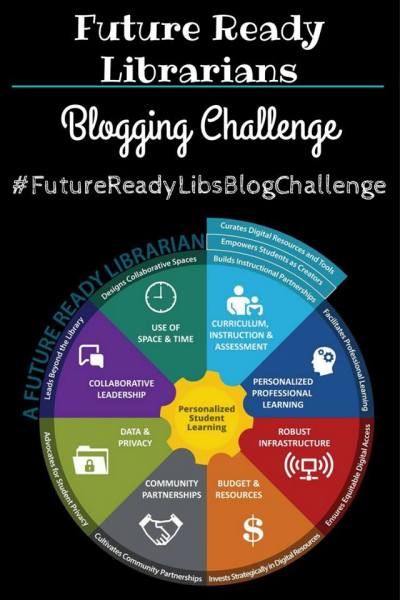
#FutureReadyLibs 10-Week #BlogChallenge Challenge #1: How did you get involved in the Future Ready Schools/Future Ready Librarians initiative? Are you involved in the district strategic planning process? What is your vision for a future ready school? What makes you a Future Ready Librarian?

How I got involved

Well I guess it was just a result of being added or adding myself to a Facebook group that looked interesting. Sometimes things just happen that way.  Also since I’ve just finished my MIS and M Ed degrees I’m still vaguely interested in this type of thing, in order to keep my learning up to date.

frlblogchallenge1I think our school, as an IB PYP school is pretty future-ready in many aspects, in fact sometimes I think the cost of being “future ready” is that you occasionally need to go “back to basics” and check up on the 3 R’s and make sure you stay sober and self-critical.

Am I future ready as a librarian? Looking at the little graphic on the left, I can tick most of those boxes, or slices, inasmuch as things are in my power at least. And where not, I’m constantly nudging for change.

I’m not entirely sure if I’m on the right topic for this week – I’d note “digital resources” so I’ll write a little about that.

Curates digital resources and tools:

When I started my job at my current school I’d come from working part time in a secondary library where a large part of my time was spent creating library guides for the Middle & High School (including the IB).  I was lucky to have Katie Day as my mentor, and we had many many discussions on how to curate resources so that students had easy access to them from their laptops (they’re a one-on-one macbook school in secondary). The idea was to have digital resources in the form of videos, curated Flipboard articles and database access, but at the same time make our physical resources digitally visual and “clickable” for later borrowing as necessary.

Screen Shot 2017-03-28 at 4.55.31 PMSo, a few weeks into my new job I discovered we had an unused library guide subscription, and I immediately put it to work. Of course curating for primary is a somewhat different proposition. Immense more thought and care needs to be put into ensuring things are age appropriate – in content, in level and in access.  And I was a newbie … so it was a case of building things and hoping they would come. It’s taken a while. After the first year, a couple of teachers were on board, and now more and more are coming to expect and use the resources. My main objective is to move away from letting kids “just google it” to an idea of just like we don’t throw a bookshelf full of books into their UOI (unit of inquiry) boxes, but make sure they’re appropriate for the grade level, for the central idea, for the lines of inquiry, and may even evolve as they go through a unit, so too we can have digital resources that are similarly curated.

A few things have been a huge boon in this respect.  In the first instance I cannot express my admiration for Epic books enough. They are an absolute game changer.  In terms of depth and breadth of their books they far surpass the incumbents such as Tumblebooks. I do have some librarian type quibbles with a few of their set-up methodologies, but that’s small fish compared to what they’re achieving.

Secondly, Springshare – the owners of Libguides are just phenomenal in their ability to constantly evolve and develop their platform. I love the fact that the libguide community are so amazing in their ability to creatively curate, to combine physical and digital and particularly the fact that they demonstrate CREATION and SHARING, which is absolutely what a future ready community should be about.  Also, my desire to make good looking guides has pushed me to learning some (very basic) HTML which never ceases to impress the fine young gentlemen and ladies in my library who then realise I’m not just an old library lady!

Thirdly LibraryThings for Libraries through their book display widgets they bridge the gap between a lovely visual interface (libguides) and an old stodgy very unfriendly catalog (Follett Destiny).

As far as tools are concerned. I try to keep introducing appropriate tools to my students and to fellow teachers – but only if they are meaningful. It’s a balance. Our students are “over tech-ed” and we’re getting a lot of pushback from both parents AND students about the amount of time they spend in front of a screen. So where it saves time, hassle, helps make things neat and well spelt, sure. Otherwise it’s back to the physical.

Empowering Students as creators

I’m very fortunate to be in a school environment where there is an EdTech coach and a STEAM coach. So wild ideas for physical or digital creation can be co-shared with them. We’ve had students create book trailers, book recommendations, book spine poetry, book covers, their own books, display work pieces in the library etc.  I don’t think any of that is particularly special though – most librarians do that kind of thing in conjunction with their students and teachers – it sure makes displays easier!

Builds instructional partnerships

That part is definitely a work in progress. It’s tricky. I could blame a whole host of things – fitting in 35 classes a week on a fixed schedule, a yet to be approved information literacy scope and sequence that’s embedded in the curriculum, running, managing and keeping up to date (and renovating) a facility, curating digital resources in library guides … but instructional partnerships is a ball I’ve dropped. Or actually never really properly had in the air. It works piecemeal, depending more on relationships and invitations than being structural. I’m working on it with my fellow librarians from our other campus, the head of curriculum etc. It takes time is all I can say. And I don’t think I’m the only one saying it judging from the comments of my fellow teacher-librarians.  I beat myself up about it a LOT in my first year. To the point of tears. This year I’ve been distracted a bit by the renovation and staff medical issues. But we’re inching there.  Watch this space.