I’m super late in sharing this presentation I gave the the L2L (Librarian to Librarian) workshop that I co-organised in Dubai in 2023.
Having worked in the Middle East for the first time, and with a predominantly muslim demographic meant I needed to get up to speed on what ensuring our collection mirrored our students would mean. Here are some suggestions – I’m no expert and have suggested links to people who are and whose guidance in this area was invaluable.
Here is the slideshow with some suggestions of books to add to a collection.
Despite appearances to the contrary I’ve actually been extremely busy blogging this month, doing a daily blog over at GLLI-US.org. Here is a summary of the month’s blogging with links to the individual blogs: ——————————-
I hope you’ve enjoyed my advent calendar type selection of “displays” for the month of December with a variety of ways to slice and dice collections and perhaps you’ve even found a few new or different books to add to your collections.
A couple of people have asked me about the how and why and wherefore of these posters, so in this wrap-up I’ll give links to the templates and also some ideas of how they are used in the various contexts. Generally all posters are put into A4 presentation books and are available in the ELA classrooms and in the library. Some selections are used for displays at the entrance of the library or on the display wall. Others are more of a “pop up” display when different classes come into the library to browse or borrow books with their classes.
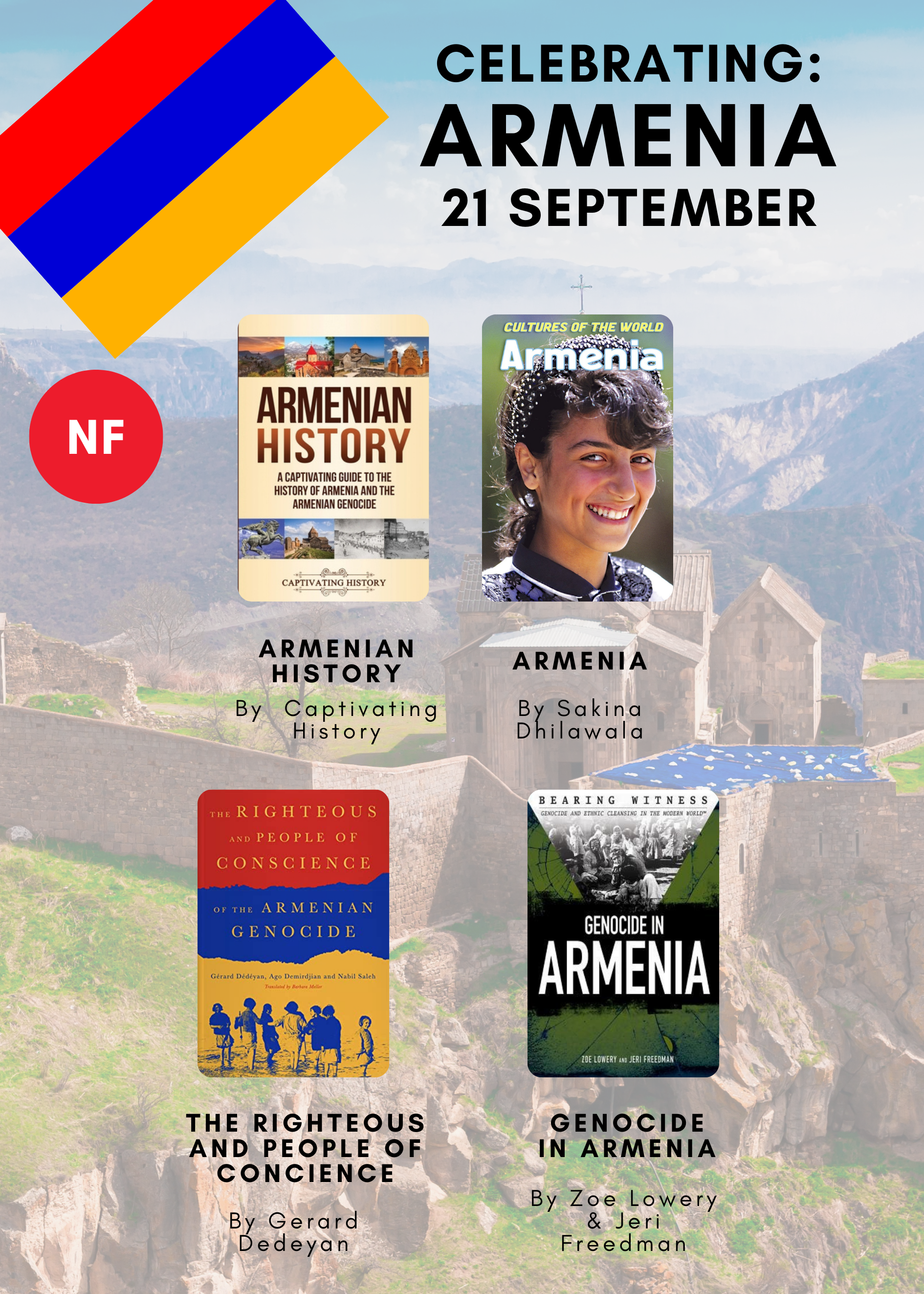
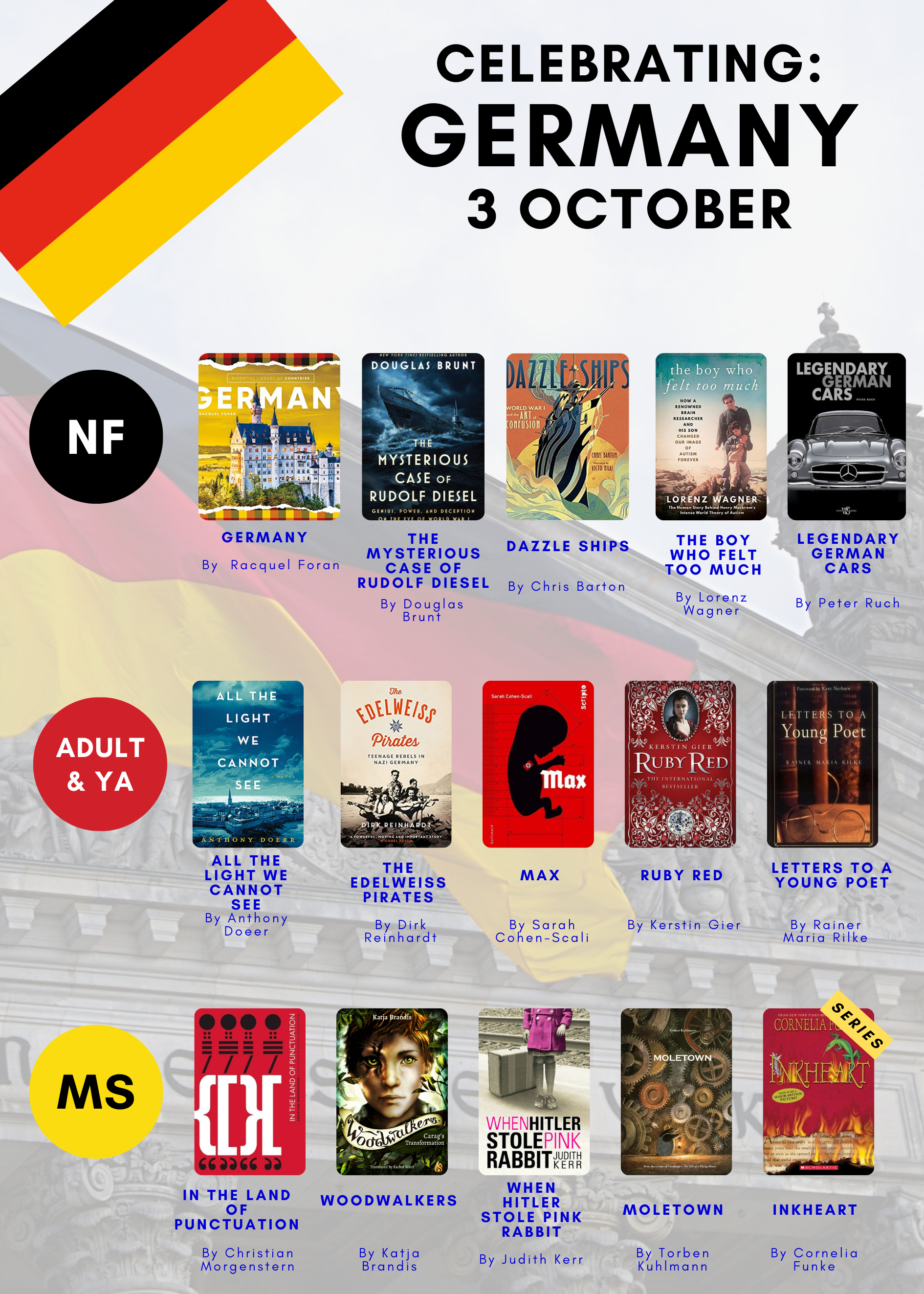
Country Celebrations
Country celebration posters are sent out in our student and staff bulletins to coincide with the National Day of the various countries. I asked our Powerschool guru to run a list of all countries where we had at least 3 students having the country as their first, second or third passport, got a list of national days and worked from there. Sending out those email “birthday cards” is one of the most rewarding things I do as a librarian as I get so many thank you emails in response and students and adults coming in to borrow some of the books on the list. Depending on how busy our display space in the library is, I may or may not display the books at the library entrance.
The read around posters are shared with our teachers of various subjects and generally they print them out in A3 size and put them either on their walls, doors or display boards outside their classrooms. Sometimes, when students come into the library with their ELA or Social Studies teachers I’ll have the books laid out on tables for them to have a look at and borrow.
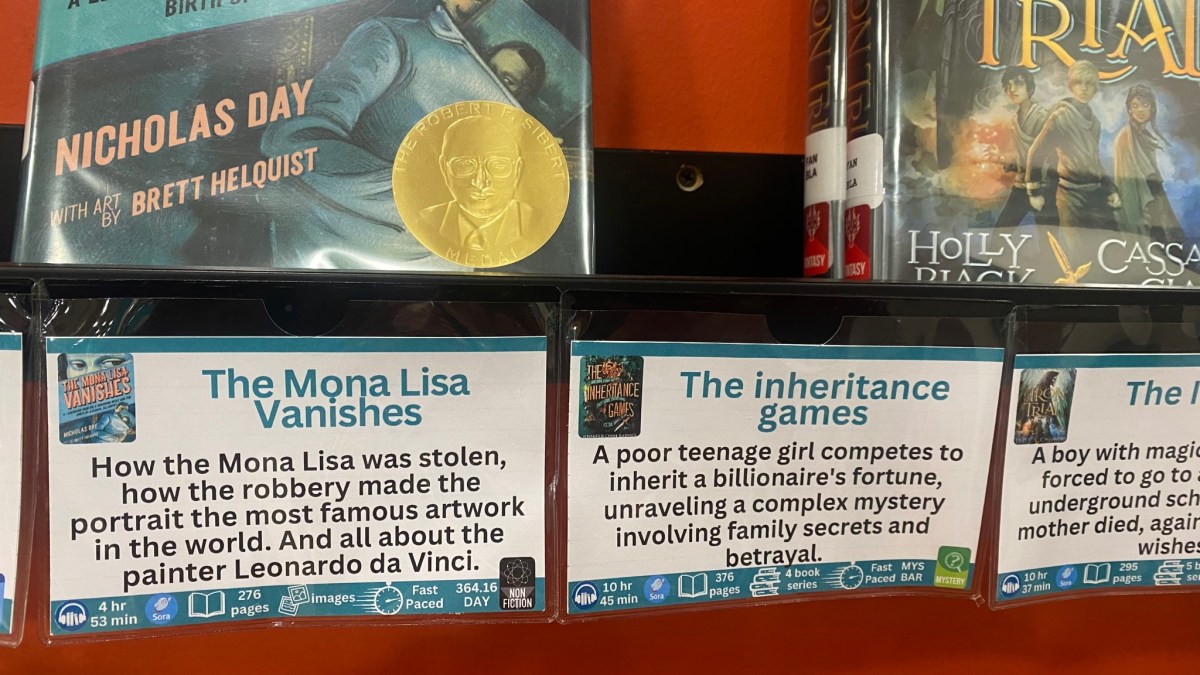
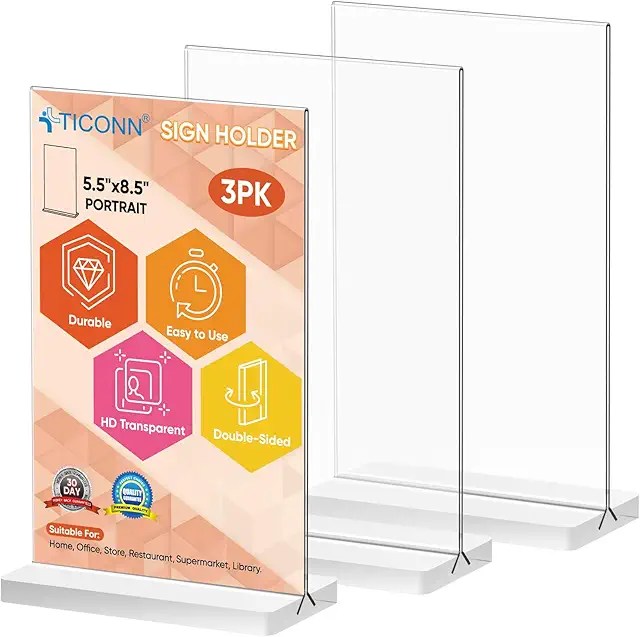
These and many other “Read alike” posters are printed in A4 and put into plastic “look book” presentation books that are available in the library and also in all our English Language Arts classrooms. Since our middle school students come to the library with their classes around once every 4 to 6 weeks, it makes it easy for students to browse for books in the classroom thematically and then go to the library with purpose in between the more formal library visits. When they come with their classes, I’ll generally confer with the teachers as to what they’d like displayed / what’s “hot” or wanted and then I’ll haul a bunch of tables to a part of the library where they can browse. Then these posters will be put into A3 acrylic sign holders on each table.
By Nadine Bailey – middle school teacher librarian, currently living and working in Dubai, formerly in Beijing China, Singapore and a bunch of other cities around the world. Passionate about our students seeing themselves and their worlds in literature and developing curiosity and a passion for reading and learning.
The views, opinions, and thoughts expressed in this blog post are solely my own and do not reflect the positions, policies, or opinions of any current or former employer. Any references or examples provided are intended for informational purposes only and should not be construed as endorsements or official statements from any organization I have been associated with.
For a while now I’ve been wanting to highlight the curation of books related to the countries and cultures of our students, and finally this year I got around to creating posters “Celebrating xxx” which I post to our school bulletins for students and adults respectively. It’s been a bit of a chicken and egg project – knowing how many students we have from each country / culture – which in itself is truly not as simple a task as it may appear. We use the proxy of first, second and third passports, but as anyone who lives internationally knows, life is a tangle of multiple strands with immigration, migration, expatriation, languages, refugees, fleeing and arriving, births and marriages and transferences and identities. So in the last two years, using this list I’ve been scouring book lists, book catalogues, recommendations, book prizes to where we finally have, for most of the countries with more than 2 students, at least a couple of books besides a travel guide.
A couple of books. How easy that rolls of the tongue. But anyone with a conscience and an iota of empathy will know that that is another potential landmine. I have carried shame for my country of birth, South Africa, for decades, and still often have trouble admitting to its citizenship since I still feel the personal burden of all the wrongs committed by people of my race. It is right that a representative sampling of literature of my country includes reference, analysis and depictions of the pain and despair that apartheid has wrought. But that is not all we are as a nation and people.
I have not yet made the list for South Africa. But that was the dilemma I faced when curating the poster for Germany. A country with a 1000 years of literature beginning with the Nibelungenlied. Whose literature I studied in translation at UCT while ignoring my true passions suppressed doing a commerce degree. Yet looking at the books we have in the library, it appears that the war years, in particular the second world war, and specifically the war atrocities, is the primary lens through which our students form their Germanic world view. Again, it is right and proper that authors, beginning with people like Günter Grass, who, in his time was vilified for daring to address the near past, should shine a light on a terrible past. But that is not all by which they should be known. And more than anything students need to become aware of nuance. By the realisation that it is possible to hold two opposing views in one’s mind simultaneously. And if not through literature, how will they learn that? How sad is it too, that all the books we have about Armenia are about the genocide?
So far I have received nothing but gratitude from our community for both curating / purchasing these books and highlighting them as their national days come by. It is I who is filled with doubt and desire to be able to offer more. And despair that in many cases there isn’t more as countries are ravaged by war and poverty – at times literally with bombs and other times with the devastation of censorship, cultural and monetary poverty and lack of access to publishing and translation of the words that need to be heard by their people, its diaspora and the rest of the worlds children and young adults / adults. We deserve more than the “lonely planet” and “countries of the world” as nice as it is to at least have that.
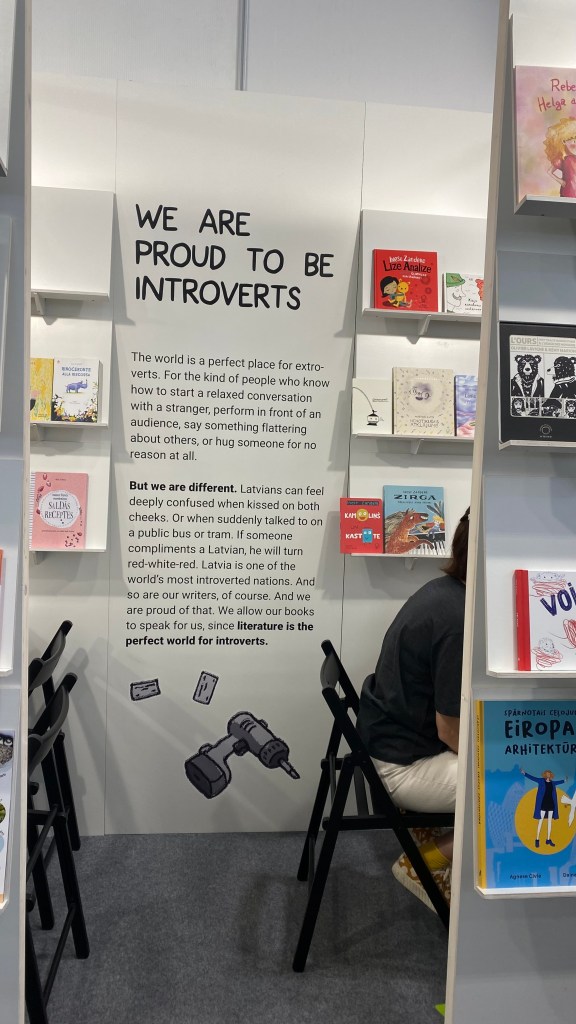
One of my book related highlights this year was being able to attend the Bologna Children’s Book Fair in April 2024. It’s been on my radar for years and the fact it took place during our school vacation and I could join a bunch of fellow librarians who were similarly disposed made it less of a “thing” to attend. For I am not fond of very large crowds in overwhelmingly big exhibition spaces (thank heavens for the Latvians who are proud to be introverts and celebrated that in their stand!) . Below are a few of my thoughts on the event.
The place of librarians
I’m not sure how to say this politely, but, like any other system, the publishing world for children is its very own special little ecosystem – this being the European version – I guess a kind of sub-species of the dominant USA version, where of course all the neighbours and relatives were free to join. Don’t get me wrong, I’m happy where-ever books and reading are celebrated, but I was quite fiercely put in my place during one of the sessions “PISA IN BOLOGNA. HOW TO FIGHT LOW READING SKILLS”. After the session – not during (I would not have dared) I asked the moderator Daan Beeke, Network Manager EURead, Stichting Lezen, how it could be that libraries and librarians were not mentioned once during the whole panel session and I was rebuked for thinking that this event was for anyone but publishers and marketers for the sales of books. Bam. And there I was thinking that us librarians were at the forefront of encouraging reading and fighting low reading skills. Or maybe could it be that there is a correlation between low reading skills and lack of support and funding for public and school libraries? Just maybe?
The place of the environment
I was extremely happy to see that “the environment” was featured prominently both in the exhibition spaces and on the event programme.
The events: “READING FOR A HEALTHY PLANET: INSPIRING CHILDREN’S BOOKS TO HELP ACHIEVE A SUSTAINABLE FUTURE” organised by the United Nations, and “UTILIZING STORYTELLING IN PRODUCT, MEDIA, PUBLISHING AND CONTENT TO CATALYSE SOCIAL AND ENVIRONMENTAL CHANGE” moderated by Helena Mansell-Stopher of Products of Change, and “SEA OF STORIES”
For 2024 the Special Category for the “BolognaRagazzi Award” was THE SEA. WINNER: Gianumberto Accinelli, Giulia Zaffaroni, Giù nel blu – Dalla superficie agli abissi: viaggio sottomarino sfogliabile. Nomos Edizioni, Italy, 2021 SPECIAL MENTIONS Antoine Guilloppé, Pleine Mer. Gautier-Languereau, France, 2018 Masakatsu Shimoda, 死んだかいぞく (The Dead Pirate). Poplar Publishing, Japan, 2020
One thing that super saddened me was that the whole event didn’t have the environment at the forefront as plastic bottles abounded and I didn’t notice any water fountains or water filling facilities – we brought our own bottles and of course the tap water from the bathrooms is 100% fine, but it would have been wonderful to see the events – in particular the ones on sustainability featuring reusable rather than plastic bottles.
The fair had two events around this topic: “ORIGINS: INDIGENOUS VOICES IN CHILDREN’S BOOKS” Moderator Dolores Prades, Founder, Director and editor, Istituto Emília, Brazil Panel Nat Cardozo, author and illustrator, Uruguay; Adolfo Córdova, author, Mexico; Jason Low, publisher and Co-owner, Lee & Low Books, USA; Aviaq Johnston, Inuk author, Canada; Victor D.O. Santos, linguist and children’s books author, Brazil/USA; David Unger, author and translator, Guatemala/USA; Eboni Waitere, Director, Huia Publishers, New Zealand.
The representative of The Indigenous Literacy Foundation (ILF) of Australia who won the prestigious Astrid Lindgren Memorial Award (ALMA) and is the 2024 ALMA Laureate, is a late inclusion on the panel and her discussion at 45.06 of the video below about the work they do, is worth listening to.
and “THE MOST PRECIOUS THING: VICTOR D.O. SANTOS IN CONVERSATION WITH VERA GHENO” – I wish the English publishers had retained “the most precious thing” as a title instead of “what makes us human” – just a personal quibble.
The place of dissent
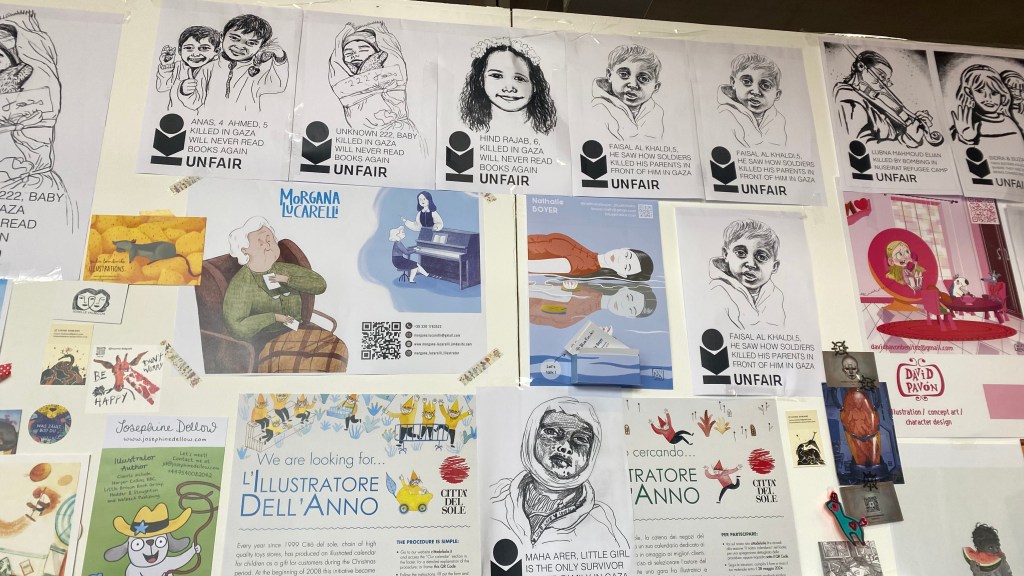
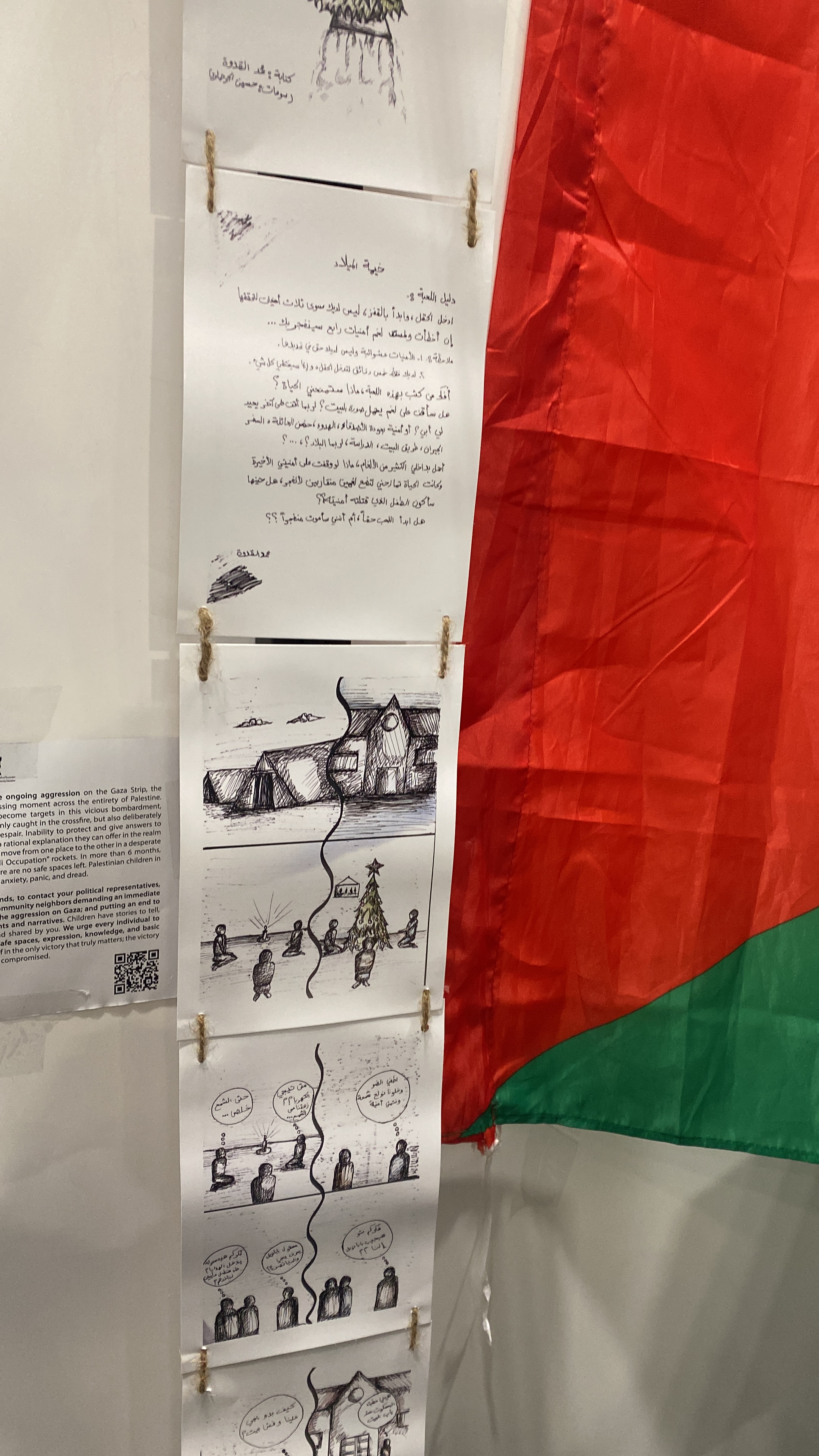
Following the issues around the 2023 LiBeraturpreis which was to be awarded to Adania Shibli, at the Frankfurt book fair last year, I was interested to see how and if dissent and awareness of geo-political issues would be handled in Bologna. There appeared to be a guerilla type of image bombing in the illustrator walls, some of which seemed to appear and disappear. Both Isreal and Palestine had representation.
It saddens me that while children are expected to live and die through wars, they have very little representation and “place” in children’s literature – yet – and what there is still focuses very heavily on the second world war experiences.
I find this type of header in the NYTimes to be quite disturbing “Teaching Young Children About War Without Frightening Them – Four new picture books tackle the subject in sensitive, reassuring ways.” I literally have no words about how insensitive that heading is.
I’ll write a whole separate blog on this some time – in the meantime please have a look at the lists created by Dr. Myra Bacsal on her Gathering Books Blog.
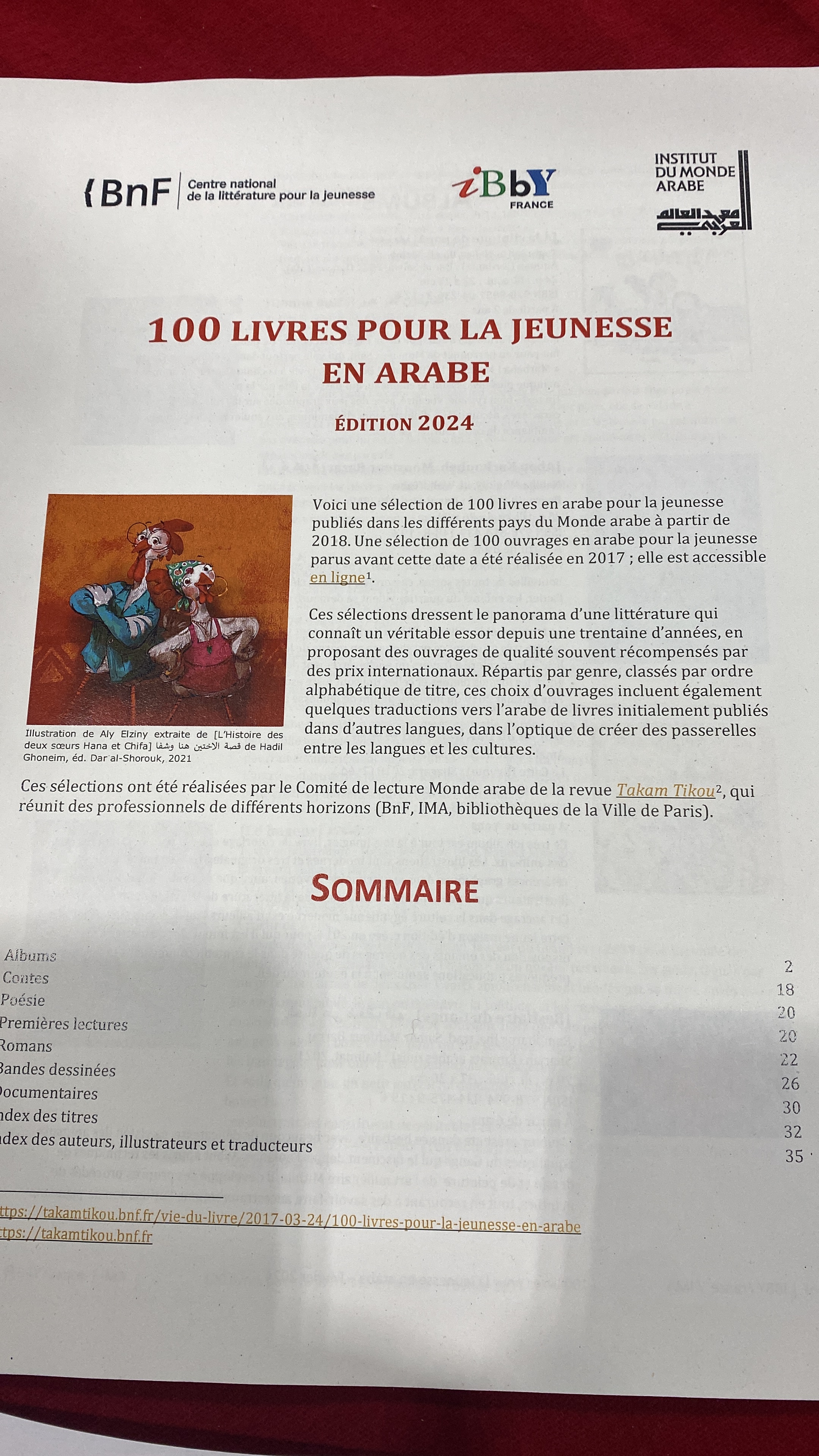
Given my own geo-location at the moment, I was interested to see that IBBY France has created a list of 100 books for young people in Arabic – here’s the link for the English version.
The place for silence
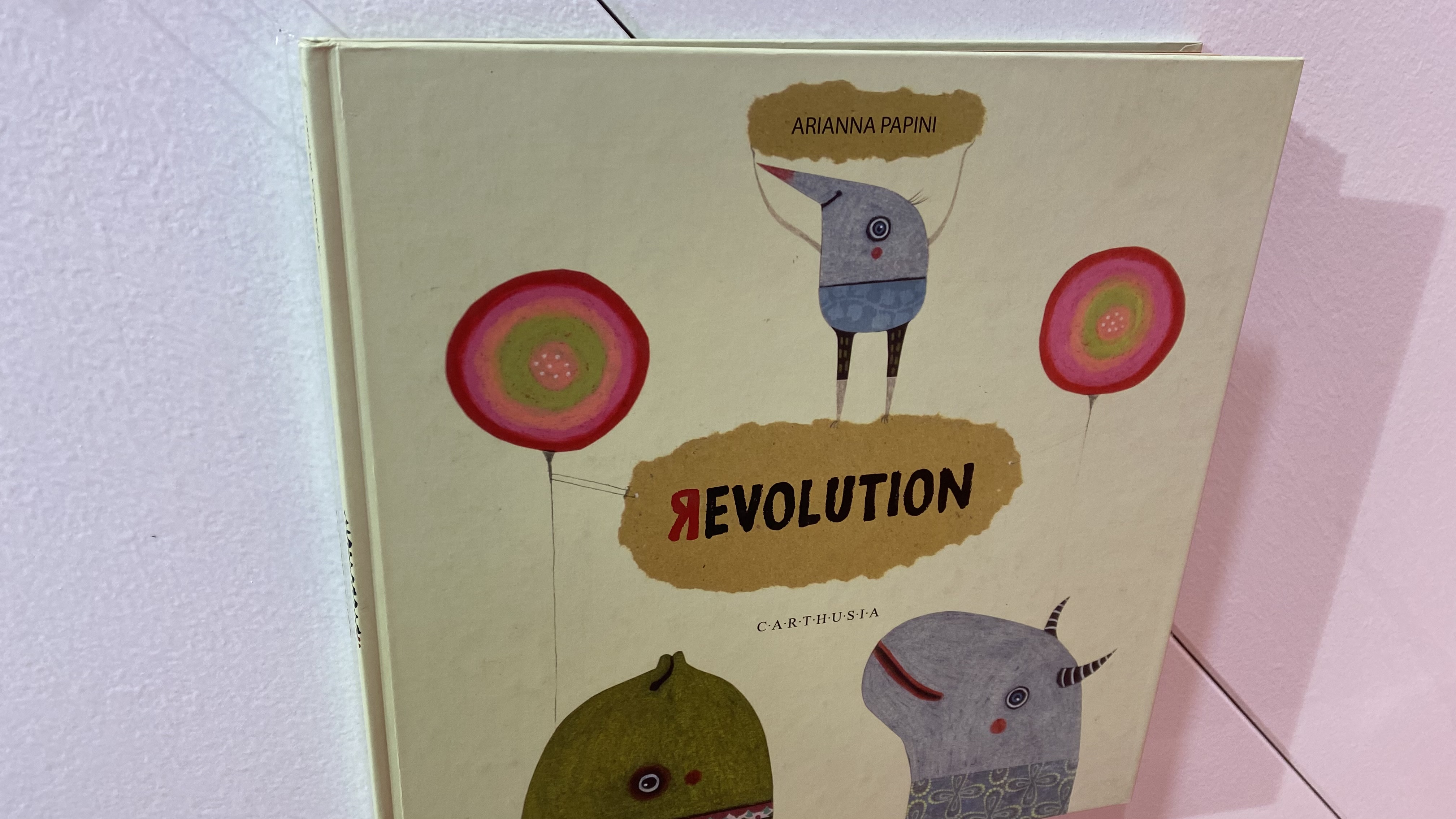
There is a special place in my heart and every library I’ve had the pleasure of working in for “wordless” or “silent” books, and the fair didn’t disappoint in that regard. Of course the highlight is the Silent Book Contest – Gianni De Conno Award and the exhibitions of the artwork around the award, as well as the previous years award winners. These are just the best books to have in your library for accessibility, thought provoking conversations and writing prompts.
I’ve had another lapse in blogging, not that things have been particularly quiet – in particular I managed to mis-step on some stairs in the center of Beijing in early April, thereby managing to fracture both my posterior and anterior malleolus (i.e ankle) resulting in my first ever ambulance ride and some pretty nifty ankle surgery inserting two titanium pins and being off my feet for 2 months, followed by quite a bit of rehabilitation. I’m happy to report that the Chinese saying 伤筋动骨100天 (injury to muscles and bones take 100 days) is absolutely correct – I’m finally capable of walking.
Luckily my brain wasn’t affected and in the interim I’ve given quite a few presentations – happily quite a few in collaboration with the veritable Katie Day who reminded me today that we should both document them before they slip into the oblivion of what was quite a year!
When you’re asked to present or be a panel member at a conference some time in November, and the presentation is in May, you suffer from a type of time illusion that makes you say yes, comfortable in the idea that it’s far away – and you keep on saying yes to different people at different times and don’t register that they’re ALL asking for May, and then suddenly you’re spending 20 hour work weeks on top of your usual work-week getting your ducks in a row to say something that won’t embarrass you too terribly – and the process is wonderful – particularly if you’ve got a great co-presenter but at the same time it’s pretty scary!
So this was the Month of May!
Toddle TIES Conference – 16 May – “Library at the Heart of the School – Developing Inquiry and Research.” A great panel moderated by Kirsten Durward with Bec Taylor, Carlos Diaz and Lamiya Bharmal the recording can be found here (click on 16 May) where we talk all things research and curation, each from a different perspective and school section (early years, primary, middle and secondary)
Then came the fantastic ECIS Library Week – the organising committee really knows how to throw together a compelling set of experts and practioners who can give some excellent presentations from things to think about to some very practical “how to” or “this is something I’ve done that worked”. Katie Day and I had each put in to present and then decided to combine our efforts on the two presentations, one a more macro view and one a more micro view on the ideas of IDEAS (Inclusion, Diversity, Equity, Accessibility and Social Justice – acronym used at WAB where I work.)
Our first presentation “Moving IDEAS to REALITY” (26 May 2021) was around how the work atInternational Schools around IDEAS is being actualised. The presentation was based on a short survey we sent out to International School Librarians. Our slides and the results of that survey in detail can be found here. This presentation focused on how through Saying (language) Doing (behaviours and actions) schools could move to Being (internalising the espoused values). This was a more macro / theoretical view on what diversity means in the international school context and in particular to international school librarians (recording is available to participants).
The next presentation – (given by me slipping out of my son’s graduation dinner for a quick hour – with his permission) was entitled “#NotOurDiversity: Beyond BANA” (29 May 2021) (slides; recording). Trying to move beyond paying lip service to “mirrors, windows, sliding doors” in the international school context is NOT easy. Despite the tremendous and well overdue and much appreciated work that is being done in BANA (Britain, Australia, North America) their diversity is not “our” diversity in the international school context. We discussed and gave examples of mono- multi- inter- cross- and trans- cultural books that we use in our schools and their relative virtues and failings for our students. The problems for international school librarians of existence, discoverability and availability of the books and the people and organisations we wanted to give a shout out to for their work in this area. Please have a look at the link to the slides for some fantastic titles and resources / people to follow in this area.
Finally at the end of May I was on a panel at the Asian Festival of Childrens’ Content (AFCC) “Connections to Global Issues: how teacher-librarians are supporting the UN SDGs and beyond” (30 May 2021) with Katie Day as Moderator, and fellow panelists Zakir Hossain and Stojana Popovska, where we focused specifically on supporting schools in incorporating the SDGs into the curriculum. (slides)
So that was the end of a very busy month! Including visits to my very excellent physio and surgeon, working and preparing!
Aside: I’m not totally happy with the new WordPress “block” feature – it’s really annoying me in the way that images appear and it’s non-intuitive nature – even though I’m sure that wasn’t their intention! Having to go into the HTML code in order to align and pad the images is an unnecessary waste of time!
Our G6 Language & Literature classes have just started a unit on “Unlikely Heroes” and I must admit I’ve been having an amazing time finding some fantastic new biographies and memoirs to entice them into reading this genre and keeping an interest in the lives of people who may not always make the headlines, or who they may not be aware of, or who they only have an inkling of.
Two very interesting stories from the sporting realm are those of Jesselyn Silva with “My Corner of the Ring” (boxing) and Ibtihaj Muhammad with “Proud: living my American dream” (fencing). These are a double win to my mind featuring both lesser written about sports for middle grade students AND featuring young girls from non-traditional backgrounds in those sport – I have a daughter who fences and I know exactly how expensive (and sometimes snobby/exclusive) we’ve found it. There’s also the recent cliffhanger with young football players in Thailand, excellently written about by Marc Aronson in “Rising Water : The Story of the Thai Cave Rescue”.
Through my privileged connection with the Neev Children’s book awards, I’m able to encounter books that I wouldn’t otherwise be aware of such as “Like A Girl: Real Stories for Tough Kids” by Aparna Jain that showcases the lives of 56 Indian ladies, who may not be familiar to our students. Another book worth mentioning is the hybrid graphic novel / biography Indira by Devapriya Roy and Priya Kuriyan (Illustrator). What makes that book special is the way it weaves in how writing research is conducted in present day with the historical facts.
The last three books, are ones where he is part of an anthology. One thing that we’ve started doing as part of this unit, is where there are a number of “heroes” in one book, we’ve added all the names in the table of contents to our cataloging record. That helps students to find different perspectives, formats, lengths of explanation and viewpoints of the same person. We’re hoping that some students will start with one of our many combined biographies, for example the great series of “Forgotten Women” by Zing Tsjeng or the “Goodnight Stories for Rebel Girls; or The Good Guys or Stories for Boys; or Stories for Kids; or “A History of the world with the women put back in” by Kerstin Lücker & Ute Daenschel and end up further researching one particular person who catches their interest.
An amazing thing has happened to nonfiction since around 2016. The visuals, design and layout has improved to no end, so books have become so much more enticing. I’m also loving the fact that biographies of women are no longer so ugly and we’re finding out about other amazing women such as Didda the ruler of Kashmir from 958 CE to 1003 CE (Queen of Ice by Devika Rangachari).
More of the wonderful books and how we categorised the various types of heroes around this unit can be found on our library guide. The revolving book lists (created with LibraryThing for Libraries) on each section lead back to our catalogue where students can see if the book is available and if necessary put the book on hold.
Next time I hope to write about some more fabulous nonfiction recent finds related to other curriculum units.
I was prompted to think about this again with the publication of the White Ravens 2019 list at the Frankfurt Book Fair. The issue of increasing diversity in an international school setting is a complex one, and something I’ve written about at length in the past.
In English
There’s the linguistic diversity bit – collections of books in “Languages other than English” (LOTE) (that post is getting a bit long in the tooth and probably needs updating) a more up to date article featuring Jeremy Willette can be found here. Though I do object to the phrase “mother tongue” the reality of many of our dual language students is that the language other than English medium at school could be that of either parent, but is often that of the father. So I prefer to refer to “home language”. In 2014/15 I went through somewhat an obsession on language, researching it to death, you can find some of the posts on that here. The one thing I would definitely add to this conversation is that unless the LOTE collection is updated regularly and championed by teachers and parents or a language based club, they often don’t earn back the investment in purchasing and the real-estate they occupy. So if you want to invest in a linguistically diverse collection you also have to invest in a mindset of pride in home language and a sense of ownership over the collection and its maintenance within that linguistic community.
The hardest part internationally is that issue of “not our diversity“ . If you have a moment, please read that post. Students who are in international education often defy the traditional (North American) definitions of diversity. They are not poor, black, hispanic, urban, immigrants. That is not to say that it’s unimportant for our students to be exposed to stories of all these groups of people and more. In fact their privilege demands that they access poverty, racism, immigration and need through the windows of literature. But those versions of diversity are not mirrors for them. With a great budget we have no shortage of windows. It’s the mirrors we lack.
And again, when we have these diverse books, we still need teachers and librarians and students and parents who will read them and champion them. Students who will dare to take a book with a cover of someone who doesn’t look like them and read it.
The thing with international students is their lack of homogeneity – something I encountered when looking at linguistic diversity. This table (from my 2015 research) speaks to some of the many variations. (Yes, in those days I also referred to MT /Mother Tongue). So one of the most important sources of mirrors for our students often is books in translation. Particularly for the “globetrotter” subsection of our students. Looking at the White Ravens list above doesn’t give me that much comfort I’m afraid. The issue I have is that most of the books in 2019 are BANA originated (Britain, Australia/NZ & North America) with the exception of one from the Philippines and one from India. 2018 was a bit better (one from Romania, India, Ghana and Korea). The list is unwieldy, you can’t search by age group. And you can’t get a print out.
Some more sources of inspiration include the various IBBY organisations. Including USBBY – even though the criteria for inclusion on the list is includes: Books that help American children see the world from other points of view; Books that provide a perspective or address a topic otherwise missing from children’s literature in the U.S; and Books that are accessible to American readers (where accessible can mean a multitude of things). Again, painfully it’s hard to get a simple list to down load – no I don’t want a pptx, or a bookmark, I just want a list to print out to buy from. And IBBY UK. Their latest publication: Children’s Literature in a Multiliterate World looks to be particularly interesting. One lives in hope.
One of the many things that concerns me with all of this, is the emphasis on picture books. Don’t get me wrong, I’m a HUGE fan of picture books. But the over-reliance on translating picture books? It just adds a PB to the five F’s (food, fashion, festivals, folklore, and flags) of pretending we’re oh-so-international and inclusive.
The Global Literature in Libraries Initiative is more cause for hope. Particularly as they reach out and co-opt people in-situ to aid with their uncovering of local treasures.
In this diversity quest, one is often more of a sleuth than anything else. For example needing to have a look at awards like the Astrid Lindgren Memorial Award and then looking at names of authors and illustrators and seeing if any of their works are translated and available. And how sad it is that many of those authors and illustrators don’t even have a web presence? Isn’t that one way in which IBBY could assist them? Just like publishers have a page on their site for each of their authors couldn’t these nominated people each have some kind of a presence. And many of the links don’t even work.
The “and available” thing. Holy hannah publishers. Get with the global world please. Honestly it’s hard enough just getting to know about Australian and New Zealand and Canadian books, not even to mention anything that is not from USA or Britain. What ever happened to the whole “print on demand” movement. I could possibly understand why it’s hard to find picture books, but middle grade / young adult / junior fiction? Surely that’s not an issue?
How are the rest of you doing with your diversity collection? What “sells” to your students what do you need to work on promoting? Do your teachers gravitate to them / read them or do they need to be pushed?
One regularly hears phrases bandied around schools such as “Every teacher is a language teacher”; or “Every class should start with 10 minutes of reading” and you’d be hard pressed to find a teacher who doesn’t agree in theory, that reading is a good thing. But then there is the “reality” of supposed too little time, too much pressure, too much content to cover and the theory of reading becomes such an abstract notion that there isn’t even a consideration of how it could be implemented.
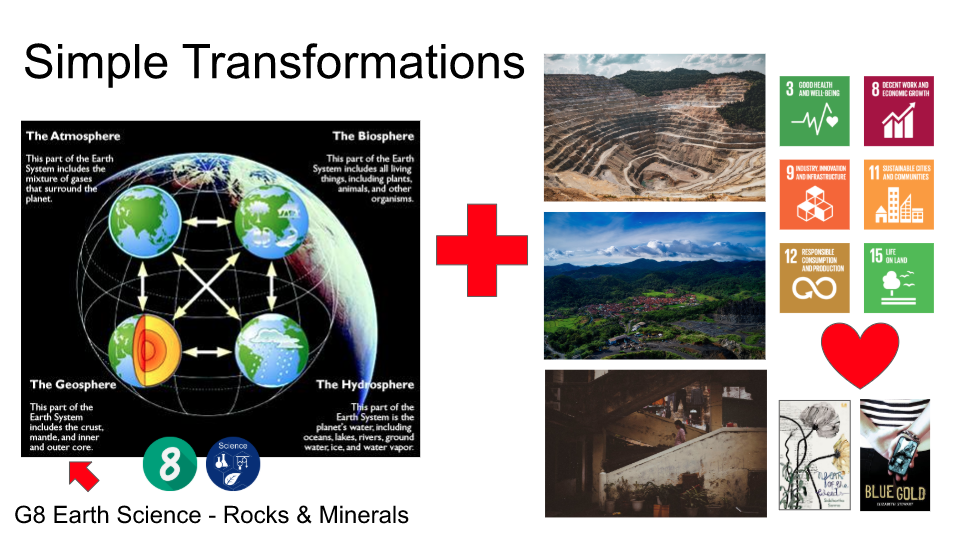
We’re on break now, and when we get back I was asked to present to our HODs for a few minutes on integrating reading into units in the middle school. I’ll probably just show this one slide:
I’d call it “content plus” – it’s from a G8 Earth Science unit that the Science team and I put together at the end of last year and they’re teaching now.
The idea is that you still have the science content as core to the unit – in this case Earth Science and learning about Sedimentary, igneous and metamorphic rocks and the minerals they contain and mining and the products of mining. But to that you add the environmental and human impact, and the lens of the SDGs (Sustainable Development Goals). And in order to help build empathy and understanding, add some literature.
Katie also had the brilliant idea, that she’s implemented in her school (and I’m going to be following quickly behind!), of getting good, relevant articles, stripping off the advertising etc (she uses Safari Reader View; I use Mercury Reader) putting them in binders and making them available in the library and classrooms – see slides 42-47).
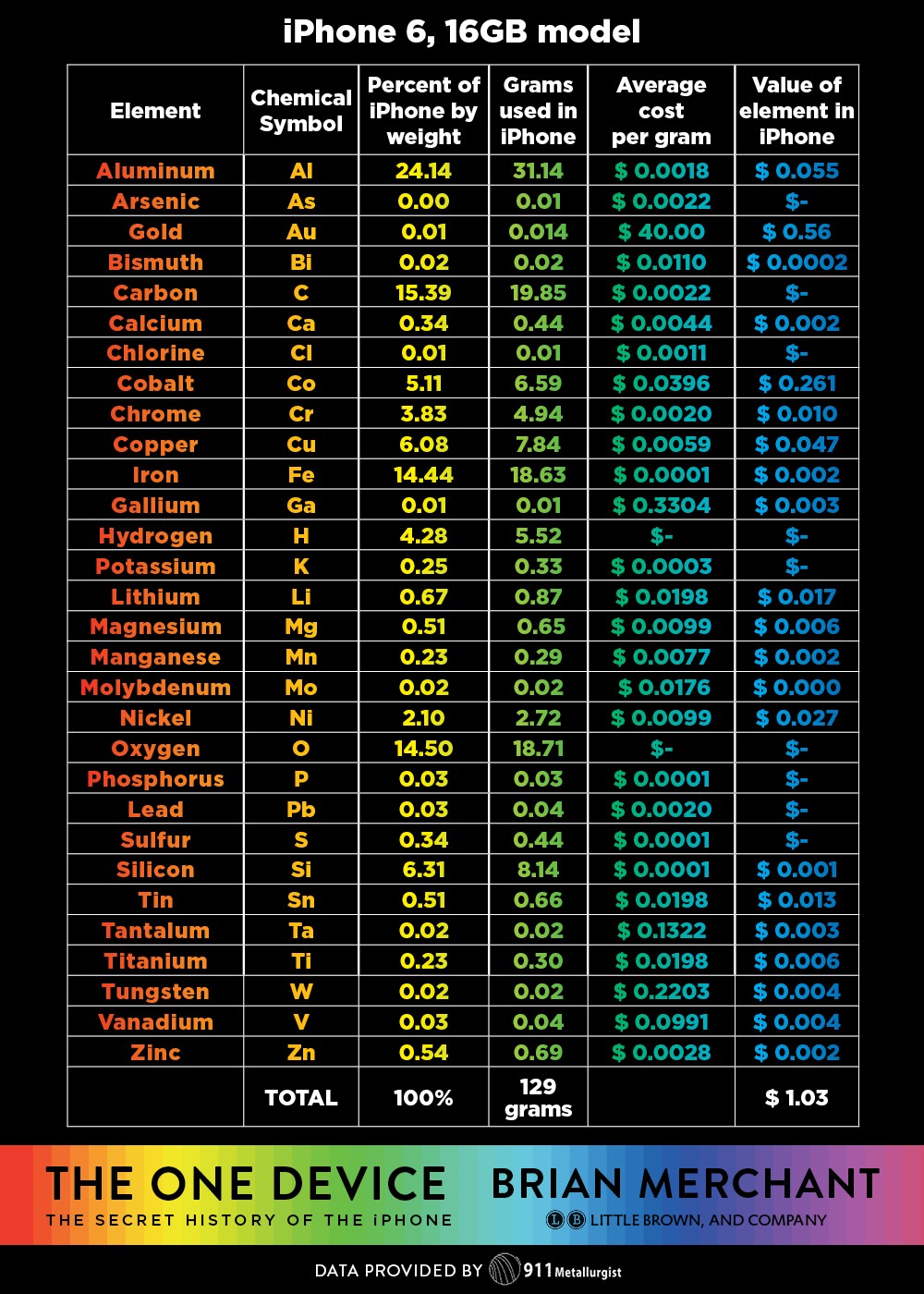
You can of course choose any minerals, but in this case to make it relevant to G8, we focused on the primary elements of an iPhone.
iPhone ingredients
Ideally, and this takes time, some of the science and or math units would be linked to Language & Literature or Individuals & Societies units allowing more time to explore literature.
In the mean time, one of the wonderful ways of adding literature into units is through picture books. In the guide we created for the Neev Festival, we made suggestions around groupings of the SDGs of the Neev shortlisted picture books plus lots of other books. It’s still a work in progress, but over time I’m hoping that for each and every global goal I have 10-20 picture books, (as well as 10-20 fiction books and 10-20 really good nonfiction books) that can easily and quickly be introduced to a class, thereby adding a very special element to learning, and truly making “every teacher a language teacher” and every teacher able to devote a tiny slice of their class to reading.
This week’s blog post will be very brief as a function of my extreme exhaustion – just been up and down to Bangalore for the Neev Literature Festival 2019. Beijing-Bangalore is not a commute I’d recommend to anyone who prizes their sleep or sanity but WOW what an intense 2 days it was.
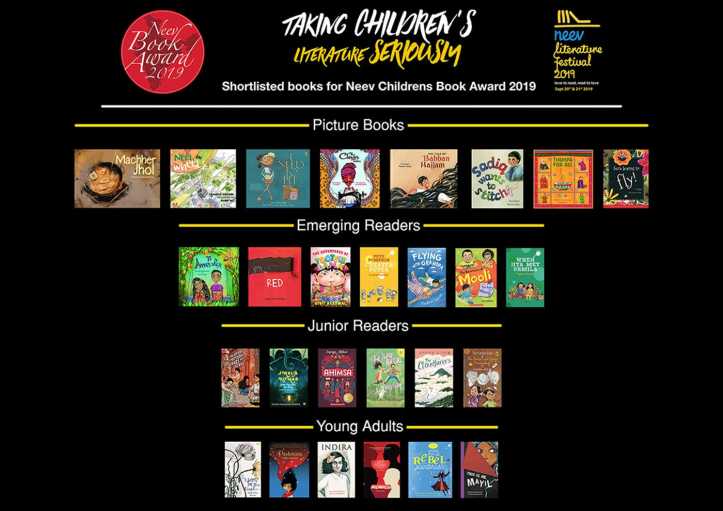
The theme this year was “Taking Children’s Literature Seriously” and I’ll write a bit more about the rest of the festival another time.
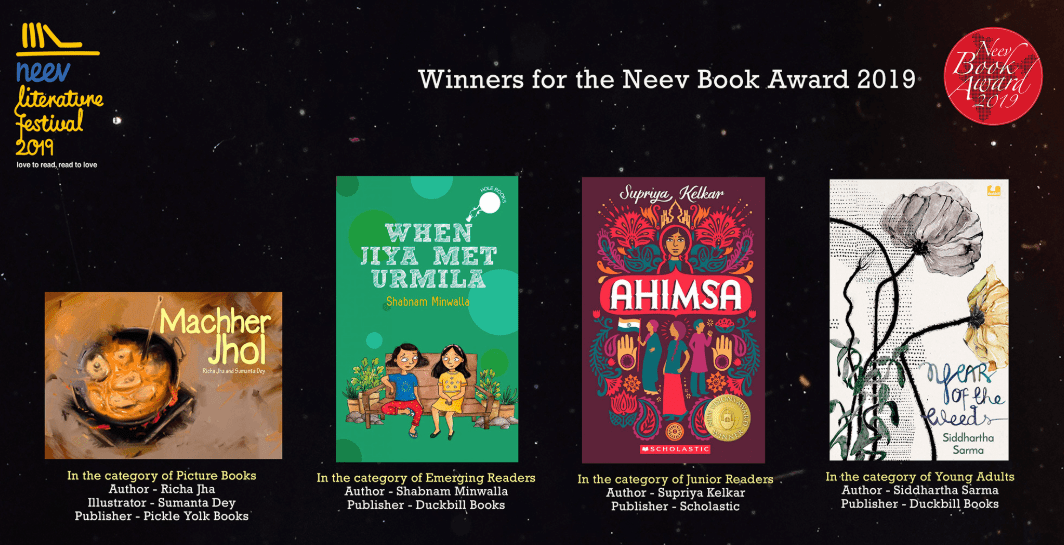
For now I just want to highlight the winners:
After a year of reading the long lists and short lists in four categories the awards were announced on Saturday for this year’s winners. I must say it was a surprisingly emotional moment even for me just as one of the jurors, I can’t imagine what it must be like for the authors!
Book buyers, librarians, teachers, parents tend to rely on a fairly narrow range of sources for their book purchasing decisions. One of those is lists, and the other prize winners (and often lists of prize winners). In this context the existence of speciality or niche book prizes is incredibly important to shed light on otherwise neglected corners of excellent children’s literature.
Since Ahimsa is already relatively well known in international children’s literature circles, I’m going to just put in a few words about the other three books.
Machher Jhol is a richly illustrated book showing the journey of a young boy through the roads of Kolkata to get the ingredients for a fish stew for his father. There is a wonderful twist to this tale that will make it beloved of any class looking for books on resilience.
When Jiya met Urmila is written for that space of emerging readers where very few authors manage to successfully tell a great story but make the writing accessible to the beginning reader. The story gently probes how segregated childrens’ lives can be.
Year of the Weeds is one of those books that I can see becoming part of a canon of middle grade / young adult books that are used in the classroom to promote thinking about globalisation, sustainable development goals of economic growth (8); industry and infrastructure (9); sustainable cities and communities (11) responsible consumption and production (12); and Life on land (15) – while still being an excellent read. The link above goes to a very interesting interview with the author.
Another thing that awards do – reward publishers for taking chances on genres, topics and authors. This year Duckbill publishers had two award winning books – here’s hoping they continue to bet on this calibre of writing AND even more importantly that their books get attention and distribution outside of India, because the world needs these books.
In response to requests – here is where to find the books:
One of my most popular blog posts was “Advocacy is not enough we need power” and I still stand by that. Ironically enough in my new role I am teacher librarian slash Edtech integrator, and I like to joke with my colleagues who need anything from data to access to fixing an issue to equipment that “I have the power”. But some stuff fluttering around twitter recently has made me wonder about librarians and power and about power in general.
Is this a case of “if a tree falls in a forest”? Where are all the OA activist librarians? Where even are all the “whinging about costs” librarians?
I like to follow a wide variety of people and Chris Bourg is one of my “go to” activist librarians. We need so much more of this ilk. But then I wondered about whether activism could exist in a vacuum of power. At the same time I know that power can both be given or assumed.
Most librarian groups now seem to have migrated to Facebook. Which is ironical because if we were better librarians and better curators we would not base the existence of our professional learning networks on a platform where groups are closed, information gets lost and the same questions are repeated ad-infinitum (see rant here). And judging by the posts we’re pretty good at complaining and most of the complaints (I’m talking the K-12 sector) are about budgets, job loss (or more accurately position loss as in “an unqualified teacher will do the library next year), or lack of acknowledgement. These are not the bleatings of people with real or perceived power.
The question is who can become activists? On the one hand you have people like Bill and Melinda Gates (see their annual letter, and particularly the bit about data can be sexist) who have the power. On the other you have people with next to nothing to lose. And then there are all the rest of us status quo huggers.
I say “us” deliberately, because I’m complicit. I think of a few things that we need to get activist about – some in the cost sphere, some in the service sphere (FollettDestiny are you listening) where we need to get organised, we need to share cost and pricing data but we don’t. Is it time? Is it being contractually bound to silence? Is it not wanting to be the tall poppy? Definitely in the diverse and relevant resource sphere as international school librarians we need to be in a constant state of outrage. And then there is the whole literature / translation thing going on – or not. Thanks to GLLI it’s moving in the right direction – albeit slowly and again why don’t they have tens of thousands of followers?
So we are librarians, a marginalised group within a sector in most countries (and in particular in many parts of the mighty trend setting US or A) that is marginalised economically, is it strange that you don’t encounter many activist librarians?
No use me merely complaining – What would my suggestions be to become an activist librarian?
Uncompromising values and standards
Unite, collaborate, be present
Champion diversity
Uncompromising values and standards
This is both personal and global. If you’re a qualified librarian be amazing at what you do and if you’re mediocre work on becoming better. If you’re amazing become even better and make sure you’re sharing and mentoring other librarians – and not just in your local network – we need more mentoring programs for regions where library science is under-represented.
And let’s not start on the levels above – the funding for library positions in schools and for university library programs. Who gets admitted into the library programs – are they taking the best of the best? Or the ones who want to get out of teaching for an “easy ride”?
It’s a bit the Finland / Singapore argument (to dig up an old trope) – well paid professions attract professionals.
Unite, collaborate, be present
Unite here not just to complain but unite in action. Collaborate and if necessary collude on matters that matter for knowledge, deep education, and investigation. Be present in the discussions and arguments. If you are not the leader be the first or subsequent follower.
If you’re a librarian in an international school join IntlLead a platform run by and for librarians not affiliated to any organisation.
I’m not just talking about #WeNeedDiverseBooks (see Meting out Diversity?). We also need diverse knowledge. Is that an oxymoron? And we need to personally be critical about what passes as knowledge and pass that critical stance on to our students. AT ALL LEVELS – not just when they’re in High School or doing TOK. Our G5 students need to know the information they consume for their PYP Exhibition is biased and deficient and that they can and should be adding to this from their cultural or geographical or linguistic perspective. We need to help publish. We need to interrogate the authors we invite to our schools on what they are doing to mentor and encourage no-name-brand authors in our locale, theirs, where they are appropriating stories for their books or elsewhere (and not just those who can afford expensive workshops). We need to invite speakers who do not repeat what we think we know but who challenge our assumptions.
Knowledge is biased
Look at this. As librarians are we passing on our outrage to our students? Do we follow sites like @WhoseKnowledge and tell our students to check the origins of what they’re reading? And that they whole darn point of learning and research is to make your own contribution to the world of knowledge and end this microscopic world view?
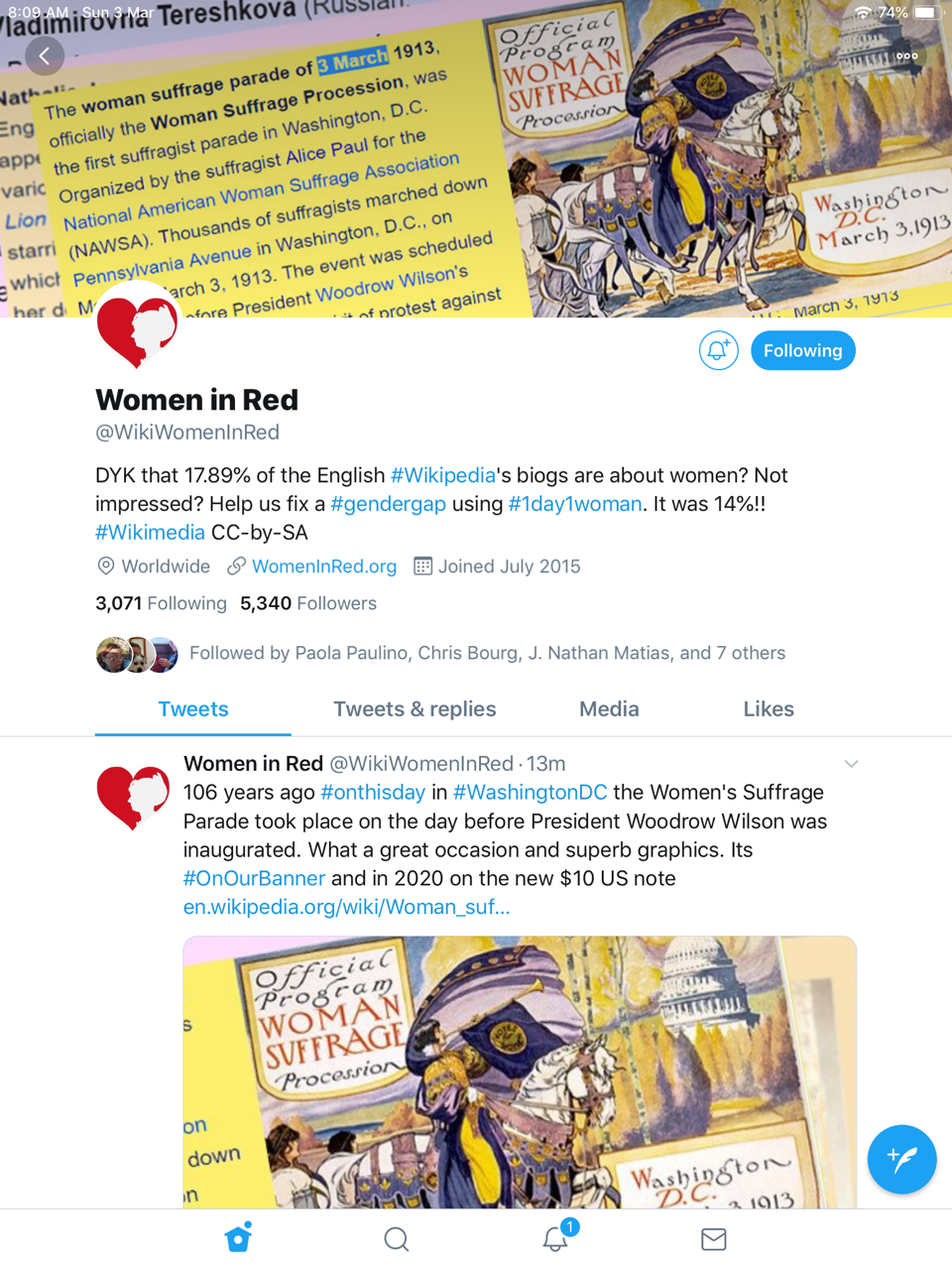
Here’s another one worth letting your students and fellow librarians know about – @WikiWomeninRed
I don’t know how to end this. Just keep on being angry or outraged. And do something positive with that anger.













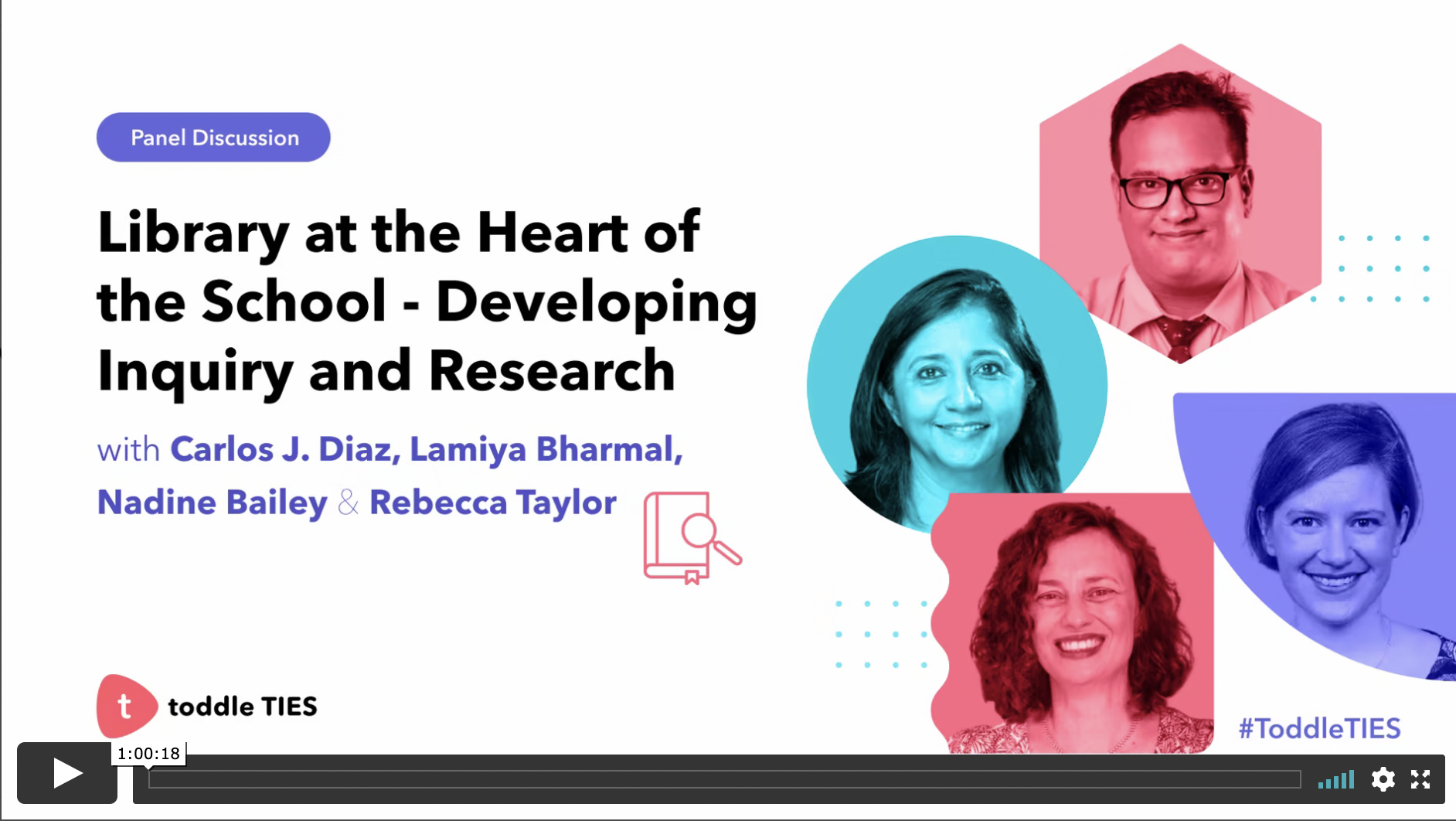 Toddle TIES Conference – 16 May – “Library at the Heart of the School – Developing Inquiry and Research.” A great panel moderated by Kirsten Durward with Bec Taylor, Carlos Diaz and Lamiya Bharmal the
  Our first presentation “Moving IDEAS to REALITY” (26 May 2021) was around how the work atInternational Schools around IDEAS is being actualised. The presentation was based on a short survey we sent out to International School Librarians.
  The next presentation – (given by me slipping out of my son’s graduation dinner for a quick hour – with his permission) was entitled “#NotOurDiversity: Beyond BANA” (29 May 2021) (
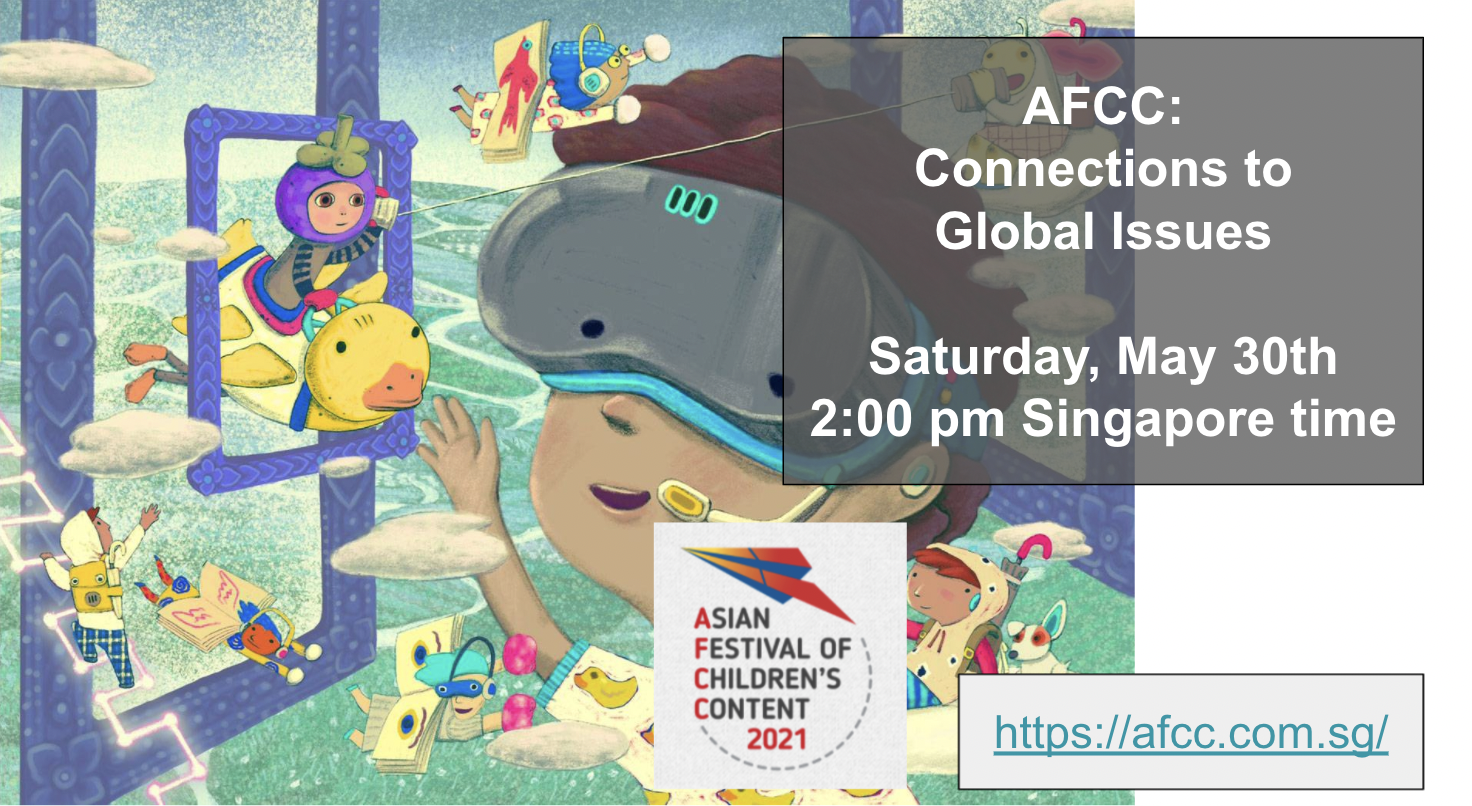 Finally at the end of May I was on a panel at the Asian Festival of Childrens’ Content (AFCC) “Connections to Global Issues: how teacher-librarians are supporting the UN SDGs and beyond” (30 May 2021) with Katie Day as Moderator, and fellow panelists Zakir Hossain and Stojana Popovska, where we focused specifically on supporting schools in incorporating the SDGs into the curriculum. (
 Two very interesting stories from the sporting realm are those of
  facts.
 The last three books, are ones where he is part of an anthology. One thing that we’ve started doing as part of this unit, is where there are a number of “heroes” in one book, we’ve added all the names in the table of contents to our cataloging record. That helps students to find different perspectives, formats, lengths of explanation and viewpoints of the same person. We’re hoping that some students will start with one of our many combined biographies, for example the great series of






 Informative Flights - Musings of a Teacher Librarian