All aboard? information literacy – citations

At times people will write to me and ask about things in library-land where they assume that somehow I or the (highly regarded) school I’m at have managed to “get it right” and they, poor normal human shouldn’t be struggling as there is a magic formula or secret sauce that could help. Alas we’re all human and all schools are the same in having struggles, perhaps the only difference being in what they struggle with and how good their marketing and communications departments are in convincing that it is otherwise.

A couple of weeks ago someone asked me about implementing NoodleTools as a citation tool in a school and how to do it. I promised a blog article as I said it wasn’t a simple thing. Ironically just yesterday I had to sincerely offer my apologies to a colleague as I had put zeal in front of our relationship around just that topic. So this is as much a “how to” as a “proceed with caution.

In the information literacy landscape, citations are a sub-topic of academic integrity. Any student who has passed through my hands in the last in the last 10 years will tell you I use the “brushing teeth” analogy with citations. As in – “you don’t just brush your teeth before you go to the dentist” you need to brush them regularly / daily. And I tell them about when I was grading Masters’ students at university how many had an absolute crisis just before submission as they didn’t have a works cited list. Heck I’ve known adult PhD students in a similar situation (and even out of perhaps misplaced righteousness refused to be paid to do it for them). It’s a nice analogy – especially when you add the idea of decayed teeth! It’s also a nice analogy because citations are what Herzberg (1959) would refer to as “hygiene factors” – ie. related to ‘the need to avoid unpleasantness’.

Now to take this a step further – parents and caregivers generally start helping very young children brush their teeth before they even have teeth, with special rubber gadgets they put on their fingers, and it’s even suggested to start early visits to the dentist to acclimatise kids to the idea of having dental checkups. Bear with me. Citations are not just a sub-topic of academic integrity, they’re part of the threshold concept in information literacy of “scholarly discourse”. Now in many areas of life, we learn how to “do” before we learn or understand “why” we do. When my kids were in Chinese Bilingual school aged 6-8 years, they learnt the San Zi Jing (三字經) and some of the three hundred Tang dynasty poems by heart without any comprehension of what they really meant – occasionally to my horror when I saw the translations of filial and patriarchal piety. Not being the kind of person or parent who ever takes things for granted I spent a lot of time trying to understand the mechanisms and reasons for this “learning by heart” and the best I could conclude was just like the English “Grammar” stage of the “Trivium” the ideas is that memorisation is best done at an early age so that logic and rhetoric (analysis and synthesis) can happen later.

So to bring this back to citations – the idea is to initially use a citation tool with pre-selected types and qualities of resources, and the students learn the steps of citing correctly and at a certain point this is expanded to understand what how these resources were selected, what scholarly discourse means along with the other threshold concepts.

Our school has chosen NoodleTools as the citation tool – you can see a set of slides I made on “5 reasons why to use it) including the ability to create inboxes for teachers to follow the process and it’s pedagogical merits of guiding students to make sure they have all the bits and pieces of a good citation. Now do all teachers and students love using it. No. Definitely not. There are a lot of things in education that are absolutely no fun initially but still somehow need to occur. The “hygiene” stuff I’d posit we want to create friction around initially so that they avoid the “unpleasantness” later. Under that heading I’d place things like times-tables, handwriting, spelling, vocabulary, learning facts etc. Now a funny thing about these things is that students will always grumble and grouse about them, but when they master the skills they are so disproportionally happy and proud of it. I notice that in the corridor talk. When in G6 they first encounter citations and NoodleTools they’re all jokey and will call me “Ms NoodleTools” in the hallway. After a couple of times, if teachers consistently use it in their research projects and I’m in the lessons refining and reminding – or rather getting them to do that – they’ll stop me – particularly the boys – and say “Ms, I did it, right? I could tell everyone in the class how to put a book/video/ website into NoodleTools!”

Why is NoodleTools suboptimal so much for so many people? Well, it’s what I’d call an MS-DOS tool. The UX (user experience) is just not what our typical Generation Alpha students or Millennial teachers are used to (or deserve). 12 point font and having to find the right box to click and bits hidden behind drop down menus are not the rizz. PalmPilot back in the 90’s already knew that users didn’t want to have to click several times in order to get to where they wanted to go.

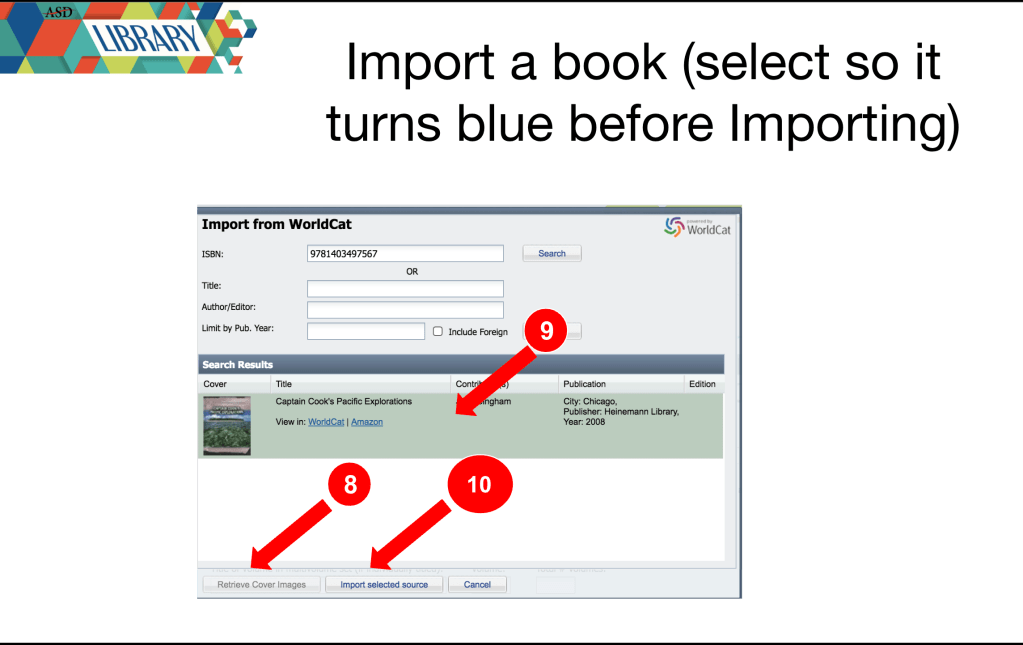
Compare MyBib.com interface and adding a book below – two steps, both visible:
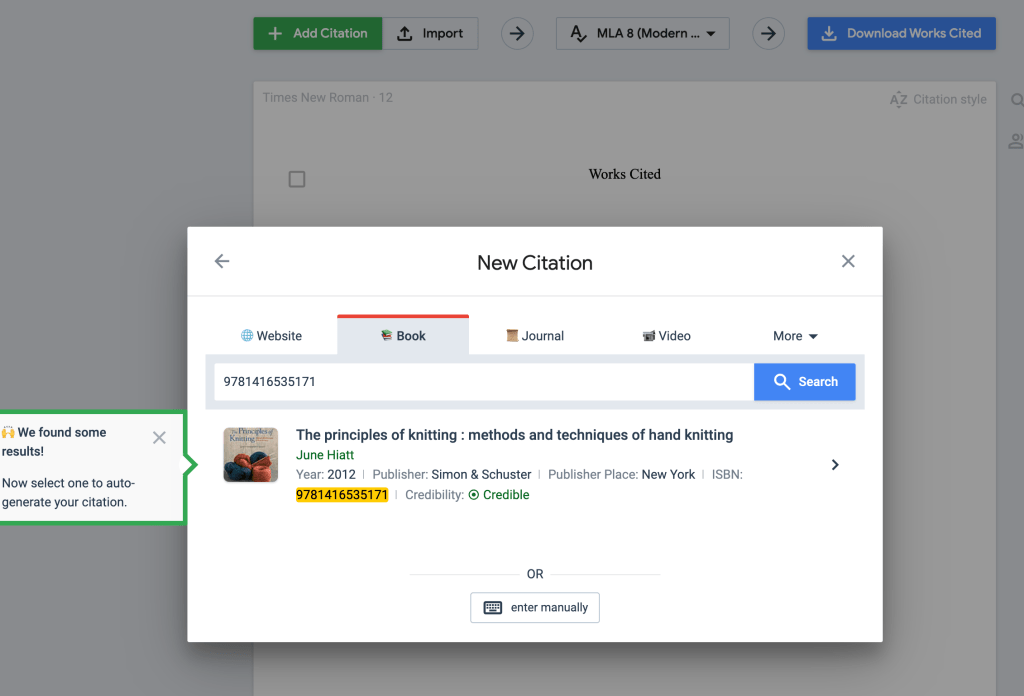
to NoodleTools – twelve steps in 7 consecutive screens (is it any wonder my kids are so proud of remembering it all and getting it right!) – see more here:

Of course there are a myriad of other citation tools, but these are the two more common ones in the secondary school landscape that are not predatory / try to sell you an essay along with your citations or steal your data / information?

So why not go for my.bib – and rather choose Noodletools IMHO? Well:

  • it’s not great with identify the Author and Date of sources – all these tools scrape the metadata from the sites you’re using and lazy webmasters and programmers won’t necessarily bother putting these in, or won’t identify them correctly with the correct tags.
  • It doesn’t play nice with databases, you need to export the citation in RIS or BibTex format and import it into your MyBib bibliography – where as NoodleTools have managed to integrate themselves into most of the common databases we use, including Credo, Gale, Infobase, JSTOR etc.
  • It doesn’t have the same level of pedagogical step-by-step guidance and error identification (for example capitalisation which is very easy to get wrong)
  • Teachers can’t follow the research process through a shared “inbox” (and the great thing is in trans-disciplinary assignments the same project can be shared with two different teachers with different class groupings.
  • It doesn’t have a notecard / outline function
  • It doesn’t have the collaborative features of NoodleTools where you can also see exactly which student contributed which citations / notecards to a project – a great feature when it comes to the “not fair” arguments on work division
  • It doesn’t have the “history” feature which allows teachers to see the unfolding of the research and the instances of “immaculate conception” of perfect research papers and notecards
  • Although my.bib is free, NoodleTools is only a couple of hundred dollars for nearly 1,000 students i.e incredibly cheap for the extra features
  • You actually WANT to create friction in the research process – a source needs to be relevant and credible to merit inclusion in the research and if there are speed-bumps in putting the source in students may be less inclined to go down the WWW (world wild web) route of random googling and more inclined to use our databases and sources in our Libguides.

So how to implement / “sell” the system
Basically it’s a push-me pull-you gig. It helps to have it as part of your information literacy scope and sequence as “the only tool recognised”. If we are student centred it is important that adults set aside some of their preferences and independence so that one system is used and students can become competent and not be confused.

Some of it is persuading departments to adopt it for the above-mentioned reasons, despite it’s ugly UX and multi-step process. Offering to set up inboxes for teachers for research projects helps. As does creating project templates with outlines and tailored notecard headings.

Students need to be taught step by step how to use the tool, and it has to be re-iterated for each assignment and the librarian needs to be prepared to be on hand to help out as there is a very long tail of students becoming competent in its use. And simultaneous to the “doing” skill, the work in the “understanding” has to begin. Why does it matter if something has n.d (no date) or n.a (no author)? How does that correlate to credibility and reliability?

So there was the very long answer to what may have seemed like a simple question. It’s great for Grade 5 to Grade 12. And what do I use personally? Well, if I’m doing an academic paper or helping an adult (or Extended Essay student) sort out their research life I still go for Zotero. I pay for the extra storage even now I’m not a student anymore and I love the integration of in-text citations and Bibliography/Works Cited in Word and GoogleDocs.

How to lie and cheat …

Teaching academic honesty is always a tricky one. Last year, my involvement was limited to showing a tool (Noodletools) to large groups of students, howling in protest that they preferred the predatory alternative EasyBib, too late in the year and being a second opinion on whether submitted work was honest or not.

This year, I’m more of a “known factor” and when I offered to start the year with a more general discussion on honesty rather than just getting into the nitty gritty of citation, a fellow teacher offered to lend a hand in a Day 9 session.

In order to get more than three nerds to sign up, I billeted it as “How to lie and cheat your way to academic success” and an unprecedented 30 students signed up for the session – the maximum allowed. During the planning we set out to find out a little more about the motivations of students and to ensure we engaged MYP ATLs, and I wanted to make sure we covered the ISTE student standards of Digital Citizen and the UDL (Universal Design for Learning) standard of “Multiple means of Engagement”. 

ATLs (Approaches to Learning)

Thinking skills

  • Critical Thinking
  • Creative Thinking

Research Skills

  • Information Literacy

ISTE Student:

2. Digital Citizen
Students recognize the rights, responsibilities and opportunities of living, learning and working in an interconnected digital world, and they act and model in ways that are safe, legal and ethical. Students:

b. engage in positive, safe, legal and ethical behavior when using technology, including social interactions online or when using networked devices.
c. demonstrate an understanding of and respect for the rights and obligations of using and sharing intellectual property.

My co-teacher Jo had some valuable day-to-day insights from the classroom of where students had a lack of understanding or were mis-understanding the topic which helped guide our planning and thinking about the session.

We started with a quick survey using Mentimeter to get an understanding where any potential plagiarism could arise. The questions were adapted from the “Symptoms of Plagiarism” by Dianne MacKenzie, further discussed here. We explained that all answers were anonymous and it wasn’t any reflection on them but rather feedback to us as teachers. We zoomed in on discussing “must do well” to better understand whether the pressure was internal (self) or external (parental) or a mixture and found it was pretty evenly spread. As teachers and creators of assignments the 25% who said they “didn’t understand the assignment” gave further pause for thought on how we set and word assessments and assessment rubrics, and also credence to our new MYP coordinator’s emphasis on ensuring teachers and students are familiar with the MYP command terms (Libguide by Stephen Taylor).


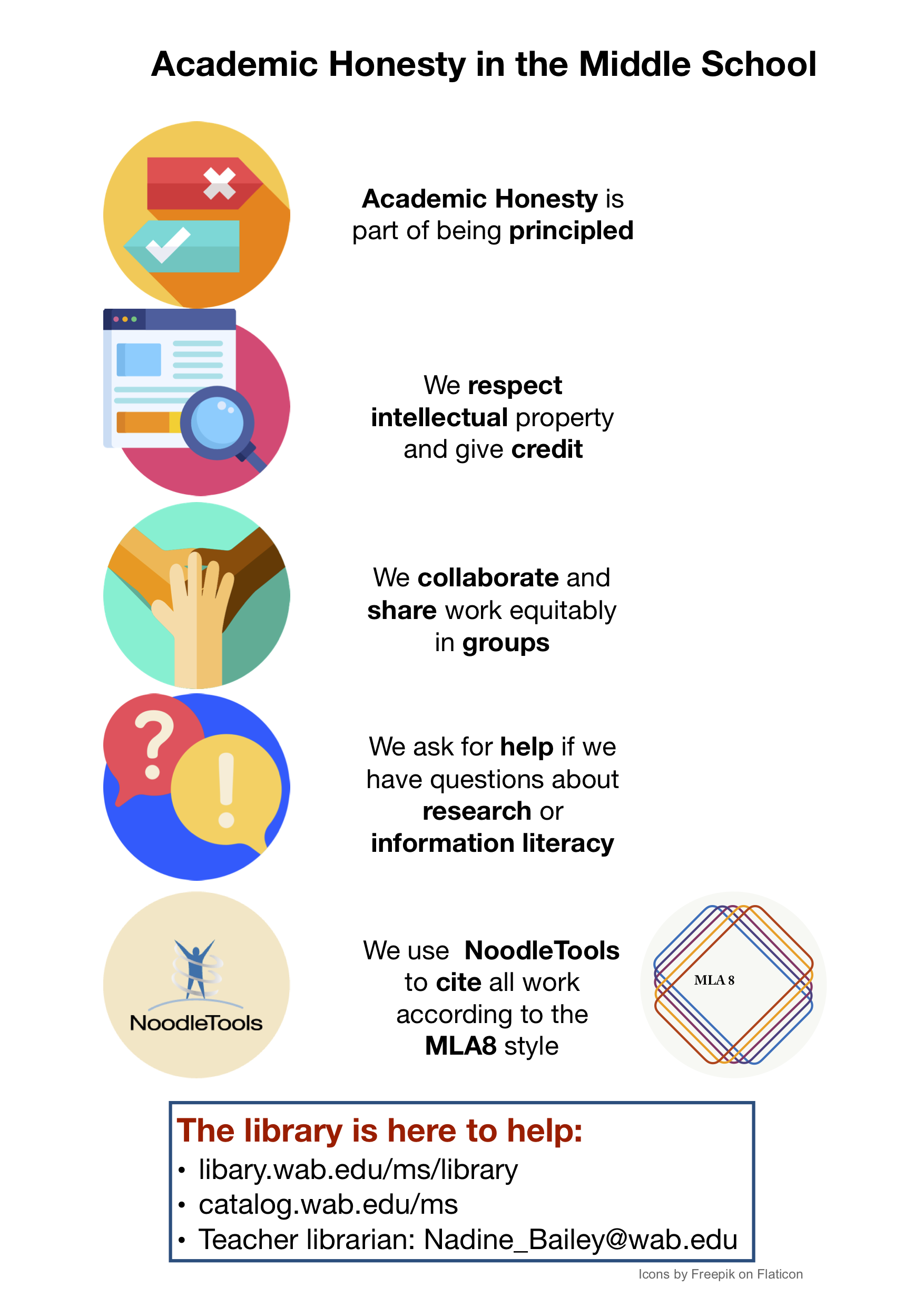
After this, we showed them their homework diaries, where at the back we’d included a graphic of our Middle School Academic Honesty Policy, and an adapted summary of Turnitin’s spectrum of plagiarism. Yet another example of not assuming “if you put it there they will notice” since none of them had noticed what was at the back of their homework agenda! Following the Turnitin spectrum we discussed the various types with real life examples. They didn’t have any idea there were so many variations, and in particular were interested in the fact that reusing your own work was not ethical if you

Academic honesty

didn’t cite yourself. As was making up data for lab reports or “client requests” for design. 

Then they played a matching game of plagiarised text to type of plagiarism. And successfully matched all types.

In four groups they were given a moral compass and allocated 10-12 “Got Ethics” cards to discuss and place on the compass based on group consensus. And when they were finished they could rank the cards in the “wrong” sector by increasing level of “wrongness”  Interestingly here, one of the groups of girls were critical of the cards themselves saying the clothing of the girls images (exposed stomachs) was sexist and not gender neutral!

The final 15 minutes were spent on a Kahoot where we wrapped up all the elements of the session with a quiz where we explained that some of the questions had no right answer or a few options, and we’d pause every now and again to discuss things like what the difference was between copying a story and writing fan-fiction and fractured fairytales. 

We felt it was 70 minutes well spent with engaged and interested students throughout and will probably run the session again.

Collaboration is air to us

And we need it to survive.

I meant to write this post a little while back, but then school started, and whoosh there went all my potential blogging time.

On one of the FB groups I follow someone was asking about teaching academic integrity / honesty. Naturally the librarians in the group responded with “ask your librarian”. To which the poster responded “I took it on. Go me!”

There are so many things wrong with this response it’s hard to know where to begin. And yet it is pretty common. Even in IBO programs. Maybe especially in IBO programs? You see a lot of IB educators (PYP, MYP, IBDP) are really smart people. Often they’re subject specialists. They’ve had additional post-graduate training specific to the IB, and often also have post-graduate degrees.

So what can be so hard for a person like that to teach information literacy / academic honesty etc? Why on earth should they involve their teacher-librarian (assuming that one still survives in their organisation and hasn’t been replaced by a (unqualified) parent volunteer or the principal’s wife?

In the first instance it’s not quite as easy and clear cut as people presume it is. Heck there are people like Mike Caulfield make it their life’s work to seriously consider information literacy and over the years boil it down to its most useful essence – perhaps in response to the “go me!” attitude of educators.

I’ve walked into classrooms where teachers have been talking old-fashioned nonsense that was relevant in the time they studied and had to go back to micro-fiches or dig through unfederated databases. Classrooms where teachers are mixing up APA in-text citations with MLA7 works cited lists in an environment where MLA8 is the norm. Classrooms where teachers have unattributed images or texts in use…

But worse than all of that, they have a black and white view of plagiarism. One that is unsubtle and non-nuanced. One that makes students “good or evil” and neglects the approach that academic honesty is a community effort. That it’s too late to make it a quick add on to a lesson. I’ve written on this in the past – plagiarism is not a simple matter, but mired in assumptions, teaching, culture and ignorance. And that’s the exact reason why it should be addressed centrally with common language, common understanding and be phased in over years with teachers and the rest of the community as role models.

Academic honesty is not just about consistent, correct citations. It is an integral part of how we look at research and inquiry. It’s not just a once off lesson taught in isolation, it’s part of us helping students to develop as researchers (please read this post on citations helping research in backward design). But if the teacher librarian is left out of the equation, it is not part of a progression, not part of ongoing development. And then we get teachers grumbling about how students are lazy and just copying and pasting, and having no integrity blah blah blah.

So don’t “go you” – unless you’re going to your teacher librarian (TL). And if you haven’t bothered to talk to, or collaborated with your TL, do yourself, and your students a favour and do so. Yes you’re smart and all that. But the TL is a specialist in this stuff (remember the two masters degrees they need?). And if they’re not used, you’ll be left with a bunch of apps and ignorance. And the problem will not go away with some nifty templates from teachers-pay-teachers or your mates on FaceBook.

——-

Photo by Fedor GoldBerg from Pexels

Facts getting in the way of a good story

It’s been a while – quite a stressful last few weeks of term – make that a stressful first half of the year. And now the last day of the vacation. Here’s a somewhat lighter post on two movies we saw that I’d like to comment on.

The first was Bohemian Rhapsody. The whole family is a fan of Queen, and given that Freddy Mercury has a special place in Montreux, our holiday stamping ground, we went to see it there. It’s a great movie – the music of course is amazing – it couldn’t not be, and you walk out with a whole nostalgic good feelings afterwards with a little sadness that he is not more.

But then my husband, who’d listened to Live Aid on the day from the Netherlands (I was living in South Africa which had a cultural ban still going at the time), disputed the play order of the songs, and my daughter, who studied Bohemian Rhapsody as part of her GCSE questioned the inclusion of some song in the “wrong” timeline so we set about googling the movie. And found the plenty on the inaccuracies in the movie. It seems yet again the problem of not letting the facts get in the way of a good story. But as I’ve stated before in my occasional review of historical fiction – one has a duty of care with the facts as not many people fact check what they’ve read or seen, and that becomes the new “reality” for them.

The next movie I watched with my son – he’s a big EDM fan and so we watched Avicii, True Stories, together (now available on Netflix). I’ll admit I asked about 20 times “where’s his mother” as things continued to spiral out of control more and more – but she didn’t feature besides one phone call. My son was more interested in naming the music, expensive watches and brand clothing … I was interested in the fact that so much of his life had been documented. And then my son said “you know he’s dead?” which led to another round of googling. Yes, in fact he did commit suicide, in April 2018, after the movie was made. This movie was more “factual” as it was a documentary – there was no hindsight as was finished before his death, and was more as an explanation as to why he wanted to stop performing than why he’d want to take his life.

In some ways the movies were very similar, each showing an extremely talented person spiralling out of control, and becoming victims of their own success and the manipulations of those around them whole fed at the same trough. Each also showed the story they wanted to show and left out some of the 18+ details (sex and drugs). I didn’t think that the Avicii movie was any less engrossing for the fact that it was a documentary.

In this interview, Rosenberg argues:

“I myself am a victim to narrative,” says Alex Rosenberg, a Duke University philosophy professor whose new book hopes to convince readers that narratives — and especially narrative history — are flawed as tools of knowledge.

Some more from Duke – this time the dispute between an author and the professor of History and Public Policy.

In the UK, Antony Beevor raises his concerns – this time it’s personal – concerning his Great-great-grandmother. And I remember another article – but can’t for the life of me find it – where a history professor complained that students coming into history programmes at university level have no idea that the latest Hilary Mantel or Philippa Gregory book is not a primary or even secondary source of historical information!

I love the fact that movies and books bring the past to life and that powerful storytelling is being used. I do think that we need to “immunise” our children and students so they can take the extra step of fact-checking and maintain a healthy scepticism of the “speculative” elements.

Beyond beyond search and cite

A long while ago (3 years) I wrote a post about the fact that we needed to look beyond “search and cite” in teaching information literacy and look at the threshold concepts of research, and a presentation I’d given on the theme. I remember at the time seeing half the audience (of librarians) eyes glazing over and thinking, “oh no, this isn’t going to work if it’s not something librarians get and relate to – and how on earth would students buy in?” I still believe that understanding threshold concepts in any discipline and for us librarians in research / information literacy is crucial in diagnosing misunderstandings and structuring our teaching. But then yesterday I had another insight on how this could be approached in a far better way.

studentIn my current position I’m considered to be part of the school wide coaching team, and as a group it was suggested we read “Student-Centered Coaching” by Diane Sweeney. I’ve been enjoying the fact that it’s a pretty practical book and one where you start to think that by taking the focus off the coach or even the teacher, you can actually take a lot of the emotion out of the coaching / teaching equation.

The book emphasises the use of data, but not necessarily the data provided by testing, but rather from the usual formative and summative assessment that is going on anyway.  One example used DRA testing – the equivalent of which occurs all over regularly anyway, and another a rubric from a writing program using a writing prompt. The idea is to select pieces of writing and score them on writing conventions and then group students into bands of “exceeding, experienced, competent, developing, emerging or below emerging” conventions. One then tries to move those groups / cluster using differentiated instruction up the scale.

I immediately thought of a lost opportunity last term, I’d had to teach citation to groups of students prior to their final assessment of a unit. It had been hectic both on my side and the teacher / classes and I’d been beating myself up a bit about it. Then my son (a different grade) came home and showed me an I&S assessment task (ungraded) he’d done and asked me what I thought of it. That’s a tough call. Because,  there was a lot going on there and not all of it was pretty.

And then I realised it was the perfect way to do a “backwards by design” session on searching and citing.

What if the “works cited list” and in-text citations of an assessment task of a whole class or grade were to be critically looked at?  It is a few lines that reveal so much of what’s going on in research. And then based on that one could group students according to where they were and what needed to be worked on and then individualise that part of the rubric in order to see if there was progress in understanding (and if they were approaching the thresholds!).

A quick reminder of the IL threshold concepts – research is/has:

  • Authority – Is constructed and contextual
  • Format – the creation, production and dissemination of research is not equivalent to its delivery or how it is experienced
  • Information goods – research has a cost and a value
  • Information structure (searching as strategic exploration) – an ability to look “under the hood” of databases and search engines (including more and more as we use things like Google scholar – the algorithms that spit out the results)
  • Research process – as iterative, difficult and building on the those who came before
  • Scholarly discourse – citation is a point of access into this discourse
  • (Research as inquiry – ongoing nature of research this is used by some but not all researchers)

Some of the things I noticed when looking at my son’s paper were –

Evidence (just two examples as an example): Not understanding that “Et al.” means “and others” – encountered in the in-text citation and works cited. The in-text citation followed the format (author, date) while the works cited was MLA8. Kind of.

Indication of not understanding:  

  • authorship = authority. But behind that was an understanding of the research process that included groups of people working on a topic
  • Format – since he’d used google scholar as a delivery point for the search. And from there had got to the database article without realising that it was an article in a database.  And didn’t understand the format or
    Screen Shot 2018-10-14 at 19.21.28information structure.
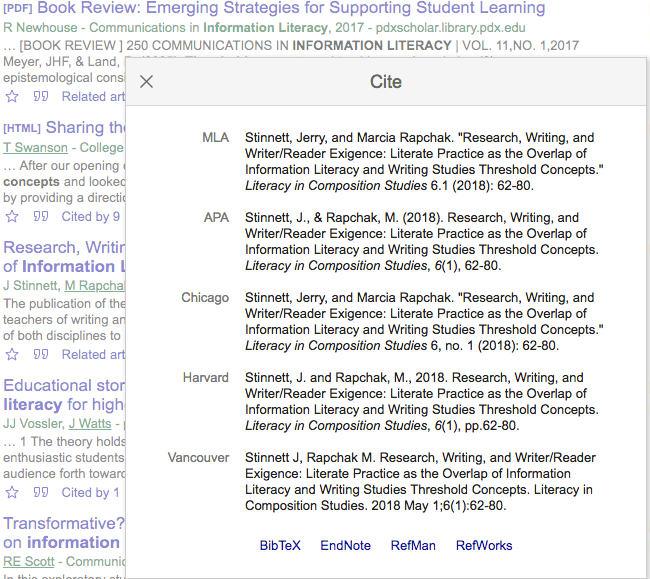
    This is something, if MLA8 is correctly taught and deployed, including its emphasis of a Russian Doll like structure of containers, should become obvious.  There is another – more simple aspect of formatthat of the format of citing and where that can be found. I showed him the  ”  marks in google scholar and how that led to the citation that could be copied into NoodleTools as is… a revelation
    for him. I also showed him in the original journal article of two other sources how he could find the citations and just copy and paste them – let’s consider small steps here!

Indication of understanding:

  • Scholarly discourse – here is where my own prejudice to APA versus MLA8 for the humanities come in – the date is probably a better indication of the point of scholarly discourse and understanding that something more recent would encompass prior research

The Scott (2017) article listed below is a particularly good one – because it asks students to rank their understanding of the concepts and to explain them. And this is where you can see the metacognitive value of “knowing what you don’t know” (please read Errol Morris’  series of articles on the anosognosics dilemma – the best ever on this, if you haven’t already) comes into play

“One mentioned domain knowledge as a barrier: “You have to have some type of familiarity with the topic to ‘enter the conversation.’” (Scott, 2017, p. 295)

To reign this back, we’re talking about middle and high school. So wading straight into threshold concepts may be going in too deep for the average student. But it may be a useful diagnostic tool.

Getting back to the coaching bit – doing an autopsy on in-text citations and the works cited list would reveal where the gaps and issues both in searching and citing were. The humanities teacher is probably looking at the assessment using a different lens – that of understanding and using the information and the ability to write it up in an academically acceptable manner using some kind of scaffolding (e.g. point, evidence). And at the end of the assessment, once a grade has been given and the focus has moved onto the next unit / assessment, the gaps in the ATL “research” may not have been identified, recognised, nor addressed in the teaching or assessment rubric for the next unit.

I believe in rubrics as a way of shaping teaching and focusing attention in student effort. If in a year, the teacher in conjunction with the librarian, moves through perhaps four iterative cycles of research, I’m sure we’d see real progress in both the practical ability and metacognition of students as they approach research and the threshold concepts.

=================

Here are some articles that explore further information literacy as a threshold concept in an interesting way:

Further reading:

Corrall, S. (2017). Crossing the threshold: reflective practice in information literacy development. Journal of Information Literacy, 11(1), 23. https://doi.org/10.11645/11.1.2241
Hofer, A. R., Townsend, L., & Brunetti, K. (2012). Troublesome concepts and information literacy: Investigating threshold concepts for IL instruction. Portal: Libraries & The Academy, 12(4), 387-405.
Hofer, A., Brunetti, K., Townsend, L., & Portland State University. (2013). A threshold concepts approach to the standards revision. Comminfolit, 7(2), 108. https://doi.org/10.15760/comminfolit.2013.7.2.141
Morris, E. (2010, June 20). The anosognosic’s dilemma: Something’s wrong but you’ll never know what it is (Part 1). Retrieved 4 February 2014, from http://opinionator.blogs.nytimes.com/2010/06/20/the-anosognosics-dilemma-1/?_php=true&_type=blogs&_php=true&_type=blogs&_r=1
Scott, R. (2017). Transformative? Integrative? Troublesome? Undergraduate student reflections on information literacy threshold concepts. Communications in Information Literacy, 11(2), 283–301. https://doi.org/10.15760/comminfolit.2017.11.2.3
Stinnett, J., & Rapchak, M. (2018). Research, writing, and writer/reader exigence: Literate practice as the overlap of information literacy and writing studies threshold concepts. Literacy in Composition Studies, 6(1), 62–80. Retrieved from http://licsjournal.org/OJS/index.php/LiCS/article/viewFile/180/239
Townsend, L., Hofer, A. R., Lin Hanick, S., & Brunetti, K. (2016). Identifying threshold concepts for information literacy: A Delphi Study. Communications in Information Literacy, 10 (1), 23-49. https://doi.org/10.15760/comminfolit.2016.10.1.13

Reflecting on reflection

There are problems with reflection. Seeped in the IB tradition, first through my children and now as an educator, I know that no matter how well it’s disguised or re-engineered most students do not like reflection. In my own children, the response to me asking them about the reflection process resulted in one saying, “it’s over, let’s move on and what difference will the reflection make anyway?” and the other saying “I do my own reflection and it’s deeply personal so I’m definitely not going to share that with a teacher, let alone my class, so I just tell them what I know they’ll want to hear”.   And with the adults in my life so far I think most fall somewhere on that continuum, with the rare exception of those prepared to be/risk being truly vulnerable.

This blog is my exercise in reflection, and heaven knows I screw up often enough, but how much of that is reflected in this? I’m afraid probably not enough. Because as a teacher one is also a public persona and unless your blog is private – in which case, why would you blog if not to receive feedback – you run the risk of incurring the ire or approbation of someone, somewhere in the organisation. Because to reflect in a way that it is meaningful one has to be open to change – either internally or in the environment – and change is one of those very hard things. Changing the self is difficult enough even if you ostensibly / presumably have control over self (I’ve just finished reading Homo Deus, where these philosophical questions were even better and more extremely expressed). As Harari wrote of power  “The entire contract can be summarised in a single phrase: humans agree to give up meaning in exchange for power.” I think we give up more than just meaning for power. And I suspect one of the reasons reflection avoidance seems to hardwired from they youngest age, is that reluctance to show our soft underbellies, because for sure, the power-hungry will pounce.

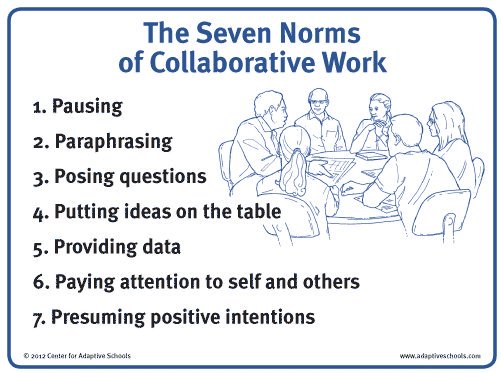
Another part of reflection is the existence of pathways and an environment allowing for honesty without it being labelled as negativity. And that is a two way street that needs a rare combination of humility, excellent communication skills, acceptance skills and the intellectual rigour to have emotional detachment from ideas and practices.  7 norms

Adaptive schools / cognitive coaching and the 7 Norms of collaboration go a long way towards bridging these human fallibilities. But there are many enemies (besides power) to the process including time pressure, face, and the very human difficulty in accepting sunk costs.

So who can reflect honestly?  The very very young, the naive, the elders – provided they are still allowed to be seen as relevant, the very wealthy and perhaps the court jesters / devil’s advocates.   The rest of us I fear go so far and no further. Or tell people what they want to hear.

The second shift

Last night my daughter asked me about citations for her Geography project. Now let it be made clear, my children, while lovely human beings, are in the “potted plant” phase of adolescence. So this was pretty rare. It’s also rare for them to acknowledge my knowledge or specialisation either.  But despite her multi-big-$$ education in a big name school (not where I’m at), and the fact that she’s highly motivated and organised, good research habits have not been instilled in her. Her references consisted of a couple of URLs and the in-text citations were random with “I KNOW mum sigh” when I raised my eyebrows. I asked what referencing style she had to use – “we can chose”. So I suggested APA – because I love it more than MLA8 and because Geography as a humanities subject is probably better suited to it long term.

I then had to teach her a few of the research habits that have served me well through two back-to-back masters degrees. This stuff is not brain science. If anything it’s like washing dishes and putting them in the cupboard. We re-activated her Evernote account that she’d opened for one enthusiastic teacher some time in the last 6 years. We then clipped all the articles into a Geography file in Evernote and tagged them with the project name. Next up was getting her citations into Zotero, the tool I prefer for upper secondary.

(After the whole debacle about RefMe / EasyBib etc. I’m committed to one tool, not following the latest trend, which inevitably seems to be about who is trying to monetise education and learning.  For primary and Middle School, it’s Noodletools)

There are many things I like about Zotero. The fact that it’s amazingly accurate in its citations and the really really good customer support being the main ones, but also the intelligence and diligence of the user-base can’t be denied. I was pleased to see that in their latest update – getting set up and integrated into Word has been made a whole lot easier. Yes, good old fashioned Word. GoogleDocs have their place but when one moves from being a child, you need to be more sophisticated and demanding in your needs and GoogleDocs doesn’t cut it.

So then I had her put the references in, via the Chrome extension (download the extension), make sure she had the right citation type, put in the missing data. Showed her OWL Purdue for APA, bookmark it, showed her the APA style blog site which has more relevant Q&A type things – like how to cite Google Maps).

And then the magic could happen – click on the end of the sentence, open Zotero in Word, put in the in text citation, click at the end of the document and have all the references upload.  Two hours. But hopefully that will be a lifetime of research “washing up” as you go along rather than crisis at the end.

Then I asked her what the style guide was for her assessment. Again, nothing.  Really teachers, please just get in the habit of telling them what you want things to look like. Line spacing, headings, margins, citation style etc. It really will set them up for University where this type of thing is so important. Stupidly important maybe, but professors can and do deduct plenty of marks for not getting it right.


No excuses – Britannica Image Quest

This no excuses post has been a long time coming. One of the things that most librarians have in common is that they are long-suffering, friendly, helpful, accommodating types, ready to share knowledge, know-how and eager to grasp on any acknowledgement they receive from academic leadership and fellow teachers. While the grumbles and moans are prolific within our little echo chambers, few of us have the time or energy to actually be vocal. We’re generally just grateful we have jobs, in a market where libraries and librarians are sacrificed a the altars of economies and “it’s on the internet”. So many just put up and shut up. And are careful of the swords we’re prepared to fall on.

In the mean time, there are people and companies in this academic / learning / research space who are making a lot of money and who do get heard / listened to. If you read only one article about this, I’d recommend the Guardian Long Read : “Is the staggeringly profitable business of scientific publishing bad for science?” I’d love to ask if the profitable business of school databases is bad for research and learning.

So the saga began at the end of the last academic year.  I was teaching academic honesty to my Grade 4’s and they were just about at the point of grudgingly agreeing that it was a good idea (in IB PYP speak) to have “integrity, respect and appreciation” for other’s work and be “principled” in acknowledging where the images they were using in their research were coming from.

In order to limit their going too wildly astray on the world wild web, the teachers and I agreed that we’d limit the images they used to two sites – the paid Britannica Image Quest (available to schools as part of the school version of Britannica bundle for a mere US$6,000 per year depending on your size), and the unpaid “photosforclass” where the attribution is included in the photo watermark and they make an effort to ensure the photos are school appropriate and are under creative commons license.

So far so good until we got to the point of looking at the citations created by – no not the free tool but the really expensive one!

As we looked up the various things students were researching to my utter dismay I realised that each and every one had as creation date 25 May 2016.

One of the things that I try to keep in the back of my mind when teaching information literacy is where we are going in terms of threshold concepts.  We want to ensure that students are not going through the rote / skill part of academic honesty without really understanding the bigger information literacy picture.

Screenshot Britannica Image Quest
Screenshot Jean Batten – Brooklands and citation, Britannica Image Quest, 10 September 2017.

So I wrote to our “local” Britannica representative questioning the date on the image. Surely it couldn’t have been May 2016? And who was the photographer? Surely they deserved a mention?

The correct structure for MLA8 (the system our school is using) is:

Creator’s last name, first name. “Title of the image.” Title of the journal or container that the image was found on, First name Last name of any other contributors responsible for the image, Version of the image (if applicable), Any numbers associated with the image (such as a volume and issue number, if applicable), Publisher, Publication date, Location. Title of the database or second container, URL or DOI number.

So the response I got back from Britannica was:

Many thanks for your email expressing your concern over our citation. I am guessing you are referring to the MLA format. We follow the required format for online publishing which does not require that particular information.

Example below.

HIV viruses (red). Photography. Britannica ImageQuest, Encyclopædia Britannica, 25 May 2016.
quest.eb.com/search/132_1274904/1/132_1274904/cite. Accessed 16 May 2017.

MLA citation requires a publication date which is considered a core element of the citation. That, of course, would be the date of the last image publish of that collection, May 25, 2016. Because the data from the images comes from more than 60 collections, it is very inconsistent or we don’t have it at all. Britannica tries never to provide information that we cannot guarantee to be correct. We suppress this from the site for that reason.

http://quest.eb.com/collections

I hope this assists your understanding of our difficulty here. Please come back to me if I can be of more assistance.

At which point I cried foul. And took my concern to a couple of librarian networks. Where it was roundly ignored. Or where it wasn’t ignored it was met with a powerless sigh. And I wrote back to them as said no, I was not satisfied with that. Are you serious? They get photos from 60+ databases and can’t be bothered to spend a few dollars on mapping the available data properly to their database? Only 60? That means you pay 60 something people, one to look at each of those databases and work out their tagging and map it to your tagging.  And then you pay somebodies to manually sort out the ones that don’t map nicely or you default to the cop-out citation for those. In the world of cheap accessible outsourced IT, that should be a no brainer. The entry about the privately owned Britannica on Wikipedia is illuminating.

In the world of fake news and fake photos and fake evidence and fake research and fake everything we need to be vigilant. When original primary research documents and images get scanned into databases we lose a trail if the creators and dates are no longer considered important enough to add. We are not talking about born-digital images here.

So I persisted and got this response:

Well you have certainly stirred thing up, in a good way I think. J

I’d like to share with you some of what has occurred since your concern was raised, in the hope it will be interesting and helpful in the future.

Our Editorial Team was consulted and they will be handling citations going forward. They did a full review of the MLA format and consulted with the MLA Handbook 8th Edition.

As I mentioned in a previous email, the reason we leave off the photographer is because the data we get from the partner is not in a format that would allow us to list it correctly on a consistent bases. The MLA Handbook states, “When a work is published without an author’s name. . .skip the author element and begin the entry with the work’s title” (p. 24). Since we cannot accurately list it, we are leaving it off. The editorial team are going to explore this a bit more and see if there is a way we can improve this, but for now we will leave it off. This will not be an easy thing to fix.

We are listing the publish date of the images (in addition to accessed date). According to the MLA Handbook, the publish date is appropriate. Because we didn’t always store the publish date in the database, when we revised for MLA 8  we had to fill in something so all images would have a date. We used the date of the most recent publish. From the point of making this change and going forward we now list the actual publish date of image. Since this did result in most, but not all, of the images having the same date we are going to go back and try to update the publish dates with the date the collection was first published on our site. This will hopefully make it easier to teach students what this date is for since the majority will not be the same. However just to reiterate, as new images are published they are now listing their actual publish date.

Over the next month or so, the Editorial Team will also complete a review of the other citation formats in ImageQuest and we will make changes as time allows. We will also create a citation page where we provide additional information to clarify our citation policy.

Nadine, I do hope it is clear that Britannica always endeavours to provide the most accurate information possible and that we do react, where we can, to try and improve on a valued customers suggestion.

and in fact, if you look at the bottom of every citation you’ll now see the following:

“The citations provided are computer-generated. Because of differences in the data available from each collection, citations may not match style rules or include all components specified by a style manual (e.g., photographer or artist information). We have made every effort to enable students to identify the page on which an image can be found, even for citation styles that do not require a URL.”

Why does this still bother me six months later? Let’s return to what we really want students to know about Information Literacy. What will carry them beyond their latest assignment, their Personal Project, their Extended essay. What will take them through life as sceptical consumers of information. Let’s go back to understanding the threshold concepts of information literacy.

We should rely on information that has authority.  So we check the credentials, experience and expertise of those giving the information. There is an image of a young woman and a claim she broke an aviation speed record in 1934. Who took that photo? Where was it taken? When was it taken? Was she leaving or arriving? If the photo was taken on another day or time was it just posed? Was that the triumphant photographic proof of her exploit?

Information has a format. And it’s format is related to its creation, production and dissemination, NOT how it is delivered or experienced. Usually this is considered when comparing journal articles in a journal in a database to the journal format of the past as in volumes of books. The fact that the format is now online, doesn’t impact on the fact that it’s a a peer reviewed journal article. A similar argument can be made for a historical photo. The fact that it’s now delivered digitally shouldn’t ignore the fact that it was once a photo taken with a camera at a point in time by a real photographer.

Information is a good (as in goods and services). As such there is a value and a cost to information, and we should be aware of that. At the moment the balance of financial cost and reward seems to be very one sided. Databases buy up collections of information, bundle it, and sell it on at a premium and add as little value to the images as they can get away with. Usually just giving information on the seller rather than the creator of the images.  The information structure – information is structured and accessed / searched in a certain way and that differs depending on the format and container.

The research process builds on existing knowledge. But if we ignore the existing knowledge and process whereby we get to the current point we’re negating this aspect. This also builds into the idea of scholarly discourse – that we’re entering an academic conversation at a certain moment.

So at this point I’d still be saying – no excuses. The fact that something is hard should never be an excuse not to do it properly.  Yes they are right – they are complying with the MLA8 structure. But they are not helping with the spirit of scholarship and information literacy.


Buying the future of research …

There’s been quite a to-do on librarian sites recently about the acquisition of RefMe, an academic citation tool by Chegg, a purveyor of online textbooks and tutors (and more). Before you click past this, let’s have a little look and think about this business model…

The citation engine issue

In the opinion of my peers – CiteThisForMe is an inferior product to its precursor RefMe. To be technical about this –
  • it doesn’t allow for importing .ris files from databases (a common standard)
  • you can’t create folders for citations
  • user interface is poor
  • numerous popup boxes for editing
  • no google SSO
  • no easy import function from existing products
  • it’s not terribly good or accurate
  • etc.

So far it seems one librarian wrote about the take-over with foreboding  but again, more from a technical point of view. It’s just not a very good product. As he pointed out – none of the “quick and dirty” products are very good. For non pure-academic sites (i.e. paid databases) It boils down to whether some back-end programmer has bothered to capture much (if any) meta-data on author, date, title etc. And I’m afraid to say that’s exactly the type of site most of our students cut their researching teeth on. Think of it as the crack-cocaine of citation. You add a chrome extension, you go to a website / youtube video / online newspaper and click the extension and like magic your citation is generated. But not quite. At worst it’ll just pick up the URL, at best perhaps a title and author. And I’m afraid to say most teachers grading “research” are long happy that even that’s been included in a bibliography or works cited or reference list.

From boring citation to sexy ‘critical moments’

But actually none of that really matters. Well it does, sort of, eventually to the people who matter who care. What is somewhat more concerning is this.
The first time RefMe came into the (financial) news in a serious way was in 2015 when GEMs Education threw some money at it. Educational companies don’t throw money at citation tools unless there’s something in it for them:

But it isn’t just students who are showing an interest in the platform, RefME has received £2.7 million backing from GEMs Education, the largest private education company in the world. They want to encourage more schoolchildren to use the app, as pupils are now increasingly having to reference too.

‘We’ve identified 150-200 million kids around the world who cite,’ said Hatton.
The platform also does more than create references – RefME collects information about what people cite, making a map of the data. This means it can give you recommendations based on what other people who used that same citation went on to find, something Hatton calls ‘removing the search from research’.

Then the Chegg acquisition 2 years later, and one of the first things you see when you open their site is side by side in the news is the financial results and the tie in between this “academic” provider and a “global media agency”
Screen Shot 2017-03-16 at 8.15.43 PM

Screen Shot 2017-03-16 at 8.11.25 PM
Bait and switch tactics …

and when you read the terms and conditions you find out:
The Services may collect “Personal Information” (which is information that can be used to identify or contact a specific individual, such as your name and email address), account information (such as a password or other information that helps us confirm that it is you accessing your account) and demographic or other information (such as your school, gender, age or birthdate and zip code and information about your interests and preferences).

And you thought FaceBook was bad …


“When you submit, post, upload, embed, display, communicate, link to, email or otherwise distribute or publish any review, problem, suggestion, idea, solution, question, answer, class notes, course outline bibliographic and citation information comment, testimonial, feedback, message, image, video, text, profile data or other material (“User Content”) to Chegg, any Chegg employee or contractor, or a Chegg Website, you grant Chegg and our affiliates, licensees, distributors, agents, representatives and other entities or individuals authorized by Chegg, a non-exclusive, worldwide, perpetual, unlimited, irrevocable, royalty-free, fully sublicensable (through multiple tiers) and fully transferable right to exercise any and all copyright, trademark, publicity, and database rights you have in the content, in any media known now or in the future, and to make, use, reproduce, copy, display, publish, exhibit, distribute, modify, sell, offer for sale, create derivative works based upon and otherwise use the User Content.
Note that we may create, facilitate or display social advertisements, whereby your name, profile and photo may be used to advertise products and services to your network based on your use of the Services and your interactions with Chegg. You agree that Chegg may use your name and profile picture in connection with social ads to advertise products and services to your network based on your use of the Services and your interactions with Chegg and third parties through the Services.
You further agree that Chegg is free to use any ideas or concepts contained in any User Content for any purposes whatsoever, including, without limitation, developing, manufacturing and marketing products and services; and creating informational articles, without any payment of any kind to you. You authorize Chegg to publish your User Content in a searchable format that may be accessed by users of the Services and the Internet. To the fullest extent permitted by law, you waive any moral rights you may have in any User Content you submit, even if such User Content is altered or changed in a manner not agreeable to you.” (Privacy Policy)
Well actually FaceBook is bad – the worst possible place to put all that information exchange and community knowledge and knowhow, (I’m looking at you my lovely library networks on Facebook), but we kind of know it’s bad and we live with it for all kinds of reasons, and most of us (I hope) extract the useful stuff and put it elsewhere like Evernote or GoogleDrive or … (oops who owns it then!?).
When Chegg bought Easybib, this is what the press release had to say:
“In the last 12 months, Imagine Easy’s bibliography and research tools powered about 240 million sessions and EasyBib alone saw more than 7 million unique users in March 2016, Chegg tells me. In total, all of these services together have helped students from mangling more than 1.4 billion bibliography entries.”
Bear in mind, nothing you do in their services is actually yours, not even the services you may have paid for:
Service Modifications
Chegg reserves the right, in our sole discretion, to make changes to or discontinue any of the Services at any time. Any description of the Services provided by Chegg is not a representation that the Services are working or will always work in that manner, as Chegg is continuously updating the Services, and these updates may not always be reflected in the Terms of Use.
Now this is one thing if you’re a Grade 5 student and with much blood sweat, tears and encouragement from your teachers, librarian and parents you’ve managed to come up with a bibliography of 3-5 items that say more that “wikipedia” or youtube.com. It’s quite another if you’re a serious researcher at say doctorate or post-doctorate level and have a few thousand articles referenced, with abstracts and perhaps attached documents or pdfs. Or if your 4,000 word extended essay is due in a few weeks time to finish off your IB, and the RefMe plug is pulled with practically no sensible communication from the company from the announcement at the end of January to about a week before the pulling of the plug on the 28th February (the Facebook trail of increasing panic and despair is awful – and that was just the librarians) – twitter showed some upset students but not as many as one would expect – perhaps the RefMe user base wasn’t that big or serious about social media – or they were too busy scrambling to migrate their data to an alternative platform.
So what is Chegg buying (by the way, the numbers are still relatively small potatoes in investment speak, but they’ve got ambition!)
If you have a look at last year’s financial report, this bit, where they refer to the acquisition of EasyBib is relevant:
With education representing a trillion-dollar opportunity in the U.S. alone, we believe that the number of students who will leverage online tools, use the services we have, and then benefit from new services that we plan to offer will increase dramatically over the next decade. That is why we continue to make strategic investments to take advantage of this growing opportunity. At the core of our success is reaching more students than anyone else, knowing more about them than anyone else, and leveraging that data to improve our products and services, acquire customers for less, and increase their customer satisfaction. That is the essence of what the Student Graph does, and we have been consistent in our product and business development strategies by investing in services that can both leverage and contribute to the Student Graph which accelerates our growth. That was the driving force behind our acquisition of Imagine Easy which has been one of the quickest and most successful integrations into the company. With 30 million annual unique visitors according to comScore, we continue to be confident that this acquisition is an enormous opportunity for students, for Chegg, and for our shareholders. There have been over 1.5 billion citations created to date with more than 400 million new ones added in 2016 alone. Already we are exceeding the expectations we have for the business and it is quickly becoming a core part of the Chegg Services platform.
The financial results are quite phenomenal actually – they’re making money, real money off a digital platform. They’ve got current students by the short and curlies and a pipeline of 200 million school kids to add to their existing user-base in the coming years. Lure them in with solving the citation hassle and then move them up the feeding chain to online textbook hire and tutors and test prep. As a former finance person I must say this is smart. I’m also wondering how much of their revenue is from selling their customer data on to media companies and all the social media / off-line entertainment type tie-ins?
So, that’s that for what’s going on in the otherwise boring old citation world… and now the next thing – online paraphrasing anyone?  Soon all you’ll have to do is get into a university (another service offered by Chegg) and the just physically sit out (or party through) your 3 or 4 years while the digital tools take care of all the messy bits of assignments and hand ins.
(ps. if you want to know what I recommend for what it’s worth? NoodleTools for K-12 students, and Zotero thereafter. And no, I don’t get a commission from either of them, and yes I pay for both for the premium service).

A tale of two systems

I’ve just spent the last 4 days at the #LKSW2017 where 80 librarians around the SE Asian region got together to learn and share (mainly teacher) librarian practise. I also hosted a Chinese lady from a school in China and gave a daily ride to another Canadian librarian working at a school in China. We had some great conversations.

The first workshop I attended was led by Brad Tyrell. He of the magnificent Libguides at Scotch College that induce envy in every other libguide – even if you know that there is a slew of very techie people behind the gloss. During the workshop he kept emphasizing that everything that they’ve done is on a creative commons basis, and in fact shared all the documentation and templates used to make the guides.  He also explained that their staff’s job descriptions include an imperative to share what they’ve done – so everytime they’ve created a new library guide, they not only share it with staff and students internally, but they also have to post it on the listserv / social media of their local library association.

This is something I’m very comfortable with, and in fact have had many discussions with my lecturers at CSU about plagiarism and the sharing of academic output amongst students, where my (slightly controversial) view was that every academic assignment I’ve made is, and should be public, and that if students abuse it, or lecturers can’t be bothered to change the assignment, the system should take care of it… discussions documented here.  My libguides are also open, and I encourage people to take what they need from them and to adapt them to their own situation – and in turn, I get inspiration and links and resources from the other community guides. What do we all want? A little acknowledgement and for it to be on a “I share so you don’t just take, but also share”.

Then there is the in-between state, I’d call it the TpT state (teachers pay teachers), where you’ve made something that’s taken so much work, it’s done in your spare time and has cost you time and effort and is of a quality that you feel you can sell it. Personally I don’t do this, I’m more on the open source side of things, but I have bought items from other teachers where I like what they’ve done and don’t think I could do a better job.  For a rationale for this model, please read this.

And then the opposite extreme.  Chatting to my two compatriots working in China, I was surprised to hear that neither their catalogues, nor their library guides were open.  I was asking about sourcing Chinese books for our program in particular, and specifically nonfiction books for our UOIs. While they were helpful, and the actual answer is due to the predominance of text-books their is a less developed nonfiction publishing market at the primary level, none of their catalogs or resource lists were open. So unlike many other schools where I could take a look into their lists to find some good resources, this wouldn’t be possible. They explained that the Chinese private school market is very very competitive and this is all considered to be proprietary and competitive information.

Which of course leads to the question – are you being stupid or reducing your own competitiveness by sharing?  I’d like to think not and that everyone is better off as a result of this and opening things up allows them to be improved upon. Provided of course that the person doing the adaptation and improving is similarly civic minded and pays the sharing forward – which isn’t always the case.