Appreciate comments.
Author: Nadine Bailey
Social Media for the professional – Twitter
I’ve been asked this question twice now in the last 2 days, both in a professional context. The first was at the librarian workshare I attended at Bangkok, where so many people were saying they didn’t get the point of twitter, and then last night by a friend who is an academic who has just published a paper in a prestigious journal and was wondering how to increase her online profile without it reflecting negatively on her professionalism.
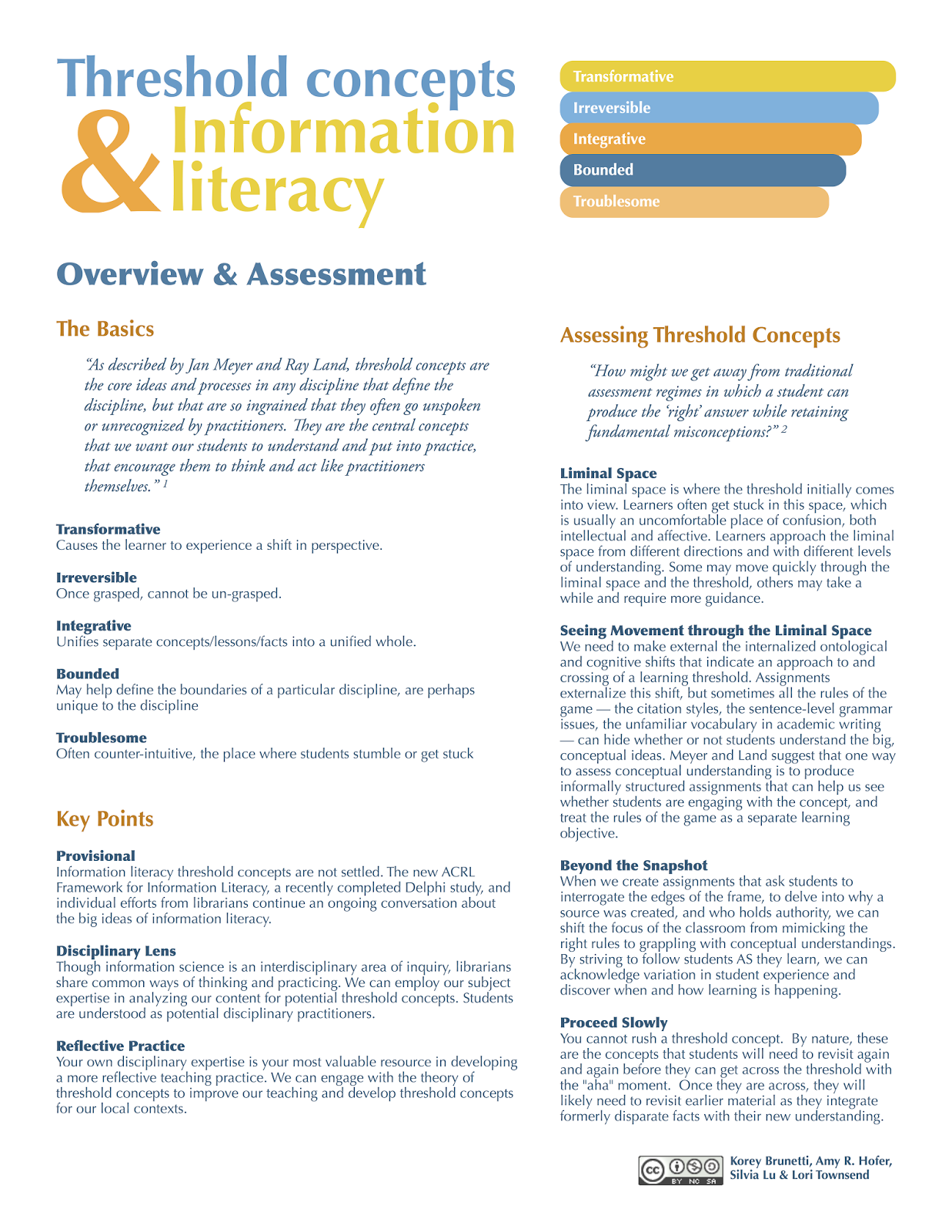
I know I’ve been harping on about Threshold concepts, but to me, twitter is a threshold concept. I truly did not get it, until I got it and now I’ll never go back again.
Twitter is a true “the world is flat” form of social media.
Step by step guide to using it on your terms:
Setup:
1. Get a twitter handle that uses your name or something you identify with (I messed this up and may have to start again at ground zero) basically @something and register it.
2. Write a profile that is professional and makes you easy to find by people you want to find you. Think carefully about key words. This isn’t about finding high school friends or long lost family or someone you met at the pub (that’s for Facebook), it’s professional
3. Add a picture. A nice professional one, or an icon at a pinch. But not too silly.
Finding your tribe:
1. Work out what are the relevant hashtags (#) for your profession. In the case of librarians, it’s #libchat for librarians generally and #TLchat for teacher librarians. That’s for starters. Then you can start looking for librarians in your country or geographic area. Or cataloging librarians, or archival librarians or whatever.
2. Type the hashtag into the search field and see who is saying what on twitter. Find out who are the leaders and the movers and shakers who are directing you to something meaningful and sort them from the people posting pictures of their breakfast. Or kids. Or flowers. Follow the interesting ones.
3. Choose your settings – either you want stuff to go to your email or you want it to stay on twitter until you choose to see it. Or you may want some people’s wisdom to hit your email and others not to. 4. If you blog, or use facebook professionally or have a flipboard or use paper.li – sort out the settings so that your pearls of wisdom are fed to your twitter account for the edification of your followers. No followers? No problem, as you start to post meaningful things and retweet other peoples meaningful things people will start to follow you.
Asking questions:
Do you have something that’s been causing you a problem professionally? something bugging you? A resource you can’t get hold of? Some highly erudite person you want to get into contact with? Try twitter.
I’ll give 2 examples where it’s worked for me recently.
most exciting thing since sliced bread …
Because I’m still delaying and procrastinating on my assignment on IL, I’m going to refer you to the excellent handout of Brunetti, Hofer, Lu & Townsend which summarises it all beautifully. I’d also encourage you to read the more extended article if you have a chance:
Hofer, A. R., Townsend, L., & Brunetti, K. (2012). Troublesome Concepts and Information Literacy: Investigating Threshold Concepts for IL Instruction. Portal: Libraries and the Academy, 12(4), 387–405. doi:10.1353/pla.2012.0039
Would love comments and ideas and musings about how and where and if this would be relevant at school level.
Stilling and stimulating the mind …
In the mean time, to cool and still my mind, or keep it otherwise occupied while in the background the IL thoughts are humming I’ve been reading and listening to some great podcasts – this one was by Salman Akhtar on the “Trauma of geographical dislocation” it’s from a psychoanalytic point of view, so you need to get over the first few minutes and may want to skip the last few if Freud isn’t your thing – but the bits inbetween are pure poetry.
On my bedside table at the moment is “Surely you’re joking Mr. Feynman” – I’m just loving the old fashioned writing and casual way he speaks about learning and education – so much is about curiosity and forging one’s own path. I wonder in the hyper-competitive environment of now if it would even be possible for students to meander so much in their learning and thought, taking out time to dabble in other subjects while pursuing their main degree? In fact I’m really thinking a lot about why we have degrees and subjects and curriculums. I know when I was studying business and accounting in the misapprehension that I wished to become an accountant (how can one become? surely you “are” something and then you just need to develop further?), I pursued a parallel existence studying languages and psychology on the side. Then in an alignment of thought, BBC world had a fascinating interview with Dr. Margaret Boden world specialist in artificial intelligence – why? Because she combined philosophy, psychology, neuroscience and a curiosity and passion for learning. Serious dabblers shall inherit the earth in my world view.
If ever asked what I’d like my children to be (like) when they grow up or even now, I’d say just roll those polyglots together and I’d be happy.
Critical Reflection ETL401
In this course, what I have learnt in the library and information sphere is now placed in the context of the school library, which is where I hope to further my career. In doing so it has clarified and added detail to concepts such as the role of the teacher librarian (TL) and information literacy (IL), while making me aware of what I don’t know much about – particularly in the area of curriculum and learning theories. As such, I am in a slightly stronger position meta-cognitively in ‘knowing what I don’t know’ (Morris, 2010). The comments of my fellow students and the course co-ordinator in the online fora, who come from a teaching background have been invaluable in this respect.
The role of the teacher librarian is complex, multi-faceted and dependent on the school context – which I explored in my first blog post (Bailey, 2014). As I work in a large K-12 international school means that some of the roles are assumed by or shared with the literacy and digital literacy coaches, leading to the need for constant collaboration and partnership not only with classroom teachers, school leadership and administrators but also these coaches.
Evidence and accountability in our role is something I would like to explore further in my work, particularly as we start up new initiatives such as classroom libraries and continue existing work in creating library pathfinders and co-teaching in some humanities models. In this way we can ensure that we are strategic in our time and resource planning to optimise our efficacy.
One of the main themes of this course has been information literacy, where we were introduced to the main thought leaders in this area, including Kuhlthau (2010; 2012a, 2012b, 2012c), Herring (2011; Herring, Tarter, & Naylor, 2002), and Eisenberg (2008; Wolf, Brush, & Saye, 2003). While many of the models of information literacy focus on the scaffolding of skills, information literacy can be seen as having four dimensions: cognitive (skill based); meta-cognitive (reflective); affective (positive and negative emotions); and the socio-cultural, including digital citizenship and ethical use of information (Kong & Li, 2009; Kuhlthau, 2013; Waters, 2012). This, and the question of transferability is something I explored in my blog discussing why information literacy is more than a set of skills (Bailey, 2015b). Literacy convergence and the 21st Century learner are valid realities that rethink the ambit of literacy in an information society that doesn’t only rely on text, and has expectations for learners that go beyond the personal consumption of information to contributing to using knowledge for personal or social transformation (Bailey, 2015a). However they can also be used as buzz words that can obfuscate the essence of information literacy irrespective of the medium used for access and dissemination of information (Crockett, 2013).
Learning naturally goes on outside the (virtual) classroom, and I have learnt a considerable amount through attending TL conferences, work shares, knowledge exchange workshops and conversations with my peers and more experienced TLs. One such conversation led to me investigating the fascinating concept of Threshold Concepts, particularly as it relates to information literacy (Hofer, Townsend, & Brunetti, 2012; Tucker, Weedman, Bruce, & Edwards, 2014). Although most research is currently in tertiary education (Flanagan,2015) I would like to explore which concepts would be relevant for our students and at what level we could introduce them and the most effective activities to do so. I’d also like to investigate assessment tools to aid us in pinpointing the problematic concepts in new students who have not come through the Guided Inquiry process of the school.
Our collaboration is not just with students, teachers and administrators but also parents who are often the ones picking up the slack and tasked with helping frustrated children with assignments or homework (Hoover‐Dempsey et al., 2005; Kong & Li, 2009). I have started doing some outreach to parents through co-ordinating our parent volunteer program, and marketing our online resources but realise I can do far more in educating parents in IL concepts and how best to continue scaffolding these concepts at home and making them aware of how our resources can aid them in this process.
One of the most valuable parts of this course was gaining an understanding of my own learning including cognitive and affective processes in the past two years and reflecting on my attempts to go through this process effectively unscaffolded, relying on instinct and common sense! Perhaps my learning would have been more efficient and effective if I’d known this all at the start, but certainly now I will be better at passing on the knowledge and experience to my students and children.
References:
Bailey, N. (2014, December 7). ETL401 Blog Task 1: The role of the TL in schools [Web Log]. Retrieved January 24, 2015, from http://thinkspace.csu.edu.au/informativeflights/2014/12/07/etl401-blog-task-1-the-role-of-the-tl-in-schools/
Bailey, N. (2015a, January 4). The role of the TL in practise with regard to the convergence of literacies in the 21st Century [Web Log]. Retrieved January 24, 2015, from http://thinkspace.csu.edu.au/informativeflights/2015/01/04/the-role-of-the-tl-in-practise-with-regard-to-the-convergence-of-literacies-in-the-21st-century/
Bailey, N. (2015b, January 18). Blog task 3: Information Literacy is more than a set of skills [Web Log]. Retrieved January 24, 2015, from http://thinkspace.csu.edu.au/informativeflights/2015/01/18/blog-task-3-information-literacy-is-more-than-a-set-of-skills/
Crockett, L. (2013, February 28). Literacy is NOT Enough: 21st Century Fluencies for the Digital Age [Streaming Video]. Retrieved January 4, 2015, from https://www.youtube.com/watch?v=N8DEeR1sraA
Eisenberg, M. B. (2008). Information Literacy: Essential Skills for the Information Age. DESIDOC Journal of Library & Information Technology, 28(2), 39–47.
Flanagan, M. (2015, January 21). Threshold Concepts: Undergraduate Teaching, Postgraduate Training and Professional Development. A short introduction and bibliography [Website]. Retrieved January 25, 2015, from http://www.ee.ucl.ac.uk/~mflanaga/thresholds.html
Herring, J. E. (2011). Assumptions, Information Literacy and Transfer in High Schools. Teacher Librarian, 38(3), 32–36.
Herring, J. E., Tarter, A.-M., & Naylor, S. (2002). An evaluation of the use of the PLUS model to develop pupils’ information skills in a secondary school. School Libraries Worldwide, 8(1), 1.
Hofer, A. R., Townsend, L., & Brunetti, K. (2012). Troublesome Concepts and Information Literacy: Investigating Threshold Concepts for IL Instruction. Portal: Libraries and the Academy, 12(4), 387–405. doi:10.1353/pla.2012.0039
Hoover‐Dempsey, K. V., Walker, J. M. T., Sandler, H. M., Whetsel, D., Green, C. L., Wilkins, A. S., & Closson, K. (2005). Why Do Parents Become Involved? Research Findings and Implications. The Elementary School Journal, 106(2), 105–130. doi:10.1086/499194
Kong, S. C., & Li, K. M. (2009). Collaboration between school and parents to foster information literacy: Learning in the information society. Computers & Education, 52(2), 275–282. doi:10.1016/j.compedu.2008.08.004
Kuhlthau, C. C. (2013, October). Information Search Process [Website]. Retrieved from http://comminfo.rutgers.edu/~kuhlthau/information_search_process.htm
Kuhlthau, C. C., & Maniotes, L. K. (2010). Building Guided Inquiry Teams for 21st-Century Learners. School Library Monthly, 26(5), 18.
Kuhlthau, C. C., Maniotes, L. K., & Caspari, A. K. (2012a). Assessment in guided inquiry. In Guided inquiry design: a framework for inquiry in your school (pp. 111–131). Santa Barbara, California: Libraries Unlimited.
Kuhlthau, C. C., Maniotes, L. K., & Caspari, A. K. (2012b). Guided inquiry design: a framework for inquiry in your school. Santa Barbara, California: Libraries Unlimited.
Kuhlthau, C. C., Maniotes, L. K., & Caspari, A. K. (2012c). The research behind the design. In Guided inquiry design: a framework for inquiry in your school (pp. 17–36). Santa Barbara, California: Libraries Unlimited.
Morris, E. (2010, June 20). The Anosognosic’s Dilemma: Something’s Wrong but You’ll Never Know What It Is (Part 1). Retrieved February 4, 2014, from http://opinionator.blogs.nytimes.com/2010/06/20/the-anosognosics-dilemma-1/?_php=true&_type=blogs&_php=true&_type=blogs&_r=1
Tucker, V. M., Weedman, J., Bruce, C. S., & Edwards, S. L. (2014). Learning Portals: Analyzing Threshold Concept Theory for LIS Education. Journal of Education for Library and Information Science, 55(2), 150–165.
Waters, J. K. (2012, September 4). Turning Students into Good Digital Citizens. Retrieved January 2, 2015, from http://thejournal.com/Articles/2012/04/09/Rethinking-digital-citizenship.aspx
Wolf, S., Brush, T., & Saye, J. (2003). The Big Six Information Skills As a Metacognitive Scaffold: A Case Study. School Library Media Research, 6, 1–24. Retrieved from http://www.ala.org/aasl/sites/ala.org.aasl/files/content/aaslpubsandjournals/slr/vol6/SLMR_BigSixInfoSkills_V6.pdf
The Teacher Librarian and multi-lingual environments – an opportunity
Practitioner literature generally concerns itself with cultural diversity in materials and the building of a world literature collection in response to student diversity or as part of a language / humanities curriculum (Garrison, Forest, & Kimmel, 2014). Some international or bilingual schools, build a “Languages other than English” (LOTE) collection. Schools may try to recruit bilingual or minority TLs, or provide training in competencies in multicultural education (Colbert-Lewis & Colbert-Lewis, 2013; Everhart, Mardis, & Johnston, 2010; Mestre, 2009).
Within a school, the main educational and social issues are to ensure students acquire the language of instruction (English) as quickly as possible and adapt to the new learning environment without loss of educational momentum, while maintaining and developing their mother tongue (Kim & Mizuishi, 2014). Even though there is evidence that support and maintenance of mother tongue is the most effective way of scaffolding such students, schools place most of their effort and resources on English acquisition (Carder, 2007; Cummins, 2001, 2003).
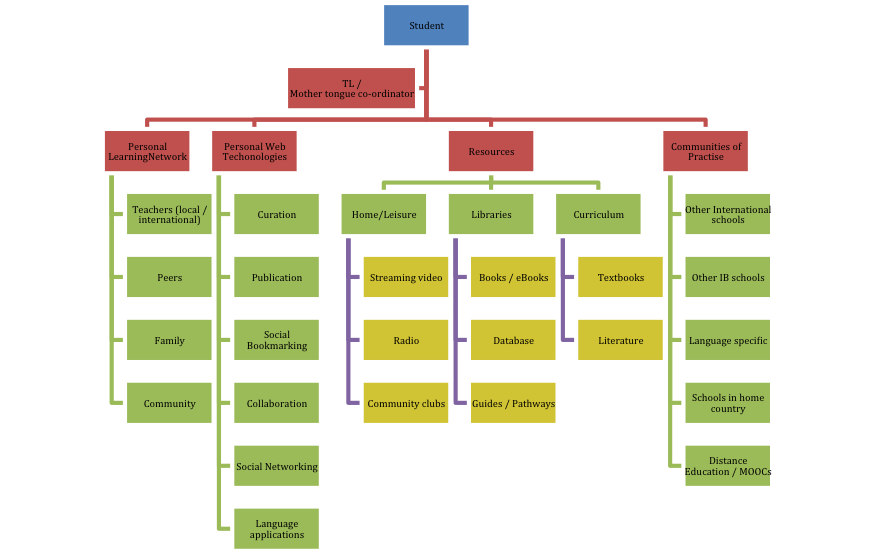
TLs in their own professional development are familiar with the use of geographically dispersed personal learning networks (PLNs) in order to create a personal learning environment (PLE) using a variety technological tools (McElvaney & Berge, 2009; O’Connell, 2014). They also have extensive networks both locally and internationally that can be tapped into. This provides TLs with an ideal opportunity of working with a group of students and teachers in creating their own PLE with a variety of resources, networks and personal web technologies (PWT) both in their mother tongue and the language of instruction.
![]() |
| Figure 1: PLE of an IB self-taught language student |
The International Baccalaureate (IB) program allows mother tongue students the option of guided self-study if the school doesn’t offer the language. Tapping into the experiences and communities of practise (COP) of distance education, massive open online courses (MOOCs), PLNs and PLEs could ameliorate the logistical, resourcing, teaching and learning difficulties of this option unbound by time and geography. A successful pilot scheme with one language group could be rolled out to other groups. Not only will this enhance the reputation of the TL in the school but will also contribute to the schools goals of equity in teaching and resources and ensure support and involvement by the whole school community.
Australian Bureau of Statistics. (2013). Australian Social Trends, April 2013. Retrieved December
14, 2014, from http://www.abs.gov.au/AUSSTATS/abs@.nsf/Lookup/4102.0Main+Features
30April+2013
Canadian Demographics at a Glance: Some facts about the demographic and ethnocultural
composition of the population. (n.d.). Retrieved December 14, 2014, from
http://www.statcan.gc.ca/pub/91-003-x/2007001/4129904-eng.htm
Carder, M. (2007). Bilingualism in international schools: a model for enriching language education.
Clevedon; Buffalo: Multilingual Matters.
Center for Public Education. (2012, May). The United States of education: The changing
demographics of the United States and their schools. Retrieved December 14, 2014, from
http://www.centerforpubliceducation.org/You-May-Also-Be-Interested-In-landing-page-
level/Organizing-a-School-YMABI/The-United-States-of-education-The-changing-
demographics-of-the-United-States-and-their-schools.html
Colbert-Lewis, D., & Colbert-Lewis, S. (2013). The Role of Teacher-Librarians in Encouraging
Library Use by Multicultural Patrons. In C. Smallwood & K. Becnel (Eds.), Library services for
multicultural patrons: strategies to encourage library use (pp. 73–81). Lanham: The Scarecrow
Press, Inc.
Cummins, J. (2001). Bilingual Children’s Mother Tongue: Why Is It Important for Education?
Retrieved May 27, 2014, from http://iteachilearn.org/cummins/mother.htm
Cummins, J. (2003). Putting Language Proficiency in Its Place: Responding to Critiques of the
Conversational – Academic Language Distinction. Retrieved May 27, 2014, from
http://iteachilearn.org/cummins/converacademlangdisti.html
Everhart, N., Mardis, M. A., & Johnston, M. P. (2010). Diversity Challenge Resilience: School
Libraries in Action. In Proceedings of the 12th Biennial School Library Association of
Queensland. Brisbane, Australia: IASL.
Garrison, K. L., Forest, D. E., & Kimmel, S. C. (2014). Curation in Translation: Promoting Global
Citizenship through Literature. School Libraries Worldwide, 20(1), 70–96.
Ho, C. (2011). “My School” and others: Segregation and white flight. Australian Review of Public
Affairs, 10(1). Retrieved from http://www.australianreview.net/digest/2011/05/ho.html
Kim, M., & Mizuishi, K. (2014, December 10). Language and Cultural Differences and Barriers in
an International School Setting – Personal Experiences and Reflections [Presentation].
UWCSEA-East.
McElvaney, J., & Berge, Z. (2009). Weaving a Personal Web: Using online technologies to create
customized, connected, and dynamic learning environments. Canadian Journal of Learning and
Technology, 35(2). Retrieved from http://www.cjlt.ca/index.php/cjlt/article/viewArticle/524/257
Mestre, L. (2009). Culturally responsive instruction for teacher-librarians. Teacher Librarian, 36(3),
8–12.
O’Connell, J. (2014). Researcher’s Perspective: Is Teacher Librarianship in Crisis in Digital
Environments? An Australian Perspective. School Libraries Worldwide, 20(1), 1–19.
Thought experiments and information literacy
A little while back KDA (Librarian Edge), enthusiastically placed a book on my desk and said I had to read it and I had to create a library guide based on it (I did, see this, and it was very enthusiastically received by Mr. Fleischman). She was completely right. What a wonderful resource has been placed into the hands of librarians and teachers everywhere. Read more ….
Information Literacy is more than a set of skills
Blog task 3: Information Literacy is more than a set of skills
The question of whether information literacy (IL) is more than a set of skills is an important one, as it sets the philosophical basis that informs the approach that an institution and its administrators, teachers and teacher librarians (TL) take in the design and implementation of a program.
IL can probably thought as occurring along a continuum of proficiency, dependent on a number of factors including but not limited to:
- Age / developmental stage of the student (Brown, 2004; Miller, 2011)
- Psychological, attitudinal and motivational factors including resilience, persistence, ability to deal with ambiguity, complexity and emotion (American Association for School Librarians, 2007; Kuhlthau & Maniotes, 2010)
- Aptitudes such as prior knowledge, comprehension, interpretation and connection seeking (Herring & Bush, 2011)
- Social, linguistic and cultural context (Dorner & Gorman, 2012)
Drawing on my interest in language acquisition and particularly the field of bilingualism, I think an argument can be made for comparing IL and bilingualism. Cummins (1998, 2001, 2003) distinguishes between Basic Interpersonal Communication Skills (BICS) and Cognitive Academic Language Proficiency (CALP). Students who have BICS appear to be fluent in the language, however, although they have developed the surface skills of speaking and listening, they lack the ability to succeed in cognitively demanding context-reduced academic tasks. Research indicated that BICS could be acquired in a couple of years, while CALP took five to seven years. Similarly it could be argued that the superficial skills of IL could be acquired reasonably rapidly within context embedded, concrete tasks that are sufficiently scaffolded by the teacher or TL. However, researchers have observed the sometimes elusive ability of students to internalise information literacy instruction, and employ or transfer it across different learning contexts, depending on assumptions made by the learning community (Herring, 2011) even if IL instruction occurs embedded in Guided Inquiry (GI) (Thomas, Crow, & Franklin, 2011). In any event, it would appear that this internalization and transfer of skills did not occur until the high school years – indicating that it is a process that occurs over time and as a result of repeated exposure to and use of IL skills in increasingly complex and abstract learning tasks.
It can be posited that one could look at the students coming out of an institution and employ a retroactive deduction on whether their institution considers IL to merely be a set of skills rather than considering its aspects of transformational process (Abilock, 2004), a learning practice (Lloyd, 2007, 2010 cited in Herring, 2011) or a construct that goes beyond personal learning of content or concept but also encompasses aspects of digital citizenship (Waters, 2012) and the participatory culture of knowledge (O’Connell, 2012).
To conclude, I still have many questions in the context of school based instruction and acquisition of IL. Does it become self-limiting by the assumptions and process by which it is taught? How far does the school system allow students to progress? If one treats IL as a skill – what would motivate a student to go beyond superficial skill acquisition and apparent information fluency and by going through the motions of pre-determined scaffolds and questions to the point of internalization and deeper learning?
References
Abilock, D. (2004). Information literacy: An overview of design, process and outcomes. Retrieved from http://www.noodletools.com/debbie/literacies/information/1over/infolit1.html
American Association for School Librarians. (2007). Standards for the 21st-Century Learner. AASL. Retrieved from http://www.ala.org/aasl/standards-guidelines/learning-standards
Brown, A. (2004). Reference services for children: information needs and wants in the public library. The Australian Library Journal, 53(3), 261–274.
Cummins, J. (1998). Immersion education for the millennium: What have we learned from 30 years of research on second language immersion? In M. R. Childs & R. M. Bostwick (Eds.), Learning through two languages: Research and practice (pp. 34–47). Katoh Gakuen, Japan.
Cummins, J. (2001). Bilingual Children’s Mother Tongue: Why Is It Important for Education? Retrieved May 27, 2014, from http://iteachilearn.org/cummins/mother.htm
Cummins, J. (2003). Putting Language Proficiency in Its Place: Responding to Critiques of the Conversational – Academic Language Distinction. Retrieved May 27, 2014, from http://iteachilearn.org/cummins/converacademlangdisti.html
Dorner, D. G., & Gorman, G. E. (2012). Developing Contextual Perceptions of Information Literacy and Information Literacy Education in the Asian Region. In A. Spink & D. Singh (Eds.), Library and information science trends and research Asia-Oceania (pp. 151–172). Bingley, U.K.: Emerald. Retrieved from http://public.eblib.com/choice/publicfullrecord.aspx?p=862261
Herring, J. E. (2011). Assumptions, Information Literacy and Transfer in High Schools. Teacher Librarian, 38(3), 32–36.
Herring, J. E., & Bush, S. J. (2011). Information literacy and transfer in schools: implications for teacher librarians. Australian Library Journal, 60(2), 123–132.
Kuhlthau, C. C., & Maniotes, L. K. (2010). Building Guided Inquiry Teams for 21st-Century Learners. School Library Monthly, 26(5), 18.
Miller, P., H. (2011). Piaget’s Theory Past, Present, and Future. In U. C. Goswami (Ed.), The Wiley-Blackwell handbook of childhood cognitive development (pp. 649–672). Chichester; Malden, MA: Wiley-Blackwell.
O’Connell, J. (2012). Change has arrived at an iSchool library near you. In Information literacy beyond library 2.0 (pp. 215–228). London: Facet.
Thomas, N. P., Crow, S. R., & Franklin, L. L. (2011). The Information Search Process – Kuhlthau’s Legacy. In Information literacy and information skills instruction: applying research to practice in the 21st century school library (3rd ed., pp. 33–58). Santa Barbara, Calif: Libraries Unlimited.
Waters, J. K. (2012, September 4). Turning Students into Good Digital Citizens. Retrieved January 2, 2015, from http://thejournal.com/Articles/2012/04/09/Rethinking-digital-citizenship.aspx
Getting into and through Algebra
Let’s slay spelling first – who the heck decided that the best way for a kid to learn how to spell was to make them write the words out using different colours and different twirly writing and writing it diagonally and vertically and do all sorts of silly games and things to fill in? All the way through primary my son had to endure this. He never minded writing a word 10 or 20 or 100 times. He did mind taking out the coloured pencils and f***ing around doing silly stuff. And is there any evidence that it works at all? I sincerely doubt it, and I’d be darned if there is any credible research behind this. I’m with Sugata Mitra on this. Yes I do think it is preferable to spell correctly and I do despair of one of my children’s inability to spell, but in the scheme of things I just don’t think it’s a deal breaker. Especially not if it involves hours of meaningless crappy worksheets at the cost of other learning. And anyway, everytime he spells something incorrectly in his Instagram it’s an opportunity for the smart kids to engage with him and tell him he’s done it wrong and correct it!
On to Algebra. Now my views there are different. I do think algebra is important. I just had a tough act selling it to a child who came home on Monday practically in tears because he didn’t have a clue what had been going on in class that day and the minute I started talking “X” and “Y” had a minor fit. So, when in doubt, google it. There is a lot of rubbish out there on math and algebra. But I did find a rather nice YouTube video which explained very nicely why algebra was important, and it aligned exactly with my views (which I didn’t know I had – i.e. I knew it was important but was incapable of expressing why properly and in the language that would relate to him).
So it’s now Thursday, and I’m happy to report that with the help of the nice big white board, tons of patiences and forbearance on my part and a burning desire to succeed on his, we have progressed remarkably far. He gets why and he gets that it’s just a language and that it’s particularly good for lazy people who don’t want to write everything out as it makes things as simple as possible with as few letters as possible. We’ve done lots of examples of pattern recognition, and converting the expression of simple patterns into equations. We’ve also managed to get to the understanding that it’s a useful way of generalising an expression so that we can then work anything in a sequence out by applying that expression. That’s a lot of progress in 4 days. (Just an aside – the optimal moment for working on this is after he’s spent an hour running or doing Crossfit! Yay for exercise).
talking to the Math teachers! Don’t do it! It’s two worksheets with a bunch of equations embedded in a picture and you solve the equations and then colour the shapes in to see the picture. Now I can tell you right off the bat that he is not going to do that homework. Not because he doesn’t want to, but because he HATES this type of homework. So I make a deal with him. I’ll write out all the equations, he works them out and I’ll do the colouring in (yes sweet saints, what the hell am I doing?). We do the first one, he finishes in a flash, and whereas he’d begun by saying he’d do the second one over the weekend, asks me to do the same for the 2nd and tackles it with gusto. While he does it we have a little discussion over the fact that c+c = 2c = c(squared). I the sucker, spend a little longer on the colouring but it gets done.