Content plus

One regularly hears phrases bandied around schools such as “Every teacher is a language teacher”; or “Every class should start with 10 minutes of reading” and you’d be hard pressed to find a teacher who doesn’t agree in theory, that reading is a good thing. But then there is the “reality” of supposed too little time, too much pressure, too much content to cover and the theory of reading becomes such an abstract notion that there isn’t even a consideration of how it could be implemented.

Last week-end, Katie Day and myself gave a 90 minute presentation to around 100 educators at the Neev Literature Festival titled “Books & Beyond”. You can find a copy of the presentation here as well as other resources.

We’re on break now, and when we get back I was asked to present to our HODs for a few minutes on integrating reading into units in the middle school. I’ll probably just show this one slide:
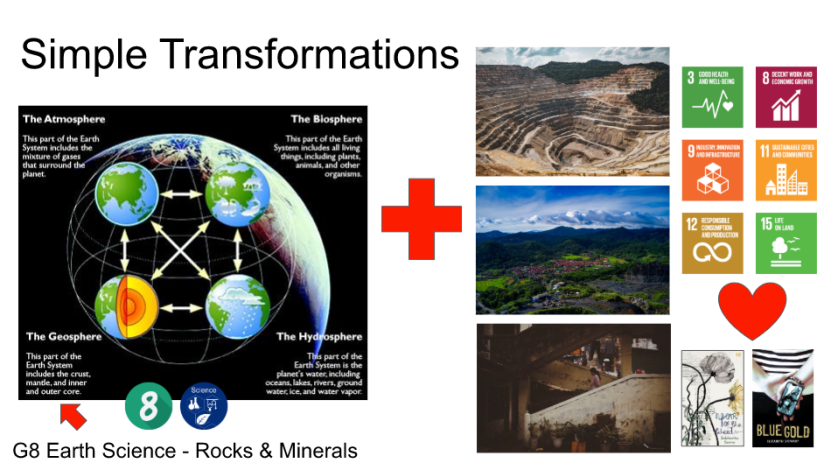
I’d call it “content plus” – it’s from a G8 Earth Science unit that the Science team and I put together at the end of last year and they’re teaching now.

The idea is that you still have the science content as core to the unit – in this case Earth Science and learning about Sedimentary, igneous and metamorphic rocks and the minerals they contain and mining and the  products of mining. But to that you add the environmental and human impact, and the lens of the SDGs (Sustainable Development Goals).  And in order to help build empathy and understanding, add some literature.

Katie also had the brilliant idea, that she’s implemented in her school (and I’m going to be following quickly behind!), of getting good, relevant articles, stripping off the advertising etc (she uses Safari Reader View; I use Mercury Reader) putting them in binders and making them available in the library and classrooms – see slides 42-47).

You can of course choose any minerals, but in this case to make it relevant to G8, we focused on the primary elements of an iPhone.
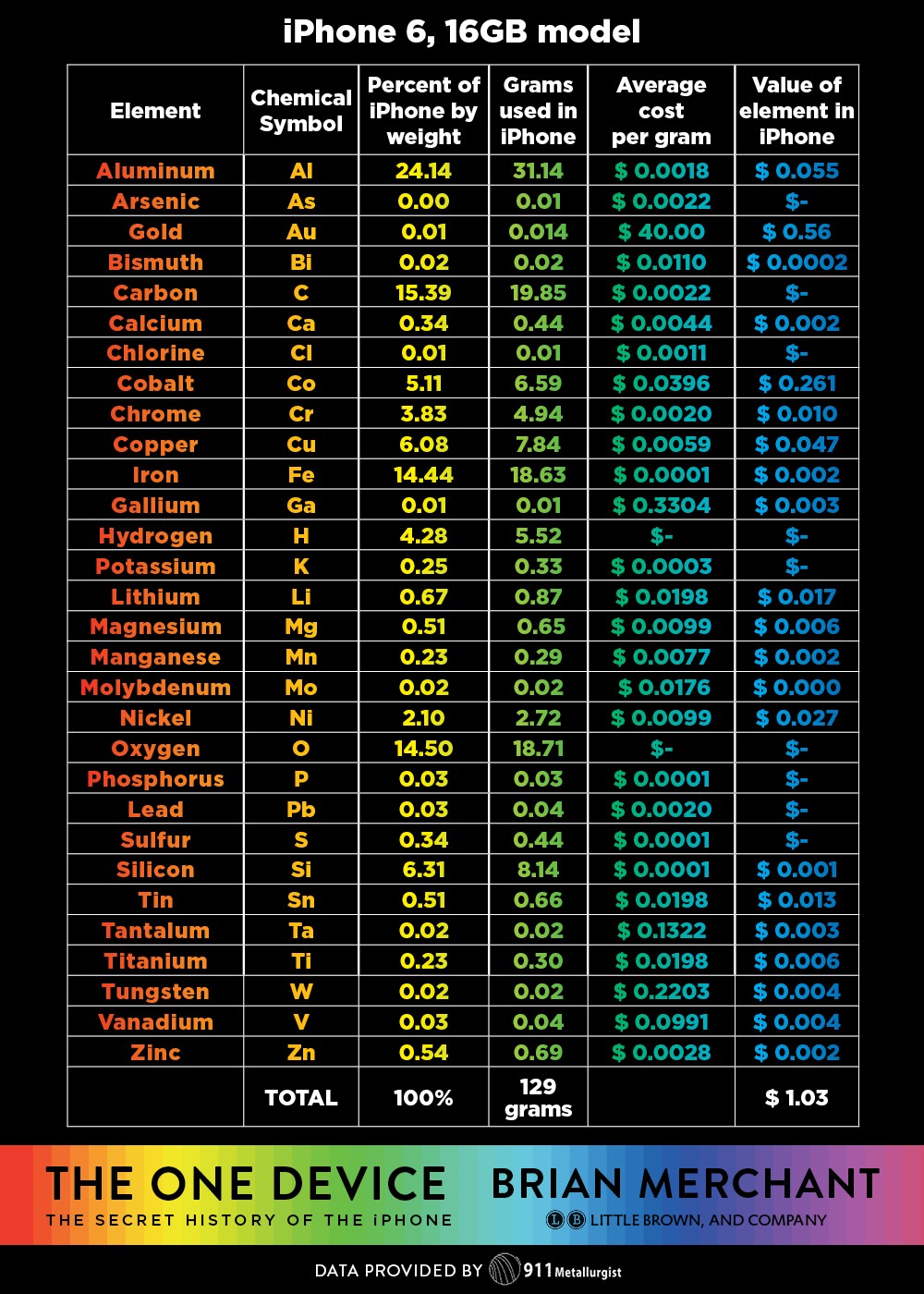
 

iPhone ingredients

Ideally, and this takes time, some of the science and or math units would be linked to Language & Literature or Individuals & Societies units allowing more time to explore literature.

In the mean time, one of the wonderful ways of adding literature into units is through picture books. In the guide we created for the Neev Festival, we made suggestions around groupings of the SDGs of the Neev shortlisted picture books plus lots of other books. It’s still a work in progress, but over time I’m hoping that for each and every global goal I have 10-20 picture books, (as well as 10-20 fiction books and 10-20 really good nonfiction books) that can easily and quickly be introduced to a class, thereby adding a very special element to learning, and truly making “every teacher a language teacher” and every teacher able to devote a tiny slice of their class to reading.
Why awards?

This week’s blog post will be very brief as a function of my extreme exhaustion – just been up and down to Bangalore for the Neev Literature Festival 2019. Beijing-Bangalore is not a commute I’d recommend to anyone who prizes their sleep or sanity but WOW what an intense 2 days it was.

The theme this year was “Taking Children’s Literature Seriously” and I’ll write a bit more about the rest of the festival another time.

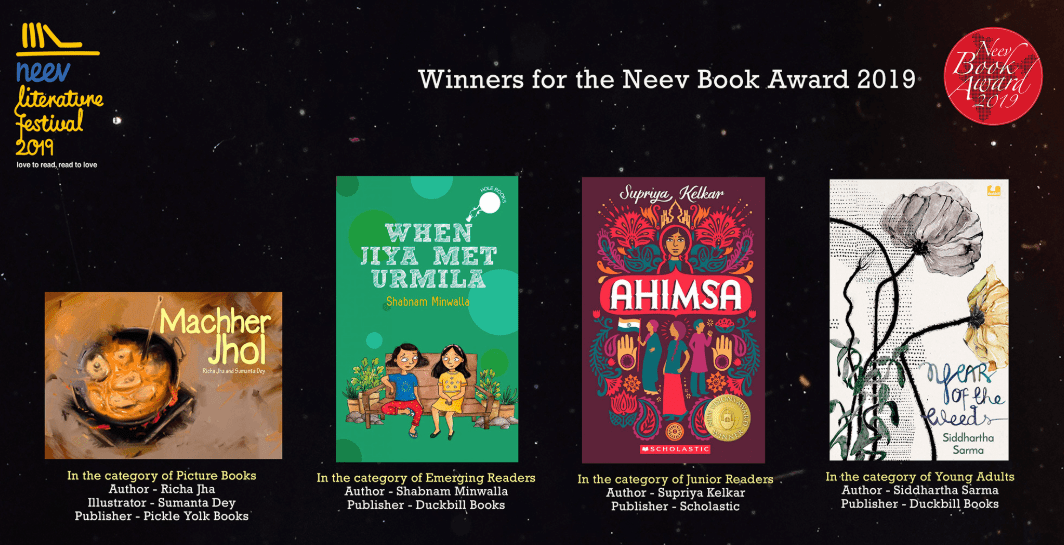
For now I just want to highlight the winners:

Screen Shot 2019-09-22 at 20.11.30

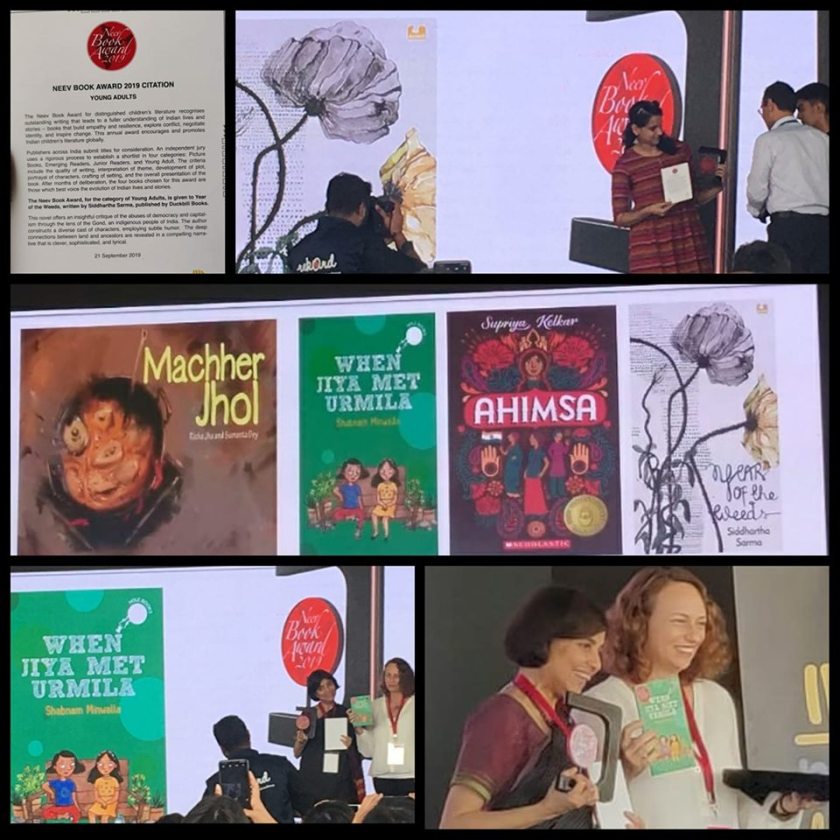
After a year of reading the long lists and short lists in four categories the awards were announced on Saturday for this year’s winners. I must say it was a surprisingly emotional moment even for me just as one of the jurors, I can’t imagine what it must be like for the authors!

There’s been a bit written recently about literary prizes – “Who Cares about Literary Prizes” is a wonderful article combining the idea of “canon” and popularity in this context with some very cool data representation. Book Prizes, the more the merrier, and A guide to the most prestigious prizes.

Book buyers, librarians, teachers, parents tend to rely on a fairly narrow range of sources for their book purchasing decisions. One of those is lists, and the other prize winners (and often lists of prize winners). In this context the existence of speciality or niche book prizes is incredibly important to shed light on otherwise neglected corners of excellent children’s literature.

Since Ahimsa is already relatively well known in international children’s literature circles, I’m going to just put in a few words about the other three books.

Machher Jhol is a richly illustrated book showing the journey of a young boy through the roads of Kolkata to get the ingredients for a fish stew for his father. There is a wonderful twist to this tale that will make it beloved of any class looking for books on resilience.

When Jiya met Urmila is written for that space of emerging readers where very few authors manage to successfully tell a great story but make the writing accessible to the beginning reader. The story gently probes how segregated childrens’ lives can be.

Year of the Weeds is one of those books that I can see becoming part of a canon of middle grade / young adult books that are used in the classroom to promote thinking about globalisation, sustainable development goals of economic growth (8); industry and infrastructure (9); sustainable cities and communities (11) responsible consumption and production (12); and Life on land (15) – while still being an excellent read.   The link above goes to a very interesting interview with the author.

neev awards.jpg

Another thing that awards do – reward publishers for taking chances on genres, topics and authors.  This year Duckbill publishers had two award winning books – here’s hoping they continue to bet on this calibre of writing AND even more importantly that their books get attention and distribution outside of India, because the world needs these books.

In response to requests – here is where to find the books:

Ahimsa

When Jiya Met Urmila

I will be sharing an email to contact if you are interested in buying the short-list or finalists in multiple copies.

In addition if you’re interested in other books:

Here is the short list:

Here is the complete LongList nominated by Indian publishers


Seek and Find – breakout

In the interests of trying new things myself, and also making library orientation and searching the catalog / tracing items from the catalog to the physical copy more fun, I decided to create a library breakout.

I’d watched the “Breakout” phenomenon ebb and flow about 3-4 years ago and had always put it in the “fun, but how?” box, and this year finally decided to get into action. Our HS Edtech person had purchased the official “Breakout box” so I could have a look at that and the resources in the official site, and our ES Edtech person had deconstructed the idea and had a bunch of Stanley boxes, suitcases with locks and locks, so I had a lot to play around with. The first port of call was the official Breakout Site. Like all great ideas, this seems to be one that had its hey-day around 2015 and many of the potentially interesting links to library orientation were either broken, or the video instruction didn’t work or there were other issues, so, I left, muttering “maintenance” . I found a few good breakout description online (Library Media TechTalk; The Bright Ideas Library; LibraryStew; Ms. Kochel’s book blog;) and then, after getting an idea of how it could work, sat down and thought of what my aims would be.

  1. I wanted to highlight the “Panda” books – the annual students’ choice books that are on a huge display in the library but often get overlooked by students and teachers alike – we order 5/6 copies of each book each year and students vote on their favourite in March.
  2. I wanted students to be familiar with the library guides and bookmark the front page.
  3. I wanted to make sure students could log onto the library catalog, search for a book and then find the physical copy in the library
  4. I wanted each student to know how to use the “self-checkout” station
  5. I wanted the students to search the catalog to find more obscure items (in titles, in descriptions of books, number of books in a series etc)

With my “ISTE educator” hat on, I wanted to ensure I could work on the role of “Facilitator”:

Educators facilitate learning with technology to support student achievement of the 2016 ISTE Standards for Students. Educators:
a. Foster a culture where students take ownership of their learning goals and outcomes in both independent and group settings.
b. Manage the use of technology and student learning strategies in digital platforms, virtual environments, hands-on makerspaces or in the field.
c. Create learning opportunities that challenge students to use a design process and computational thinking to innovate and solve problems.

In this case they would be “Knowledge constructors”

3. Knowledge Constructor
Students critically curate a variety of resources using digital tools to construct knowledge, produce creative artifacts and make meaningful learning experiences for themselves and others. Students:
a. plan and employ effective research strategies to locate information and other resources for their intellectual or creative pursuits.

ATLS (approaches to learning):

  • Thinking – Creative thinking / problem solving
  • Self Management – Affective – show resilience; Demonstrate persistence and perseverance
  • Social – Collaborative – share responsibility and roles with others

Universal design for learning:

  • Multiple means of Engagement: Provide options for Sustaining Effort & Persistence
  • Multiple means of Action and Expression: Provide options for Physical Action

The guide for the breakout can be found here with the clues. Students could access this guide through a QR code on the box.  Most of them didn’t examine the box for the QR code but went straight for the printed instructions.

The activity needed at least 50-60 minutes – with some classes we had that, and generally those were the more successful classes who managed to complete all locks.

Some teams / classes didn’t complete for various reasons, and they didn’t get anything. Nothing. No compensatory prizes, no consolation prizes. The teams who did succeed could trade in their “key for success” cards in the box for boxes of “smarties” or chocolates – and the feeling of success.

Main takeaways:

  •  Students need to be carefully guided to read the instructions completely and carefully
  • Their enthusiasm and “let’s run here” inclinations needs to be tempered with “hey guys, how about stopping and thinking about …”
  • Where an activity led them to need to get a next clue from the library staff, our staff was instructed that they only proceeded if they were politely addressed and asked (part of the hidden agenda that my staff are people with feelings who need to be treated respectfully)
  • Students (and teachers) often don’t see displays and look over them – their attention needs to be brought to things deliberately
  • Don’t assume anything – some 14 year olds have never done puzzles or have any idea of what a cipher wheel is!


How to lie and cheat …

Teaching academic honesty is always a tricky one. Last year, my involvement was limited to showing a tool (Noodletools) to large groups of students, howling in protest that they preferred the predatory alternative EasyBib, too late in the year and being a second opinion on whether submitted work was honest or not.

This year, I’m more of a “known factor” and when I offered to start the year with a more general discussion on honesty rather than just getting into the nitty gritty of citation, a fellow teacher offered to lend a hand in a Day 9 session.

In order to get more than three nerds to sign up, I billeted it as “How to lie and cheat your way to academic success” and an unprecedented 30 students signed up for the session – the maximum allowed. During the planning we set out to find out a little more about the motivations of students and to ensure we engaged MYP ATLs, and I wanted to make sure we covered the ISTE student standards of Digital Citizen and the UDL (Universal Design for Learning) standard of “Multiple means of Engagement”. 

ATLs (Approaches to Learning)

Thinking skills

  • Critical Thinking
  • Creative Thinking

Research Skills

  • Information Literacy

ISTE Student:

2. Digital Citizen
Students recognize the rights, responsibilities and opportunities of living, learning and working in an interconnected digital world, and they act and model in ways that are safe, legal and ethical. Students:

b. engage in positive, safe, legal and ethical behavior when using technology, including social interactions online or when using networked devices.
c. demonstrate an understanding of and respect for the rights and obligations of using and sharing intellectual property.

My co-teacher Jo had some valuable day-to-day insights from the classroom of where students had a lack of understanding or were mis-understanding the topic which helped guide our planning and thinking about the session.

We started with a quick survey using Mentimeter to get an understanding where any potential plagiarism could arise. The questions were adapted from the “Symptoms of Plagiarism” by Dianne MacKenzie, further discussed here. We explained that all answers were anonymous and it wasn’t any reflection on them but rather feedback to us as teachers. We zoomed in on discussing “must do well” to better understand whether the pressure was internal (self) or external (parental) or a mixture and found it was pretty evenly spread. As teachers and creators of assignments the 25% who said they “didn’t understand the assignment” gave further pause for thought on how we set and word assessments and assessment rubrics, and also credence to our new MYP coordinator’s emphasis on ensuring teachers and students are familiar with the MYP command terms (Libguide by Stephen Taylor).


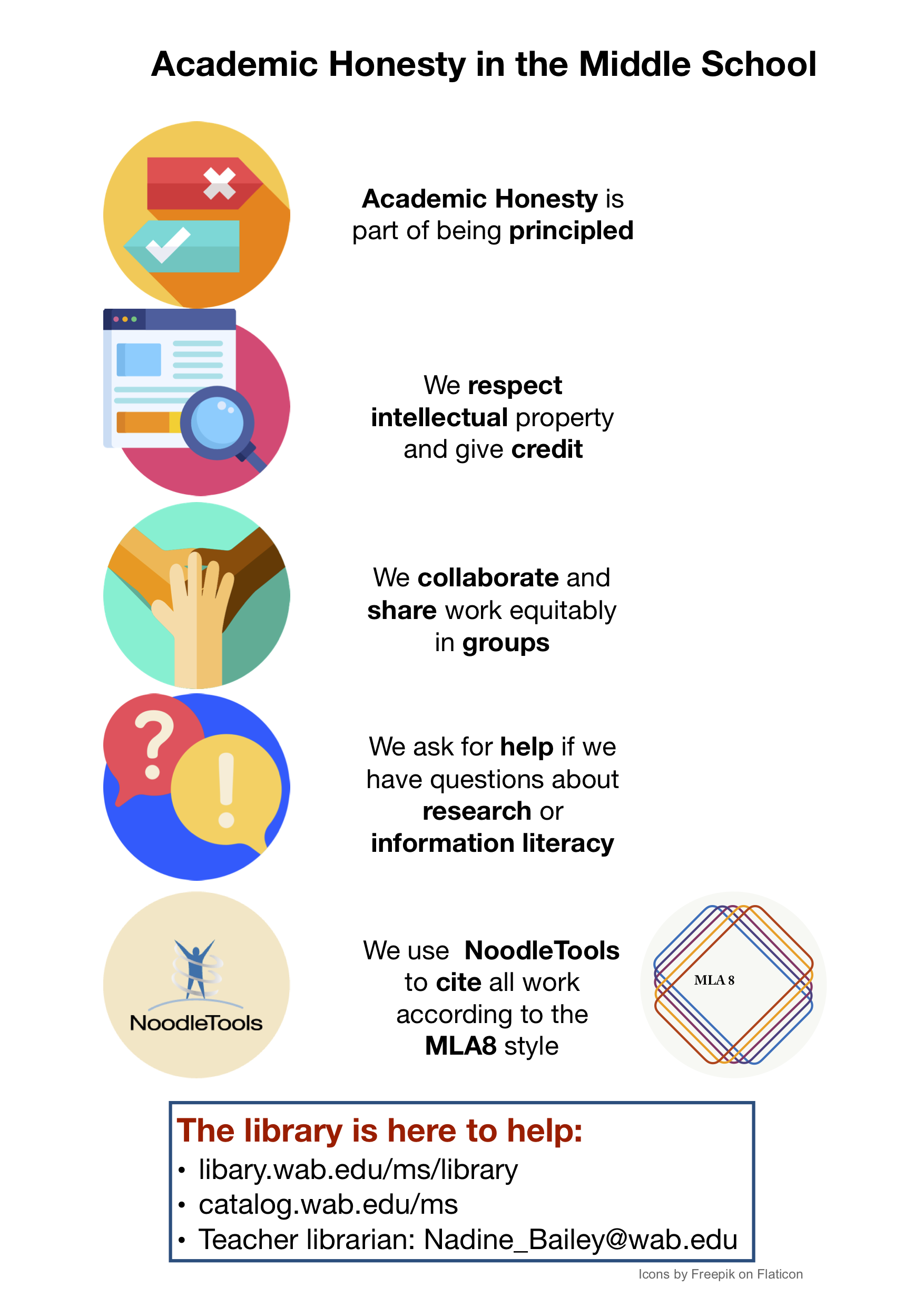
After this, we showed them their homework diaries, where at the back we’d included a graphic of our Middle School Academic Honesty Policy, and an adapted summary of Turnitin’s spectrum of plagiarism. Yet another example of not assuming “if you put it there they will notice” since none of them had noticed what was at the back of their homework agenda! Following the Turnitin spectrum we discussed the various types with real life examples. They didn’t have any idea there were so many variations, and in particular were interested in the fact that reusing your own work was not ethical if you

Academic honesty

didn’t cite yourself. As was making up data for lab reports or “client requests” for design. 

Then they played a matching game of plagiarised text to type of plagiarism. And successfully matched all types.

In four groups they were given a moral compass and allocated 10-12 “Got Ethics” cards to discuss and place on the compass based on group consensus. And when they were finished they could rank the cards in the “wrong” sector by increasing level of “wrongness”  Interestingly here, one of the groups of girls were critical of the cards themselves saying the clothing of the girls images (exposed stomachs) was sexist and not gender neutral!

The final 15 minutes were spent on a Kahoot where we wrapped up all the elements of the session with a quiz where we explained that some of the questions had no right answer or a few options, and we’d pause every now and again to discuss things like what the difference was between copying a story and writing fan-fiction and fractured fairytales. 

We felt it was 70 minutes well spent with engaged and interested students throughout and will probably run the session again.

Little big things

Or perhaps big little things? The theme for this year’s Collaboration for Growth MYP session is “School Cultures; How do we shape them? How do they shape us?

It made me think about what is different this year to last year culturally (besides feeling less like a deer in the headlights as it’s my 2nd year). A big thing has been the change in our school food provider. One would think that food is food and there’s not much difference between one and the other, but there has been quite a big shift. Last year many of us descended to one of the lounges and ate communally. It was fun to see on any particular day who would be there, and such interesting conversations would be had between Elementary, Middle and High school teachers and staff. You never knew who you’d bump into and all sorts of know-how and information would be passed along over lunch.

As someone not particularly inclined to shop and cook (and who’s trying to teach my teen to cook for himself, so increasingly leaving him up to fending for his dinners himself) it meant having a nutritious main meal for lunch and not bothering about dinner.

These days, the lounge is semi-deserted. I hardly ever see the people I used to bump into unless we make a point of meeting after school or for an external lunch – so much more effort. No more chatter about what’s going on educationally or personally in our lives. No more great ideas plotted out. Now I make a double meal at night and warm it up in our divisional microwave in our divisional staffroom if I can be bothered, or just eat at my desk when things are too overwhelming.

A little thing. A little big thing. But many have been mentioning the loss. And so culture changes. Without intent, positive or negative.