Content plus

One regularly hears phrases bandied around schools such as “Every teacher is a language teacher”; or “Every class should start with 10 minutes of reading” and you’d be hard pressed to find a teacher who doesn’t agree in theory, that reading is a good thing. But then there is the “reality” of supposed too little time, too much pressure, too much content to cover and the theory of reading becomes such an abstract notion that there isn’t even a consideration of how it could be implemented.

Last week-end, Katie Day and myself gave a 90 minute presentation to around 100 educators at the Neev Literature Festival titled “Books & Beyond”. You can find a copy of the presentation here as well as other resources.

We’re on break now, and when we get back I was asked to present to our HODs for a few minutes on integrating reading into units in the middle school. I’ll probably just show this one slide:

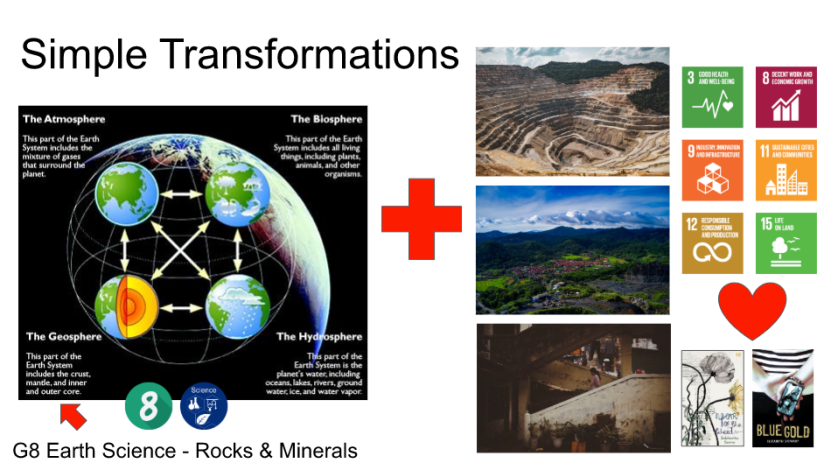
I’d call it “content plus” – it’s from a G8 Earth Science unit that the Science team and I put together at the end of last year and they’re teaching now.

The idea is that you still have the science content as core to the unit – in this case Earth Science and learning about Sedimentary, igneous and metamorphic rocks and the minerals they contain and mining and the  products of mining. But to that you add the environmental and human impact, and the lens of the SDGs (Sustainable Development Goals).  And in order to help build empathy and understanding, add some literature.

Katie also had the brilliant idea, that she’s implemented in her school (and I’m going to be following quickly behind!), of getting good, relevant articles, stripping off the advertising etc (she uses Safari Reader View; I use Mercury Reader) putting them in binders and making them available in the library and classrooms – see slides 42-47).

You can of course choose any minerals, but in this case to make it relevant to G8, we focused on the primary elements of an iPhone.


iPhone ingredients

Ideally, and this takes time, some of the science and or math units would be linked to Language & Literature or Individuals & Societies units allowing more time to explore literature.

In the mean time, one of the wonderful ways of adding literature into units is through picture books. In the guide we created for the Neev Festival, we made suggestions around groupings of the SDGs of the Neev shortlisted picture books plus lots of other books. It’s still a work in progress, but over time I’m hoping that for each and every global goal I have 10-20 picture books, (as well as 10-20 fiction books and 10-20 really good nonfiction books) that can easily and quickly be introduced to a class, thereby adding a very special element to learning, and truly making “every teacher a language teacher” and every teacher able to devote a tiny slice of their class to reading.

Why awards?

This week’s blog post will be very brief as a function of my extreme exhaustion – just been up and down to Bangalore for the Neev Literature Festival 2019. Beijing-Bangalore is not a commute I’d recommend to anyone who prizes their sleep or sanity but WOW what an intense 2 days it was.

The theme this year was “Taking Children’s Literature Seriously” and I’ll write a bit more about the rest of the festival another time.

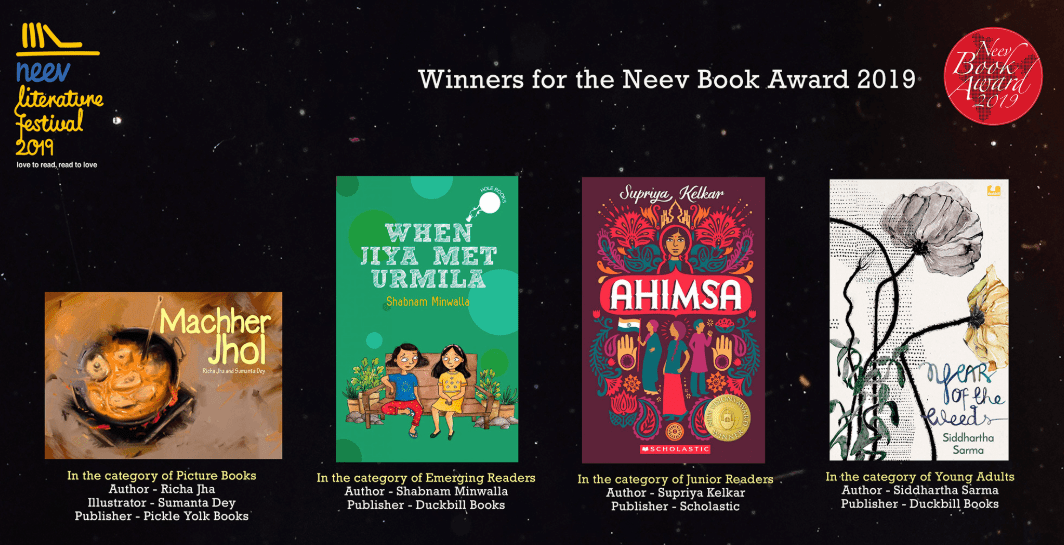
For now I just want to highlight the winners:

Screen Shot 2019-09-22 at 20.11.30

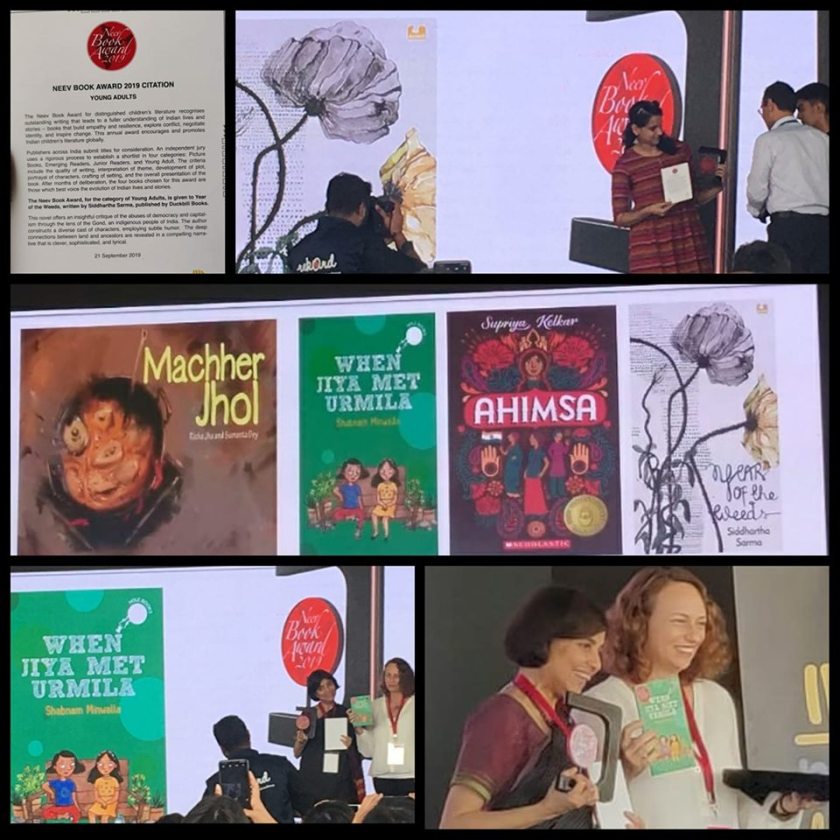
After a year of reading the long lists and short lists in four categories the awards were announced on Saturday for this year’s winners. I must say it was a surprisingly emotional moment even for me just as one of the jurors, I can’t imagine what it must be like for the authors!

There’s been a bit written recently about literary prizes – “Who Cares about Literary Prizes” is a wonderful article combining the idea of “canon” and popularity in this context with some very cool data representation. Book Prizes, the more the merrier, and A guide to the most prestigious prizes.

Book buyers, librarians, teachers, parents tend to rely on a fairly narrow range of sources for their book purchasing decisions. One of those is lists, and the other prize winners (and often lists of prize winners). In this context the existence of speciality or niche book prizes is incredibly important to shed light on otherwise neglected corners of excellent children’s literature.

Since Ahimsa is already relatively well known in international children’s literature circles, I’m going to just put in a few words about the other three books.

Machher Jhol is a richly illustrated book showing the journey of a young boy through the roads of Kolkata to get the ingredients for a fish stew for his father. There is a wonderful twist to this tale that will make it beloved of any class looking for books on resilience.

When Jiya met Urmila is written for that space of emerging readers where very few authors manage to successfully tell a great story but make the writing accessible to the beginning reader. The story gently probes how segregated childrens’ lives can be.

Year of the Weeds is one of those books that I can see becoming part of a canon of middle grade / young adult books that are used in the classroom to promote thinking about globalisation, sustainable development goals of economic growth (8); industry and infrastructure (9); sustainable cities and communities (11) responsible consumption and production (12); and Life on land (15) – while still being an excellent read.   The link above goes to a very interesting interview with the author.

neev awards.jpg

Another thing that awards do – reward publishers for taking chances on genres, topics and authors.  This year Duckbill publishers had two award winning books – here’s hoping they continue to bet on this calibre of writing AND even more importantly that their books get attention and distribution outside of India, because the world needs these books.

In response to requests – here is where to find the books:

Ahimsa

When Jiya Met Urmila

I will be sharing an email to contact if you are interested in buying the short-list or finalists in multiple copies.

In addition if you’re interested in other books:

Here is the short list:

Here is the complete LongList nominated by Indian publishers


Culture eats strategy for breakfast

This phrase is attributed to Peter Drucker and made famous by Mark Fields (although can’t easily be authenticated). I firmly believe it to be a reality both in business and education, and many a manager has been burnt by this.

I’m currently in Bangalore, having spent the last three days at the Neev Literature Festival  where I had the honor to be invited back as a speaker / workshop leader and as a jury member of the inaugural Neev Book Award. It was touch and go whether I’d be able to attend, given that my passport has been tied up with either visa or customs arrangements since the beginning of August, but a little more than a week ago I got the go-ahead! I’m so glad I did. You see Neev is a very special place. Many schools claim to promote a culture of reading and spend vast amounts of money on classroom or central libraries. But sometimes to no avail as the individual teachers or heads don’t actually walk the walk.

Here the founder really and truly believes in reading, and has invested immensely to ensure that reading permeates the school – what other school hosts a free literature festival at their premises, flies over authors, illustrators, librarians, storytellers, interpretive dancers and then invites other schools and the public to partake of their largess?  I was talking to their new head last night, about admissions, and she said they were in a luxury position where demand was greater than supply of school places and one of the ways they decided on who gets a seat was based on the families being able to demonstrate that they supported a reading culture at home! Imagine that! Not portfolios, or CV’s or admission tests. And it shows. Listening to the young students as they described their reading lives I was astounded at the depth and breadth of their reading.

I spent the morning today with a few of the visiting authors, and one – the wonderful Nadia Hashami,  was telling me of a conversation with a reader who had read her book twice and was recommending it to everyone, and who had also attended her panel on “Protect or Prepare” difficult topics in literature – the discussions, chaired by Katie Day were around which topics could or should be out of bounds for children. This young lady’s take on it was that death was a part of life and had a place in literature as it was part of a normal life, however, she could not come to terms with rape and sexual violence because it was something that one would never want to be part of your life and which would never leave you or have a resolution. Astounding the maturity and empathy (some USA people could do with a little more empathy-powering literature obviously).

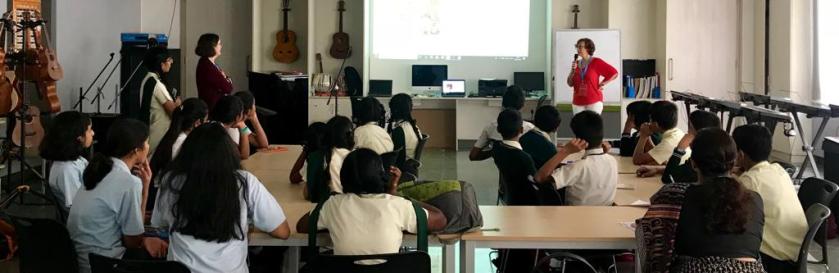
I had my own encounter with culture, which I’d like to reflect on. I did a workshop for 11-15 year olds using empathy mapping. I had the luxury of around 20 students and 90 minutes. So my strategy was to do a warm-up exercise by introducing the concept of empathy mapping using gender, and trying to take the view of the opposite gender based on what to Western sensibilities are rather sexist advertisements about mother/daughter bonding over dishwashing and father/son bonding over dude stuff like fishing and hanging out outside and drinking beers. It had worked extremely well in the international school environment I was coming from. But I hadn’t done my homework and had it “sensitivity tested” by my Indian friends … I quickly discovered that young Indian ladies (bar one or two) think that it is lovely to be able to bond with your mother over household chores, and that generally the students never needed to do chores, being of a class where chores were done for them by others! With a bit of prompting and help from my friends and the students’ teachers we managed to successfully complete the exercise and move on to phase 2 which was a reading of “No one walks on my father’s Moon” . It is a difficult text, despite being a picture book. However I like to use it, as even without an accompanying empathy mapping exercise, it provides a very powerful message of reconciliation and perspective taking.

file5This time the exercise really did work – on reflection, the “warm up” possibly did help the  success, despite not being optimal, because the students just weren’t used to giving their own views and in the first half kept looking to the adults for the “right / expected answer”. We had some powerful contributions from the groups, and some very interesting movement from utter condemnation for the father’s behaviour to understanding and empathy for the context and actions. And also the feeling that they could use this in their personal and academic lives.

Here’s a copy of the presentation – I believe that empathy cannot always be taken for granted despite the great potential of literature and us very much wanting it to be so. Hopefully this helps us and our students to take a step closer into “climbing into someone’s skin and walking around in it”

Celebrating the joy of reading

Last weekend I had the privilege of being invited to join the first children’s literature festival in India, hosted by Neev Academy in Bangalore.  What a fabulous weekend it was.

IMG_6326

One of my constant concerns as a librarian here in Singapore in an international school is that I don’t feel that my collection reflects the many rich and varied cultures and identities that my students have. So I must admit (selfishly) one of the first things that crossed my mind when I was invited was YAY, I don’t have to wait until ECISlibrary2018 to go on an Indian book buying spree for my library!

When I arrived on Thursday evening, I met up with Maya Thiagarajan, author of “Beyond the Tiger Mom“, friend, ex-colleague and fabulous once-a-month book-club member. Getting together is always so exciting as we have a million-and-one things to chat about, and her move to Chennai has created a huge gap for me, but is a wonderful thing for India as she can share her knowledge, experience and expertise with schools there. We brainstormed together for a presentation we were doing for parents and the public on “grow to read and read to grow” and then she gave me her perspectives as a classroom teacher on my workshop for teachers and administrators on Classroom libraries. Then we decided to do the workshop together instead of separately as it would add a multi-perspective to it!

On Friday, the first thing that struck me as I entered the school, besides the warm welcome, was the wonderful posters and signage and set up.

The Friday was set aside for celebrating storytelling, books and literature with children. I must say I was really happy to see the emphasis on storytelling, since it is the basis of everything. In fact, when I was asked to run a workshop for 5 year olds, that’s the first thing I thought of – using a wordless book as a prompt to encourage students to tell a story.

My session used the wordless books “Chalk” and “The Typewriter” by Bill Thomson to introduce the basic elements of a story – build up to a problem and a solution. First I told them they’d been tricked and I wasn’t going to read a story to them, but they were going to read to me (groans all around) and then they proceeded to do so, with “Chalk” lured by the images! We then spoke a little about the problem and solution and I said I had another book where something similar was going on and they could read it to me as well. I then projected “The Typewriter” (as I didn’t have a hardcopy) and we went through the same procedure, adding more prediction in this time.  Then they went off to tables we’d set up with plain black goodie bags and cut out gold moons and stars to make their own “magic chalk” bag. They came back to the carpet and were told they were going to make their own story without words with magic chalk. We brainstormed some ideas of what kind of problems could happen and what their solutions would be. Such wonderful ideas, ranging from torrential rainstorms and flooding, to a meteorite crashing into earth, sharks attacking a mermaid, ghosts coming into the a house and scaring people etc.! We also chatted about how you would (in the case of the ghost story) show that time had passed and the ghost left and they came up with having a moon in some of the pictures with the ghost and a sun when the ghost fled. What was great was that some then said they wanted to do it in “teams”.  Off they then went, armed with A1 black paper, folded into 6 panels and unfolded to de-mark scenes and lots of coloured chalk.  As they were drawing I wandered the class with their teachers talking to them about the stories as they unfolded.  90 minutes without a break was barely enough to have everything finished and they proudly left with their magic bags and story creations.

The rest of the day flew by, popping in and out of classes and storytelling sessions, followed by the teacher workshop on classroom libraries.  I’d somehow misheard that it was for 15/16 teachers… actually it was for 50-60 teachers – their whole staff!  Maya and I had already (luckily, as that’s our philosophy) decided to take the tack that the existence or not of a classroom library was merely one part of creating a culture and eco-system of reading in a school. The session was lively and interactive.  That’s  one of the things I grew to really appreciate about what is going on a Neev academy – the vision of creating an alternative to traditional teaching and learning in their school, using the frameworks of the IB system and the encouragement of pleasure reading.  As a non-international school they shine out as a beacon for local students.

Saturday’s sessions were opened to the wider community and public with a rousing speech by visionary Neev Academy founder Kavita Gupta Sabharwal. 

Maya had the honour of being on a panel with Dr. Shyam Bhat and Sudha Murty and all three spoke of the importance of reading and storytelling, emotionally, from a neuro-science and educational point of view.  My panel on “trends vs. traditions” co-hosted with Jane DeSouza with Ankit Chadha;  Timeri Murari; Sohini Mitra and Reena Puri looked at the threats and potential of globalisation and the digital era on traditional storytelling, publishing and writing.

Then in-between another book buying spree at Lightroom Bookstore (who had a pop-up store at the festival). What a fabulous bookseller – I really really love independent bookstores with knowledgeable founders and staff who delight in the books as much as I do. Ones where you just have to start describing the book whose name you’ve forgotten and it’s suddenly in your hands! I had chance to meet up with the lovely librarians at both Neev Academy and Stonehill International School and we did what librarians do best – geek out on what our favourite resources were, what our websites included, how we resource our respective curricula and darn, there just wasn’t enough time so we have to continue our conversations online and through librarian facebook groups.

I then caught the tail end of  a lively discussion “Should we fear the Dark?” that explored dark themes in children’s literature – luckily I shared a taxi with Paro Anand afterwards so we could continue the conversation together afterwards. I love fearless authors!

Maya and I shared the closing session of the day, focusing on how to hook children on reading and keep them reading with some great audience participation, and before we knew it, it was all over!

A great weekend, incredibly well organised and curated, buzzing with ideas and thought stimulation, discovering new books and authors. My biggest regret was the inability to clone myself so that I could join all the sessions simultaneously. Well done to Neev Academy and Kavita.

(PS Here is a selection of the book loot – invited our Singapore librarian network librarians around to have a look last week!