
As we move into Week 5 of online learning I had a yearning to return to my librarian roots. I was prompted by our librarian network sending out a notice for the voting for the annual Panda Book Awards. Despite the closures the voting will continue. In my previous incarnation as a PYP librarian in Singapore I found it a lot easier to promote the Red Dot Book awards – you have a weekly captured audience in primary, plus we had our after school reading club geared towards preparing for the annual Readers’ Cup.
Things change in Middle School – puberty seems to affect the reading muscle as much as it does every other aspect of being. Also in China we have the “Kids Read” competition for middle schoolers, which is considerably more daunting – 100 books in teams of four.
Another aspect of online learning is that it is really hard for everyone to stay motivated. Our daily entry point each day is the Mentor discussion forum on Moodle. As much as Moodle is extremely robust, it’s also very old fashioned and clunky, so driving traffic there is a chore.
I’d been seeing a lot on my twitter feed on US librarians setting up for “March Madness” and that inspired me to get a “Panda Madness” going for March. Besides the voting I also wanted to put in some challenges for points with a couple of aims:
- getting students onto our online reading platform Sora
- getting students reading online generally
- getting students reading the Panda Books
- getting students to promote books through FlipGrid and book reviews on Oliver
- making the daily sign-in to their mentor groups a bit more motivating and of course
- having some fun
First off was selecting the books – in MS we’re literally in the middle of the reading spectrum so I could select from both the “middle” and “older” reader lists. I selected 16 of the books, leaving out a couple of picture books and trying to use books that were available on Sora so they could still be read.
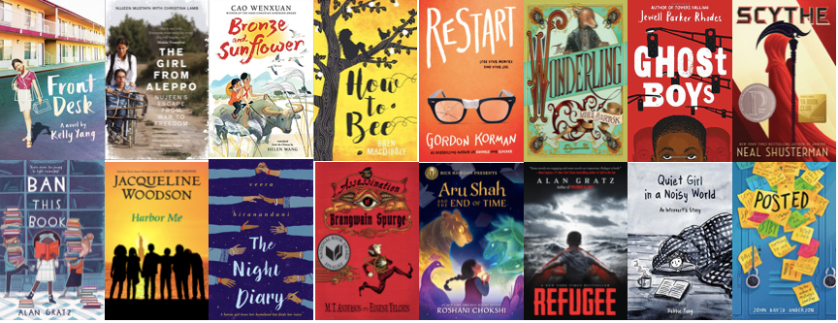 The complication in China is that not only do books have to be available with rights in China, they also have to be approved by an agency for use. So the hurdles we climb (besides expensive platform fees and expensive digital rights that disappear after 12/24/26 months or 26 checkouts are:
- lack of a digital version,
- georights, or
- publisher preferences. For example, the publisher Hachette Livre (one of the “Big Five”), don’t sell their ebooks to schools or libraries outside of the US.


Then there’s weird stuff, like “Front Desk” is available as an audiobook but not an eBook … usually it’s the other way around, books are available as an eBook but not audiobook (which kind of makes sense as there are extra costs and efforts involved recording an audiobook). I’ve reached out to Kelly Yang and she’s looking into it (love authors who are invested in helping one out!)
In the Older list we’re missing “How to Bee” and “The Assassination of Brangwain Spurge” I’ve reached out on Twitter to both sets of authors but not heard anything back yet. In the Middle list we’re covered, although it would be nice to have “Front Desk” as an eBook – there’s a hierarchy of how students like to read
- Not at all (lol)
- Physical Copy
- eBook
- Audiobook
Next step was making the knockout lists. That was a tough one. Which books to pair against each other to make it a little bit exciting – I must admit to have spent way too much time on overthinking this one.
Then I didn’t want to start the voting straight away, so for Friday (we have virtual WEIRD every Friday where I lead the Mentor discussion) I started with the motivation and getting ready bit. In order to do that I needed to set up a point system*, Libguide, Flipgrid and Microsoft Team, plus all the graphics. Needless to say that consumed all of Thursday in-between the usual Tech troubleshooting.

And then it was a case of waiting with baited breath as to the response – luckily it was extremely positive – by the time I woke up at 6am European time, my “copilot” on the MSTeam had approved 83 students and by the end of the day we had 121 students and teachers signed up (over 1/3 of our student population).

Yesterday I wanted to sort out the leaderboard and the scoring … that was another full day task – mainly because there is so much to set up – a current and reliable student/mentor group spreadsheet (yes, we’ve had a few poor souls who joined the school just prior to, or during the closure period), getting all the data of who had signed up to Sora – with proof, and then the most time consuming – going through the library records of each of the 16 books to award points to the consistent readers who’ve been reading the books since the start of the school year in August! A very manual procedure.
Another thing one would expect would be easy but wasn’t is extracting a list of “members” from a MS team! There’s no way to export that – so I had to copy and past from the list into excel and then sort it out and match to my master sheet.
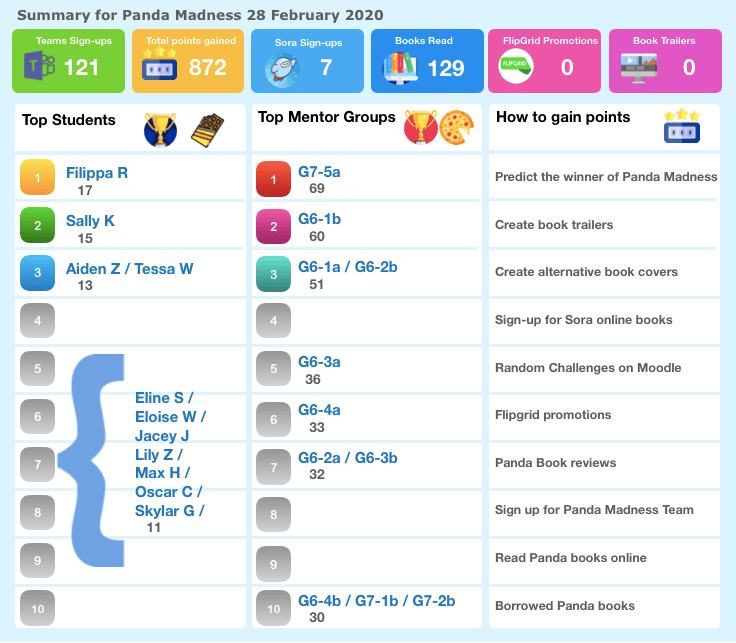
Another thing that I spent way too much time on of course was creating the graphic of the leaderboard. I must admit to having found one I quite liked and then adapting it. On the first day students had gained 872 points and we had a history of the books being read 129 times. A lot of students / groups tied as it was the first day.
Then rubrics / criteria for the Book Trailers and alternative book covers were created. Luckily I only had to adapt these from the ISLN Readers’ Cup that I was heavily involved in during my time there, and Barb Reid kindly sent me the latest versions.
The last thing was to create a Form for students to predict the winner and to post the updated status to the Moodle announcement for Monday.
Hopefully the rest will just be maintaining the scoresheet each week and monitoring the Flipgrid; student book reviews on Oliver; and entries for the book cover competition and book trailers… The first knockout vote will be on Friday.
Let’s see how this goes and if we can achieve our aims! Already the teams who have teachers involved (they can take part with their group) are the leading teams… says something! Happy to share everything created with other schools affected by the closure – just flip me an email or PM on twitter with your email. Everything is on Pages and can easily be adapted / changed for different books.
==========================
*Points for now – I’ll add to this as we go on
- 5 points for taking part
- 5 points per Flipgrid promotion of a book (multiple promotions possible – but you must have read the book)
- 5 points for a one paragraph review of a Panda book on Oliver
- 2 points for every Panda book you borrowed before school closed
- 2 points for signing into Sora (upload a screenshot to Moodle to gain the point)
- 5 points for borrowing and reading a Panda eBook on Sora (screenshot and summary to gain the points)
- 5 points for borrowing and listening to a Panda AudioBook on Sora (screenshot and summary to gain the points)
- 10 points for predicting the winner
- 5 points for predicting one of the 1/2 finalists
- 2 points for predicting one of the 1/4 finalists
- 1 point for predicting one of the 1/8 finalists
- 5 points per good quality book trailer following criteria
- 5 points per good quality alternative book cover following criteria
- Each week new random bonus points will be awarded based on new challenges


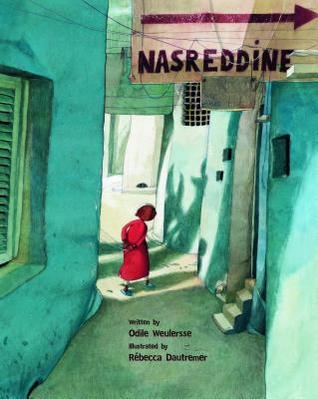
 Now I work really hard at trying to transform my library into one that is representative of my students. I love the fact that my one Bangladeshi student asks me every week if I have any new books about or set in Bangladesh. And that at the beginning of term she came to proudly tell me that she was no longer the one and only but had been joined by another family. And when I showed her our new book about Bangladesh she took time out of her library browsing time to show me all the things the book depicted that were special to her.








 Informative Flights - Musings of a Teacher Librarian
