The following slides are part of a presentation Katie Day and I made for the 2025 ISLE librarian conference in London. (Note: Although I am the one “publishing” or “blogging” this discussion the credit equally goes to Katie Day as this all originates in our many discussions on reading, nonfiction, librarianship and more. )
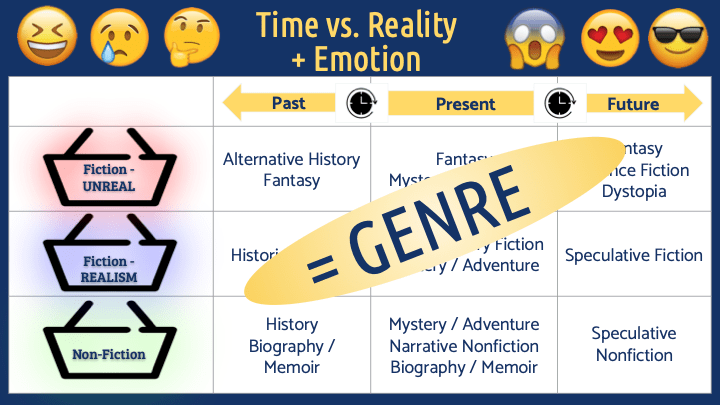
The slides are pretty self-explanatory. The main idea being that we tend to lump nonfiction into one big pile, perhaps separated by the five types recognised by Melissa Stewart. In this part of the presentation we argued that nonfiction could be categorised along the dimensions of “reality” “time” and “emotion”. In doing so one can more easily appeal to students who are more used to the fictional genres and sub-genres and perhaps find some nonfiction appealing to their fictional reading preferences.
This is the typical way of looking at the continuum between fiction and nonfiction. Note we talk about nonfiction as being “informational” rather than “factual” and try to nudge students into thinking of it in the same way.
The next dimension we add to the equation is that of time. In this instance we are focused on the bottom line of the time dimensions of nonfiction.
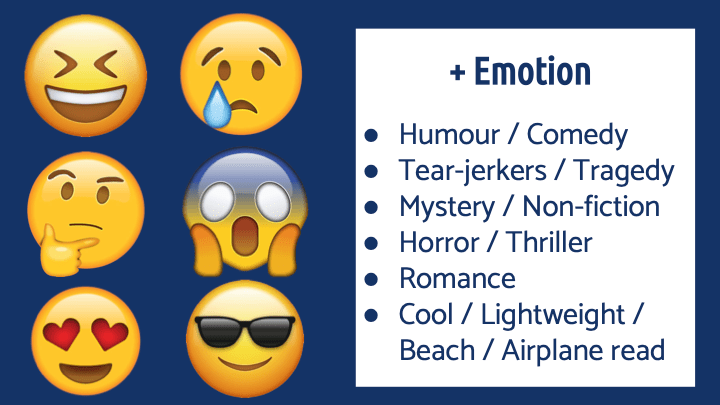
We then further elaborate with the dimension of emotion. And this is where we allow our students to feel they are in the more familiar territories of “genre”
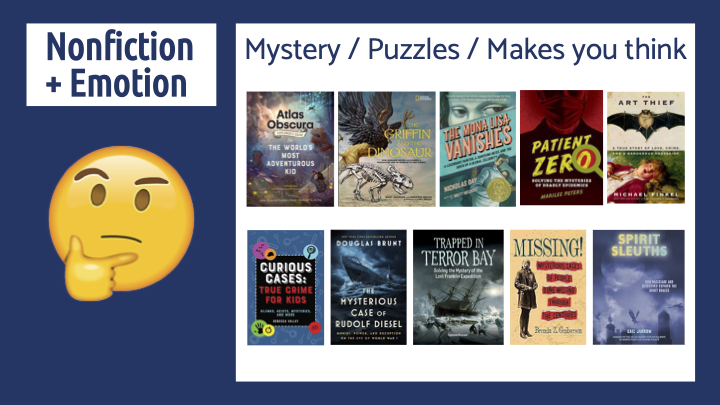
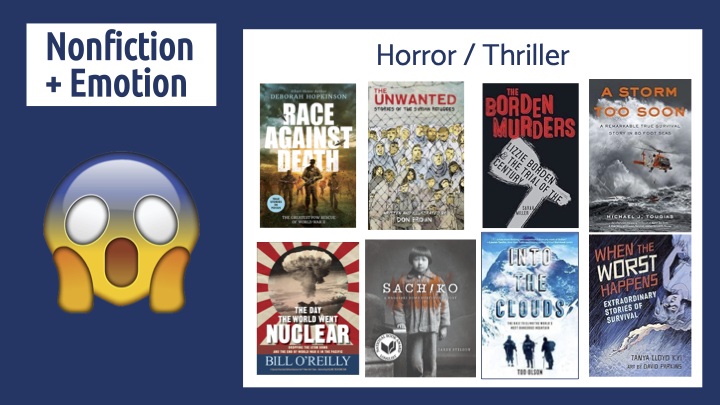
The next couple of slides give examples of the 6 “emotional tones” and related books.
Have fun exploring and discussing the categorisations with your students.
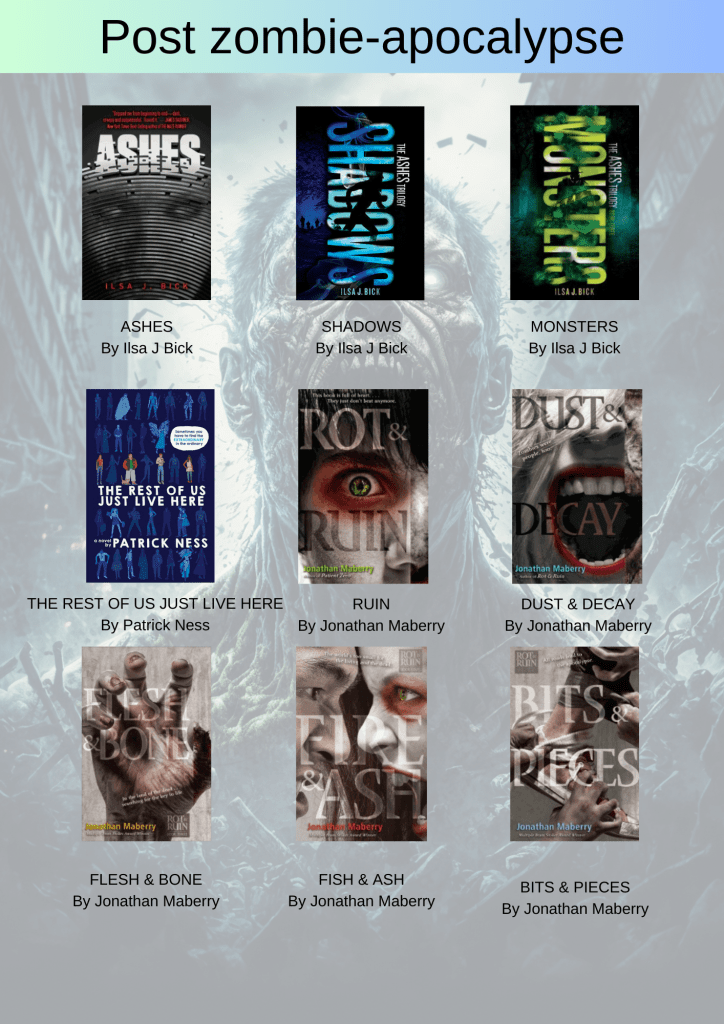
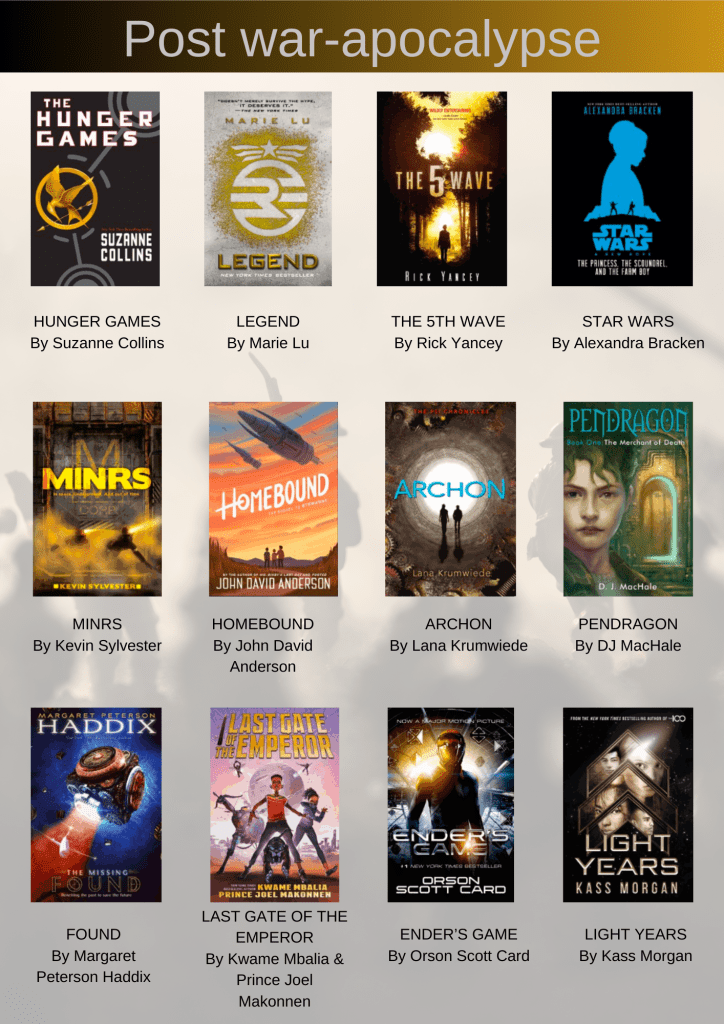
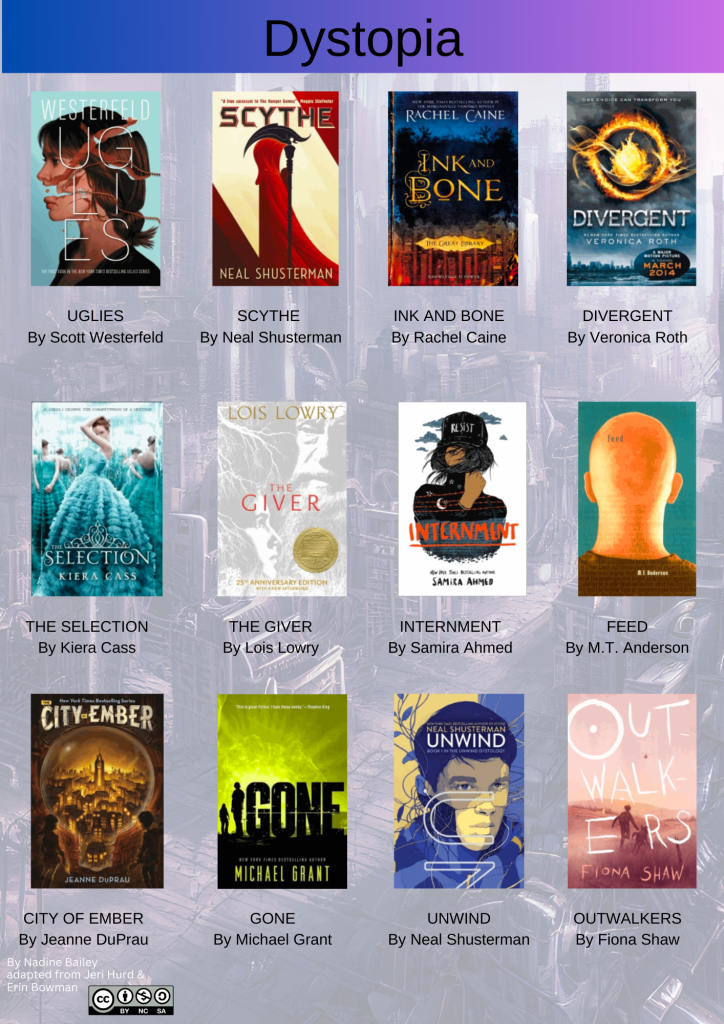
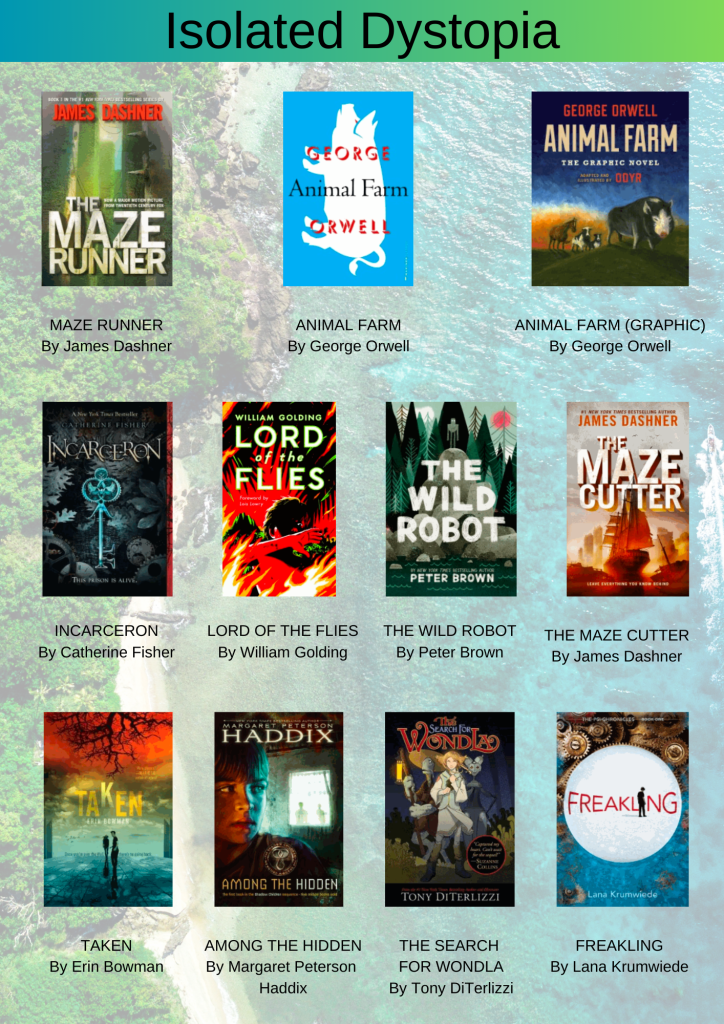
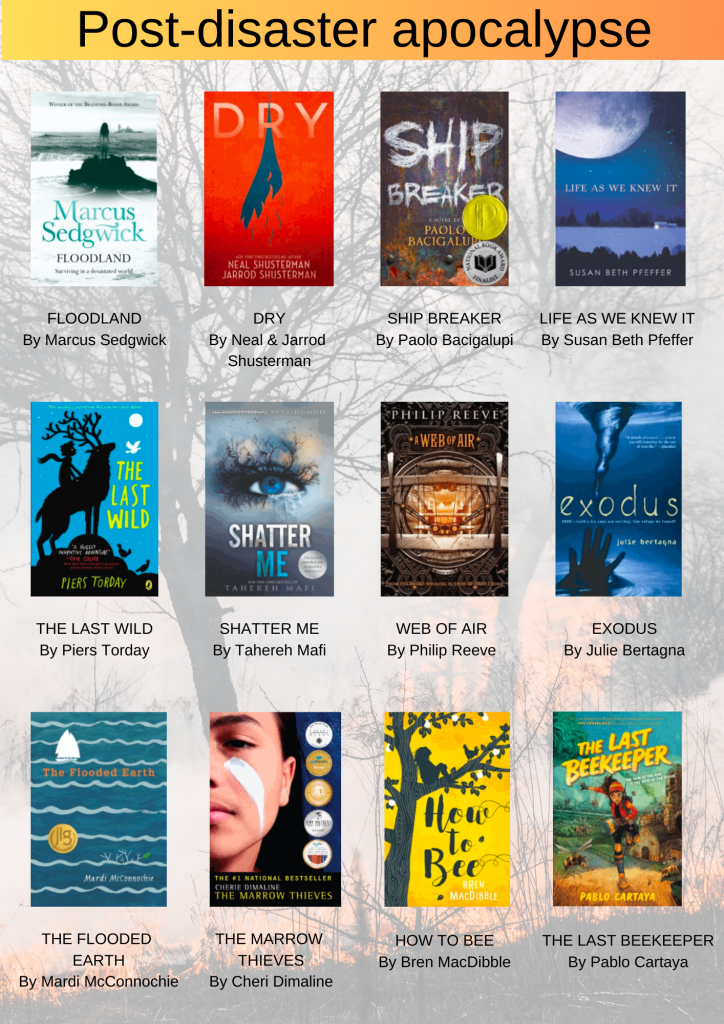
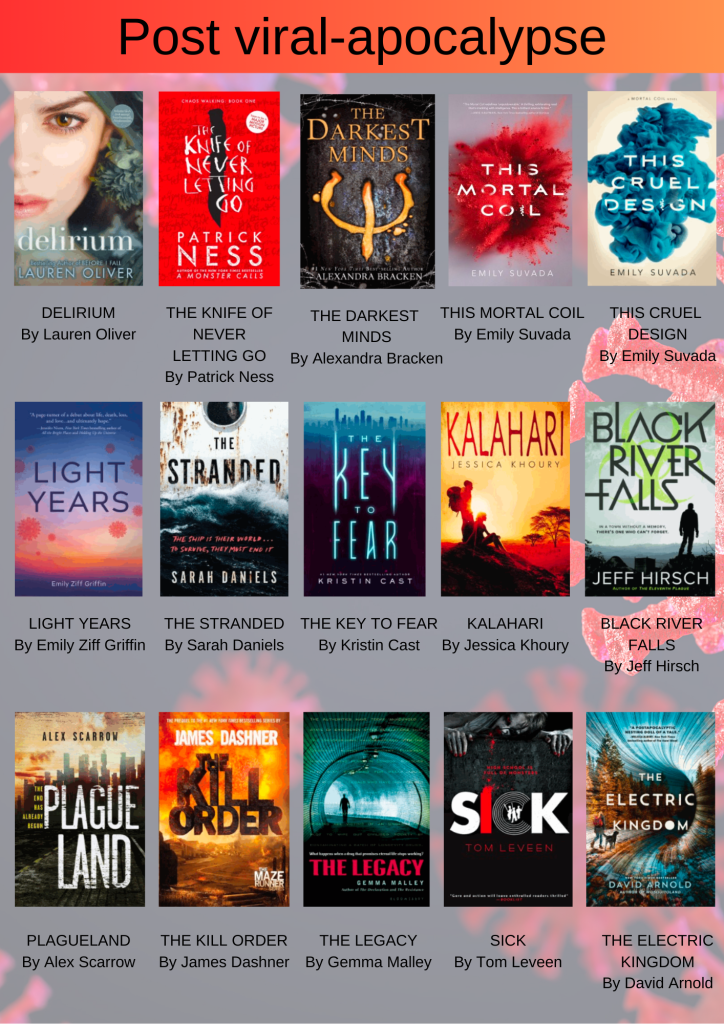
Our Grade 7 students do a dystopian unit in their English Language Arts (ELA) class, and I came across this nifty categorisation in a poster by Jeri Hurd (sans the sub-pages / images). Since I find our students are increasingly stimulated by imagery, rather than just text, I adapted the poster to include 7 sub-posters combining the books in our collection to the suggestions.
It’s not always easy to find middle grade appropriate science fiction, so this collection includes some YA works – particularly in the “Zombie apocalypse” section.
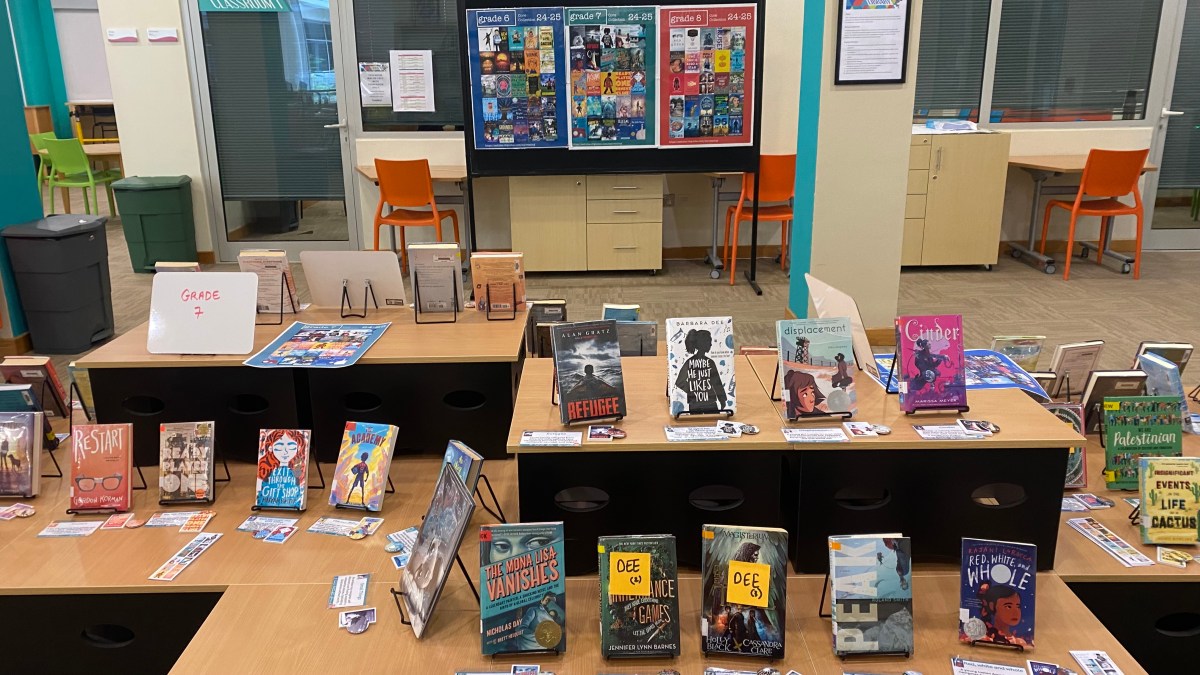
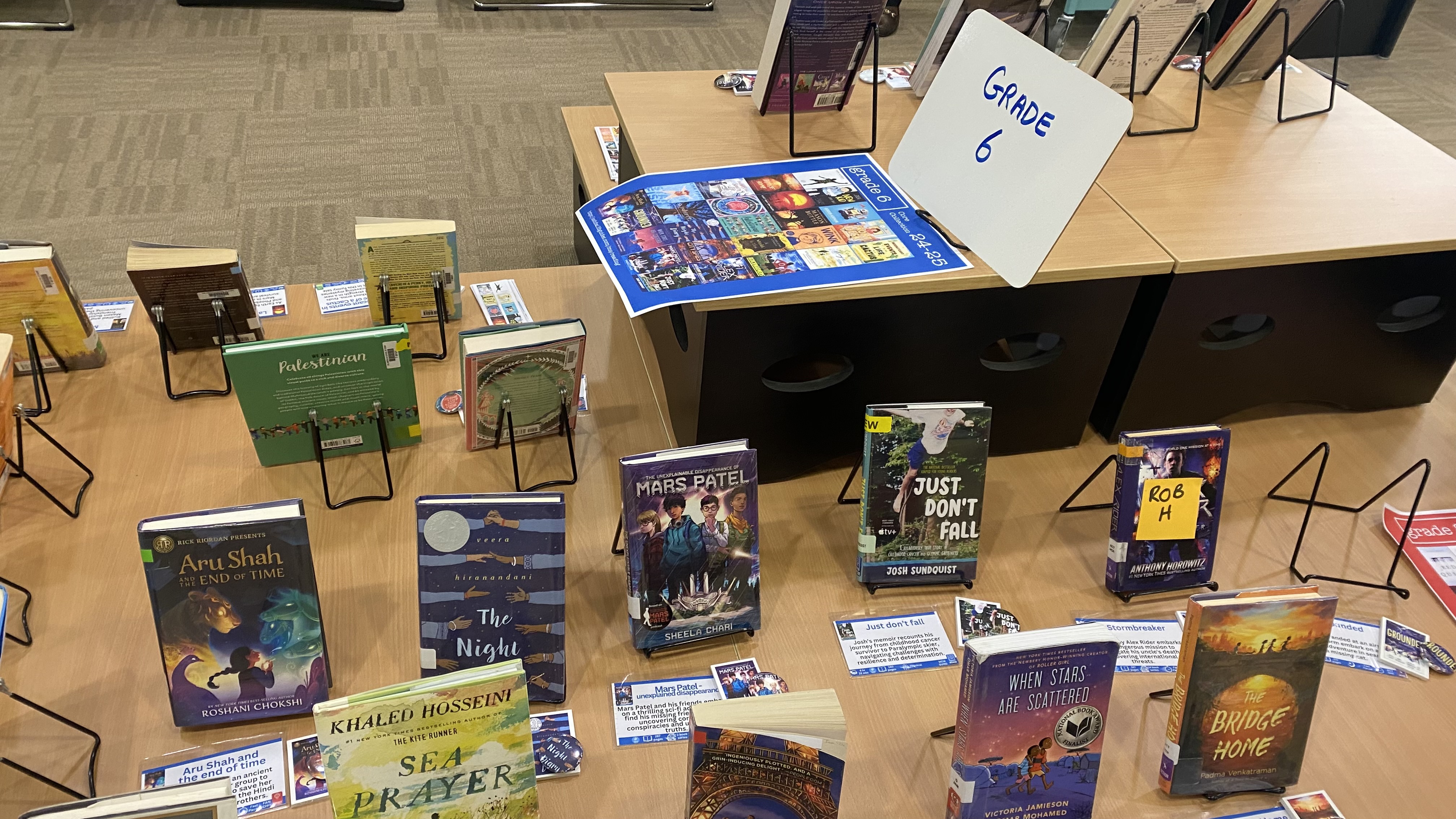
During a recent library visit after the students had completed their bookclubs with their chosen books, we had tables set out with the posters and the related books so they could further explore the various sub-sets of the genre.
If you are really interested in Utopian / dystopian literature and have quite a few hours to spare (like in the upcoming Spring break) I’d highly recommend Pamela Bedore’s “Great Utopian and Dystopian Works of Literature” from The Great Courses.
Our G6 students are currently studying Ancient Greece and will soon be embarking on a week long “week without walls” trip around Greece. Besides our nonfiction books on the City States and other aspects of Ancient Greece here are some more titles the “riff on the theme”.
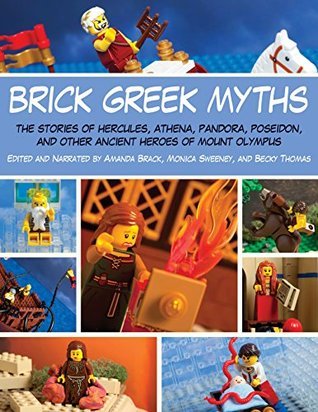
Of course an easy hit are those around the Greek Myths, and yesterday and today I went to the social studies classes and with a trolley full of Greek Myth books, in particular the multiple copies we have of the 12 George O’Connor Olympians series and each student could check a book out. Not depicted on the poster but one of my absolute favourites series are the “Brick Books” where various classic tales are depicted with Lego Bricks. Unfortunately many of the series are now out of print, but in previous libraries I’ve had the full set of Shakespeare plays, fairy tales etc.
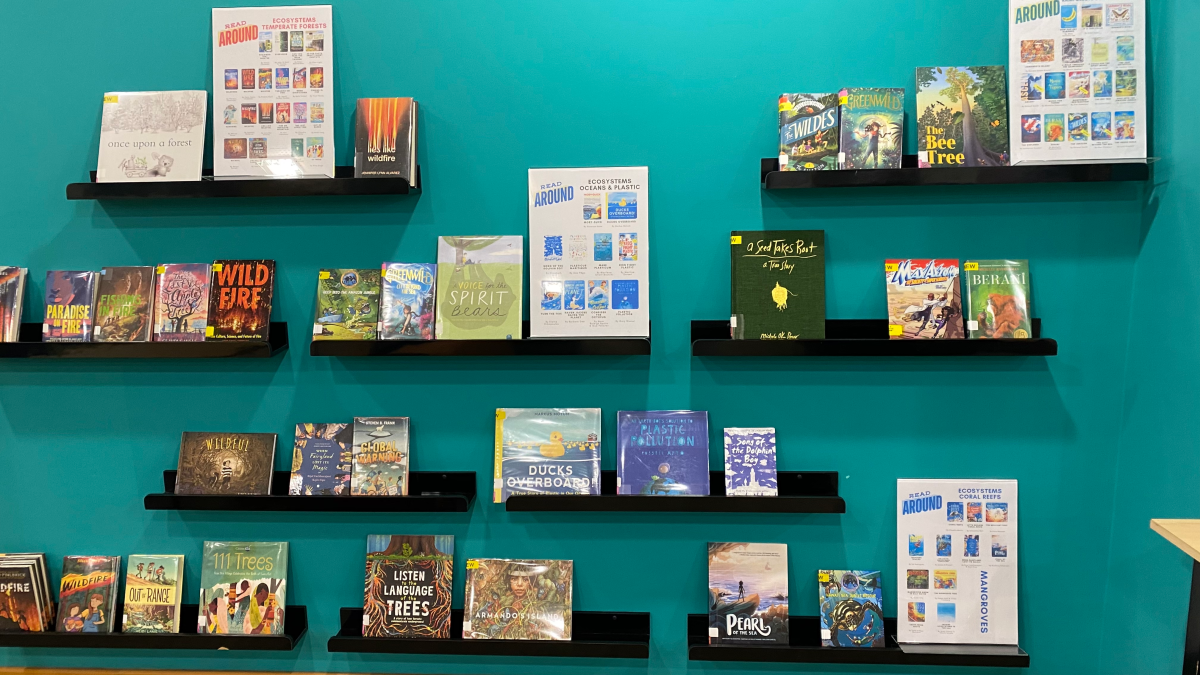
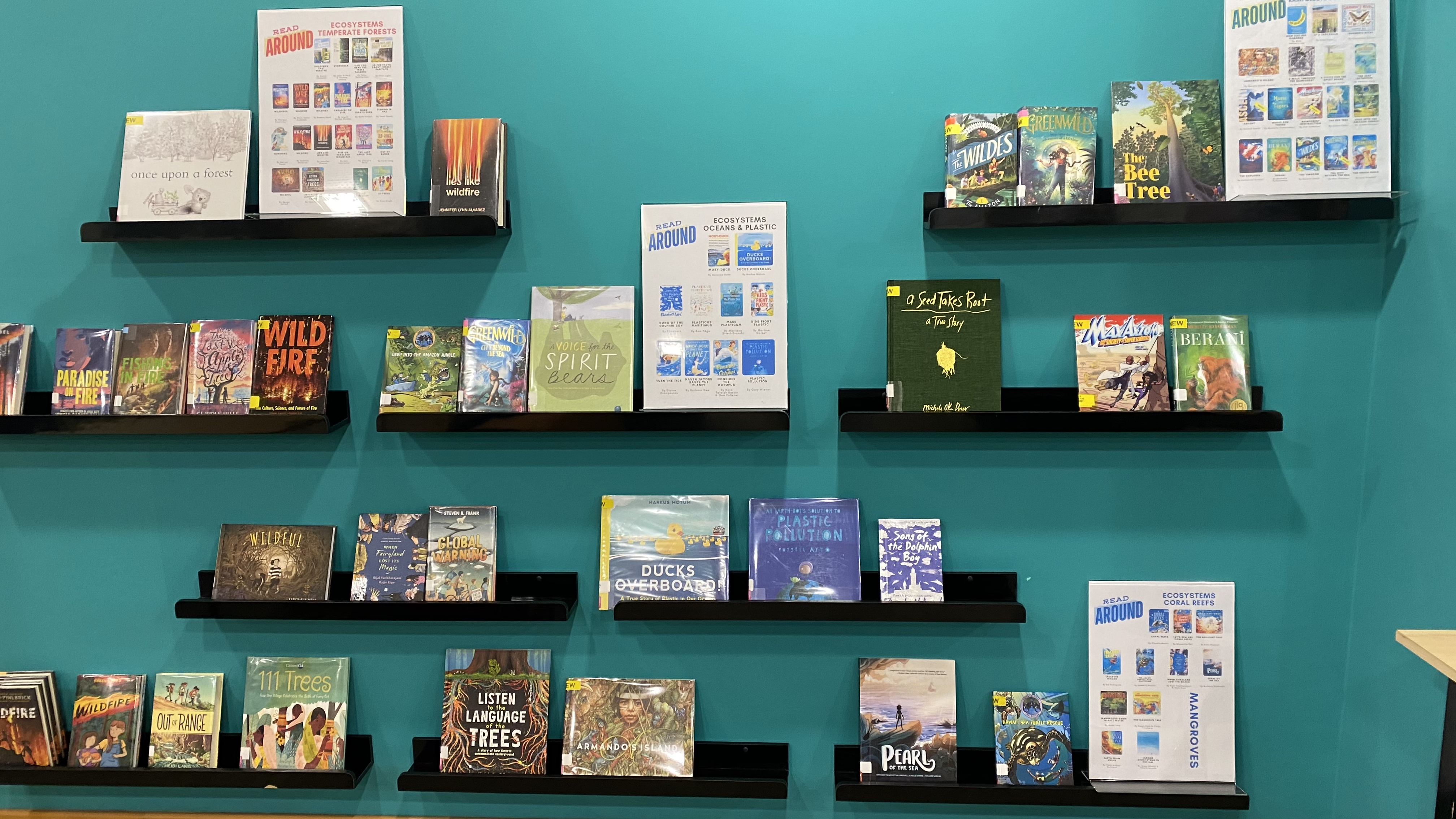
When I wrote the series of blogs in December for GLLI many people asked about displays so I remembered to take a picture of a couple of our displays of last week. We have two main spaces downstairs for display, one as you walk into the library and one against the wall. So one was dedicated to ancient Greece and the other to our Ecosystems projects.
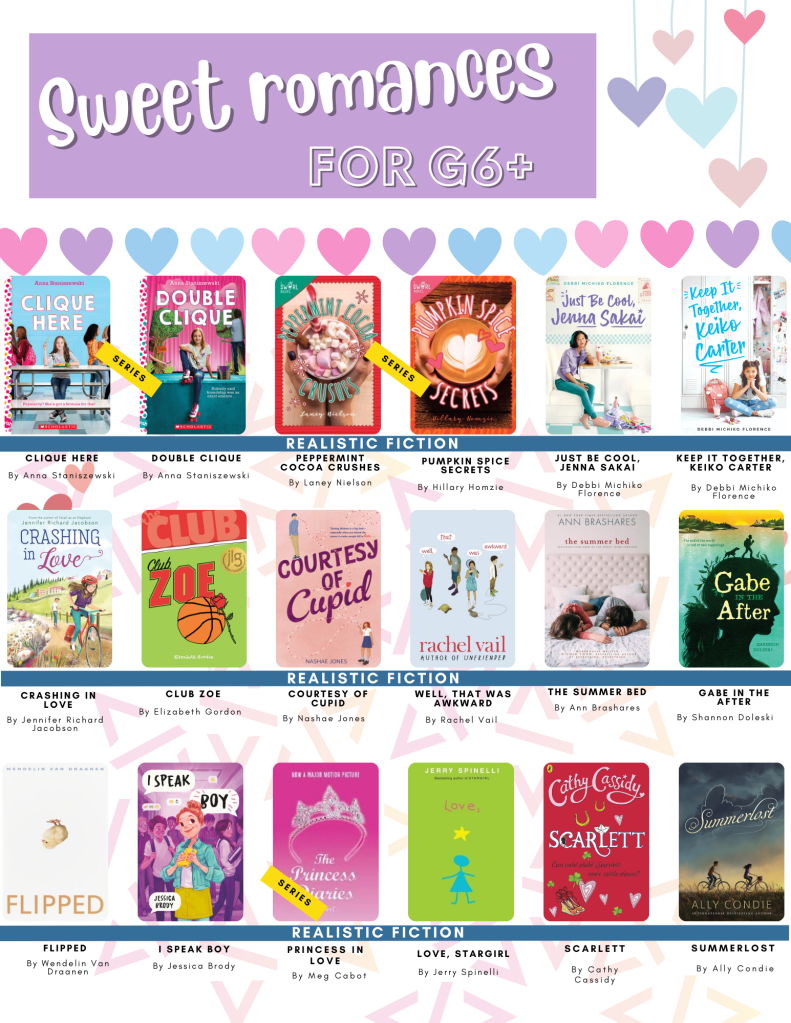
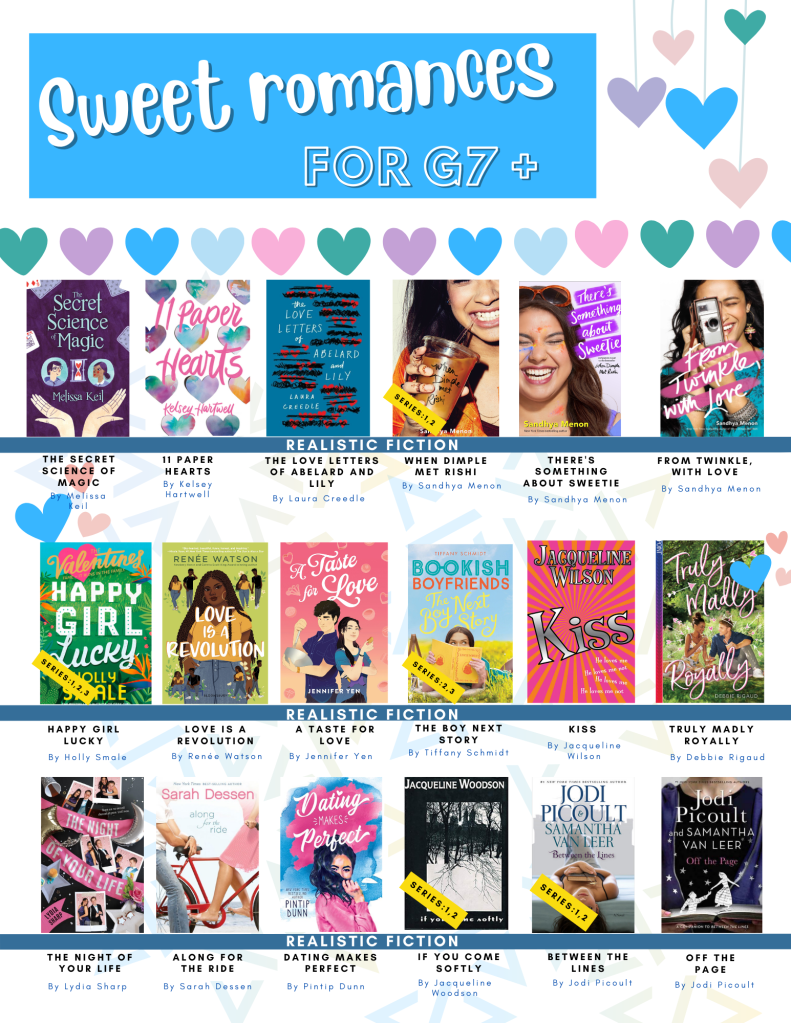
How easy it is to slip back into slothfulness – after a month of posting over at GLLI, today’s the first time I have had both the mindspace and timespace to do something on my own blog. Reading through various FB librarian spaces it seems that Romance is still doing the rounds and people are still looking for good, age appropriate romance novels that the parent-police / rabid-anti-readers / censors whatever are not going to object to, so I spent a few hours this week trying to find as many romance books as possible on Mackin.com that are rated respectively Grade 6+, Grade 7+ and Grade 8+. Now for all of you non-educators, non ex-parents of teenagers, non-working with teens people the distinction may appear ridiculous. But believe me, a 10/11 year old Grade 6 child is developmentally and emotionally ready for something quite different to a 13/14 year old. Or at least some of them / their parents and others that try to police their thoughts and reading.
I say this as an adult who has recently read “The Memory Police” by Yōko Ogawa and translated by Stephen Snyder and as a GenXer whose reading was not policed, except perhaps for “The Godfather” which my parents considered too violent, and therefor like every teen in my school read the whole sordid “Flowers in the Attic by V.C. Andrews series” before we really fully understood what incest was all about (an aside – read this Atlantic Article about just how prevalent it was / is).
I am also living in a region where even a mention of kissing could be construed as scandalous, but with students from all sorts of parenting, cultural, religious, regional, national and linguistic backgrounds. So tightrope, people. Tightrope. While doing my research I really had to wonder what exactly was the criteria to distinguish between suitability of the various age / grade boundaries. And I’m still wondering. There is a lot of talk about the age of the protagonists and whether or not there is kissing, hand holding, other touching, sexual encounters that are graphic or non-graphic or just hinted at but nada on where the lines are.
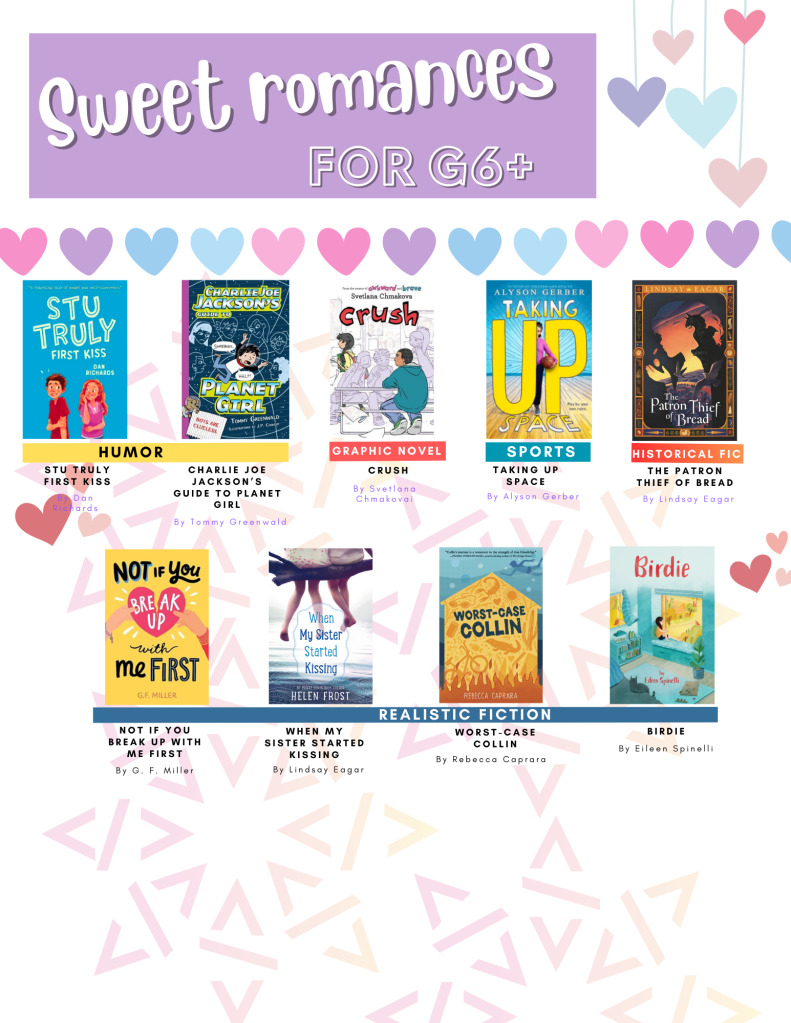
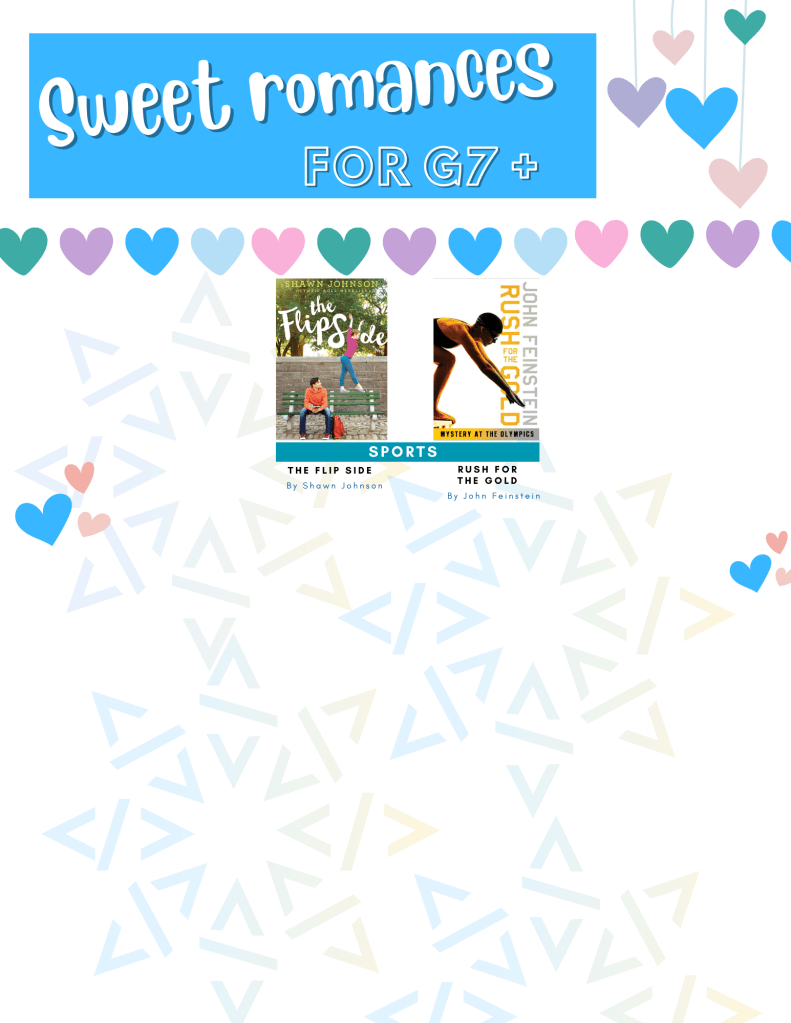
Back to library-land – why Mackin.com – well, unlike Follett which has very broad categorisation = Grades 3-6 / 5-8, 7-10 and YA, they are a little more granular so I poured over lists and lists of romance books and came up with the posters below. Also bear in mind these are inasmuch as I am aware all heterosexual in nature, again due to where I am living and trying to breathe and exist.
In another time and space I hope to have a far more inclusive list. And read my disclaimers below on this post. There is some nice cross-over in genres as well, getting into sport / fantasy / historical fiction with a brushing of romance – very important for our male-type patrons who are more likely to entertain the thought of romance in the context of anything but realistic fiction.
Disclaimer:The views, opinions, and thoughts expressed in this blog post are solely my own and do not reflect the positions, policies, or opinions of any current or former employer. Any references or examples provided are intended for informational purposes only and should not be construed as endorsements or official statements from any organization I have been associated with.
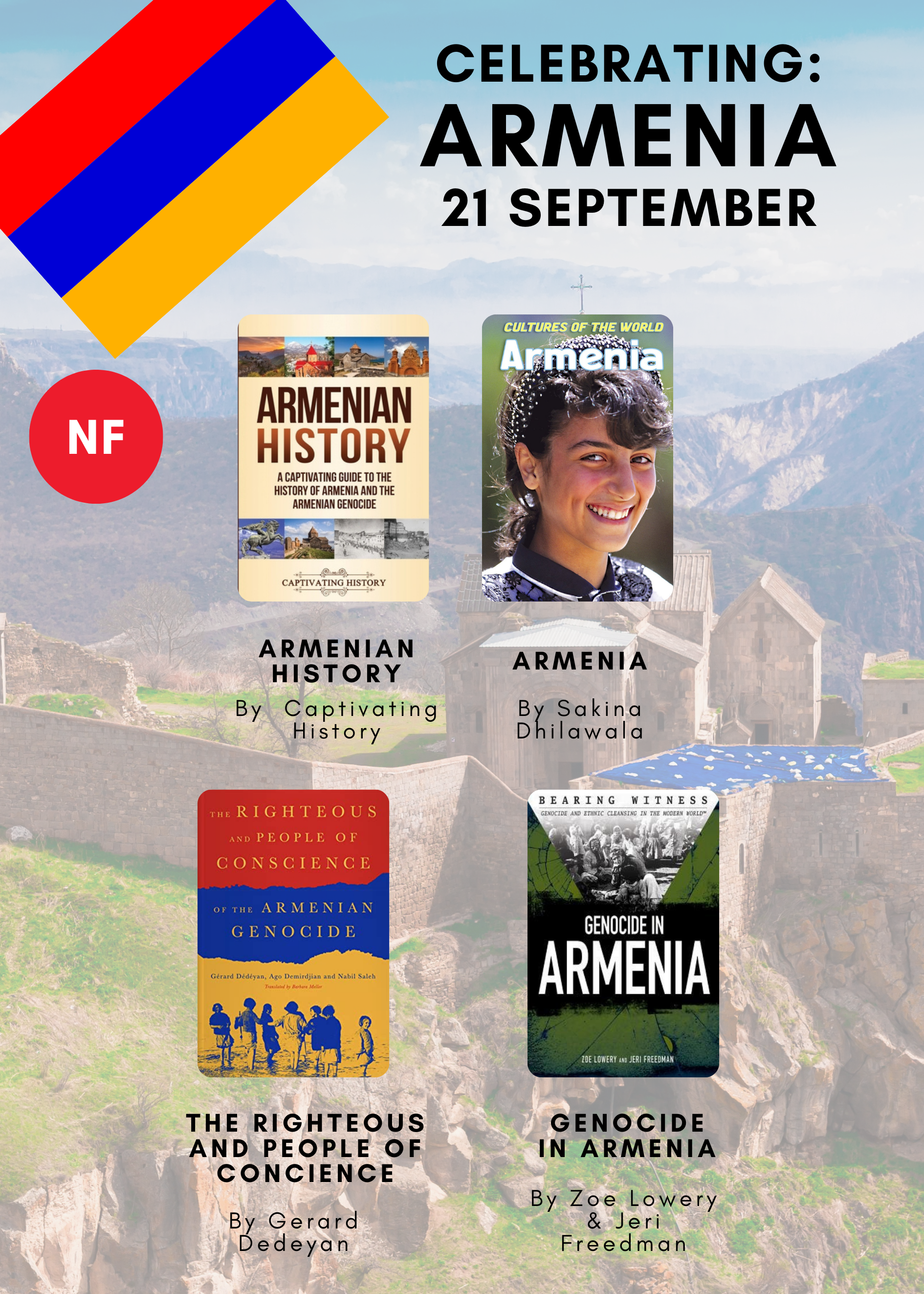
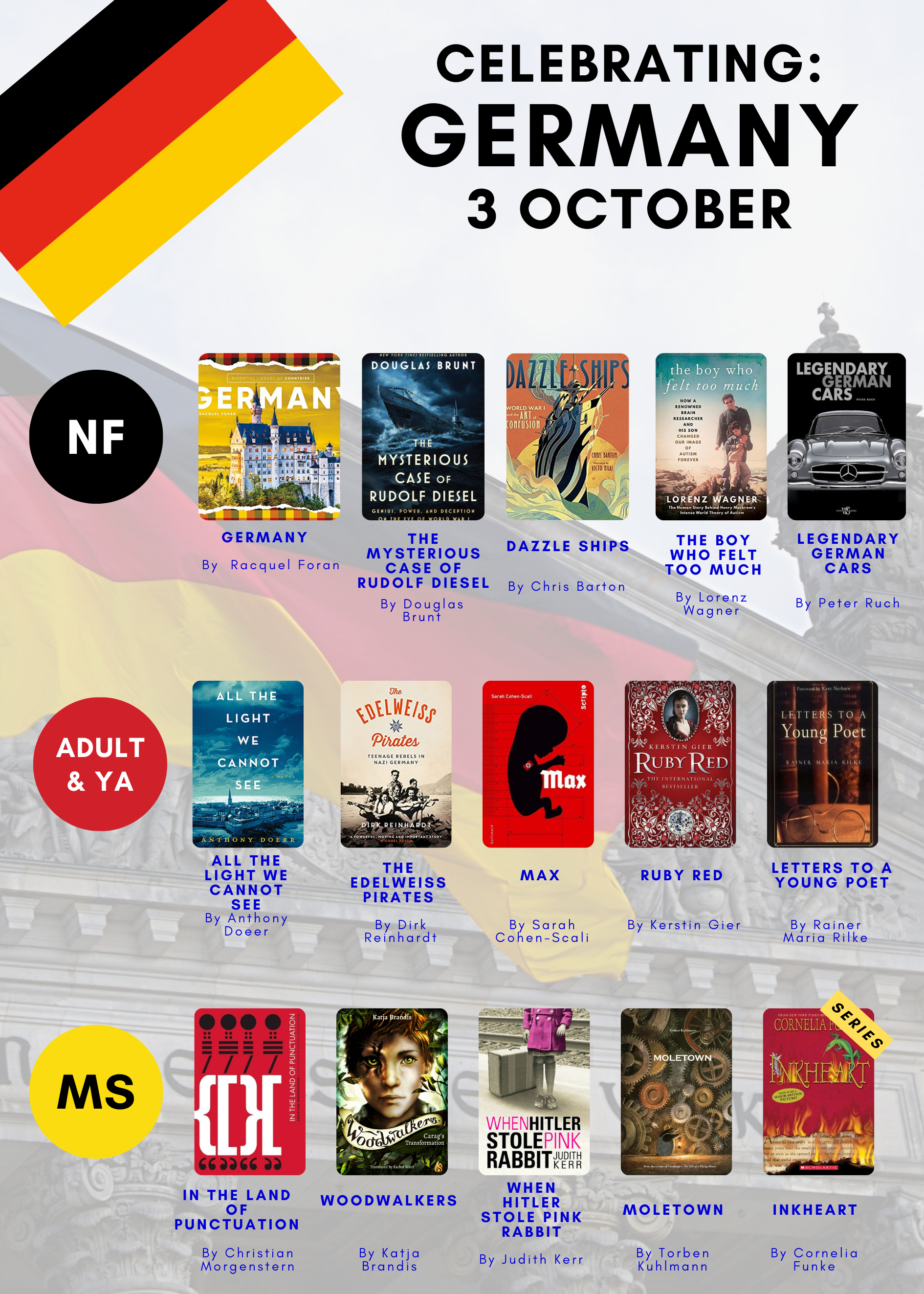
For a while now I’ve been wanting to highlight the curation of books related to the countries and cultures of our students, and finally this year I got around to creating posters “Celebrating xxx” which I post to our school bulletins for students and adults respectively. It’s been a bit of a chicken and egg project – knowing how many students we have from each country / culture – which in itself is truly not as simple a task as it may appear. We use the proxy of first, second and third passports, but as anyone who lives internationally knows, life is a tangle of multiple strands with immigration, migration, expatriation, languages, refugees, fleeing and arriving, births and marriages and transferences and identities. So in the last two years, using this list I’ve been scouring book lists, book catalogues, recommendations, book prizes to where we finally have, for most of the countries with more than 2 students, at least a couple of books besides a travel guide.
A couple of books. How easy that rolls of the tongue. But anyone with a conscience and an iota of empathy will know that that is another potential landmine. I have carried shame for my country of birth, South Africa, for decades, and still often have trouble admitting to its citizenship since I still feel the personal burden of all the wrongs committed by people of my race. It is right that a representative sampling of literature of my country includes reference, analysis and depictions of the pain and despair that apartheid has wrought. But that is not all we are as a nation and people.
I have not yet made the list for South Africa. But that was the dilemma I faced when curating the poster for Germany. A country with a 1000 years of literature beginning with the Nibelungenlied. Whose literature I studied in translation at UCT while ignoring my true passions suppressed doing a commerce degree. Yet looking at the books we have in the library, it appears that the war years, in particular the second world war, and specifically the war atrocities, is the primary lens through which our students form their Germanic world view. Again, it is right and proper that authors, beginning with people like Günter Grass, who, in his time was vilified for daring to address the near past, should shine a light on a terrible past. But that is not all by which they should be known. And more than anything students need to become aware of nuance. By the realisation that it is possible to hold two opposing views in one’s mind simultaneously. And if not through literature, how will they learn that? How sad is it too, that all the books we have about Armenia are about the genocide?
So far I have received nothing but gratitude from our community for both curating / purchasing these books and highlighting them as their national days come by. It is I who is filled with doubt and desire to be able to offer more. And despair that in many cases there isn’t more as countries are ravaged by war and poverty – at times literally with bombs and other times with the devastation of censorship, cultural and monetary poverty and lack of access to publishing and translation of the words that need to be heard by their people, its diaspora and the rest of the worlds children and young adults / adults. We deserve more than the “lonely planet” and “countries of the world” as nice as it is to at least have that.
Yet again an article despairing how kids are not reading “For Too Many Kids, Books Are Uncool and Unread” with all sorts of “reasons” and little in the way of solutions. So here are a few people / places / organisations who are trying to do something and a little on the work I was doing recently.
Engage everyone
While language arts / language and literature teachers and particularly librarians are often called upon or take it upon themselves to play a role in turning out literate students who hopefully also enjoy reading – it is a mistake to pigeonhole the efforts onto a few people. Just like I spend quite a few hours of my week engaged in coaching students in sport I like to think that my colleagues in other subject areas – including Physical Education etc. could spend a bit of time encouraging students to read. Particularly PHE teachers – since as my now young adult son (previously reluctant reader middle school son) told me “give up mom, middle schoolers don’t listen to anyone except maybe their PHE teachers and sports coaches”.
Last year I started having a core collection (an idea initially started in the UK by CLPE, and carried on internationally by Katie Day) of 25 books per grade for our middle school. We invested in at least 3 copies of most of the books and the books were promoted in the ELA (English Language Arts) classes and the library. Having a narrower selection of books to focus on meant that as a group we could try and read as many of these as possible and “sell” them to students. The news crew of our “Falcon Flyer” also helped with promotion by featuring the books, and they were also displayed on our internal TV screens in the library and MS corridor. A weekly quiz via google forms and the “Battle of Core” assembly were less successful than I’d have liked – but let’s say it was something to build on. However when I analysed the circulations from these 75 books I was positively surprised and just how many had circulated. As can be seen – kids still prefer print, and audio is their least preferred medium.
In my discussion with the ELA department about declining reading there was a strong feeling that promoting the books shouldn’t just be on them – and I took that thought to heart and just before the summer in our last staff meeting with the support of our admin launched the “staff summer reading challenge”
This involved quite a bit of preparation work, starting about 6 weeks before the end of term, including updating the lists for the new year, taking out books that weren’t popular or didn’t resonate with students, getting suggestions from our most avid readers (and asking them to pre-read where I wasn’t sure which book would be better) and making sure we had coverage of genres, levels of difficulty and format (verse novel, graphic novel, nonfiction, memoir, fiction) and our books were reflective of our community – each grade having at least one book with a muslim perspective as we’re in the UAE. Our new list can be found on our reading libguide. Next up was making sure all the books were ordered so that they were available before the meeting and then making new posters, shelf-signs with a summary, badges and a “mini-book”.
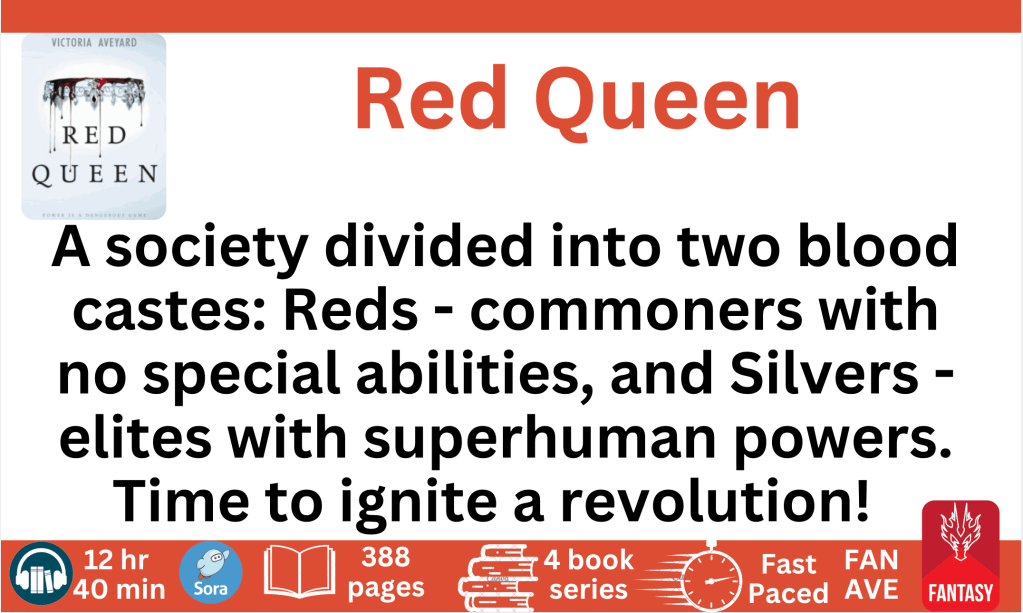
The shelf talker signs were based on inspiration from Kelsey Bogan but I wanted them to convey a little more information that I thought would be relevant in the “selling” process – first to our staff and then to our students, so I amended them a bit – the colouring corresponds to the grade, I added the book image and the genre image. Kept the blurb to 20-25 words (combination of publisher blurbs, Magic School AI summary powers and my knowledge of the book – AI can really get things badly wrong with what trigger words would encourage readers and be very repetitive with some phrasing!); I also added whether we had the eBook or Audiobook and the duration of the audio; pages of the book; whether it was part of a series, and the pacing.
Here are the canva files for our Grade 6; Grade 7 and Grade 8 lists – feel free to use or adjust as necessary.
The badges were made thanks to the loan of a badge maker by our design department and the “mini books” are images of the books on a piece of foam that the teachers can stick on their classroom door.
For the meeting, I put all the books on display with their paraphernalia, and the teachers were invited to select a book to borrow for the summer, commit to reading it and to help be the books “key account manager” for the coming year and promote it to students in the coming year. Our communications department helped by taking pictures of teachers with their chosen books (hiding the face) so we can use that for a little promotion guessing game in the new year); teachers borrowed the book and could put the badge on their lanyards. They “claimed” the book by putting a sticky note with their name on the poster. In the end, only 6 out of 52 staff members declined. Several teachers selected more than one book and our drama teacher selected 5 (and sent me a very enthusiastic voice mail last week to say she’d read them all and enjoyed them so much she’d also read all of the rest of the books in the various series, coming to a total of 17 books!).
So, watch this space and we’ll see if this has more of an impact in the coming year.
Other people / organisations making a big difference
Although not always realistic, I am a secret admirer of the “go big or go bust” approach to things. I suspect some times we are actually underestimating the abilities of our students by setting very low goals for them. There is a balance however between something being too daunting versus to infantile. Generally I suggest students should try and read a book a week – something quite manageable if one is truly spending 20-30 minutes a day in focused reading, perhaps combined with audiobooks and some manga / graphic novels. Also, our top readers (ironically – or not – none of whom have mobile phones) manage 2-3x that.
The Neev Reading challenge 2024 of 30 books over 3 months for grades 4-6 combined with author interactions, and a live quiz during the literature festival is a great example of setting a stretch goal, having competitive and noncompetitive tracks and a great starting point to select books. I just love how ideas grow and evolve. When I moved to Beijing in 2018, I was part of the 50 books Reader’s Challenge which I think the librarians at ISB started. In my role of juror for the Neev Children’s Book award, I was chatting to Neev about the challenge, and what worked and didn’t work quite as well – and they grabbed the ball, ran with it and now it’s this amazing thing!
I’ve blogged about the Global ReadAloud before, and still think this is a phenomenal way to involve students and teachers with books and connections with other readers and most importantly the “smelling salts” of reading aloud to them. Here are the selections for 2024. I particularly love “As long as the lemon trees grow” a book that’s on our core list and a fantastic read for older students.
At the end of the school year we have 6 library sessions involving our “upcoming” grade 5 into 6 students to introduce them to the Secondary School library. This year as an exit ticket I asked them to write down their favourite book / author / series. As I roamed around talking to them while they were doing this, I’d say that at least 75% of the books they said they loved the most were books that had been read to them by a teacher, parent, grandparent etc. Reading aloud matter.
Besides her work on the GRA – Pernille Ripp also has some great posters (and books) on encouraging a reading culture, such as the one on “Helping Home adults support adolescent readers”
That’s all I have time for today – if you’d like to have your initiative featured, please let me know!
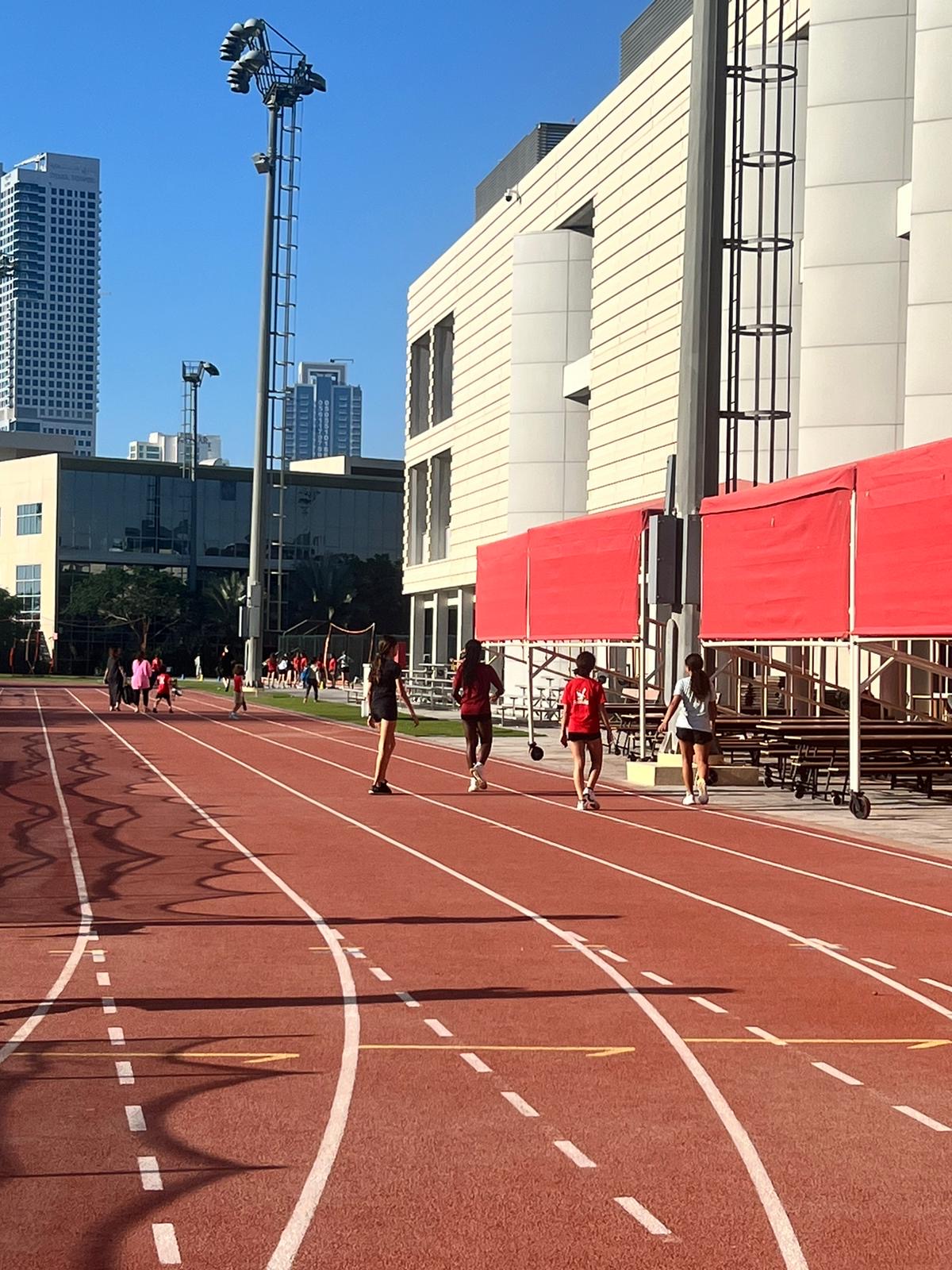
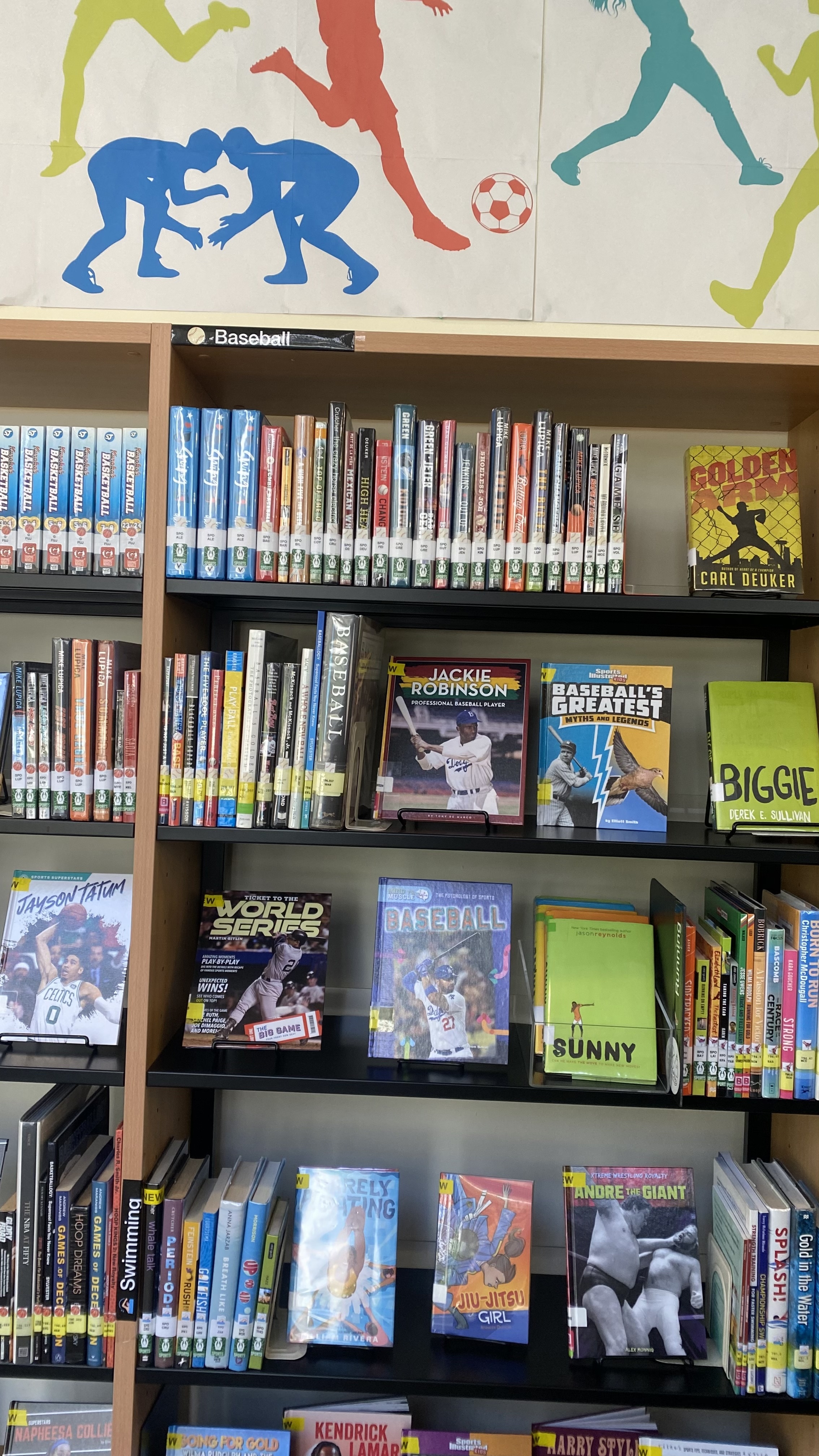
The best compliment I’ve received in the last two years was from one of my (non reading) grade 8 books who said to me during an athletics event, “you know miss – I used to think you’re just the librarian, but now I know you’re so much more”. The history behind that is that after many years of being a middle of the pack longer distance runner (i.e after each event I was pretty much very much in the middle for my age group and distance), our athletics director at WAB was looking for some more coaching volunteers and I did some online certifications in track & field and cross country and joined the after/before school coaches as an extra warm body in Beijing. Here in Dubai I’ve mainly done track and in contrast with my teams in Beijing who were primarily the more academic types, I’m finding myself amongst some great kids who are very athletic but have an aversion to reading. Have I performed any miracles in making them readers? Well no, I don’t really think so. But I’d like to think I’ve gained some credibility and relationships that can open up conversations around what they could be reading. And it’s helped me in creating a new blended section in the library – our sports section.
New genre – sports
It started with noticing a lot of students were asking for books about “basketball” or “soccer” during our library classes, so initially a new genre of “sports” books was created split out of our realistic fiction section. That helped some during the first year in the new library. Then students were asking for more biographies of their favourite sports people and more books (nonfiction) on their favourite sports. Our nonfiction section in that regard needed some boosting, so we bought more books.
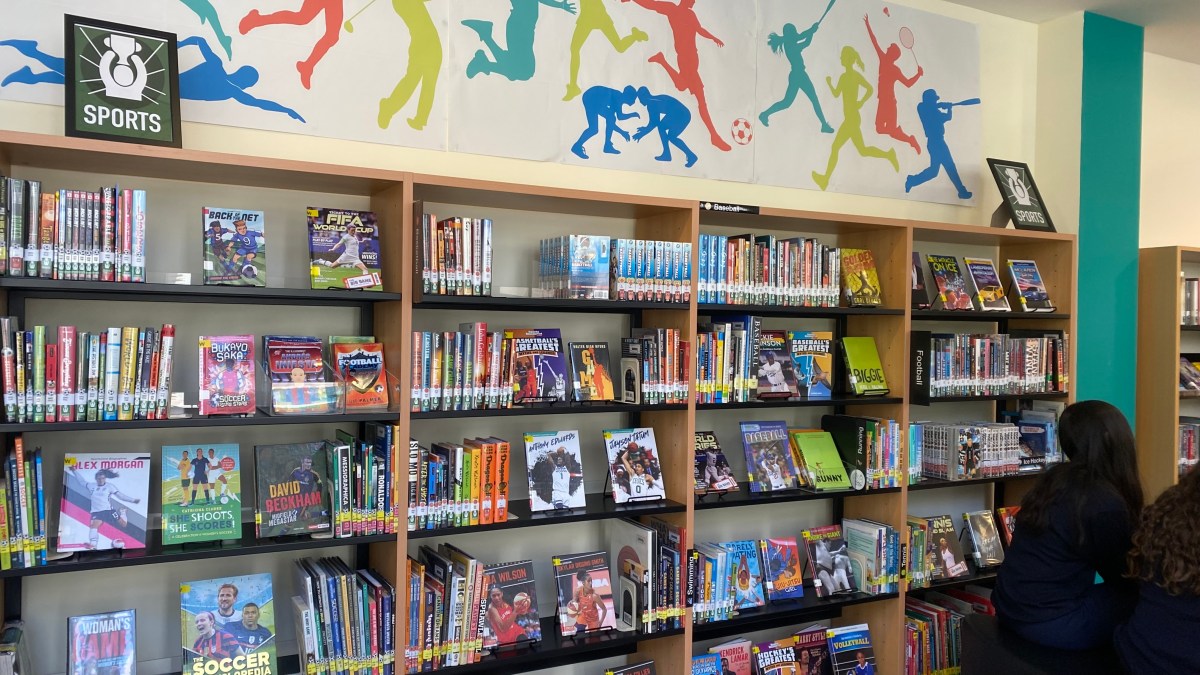
A new blended section – Sports
Since nonfiction, memoirs and biographies were upstairs and fiction sports downstairs it seemed logical to move them all to one place. So we trialed putting all our sports books together in a dedicated area. That meant pulling fiction, nonfiction, memoirs, biography, graphic novels and manga and sorting them by sport. Our poster was made in Canva in our library colours and is 3 panels representing the sports of our three sports seasons (template link). Our book spines have a small sticker of the sport represented to help with shelving.
We’ve probably doubled the circulation of our nonfiction sports books and it’s an area that garners a lot of attention. Unfortunately it is still really hard to find good fiction with sports themes. There are more good biographies and a small uptick in graphic novels and manga. Here are some of our best circulating titles.
Fiction
As you can see it’s heavily dominated by Jason Reynolds and Kwame Alexander. How I wish there were more authors writing shorter easy to ready and/or verse novels without naff babyish covers for this demographic!
Ghost – Jason Reynolds
The crossover – Kwame Alexander
Booked – Kwame Alexander
World in between : based on a true refugee story – Kenan Trebinčević
Patina – Jason Reynolds
Rebound Kwame Alexander
Stanford Wong flunks big-time – Lisa Yee
Defending champ – Mike Lupica
Boy 21 – Matthew Quick
Sunny – Jason Reynolds
Memoirs & Biographies
In particular the series by Matt and Tom Oldfield (from the playground to the pitch) and any of the Luca Caioli books are popular. And if you’re wondering who the GOAT is according to our students – Neymar and/or Ronaldo books outrank all the others.
Nonfiction
Anything soccer seems to dominate with basketball and F1 making an appearance. I was pleased to see one of my personal favourites – “The boys in the boat” tying with “The Barcelona complex” for 10th place as I’ve been promoting it heavily this year – I’m hoping the release of the movie will help it along as well.
Stars of world soccer – Jökulsson Illugi
The official history of the FIFA World Cup – FIFA World Football Museum
Outcasts united : the story of a refugee soccer team that changed a town – Warren St. John
THE FOOTBALL BOOK : the leagues, the teams, the tactics, the laws – David Goldblatt
Return of the king : Lebron James, the Cleveland Cavaliers, and the greatest comeback in NBA history – Brian Windhorst
The rise : Kobe Bryant and the pursuit of immortality – Mike Sielski
All thirteen : the incredible cave rescue of the Thai boys’ soccer team – Christina Soontornvat
F1 : the pinnacle : the pivotal events that made F1 the greatest motorsport series – Simon Arron
The race of the century : the battle to break the four-minute mile – Neal Bascomb
The Barcelona complex : Lionel Messi and the making–and unmaking–of the world’s greatest soccer club – Simon Kuper
The boys in the boat : the true story of an American team’s epic journey to win gold at the 1936 Olympics – Daniel James Brown (we have both the YA and the original version)
What are we missing?
All the books by Mike Lupica / John Feinstein / John Coy are unfortunately showing their age now and are also very much written for an American rather than international audience.
We’ve had some more interest in cricket recently and just haven’t found enough books – fiction or nonfiction to meet that need. While there are more graphic novels coming up we need more of them.
If you have any great suggestions I’d love to hear them.
Initially I thought of perhaps going through the DDC systematically from 000 to 999 and writing about some of the books I’ve loved / used / displayed, but then I spent the day yesterday re-reading Zen by Shabnam Minwalla and decided randomness, chaos and interest was infinitely preferable to order and sensibility.
There’s something amazing about books that manage to evoke a sense of time and place both through words and cultural references to music, poetry, quotes etc. And the books I’ve been reading and promoting for our middle school have been great at this. How many others sit with a book in one hand (or audio in one ear) and youtube open in the other to look up the songs you don’t know or listen to old favourites while reading?
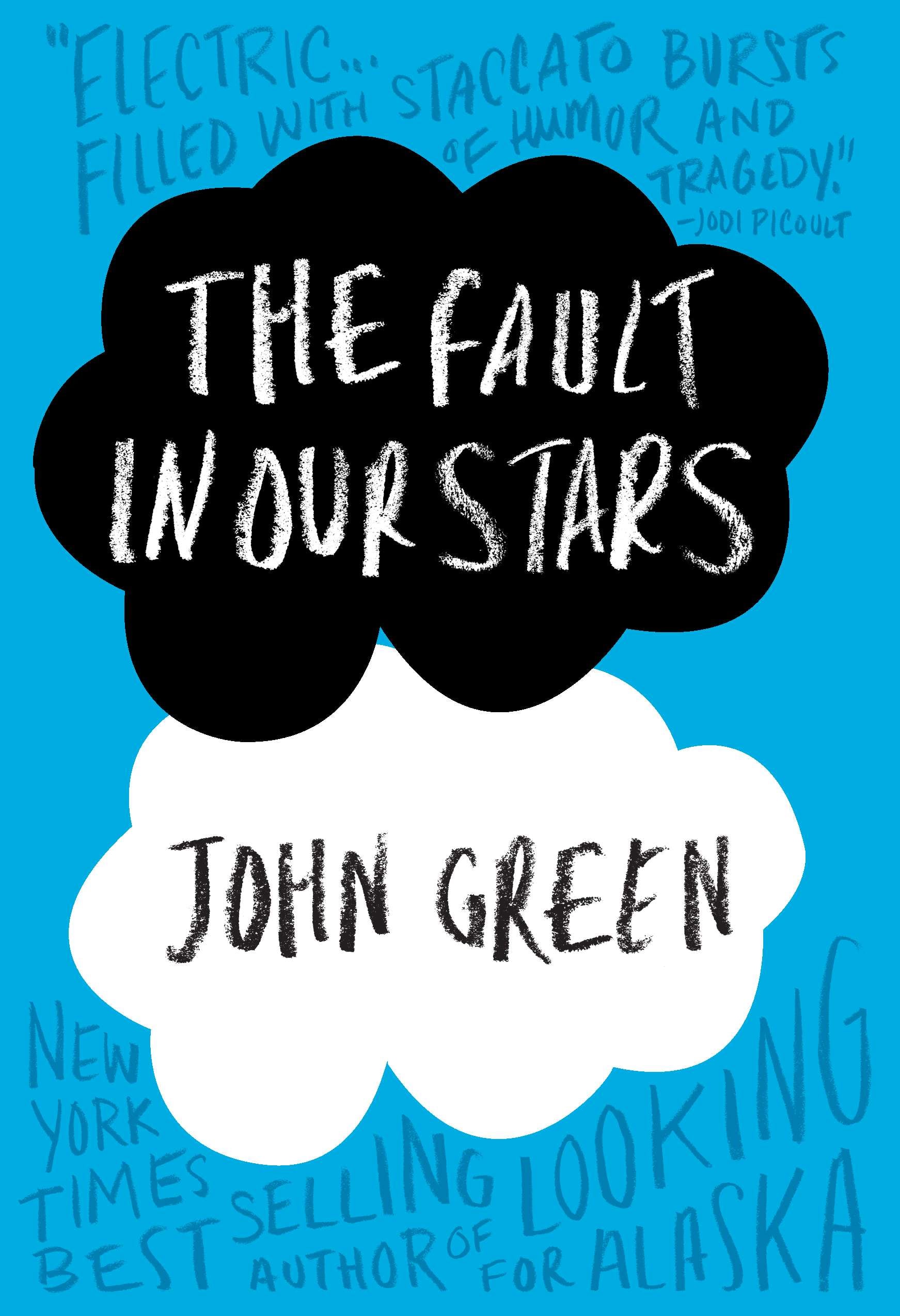
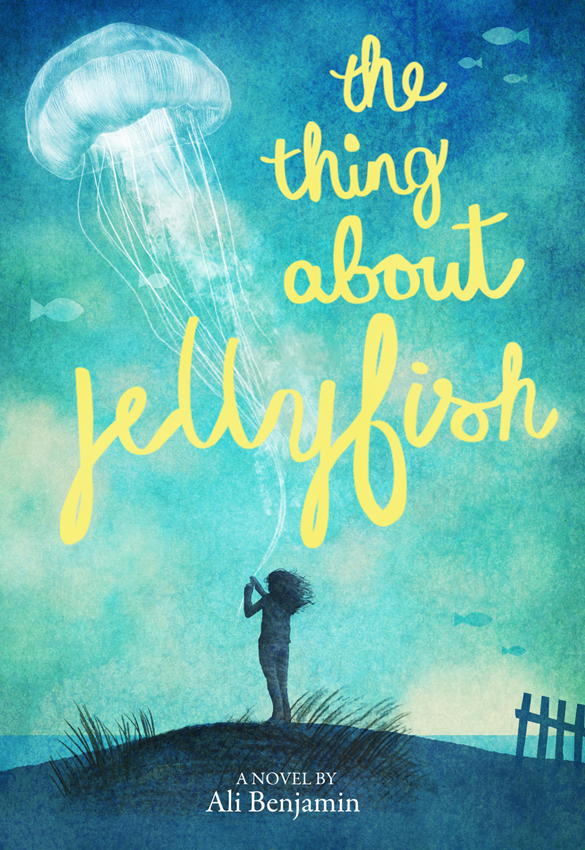
I remember back when I first started out as an intern under KD at UWCSEA East making a libguide page (see “other interesting stuff” in the tabbed box) to support John Green’s amazing “The Fault in our Stars“. (cringe moment at how bad I was at that time in making good looking libguides!). When I introduce books with musical elements now to my students, I like to have some music playing in the background when they enter. Some more great ones include Ready player one, Red White and Whole, The thing about Jellyfish and Wink .
And here is a list of more from “Middle Grade Carousel” many of which ended up in one of the displays this year. Another display that worked really well for my “Swifties” was to match the song names in her latest album to other “related” titles (in the broadest sense of the word). There were chocolates on offer!
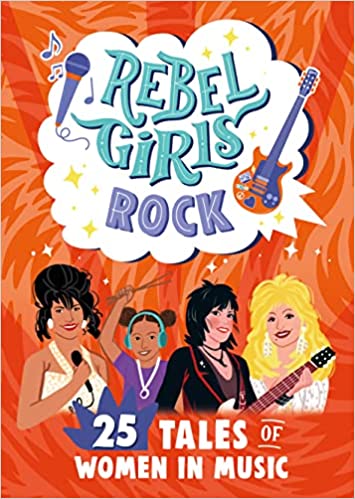
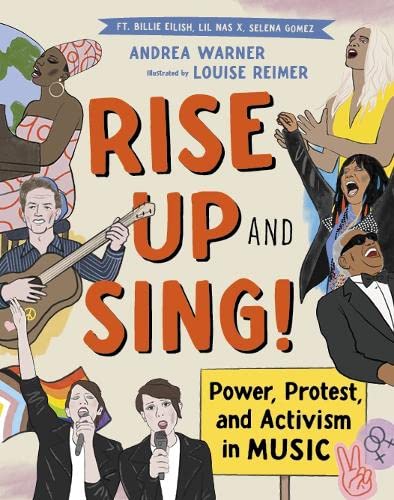
And that’s all for today. Please reply with your favourite fiction or nonfiction books on music!
PS
Two things I meant to put in and then forgot about:
uplifting music
According to a study conducted by cognitive neuroscientist Jacob Jolij of the University of Groningen, Don’t Stop Me Now’ by Queen is the most encouraging track in the world.
The research analyzed various factors, including the beats per minute, the key, and the chords of the song. Here are the top 10 songs that put you in a good mood (and the youtube versions):
Queen, “Don’t Stop Me Now”
ABBA, “Dancing Queen”
Beach Boys, “Good Vibrations”
Billy Joel, “Uptown Girl”
Survivor, “Eye of the Tiger”
The Monkees, “I’m a Believer”
Cyndi Lauper, “Girls Just Wanna Have Fun”
Bon Jovi, “Livin’ on a Prayer”
Gloria Gaynor, “I Will Survive”
Katrina & the Waves, “Walking on Sunshine”
seismic music
Something that combines a bit of geoscience and music – according to seismologists at the British Geological Survey (BGS) earthquake activity was clocked during the Taylor Swift Eras Tour in Edinburgh and the most seismic activity was caused by the song “… Ready for It?” .
I’d love a dollar for every time as a TL I’m asked to teach students “how to search” or “search terms” or “searching. Once upon a time I complied. I’ve become a bit more bolshie in my old age. I now try to engage. Engage in a conversation as to what exactly the teaching and learning aim is behind the request.
You see, we don’t need to teach dogs to chase cars. We need to teach them what to do with them once they’ve caught them. And we need to teach that bit first, so that they can decide with the right amount of information at their disposal that actually, cars are not edible and therefore not worth the chase.
I understand the impetus behind wanting to teach better searching. It comes from a good place. One which recognises that students are going to google anyway, it will probably be their first and last port of call and we may as well teach them how to use it better so at least the results somewhat resemble the information they’re looking for.
But without some kind of prior knowledge or context, how will they recognise what is in front of them for what it is? And without deep literacy skills, both on the reading and writing side, how will they do something with it? And why am I seeing two huge time sucks in student “research” – searching and gathering “information” and dressing it up in some kind of (digital) presentation form. aka, the dogs chasing the car and trying to make a silk purse out of a sows ear. Which leaves precious little time for the meat in the middle.
Am I overly cynical, or is this a more generic experience? And what can we / dare we do about it?
I subscribe to way too many Facebook groups. I need to stop it actually, they’ve become like women’s magazines. But worse. You keep seeing the same things come up over and over again, but instead of ignoring them you can actually have a say, which is giving yourself the delusion of helpfulness, but actually the smartest person in the room of Facebook groups is not the room itself, to misquote David Weinberger.
Some of the smartest people I know don’t do Facebook and when they do, they’re lurkers not participators. So I guess that’s making me stupid. I just can’t help myself because the fact that someone may actually genuinely want an accurate answer AND follow up is illusionary enough to put up with the ignorance of echo-chambers and the chance that you may learn something.
No where is worse than education groups, and within those groups nothing is worse than questions and answers about bilingualism and language. Except perhaps dinner parties between parents of children of roughly the same age that are excruciating examples of passive aggressive one-upmanship. Right now the sum of my parenting advice can be summed up as:
Regularity, sleep and reading (and don’t be too poor)
Avoid dinner parties with other parents unless their children are at least 10 years older than yours
Pick two languages and give them all you’ve got
It’s the last point I’d like to write about today. On one of the groups the following was posted:
2yr old (born NOV 2015) who is trilingual (if you can even say this about a 2yr old). German mum, French dad, English spoken with nanny and language between parents. I’m looking for kindergarten options from around next summer … have no idea where to start. No preference towards public/private or towards any language even though I’m wondering if adding mandarin might be a bit confusing given that there are already the other 3. What do you think? Focus is more on play/social activities rather than academics
This is a pretty typical question and the answers were also pretty typical – a combination of shouting out school names that have either French or German, alternating with saying that children can easily learn any amount of languages (the number 12 was even suggested), compared with humblebrags about how “fluent” their 5 year old was in any number of languages.
I must admit to entering the fray and suggesting that they chose the language of the school based on their future plans if known – i.e. go back to a French / German speaking environment or continue in the international sphere, and based on who would be at home to support the homework and reading. And to choose 2 languages and do them properly. There are language experts who can help people on this. There are books and research papers written on this. And don’t ask parents of young children – they know not what they say. Don’t even talk to educators in primary schools. speak to parents with teenagers, preferably at the point where they have to choose their IB language. Talk to teenagers, and talk to teachers of IB languages.
Being bilingual is NOT just speaking a language. It is reading and writing. Being literate. And that takes formal lesson time, time spent reading and writing AT grade level. There are so many barriers to that. I’m now talking general international schools, of course there are exceptions / bilingual schools. If you’re lucky you’ll get 40 minutes a day in the language at school. Probably in that language as a SECOND language, i.e. language learning may just be a combination of groundhog day (learning the same things year after year) and/or teaching to the lowest common denominator. So you’re going to have to supplement at home. Either by classes in the afternoon / weekends, online or with a tutor. Besides having to read to and with your child in that language. And dedicate at least part of your holidays to immersion in that language environment. As one expert who recently visited our school said “language is not buy one, get one free”. My personal statement is always “you don’t learn a language by breathing the same air as others who speak it”. Bottom line is it takes planning, time and money.
As I write (Saturday afternoon) my husband is in my son’s room reading in Dutch with him. He’s 14. He has in-school after hours Dutch classes for 3 hours a week plus out-of-school additional tutoring for about 2 hours a week / fortnight depending on his needs. According to his Dutch teacher there are many students who cannot enter the program as the level of their “literate” Dutch is too low. And many of the students in the program are doing Dutch at a much lower level than their chronological age. We took action when he was 9 and started intensive work on his Dutch after he was failing at Chinese. It’s been expensive and time-consuming but he’s on track for a bilingual diploma plus he can communicate with his Dutch family and if necessary could student there in Dutch at university level.
My daughter thrived in the bilingual English-Chinese environment in Hong Kong, hated the only alternative of Chinese second language at her primary school, Had me nagging her to continue reading and writing chinese in her spare time with a tutor until middle school, got into the native stream for middle school / iGCSE where she’s the only caucasian / non-Chinese-heritage child left in a class of about 8 students only. This is only because she’s an exceptionally diligent child and kept up her reading and writing. She bemoans the low expectations and standards at school. Most of the students in her class are only doing Chinese on the insistence of their parents. She may do first language IB and has been recommended for it, but has lost motivation.
All of my French friends who have had children come up the system internationally have, to their regret, children doing French second language.
If you’re interested in reading more on this topic, I’ve read, thought and written reams about it.

































 Informative Flights - Musings of a Teacher Librarian