International Mother Tongue Day is next week Friday, but my students and I will be embarking on their annual Week Without Walls trip so I’m a week early with this post – hopefully it will be of some use to those of you planning on celebrating it in the library. I will be upfront about my objection to it being called Mother Tongue Day – as it denies all the families where the language of other significant family members are spoken at home. I prefer the term “home language”. This year is the silver jubilee of the event. Despite all efforts, languages are becoming extinct at an ever increasing rate, and unfortunately this doesn’t attract quite as much attention as pictures of cute or not so cute animal. Schools and other educational institutions are complicit in this – something I’ve been banging on about for years, the lack of multiple-lingual home and heritage language education I still see as a failure of imagination rather than a failure of resources in this day and age. Ok, off my soap box and back to the practical.
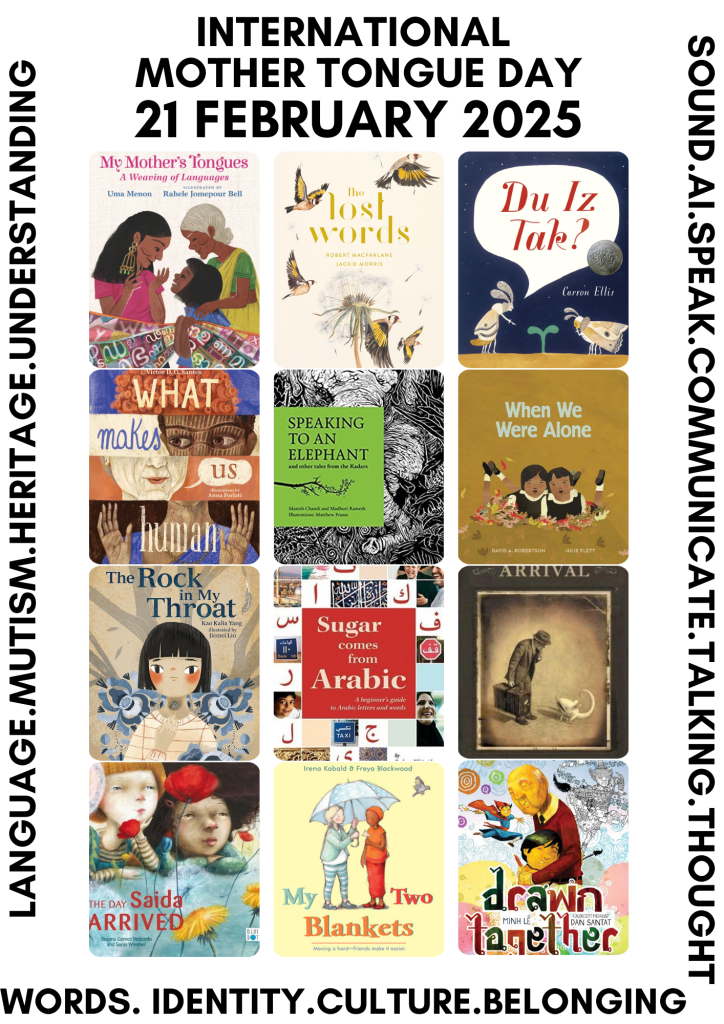
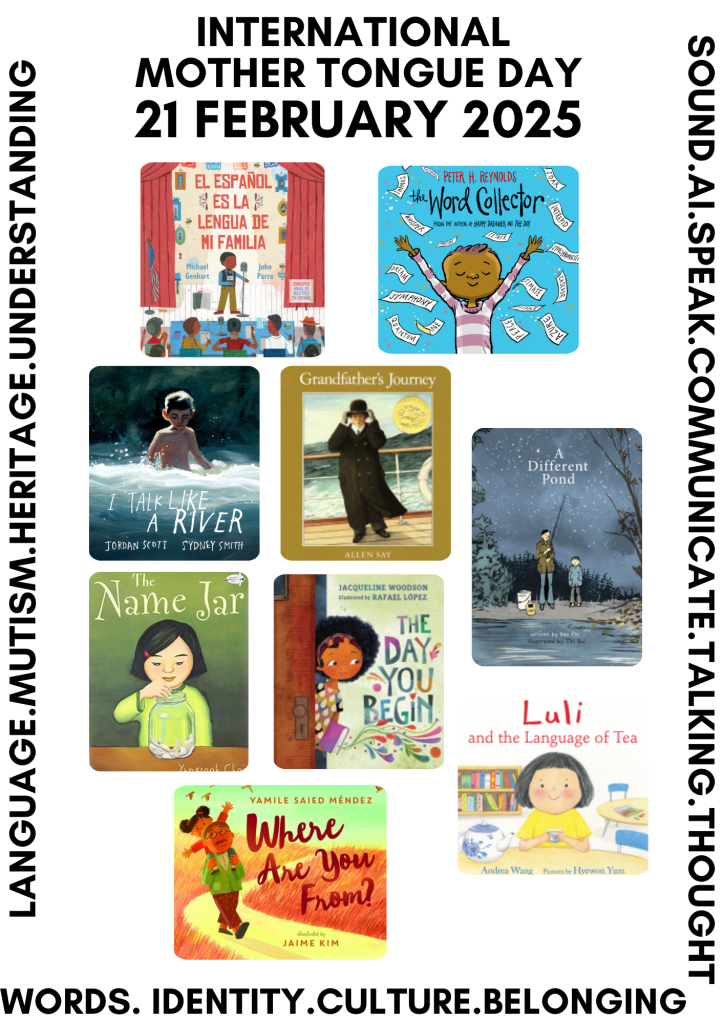
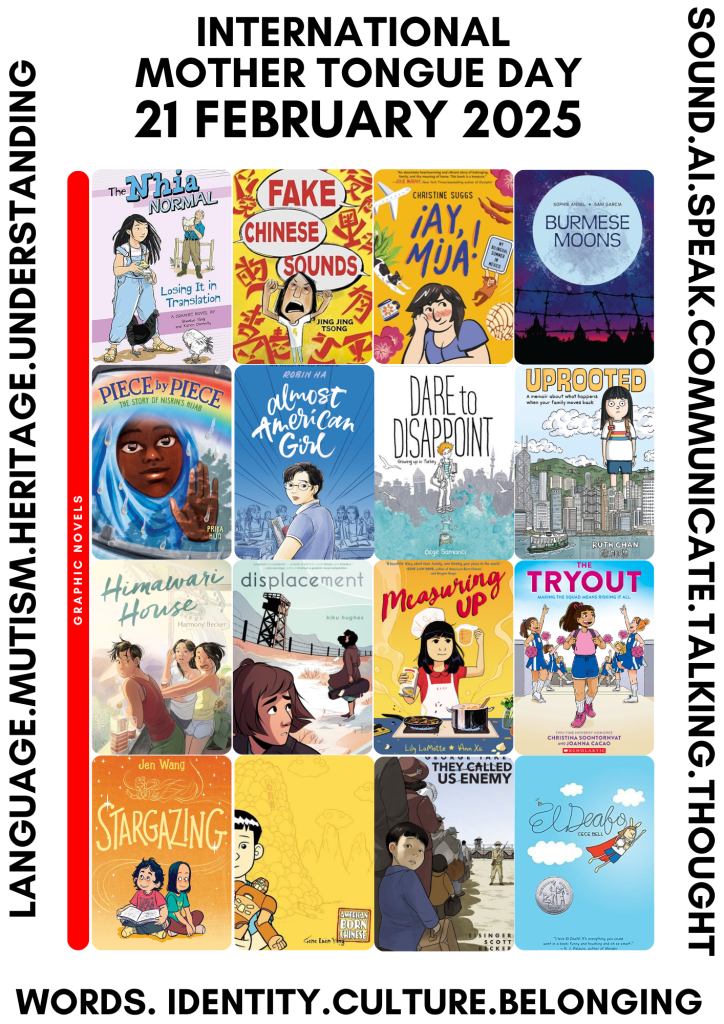
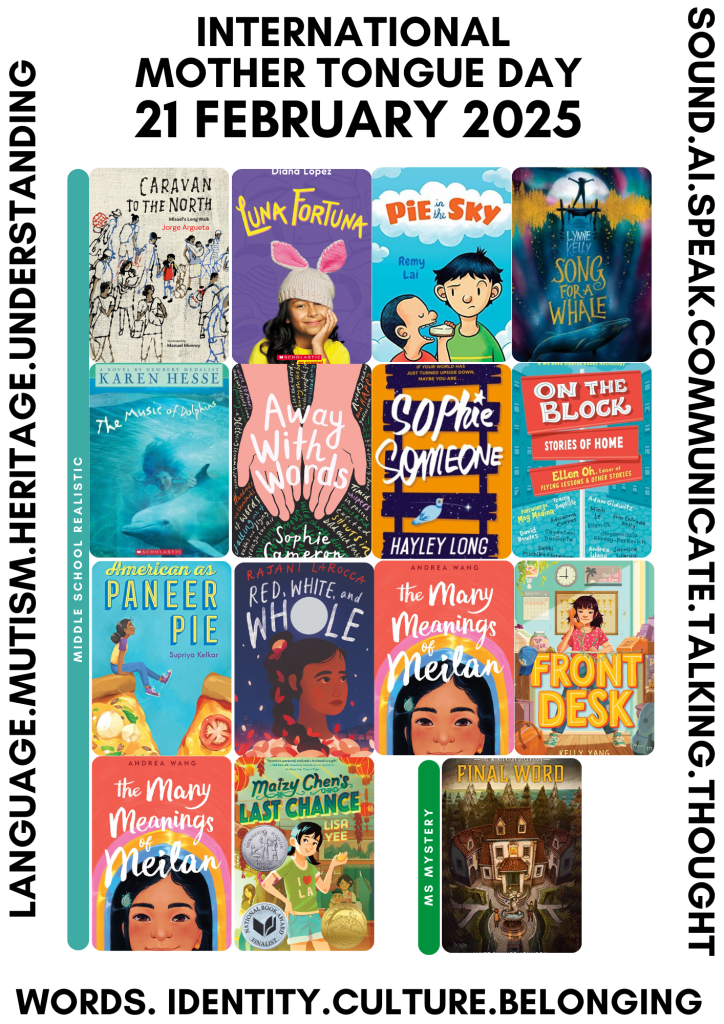
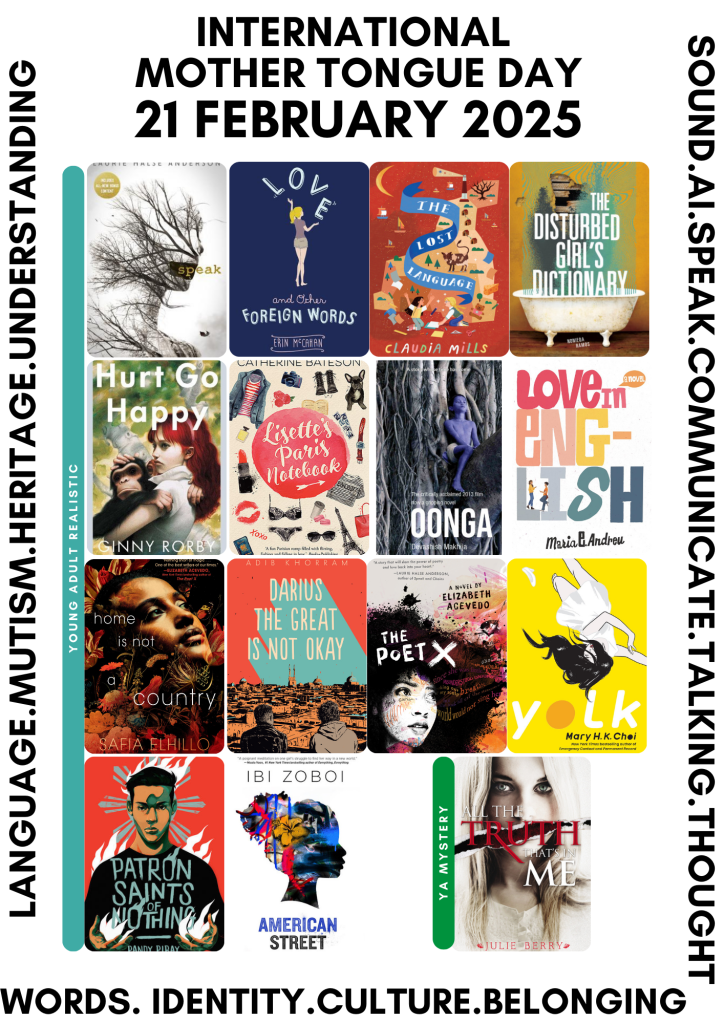
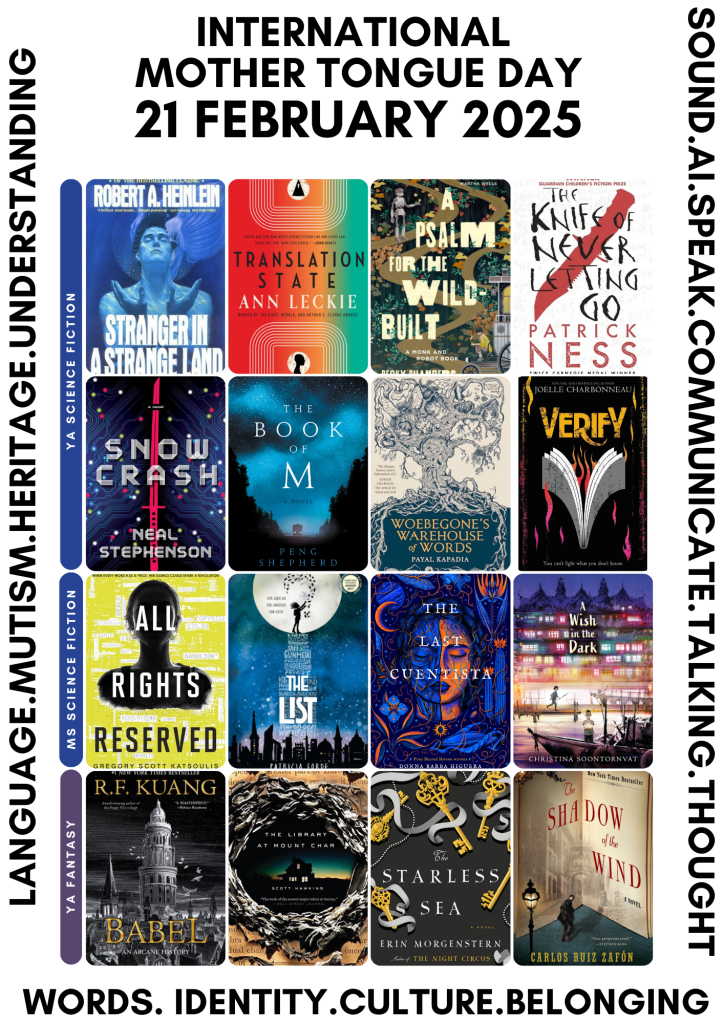
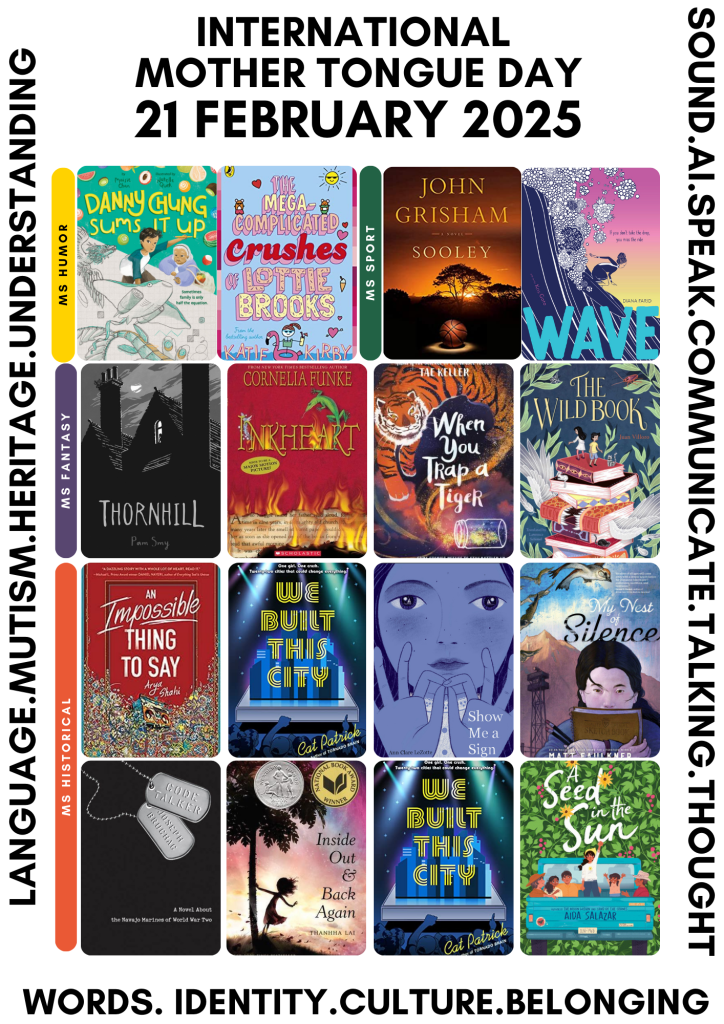
These lists started with a casual conversation with KD as to what I had planned for the day, as my passion for language is well known. Which led to a discussion on which books one would consider and then, as usual things got a little out of hand and now I have 9 pages of posters of books that feature language. Language in all its glorious and inglorious forms. Learning language, struggling with a language, speaking or not speaking. Sign language. Heritage language. Language and thought, language and power or control. Selective mutism. Denial of language, erasure and extinction of language.
As for what to do – if I were here, these are the things I would do.
Have big sheets of paper our where the community could write down the languages they speak / read / write. The languages they’re learning. The languages of their fathers, mothers, grandparents.
I’d have them make a language family tree. Have a poster with a QR code that led to this quirky test on Language.
As usual here is the link to the template / books used. In return I’d love some comments on the books you recognise and the link to language! And any displays or activities you’re planning. And of course if you have suggestions of books I’ve missed I’d appreciate you adding them in a comment.
I was prompted to think about this again with the publication of the White Ravens 2019 list at the Frankfurt Book Fair. The issue of increasing diversity in an international school setting is a complex one, and something I’ve written about at length in the past.
In English
There’s the linguistic diversity bit – collections of books in “Languages other than English” (LOTE) (that post is getting a bit long in the tooth and probably needs updating) a more up to date article featuring Jeremy Willette can be found here. Though I do object to the phrase “mother tongue” the reality of many of our dual language students is that the language other than English medium at school could be that of either parent, but is often that of the father. So I prefer to refer to “home language”. In 2014/15 I went through somewhat an obsession on language, researching it to death, you can find some of the posts on that here. The one thing I would definitely add to this conversation is that unless the LOTE collection is updated regularly and championed by teachers and parents or a language based club, they often don’t earn back the investment in purchasing and the real-estate they occupy. So if you want to invest in a linguistically diverse collection you also have to invest in a mindset of pride in home language and a sense of ownership over the collection and its maintenance within that linguistic community.
The hardest part internationally is that issue of “not our diversity“ . If you have a moment, please read that post. Students who are in international education often defy the traditional (North American) definitions of diversity. They are not poor, black, hispanic, urban, immigrants. That is not to say that it’s unimportant for our students to be exposed to stories of all these groups of people and more. In fact their privilege demands that they access poverty, racism, immigration and need through the windows of literature. But those versions of diversity are not mirrors for them. With a great budget we have no shortage of windows. It’s the mirrors we lack.
And again, when we have these diverse books, we still need teachers and librarians and students and parents who will read them and champion them. Students who will dare to take a book with a cover of someone who doesn’t look like them and read it.
The thing with international students is their lack of homogeneity – something I encountered when looking at linguistic diversity. This table (from my 2015 research) speaks to some of the many variations. (Yes, in those days I also referred to MT /Mother Tongue). So one of the most important sources of mirrors for our students often is books in translation. Particularly for the “globetrotter” subsection of our students. Looking at the White Ravens list above doesn’t give me that much comfort I’m afraid. The issue I have is that most of the books in 2019 are BANA originated (Britain, Australia/NZ & North America) with the exception of one from the Philippines and one from India. 2018 was a bit better (one from Romania, India, Ghana and Korea). The list is unwieldy, you can’t search by age group. And you can’t get a print out.
Some more sources of inspiration include the various IBBY organisations. Including USBBY – even though the criteria for inclusion on the list is includes: Books that help American children see the world from other points of view; Books that provide a perspective or address a topic otherwise missing from children’s literature in the U.S; and Books that are accessible to American readers (where accessible can mean a multitude of things). Again, painfully it’s hard to get a simple list to down load – no I don’t want a pptx, or a bookmark, I just want a list to print out to buy from. And IBBY UK. Their latest publication: Children’s Literature in a Multiliterate World looks to be particularly interesting. One lives in hope.
One of the many things that concerns me with all of this, is the emphasis on picture books. Don’t get me wrong, I’m a HUGE fan of picture books. But the over-reliance on translating picture books? It just adds a PB to the five F’s (food, fashion, festivals, folklore, and flags) of pretending we’re oh-so-international and inclusive.
The Global Literature in Libraries Initiative is more cause for hope. Particularly as they reach out and co-opt people in-situ to aid with their uncovering of local treasures.
In this diversity quest, one is often more of a sleuth than anything else. For example needing to have a look at awards like the Astrid Lindgren Memorial Award and then looking at names of authors and illustrators and seeing if any of their works are translated and available. And how sad it is that many of those authors and illustrators don’t even have a web presence? Isn’t that one way in which IBBY could assist them? Just like publishers have a page on their site for each of their authors couldn’t these nominated people each have some kind of a presence. And many of the links don’t even work.
The “and available” thing. Holy hannah publishers. Get with the global world please. Honestly it’s hard enough just getting to know about Australian and New Zealand and Canadian books, not even to mention anything that is not from USA or Britain. What ever happened to the whole “print on demand” movement. I could possibly understand why it’s hard to find picture books, but middle grade / young adult / junior fiction? Surely that’s not an issue?
How are the rest of you doing with your diversity collection? What “sells” to your students what do you need to work on promoting? Do your teachers gravitate to them / read them or do they need to be pushed?
I subscribe to way too many Facebook groups. I need to stop it actually, they’ve become like women’s magazines. But worse. You keep seeing the same things come up over and over again, but instead of ignoring them you can actually have a say, which is giving yourself the delusion of helpfulness, but actually the smartest person in the room of Facebook groups is not the room itself, to misquote David Weinberger.
Some of the smartest people I know don’t do Facebook and when they do, they’re lurkers not participators. So I guess that’s making me stupid. I just can’t help myself because the fact that someone may actually genuinely want an accurate answer AND follow up is illusionary enough to put up with the ignorance of echo-chambers and the chance that you may learn something.
No where is worse than education groups, and within those groups nothing is worse than questions and answers about bilingualism and language. Except perhaps dinner parties between parents of children of roughly the same age that are excruciating examples of passive aggressive one-upmanship. Right now the sum of my parenting advice can be summed up as:
Regularity, sleep and reading (and don’t be too poor)
Avoid dinner parties with other parents unless their children are at least 10 years older than yours
Pick two languages and give them all you’ve got
It’s the last point I’d like to write about today. On one of the groups the following was posted:
2yr old (born NOV 2015) who is trilingual (if you can even say this about a 2yr old). German mum, French dad, English spoken with nanny and language between parents. I’m looking for kindergarten options from around next summer … have no idea where to start. No preference towards public/private or towards any language even though I’m wondering if adding mandarin might be a bit confusing given that there are already the other 3. What do you think? Focus is more on play/social activities rather than academics
This is a pretty typical question and the answers were also pretty typical – a combination of shouting out school names that have either French or German, alternating with saying that children can easily learn any amount of languages (the number 12 was even suggested), compared with humblebrags about how “fluent” their 5 year old was in any number of languages.
I must admit to entering the fray and suggesting that they chose the language of the school based on their future plans if known – i.e. go back to a French / German speaking environment or continue in the international sphere, and based on who would be at home to support the homework and reading. And to choose 2 languages and do them properly. There are language experts who can help people on this. There are books and research papers written on this. And don’t ask parents of young children – they know not what they say. Don’t even talk to educators in primary schools. speak to parents with teenagers, preferably at the point where they have to choose their IB language. Talk to teenagers, and talk to teachers of IB languages.
Being bilingual is NOT just speaking a language. It is reading and writing. Being literate. And that takes formal lesson time, time spent reading and writing AT grade level. There are so many barriers to that. I’m now talking general international schools, of course there are exceptions / bilingual schools. If you’re lucky you’ll get 40 minutes a day in the language at school. Probably in that language as a SECOND language, i.e. language learning may just be a combination of groundhog day (learning the same things year after year) and/or teaching to the lowest common denominator. So you’re going to have to supplement at home. Either by classes in the afternoon / weekends, online or with a tutor. Besides having to read to and with your child in that language. And dedicate at least part of your holidays to immersion in that language environment. As one expert who recently visited our school said “language is not buy one, get one free”. My personal statement is always “you don’t learn a language by breathing the same air as others who speak it”. Bottom line is it takes planning, time and money.
As I write (Saturday afternoon) my husband is in my son’s room reading in Dutch with him. He’s 14. He has in-school after hours Dutch classes for 3 hours a week plus out-of-school additional tutoring for about 2 hours a week / fortnight depending on his needs. According to his Dutch teacher there are many students who cannot enter the program as the level of their “literate” Dutch is too low. And many of the students in the program are doing Dutch at a much lower level than their chronological age. We took action when he was 9 and started intensive work on his Dutch after he was failing at Chinese. It’s been expensive and time-consuming but he’s on track for a bilingual diploma plus he can communicate with his Dutch family and if necessary could student there in Dutch at university level.
My daughter thrived in the bilingual English-Chinese environment in Hong Kong, hated the only alternative of Chinese second language at her primary school, Had me nagging her to continue reading and writing chinese in her spare time with a tutor until middle school, got into the native stream for middle school / iGCSE where she’s the only caucasian / non-Chinese-heritage child left in a class of about 8 students only. This is only because she’s an exceptionally diligent child and kept up her reading and writing. She bemoans the low expectations and standards at school. Most of the students in her class are only doing Chinese on the insistence of their parents. She may do first language IB and has been recommended for it, but has lost motivation.
All of my French friends who have had children come up the system internationally have, to their regret, children doing French second language.
If you’re interested in reading more on this topic, I’ve read, thought and written reams about it.
The parameters of scholarship in education are often based on Boyer’s (1990) dimensions of discovery, integration, application and teaching. Healey further expands on the scholarship of teaching to include “research into teaching and learning, critical reflection of practice and communication and dissemination about the practice of one’s subject” (2000, p. 169).
Broadening the discussion to include the transformational aspects of “digital” technology, educational scholarship has been enriched through open data, open publishing, a blurring of the academic and ‘real’ world, open teaching and learning and a movement from the individual to the distributed scholar and global access (Pearce, Weller, Scanlon, & Kinsley, 2012). However, Pearce etal. (2012, p. 169) cautioned that technology is “a necessary but not sufficient condition” for true scholarship. The question is, given the potential and reality of technology, what else is needed to fulfil the obligations of a modern ‘digital’ scholar?
Argument statement
This essay will argue that the dominance of a Western cognitive constructivist tradition in online and offline education, led by British, Australasian and North American (BANA) institutions limits knowledge, understanding and progress not only of its students, but of its scholars as well in exploiting the true potential of open educational tools and resources.
There are four main reasons for situating this essay in the context of teaching and learning, in particular, a critical reflection of digital scholarship practice in relation to multi-cultural multi-lingual (MCML) learning environments. Firstly, demographic shifts in education are occurring at an unprecedented rate as a result of globalisation, immigration, migration, and war (Boelens, 2010; Boelens, Cherek, Tilke, & Bailey, 2015). Secondly a significant shift to online education where the global market is showing a 9.2% five year annual compound growth rate and is now worth $107 billion led by India and China (Pappas, 2015). Thirdly, work and employment increasingly is global, remote and disaggregated with globally mobile and fluid workforce and both employers and employees requiring “just in time” rather than “just in case” skills and knowledge. Finally, and perhaps most importantly, there is a moral, ethical and value-based argument. On the one hand, MCML students are prejudiced by the dominance of a Western cognitive constructivist tradition in education (Catterick, 2007; Sadykova, 2014; Zhang & Kenny, 2010) and on the other, ignoring the MCML dimension limits critical reflective practice, the potential of international digital scholarship and knowledge and understanding of a large part of the educational scholars’ field.
Interpretive Discussion
Background
Traditionally, creating culturally-responsive accommodations for MLMC students has faced considerable institutional opposition. The response of educational institutions, comprised a narrow range between non-accommodation and intervention in the form of student induction into ‘the system’ i.e. modify the student not the program (Catterick, 2007; Parrish & Linder-VanBerschot, 2010). Arguments against interventions cite costs, quality control, and expectations of the students themselves and their future employers that they are “Westernised” as a by-product of their education (Catterick, 2007).
Parrish and Linder-VanBerschot (2010) acknowledge these issues and suggest that institutions distinguish between entrenched cultural values and superficial practices, and create interventions with constructivist and instructivist alternatives or choices in learning activities and instructional format only where these are critical to learning success. Researchers sound a word of caution against cultural generalizations that lead to stereotyping and discrimination (Gazi, 2014; Hardy & Tolhurst, 2014; Parrish & Linder-VanBerschot, 2010). This can be ameliorated through a combination of embedding cultural considerations in each stage of the instructional design process, ensuring an iterative practice of reflection and modification and encouraging student interaction and feedback (Parrish & Linder-VanBerschot, 2010; Young, 2009).
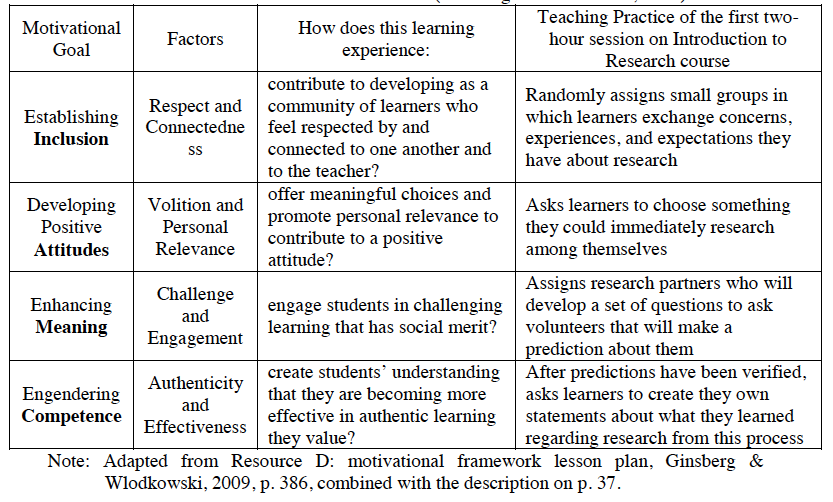
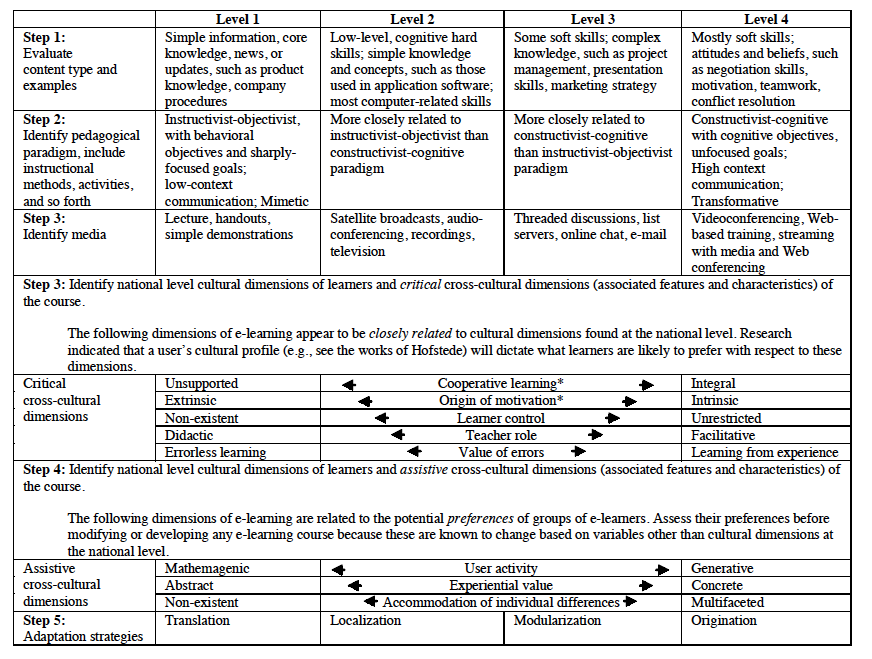
Models designed to foster awareness of cultural implications in education vary in their orientation. Initially research done in corporations (Hofstede, Hofstede, & Minkov, 2010) and physical classrooms led to classroom or systemsoriginated and oriented models such as the Inclusion, Attitude, Meaning, Competence (IAMC) model of Ginsberg & Wlodkowski (2009, cited in Suzuki & Nemoto, 2012) and the Cultural Dimensions Learning Framework (CDLF) (Parrish & Linder-VanBerschot, 2010) which were adapted for online learning.
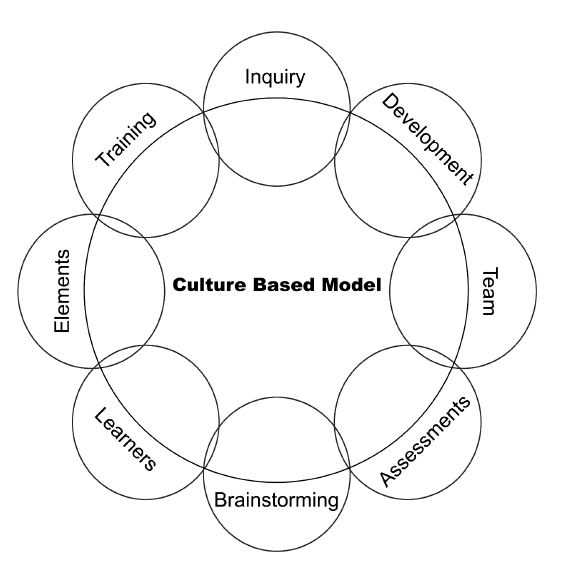
In contrast, the Culture Based Model (CBM) framework of Young (2009) and the Cultural Adaptation Process (CAP) model (Edmundson, 2007b) are product oriented with the aim of guiding designers to incorporate culture in the design of digital and online educational products. (See Appendix 1 for illustrations of these models).
Reflection on teaching and learning in a multi-cultural environment
Educational institutions are not the only suppliers of teaching and learning. Commercial entities, particularly multinational companies, go to an enormous amount of effort in creating culturally compatible user interfaces – see Edmundson’s (2007a) book “Globalized e-learning cultural challenges”. One could argue that this effort directly benefits their bottom line, however all institutions would benefit from this approach.
Fortunately there are some researchers open-minded enough to examine the assumptions of their own culture, reflect on the embedded cultural practices of teaching and learning and those of the digital platforms and applications and thoughtfully researching ways to reconcile the two so as to optimise the learning of their students (Chan & Rao, 2010; Looker, 2011; Ren & Montgomery, 2015; Sadykova, 2014). Critical examination of one’s own culture and introducing new technologies in a more considered and less forceful way, appears to result in more success and acceptance. Pedagogy aligned with sociocultural context allows scaffolding of current to new practice and understanding (Chan, 2010; Chan & Rao, 2010; Law et al., 2010; Rao & Chan, 2010).
Chan (2010) demonstrated aspects of the Confucian approach to teaching and learning were highly compatible with the values of digital scholarship, and showed how modifications in the way technological tools for collaborative learning were introduced positively impacted their acceptance by teachers and students in a high school setting.
More recently, in examining Korean students’ experiences of Massive Open Online Courses (MOOCs), Ahn, Yyon and Cha (2015) built on the CDLF of Parrish & Linder-VanBerschot (2010) showing how awareness, cultural sensitivity and relatively minor adjustments could enhance the online learning experience of such students without detracting from the quality and substance of the courses.
The introduction of digital innovation in the learning environment does not automatically lead to universal acceptance, but can resoundingly be rejected in any culture when it is felt basic assumptions and expectations are being violated – as the study of an online peer-to-peer review workshop tool revealed (Wilson, Diao, & Huang, 2015). Even if peer-to-peer review and data analytics have meta-cognitive benefits, their implementation is often poor and occurs within a context where cooperation and collaboration is espoused but underlying assumptions and pressures of competition and the importance of good grades prevail (Durall & Gros, 2014; Wilson et al., 2015). Similarly, suboptimal outcomes are seen if the social-emotional needs and group formation process is neglected in online scholarship or learning and made subservient to certification and task performance (Carabajal, LaPointe, & Gunawardena, 2003).
Current trends, futurist predictions, theoretical perspectives
Disaggregation and re-aggregation appears to be a theme in many of the discussions on trends and the future of education – something technology allows in ways previously not possible.
Ware, writing in 2011, predicted that the publication of academic research would be disaggregated between the repository process of registration and dissemination of work and the certification process which includes peer review and branding – an idea that harks back to the learned societies of the 18th and 19th centuries. (Ware, 2011). Four years later this is the reality in open access repositories in China (Ren & Montgomery, 2015). Retractions of research papers have also resulted in the calls for the publication of the complete research work flow including raw data – something that is now technologically possible and feasible as interrogation and data analytic tools develop (Larsen, 2008; Oransky & Marcus, 2010; Ware, 2011).
Technology enhances the agency of the self-directed learner (SDL) to re-aggregate OER to suit their learning needs. Mike Caulfield’s idea of choral explanations in OER textbooks:
“the text branches off into multiple available explanations of the same concept, explanations authored individually by a wide range of instructors, researchers, and students. You can keep reading until you find the explanation that makes sense, or you can start with simpler explanations and work your way to nuance.” (Caulfield, 2016, para. 63)
opens many possibilities for expanding textbooks to accommodate linguistic and cultural diversity – something international students already do when they purchase two (physical) textbooks, one that is not only in their home language but also in their home pedagogical culture (Bailey, 2016; Kim & Mizuishi, 2014)
Bates cautions that there is still an agency role to structure and accredit that knowledge acquisition (Bates, 2011), but in a globally mobile and fluid workforce, those aggregators will need to accommodate different cultures of learning. Public/private educational entities such as Singapore’s Institute of Technical Education are taking a regional lead in exporting their vocational training through their educational services division (Chong, 2014; ITEES, 2015; Li, Yao, & Chen, 2014).
Similarly consideration could be given to using the models and algorithms in the field of adaptive learning (Charles Sturt University, n.d.) and personalisation in order to create cultural adaptations based on parameters set by students.
Two universities, although very different in design are using innovative online technology, Kiron University to give refugees the opportunity to further their education (Bates, 2015) and Minerva University to give fee paying students a global education that is location independent for both students and professors (Wood, 2014). Such disruptive models of higher education raise all kinds of questions on the implications of digital learning including whether scholarship and research will continue if scholarship is not directly visible or rewarded (Harry Lewis, cited by Wood, 2014).
Implications for scholarly practice
In order to understand the role of technology, Kalantzis and Cope (2015) go back to the etymology of ‘media’ as agents bridging meaning across space and time to facilitate communication, understanding and learning. This has huge implications for scholarly practice.
Literature on global collaboration in the classroom (Higgitt et al., 2008; Thombs, Ivarsson, & Gillis, 2011), the research process (Siemens & Burr, 2013; Siemens, Cunningham, Duff, & Warwick, 2011) and online conferencing (LaPointe & Gunawardena, 2004) enumerates many benefits of such collaboration. These include but are not limited to the opening of and access to new knowledge; flattening of hierarchies, easier discovery and connection mechanisms; extending the reach and equity of scholars and reducing costs. Some of the problems however, include issues with technological difficulties and failure, differences in equipment standards and capabilities, scheduling issues due to time differences, misunderstandings due to language, the nature of computer-mediated communication including its text-basis, time-independence, asynchronous nature and inability to interpret culturally based non-verbal cues (Pearce et al., 2012; Selwyn, 2010; Veletsianos & Kimmons, 2012a, 2012b; Weller, 2011).
Of these, language remains a significant barrier to open access international research and learning. Even where all members of a research team are proficient in a language (usually English), research in other languages may not be accessible to non-speakers (Loan & Sheikh, 2016; Ren & Montgomery, 2015), and language and cultural norms may be intertwined where nuance can result in misunderstanding (Siemens & Burr, 2013). As translation software continue to evolve will more students be able to study and do internationally recognised and disseminated research in their home language, (Cheesman et al., 2016; Palaiologou, 2007; Sadykova, 2014)? Or will the dominance of English prevail – albeit with a move to “global English” as envisioned by Schell (2007) and what will be lost as a result?
Conclusion
Digital scholarship within the context of international and globalised education could benefit from additional critical reflection into the assumptions concerning and attitudes towards multi-cultural and multi-lingual students and fellow researchers. Given the plethora of technological tools, research, knowledge and practice in non-BANA educational institutions, of intrepid researchers in BANA institutions and of multi-national corporations there are ample examples of best practice and the potential to positively impact student learning and educational scholarship in the digital realm.
References
Ahn, M. L., Yoon, H. S., & Cha, H. J. (2015). Cultural sensitivity and design implications of MOOCs from Korean learners’ perspectives: Case studies on edX and Coursera. Educational Technology International, 16(2), 201–229. Retrieved from http://www.kset.or.kr/eti_ojs/index.php/instruction/article/viewFile/49/pdf_15
Bates, T. (2011). Understanding Web 2.0 and its implications for e-learning. In M. J. W. Lee & C. McLoughlin (Eds.), Web 2.0-Based E-Learning: Applying Social Informatics for Tertiary Teaching (pp. 20–42). Hershey, PA: Information Science Reference. Retrieved from 10.4018/978-1-60566-294-7
Boelens, H. (2010). The evolving role of the school library and information centre in education in digital Europe (PhD Thesis). Middlesex University. Retrieved from http://eprints.mdx.ac.uk/7329/
Boelens, H., Cherek, J., Tilke, A., & Bailey, N. (2015). Communicating across cultures: Cultural identity issues and the role of the multicultural, multilingual school library within the school community. Presented at the ‘The school library rocks’ IASL 2015, Maastricht, Netherlands.
Boyer, E. L. (1990). Scholarship reconsidered: priorities of the professoriate. Princeton, N.J: Carnegie Foundation for the Advancement of Teaching.
Carabajal, K., LaPointe, D., & Gunawardena, C. (2003). Group development in online learning communities. In M. G. Moore & W. G. Anderson (Eds.), Handbook of distance education (pp. 217–234). Mahwah, N.J: L. Erlbaum Associates.
Catterick, D. (2007). Do the philosophical foundations of online learning disadvantage non-western students? In A. Edmundson (Ed.), Globalized E-Learning Cultural Challenges: (pp. 116–129). Hershey, PA: Information Science Pub.
Chan, C. K. K. (2010). Classroom innovation for the Chinese learner: Transcending dichotomies and transforming pedagogy. In C. K. K. Chan & N. Rao (Eds.), Revisiting The Chinese Learner (pp. 169–210). Dordrecht: Springer Netherlands.
Chan, C. K. K., & Rao, N. (Eds.). (2010). Revisiting the Chinese learner: changing contexts, changing education. Dordrecht: Springer.
Cheesman, T., Flanagan, K., Thiel, S., Rybicki, J., Laramee, R. S., Hope, J., & Roos, A. (2016). Multi-retranslation corpora: Visibility, variation, value, and virtue. Digital Scholarship in the Humanities. http://doi.org/10.1093/llc/fqw027
Chong, T. (2014). Vocational education in Singapore: meritocracy and hidden narratives. Discourse: Studies in the Cultural Politics of Education, 35(5), 637–648. http://doi.org/10.1080/01596306.2014.927165
Durall, E., & Gros, B. (2014). Learning analytics as a metacognitive tool (pp. 380–384). Presented at the CSEDU 2014 – 6th International Conference on Computer Supported Education.
Edmundson, A. (Ed.). (2007a). Globalized e-learning cultural challenges. Hershey, PA: Information Science Pub.
Edmundson, A. (2007b). The cultural adaptation process (CAP) model: Designing E-learning for another culture. In A. Edmundson (Ed.), Globalized E-Learning Cultural Challenges: (pp. 267–290). Hershey, PA: Information Science Pub.
Hardy, C., & Tolhurst, D. (2014). Epistemological beliefs and cultural diversity matters in management education and learning: A critical review and future directions. Academy of Management Learning & Education, 13(2), 265–289. http://doi.org/10.5465/amle.2012.0063
Healey, M. (2000). Developing the scholarship of teaching in higher education: A discipline-based approach. Higher Education Research & Development, 19(2), 169–189. http://doi.org/10.1080/072943600445637
Higgitt, D., Donert, K., Healey, M., Klein, P., Solem, M., & Vajoczki, S. (2008). Developing and enhancing international collaborative learning. Journal of Geography in Higher Education, 32(1), 121–133. http://doi.org/10.1080/03098260701731629
Hofstede, G. H., Hofstede, G. J., & Minkov, M. (2010). Cultures and organizations: software of the mind: intercultural cooperation and its importance for survival (3rd ed). New York: McGraw-Hill.
ITEES. (2015). About ITE Education Services. Retrieved 27 August 2016, from http://www.itees.com.sg/
Kim, M., & Mizuishi, K. (2014, December). Language and cultural differences and barriers in an international school setting – personal experiences and reflections. UWCSEA-East.
LaPointe, D. K., & Gunawardena, C. N. (2004). Developing, testing and refining of a model to understand the relationship between peer interaction and learning outcomes in computer‐mediated conferencing. Distance Education, 25(1), 83–106. http://doi.org/10.1080/0158791042000212477
Law, N. W. Y., Yuen, A. H. K., Chan, C. K. K., Yuen, J. K. L., Pan, N. F. C., Lai, M., & Lee, V. S. L. (2010). New experiences, new epistemology, and the pressures of change: The Chinese learner in transition. In C. K. K. Chan & N. Rao (Eds.), Revisiting The Chinese Learner (pp. 89–129). Dordrecht: Springer Netherlands.
Loan, F. A., & Sheikh, S. (2016). Analytical study of open access health and medical repositories. The Electronic Library, 34(3), 419–434. http://doi.org/10.1108/EL-01-2015-0012
Looker, P. (2011). Globalising the local: The scholarship of teaching and learning in a larger context. Journal of the NUS Teaching Academy, 1(1), 21–31.
Palaiologou, N. (2007). Intercultural dimensions in the information society: Reflections on designing and developing culturally-oriented learning. In A. Edmundson (Ed.), Globalized E-Learning Cultural Challenges: (pp. 267–290). Hershey, PA: Information Science Pub.
Parrish, P., & Linder-VanBerschot, J. A. (2010). Cultural dimensions of learning: Addressing the challenges of multicultural instruction. International Review of Research in Open & Distance Learning, 11(2), 1–19.
Pearce, N., Weller, M., Scanlon, E., & Kinsley, S. (2012). Digital scholarship considered: How new technologies could transform academic work. In Education, 16(1). Retrieved from http://ineducation.ca/ineducation/article/view/44
Rao, N., & Chan, C. K. K. (2010). Moving Beyond paradoxes: Understanding Chinese learners and their teachers. In C. K. K. Chan & N. Rao (Eds.), Revisiting The Chinese Learner (pp. 3–32). Dordrecht: Springer Netherlands.
Ren, X., & Montgomery, L. (2015). Open access and soft power: Chinese voices in international scholarship. Media, Culture & Society, 37(3), 394–408. http://doi.org/10.1177/0163443714567019
Sadykova, G. (2014). Mediating knowledge through peer-to-peer interaction in a multicultural online learning environment: A case of international students in the US. The International Review of Research in Open and Distributed Learning, 15(3).
Schell, M. (2007). How to globalize online course content. In A. Edmundson (Ed.), Globalized E-Learning Cultural Challenges: (pp. 155–167). Hershey, PA: Information Science Pub.
Selwyn, N. (2010). Looking beyond learning: notes towards the critical study of educational technology. Journal of Computer Assisted Learning, 26(1), 65–73. http://doi.org/10.1111/j.1365-2729.2009.00338.x
Siemens, L., & Burr, E. (2013). A trip around the world: Accommodating geographical, linguistic and cultural diversity in academic research teams. Literary and Linguistic Computing, 28(2), 331–343. http://doi.org/10.1093/llc/fqs018
Siemens, L., Cunningham, R., Duff, W., & Warwick, C. (2011). A tale of two cities: implications of the similarities and differences in collaborative approaches within the digital libraries and digital humanities communities. Literary and Linguistic Computing, 26(3), 335–348. http://doi.org/10.1093/llc/fqr028
Suzuki, K., & Nemoto, J. (2012). Cultural and social frameworks of instructional design (pp. 22–24). Presented at the 10th International Conference for Media in Education, Beijing.
Thombs, M., Ivarsson, L., & Gillis, M. (2011). Building bridges across the Atlantic: The impact of technology facilitated classroom partnerships on cultural competency and language skills. In M. Bhattacharya, N. Mach, & M. Moallem (Eds.), Emerging Technologies in Learning: Impact on Cognition and Culture (pp. 35–44). Association for the Advancement of Computing in Education (AACE). Retrieved from https://www.learntechlib.org/p/39252
Wilson, M. J., Diao, M. M., & Huang, L. (2015). ‘I’m not here to learn how to mark someone else’s stuff’: an investigation of an online peer-to-peer review workshop tool. Assessment & Evaluation in Higher Education, 40(1), 15–32. http://doi.org/10.1080/02602938.2014.881980
Young, P. A. (2009). The Culture-Based Model framework. In P. A. Young, Instructional Design Frameworks and Intercultural Models: (pp. 37–53). Hershey, PA: IGI Global. Retrieved from 10.4018/978-1-60566-426-2.ch003
Zhang, Z., & Kenny, R. F. (2010). Learning in an online distance education course: Experiences of three international students. International Review of Research in Open and Distance Learning, 11(1). Retrieved from http://www.irrodl.org/index.php/irrodl/article/view/775/1481
Appendix 1: Illustrations of Models
Figure 1: IAMC model Ginsberg & Wlodkowski, 2009 (cited in Suzuki & Nemoto, 2012 p. 25)
Figure 2: Cultural Dimensions Learning Framework (Parrish & Linder-VanBerschot, 2010, summarized in Ahn, Yoon & Cha, 2015, p.207)
Figure 3: Culture Based Model, Young, 2009, p. 38
Figure 4: Cultural Adaptation Process (Edmundson, 2007b, p. 269)
I need to write an interpretive discussion paper. I’m trying to organise my thoughts. My first and foremost thought is that writing this paper is in direct contravention to the topic of the paper, which is “Digital scholarship in education, in the context of interdisciplinary knowledge and research” – because my digital scholarship is leading me down all sorts of other avenues and thoughts which definitely do NOT fit into the marking rubric. I’m also immensely frustrated at being a distance learner and not knowing who in the zoo to discuss these thoughts with. I’m tired of rehashing the articles that all say the same thing about the evolution from web 1.0 to 2.0 to 3.0 and the fact that we all can be producers and not just consumers, open access (OA), MOOCs, twitter, blogs blah blah.
Transformative?
What are my thoughts right now – on the exact topic? In the first place that digital has not been transformative enough to scholarship. Yes in theory, no in fact. The digital spaces I see in education have been highjacked not by scholars but by self-promoting practitioners of the twitterati. There is a lot of anecdotal rather than research based evidence. And they’re echo-chambers of white middle-class educators, often male. I need to expand my networks, and I’ve been making a concerted effort to follow people who are publishing real peer-reviewed research – some of which are on social media and some of which aren’t. Some who tweet about their research, most who don’t. Or just refer to conferences they’re talking at or have talked at, or their followers enticingly frustratingly refer to such presentations. The thing is that for all this to be transformative it also needs to be heretical. And heretics are not welcome in institutions. Because they threaten the control and status quo of institutions, and by definition are persona-non-grata and there are pathways of recognition (leading to tenure at which point hopefully you’d be entrenched enough to say what the damn you please but by then you’d probably be entrenched enough to buy into the status quo and have a stake in maintaining it). Yes they are clever. Who runs the MOOCs? Who feeds them, who controls them, finances them and their content? – the institutions. And the money. Yes, always follow the money. All those wonderful digital tools. Those databases, those journals, encyclopedias. My gold standard for testing anything a salesman throws at me as a school librarian is looking up “socialism” and “communism” in their search engines. Try it. Just try it.
What is education for? I’ll buy the ‘transformative’ bit on the micro individual well-heeled personal level, – but take it local or regional or national and you have the ‘productive literate citizen’ emerging. What do we want from the 21st Century learner? Link looks great doesn’t it. Global citizens and all those skills (not content or facts), and then you click on “pricing” and you can clone plans. I repeat. You can pay to clone plans. You can pay someone else to do your thinking and planning for you can you can teach to that plan and create clones of every other global child whose school or teacher can afford this. It’s so slick it’s so nicely designed, it’s so intuitive and easy.
Confrontational and Challenging
Easy. Am I a puritan that I think things have to be a struggle and difficult? Not really, I like Vygotsky and the ideal of proximal development. I don’t like when kids are proximally developed to be led by the nose or to follow the breadcrumbs to the cottage in the woods made of candy only to find out that they’ll be trapped by the witch of educational debt in a cage that is not of their making. No, I think that education does not really have so much to be difficult as in inaccessible and alienating, but I think it needs to be difficult in that it should be confrontational and challenging. And education dominated by packaging – of textbooks, of websites, of learning platforms, of learning plans – created by big corporations and big non-profits cannot be confrontational. It can only be nationalistic or capitalistic or serve the needs of the society in which it finds itself. Or the version of what that society thinks its needs are. Good productive (national) citizens. Because often being a global citizen is at odds with being a national citizen. Because then you might just want to open the borders and let the refugees in. You may not vote for the hawks. You’d want to leak confidential documents, hack into university databases, give maternity & paternity leave, free education, a minimum wage, universal health coverage AND WHO WOULD PAY FOR ALL THAT? Huh?
Tower of Babel
So the digital. The open borders, the open access. The flat earth. Where a researcher / research at the other end of the world is at the touch of a button or a click of a mouse. As long as you both have the internet. And speak each other’s language (or preferably that current god of all language, English), as long as that research is in a bundle paid for by your institution. As long as you’re part of an institution, because paying $39.95 per article for research that may or may not be relevant, may or may not be any good is no joke for the casual dilettante. And when you leave formal education, when you graduate and lose access to all that body of formal knowledge, lose your writing on fora and institutional blogs, when the gates to the ivory towers slam shut? Are you no longer a scholar? Are you an ex-scholar? A practitioner? I think about this a lot as I reach the end of this degree.
Language and culture
Coming back to the whole language thing. According to Ren and Montgomery (2015) from 1996 to 2012 – 2,680,395 scholarly articles were published internationally by Chinese authors, 35% of which have never been cited, and the average citation per publication is 6.17 versus 20.45 for an American author. 95% of its most important research “are now published by foreign commercial publisher and locked behind pay-walls” (p. 397). Most scholars do not have the English proficiency, there are not enough translators and therefore the research remains trapped in Chinese repository systems. The article is a fascinating glimpse into the profundity of linguistic barriers, cultural and ideological differences in writing, research and performance metrics that are seldom if ever mentioned in the jubilant digital scholarship literature.
Interdisciplinary
As a fairly recent migrant from the world of commerce and industry to the world of education, one of the other articles I read was cause for inner ironical chuckling. Interdisciplinary. What does that mean? That you stay in your academic ivory tower but build bridges to other towers in the same academic village, or even across the pond to another tower where there are English speakers? And you interact only with the grubby world of business when they sell you OLP (online learning platforms) and data analytic systems and student interfaces and lesson plans and databases. But do you consider that you may be able to learn from that world? Even within business schools, the frenetic search for pertinent case studies is to inform and guide practise by current or potential business people. And so I turn to Siemens and Burr (2013) – who I must say I have a huge amount for respect for, because they are talking, reading about and DOING research in international research teams. They are grappling with linguistic and cultural barriers. And I read their article and the whole time I’m thinking – you’ve got to be kidding me. Yes, you’re probably breaking new ground in your context, but global companies have been doing this for decades. For eons. Your average wet-nosed graduate in a developing country working for a multi-national could have told you of all these challenges AND how they’re resolved in commerce and industry. I have to wonder, when a paper cites Hofstede – 1980 * if they’ve read and understood it’s context (Shell oil company), why they don’t think – heck – those multinational companies must know a thing or two about this – let’s go and ask them how to resolve this rather than us having to reinvent the wheel. Just pop over to your local business school or track down a travelling salesman with a passport to find out more.
I realise I’ve nearly written 1,500 words right now, and I don’t even begin to cover all the ground that I’d want to cover but can’t. I’ll just end by referring back to Gee and Hayes (2011). The first six chapters are a great read to understand the context of current education, language and literacy as part of a continuum of education across the ages – and they can express this background so much better than my amateur fumblings. And after giving a context what is the future? It would have to be in machine translation. In non-affiliation to a single academic organisation or nation. The return of the professional amateur, of “royal societies” that are not royal or national. Different pathways of legitimisation and accreditation. More cooperation and collaboration but also more confrontation. Assignments that are conceptually bound but content liberated. Radically open access to both published and rejected research, with commentary as to the rejection – a bit of meta-cognition anyone? Access to assignments with grading. Plagiarism is only an option in a closed rigid system with unimaginative content related assignments. And those do nothing to further scholarship, digital or otherwise.
(And apologies to all those authors and researchers who are not cited but who are informing my thinking, but were not read in the last few days).
References:
Gee, J. P., & Hayes, E. (2011). Language and learning in the digital age (1st ed). New York, NY: Routledge.
Ren, X., & Montgomery, L. (2015). Open access and soft power: Chinese voices in international scholarship. Media, Culture & Society, 37(3), 394–408. http://doi.org/10.1177/0163443714567019
Siemens, L., & Burr, E. (2013). A trip around the world: Accommodating geographical, linguistic and cultural diversity in academic research teams. Literary and Linguistic Computing, 28(2), 331–343. http://doi.org/10.1093/llc/fqs018
————————
(* As a side note, Hofstede was taught to me as an expat 101 in the early 1990’s before my husband and I left on our first international assignment in Brazil. There is an updated version of his book – co-written by his son and Michael Minkov. Should be read by every ‘global’ educator and student interested in global collaboration and cooperation :
Hofstede, G. H., Hofstede, G. J., & Minkov, M. (2010). Cultures and organizations: software of the mind: intercultural cooperation and its importance for survival (3rd ed). New York: McGraw-Hill.)
One of the most difficult aspects of my last assignment on multicultural and diverse literature (MCD) was coming to grips with the extent to which all literature, including MCD literature is dominated by white and/or western based authors. When I have more headspace I’d like to write an article on what kind of criteria one could apply to assess the legitimacy of authors to tackle MCD themes – aka “the right to write”. It would be a set of guidelines that librarians and even teachers and students could use to critically look at existing literature and to use when deciding what books should be purchased and/or included in curricula activities.
My thoughts so far are around:
origin of author or illustrator – birth and residency
whether they are cultural / religious insider by residency / descent / marriage
time spent living in the region / culture
language – I think this is HUGE – language=culture – as a parent of a child who we put in chinese language immersion school at a young age her access to the language = access to the culture and she is no longer as western culturally assimilated as she was before. I’m thinking of Pearl Buck now as well – she is revered in China as someone with a “chinese soul” whereas I don’t think that is given to many other ‘touristic’ writers.
Role as gatekeeper or guide – I do think that authors could spend more time in nurturing talent and “passing the baton” rather than blocking the way – there is the balance between accessibility for the western sensibilities – it can’t be too unfamiliar, uncomfortable (I’m even thinking of how my students found Bleakboy “weird” and that’s just Aussie vs. their usual diet of UK / USA – but fortunately they didn’t reject it) but it needs to be authentic – particularly the inner dialogue – we can’t impose western sensibilities about gender rights, individual rights on a collectivist society – my Chinese / Asian friends do not rebel against the fact that their parents chose their study direction, university and career (and sometimes husband) for them, because the assumption is that the parent knows best and has their best interest at heart – not all the stuff we project onto the situation.
Yes, there are the gaps and I agree without the filling by Deborah Ellis etal, our students wouldn’t have the awareness at all – but we’re 10-20-30-60 years on in the case of some issues and STILL the middle class white people are writing and being published. Why? And whose lives are richer / poorer as a result of these works.
Just my random thoughts this morning. Any comments?
I’m really interested in language-learning ecology/(ies) and since hers mentioned this, I decided to take the plunge and wade through the 372 pages. And what I found was rather interesting. Aside from all the detailed analysis, the most interesting chapter was on “Is Asian Language Study Equitable” – she has written a paper on it, which unfortunately doesn’t seem to be easily accessible (i). (Just tried to find her on twitter to see where I can get a copy…)…. read more
I’m going to either become very quiet or very noisy in the next few weeks as I dive into my next research topic for my last (yikes, how fast did that go) assignment for INF530.
This is my research proposal:
===============================================
1. Proposal Topic
Language learning and the new digital information ecology
2. Proposed digital tools and/or spaces to be used
iBooks
This is a tool I’ve wanted to experiment with for a while, and I think it can be used to encompass all the multi-media affordances required for this essay. Eventually I’d like to expand on it and turn it into a resource for our students, educators and families.
3. Rationale
Previous research has indicated that successful language acquisition is the result of the combination of optimising factors relating to the child (student), family, school and community. These can be considered to operate in inter-relationships in a knowledge ecology.
The affordances of digital technology in education combined with global connectedness allow unprecendented opportunities to leverage the connected learning principles of
production centered
openly networked
shared purpose
within language learning, however the current structures of education may ignore or limit these opportunities due to institutional (or familial) fear, ignorance or perceived loss of control.
This essay will look at the work of Seely, Hatie, Bawden, Ng, Siemans, Downes, Ford, Perrault etal. to examine learning design and the information environment and discuss how the learning systems and constituents allow for zones of intervention within the language learning ecology to leverage learning – sychronous and asynchronous, local and global and allow students and their families a greater locus of control over language learning.
A particular focus will be mother tongue learning, an area often neglected by schools, who state they unable to justify supporting a large number of minority languages formally. I will argue this may be the result a failure of imagination and the application of digital technology and collaborative learning rather than a lack of resources.
“Knowledge, then, is experiences and stories, and intelligence is the apt use of experience, and the creation and telling of stories. Memory is memory for stories, and the major processes of memory are the creation, storage, and retrieval of stories.”(Schank & Abelson, 1995, p. 8)
Red Dragon Wallpaper Download. (2011)
Proposal Topic:
“追龍 – Chasing the Dragon*
a family’s story of language and identity”
From 2006 to 2011 our family was engaged in learning Chinese in one form or another including language classes, attending a bilingual immersion school and following a university degree – with nearly devastating consequences for one child. This digital story weaves together extracts from blog entries written at the time, digital photos and videos, images of school books and writing and interviews as each child and the family grappled and came to terms with who they were and how language shaped that identity.
Proposed digital tools and/or spaces to be used:
iMovie, Blogger, twitter, facebook, digital photos and videos, memorabilia
Rationale for topic focus
In Asia, particularly Hong Kong, where parenting is a competitive sport, giving your children the opportunity to learn Chinese has become the holy grail of expatriate parenting. Children are enrolled in language programs and immersion schools without much understanding or consideration of the possible consequences.
Research is scant and evidence, mainly anecdotal, focuses on the positive success stories. A climate of shame, and fear of it reflecting badly on the parent, prevents openness when children do not succeed.
Our family’s story of “chasing the dragon” is one of success, failure and ultimate triumph. In this project, I hope to use storytelling as a way of making sense of events and experiences and communicating this (Botturi, Bramani, & Corbino, 2012) to others in a similar situation.
The affordance of digital storytelling is to incorporate multi semiotic systems that ‘allow for the linking and integration of cognitive, tacit, affective, cultural, personal, graphic and photographic ways of exploring, articulating, expressing and representing sense-making about learning and identity’ (Williams, 2009, cited in Walker, Jameson, & Ryan, 2010, p. 219). It is a warning story and also a story of hope.
Finally, I am considering putting in a proposal to present at a conference on language next year. I would like to use this story as the basis of adding context to academic theory on mother-tongue, language learning and identity so that educators and parents alike not only have an intellectual understanding of the theories but an emotional response through this story to the platitude that “every child is unique”.
* “chasing the dragon” is a Hong Kong slang term referring to inhaling opium vapour – the metaphorical meaning includes the elusive pursuit of an ultimate high. For the purposes of this story it’s the elusive pursuit of mastering the Chinese language.
Botturi, L., Bramani, C., & Corbino, S. (2012). Finding Your Voice Through Digital Storytelling. TechTrends, 56(3), 10–11. doi:10.1007/s11528-012-0569-1
Schank, R. C., & Abelson, R. P. (1995). Knowledge and Memory: The Real Story. In R. S. Wyer (Ed.), Knowledge and Memory: The Real Story (Vol. VIII, pp. 1–85). Hillsdale, NJ: Lawrence Erlbaum Associates. Retrieved from http://cogprints.org/636/1/KnowledgeMemory_SchankAbelson_d.html
Walker, S., Jameson, J., & Ryan, M. (2010). Skills and strategies for e-learning in a participatory culture (Ch. 15). In R. Sharpe, H. Beetham, & S. Freitas (Eds.), Rethinking learning for a digital age: How learners are shaping their own experiences (pp. 212–224). New York, NY: Routledge.








 Informative Flights - Musings of a Teacher Librarian