Our local library in Vevey has decided to do a pop-up library on the shores of lake Geneva!




On one day this week, spend 30 minutes on your way to work, at the gym or in a restaurant, taking care to observe, and note in a sketchpad, everything that you think has been designed for a purpose, without which the journey, gym or restaurant experience would be more difficult, or less pleasant. Has anything been designed for one purpose but harnessed for another?
==============================================================
Since I’m still on holiday, I considered the area I’m in at the moment. Vevey is located on Lac Leman in the southern part of Switzerland. It is home to Nestlé, where about 6,000 of its employees work in a beautiful building on the lake.
When we’re here in the summer we often come down to the lake to picnic in the park and s to take out the paddle boats or swim in the lake, and in the evenings I notice the employees coming out of the office and decided to document the ‘design’ experience of their commute home or to have fun next to the lake after work.
Commuting options:
Straight outside the office complex their is a funicular which takes one up the hill into the Lavaux where one can hike or walk or bike for hours. There is also a “freecycle” stand with bicycles that can be taken and used and returned at another spot. The trolley bus line passes by which links to the train station with 2 trains per hour with a commute of 1 hour to Geneva (the closest big airport), or 30 minutes to Lausanne.
There is also a lovely pedestrian promenade along the lake which is extremely well maintained with lovely flowers.
A great design “nudge” was the display in the bus which said (translated from French) “90% of your fellow passengers have paid their fare”. In addition, during the Montreux Jazz festival (which has just finished), the bus has extended hours and provides free trips to Montreux to prevent the use of passenger cars with the resulting congestion and parking problems.

Recreation options:
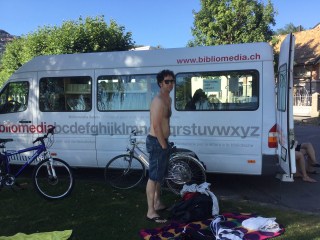
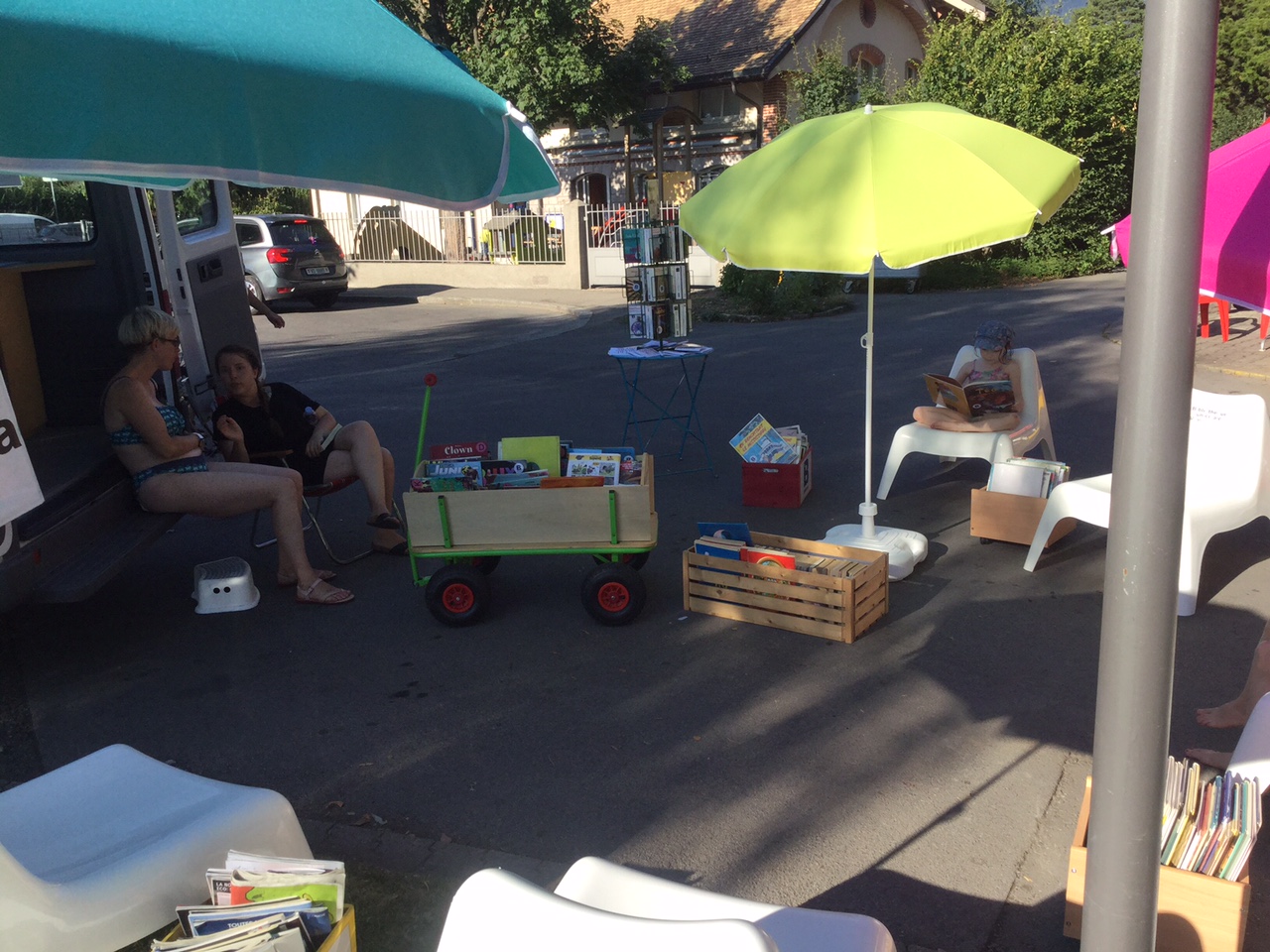
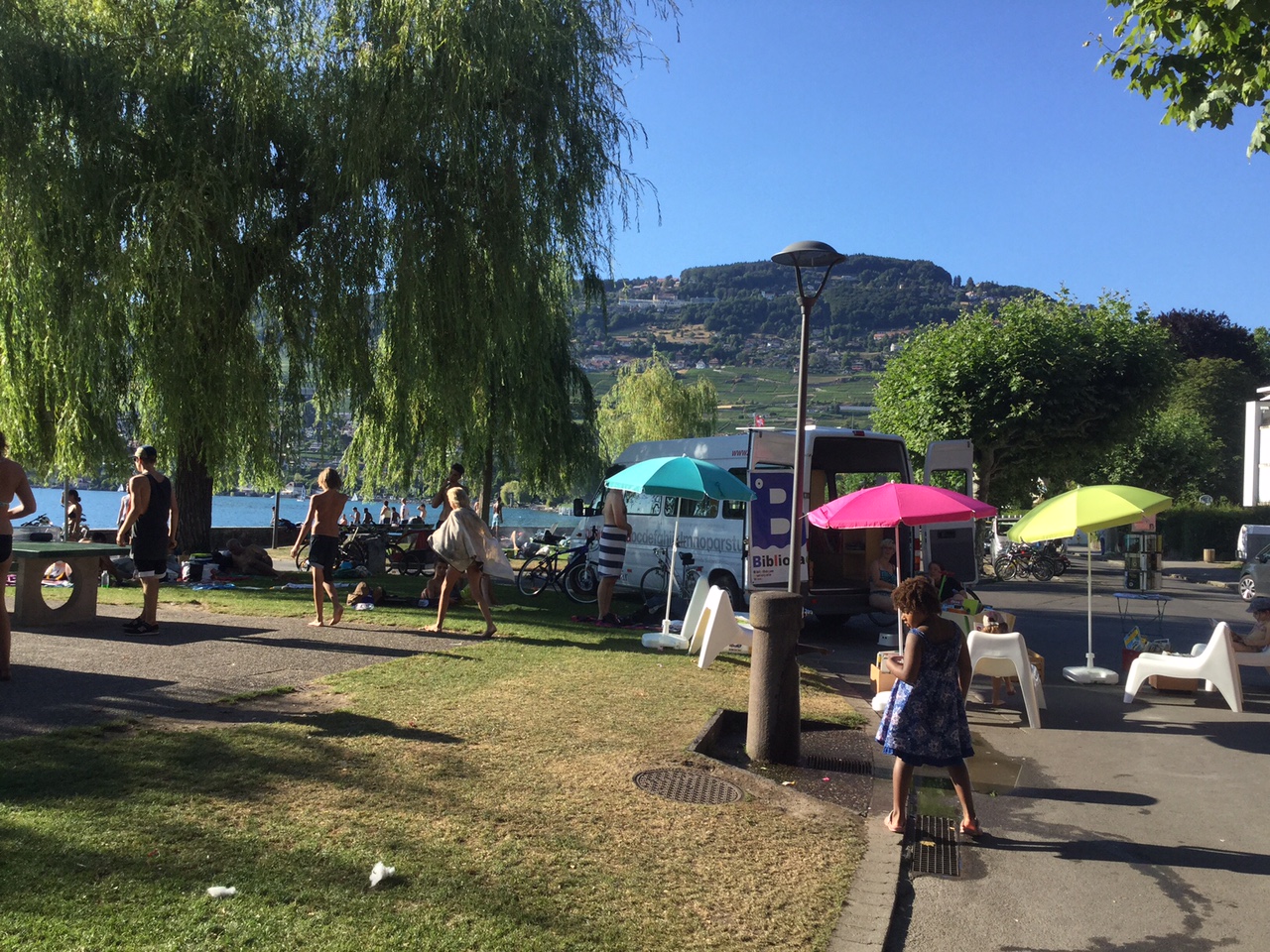
It seems like many people leave work on time (around 5pm) and since it’s still light until about 9.30pm they’ll stop by the park and bathing areas and meet their partners and children there and have a picnic dinner or BBQ on small portable stands. The whole area transforms into a space of families after 5pm. The best form of design “repurposing” are the fountains. Unlike in most parts of the world where putting body parts into the decorative fountains is strictly prohibited, here it seems to be encouraged, and all 3 of the fountains are repurposed as bathing areas for the little ones for whom the lake would be too cold or too deep (see images 1-3 above).
When I walked past on Tuesday, the local library had brought along their van with a pop-up library with books for kids in a cute little trolley and chairs to curl up into – and of course a friendly librarian to help with your choice.
 |
 |
 |
 |
Images: Nadine Bailey
The community also provides free wifi – albeit at not a very fast bandwidth.
Aesthetics
The whole area is surrounded by beauty both in nature, but also in the man-made and maintained flowerbeds and the placement of sculpture – including the wonderful kinetic sculptures of Charles Morgan, who is a local inhabitant.
In conclusion, this environment definitely reflects the words of Tim Brown in his TED talk in that it makes life easier, more enjoyable with an understanding of culture and context and where a focus on the systems (such as public transport) have a bigger impact on the society as a whole.
(a) Describe a problem space that is not serving the purpose it could do, for learning
The orchestra my son was playing in during music camp had a very small podium to rehearse on – about 8mx4m for about 35-40 students including 1st, 2nd & 3rd violins, cellos, violas and double basses. The podium had an upright piano – which wasn’t being used but can be moved but not off the podium. The “norm” would for orchestras is almost double this – a recommended 1.7-2m2 per person – this particularly has to do with health and safety guidelines – for sound exposure (Sound Advice, 2007).
(b) Explain, using some of the suggested reading, why that space might benefit from some thinking on its design
The musicians only come together for four days of rehearsals with the final concert on the fifth day. Most do not speak English, and the average age was about 12 years – an interesting case of “extreme users” as suggested by Brown (2008) where an effective learning space is critical.
Kimbell refers to design thinking as “a set of contingent, embodied routines that reconfigure the sociomaterial world” (Kimbell, 2012, p. 141) – in this case the “embodied routine” of using a podium was limiting the efficacy of the space and not allowing “design in use”. Further the context of a junior amateur orchestra was not the embodied knowledge of the (professional) conductor which prevented a reconfiguration of space and thereby value.
The impact the limited space has includes the fact that it is very difficult for the conductor and the teachers aiding the orchestra to move between the ranks, and individual players – this is normal behaviour in amateur and student orchestras since the players are often too young to just take the instructions and write them in the music unaided, or even sometimes to understand exactly what is meant or asked for so this needs to be demonstrated in situe. All players should be able to see the conductor which was not the case.
|
|
|
|
|
|
|
|
(c) Describe the changes, however small, you make to that space as a result, in order to attempt to create a better space for learning
The interesting part of the equation is although the podium is small, the rehearsal space is very big, and there are relatively few observers. Although I made the suggestion to the conductor that there was no particular need for the rehearsals to take place on the podium, and we as observers would be happy to sit in one part of the room while they took over the rest – he wasn’t open to the idea.
However, I saw my suggestion in action on the third day when I went to look at the rehearsal of another orchestra. Voila! This conductor obviously was not constrained by the box! The first violins, cellos and double basses sprawled over the front edge, as did the conductor and the spectators were pushed back.
Compared to the limited freedom of movement which leads to more cramped posture and claustrophobic feeling of the first orchestra, there was more space, and this space was used more often by the conductor and teacher-aides to move around the players and “show not tell” what they were requiring.
Why? I can only imagine that with six cello players needing chairs (as opposed to just three in the first orchestra) they just HAD to move down, it was no longer an option to stay “in the box” in this case the constraint was a source of inspiration, and flexibility of mind and “risk taking” behaviour was exhibited (Kuratko, Goldsby, & Hornsby, 2012).
|
|
|
|
|
|
References:
Brown, T. (2008). Design thinking. Harvard Business Review, 86(6), 84–92. Retrieved from http://ezproxy.csu.edu.au/login?url=http://search.ebscohost.com/login.aspx?direct=true&db=heh&AN=32108052&site=ehost-live
Kimbell, L. (2012). Rethinking design thinking: Part II. Design and Culture, 4(2), 129–148. http://doi.org/10.2752/175470812X13281948975413
Kuratko, D. F., Goldsby, M. G., & Hornsby, J. S. (2012). The design-thinking process. In Innovation acceleration: transforming organizational thinking (1st ed, pp. 103–123). Boston: Pearson.
Sound Advice. (2007). Sound Advice Note 12 – Orchestras. Retrieved July 22, 2015, from http://www.soundadvice.info/thewholestory/san12.htm
Post-script
Funnily enough I did ask my son and his fellow other viola players how they felt as well as the other parents. The students were a lot less indignant than their parents. Is it because they are much younger and have less insight and perspective? Or is it because they are more happy to accept what someone in authority decides? Or do they get less upset and excited generally about this type of thing? Didn’t it matter enough? Would it have mattered more if it went on for a longer period of time? Anyone have suggestions? Do we care too much?
 |
| The area of learning indicated by the red circle |
Source: https://www.youtube.com/watch?v=v20gjN3yTLY
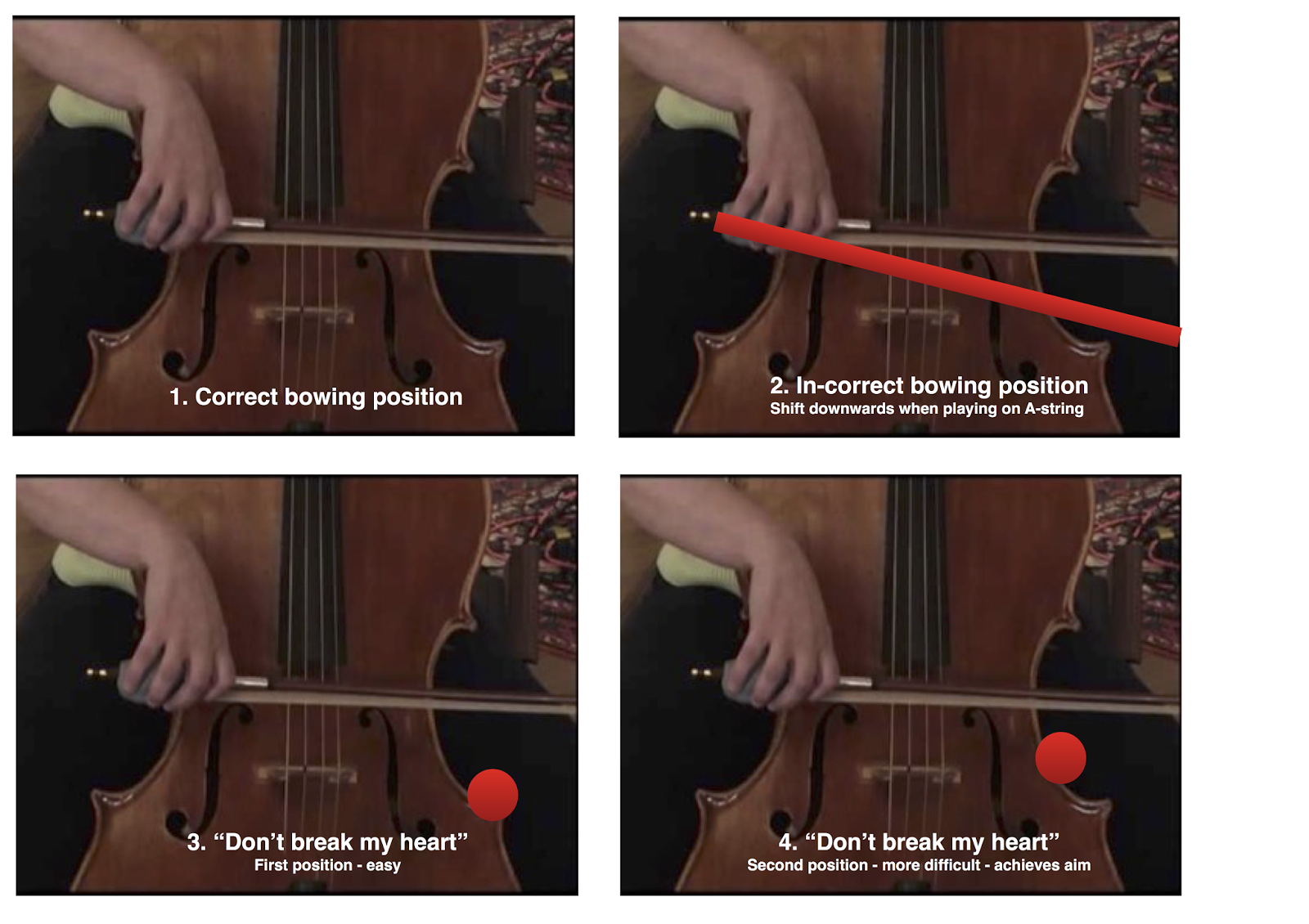
As the boy finishes playing, the teacher praises him for his interpretation and then says, “please don’t break my heart” – he moves to his bag and gets a roll of sticky tape and fashions a heart out of the tape. He then places the tape on the tip of the C Bout (as illustrated in 3 below) and instructs the student to play the passage again. At no point does he tell the student he’s bowing incorrectly (as illustrated in 2 below) but the student in question and all the students around him immediately get the point of what was wrong. He plays again, to animated “acting” by the teacher about his heart not being broken and the bowing is better. The ‘goal post’ is then shifted (as illustrated in 4) and the bowing is even better.
 |
| An illustration of the lesson components |
Enjoy the video – the quality is not very good as individuals are not focused on to protect their privacy.
Don’t break my heart from Nadine Bailey on Vimeo.
The lessons I drew from this were the making of a design change – in this case introducing a constraint, display (playing with the constraint) and replay (moving the constraint) with the feedback to both the participant in question and all the learners around, as well as to the audience of a teaching “trick” that is effective.
I’ve been blogging for a long time and have used it to document my learning and understanding about a wide range of things, including my children’s development, learning chinese, coming to grips with living in different cultures and most recently as I continue my tertiary education.
I think Dr. Barrett has some very valid points. BUT. It really all depends on who is initiating the creation of the portfolio. If I look at my children for example. I have a child who is a serial obsessive and during an obsession will spend every waking moment learning everything he needs to know about his desired topic. This includes joining online chat groups, watching youtube videos, experimentation, talking to people, finding experts and grilling them. However he’s not a keen writer or documenter so this will never go beyond what we as a family observe and what teachers may notice and appreciate (or even document themselves). If I look back at his “compulsory” school learning portfolio I see little or no evidence of this learning. Does this mean it didn’t happen? Or that it’s not appreciated or meaningless? It’s in fact one of the things that happen that allow me to have complete faith that regardless of school grades “he’ll be ok”. Gee made the same point in his discussion on passionate affinity spaces.
A friend of mine recently confided that her son had decided to “drop out” of school just before his final year. I know a couple of other highly intelligent very motivated high school students who are at risk. Their problem? Not that they’re struggling with the subject matter but that they’re struggling with the matter of subjects. Often they seem to be just the students who DO know what their calling is and everything else on offer (demand) is just so much noise.
Out of the school environment, with the assumption that individuals are studying a subject of interest and choice another issue seems to arise. Fear / embarrassment. So many of my cohort – otherwise accomplished, intelligent and knowledgeable individuals struggle to the point of refusal to document their learning process. This belies the fact that the whole point is to document a process rather than an outcome. It’s also a very flawed view. What parent would refuse to video their child learning to roll over, sit, crawl, stand up and finally walk but say “I’ll wait until they walk because all the rest is just practise for that end goal”? I think as adult learners we do everyone else coming after us a disservice by not showing our mistakes and errors in thinking and assumptions and unpolished learning – because if they can’t see the steps the end-goal seems so much less attainable.
So I guess the thing is yes to ePortfolios but perhaps negotiation as to the content and topics.
Just started delving into the outline and introduction of INF536 my new course for this semester. It feels like INF530 has barely finished and now it’s already time to move on.
I’m moving on in more ways that one. At the end of last term I unexpectedly found a “look-see” at a school library after expressing vague interest in an opening turning into a job interview and then a job offer and then another interview at another school and another job offer and then the agonising choice between two excellent but very very different opportunities! The tyranny of choice. After a sleepless night and an early morning (like 4am early – another interesting TED talk by Rives – see below), and the input of my entire family a choice was made and I’m going to be leaving my great but part-time and low-paying apprenticeship type job for a real “the buck stops here” job as Teacher-Librarian.
https://embed-ssl.ted.com/talks/rives_on_4_a_m.html
Which makes me even more excited about this course, because I must admit my heart did sink just a tiny little bit when I saw the small space that will be my new “domain”. But then I am heartened by the idea that there is value to be found in constraint. And that the physical space is but one part of where learning takes place. And that I’m going to be learning and doing and learning so this will be a “just in time” course for me.
The first was the retraction of an article in Science. (Retraction watch – who knew that it even existed? And now I know it’s going to be on my reading list from time to time! They’re on twitter @RetractionWatch so that makes it easier – makes me think of “This idea must die” which is also on my reading list after hearing this talk).
Jesse Singal has written an excellent article – “The Case of the Amazing Gay-Marriage Data” – it really is worth reading the whole thing because it covers so many aspects of the world of academic publishing, how it can go badly wrong, and just how unlikely it is that it is found out and even if it’s found out, how hard it is to be a whistleblower.

Now that I’ve started breathing again I can start to think about the iBooks experience and what I’ve learnt from it.
I found out today that there are no iBooks in Singapore where I’m living and where I wrote / produced / cobbled together my first iBook. Nope, none. Something I didn’t really actually realise. I mean I’d tried to buy Dave Caleb’s excellent photography iBook and couldn’t do it here, but I didn’t twig that I couldn’t buy ANY iBook here… and you know what’s really weird? I can’t find out why anywhere. Is is because “singapore” or is it because “apple”? I notice my home country has a similar problem. Who decides? Who’s the boss. And who would care anyway, especially for a free home-made stitched together effort? I need to know these things. I’m sure my curiosity and sense of fairness will get me into trouble some time.

What would I advice people coming after me? Play with it in your spare time, NOT when you have an assignment deadline. Make something simple, low barrier, low stakes and iron out all the learning and mistakes before you use it for a major assignment. Or maybe better still – get a class of 11 year olds to do it for you!
If you do use it for an assignment – be ready at least 48 hours before the due date. It takes 24 hours more or less from the time you hit the “submit” button to when it’s live, and then you get a nasty little surprise that things that may have worked in iBooks author and on your previews, suddenly don’t work so well in the published book. I suspect that it has something to do with the fact that the widgets for feeding in video, twitter etc. are handled by Bookry.com and I probably overloaded it with too many requests one after the other – the weird thing is both the display AND the functionality was fine in author … and then when I pressed “play” in iBooks 3 of the videos just reverted to the last loaded video… oops. So I corrected that and then reloaded it, and it will take another 24 hours before it’s working…
Oh, and another thing with Bookry – well it seems you can publish directly there, BUT if you try and download the app on your mac it doesn’t like it one bit …
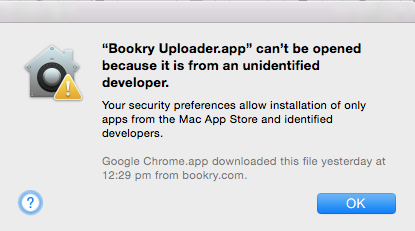
I’m 100% sure this is not an insurmountable problem and with enough time and patience I could get it to work. But both time and patience were in rather short supply yesterday afternoon / evening.

It also helps to ask around a lot. One of my friends when she heard I was going to use iBooks author said “oh no, I hear that’s really difficult. Our tech guy at school suggests that our kids use Book Creator for iPad instead. Unfortunately I was about 80% finished by the time she said that … although the 80:20 rule definitely applied at that point – I thought I was at 80%
And if you export it to pdf, note that the pdf can be a maximum of 10MB for this wordpress platform … mine was 20MB after the correct videos were updated, so can’t fly here … maybe I can publish it to the web (thinking aloud) …
I’d also like to say it is wonderful having a cohort of selfless fellow students around you who make encouraging noises about the things that do work publicly and kindly point out this kind of snafu to you privately. lol you know who you are!
Another lesson – never do this type of thing over a long-holiday weekend. You may think it’s a good idea, but then you can’t access all the tech guru’s in your life because, well, they’re having a life with their families and #notfair to disturb them.
1 ibooks author intro from UWC South East Asia on Vimeo.
Of course the whole irony of this learning stuff is that we don’t do it unless we “have” to do it, and when we “have” to do it, it’s kind of high stakes if you get it wrong, so then you’d rather play safe and go with something you’re sure will work. I can see how this FOMM (fear of making mistakes) and FOF (fear of failure) can inhibit personal, academic, learning and technical progress.
What else did I want to do if I had endless time – or what I’d like to do some time? Well, really to get the whole “get started” thing going on how to implement a program. I’d also love to write a Inklestudios book based on the stories of our students and their families and the many and varied choices and options on language, and put that into it … I’d also LOVE to have a designer and producer and team of creative people around me who can make a much better job on the design side – I mean I know something great when I see it, but just can’t seem to make it myself! Has everyone see the Guardian’s latest interactive book on the digital language divide. Gosh they are so wonderful. Maybe I can get a research job with them… I’d like to interview some parents and put it on a video and add that… there is so much.
My new quote and drive on this whole language thing comes from this clickbait collection:
“Never doubt that a small group of thoughtful committed citizens can change the world. Indeed, it is the only thing that ever has.” — Margaret Mead, cultural anthropologist


 Informative Flights - Musings of a Teacher Librarian