#AI – Will they find their voice? Will we hear it?

I am thinking a LOT about AI. My participation in thinking and reading as a factor of my actual usage would be something in the realm of 1 million to 1 at the moment. Save for some tedious bits and pieces like analysing surveys and the occasional laziness in making very short book summaries (which I then have to correct extensively anyway) I’m just not feeling the joy. Please do not construe in any way that I am therefore “feeling the fear”. No. I’m just spending a lot of time exploring and thinking about it. And what it means. And in particular what it means for the current generation of students / young people.

I started blogging in 2003, and blogged about losing my identity as a person while I spent time being a SAHM, holding the threads of my existence together through bringing up children internationally, nuturing bilingual and multi-cultural beings. I then deleted that blog as it had become too personal, too well known and I had become too identifiable and my children had become adolescents and had a right to their own privacy and thoughts and being. Then I started studying to become an educator and librarian and spent four years in academic pursuit, where for many of my courses, blogging was a course requirement. It was a really good thing to make reflections on learning via blogs a course requirement. At WAB (my previous school) elementary students also blogged and I think there can be nothing as wonderful as seeing the thoughts, words and intellectual development of young people developing and maturing and growing over time. Nothing makes better writers than doing a lot of writing. And through writing, one does tend to become a better writer and find your “writers voice”.

Last week our school shut Grammarly off for students. It’s a tool that has always personally irritated me, as I still grew up with the luxury of uninterrupted schooling where we went to school for our lessons, did all our sports and activities after school at school, had no internet, and government controlled TV that only came in after I turned 12. It was a plain vanilla, no frills government school and there wasn’t even enough money for an arts programme. Yes, huge deficits in my education but I did get grammar. The old fashioned way. Swings and roundabouts.

What did Grammarly do? Well, the new update allows students to highlight a paragraph and request Grammarly to rephrase or improve their writing three times a day for free using AI. And teachers were being given work that didn’t reflect the thoughts, intents, abilities or voice of their students. Teachers care. They care deeply that tools can be used to aid the students that need it the most. They also care that tools don’t get in the way of intellectual and skill development. Writing well takes a LOT of practice and also a LOT of reading and if there are any short cuts I’m not aware of them.

The word of the year in 2023 was “Enshittification“, a termed coined by Cory Doctrow and explains the process of platforms first being good for their users, then abusing the users so businesses can make money off the users, then abusing the businesses go get a piece of the pie and then dying. It is the first two parts of the equation that are of most interest to me viz a viz education and AI.

Being good for their users” needs a modifier – “appearing to be good for their users”. In his long form article Andrew Nikiforuk touches on “whole foods are being replaced by ultra-processed stuff” which was exactly the analogy I was thinking of while reading NYTimes wellness challenge of this week – the article talking about “Are ultraprocessed foods really that delicious?” and asking readers to compare an ultraprocessed product to its natural equivalent. Unfortunately for many young people when they compare their complex pubescent self to what media is telling them is “the real thing” they feel like they come up short, not the artificial reality. One of the disturbing trends with young people is their anxiety and obsession with being perfect (and not just academic – look at the beauty / makeup thing – talk about a distraction) – some of which is parent / adult driven through a failure to understand or recognise that young people are not hatched with perfect writing, grammar, thought, and research skills. That is the whole point of being at school. We’re seeing a bunch of ultra-processed writing and assignments and research at the moment and I’m not sure that it’s leading to better learning.

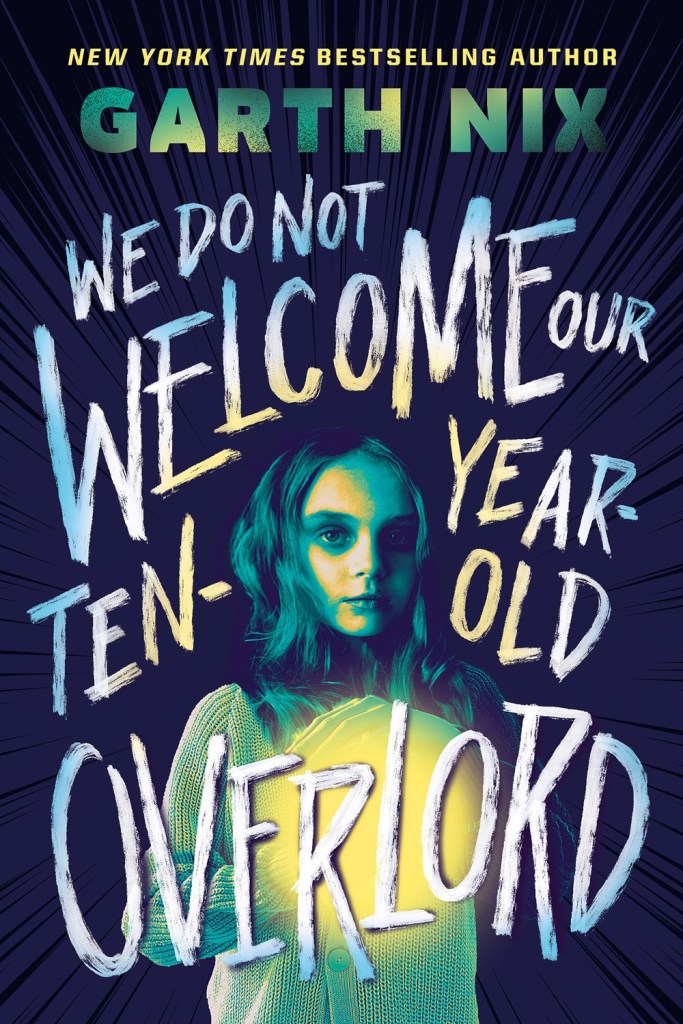
I’m currently reading “We do not welcome our 10-year-old Overlord by Garth Nix” – it’s a great middle grade version of this process of something external to humanity trying to take over under the auspices of “being good and doing good”. What I see, even with the most simple of all tools – a spelling check – is that students will type without any attention to spelling or capitalisation and expect the computer to mop up after them. And the next time the word / phrase is used they will continue to use it incorrectly and have auto-correct sort it out. The question then is whether there is any learning happening. And the meta question whether that learning needs to occur or not? Do we enter dangerous territory when we start deciding which students need to know things or not, develop skills in certain areas or not? We do not know what we don’t know and they definitely don’t. It would be way to easy to decide that perhaps some students don’t need to develop a writing voice and that it’s all so hard for them that it’s OK for AI or other tools to just take care of writing and editing what that tool thinks it is that the student is trying to express. Can you see where this is going? Because if we are not exposed to many ideas and thoughts and schools of thought and philosophies and histories how can we have enough information and knowledge under our belts to know what it is that we want to express? How can we know what OUR thoughts and feelings are when we’re in a feedback loop echo-chamber?

Back a little to the blogging thing – if students reflect on blogs that are open to the community it is so much easier to see what is normal and appropriate for each age group. Now we have writing that is largely hidden except to the teacher and their peers if they do comparative grading, and perhaps the adults in the lives of some of the students who will judge it by their adult standards AND whatever tools that are on student computers that again will transform the writing to some external adult standard. I’m also fascinated with, within the context of the apparent need for grading and scoring the work of students how granularity has decreased to the absurd point of students getting a score out of 4 for their efforts. Really? While packing up my life yet again for the move from China to Dubai I came across my old school reports. Everything was graded from 0-100 and there was plenty of room to improve from say a 69 to a 75 or an 89 to a 95 and no one ever ever ever got 100%. There was nuance. A lot of nuance. In the IB system scoring is to 8 and now in the American system it’s to 4. Talk about a blunt tool with which to sculpt learning!

I was just listening to Maggie Appleton (whose writings, as a cultural anthropologist turned Tech person on AI I really appreciate – particularly this one on the dark forest and generative AI) on the HanselMinutes podcast and I love her ideas about using AI for rubberducking – not just for IT debugging but for debugging your ideas and thoughts – although as she says it’s not really built for that as it’s more inclined to “yes AND” than to be a critical partner. I’m so long in the tooth that I remember when blogging was the medium for rubberducking your thoughts and every post got good handfuls of thoughtful comments by real people who would challenge or corroborate on your thinking. I made a lot of IRL friends off the back of blogging back in the day!

I’m fascinated about what other people think about student writing and student voice in writing as opposed to all that is being written about adult voice being taken over by AI – it is terrible, but how fortunate we have been to be allowed to develop a voice in the first place. Are we denying that to this generation of potential writers? Here is a link to one article in Writer’s Digest – of interest are all the other related articles at the bottom including some on maintaining voice as a comedian.

Are we teaching dogs to chase cars?

I’d love a dollar for every time as a TL I’m asked to teach students “how to search” or “search terms” or “searching. Once upon a time I complied. I’ve become a bit more bolshie in my old age. I now try to engage. Engage in a conversation as to what exactly the teaching and learning aim is behind the request.

You see, we don’t need to teach dogs to chase cars. We need to teach them what to do with them once they’ve caught them. And we need to teach that bit first, so that they can decide with the right amount of information at their disposal that actually, cars are not edible and therefore not worth the chase.

I understand the impetus behind wanting to teach better searching. It comes from a good place. One which recognises that students are going to google anyway, it will probably be their first and last port of call and we may as well teach them how to use it better so at least the results somewhat resemble the information they’re looking for.

But without some kind of prior knowledge or context, how will they recognise what is in front of them for what it is? And without deep literacy skills, both on the reading and writing side, how will they do something with it? And why am I seeing two huge time sucks in student “research” – searching and gathering “information” and dressing it up in some kind of (digital) presentation form. aka, the dogs chasing the car and trying to make a silk purse out of a sows ear. Which leaves precious little time for the meat in the middle.

Am I overly cynical, or is this a more generic experience? And what can we / dare we do about it?

A little writing about writing

I threw down the gauntlet to my mentor, Katie Day last night. She who taught me all I know about being a teacher librarian in the weeks and months that I sat by her side while doing my MIS and part of my M.Ed before I was thrust into the world of a library of my own. I was mentioning how I was a little shocked and disappointed at the standard of writing of Masters’ level students, and she mentioned that in her current position she was seeing more student writing and had decided to give that a focus this school year. I have a mentor group for the first time this year, and I want to try to emulate a wonderful teacher in my previous position, Christene, who used back and forth journalling with her G6 class as a way of getting to know them deeper, while developing their writing and depth of thought – particularly over what they were reading.

Now Katie is a phenomenal librarian – probably one of the best in the Asian international school network. She suffers from one immense flaw generally – the fact that she doesn’t market herself, and currently, she’s gone silent and no longer stimulates and challenges the rest of our thinking frequently enough  through her blog. This is where a biblical reference is most apt – that of hiding your light under a bushel. Like most newbies to a profession, I’m still greedy for knowledge and advancing my skills and look to thought-leadership in the field to advance my own understanding. So, the blogging challenge is on – at least a blog a week between now and Christmas.

In our first week at school, we were asked to do a Strengths Finder test – I’ve done one previously, but this was a different one. I found it a little repetitive as it kept bringing up the same questions differently phrased – I know, internal validity and all that. And then was a little surprised – bearing in mind the results of a previous such test – when the top strength spat out at me was “writing”. I immediately wanted to reject this, as actually I do precious little writing in my job. And it sounded such a stagnant non-sexy non-innovative type of thing that I felt undervalued me as a thinking, teaching, doing, researching, active professional.

As a librarian I read a prolific amount, a lot of it mediocre if I have to be honest, and I’ve always said that you’d never find me writing a book, in response to everyone who asks. I know enough authors to know that besides anything, it’s a poorly paid mugs’ game where you spend a disproportionate amount of time trying to get out there and promote the book rather than write – plus the financial returns are so poor that you inevitably need a second or third career to sustain your writing. So I don’t actually see myself as a writer. But then I realised, that I’ve been blogging now for 15 years, and that actually I have a need to write my experience. And I’m forever encouraging students and fellow professionals to do the same.

So here goes everyone – if you still have a blog out there – dust it off, start writing, or continue writing! Post your URL’s in the comments so we can follow and comment on each other’s posts.

Whole new generation – Postcards

This year I’ve managed to encourage many of my Grade 3-6 teachers to take part in the Global Read Aloud. I’ll save my comments on the good and bad of that for another post. This year for the first time, we’re also taking part in the postcard exchange.  Basically you put your school / class name and address onto a spreadsheet and promise to send everyone else on the list a postcard in exchange for receiving postcards from them.

So far so simple. Except the logistics. Dashing off to the post office to queue up for 60 international postage stamps. Gosh, that’s pricy, there goes bits of my budget. Convincing teachers to let their kids use a huge chunk of their library lesson to write postcards. Dredging out a tutorial to remind myself how to do a mail merge from a google sheets list. Oh gosh, yes, the data on the excel sheet has to be redone so it’s the right format. Purchase labels in the right size. Fiddle around with printing. Convince one teacher to buy a bunch of postcards and convince marketing to give us the balance in school cards. That was all the backend stuff.

And then it was hilarious. Do you know that most 10 year olds have never written a postcard? Ever. Or received one. Do you know that most 10 year olds have never ever licked a stamp? Don’t know where to write the address / write the message. And if it wasn’t for the picture of where to put the stamp they’d not know where to put it.  So who is buying postcards, and will they soon go the way of CD’s and DVD’s and all that physical stuff in our lives?


Books I wish would be published

I’ve been asked to be on a panel at the AFCC to chat about “Books Teachers Wish Authors Would Write” from a teacher / librarian perspective. So I put the question out on one of my teacher-librarian networks (an international one) and these were the responses I received:
  • World war 2 in Asia- novel for 8-10 year olds (NF / NNF)
  • big shortage of narrative nonfiction that is NOT about the holocaust, slavery, the American great depression or US civil rights. Also shortage of intra-Asia migration stories not Asia to Europe / north America (NF / NNF)
  • Third culture kids as main characters (CD)
  • More stories about our present/ early future stories that include digital tools and behaviour (D)
  • I’m looking for things like “lego ideas / lego play” but in small manageable books that kids can take out without breaking their backs / the book
  • nonfiction – updated human rights / millennial goals / NGOs / Poverty etc. for G4 level (9 year old) mixed format, good graphic design, mix of narrative and fact (NF)
  • Middle school nonfiction – life in different economic / political systems – communist, socialist, social democracy etc. with a world wide unbiased view of positives and negatives with personal stories and data (NNF)
  • Books on gaming or from the creators of games like Minecraft, Roblox, etc. (D)
  • Conflicts over resources around the world – case studies that are elementary friendly (NF)
  • The next “The Outsiders.” Something to appeal to the teens who fall in love with it in class, and are looking for something like it.
  • Decent Biographies that are at elementary aged level & middle school level without being dumbed down – with more Asian protagonists! (CD / NF)
  • Books purposely written for upper ES that has appropriate content and reading “level” (ELL)
  • More ES novels featuring multicultural characters that are not related to war or historical events (CD)
  • Books about world topics that are appropriate for kinder/g2 (NF)
  • Modern urban indigenous stories – universal experiences in all first nations people. (CD)
  • Easy read stories that are well written & not dumbed down for teens. – yes! especially for our ELL students! And that don’t portray just the…..dark side of life? I feel like when I was purchasing for xxx, the high interest/low level books all were about gang members/drug dealers in the US. (ELL)
  • Science fiction for Elementary kids. (SF)
  • Middle Grade fiction with a Korean protagonist (My Name Was Keoko style) (CD)
  • Books with culturally diverse characters. I still remember teaching a boy could Yousef who threw the book down in disgust and said ‘Why can’t they give them normal names?’……the character was called Joseph. Which really isn’t that out there, unless you’re an Arab boy. Then it’s just weird. (CD)
  • LGBT books for tweens (G)
  • Definitely more emigration/immigration stories that are intra-Asia. There are so many diaspora stories to be told that have nothing to do with Europe or North America. (NF / NNF)
  • Does anyone want war stories set in Asia – like Japanese invasion/ Korean War / American or Vietnam war with perspective from the non-western side – or is that too sensitive? (NF / NNF)
  • My teachers want more World War 1 fiction for grades 6-8 and social justice books for middle schoolers.(NF / NFF)
  • My middle school girls want more heroes that are NOT princesses. (G)
  • My boys want fiction that has video game elements like Minecraft stories.(D)
  • All of my high schoolers want “classics” with better covers.
  • what about this: teachers, school, parents do not compare my score with others, do not give me homework, I want to play. (C)

I’ve tried to code the answers as follows:

  • NF / NNF: narrative nonfiction – 10x
  • CD: cultural diversity – 6x
  • D: digital / gaming element – 3x
  • G: Gender related – 2x
  • ELL: hi lo / books for English Language Learners – 2x
  • SF: Science fiction – 1x
  • C: cultural issue – 1x

Looking at these I think that the theme is a general frustration with a lack of books with an Asian context.  Particularly historical fiction / narrative nonfiction and culturally diverse characters. We all know that the USA dominates publishing, followed by the UK. Australia has some good stuff out but limits itself by its steep pricing, expensive shipping costs and insular publishing industry. China is a late entrant into children’s books and is making great inroads – but mainly in translation into Chinese. What is particularly commendable is that they are not just translating the (North) American staples but many of the brilliant and wonderful European offerings.

Then I did a similar exercise with the BWB (Blokes with Books) yesterday. I asked them to go in groups of 2-4 students and tell me what kind of book they were missing in their lives. Books they wish authors would write.   They were amazing – a couple of groups even started writing the books they wish were written (a nice outcome given the fact that teachers are now complaining that we’ve got them reading but their writing is still poor).

Their suggestions could also be broadly grouped:

  • Two groups wanted Harry Potter extensions or back stories – one wanted the parallel books that focused on the other houses, not just Gryffindor Tower. Another group was fascinated by the horcruxes and wanted a book on that.
  • One group wanted an elaborate Pokemon book that inverted some of the characters with unexpected twists.
  • One group combined the ideas of the three group members into a fantasy / reality mixture involving video games and rugby with a wimpy gaming protagonist being forced to play rugby by an over-zealous parent and learning tricks and manouvers in video games that led him to dominate on the real life rugby pitch.
  • One group wanted (and started outlining the chapters) of a Roblox user manual.
  • Quite a few of them agreed they’d like fiction books with colour pictures inside

I’d like to add a note to the above list – the students are not yet familiar with fan fiction, and I’m not sure they’ve looked into the Harry Potter wikis. In a sense that makes me happy that they’re still at that wonderful age where this type of magical immersive reading stuff is to be found in books rather than online. They are aware that there are user forums on these games and chat rooms etc. BUT THEY WANT TO READ ABOUT IT IN A BOOK. This is a GOOD thing. Whenever they ask for books about Minecraft and Roblox and video games and I tell them we have some of the storybook series, the Minecraft “how to” and “surely you can just ask online” they say “but we want a book”.  There are few Roblox books and they all seem to be eBook editions (publishing haste?). The Minecraft adventure books are not what they’re looking for – remember the colour pictures comment? They want more graphics! I think also as adults we see their online/offline selves as separate, whereas they don’t, and they want to see that new normal reflected in what they read. They’re all avid fantasy readers, and that I think is partially meeting their need for that online/offline fantasy/reality integration.

A caveat to all the comments (and a personal gripe) – above all children want a well written story. They don’t want to be preached to. They’re sophisticated and well- and globally read. And they can spot the fakes. As a teacher-librarian I get immensely frustrated by wanna-be and self-published authors who keep trying to foist their wares on me when it’s immediately apparent that they’re poorly written, even more badly illustrated, not edited and horribly and cheaply published. Writers need to read. They need to read a lot, they need to read widely. They need to research not just their topic but also who else has written about it, tangentially to it, similarly to it. If you want to self-publish, unless you’re a designer, pay someone to do your design for you. Unless you’re an author-illustrator find the best illustrator you can afford. And everyone, join a writing / critique group (like SCWBI) – honestly, other authors are not out to steal your ideas – they’re too busy working on their own passions. And when you think you’re done, get a good and critical editor. All authors need good editors, even great authors. Do yourself a favour and look at the interactive TS Eliot “The Wasteland” and see all the handwritten edits by Ezra Pound.

To come back to the forum and the original question that started all this:

“Creators can step into the shoes of a teacher for one hour and learn what makes a book a treasured find. From beautiful illustrations to didactic language, speakers discuss their views on relevant and useful books children need and love.”

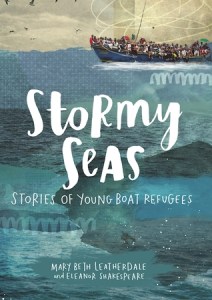
What a huge question. Relevant is not always pedagogically useful. Useful for whom? Relevant to what?  I’d like to end with the most relevant and useful and just plain wonderful book I’ve encountered this year – Stormy seas: stories of young boat refugees. 

31213610 Well done Annick Press (that does a lot of amazing things – particularly in nonfiction) It has become the new gold standard to which I will hold all nonfiction. The elements that make it so special:

  • Great graphics – combination of good design elements with original primary source photos
  • Easy to navigate blocks of text
  • Personal stories
  • Historical facts
  • Timelines
  • Maps

It is not out yet (April 2017) and I got a preview copy through Netgalley (sign up if you’re a teacher / librarian), I showed it to a couple of classes from G3-G6 and all were clamouring for a copy afterwards – something unusual for nonfiction. And when I couldn’t give them I copy I managed to “sell” some of my otherwise untouched narrative nonfiction / historic fiction books on WW2 etc.

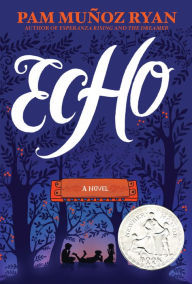
Another surprising (but not really because it’s so absolutely wonderful) hit has been Echo. It’s a huge book but every child and adult whose hand I’ve put 22749539it into  has just loved it – depite the fact that it takes a while to get through. Why – I suspect that the range and diversity of the characters and settings is satisfying to my international audience. But it is also great storytelling. And then they go on to read all the other Pam Muñoz Ryan books, which is also an excellent outcome.


What would you like to see more of that is “relevant and useful”?

Writing in order to write

After a hiatus of over a month due to moving house, school holidays, visitors etc. I’m having to pick up on writing again.  I’ve done a lot of reading in the interim – for my course and around my course and for an article I’m co-authoring for the IASL conference. I’m finding if I don’t put my thoughts down I tend to dream about them way too much. And believe me, dreaming about virtual networks, new literacies and various multi-player online games that I don’t play myself and only read about is no fun.

I did encounter an interesting blog post on the value of blogging as an academic (Not that I’d pretend to be an academic – even as the conceptualisation of what an academic is shifts). It is a really good article and I’d recommend you have a look at it. I agree completely with the points. When I write, I’m forced to think more deeply about what I’ve read. I have to link it to other things, I need to bring things together that were bouncing around at the edge of my consciousness into focus.  I do miss the days when blogging was more social and posts would get many comments and communities would spring up around them. There is a bit of that going on, but not nearly as much as before. I think discourse has moved onto other social media platforms and I think that blogging as a pseudo academic tool may have flogged itself to death – if everyone is blogging, who is reading the blogs?

My son, the reluctant reader and even more reluctant writer has started reading Zoe Sugg’s Girl Online and is thinking about starting a blog. He already has an avid Instagram following from the days that he was passionate about photography, and I’m sure would blog in an equally competitive way (is this type of competition a social media thing or a boy thing or just a thing?). I said I’d support him and that it was probably a good idea, given that blogs were more traditionally a “girl” thing, and he’d probably find an audience in kids like him.

Writing, longer writing, beyond 140 characters or passing on liked posts on social media is something valuable, as it is transformational and productive, not just consumptive, which is the easy part of our digital world.  And now my focus needs to shift to my assignment.

Digital Storytelling – an 8-week interactive program for Middle School students

Note: This is the example of the type of program that could be held for this age group – it is an academic submission and as such has not been tested in reality.

____________________________________________________________________
Assessment Item 1: Report and program for specified age group
INF 505 – Library Services for Children and Youth
Digital Storytelling – an 8-week interactive program for Middle School students at UWCSEA-East
Report prepared for the Librarian of UWCSEA-East by Nadine Bailey, September 2014

___________________________________________________________________


“For those associations and borrowed emotions, coming as they do from outside, carry young people over the dangerously spongy spiritual ground of the years during which one must signify something to oneself, while one is still too incomplete really to signify anything at all” (Musil, 2001, p. 10 writing on the value of literature for adolescents)


Part 1: Background and context

 
United World College of South East Asia East (UWCSEA-East) is an International School located in Singapore. It has a student population of 2,240 who come from 68 different countries and speak 50 different languages (UWCSEA, n.d.).  Around 40% of the students are bilingual and 12% speak more than two languages. As an international school drawing on an expatriate population, it has a high student turnover and the community can largely be described as cosmopolitan elite. The campus has two libraries, one for the Kindergarten and Primary students, and the other for Secondary students.
 
Section
 Number
Kindergarten
 353
Primary School
 654
Middle School
 587
High School
 324
IB
 321
Total
 2,239
Figure 1: Student breakdown by section
 
The school recently won the “21st Century school of the year award” (21stCL, 2013) and has a one-laptop-per-child program from Grade 6. Secondary school parents are ambivalent about the prevalence of computers in their children’s lives and often complain that their teenagers spend too much “non-productive” time on social media and online-game playing.
While the school offers a wide range of activities to the students, including outdoor adventure, sports, drama, music and socially driven clubs, there are no activities catering for creative writing or story-telling. There is a “techspert” club which deals with the technical rather than the creative aspects of technology and at present, besides the parents’ book club, the library does not run any programs outside of curriculum teaching, readers’ advisory, and reference or research assistance. Some teachers, learning support staff and librarians feel there is a need for a creative writing activity outside of the classroom to cater for younger adolescents who are introvert or struggle to express themselves due to shyness, learning differences or developing English skills and who would otherwise get “lost” in such a large, noisy, busy and extroverted campus.
The affordances of Web 2.0, social media and digital technology may have pedagogical and social benefits to secondary students, particularly those who are shy or socially awkward, and act as a bridge to physical relationships and interactions (Gorrindo, Fishel, & Beresin, 2012; Greenhow, Robelia, & Hughes, 2009). Educational research has indicated that exposure to technological tools in the creation of digital stories and book talks benefit students through increased motivation, engagement, ownership, control, confidence and deeper understanding. In turn, both the reading and writing aspects of textual literacy are improved (Barnard, 2011; Beach, 2012; Gunter & Kenny, 2008, 2012; Kenny & Gunter, 2004; Kenny, 2011; Ragen, 2012; Yoon, 2013).  It was therefore decided to combine the creative writing and technology aspects in a “Digital Storytelling” eight-week interactive program.
This program will be targeted to Middle School students, (grades 6 to 8) for a number of reasons. Firstly, as students move into Middle School (around age 12), they loose the structure and security of one class teacher and a fixed group of classmates while at the same time academic demands become higher. In addition, besides losing part of their peer group from the previous year due to international relocations, the school adds extra classes and pupils, resulting in about a third of the cohort being new to both Singapore and the school. This is the age group where, in Eriksonian terms, students are struggling with the commencement of puberty, and the related psychological stresses of developing and discovering an identity, negotiating social interaction and affiliating with friends, causes and ideals (Greenhow et al., 2009). Finally, this development takes place within a digital and online context which may be overwhelming to young teens as they explore the boundaries of online social behaviour and interaction (Gorrindo et al., 2012) and may not have positive role models in their home or peer environments.
“One reason that an afterschool program can have such a large impact relates back to the developmental needs of teenagers” (Jones & Waddle, 2002, p. 43).  These needs can be summarised as:
·      Positive social interaction with adults and peers
·      Structure and clear limits
·      Physical activity
·      Creative expression
·      Competence and achievement
·      Meaningful participation
·      Opportunities for self-definition (Jones & Waddle, 2002 cited in Meyers, Fisher, & Marcoux, 2007)
The secondary library that will host this program is a two-level open-plan space with moveable bookshelves.  Teenage students are comfortable in the welcoming library space which incorporates design thinking in creating zones for comfort, relaxation, reading and social interaction. The ground floor is mainly open plan with two study rooms with carousels and one large classroom (the Think Tank), while most of the collection is located on the first floor that additionally has two study rooms set up for audio-visual work.


Part 2: Design and develop a program

 
In this section, the following elements of program design will be covered: goals and objectives; cost and logistical considerations; marketing and promotion; and program delivery. Evaluation will be covered in the next section.


Goals and objectives

 
The primary goal is to design a program in which students can use technology in a positive and creative way to express themselves through storytelling in a safe environment that meets their developmental needs.
The program objectives, their relevance and how they will meet these needs are summarized below:

Objective
Relevance
Related Developmental need
1. Introduce students to concepts, examples and tools of digital storytelling
Students are familiar with literature and with digital tools, however not with digital storytelling.  This will broaden their competencies while scaffolding on what they already know.
Competence and achievement
Structure and clear limits
2. Support students in the creation of their own narratives using the tools of digital storytelling
For successful creative output, students will need technical, literacy and social support in an encouraging non-judgmental environment
Creative expression
Positive social interaction with Adults and Peers
Competence and Achievement
Opportunities for Self-definition
3. Provide a forum for sharing, promotion, collaboration and interaction
Student’s digital storytelling outputs receive validation through providing an appreciative audience while allowing them to contribute the same to their fellow participants.
Positive social interaction with Adults and peers
Meaningful participation

Figure 2: Objectives, relevance and developmental needs


Cost, staffing and other logistical considerations

 
Since the program will be run from the school library using school equipment, premises and staff, there are no associated program costs. Instruction time given to the program will count towards staff’s “educator activity contribution requirement”. Students will use their own laptops, pre-loaded with all the necessary software and digital tools for which the school has an education license.

·      Image – iPhoto and Photoshop
·      Moving image – iMovie
·      Text – Google documents or Pages
·      Music / sound / voice over – iTunes / Garage band / Voicethread

Thirteen Nikon D7000 cameras with tripods are available for loan during school hours to students and teachers. Besides the “Think Tank” meeting room where most of the sessions will be held, the library has two audio-visual rooms equipped with a television, projector and green or blue screen which will be reserved for program students during weeks 5 and 6, during the program time at lunch time. The program will run as an official school activity for eight weeks on a Monday afternoon from 15h15 to 17h00 so as not to clash with the sports and other activity programs. Sign up will be through the school activity sign up program. The activity is free and limited to 12 students selected from a pool of applicants in consultation with tutor mentors, learning support staff and the school counsellor.


Program delivery

 
Writing is a complex highly abstract process involving productive rather than receptive skills. These include cognitive, psychological and semiotic expertise within the social, cultural and historical context of the writer. Students often have an imbalance between their spoken and written abilities and get bored by the recursive steps of planning, prewriting, drafting, revising and editing (Thompson, 2012). Ways to encourage reluctant writers include ensuring that the topic is: relevant; of interest; taught naturally; understandable; engages emotions; expresses an inner world and is delivered in a playful manner (Vygotsky, 1978, cited in Nilsson, 2010). Fortunately, digital and technological tools have been shown to create new motivation and purpose in reluctant writers (Beach, 2012; Burke & Kafai, 2012; Dreon, Kerper, & Landis, 2011; Green, 2011; Hall, Hall, Hodgson, Hume, & Humphries, 2012; Morgan, 2014)
In the creation of this program, the above factors were considered, while the weekly structure follows the four P’s of digital storytelling (Knight, 2012):

·      Plan (Objective 1 – concept and tool introduction) – weeks 1-3,
·      Produce (Objective 2 – support students in their creation) – weeks 4-6,
·      Publish and Promote (Objective 3 – provide a forum for sharing) – week 7
Instructors were carefully selected to ensure they had a good rapport with this age group, but were not involved with them as classroom teachers, so did not have any pre-conceptions about their writing, technological or creative skills.
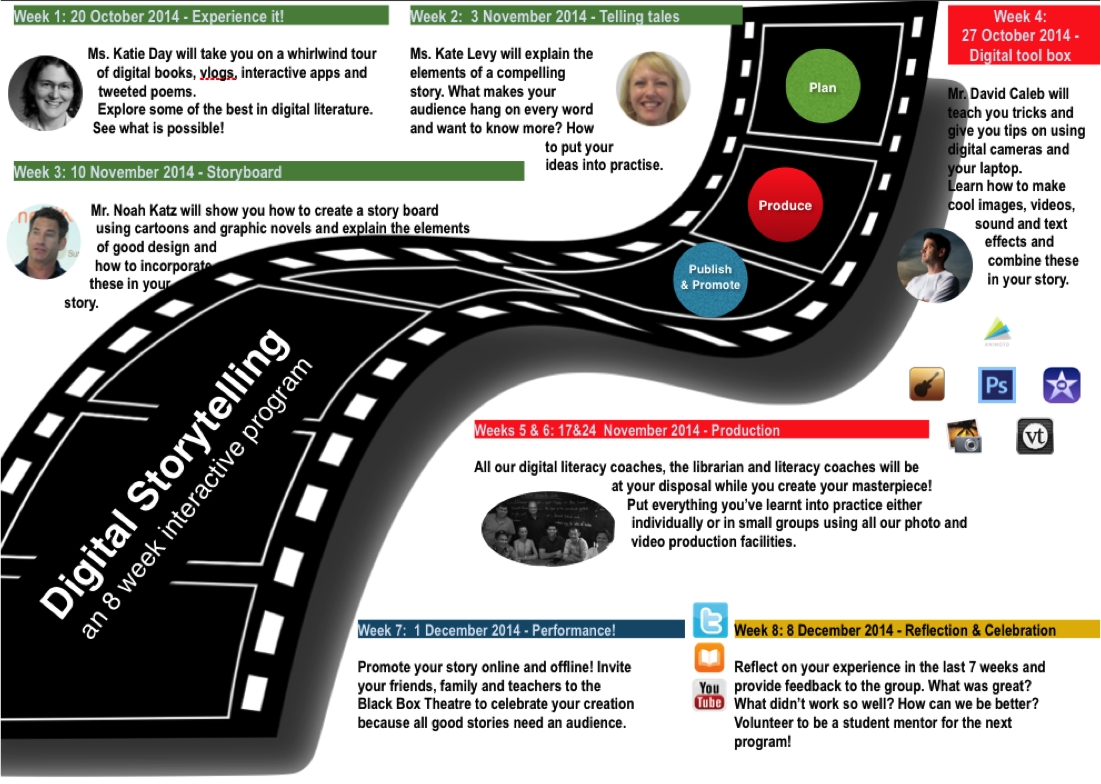
An overview of the activities is given in Appendix 1.


Week 1: Experience it!

 
During the first session, a variety of digital literature will be made available to the group. An example of each type will be briefly introduced and then students will be free to chose and borrow the example that most appealed to them, or to find other examples in that genre.


Week 2: Telling Tales

 
This week the elements of storytelling will be introduced.  Using the conceptual framework of Branigan (1992, cited in Kenny, 2011), story telling as a universal construct includes the interaction between a teller and the audience with the elements of time and place (background), cause (conflict or challenge) and effect (fight or flight) which result in a transformation as the story is resolved.
The acronym “I AM TOP CAMP” is a useful way to remember the principles of digital story telling, i.e. Interactive; Authentic; Meaningful; Technological; Organized; Productive; Collaborative; Appealing; Motivating; and Personalized (Yoon, 2013).


Figure 3: Storytelling process


Week 3: Storyboard

 
Building on the experiences of week one and learning of week two, students will be encouraged to start thinking about creating a storyboard for their own story. Comics and graphic books will be used to scaffold this activity (Hall et al., 2012). The elements of good design will be introduced, namely Contrast, Alignment, Repetition, Proximity otherwise known as CARP (Reynolds, 2008).


Week 4: Digital tool box

 
Each of the modal choices in digital storytelling (still and moving image, text, voiceover, music and sound (Buchholz, 2014)) requires the use of different technological tools, which can either be used separately, or in combination with each other.


Weeks 5 & 6: Production

 
Students are given the opportunity to create their own story. They have complete control over the type of story, tools to use and whether to work in a group or pairs or individually. Additional staff members will be available on a roving basis to trouble-shoot and assist students with any technical or story-telling difficulties they encounter.  Audio-visual rooms and digital cameras will also be available during lunchtimes should students wish to work on their story outside of the activity time.


Week 7:  Performance

 
One of the problems with creative writing is the perceived lack of an audience (Thompson, 2012). Although collaboration, interaction and sharing has been a part of all the activities up to now, this week the activity makes the audience explicit. The group’s productions will be shown at a special screening in the small black box theatre. Students can invite friends, parents and teachers.


Week 8: Reflection and celebration

 
In the final week, students will be able to reflect on their experiences during the last 7 weeks and provide feedback to the group (Survey – Appendix 4). This will be part of the evaluation discussed in the next section. Students will be allowed to bring along a snack for a celebratory party and will be invited to help as student volunteers in the Production stage of the next program.


Detailed activity plan – Week 1


Materials required

 
Laptop (MacBook) and iPads with preloaded eBook apps, screen, projector, apple TV for screening. The following digital literature should be preloaded onto iPads, available online or available for borrowing from the library catalog:


Type
Name
Link
Interactive Documentary
A global guide to the first world war (Panetta, 2014)
Twitterature
100 Greek Myths retold in 100 tweets (Crown Publishing, 2012)
Digital Novel
Inanimate Alice (DreamingMethods, 2012)
Vlog
Lizzie Bennet Diaries (Su, Noble, Rorick, & Austen, 2014)
Animated dreamtime stories
Dust Echoes (ABC, 2007)
iPad app and eBook
Shakespeare in Bits – Romeo and Juliette (Mindconnex Learning Ltd, 2012)

Figure 4: Digital Literature examples for screening


Step by step procedures of what is to be done 


Item
Equipment / Material
Timing
Greet students and ask for a brief introduction with name, class, where they are from and any experience or expectations they have from the program.
Stickers for students to write the names on
10 minutes
Perform a short icebreaker such as “two truths and one lie” with students in pairs.
n/a
10 minutes
Ask students to do initial survey using google forms.
Survey (Appendix 3)
5 minutes
Show snippets of the first three examples of digital story telling – A Global guide to the first world war, 100 Greek Myths and Inanimate Alice.
Laptop, projector and screen. Ensure various resources are open to minimise turnover time
3 resources, 5 minutes each = 15 minutes
Open discussion on what appeals to the students
Use the elements of successful digital story telling i.e. Interactive; Authentic; Meaningful; Technological; Organized; Productive; Collaborative; Appealing; Motivating; and Personalized (Yoon, 2013) to scaffold activity
20 minutes
Give students a break to have a snack, use the washroom, etc.
10 minutes
Show snippets of the next three examples of digital story telling – Lizzie Bennet Diaries, Dust Echoes and Shakespeare in Bits – Romeo and Juliette.
Laptop, projector and screen. Ensure various resources are open to minimise turnover time.
3 resources, 5 minutes each = 15 minutes
Ask students to choose the type of digital storytelling that most appeals to them; they can explore the resource in the remaining class time and borrow the resource to explore further at home.
Assist with loan and downloading of materials or searching of similar materials.
20 minutes
Finish in time for buses / pickup
Total 1 hour 45 minutes

Figure 5: Step by Step Procedure for week 1


Audience, staffing and other considerations

 
As discussed in Part 1, there will be 12 middle school students aged 12 – 15 years. All students should have a laptop and access to the library catalog and the Internet.  The secondary school librarian will demonstrate the material and show where similar material can be found in the catalog. An assistant librarian should be on hand to troubleshoot if students have problems loading the apps or eBooks, signing in or any other technical difficulties. Ensure room shades are all working so the room can be darkened sufficiently.


Marketing and promotion


The school markets all activities through the website and has a centralized signup program, however, as this is a new activity, additional promotion will be needed. A promotional calendar has been created including a short synopsis of each activity and its relevance (see Figure 2 below, and Appendix 1 for the promotional calendar).


Figure 6: Promotional Calendar


Printed posters will be put in the library, hallways, and elevator notice boards. In order to attract those students who would most benefit from the program a combination of “pull” and “push” promotion will be needed, so flyers will be given to Middle School language teachers, digital literacy coaches, learning support teachers and school counsellors who will be encouraged to discuss participation with students who may benefit from the program. A link to the calendar will also be placed on the library portal and in the school newsletter, the eBrief.


Part 3: Evaluation and reflection


How to evaluate the program

 
There are two main ways in which participants will evaluate the program.  In the first place a questionnaire will be completed (see Appendix 4). Secondly students will reflect on their own work and give feedback to other participants as part of the reflection in Week Eight.  Students are used to the PNI method of reflecting on the Positives, Negatives and possible Improvements. The most relevant evaluation however will be whether the activity is seen as interesting in subsequent semesters with demand and over-subscription from students during the Season 2 signup period. Although the student as “client” will be the main evaluator of the program, the teachers and digital, visual and text literacy coaches will also be asked to give feedback on the content, logistics and perceived usefulness of the program. 
Some digital storytelling programs have administered pre- and post- program literacy tests to students to evaluate the efficacy of the program (Barnard, 2011; Beach, 2012; Gunter & Kenny, 2008; Ragen, 2012; Yoon, 2013). But, since the primary goal of the program is to provide a social and creative outlet for students using digital tools, this will not be undertaken formally. However, the tutor mentors of the students participating in the program will be asked if they feel the program had any impact on the students socially or academically.


Reflection

 
One of the issues to be considered in this program will be the possible duality in the audience it attracts. On the one hand it may appeal to students with a passion for reading and writing, who already have a high level of sophistication and affiliation for writing. On the other, it may appeal to students who have difficulties in expressing themselves due to learning or language difficulties. They may be attracted by the expressive affordances of digital literature, the lure of technology or they may be encouraged to join in by their English teacher, learning or language support teacher or school counsellor. An important consideration would be how to cater to both these groups allowing each to build on their strengths without compromising the needs of either.  A further concern is that students will put a disproportionate amount of time into struggling with flashy technology and this will compromise the story-telling process. For this reason, digital tools are only introduced in the fourth week, after storytelling and the storyboard has been completed. During the mentoring, digital literacy coaches should remind students of academic honesty, consideration of DRM (digital rights management) and the correct accreditation or attribution of images and other material.
In setting up this program, older students were not considered, since once they move into High School and the International Baccalaureate program; study and exam pressures result in limited time for participation in activities. In the primary school, extensive writing workshops are already in place, led by the literacy coach. At a later stage, if the program is successful it could be expanded to include other groups of students.
Finally, it is important to reflect on the developmental needs of teenagers in the light of the objectives and characteristics of the program.


Objective
1. Introduce students to concepts, examples and tools of digital storytelling
2. Support students in the creation of their own narratives using the tools of digital storytelling
3. Provide a forum for sharing, promotion, collaboration and interaction

Figure 7: Objectives revisited


Developmental Need
Expression
Program Objectives
Program characteristics
Positive Social Interaction with Adults & Peers
Seek attention, socialization
2, 3
Small group of students with specialist teachers with a variety of skills and personalities
Structure & Clear Limits
Push boundaries, challenge authority
1, 2, 3
Program is limited to 8 sessions with a clear structure within which choice and autonomy is possible
Physical Activity
Running, jostling, roaming
n/a
Not applicable
Creative Expression
Vandalism, Vine, Instagram, Snapchat
2
Creative storytelling is the main thrust of the program
Competence & Achievement
Competitive behaviour, Minecraft, number of followers on social media
1,2,3
The program allows for mastery of technological and storytelling skills within a new format, end result is performed and published
Meaningful Participation
Opinionated, socialization, clique club or team membership
2, 3
Activities allow for interaction in the physical and virtual space
Opportunities for Self-Definition
Status symbols, dress and hair,
2
Students are encouraged to consider their culture, linguistic and social identities in producing their story

Figure 8: Summary of developmental needs, expression, program objectives and characteristics
(Adapted from: National Middle School Association (1996). Research Summary: Young Adolescent’s Developmental Needs, 2006, cited in Gallaway, 2008).


References


21stCL. (2013). School of The Year – 21st Century Learning International. Retrieved May 15, 2014, from http://21c-learning.com/awards/school-of-the-year/

ABC. (2007). Dust Echoes. Retrieved August 20, 2014, from http://www.abc.net.au/dustechoes/dustEchoesFlash.htm

Barnard, C., A. (2011). How Can Teachers Implement Multiple Modalities into the Classroom to Assist Struggling Male Readers? (Education Masters Paper 26). St. John Fisher College, Rochester, NY.

Beach, R. (2012). Uses of Digital Tools and Literacies in the English Language Arts Classroom. Research in the Schools, 19(1), 45–59.

Buchholz, B. (2014). “Actually, that’s not really how I imagined it”: Children’s divergent dispositions, identities, and practices in digital production. In Working Papers in Literacy, Culture, and Language Education (Vol. 3, pp. 25–53). Bloomington, IN: School of Education, Indiana University. Retrieved from http://education.indiana.edu/graduate/programs/literacy-culture-language/specialty/wplcle/index.html

Burke, Q., & Kafai, Y. B. (2012). The writers’ workshop for youth programmers: digital storytelling with scratch in middle school classrooms (pp. 433–438). Presented at the Proceedings of the 43rd ACM technical symposium on Computer Science Education, ACM.

Crown Publishing. (2012, November). @LucyCoats: 100 Greek Myths Retold in 100 Tweets (with tweets). Retrieved September 4, 2014, from https://storify.com/CrownPublishing/100-greek-myths-retold-in-100-tweets

DreamingMethods. (2012). Inanimate Alice – About the Project [Digital Novel]. Retrieved September 4, 2014, from http://www.inanimatealice.com/about.html

Dreon, O., Kerper, R. M., & Landis, J. (2011). Digital Storytelling: A Tool for Teaching and Learning in the YouTube Generation. Middle School Journal, 42(5), 4–9.

Gallaway, B. (2008). Pain in the Brain: Teen Library (mis)Behavior. Retrieved September 4, 2014, from http://www.slideshare.net/informationgoddess29/pain-in-the-brain-teen-library-misbehavior-presentation

Gorrindo, T., Fishel, A., & Beresin, E. (2012). Understanding Technology Use Throughout Development: What Erik Erikson Would Say About Toddler Tweets and Facebook Friends. Focus, X(3), 282–292. Retrieved from http://focus.psychiatryonline.org/data/Journals/FOCUS/24947/282.pdf

Green, M. R. (2011). Writing in the Digital Environment: Pre-service Teachers’ Perceptions of the Value of Digital Storytelling. In American Educational Research Association (pp. 8–12). Retrieved from http://worldroom.tamu.edu/Workshops/Storytelling13/Articles/Green.pdf

Greenhow, C., Robelia, B., & Hughes, J. E. (2009). Learning, Teaching, and Scholarship in a Digital Age: Web 2.0 and Classroom Research: What Path Should We Take Now? Educational Researcher, 38(4), 246–259. doi:10.3102/0013189X09336671

Gunter, G. A., & Kenny, R. F. (2008). Digital booktalk: Digital media for reluctant readers. Contemporary Issues in Technology and Teacher Education, 8(1), 84–99.

Gunter, G. A., & Kenny, R. F. (2012). UB the director: Utilizing digital book trailers to engage gifted and twice-exceptional students in reading. Gifted Education International, 28(2), 146–160. doi:10.1177/0261429412440378

Hall, M., Hall, L., Hodgson, J., Hume, C., & Humphries, L. (2012). Scaffolding the Story Creation Process. In 4th International Conference on Computer Supported Education. Porto, Portugal. Retrieved from http://www.lynnehall.co.uk/pubs/ScaffoldingTheStoryCreationProcess.pdf

Jones, P., & Waddle, L. L. (2002). New directions for library service to young adults. Chicago: American Library Association.

Kenny, R. F. (2011). Beyond the Gutenberg Parenthesis: Exploring New Paradigms in Media and Learning. Journal of Media Literacy Education, 3(1), 32–46. Retrieved from http://www.jmle.org

Kenny, R. F., & Gunter, G. A. (2004). Digital booktalk: Pairing books with potential readers. Association for Educational Communications and Technology, 27, 330–338.

Knight, S. (2012, June 20). Introduction to Digital Storytelling. Retrieved September 6, 2014, from http://www.slideshare.net/sknight/digital-storytelling-ed554?related=1

Meyers, E. M., Fisher, K. E., & Marcoux, E. (2007). Studying the everyday information behavior of tweens: Notes from the field. Library & Information Science Research, 29(3), 310–331. doi:10.1016/j.lisr.2007.04.011

Mindconnex Learning Ltd. (2012, January 25). Shakespeare In Bits: Romeo & Juliet iPad Edition on the App Store [iTunes]. Retrieved September 6, 2014, from https://itunes.apple.com/us/app/shakespeare-in-bits-romeo/id370803660?mt=8

Morgan, H. (2014). Using digital story projects to help students improve in reading and writing. Reading Improvement, 51(1), 20–26. Retrieved from http://search.proquest.com/docview/1540737338?accountid=10344

Musil, R. (2001). The confusions of young Törless. (S. Whiteside, Trans.). New York, N.Y.: Penguin Books.

Nilsson, M. (2010). Developing Voice in Digital Storytelling Through Creativity, Narrative and Multimodality. International Journal of Media, Technology and Lifelong Learning, 6(2), 148–160. Retrieved from http://seminar.net/index.php/volume-6-issue-2-2010/154-developing-voice-in-digital-storytelling-through-creativity-narrative-and-multimodality

Panetta, F. (2014). A global guide to the First World War [Interactive documentary]. Retrieved from http://www.theguardian.com/world/ng-interactive/2014/jul/23/a-global-guide-to-the-first-world-war-interactive-documentary

Ragen, M. (2012). Inspired technology, inspired readers: How book trailers foster a passion for reading. Access, 26(1), 8–13. Retrieved from http://search.proquest.com/docview/934354989?accountid=10344

Reynolds, G. (2008). Chapter 6 Presentation Design: Principles and Techniques. In Presentation Zen: Simple Ideas on Presentation Design and Delivery (pp. 152–163). New Riders. Retrieved from http://www.presentationzen.com/chapter6_spread.pdf

Su, B., Noble, K., Rorick, K., & Austen, J. (2014). The secret diary of Lizzie Bennet. London ; Sydney: Simon & Schuster.

Thompson, I. (2012). Stimulating reluctant writers: a Vygotskian approach to teaching writing in secondary schools: Stimulating reluctant writers. English in Education, 46(1), 85–100. doi:10.1111/j.1754-8845.2011.01117.x

UWCSEA. (n.d.). Languages at UWCSEA. Retrieved from http://issuu.com/uwcsea/docs/uwcsea_languages

Yoon, T. (2013). Are you digitized? Ways to provide motivation for ELLs using digital storytelling. International Journal of Research Studies in Educational Technology, 2(1). doi:10.5861/ijrset.2012.204

 

Appendix 1: Program Overview


Element
Synopsis
Relevance
Instructor
Location
Week 1:
20 October 2014
Experience it!
A whirlwind tour of digital books, vlogs, interactive apps and tweeted poems.
Provide background to program and give understanding of what is possible.
Ms. Katie Day – secondary school librarian – expert in YA literature
Library Think Tank
Week 2:
27 October 2014
Telling tales
Elements of storytelling explained with particular reference to digital storytelling.
Storytelling, no matter what the medium is the basis of this program.
Ms. Kate Levy – high school English teacher
Library Think Tank
Week 3:
3 November 2014
Storyboard
Students shown how to create a storyboard using the example of cartoons and graphic novels and elements of good design are introduced.
Learn the elements of good design and how to incorporate these in your story.
Mr. Noah Katz – visual literacy coach
Library Think Tank
Week 4:
10 November 2014
Digital tool box
Digital tools for capturing and combining different modal choices (image, sound, text) are explained. Best practise is highlighted.
Bring students digital skills to a comparative level of mastery and show how to incorporate into their storytelling.
Mr. David Caleb – digital literacy coach, photographer and author of “The Photographer’s Toolkit”
Library Think Tank
Week 5:
17 November 2014
Production
Students will be given the time and resources to put their ideas and skills into practise. They can choose between individual, paired or group production.
Students will be aided in their creation of digital stories by competent experts they can achieve their creative goals within a clear structure.
All 7 school digital literacy coaches, librarian and Ms. Levy
Library – Emily Dickinson, Pablo Neruda rooms & Think Tank – green, blue or white screens available
Week 6:
24 November 2014
Production
Week 7:
1 December 2014
Performance!
Output is produced and promoted. Friends, family and teachers are invited to the Black Box Theatre watch the digital storytelling productions.
An explicit audience is an important aspect of storytelling. Students will have a sense of competency and achievement.
Ms. Katie Day, participants, digital literacy coaches
Black Box Theatre
Week 8:
8 December 2014


Reflection
Time is given for reflection and feedback of the last 7 weeks. The end results are celebrated and promoted further.
The end of the program is indicated by this activity both setting a limit to the formal program and allowing reflection and also validating participants by requesting their evaluation and suggestions for improvement.
All instructors
Library Think Tank


Appendix 2: Promotional Calendar


Appendix 3: Pre-program Survey


Digital Storytelling Program
Pre-program Surve
y
To give us an idea of your current understanding, preferences and skills please complete this survey. Thank you!
Definitely
Usually
Some-what
Not really
Not at all
I enjoy reading or watching
Fiction, stories, memoirs
Non-fiction or documentaries
Poetry
I can use the following technology
Digital Camera
Digital Video Camera
iPhoto
Photoshop
iTunes
Garage Band
iMovie
I use the following social media
Facebook
Instagram
Twitter
YouTube
Other – please state which ……
I express my creativity through
Writing
Art or photography
Music or dance
Drama and acting
Video or film
I am not creative
What do you expect from this program?


Appendix 4: Post Program Survey

 
Digital Storytelling Program
Post-program Survey
Now you have finished the program please reflect on your experiences and learning.
Definitely
Usually
Some-what
Not really
Not at all
I understand the concepts and tools of Digital Storytelling
Different types of digital stories
What is important in storytelling
How to create a storyboard
I can produce my own digital story
I can use the following technology
Digital Camera
Digital Video Camera
iPhoto
Photoshop
iTunes
Garage Band
iMovie
I would recommend this program
To friends / classmates
To teachers
What was the best / most positive part of this program?
What didn’t you enjoy about this program?
What improvements would you suggest?