Junior fiction – what’s hot and what’s not

It’s a public holiday today, so instead of doing what I should be doing (making questions for the Readers’ Cup), I’ve been ordering replacement FollettBound books – for the ones that have fallen apart and are now out of print.  Easier said than done. There’s a reason (some) books go out of print. And junior fiction is a very special and dare I say, very fickle, niche in children’s books.

I started looking through our lists of what’s circulating and what’s not and it was rather fascinating how tastes, and perhaps even reading ability is changing over the years. Our Junior section caters for the Grade 1 to 3 crowds (6-8 year olds). Or to be more accurate, those who have gone past the early readers and are not quite ready for more substantial chapter books yet.

[Have I ever moaned about Follett Destiny before? If not, just a little aside about how difficult it is to get the kind of reports you’d like to have easily. So for this exercise I ran a “Shelf List” by call number, grouping call numbers together, and requested circulations for the last 2 years and publication date (price is the other alternative – economically useless because for my purposes cost is sunk cost, the only relevant piece of information here would be publication date and acquisition date – since newer books have had less time to circulate… are there any real current or former librarians actually working at Follett one has to wonder?). ]

Looking mainly at series – because this is so the age of reading series, what’s happening amongst my elite little bunch of international kids in Singapore?

What’s Hot 
Screen Shot 2017-05-10 at 15.03.32

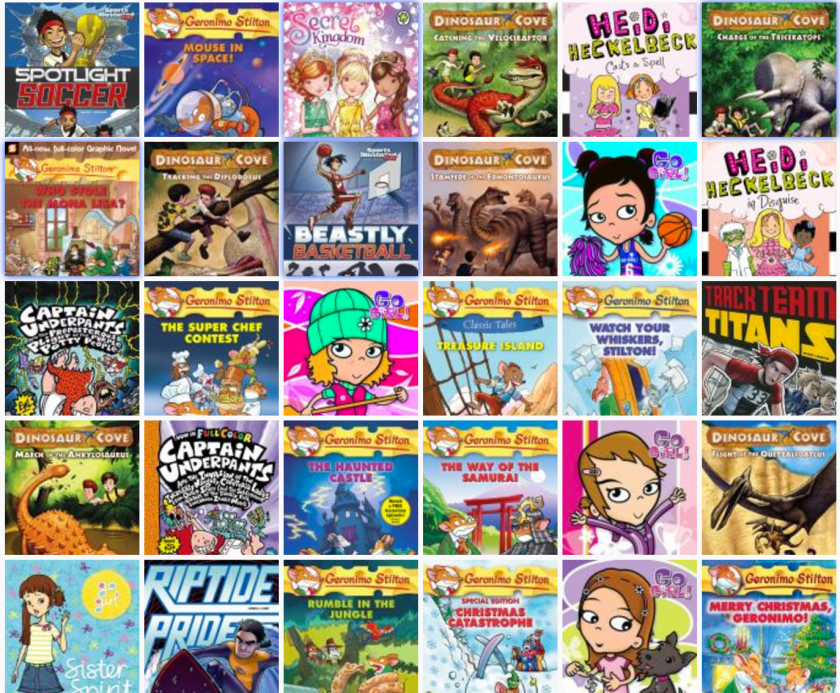
  • Geronimo and Thea Stilton (may I admit I’m not rushing to replace these as they die a natural death through over-circulation?)
  • Billie B Brown
  • Star Wars
  • Heidi Hecklebeck
  • Go Girl
  • Captain Underpants
  • Jake Maddox
  • Sports Illustrated Kids / Jake Maddox
  • Dinosaur Cove (and oldie, still hanging in there)
  • Minecraft adventures / Zombies (I don’t think they’re actually reading these as the level is too high for them – need to replace them with something easier)
  • Secret Kingdom
  • Danger Dan (yay for local authors visiting who make a difference)
  • Jill Tomlinson (yay for teachers who champion good authors)
  • Red Dot Books (anything on the current and prior year’s list)

What’s gaining Traction

  • Scholastic Branches series – especially Princess Pink & Owl Diaries
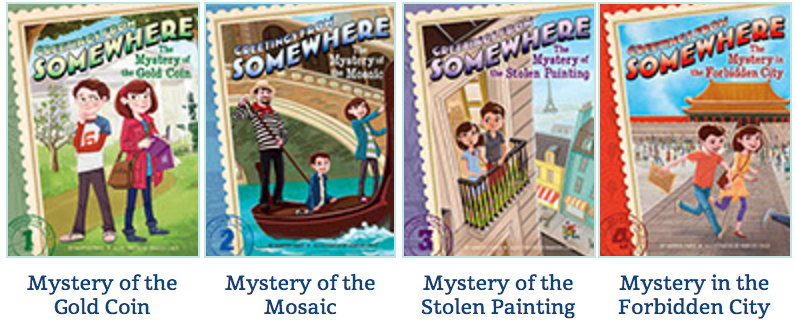
  • Greetings from Somewhere
  • Galaxy Zack
  • Dragonbreath
  • Kingdom of Wrenly
  • Dory Fantasmagory

What’s Surviving

These titles are circulating regularly but not spectacularly – but not badly enough to be culled. And some may have merit imho so I probably need to push some of them more

Screen Shot 2017-05-10 at 14.50.50

  • Zac Power
  • EJ12
  • My Weird School
  • Judy Moody
  • Magic Treehouse
  • A-Z mysteries
  • Clementine (I personally love this, so need to push it as a read-aloud)
  • Roald Dahl (the older books do better than the early books)
  • Ready Freddy
  • Cam Jansen
  • Horrid Henry – but not Horrible Harry (both I think are awful)
  • Rainbow Magic (although some titles are not going so may be time to cull a box of these)

What’s Not

  • Marvin Redpost
  • Nancy Drew Notebooks
  • Tashi
  • Bailey School Kids
  • Box Car Children
  • Owen Foote

Find out more about what our students like by visiting our “top 10” lists of Fiction, Junior Fiction, Picture Books and Graphic Novels.
It’s not (just) the book

This is a post I’ve been meaning to write for a while. A long while. I’m a member of quite a few librarian and school librarian groups and invariably, at least once a month, a question will pop up asking for a “killer” book. Either one that is perfect for reluctant readers, or one that will entice students to read, or the perfect book for boys, for grade 2, 3, 6, middle grade. There is an assumption out there that there’s a quick fix. That one book that will transform lives, transform non-readers to readers. It’s that one dose of the right drug that will make of our students little reading addicts. Firmly entrenched in the Judaeo-Christian culture of the “road to Damascus”. There is a similar culture amongst dieters and sports people. The one tablet, the one food, the one diet, the one coach.

The truth I’m afraid is more nuanced. Yes there are books that capture and imagination and hearts and minds. Just as the “Kid magician” captured that of my BWB (Blokes with Books) last year. But I think once the flame is kindled with a book, the fire needs to be continually fed in order to keep burning.

Since I’m giving a session at the AFCC I was asked to provide a book list so that the books could be available after the session for parents and students to purchase. So on Friday I asked my blokes to write down the top 3 books that they’ve read in the last few months. When they’d done that some grumbled that 3 wasn’t enough, so I let them also add “the ones that got away”.  I’ve just gotten around to analysing the list. Now a list is a list prima facie, unless you have a very good feel for what is going on in the school and the environment it would be very easy to misinterpret this list and think that there was something special about the books.  Yes, each of the books selected by the 21 boys have merit, but there is more.

  1. The top books are books with “cult status“.  I deliberately said they couldn’t choose “Wimpy kid” because it’s already at the top of my “top 10 fiction” lists each month. It’s also the book that everyone always mentions as a panacea to reluctant readers. We know that, let’s move on. So in our top books we find the series of “Storey Treehouse” (Andy Griffiths and Terry Denton). Then comes Harry Potter (JK Rowling) – who is still making his mark, followed by Amulet (Kazu Kibuishi) and Conspiracy 365 (Gabrielle Lord).
  2. The next set of books are very special. Mainly because I KNOW they were teacher read-alouds to various classes. This I think is very important. Yes they are great books, I know because I recommended them to the various teachers. But they aren’t always the easiest books to read independently. These include Because of Mr. Terupt, Pax, Wonder and City of Ember. I cannot over emphasize the importance of teachers reading books aloud to their classes. Particularly “first in the series” books.
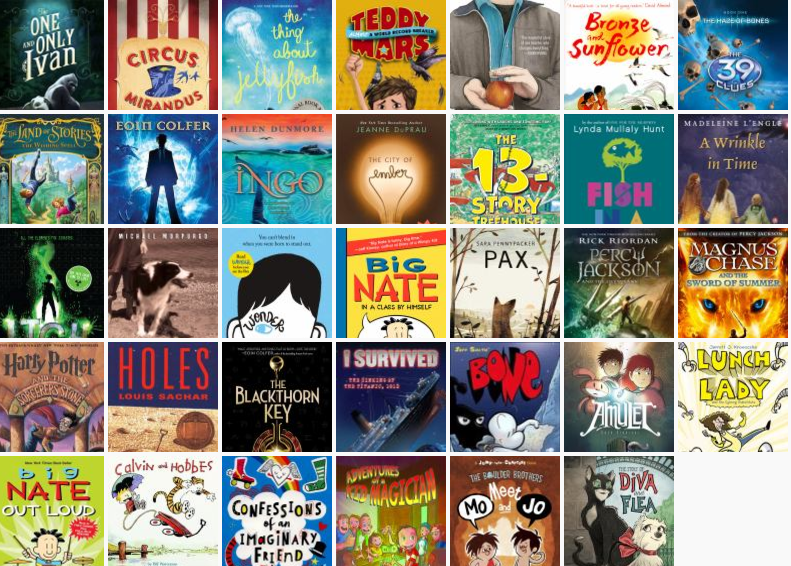
  3. The following set shows the power of carefully selected books for national or regional book awards. In this instance the “Red Dot Book Awards” run by the ISLN. Of the selection for 2016/7: Secrets of Singapore; Confessions of an Imaginary Friend; The Thing about Jelly Fish; Blackthorn Key; Bronze and Sunflower; and Circus Mirandus; made the lists. Once again, these are books that students probably wouldn’t naturally gravitate towards, but which have received a lot of publicity in the school, we have at least 6 copies of each which means they’re more widely available and read and talked about.
  4. The power of author visits. During the past year we’ve had the authors of these titles, and it’s shown clearly in their popularity: Sherlock Sam, Secrets of Singapore / Danger Dan.
  5. The rest. What is so interesting about the list is that 21 boys selected 36 different titles in their top 3 lists and a further 10 titles in their “ones that got away”. I really like that. It shows an increasing maturity in reading and a diversity in taste and choice.

The complete list can be found here:

BWB favourites


Frustrations of a librarian

And it’s not the usual stuff about being poor misunderstood under-utilized bits of the school / community.  No, the frustration goes much much further.  It’s about how information, knowledge, books, data, well just about anything is NOT being tagged and catalogued and made generally searchable, available.

What prompted this?  Well my inbox. I subscribe to a few blog sites that are, well let’s say prolific is an understatement.  One is the NerdyBookClub and the other is  Global Literature in Libraries Initiative  and the last is Gathering Books. And do you know what is terribly frustrating – I get behind on the reading. Terribly behind. And I know there are all sorts of ways of IFTTTing your inbox, but what I’d prefer is that theses consortia of writers (because no one human can be so prolific, so usually the blogs are written by teams) would just tag their posts, and make the tags obvious at the TOP of the blog, so that I know whether to read it now or leave it for later or just delete it.

Let’s take some examples that I’ve been reading today in a desperate attempt to tame my inbox:

GLLI: French Graphic Novels in translation – not categorised and no tags. If I’d been writing that post it would have had the tags of: French, Translation, Graphic Novels, Middle Grade at the very least. Then I’d immediately know that it’s worth a read, because I need to increase the diversity of my collection, so some French books in translation are relevant. My students love GN’s so that would have caught my interest but NOT if the tag included YA, since right now I’m in K-6

NBC: A look at expository literature: again, the only tag is the author and their twitter tag. Not enough. I needed to know that they were talking about: picture books, nonfiction, mentor texts, and that it included a booklist. 

Gathering Books: Fears etc. again a fabulous site with resources, but the layout and curation makes my head spin and spin and spin. It’s really hard to find stuff, there are so much great reviews going on, but then sometimes it’s poetry, sometimes it’s other stuff. The posts are allocated to categories, but don’t seem to be tagged, so if I wanted to see all the book reviews on grief, or death, or migration for example I wouldn’t be able to do so.

And then the HUGE question of where all this goes?  And it’s a really big question. Because we all know the problems of finding great and diverse literature. Of finding authors with a unique voice who are new and interesting and not part of the publishing machinery. Ones that aren’t institutionalised onto the same old same old top 10 lists.But why do we keep going back to those lists? Because it’s so easy.

Where are all these fabulous blogs curating their book lists? Where are the catalogues? Are they on Goodreads with a proliferation of shelves or on LibraryThings with 100s of tags and collections?  Where are the links and the connections and the overlaps? Even the ones working together (like NBC) seem to be working on their own.Their site has a store selling mugs for heavens’ sake. The list on the side is a list of their bloggers, not of the books / categories / shelves. Even the Nerdies – their awards page, is an unlinked list of books that is not tagged or categories in any way… where are the librarians? This is not a criticism of what they’re doing – they’re doing some fabulous things – it’s about how they’re doing it, and how much easier it could be for their readers / followers!


Books I wish would be published

I’ve been asked to be on a panel at the AFCC to chat about “Books Teachers Wish Authors Would Write” from a teacher / librarian perspective. So I put the question out on one of my teacher-librarian networks (an international one) and these were the responses I received:
  • World war 2 in Asia- novel for 8-10 year olds (NF / NNF)
  • big shortage of narrative nonfiction that is NOT about the holocaust, slavery, the American great depression or US civil rights. Also shortage of intra-Asia migration stories not Asia to Europe / north America (NF / NNF)
  • Third culture kids as main characters (CD)
  • More stories about our present/ early future stories that include digital tools and behaviour (D)
  • I’m looking for things like “lego ideas / lego play” but in small manageable books that kids can take out without breaking their backs / the book
  • nonfiction – updated human rights / millennial goals / NGOs / Poverty etc. for G4 level (9 year old) mixed format, good graphic design, mix of narrative and fact (NF)
  • Middle school nonfiction – life in different economic / political systems – communist, socialist, social democracy etc. with a world wide unbiased view of positives and negatives with personal stories and data (NNF)
  • Books on gaming or from the creators of games like Minecraft, Roblox, etc. (D)
  • Conflicts over resources around the world – case studies that are elementary friendly (NF)
  • The next “The Outsiders.” Something to appeal to the teens who fall in love with it in class, and are looking for something like it.
  • Decent Biographies that are at elementary aged level & middle school level without being dumbed down – with more Asian protagonists! (CD / NF)
  • Books purposely written for upper ES that has appropriate content and reading “level” (ELL)
  • More ES novels featuring multicultural characters that are not related to war or historical events (CD)
  • Books about world topics that are appropriate for kinder/g2 (NF)
  • Modern urban indigenous stories – universal experiences in all first nations people. (CD)
  • Easy read stories that are well written & not dumbed down for teens. – yes! especially for our ELL students! And that don’t portray just the…..dark side of life? I feel like when I was purchasing for xxx, the high interest/low level books all were about gang members/drug dealers in the US. (ELL)
  • Science fiction for Elementary kids. (SF)
  • Middle Grade fiction with a Korean protagonist (My Name Was Keoko style) (CD)
  • Books with culturally diverse characters. I still remember teaching a boy could Yousef who threw the book down in disgust and said ‘Why can’t they give them normal names?’……the character was called Joseph. Which really isn’t that out there, unless you’re an Arab boy. Then it’s just weird. (CD)
  • LGBT books for tweens (G)
  • Definitely more emigration/immigration stories that are intra-Asia. There are so many diaspora stories to be told that have nothing to do with Europe or North America. (NF / NNF)
  • Does anyone want war stories set in Asia – like Japanese invasion/ Korean War / American or Vietnam war with perspective from the non-western side – or is that too sensitive? (NF / NNF)
  • My teachers want more World War 1 fiction for grades 6-8 and social justice books for middle schoolers.(NF / NFF)
  • My middle school girls want more heroes that are NOT princesses. (G)
  • My boys want fiction that has video game elements like Minecraft stories.(D)
  • All of my high schoolers want “classics” with better covers.
  • what about this: teachers, school, parents do not compare my score with others, do not give me homework, I want to play. (C)

I’ve tried to code the answers as follows:

  • NF / NNF: narrative nonfiction – 10x
  • CD: cultural diversity – 6x
  • D: digital / gaming element – 3x
  • G: Gender related – 2x
  • ELL: hi lo / books for English Language Learners – 2x
  • SF: Science fiction – 1x
  • C: cultural issue – 1x

Looking at these I think that the theme is a general frustration with a lack of books with an Asian context.  Particularly historical fiction / narrative nonfiction and culturally diverse characters. We all know that the USA dominates publishing, followed by the UK. Australia has some good stuff out but limits itself by its steep pricing, expensive shipping costs and insular publishing industry. China is a late entrant into children’s books and is making great inroads – but mainly in translation into Chinese. What is particularly commendable is that they are not just translating the (North) American staples but many of the brilliant and wonderful European offerings.

Then I did a similar exercise with the BWB (Blokes with Books) yesterday. I asked them to go in groups of 2-4 students and tell me what kind of book they were missing in their lives. Books they wish authors would write.   They were amazing – a couple of groups even started writing the books they wish were written (a nice outcome given the fact that teachers are now complaining that we’ve got them reading but their writing is still poor).

Their suggestions could also be broadly grouped:

  • Two groups wanted Harry Potter extensions or back stories – one wanted the parallel books that focused on the other houses, not just Gryffindor Tower. Another group was fascinated by the horcruxes and wanted a book on that.
  • One group wanted an elaborate Pokemon book that inverted some of the characters with unexpected twists.
  • One group combined the ideas of the three group members into a fantasy / reality mixture involving video games and rugby with a wimpy gaming protagonist being forced to play rugby by an over-zealous parent and learning tricks and manouvers in video games that led him to dominate on the real life rugby pitch.
  • One group wanted (and started outlining the chapters) of a Roblox user manual.
  • Quite a few of them agreed they’d like fiction books with colour pictures inside

I’d like to add a note to the above list – the students are not yet familiar with fan fiction, and I’m not sure they’ve looked into the Harry Potter wikis. In a sense that makes me happy that they’re still at that wonderful age where this type of magical immersive reading stuff is to be found in books rather than online. They are aware that there are user forums on these games and chat rooms etc. BUT THEY WANT TO READ ABOUT IT IN A BOOK. This is a GOOD thing. Whenever they ask for books about Minecraft and Roblox and video games and I tell them we have some of the storybook series, the Minecraft “how to” and “surely you can just ask online” they say “but we want a book”.  There are few Roblox books and they all seem to be eBook editions (publishing haste?). The Minecraft adventure books are not what they’re looking for – remember the colour pictures comment? They want more graphics! I think also as adults we see their online/offline selves as separate, whereas they don’t, and they want to see that new normal reflected in what they read. They’re all avid fantasy readers, and that I think is partially meeting their need for that online/offline fantasy/reality integration.

A caveat to all the comments (and a personal gripe) – above all children want a well written story. They don’t want to be preached to. They’re sophisticated and well- and globally read. And they can spot the fakes. As a teacher-librarian I get immensely frustrated by wanna-be and self-published authors who keep trying to foist their wares on me when it’s immediately apparent that they’re poorly written, even more badly illustrated, not edited and horribly and cheaply published. Writers need to read. They need to read a lot, they need to read widely. They need to research not just their topic but also who else has written about it, tangentially to it, similarly to it. If you want to self-publish, unless you’re a designer, pay someone to do your design for you. Unless you’re an author-illustrator find the best illustrator you can afford. And everyone, join a writing / critique group (like SCWBI) – honestly, other authors are not out to steal your ideas – they’re too busy working on their own passions. And when you think you’re done, get a good and critical editor. All authors need good editors, even great authors. Do yourself a favour and look at the interactive TS Eliot “The Wasteland” and see all the handwritten edits by Ezra Pound.

To come back to the forum and the original question that started all this:

“Creators can step into the shoes of a teacher for one hour and learn what makes a book a treasured find. From beautiful illustrations to didactic language, speakers discuss their views on relevant and useful books children need and love.”

What a huge question. Relevant is not always pedagogically useful. Useful for whom? Relevant to what?  I’d like to end with the most relevant and useful and just plain wonderful book I’ve encountered this year – Stormy seas: stories of young boat refugees. 

31213610 Well done Annick Press (that does a lot of amazing things – particularly in nonfiction) It has become the new gold standard to which I will hold all nonfiction. The elements that make it so special:
  • Great graphics – combination of good design elements with original primary source photos
  • Easy to navigate blocks of text
  • Personal stories
  • Historical facts
  • Timelines
  • Maps

It is not out yet (April 2017) and I got a preview copy through Netgalley (sign up if you’re a teacher / librarian), I showed it to a couple of classes from G3-G6 and all were clamouring for a copy afterwards – something unusual for nonfiction. And when I couldn’t give them I copy I managed to “sell” some of my otherwise untouched narrative nonfiction / historic fiction books on WW2 etc.

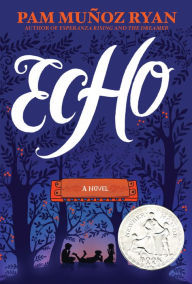
Another surprising (but not really because it’s so absolutely wonderful) hit has been Echo. It’s a huge book but every child and adult whose hand I’ve put 22749539it into  has just loved it – depite the fact that it takes a while to get through. Why – I suspect that the range and diversity of the characters and settings is satisfying to my international audience. But it is also great storytelling. And then they go on to read all the other Pam Muñoz Ryan books, which is also an excellent outcome.


What would you like to see more of that is “relevant and useful”?

The unmentionables

Reading “Small Things” and discussing it with colleagues and friends, combined with the Sinna Man video has set me off on a train of thought of what the “unmentionables” in children’s literature – or more specific, picture books are. Yes, some Europeans are doing some things, but it doesn’t yet seem to be in the mainstream BANA literature.

Is it merely a question of time? Certainly since I was a teenager, middle school and YA literature has taken leaps into sexuality, gender issues, rape, abuse, addiction etc. But what makes us think that there is this sudden flick of a switch in the teen years? Why do we think younger children are so innocent or naive or not ready?  Is it psychologically sound to deny them this glimpse into the expression of these forms of reality, or is it a form of misguided protection?

As a teacher librarian I see young children sitting masturbating while listening to stories. Teachers come to me and ask me about books about it, or at least ones that help children set boundaries, or stop it in public. Parents have varying views from horror and denial to acceptance and insistence on normality and ‘leave them be’.  I’ve tried googling it, but that may brand me as a paedophile on the look out for smutty images… what I want is the book form of the sex-ed my kids received in Grade 1, which was comparing your body to your home and explaining how you had levels of who  you let into various areas of your home (or in the front door at all), and so to it was with your body. Setting boundaries. Knowing what was public and private.  In thought word and deed.  Anyone know of anything?

Death and dying is sensitively dealt with an a couple of books – literally a handful, most recentl300961y in Ghosts (really for middle school but it’s very popular with my elementary age students from about 8 years old), childhood anxiety and depression? Not many that I’m aware of besides “Small things” and Michael Rosen’s Sad Book.

The books on learning difficulties like ADHD, Autism, Dyslexia etc. are often (badly) written and illustrated and self-published by interest groups or desperate parents, and it shows.  Step up to plate authors!

Similarly abuse. There are enough books for middle school and YA, but many children grow up in families where there is physical, verbal or emotional abuse. That becomes their normal and you see it in the way they behave to others out of the home. There is substance abuse and addiction. How about bullying? Have the picture books you’ve read ever really helped portray the agony with out a flippant resolution? The Invisible Boy is one of the lovely books in this respect. But often the protagonists have some hidden talent … what if they don’t? What if they really are fat or ugly, or dress funny, or poor, or can’t keep up in class?

Are these the unmentionables? What would you add? I know these are probably not going to be best sellers, run away hits. But they deserve the light of day. A good light of day by excellent authors and illustrators. Who children will read because they trust and believe in those people to be their voice and their eyes and ears.

It’s so beautiful I want to cry …

It’s been a tough few weeks, and this morning I was reminded just what it’s all about. I was reading “All the lost things” by Kelly Canby to a Grade 2 class, and at the end, one little girl said “It’s so beautiful I want to cry” at which point I also wanted to plink a tear. Because it is beautiful. And what is even more beautiful is when a 7 year old recognises and empathises with beauty in a book.

lost-things

From an instructional point – it also has great links to the string of Lauren Castillo books we’ve been reading as part of the Global Read aloud  so we could refer back to “Nana in the City” and “Yard Sale”.

The other moment of sad beauty this morning was reading “Small Things” by Mel Tregonning. It was the third or fourth time I’ve started reading this, and each time I had to stop after a few pages since it’s not something you can just read in a hurry. It’s something that needs you to slow down and take your time. You also both need to not know the back story before reading it, and then to read the back story and then read it again.  Many young children suffer from stress and anxiety. The fact this is a wordless book makes it even more powerful. Look at the demons following him and eating away at his existence.

I’m almost at a loss at what to do with this. I can see parents being terrified by this, and yet we need to acknowledge the range of feelings and emotions our children endure. It would be a powerful book for use with bibliotherapy, but one almost doesn’t want it used wrongly.

Day 2: ebooks & audiobooks

This is a tough one.  The library I’m with at school hasn’t jumped on board.  And all for very good reasons.  Personally though, in my home library I’ve been embracing audio books ever since my kids were very small – (about 10 years ago) when we were living in Spain and I had a long commute to take them to and from kindergarten every day.  We started off with Peter Pan, and we’ve never stopped since then.  Even now when we drive from Netherlands to Switzerland in the summer – a good 8 hour trip we’ll arrive at the destination and they’ll clamour to stay in the car until the chapter is over.  It’s always been Naxos audio-books, as they have such wonderful voice artists, and we must have the CD of just about everything they’ve ever published (and if I ever have to listen to Professor Branestawn which has been on repeat mode for about 1 million time … again ….).  I also listen to the adult ones, and “A history of the world in 10 1/2 chapters” must be one of my all time favourites – it almost demands to be read aloud.   We had a subscription to the Naxos spoken word library – and that was wonderful – the kids used to dip in and out of books every evening before going to bed – particularly the children’s poetry – again something that is wonderful to hear rather than to read.

eBooks – I was an early kindle adopter, and I’m slowly but surely replacing all my old mouldy and yellowing classics with the online versions.  I love it for holiday.  I also have “overdrive” on my ipad, where I borrow books non-stop from the NLB, particularly when I’m travelling.  They also have audio-books for kids and my kids had great fun listening to the “Just William” books.

As a consumer therefore, yes, but as a librarian I know there are all sorts of issues with rights and ownership, not even to mention needing to train staff to train clients on the use thereof.  So that concludes day 2 of the challenge.

And if anyone knows how to get Gutenberg books into your Follett Destiny Catalogue – I’m all ears!